
Crypto World
Kalshi Brings Crypto’s Perpetual Futures Model to Stocks With CFTC Filing



Kalshi filed with the Commodity Futures Trading Commission (CFTC) to launch perpetual futures tied to a major US stock index and to copper, extending a leverage-trading structure it pioneered in Bitcoin (BTC) earlier this year.
The filing puts a prediction market operator in direct competition with CME Group and Cboe Global Markets. Both exchanges have built decades of business on contracts with fixed expiration dates.
A Product Built for Crypto, Now Aimed at Stocks
Perpetual futures, known as perps, carry no expiration date. Traders hold a position indefinitely, paying or receiving periodic funding to keep the contract price aligned with the underlying asset.
Historically, the structure originated offshore, because domestic regulators had not approved a similar listing. Exchanges outside the country built entire businesses on crypto perps as a result.
However, that changed in May. The CFTC approved Kalshi’s Bitcoin perpetual futures contract, the first allowed on a US-regulated exchange.
The contract crossed $1 billion in trading volume within its first week, Kalshi CEO Tarek Mansour said. It topped $5.5 billion within two weeks of launching June 3.
Kalshi has since used that approval as a template. It filed for gold and silver perpetuals last month, followed by stock index and copper contracts on Tuesday.
CME’s Lawsuit Looms Over the New Filing
Kalshi’s stock filing lands as CME Group pursues a lawsuit over crypto perps. CME argues the Bitcoin perpetual is a swap, not a future.
Kalshi and the CFTC disagree, however, maintaining it is simply a futures contract without a fixed expiration date. The stock index filing leans on the same argument. It points to standardized contract sizes, central clearing, and margin requirements.
Traditional exchanges have not stood still either. Cboe Global Markets launched Mini-S&P 500 binary options through Interactive Brokers in June. In contrast, Cboe’s product uses fixed-settlement binary options rather than a perpetual structure.
BitMEX, the exchange that invented the offshore crypto perpetual swap in 2014, announced its closure in July. Meanwhile, it will close by September 23.
Analysts have cited reasons behind BitMEX’s closure as a sign the offshore era for perps may be ending. US-regulated venues are capturing that volume onshore instead.
The CFTC has not set a timeline for reviewing Kalshi’s stock index filing. Therefore, the CME lawsuit’s outcome will likely determine how quickly leveraged, never-expiring stock exposure reaches American traders.
The post Kalshi Brings Crypto’s Perpetual Futures Model to Stocks With CFTC Filing appeared first on BeInCrypto.



A preliminary analysis says six chained bugs let a 23-message transaction drain 48.87 million CACAO, sending the token down nearly 89%.
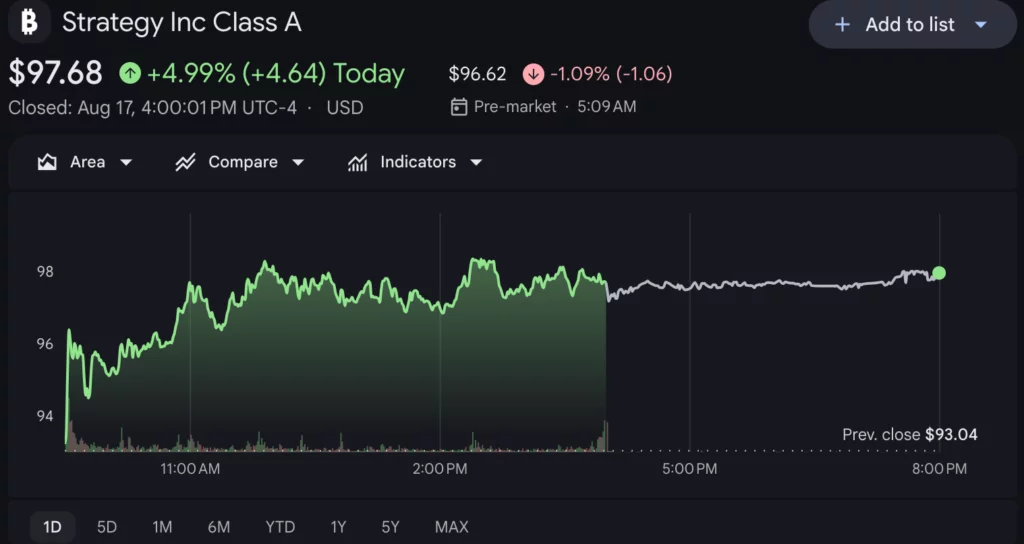
Short seller James Chanos described Strategy and Bitcoin as an “$80 billion actionable spread” on Aug. 18, reviving debate over the valuation of Michael Saylor’s Bitcoin treasury company.
Summary
- Strategy held 840,447 bitcoin after recent sales, below the 847,363 coin peak disclosed in June.
- At $64,188 per Bitcoin, Strategy’s remaining holdings were worth approximately $53.95 billion on Tuesday morning.
- MSTR’s market capitalization was about $34.4 billion, but direct comparison ignores senior financing claims entirely.
- Chanos previously closed his short MSTR, long Bitcoin trade in November 2025 after spread compression.
- Strategy’s dashboard placed its mNAV near 1.04, indicating only a narrow enterprise value premium Tuesday.
Chanos called the relationship one of the largest “pure arbitrage opportunities” he had seen. His earlier trade involved shorting Strategy’s MSTR shares while taking a long position in Bitcoin.
The latest claim requires context. Strategy no longer holds the 847,363 BTC cited in some reports. Recent company disclosures place its balance at 840,447 BTC following several sales during July and August.
At Bitcoin’s Tuesday price of approximately $64,188, those holdings were worth about $53.95 billion. MSTR had a market capitalization of roughly $34.4 billion, while its shares gained close to 5% to $97.68.
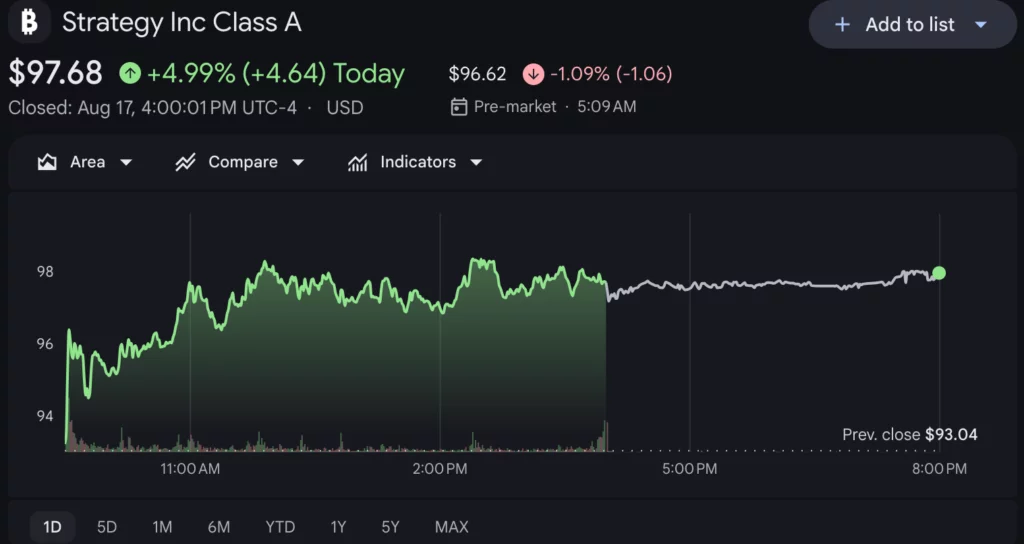
The $19.5 billion difference between those two figures is not a direct arbitrage profit. It excludes debt, preferred stock, cash, software operations, taxes and the costs required to maintain a hedged position.
Chanos’s $80 billion figure is not a simple market gap
Chanos did not publish a complete calculation showing how he reached the “$80 billion actionable spread.” The figure therefore remains his characterization of the opportunity rather than a directly verifiable difference between two market prices.
Strategy’s own dashboard placed its modified net asset value multiple, or mNAV, near 1.04 on Tuesday. That measure compares enterprise value with the value of its Bitcoin after accounting for parts of the capital structure.
An mNAV of 1.04 indicates a premium of approximately 4%, based on the company’s methodology. It does not show MSTR trading at the wide premium that supported Chanos’s original trade in 2025.
Comparing common equity market capitalization directly with Bitcoin holdings produces a discount because common shareholders rank behind creditors and preferred shareholders. Strategy has issued several preferred securities carrying dividend obligations and also has outstanding debt.
The company’s software operation, dollar reserve and other assets must also be included. As a result, buying MSTR does not provide the same economic exposure as holding an equivalent dollar amount of Bitcoin.
Strategy’s Bitcoin balance has declined from its peak
A June 29 SEC filing showed that Strategy held 847,363 BTC at the end of June. The company had spent $64.1 billion acquiring the coins at an average price of $75,651.
Strategy subsequently sold Bitcoin under a board authorized monetization program. The program allows sales to fund its dollar reserve, interest expenses, preferred dividends and security repurchases.
As previously reported, the company sold 1,690 BTC and used the proceeds for preferred share repurchases during the week ending Aug. 9.
Those sales reduced the balance to 840,447 BTC. The remaining tokens carried an aggregate acquisition cost of approximately $63.36 billion and an average cost of $75,385 per coin.
At Tuesday’s Bitcoin price, the position was approximately $9.4 billion below its disclosed purchase cost. That is an unrealized accounting difference rather than a realized loss unless the coins are sold.
The same filing series showed that the company raised cash by issuing additional MSTR shares. Common stock issuance increases liquidity but also expands the number of shares participating in the Bitcoin exposure.
MSTR and Bitcoin carry different financial risks
Direct Bitcoin ownership exposes an investor mainly to changes in Bitcoin’s market price and the security of their custody arrangement. MSTR adds corporate financing and management risks.
Strategy has issued STRC, STRF, STRD and STRK preferred shares. These securities sit ahead of common shareholders and carry dividend rates ranging from 8% to 12%, subject to their respective terms.
The company has also established a dollar reserve to meet preferred dividends and interest obligations. In related coverage, the reserve reached $4.65 billion after further common stock sales.
Strategy’s board authorized up to $1.25 billion of additional Bitcoin sales to help fund that reserve. It also approved separate $1 billion repurchase programs for preferred securities and MSTR common stock.
These layers prevent the trade from being risk free. A short seller must borrow MSTR shares, pay borrowing costs and manage the possibility that the stock rises faster than Bitcoin.
The long side also requires financing. If Bitcoin falls while MSTR rises because of short covering, new financing or changing investor demand, both parts of the trade can lose money temporarily.
Chanos previously exited after the premium contracted
Chanos began constructing his earlier position in late 2024, when MSTR traded at a large premium to the value of Strategy’s Bitcoin. The premium exceeded three times the Bitcoin value at points during November 2024.
He publicly described the trade in 2025 as long Bitcoin and short MSTR. Chanos argued that investors were paying too much for Bitcoin exposure available directly or through lower cost exchange traded products.
As Reuters reported, Strategy’s market value stood around 1.74 times its Bitcoin holdings when Chanos renewed his criticism in June 2025.
The gap later narrowed. Chanos said his firm closed the hedged position on Nov. 7, 2025, after the trade gained more than 50%. He described the remaining opportunity as too small to justify keeping the position open.
His latest statement does not confirm that he has reopened the trade. It also does not disclose position size, entry prices, borrowing costs or the instruments that would be used.
Future SEC filings will show whether Strategy continues selling Bitcoin, issuing MSTR shares or repurchasing preferred securities. Those decisions, together with Bitcoin’s price and changes in financing costs, will determine whether the company trades at a premium or discount to its adjusted asset value.


Investigators may have given U.S. authorities information capable of identifying an attacker responsible for the first Coldcard theft wave, Bitcoin Magazine reported on Aug. 18.
Summary
- Block traced the first Coldcard sweep to a paid blockchain data account used during theft.
- Galaxy said the first wave removed 1,082.65 BTC, with the associated funds remaining unmoved afterward.
- No FBI statement confirms an attacker’s identity, arrest, charges, seizure, or recovery of stolen funds.
- At least 1,700 BTC was stolen across multiple waves, according to Galaxy’s latest public estimate.
- Existing vulnerable seeds remain unsafe after firmware updates and require migration into newly generated wallets.
Galaxy Research’s Alex Thorn said the first wave attacker’s identity “may be known to law enforcement.” His statement was cautious, and the FBI has not publicly confirmed identifying a suspect, opening a case, making an arrest or recovering any stolen Bitcoin.
The first wave removed 1,082.65 BTC from wallets generated using vulnerable Coldcard firmware. At Bitcoin’s recent price near $64,000, those coins would be worth approximately $69 million, not $11.8 million.
Block found an offchain trail from the first sweep
Block engineering lead Clay Garrett said investigators found an unusual pattern in the attacker’s onchain sweeps. The operator allegedly used a paid account at an unnamed blockchain data provider to query source addresses and perform related activity.
Block contacted the provider, whose internal logs reportedly matched the number, timing and sequence of the suspected requests with “extraordinary specificity.” Garrett said Block passed relevant information to the appropriate authorities.
The account could contain payment, access or subscriber records. However, no public evidence establishes which records were retained, who controlled the account or whether the service received accurate identifying information.
Block also said it found no evidence that the provider knowingly assisted the theft. The company appeared to have supplied ordinary services without knowing how the information would be used.
FBI identification remains an unconfirmed possibility
Bitcoin Magazine’s report linked the investigative lead to the FBI, but no FBI statement confirms the claim. No criminal complaint, indictment, seizure filing or forfeiture action was located in the public record.
Thorn’s wording is therefore important. An identity that “may be known” is not the same as a verified suspect or charged defendant. Investigators must still establish who operated the account, who controlled the receiving addresses and whether the evidence supports criminal charges.
The first wave funds remain visible at associated addresses. As crypto.news previously reported, the largest attacker’s unmoved balance had not entered a known exchange or mixer.
Those coins are not frozen. Bitcoin transactions cannot be reversed or blocked at the protocol level. Recovery would require control of the private keys, voluntary return, or a later transfer through an intermediary able to comply with a lawful seizure order.
Coldcard losses extend beyond one attacker
Galaxy’s latest public research page lists losses of at least 1,700 BTC across multiple waves. Other totals remain higher because researchers use different address clusters, confirmation standards and victim reports.
Later theft waves displayed different transaction patterns. Researchers have therefore cautioned that more than one actor may have exploited the weak seed space after information about the flaw became public.
This distinction means identifying the first operator would not necessarily resolve every theft. Galaxy has distributed suspected addresses to investigators, exchanges and analytics companies, but no agency has announced a recovery.
In related coverage, crypto.news’ earlier technical review found that the incident involved weak seed generation rather than compromise of the Bitcoin protocol or physical access to devices.
Vulnerable users must still migrate their funds
Coinkite’s advisory says affected Mk2 and Mk3 firmware generated seeds with inadequate entropy beginning with version 4.0.1. Seeds created on certain Mk4, Mk5 and Q releases were also exposed, although their entropy reduction was less severe.
Fixed firmware prevents the same defect when generating new seeds. Installing an update does not repair an existing vulnerable seed. Users must update first, create a completely new seed and move their funds after verifying a test transaction.
Coinkite’s current status says its formal technical postmortem remains in progress. It also says targeted independent checks have occurred but do not establish that every fixed firmware binary received a complete audit.
The incident has prompted calls for independent hardware audits. The immediate questions now concern whether authorities can connect the paid account to a person, whether the first wave funds move, and whether court records eventually confirm an investigation.


The Blockchain Association has backed a U.S. Securities and Exchange Commission proposal to repeal two market rules adopted in 2005, arguing that their removal could make it easier for tokenized securities to trade on public blockchains.
Summary
- The Blockchain Association backed the SEC’s proposal to repeal Rules 611 and 610(e) of Regulation NMS.
- The group said the two rules impose unnecessary costs and can restrict the development of tokenized securities markets.
- The association urged the SEC to recognize onchain execution as a compliant way to achieve fair and efficient securities trading.
- The SEC’s public comment period on the proposal ended on Aug. 17.
The Blockchain Association said in an Aug. 17 comment letter that the SEC should move ahead with plans to rescind Rules 611 and 610(e) of Regulation National Market System, or Regulation NMS, as the existing requirements no longer fit the way modern securities markets operate.
The filing arrived on the final day of the SEC’s public comment period for the proposal, which was first issued on June 11. The agency is considering removing the two rules along with related definitions in Rule 600 and making corresponding changes to other provisions of Regulation NMS.
“Rules 611 and 610(e) have failed to achieve their stated purposes and have instead imposed substantial, unnecessary costs on market participants for the past two decades,” the association said.
SEC proposal would remove two Regulation NMS rules
Adopted as part of Regulation NMS in 2005, Rule 611 prevents a trading venue from executing certain stock orders at an inferior price when a protected, better-priced quotation is available on another market.
Rule 610(e), meanwhile, restricts national securities exchanges and other covered markets from displaying quotations that lock or cross protected quotations elsewhere. A locked market occurs when the best bid and offer are equal, while a crossed market occurs when the best bid exceeds the best offer.
When the SEC proposed removing both requirements in June, Chair Paul Atkins said two decades of experience with Rule 611 had given the regulator reason to examine its unintended consequences. The proposal is designed to simplify U.S. equity market structure and lower costs while allowing competition and technology to play a larger role in how orders are executed, according to the agency.
The Blockchain Association made a similar argument in its filing, saying trading technology has changed substantially since the rules were introduced.
Markets have become faster, more automated and more connected, the group said in a series of posts accompanying the filing, while blockchain-based financial infrastructure has introduced another way to issue, transfer and settle securities.
“Today’s markets have evolved dramatically since 2005, and a revolutionary shift is now underway: the representation of traditional assets on public blockchains,” the association said.
Tokenized securities could benefit from the SEC rule changes
Tokenization formed a key part of the group’s case for repealing the two rules, with the association arguing that existing Regulation NMS requirements can interfere with the development of markets that execute and settle securities on public blockchain networks.
According to the filing, the reasoning behind removing the rules also supports giving market participants more flexibility when assessing tokenized securities transactions. The group said execution quality should account for more than the quoted price when blockchain-based markets can provide other features.
“[The] logic underlying the rules’ rescission points to the benefits of enabling tokenized securities markets generally,” the association said. “Specifically, that logic favors weighing multiple factors when evaluating securities transactions, including the benefits of tokenized securities.”
The comments come as the SEC has been considering separate ways to bring blockchain-based versions of conventional securities within U.S. market rules.
In May, an SEC proposal was reported to be under development that could allow blockchain platforms to offer tokenized versions of publicly traded shares through an innovation exemption. The framework was expected to cover tokens representing existing public equities while setting conditions for how the products could be issued and traded.
SEC Commissioner Hester Peirce later narrowed expectations around the plan, saying any exemption she envisioned would be limited to digital representations of equity securities that investors can already purchase in public secondary markets.
By June, Ondo Finance had also sought SEC clearance for a model that records securities interests as tokens on Ethereum while keeping the underlying assets within existing broker-dealer custody arrangements.
Ondo’s request asked SEC staff to confirm that they would not recommend enforcement action over the structure used by Ondo Global Markets. Under the model, blockchain tokens represent interests connected to securities held through regulated U.S. financial infrastructure instead of replacing the underlying custody arrangement.
Blockchain Association wants onchain execution recognized
Alongside its support for repealing Rules 611 and 610(e), the Blockchain Association asked the SEC to update its approach to best execution, an obligation that requires broker-dealers to seek favorable terms for customer orders.
The group argued that execution standards should account for the features available through blockchain infrastructure and asked the regulator to acknowledge that transactions completed through public networks can comply with securities requirements.
“The SEC should recognize employing an onchain execution mechanism as a compliant means of achieving fair and efficient execution,” the filing said.
The request puts execution rules alongside a separate regulatory question facing tokenized markets: whether blockchain records can operate inside the existing securities system without changing the legal rights attached to the underlying asset.
Several projects have begun testing that model. In July, Ondo put U.S. securities onchain through a structure that kept the underlying assets in regulated custody while issuing blockchain-based representations through a registered transfer agent.
The initial deployment included BlackRock’s iShares Core S&P 500 ETF and Micron Technology shares on Ethereum. Ondo said the tokens were backed 1:1 while the underlying securities remained within conventional U.S. custody infrastructure.
Around the same time, BlackRock-backed Securitize tokenized its common stock on Solana and Avalanche when the company began trading on the New York Stock Exchange. Securitize said the blockchain-based SECZ tokens represented the same common shares instead of creating a separate class of equity.
SEC comment period has now closed
The SEC’s Regulation NMS proposal was published in the Federal Register on June 17 under file number S7-2026-20, with Aug. 17 set as the deadline for public comments.
Besides repealing Rule 611’s trade-through prohibition and Rule 610(e)’s restrictions on locked and crossed quotations, the proposal would remove definitions in Rule 600 that would no longer be needed and amend provisions that currently refer to the two rules.
SEC Commissioner Mark Uyeda said when the proposal was introduced that removing Rule 611 could raise questions involving best execution, transparency, trading mechanics and investor confidence, areas the agency asked market participants to address during the comment process.
Peirce also supported putting the rules under review, arguing in June that changes in trading technology had reduced the market-connectivity concerns that led regulators to adopt Rule 611 more than two decades ago.
The Blockchain Association’s Aug. 17 filing asked the SEC to consider those execution questions alongside the development of blockchain-based markets and to recognize public blockchains as a possible compliant venue for fair and efficient securities execution.


The Financial Accounting Standards Board (FASB) proposed new U.S. accounting guidance on Aug. 18 that would clarify when companies may present certain stablecoins as cash equivalents.
Summary
- FASB proposes allowing qualifying stablecoins to be presented as cash equivalents without changing GAAP’s definition.
- Qualifying tokens require issuer redemption rights and segregated reserves holding highly liquid short term assets.
- Secondary market liquidity alone cannot qualify a token when holders lack direct contractual redemption rights.
- All entities would disclose major cash equivalent components, whether digital assets are involved or not.
- Public comments remain open until November 19, with FASB setting the effective date after review.
The proposed Accounting Standards Update would add examples to Topic 230, Statement of Cash Flows. It would not change the existing definition of cash equivalents under U.S. generally accepted accounting principles.
FASB opened the proposal for public comment through Nov. 19. The board will decide whether to issue a final standard and set its effective date after reviewing responses.
FASB would apply three stablecoin conditions
A digital asset could qualify only if its holder has an on demand contractual right to redeem it for cash. The right must allow direct redemption with the issuer for a known amount.
The issuer must also hold at least one to one reserves in segregated accounts. Those reserves would need to consist of short term, highly liquid assets that are readily convertible into known cash amounts.
Meeting those conditions would not force a company to classify the token as a cash equivalent. Companies would retain the option to use that presentation and would need to consider applicable laws and regulations.
The proposal is not final guidance. FASB said the examples are intended to “promote more consistent application” after stakeholders reported uncertainty and different accounting treatments during its 2025 agenda consultation.
Secondary trading would not replace redemption rights
One proposed example examines a token that trades actively on secondary markets but does not give the holder a direct right to redeem with its issuer. FASB concluded that market liquidity alone would not satisfy the existing cash equivalent definition.
A liquid exchange market can allow a company to sell a token quickly. However, its market price can move away from the promised value during periods of stress. Direct redemption provides a separate contractual route to receive a known cash amount.
Another example rejects cash equivalent treatment when reserves include crypto assets and gold. FASB said price changes in those assets could prevent the holder from receiving a known amount of cash.
These examples would exclude algorithmic tokens, overcollateralized crypto backed products and other assets without direct issuer redemption, even when they use the stablecoin label.
U.S. companies currently use different treatments
FASB began the project because companies have reached different conclusions under existing GAAP. Some public companies already classify selected payment stablecoins as cash equivalents based on their redemption and reserve arrangements.
Coinbase voluntarily changed its accounting method effective Dec. 31, 2025. Its SEC filing says USDC, EURC and PYUSD are redeemable one to one and backed by cash equivalents in segregated accounts.
The company applied the change retrospectively. Coinbase said it did not alter previously reported assets, liabilities, equity, net income or earnings per share, although it changed portions of its cash flow presentation.
A final FASB standard could make those assessments more comparable across U.S. companies. It would not determine whether an issuer may legally offer a token or whether reserves comply with federal rules.
Proposal arrives before federal rules take effect
The accounting proposal arrives as agencies implement the GENIUS Act, which created the first federal framework for U.S. payment stablecoins. As previously reported, the law established new federal payment rules covering licensing, reserves, redemption and disclosures.
The GENIUS Act generally takes effect in January 2027. Regulators have continued developing its operating requirements after missing the original rulemaking deadline.
The Treasury Department also recently opened consultation on when tokens are issued, offered or sold in the United States. In related coverage, crypto.news examined Treasury’s latest licensing proposal.
FASB’s process remains separate from those regulatory proceedings. A token could satisfy federal issuance rules but still fail the accounting test if a particular holder lacks direct redemption rights or the reserves contain volatile assets.
The proposal would also require every entity reporting cash equivalents to disclose their major components and corresponding amounts. That requirement would apply even when no digital assets are included.
Stakeholders may submit written responses until Nov. 19. FASB will then consider revisions, decide whether to adopt the update and determine when companies must begin applying it.


Disclosure: This article does not represent investment advice. The content and materials featured on this page are for educational purposes only.
Decentrawood is positioning DEOD at the intersection of AI and web3, with a new exchange reveal, Task AI Agent, and DEOD DAO launches planned for August 23–24.
Summary
- Decentrawood prepares for new exchange listing, AI Agent launch and DAO governance as DEOD AI expands its Web3 ecosystem.
- DEOD AI gains momentum with 6,900+ users as Decentrawood approaches key exchange, AI agent and governance milestones.
- Decentrawood targets fresh growth with a new exchange listing and DEOD AI agent and DAO launches scheduled for August 23–24.
Every crypto bull market has its biggest winners. In past cycles, meme coins, DeFi, NFTs, and metaverse tokens delivered 10x, 50x, and even 100x gains as new trends captured investor attention.
Many believe AI could be the next major crypto narrative in 2026. While nothing is guaranteed, projects building real AI infrastructure are attracting growing interest. One of them is Decentrawood.
With the launch of DEOD AI, an expanding ecosystem, multiple exchange listings, and several major catalysts approaching on 23–24 August, Decentrawood is positioning itself at the intersection of AI and Web3.
The upcoming milestones include a new exchange reveal on 23 August, followed by the Task AI Agent launch and DEOD DAO governance launch on 24 August. As these developments approach, crypto investors are watching to see whether DEOD can continue building momentum.
What is Decentrawood?
Launched in October 2022, Decentrawood combines several technologies into one ecosystem, including:
- AI-powered applications
- Blockchain gaming
- Web3 social experiences
- Creator tools
- Digital ownership
- Autonomous AI agents
Rather than focusing on a single product, Decentrawood is building an interconnected ecosystem where the DEOD token supports multiple products and use cases.
DEOD AI: Moving beyond traditional AI tools
The latest addition to the ecosystem is DEOD AI, an Agentic AI platform designed to help users build intelligent AI agents without requiring advanced technical knowledge.
The platform enables users to:
- Create AI agents
- Verify AI agents through blockchain technology
- Deploy autonomous agents
- Monetize AI agents
- Build multi-agent systems Additional capabilities include:
- No-Code AI Agent Builder
- Know Your Agent (KYA) Verification
- Blockchain Identity Layer
- Trust Score System
- AI-to-AI Communication
- Enterprise Deployment
- Agent Marketplace
- Retrieval-Augmented Generation (RAG) Knowledge Systems
The goal is to create trusted AI agents that businesses and individuals can use for automation, customer support, research, content creation, and digital workflows.
Growing adoption across the ecosystem
Since launching DEOD AI, the ecosystem has continued expanding. According to the latest platform statistics:
- 6,900+ registered users
- 70+ AI agents created
- 52+ verified AI agents listed
These early adoption metrics highlight growing participation as developers and users continue exploring the platform.
The upcoming AI Agent launch on 24 August could further expand this ecosystem by introducing additional functionality and use cases for AI-powered agents.
A major 24 August catalyst for DEOD
The next major phase of Decentrawood’s development is approaching, with multiple milestones scheduled around 23–24 August.
23 August — New exchange reveal
Decentrawood is expected to reveal a new exchange listing on 23 August.
DEOD has already expanded its availability across several trading platforms, and another listing could potentially increase accessibility, liquidity, and exposure to new markets.
24 August — AI Agent Launch
The AI Agent launch is scheduled for 24 August.
AI agents are becoming an increasingly important part of the broader artificial intelligence narrative, with autonomous systems capable of performing tasks and interacting with users and other applications.
For Decentrawood, this launch could further strengthen the role of DEOD AI within its broader Web3 ecosystem.
24 August — DEOD DAO Governance Launch
Another major milestone arrives on the same day: the DEOD DAO governance launch.
The DAO is designed to introduce a more community-driven governance structure, giving participants a greater role in decision-making and the future development of the ecosystem.
Together, the AI Agent launch and DAO launch make 24 August an important date for Decentrawood.
Expanding utility for the DEOD token
As the ecosystem grows, the DEOD token continues to gain additional utility. Today, DEOD is used for:
- AI ecosystem participation
- Staking
- Gaming rewards
- Marketplace transactions
- Governance
- Community incentives
The addition of AI Agents and DAO governance could further expand the token’s role across the ecosystem.
As more developers create AI agents and more users interact with the platform, the potential utility surrounding DEOD could continue to develop.
Exchange expansion continues
Exchange accessibility remains another important part of Decentrawood’s growth strategy.
DEOD is currently available on:
- MEXC
- Toobit
- WEEX
- CoinDCX Web3
- PancakeSwap
- BingX
The BingX listing, which was scheduled for 7 August 2026, added another major trading venue for DEOD and expanded its global accessibility.
With the project now moving toward its next milestones on 23–24 August, attention is shifting from exchange expansion toward the continued development of the AI and governance ecosystem.
Why investors are paying attention
Several trends are beginning to converge around Decentrawood:
- AI adoption continues accelerating worldwide.
- Demand for autonomous AI agents is increasing.
- Blockchain-based identity and verification are becoming more important.
- Web3 gaming continues to develop.
- Exchange accessibility continues expanding.
- Decentralized governance is becoming increasingly important for Web3 ecosystems.
Instead of relying on a single narrative, Decentrawood combines multiple sectors into one ecosystem powered by the DEOD token.
This diversified approach could become one of the project’s strengths if Decentrawood successfully converts its growing product ecosystem into sustained user adoption.
What could the 24 August catalyst mean for DEOD?
Major product launches and exchange announcements can attract increased attention to crypto projects, but their long-term impact depends on execution and adoption.
For DEOD, the upcoming sequence is notable because it combines three different catalysts across two days:
23 August: New exchange reveal
24 August: AI Agent launch
24 August: DEOD DAO governance launch
If these developments lead to greater user activity, developer participation, community engagement, and token utility, they could potentially support the next stage of Decentrawood’s growth.
Looking ahead
The crypto market continues rewarding projects that deliver working products rather than concepts alone.
With DEOD AI already live, 6,900+ users, 70+ AI agents, 52+ verified agents, staking, gaming, multiple exchange listings, and major AI and governance
milestones approaching, Decentrawood is entering another important phase of development.
The biggest date on the near-term roadmap could be 24 August.
The combination of the AI Agent launch and DEOD DAO governance launch, following a new exchange reveal on 23 August, gives the Decentrawood ecosystem several potential catalysts to watch.
As artificial intelligence and blockchain continue moving closer together, projects providing infrastructure for autonomous AI agents could become increasingly relevant within the broader Web3 sector.
Whether DEOD ultimately becomes one of the leading AI-powered blockchain ecosystems will depend on continued product development, user adoption, liquidity, and execution.
For now, 23–24 August stands out as a major milestone for Decentrawood — and one that $DEOD investors will be watching closely.
Disclosure: This content is provided by a third party. Neither crypto.news nor the author of this article endorses any product mentioned on this page. Users should conduct their own research before taking any action related to the company.
Disclosure: This article does not represent investment advice. The content and materials featured on this page are for educational purposes only.
Whitechain is relaunching as a distribution-first Ethereum Layer 2 focused on helping web3 projects overcome user acquisition and distribution challenges.
Summary
- Whitechain is relaunching as a distribution-first Ethereum Layer 2 focused on helping web3 projects reach users, liquidity and activity.
- Backed by W Group and WhiteBIT, Whitechain is building an exchange-powered Ethereum L2 designed to connect on-chain infrastructure with broad user distribution.
- Whitechain is shifting the Layer 2 conversation beyond scalability and fees, putting user acquisition and ecosystem distribution at the center of its Ethereum-based network.
Whitechain blockchain platform is relaunching as a distribution-first Ethereum Layer 2 designed to address one of the biggest challenges facing Web3 projects: reaching and acquiring users.
Whitechain is part of W Group, a global fintech ecosystem reaching more than 40 million users worldwide, alongside WhiteBIT, a cryptocurrency exchange with more than 10 million users. By bringing these capabilities together, Whitechain is designed to connect on-chain infrastructure with the distribution power of an established financial and crypto ecosystem — giving web3 projects a path to reach users beyond the blockchain itself.
While L2 networks have traditionally competed on technical performance, scalability and transaction costs, Whitechain is putting distribution at the center of its model. Relaunched on the OP Stack as an exchange-powered, distribution-first Ethereum L2, Whitechain is designed to address what often becomes the harder challenge after a product is built: attracting users, liquidity and sustained activity.
“There are many strong ecosystems, but what increasingly sets them apart is their ability to distribute,” said Volodymyr Nosov, Founder and President of W Group and Founder and CEO of WhiteBIT. “The industry has built increasingly sophisticated infrastructure, but great technology does not automatically translate into adoption. We want Whitechain to change that equation. Our ambition is to give builders a strong technical foundation and put the distribution power of our ecosystem behind the products that are ready to grow.”
Three tracks for projects at every stage:
The relaunch is supported by W Group and structured around three tracks for projects at different stages of development, including funding and growth opportunities for teams with high-potential ideas and projects that have already achieved product-market fit and are ready to scale.
- Builder Program for early-stage teams, with discretionary funding up to $300,000 per project for eligible applicants, with funding released against agreed milestones. The program is intended to support teams from testnet development through to acquiring their first users.
- Strategic Ecosystem Deals will target established protocols with demonstrated TVL and active user bases. Support will be tailored to individual projects and may include contract and liquidity migration support, co-marketing and direct collaboration with the Whitechain team.
- Chain Expansion Support is designed for existing multichain protocols seeking access to an additional audience without leaving the networks on which they already operate. Support is intended to be structured around incremental user growth, with no exclusivity requirement, subject to specific deal terms.
On August 18, Whitechain will open the public testnet, funding applications and migration track to Web3 teams, from early-stage builders to established protocols and multichain projects.
As the network progresses toward mainnet, Whitechain plans to introduce Day 1 primitives intended to include a native DEX, oracle and bridge, providing developers with the core infrastructure needed to build applications and move liquidity across the ecosystem.Because Whitechain launches into an established OP Stack tooling and infrastructure ecosystem, teams build on proven wallet, indexing and developer infrastructure from the start rather than waiting for it to arrive.
Projects interested in building, migrating or expanding on Whitechain can apply through the Whitechain ecosystem program.
Disclosure: This content is provided by a third party. Neither crypto.news nor the author of this article endorses any product mentioned on this page. Users should conduct their own research before taking any action related to the company.
BlackRock said in an August 2026 research report that Bitcoin’s decline of more than 50% from its October 2025 record did not change the asset manager’s long term investment case.
Summary
- Bitcoin fell more than 50% from October 2025’s record before reaching June lows below $60,000.
- Futures open interest exceeded $90 billion, with offshore perpetual contracts representing approximately 80% at peak.
- Spot Bitcoin ETPs lost roughly $5 billion after attracting $60 billion through October 2025 previously.
- Strategy sold 1,690 BTC in August, using $108.6 million to repurchase preferred shares during weakness.
- BlackRock’s historical analysis found 1% to 2% allocations improved hypothetical portfolio risk adjusted returns historically.
The firm attributed the correction to excessive leverage, weaker institutional flows and slower purchasing by digital asset treasury companies. Its paper described the decline as a positioning and liquidity event rather than evidence that Bitcoin’s monetary or diversification properties had structurally changed.
BlackRock’s view is an investment assessment, not a prediction that prices will recover. The firm also manages the iShares Bitcoin Trust ETF and warned that Bitcoin remains volatile, speculative and capable of causing a total loss.
Bitcoin’s $90 billion leverage buildup amplified losses
Bitcoin climbed from $15,765 in late 2022 to a record $124,606 in October 2025, according to BlackRock’s Bloomberg and Coin Metrics data. Futures open interest exceeded $90 billion near the peak.
Approximately 80% of that exposure came from perpetual futures outside CME. Some platforms offered leverage of between 50 and 125 times, leaving traders vulnerable to automatic liquidation following relatively small adverse price moves.
The first major unwind followed U.S. tariff announcements involving China on Oct. 10, 2025. Bitcoin fell 6%, while open interest declined by $20 billion in one day. BlackRock described this as the largest daily open interest reduction in the data reviewed.
Further liquidation waves followed in February and June 2026, eventually pushing Bitcoin below $60,000. The sequence supported BlackRock’s argument that leverage accelerated the decline, although it does not prove that positioning was the only cause.
The U.S. derivatives market has also changed since the selloff. The CFTC approved KalshiEX’s onshore Bitcoin perpetual contract in May, finding that its structure complied with federal derivatives rules. The order brought a product long associated with offshore exchanges into a regulated U.S. market.
ETP outflows and AI funds competed for capital
Spot Bitcoin ETPs attracted approximately $60 billion between their January 2024 U.S. launch and October 2025, BlackRock found. The products then recorded roughly $5 billion in aggregate outflows through July 2026.
Over the later period, AI themed funds attracted more than $46 billion. BlackRock said the rotation “likely competed for capital” and became a drag on Bitcoin allocations. The wording reflects the firm’s interpretation because fund flow data alone cannot establish why every investor moved money.
The rotation was also visible in retail and institutional attention. As previously reported, both Bitcoin fund withdrawals and declining crypto search interest coincided with stronger interest in AI equities.
Recent U.S. fund data has been more constructive but remains uneven. Farside data showed $297.5 million of net inflows on Aug. 17 and $189.3 million on Aug. 18. The combined $486.8 million followed approximately $385.2 million of withdrawals during the previous week.
Treasury sales added supply during the correction
BlackRock also identified sales by miners, large holders and digital asset treasury companies as sources of pressure. MARA sold 15,133 BTC for approximately $1.1 billion during March, according to its regulatory filing.
Strategy later adopted a Bitcoin monetization program allowing sales to fund reserves, dividends, interest payments and security repurchases. The program does not require the company to sell and has no fixed expiration date.
An Aug. 10 SEC filing confirmed that Strategy sold 1,690 BTC for $108.6 million between Aug. 3 and Aug. 9. It used the proceeds to repurchase STRC preferred shares.
The transaction provided a verified update to BlackRock’s discussion of treasury related selling. In related coverage, crypto.news examined how corporate treasury selling pressure has increasingly interacted with U.S. spot fund demand.
BlackRock retains its small allocation argument
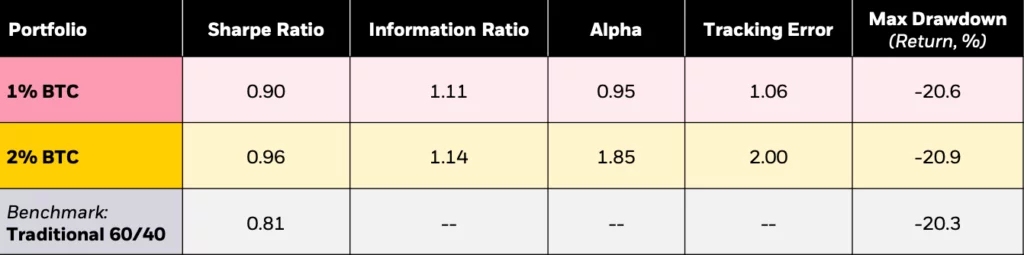
BlackRock’s ten year historical test found that adding a 1% or 2% Bitcoin allocation to a traditional U.S. 60/40 portfolio improved hypothetical risk adjusted returns. A 1% allocation produced a Sharpe ratio of 0.90, compared with 0.81 for the benchmark. A 2% allocation produced a ratio of 0.96.
Maximum drawdowns were similar across the tests. The traditional portfolio recorded a 20.3% decline, compared with 20.6% for the 1% allocation and 20.9% for the 2% allocation.
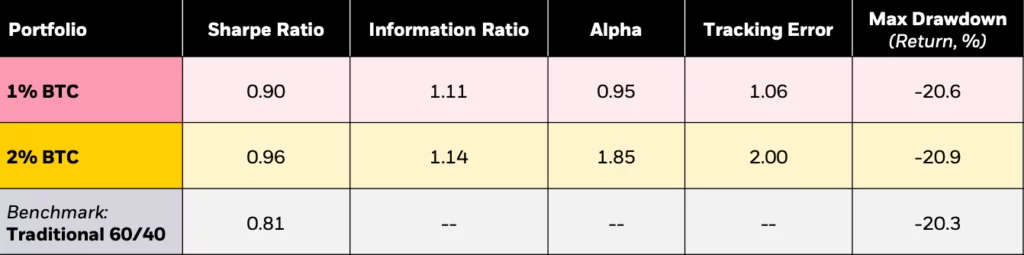
These results were hypothetical and benefited from hindsight. They did not include an actual BlackRock client portfolio and cannot establish how the allocations will perform in the future. Diversification also cannot prevent market losses.
BlackRock nevertheless said Bitcoin’s investment case “remains unchanged,” citing its capped supply, ten year correlation of 0.18 with the S&P 500 and possible use as a hedge against declining fiat purchasing power.
Bitcoin traded near $64,300 on Aug. 19 after reclaiming $64,000. As crypto.news reported, the latest price recovery coincided with renewed ETP inflows, although increasing leverage left the move exposed to another reversal.
The next evidence will come from ETP flows, futures positioning and corporate disclosures. Sustained inflows and lower speculative leverage would support BlackRock’s cyclical correction argument. Renewed liquidations or continued treasury sales would keep pressure on that assessment.
Disclosure: This article does not represent investment advice. The content and materials featured on this page are for educational purposes only.


Bitcoin held near $64,000 and every major except BNB gained, while Korean semiconductor stocks fell more than 7% and Fed minutes are due at 2 p.m. ET.
VanEck said on Aug. 18 that Bitcoin may be approaching an accumulation phase after eight of its 12 capitulation indicators remained active as of Aug. 12.
Summary
- Eight of VanEck’s 12 Bitcoin capitulation signals were active on August 12, indicating late cycle stress.
- All 12 indicators entered capitulation territory during the three months preceding VanEck’s August research update.
- Long term holder supply dropped 356,534 BTC, leaving 11.84 million BTC untouched for over one year.
- U.S. spot Bitcoin ETPs absorbed $663 million while realized volatility declined to 27.2% over 30 days.
- Historical capitulation clusters lagged Bitcoin’s baseline for six months, outperforming only across one year holding periods.
The asset manager’s latest report placed the current correction in its tenth month, measured from Bitcoin’s October 2025 peak. VanEck estimated that the next turning point could arrive between September and November if the current cycle follows earlier patterns.
However, the firm did not present the historical timetable as a reliable price forecast. VanEck disclosed that it has exposure to Bitcoin and warned that its forward return study uses a small number of heavily overlapping observations.
Bitcoin capitulation signals point to late cycle stress
VanEck considers a signal active when its latest reading reaches an extreme historical percentile. Most indicators must fall within the bottom 15% of their recorded history, or the top 10% when a high reading represents stress.
Price drawdown uses a separate threshold. VanEck activates this signal when Bitcoin falls at least 35% from its peak. Bitcoin was down approximately 49% from its October record in the firm’s analysis, although that decline ranked only in the 35th percentile of its own history.
Applying the same percentile rule to the drawdown would reduce the total from eight active signals to seven. VanEck defended the separate threshold by arguing that institutional ownership and spot ETP demand could produce a shallower bear market than previous cycles.
The firm said it “expects a shallower trough this cycle,” but acknowledged that this remains an assumption rather than a confirmed market outcome. Earlier Bitcoin bear markets produced drawdowns ranging from 78% to 94%.
Historical returns offer no clear six month advantage
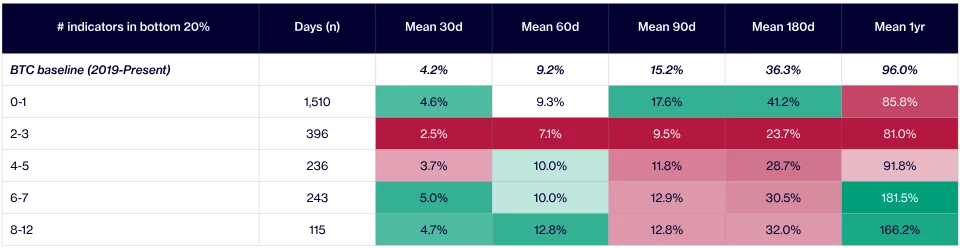
VanEck’s backtest provides a cautious reading for investors expecting an immediate rebound. When between eight and 12 indicators were in capitulation territory, Bitcoin returned an average 12.8% over the following 90 days. Its baseline return for all comparable periods was 15.2%.
The same group generated an average 32% return over 180 days, below the 36.3% baseline. Outperformance appeared only across the one year horizon.
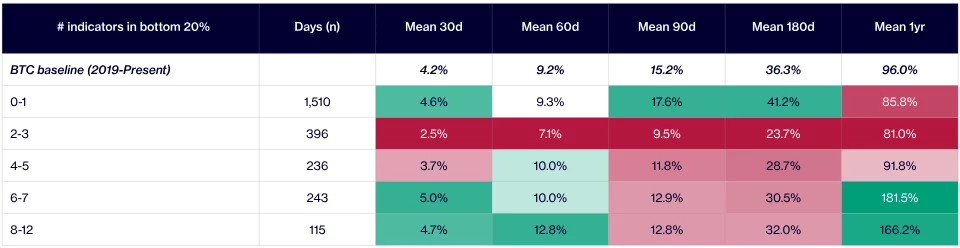
VanEck warned that the one year result came from 115 observation days that overlapped heavily. Those observations represent only a small number of separate market episodes. The firm said it does not place substantial weight on that result.
The findings suggest capitulation readings may identify late cycle conditions without identifying an exact bottom. They also leave room for prolonged sideways trading before a durable recovery begins.
U.S. fund inflows absorb long term holder selling
U.S. spot Bitcoin ETPs recorded approximately $663 million in net inflows during the 30 days covered by VanEck. The total represented about 10,400 BTC at prevailing prices and reversed roughly $2.4 billion of outflows during the preceding month.
Fund flows remained uneven after VanEck’s measurement period. U.S. spot funds lost about $385.2 million across the week ending Aug. 14, as crypto.news reported in its analysis of why liquidity has yet to return.
Demand then recovered. Farside data showed $297.5 million of net inflows on Aug. 17 and another $189.3 million on Aug. 18. The combined $486.8 million partly reversed the previous week’s withdrawals.
Those inflows followed earlier signs of ETF demand supporting the $64,000 area. Bitcoin traded near $64,250 on Aug. 19, above VanEck’s Aug. 11 closing reference of $63,549 but still below its 200 day moving average.
Long term holders complicate the accumulation case
Coins held for longer than one year declined by 356,534 BTC over 30 days, according to VanEck’s Glassnode based figures. Holdings fell 2.9% to 11.84 million BTC, equal to 59.1% of circulating supply.
All six long term age groups contracted. Coins aged between one and two years recorded the largest reduction at approximately 156,000 BTC. Holdings older than ten years fell by only about 4,000 BTC, suggesting the oldest wallets remained comparatively inactive.
VanEck said some movements may have involved wallet security rather than sales. The firm cited concern following the Coldcard security failure, which crypto.news examined in its coverage of the $89 million wallet drain.
It nevertheless called the security explanation difficult to verify. Confirmed losses were far smaller than the total movement by aged coins. Exchange inflows separated by coin age could help determine whether holders transferred funds to trading venues or moved them between private wallets.
The period from September through November now provides the next test of VanEck’s cycle framework. A sustained increase in spot demand, stronger trading volume and stabilization in long term holdings would support the accumulation case. Continued distribution or renewed fund outflows would weaken it.
Teofimo Lopez sums up Conor Benn’s chances of beating Ryan Garcia to become champion

Tom Holland’s INSANE Spider-Man payday revealed: Star stands to make eye-popping nine figures

Green light for $28m Cockburn shopping centre





-

 Fashion4 days ago
Weekend Open Thread: Ann Taylor
-
 Sports5 days ago
This U.S. Amateur is a glimpse into golf’s future in more ways than you think
-
 Tech5 days ago
11 Ways to Rank Your Videos
-
 NewsBeat4 days ago
Myanmar says over 300,000 Rohingya refugees verified for repatriation as exodus enters ninth year
-

 Sports4 days ago
Birmingham 2026: Day 6 Timetable for Irish Athletes
-

 Politics4 days ago
SEQ Code: The Three Letter Boarding Pass Code That Could Give You The Worst Seat
-
 Entertainment7 days ago
Keke Palmer Subtly Hints At Sean Evans Drama With Cryptic Post
-

 Tech5 days ago
DeepSeek Harness launches as open source rival to Claude Code, alongside V4-Pro on API with higher prices
-

 Sports6 days ago
DeQuan Jones in ‘high spirits’ after successful leg surgery
-
 Crypto World7 days ago
Perplexity AI Predicts an XRP Scenario Few Analysts Are Discussing
-

 Tech7 days ago
SpaceXAI’s Grok Bot turns agents into persistent digital coworkers that can operate your apps for $120-per-month
-

 Crypto World1 day ago
OCC Greenlights Trump Family Crypto Firm for Trust Charter
-

 Politics7 days ago
How Average Are You In The UK?
-
 Entertainment7 days ago
2026’s Most Ambitious Fantasy Movie Officially Scores Sequel Update
-
 Entertainment6 days ago
All 10 Hayao Miyazaki Fantasy Movies, Ranked
-

 Fashion7 days ago
Why Botanical Fashion Never Goes Out of Style
-
 Entertainment6 days ago
Travis Kelce Breaks Silence On ‘Crazy’ Taylor Swift Wedding
-
 Entertainment5 days ago
10 Netflix Shows That Quietly Became Modern Classics
-

 NewsBeat7 days ago
‘Regret is a major theme of my work’: Matt Haig on finding acceptance
-

 Fashion7 days ago
Wednesday’s Workwear Report: Stretch-Cotton Pleated-Waist Top
You must be logged in to post a comment Login