

Crypto World
KnockoutStocks vs Benzinga: Best Stock Research Platform for 2026

Among active traders and investors seeking immediate market intelligence, Benzinga has established itself as a leading resource. The platform earned its reputation by delivering rapid-fire financial news, options market data, and critical market events that move stocks.
KnockoutStocks pursues an alternative strategy. The platform emphasizes artificial intelligence-driven stock analysis, a unique scoring methodology, and portfolio management tools engineered to help investors identify and monitor quality investment opportunities. While both platforms cater to the investing community, their fundamental approaches differ significantly.
Platform Overview
What Is KnockoutStocks?
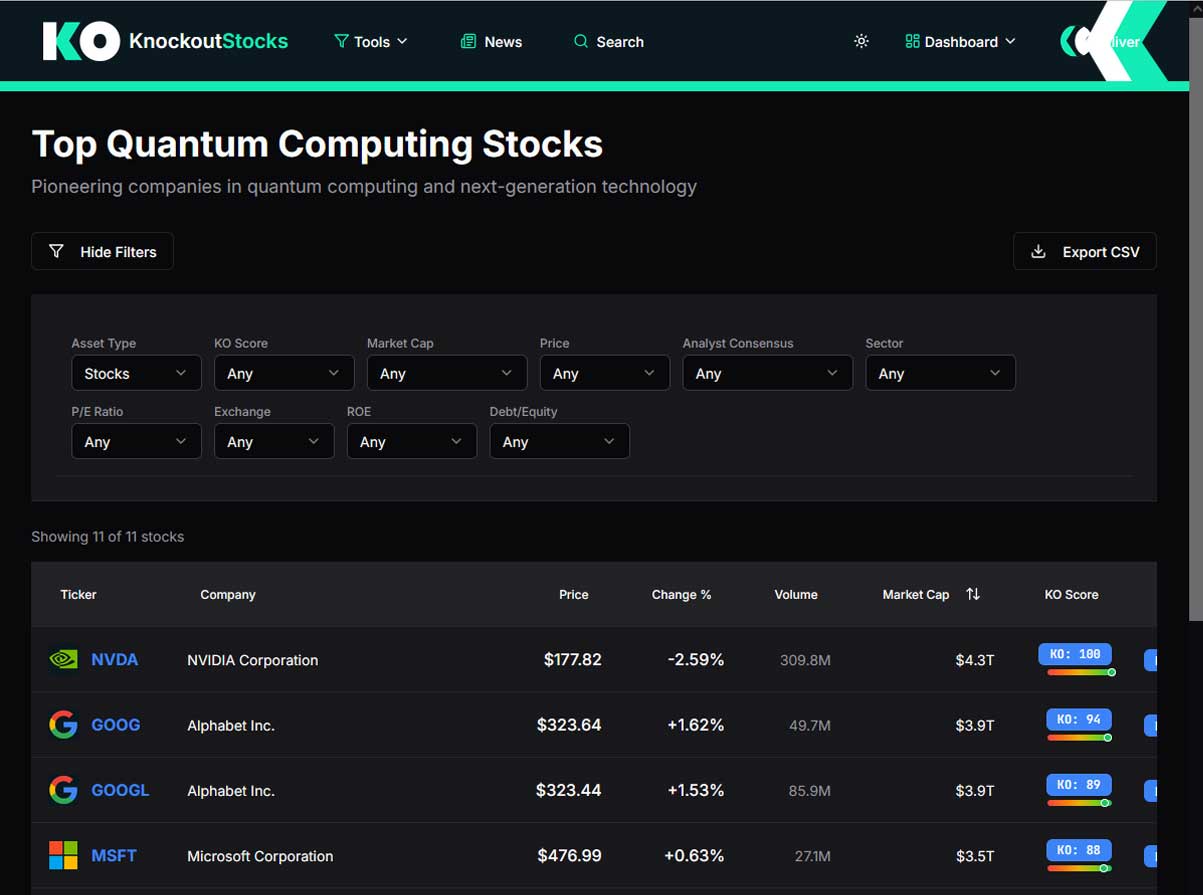
KnockoutStocks represents an AI-driven stock analysis platform centered on the KO Score — a unique ranking methodology that assigns each stock a grade between 0 and 100. This evaluation system analyzes stocks through five distinct dimensions: profitability metrics, financial stability, growth trajectory, market momentum, and analyst sentiment.
Users gain access to an intelligent AI investment assistant, on-demand AI-generated stock analyses, sophisticated screening capabilities, portfolio oversight tools, and customized market updates. The platform streamlines investment research by consolidating critical data points that would otherwise require consulting multiple resources.
What Is Benzinga?
Established in 2010, Benzinga operates as a financial media and market data provider. The company’s flagship offering, Benzinga Pro, stands out as its premium service delivering instantaneous market updates, equity alerts, options trading data, and actionable signals for serious traders and investors.
Day traders, swing traders, and highly active market participants represent Benzinga’s core user base—individuals who require constant awareness of developing market stories and time-sensitive opportunities. The platform’s DNA centers on velocity and comprehensive news coverage.
Feature Comparison
Stock Research and Analysis
Through the KO Score system, KnockoutStocks assigns every publicly traded stock a comprehensive quality rating that synthesizes five fundamental and market-based factors into a single, digestible metric. Investors can quickly assess any company’s standing across profitability, financial soundness, growth prospects, momentum indicators, and professional analyst outlook. The design serves investors seeking holistic stock evaluation.
Benzinga’s research infrastructure revolves around news flow, professional analyst opinions, and price target revisions rather than proprietary scoring mechanisms. Individual stock profiles display current headlines, analyst perspectives, earnings information, and options market activity. The emphasis lands on immediate developments rather than comprehensive fundamental quality measurement.
AI Tools and Insights
Artificial intelligence forms the foundation of KnockoutStocks’ architecture. The platform’s AI assistant enables users to pose questions regarding specific securities, portfolio composition, or broader market patterns whenever needed. Premium subscription tiers unlock voice-enabled AI interaction and unrestricted daily question volume.
Benzinga has incorporated certain AI-enhanced capabilities including automated news digests and market overview briefings. While helpful for rapid information consumption, Benzinga lacks a dedicated conversational AI investment advisor or real-time AI stock evaluation comparable to KnockoutStocks’ offering.
AI-Generated Stock Reports
KnockoutStocks produces comprehensive AI stock reports instantaneously for any requested security. These documents encompass business descriptions, financial condition assessment, essential performance metrics, market behavior analysis, recent developments, and analyst perspectives—consolidated into a single resource within moments.
Benzinga’s content strategy doesn’t include instant AI-generated stock reports. The platform concentrates on news publishing, analyst update distribution, and market data presentation rather than automated comprehensive research document creation.
Stock Picks
KnockoutStocks maintains a carefully selected, high-confidence stock portfolio assembled by its internal research specialists. Each position earns inclusion through exhaustive analysis, industry evaluation, and practical investment reasoning grounded in fundamental strength, sustainable competitive positioning, and extended growth runway.
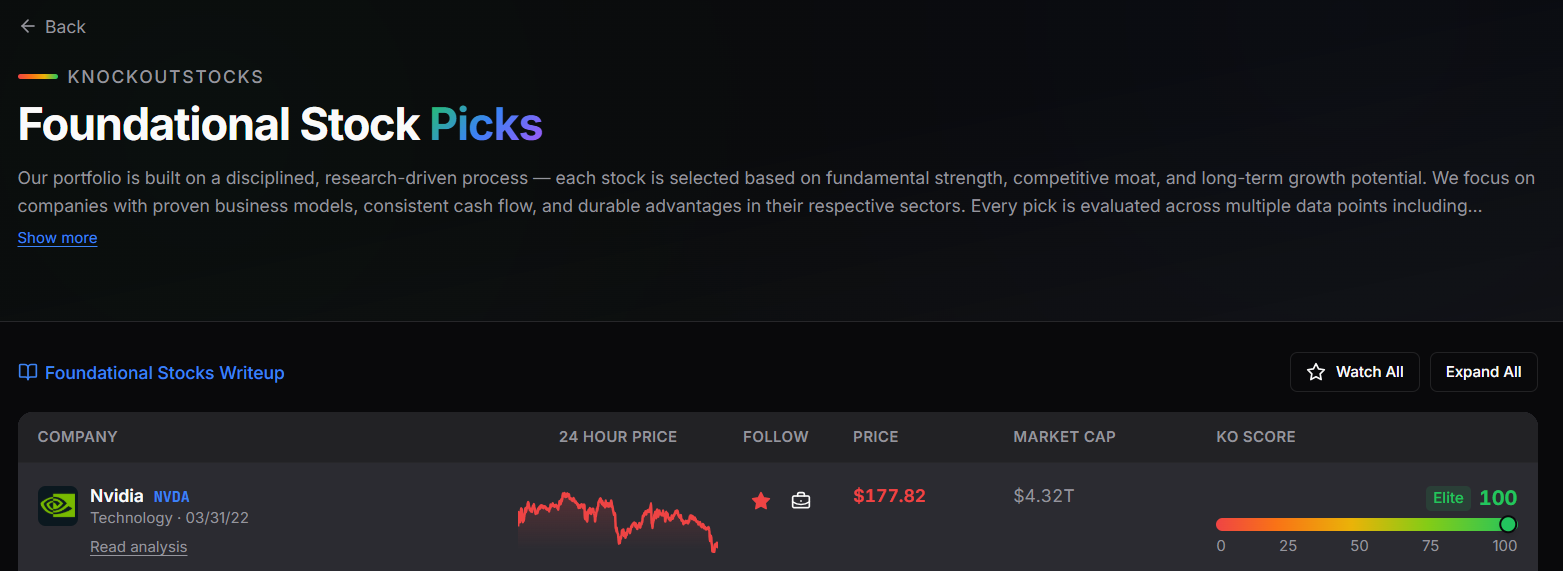
The portfolio undergoes continuous oversight with adjustments made exclusively when the underlying data justifies changes. Complete access to the Stock Picks section—featuring active positions, performance metrics, and detailed rationale for each holding—comes with Middleweight and Heavyweight membership levels.
Benzinga doesn’t provide a comparable curated stock portfolio service. While the platform publishes equity-focused content, analyst rating notifications, and market analysis, it doesn’t maintain a structured, high-conviction portfolio developed and monitored by dedicated research personnel. Investors seeking systematic, research-backed stock recommendations will find KnockoutStocks more aligned with this need.
Real-Time News and Market Data
This category represents Benzinga’s strongest competitive position. Benzinga Pro’s architecture prioritizes speed above all else. The platform’s news stream delivers breaking market intelligence faster than most competitors, while its audio squawk functionality verbalizes headlines in real-time, ensuring traders never miss critical market-moving information.
KnockoutStocks provides personalized market updates calibrated to individual watchlists and portfolio holdings. It maintains user awareness regarding owned and monitored securities. However, real-time news velocity and coverage breadth define Benzinga’s core competency, where it outperforms virtually all alternatives.
Options Flow and Trading Signals
Benzinga Pro incorporates unusual options activity monitoring—among its most valued features for active trading audiences. Detecting substantial unusual options transactions can reveal institutional positioning before significant stock movements materialize. The platform additionally delivers trading signals and equity alerts triggered by technical patterns and news catalysts.
KnockoutStocks doesn’t currently provide options flow intelligence or trading signal generation. Its concentration remains on fundamental equity quality and AI-enhanced research rather than short-duration trading instruments. Investors incorporating options activity into their methodology will find Benzinga superior for this application.
Stock Screener
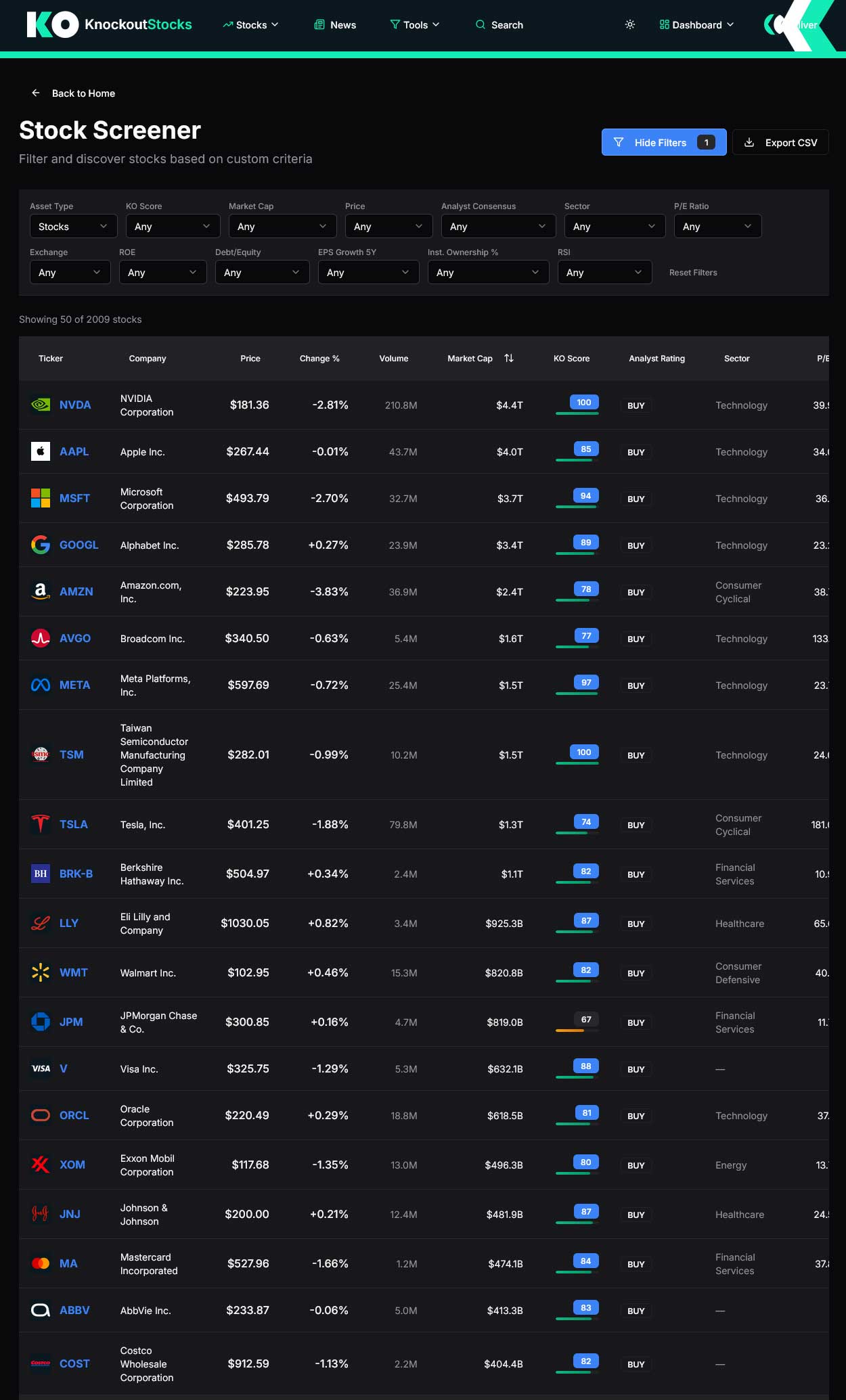
KnockoutStocks features a sophisticated screening tool offering more than 20 filter parameters spanning KO Score, capitalization, share price, trading volume, fundamental data points, and technical indicators. Complete screener functionality is available even on the no-cost membership tier.
Benzinga Pro includes a stock screening utility with filters addressing price, volume, market capitalization, and technical patterns. While functional, it doesn’t match KnockoutStocks’ depth regarding fundamental metrics. The screener design favors identifying near-term trading prospects over assessing long-term equity quality.
Portfolio Tracking
KnockoutStocks delivers comprehensive portfolio monitoring with live performance data, profit/loss calculation, and AI-enhanced portfolio evaluation. The Heavyweight subscription supports up to 100 securities per portfolio with unlimited portfolio creation and AI-generated portfolio assessments.
Benzinga Pro offers elementary watchlist and portfolio capabilities, but portfolio management doesn’t constitute a platform strength. The service functions primarily as a news and data resource rather than a portfolio administration solution.
Alerts and Updates
Both platforms furnish alert capabilities with distinct orientations. KnockoutStocks distributes customized daily or weekly email notifications covering watchlist movements, leading KO Score changes, earnings releases, analyst upgrades, and breaking news relevant to user holdings.
Benzinga Pro’s notification infrastructure emphasizes speed and active trading requirements. Users can configure alerts for news references, price action, analyst rating modifications, and unusual options transactions. For traders requiring rapid market event response, Benzinga’s alerts deliver speed and extensive customization options.
Pricing
KnockoutStocks presents three membership levels. The complimentary tier includes complete screener access, one portfolio slot, five watchlist positions, one weekly AI conversation, and one weekly AI stock report. The Middleweight tier costs $19.99 monthly, providing 10 daily AI queries and 10 weekly AI reports. The Heavyweight tier runs $59.99 monthly with unlimited AI access, voice coaching capabilities, PDF report generation, and CSV data export.
Benzinga Pro pricing begins approximately $37 monthly for the Basic subscription, escalating to roughly $47 monthly for the Essential package incorporating options flow data. Annual payment reduces effective monthly costs. No substantial free tier exists—Benzinga’s principal value proposition requires paid subscription.
Pros and Cons
KnockoutStocks
Pros
- KO Score delivers rapid, comprehensive quality assessment across thousands of securities
- Integrated AI advisor for immediate stock and portfolio inquiries
- Instant AI stock reports accessible for any security on demand
- Curated high-conviction stock portfolio with complete research documentation
- Complete screener access included in free membership
- Robust portfolio monitoring with real-time data and AI analysis
- More accessible pricing with substantial free tier functionality
- Voice-enabled AI advisor included in premium tier
- Customized news streams aligned with watchlist and portfolio composition
Cons
- No live breaking news squawk or audio broadcast
- No unusual options flow monitoring capability
- Not designed for active day trading or short-term signal generation
- Less emphasis on news delivery speed
Benzinga
Pros
- Industry-leading real-time financial news distribution
- Audio squawk feature enabling hands-free news monitoring
- Unusual options activity tracking provides genuine competitive advantage
- Rapid, customizable notification system designed for active traders
- Comprehensive coverage of earnings events, analyst updates, and market developments
- Excellent for traders requiring immediate news reaction capability
Cons
- No dedicated conversational AI investment advisor
- No on-demand AI-generated stock reports
- No curated high-conviction stock portfolio offering
- No proprietary fundamental equity scoring methodology
- Elementary portfolio tracking functionality
- Screener lacks depth in fundamental metric filtering
- No meaningful free membership tier
- Architecture favors traders over long-term investors
Which Platform Is Best for Different Investors?
Use KnockoutStocks if you:
Seek a comprehensive, analytics-driven stock quality perspective using a transparent scoring framework that evaluates profitability, financial stability, growth dynamics, momentum characteristics, and analyst confidence. The KO Score provides immediate insight into any equity’s fundamental standing.
Desire AI-powered capabilities on demand—posing questions, generating instant stock analyses, and evaluating portfolio composition without requiring constant live news feed monitoring.
Want access to a meticulously researched, high-conviction stock portfolio constructed on genuine fundamentals and long-horizon thinking. The Stock Picks section provides Middleweight and Heavyweight members a clear foundation supported by thorough research.
Identify as a long-term or intermediate-term investor focused on discovering quality securities and tracking them across time. KnockoutStocks’ architecture supports this investment approach.
Value a substantial free tier and reasonable premium pricing that delivers genuine research capabilities affordably.
Use Benzinga if you:
Operate as an active trader requiring the most rapid access to breaking market intelligence and price-moving events. Benzinga Pro’s entire infrastructure emphasizes speed, evident across all features.
Incorporate unusual options activity as a signal within your trading methodology. The options flow data represents one of Benzinga’s most powerful and distinctive capabilities.
Require real-time notifications for news mentions, price movements, and analyst modifications enabling immediate action. Benzinga’s alert infrastructure delivers speed and extensive customization for active trading workflows.
Prefer an audio news stream maintaining awareness hands-free during continuous market monitoring throughout trading sessions.
Final Verdict
Benzinga and KnockoutStocks serve distinct investor profiles and investment methodologies.
Benzinga excels in real-time news velocity, options flow intelligence, and capabilities engineered for active traders. If your day involves responding to market news and pursuing time-sensitive opportunities, Benzinga Pro represents a powerful resource for that workflow.
KnockoutStocks excels in fundamental equity analysis, AI-enhanced research, curated stock selections, portfolio oversight, and overall value proposition. The KO Score addresses more analytical dimensions than any Benzinga offering for assessing stock quality, while the AI advisor, instant reports, and high-conviction stock picks provide layers of intelligence and guidance Benzinga simply doesn’t deliver.
For long-term and intermediate-term investors seeking to identify exceptional stocks, follow a research-backed picks portfolio, and obtain AI-powered insights on demand—KnockoutStocks presents the superior platform in 2026. Benzinga remains the better instrument for active traders whose success depends on real-time market news consumption.
If your objective centers on building long-term wealth through intelligent stock selection rather than responding to daily news cycles, KnockoutStocks represents the more appropriate choice.


TLDR
- Polymarket partnered with Palantir Technologies and TWG AI to build a sports market integrity platform.
- The platform uses the Vergence AI engine to monitor trades in real time.
- The system screens prohibited users and detects suspicious trading activity.
- Shayne Coplan said the partnership will strengthen monitoring across sports prediction markets.
- The move comes as Polymarket expands its sports offerings and plans a return to the United States.
Polymarket has partnered with Palantir Technologies to build a monitoring platform for its sports prediction markets. The companies will deploy advanced analytics to detect suspicious trading and enforce compliance standards. The agreement comes as Polymarket expands its sports markets and prepares to re-enter the United States.
Polymarket Partners with Palantir and TWG AI to Launch Integrity Platform
Polymarket confirmed that it will work with Palantir Technologies and TWG AI to develop a sports integrity system. The platform will use the Vergence AI engine, which Palantir and TWG AI jointly operate. The companies said the system will monitor trades and flag irregular activity in real time. The announcement outlined plans to prevent manipulation and insider activity across sports prediction markets.
Polymarket said the system will screen prohibited users and support compliance reporting tools. It will also track market behavior to identify unusual trading patterns. The companies stated that the platform will help ensure trust and fairness as trading volumes grow. Shayne Coplan said, “Our partnership with Palantir and TWG AI allows us to apply world-class analytics and monitoring to sports markets.” He added that the tools will help leagues and teams maintain confidence in games.
Expansion of Sports Prediction Markets and Regulatory Backdrop
Polymarket and Kalshi have expanded sports event contracts as trading volumes increase. The expansion has drawn scrutiny from certain gaming authorities and state regulators. At the same time, DraftKings has launched DraftKings Predictions in 38 states. These states include California, Florida, Georgia, and Texas, where traditional sports betting remains restricted.
The U.S. Commodity Futures Trading Commission filed a friend-of-the-court brief supporting Kalshi last month. The agency asserted “exclusive jurisdiction” over futures markets, including gaming contracts. Kalshi faces a lawsuit alleging violations of Nevada gaming laws. CEO Tarek Mansour said Kalshi recorded over $1 billion in trading volume on Super Bowl Sunday.
The Wall Street Journal reported that Polymarket and Kalshi have discussed funding rounds with potential investors. The report said both companies seek valuations near $20 billion. Polymarket has also acquired a CFTC-regulated platform to facilitate its return to the United States. The company has opened a waitlist for users ahead of the relaunch.
Palantir Technologies, co-founded in 2003 by Peter Thiel and Alex Karp, develops data analytics software. The company provides tools to U.S. government agencies and enterprise clients. Through the Vergence AI engine, Palantir and TWG AI will power the new monitoring platform for Polymarket’s sports markets.
TLDR
- KBC partnered with Swiss fintech Taurus to support its regulated crypto trading service in Belgium.
- KBC became the first Belgian bank to offer Bitcoin and Ethereum trading within a regulated banking framework.
- The bank integrated Taurus-PROTECT to provide institutional-grade digital asset custody for its Bolero platform.
- Retail clients can trade Bitcoin and Ether on an execution-only basis under the EU MiCAR framework.
- KBC structured the service under a closed model that keeps crypto assets within the Bolero platform.
Major Belgian lender KBC has partnered with Swiss fintech Taurus to power its regulated crypto trading service. The bank will use Taurus-PROTECT to provide institutional custody for digital assets offered through its Bolero platform. The launch makes KBC the first Belgian bank to enable Bitcoin and Ethereum trading within a regulated banking framework.
KBC Group Launches Regulated Bitcoin Trading with Taurus Support
KBC Group confirmed it teamed up with Taurus SA to deploy Taurus-PROTECT for secure digital asset custody. The bank integrated the platform into Bolero, its self-directed investment service, to support regulated crypto trading. The service went live last month and offers retail clients access to Bitcoin on an execution-only basis.
KBC Group structured the offering under the European Union’s Markets in Crypto-Assets Regulation framework. The bank executes all Bitcoin transactions in compliance with MiCAR requirements and internal governance standards. Erik Luts, Chief Innovation Officer at KBC Group, said growing client demand drove the partnership.
“By working with Taurus, we can offer crypto services supported by banking-grade custody,” Luts said. He added that the bank applies the same security and control standards across its crypto operations. KBC Group confirmed that clients trade Bitcoin directly within Bolero without external transfers.
Ether Access Expands Through Closed Operating Model
KBC Group also introduced Ethereum trading under the same regulated structure. Retail clients can access Ether on an execution-only basis through Bolero. The bank keeps all purchased crypto assets within its closed operating model.
Under this model, clients cannot transfer Bitcoin or Ether to external wallets or exchanges. The structure removes the need for clients to manage private keys themselves. KBC Group said this approach reduces operational and fraud risks linked to retail custody.
Lamine Brahimi, Co-founder and Managing Partner at Taurus, addressed the collaboration. “We are proud to support KBC’s market-first initiative in Belgium with Taurus-PROTECT,” Brahimi said. He stated that Taurus designed the platform specifically for banks seeking institutional-grade custody.
Taurus-PROTECT provides digital asset storage with governance and compliance controls aligned with banking standards. KBC Group confirmed it applies the same oversight procedures used across its broader financial services. The bank said the platform ensures secure storage of both Bitcoin and Ether holdings.
KBC Group stated that all transactions occur within a fully regulated banking environment. The bank said it processes trades through established compliance systems and internal monitoring tools. The service became available to retail investors last month through the Bolero platform.
KBC Group emphasized that clients gain crypto exposure through a trusted banking channel. The bank maintains full custody responsibility for assets held on the platform. The announcement marked the official rollout of regulated Bitcoin and Ether trading in Belgium’s banking sector.


Bitcoin brushed off geopolitical turbulence to trade above $70K, with an analyst pointing to resilience as a bullish signal.
Bitcoin (BTC) was trading just above the $70,000 level today, brushing off weeks of geopolitical turbulence tied to the conflict pitting the U.S. and Israel against Iran to post gains of about 4% in the last 24 hours.
Now, analyst Markus Thielen is arguing that the flagship cryptocurrency’s refusal to crumble under that pressure is itself a bullish signal, which makes a return to the $70,000 to $80,000 range more likely.
BTC Has Absorbed the Pressure
In his March 10 daily chart note for Matrixport, Thielen pointed out that since early February, BTC has mostly traded sideways, despite facing headwinds such as weaker U.S. employment figures, a sell-off in Korean equities, and a significant rise in oil prices over the weekend.
He noted that Bitcoin only retraced toward the $66,000 level, eventually finding support, even as oil prices briefly jumped to $120 over fears of Iran closing the Strait of Hormuz.
“As markets gradually start to discount the Iran conflict,” Thielen wrote, “Bitcoin is likely to look through the geopolitical noise, which should support a move toward this higher trading range.”
The sentiment has found backing from the broader news cycle, with reports emerging on March 9 that U.S. President Donald Trump had said that the war was “very complete, pretty much.” Oil prices dropped back below $90 per barrel shortly after his remarks, with gold touching $5,140 per ounce and the S&P 500 climbing above 6,800.
Bitcoin wasn’t left behind either, jumping to around $69,600 before settling near $69,000 that day. Its current CoinGecko data shows a 24-hour range of about $67,000 to $71,200, with the asset now just above $70,500.
The price is up 3% from its level 7 days ago and more than 10% over 2 weeks. However, BTC is still down about 15% year-on-year and sits over 44% below its October 2025 all-time high when it passed $126,000.
You may also like:
Deleveraged Market Prepares the Stage for a Move Higher
One reason analysts are closely watching the current structure is because of the significant deleveraging that has taken place. As we previously covered, CryptoQuant analyst Darkfost noted that since February, Bitcoin’s Estimated Leverage Ratio on Binance fell from 0.198 to 0.152, as the OG crypto dropped from $96,000 to around $69,000.
According to the market technician, lower leverage usually means less systemic pressure, which can help stabilize price action before the market enters a new directional phase.
Interestingly, the cleaner leverage profile seems to be pairing with a futures market leaning heavily on shorts. Per data from Binance Research, open interest has gone up some 18% since late February, returning from under $30 billion, while funding rates have stayed low to negative.
That combination means a large share of current open interest is from short positions, and if BTC moves higher, forced short covering could add velocity to any rally.
Binance Free $600 (CryptoPotato Exclusive): Use this link to register a new account and receive $600 exclusive welcome offer on Binance (full details).
LIMITED OFFER for CryptoPotato readers at Bybit: Use this link to register and open a $500 FREE position on any coin!
TLDR
- Strategy recorded its largest STRC issuance day and bought an estimated 1,420 Bitcoin.
- The company sold about 2.4 million STRC shares through its at-the-market program.
- Strategy reported around $378 million in STRC proceeds in its latest SEC filing.
- The company disclosed a total Bitcoin purchase worth 1.3 billion dollars.
- Strategy amended its ATM sales rules to allow a second agent to sell shares outside regular hours.
Strategy executed its largest recorded STRC issuance day and used the proceeds to acquire an estimated 1,420 Bitcoin. The company amended its at-the-market sales rules and expanded agent access before and after regular trading hours. It then reported $1.3 billion in total Bitcoin purchases in its latest SEC filing.
STRC Issuance Drives Estimated 1,420 BTC Purchase
Strategy sold about 2.4 million STRC shares through its at-the-market program in one day. Data from STRC.live estimated that the company bought 1,420 Bitcoin following the sales. The estimate marked the largest daily STRC issuance and related Bitcoin purchase on record.
Previously, STRC.live recorded a daily purchase of 1,069 Bitcoin as the highest issuance-linked total. However, the latest transaction exceeded that earlier figure based on the same data source. STRC functions as Strategy’s variable-rate perpetual preferred stock launched in July 2025.
The company uses STRC alongside Stride, Strife, Strike, and common stock to fund Bitcoin acquisitions. Strategy sets monthly variable cash dividends for STRC holders. It fixed the March annualized dividend rate at 11.5 percent.
Bitcoin Purchase Expands Treasury Holdings
Strategy disclosed in its SEC filing that it sold about $378 million in STRC. The company also reported nearly $900 million in proceeds from common stock MSTR sales. Together, those transactions supported a $1.3 billion Bitcoin purchase.
STRC.live had estimated that weekly STRC proceeds would fund around 4,300 Bitcoin purchases. However, the reported total exceeded that estimate based on disclosed sales figures. Strategy confirmed the Bitcoin acquisition as one of its largest on record.
The company reported an average cost basis of $75,862 for its Bitcoin holdings. At the time of reporting, Bitcoin traded at $71,279. Strategy continued purchases despite the market price remaining below its average cost.
Revised ATM Rules Expand Sales Access
Strategy amended its at-the-market program rules on Monday. The company now allows a second sales agent to sell securities outside regular market hours. Previously, it limited sales to one agent per trading day.
The updated structure permits sales before the US market opens and after it closes. Market observer Ragnar stated, “A lot more capital will be raised, and a lot more Bitcoin will be purchased.” The company has not issued further operational changes beyond the filing.
STRC remains one of several securities used to fund Strategy’s Bitcoin treasury approach. The company continues to report sales and purchases through SEC filings. The latest filing detailed the $1.3 billion Bitcoin acquisition and expanded ATM structure.
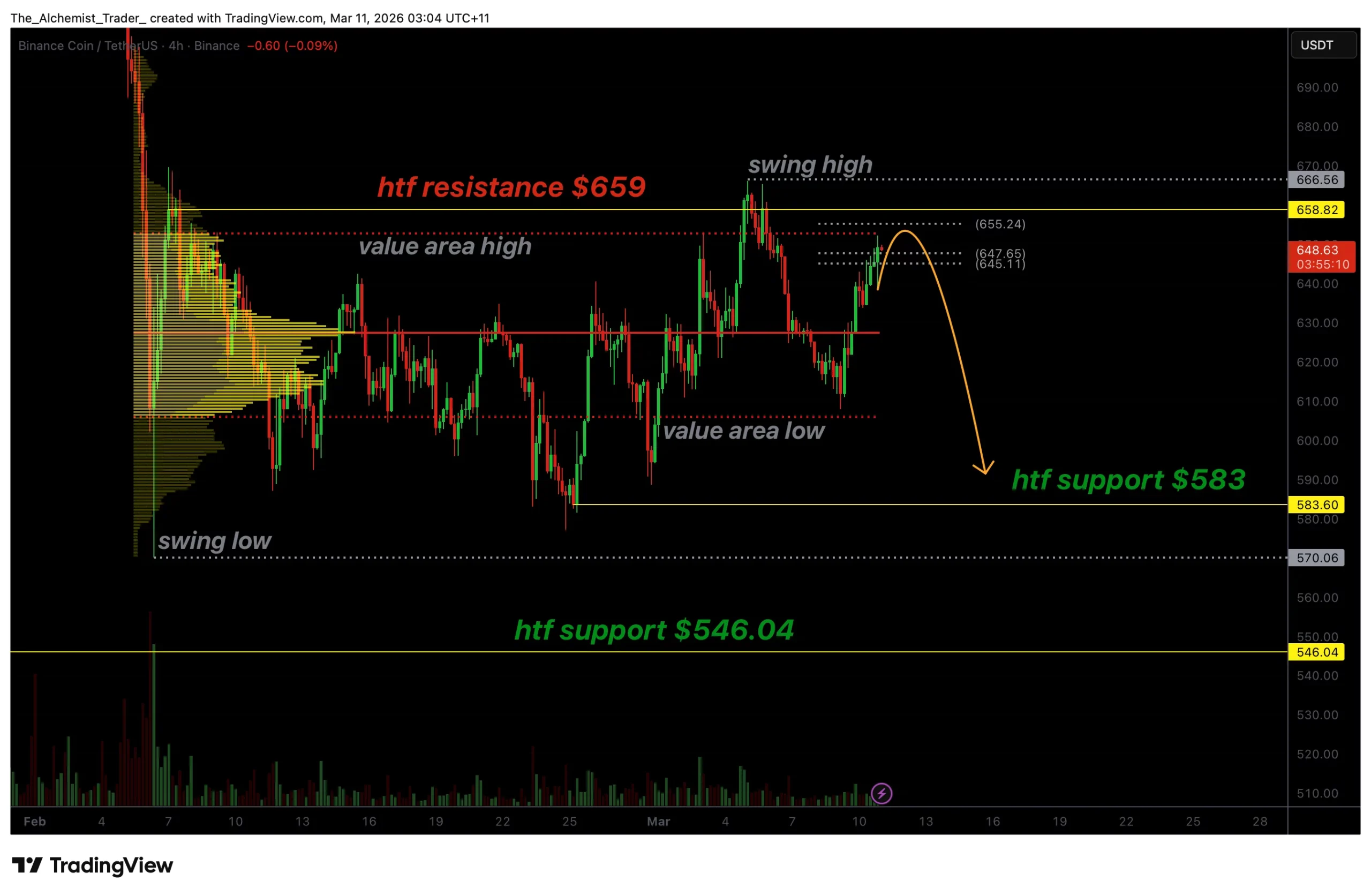
BNB price approaches $656 resistance at the value area high with weak volume. A rejection here could trigger a rotation toward key support near $583.
Summary
- Key Resistance: BNB testing value area high near $656–$659.
- Volume Signal: Rally occurring on weak bullish volume, signaling exhaustion.
- Downside Target: Rejection could trigger rotation toward $583 support.
Binance (BNB) price is approaching a critical technical level as price rallies toward a major resistance zone near $656–$659. This region aligns with the value area high and a high-timeframe resistance level, making it an important inflection point that could determine the next directional move.
While the recent bounce has brought bullish momentum back into the market, the broader structure suggests that this rally may be nearing exhaustion. Technical analysis indicates that the current move began at the value area low, where buyers stepped in to defend support.
However, as price approaches the upper boundary of the value area, momentum appears to be weakening due to a noticeable lack of strong bullish volume.
BNB price Key Technical Points
- Key Resistance: BNB testing value area high near $656–$659.
- Volume Weakness: The rally toward resistance is occurring on declining bullish volume.
- Downside Target: Rejection could trigger a rotation toward $583 high-timeframe support.
BNB’s current price action is unfolding within a technically well-defined structure where key levels continue to dictate market behavior. One notable feature on the chart is how consistently price has respected the value area high and value area low during previous rotations. These levels represent areas where the majority of trading activity has occurred, making them important zones of equilibrium between buyers and sellers.
The recent bounce from the value area low signaled that buyers were willing to step in at discounted prices. As price moved higher, it began rotating toward the opposite side of the trading range. This type of movement is consistent with typical market behavior within range-bound conditions, where price oscillates between support and resistance levels as liquidity is redistributed.
However, as BNB approaches the value area high near $656, signs of exhaustion are beginning to appear. One of the key signals supporting this view is the lack of strong bullish volume accompanying the current rally. When price moves higher without sufficient volume confirmation, it often indicates that buying momentum is weakening and that the move may struggle to sustain itself.
This comes as a U.S. federal court recently dismissed a lawsuit accusing Binance of facilitating terrorism financing, ruling that the plaintiffs failed to meet the legal requirements needed to hold the exchange liable under anti-terror laws, removing a major legal overhang for the platform.
Low-volume rallies frequently occur during corrective phases within a broader consolidation structure. In these cases, price may drift upward toward resistance but ultimately fail to break through due to the absence of strong participation from buyers. As a result, these areas often become zones where sellers regain control of the market.
From a market structure perspective, the value area high and high-timeframe resistance near $659 represent a confluence zone where supply may begin to enter the market. If sellers step in around this region, it would reinforce the idea that the current rally is losing strength and could mark the beginning of another rotational move lower.
Another important factor supporting this scenario is how previous pivots on the chart have occurred at technically significant levels. Each rotation within the range has respected the value area boundaries, suggesting that the market is continuing to operate within a structured auction environment. When these patterns repeat consistently, traders often anticipate similar behavior during future tests of these levels.
Meanwhile, Binance’s regional head has confirmed that the exchange expects to secure five additional licenses across Asia this year, signaling continued expansion despite ongoing regulatory scrutiny.
If BNB fails to break above the $656–$659 resistance zone, the market may once again rotate toward the lower boundary of the value area. In this case, the next major support level to watch would be the high-timeframe support near $583.
What to expect in the coming price action
BNB is now approaching a key resistance region where the value area high intersects with high-timeframe resistance near $656–$659. The lack of strong bullish volume suggests that the current rally may be losing momentum as price enters this supply zone. If sellers defend this level, the market could reject and rotate back toward $583 support.
However, a strong breakout above resistance with increasing volume would invalidate the bearish scenario and open the door for further upside continuation.

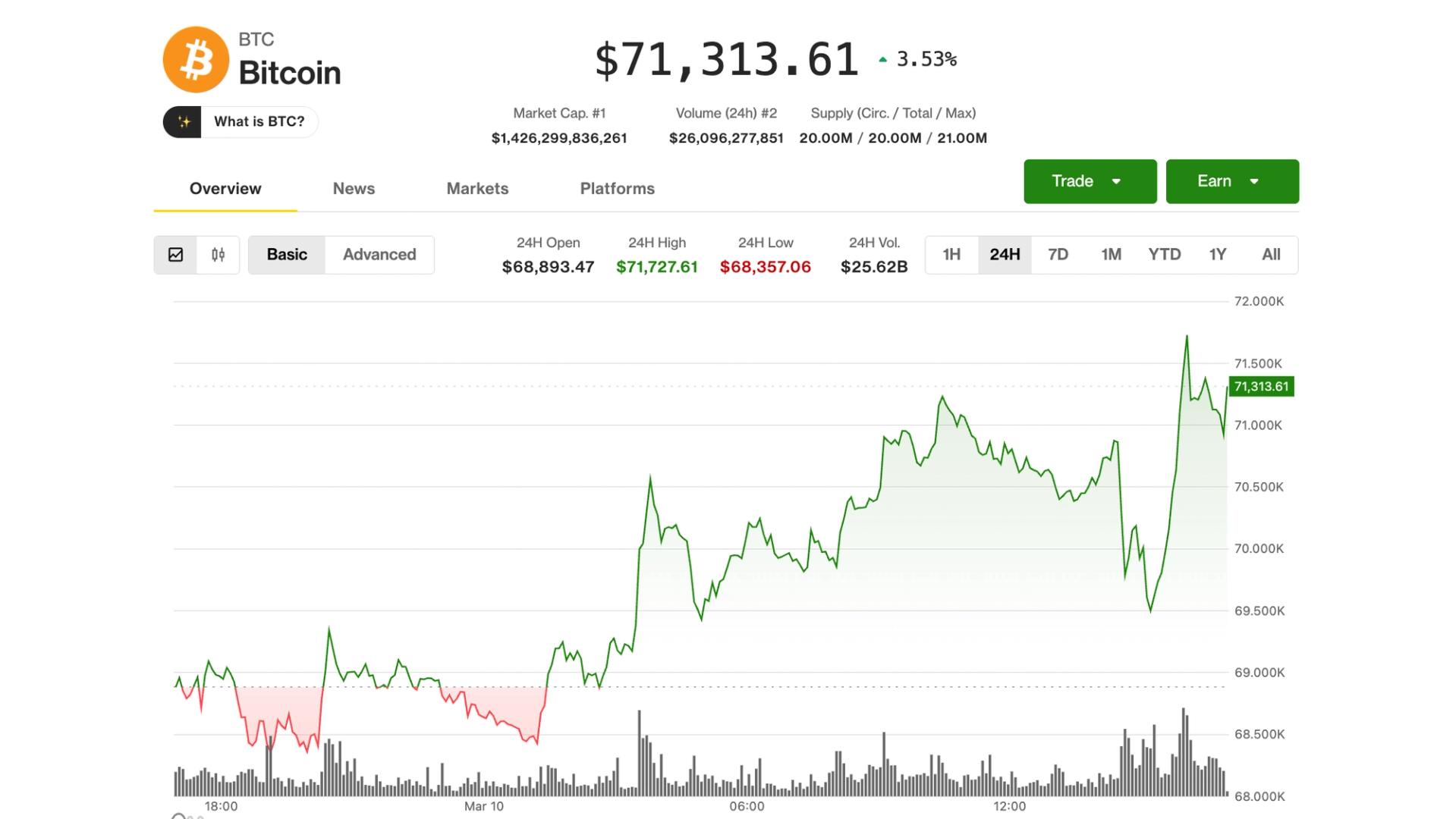
Cryptocurrencies are extending their advances on Tuesday as easing concerns about a potential oil supply shock improved risk sentiment across global markets.
The sentiment shift came after the International Energy Agency (IEA) said it would convene an extraordinary meeting of its member countries to consider releasing emergency oil reserves.
Bitcoin climbed above $71,500 for the first time since Thursday, before easing back to the current $71,300, up 3.2% over the past 24 hours. The broad market CoinDesk 20 Index was up by a similar amount, with XRP (XRP), , and Hyperliquid’s native token (HYPE) leading gains among major crypto assets.
WTI crude oil extended its decline on the news, dropping to $82 after spiking to near $120 over the weekend. Meanwhile, the S&P 500 and tech-heavy Nasdaq 100 were up roughly 0.5% at midday.
Most crypto-related stocks mirrored the advance. Stablecoin issuer Circle (CRCL) was up another 6%, now nearly 100% higher in two weeks, while digital asset infrastructure firm BitGo (BTGO) climbed more than 8% and blockchain firm Figure (FIGR) rallied 12%.
Since Nigel Farage was announced as joining U.K. bitcoin treasury firm Stack BTC (STAK) on Monday, that stock has surged more than 200%.
Bitcoin decoupling from software
Bitcoin appears to be losing its correlation with the software stock ETF (IGV), as BlackRock’s IBIT is up around 3% over the past 24 hours while IGV is down more than 2%.
However, over the past five days, IGV is up about 1.5% while IBIT is down roughly 2%, suggesting IBIT may still have some catching up to do if the correlation with software stocks is to re-establish itself.
A weakening correlation could also be notable, as it may signal bitcoin beginning to trade more independently from software and tech equities, potentially becoming a more uncorrelated asset during periods of macro uncertainty. While still outperforming gold and U.S. equities since the war began.
‘Cautiously optimistic’ for BTC
Zooming out, bitcoin’s recent price action has been relatively resilient despite the ongoing macro turbulence, said James Harris, CEO of crypto yield platform Tesseract Group.
After briefly testing the low-$60,000 area, BTC recovered even as broader risk markets struggled with geopolitical uncertainty, he said. Meanwhile, ETF inflows have remained broadly supportive, while a sharp deleveraging earlier in the month helped clean up excessive positioning in derivatives markets.
The mix of washed-out sentiment, flushed-out leverage and support around the $66,000 zone suggests bitcoin may be entering a bottoming process, Harris said. However, downside risk persists as the crypto market remains fragile.
“If support in the mid-$60k area fails, we could easily see another test lower, but for now we remain cautiously optimistic on BTC,” he said.


We all know the problem with a public ledger. Most of us living inside the crypto ecosystem can’t actually bring ourselves to say it.
But find a normie on the street, one with some knowledge of blockchain (good luck with that), and they’ll tell you straight. It’s public. A public ledger is public.
We’ve spent almost two decades trying to sell pork pies to vegans, trumpeting “public” as a virtue, when people actually crave privacy.
Out there in the real world, normies don’t see radical transparency. Many perceive insanity. They see data breaches. They are in no doubt that sharing a permanent and immutable record of every transaction they’ve ever made is utterly absurd.
You wouldn’t use a credit card if your neighbor could see every transaction you made. You wouldn’t run a business if your competitors could see exactly who your suppliers are and what you’re paying them.
To put it simply, on-chain is too public, off-chain is too private. There has to be a balance. Some information needs to be made public for audit and regulatory purposes. Some information needs to remain private to enable businesses to function effectively.
Businesses need to shield their proprietary moves from competitors while providing a “viewing key” to regulators or auditors. It’s a balance between complying with the law and functioning effectively in the market.
There are some good reasons why institutional finance hasn’t fully embraced blockchain–why the hedge funds, asset managers and corporate treasuries with billions to invest haven’t been red-pilled. One of those reasons is that they understandably don’t want to hand their proprietary strategy to the entire world, and simply cannot do so. It would be like broadcasting their alpha for free.
The corporate reality check
Stablecoins promise speed and efficiency for B2B transactions. The cost is low, but the price is high. Privacy. A transparent ledger means everyone–friend or foe, ally or rival–can see a company’s business. Which vendor they’re using, the volume of the orders and the price per unit. There are no secrets; everything’s on display, and they’re effectively leaking their entire supply chain. Businesses have to find ways around the problem by enhancing privacy while remaining compliant.
What we need is the blockchain equivalent of the internet’s SSL moment. We didn’t get a functional web until encryption became a standard layer, allowing us to send credit card info without the whole world watching.
From theory to practice
We are finally seeing this infrastructure move from whitepapers to the real world. For example, the Canton Network has had some success in bringing privacy to enterprise finance, albeit in a permissioned form. I’ve been involved in one of the latest privacy advances. It’s the newly announced plan to launch strkBTC on Starknet. We have spent years treating Bitcoin as digital gold—a great store of value, but one that is largely static and totally exposed if you try to use it in DeFi.
For the first time, you can have the security of Bitcoin with a “confidentiality layer” that protects your balances and counterparties from public view. It is the first proof that we can have an “active” Bitcoin that respects the commercial need for privacy, all with selective disclosure for reasonable risk management.
The path forward
One of the values of early crypto adopters was privacy, but that ambition will remain unfulfilled if we don’t build for the systemically important capital flows that move the world. Public blockchains will only scale if they can support private finance.
Through selective disclosure and protocol-level confidentiality, we aren’t just adding a feature. We are finally building a system that the world can actually use. The technology is here—the remaining question is which networks will set the standard for the next era of global finance.


Latest developments: Edelman told CoinDesk’s Jennifer Sanasie on Markets Outlook that the dispute over whether stablecoins can offer yield is threatening progress on market structure legislation.
- Banking groups argue allowing stablecoin issuers to offer yield would siphon deposits from traditional banks.
- Edelman said banks are opposing the provision largely because stablecoins pose a competitive threat to their business models.
- The issue has become a sticking point in negotiations around the Clarity Act, a proposed crypto market structure bill in Washington.
- Despite siding with crypto on the economics, Edelman said the banking lobby is politically strong and “likely to win the argument.”
Why it matters: Edelman argues the industry should compromise rather than risk losing regulatory clarity altogether.
- “I don’t think it’s the hill to die on,” Edelman said about the fight over stablecoin yield.
- He said the broader legislation would provide long-awaited regulatory certainty for crypto companies and investors.
- Prediction markets currently suggest the bill will pass, he said, though the timeline remains uncertain.
- Edelman warned the bill could stall if it doesn’t pass before midterm elections.
The market outlook: Edelman believes regulatory clarity could quickly revive crypto markets.
- If the bill fails, he expects a sharp but temporary drop in crypto prices as investors react.
- Over the long term, crypto would still grow but at a slower pace without supportive legislation.
- If clarity arrives, Edelman predicts crypto prices could surge and quickly reach new all-time highs.
- He reiterated his long-term forecast that bitcoin could reach $500,000 by the end of the decade.
Reading between the lines: Edelman also pushed back on fears that quantum computing threatens Bitcoin.
- Claims that quantum computers will break the Bitcoin blockchain are “one of the dumbest things I’ve ever heard anybody say,” Edelman said.
- He argued the industry would develop defensive cryptography alongside any advances in quantum computing.
- Even if such machines emerge, attackers would likely target larger financial systems or infrastructure before Bitcoin.
- Edelman continues to recommend investors allocate up to 40% of portfolios to crypto broadly, focusing mainly on major assets such as bitcoin, ether and solana.
Looking ahead: Edelman expects consolidation among cryptocurrencies as the market matures.
- He predicts roughly a dozen major cryptocurrencies will ultimately dominate the sector.
- At the same time, tokenization could create hundreds of thousands of blockchain-based tokens representing assets like real estate, commodities and collectibles.
- That shift could dramatically expand diversification opportunities for investors.
Crypto World
Alphabet (GOOG) Stock: Pentagon to Receive Gemini AI Agents for 3 Million Defense Personnel

Key Highlights
- Pentagon’s complete 3 million-person workforce will gain access to Google’s Gemini AI agents
- Initial rollout targets unclassified systems, while discussions progress for classified network integration
- Platform offers eight pre-configured agents designed for budget creation, meeting notes, and strategic planning
- Defense Department users have generated 40 million prompts through Google’s AI interface since its December debut
- Training completion remains limited to just 26,000 personnel despite significantly higher adoption rates
Google, owned by Alphabet, has initiated a comprehensive deployment of its Gemini AI agent technology throughout the United States Department of Defense, encompassing approximately three million personnel.
The initial phase focuses on unclassified network infrastructure, where the majority of Defense Department personnel operate daily. Emil Michael, serving as under secretary of defense for research and engineering, indicated this strategic starting point.
Michael revealed that negotiations with Google are currently active regarding expansion into classified and top-secret cloud computing environments.
Google Vice President Jim Kelly made the announcement public through a Tuesday blog entry. Defense personnel will have the capability to create customized AI agents through natural language commands, eliminating any programming requirements.
The platform launches with eight ready-to-deploy agents. These automated assistants handle functions including meeting documentation, financial planning, and verification of proposed initiatives against national defense objectives.
Certain agents are designed to provide operational value, assisting with logistical planning and resource forecasting for military operations — capabilities available even on unclassified infrastructure.
Google’s conversational AI interface on the GenAI.mil website has been operational since December. During this period, 1.2 million Defense Department personnel have engaged with the system, generating 40 million distinct queries and submitting over four million documents.
The usage volume demonstrates significant adoption. The Gemini agent platform becomes accessible through this identical portal starting Tuesday.
Personnel Education Falls Short of Adoption Rates
A significant challenge exists. Just 26,000 Pentagon employees have completed formal instruction on appropriate AI utilization. Upcoming educational programs have reached capacity, a Pentagon representative confirmed.
Michael emphasized the importance of proper training. “It saves you a lot of time in the middle, but you have to review at the end to make sure there’s no hallucinations,” he said.
Bridging the divide between actual usage and completed training represents a priority as the Defense Department expands agent availability.
Military Exercise Planning Sees Dramatic Efficiency Gains
The technology has already demonstrated measurable impact in operational settings. Kenneth Harvey, who directs the Mission Training Complex at Fort Bragg, explained that developing a military exercise scenario accommodating up to 50,000 simulated troops previously required his nine-member team six months.
Leveraging the AI platform, a comparable exercise for US Southern Command reached completion within six weeks.
Harvey emphasized that “human eyes vetted every word” throughout the process.
This latest initiative represents a significant expansion of collaboration between Google and the Pentagon, a relationship that has experienced turbulence. In 2018, thousands of Google staff members protested the corporation’s participation in Project Maven, an AI-powered drone surveillance initiative. Google declined to continue that contract.
The technology company subsequently revised its policies regarding military contracts. Michael characterized Google as a “trusted” and “supportive” partner.
The Pentagon has simultaneously broadened its artificial intelligence partnerships. Recent agreements with OpenAI and Elon Musk’s xAI enable operations on restricted networks — developments that coincided with deteriorating relations with Anthropic.
The Department of Defense designated Anthropic a supply-chain security concern last week following the company’s objections regarding potential AI applications. Anthropic has responded by filing legal action against the government challenging this classification.
Prior to this conflict, Anthropic maintained exclusive status as the sole AI vendor with access to the Pentagon’s classified cloud infrastructure.
GOOG was trading at $308.84, up 0.81% on the day at the time of writing.

Bitcoin mining company Canaan increased its digital asset holdings to record levels in February, signaling a long-term accumulation strategy despite challenging market conditions for miners.
In its February unaudited mining update issued Tuesday, Canaan said it produced 86 Bitcoin (BTC) during the month, bringing its total holdings to 1,793 BTC, a new record for the company.
Canaan’s Ether (ETH) holdings also reached a record high of 3,952 ETH, with the combined value of its digital asset treasury totaling roughly $128 million at current prices.
The company’s Nasdaq-traded shares (CAN) were up 1% in late Tuesday morning trading. Sector-tracking exchange-traded fund CoinShares Bitcoin Mining ETF (WMGI) was up 2.5%.
Chairman and CEO Nangeng Zhang said the company remains focused on a long-term strategy of building its digital asset reserves.
“We maintain a long-term perspective on building and managing our digital asset treasury,” Zhang said.

Canaan also expanded its mining operations, with its installed hashrate reaching 14.75 exahashes per second (EH/s).
The update follows Canaan’s recent expansion in the United States. In February, the company acquired a 49% stake in three Bitcoin mining projects in West Texas for $39.75 million, a move aimed at increasing its North American mining capacity.
The Texas facilities are expected to boost Canaan’s presence in one of the world’s largest Bitcoin mining regions.
Related: Bitcoin miner production data reveals scale of US winter storm disruption
Miners ramp up Bitcoin sales as margins tighten
Canaan’s update comes as Bitcoin miners increasingly sell portions of their reserves amid worsening market conditions.
The trend has accelerated since October, when the biggest crypto by market capitalization peaked around $126,000 before falling by more than half to the low-$60,000 range, squeezing mining profitability.
The downturn has compounded what some analysts describe as the harshest margin environment the sector has faced, with rising operational costs and lower BTC prices weighing on miners’ balance sheets.
Data from TheEnergyMag’s Miners Weekly shows that publicly traded mining companies have sold more than 15,000 BTC since October. The total includes several large transactions, such as Cango’s February sale of 4,451 BTC and Core Scientific’s plan to sell up to 2,500 BTC this quarter.

The shift marks a departure from the trend seen earlier in 2025, when many miners adopted a de facto treasury strategy, choosing to retain a larger share of the Bitcoin they mined rather than selling it immediately.
Related: Bitcoin mining’s 2026 reckoning: AI pivots, margin pressure and a fight to survive

Polymarket Taps Palantir for Sports Market Monitoring

Striking Romford NHS workers to demonstrate at Wes Streeting’s office

Rory McIlroy (back) eyes Wednesday arrival at Players Championship


-
Business4 days ago
Form 8K Entergy Mississippi LLC For: 6 March
-

 Fashion4 days ago
Weekend Open Thread: Ann Taylor
-

 News Videos1 day ago
10th Algebra | Financial Planning | Question Bank Solution | Board Exam 2026
-

 Crypto World1 day ago
Paradigm, a16z, Winklevoss Capital, Balaji Srinivasan among investors in ZODL
-

 Tech5 days ago
Bitwarden adds support for passkey login on Windows 11
-
 Sports5 days ago
499 runs and 34 sixes later, India beat England to enter T20 World Cup final | Cricket News
-

 Sports3 days ago
Three share 2-shot lead entering final round in Hong Kong
-

 Sports2 days ago
Braveheart Lakshya downs Lai in epic battle to enter All England Open final | Other Sports News
-

 Business7 days ago
Guthrie Disappearance Enters Fifth Week as Family Visits Memorial
-

 Politics4 days ago
Top Mamdani aide takes progressive project to the UK
-

 NewsBeat5 days ago
Piccadilly Circus just unveiled ‘London’s newest tourist attraction’ and it only costs 80p to enter
-

 Business2 days ago
Search for Nancy Guthrie Enters 37th Day as FBI Probes Wi-Fi Jammer Theory
-

 Entertainment4 days ago
Hailey Bieber Poses For Sexy Selfies In New Luscious Lip Thirst Traps
-
 NewsBeat17 hours ago
Pagazzi Lighting enters administration as 70 jobs lost and 11 stores close across Scotland
-

 Tech1 day ago
Despite challenges, Ireland sixth in EU for board gender diversity
-

 Crypto World6 days ago
New Crypto Mutuum Finance (MUTM) Reports V1 Protocol Progress as Roadmap Enters Phase 3
-

 Tech5 days ago
ACIP To Discuss COVID ‘Vaccine Injuries’ Next Month, Despite That Not Being In Its Purview
-
Entertainment6 days ago
Harry Styles Has ‘Struggled’ to Discuss Liam Payne’s Death
-

 Business22 hours ago
Search Enters 39th Day with FBI Tip Line Developments and No Major Breakthroughs
-
 NewsBeat5 days ago
Good Morning Britain fans delighted as Welsh presenter returns to host ITV show