
Crypto World
L3Harris Replaces CEO After Conduct Investigation, Shares Retreat


L3Harris stock retreated early Monday after the defense contractor abruptly parted ways with CEO Christopher Kubasik due to conduct violations. L3Harris (LHX), maker of aircraft components and weapons systems, on Monday said it departed ways with Christopher Kubasik, chairman and CEO, effective immediately. The defense contractor said Kubasik engaged in “conduct that was not consistent with the values of the…
Copyright ©2026 Investor’s Business Daily, LLC. All rights reserved. 87990cbe856818d5eddac44c7b1cdeb8

Crypto World
How a bug in Coldcard’s code went unnoticed for years, leading to $100 million in hacked funds


Hardware wallets are somewhere in between a paper wallet and a browser-based hot wallet. They’re harder to hack than software, harder to lose than paper, but they’re not infallible. They can be lost or stolen, and users need to be able to trust the device to create their keys properly in the first place.
“Air-gapped systems help, but they are not a perfect fix,” Bobby Gray, founder of TEXITcoin, told CoinDesk. “Security has to begin with how the keys are generated and continue through every part of the custody process.”
This is, unfortunately, where things went wrong for Coinkite, the maker of the Coldcard wallet.
A bug in the system
In March 2016, the Toronto-based bitcoin company told customers it was sunsetting its hosted hot wallet. Running an online financial services company had brought persistent floods of junk internet traffic aimed at knocking their services offline, along with mounting legal costs and regulatory complications.
Instead, Coinkite said it wanted to try something different. It wanted to build decentralized hardware and “software-not-as-a-service.” That was early in crypto’s history, before Bitcoin’s second halving, when one entire bitcoin was trading slightly above the $400 mark.
Coinkite’s pivot first produced Opendime in April 2016. The small USB stick generated and concealed a private key, allowing bitcoin to be passed from one person to another like a physical bearer instrument. Physically breaking the device’s seal revealed the key and allowed the funds to be spent.
Tom Lee’s Bitmine Immersion Technologies, an Ethereum treasury company, resumed its Ether purchases last week, bringing it closer to a key business target of owning 5% of the second-biggest cryptocurrency’s supply despite challenging market conditions.
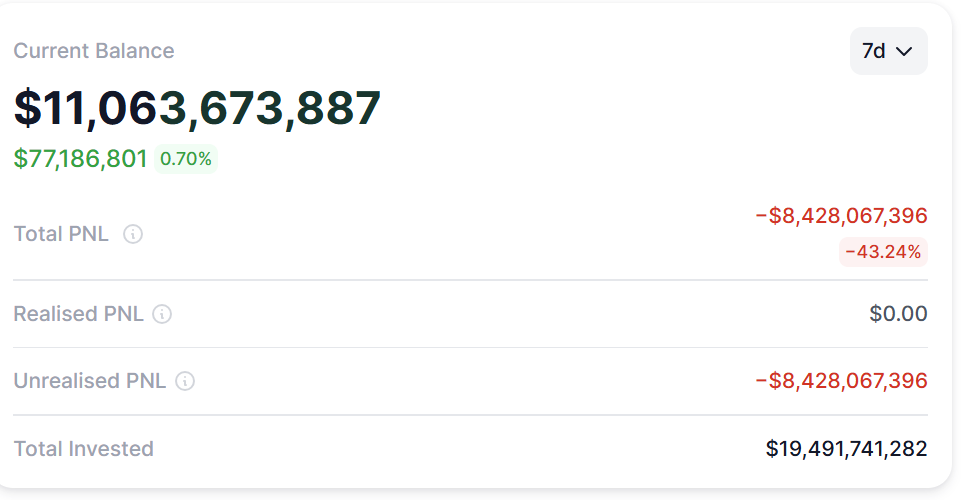
The company disclosed Monday that it acquired 9,926 Ether (ETH) during the week ending Aug. 16, bringing its total holdings to roughly 5.82 million ETH, or about 4.8% of Ethereum’s circulating supply. At an ETH reference price of $1,893, Bitmine’s Ether holdings were valued at roughly $11 billion. However, much of the company’s ETH was acquired at significantly higher prices.
Ether’s price was little changed on Monday, sitting just above $1,900.
The latest purchase puts Bitmine within striking distance of its long-term “Alchemy of 5%” target of holding 5% of the total ETH supply.
Bitmine’s conviction has been tested by a prolonged bear market for Ether, which has sharply eroded the value of its digital asset treasury. The company is sitting on more than $8.4 billion in unrealized losses on its ETH holdings, according to industry data.
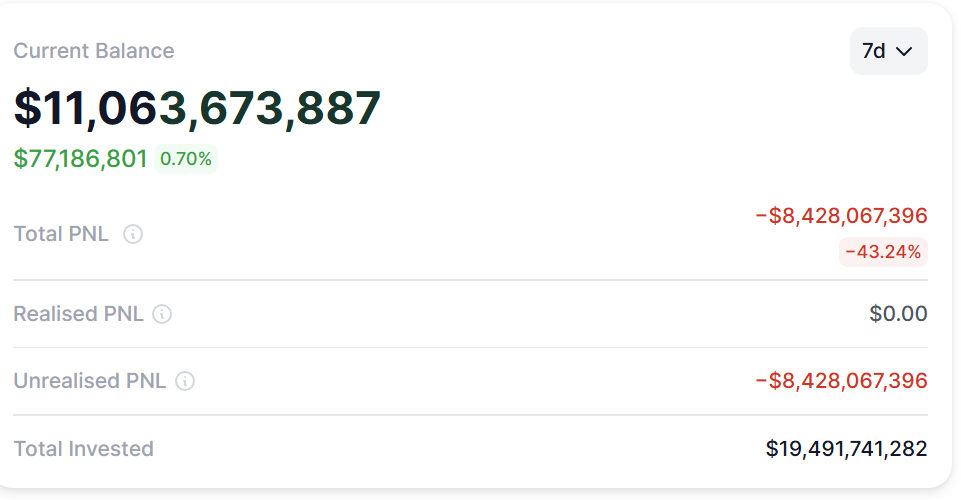
With a portfolio value of more than $11 billion, BitMine’s unrealized losses are around 43%. Source: DropsTab
Still, Bitmine has continued accumulating Ether, making purchases every week since launching its ETH treasury strategy in June 2025.
Related: Ethereum devs to narrow 66 proposals tied to Hegotá upgrade
Bitmine’s staked Ether approaches $10 billion in value
Although Bitmine is sitting on large unrealized losses on its Ether holdings, its staking operations continue to generate yield. The company said it is staking more than 5 million ETH, worth roughly $9.6 billion at current prices.
That staking has enabled Bitmine to earn protocol rewards for helping secure the Ethereum network, providing a predictable source of yield regardless of short-term ETH price movements. Based on a seven-day staking yield of 2.61%, Bitmine projects annualized staking rewards of roughly $287 million, according to Lee.
Related: Crypto Biz: Bitcoin’s $116M self-custody wake-up call


SafePal disclosed on Aug. 16 that a flaw in an order-tracking plug-in exposed the personal data of 39,798 customers, and a threat actor is already advertising the records for sale on a cybercrime forum. The file pairs home addresses and phone numbers with proof of hardware wallet ownership, which… Read the full story at The Defiant


Stripe has finalized an agreement to buy AI model gateway OpenRouter for more than $7 billion, Bloomberg reported Sunday, citing people familiar with the matter. Neither company has announced the deal, and a Stripe spokesperson told TechCrunch the company does not comment on rumors or speculation…. Read the full story at The Defiant
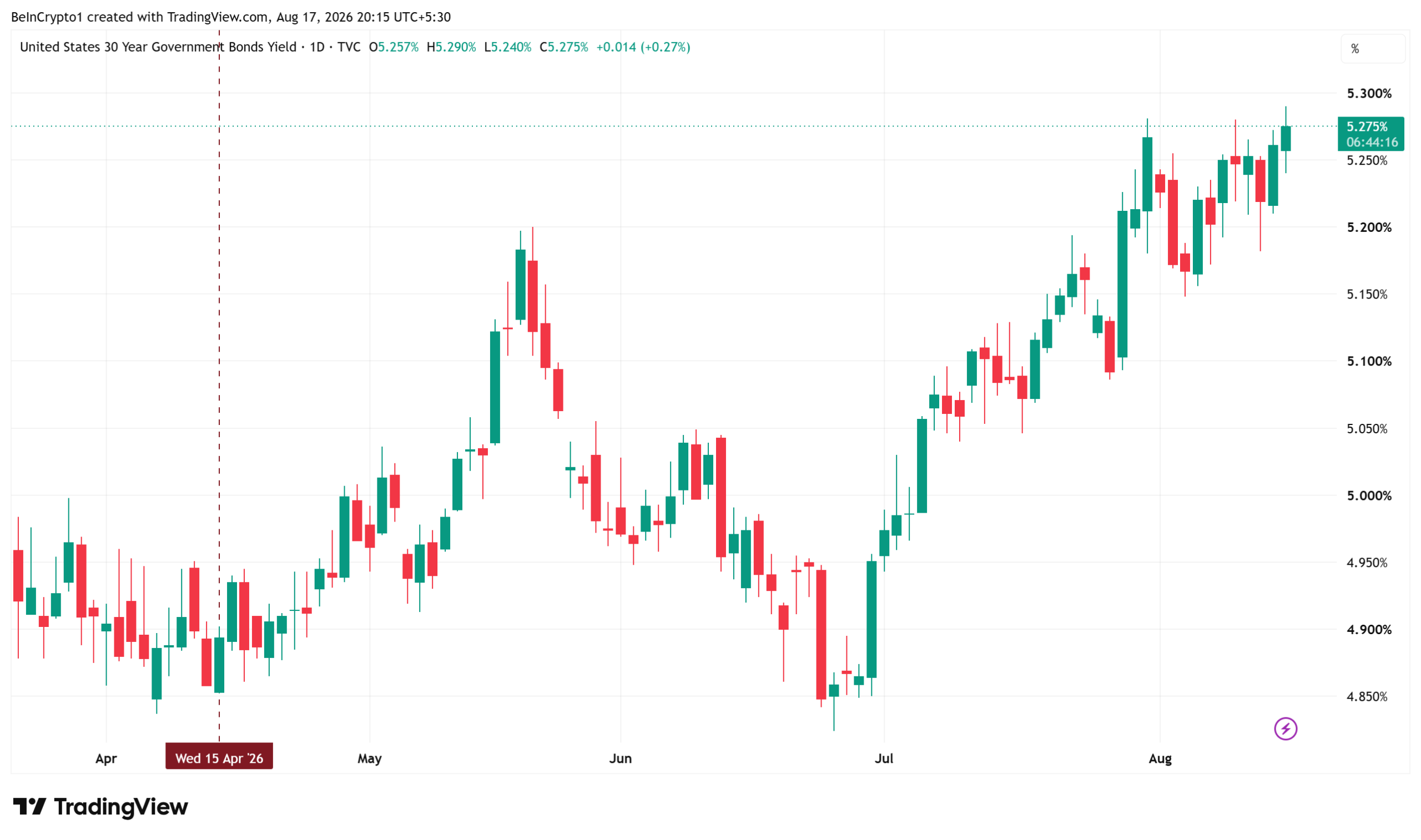
The US government now pays 5.27% to borrow for 30 years, the highest rate of 2026. Artificial intelligence (AI) companies are a large part of the reason. Bitcoin (BTC) is losing the fight for the same money.
Bitcoin trades near $63,517, down 46.1% over the past 12 months. Gold rose 32.6% in the same stretch. The gap between them is almost 79 percentage points.

AI Borrowing Now Competes With the US Treasury
Start with the trend. US technology companies used to sell about $61 billion of bonds a year. That is the five-year average, JPMorgan Asset Management said in July. In 2025 they sold $131 billion. By late July 2026 they had sold $192 billion.
One sector now accounts for 27% of all net investment-grade bond sales, by JPMorgan’s count. Across every US company, issuance reached $1.68 trillion through July. That tally comes from the Securities Industry and Financial Markets Association.
Here is why that matters. The buyers are the same pension funds and insurers that fund Washington. Nomura Securities estimates Big Tech borrowing now equals roughly 25% of Treasury net bond sales to private investors. A year ago the share was five times smaller.
“Whoever’s issuing, be it a government or a hyperscaler or a non-hyperscaler credit, is now competing with more borrowers. And therefore yields have to be higher,” Tony Rodriguez, head of fixed-income strategy at Nuveen Asset Management, in a statement to Bloomberg.
Follow us on X to get the latest news as it happens
Why Bitcoin Loses When Yields Rise
The mechanism is simple. Bonds pay interest. Bitcoin does not.
The 30-year Treasury yield closed at 5.25% on August 14, its highest level this year, Treasury Department data show. The 10-year sits at 4.68%, up 0.49 percentage points since January 2.
Bank of America economists attribute about 0.3 of that rise to corporate and mortgage bond supply. On those numbers, new debt supply explains roughly 60% of the move in the 10-year this year.
Corporate paper pays even more. Alphabet priced 30-year debt near 6.4% recently, about 1.15 points above comparable Treasuries, Bloomberg reported. A bond financing a Meta data center paid over 7.5% last month.
An investor can now earn 6% or 7% from two of the world’s most profitable companies. That is the bar Bitcoin’s price performance must clear. It has not cleared it since global bond yields climbed to 2008 levels.
The Treasury Cannot Sidestep It
Treasury Secretary Scott Bessent has tried to protect long-term rates by selling more short-term debt instead. Barclays estimated the shift would cut net supply of new Treasury notes and bonds by $440 billion this year.
AI borrowing filled that space and more. Barclays expects net corporate bond supply to grow by $474 billion, most of it from the tech giants.
Washington is not borrowing less either. The federal deficit hit $1.8 trillion in the first 10 months of fiscal 2026. That is $169 billion more than last year, the Congressional Budget Office said. Rising US debt interest costs add to it.
The AI bill is also mostly unpaid. JPMorgan Asset Management projects $5.5 trillion of AI capital spending through 2030. It expects $2.1 trillion of that to come from new bonds.
“That is a crowding-out effect. It is important to remember that we are just starting. This hyperscaler debt issuance story has really just begun,” Greg Peters, co-chief investment officer at PGIM, in a comment on Bloomberg Television.
Endless borrowing is the core of the Bitcoin scarcity argument. This year the argument has not paid. Gold took the money, and the 30-year Treasury yield record shows why. The next long-end auctions will test whether buyers have room for both.
The post AI Debt Lifts 30-Year Treasury Yield to 5.27%: Can Bitcoin Compete? appeared first on BeInCrypto.
At least one Wall Street analyst is skeptical that private equity firm Silver Lake will pull off a deal to acquire software maker Workday (WDAY). Workday stock popped on Feb. 13 amid reports of Silver Lake’s interest but has cooled off the next two trading sessions. In early 2026, Workday Cofounder and Executive Chairman Aneel Bhusri returned as chief executive…
Copyright ©2026 Investor’s Business Daily, LLC. All rights reserved. 87990cbe856818d5eddac44c7b1cdeb8


“DeFi is a remarkable innovation; however, it has achieved limited institutional adoption,” Schnarch said in a statement. “Current product offerings fall short of meeting the traditional finance bar, especially as it pertains to compliance and technical requirements.”
The move is a logical response to the shift in DeFi’s user base, according to Ran Hammer, chief business officer at Orbs.
“Retail participation is a fraction of what it was, and the chain has quietly become a venue for settlement, execution and interaction between financial institutions,” Hammer said. “Since DeFi summer, the space has turned into something completely different, essentially a new financial layer for institutions. So bringing in leadership that speaks that language is exactly the right direction.”
The size of the allocated budget, the largest approved by Compound’s decentralized autonomous organization (DAO), may help underline its commitment.
“The $52 million and a bench with that much institutional experience is a serious move, and it should improve its execution,” said Himanshu Sahay, co-founder and chief technology officer of crypto lending firm Arch Lending, but institutions will want more than credentials. They “aren’t underwriting teams, they’re underwriting structures.”
Crypto World
Sam Altman ChatGPT AI Predicts Bitcoin Could Be Entering Its Most Important 5 Months of 2026
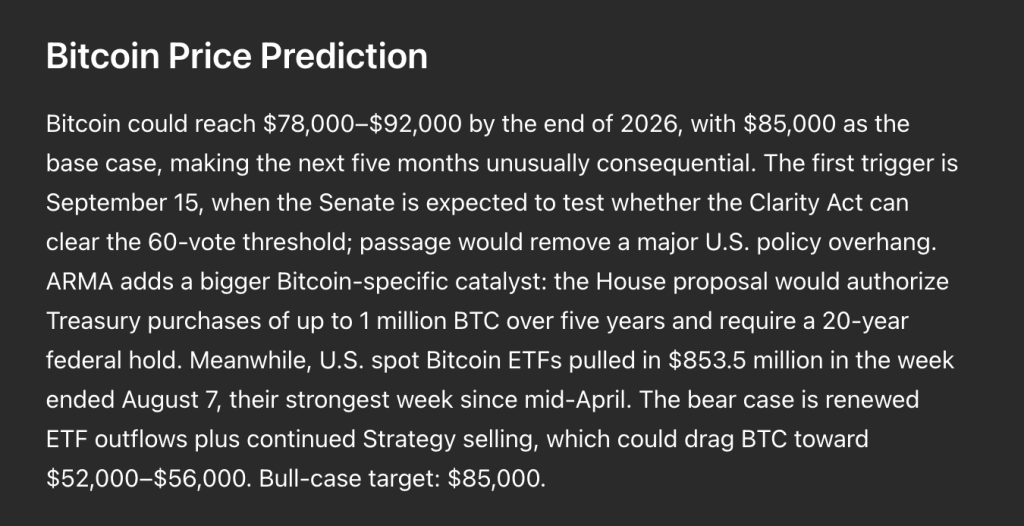
Two dates in Washington and one week of ETF flows explain why the calendar suddenly matters. ChatGPT AI predicts that the next five months will be unusually consequential, and the price prediction for Bitcoin runs from $78,000 to $92,000 by the end of 2026, with $85,000 as the base case.
September 15 is the first trigger. The Senate is expected to test whether the Clarity Act can clear the 60-vote threshold.
The passage would remove a major U.S. policy overhang. That alone changes the risk calculus for allocators who have stayed on the sidelines.

ARMA is the bigger Bitcoin-specific catalyst. The House proposal would authorize Treasury purchases of up to 1 million BTC over five years.
It also requires a 20-year federal hold on those coins. Buying at that scale with a two-decade lockup would remove supply permanently rather than temporarily.
Flows are already turning. U.S. spot Bitcoin ETFs pulled in $853.5 million in the week ended August 7, their strongest week since mid-April.
The bear case reverses that same picture. Renewed ETF outflows are the first pressure point.
Continued Strategy selling compounds it. Together, they could drag BTC toward $52,000 to $56,000.

Discover: Everyone’s Got a Take. Get Free $25 to Actually Trade Yours
Bitcoin Price Prediction: Five Months, Two Bills, And One Very Large Buyer
The weekly chart shows a cycle that has already peaked. Bitcoin topped near $126,000 in mid-2025 and has trended lower since.
Late 2025 broke the structure, taking the price from $120,000 toward $84,000. Early 2026 delivered the deepest leg down near $58,000.
Spring produced a recovery attempt to roughly $82,000. That failed by June, and the price returned to the low $60Ks.
Recent weeks have built a shallow base. Higher lows are forming, though without any strong upward push behind them.
The weekly close reads $63,078, down 2.74% and $1,780. The weekly range covered $62,470 to $65,333.
Support sits at $62,000, then $58,000 and $56,000 as the zone ChatGPT flags. Resistance appears at $70,000, then $80,000 and $92,000.
RSI reads 39.06 with its signal line just above at 39.32. The two lines have converged almost exactly, separated by roughly a quarter point.
That reading sits well below the midline and is near oversold. Momentum is weak, though the flattening suggests the decline is losing force.
ChatGPT’s base case sits 35% above this level. September 15 is the first date that tells you whether the market starts pricing it.
Discover: Your Market Calls Are Worth Something. Start with a free $25 on Kalshi
If September 15 Is the Trigger, Kalshi Lets You Trade the Decision Before Bitcoin Reacts
Bitcoin holders are waiting for Washington to move first. Kalshi gives traders a way to take a position on the event itself.
The platform lets users trade on real-world outcomes across politics, economic data, Fed decisions, crypto, and other market-moving events. That matters when the Bitcoin thesis is increasingly tied to specific dates rather than vague expectations.
If the market is watching whether legislation clears Congress, whether policy shifts, or whether another macro catalyst lands, Kalshi turns that uncertainty into a tradable probability. You are no longer forced to buy BTC and hope the eventual reaction matches your thesis. You can trade the outcome directly.
With September 15 now shaping up as one of Bitcoin’s most important near-term dates, that distinction matters.
Eligible new users who sign up through CryptoNews can also receive $25 through our referral link.
The post Sam Altman ChatGPT AI Predicts Bitcoin Could Be Entering Its Most Important 5 Months of 2026 appeared first on Cryptonews.
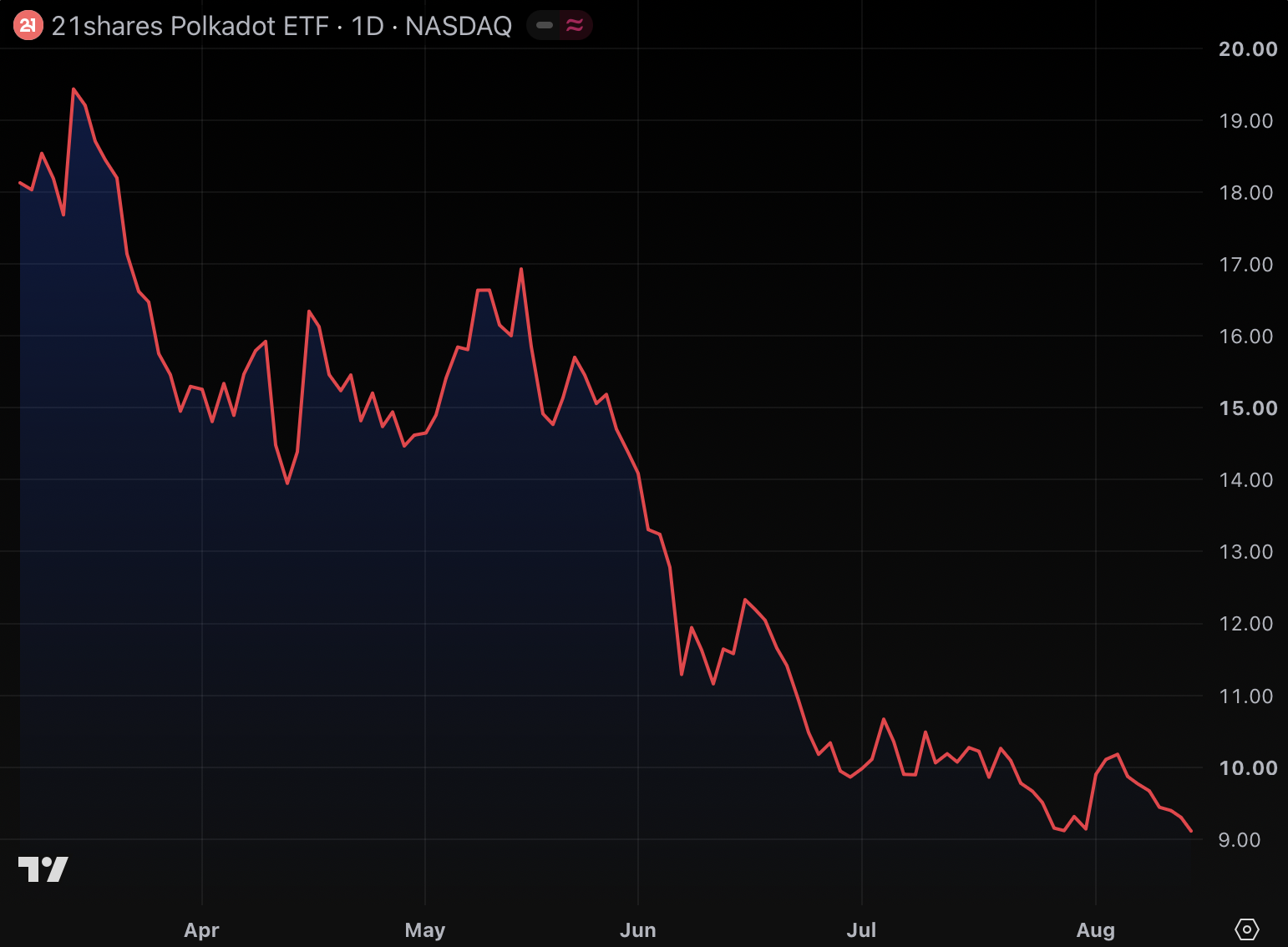
On Friday, the 21Shares Polkadot ETF (TDOT) reported that it realized $4.52 of loss per share by selling Polkadot (DOT) tokens to make each $1 per share of staking payouts last quarter.
The fund sold 98,505 DOT last quarter to generate $107,510 of cash payments to shareholders. Those sales finalized losses of $485,553 due to the dramatic decline of DOT.
Specifically, the price of DOT declined 34% during Q2 2026. For the 12 months ending June 30, 2026, DOT declined 76%.
TDOT shareholders do not actually receive staking rewards denominated in DOT. Instead, the fund must sell DOT to mimick and provide the corresponding staking rewards in USD for its shareholders.
All things considered, the payout is embarrassing. Holding TDOT from April through June this year entitled shareholders $0.146980 per share of payouts, which certainly did not compensate for the fund’s 34% share price decline from $14.95 to $9.86.
This is, of course, not any particular fault of 21Shares but rather the fault of DOT itself, which continues to fall out of favor with investors.
DOT was supposed to power parallelized execution capable of roughly 1 million transactions per second across up to 100 parachains, an ‘internet of blockchains’ with shared security, and seamless cross-chain interoperability.
In practice, total value locked across all parachains sits at less than $100 million, and DOT trades near 97% below its all-time high as investors find more utility elsewhere.
Paying out staking rewards crystallizes DOT losses
TDOT records cash payouts as a distribution of staking income. Nothing in the filing hides the mechanism by which it realized losses, and shareholders cannot interpret the cause of this $485,553 loss as unrelated to generating staking payouts.
Indeed, the trust unambiguously states, “Aggregate distributions of $107,510 or $0.146980 per share reduced the Trust’s DOT holdings through the sale of DOT to generate cash.”
That crystallized more than four dollars of permanent loss for every $1 it distributed.
By comparison, four peer crypto staking funds disclosed a realized loss in Q2, yet none lost more than $0.89 per $1 distributed. Respectively, Invesco’s Galaxy Solana fund realized $0.89 of loss, the same sponsor’s Solana fund disclosed $0.74 of loss, its Sui fund finalized $0.31, and BlackRock’s staked ether fund reported $0.25.
Read more: Where are the Ethereum founders 11 years after the genesis block?
Realizing losses as Polkadot continues to crash
Shareholders, not these sponsors, bear those losses. The entities behind these funds make money running their products, regardless of the price of crypto.
Specifically, TDOT names 21Shares US LLC as the fund’s sponsor, wholly owned by 21co Holdings Limited. Crypto prime broker FalconX finished buying that parent in November 2025. CEO Russell Barlow and President Duncan Moir signed the quarterly report on August 14.
The trust’s original backer was the Web 3.0 Technologies Foundation, the Swiss entity behind Polkadot. It seeded the fund in January 2025 with DOT worth about $53 million, or roughly $88 per share. Shares closed Q2 at $9.86 per share.
Sadly, selling DOT to generate cash for staking reward payouts was not even the quarter’s most expensive liquidation. Instead, outright redemptions from investors who wanted out of the fund forced the trust to realize another $1.76 million of loss during the quarter.
Moreover, selling DOT to pay its own ‘sponsor fee’ cost $253,417. Total realized losses for the quarter totaled $2.5 million.
The first distribution, $0.090846 per share, carried a May 14 record date and paid the next day. The second, $0.056134 per share, followed with a June 29 record date, a shrinking payout on a shrinking asset.
Both landed inside a quarter in which DOT fell 34%. The coin slid from $1.25 on March 31 to $0.82 on June 30.
Competition is thinning rather than growing. Grayscale withdrew its own Polkadot ETF registration on August 7, and crypto ETF net asset values are down across the board since early 2025.
Got a tip? Send us an email securely via Protos Leaks. For more informed news and investigations, follow us on X, Bluesky, and Google News, or subscribe to our YouTube channel.


Ethereum treasury company Bitmine Immersion added more of the token to its balance sheet, bringing its total holdings up to 5.815 million tokens.
In an announcement Monday, the company led by Chairman Tom Lee said it bought another 9,926 ETH last week, continuing its streak of weekly buys that began in June 2025 when the company launched.
Bitmine, which trades under the ticker BMNR, now holds 4.8% of ETH’s total supply with its tokens worth about $11 billion at the current price of $1,904.
Lee said the ETH/BTC ratio has broken above a years-long downward trend, which he sees as a sign that investors are starting to price in growing demand for Ethereum from tokenization and AI-agent applications.
On the macro front, he expects “easing financial conditions to be a tailwind for crypto,” he said in a statement.
ETH is up about 1.6% over the past 24 hours while BMNR is trading more than 2% higher today.
The company also bought an additional 1.7 million shares of its own stock last week, now owning 20.8 million shares under a previously authorized $4 billion buyback program.

Kate Walsh Moved Back to U.S. After Relocating to Australia

Inside Hayden Panettiere’s many heartbreaks: From doomed union with much-older Milo Ventimiglia to custody drama with Wladimir Klitschko

BECU Credit Union Down? Users Report Outage as Downdetector Sees Spike in Complaints This Monday Afternoon


-

 Fashion3 days ago
Weekend Open Thread: Ann Taylor
-
 NewsBeat6 days ago
Communication cards help banking customers access services or report scams
-
 Business7 days ago
Oil Price Today (August 11): Crude oil rises to $88 after Trump’s compensation demand dents Hormuz opening. Here’s why
-

 Crypto World7 days ago
Revolut wins French banking licence, creates second EU banking hub
-
 Sports4 days ago
This U.S. Amateur is a glimpse into golf’s future in more ways than you think
-
 Crypto World7 days ago
Why Did Nvidia Stock Fall on Monday Despite a $500 Billion Wall Street AI Deal?
-

 Sports3 days ago
Birmingham 2026: Day 6 Timetable for Irish Athletes
-
 NewsBeat2 days ago
Myanmar says over 300,000 Rohingya refugees verified for repatriation as exodus enters ninth year
-
 Entertainment5 days ago
Keke Palmer Subtly Hints At Sean Evans Drama With Cryptic Post
-

 Politics2 days ago
SEQ Code: The Three Letter Boarding Pass Code That Could Give You The Worst Seat
-

 Fashion7 days ago
Can You Wear Double Cloth Gauze Clothing To Your Office?
-
 Entertainment7 days ago
57 Years Later, the Best Sitcom Ever Made Still Deserves a Reboot
-

 Fashion6 days ago
Coffee Break: The Fonteyn Jane Flat
-
 Crypto World7 days ago
Hormuz Nerves Cost Bitcoin $65,000 Mark Despite Solid Institutional Flows
-

 Tech6 days ago
Zoom Screen-Sharing Bug Let People Fully Take Over Other Devices On A Call
-

 Crypto World7 days ago
Bitcoin's BIP Editors Remove Luke Dashjr Two Days After BIP-110 Fork Stalled
-

 Fashion6 days ago
Claire Life: Kicking Off MVAAFF With the C Suite Luncheon Featuring Phylicia Rashad, Letoya Luckett, and More!
-

 Fashion6 days ago
Should you refinance your debt? Pros, cons, and real numbers
-
 Crypto World5 days ago
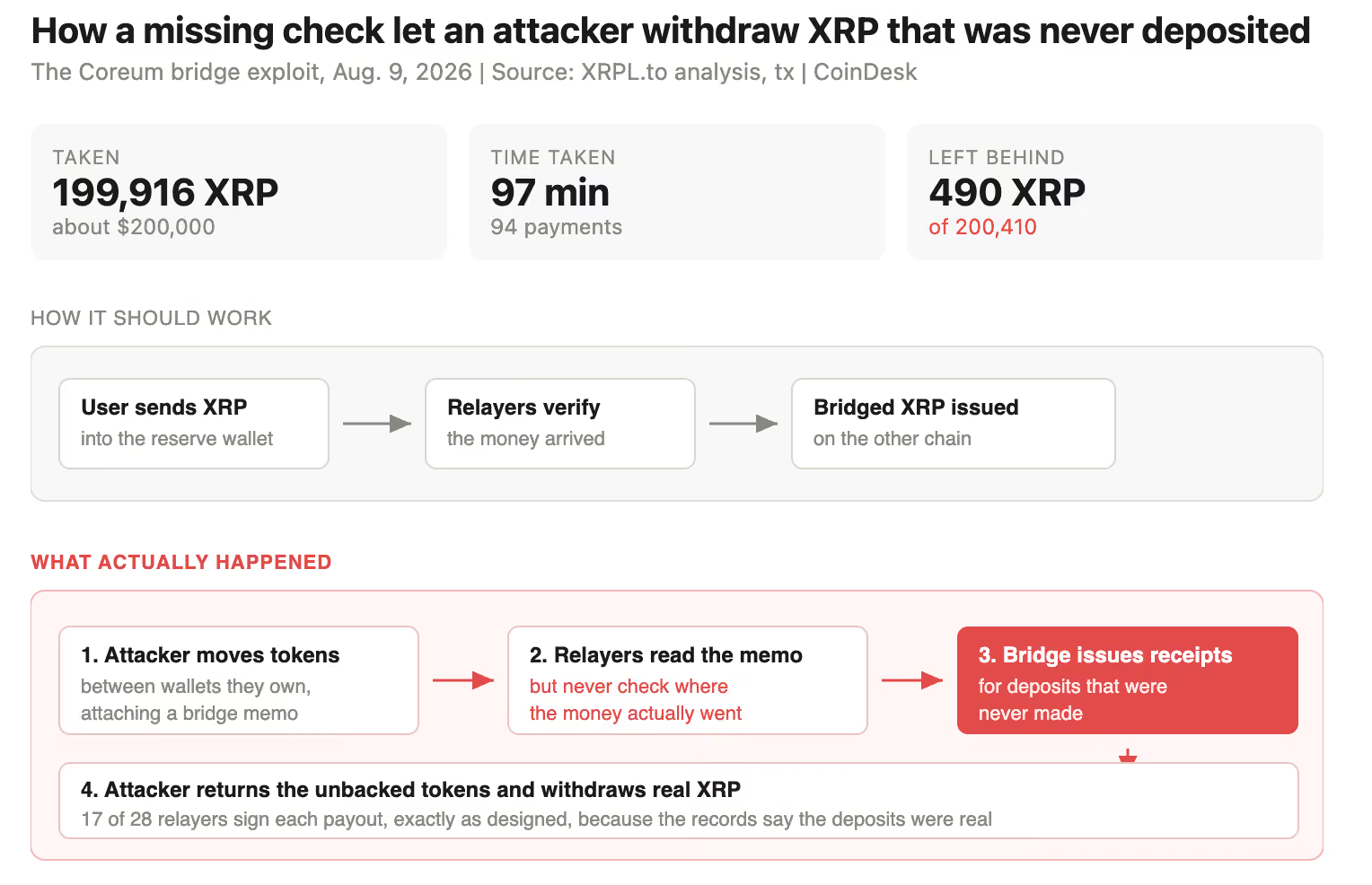
XRP bridge drained after software mistook fake deposits for real ones
-

 Sports5 days ago
DeQuan Jones in ‘high spirits’ after successful leg surgery
You must be logged in to post a comment Login