

Crypto World
Lagarde Says Stablecoins Will Not Strengthen Euro’s Global Role

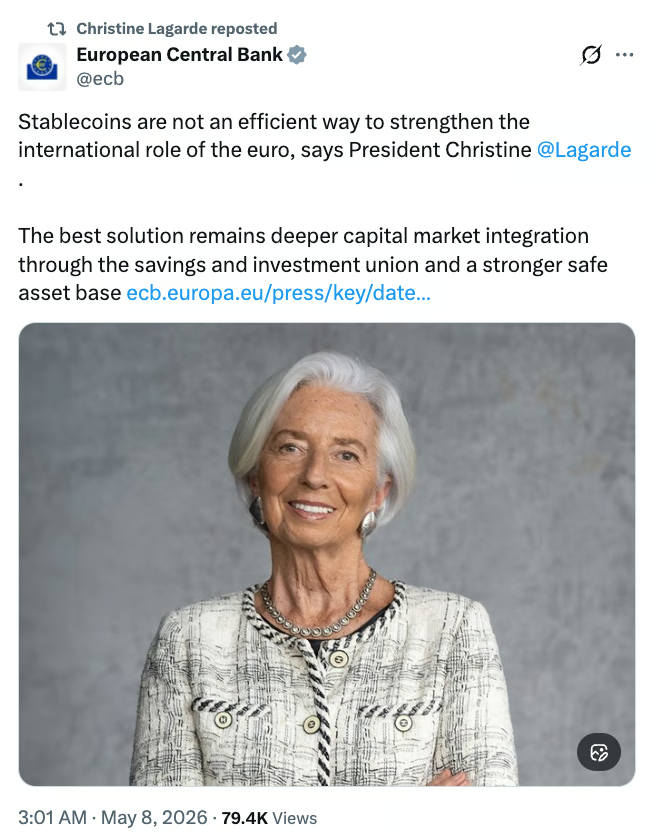
European Central Bank (ECB) President Christine Lagarde said stablecoins are not Europe’s best route to strengthening the euro’s international role, pushing back against calls to respond to US dollar-backed stablecoins with euro-denominated tokens.
Speaking on Friday at the Banco de España LatAm Economic Forum in Roda de Bará, Spain, Lagarde made several comments on the role of stablecoins in the European economy. “It is no longer about whether stablecoins should exist, but whether jurisdictions can afford to be without them,” she said, arguing that the case for promoting euro stablecoins becomes less clear once their two core functions are separated.
“The benefits attributed to them [stablecoins] rest on two distinct functions — a monetary function and a technological function — that are systematically conflated in the current debate,” Lagarde said.
The speech lays out one of Lagarde’s clearest arguments yet against treating euro stablecoins as Europe’s answer to US dollar-backed stablecoins, which currently dominate the market with a roughly 98% share. The US has been promoting dollar stablecoins as a way to support the US dollar as a global reserve currency. Instead, she said Europe should build tokenized financial infrastructure anchored by central bank money, including the Eurosystem’s Pontes project for wholesale settlement and the Appia roadmap for an interoperable European tokenized finance ecosystem.
Monetary function: Possible upside, but clear trade-offs
However, Lagarde said that euro-denominated stablecoins operating under the European Union’s Markets in Crypto-Assets Regulation (MiCA) “could generate additional global demand for euro-area safe assets.”
She stressed that this comes with significant trade-offs, including financial stability risks such as fund runs and reserve fragility, and weaker monetary policy transmission if deposits move out of banks.

Source: Christine Lagarde
Lagarde pointed to the 2023 collapse of Silicon Valley Bank, when Circle’s USDC stablecoin briefly fell below its peg after revealing exposure to the bank, as an example of how quickly confidence can weaken.
She said such episodes show how redemption pressures can spill into underlying asset markets and, as stablecoin use grows, create feedback loops between redemptions and prices, particularly where issuers are not banks.
Technology function: Stablecoins are not the only solution
On the technology side, Lagarde acknowledged the role of stablecoins in cross-jurisdictional financial market infrastructure that is accessible “without relying on a maze of legacy intermediaries.”
However, she said that this technological function is not unique to stablecoins. Other forms of tokenized money, including commercial bank deposits or central bank money, could perform the same role within distributed ledger systems, Lagarde said.
“The answer […] does not lie in rejecting technology or discouraging stablecoins altogether. Instead, we must build the public infrastructure that will enable alternative instruments, such as stablecoins and other forms of tokenised money, to operate within a framework anchored by central bank money.”
Lagarde said the EU response is to facilitate wholesale settlement in central bank money through its Pontes project, which links distributed ledger platforms to the Eurosystem’s existing settlement infrastructure, allowing DLT-based transactions to be settled directly in central bank money.
Related: Stablecoin adoption to scale on back of big tech firms: Bitwise
She added that the Appia roadmap, published in March, goes further and outlines a plan for a fully interoperable European tokenized financial ecosystem by 2028.
“Europe knows which port it is sailing to,” she said, adding: “Our task is not to replicate instruments developed elsewhere, but to build the foundations and the infrastructure that serve our own objectives, so that we can harness the benefits of innovation without importing the fragilities.”
Magazine: Guide to the top and emerging global crypto hubs: Mid-2026



Hong Kong’s SFC flags HabitTrade in a warning on unlicensed virtual asset platforms, but the broker insists it hasn’t done regulated business or marketed services to Hong Kong investors and blames unauthorized third‑party promoters.
Summary
- Hong Kong’s Securities and Futures Commission (SFC) has warned investors about unlicensed platforms and recent promotional activity referencing HabitTrade.
- In response, HabitTrade says it is a licensed Australian brokerage and “has not conducted any regulated business in Hong Kong,” nor marketed such services to the Hong Kong public.
- The firm blames third-party promoters for unauthorized content using its brand and says it may pursue legal action, underscoring how tight Hong Kong’s virtual asset rules have become.
HabitTrade has pushed back against an investor alert from Hong Kong’s Securities and Futures Commission, saying it does not carry out regulated activities in the city and has not marketed its services to Hong Kong residents. In a statement posted on X, the brokerage said it “is a licensed Australian brokerage and compliant financial services platform” and that it “has not conducted any regulated business in Hong Kong, nor promoted or provided related services to the public in Hong Kong,” directly disputing any suggestion that it is operating there without authorization.
The clarification comes after the SFC published a notice reminding the public to be wary of “unlicensed platforms and related market promotional activities,” explicitly flagging HabitTrade in the context of suspicious marketing around virtual asset trading. While the regulator’s latest web alert does not yet list HabitTrade by name on its public “suspicious virtual asset trading platforms” page, the SFC has regularly used such notices to call out firms it believes may be targeting Hong Kong investors without a license. In an earlier circular on crypto products, the SFC warned that dealing in virtual asset futures or routing related orders for Hong Kong clients is a “Type 2” regulated activity and “requires a license from the SFC regardless of whether the business is located in Hong Kong.”
HabitTrade argues that any recent marketing push is not coming from the company itself. The broker said that “some third-party promotional content, video materials, and platform traffic diversion activities that have recently appeared in the market do not represent the official position of HabitTrade,” adding that it “reserves the right to trace and take legal action against any misleading promotions and violations using its brand, technological channels, or partnerships without authorization.” The firm also pledged to “adhere to a compliance-first approach and cooperate with the regulatory requirements of relevant jurisdictions to conduct necessary investigations,” signaling that it is prepared to work with authorities to identify promoters it says are misusing its name.
The dispute highlights how aggressive Hong Kong’s enforcement stance around virtual assets has become. In 2023, the SFC warned unlicensed virtual asset trading platforms that making false claims about license applications or offering prohibited services such as staking could constitute a criminal offence under the Anti‑Money Laundering and Counter‑Terrorist Financing Ordinance. In February 2024, the regulator and local police jointly warned about an alleged scam using the name of MEXC, putting the platform on its alert list and reiterating that overseas exchanges cannot market or serve Hong Kong retail users without a license, as crypto.news reported in a detailed story.
Those rules have only tightened. A recent crypto.news story on Hong Kong’s upcoming stablecoin and virtual asset regime noted that the city is building out parallel licensing systems for exchanges, custodians, dealers and advisers, and making it explicit that any foreign platform “targeting” Hong Kong investors via marketing or website localization is within scope. Against that backdrop, HabitTrade’s insistence that it has done no regulated business in Hong Kong is as much about legal risk as it is about reputation: under current SFC guidance, even the perception of soliciting Hong Kong users without a license can be enough to land a platform on the regulator’s alert list, with all the banking and counterparties problems that follow.


MegaETH has activated a MEGA token buyback program funded entirely by net revenue from its USDm stablecoin, turning Treasury‑backed yield into a standing bid for its “real‑time Ethereum” L2 token after a sharp post‑launch selloff.
Summary
- The MegaETH Foundation has kicked off a MEGA token buyback program, completing its first purchase using all net earnings generated by USDm through the end of April.
- USDm’s current supply is about $480 million, and future MEGA buybacks will run programmatically, with size determined by USDm supply and yield on its reserve assets.
- The foundation stresses that USDm is not issued or operated by MegaETH or MegaLabs, even as its revenue stream becomes a core economic engine for MEGA demand.
The MegaETH Foundation says its MEGA token buyback plan is now live, with the first repurchase funded entirely by net earnings from USDm accumulated through the end of April. In an announcement on X, the foundation said it had “completed the first MEGA buyback using all net income generated by USDm’s issuer as of April 30,” framing the move as the start of an ongoing demand loop where the ecosystem’s stablecoin revenue is recycled into the native token.
MEGA buyback goes live, tied directly to USDm revenues
Importantly, the foundation reiterated that “USDm is not issued or operated by the MegaETH Foundation or MegaLabs,” clarifying that the stablecoin’s issuer is a separate entity even though its economics are tightly coupled to MEGA. USDm is a yield-bearing stablecoin built on Ethena’s USDtb rails, with reserves primarily invested in BlackRock’s tokenized U.S. Treasury fund BUIDL via Securitize, alongside liquid stables for redemptions. Those reserves generate a predictable yield, which flows to the USDm issuer and, under the new scheme, is then used as the funding source for MEGA buybacks.
CoinMarketCap’s overview of MegaETH notes that the MEGA token has a fixed supply of 10 billion and is used for gas, staking and governance within the “real-time Ethereum” L2, which targets sub-millisecond latency and over 100,000 transactions per second. By tying MEGA buybacks to USDm’s revenues, the foundation is effectively turning stablecoin growth and on-chain economic activity into a direct support mechanism for MEGA’s price and scarcity.
Programmatic buybacks, variable size, and market impact
According to the foundation, future MEGA buybacks will be executed “as programmatically as possible,” running automatically according to preset rules instead of being manually timed by the team. The size of each operation “will not be fixed,” it said, but will depend on “changes in USDm supply and the yield of the underlying reserve assets,” meaning that as USDm circulates more widely and its Treasury-backed yield rises or falls, the buyback firepower will adjust in tandem.
Earlier this year, the MegaETH Foundation outlined a broader economic model in which USDm functions as an “economic engine” for the L2: yield from its reserves is used to subsidize sequencer costs and network fees and, now, to fund ongoing MEGA purchases from the market. MEXC’s summary of the plan notes that USDM (often stylized as USDm) “is backed by Ethena and BlackRock’s BUIDL fund,” and that the project will “trigger MEGA token generation based on KPIs” such as reaching $500 million in USDm circulation, launching 10 apps on MegaETH, or having at least three apps generate $50,000 in fees for 30 consecutive days. DefiLlama data show USDm’s broader MegaETH stablecoin stack now has a market cap of about $810.6 million, with USDm itself accounting for roughly 58% dominance, implying a USDm supply in the neighborhood of $470–$480 million.
The timing of the first buyback is notable. AInvest reported that MEGA fell about 38% from its April 30 launch price to $0.138 amid heavy post‑TGE selling pressure from early participants. CoinMarketCap’s explainer on MegaETH says the ecosystem was designed from the outset to “use its native stablecoin’s reserve yield to fund MEGA buybacks,” positioning this week’s announcement as the moment when that theoretical flywheel actually starts to spin. If USDm continues to grow and on-chain yields remain robust, the programmatic buyback mechanism could become a persistent marginal buyer of MEGA in secondary markets, linking the token’s long-term value more tightly to real usage and stablecoin demand rather than one-off hype cycles.


Pi Network (PI) trades around $0.19 with most quant models pinning it in a cramped $0.12–$0.20 band through 2026 as token unlocks, patchy listings and soft demand keep any meaningful upside firmly capped.
Summary
- Pi Network (PI) is trading around $0.19 today, with a live market cap near $1.88 billion and 24‑hour volume of about $25–26 million.
- Quant models mostly see PI stuck in a $0.12–$0.18 range through 2026, with a base‑case year‑end target around $0.13–$0.18—down modestly from current levels.
- Recent and upcoming token unlocks, combined with tepid demand and limited exchange access, are keeping a lid on price even as open mainnet and ecosystem promises remain in place.
Where PI trades today
Pi Network (PI) is currently changing hands at about $0.1898, according to the Pi Network price page on crypto.news, with 24‑hour volume near $25.47 million and a market capitalization of roughly $1.88 billion. That puts PI at rank 46 by market cap, with a fully diluted valuation of about $2.89 billion based on a 100 billion maximum supply.
Other trackers line up in the same band. CoinGecko quotes PI at $0.1702 with a 24‑hour volume of around $22.9 million and a 7.7 billion circulating supply figure, implying a market cap closer to $1.31 billion. Crypto.com shows a spot price of $0.1699, down about 4.97% on the day and 9.21% over the week, and Kraken’s listing has PI at $0.17 with a 5.86% 24‑hour drop. The slight discrepancies stem from different circulating‑supply assumptions and which IOU versus mainnet markets each site tracks.
2026 outlook: narrow range, modest downside bias
Model‑driven forecasts lean cautious. CoinCodex, summarized in a recent Capital.com analysis, pegs PI’s current reference price at about $0.1726 and projects an end‑2026 level of roughly $0.1316—about 25% below that mark. Its table shows a 2026 trading range between $0.1207 and $0.1760, with sentiment flagged as “bearish,” a neutral 14‑day RSI of 50.83, and PI sitting below its 200‑day SMA of $0.1966 but near its 50‑day SMA of $0.1768.
Gate’s research desk, also cited by Capital.com, is slightly more constructive. It estimates an average PI price around $0.2082 for 2026, with a band between roughly $0.1582 and $0.2706, arguing that current levels sit near the center of its modeled range. Binance’s dedicated Pi Network prediction page is more short term, projecting daily values in a tight $0.175–$0.176 corridor for early May 2026 and an incremental climb toward roughly $0.223 by 2031, implying a 27–30% gain over five years.
Crypto.news took a longer perspective in its Pi coin 2030 story, noting that PI sat near $0.20 in late 2025 with high volatility and that 2030 forecasts spanned from fractions of a cent to around $1 depending on assumptions about exchange listings, token unlocks and real‑world utility. That piece made two blunt points: a $1,000 target is fantasy, and even $1 requires a combination of full open‑mainnet adoption, sustained app growth and much broader listings than exist today.
Token unlocks, weak demand and key risks
The immediate headwind is supply. A February 2026 crypto.news story highlighted that PI had “crashed for three consecutive days” and was hovering near all‑time lows ahead of a big token unlock. Data from PiScan cited in that piece showed that roughly 205 million tokens—worth over $27 million at the time—were scheduled to be released over the remainder of the month, including more than 37 million in just two days. The article argued that with demand waning, those unlocks were likely to push price toward $0.10, especially as macro data (strong U.S. jobs numbers) kept rate‑cut hopes in check and weighed on risk assets broadly.
The structural uncertainty goes beyond any one unlock. As the 2030 story stressed, a huge share of PI remains locked, KYC completion is uneven, and exchange access is still partial, which makes price discovery messy and amplifies slippage when large holders move. Capital.com’s forecast roundup points to the same issues: future performance depends heavily on how and when more tokens enter circulation, how the project manages sell pressure from early miners, and whether it can convert its large nominal user base into on‑chain activity that justifies a richer multiple.
Taken together, the base case for 2026 is not a moonshot but a grind: most quantitative models cluster PI somewhere in the $0.12–$0.20 area, with a slightly negative skew from today’s ~$0.19 and wide uncertainty bands tied to unlock schedules and liquidity. If listings broaden and actual usage ramps, you can make a case for the upper ends of those ranges. If unlocks keep outrunning demand, the path toward $0.10 that crypto.news flagged in February may not be finished yet.

TLDR:
- ETH stays below the $2,400 resistance as repeated rejections signal weak bullish momentum overall
- Ethereum DEX volume drops 53% in six months, while DApp revenue declines nearly 49% sharply
- Solana and Hyperliquid now capture about 42% of total DApp revenue, shifting market activity
- ETH underperforms the market with 21% yearly decline compared to the broader crypto drop of 11%
Ethereum price warning signs are becoming more pronounced as the asset struggles with a weak price structure and declining ecosystem activity.
Persistent resistance, falling transaction volumes, and rising competition suggest shifting market behavior around Ethereum’s role in crypto markets.
Ethereum Price Warning Signs Intensify as Market Structure Weakens
Ethereum, once the dominant force in decentralized finance, is now showing signs of reduced momentum across multiple layers of its ecosystem.
ETH has remained below the $2,400 resistance level for nearly three months. Each attempt to break higher has been met with rejection, reflecting limited buying strength and persistent selling interest.
This weakness becomes more visible when compared to the broader market. While the overall crypto sector has declined around 11% year-to-date, Ethereum has dropped approximately 21%, signaling deeper relative underperformance.
In previous cycles, Ethereum acted as the primary liquidity engine for the market. Capital rotated through its ecosystem during periods of expansion, driven by DeFi growth, NFTs, and token issuance activity.
A market observer noted on X: “Ethereum price warning signs are increasingly linked to ecosystem slowdown rather than short-term volatility.”
Declining Ecosystem Activity and Rising Competition Pressure ETH
On-chain metrics show clear signs of weakening network engagement. Ethereum decentralized exchange volume has fallen roughly 53% over the past six months, indicating reduced trading activity across DeFi protocols.
DApp revenue has also declined nearly 49% during the same period. Since Ethereum relies heavily on transaction fees, lower protocol income reflects reduced user participation across its ecosystem.
Memecoin activity, which previously contributed significantly to network traffic, has also cooled. Lower speculative issuance has reduced transaction density and fee generation across Ethereum applications.
This shift has directly affected Ethereum’s economic model, which depends on sustained demand for block space. Reduced activity means fewer transactions and lower overall network utilization.
Another X-based commentary stated:
“Falling speculative activity has reduced Ethereum’s transaction-driven revenue cycle.”
At the same time, competition from alternative chains continues to expand. Solana has strengthened its position as a high-speed, low-cost trading environment, attracting consistent retail participation.
Hyperliquid is known for optimizing execution speed and user experience in derivatives trading. These platforms are increasingly capturing active users who once primarily operated on Ethereum.
Combined, Solana and Hyperliquid now account for about 42% of the DApp revenue share. This shift reflects a broader redistribution of economic activity across blockchain ecosystems.
Ethereum still maintains leadership in total value locked, supported by institutional trust and long-established DeFi infrastructure. However, large capital reserves do not always reflect active user engagement.
As Ethereum price warning signs continue to build, attention remains on whether the network can restore activity levels or continue ceding ground to faster-moving ecosystems.

Key Takeaways
- A markup hearing for the Digital Asset Market Clarity Act has been scheduled by the Senate Banking Committee for May 14
- Progress on the legislation halted earlier this year when Coinbase withdrew its backing due to concerns over stablecoin yield restrictions and DeFi provisions
- Senators Tillis and Alsobrooks negotiated a compromise on stablecoin yield regulations last week
- Major banking organizations remain skeptical and argue the bill requires additional refinement
- Senator Gillibrand is pushing for ethics safeguards to prevent government officials from profiting from crypto holdings
The Senate Banking Committee has officially scheduled May 14 for its markup session on the Digital Asset Market Clarity Act of 2025, commonly referred to as the Clarity Act. The proceedings are set to commence at 10:30 a.m.
This represents a critical milestone in the legislative journey of the bill. During a markup session, committee members examine, debate, and cast votes on proposed legislation prior to advancing it to the complete Senate chamber.
The legislation has experienced significant turbulence over recent months. Back in January, Coinbase CEO Brian Armstrong publicly announced the cryptocurrency exchange was withdrawing its endorsement. Armstrong cited multiple issues, including insufficient legal safeguards for developers working on open source software, prohibitions on stablecoin yield generation, and problematic decentralized finance regulations.
This withdrawal effectively brought the bill’s momentum to a standstill for several months.
Last week marked a turning point when Senators Thom Tillis and Angela Alsobrooks unveiled compromise language designed to resolve the stablecoin yield controversy. Under the proposed compromise framework, cryptocurrency platforms would be prohibited from paying yield on passive stablecoin reserves, while permitting rewards when stablecoins participate in active financial transactions.
Coinbase’s response to this development was enthusiastic. Paul Grewal, the company’s chief legal officer, shared on X: “It’s on like Donkey Kong.” Meanwhile, Faryar Shirzad, chief policy officer, characterized it as a “big step forward” and emphasized the bill’s critical importance for consumer protection and maintaining America’s leadership in crypto innovation.
Senator Cynthia Lummis, recognized as a prominent cryptocurrency advocate in the Senate, also expressed support, declaring on X: “Let’s pass the Clarity Act out of the Banking Committee on Thursday!”
Traditional Banking Sector Voices Reservations
Universal support remains elusive. A joint letter from multiple banking industry associations — including the American Bankers Association, the Bank Policy Institute, and the Independent Community Bankers of America — stated that “additional work is needed” on the bill’s wording. These organizations submitted detailed recommendations for modifying the compromise language unveiled last week.
Neverthstanding these reservations, the fact that a markup has been scheduled indicates Senate leadership is prepared to proceed with the legislation in its present form.
Debate Over Ethics Requirements Continues
Senator Kirsten Gillibrand, who has historically championed the cryptocurrency sector, has introduced an additional consideration. She is advocating for language in the bill that would prohibit senior government officials from financially benefiting from the crypto industry while simultaneously holding regulatory authority over it.
Polling data commissioned by CoinDesk revealed that 73% of registered US voters favor such restrictions.
Nevertheless, this ethics provision may be absent from the Senate Banking Committee’s iteration of the legislation. Following the Banking Committee’s markup process, the Senate must reconcile its version with the text produced by the Senate Agriculture Committee before the complete Senate body can hold a final vote.
Kara Calvert, Coinbase’s vice president of US policy, had forecast the markup timing during remarks at the Consensus 2026 conference just days prior. She additionally observed that the bill will require a minimum of 60 votes and bipartisan cooperation to secure passage.
Crypto World
This Week in Crypto: $1M Bitcoin Forecast, Senate CLARITY Vote, and Coinbase Losses Mount
Key Highlights
- Matthew Sigel from VanEck forecasted Bitcoin reaching $1 million over the next five years, drawing parallels to the video gaming sector’s expansion
- The Senate Banking Committee has scheduled May 14 for CLARITY Act deliberations, aimed at establishing clear definitions for crypto token categorization
- DTCC continues developing its tokenization initiative with collaboration from over 50 major financial institutions
- Coinbase reported its second consecutive quarterly deficit at $394.1 million, while revenues declined from $2.03 billion to $1.43 billion year-over-year
- Tether has frozen more than $514 million worth of USDT tokens on Ethereum and Tron networks during the last month
VanEck Executive Forecasts Seven-Figure Bitcoin Price Within Five Years
Matthew Sigel, who leads digital assets research at VanEck, made headlines this week by projecting Bitcoin could surge to $1 million over the coming five-year period.
The forecast garnered significant attention due to its source—a prominent institutional asset management firm rather than speculative social media voices.
Sigel’s thesis centers on the observation that millennial and Gen Z investors are progressively allocating larger portions of their portfolios toward cryptocurrency. He drew an analogy between Bitcoin’s adoption trajectory and the explosive expansion the video gaming industry experienced over past decades.
Bitcoin’s notorious price swings mean any seven-figure valuation scenario requires several conditions: broader mainstream acceptance, heightened institutional participation, and favorable macroeconomic conditions.
The statement contributes to ongoing debates about Bitcoin’s place in diversified investment strategies, particularly as exchange-traded funds and traditional money managers deepen their crypto market engagement.
Senate Banking Panel Sets CLARITY Act Hearing for Mid-May
According to Reuters reporting, the Senate Banking Committee has placed the CLARITY Act on its calendar for May 14 consideration.
The proposed legislation seeks to establish definitive guidelines determining whether digital tokens qualify as securities or commodities, while delineating regulatory authority among federal agencies.
A provision attracting considerable debate involves stablecoin yield restrictions. The current draft would prohibit platforms from offering rewards on dormant stablecoin balances while permitting incentives tied to active transactions.
This distinction carries weight because traditional banking institutions and cryptocurrency companies are debating whether stablecoins might siphon deposits from conventional financial institutions.
How the CLARITY Act review proceeds could establish the regulatory framework governing American crypto markets for the foreseeable future.
DTCC Broadens Digital Asset Initiative With Major Financial Players
The Depository Trust and Clearing Corporation has grown its blockchain-focused working group, which now incorporates expertise from more than 50 financial sector participants.
According to DTCC’s announcement, the collaborative effort concentrates on testing operational procedures and achieving cross-chain compatibility—two critical obstacles for tokenized financial instruments.
This development transcends the cryptocurrency ecosystem’s traditional boundaries. Established financial infrastructure providers are now seriously investigating blockchain applications for settlement processes, collateral administration, and securities handling.
Coinbase Suffers Back-to-Back Quarterly Deficits
Coinbase disclosed a $394.1 million net loss this week, marking its second straight quarter in the red.
Total revenue contracted to $1.43 billion from $2.03 billion recorded during the corresponding period last year. Transaction-based revenue plummeted 40% to reach $756 million.
The financial performance underscores how critically cryptocurrency exchanges rely on robust trading volumes. During market slowdowns, income streams contract dramatically.
Coinbase has pursued diversification through subscription services, stablecoin operations, derivatives products, and prediction markets, yet sluggish spot trading activity continues weighing on overall performance.
Tether Locks More Than Half a Billion USDT in One Month
Tether has frozen upward of $514 million in USDT tokens distributed across Ethereum and Tron blockchain addresses during the previous 30-day window, based on BlockSec data.
These freezing actions demonstrate the expanding enforcement role stablecoin issuers assume in cryptocurrency compliance and asset recovery operations.
Some observers interpret this as evidence that stablecoins are evolving toward greater regulatory compliance and cooperation with law enforcement agencies. Critics, however, question the implications of centralized authority over supposedly decentralized financial transactions.
Tether’s recent activity represents among the most extensive enforcement-related freezing campaigns the stablecoin issuer has executed in recent history.
Key Takeaways
- On May 7, U.S. Bitcoin spot ETFs experienced $277 million in net withdrawals, breaking a five-consecutive-day accumulation pattern
- IBIT from BlackRock recorded a single-day withdrawal of $98 million; Fidelity’s FBTC experienced consecutive outflow days
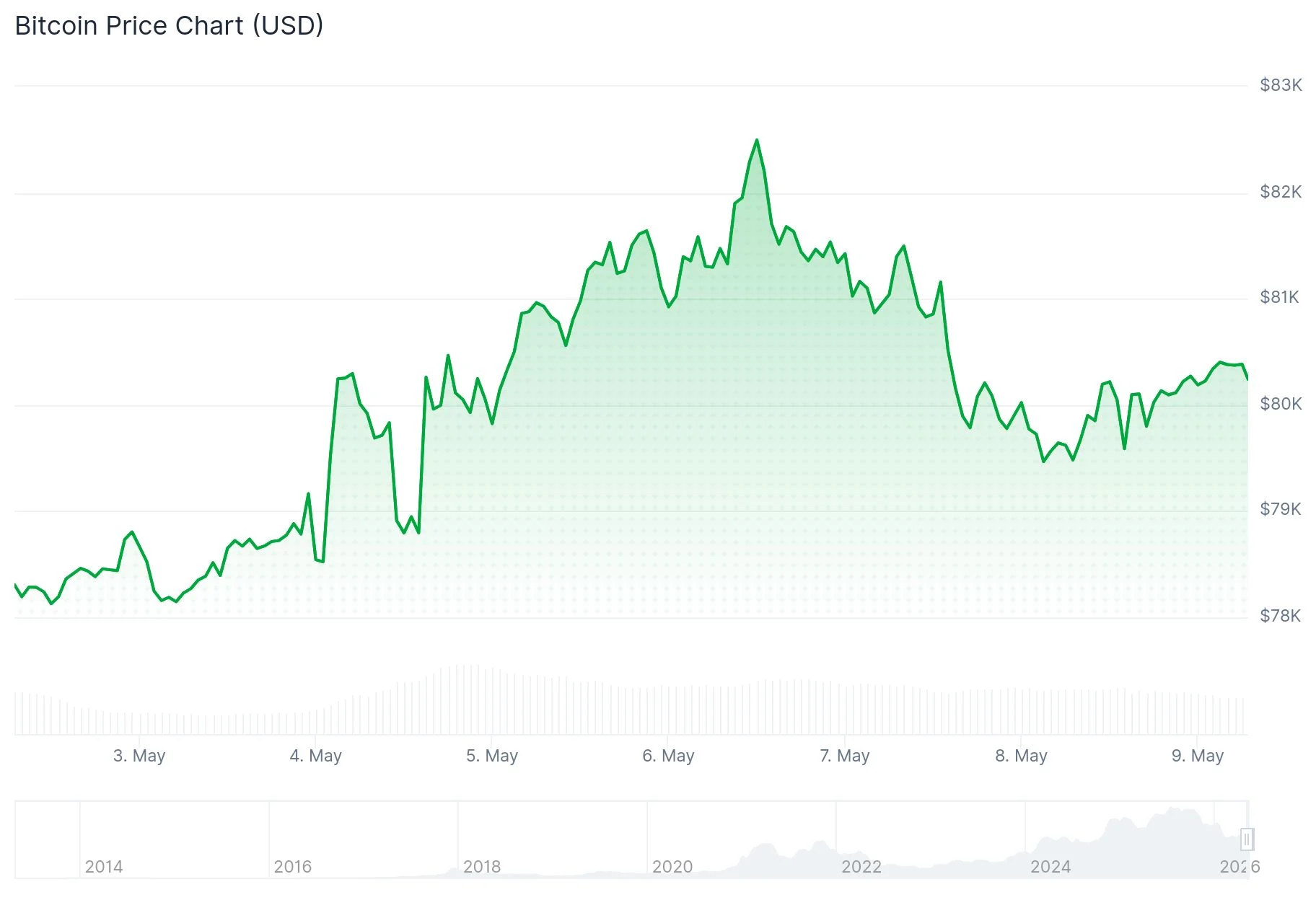
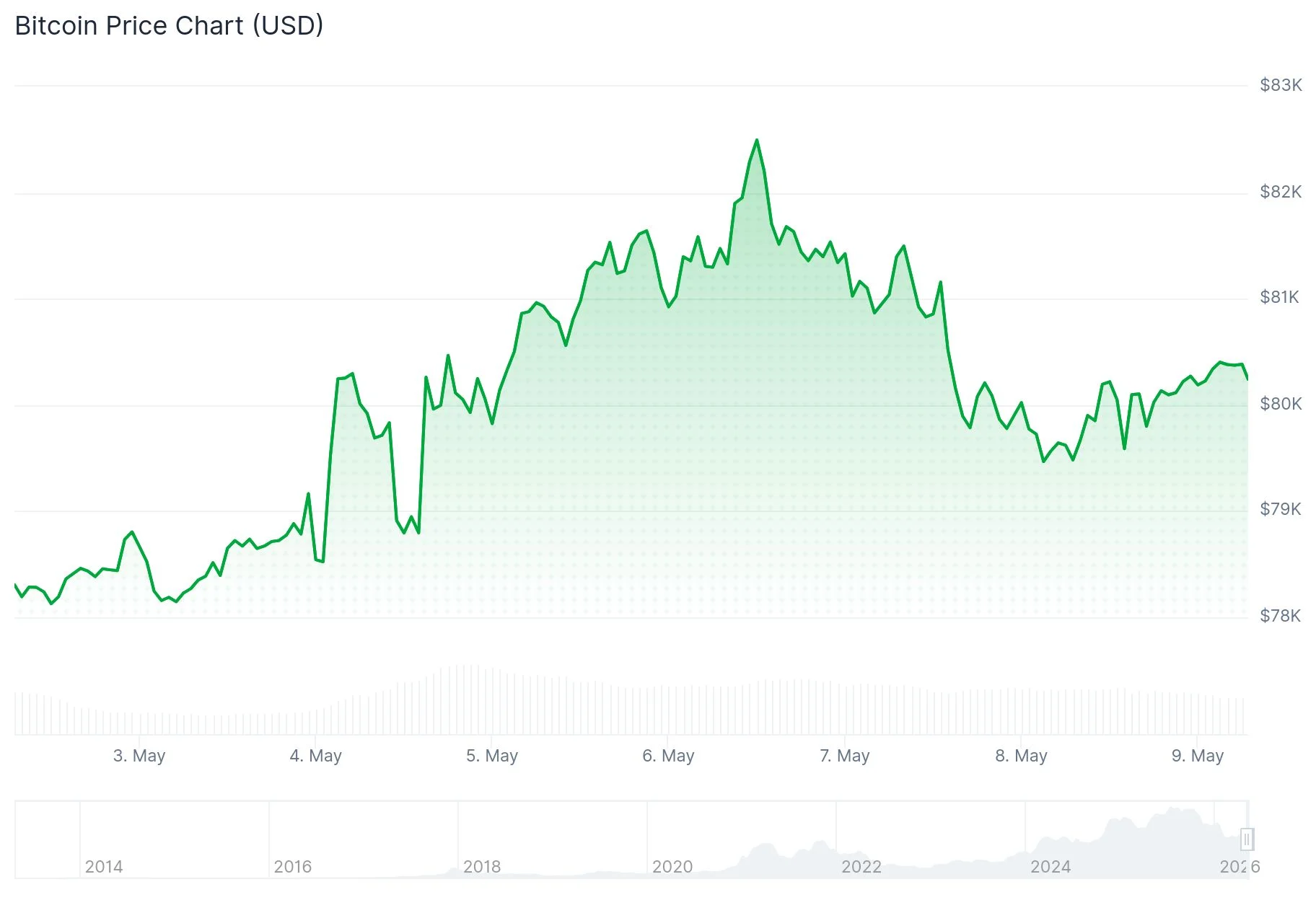
- Bitcoin retreated from $80,000 following rejection at the $82,000–$82,500 resistance level
- Coinbase and Robinhood reported revenue declines of 31% and 47% respectively in crypto operations, signaling diminished retail participation
- Dollar weakness and speculation surrounding a Strategic Bitcoin Reserve maintain long-term bullish sentiment
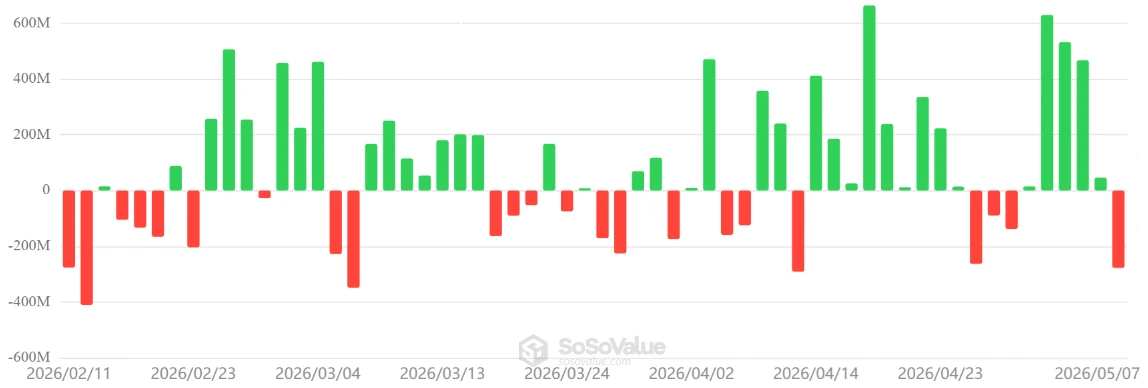
The streak of capital flowing into U.S. Bitcoin exchange-traded funds came to an abrupt halt on May 7, with institutional investors pulling $277.5 million from spot products. This reversal ended a remarkable accumulation phase that had attracted more than $1.6 billion since the beginning of May.
The iShares Bitcoin Trust (IBIT) from BlackRock experienced its largest single-day redemption, with $98 million exiting the fund. This marked a sharp contrast to the preceding five trading sessions, during which IBIT accumulated more than $1 billion in Bitcoin exposure. Despite the outflow, the fund maintains approximately $75.8 billion in total holdings.
Fidelity’s Wise Origin Bitcoin Fund (FBTC) witnessed outflows for the second consecutive session, with combined withdrawals reaching $167.94 million over the two-day period. The fund currently manages $15.24 billion in assets.
Collectively, the universe of U.S. spot Bitcoin ETFs maintains approximately $106.77 billion in Bitcoin holdings.
Bitcoin’s price action on Friday showed consolidation in the $79,700–$80,180 range, following a rejection at the $82,000–$82,500 resistance zone earlier in the week. The pullback triggered liquidations of leveraged long positions totaling approximately $270 million in a 24-hour window.
Weakening Retail Participation
Quarterly earnings reports from leading cryptocurrency platforms revealed declining retail engagement. Coinbase disclosed a 31% revenue contraction compared to the first quarter of 2025. Meanwhile, Robinhood’s cryptocurrency segment experienced a steeper 47% decline during the same timeframe.
Jake Kennis, who serves as senior research analyst at Nansen, observed that Bitcoin’s push above $81,000 was primarily fueled by institutional spot acquisitions and forced short closures — with minimal retail trader involvement. Notably, funding rates remained subdued throughout the price advance.
Lacie Zhang, research analyst at Bitget Wallet, suggested that absent a revival in retail interest, Bitcoin could face downward pressure toward the $75,000–$78,000 support range.
Data from major exchanges showed shifting sentiment among sophisticated traders. Top-tier Binance traders reduced their Bitcoin long exposure to levels not seen in more than four weeks. At OKX, the long-to-short ratio among leading traders plummeted to 0.27, a dramatic decline from 1.20 recorded just ten days prior.
Broader Economic Context: Employment Figures and Currency Weakness
The April U.S. nonfarm payrolls report delivered 115,000 new jobs — substantially exceeding the anticipated 62,000. Additionally, March figures were revised upward to 185,000. The unemployment rate remained steady at 4.3%.
While the robust employment data supported short-term risk appetite, the Federal Reserve’s capacity to implement rate cuts remains constrained by ongoing energy-related inflationary pressures.
The U.S. dollar has experienced depreciation against major global currencies over the past two months. Market analysts suggest this dynamic diminishes the attractiveness of U.S. Treasuries and may redirect capital toward scarce digital assets like Bitcoin.
Geopolitical tensions resurfaced as uncertainties regarding a U.S.-Iran ceasefire intensified. Iranian authorities alleged that Washington violated previously agreed-upon terms, while reports of renewed military action near the Strait of Hormuz drove crude oil prices higher on Friday.
In related developments, Kevin Warsh is anticipated to succeed Jerome Powell as Federal Reserve Chair. Warsh has publicly expressed favorable views toward Bitcoin and recently disclosed personal investments in cryptocurrency assets and industry-related companies.
Polymarket prediction markets indicate increasing probability that the U.S. Strategic Bitcoin Reserve could commence BTC accumulation by 2027.
According to CryptoQuant data, Bitcoin held on exchanges decreased by 9,832 BTC between May 1 and May 9, declining from 2,686,423 to 2,676,591.


Perché scegliere un bookmaker non AAMS affidabile?
Molti scommettitori italiani si chiedono se abbia senso puntare su un bookmaker non AAMS. La risposta è sì, a patto di selezionare solo operatori che dimostrino solidità, licenze internazionali riconosciute e una reputazione positiva tra i giocatori. Un bookmaker non AAMS affidabile può offrire quote più competitive, promozioni più generose e una gamma più ampia di mercati sportivi rispetto ai siti regolamentati dall’AAMS.
Il vantaggio principale è la libertà di scegliere tra più valute, metodi di pagamento e, spesso, un’esperienza di gioco più fluida. Tuttavia, la mancanza di una supervisione locale implica che il giocatore debba essere più attento a valutare la licenza, il supporto e le policy di sicurezza prima di depositare i propri fondi.
Come verificare l’affidabilità di un bookmaker non AAMS
Licenze internazionali e regolamentazioni
Le licenze più riconosciute sono quelle rilasciate da Malta Gaming Authority (MGA), United Kingdom Gambling Commission (UKGC) e Curacao eGaming. Controllare il numero di licenza sul sito dell’operatore è il primo passo: una licenza valida garantisce che il bookmaker segua standard di sicurezza, protezione dei dati e fair play.
Un altro indicatore di affidabilità è la presenza di audit indipendenti, solitamente effettuati da eCOGRA o iTech Labs. Queste entità testano i generatori di numeri casuali (RNG) e verificano che le percentuali di payout siano conformi a quanto pubblicizzato.
Le offerte di benvenuto sono spesso il biglietto d’ingresso più allettante, ma è fondamentale leggere le clausole. Tra gli elementi da valutare troviamo i requisiti di scommessa (wagering requirements), i giochi ammessi al conteggio del turnover e le limitazioni temporali.
Ecco una checklist rapida da usare prima di accettare un bonus:
- Percentuale di rollover (es. 30x)
- Giochi su cui il bonus è valido (solo slot o anche sport)
- Limiti massimi di vincita derivante dal bonus
- Scadenza del bonus e della quota di scommessa
Metodi di pagamento e velocità di prelievo
Un bookmaker non AAMS affidabile deve offrire diverse opzioni di deposito e prelievo, dal tradizionale bonifico bancario alle carte di credito, fino ai portafogli elettronici più diffusi. La velocità di pagamento è cruciale: pochi giorni per un prelievo possono rovinare l’esperienza, mentre i pagamenti istantanei aumentano la fiducia.
Di seguito una tabella comparativa dei metodi più comuni e dei tempi medi di elaborazione:
| Metodo | Deposito (tempo) | Prelievo (tempo) | Commissioni |
|---|---|---|---|
| Carte di credito/debito (Visa, MasterCard) | Immediato | 1‑3 giorni lavorativi | 0 % |
| Portafogli elettronici (Skrill, Neteller) | Immediato | Fino a 24 ore | 0‑2 % |
| Bonifico bancario | 1‑2 giorni | 2‑5 giorni lavorativi | 0 % |
| Paysafecard | Immediato | Non supportato per prelievi | 0 % |
Registrazione, verifica dell’identità (KYC) e sicurezza
La procedura di registrazione su un bookmaker non AAMS è spesso più rapida rispetto ai siti italiani, ma la verifica KYC rimane obbligatoria per prelievi superiori a una certa soglia. Documenti tipici richiesti sono una carta d’identità, un passaporto o una patente, accompagnati da una bolletta recente per confermare l’indirizzo.
Per garantire la sicurezza dei dati, scegli operatori che usano protocolli SSL a 256 bit e che abbiano politiche di privacy conformi al GDPR. Un ulteriore segnale di affidabilità è l’autenticazione a due fattori (2FA) per l’accesso al conto.
Esperienza mobile e app per scommesse sportive
Oggi la maggior parte dei giocatori utilizza lo smartphone per piazzare le proprie scommesse. Un bookmaker non AAMS affidabile deve offrire un’app dedicata per iOS e Android, ottimizzata per velocità, stabilità e accessibilità.
Caratteristiche da cercare nell’app:
- Interfaccia intuitiva e caricamento rapido
- Notifiche push per quote live e promozioni
- Supporto per deposito e prelievo direttamente dal dispositivo
- Sezione “responsible gambling” con limiti di deposito e autoesclusione
Assistenza clienti e supporto multilingua
Un servizio di assistenza disponibile 24/7 è fondamentale, soprattutto quando si scommette su eventi live. I canali più comuni sono chat live, email e, in alcuni casi, supporto telefonico. Verifica sempre la rapidità di risposta e la competenza degli operatori.
Molti bookmaker non AAMS offrono supporto in inglese, spagnolo, francese e, in misura minore, in italiano. Se la lingua è un ostacolo, cerca un operatore che fornisca FAQ dettagliate tradotte nella tua lingua.
Gioco responsabile e strumenti di protezione
La responsabilità del giocatore è una priorità anche per i bookmaker non AAMS. Strumenti come limiti di deposito giornalieri, settimanali o mensili, autoesclusione temporanea e la possibilità di impostare promemoria di tempo di gioco aiutano a mantenere il controllo.
Alcuni operatori collaborano con organizzazioni di supporto al gioco problematico, offrendo link a linee di assistenza e materiale informativo. Scegliere un bookmaker che promuove attivamente il gioco responsabile è un segno di serietà e affidabilità.
Confronto rapido di alcuni bookmaker non AAMS consigliati
Di seguito una panoramica sintetica dei bookmaker non AAMS più affidabili per gli utenti italiani, basata su licenza, bonus di benvenuto, velocità di prelievo e supporto mobile.
| Bookmaker | Licenza | Welcome Bonus | Tempo medio prelievo | App mobile |
|---|---|---|---|---|
| BetMaster | MGA | 100 % fino a €200 + 20 free bet | Fino a 24 h | iOS & Android |
| SportWin | UKGC | 150 % fino a €300 | Fino a 12 h | App dedicata |
| LuckyBet | Curacao | 50 % fino a €100 + 10 free spin | 2‑3 giorni | Web‑responsive |
Per vedere una lista aggiornata di casinò non ADM, visita il nostro portale casino non ADM. Ricorda che la scelta finale dipende dalle tue preferenze personali: quote, sport disponibili, bonus e soprattutto la sensazione di sicurezza che percepisci durante la navigazione.


After Bitcoin pushed into the $82,000–$83,000 band, short‑dated implied volatility has bounced from late‑2025 lows, with a roughly $2 billion short‑gamma pocket around $82,000 turning dealer hedging into a potential amplifier of every move.
Summary
- After Bitcoin pushed into the $82,000–$83,000 band, short-dated implied volatility has rebounded sharply, with 1‑week IV up about 6 vol points from its October 2025 lows, signaling renewed demand for short-term optionality.
- Glassnode says the 25‑delta skew is compressing toward neutral and the volatility risk premium has flipped positive, meaning options now price higher future volatility than the spot market has recently realized and short-term bearish hedging demand has weakened.
- A roughly $2 billion short gamma cluster around $82,000 and heavy call‑selling (81% of past‑day flow) suggest dealer hedging could amplify near-term price swings even as positioning tilts toward consolidation rather than panic.
On-chain analytics firm Glassnode notes that after Bitcoin (BTC) broke key resistance and traded into the $82,000–$83,000 area, options markets “snapped back to life,” with front-end implied volatility climbing meaningfully from cyclical lows. Studio data show at‑the‑money 1‑week implied volatility near 52% at the end of March, versus mid‑40s readings seen during the October 2025 lull, implying about a 6‑point rebound in short-dated IV as traders re-engage with near-term options.
At the same time, the classic 25‑delta skew — the gap between put and call IV at 25‑delta — has compressed toward zero across key tenors. Glassnode’s skew dashboards show BTC’s normalized 1‑week 25D skew near 10.5% in late March, down from more extreme put‑heavy readings seen during prior drawdowns, while an updated IBIT-specific 25D skew series is hovering close to flat for 1‑week maturities. In practice, that means traders are no longer willing to pay a steep premium for downside puts; demand for short‑term bearish hedges has faded as spot grinds higher and realized volatility stays contained.
Volatility risk premium turns positive
Crucially for options desks, Glassnode points out that the volatility risk premium has turned positive again. In other words, the implied volatility embedded in options prices has risen above the level of realized volatility observed in the spot market, reversing the deeply discounted IV regime that prevailed during the late‑2025 chop. Product updates published in January and December describe this as a central signal: when VRP is positive, option sellers can once again collect a premium for warehousing volatility risk, and buyers must pay up for tail protection or leveraged convexity.
Glassnode’s Week‑18 “Bulls Approach the Ceiling” note adds that the recent move has been driven mainly by the front end of the curve. One‑week and one‑month IV have repriced “sharply,” while three‑ and six‑month maturities are only up 1–2 vol points, reflecting “a short-term re-engagement in optionality without a broader shift in long-dated volatility expectations.” That term‑structure shape — steeper at the front, relatively anchored at the back — fits a market that expects choppy action around $80,000–$85,000 rather than a new secular regime shift.
$2 billion gamma short at $82,000 and heavy call selling
Positioning is where this becomes reflexive. Glassnode highlights a concentrated short‑gamma pocket around the $82,000 strike, with options open interest implying nearly $2 billion of negative gamma exposure in that region. As a separate Binance research post on the $80,000–$82,000 “gamma wall” explains, when dealers are short gamma at a given strike, they are forced to buy BTC as price rises and sell as it falls in order to stay delta‑neutral. That hedging pattern can mechanically amplify volatility: once spot trades into the cluster, relatively small moves can trigger disproportionately large hedge flows, exaggerating both squeezes and flushes around the level.
Glassnode adds that the last 24 hours of BTC options flow have been dominated by call overwriting, with “selling call options accounting for 81% of trading flow,” a clear sign that some traders are locking in profits rather than paying up for further upside. Combined with the neutralizing skew and positive VRP, that flow mix points to a market leaning toward consolidation and yield generation — selling topside volatility into strength — rather than panicked demand for downside insurance.
For directional crypto traders, the message is double‑edged. On the one hand, diminished put skew and a positive VRP are typical of late‑stage rallies that are still intact but maturing. On the other, the $2 billion gamma short cluster around $82,000 means that any decisive break above or below that zone could trigger mechanically driven volatility spikes, making the next leg as much about dealer hedging reflexes as about fundamentals.

Switzerland’s bid to compel the central bank to hold Bitcoin appears to have fallen short of a nationwide referendum. Organizers reported they gathered roughly half the 100,000 signatures required under Swiss law, a threshold they could not meet, according to Reuters.
The proposal would have amended the Swiss constitution to mandate the Swiss National Bank (SNB) hold Bitcoin alongside gold and foreign currency assets. The SNB has long opposed adding digital assets to its reserves, arguing that cryptocurrencies do not meet reserve-management standards due to volatility and liquidity concerns. Reuters cited the central bank’s persistent stance as a major hurdle for the initiative.
Campaign founder Yves Bennaim told Reuters the effort was always unlikely to succeed, but he said it still advanced the debate about Bitcoin’s place in global finance. Supporters argued that including Bitcoin could help diversify Switzerland’s reserves away from dollar- and euro-denominated assets, which Reuters noted account for roughly three-quarters of the SNB’s foreign currency holdings.
Key takeaways
- Swiss petition to force the SNB to hold Bitcoin failed to reach the required signatures for a national vote, signaling the practical difficulty of altering central-bank mandate through a popular referendum.
- The SNB has consistently opposed crypto inclusion in its reserves, citing volatility and liquidity risks that complicate sovereign-level risk management.
- Despite the setback in Switzerland, debates over Bitcoin’s role in sovereign reserves continue, with El Salvador and Bhutan cited as notable, though divergent, examples of government engagement with BTC.
- The broader trend remains cautious: while corporations embraced Bitcoin treasuries in 2025, sovereign adoption remains limited and uneven, reflecting regulatory, logistical, and political considerations.
- In the United States, a separate strategic posture toward Bitcoin has surfaced through an executive action establishing a Strategic Bitcoin Reserve, signaling a long-term, budgetary-strategy-oriented approach to digital assets.
Swiss bid tests the boundaries of monetary policy and crypto politics
The Swiss campaign aimed to constitutionalize a new reserve rule, aligning the SNB’s asset mix with the volatility-conscious framework central banks typically maintain. While the idea of a Bitcoin-inclusive reserve sparked debate about how a modern monetary authority could react to digital assets, the practical path to constitutional change proved blocked by signature collection hurdles and a central bank reticence that resonates with many policymakers worldwide.
Observers note that proponents framed Bitcoin as a potential hedge against traditional fiat exposure, while skeptics highlighted liquidity constraints, price swings, and the governance challenges that come with managing a state-level cryptocurrency position. The SNB’s stance remains rooted in risk management principles that prioritize stable, liquid assets for foreign reserves. A failed referendum does not eliminate the wider discussion, but it does curb the immediacy of a constitutional pivot in Switzerland.
For investors and markets, the episode reinforces the message that sovereigns continue to weigh the costs and benefits of crypto exposure at the central-bank level, distinct from the corporate treasury plays that gained traction in earlier years. The Swiss case also underscores how public appetite for bold monetary experiments can be tempered by institutional caution and the practical realities of reserve management.
Global trend: sovereigns toe the line on Bitcoin reserves
The year 2025 marked a notable wave of corporate treasuries embracing Bitcoin as a crypto-forward treasury tool, but sovereign adoption has remained deliberately restrained. El Salvador stands out as the most explicit national experiment, having incorporated Bitcoin into its policy framework and holdings. BitcoinTreasuries.com data indicate El Salvador currently holds 7,645 BTC as part of its sovereign approach, reflecting a deliberate, policy-driven accumulation strategy rather than opportunistic purchases.
Bhutan, often cited for its ambitious, hydro-powered crypto agenda, built much of its early BTC exposure through state-backed mining operations that leveraged surplus renewable energy to develop a digital economy. However, recent data from Arkham Intelligence shows a notable shift in Bhutan-related activity, with wallets linked to the country reporting a sizable reduction in reserves—from around 13,000 BTC at the end of 2024 to roughly 3,654 BTC by April 2026, following a sequence of large transfers and what appears to be asset-rotation activity.
Beyond these two cases, the three largest sovereign holders of Bitcoin—the United States, China and the United Kingdom—largely acquired their holdings through means other than ongoing market purchases. Analysts note that seized assets and forfeiture actions have contributed to the bulk of these totals, rather than explicit, budget-driven expansion of reserves through routine acquisitions.
In a related development, the U.S. government signaled a strategic posture toward Bitcoin through a high-profile policy action. On March 6, 2025, President Donald Trump signed an executive order establishing a Strategic Bitcoin Reserve and a United States Digital Asset Stockpile. The order states that BTC held by the reserve “shall not be sold” and would be maintained as reserve assets of the United States. While the executive action envisions exploring budget-neutral strategies for augmenting the BTC stockpile, the reserve is initially backed by BTC already held by the government through forfeiture proceedings. The move marks a formal, forward-looking stance on digital assets as part of national strategy, even as it leaves open questions about implementation, oversight, and long-term fiscal implications.
The broader implication of these developments is clear: even as some nations flirt with crypto as a tool for diversification and strategic autonomy, many others remain cautious, prioritizing proven liquidity and risk-management standards. The Swiss episode adds to the mosaic of ongoing experiments, indicating that the path to sovereign Bitcoin adoption remains selective and highly contingent on regulatory clarity, macroeconomic considerations, and political consensus.
As markets digest these moves, investors and policymakers alike will watch for evolving precedents. Will more countries consider referenda or constitutional amendments to embed crypto in national reserves, or will official reserve strategies continue to favor traditional assets and carefully managed exposure to digital currencies? The coming years will likely reveal a spectrum of approaches—from formal, policy-driven allocations to cautious, incremental experimentation—alongside continuing debates about the role and safety of Bitcoin in sovereign balance sheets.
What to watch next: policymakers’ responses to sovereign reserve experiments will shape both risk profiles and institutional trust in crypto as a macro tool. Watch for any new data on holdings, shifts in reserve-management guidelines, and the regulatory contours that could either unlock or constrain further sovereign engagement with Bitcoin.

North East businesses urged to act on rising energy costs

Playtika Q1 2026 slides: DTC revenue surges 63% amid profit squeeze

HabitTrade denies doing regulated business in Hong Kong after SFC warning

Manchester United reach agreement with Casemiro over contract clause amid transfer speculation

US brings back mandatory military draft registration

Steven Gerrard disagrees with Gary Neville over ‘shock’ Chelsea and Arsenal claim | Football


-
 Crypto World22 hours ago
HarrisX Poll Found 52% of Registered Voters Support the CLARITY Act
-

 NewsBeat6 days ago
Channel 5 – All Creatures Great and Small series 7 new post
-

 Crypto World2 days ago
Upbit adds B3 Korean won pair as Base token gains Korea access
-

 Tech4 days ago
Image AI models now drive app growth, beating chatbot upgrades
-
 NewsBeat2 days ago
NCP car park operator enters administration putting 340 UK sites at risk of closure
-

 News Videos6 days ago
AP Dhillon – Old Money (Official Audio)
-

 Fashion14 hours ago
Weekend Open Thread: Marianne Dress
-

 Sports6 days ago
Five killed in Texas plane crash identified as Amarillo pickleball players
-
Entertainment6 days ago
New Netflix Movies in May 2026 — My Top 3 Picks to Stream
-
Crypto World7 days ago
Pi Network Mandates Protocol 23 Upgrade for All Mainnet Nodes Before May 15 Deadline
-

 Entertainment6 days ago
Melissa Joan Hart and More Stars Attend 2026 Kentucky Derby
-
Entertainment6 days ago
Anna Nicole Smith’s Daughter Attends 2026 Kentucky Derby
-

 Crypto World6 days ago
Bitcoin mining equities rise in 2026 as BTC lags behind
-

 Business6 days ago
Luka Doncic Injury Update: Doncic’s Hamstring Recovery Slows Lakers’ Hopes Against Thunder: Can He Run Yet?
-
Entertainment6 days ago
Venus Williams’ Best Met Gala Looks Over the Years
-

 Business7 days ago
Kuwait International Airport Resumes Operations After Closure as Regional Tensions Ease in 2026
-
Entertainment6 days ago
“Storage Wars” star Darrell Sheets' ex-wife breaks silence on his death
-

 Sports6 days ago
Is Man United v Liverpool on TV? Channel, streaming and how to watch Premier League fixture
-
 Entertainment7 days ago
After 2 Years, This Taylor Sheridan Neo-Western Doesn’t Have a Single Bad Episode
-
Crypto World6 days ago
Q1 2026 Tech Layoffs AI Wave Hits 81,747 as Firms Shift to AI Infrastructure
You must be logged in to post a comment Login