Crypto World
Latest DeFi yield vault drama wipes out $69M of msUSD and AVLT market cap

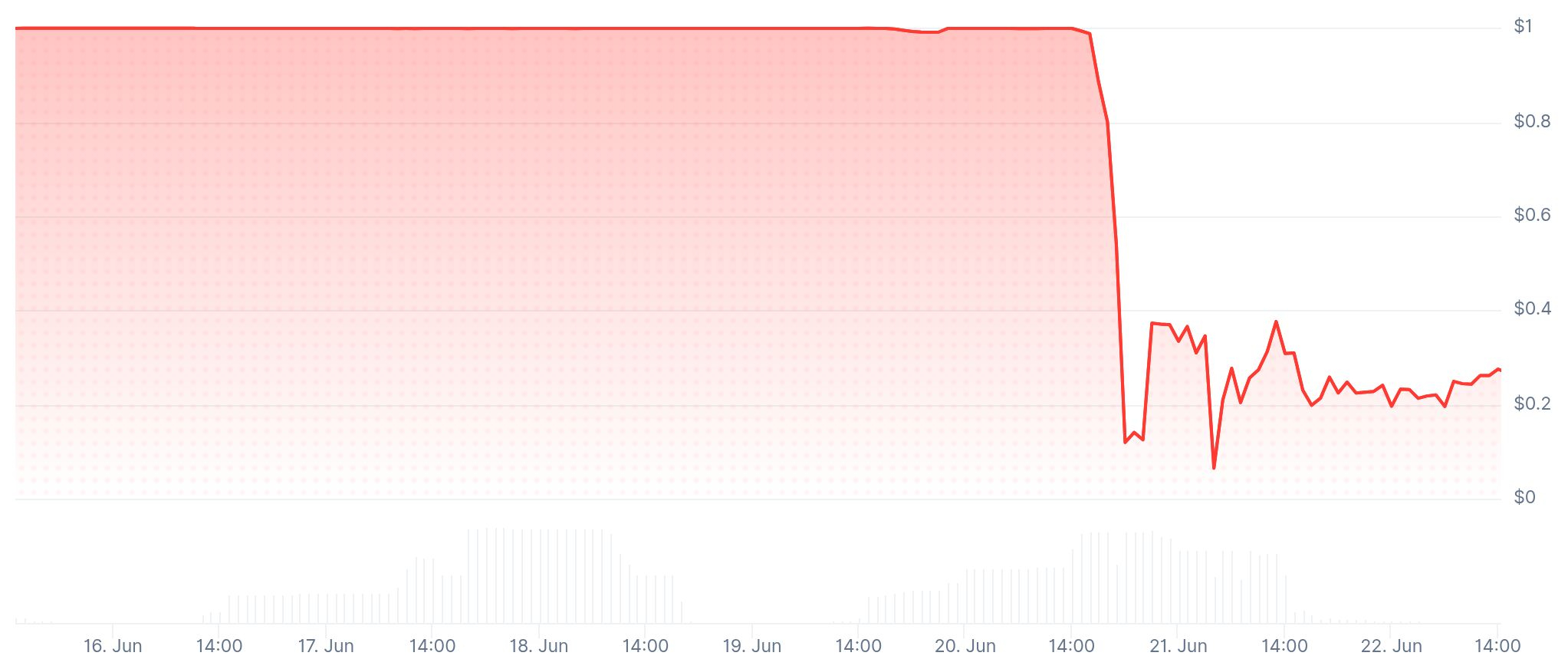
Main Street Finance’s stablecoin msUSD has depegged to $0.27, sparked by a post addressing the “shutdown of [its] third-party proof-of-reserves dashboard.”
The following day, the firm behind the dashboard in question, Accountable, announced it was terminating its asset verification services with msUSD’s issuer.
In classic DeFi fashion, the fallout appears to have led to a bank run on Altura’s USDT vault, leading to the firm deciding to close down the vault.
At least $8.5 million was withdrawn ahead of the announcement and before a sell-off of the AVLT vault token led to an 11% depeg.
The weekend’s depegs come on the back of ongoing troubles for DeFi stablecoins apxUSD and sUSDat, which are backed by Strategy’s struggling STRC.
Read more: Saylor distances himself from STRC-backed DeFi after stablecoin wobble
Main Street Finance: ‘Institutional-grade yield’
Late on Saturday, Main Street Finance published a long post to X reassuring users that it “remains fully backed,” calling the loss of its dashboard a “reporting issue, not a solvency issue.”
By the time of the post, the price of msUSD had already collapsed. It sat at around $0.12 after losing its $1 peg around six hours previously but has since rebounded to around $0.27 from a low of $0.06 in the early hours of Sunday morning (UTC).
The advance reaction led some to believe that “insiders… got the memo that they should take the available liquidity to get out.”
Then, on Sunday, RWA accounting firm Accountable announced that, following Main Street Finance’s failure to provide adequate proof of reserves, it was terminating its contract with the firm.
Others questioned Accountable’s lack of prior action, given that doubts over Main Street’s transparency were publicly raised back in April.
Accountable’s post positions it as “neutral verification infrastructure,” however it also claims it “did not retain an ongoing, source-level view of [Main Street’s] reserves,” raising concerns over the reliability of its data on other clients.
Read more: DeFi projects under fire for inflated TVL and murky lending loops
Given Accountable’s entire business case, the post also drew ridicule, with one user comparing it to May 2022’s infamous Three Arrows Capital AUM statement.
In addition to the depeg of msUSD, Main Street’s yield token, msY, which it promises “turns box spreads into market-neutral” 12% yield also collapsed in price.
Blockchain auditor Peckshield highlighted the Morpho msY/USDC market hitting 100% utilization, trapping $18 million of AlphaPing assets.
Read more: Resolv hack shows DeFi learned nothing from last contagion
Altura: “the yield engine”
Altura runs a HyperEVM-based USDT yield vault, currently offering almost 30% yield.
In a post on Sunday, Altura distanced itself from the msUSD depeg, stressing it “never had any exposure to Mainstreet or any of its underlying investment strategies.”
It also assured users that it had successfully redeemed over $5 million during the previous 24 hours.
Rather than reassuring depositors, however, it appears the post had the opposite effect.
Twelve hours later, Altura co-founder and CEO Ranveer Arora revealed that, due to “sustained withdrawal demand and current market sentiment” the firm would proceed with “an orderly wind-down of the Altura vault.”
Redemptions had now climbed to $8.5 million.
The rush for the exits was reflected in the price of the vault’s yield-bearing AVLT token. Over the past 24 hours it has dropped 14%, from $1.09 to $0.93 at the time of writing.
Between redemptions and price action, AVLT’s market cap dropped from $39 million to a low of $26 million over the weekend.
In a later update, Altura stated that “a maturity mismatch between our onchain and off-chain positions” forced it to pause withdrawals. It promised market making strategies would be closed within 72 hours but “RWA positions will take more time due to their inherent nature.”
On top of the $18 million exposed to the msY/USDC market, AlphaPing also has over $10 million of exposure to AVLT, according to its Morpho curator dashboard.
Read more: High yields to haircuts: Has DeFi learned anything from yield vault collapse?
DeFi’s risk curator “daisy chain”
Despite its premise as transparent, open finance, the DeFi sector has faced a number of shocks in recent months due to murky “daisy chains” and recursive lending.
In late October, concerns began to circulate over the stability of a number of high yield vaults. These tokens often used looped leverage against one another, inflating TVL far above the legitimate stablecoin backing.
The space exploded days later when one of the main offenders, Stream Finance, revealed it had lost $93 million. Its stablecoin, xUSD, immediately collapsed 75%.
Read more: Four months on, MEV Capital falls victim to $4B DeFi daisy chain implosion
Later, in March, a $23 million hack of Resolv’s USR due to a private key compromise wrought havoc across multiple yield vaults as opportunistic traders bought depegged USR and used it to drain liquidity in markets with hardcoded oracles.
So-called risk curators even continued to provide liquidity to the vulnerable markets via Morpho’s Public Allocator automation feature.
Such episodes go to show that rather than a novel financial system which operates autonomously and permissionlessly, DeFi is all too often forced to recur to the blame game when things go away.
Got a tip? Send us an email securely via Protos Leaks. For more informed news, follow us on X, Bluesky, and Google News, or subscribe to our YouTube channel.
You must be logged in to post a comment Login