
Crypto World
Major Bank Expects Solana to Outperform Bitcoin: When and How?

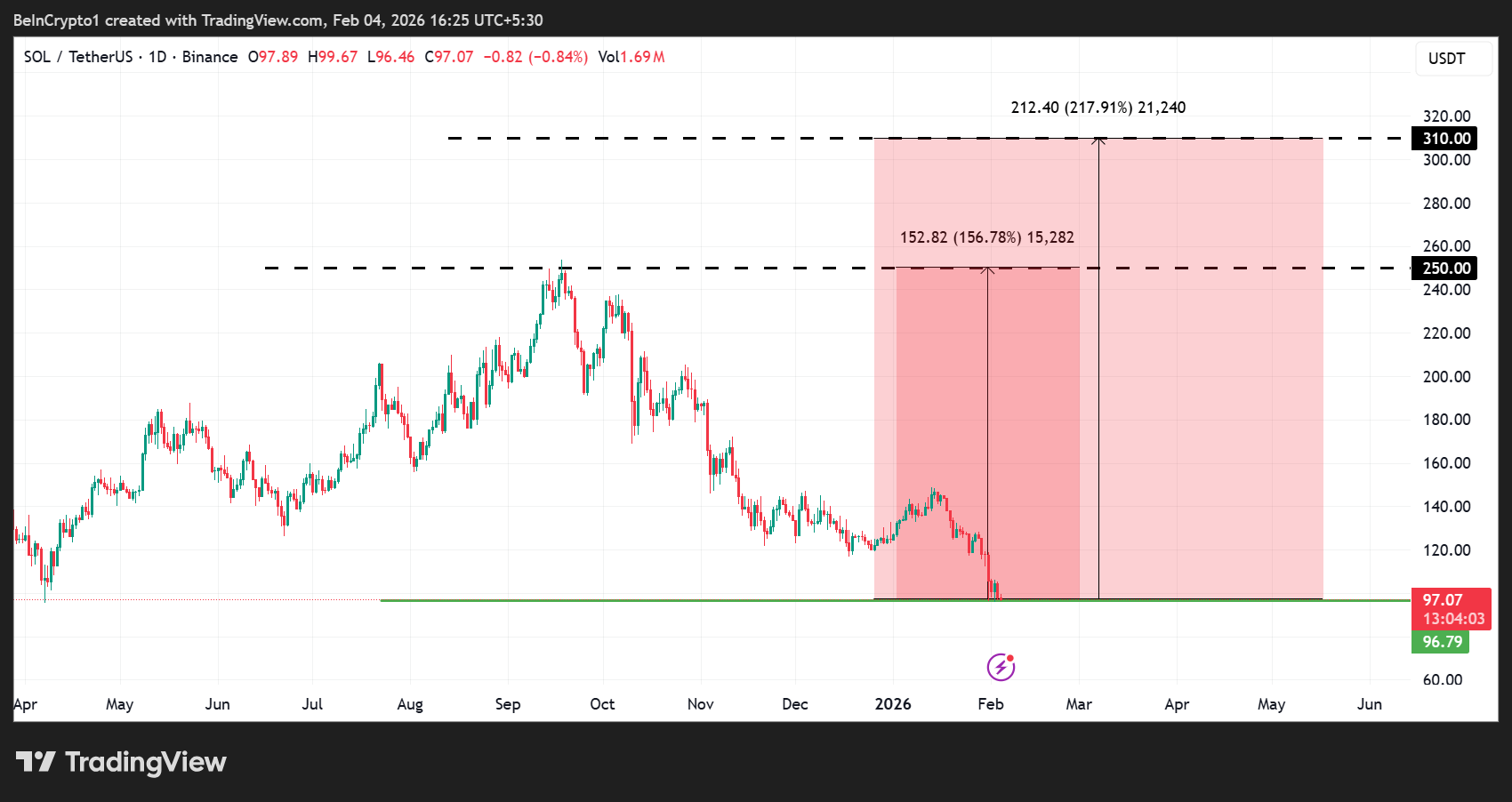
Standard Chartered is urging investors to look through near-term volatility in digital assets and focus on what it calls “quality” blockchain projects.
The remark comes as the recent selloff reshapes relative value across the crypto market.
Sponsored
Sponsored
Standard Chartered Backs Ethereum and Solana for Long-Term Outperformance Despite Near-Term Volatility
Geoff Kendrick, the bank’s Head of FX and Digital Assets Research, said he is actively accumulating during the downturn. According to the analyst, the pullback is a defining moment for long-term positioning.
“I am a buyer of this dip in digital assets,” Kendrick told BeInCrypto in an email. “What’s more, I think this is the start of greater differentiation in digital asset performance, whereby quality projects win.”
Within that framework, Standard Chartered continues to favor Ethereum and Solana as its top layer-1 exposures. Kendrick reiterated that view explicitly, adding:
“I have previously highlighted my view that Ethereum is one such quality project. And here I do the same for Solana. Buy quality.”
Recently, Standard Chartered said it saw Ethereum outperforming Bitcoin, citing DeFi dominance, scalability upgrades, and regulatory clarity.
The bank, however, has tempered its near-term expectations for Solana. Standard Chartered lowered its end-2026 price forecast for SOL to $250 from $310. On this, they cite the time required for the network’s next major use case to mature.
“We lower our end-2026 price forecast to USD 250, as Solana’s next dominant use case may take time,” Kendrick said.
Sponsored
Sponsored
Despite that cut, the bank raised its longer-dated projections, arguing that Solana’s structural advantages remain intact.
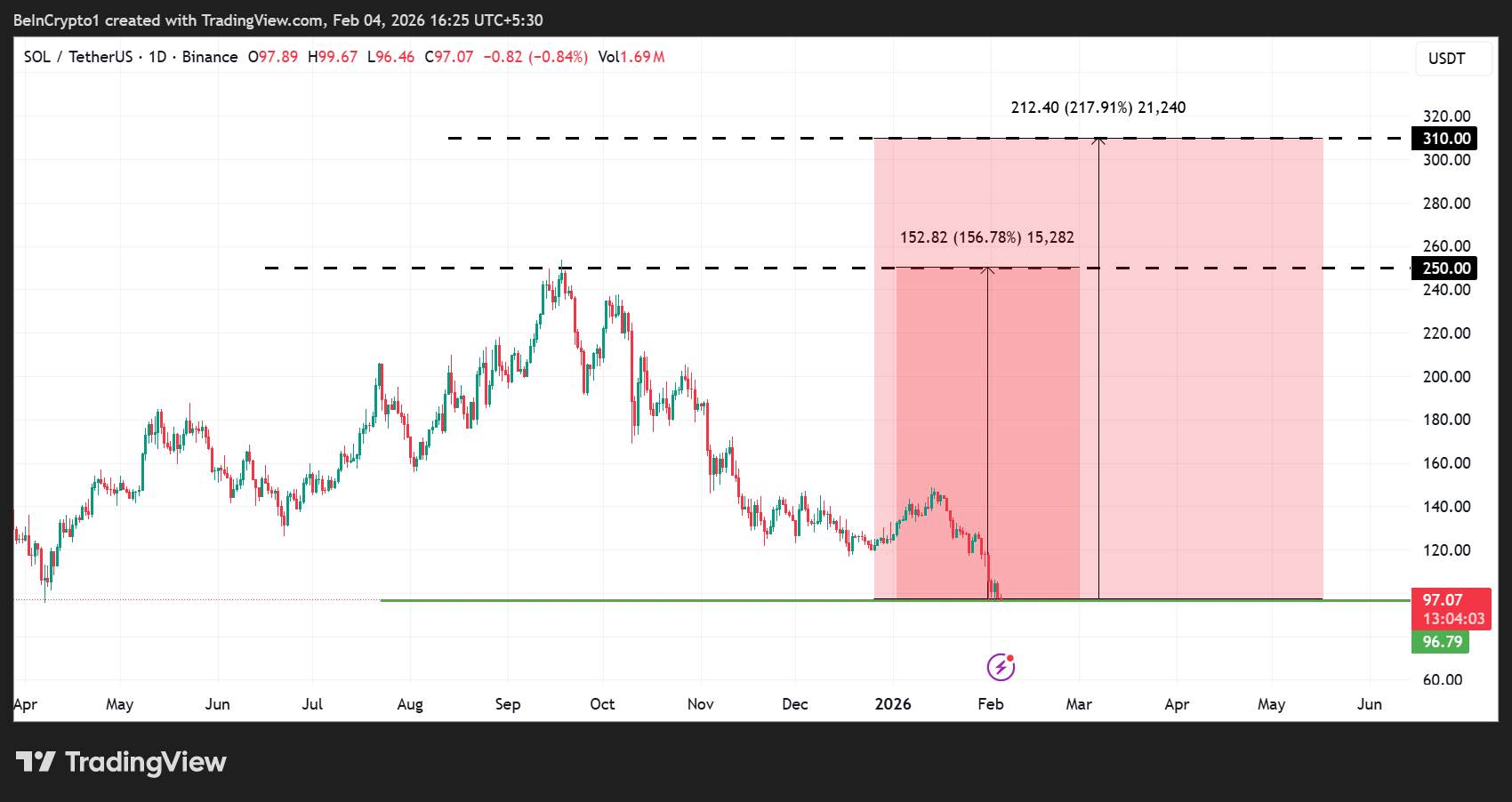
Solana’s Shift from Meme Coins to Micropayments Could Drive Long-Term Outperformance
According to Standard Chartered, Solana’s ultra-low-cost, high-throughput architecture positions it to eventually dominate micropayments. This, Kendrick says, is particularly true as AI-driven applications and stablecoin-based transactions gain traction.
“We raise our forecasts thereafter, as we see Solana eventually dominating the micropayments space,” Kendrick noted.
Sponsored
Sponsored
If that thesis plays out, the bank expects SOL to outperform Bitcoin between 2027 and 2030, while only gradually catching up to Ethereum as the ecosystem scales.
The report highlights a subtle but important shift underway on Solana’s decentralized exchanges. While the network has long been associated with meme coin activity, flows are increasingly rotating toward SOL-stablecoin trading pairs.
These stablecoins, Standard Chartered notes, are turning over two to three times faster than their Ethereum counterparts.
That evolution could help Solana shed its “meme coin discount,” which previously weighed on valuation and deterred TradFi participants.
Sponsored
Sponsored
Analysts Back Standard Chartered’s Quality Wins Narrative
Market commentators broadly echoed the bank’s “quality wins” narrative. Investor Mike Alfred described the drawdown as a textbook risk-off move.
“…this is a run-of-the-mill risk-off move where the lowest quality goes down the hardest, and then everything bounces… This is when real money is made,” wrote Alfred, referencing the recent market drop.
Developer and investor Mike Ippolito struck a similar tone, arguing that sentiment has swung too far in the negative direction.
“I think people are far too bearish ETH and SOL today,” he said, calling layer-1 blockchains “the Amazon or Google of our time” due to their global markets, high barriers to entry, and fee-generating potential.
Standard Chartered expects Solana to underperform Ethereum through 2026 and into 2027. But beyond that window, the bank sees a catch-up phase driven by scale, utility, and cost advantages.
In Kendrick’s view, the current volatility is less a warning sign than a sorting mechanism, one that may ultimately reward investors willing to buy quality while the market is still unsettled.



The payments-focused L1 launches with a slew of fintech and TradFi partners, while MPP is aimed at enabling agentic commerce.
Payments-focused blockchain Tempo, developed by Stripe and Paradigm, announced the launch of its mainnet today, March 18. Also today, Stripe and Tempo revealed a new open standard for AI agent payments, Machine Payments Protocol (MPP), per a separate X post.
Today’s mainnet launch opens public RPC endpoints to developers. The headline addition is the MPP, an open, rail-agnostic standard for autonomous agent-to-service payments. MPP introduces a “sessions” primitive that lets agents authorize a spending limit upfront and stream micropayments continuously without an on-chain transaction per interaction.
Stripe, Visa, and Lightspark have already extended MPP to support cards, wallets, and Bitcoin Lightning payments respectively. A payments directory launching alongside mainnet lists over 100 compatible services.
Unveiled by Stripe and crypto VC Paradigm last September, Tempo was purpose-built as settlement infrastructure for high-volume stablecoin payments — emphasizing predictable low fees, instant finality, and throughput suited to commercial-scale workloads. The project launched its public testnet in December, as The Defiant reported at the time.
Tempo’s backers are pitching the chain as infrastructure for both emerging agentic commerce and more traditional payment flows including cross-border remittances, global payouts, and tokenized deposits. Partners named include Anthropic, OpenAI, DoorDash, Mastercard, Nubank, Revolut, Shopify, and Standard Chartered.
The project hasn’t been without skeptics in the crypto-native community — crypto and web3 researchers have raised questions about the trade-offs of corporate-backed chains like Tempo, particularly around decentralization and permissioning.
Tempo’s mainnet launch arrives amid growing institutional momentum around stablecoin infrastructure, including Klarna’s recent debut of its own stablecoin as it pushes deeper into on-chain payments.
This article was written with the assistance of AI workflows. All our stories are curated, edited and fact-checked by a human.


Tempo, the payments-focused blockchain developed by payments giant Stripe and crypto investment firm Paradigm, launched its mainnet on Wednesday, bringing its stablecoin payment system out of testing and into live use.
The network is built to process large numbers of transactions quickly and at low cost. It aims to make sending money with stablecoins — digital tokens tied to currencies like the U.S. dollar — feel as simple as using a card or bank transfer, but faster and available at all times.
The launch follows a public testnet that began in December, when companies including Mastercard, UBS, Klarna and Visa started experimenting with sending payments on the network. That phase allowed developers to test how stablecoins could handle everyday financial activity, such as payouts and cross-border transfers.
Alongside the mainnet launch, Tempo introduced the Machine Payments Protocol, a system co-developed with Stripe that lets software programs make payments on their own. This allows applications or artificial intelligence (AI) tools to pay for services such as data or computing power without human approval at each step.
Tempo is also targeting more familiar uses, such as sending money across borders or paying large groups of workers at once. These processes often take days and involve multiple intermediaries.
The launch comes as global payments processing firms increasingly see blockchain rails and stablecoins as a key piece of plumbing for cross-border finances. Mastercard said this week it will acquire stablecoin infrastructure startup BVNK for $1.8 billion to embed digital dollars into its payment network. That deal followed Stripe’s buying of stablecoin startup Bridge and crypto wallet firm Privy.
Tempo also seeks to establish a foothold in agentic finance, an emerging trend in which AI agents use blockchains to pay for certain services that require micro payments.
Read more: Visa is ready for AI agents. So is Coinbase. They’re building very different internets
Crypto World
Nvidia (NVDA) Stock Dips as Jensen Huang Declares OpenClaw the Next Major AI Breakthrough

Key Takeaways
- At Nvidia’s GTC conference in California, CEO Jensen Huang declared OpenClaw is “definitely the next ChatGPT” in a televised interview.
- OpenClaw operates as an open-source platform for autonomous AI agents that execute tasks and make independent decisions without constant user guidance.
- The company unveiled NemoClaw, an enterprise-focused version of OpenClaw integrated with Nvidia’s proprietary software infrastructure and enhanced security features.
- Hong Kong-traded Chinese technology firms associated with OpenClaw experienced significant gains Wednesday, including MiniMax Group surging 14% and Zhipu advancing 11%.
- Shares of Nvidia (NVDA) declined 0.26% when the coverage was published.
During a Tuesday evening “Mad Money” segment with Jim Cramer at Nvidia’s GTC conference in California, Jensen Huang generated significant buzz by declaring OpenClaw is “definitely the next ChatGPT.”
Nvidia CEO Jensen Huang on Tuesday pointed to a fast-rising AI project called OpenClaw as a major step forward in how people interact with artificial intelligence.
Nvidia CEO Jensen Huang says OpenClaw could be the next ChatGPT as AI shifts from answering questions to taking… pic.twitter.com/nSE0Azq1F4
— CNBC International (@CNBCi) March 18, 2026
The Nvidia chief executive characterized OpenClaw as “the largest, most popular, the most successful open-sourced project in the history of humanity.” Such forceful language immediately captured investor attention.
OpenClaw represents an open-source platform for autonomous AI agents. Rather than simply responding to queries like conventional chatbots, it independently executes tasks, renders judgments, and implements actions.
Huang offered a straightforward value proposition: “In one line of code, you can create for yourself your own agent. Then after that, just ask the agent to do whatever you want.”
He illustrated the concept using kitchen design. An OpenClaw-powered agent could analyze photographs, master design software, experiment with various configurations, and enhance its own creations — all functioning autonomously after initial deployment.
“Every carpenter can now be an architect. Every plumber will become an architect,” Huang proclaimed.
NemoClaw Enterprise Solution Debuts
One day prior to the interview on Monday, Nvidia revealed NemoClaw — the company’s enterprise-optimized interpretation of OpenClaw. This offering integrates Nvidia’s proprietary software infrastructure with the open-source foundation.
NemoClaw targets business environments by delivering AI agents with enhanced security, scalability, and deployment readiness. The platform incorporates data privacy safeguards, monitoring capabilities, and enterprise-standard security frameworks.
This strategic initiative establishes Nvidia as more than a semiconductor manufacturer — it positions the firm as a comprehensive AI infrastructure provider.
Autonomous AI agents have generated apprehension regarding security vulnerabilities and governance challenges. NemoClaw represents Nvidia’s solution to these concerns, providing safety mechanisms for organizations planning large-scale agent deployment.
Chinese Technology Stocks Surge
Huang’s endorsement sparked a Wednesday rally among Chinese equities linked to OpenClaw technology.
MiniMax Group, which previously introduced its proprietary AI agent, jumped as high as 14% during Hong Kong trading. Knowledge Atlas Technology, operating as Zhipu, advanced as much as 11%.
Shanghai-listed cloud infrastructure provider UCloud Technology similarly registered positive movement.
These price increases followed immediately after Huang’s remarks gained widespread circulation, demonstrating the substantial influence his statements currently command in financial markets.
Nvidia shares traded marginally lower at publication time, with NVDA declining 0.26%, equivalent to $0.48, when the interview became publicly available.
The GTC conference remains a critical venue for Nvidia to reveal strategic partnerships and future product initiatives.
Nvidia acknowledged its partnership with OpenClaw’s development team as part of Monday’s NemoClaw launch disclosure.
The post Nvidia (NVDA) Stock Dips as Jensen Huang Declares OpenClaw the Next Major AI Breakthrough appeared first on Blockonomi.

RedotPay, a Hong Kong-based stablecoin payments platform, says it has consolidated its teams to improve efficiency as it scales, following market chatter about executive turnover and sensitivities tied to its ties with mainland China. A Bloomberg report on March 18, 2026, flagged at least five senior departures in the past year, including two heads of compliance, amid a demanding work culture and marathon hours. The company has been pursuing a US initial public offering that could exceed $1 billion in proceeds and values the firm at over $4 billion, according to Bloomberg. RedotPay publicly framed the moves as part of transitioning from an early-stage startup to a unicorn, while insisting its leadership core remains intact.
Key takeaways
- RedotPay is reorganizing its organizational structure and talent pool to support continued growth and an anticipated scale-up toward a potential IPO, signaling prioritization of governance and operational efficiency.
- Bloomberg reported significant leadership churn over the past year, including multiple senior departures, with the report noting a demanding culture and long working hours tied to rapid expansion.
- The company continues to pursue a U.S. listing, with reports suggesting a deal could raise more than $1 billion and value the company above $4 billion, backed by banks named by sources as advisers.
- RedotPay says it has not yet appointed a chief financial officer, and its co-founders still oversee core functions as the company grows to more than 250 employees globally, anchored in Hong Kong.
- Despite heavy fundraising in 2025, RedotPay asserts no urgent need for additional capital, citing strong cash flow and liquidity while remaining open to investor participation.
Sentiment: Neutral
Market context: The story unfolds as stablecoins and crypto-enabled payments continue to attract capital and regulatory attention. The market cap of stablecoins has risen above $300 billion, reflecting expanding use cases in everyday transactions and remittances. Within this backdrop, major banks and advisory firms have been linked to potential crypto-related listings, including a hypothetical U.S. IPO for RedotPay that could involve banks such as JPMorgan, Goldman Sachs and Jefferies.
Why it matters
RedotPay’s pivot from an early-stage startup toward what some sources describe as unicorn status underscores the broader tension between rapid scale and governance in the fast-growing stablecoin payments space. A successful US listing would place the company among a cohort of crypto-native firms seeking mainstream access to capital, potentially validating a model that blends card-based spending with yield-generating stablecoins and cross-border remittances. The involvement of established banks as advisers—if confirmed—could lend credibility to a sector that has faced intense regulatory scrutiny in recent years, particularly around stablecoins’ reserve structures and cross-border settlement capabilities.
From a governance perspective, the reported leadership churn raises questions about talent retention and organizational culture at scale. Five senior departures within a year—per the Bloomberg report—include two compliance chiefs, highlighting the delicate balance between rapid deployment of new products and rigorous compliance controls. RedotPay’s response emphasizes ongoing leadership by its co-founders and a strategic restructuring intended to support growth while preserving core leadership responsibilities. In a market where investor confidence often hinges on governance transparency, how the company manages talent and internal controls may influence investor appetite for a potential IPO.
On the funding front, the company has demonstrated a capacity to sustain growth through multiple rounds of financing. The 2025 fundraising wave totaled $194 million across three rounds, beginning with a $40 million Series A in March led by Lightspeed, followed by a $47 million strategic round in September that brought in Coinbase Ventures and helped push the company toward unicorn status, and culminating in a $107 million Series B in December led by Goodwater Capital with participation from Pantera Capital, Blockchain Capital and Circle Ventures. RedotPay states that its current operating cash flow remains robust and that liquidity is ample, which it says dampens the urgency for additional fundraising, even as it remains open to investor interest. The financing momentum a year ago signals strong market appetite for well-capitalized fintechs operating in the crypto payments space, even as the sector navigates a complex regulatory environment.
The market backdrop for stablecoins—central to RedotPay’s value proposition—adds another layer of significance. The DefiLlama data embedded in industry discourse shows a stablecoin market that has surpassed a substantial value threshold, underscoring the demand for programmable money that can underpin everyday transactions. As more users seek frictionless ways to spend and transfer value across borders, platforms that can demonstrate sustainable growth, resilient liquidity, and credible risk management are likely to command heightened investor attention. In this context, RedotPay’s stated roadmap toward an IPO and its organizational evolution will be watched closely by investors seeking to gauge how well the company translates a disruptive business model into long-term financial and governance discipline.
Beyond the immediate corporate drama and fundraising cadence, the company’s plan to scale operations—anchored by a global workforce of more than 250 employees and a growing footprint in Hong Kong—will be a litmus test for how crypto-enabled payments platforms balance rapid expansion with regulatory compliance, particularly in a climate of heightened scrutiny toward cross-border crypto activity. If RedotPay can demonstrate consistent cash flow generation, robust internal controls, and a credible pathway to public markets, it could become a reference point for other issuers pursuing US-listed exits from the Asia-Pacific stablecoin and payments ecosystems. Conversely, persistent leadership instability or material regulatory challenges could complicate its IPO trajectory, even amid strong market demand for crypto-enabled payments solutions.
The company’s public statements emphasize that the leadership remains intact and that the organizational shifts are deliberate steps in a broader growth strategy. As market participants parse the evolving narrative, the balance between ambition and governance will be the defining factor shaping RedotPay’s reception among investors and potential partners on the path to a public listing.
What to watch next
- Whether RedotPay appoints a chief financial officer and when that appointment would occur.
- Updates on the U.S. IPO timeline, including any formal filings or regulatory milestones in 2026.
- Any further disclosures about leadership changes or organizational restructuring and their rationale.
- Additional fundraising activity or investor commitments beyond the 2025 momentum.
- Regulatory developments affecting cross-border crypto payments and stablecoins that could impact the listing process.
Sources & verification
RedotPay navigates expansion amid churn rumors as it eyes a US IPO
RedotPay, a Hong Kong-based stablecoin payments platform, has told investors it is consolidating its teams to bolster efficiency as it scales, a move that follows a February-March wave of press coverage about leadership churn and sensitivities linked to the company’s China connections. The company’s public communications frame the organizational changes as a natural part of maturing from an early-stage startup into a unicorn while preserving the leadership of its co-founders, including CEO Michael Gao, who remain at the helm of critical functions. This narrative aligns with a broader push in the crypto payments space to translate rapid growth into governance discipline, a prerequisite for any public market ambitions.
According to Bloomberg’s March 18 report, at least five senior hires departed RedotPay within the last year, including two roles in compliance. The account of churn highlights the strains that can accompany aggressive scaling, particularly in an industry sensitive to regulatory scrutiny and mainland China associations. RedotPay’s rebuttal stresses that the departures are part of a broader organizational evolution designed to support ongoing growth while the core leadership team continues to guide the business through its next phase.
Turning to the potential IPO, Bloomberg noted that a US listing could exceed $1 billion in proceeds and value the company at more than $4 billion. The report cited the involvement of established banks—JPMorgan, Goldman Sachs, and Jefferies—as advisers on a potential New York listing that could come as early as this year. RedotPay did not confirm these details in a standalone interview with Cointelegraph, but its public statements reiterate a message of strategic transition aimed at sustaining growth and expanding its geographic reach and product capabilities. The claim of an IPO pathway underscores how market signals about public-market readiness remain intertwined with perceptions of governance and execution risk in a high-growth crypto fintech.
On the financial front, RedotPay has demonstrated fundraising resilience. The company disclosed that it raised a total of $194 million in 2025, delivering a sequence of rounds that fortified its balance sheet and expanded its global footprint. The March 2025 Series A of $40 million, led by Lightspeed, established a foundation for subsequent rounds. In September, a $47 million strategic round brought in Coinbase Ventures and helped cement unicorn status, while December’s $107 million Series B, led by Goodwater Capital with participation from Pantera Capital, Blockchain Capital, and Circle Ventures, extended its capital runway. RedotPay has positioned itself as a payments-enabled platform that allows users to spend stablecoins through a Visa-enabled card, while offering yield products and remittance services, which adds a revenue diversification angle beyond pure exchange or fee-based models.
Despite this fundraising cadence, RedotPay says there is no urgency to secure additional capital, pointing to strong cash flow and liquidity. It notes ongoing openness to investor dialogue but emphasizes that management will prioritize organic growth and profitability where possible. The company’s stance highlights a broader debate in the crypto-fintech space: how growth-stage firms balance ambitious capital-intensive expansion with disciplined capital management and a clear path to profitability, particularly when courting public-market investors. In RedotPay’s case, the question now shifts from fundraising momentum to execution credibility—can the platform translate its growth story into consistent earnings, a robust governance framework, and a credible, timely IPO plan within a still-evolving regulatory landscape?
Market dynamics surrounding stablecoins—an essential pillar of RedotPay’s business—also influence how the market will interpret its next moves. The sector’s scale, underscored by a market cap that has surpassed notable thresholds in recent months, suggests a durable demand for crypto-enabled payments and cross-border financial flows. That demand is tempered by regulatory expectations and the need for transparent reserve practices, especially as more institutional capital seeks exposure to tokenized cash equivalents and on-chain settlement capabilities. RedotPay’s ability to articulate a clear governance and risk framework, alongside a credible IPO timeline, will be a critical test for the company and for investors evaluating the viability of stablecoin-centric fintechs in the public market arena.

Key Takeaways
- DocuSign’s price target reduced to $86 from $124 by Citizens, which maintains Market Outperform rating amid revenue growth worries
- Wells Fargo lowered its price target from $75 to $60 while keeping Equal Weight rating
- Shares have plummeted 44% in the last half-year, trading near $47.54
- Fourth quarter FY2026 earnings per share reached $1.01 versus $0.95 consensus; revenue of $837M exceeded $827.9M expectations
- IAM platform generated $350M in Q4 (representing 11% of total revenue), with projections targeting $600M (18% of total) by FY2027 conclusion
The past half-year has proven challenging for DocuSign, prompting Wall Street analysts to recalibrate their forecasts. This week witnessed two prominent investment firms reducing their stock price projections — including one particularly significant cut.
Citizens slashed its projection from $124 down to $86, representing a substantial 31% decrease, while maintaining its Market Outperform stance. The firm highlighted worries surrounding revenue acceleration as the primary catalyst for this adjustment.
Currently hovering around $47.54, the stock trades significantly beneath even these reduced projections — reflecting a 44% decline over the preceding six-month period. This represents a considerable valuation compression for an enterprise that continues delivering 79.5% gross margins while maintaining a cash position exceeding its debt load.
Wells Fargo adopted a less aggressive revision, lowering its target from $75 down to $60 while preserving an Equal Weight designation. The firm characterized Q4 performance as generally aligned with expectations, albeit “a touch below” the magnitude of previous quarterly surprises.
Wells highlighted that elevated R&D spending will probably constrain margin improvement in upcoming quarters. Additional disclosure changes introduced by the company necessitate recalibration of analyst forecasting models.
Fourth Quarter Performance Surpasses Forecasts
Notwithstanding the pessimistic target revisions, DocuSign’s fourth quarter FY2026 performance proved respectable. Earnings per share registered at $1.01, surpassing the $0.95 analyst consensus. Quarterly revenue totaled $837 million, modestly exceeding the $827.9 million projection.
The positive earnings surprise failed to alleviate anxieties regarding future growth momentum, which remains the fundamental concern underpinning the target reductions.
IAM Platform Growth and Artificial Intelligence Advances
Optimistic investors are concentrating on the company’s IAM offering, which generated $350 million during Q4, accounting for 11% of aggregate revenue. Management has provided guidance projecting this figure to reach $600 million, representing 18% of total revenue, by fiscal year 2027’s conclusion.
The organization is transitioning toward consumption-based subscription models beginning in the first quarter.
Regarding artificial intelligence development, the company’s Iris engine now processes over 200 million privately consented agreements through Navigator, advancing from 150 million in December. Management claims achieving AI processing cost reductions up to 50 times compared with executing direct prompts on large language models.
DocuSign addresses a $50 billion total addressable market opportunity, equally distributed between electronic signature and contract lifecycle management segments, serving 1.8 million customers throughout its ecosystem.
Wells Fargo observed that updated ARR guidance projects approximately 50 basis points of growth acceleration entering FY2027.
The post DocuSign (DOCU) Stock Sees Analyst Price Targets Slashed Following Q4 Results appeared first on Blockonomi.
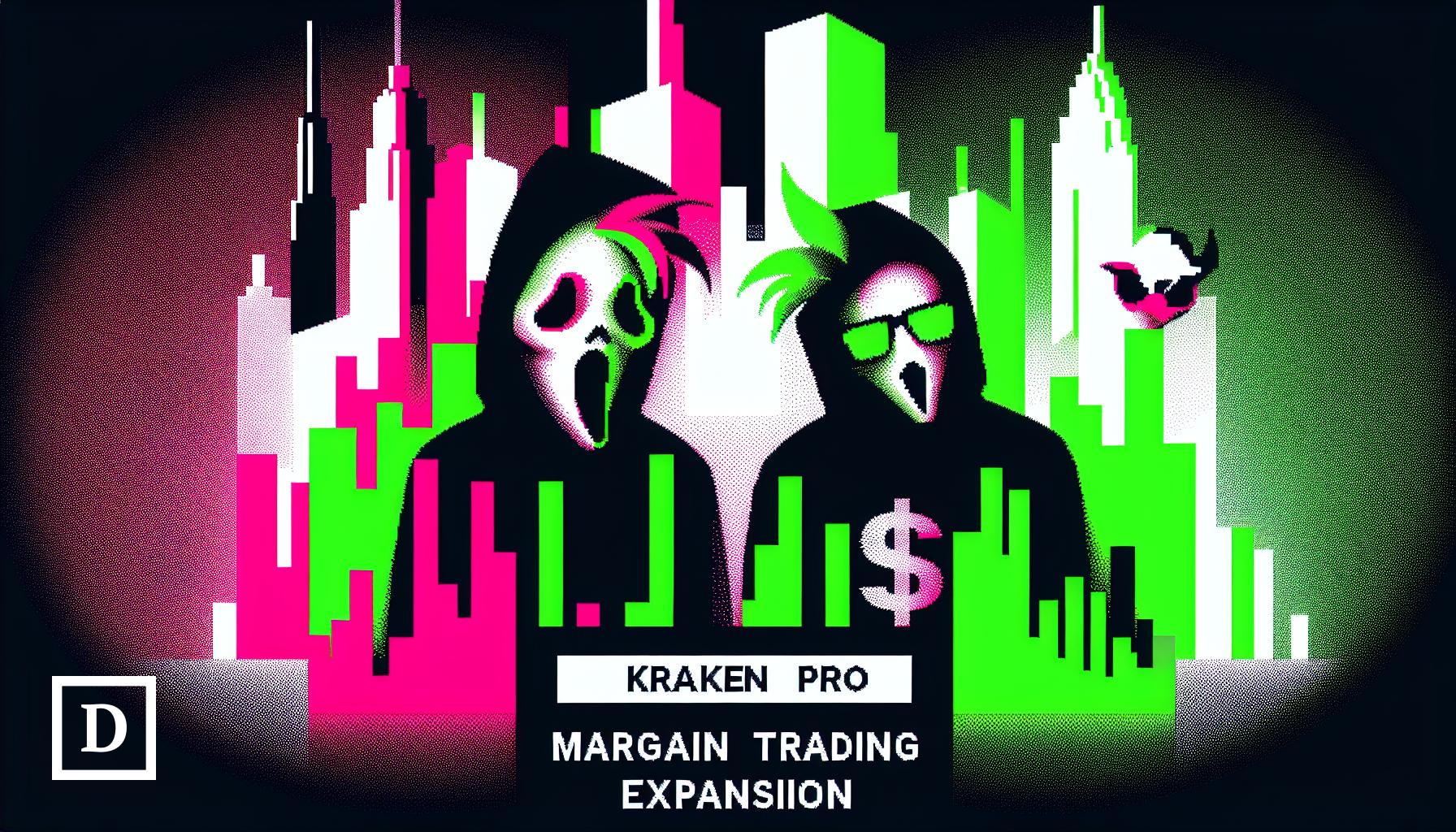
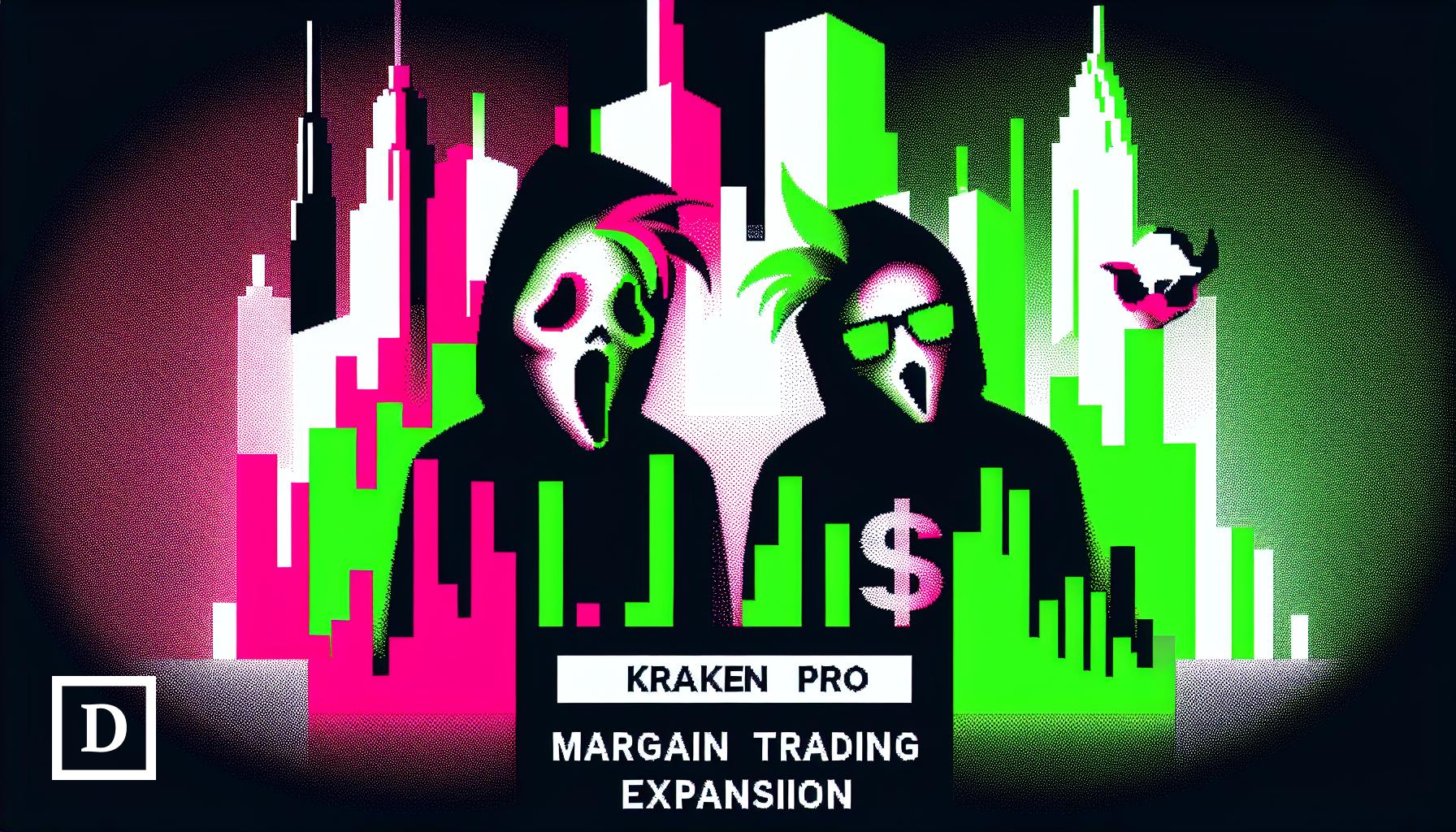
Kraken Pro has rolled out its largest single margin leverage expansion, adding support across 44 trading pairs including stablecoins, gold tokens, BTC and ETH regional pairs, mid-cap assets, and DeFi blue-chips.
Kraken Pro has expanded margin leverage across 44 trading pairs, marking the exchange’s largest single leverage expansion to date. The expansion spans four distinct asset categories: stablecoins, gold tokens, BTC and ETH regional pairs, mid-cap assets, and DeFi blue-chips. The rollout is designed to allow traders to size positions that better reflect their conviction without hitting leverage limits.
The expansion builds on Kraken’s recent push to grow its margin trading offerings. The exchange previously increased collateral currency options and added new margin pairs including MON and NIGHT, bringing the total number of available margin markets to over 240. The latest expansion reinforces Kraken Pro’s positioning as a platform for advanced traders seeking deeper leverage access across multiple asset classes.
Sources: Kraken Blog | Kraken Pro
This article was generated automatically by The Defiant’s AI news system from publicly available sources.
Crypto World
BNB Chain Launches BNBAgent SDK, the First Live Implementation of ERC-8183 for Trustless Onchain AI Agents
[PRESS RELEASE – Dubai, UAE, March 18th, 2026]
BNB Chain today announced the launch of BNBAgent SDK, the first live implementation of ERC-8183 and a complete developer framework enabling trustless onchain AI workflows. The release represents a major step forward in building the infrastructure needed for autonomous agents to operate at scale, with verifiable workflows, trustless settlement, and decentralized dispute resolution built in.
As AI agents move beyond experimentation into workflows where tangible value is involved, capability alone is insufficient. A key consideration is trust—specifically, the ability to verify results, resolve disputes, and settle payments in a reliable manner without dependence on centralized platforms.
The SDK provides:
- Onchain identity and reputation, built on ERC-8004 Every agent registered through the SDK gets a persistent onchain identity tied to ERC-8004, with a verifiable record of activity and outcomes that builds over time. Rather than being deployed in isolation, agents become discoverable participants that applications and users can evaluate and trust based on their actual track record.
- A standardized job lifecycle, no custom escrow required ERC-8183 establishes a shared protocol covering task creation, funding, execution, and settlement. The SDK puts that protocol directly in developers’ hands, so teams can integrate agent workflows without rebuilding contract logic for every new use case.
- Dispute resolution via UMA’s Optimistic Oracle When agent outputs go unchallenged, jobs settle quickly. When they are disputed, the SDK routes resolution through UMA’s Data Verification Mechanism, where token holders weigh in on the outcome. The process is transparent, decentralized, and doesn’t require either party to trust a third-party intermediary.
- A Python toolkit built for real workflows The SDK packages all of this into a Python developer toolkit with encrypted keystore support included by default. Developers interact with ERC-8183 using familiar patterns rather than writing low-level contract logic, and the architecture is designed to stay flexible as wallet systems and verification models continue to develop.
The code will be released publicly in the coming week, with mainnet to follow. For more information, users can visit the blog HERE.
About BNB Chain
BNB Chain is one of the largest and most active blockchain ecosystems in the world, supported by a global community of developers and users. With high throughput, low transaction costs, and full EVM compatibility, BNB Chain powers scalable applications across finance, gaming, and the broader Web3 economy. For more information, users can visit www.bnbchain.org.
Binance Free $600 (CryptoPotato Exclusive): Use this link to register a new account and receive $600 exclusive welcome offer on Binance (full details).
LIMITED OFFER for CryptoPotato readers at Bybit: Use this link to register and open a $500 FREE position on any coin!
Crypto World
Ethereum’s Fast Confirmation Rule targets 13-second bridge times with 98% reduction: Ethereum Foundation


Ethereum’s proposed Fast Confirmation Rule aims to slash L1-to-L2 bridge and exchange deposit times from minutes to just 13 seconds without requiring a hard fork.
Ethereum is moving forward with a Fast Confirmation Rule (FCR) designed to dramatically accelerate bridge times between Layer 1 and Layer 2 solutions, as well as exchange deposits. The mechanism targets completion times of approximately 13 seconds—a reduction of 80–98% compared to current timelines—and achieves this without requiring a hard fork to the network.
The FCR leverages attestations rather than blocks to verify transactions, representing a shift in how Ethereum handles cross-layer confirmation speed. This proposal aligns with broader Ethereum roadmap efforts to reduce finality times and slot durations, part of a longer-term vision to make the network faster and more efficient for users and institutions.
Sources: Julian (@_julianma) on X | Binance Square
This article was generated automatically by The Defiant’s AI news system from publicly available sources.
Trump continues to urge Powell to cut the rates, but it’s highly unlikely.
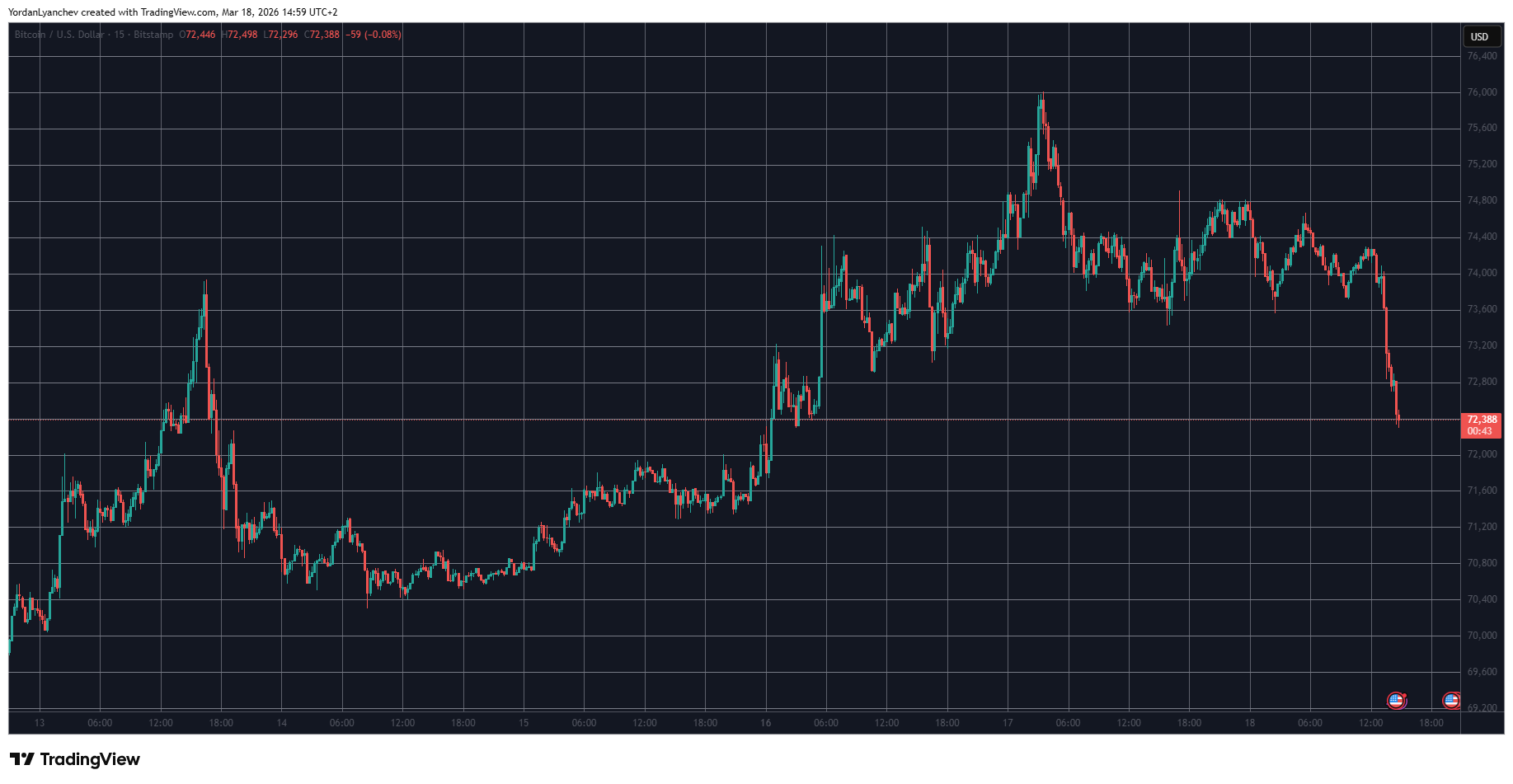
With just hours left until the US Federal Reserve publishes its decision whether it will change in any way the key interest rates, BTC’s price has dived by roughly two grand in minutes, dropping to a multi-day low of under $72,500.
This would be the second-to-last FOMC meeting before the Fed’s chair, Jerome Powell, leaves office as his four-year term expires on May 15.
FOMC Today: What to Expect
The general consensus among experts and prediction platforms is that there will be no changes to the interest rates today. According to most reports, Powell will likely keep them the same, as the war in the Middle East has only increased uncertainty, with gas prices jumping worldwide.
“Heading into the March [Federal Open Market Committee] meeting, the key question for the Fed is how to handle oil price shocks,” wrote Morgan Stanley economists in a recent note as cited by NBC News.
At the same time, economists at UBS reaffirmed the narrative that the Fed will not pivot on its most recent monetary policy. BeiChen Lin, a senior investment strategist at Russell Investments, also believes there won’t be any changes today, but noted that “any hints Chair Powell might drop about the path of future interest rates will be key.”
US President Trump continues to request that Powell cut the rates, which has brought him little to no success over the past several months. It appears he would have to wait for his nominee, Kevin Warsh, to replace Powell in mid-May.
As reported yesterday, the central banks for the UK and the European Union will also have such meetings in the near future, but the landscape in those jurisdictions is rather identical, as the market does not expect any changes.
Bitcoin Slips
Bitcoin became one of the top-performing assets since the war started on February 28, and jumped from a then-low of $63,000 to $76,000 marked yesterday morning. Although it was stopped there, it managed to hold above $74,000 until a few hours ago.
You may also like:
That’s when it started to lose value rapidly, dropping by around two grand in 90-120 minutes. The asset has a long history of reacting with intense volatility to Powell’s speeches, and more fluctuations are expected today, even if the Fed indeed leaves the rates as they are.
Binance Free $600 (CryptoPotato Exclusive): Use this link to register a new account and receive $600 exclusive welcome offer on Binance (full details).
LIMITED OFFER for CryptoPotato readers at Bybit: Use this link to register and open a $500 FREE position on any coin!

The SEC just gave crypto its biggest regulatory green light in years.
Chair Paul Atkins floated a safe harbor exemption on March 18 that lets crypto projects operate without immediate securities registration. It is a direct reversal of the regulation by enforcement era that suffocated US-based development for years.
Token projects now have a compliant runway to decentralize without the threat of an SEC lawsuit hanging over them. For altcoin valuations, that changes the math entirely.x
- Atkins identified four asset categories—digital commodities, collectibles, tools, and payment stablecoins—that are not subject to securities laws.
- The safe harbor proposal offers a specific grace period for projects to reach decentralization without facing enforcement actions.
- Formal rulemaking is expected within weeks to replace temporary staff guidance and solidify these protections.
The Safe Harbor Framework Explained
Atkins is cutting through a decade of deliberate ambiguity.
Speaking at a Digital Chamber event, he laid out a framework that separates capital raising from the underlying asset. Four categories are now explicitly excluded from securities jurisdiction. Digital commodities, digital collectibles, digital tools, and payment stablecoins.
— BSCN (@BSCNews) March 18, 2026
 UPDATE: SEC CHAIR PROPOSES CRYPTO SAFE HARBOR FRAMEWORK
USE SEC Chair, Paul Atkins, has proposed a new regulatory safe harbor for crypto firms in the US.
The framework aims to ease pressure on early-stage projects. It would allow firms to raise capital with fewer… pic.twitter.com/NRTHMyAv0J
For everything that does not fit cleanly into those boxes yet, the safe harbor buys time. Instead of Wells Notices for technically failing the Howey Test during development, projects face purpose-fit disclosures and a transparent path toward decentralization. Build first. Comply as you go.
Custody rules are also getting overhauled. Broker-dealers will be able to hold both crypto assets and traditional securities simultaneously. The special purpose broker-dealer model that no compliant firm could actually use is effectively dead.
Atkins is trying to bring crypto trading back to national securities exchanges and stabilize a market that has been hammered by legal uncertainty for years. Assets like XRP have historically exploded the moment regulatory clouds clear.
Those clouds are clearing fast.
Market Implications for Issuers and Exchanges
The immediate winners are US-based token issuers and exchanges.
Coinbase has operated for years under the threat that any listing could trigger a lawsuit. A formal safe harbor removes that existential risk entirely. That clarity is the missing piece institutional product approvals have been waiting for.
The ETF race is the most direct beneficiary. Solana’s push for a spot ETF has faced headwinds specifically because the SEC previously labeled SOL a security. If SOL lands in the digital commodity or digital tool bucket under Atkins’ new classification, the path to approval gets significantly shorter overnight.
The broader impact is a sector-wide repricing. Token prices have been trading at a discount for years to account for enforcement risk. Remove that discount and valuations adjust upward across the board.
The cost of capital just dropped for the entire industry.
Discover: The best new crypto in the world
The post SEC Chair Paul Atkins Floats ‘Safe Harbor’ Exemptions for Crypto appeared first on Cryptonews.

The old and the “new”: Slovenia’s parliamentary elections

Louis Tomlinson Slams One Direction’s ‘Corny’ What Makes You Beautiful

Bilibili: Still A 'Buy' Amid DAU Growth And Ad Surge

Smart energy pays enters the US market, targeting scalable financial infrastructure

Why Israel is blocking foreign journalists from entering

Bitcoin: We’re Entering The Most Dangerous Phase

How Blockchain Works Explained Simply! #blockchain #bitcoin #shorts

PARLIAMENT OF MALAWI – PAC MEETING WITH REGISTRAR OF FINANCIAL ON AMARYLLIS HOTEL – INQUIRY LIVE

Does Checking “Yes” on the IRS 1040 Crypto Question Trigger an Audit?
-
 Crypto World4 days ago
HYPE Token Enters Net Deflation as HyperCore Buybacks Outpace Staking Rewards
-

 Fashion5 days ago
Weekend Open Thread: Addict Lip Glow
-

 Tech3 days ago
Your Legally Registered ‘Motorcycle’ Might Not Count Under Proposed US Law
-
Sports4 days ago
Why Duke and Michigan Are Dead Even Entering Selection Sunday
-

 Sports7 days ago
PWHL, Senators discussing plan to keep Charge in Ottawa
-

 NewsBeat7 days ago
Residents reaction as Shildon murder probe enters second day
-

 Business3 days ago
Search for Savannah Guthrie’s Mother Enters Seventh Week with No Arrests
-

 Business4 days ago
US Airports Launch Donation Drives for Unpaid TSA Workers as Partial Government Shutdown Enters Fifth Week
-
 Tech21 hours ago
Are Split Spacebars the Next Big Gaming Keyboard Trend?
-
Crypto World4 days ago
Coinbase and Bybit in Investment Talks: Could Bybit Finally Enter the US Crypto Market?
-

 NewsBeat7 days ago
I Entered The Manosphere. Nothing Could Prepare Me For What I Found.
-

 Business4 days ago
Country star Brantley Gilbert enters growing non-alcoholic beer market
-

 Business2 days ago
Australian shares drop as Iran war enters third week
-

 Crypto World2 days ago
Crypto Lender BlockFills Enters Chapter 11 with Up to $500M in Liabilities
-

 Sports5 days ago
College Basketball Best Bets: Conference Tournament Semifinal Picks
-

 Politics5 hours ago
The House | The new register to protect children from their abusers shows Parliament at its best
-

 Crypto World7 days ago
Three Binance Charts May Be Hinting at Bitcoin’s Next Move
-

 Business6 days ago
Trump demands Powell cut rates as Iran conflict raises energy prices
-

 Crypto World6 days ago
Senate Votes to Include CBDC Ban in Bipartisan Housing Bill
-

 Fashion2 days ago
25 Celebrities with Curly Hair That Are Naturally Beautiful


You must be logged in to post a comment Login