
Crypto World
Maya Protocol exploit drains bitcoin and other assets as pool value drops $11 million



A chain of six flaws caused the cross-chain trading network to credit a pool with nearly 50 million tokens that were never properly funded, letting an attacker drain real assets.

Goldman Sachs signage on the floor of the New York Stock Exchange (NYSE) in New York, US, on Tuesday, July 14, 2026.
Michael Nagle | Bloomberg | Getty Images
Artificial intelligence is starting to weigh on labor market across major developed economies, with effects varying across industries and seniority levels, according to Goldman Sachs.
The Wall Street investment bank found in its research that industries with greater exposure to AI automation have generally seen slower job openings growth since the second half of 2022, with the relationship particularly pronounced in Germany, Australia and the U.S.
Goldman said in its report published Wednesday that employment in information and communication services, among the industries most exposed to AI, has slowed across nearly all major developed economies since 2022.
However, employment in these industries remains near or above its long-run trend outside the U.S.
Looking more closely at highly AI-exposed industries, Goldman found a similar, though generally more muted, pattern of employment headwinds across other developed markets.
Employment in call centers, software publishing, management consulting and advertising has fallen sharply below its historical trend across developed markets, Goldman said.
Call centers stand out in particular. Employment in the industry is now below trend in the U.S., 39% lower, Canada, down 33%, and Germany 27% below trend, according to the report. Goldman said the pattern indicates that AI-related employment pressures are already visible in industries where tools capable of automating work are available.
Entry-level workers feel more pressure
The effects appear to be more pronounced for those looking to start their careers.
Goldman analyzed employment growth across more than 800 occupations and found that AI-related headwinds were the strongest among entry-level workers. It also found an additional, though smaller, negative effect among occupations considered to have a high risk of displacement from AI.
Across the broader labor market, a 10% occupational exposure to AI was associated with only a 0.1 percentage point drag on annual headcount growth in France, Canada and the U.S. But for entry-level workers, the impact ranged between more than 0.6 percentage point (Australia) and over 0.2 percentage point (U.S.).
Overall, the investment bank concluded that AI-related hiring pressures are clearly visible in employment data globally, but remain limited to a relatively narrow set of industries and workers.
Where AI adoption is highest
The labor market impact comes as AI adoption is spreading across developed economies.
Goldman combined 11 surveys measuring AI adoption across countries and found that major developed markets have adoption rates of roughly 15% to 20%.
France, the U.S., the Netherlands and the U.K. are leading AI adoption, while Italy, Japan and New Zealand were among the developed economies at the lower end of adoption.
Major emerging markets, meanwhile, had estimated adoption rates of between 10% and 15%.
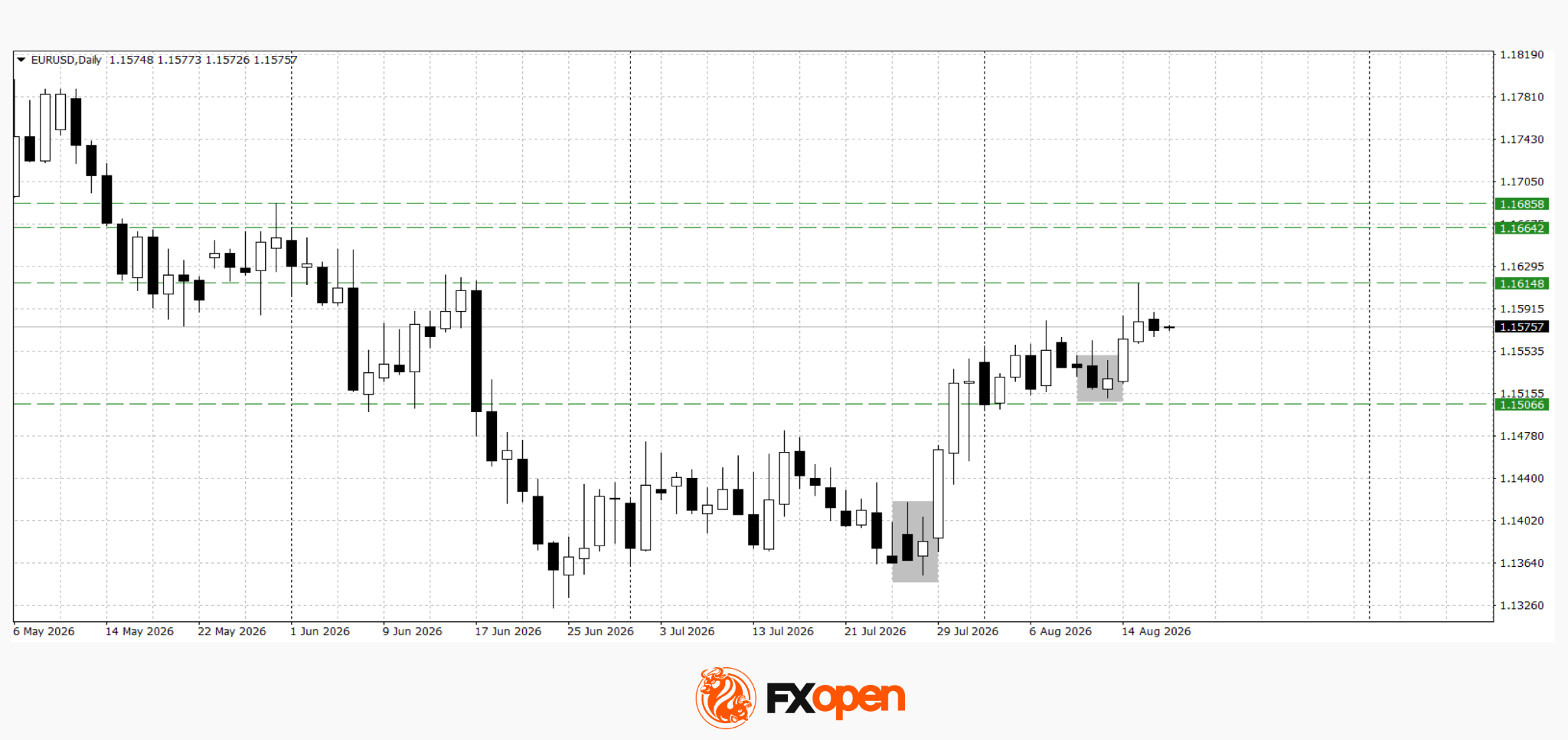
The euro and British pound are trading cautiously against the US dollar as markets await the release of the minutes from the Federal Reserve’s latest meeting. At its July meeting, the Fed left interest rates unchanged and reiterated that future decisions would depend on incoming economic data.
Investors will pay particular attention to how FOMC members assessed inflation risks, labour-market conditions and the outlook for interest rates. Following softer inflation data and signs of a cooling labour market, a more dovish tone in the minutes could strengthen expectations of monetary easing and weigh on the dollar. Conversely, a continued emphasis on inflation risks and a restrictive policy stance could provide additional support for the US currency.
For sterling, today’s UK inflation figures will provide an additional catalyst. The data will be closely assessed for clues about the Bank of England’s next policy steps. Persistent price pressures could reduce the scope for further monetary easing and support the pound, while a more pronounced slowdown in inflation could reinforce expectations of lower interest rates.
With few major domestic catalysts for the euro, EUR/USD is likely to remain particularly sensitive to movements in the US dollar. As a result, the FOMC minutes could become a key driver of the pair’s next move.
EUR/USD
EUR/USD tested the June highs near 1.1600 yesterday. From a technical perspective, the pair could extend its advance towards 1.1660–1.1680 if the previous session’s high is successfully turned into a support level.
Failure to establish a firm foothold above the current levels, however, could trigger a corrective move and bring the pair back towards the 1.1500 support area.
Key events for EUR/USD:
- today at 12:30 (GMT+3): German 10-year Bund auction;
- today at 17:30 (GMT+3): US crude oil inventories;
- today at 21:00 (GMT+3): release of the FOMC minutes.
GBP/USD
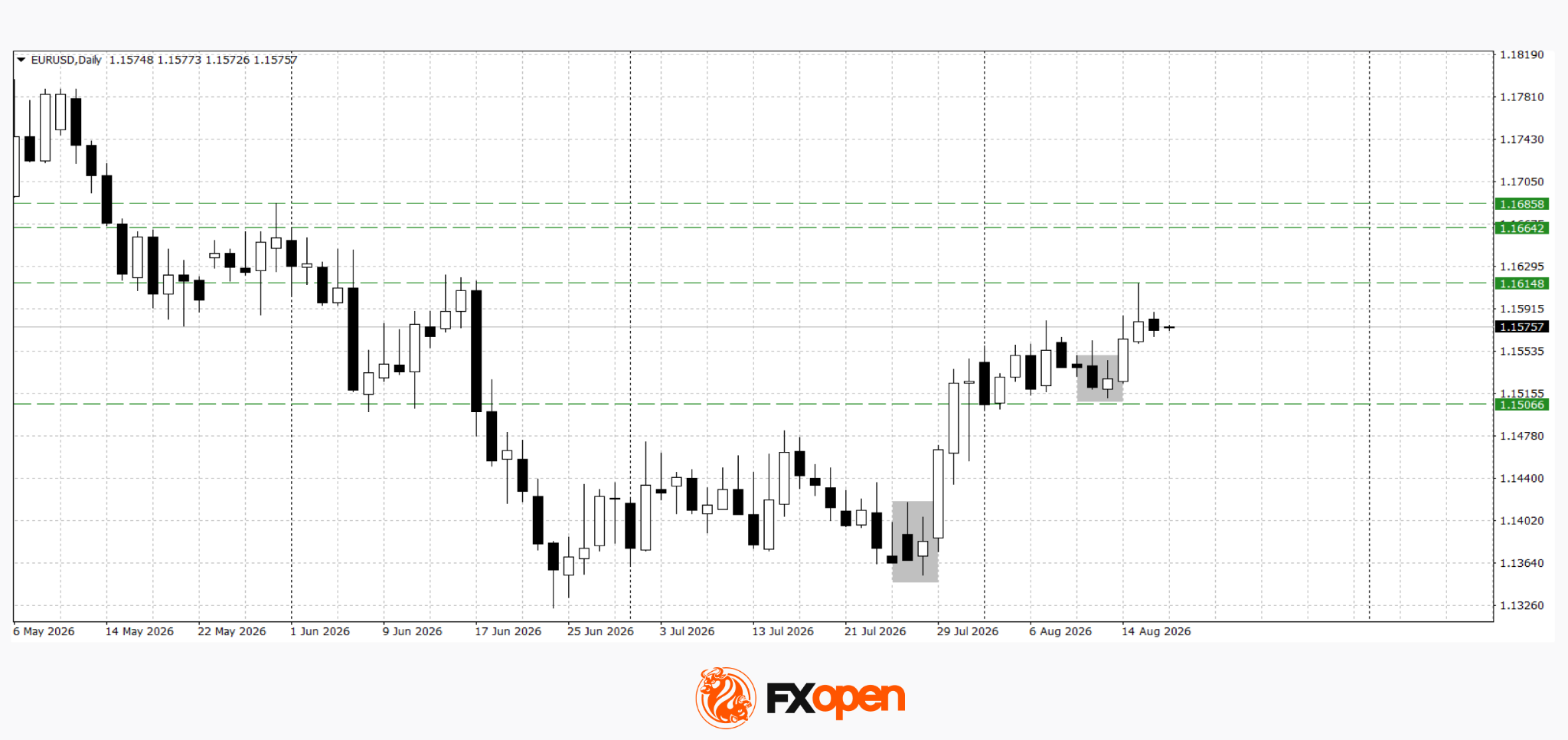
GBP/USD buyers have managed to push the pair above the important 1.3500 resistance level over the past few sessions. If the pair can maintain its position above this threshold, the next upside targets could be found around 1.3600–1.3640.
A decisive move back below 1.3500, on the other hand, could signal the start of a bearish correction towards the 1.3430–1.3470 area.
Key events for GBP/USD:
- today at 09:00 (GMT+3): UK Consumer Price Index (CPI);
- today at 11:30 (GMT+3): UK house price index;
- tomorrow at 15:30 (GMT+3): US Philadelphia Fed Manufacturing Index.
EUR/USD and GBP/USD are both holding close to important technical levels, leaving the next directional move dependent on fresh fundamental signals. UK inflation will be the first major catalyst for sterling, while the FOMC minutes represent the main event for both currency pairs.
A more dovish message from the Federal Reserve could put renewed pressure on the dollar and support further gains in the euro and pound. Conversely, a persistently hawkish stance could strengthen the US currency and trigger corrective declines in both EUR/USD and GBP/USD.
Trade over 50 forex markets 24 hours a day with FXOpen. Take advantage of low commissions, deep liquidity, and spreads from 0.0 pips (additional fees may apply). Open your FXOpen account now or learn more about trading forex with FXOpen.
This article represents the opinion of the Companies operating under the FXOpen brand only. It is not to be construed as an offer, solicitation, or recommendation with respect to products and services provided by the Companies operating under the FXOpen brand, nor is it to be considered financial advice.


Interstice Digital has launched a non-custodial cross-chain swap engine with FalconX that connects the Canton Network with Ethereum, Solana, and Robinhood Chain while using FalconX to supply liquidity.
Summary
- Interstice Digital has launched a non-custodial swap engine connecting Canton with Ethereum, Solana and Robinhood Chain.
- FalconX is providing liquidity for cross-chain swaps without Interstice taking custody of user assets.
- The engine gives users a route between tokenized assets on Canton and liquidity across major public blockchains.
- Canton is already being used for tokenized Treasuries, stablecoin settlement and institutional collateral transactions.
Interstice Digital said in an Aug. 18 announcement that the engine lets users swap assets across the four networks without the company taking custody of funds or executing transactions on their behalf. The company also said the product has been named a Featured App on Canton.
The system is designed to give users a route between tokenized assets issued or traded through Canton and liquidity available on public blockchain networks. FalconX, which provides digital asset prime brokerage services to institutional investors, is supplying liquidity for the engine.
Interstice Digital links Canton with three public-chain markets
Under the new setup, Interstice is connecting Canton’s institution-focused infrastructure with Ethereum, Solana and Robinhood Chain, three networks that provide access to different parts of the digital asset market.
Interstice described Canton as a public, permissionless blockchain built for capital markets, with privacy and permissioning controls intended for regulated transactions. The network is used by financial institutions working with tokenized securities, collateral, and blockchain-based settlement.
For the public-chain side of the connection, Interstice cited the scale of the networks involved. The company said Robinhood has 28 million funded accounts and $369 billion in total platform assets, while Robinhood Chain reached 100 million transactions faster than any other EVM network.
Solana recorded 167 million monthly active addresses in April 2026 and handled $650 billion of stablecoin transaction volume in February, according to figures cited by Interstice. The company described Ethereum as the industry’s deepest developer ecosystem and noted that Robinhood Chain uses Ethereum technology as its base.
“We built the cross-chain swap engine to help connect Solana, Ethereum, and Robinhood Chain to the growing Canton ecosystem where over $9T in tokenized RWA flow monthly,” Interstice Digital CEO Janine Yorio said.
Interstice did not disclose which assets are supported at launch or provide transaction-volume figures for the engine. The company is a wholly owned subsidiary of Everyrealm and is backed by investors including a16z Crypto, Coinbase Ventures, Galaxy and Brevan Howard.
FalconX supplies liquidity without Interstice holding user assets
FalconX’s role centers on liquidity for swaps routed through the engine. Interstice said its non-custodial structure means it does not hold customer assets or act as the party executing transactions for users.
FalconX Head of Trading Strategy Hassan Bassiri said institutional demand for digital assets is increasing and argued that firms will need infrastructure capable of moving capital between different ecosystems.
“The cross-chain swap engine we’ve developed with Interstice Digital is exactly the kind of infrastructure this market needs,” Bassiri said, after describing cross-ecosystem capital movement as an important requirement for institutional firms.
Canton is also being used for live and trial transactions involving government securities, stablecoins and institutional collateral.
Earlier in August, four Mitsubishi UFJ Financial Group companies launched a proof of concept to test Japanese government bond repo transactions on Canton, as crypto.news reported on Aug. 13. MUFG, Mitsubishi UFJ Morgan Stanley Securities, Mitsubishi UFJ Trust and Banking and MUFG Bank are working with Digital Asset and Progmat on the project.
The participants plan to test automated processing and real-time settlement available around the clock. The trial forms part of Japan’s Financial Services Agency-backed Payment Innovation Project and includes work on whether blockchain infrastructure can improve funding and capital use in repo markets.
An earlier Japanese trial involving Japan Securities Clearing Corporation, Mizuho Financial Group, Nomura Holdings and Digital Asset tested whether rights linked to Japanese government bonds and updates to book-entry records could be handled through Canton while remaining within Japan’s existing legal framework.
Canton has expanded tokenized settlement activity
Canton has also been used in transactions involving tokenized U.S. government securities. In July, Tradeweb said it executed an onchain U.S. Treasury trade in which Franklin Templeton transferred a tokenized Treasury security to Virtu Financial in exchange for tokenized cash.
Tradeweb provided execution and price discovery, while Canton synchronized settlement between the two assets in real time, according to the companies involved. Tradeweb described the transaction as the first real-time purchase and sale of a tokenized U.S. Treasury settled against USDCx, a USDC-backed stablecoin issued on Canton.
Societe Generale, Digital Asset and Blockdaemon also participated in the transaction. Societe Generale has separately deployed euro- and dollar-denominated stablecoins on Canton for uses including tokenized collateral, repo financing and institutional settlement.
Payment companies are testing the network as well. Visa tested private stablecoin settlement using Brale’s SBC token on Canton in June and has since included Canton among the blockchains supported by its stablecoin settlement program. A July report on Visa’s program said the settlement pilot supported nine blockchains and had reached a $7 billion annualized run rate by March.
Visa joined Canton as a Super Validator in March before adding the network to its stablecoin settlement work. The company received approval for its validator application that month and later added Canton to its stablecoin settlement pilot.
Digital Asset has raised capital for Canton expansion
Institutional funding has accompanied the increase in activity around the network. Digital Asset, the company behind Canton, raised $355 million in June in a round led by Andreessen Horowitz’s a16z crypto fund.
A16z crypto contributed $100 million to the round, while other participants included Citadel Securities, Apollo, BNP Paribas, CME Ventures, Coinbase Ventures, HSBC, Optiver and the Abu Dhabi Investment Authority. Digital Asset said the capital would support partnerships, acquisitions and expansion of the Canton ecosystem.
The funding followed a $135 million strategic round involving Goldman Sachs, Citadel Securities, DTCC, BNP Paribas and Tradeweb Markets. Digital Asset has positioned Canton for financial applications that require transaction privacy while allowing different institutions and applications to coordinate settlement.
Canton’s use in government-bond markets has continued in Asia. The MUFG repo proof of concept is examining Japanese government bonds in short-term financing transactions, while a separate Progmat working group has been studying tokenized JGBs, stablecoin settlement, T+0 processing and 24-hour access.
S&P Dow Jones Indices and Kaiko have also placed the iBoxx U.S. Treasuries index on Canton through smart-contract infrastructure, according to the Aug. 13 MUFG report. The index project sits alongside other Canton-based work involving tokenized Treasury products and institutional collateral.


Solana Policy Institute CEO Miller Whitehouse-Levine said on Aug. 18 that the CLARITY Act has only a 10% chance of becoming law before the November midterm elections.
Summary
- Solana Policy Institute CEO Miller Whitehouse-Levine assigns the Clarity Act 10% odds before November’s midterms.
- Senate leaders scheduled a cloture vote on proceeding to the bill for September 15 afternoon.
- Polymarket currently prices 2026 passage near 20%, with trading volume exceeding $7.2 million in total.
- The procedural vote would begin Senate consideration and would not constitute final passage of legislation.
- SEC proposed separate crypto offering rules while Congress continues debating broader digital asset market structure.
Speaking at the Wyoming Blockchain Symposium, Whitehouse-Levine described the digital asset market structure bill as being in “August recess purgatory.” He said the narrowing congressional calendar and unresolved industry disputes had made passage increasingly difficult.
His percentage is a personal assessment, not an official forecast. The Senate has taken one procedural step that preserves a September path, but several votes and further negotiations would still be required.
CLARITY Act faces a Sept. 15 procedural test
Senate Majority Leader John Thune filed cloture on the motion to proceed to H.R. 3633 before senators left Washington. The chamber resumes normal business on Sept. 14.
The official Senate schedule says the cloture motion will ripen at 2:15 p.m. on Sept. 15. Approval would allow the Senate to begin considering the legislation.
The vote is not final passage. Senators would still need to debate the measure, consider amendments and approve the resulting text. Any Senate changes could also require further House action before the bill reaches the president.
As crypto.news previously explained, the September procedural vote will test whether supporters have enough bipartisan backing to overcome the Senate’s 60 vote cloture threshold.
Prediction markets remain more optimistic
Polymarket’s live market placed the chance of the CLARITY Act becoming law in 2026 at approximately 20% on Aug. 19. Trading volume had passed $7.2 million.
Kalshi traders placed the probability near 23% on Aug. 18, down from roughly 50% less than a month earlier. Prediction market prices can move quickly and do not guarantee legislative outcomes.
The comparison with Whitehouse-Levine’s 10% estimate requires caution. His prediction covered passage before the November midterms, while the Polymarket contract allows the bill to become law through Dec. 31.
The market therefore includes a possible post election session. That wider deadline partly explains why traders may assign higher odds than Whitehouse-Levine did.
Stablecoin and ethics disputes narrow the path
Whitehouse-Levine said participation by banks, securities companies and derivatives firms had added competing demands to negotiations. Banks remain concerned about provisions involving stablecoin rewards, while other financial firms are focused on sections affecting their existing businesses.
Democratic lawmakers have also sought ethics restrictions covering government officials’ digital asset interests. Those disputes add to negotiations over SEC and CFTC jurisdiction, decentralized finance and customer protection.
Whitehouse-Levine called himself “hopeful, but realistic about its odds.” He also warned that failure would discard more than a year of work by congressional lawmakers and staff.
In earlier coverage, crypto.news mapped how the limited Senate calendar leaves little time for debate and amendments before election politics consume the floor.
SEC moves while Congress remains stalled
The SEC proposed Regulation Crypto Assets on Aug. 18, creating a separate regulatory track while Congress debates the broader market structure bill.
The agency’s proposal includes two exemptions for certain investment contracts involving crypto assets. One would cover offerings of up to $5 million during four years. Another would cover up to $75 million during each 12 month period.
The rules remain proposals and cannot replace every provision in the CLARITY Act. Agency rules also carry less permanence than federal legislation and remain subject to statutory limits and court review.
Whitehouse-Levine said regulators should move because the industry “can’t afford to keep waiting for Congress.” His organization plans to focus on token fundraising pathways and rules allowing more securities and derivatives activity to occur onchain.
The next confirmed event is the Sept. 15 cloture vote. Failure to proceed would sharply reduce the bill’s remaining 2026 path. Success would keep it alive but leave amendments, final passage and possible House coordination unresolved.


Maya Protocol has halted its cross-chain network after an attacker exploited six linked software flaws to steal an estimated $1.7 million in Bitcoin and other crypto assets.
Summary
- Maya Protocol halted its network after an attacker stole an estimated $1.7 million in crypto.
- The exploit chained six software flaws and used a single transaction containing 23 messages.
- About $1.36 million was moved to external blockchains, while another $291,000 remained in attacker controlled positions.
- CACAO plunged 88.7% during the incident as Maya Protocol began working on fixes to restore swaps.
Maya Protocol pseudonymous co-founder Aalux said on Wednesday that the attacker took about 20 Bitcoin, worth roughly $1.4 million, alongside another $300,000 in assets before the protocol activated a global halt to stop further losses.
The team has since started working on fixes needed to restore swaps, while a preliminary technical analysis shared by Aalux traced the attack to a chain of bugs involving trade accounts, outbound transaction processing, and liquidity pool calculations.
Maya Protocol exploit used six chained bugs
According to the preliminary analysis, the attacker combined six separate flaws instead of relying on a single vulnerability, allowing several parts of MAYAChain’s transaction and accounting system to be manipulated within the same attack.
A single transaction containing 23 messages was used to execute the sequence. The analysis said the attacker first triggered the protocol’s theft-detection mechanism incorrectly before manipulating a pool with limited liquidity.
By inflating the value of the low-liquidity pool, the attacker was able to withdraw 48.87 million CACAO tokens from Maya’s Asgard module, according to the technical findings.
Asgard modules hold assets used by the protocol to process cross-chain swaps. Maya Protocol allows users to exchange native assets across different blockchains without relying on a traditional centralised exchange, making the network’s vault and liquidity accounting systems central to settling transactions.
The preliminary accounting estimated that approximately $1.36 million in assets ultimately moved to external blockchains. Another $291,000 remained under the attacker’s control through CACAO holdings and trade-account positions on MAYAChain.
Aalux said the global halt contained the incident and prevented additional damage while developers investigated the affected components and prepared a fix.
The response resembles emergency measures used by other cross-chain protocols when vulnerabilities threaten assets held across several networks. In June, Axelar disabled bridge routes connected to Secret Network after approximately $4.7 million in bridged assets were taken through an exploit linked to a Secret-side ICS-20 smart contract.
Axelar’s emergency committee shut the affected connections while the investigation continued. The interoperability protocol said at the time that its core infrastructure had not been compromised and that the problem appeared isolated to the smart contract supporting the connection with Secret Network.
CACAO price collapsed during the attack
Independent blockchain security researcher Vini Barbosa, summarising the preliminary findings, said CACAO dropped 88.7% during the incident, falling from about $0.115 to $0.013.
The decline in CACAO also complicated estimates of the total economic damage because the attack affected both assets directly extracted from the protocol and the market value of liquidity remaining in its pools.
According to the technical analysis, the total decline in pool value reached approximately $10.9 million. However, the report did not classify the entire amount as stolen funds because the calculation also included arbitrage activity and the sharp devaluation of CACAO during the incident.
The estimated amount directly moved out of the system was considerably lower, with about $1.36 million transferred to other blockchains and roughly $291,000 remaining in positions controlled by the attacker.
Cross-chain systems have faced several attacks this year in which the value initially affected by a vulnerability differed from the amount ultimately extracted. Echo Protocol, for example, paused cross-chain transactions in May after an attacker minted about $76.7 million worth of unauthorised eBTC on Monad. Security researchers later estimated that roughly $816,000 in actual value had been stolen despite the much larger unauthorised mint.
Echo’s incident was linked by security researchers to a compromised administrative private key. Monad co-founder Keone Hon said at the time that the underlying Monad network continued operating normally, while Curvance paused the affected Echo eBTC market as a precaution.
Cross-chain DEX exploits have forced similar network halts
Maya Protocol’s decision to stop network activity also follows a series of security incidents involving cross-chain trading infrastructure in 2026.
In May, crypto.news reported a THORChain exploit that forced the cross-chain DEX to pause trading and activate a global emergency halt after blockchain investigator ZachXBT estimated losses of at least $10 million across several networks.
THORChain later determined that approximately $10.7 million had been drained from one of its five vaults. The protocol said a newly churned node operator exploited a vulnerability in its GG20 Threshold Signature Scheme and reconstructed a private key, while automatic solvency checks stopped cross-chain signing and trading within minutes.
Node operators subsequently approved the ADR028 recovery plan, which used protocol-owned liquidity to absorb losses without minting new RUNE, selling RUNE or diluting existing holders. Developers also prepared version 3.19.0 with additional security measures, including a mechanism designed to quarantine compromised vaults.
After more than a month offline, THORChain resumed network trading on June 23. Swaps, signing, churning, secured assets, trade assets and liquidity provider functions were restored after the protocol said vaults and keyshares had been checked as part of the restart process.
Another cross-chain protocol, Transit Finance, lost about $1.88 million in May after an exploit flagged by blockchain security firm PeckShield. At the time of the initial report, Transit Finance had not released a detailed technical post-mortem or recovery plan.
Maya Protocol works on restoring swaps
For Maya Protocol, the immediate work is focused on fixing the vulnerabilities identified in the preliminary review before cross-chain swaps can resume.
The technical findings indicate that the attack depended on several components interacting in sequence, including trade-account behaviour, outbound transaction processing and liquidity calculations. The 23-message transaction allowed the attacker to combine those weaknesses, trigger an incorrect theft response and manipulate the low-liquidity pool before extracting CACAO from Asgard.
Maya’s incident comes as security concerns around cross-chain infrastructure remain focused on the number of components required to move assets between otherwise separate blockchain networks. A July crypto.news review of cross-chain bridges noted that such systems can use lock-and-mint, burn-and-mint or liquidity-based designs, while transaction verification can depend on validators, multisignature arrangements or cryptographic mechanisms.
Maya Protocol has not provided a timetable for fully restoring swaps in the information available so far. Aalux said the global halt had contained further damage and that the protocol was working on the fixes required to bring network operations back online.
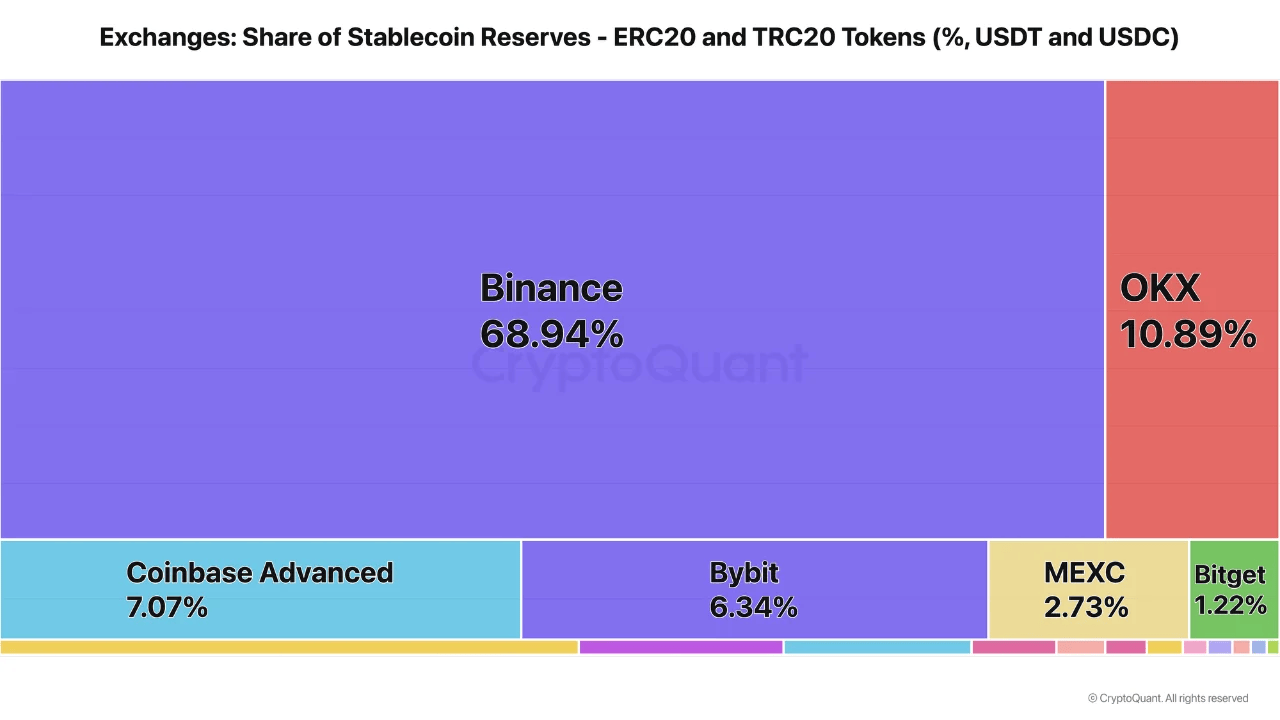
Stablecoin reserves parked on centralized exchanges have shrunk to roughly $64 billion, down about $16 billion from a late-2025 peak near $80 billion, CryptoQuant data shows.
The drain leaves less idle capital sitting ready to buy. What remains has pooled into fewer venues, with Binance alone accounting for 68.5% of exchange stablecoin liquidity.
Binance Absorbs a Shrinking Liquidity Pool
CQ Research said that Binance has “proven considerably more resilient” compared to other major exchanges. Balances at Coinbase, Bybit, OKX, and smaller venues contracted more sharply.
That divergence lifted Binance’s share from the low-60% range in late 2025 to 68.5% today. The exchange is winning a larger slice of a smaller pie.
“The divergence has allowed Binance to gain market share even while its own absolute liquidity declines, illustrating that the current downturn is simultaneously reducing aggregate liquidity and concentrating what remains,” the report read.

CryptoQuant flagged the same trend in February. Binance then held 65% of tracked reserves, worth $47.5 billion in stablecoins.
Concentration follows order books. Binance captured 38.7% of centralized exchange spot volume in the second quarter, according to CoinGecko. Bybit placed second near 10%.
Follow us on X to get the latest news as it happens
Fear Language Spreads Even as Sentiment Lifts Off Its Low
The liquidity drain coincides with deteriorating retail sentiment. Blockchain analytics firm Santiment reported last week that bearish vocabulary is spreading across social platforms.
“Crypto ‘dead’ chatter is rising again… This is fear language. It usually appears when retail patience is breaking, prices feel stuck, and traders start treating temporary weakness like permanent failure,” the firm said.
Santiment noted that crypto markets often make their sharpest moves when investors become overly convinced that further gains are unlikely.
“When ‘crypto is dead’ talk rises while Bitcoin holds key levels, stronger hands keep accumulating, and forced sellers fade, the setup often becomes more attractive for patient buyers,” it added.
The Crypto Fear and Greed Index tells a more mixed story. The gauge read 46 on Wednesday, still inside fear territory but well off last week’s low. Alternative.me put the index at 27 a week ago and 29 a month ago. It closed Tuesday at 41.
What a Shrinking Supply Means For Markets
Stablecoins serve as the primary quote currency across crypto trading pairs. Their aggregate supply is the market’s most readily available source of on-chain buying power. When they fall, fewer dollars sit ready to absorb selling pressure or fund the next leg higher.
Total supply has fallen to $300.89 billion from a high of nearly $316 billion in May, according to DefiLlama data. USDT sits at $182.95 billion and USDC at $71.97 billion.
That 4.8% market-wide decline is far shallower than the 20% drain from exchanges. The gap suggests that much of the liquidity leaving exchanges may be moving elsewhere on-chain rather than exiting the crypto market altogether.
Moreover, historical extremes have not been reached. Stablecoin supply fell 34% between April 2022 and August 2023 in a prolonged, grinding contraction, while Bitcoin’s (BTC) price dropped 43% over the same period.
The current decline is considerably milder. If the decline continues and approaches those historical extremes, it could signal a more significant deterioration in crypto’s available buying power and add pressure on Bitcoin and the broader market.
For now, however, the relatively modest contraction suggests the market has not yet entered a liquidity drain comparable to the 2022–2023 period. The key indicator to watch is whether stablecoin supply stabilizes or resumes its deeper decline, particularly if exchange balances continue to fall.
Subscribe to our YouTube channel to watch leaders and journalists provide expert insights
The post Exchange Stablecoin Reserves Drop 20% as Bear Market Drains Liquidity appeared first on BeInCrypto.
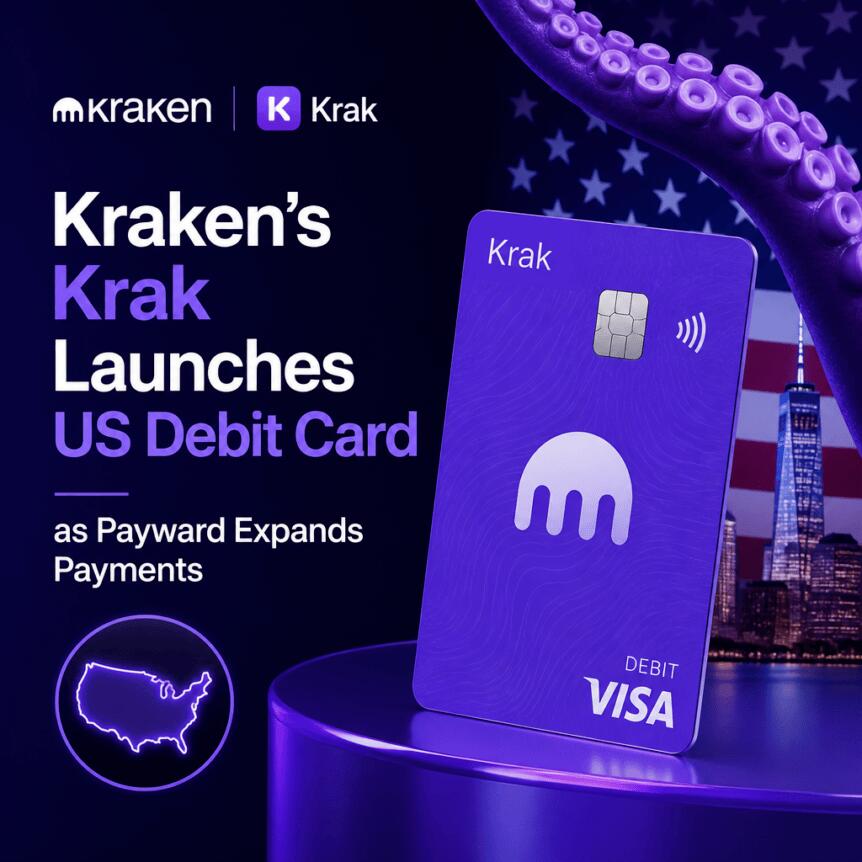
Kraken’s consumer app Krak has rolled out a multi-asset debit card in the United States, giving customers a way to pay with crypto and fiat while earning cashback denominated in either US dollars or Bitcoin (BTC). The launch adds to a broader push by crypto exchanges to move beyond trading and into everyday financial services.
According to Krak’s announcement, the card supports more than 600 currencies and assets. At the point of sale, users’ holdings are converted into US dollars, and a single purchase can draw from multiple balances depending on the spending order the customer sets.
Key takeaways
- Krak’s US debit card lets users spend from a wallet containing both crypto and fiat, with point-of-sale conversion into USD for purchases.
- Cashback can be earned in dollars or Bitcoin, with rates tied to average assets held across Krak, Kraken, and Kraken Pro.
- The card is issued by Lead Bank on Visa’s network and uses Stripe Issuing for program infrastructure, with physical and virtual options available to eligible customers.
- Krak positions the card as a rewards alternative to credit cards, aiming to appeal to customers wary of carrying monthly balances.
- Kraken and its parent Payward continue expanding into financial services beyond crypto trading, including payments and broader market products.
A multi-asset card designed for everyday spending
The Krak debit card is built around a simple promise: users can spend using a range of crypto and fiat holdings without having to manually select which asset to use for each transaction. Instead, the app allows cardholders to configure an asset-spend order, and the card will then pull from multiple balances as needed for a purchase.
Cashback is described as a key part of the value proposition. Krak said customers can receive up to 2% cashback, with the payout available in either US dollars or BTC. The company also noted that the specific cashback rate is dependent on the average assets held across Krak, Kraken, and Kraken Pro—meaning rewards are designed to scale with longer-term engagement rather than a one-off balance.
For US cardholders, the program includes both physical and virtual cards, with issuance routed through Visa’s network via Lead Bank. Krak said the rollout is powered by Stripe Issuing, an arrangement that signals how payment infrastructure is being leveraged to bring crypto-linked benefits into mainstream checkout flows.
Why Krak is leaning on “no-debt” rewards
Krak is framing the card as a counterweight to credit-card rewards programs. To support that positioning, the company commissioned a Morning Consult survey of 2,001 US adults.
The survey found that 42% of credit card holders worry about paying off their monthly balance. It also reported that 60% of respondents said they would switch to a debit card offering rewards without taking on debt.
In practical terms, that message targets a common friction point for rewards programs: the possibility that benefits come with a cost if consumers carry balances. By centering the product around debit spending—rather than credit limits—Krak is attempting to fit crypto rewards into behavior patterns that resemble traditional consumer debit programs, while still offering exposure to digital assets through BTC-denominated cashback.
From payments to broader financial services
Kraken’s consumer card launch lands within a wider strategy for Payward, the company behind Kraken and its apps. Co-CEO Arjun Sethi discussed broader expansion during remarks Tuesday at the Wyoming Blockchain Symposium, according to coverage of his comments.
Sethi said that expanding into multiple asset classes can reduce exposure to any single market. He also described tokenization as “a large part” of Payward’s effort to widen its financial offerings, and he argued the company must build products and services that are “not too different to a JP Morgan or a financial institution.”
The framing highlights the direction many major exchanges have taken in recent years: using regulated infrastructure and institutional know-how to develop more than trading platforms. When exchanges move into banking-related services and asset tokenization themes, the emphasis often shifts from pure price speculation to product distribution—placing crypto-linked capabilities closer to how consumers already spend, invest, or move money.
Kraken’s card rollout also aligns with a broader industry pattern. Coinbase and other large platforms have been expanding into additional product categories beyond spot trading, including areas such as equities, derivatives, prediction markets, tokenized assets, and pre-IPO products.
Kraken’s US expansion doesn’t stop at payments
In parallel with the debit card announcement, Kraken said it launched stock trading for customers in the European Economic Area (EEA) for more than 7,000 US-listed stocks. The company’s decision to widen trading access to traditional markets underscores that its consumer growth strategy is not limited to payments.
Taken together, the card and the stock expansion show how crypto platforms are working to broaden their customer base and deepen engagement. A debit card can drive day-to-day usage, while expanded market offerings can capture users looking to trade across asset classes within a single ecosystem.
For investors and users, the key question is how these product lines will reinforce each other over time. Cashback incentives tied to average holdings across apps could encourage users to maintain balances within the Kraken ecosystem, potentially improving retention. At the same time, regulators and payment networks will remain central to whether these offerings can scale smoothly and sustainably.
Looking ahead, readers should watch how Krak’s cashback terms perform in practice—especially how average-holding calculations are applied—and whether Kraken continues to add card-linked features or expand into more mainstream financial services categories beyond crypto payments.


A Hyperliquid perp priced Unitree far above its IPO valuation before Shanghai trading began, but the robot maker’s first public trade still opened roughly 75% above crypto traders’ implied price.


Unitree Robotics stock opened 629% above its IPO price in Shanghai on Wednesday, overshooting the valuation crypto derivatives traders had priced into pre-IPO perpetual futures.
The Hangzhou company raised about 6.1 billion yuan, or $905 million. Its stock opened at 1,100 yuan against an offer price of 150.8 yuan, then pared gains to 968.1 yuan.
Pre-IPO Perps Called the Unitree Stock Pop and Still Undershot It
Perpetual futures tracking Unitree changed hands near $100 on Hyperliquid on Tuesday. That level implied a valuation of $40.5 billion, according to Bloomberg.
The offering itself valued the robot maker at nearly $9 billion. Perp pricing, therefore, signaled a first-day gain of roughly 347%. The open delivered 629%.
Perpetual futures for CXMT, the Chinese memory-chip maker, also pointed to a sharp rally before its debut last month.
IPO-linked perps have attracted growing attention this year, particularly for highly anticipated listings. Contracts tracking SpaceX, for example, drew significant trading interest ahead of its June IPO.
Most equity-linked perpetuals give traders exposure to US companies. CXMT and Unitree mark a notable expansion of that market, offering exposure to companies listed on the mainland China market.
Follow us on X to get the latest news as it happens
DeepSeek Money Meets a 50,000 Robot Forecast
Unitree’s IPO drew strong demand from both retail and institutional investors. Last week, the Chinese robotics maker said its offering was more than 8,000 times oversubscribed among retail investors.
The company’s existing backers include Chinese technology giant Tencent. DeepSeek, the Chinese artificial intelligence (AI) company, has also invested about 140.8 million yuan ($19.6 million) in Unitree.
The firm also unveiled its latest humanoid robot, Superman, on Monday ahead of the IPO. The company says the robot can perform a standing jump of more than 2 meters and reach a top running speed of 12.66 meters per second.
The strong investor interest comes as expectations for China’s humanoid robotics industry continue to rise. In June, Morgan Stanley nearly doubled its 2026 forecast for Chinese humanoid shipments to 50,000 units, up from 28,000. The bank expects the market to grow from $2 billion this year to $15 billion by 2030.
Subscribe to our YouTube channel to watch leaders and journalists provide expert insights
The post Unitree Stock Opens 629% Higher After Crypto Traders Underpriced Its Debut appeared first on BeInCrypto.
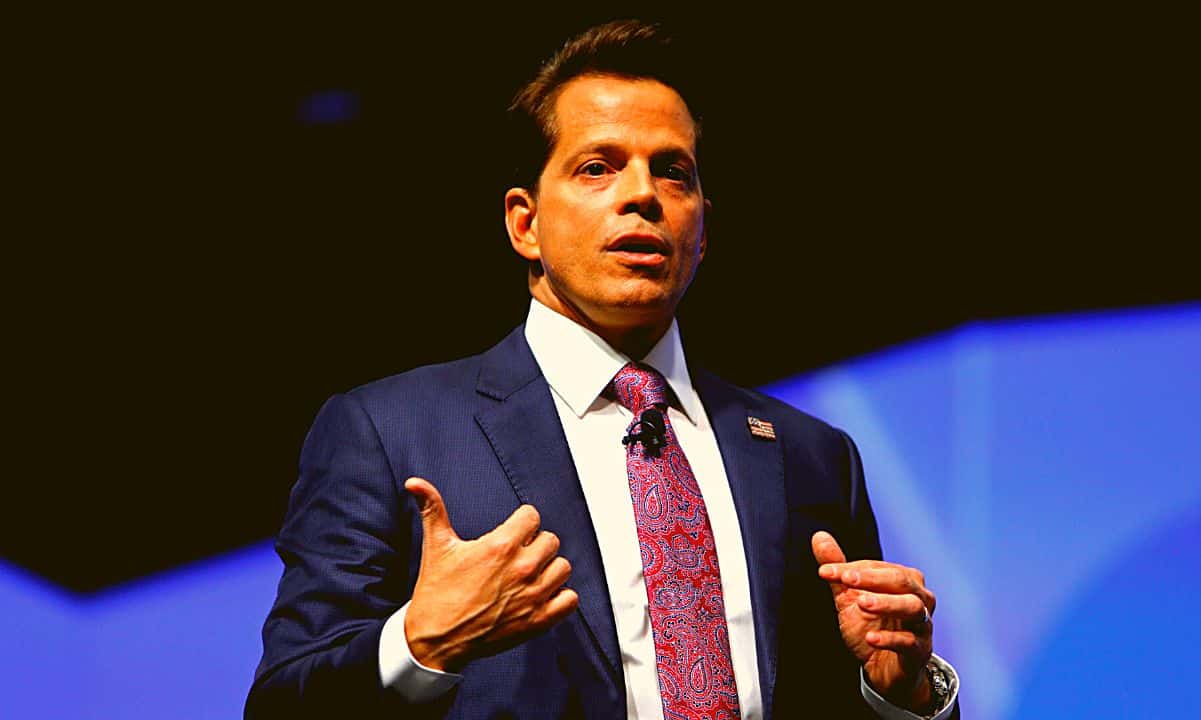
SkyBridge Capital founder and managing partner Anthony Scaramucci told CNBC’s Squawk Box on Tuesday that Bitcoin (BTC) will climb back over $100,000 as the halving cycle tightens prices, a level the asset has not closed above since November 13, 2025.
“I think as the halving cycle comes in again, it will tighten prices and you’ll see a move back up over $100k,” says @Scaramucci of $BTC. https://t.co/x8GF2oK0uh pic.twitter.com/lVSyypTzEN
— Squawk Box (@SquawkCNBC) August 18, 2026
Bitcoin briefly hit $65,000 on Tuesday, according to CoinGecko. The next halving falls at block 1,050,000, which countdown trackers place around April 2028, and the network stood at block 963,063 on Tuesday.
Halvings arrive every 210,000 blocks, and the block subsidy will drop to 1.5625 BTC from 3.125 BTC.
Prior Call Targeted $170,000
Coin Metrics puts Bitcoin at $64,908 on April 20, 2024, the day of the last halving. The cycle that followed peaked at over $126,000 on October 6, 2025. The asset last closed at or above six figures on November 13, 2025, at $100,035, then fell to $86,505 by December 1, $76,911 on February 1, and $65,734 on March 1. Its 2026 low was at under $58,000 on July 1.
Scaramucci made a similar argument before the last halving in early 2024, expecting Bitcoin to reach $170,000 after the April halving, based on a pattern he described as multiplying the halving-day price by four roughly 18 months later. BTC traded near $43,000 when he made that call.
The four-year pattern is itself disputed now, as even analysts, including Scott Melker and Arthur Hayes, are questioning whether the cycle still holds, with Melker noting Bitcoin ran 1,080 days from its last major low against a historical peak window of 1,060 to 1,070 days, and PlanB placing a possible top anywhere between 2026 and 2028.
Clarity Act Vote Set for September
Some of the catalysts for the price surge, at least in the short term, could be the impact of the Clarity Act and the state of crypto among the topics covered across the eight-minute interview.
The Digital Asset Market Clarity Act, filed as H.R. 3633, is scheduled for a Senate cloture vote on September 15 at 2:15 PM ET.
CryptoPotato reported that Senate Majority Leader John Thune filed cloture shortly before the August recess after Democrats declined to back a procedural vote, and that the bill’s odds of becoming law this year have fallen, according to experts and prediction platforms.
The motion needs 60 votes, and senators will not be voting on the legislation itself that day.
The post Bitcoin Back Above $100K? Scaramucci Says the 2028 Halving Holds the Key appeared first on CryptoPotato.

Fernando Tatis Jr. hits two HRs, robs grand slam as Padres beat Mets

Joy-Cons Plus WiiMotes Make For Switch 2 Wii-Cons

Ethereum Has Not Touched This Line Since October, $1,900 Decides Every Altcoin





-

 Fashion5 days ago
Weekend Open Thread: Ann Taylor
-
 Sports5 days ago
This U.S. Amateur is a glimpse into golf’s future in more ways than you think
-
 Tech5 days ago
11 Ways to Rank Your Videos
-
 NewsBeat4 days ago
Myanmar says over 300,000 Rohingya refugees verified for repatriation as exodus enters ninth year
-

 Sports4 days ago
Birmingham 2026: Day 6 Timetable for Irish Athletes
-

 Politics4 days ago
SEQ Code: The Three Letter Boarding Pass Code That Could Give You The Worst Seat
-
 Entertainment7 days ago
Keke Palmer Subtly Hints At Sean Evans Drama With Cryptic Post
-

 Sports7 days ago
DeQuan Jones in ‘high spirits’ after successful leg surgery
-

 Tech6 days ago
DeepSeek Harness launches as open source rival to Claude Code, alongside V4-Pro on API with higher prices
-
 Crypto World7 days ago
Perplexity AI Predicts an XRP Scenario Few Analysts Are Discussing
-
 Entertainment7 days ago
2026’s Most Ambitious Fantasy Movie Officially Scores Sequel Update
-

 Crypto World1 day ago
OCC Greenlights Trump Family Crypto Firm for Trust Charter
-

 Politics7 days ago
How Average Are You In The UK?
-
 Entertainment7 days ago
All 10 Hayao Miyazaki Fantasy Movies, Ranked
-

 Fashion7 days ago
Why Botanical Fashion Never Goes Out of Style
-
 Entertainment7 days ago
Travis Kelce Breaks Silence On ‘Crazy’ Taylor Swift Wedding
-
 Entertainment5 days ago
10 Netflix Shows That Quietly Became Modern Classics
-

 Fashion7 days ago
Wednesday’s Workwear Report: Stretch-Cotton Pleated-Waist Top
-

 Fashion6 days ago
The Details Do the Dressing
-

 Fashion5 days ago
Weekly News Update, 8.14.26 – Corporette.com
You must be logged in to post a comment Login