
Crypto World
Metaplanet turns stock volatility into a 210,000 BTC war chest



Metaplanet sold equity and fixed‑strike warrants at a premium, monetizing stock volatility into up to $531 million of dry powder for a 210,000 BTC, yen‑hedged balance‑sheet bet.
Summary
- Metaplanet raised about $255 million via a private share placement at a 2% premium, paired with fixed‑strike warrants at a 10% premium for another ~$276 million if exercised.
- Warrants only trigger if the stock trades above a Bitcoin‑linked mNAV threshold, turning equity upside and volatility into self‑funding BTC accumulation instead of pure dilution.
- The strategy aims to make Metaplanet “Japan’s MicroStrategy,” swapping yen‑denominated equity for a structurally scarce asset and using BTC as a long‑term currency and equity hedge.
Metaplanet just weaponized its equity to buy more Bitcoin (BTC). This is not a vibes-based CT announcement; it is a highly engineered capital markets trade aimed squarely at becoming “Japan’s MicroStrategy,” with a yen hedge bolted on.
Deal structure in plain language
Metaplanet raised about 255 million dollars from global institutional investors via a private placement of new shares priced at a 2% premium to market. Alongside that, it issued fixed‑strike warrants at a 10% premium, which, if fully exercised, could bring in roughly another 276 million dollars. In total, the company is unlocking up to 531 million dollars in incremental “firepower” to push toward its stated target of holding 210,000 BTC on its balance sheet.
The key innovation is not “we raised money and we’ll buy Bitcoin.” It is the explicit monetization of equity volatility: investors are effectively paying for convexity on the stock, and Metaplanet is harvesting that option value to buy hard assets.
Why the warrant design matters
The warrants are struck 10% above the reference price, so they only get exercised if Metaplanet’s share price trades higher, i.e., if the market buys the Bitcoin accumulation story. That creates a self‑funding loop: volatility and upside in the equity translate directly into more capital to deploy into BTC. Commentators on the thread correctly highlight this as “the real innovation,” noting that Metaplanet benefits both from stock volatility and from Bitcoin appreciation.
In market structure terms, the firm is short call options on its own equity and long Bitcoin. It is selling path‑dependent equity upside today to increase its exposure to a non‑sovereign monetary asset it believes will outperform the yen and, likely, Japanese equities over the long term.
Japan, currency risk, and the “denominator”
Where MicroStrategy pioneered this model in the US, Metaplanet adds another layer: a currency hedge against a structurally weak yen. One international holder in the replies openly frames the move as bullish for Japan, arguing that the yen “could benefit greatly from Bitcoin.” Others go further, calling the strategy a matter of corporate “survival” rather than mere profit, a blunt acknowledgment of what sustained currency debasement does to domestic balance sheets.
Another respondent captures the denominator problem cleanly: institutional capital is “waking up to the reality of the denominator” and “building a fortress out of math,” with volatility as the energy source to forge a new standard. Translated into market terms: Metaplanet is trading a dilutable equity, priced in a weakening unit of account, for an asset with a credibly scarce supply schedule.
Signal to the market
Reaction on X swings from praise—calling the placement a “masterclass in capital strategy”—to confusion and outright skepticism about what Metaplanet is and whether this is a scam. That bifurcation is typical early in any new corporate balance‑sheet regime: most participants do not yet speak the language of corporate‑fi‑meets‑Bitcoin, and the documentation reads like jargon to anyone not trained in derivatives.

Crypto World
Australian Senate committee backs digital assets regulatory framework: Senate Economics Legislation Committee


Australia’s Senate Economics Legislation Committee has endorsed proposed legislation to modernize the country’s digital assets regulatory framework.
Australia’s Senate Economics Legislation Committee has backed a proposed legislative framework to modernize digital assets regulation, according to a report published Monday. The committee stated that the new framework will strengthen the regulatory environment for cryptocurrency and digital asset markets in the country.
The endorsement builds on Australia’s prior efforts to establish robust anti-money laundering and counter-terrorism financing (AML/CTF) rules for crypto-assets. The committee has previously recommended introducing new regulatory standards for custody arrangements of digital assets, reflecting ongoing efforts to enhance consumer protection and market integrity in digital asset markets.
Sources: ASIC
This article was generated automatically by The Defiant’s AI news system from publicly available sources.
Crypto World
SEC dismisses civil fraud case against BitClout founder Nader Al-Naji: U.S. Securities and Exchange Commission


The SEC has closed its civil enforcement lawsuit against DeSo creator Nader Al-Naji, ending a case that accused him of wire fraud and selling unregistered securities.
The Securities and Exchange Commission has dismissed its civil lawsuit against Nader Al-Naji, founder of BitClout and the DeSo blockchain, according to a filing on Monday. The regulator ended the enforcement action that had accused Al-Naji of wire fraud and selling unregistered cryptocurrency securities.
The SEC initiated the civil case against Al-Naji in July 2024 as part of a $257 million enforcement action. The dismissal marks a significant development in the regulator’s approach to crypto project founders and decentralized network creators, following months of litigation over allegations that BitClout was misrepresented to investors.
Sources: Court Filing
This article was generated automatically by The Defiant’s AI news system from publicly available sources.
Ironlight Group has raised $21 million in a Series A round to expand infrastructure for tokenized securities, including scaling its alternative trading system (ATS) and technology platform for issuing, distributing and trading digital securities.
The privately held company said the round included backing from institutional investors and financial services executives, led by former TD Bank President and CEO Greg Braca, along with the Sei Development Foundation.
The funds will be used to expand Ironlight’s marketplace infrastructure for tokenized assets, including the Ironlight Markets alternative trading system and its settlement platform. The company operates a broker-dealer and alternative trading system for digital and traditional securities under SEC Regulation ATS and FINRA oversight.
Austin, Texas-based Ironlight said its platform is designed to support tokenized securities across asset classes including private equity, fixed income, structured products, private credit and real estate, with blockchain-based settlement intended to streamline post-trade processes for institutional investors and wealth advisers.
The company added that the capital will support further development of its marketplace as tokenized securities gain traction across private markets and alternative assets.
Related: Metaplanet raises $255M and adds warrant structure for Bitcoin buys
Sei Foundation broadens ecosystem initiatives
The Sei Development Foundation, which participated in the funding round, launched in 2025 as a US-based nonprofit supporting adoption of the Sei blockchain network. Funded by the Sei Foundation, the New York-based organization supports developers through funding programs, education initiatives and ecosystem partnerships.
In March 2025, the Sei Foundation said it was exploring a potential acquisition of genetic testing company 23andMe following its bankruptcy filing, proposing that the company’s genetic data could be placed on blockchain infrastructure to give users greater control over their information. The proposal did not materialize into a deal.
The foundation has also pursued partnerships around blockchain infrastructure. In February, Nasdaq-listed AIxCrypto announced a strategic technology arrangement with the Sei Development Foundation to explore integrations combining artificial intelligence and blockchain systems.
In the first quarter of 2026, Bhutan’s sovereign wealth fund, Druk Holding and Investments (DHI), said it would deploy and operate a validator on the Sei network in collaboration with the Sei Development Foundation as part of the country’s digital transformation efforts.
Sei is a layer-1 blockchain launched in 2023 that focuses on infrastructure for decentralized applications and digital asset trading. The network is backed by investors including Multicoin Capital, Jump and Coinbase Ventures.
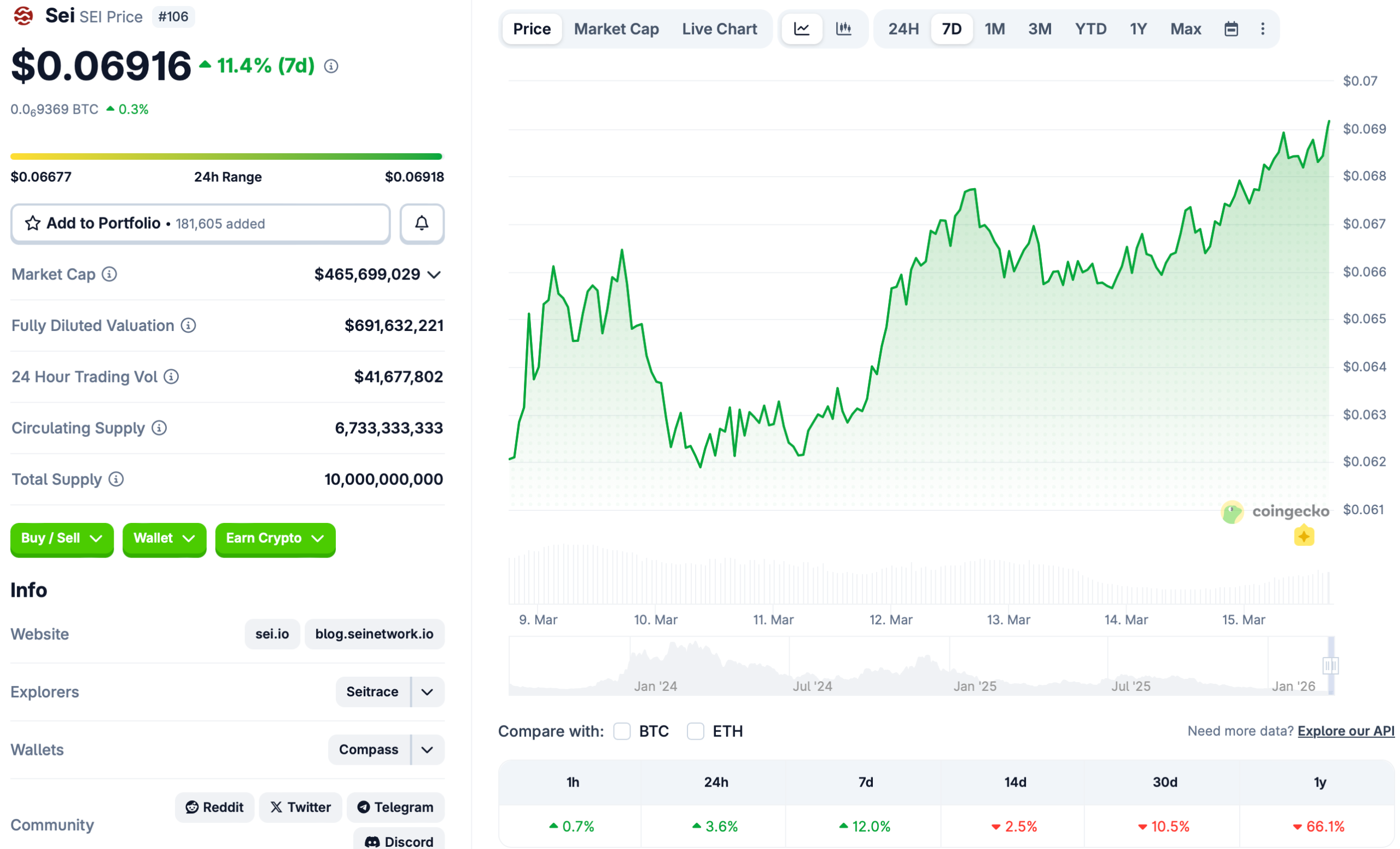
Data from CoinGecko shows the price of SEI (SEI) at about $0.069, up about 11% over the past seven days, giving the token a market capitalization of around $465 million. The token’s value peaked above $0.37 in mid-2025.

Magazine: The debate over Bitcoin’s four-year cycle is over: Benjamin Cowen

Strategy expanded its Bitcoin reserves again after executing another large weekly purchase. The move extended the firm’s aggressive accumulation strategy and pushed total holdings above 760,000 coins. Meanwhile, the purchase came as Bitcoin traded above $74,000 during the latest market rally.
Strategy Expands Bitcoin Holdings With $1.57 Billion Purchase
Strategy increased its Bitcoin treasury through a major acquisition announced in a recent regulatory filing. The company purchased 22,337 BTC for approximately $1.57 billion during the latest buying cycle. Furthermore, the average purchase price reached about $70,194 per Bitcoin.
The acquisition marked the company’s largest Bitcoin purchase of the year. It exceeded the 22,305 BTC purchase completed earlier in January. As a result, Strategy reinforced its position as the largest corporate holder of Bitcoin.
The latest purchase also extended the firm’s consistent buying streak. Strategy completed twelve consecutive weekly Bitcoin acquisitions through its treasury strategy. Therefore, the company maintained a steady accumulation pace despite market volatility.
Total holdings now stand at approximately 761,068 BTC across all acquisitions. Strategy acquired these coins for a combined value of roughly $57.61 billion. Consequently, the firm holds Bitcoin at an average cost of about $75,696 per coin.
The company built its Bitcoin treasury over several years through continuous purchases. The strategy began under the leadership of Michael Saylor. Since then, the firm has positioned Bitcoin as its primary treasury reserve asset.
Stock Sales Fund Latest Weekly Bitcoin Acquisition
Strategy financed the latest purchase through share sales under its capital raising programs. The company issued shares of STRC preferred stock and common MSTR stock. These sales generated the funds required for the Bitcoin acquisition.
The company sold approximately 11.8 million STRC shares during the period. That transaction produced net proceeds of roughly $1.18 billion. Meanwhile, Strategy also sold about 2.8 million MSTR shares.
The MSTR share sale raised an additional $396 million in proceeds. Combined funding from both programs supported the $1.57 billion Bitcoin purchase. Therefore, equity issuance remained a key part of the firm’s treasury approach.
This transaction also marked a notable shift in Strategy’s funding structure. The company raised more capital from the STRC at the market program than from MSTR shares. Such a development occurred for the first time this year.
Market data also showed strong trading activity around the STRC instrument. The preferred stock recorded one of its most active trading weeks during the month. Consequently, the strong liquidity supported the company’s financing strategy.
MSTR Stock Rises As Bitcoin Climbs Above $74,000
Strategy’s stock price advanced following the announcement of the new Bitcoin purchase. Market data indicated that MSTR shares traded near $146 during the latest session. The stock gained more than 4% compared with last week’s closing level.
Earlier trading activity pushed the shares even higher before the market opened. The stock reached roughly $149 during premarket trading hours. This movement reflected increased market attention around the company’s Bitcoin strategy.
The rally also coincided with upward momentum in Bitcoin’s price. Bitcoin climbed above $74,000 during intraday trading on the same day. As a result, Strategy’s share performance often mirrored movements in the cryptocurrency market.
Market analysts also evaluated the impact of the latest acquisition on shareholders. Some industry observers described the purchase as the most accretive transaction since November 2024. The analysis focused on how the financing structure supported shareholder value.
Other analysts highlighted the growing use of STRC financing in recent transactions. They noted a shift toward preferred stock funding rather than common share sales. Therefore, the trend may influence how Strategy structures future Bitcoin purchases.
Stretch the Orange Dots. pic.twitter.com/WMVPUxlIcx
— Michael Saylor (@saylor) March 15, 2026

TLDR
- Russia will collect about 567 million rubles or over $7 million in crypto mining taxes for 2025.
- The Federal Tax Service said miners will pay 84 million rubles in personal income tax and 483 million rubles in corporate tax.
- Earlier projections had estimated mining tax revenue at 6 billion rubles, which is far higher than the current figure.
- Officials said rising electricity tariffs and lower Bitcoin prices reduced miners’ profitability.
- Authorities reported that more than two-thirds of active mining enterprises remain unregistered.
Russia will collect about 567 million rubles in taxes from cryptocurrency miners for 2025. The amount equals slightly over $7 million at the current exchange rate. Officials confirmed the figure and outlined lower-than-expected revenue from the regulated mining sector.
Russia Mining Tax Revenue Falls Short of Early Projections
Denis Kuzmichev, head of taxpayer registration at the Federal Tax Service, presented the updated figures during a public briefing. He stated that miners will transfer 84 million rubles in personal income tax and 483 million rubles in corporate income tax. He also said the second quarter of last year generated the highest assessed payments, totaling about 180 million rubles.
Earlier projections had estimated tax revenue of 6 billion rubles, or nearly $74 million. Sergey Bezdelov, Director of the Industrial Mining Association, recalled those expectations during the meeting. He said rising electricity tariffs, a high global Bitcoin hash rate, and lower BTC prices reduced miners’ profitability.
Officials also cited the weaker U.S. dollar against the ruble as a factor affecting returns. Kuzmichev stated that limited legalization has constrained full tax collection. Authorities reported that more than two-thirds of active mining enterprises remain unregistered.
Russia adopted legislation in 2024 to regulate cryptocurrency mining activities. The law permits legal entities, entrepreneurs, and citizens to participate in mining operations. However, companies and entrepreneurs must register with the Federal Tax Service.
Citizens may mine without registration if they consume less than 6,000 kWh per month. All miners must report the type and value of digital assets produced. They must also disclose the hardware used in mining operations.
Russia Expands Mining Capacity While Enforcing Restrictions
The Ministry of Energy reported that the mining industry consumes 16 billion kWh annually. Bezdelov said this accounts for about 2% of Russia’s total electricity demand. Authorities also confirmed that mining farms and data centers reached 4 GW of connected capacity in 2025.
The 4 GW capacity marks a 33% increase compared to the previous year. However, the government imposed a full mining ban in 10 regions. The restrictions target areas in the Far East, Siberia, the Caucasus republics, and occupied territories in Eastern Ukraine.
Officials introduced seasonal bans in the Republic of Buryatia and Zabaykalsky Krai. Those restrictions expired on March 15. However, the federal government is considering year-round limits in both regions.
Lawmakers are preparing new financial penalties for violations of mining rules. The legislative committee at the State Duma approved a bill introducing fines. The draft sets fines between 100,000 and 150,000 rubles for individuals.
Companies could face fines ranging from 1 million to 2 million rubles. Authorities may also suspend operations for up to 90 days. In both cases, officials may confiscate mining equipment.
The bill also targets unregistered mining where registration is required. Fines for such violations range from 100,000 to 500,000 rubles. The State Duma committee recommended the bill for adoption on Monday.


Cryptocurrencies seem to have lost their allure at the South by Southwest (SXSW) festival, giving way this year to panels and events focused on the rise of artificial intelligence.
As the annual Austin, Texas event kicked off last week for a run through Wednesday, only a few official sessions focused on crypto, while a side event, the “Bitcoin Takeover” in downtown Austin, featured Bitcoin (BTC) maximalists and other industry representatives.
“Almost exactly the pattern that’s playing out with AI is what’s playing out with crypto,” Ali Tager, the National Cryptocurrency Association’s vice president of communications, told Cointelegraph, referring to many of the uncertainties from the general public in the early days of the industry.
She added: “I do believe that crypto is just a few years behind on that journey.”

Related: High-yield bond surge signals rising risk, demand in BTC mining, AI infrastructure
In contrast to previous SXSW festivals in Austin, which doted heavily on nonfungible tokens (NFTs) in 2022, focused on Web3 in 2023, and featured Coinbase executives in 2025, the industry representation this year was scant. While there were several panels this year focused on AI through art, music, storytelling, and risk warnings, only a handful featured crypto, and were hosted by the NCA, Solana Foundation, or Foundation Capital.
“The energy is different every single year,” said Tager, referring to SXSW.
Some mining companies also pivoting into AI infrastructure
Amid increasing BTC difficulty and related costs, some of the largest crypto miners in the US have announced plans to shift their business strategies from digital assets to AI and high-performance computing. For companies like Riot Platforms, CleanSpark, MARA Holdings, Core Scientific, Hut 8, and TeraWulf, that includes plans to repurpose some of their infrastructure in data centers toward AI.
Magazine: Human brain cell wetware plays Doom, fly’s mind uploaded: AI Eye
Disclosure: This article does not represent investment advice. The content and materials featured on this page are for educational purposes only.
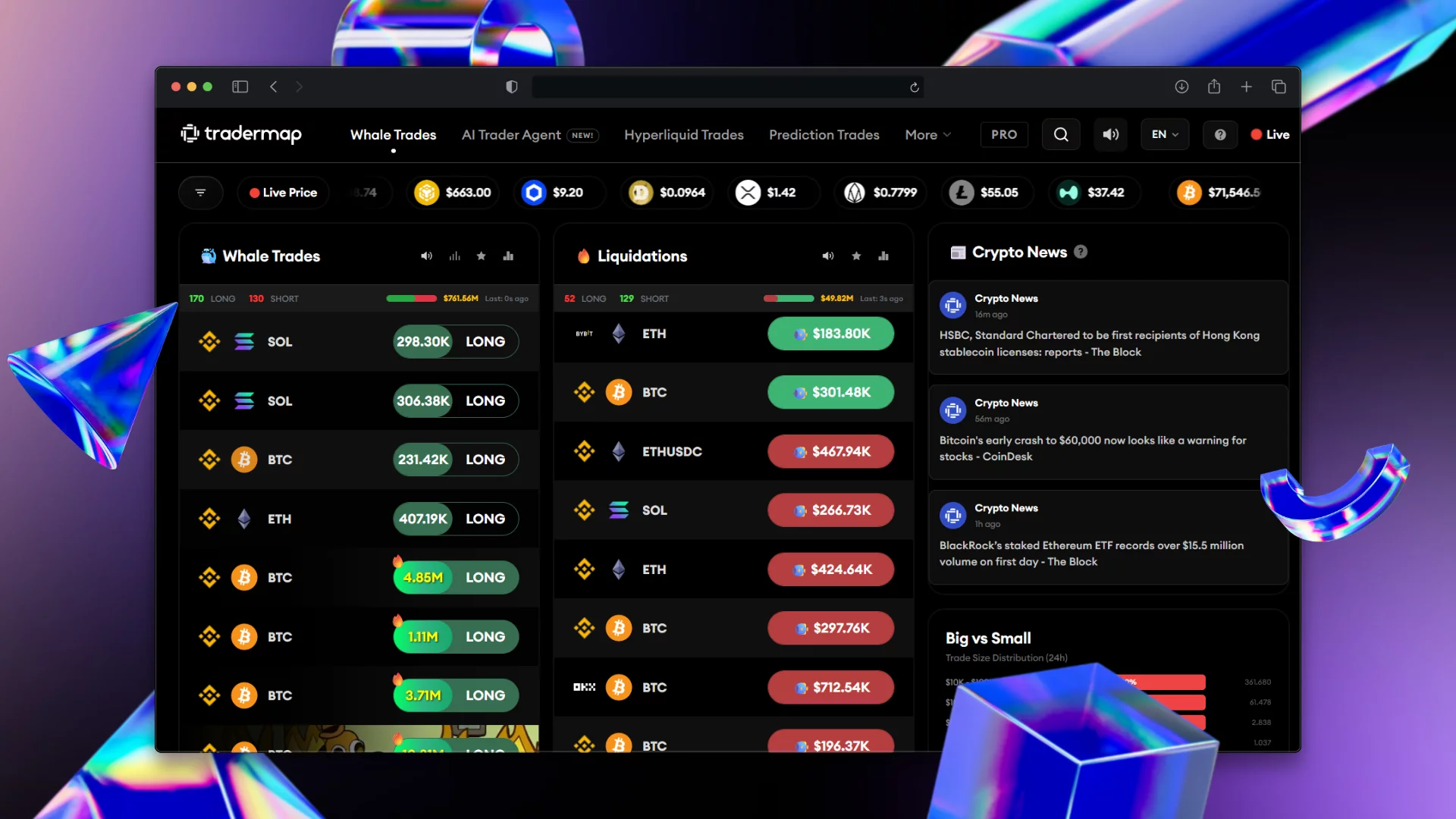
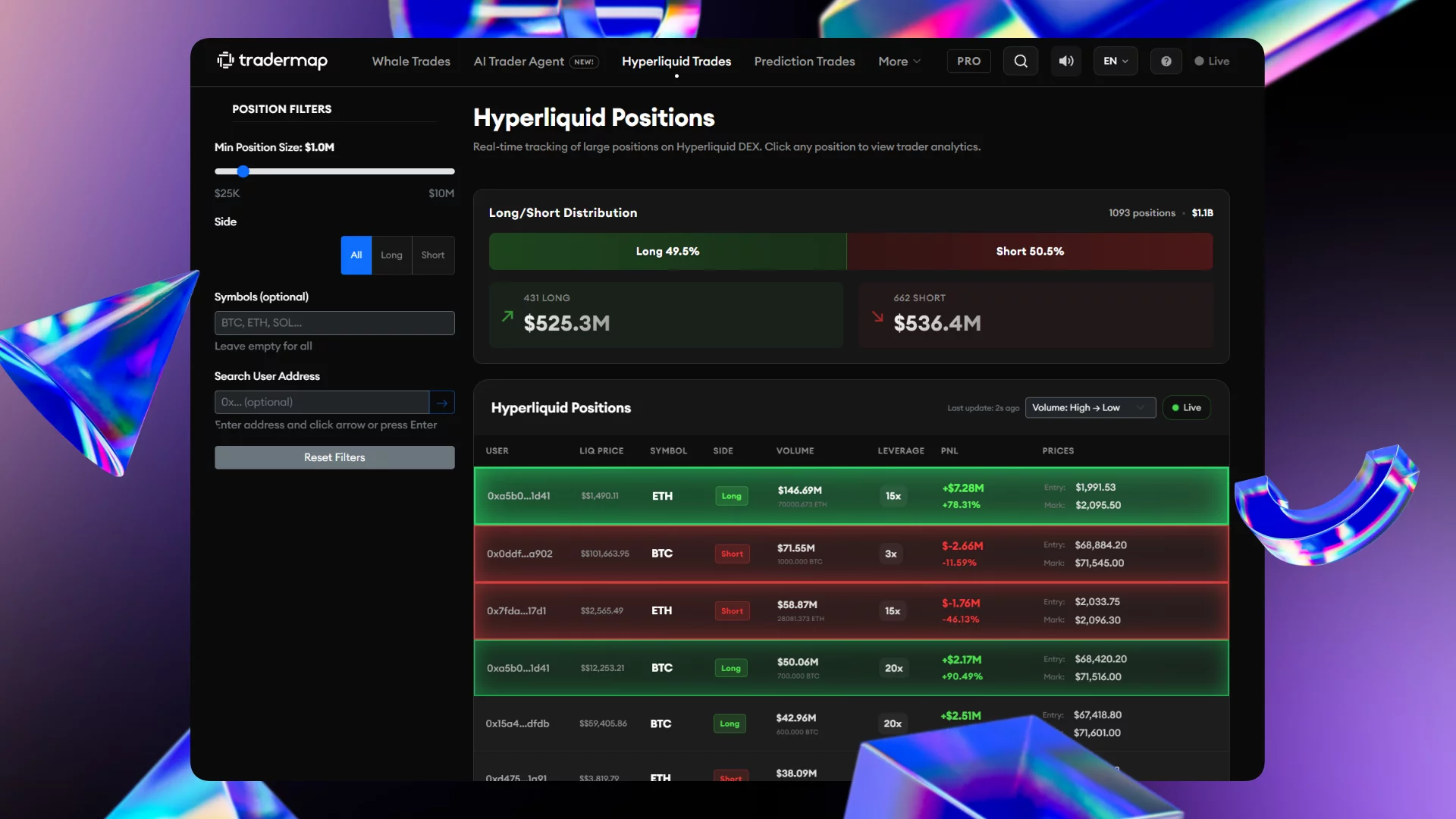
TraderMap helps crypto traders to track whale activity as institutional capital continues shaping market price movements.
Summary
- TraderMap launches as a unified dashboard for tracking whales, liquidations, and market news.
- TraderMap streams real-time data from exchanges including Binance, Bybit, and OKX.
- The platform aggregates whale trades, liquidations, and headlines into a single zero-latency crypto trading interface.
In the cryptocurrency market, price action is rarely random. It is driven by “Whales”— institutional entities and high-net-worth individuals who possess the capital necessary to shift market structures.
For the retail trader, success often depends on the ability to identify these “Smart Money” footprints before they result in massive price swings.
Whale tracking is the real-time monitoring of large-scale transactions, exchange inflows/outflows, and massive derivative positions.
The importance of the “smart money” flow
- Anticipating Volatility: Large players often position themselves in real-time before major volatility manifests on standard candlestick charts.
- Identifying Accumulation: Monitoring whale trades exactly as they open provides a clear map of institutional movement.
- Avoiding “Retail Traps”: Price spikes are often driven by retail FOMO; whale data helps you distinguish between retail hype and genuine institutional accumulation.
To capture these movements effectively, traders need zero-latency data. Professional tools utilize direct websocket feeds from major exchanges to ensure moves are seen the millisecond they occur, eliminating the “fog” of lagging indicators.
For active traders, the choice of platform is the difference between leading the market and following the noise. While standard blockchain explorers are useful for historical audits, they are far too slow for real-time execution in a market that moves in milliseconds.
TraderMap: The professional standard
For those who prioritize speed, accuracy, and efficiency, TraderMap serves as the definitive centralized command center. It is specifically engineered to eliminate “tab-switching” fatigue — the seconds lost jumping between different sites for prices, news, and alerts — by centralizing everything into a single, zero-latency view.
TraderMap changes the tracking experience by consolidating high-criticality data streams:
- Live Whale & Hyperliquid Trades: Monitor massive institutional positions and high-conviction moves exactly as they open.
- Real-Time Liquidations: Identify exactly where market leverage is being “flushed out” to find superior entry points during periods of maximum retail pain.
- Integrated News Feed: Headlines appear directly alongside price action, ensuring you understand the “why” behind every sudden volatility spike without leaving the interface.
- Zero-Latency Infrastructure: Powered by direct websocket feeds from major exchanges like Binance, Bybit, OKX, and Hyperliquid, the platform delivers data at the speed used by institutional desks.
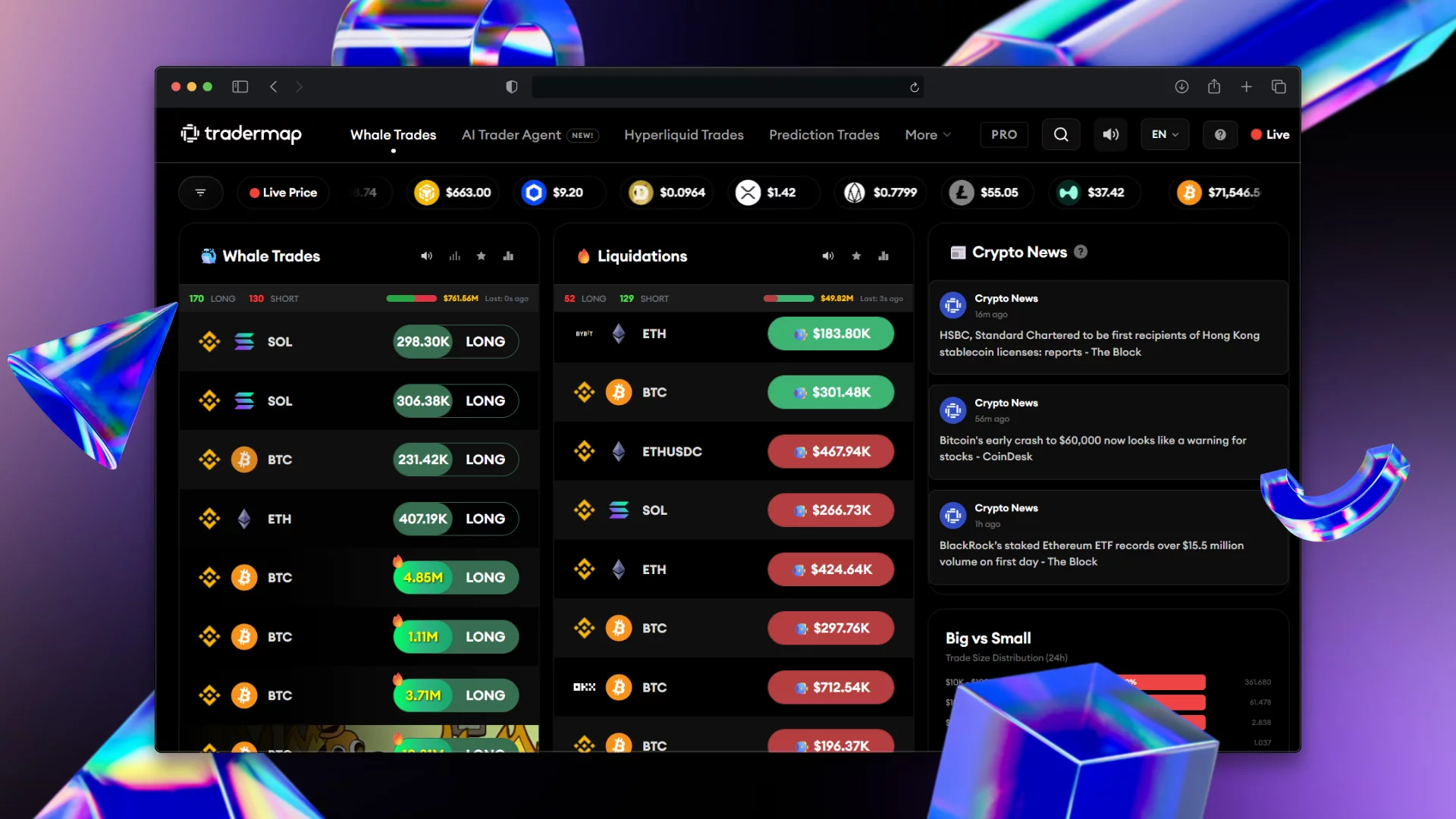
Tracking whales effectively requires filtering out the “noise” of small retail trades. Here is how to use the TraderMap toolkit to isolate high-conviction moves:
Step 1: Set filters
Navigate to the Position Filters section. To find the “real” money, set the Min Position Size to a significant threshold, such as $1.0m. This ensures feed is only populated by institutional-grade entries.
Step 2: Monitor Hyperliquid positions
Advanced traders use the Hyperliquid Trades section to track large-scale decentralized derivative positions.
- Address Search: If a consistently profitable whale is identified, use the Search User Address feature to track their specific entries and leverage in real-time.
- Long/Short Distribution: Monitor the visual distribution bar (e.g., 62% Long vs. 38% Short) to gauge the immediate directional bias of the market’s biggest players.
Step 3: Correlate with visual momentum
Use the RSI Heatmap and Crypto Bubbles to see which assets are overextended. If a whale makes a massive entry on an asset that the dashboard shows is overbought or oversold, that’s a high-probability trade signal.
Adopting a whale-centric strategy provides several unique advantages that standard technical analysis cannot offer:
- Liquidation Hunting: By tracking real-time Liquidations, users can see exactly where leverage is being “flushed out”. Smart Money often enters at these points of maximum pain for retail traders.
- Contextual Execution: TraderMap integrates a live news feed alongside trade data. This allows users to understand the “why” behind a whale movement, such as an SEC decision, ensuring they aren’t trading in a vacuum.
- Big vs. Small Analysis: Use the Big vs. Small distribution tool to distinguish between genuine institutional accumulation and speculative retail bubbles.
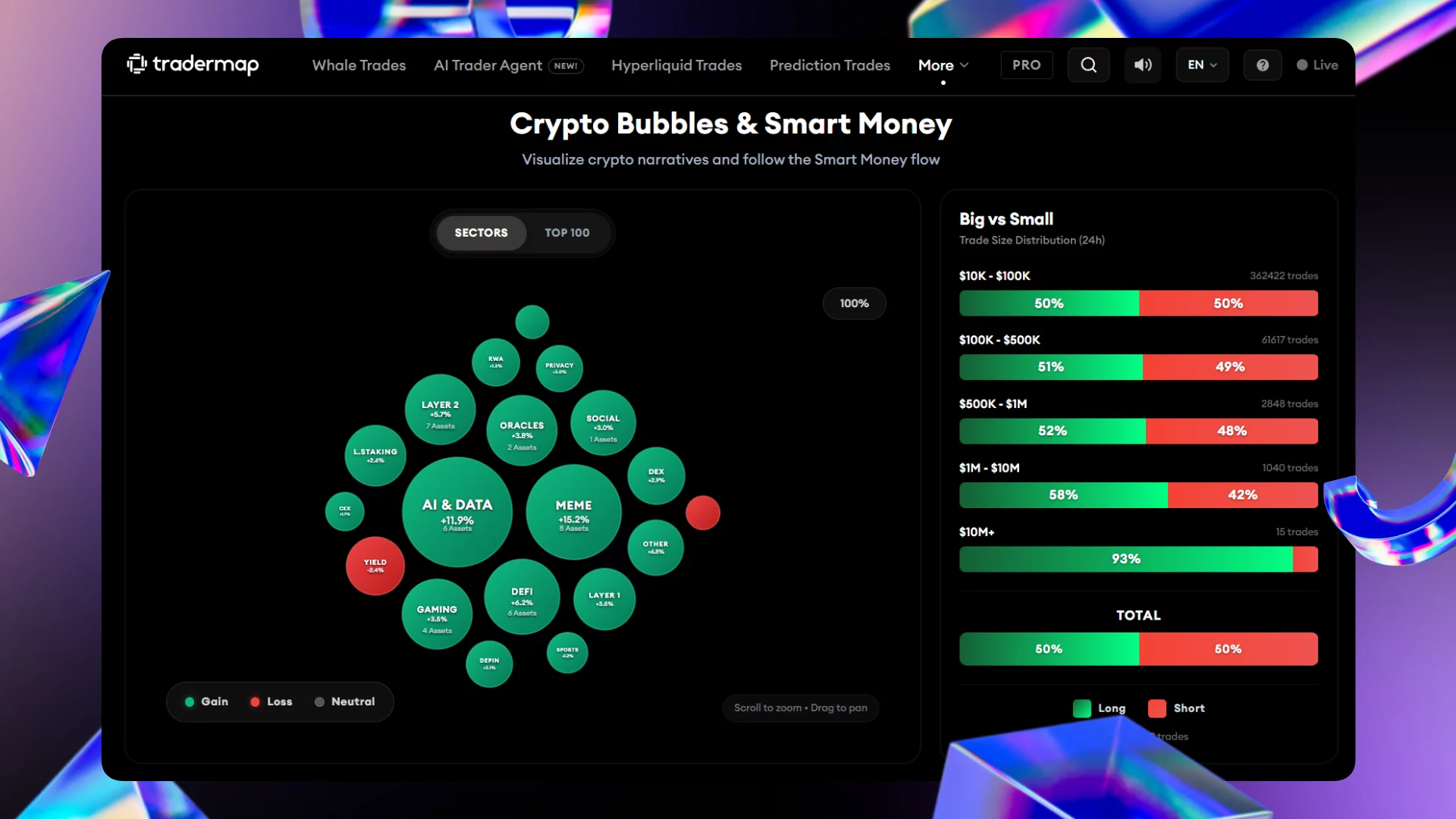
In an industry where information is the ultimate currency, the ability to follow the “Smart Money” is the only way to operate with the clarity of a market veteran. TraderMap provides the institutional-grade tools necessary to turn raw blockchain data into actionable trading intelligence.
Stop guessing and start following the data. Explore the future of real-time crypto intelligence at tradermap.io.
Disclosure: This content is provided by a third party. Neither crypto.news nor the author of this article endorses any product mentioned on this page. Users should conduct their own research before taking any action related to the company.
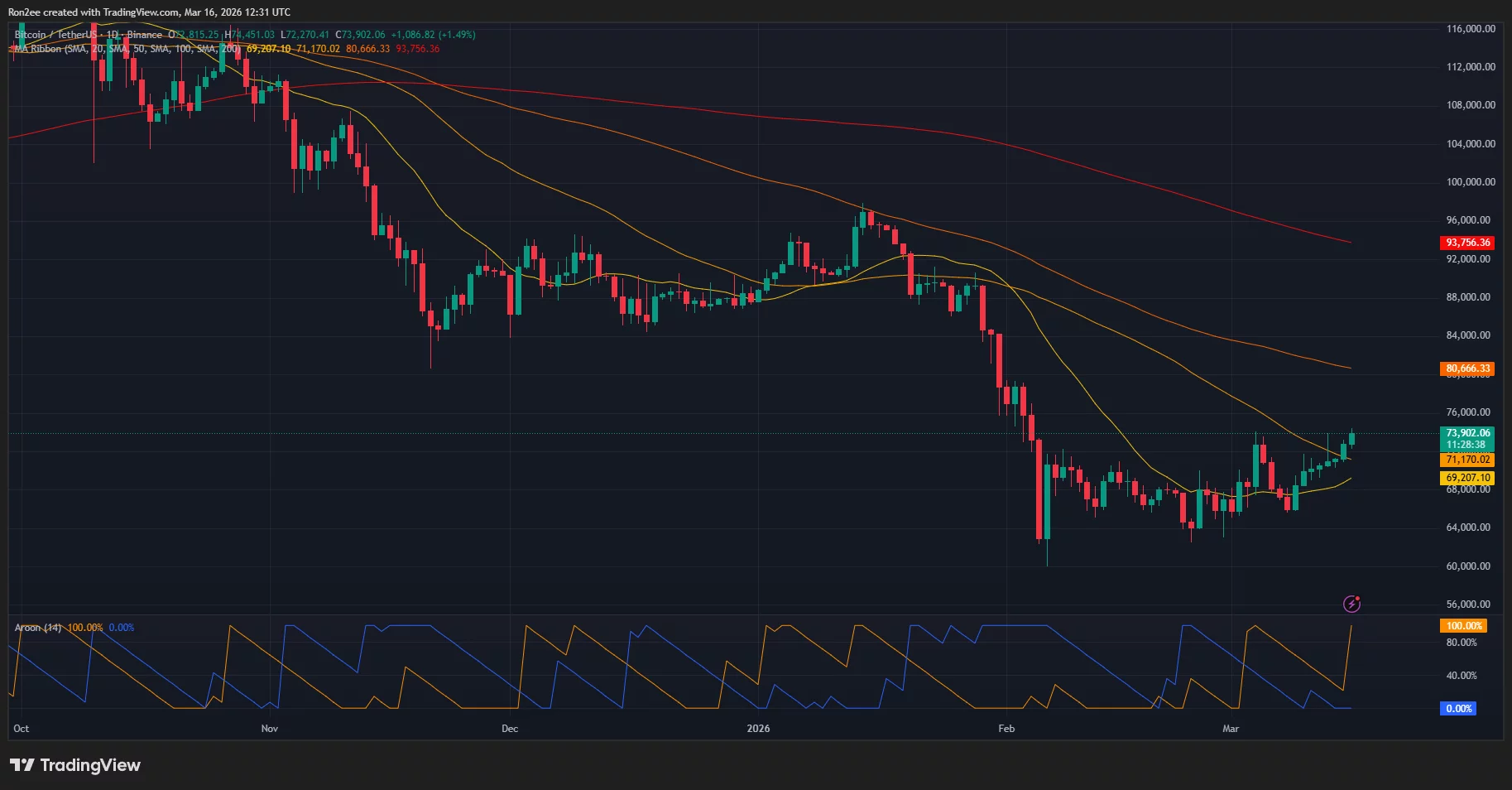
Bitcoin price rallied to a 5-week high of $74,157 on Monday morning amid institutional and whale accumulation. Can the bellwether climb past the $75,000 psychological support level ahead of the Federal Reserve interest rate decision set to be revealed later this week?
Summary
- Bitcoin price rose to a five-week high of $74,157 as institutional inflows and whale accumulation pushed the asset higher.
- U.S. spot Bitcoin ETFs have attracted $2.1 billion in inflows over the past three weeks, while large wallets increased their share of the total supply.
- Markets are now watching the $75,000 resistance level ahead of the Federal Reserve interest rate decision expected later this week.
According to data from crypto.news, Bitcoin (BTC) price briefly rose nearly 4% to $74,157 on March 16, pushing its market cap back above $1.48 trillion. Trading at $73,626 when writing, the bellwether now lies 17% above its lowest point this year.
Bitcoin’s price rebound today came as institutions and whales kept buying the dip to bet on the safe-haven asset amid ongoing geopolitical tensions.
Notably, U.S. spot Bitcoin ETFs have experienced back-to-back net inflows over the past three weeks, bringing the total figure to $2.1 billion. The persistent inflow trend has boosted retail sentiment for the token, supporting its gains.
At the same time, Bitcoin’s gains seem to have been supported by whale accumulation. According to on-chain data from Santiment, wallets holding between 10 and 10,000 BTC have entered an accumulation phase, increasing their share of the total supply to 68.17%.
This was noted as a “bullish signal” by Santiment, as it suggests that Bitcoin was moving into the wallets of long-term holders.
Meanwhile, the aggressive buying from Bitcoin treasury companies such as Michael Saylor’s MicroStrategy and Metaplanet has also provided a significant price floor.
In their most recent filings, Strategy has continued its multi-billion-dollar acquisition strategy, while Metaplanet has mirrored this “debt-for-Bitcoin” model to expand its holdings in the Japanese market.
Retail investors have also been rotating capital away from traditional safe-haven assets such as gold and silver into Bitcoin as they prepare for further volatility amid escalating conflict between the U.S. and Iran.
The military escalation and attacks on Iranian infrastructure (such as Kharg Island) have led crude prices to spike to multi-year highs as Iran threatened a total blockade of the Strait of Hormuz, a key global oil artery.
For now, a major catalyst for Bitcoin price would be the Federal Reserve rate cut decision scheduled to be announced on Wednesday, March 18, at 2:00 PM ET.
Economists broadly expect the Federal Reserve to keep interest rates steady in the 3.50% to 3.75% range, likely maintaining a cautious stance as inflation continues to remain elevated due to the shock in oil prices.
While steady rate expectations have historically tempered the rally of risk assets, Bitcoin’s current momentum and its emergence as “digital gold” suggest that a break above the $75,000 psychological resistance could trigger a massive short squeeze toward the $80,000 mark.
Bitcoin price analysis
At press time, technical indicators on the Bitcoin/USDT 1-day chart also seem to present a bullish setup that suggests a significant trend reversal is underway.
Bitcoin price has moved above the 50-day simple moving average at $71,164, which is a key psychological and technical level. Last time when it crossed above this trendline back in early February, BTC rallied nearly 33% within a month.
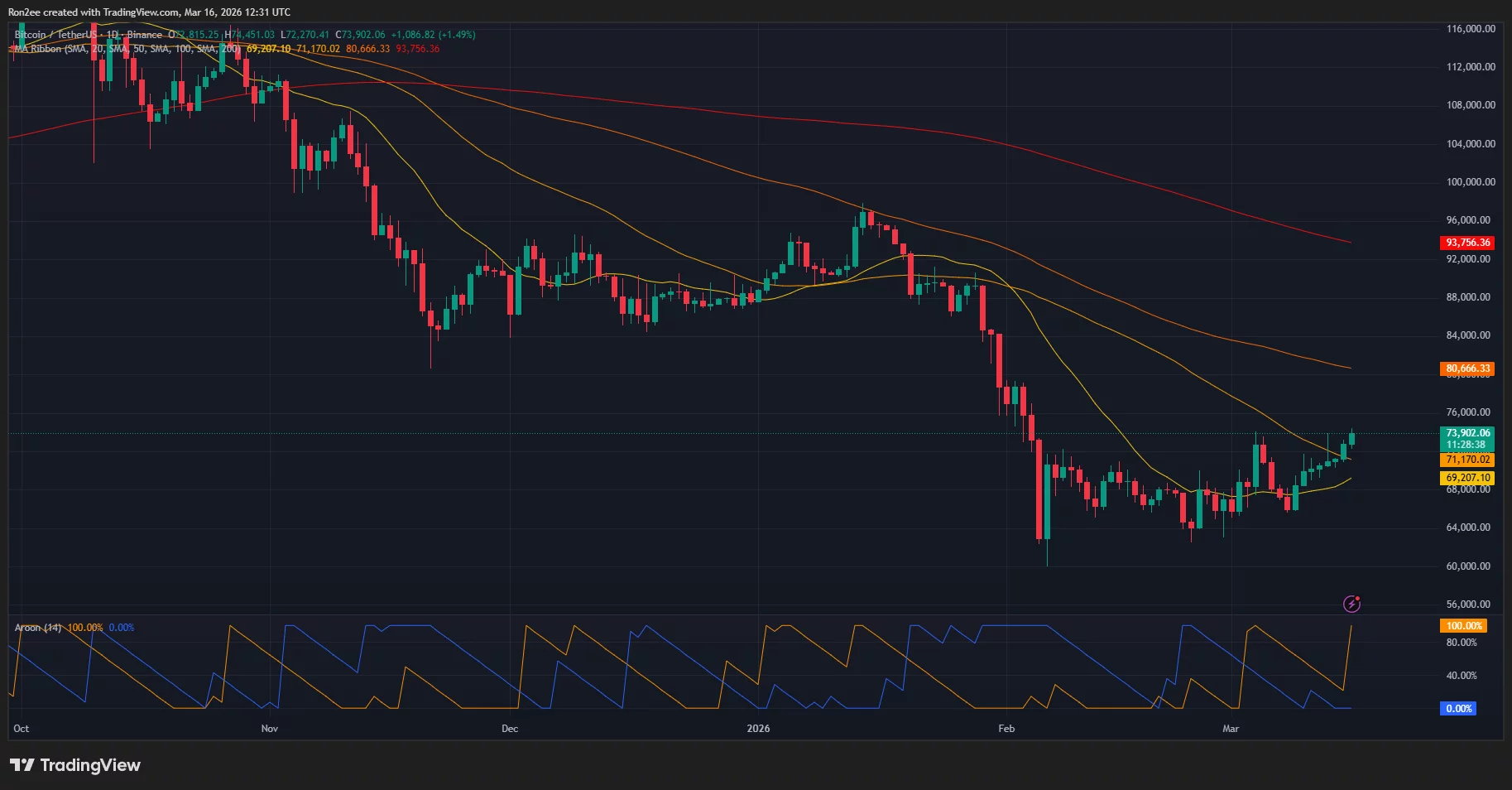
The 20-day SMA is also on the cusp of completing a bullish crossover with the 50-day SMA, a classic signal often referred to as a golden cross that typically precedes sustained upward momentum.
At the same time, the Aroon lines also added to the bullish outlook with the Aroon Up at 100% in comparison to the Aroon Down at 0%. This is a powerful configuration that hints at a strong emerging uptrend and suggests that buyers are in complete control of the current price action.
For now, the $75,000 zone, which has historically acted as a psychological barrier for traders, will serve as key resistance that would decide the short-term trajectory of the asset. A break above it could embolden bulls to target the next resistance pivot at $80,665.
On the contrary, a drop below the $70,000 support level could invalidate the current breakout and lead to a period of consolidation.
Disclosure: This article does not represent investment advice. The content and materials featured on this page are for educational purposes only.
Key takeaways:
-
Bitcoin derivatives remain bearish as traders hedge against a price drop despite BTC reclaiming the $74,000 level.
-
Fears of a global energy shortage mount as the Strait of Hormuz remains closed, forcing investors into safe-haven Treasury assets.
Bitcoin (BTC) climbed above $74,000 on Monday, following gains on the Nasdaq Index as investors await a keynote from Nvidia (NVDA US) CEO Jensen Huang at the chipmaker’s biggest event of the year, the Nvidia GTC 2026 global AI conference. A drop in oil prices and growth in the US manufacturing sector also helped support risk-on assets.
Despite this bullish background, Bitcoin derivatives suggest professional traders were unfazed by the rally that pushed prices to a 40-day high.

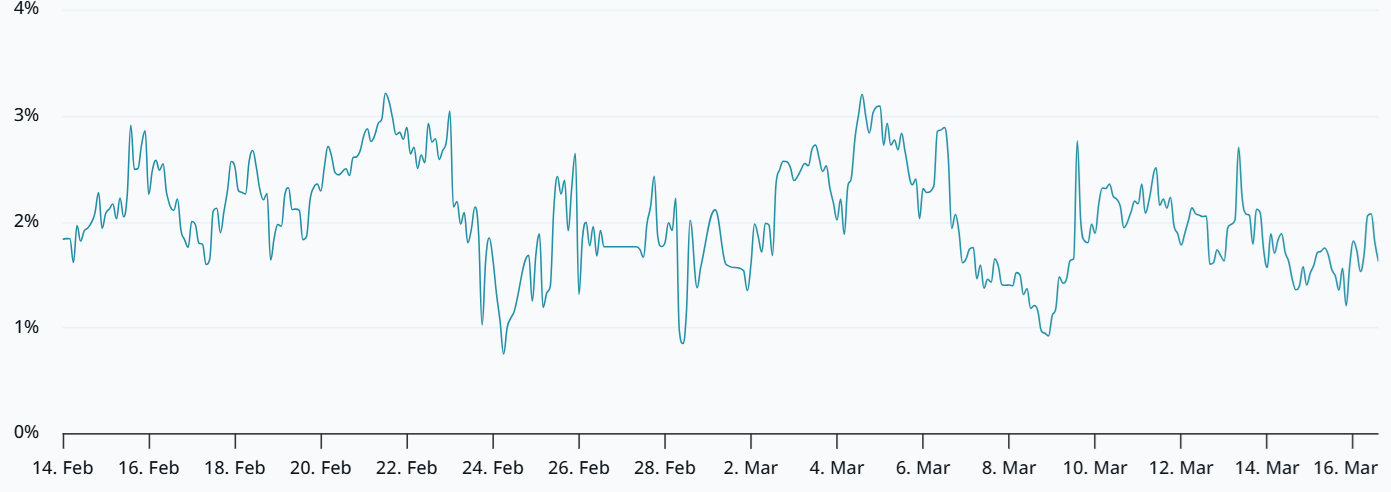
The annualized Bitcoin monthly futures premium relative to spot markets stood at a meager 2% on Monday, well below the neutral 4% to 8% range. This lack of enthusiasm has been the norm for the past 30 days, likely reflecting traders’ discomfort as Bitcoin traded down 31% in six months while gold gained 18% and the Nasdaq 100 Index stayed flat.
While it is difficult to pin down the exact drivers behind the price weakness, it can be partially attributed to a handful of events, including the absence of a clear execution timeline for the US Strategic Bitcoin Reserve. Meanwhile, the historic $19 billion liquidation event on Oct. 10, 2025, flushed out over-leveraged long positions and hit market makers’ risk appetite.
Furthermore, fears over quantum computing vulnerabilities emerged while Bitcoin decoupled from gold and silver as capital sought safety from the US and Israel-Iran war and signs of weakness in the US job market.
Bitcoin options signal fear despite institutional buying streak

The Bitcoin options delta skew on Deribit remained at 13% on Monday, signaling persistent fear that have dominated the market for five weeks. When whales and market makers avoid downside exposure, put (sell) options tend to trade at a 6% or higher premium relative to call (buy) instruments. The recent rally to $74,500 was unable to change traders’ sentiment.

USD stablecoins traded at a 0.5% premium relative to the official US dollar to yuan exchange rate on Monday, suggesting a balanced inflow and outflow in the region. Heightened demand for Bitcoin usually pushes the indicator above the 1.5% neutral threshold. At the same time, periods of stress typically cause stablecoins to trade at a discount when trades rush to exit cryptocurrency markets.
Regardless of the outcome of the Nvidia GTC 2026 event, investors are closely tracking the development of the war in Iran. US benchmark West Texas Intermediate oil prices held near $95 per barrel after the US struck Iranian military assets late Friday night, while drone strikes reportedly halted oil loadings at the key port Fujairah in the United Arab Emirates, according to Yahoo Finance.
Related: Metaplanet raises $255M and adds warrant structure for Bitcoin buys

The Strait of Hormuz, the world’s most important shipping lane for oil, reportedly remains “essentially closed,” causing analysts to reassess the risk of a “prolonged global energy shock.” Yields in the US 5-year Treasury dropped to 3.82% after peaking at 3.87% on Thursday, indicating that investors sought protection in government-backed assets amid the increasing uncertainty.
Bitcoin’s bullish momentum has been supported by Strategy buying 22,337 BTC during the previous week alone, while US-listed spot Bitcoin ETFs netted 11,117 BTC in inflows. Despite institutional appetite, the lack of confidence in Bitcoin derivatives is strong evidence that bear-market sentiment is not over.
This article does not contain investment advice or recommendations. Every investment and trading move involves risk, and readers should conduct their own research when making a decision. While we strive to provide accurate and timely information, Cointelegraph does not guarantee the accuracy, completeness, or reliability of any information in this article. This article may contain forward-looking statements that are subject to risks and uncertainties. Cointelegraph will not be liable for any loss or damage arising from your reliance on this information.

Bitcoin (CRYPTO: BTC) pressed toward a key resistance near $74,508, a level that traders are watching closely for signs of a sustained breakout. The move arrived as on-chain indicators suggested renewed buying interest from mid-sized wallets, with addresses holding between 10 and 10,000 BTC beginning to accumulate again—an activity historically associated with upside momentum. In parallel, U.S. spot BTC ETFs continued to draw capital, marking the fifth straight day of inflows and signaling persistent institutional engagement. A Bernstein research note linked these liquidity tides and corporate buying to a strengthening long-term holder base, painting a portrait of a market that could tolerate shocks better than in prior cycles. Against this backdrop, observers also noted the broader market’s crosscurrents—S&P 500 dynamics and the U.S. dollar’s movements—that tend to color crypto’s near-term trajectory.
Key takeaways
- BTC price action centered around $74,508 resistance, with a close above this level seen as a potential trigger for a rally toward $84,000.
- On-chain data showed renewed accumulation by wallets holding 10–10,000 BTC, a sign of growing demand at a critical segment of the holder distribution.
- Spot BTC ETFs attracted inflows for five consecutive days, underscoring ongoing institutional interest in the benchmark asset.
- A Bernstein note tied ETF inflows and corporate buying to a strengthening long-term holder base, suggesting a more resilient market structure in stressed conditions.
- Several major altcoins appeared to clear overhead resistance levels, indicating broader demand beyond BTC as liquidity cycles unfold.
Tickers mentioned: $BTC, $ETH, $BNB, $XRP, $SOL, $DOGE, $ADA, $HYPE
Market context: The week’s price action sits at the intersection of on-chain activity, ETF-driven inflows, and macro indicators. The S&P 500 faced a retest after hitting a notable level near the 20-day moving average, while the U.S. Dollar Index approached a notable resistance. These dynamics matter because they influence risk sentiment and liquidity availability for crypto markets, framing the probabilities of a sustained breakout or a deeper pullback.
Why it matters
The test of critical resistance levels in BTC comes at a moment when institutional access to crypto exposure is increasingly normalized through regulated products. The five-day streak of inflows into spot BTC ETFs demonstrates that institutions are not only interested in price exposure but also in the liquidity and custody frameworks that such products offer. When combined with on-chain evidence of renewed activity among mid-sized holders, the environment is arguably more conducive to a sustained move higher rather than a quick capitulation after a bounce.
Beyond Bitcoin, the health of the broader crypto ecosystem appears intertwined with the flows seen in ETFs and with corporate risk-taking. The Bernstein analysis highlighted how inflows into BTC-related vehicles, together with visible corporate buying, can bolster the long-term holder base—an important attribute for resilience during drawdowns. If market participants interpret these signals as a structural shift rather than a temporary optimism, it could translate into a steadier accumulation trend and a more robust bid for a swath of blue-chip altcoins that have cleared their own overheads.
From a trader’s perspective, the current configuration—where major assets are testing resistance while on-chain demand persists—suggests that risk management remains essential. The possibility of a bullish breakout hinges not only on Bitcoin’s ability to close above the resistance but also on sustained buying interest across key altcoins. As prices push higher, the likelihood of profit-taking increases, and traders may expect increased volatility around known hurdle levels, particularly if macro cues deteriorate or liquidity tightens due to shifts in the traditional financial markets.
What to watch next
- A sustained close above the $74,508 level for BTC could open the door to the next milestone near $84,000, while a pickup in selling pressure could pull the price back toward the nearby moving averages.
- ETH and other major altcoins appear to be testing their own overheads; a clear breakout in ETH could act as a supportive signal for broader upside, with potential targets around $2,600 and beyond.
- ETF inflows momentum remains a critical gauge of institutional appetite; continued net inflows over the coming weeks would reinforce the case for a more persistent upside, even in the face of occasional macro shocks.
- Macro drivers—such as the path of the US dollar and equity risk sentiment—will shape the range in which crypto markets operate. A sustained risk-on tone could lubricate further upside, whereas a shift toward risk-off could reintroduce volatility and test the lower bounds of recent ranges.
Sources & verification
- Santiment on-chain data showing accumulation by wallets holding 10–10,000 BTC: https://cointelegraph.com/news/bitcoin-whale-accumulation-btc-price-retail-santiment
- Five straight days of inflows into spot BTC ETFs: https://cointelegraph.com/news/spot-bitcoin-etfs-five-day-inflow-streak-2026
- Bernstein research note discussing ETF inflows and long-term holder base: https://cointelegraph.com/news/bitcoin-rebound-bernstein-long-term-holder-base
- Market analysis referencing a potential price test near $60,000: https://cointelegraph.com/markets/58k-btc-price-still-in-play-five-things-bitcoin-this-week
- Context on BTC hitting notable levels and upside potential: https://cointelegraph.com/markets/bitcoin-hits-74-4k-six-week-high-analysts-more-upside-for-btc
- TradingView market visuals referenced in broader coverage
Bitcoin price action and the crossroads of liquidity, on-chain activity, and macro signals
Bitcoin (CRYPTO: BTC) has been hovering around a critical resistance near $74,508, a level that many analysts view as a potential inflection point for a sustained rally. The move comes as on-chain data shows renewed activity among mid-range holders, with addresses carrying between 10 and 10,000 BTC starting to accumulate again. This behavior, often observed before a leg higher, provides a counterpoint to the immediate price action and suggests that demand is broadening beyond the largest holders who capitalized during earlier phases of the cycle. The combination of on-chain dynamics with price action creates a narrative where a breakout above the hurdle could unlock a larger upside move.
The activity is complemented by investor flows into regulated products. Five consecutive days of inflows into spot BTC exchange-traded funds point to a broader institutional appetite for crypto exposure, beyond the speculative bid that often dominates during bull markets. This steady influx occurs in a context where macro liquidity and risk discipline intersect with a broader corporate embrace of crypto assets. Bernstein’s note ties these liquidity fluxes to a strengthening long-term holder base, suggesting that the market could exhibit greater resilience during periods of stress than in prior cycles. Such a structural improvement is meaningful for all market participants because it may translate into more robust bid depth and a steadier price discovery process over time.
Alongside BTC’s trajectory, major altcoins have demonstrated their own momentum. Ether (CRYPTO: ETH) has shown signs of a breakout from a consolidation range, with analysts pointing to a potential path toward higher targets as buyers re-enter the market. If Ethereum can sustain a move beyond critical resistance, it could reinforce a positive feedback loop for other assets that have flirted with overheads. Other high-profile names—BNB (CRYPTO: BNB), XRP (CRYPTO: XRP), SOL (CRYPTO: SOL), DOGE (CRYPTO: DOGE), ADA (CRYPTO: ADA), and HYPE (CRYPTO: HYPE)—have also moved above their respective overhead levels in recent sessions, signaling broad-based demand and a shift in momentum that goes beyond BTC alone.
Yet the landscape remains nuanced. While the short-term tilt appears constructive, technical traders are mindful of potential traps. Price action around the moving averages, coupled with risk sentiment directed by the S&P 500’s behavior and the US Dollar Index (DXY), could still provoke pullbacks or consolidation. The S&P 500’s interactions with the 20-day moving average and a possible drift toward support around the mid-6,000s range offer a reminder that macro conditions can quickly reshape crypto trajectories. At the same time, DXY’s approach to resistance near 100.54 keeps the door open for either a renewed uptrend or a retracement, depending on how risk appetite responds to incoming economic data.
In this environment, traders will be watching not just price levels but also the durability of the bid across a suite of assets. The narrative of rising on-chain accumulation, coupled with elastic ETF inflows and corporate interest, hints at a more robust ecosystem than in past cycles. If these signals persist, BTC could be well-positioned to break higher and pull several leading altcoins along with it. The market’s next moves will likely be driven by a combination of on-chain activity, ETF flow momentum, and macro risk sentiment—each a piece of a larger mosaic that investors are still building as the year unfolds.

Terrified Florida crowd flee beach after hearing ‘gunshots’ during Spring Break

Debt Will Eat Paramount Stock’s Future Returns (NASDAQ:PSKY)

Australian Senate committee backs digital assets regulatory framework: Senate Economics Legislation Committee


-
 Tech6 days ago
A 1,300-Pound NASA Spacecraft To Re-Enter Earth’s Atmosphere
-
Crypto World3 days ago
HYPE Token Enters Net Deflation as HyperCore Buybacks Outpace Staking Rewards
-

 Business6 days ago
ExxonMobil seeks to move corporate registration from New Jersey to Texas
-

 Fashion3 days ago
Weekend Open Thread: Addict Lip Glow
-

 Tech6 days ago
ChatGPT will now generate interactive visuals to help you with math and science concepts
-
Sports2 days ago
Why Duke and Michigan Are Dead Even Entering Selection Sunday
-

 NewsBeat5 days ago
Residents reaction as Shildon murder probe enters second day
-

 Business6 days ago
Search Enters Sixth Week With New Leads in Tucson Abduction Case
-

 Business1 day ago
Search for Savannah Guthrie’s Mother Enters Seventh Week with No Arrests
-

 Business2 days ago
US Airports Launch Donation Drives for Unpaid TSA Workers as Partial Government Shutdown Enters Fifth Week
-

 NewsBeat5 days ago
I Entered The Manosphere. Nothing Could Prepare Me For What I Found.
-
Crypto World2 days ago
Coinbase and Bybit in Investment Talks: Could Bybit Finally Enter the US Crypto Market?
-

 Business3 days ago
Country star Brantley Gilbert enters growing non-alcoholic beer market
-

 Sports5 days ago
PWHL, Senators discussing plan to keep Charge in Ottawa
-

 Business14 hours ago
Australian shares drop as Iran war enters third week
-
 Crypto World6 days ago
Will Chainlink price reclaim $10 amid volatility squeeze?
-

 Sports3 days ago
College Basketball Best Bets: Conference Tournament Semifinal Picks
-

 Crypto World15 hours ago
Crypto Lender BlockFills Enters Chapter 11 with Up to $500M in Liabilities
-

 Politics6 days ago
Trump Says Middle East Is ‘Very Lucky’ That He’s President
-
 Crypto World5 days ago
Three Binance Charts May Be Hinting at Bitcoin’s Next Move


You must be logged in to post a comment Login