

Crypto World
Micron (MU) Stock Plummets 15% Despite Record-Breaking Quarterly Performance


Key Takeaways
- Micron shares declined approximately 15% across four consecutive trading sessions following exceptional Q2 fiscal 2026 results
- Quarterly revenue reached $23.86 billion, representing nearly a 200% surge from the prior year’s $8.05 billion
- According to CEO Sanjay Mehrotra, current production capacity meets only 50% to 66% of major customer demand
- Competitor SK Hynix announced plans for an $8 billion EUV equipment investment and potential $10 billion U.S. stock listing — intensifying competitive dynamics
- Leading Wall Street firms including Bank of America, Morgan Stanley, and JPMorgan elevated their price projections following the earnings announcement
Micron delivered exceptional quarterly results last week. Wall Street’s reaction? A double-digit decline.
Following the release of Q2 fiscal 2026 earnings on Wednesday, Micron shares have experienced consecutive daily losses spanning four trading sessions. The negative price action has left many observers perplexed, particularly considering the impressive financial metrics.
Quarterly revenue totaled $23.86 billion — representing approximately a threefold increase from the $8.05 billion Micron generated during the comparable quarter last year. Management also projected gross margin percentages hovering around 80% for the upcoming quarter.
Despite the recent downturn, Micron shares have surged more than 300% over the trailing twelve months. The memory chip manufacturer stands as the sole technology company among America’s top 10 market leaders posting year-to-date gains, while Oracle and Microsoft have both retreated over 20%.
Citi’s semiconductor analyst Atif Malik attributed the selloff primarily to investor profit-taking. “Higher FY27 capex and peak gross margin concerns (81% > Nvidia’s 75%) likely induced some profit taking after a strong stock run into the print,” he noted.
Production Capacity Lags Behind Customer Requirements
CEO Sanjay Mehrotra spoke openly about current supply constraints during an interview with CNBC’s Squawk on the Street on Thursday.
“Memory today is very tight supply and supply cannot be brought up that easily,” he explained. Major clients are presently obtaining only “50% to two-thirds of their requirements.”
This supply squeeze stems directly from artificial intelligence demand. Micron, SK Hynix, and Samsung collectively dominate the high-bandwidth memory segment that powers AI processors from manufacturers such as Nvidia and AMD.
The explosion in AI infrastructure investments has elevated memory pricing while keeping availability constrained. Mehrotra indicated the company’s robust financial performance directly mirrors these market dynamics.
Major financial institutions including Bank of America, Morgan Stanley, and JPMorgan raised their valuation targets for Micron following the quarterly disclosure, suggesting analysts remain optimistic about longer-term prospects despite near-term share price weakness.
South Korean Rival Escalates Competition
Compounding investor concerns this week, SK Hynix unveiled two significant strategic initiatives that unsettled Micron shareholders.
The Seoul-based chipmaker submitted regulatory documentation on Tuesday revealing intentions to acquire approximately $8 billion worth of extreme ultraviolet (EUV) lithography systems from ASML through the end of 2027 — representing a substantial commitment to advanced manufacturing capabilities.
Simultaneously, Korea Economic Daily published reports indicating SK Hynix is evaluating a potential U.S. stock exchange listing that could generate up to $10 billion in capital. U.S. investors presently face restricted access to SK Hynix equity, with most exposure limited to over-the-counter trading or exchange-traded funds such as the iShares MSCI South Korea ETF.
A domestic U.S. listing could fundamentally alter investment flows within the memory semiconductor sector. SK Hynix currently commands a forward price-to-earnings multiple of approximately 4.8 times, compared to Micron’s 5.3 times valuation, based on FactSet data.
During Tuesday’s midday trading session, Micron shares declined an additional 2.4%, prolonging the post-earnings retreat to four consecutive sessions.


Crypto World
5 Chip Stocks Dominating Investor Attention This May: Nvidia (NVDA), AMD (AMD), and More

Key Takeaways
- Semiconductor stocks are experiencing a powerful rally fueled by artificial intelligence demand, with the PHLX Semiconductor Index posting its strongest outperformance versus the S&P 500 in more than 12 months
- Nvidia (NVDA) maintains the most bullish analyst consensus in the sector, boasting 48 buy recommendations and no sell ratings
- AMD (AMD) delivered first-quarter revenue of $10.25 billion with data-center sales surging 57%, prompting over 20 analysts to lift their price targets
- Micron Technology (MU) posted its strongest five-day performance since 2008, jumping 30% on surging demand for AI memory chips
- ASML Holding stands as the only company in this group facing sell-side skepticism, with 2 sell ratings among 21 buy calls
Artificial intelligence continues to dominate market momentum, and semiconductor companies remain squarely in the spotlight. As we move through May 2026, five chip stocks have emerged as the primary focus for investors tracking this critical sector.
The semiconductor benchmark index has recently delivered its most impressive outperformance against the broader S&P 500 in over a year. This rally has spread across multiple chip categories, including graphics processors, memory manufacturers, equipment providers, and connectivity specialists.
Let’s examine the five semiconductor equities capturing the most investor attention right now.
Nvidia (NVDA)
Nvidia maintains its position as the undisputed leader in artificial intelligence silicon. The company’s graphics processing units remain the foundation for both training and deploying sophisticated AI models, while its comprehensive software stack and networking infrastructure position it as far more than just a chip vendor.
Analyst sentiment couldn’t be clearer. According to MarketBeat tracking, Nvidia commands 48 buy ratings, 4 strong buy calls, 2 hold recommendations, and zero sell ratings. This represents one of the most lopsided professional consensus views across the entire equity market.
The primary concern centers on valuation. Following its substantial price appreciation, future gains hinge on whether the company can continue exceeding already elevated earnings forecasts.
Advanced Micro Devices (AMD)
Advanced Micro Devices stands as Nvidia’s primary competitor in the AI chip arena. The company recently reported first-quarter adjusted earnings per share of $1.37 on revenues totaling $10.25 billion, with data-center sales surging 57% compared to the prior year.
Advanced Micro Devices, Inc., AMD
AMD provided second-quarter revenue guidance of approximately $11.2 billion, exceeding Wall Street’s consensus estimates. Following the earnings release, no fewer than 20 brokerage firms increased their price objectives.
Analyst ratings currently stand at 30 buys, 2 strong buys, and 12 holds with no sell recommendations. The challenge lies in rising expectations that have climbed rapidly alongside the share price.
Broadcom (AVGO)
Broadcom offers investors artificial intelligence exposure extending beyond traditional GPU chips. The company’s involvement spans custom AI processors, networking equipment, and infrastructure spending by major technology platforms.
Industry reports have connected Broadcom to custom chip development projects with OpenAI, though questions regarding project financing and customer diversification have also emerged. Analyst sentiment reflects 27 buys, 2 strong buys, and 4 holds with no sell ratings.
Micron Technology (MU)
Micron represents the memory-focused investment opportunity within this group. AI data centers demand high-bandwidth memory solutions, positioning Micron as a direct beneficiary of this infrastructure buildout.
MarketWatch noted that Micron recorded its strongest weekly performance since 2008, advancing 30% across five consecutive trading days and eclipsing JPMorgan’s market capitalization. The analyst community assigns 30 buys, 5 strong buys, and 4 holds with zero sell ratings.
The cautionary element is memory’s historically cyclical nature, where pricing power can deteriorate rapidly if industry supply expands.
ASML Holding
ASML manufactures the specialized lithography systems essential for producing state-of-the-art semiconductors. Without ASML’s equipment, companies including Nvidia, AMD, and TSMC cannot fabricate their most advanced chip designs.
This positions ASML as a critical supply chain enabler rather than a chip producer. The stock carries 21 buys, 3 strong buys, 6 holds, and 2 sell ratings — making it the sole company in this group with any bearish recommendations. Export restrictions and lumpy capital equipment spending patterns represent the principal risk factors.
Bottom Line
The semiconductor industry is responding to genuine infrastructure demand, not speculative enthusiasm. AI computing facilities require processors, memory, and the manufacturing equipment to produce them — and these five companies occupy strategic positions across that value chain. Analyst coverage remains overwhelmingly positive across the group, though valuations have appreciated considerably, requiring investors to carefully balance growth potential against current pricing.


For decades, Latin Americans have lived with financial constraints that citizens of more developed economies rarely think about: periodic currency devaluations, inflation shocks, limited access to credit and banking systems that often fail to reward savers.
A new layer of innovation is now reshaping the region’s financial landscape. Decentralized finance — DeFi — is quietly moving from a niche crypto experiment to a practical set of tools that expand financial opportunity across the region.
Historically, navigating DeFi required technical expertise, and that kept adoption limited to early crypto enthusiasts. But major protocols such as Aave are increasingly working with Latin American companies to make their infrastructure usable for everyday consumers. In other words, Latin America is starting to use DeFi primitives thanks to the abstraction provided by local firms.
Enhancing access to DeFi
For most of its existence, DeFi has been the domain of the technically fluent. You needed a self-custody wallet, a working understanding of blockchain mechanics and a tolerance for complex interfaces. For the average person in Mexico City or São Paulo, that was an almost insurmountable barrier.
But things are changing. Latin American fintech companies are now building the abstraction layer that DeFi has always lacked: user-friendly interfaces, peso- and real-denominated stablecoins, fiat on-ramps that let users move seamlessly between cash and crypto and custody solutions that don’t require understanding what a private key is.
The result is a hybrid model. Global protocols provide the rails; local companies provide the on-ramp. It’s not pure decentralization in the ideological sense, but it’s something arguably more valuable: decentralization that actually gets used.
Latin America, which has long lagged behind other regions in DeFi adoption, is beginning to catch up — not because the underlying technology changed, but because the access to it became easier.
The new tools that DeFi provides
The specific tools DeFi offers are remarkably well-suited to the financial realities of the region.
Take dollar savings. In Brazil, holding U.S. dollars in a bank account earns essentially nothing — most Brazilians have no practical way to generate yield on foreign-currency savings. But DeFi lending markets change that equation. By depositing USDC into a protocol like Aave, users can earn yield generated by global demand for dollar liquidity. For the first time, a saver in Recife can access the same basic financial product that a saver in New York has long enjoyed: a dollar account that actually works for them.
Then there is the question of liquidity. Across the region, a significant number of people hold bitcoin or ether as a long-term store of value, particularly in countries with volatile local currencies. Until recently, accessing that value meant selling, which triggers tax events and comes with loss of exposure.
DeFi protocols have eliminated that trade-off. Users can now deposit BTC or ETH as collateral and borrow stablecoins against it, accessing liquidity without surrendering the asset. It’s the equivalent of a home equity line of credit, except the collateral is digital, and the loan can be executed in minutes at any hour of the day.
These aren’t exotic financial instruments. They are basic tools of modern financial life that many Latin Americans have never had access to.
Bringing broader financial inclusion
Traditional financial systems have always had a geography problem. Credit markets are local, and yield depends on where you happen to live. A saver in Lima has never been able to earn the same return on her dollar deposits as a saver in London, simply because the infrastructure connecting her to global capital markets doesn’t exist.
DeFi removes that geography problem. As long as you have an Internet connection, you can participate in the same lending markets, earn the same yields, and access the same liquidity as anyone else. Latin American fintechs are making the global DeFi market easier to tap into.
Traditional lending in Latin America is also burdened by underwriting infrastructure built for a different era. There are strict income documentation requirements, and credit scoring systems usually exclude large segments of the population.
DeFi lending is collateral-based rather than identity-based. If you have assets, you have access — regardless of whether you have a credit history or a formal employment contract. The market is always available to you, no matter what.
This doesn’t mean DeFi is without risk. Smart contract vulnerabilities, protocol failures and the volatility of collateral assets are real concerns that the industry is still working to address. But the trajectory is clear. As Latin American firms continue to build accessible interfaces and regulatory bridges, and as protocols mature and accumulate track records, the barriers to entry will keep falling.

Although most of the market saw notable gains over the past few weeks, with BTC surging to a multi-month peak at almost $83,000, Ripple’s cross-border token couldn’t really mimic the rally and was rejected at $1.45.
Since then, the bears have resumed control, pushing it below $1.40, which allowed BNB to retake its position as the fourth-largest cryptocurrency by market cap.
Yet, popular analyst EGRAG CRYPTO remains highly bullish on XRP’s long-term future and laid out three different scenarios. Interestingly, all of them envision quadruple-digit gains.
The XXXX% Road Ahead
The recent X post from EGRAG, titled “which historical EMA ribbon move is most likely,” begins with a brief history lesson, suggesting that XRP has typically exploded “after reclaiming and expanding away from the EMA Ribbon.” In the three past cycles cited by the analyst, the asset rocketed by 2,400%, 1,000%, and 1,250%, respectively.
Although all of these predictions seem quite bullish at the moment, EGRAG believes one stands out as the most probable based on the current macro structure, liquidity conditions, cycle maturity, and realities of market cap expansion.
It’s the middle scenario, which foresees a 1,250% price pump for XRP. According to EGRAG, it has a 50-55% chance of materializing as it “aligns best with current cycle structure and broader market conditions.”
The 1,000% move has a smaller 30-35% probability chance, while the wildcard 2,400% prediction is the least probable, with 10-15% odds.
#XRP – Which Historical EMA Ribbon Move Is Most Likely?

On the Weekly Time Frame, #XRP has historically exploded AFTER reclaiming and expanding away from the EMA Ribbon.
Historical expansions:
White Move:
~2,400%
Blue Move:
Green Move:
Now… pic.twitter.com/L0U9Z5mJTs
— EGRAG CRYPTO (@egragcrypto) May 8, 2026
Reality Check
Although EGRAG mentioned that these scenarios need to be checked, especially in terms of potential market cap expansions, to see whether they sound viable, it’s still worth noting that even the most modest prediction requires a massive rally. If XRP is to skyrocket by just 1,000%, it would still put its price at roughly $15 per token. The ‘most probable’ 1,250% scenario envisions a surge to $19, while the most bullish puts the token at $35.
Let’s just quickly examine the first two targets, as even EGRAG wasn’t too optimistic about the last one. If XRP taps $15, its market capitalization would need to be close to $1 trillion (with a T, yes). Consequently, a surge to $19 would make it a $1.250 trillion asset.
Just to put things into perspective – there’s only one cryptocurrency with a market cap beyond those numbers. And, overall, there are only 13-14 global assets bigger than that. So, we are not saying that XRP at $13 sounds impossible, but it would require nothing short of a miracle, especially given the current market environment.
The post All Ripple Roads Lead Up? Analyst Maps 3 Bullish Outcomes for XRP appeared first on CryptoPotato.

Key Highlights
- Shares of MRAM peaked at $23.10 on May 8, closing near $22.59 with approximately 437,000 shares traded
- The company finalized a decade-long production agreement with Microchip Technology for U.S.-based MRAM manufacturing in Oregon
- First quarter earnings per share reached $0.11 on revenue of $14.87M, exceeding Wall Street’s $14.60M projection
- Second quarter 2026 EPS forecast ranges from $0.000 to $0.030; analyst rating averages Hold with $18.50 price target
- Top executives liquidated approximately $796K in shares during early May
Everspin Technologies (MRAM) shares touched a fresh 52-week peak at $23.10 this past Friday, May 8, ultimately closing the session near $22.59. The closing price represents a substantial premium over both the 50-day moving average of $11.18 and the 200-day moving average of $10.63.
Everspin Technologies, Inc., MRAM
Trading activity for the session registered approximately 437,000 shares, marking an increase from the previous session’s close at $21.51.
The semiconductor stock has appreciated roughly 25% in recent weeks, propelled primarily by a strategic manufacturing announcement made last month.
Strategic Partnership with Microchip Technology
On April 8, Everspin unveiled a 10-year manufacturing collaboration with Microchip Technology focused on producing MRAM and Tunnel Magnetoresistive (TMR) sensor solutions at Microchip’s Oregon production facility.
Under the terms, Everspin retains full ownership of its intellectual property and manufacturing processes. The arrangement also provides ITAR-compliant wafer processing capabilities, a critical requirement for defense and aerospace applications.
Everspin plans to maintain operations at its existing Chandler, Arizona fabrication plant simultaneously. Initial product shipments from the Oregon facility are anticipated during the latter half of 2027.
The collaboration includes provisions for extension beyond the initial 10-year period in two-year increments.
Strong Q1 Results Overshadowed by Conservative Q2 Forecast
For the first quarter of 2026, Everspin delivered earnings per share of $0.11 alongside revenue of $14.87 million, surpassing analyst projections of $14.60 million.
The company reported a net margin of 0.50% with return on equity at 4.78%.
However, the second quarter 2026 outlook presents a more subdued picture. Management issued EPS guidance spanning $0.000 to $0.030 — an unusually broad and modest range suggesting near-term uncertainty.
The company currently carries a market capitalization of $593 million, with a price-to-earnings ratio of 2,532 — underscoring the nascent stage of its profitability trajectory.
Mixed Signals from Analysts and Insider Activity
Wall Street sentiment remains divided. Needham elevated its price objective from $14.00 to $18.50 while reaffirming a Buy rating on April 30. Conversely, Weiss Ratings maintained a Sell recommendation in March. Wall Street Zen moved from Buy to Hold in February.
The consensus rating currently stands at Hold with an average price target of $18.50 — notably beneath current trading levels.
Regarding insider transactions, CEO Sanjeev Aggarwal divested 28,459 shares at $19.58 per share on May 4, generating proceeds of approximately $557,000. This transaction reduced his ownership stake by 3.36%.
CFO William Earl Cooper sold 11,000 shares at $21.75 on May 6, totaling $239,250 in proceeds — representing a 6.39% decrease in his holdings.
Collectively, company insiders have sold roughly 60,448 shares valued at approximately $990,000 during the past three months.
Institutional investors hold 44.68% of outstanding shares, with multiple hedge funds establishing fresh positions in recent quarters, including Raymond James Financial, Kestra Advisory Services, and Occudo Quantitative Strategies.
The stock’s beta coefficient of 1.75 indicates elevated volatility relative to the broader equity market.


BlackRock (BK), the world’s largest asset manager, overseeing $14 trillion in assets, is deepening its push into tokenized finance with a pair of new filings tied to blockchain-based U.S. Treasury and money-market funds.
In a Friday filing with the U.S. Securities and Exchange Commission (SEC), the asset management giant proposed launching the BlackRock Daily Reinvestment Stablecoin Reserve Vehicle, a new fund that invests in cash, short-term U.S. Treasury securities, and overnight repurchase agreements backed by Treasuries.
The fund would issue “OnChain Shares” through a permissioned system connected to multiple public blockchains. Securitize Transfer Agent LLC will maintain the official ownership records for those tokenized shares. According to the filing, the transfer agent will use a permissioned framework tied to public blockchain networks, while maintaining offchain records linking wallet addresses to investor identities.
The filing did not disclose which blockchains the fund will initially support. Investors would face a $3 million minimum investment.
Separately, BlackRock also filed paperwork to create an onchain share class for its BlackRock Select Treasury Based Liquidity Fund, a traditional money-market fund with nearly $7 billion in assets under management.
That filing outlined how the fund’s transfer agent, BNY Mellon Investment Servicing, would maintain official ownership records on Ethereum using ERC-20 token standards. Blockchain records, combined with offchain identity systems linking wallets to investors, would serve as the official shareholder registry.
The filings deepen BlackRock’s push into tokenized finance, one of the fastest-growing areas of digital assets. Tokenization refers to creating blockchain-based representations of traditional financial assets such as funds, bonds or equities. Advocates say the technology can speed up settlement, enable round-the-clock trading and improve transparency.
The tokenized real-world asset market has grown more than 200% over the past year and now exceeds $30 billion, according to rwa.xyz data. A report by Boston Consulting Group and Ripple projected the market could reach $18.9 trillion by 2033.
BlackRock CEO Larry Fink has repeatedly backed tokenization as a way to modernize financial infrastructure. In 2024, the firm launched its first tokenized money-market fund, BUIDL, with Securitize (CEPT). The fund has since grown to roughly $2.5 billion in assets and is increasingly used across crypto markets as collateral for borrowing and leveraged trading.
Crypto World
Crypto wallets are being rebuilt for AI agents, Trust Wallet and Mesh executives say at Consensus Miami


MIAMI BEACH, Fla. — Crypto wallets are being rebuilt for AI agents, said executives from Trust Wallet and Mesh on Thursday, with companies racing to give autonomous software a way to hold value, prove identity and transact on-chain.
Appearing at CoinDesk Miami, Arjun Mukherjee, chief technology officer at Mesh, said the shift is driven by what he called the cold-start problem for AI agents.
“An agent can’t do anything until it has a wallet funded,” he said. “It’s very difficult for the agent to act until it has a wallet to do something, and it has value to transact with. And suddenly, enter crypto. Crypto has found its kind of niche, its killer app.”
Mesh, which builds a connectivity layer across exchanges, wallets, smart contracts and decentralized exchanges, has launched a product called Smart Funding that routes payments across chains, networks, accounts and tokens for both human and agent users.
Felix Fan, CEO of Trust Wallet, said the company is taking a deliberately bifurcated approach to agent integration. On its consumer crypto app, where users hold the keys, agents act as a copilot to simplify navigation and reduce friction without taking custodial control.
“Users always hold the keys and all these permissions. Every single step, they need to give consent,” Fan said. The agent’s role on the consumer side is to “speed up the process and also help them to better understand how to navigate on-chain.”
On the developer side, Trust Wallet has taken a more aggressive posture. The company recently launched an agent kit that lets agents autonomously make trades, transfers and other on-chain actions, and it is implementing EIP-8004, an Ethereum proposal that provides agents with on-chain identity and credit-style scores.
“On the crypto app side, we’re enabling humans to have superpowers with AI, whereas on the developer side, we are enabling agents to do something like humans,” Fan said.
On where liability sits, Mukherjee said Mesh is wary of importing traditional finance’s friction into agent payments.
“AI should augment human judgment, not replace human responsibility or accountability,” he said, adding that responsibility for an agent’s actions sits with the institution that deploys it.
Both panelists said they expect AI labs to launch their own wallets. X has already been vocal about X Money, Fan noted, and “Grok will very likely have a wallet within.”
“Claude and all these players, they can run on-chain maybe just tomorrow,” Fan said. “So we are open for that challenge.”
Mukherjee said Mesh’s strategy is to remain agnostic across wallets, networks and tokens.
“If there’s Web3-based e-commerce on any network, on any token, and any connected funds, we all win,” he said.


LayerZero said late Friday U.S. time that it “made a mistake” allowing its own verification infrastructure to secure high-value crypto assets in a vulnerable configuration, marking a notable shift in tone after weeks of blaming developer Kelp DAO for a $292 million hack tied to North Korean attackers.
The admission marks a notable shift after weeks of public finger-pointing between LayerZero and Kelp over responsibility for the April hack, which LayerZero had initially framed as an application-level configuration failure by Kelp.
“First things first: an overdue apology,” LayerZero wrote in a blog published Friday.
LayerZero initially blamed Kelp, arguing the protocol had chosen a risky “1-of-1” configuration in which only a single decentralized verifier network, or DVN, needed to approve cross-chain transfers, creating a single point of failure. A DVN is part of the infrastructure that verifies whether a transaction moving assets between blockchains is legitimate.
“We made a mistake by allowing our DVN to act as a 1/1 DVN for high-value transactions,” the company said. “We didn’t police what our DVN was securing, which created a risk we simply didn’t see. We own that.”
To counter this, LayerZero Labs said its DVN will no longer service 1/1 DVN configurations. Additionally, “all defaults on all pathways are being migrated to 5/5 where possible and no less than 3/3 on any chain where only 3 DVNs are available,” the blog said.
Cross-chain bridges act like digital transfer rails between otherwise separate blockchain networks, but have long been among crypto’s most vulnerable pieces of infrastructure.
LayerZero maintained that its underlying protocol was not compromised and reiterated that developers are ultimately responsible for configuring their own security assumptions.
“The LayerZero protocol remained unaffected,” the company said, attributing the exploit to an attack on internal RPC infrastructure used by the LayerZero Labs DVN, while external RPC providers were simultaneously hit with distributed denial-of-service attacks.
Additionally, Layer Zero said that three and a half years ago, one of its signers on our multisig used their multisig hardware wallet to perform a personal trade, intending to use their own personal hardware wallet. It is taking action against such moves and said, “This is obviously not ok.”
“This signer was removed from the multisig, wallets rotated, and we’ve since updated our security practices around signing devices, added localized anomaly detection software on each device, and created a custom-built multisig called OneSig.”
Competitors, including Chainlink, are using the fallout to win business from protocols rethinking their security providers.
Kelp has already moved its rsETH bridge to Chainlink’s competing Cross-Chain Interoperability Protocol, while Solv Protocol said this week it is migrating more than $700 million in tokenized bitcoin infrastructure away from LayerZero following a fresh security review.

TLDR
- Shares of Cisco reached a record intraday peak of $97.02 on Friday, ending the session at $96.57 with a 4.8% gain
- An upcoming earnings report has traders anticipating a potential 5.8% price swing based on options market activity
- UBS maintains a Buy recommendation and forecasts revenue reaching the upper end of company guidance at $15.4B to $15.6B
- Evercore ISI boosted its price objective to $110, highlighting anticipated expansion in AI-driven revenue streams
- The networking giant increased its quarterly dividend payout to $0.42 per share and delivered 9.7% revenue growth in its most recent quarter
Shares of Cisco Systems (CSCO) experienced a powerful rally on Friday, climbing 4.8% during the trading session and touching an intraday peak of $97.02 before settling at $96.57. This marks a fresh record for the networking equipment giant, surpassing its previous closing level of $92.16.
Trading activity was notably robust. Approximately 24.5 million shares traded hands throughout the day, representing roughly 10% more than the typical daily volume of 22.2 million.
The upward momentum arrives as the company prepares to release its quarterly financial results. Analysis of options market activity indicates that investors are positioning for approximately a 5.8% price movement following the earnings announcement.
Cisco’s most recent quarterly performance delivered impressive results that energized investors. The technology firm reported adjusted earnings of $1.04 per share, surpassing the consensus estimate of $1.02. Total revenue reached $15.35 billion, marking a 9.7% year-over-year increase and exceeding Wall Street’s projection of $15.11 billion.
The stock has experienced a remarkable ascent of approximately 58% over the trailing twelve months. Technical indicators show the 50-day moving average positioned at $82.32, while the 200-day moving average stands at $78.56 — both substantially lower than current trading levels.
Wall Street’s Perspective
UBS has reaffirmed its Buy stance heading into the earnings release and anticipates revenue landing at the upper boundary of management’s guidance range, between $15.4B and $15.6B. The investment bank also emphasized robust data center capital expenditure trends as a favorable factor.
Evercore ISI took a more aggressive approach, elevating its price objective to $110 while maintaining an Outperform designation. The firm emphasized projected expansion in artificial intelligence-related revenue streams as a critical catalyst in the years ahead.
The broader analyst community maintains an optimistic outlook. Among firms monitored by MarketBeat, three rate the stock as Strong Buy, fourteen assign a Buy rating, and eight recommend Hold.
The average price target currently stands at $90.29 — a level already surpassed by Friday’s closing price, potentially setting the stage for additional target revisions.
Wall Street Zen did shift its recommendation to Hold from Buy in March, indicating some divergence in analyst sentiment.
Shareholder Returns and Strategic Initiatives
Cisco recently enhanced its quarterly dividend distribution to $0.42 per share, an increase from the previous $0.41. The payment was distributed to shareholders on April 22nd. This adjustment brings the annualized dividend to $1.68, translating to a yield of approximately 1.7%.
Beyond financial results, Cisco has advanced several strategic initiatives. The technology company introduced a research prototype known as the Universal Quantum Switch, designed to enhance the routing capabilities of quantum computing networks.
Additionally, reports suggest the company is engaged in acquisition discussions with Astrix Security, a privately-owned Israeli cybersecurity specialist. UBS estimates the transaction value could range from $250 million to $350 million.
Regarding institutional activity, PNC Financial Services expanded its stake during the first quarter, acquiring an additional 237,187 shares to increase its total holdings beyond 6.6 million. DJE Kapital executed a more substantial purchase, adding 655,240 shares during the same timeframe. Institutional ownership currently represents 73.33% of outstanding shares.
Cisco’s market capitalization currently stands at $381.44 billion, with a price-to-earnings ratio of 33.88 and a beta coefficient of 0.92.
Wall Street analysts project full-year earnings of $3.42 per share for the ongoing fiscal year.
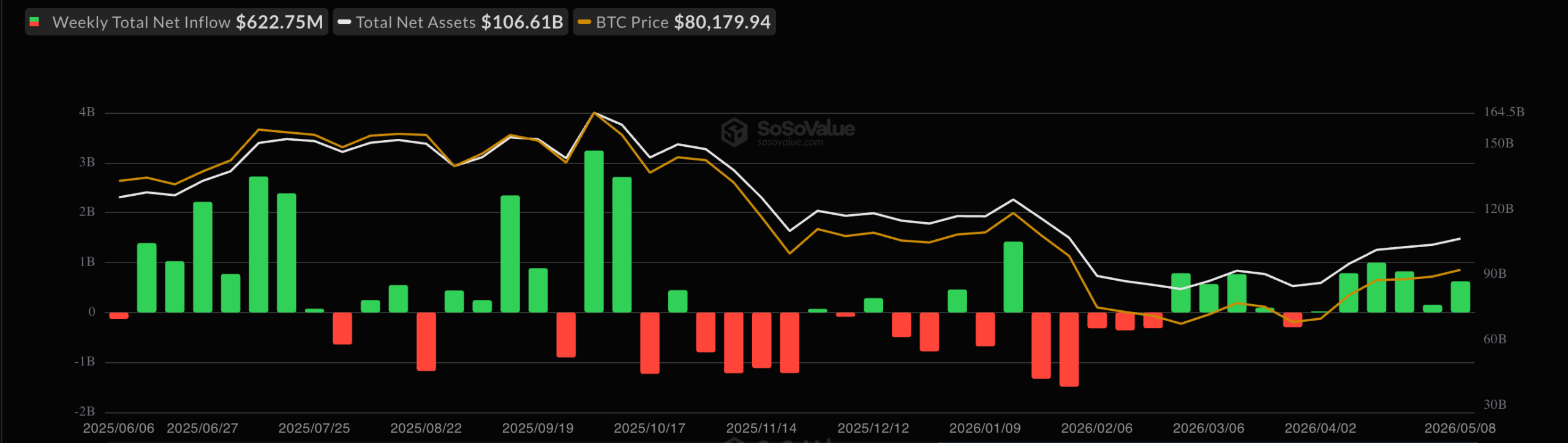
Spot Bitcoin exchange-traded funds (ETFs) recorded six straight weeks of net inflows through Friday, drawing $3.4 billion combined.
The run marks the longest positive streak since a seven-week stretch ended in July 2025, according to SoSoValue data.
Bitcoin ETFs Extend Inflow Streak to 6 Weeks
The week ending April 17 anchored the streak with $996.38 million in net inflows. That marked the largest weekly haul since mid-January.
Follow us on X to get the latest news as it happens

Notably, Bitcoin products outperformed other crypto ETFs over the same window. Ethereum (ETH) ETFs slipped to an $82.47 million outflow in the week ending May 1. They rebounded to $70.49 million the following week.
XRP (XRP) and Solana (SOL) funds also could not match Bitcoin’s straight run. Both recorded weekly outflows in the week ending May 1, breaking their inflow trend.
Six-Week Streak Faces Test as Buyers Step Back
The current run is close to last summer’s streak in length but trails it sharply in scale. Weekly inflows since April 2 have averaged $568 million. By comparison, the seven-week run ending July 25, 2025, averaged $1.51 billion per week and totaled $10.58 billion.
Moreover, daily flows suggest a cooling of momentum. Bitcoin ETFs posted back-to-back outflows on May 7 and May 8. That broke a five-session green run for the funds.
The funds shed $277.50 million on May 7 and another $145.65 million on May 8. Until then, daily inflows had been strong from April 30 through May 6. Net inflows on May 1 alone reached $629.73 million.
Whether the weekly streak extends to a seventh week now hinges on flows in the days ahead. The next sessions will show whether buyers return or the run ends at six.
Subscribe to our YouTube channel to watch leaders and journalists provide expert insights
The post US Bitcoin ETFs See $3.4 Billion Inflow Since April, Longest in 9 Months appeared first on BeInCrypto.

Key Takeaways
- At a White House gathering on Friday, President Trump encouraged Americans to purchase Dell products
- Dell Technologies (DELL) shares jumped as much as 14.6%, reaching an unprecedented peak of $263.99 before stabilizing near +13%
- The presidential recommendation came after Michael and Susan Dell contributed $6.25 billion to Trump’s children’s wealth program in December 2025
- Wall Street firms Mizuho and Bank of America have recently upgraded their targets for the technology stock
- Competitor Super Micro (SMCI) climbed more than 5% as well, supported by robust quarterly projections
Shares of Dell Technologies (DELL) reached unprecedented levels on Friday following President Donald Trump’s public recommendation that Americans purchase the company’s computing products during a White House gathering.
During his address, Trump expressed gratitude to the “Dell family,” praising their contributions by stating they had “done such a job.” He then added: “Go out and buy a Dell, they’re great.” Following these remarks, shares climbed as much as 14.6%, touching a historic peak of $263.99 per share before moderating to approximately 13% gains.
The presidential endorsement followed a substantial $6.25 billion contribution by Michael and Susan Dell to “Trump Accounts” in December 2025 — a federal initiative aimed at creating wealth opportunities for American children.
By 1:01 PM ET, Dell shares were changing hands at $253.64, representing a 10.15% advance for the session.
The White House backing provided additional momentum to a stock that had already been attracting favorable attention from equity analysts.
Vijay Rakesh of Mizuho elevated his price objective on DELL to $260 from $215 this Wednesday, maintaining an Outperform recommendation. Meanwhile, Bank of America increased its target to $246, with analyst Wamsi Mohan highlighting agentic AI as a significant catalyst for Dell’s equipment sales.
How AI Server Expansion Benefits Dell
Mohan elaborated that agentic AI “transforms a single discrete inferencing event into sequenced workflows, generating multiple inference events per task.” This evolution could substantially increase demand for CPU-intensive equipment — precisely the hardware Dell manufactures.
Bank of America projects Dell is well-positioned to secure a portion of the estimated $496 billion AI server marketplace.
Super Micro (SMCI) also advanced over 5% during Friday’s session. The company experienced gains earlier this week following quarterly guidance that exceeded expectations while alleviating investor concerns regarding a Department of Justice probe. Market observers cited Super Micro’s outlook as evidence of broader strength throughout the AI server industry.
Dell Technologies is scheduled to announce its Q1 FY2027 financial results on May 28.
Wall Street Price Objectives Prior to Friday’s Rally
Before Friday’s surge, Mizuho’s upgraded $260 target already represented a premium to the stock’s trading range. The new record high of $263.99 temporarily surpassed even that elevated projection.
Bank of America established its $246 price objective in late May, prior to the presidential remarks that propelled shares to even loftier levels.
Dell’s upcoming earnings announcement on May 28 represents the next major event, with market participants eager to assess AI server revenue performance.

Does a Plaid Cymru win mean Welsh independence could be on the horizon?

Is Your Car a Write-Off? How to Check Its True History Before You Buy
5 Chip Stocks Dominating Investor Attention This May: Nvidia (NVDA), AMD (AMD), and More

Manchester United reach agreement with Casemiro over contract clause amid transfer speculation

US brings back mandatory military draft registration

Steven Gerrard disagrees with Gary Neville over ‘shock’ Chelsea and Arsenal claim | Football


-
 Crypto World1 day ago
HarrisX Poll Found 52% of Registered Voters Support the CLARITY Act
-

 NewsBeat6 days ago
Channel 5 – All Creatures Great and Small series 7 new post
-

 Crypto World2 days ago
Upbit adds B3 Korean won pair as Base token gains Korea access
-

 Tech5 days ago
Image AI models now drive app growth, beating chatbot upgrades
-

 News Videos6 days ago
AP Dhillon – Old Money (Official Audio)
-
 NewsBeat2 days ago
NCP car park operator enters administration putting 340 UK sites at risk of closure
-

 Fashion21 hours ago
Weekend Open Thread: Marianne Dress
-

 Sports7 days ago
Five killed in Texas plane crash identified as Amarillo pickleball players
-
Entertainment7 days ago
New Netflix Movies in May 2026 — My Top 3 Picks to Stream
-
 Crypto World7 days ago
Pi Network Mandates Protocol 23 Upgrade for All Mainnet Nodes Before May 15 Deadline
-
Entertainment6 days ago
Anna Nicole Smith’s Daughter Attends 2026 Kentucky Derby
-

 Crypto World6 days ago
Bitcoin mining equities rise in 2026 as BTC lags behind
-

 Entertainment6 days ago
Melissa Joan Hart and More Stars Attend 2026 Kentucky Derby
-
Entertainment7 days ago
Venus Williams’ Best Met Gala Looks Over the Years
-

 Business6 days ago
Luka Doncic Injury Update: Doncic’s Hamstring Recovery Slows Lakers’ Hopes Against Thunder: Can He Run Yet?
-
Entertainment6 days ago
“Storage Wars” star Darrell Sheets' ex-wife breaks silence on his death
-

 Sports6 days ago
Is Man United v Liverpool on TV? Channel, streaming and how to watch Premier League fixture
-

 Business7 days ago
Kuwait International Airport Resumes Operations After Closure as Regional Tensions Ease in 2026
-
 Entertainment7 days ago
Netflix’s 10-Part Miniseries Based on a True Story Is a Perfect Weekend Binge
-
Crypto World7 days ago
Q1 2026 Tech Layoffs AI Wave Hits 81,747 as Firms Shift to AI Infrastructure
You must be logged in to post a comment Login