

Crypto World
Miner Supply Hits Bitcoin Market as Marathon Moves 298 BTC to Cumberland Wallets


TLDR:
- Marathon transfers 298 BTC to Cumberland, adding miner-linked supply to the market.
- Spot Taker CVD shows buyers absorbing miner sell pressure efficiently.
- Bitcoin NVT drops 33.8%, indicating rising transaction activity across the network.
- Funding Rates turn negative, signaling increased short positioning in derivatives markets.
Marathon moves 298 BTC to Cumberland, introducing miner-linked supply into Bitcoin markets. Spot buyers continue absorbing sell pressure, while derivatives funding rates indicate rising bearish positioning among traders.
Miner Transfers Add Supply While Spot Buyers Absorb Pressure
Marathon Digital recently transferred 298 BTC, valued at approximately $20.57 million, to Cumberland. Lookonchain data indicated multiple transactions leaving MARA-linked wallets roughly six hours before reporting.
Such miner movements often attract attention because miners tend to liquidate coins to meet operational or liquidity requirements. Despite the influx, the transfer’s size remains moderate relative to overall Bitcoin liquidity.
Historically, similar miner distributions have been absorbed without creating substantial price disruptions. Traders still watch these flows closely, as miner selling has previously preceded short-term volatility spikes.
Spot order-book dynamics indicate strong buyer absorption of the incoming supply. The Spot Taker CVD (90-day) shows that aggressive buyers continue executing trades at the ask.
When taker demand dominates, sellers must incrementally raise offers to match ongoing buying activity. Such market behavior contributes to price stability during periods of miner distribution.
Even amid new supply, buyers maintain control, preventing abrupt declines or disorderly trading conditions. The MARA transfer has so far not disrupted broader demand across Spot exchanges, signaling market resilience.
Additionally, social sentiment reflects trader awareness, with discussions around miner transfers and buyer absorption circulating online. Monitoring these conversations complements quantitative metrics in assessing short-term market behavior.
Combined Spot data and social tracking provide insight into how miner-linked supply interacts with active demand.
On-Chain Metrics and Derivatives Indicate Mixed Market Signals
Bitcoin’s NVT Ratio fell to 27.7 after a 33.8% decline, signaling rising network transaction activity. A lower NVT suggests more coins are moving relative to market capitalization, reflecting a more active ecosystem.
Analysts often combine NVT data with other metrics to evaluate broader market conditions, including miner-related movements. The Stock-to-Flow Ratio increased by roughly 100%, showing heightened structural scarcity.
Fewer newly minted coins relative to the circulating supply reinforce Bitcoin’s long-term scarcity narrative. This metric remains relevant for assessing the ecosystem’s fundamental strength, even during minor distribution events.
Derivatives markets reveal contrasting sentiment, with Funding Rates dropping to −0.0007 after a 294.54% decline. Negative funding indicates growing short positioning, where short traders receive payments from long traders in perpetual futures.
Such heavily negative funding can also create short-squeeze conditions if spot prices stabilize or rise. Market participants interpret these dynamics as a divergence: Spot demand absorbs supply efficiently while derivatives sentiment grows bearish.
Traders track both on-chain metrics and funding rates to gauge potential volatility and supply-demand shifts. Overall, miner transfers, network activity, and scarcity measures continue to support Bitcoin’s structural fundamentals despite mixed short-term signals.


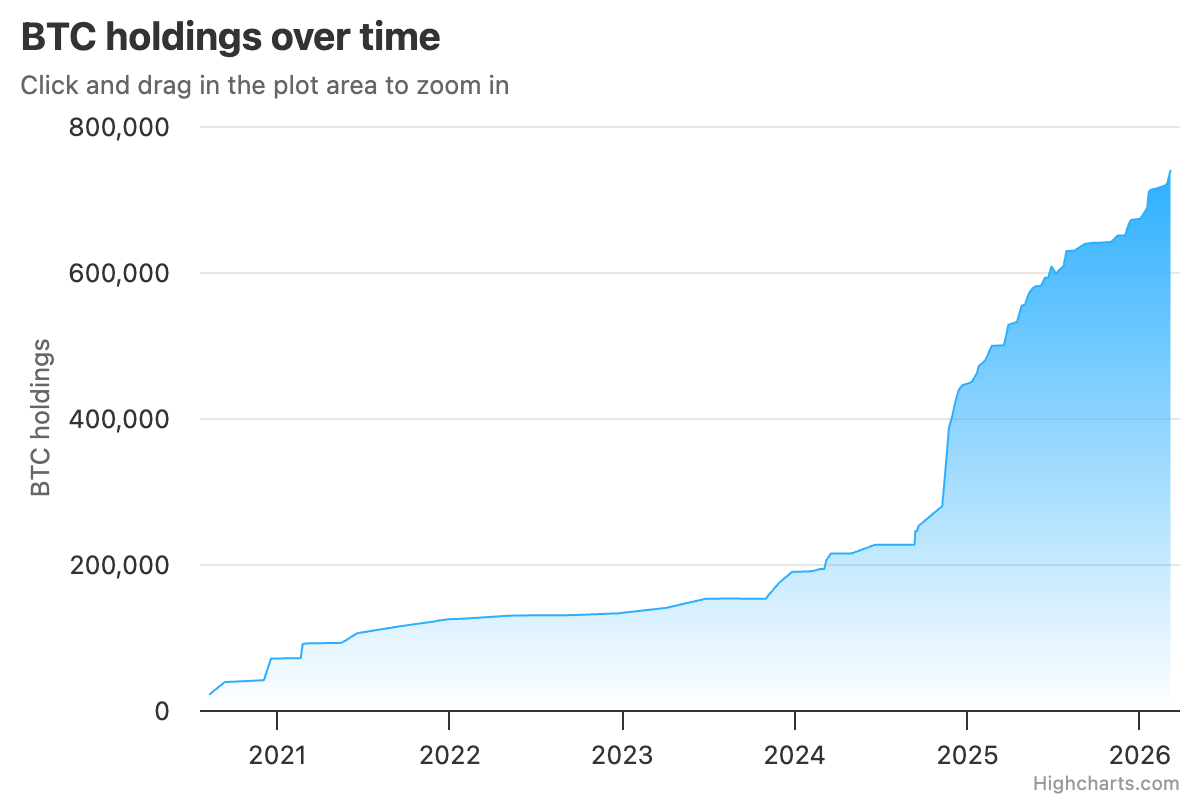
Michael Saylor’s Strategy (MSTR) may reach the 1 million Bitcoin (BTC) milestone faster than expected, potentially overtaking BlackRock in total holdings.
Key takeaways:
-
STRC share sales have generated cash to acquire over 3,500 BTC so far this week.
-
Strategy’s implied buying power could rise to roughly 5,700 BTC per day at Tuesday’s record pace.

Rising STRC demand implies 1,940 BTC of daily buying power
Strategy currently holds 738,731 BTC, including the 17,994 BTC purchase announced on Monday. Meanwhile, BlackRock’s iShares Bitcoin Trust (IBIT) holds 775,156 BTC, or roughly 36,500 BTC more than Strategy today.
But a relatively new instrument, Strategy’s STRC preferred stock, is helping close that gap faster.
STRC currently pays an 11.50% annual dividend, distributed monthly in cash.
The dividend rate adjusts every month to encourage the stock to trade near its $100 par value, which helps limit volatility. Strategy uses the proceeds from the share sales to buy Bitcoin.
Just this week, Strategy is estimated to have purchased over 3,500 BTC after selling roughly 6 million STRC shares through its at-the-market (ATM) program, data resource STRC.LIVE shows.

Among the top STRC buyers is Bitcoin investment firm Strive.
On Wednesday, chief risk officer Jeff Walton said they acquired $50 million in STRC, noting that the allocation would generate about $5.75 million in annual income at STRC’s current yield.

That is higher than roughly $1.85 million from 13-week T-bills, a difference of about $3.90 million per year.
On Tuesday, STRC logged a record $409 million daily volume and a $138.5 million 30-day average.

Using the $138.5 million average daily trading volume and a Bitcoin price near $71,000, STRC could theoretically buy roughly 1,940 BTC per trading day, more than four times Bitcoin’s daily mined supply.
On days when STRC trading approaches its $409 million record, the implied buying power rises to around 5,700 BTC, or nearly 13 times daily mining supply.
At this rate, Strategy’s Bitcoin holdings can surpass the 1 million BTC mark by August, likely leaving behind BlackRock as well.
MSTR may tap $145.1 trillion fixed-income market
STRC may soon start competing with the traditional fixed-income markets, according to analyst Adam Livingston.
Global fixed-income markets outstanding reached $145.1 trillion in 2024, and US fixed income outstanding was $48.9 trillion as of Q3 2025, Livingston said in a Wednesday post, adding:
“If products like STRC eventually attract even 0.1% of global fixed income outstanding, that is $145.1 billion. At $71.2K per Bitcoin, that amount of capital would be enough to buy roughly 2.04 million BTC, purely as a scale illustration.”
STRC still carries risk for investors
In its disclaimer, Strategy warned that STRC doesn’t guarantee returns, noting that it is “neither a bank deposit, nor FDIC insured, nor regulated in the same way.”
Additionally:
“It does not have the same regulatory and other protections as bank accounts, money market funds, treasuries, or similar instruments and as a result may not be a comparable investment.”
Strategy Analyst ColinTalksCrypto also warned that STRC can cut the dividend, its share price can fall below its $100 par value, and Strategy can issue more shares that dilute existing holders.
I’ve been seeing a lot of euphoric bullposting about $STRC.
It’s an interesting financial product, but I will be the black sheep and state that I personally feel it’s too risky of an investment.$STRC doesn’t really give you any guarantees (despite seeming like guaranteed fixed…
— 𝙲𝚘𝚕𝚒𝚗 𝚃𝚊𝚕𝚔𝚜 𝙲𝚛𝚢𝚙𝚝𝚘 🪙 (@ColinTCrypto) March 10, 2026
This article does not contain investment advice or recommendations. Every investment and trading move involves risk, and readers should conduct their own research when making a decision. While we strive to provide accurate and timely information, Cointelegraph does not guarantee the accuracy, completeness, or reliability of any information in this article. This article may contain forward-looking statements that are subject to risks and uncertainties. Cointelegraph will not be liable for any loss or damage arising from your reliance on this information.
For the first time in over a month, Tether mints $1 billion USDT on the Tron network.
Tether, the world’s largest stablecoin issuer, just minted $1 billion worth of USDT on the Tron network. This is the first time the company has issued such a large amount in over a month, and it pushes the total circulating supply to about $183 billion, which is over $100 billion more than its closest competitor, USDC.
According to its official transparency page, over $96 billion of the total supply sits on Ethereum, while Tron is a close second with $86 billion.
Tether minted another 1B $USDT on #Tron 6 hours ago.
The circulating supply of $USDT on #Tron has reached 85.3B, far more than on #Ethereum.https://t.co/2wFo2DEvz3 pic.twitter.com/YPmRZ7nFHM
— Lookonchain (@lookonchain) March 12, 2026
While moves of this kind don’t usually cause significant volatility in the markets immediately, the firm may be anticipating increased demand for USDT amid ongoing military tensions worldwide.
The war in Iran has sent massive ripples across the global economy. Just last week, the price of crude oil exploded by more than 30% daily, reaching a high above $120, before plummeting during the same day (and the ones to follow) on subsequent announcements. This had an immediate impact on Bitcoin’s price, which followed suit and also went through extreme volatility.
It’s inevitable that global geopolitical turmoil impacts crypto markets, and while the current move to mint $1 billion USDT might not lead to an immediate change in pricing, increased liquidity across the board can help the market absorb potential shocks.
Binance Free $600 (CryptoPotato Exclusive): Use this link to register a new account and receive $600 exclusive welcome offer on Binance (full details).
LIMITED OFFER for CryptoPotato readers at Bybit: Use this link to register and open a $500 FREE position on any coin!

Key Highlights
- Two new wholly owned entities introduced: Metaplanet Ventures and Metaplanet Asset Management
- Venture capital division plans to invest approximately 4 billion yen (~$25M) in Japanese Bitcoin infrastructure companies throughout the coming years
- Initial portfolio investment announced — 400 million yen ($2.5M) stake in JPYC, a Japanese stablecoin provider, as part of its Series B funding
- U.S.-based asset management division will operate from Miami, targeting Bitcoin financial products for investors across Asia and the West
- MTPLF shares gained 5.53% Wednesday, finishing at $2.29; Tokyo shares declined 1.9% Thursday to 362 yen
The Tokyo-based Bitcoin treasury company Metaplanet has significantly broadened its strategic footprint. On Thursday, the firm unveiled two newly formed, fully owned subsidiaries — a venture capital division and an American asset management operation — signaling a major evolution in its Bitcoin-centric business model.
Chief Executive Simon Gerovich announced the developments on X, noting board approval for both entities. These strategic moves arrive as Japanese regulatory frameworks progress toward formal recognition of Bitcoin as a regulated financial instrument, with Metaplanet anticipating official classification by January 2028.
The venture capital subsidiary, Metaplanet Ventures, will concentrate investments in seed through growth-stage companies developing Bitcoin financial infrastructure across Japan. Priority sectors encompass lending platforms, payment solutions, custody services, stablecoin technology, derivative products, and compliance systems. Additionally, the venture division will operate an incubator alongside a grants initiative supporting nascent founders, open-source contributors, educators, and academic researchers.
The planned $25M capital deployment spans a two-to-three-year timeframe and will draw funding from Metaplanet’s Bitcoin-related revenue streams — explicitly avoiding liquidation of its existing Bitcoin treasury.
Inaugural Investment: JPYC Stablecoin Platform
The venture arm moved swiftly with its debut investment. Metaplanet Ventures committed 400 million yen ($2.5M) to JPYC Inc., the company behind Japan’s first officially licensed stablecoin. This capital injection forms part of JPYC’s Series B funding round.
JPYC debuted in October 2025 and maintains its 1:1 Japanese yen peg through a combination of bank deposits and government securities. The stablecoin operates across Ethereum, Avalanche, and Polygon networks. In recent weeks, JPYC established a strategic partnership with Sony Bank to penetrate Japan’s music and entertainment industries.
Gerovich articulated the strategic rationale behind the investment: “Every Bitcoin transaction has two sides: Bitcoin and a currency. As this market goes institutional, that currency side goes digital.”
Establishing U.S. Operations in Miami
The companion subsidiary, Metaplanet Asset Management, will establish headquarters in Miami, functioning as a “digital credit and Bitcoin capital markets platform.” The entity aims to bridge Asian and Western capital markets while delivering Bitcoin investment vehicles, capital markets consulting, and associated regulatory frameworks.
Management indicated forthcoming announcements regarding specific fund launches and investment approaches, spanning fixed income instruments through actively managed equity positions and volatility-based strategies.
Metaplanet’s current treasury contains 35,102 BTC — valued at approximately $2.45 billion — positioning the firm as the fourth-largest corporate Bitcoin holder globally. The company maintains an ambitious acquisition target of 210,000 BTC by the conclusion of 2027.
Financial results released last month showed a net loss of 95 billion yen ($598M) for 2025, primarily attributed to unrealized mark-to-market adjustments on Bitcoin holdings. Gerovich countered negative interpretations of the headline figure, highlighting a remarkable 1,695% year-over-year increase in operating profitability.
“Even in this year’s down market, our stock fell 23% while Bitcoin fell 24% — we have not underperformed,” he stated.
MTPLF shares advanced 5.53% during Wednesday’s session, closing at $2.29. The Tokyo-listed equity experienced a 1.9% intraday decline Thursday, trading at 362 yen.
PI has become one of the trendiest tokens today on CoinGecko, but its price has not benefited from the big announcement.
Ever since it saw the light of day over a year ago, the vast Pi Network community has speculated whether (or when) the underlying token will be listed on some of the largest and oldest crypto exchanges.
Although a few trading platforms continue to stay clear, the veteran US giant Kraken has joined the PI bandwagon following the likes of OKX, Bitget, MEXC, Gate, and others.
Coming soon: $PI@PiCoreTeam Pi Network is a mobile-first Layer-1 blockchain and developer platform enabling accessible crypto mining via smartphone, with a utility-based ecosystem on an identity-verified mainnet.
Trading starts March 13
Get ready → https://t.co/47fNCUnRqD pic.twitter.com/nPmrRElAPW
— Kraken Listings (@krakenlistings) March 12, 2026
There have been a growing number of speculations in the past month or so about this listing. In fact, one user tried to “manifest” precisely this – PI going live for trading on Kraken before March 14, known in the Pi Network community as Pi Day.
The exchange stated that trading will commence tomorrow, March 13. Interestingly, there has been no positive reaction from the underlying asset despite this major announcement.
Big listings tend to boost the token, but PI has remained flat over the past 24 hours. However, it’s one of the best performers on a weekly and monthly scale, gaining 24% since last Thursday and a whopping 65.6% since February 12.
A large portion of its recent gains could be attributed to the protocol updates, as the team announced the successful implementation of v19.6 and v19.9 consecutively. The next version, 20.2, is actually expected to be introduced today.
You may also like:
Binance Free $600 (CryptoPotato Exclusive): Use this link to register a new account and receive $600 exclusive welcome offer on Binance (full details).
LIMITED OFFER for CryptoPotato readers at Bybit: Use this link to register and open a $500 FREE position on any coin!
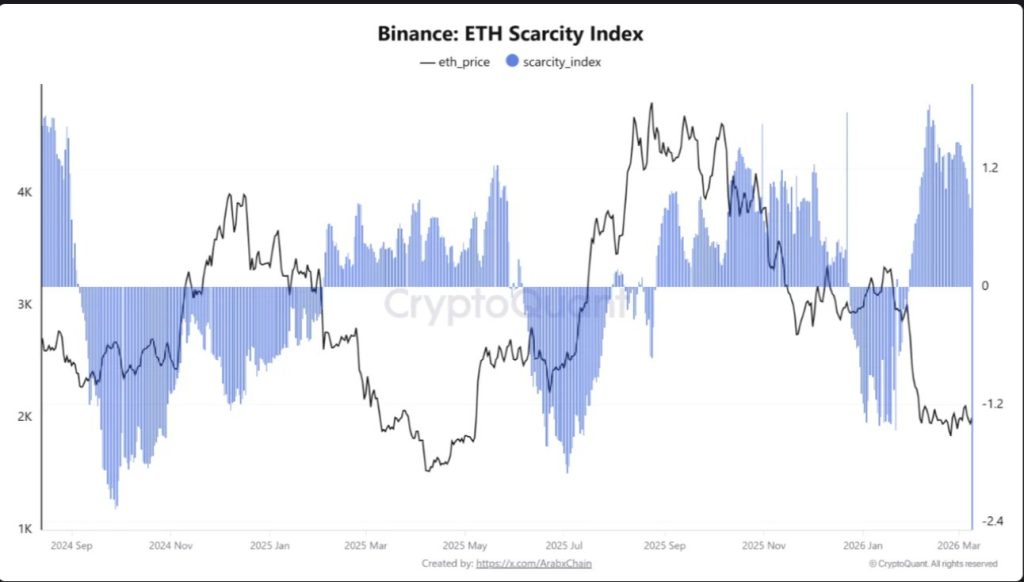
Ethereum has reclaimed $2,000 overnight with a modest +0.6% move to the upside as ETH USD continues to chop sideways as the broader market searches for direction.
However, under the hood on Binance, a key supply metric just flashed a positive 0.67 reading. While price action looks hesitant, this signal suggests the order book is thinning out in favor of sellers.
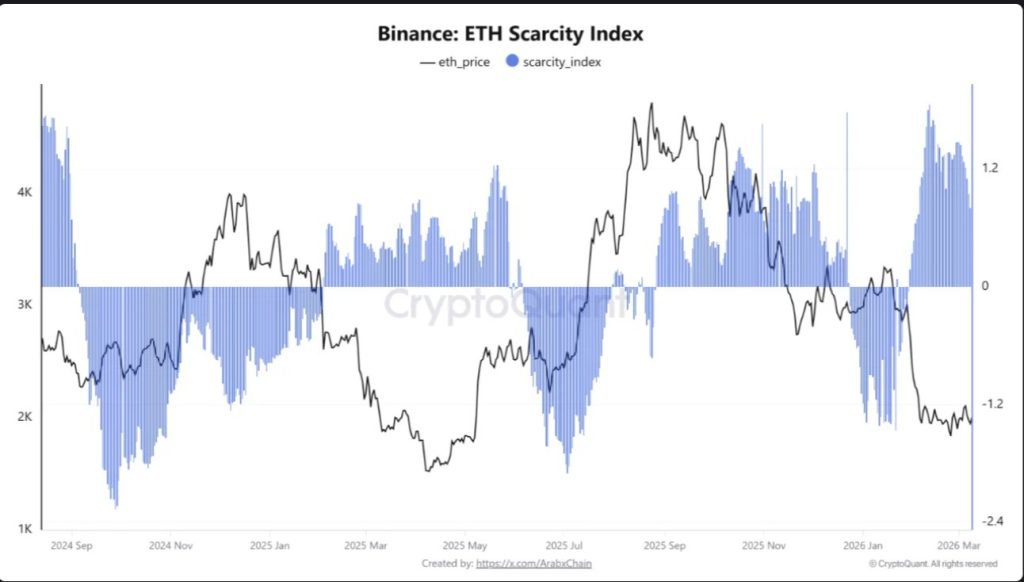
The Scarcity Index, tracked by CryptoQuant analysts, measures the deviation of exchange reserves against historical baselines. A positive reading indicates that the platform’s available inventory is dropping below average levels, reducing the liquidity cushion for sell orders.
At 0.67, the index isn’t screaming an immediate supply shock, but it marks a definitive structural shift. Historically, similar transitions from negative to positive scarcity values have preceded recovery phases, as sell-side pressure exhausts itself against steady accumulation.
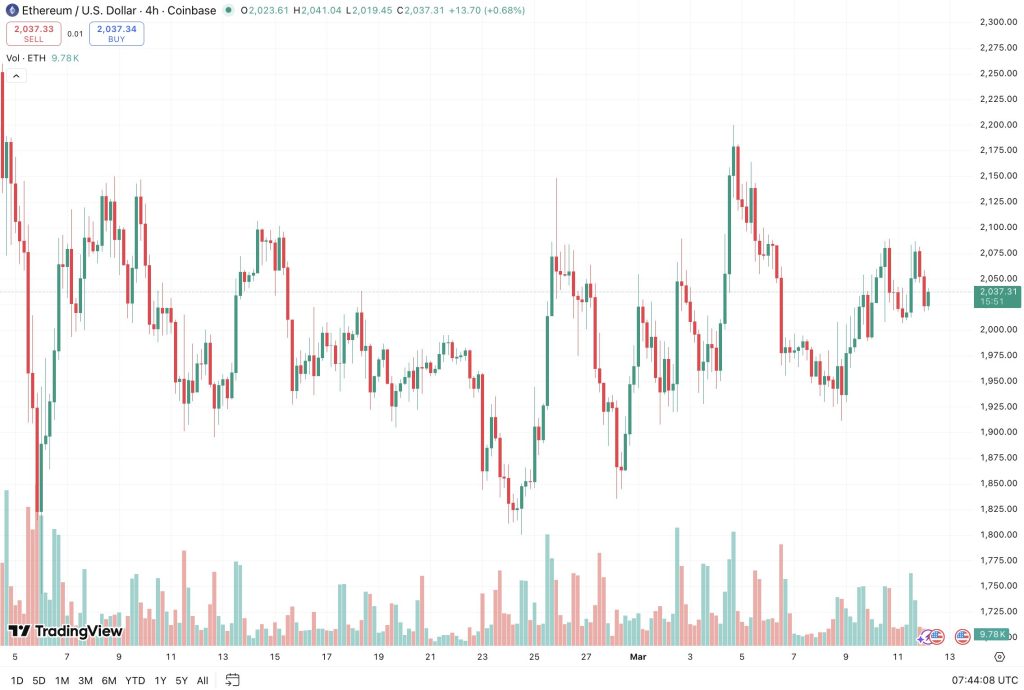
Ethereum Price Prediction: Can the Scarcity Signal Push ETH Back Above $2,200?
ETH is currently compressing in a tight range between $1,900 and $2,100. The asset remains significantly below its 50-day simple moving average of $2,278 and the 200-day average near $3,038.
This technical weakness suggests that while supply is shrinking, demand has not yet risen enough to overcome overhead resistance.
If bulls can leverage the thinner order books to push past $2,150, the next major resistance cluster sits at $2,200–$2,400. A reclaim of the $2,278 level would align the technicals with the bullish on-chain data.
Some analysts argue that smart money is positioning for the long haul, as Wall Street shows signs of choosing Ethereum as a backbone for future finance.
However, if the consolidation breaks downward, the scarcity signal will be invalidated by sheer selling volume. A daily close below $1,900 opens the door to a retest of the $1,800 support zone.
DISCOVER: Next Crypto to Explode in 2026
What Traders Are Watching Next for ETH USD
The key to validating the 0.67 scarcity reading is volume. Traders are watching for a spike in spot buying activity amid the reduced supply. Without volume, low liquidity simply means price action remains choppy.
Per CoinGlass data, institutional flows also remain a wildcard with BlackRock beginning the week by selling over 28,000 ETH ($55M). However, the past two days have finished in the green, with nearly +$70M in positive flows across March 10 and 11.
ETF data needs to maintain the positive momentum of the past few days to support the spot market recovery and any ETH USD push toward $2,200 and above.
Away from ETFs, Digital Asset Treasury firms like the Tom Lee-led Bitmine continue to scoop up ETH USD, adding to the scarcity as the company has now locked over 3M ETH, totalling around $6Bn at current prices.
Investors are monitoring regulatory headlines, such as recent news that Binance is suing the WSJ over defamation claims, which can impact user sentiment and flow dynamics on the platform.
If the Scarcity Index climbs above 1.0 while price holds $2,000, the probability of a supply-shock rally increases significantly.
EXPLORE: Best Crypto Presales to Buy in 2026
The post Ethereum Scarcity Index Turns Positive as ETH USD Pushed Back Above $2,000 appeared first on Cryptonews.
Ripple has unveiled a $750 million buyback plan for the XRP token, sparking speculation about whether the move could trigger renewed bullish momentum for the XRP price.
Summary
- Ripple announced a $750M buyback plan that could tighten circulating supply of XRP.
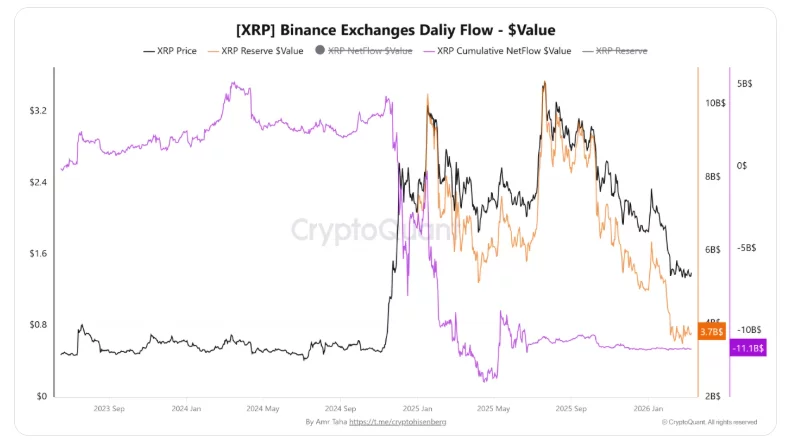
- On-chain data from CryptoQuant shows XRP reserves on Binance dropping to a 10-month low of $3.7B, signaling potential accumulation.
- XRP price remains in consolidation near $1.37, with $1.50 acting as key resistance and $1.30 as immediate support.
Corporate buybacks are often interpreted as a signal of confidence in an asset’s long-term value. In crypto markets, similar strategies can also affect liquidity by reducing circulating supply, potentially supporting prices if demand remains strong.
While the company has not disclosed the precise timeline or execution strategy, reports on the buyback has already drawn attention from traders looking for potential catalysts in a market that has been largely range-bound in recent weeks.
The move comes as XRP price continues to attract institutional interest and broader adoption across cross-border payment networks tied to Ripple’s ecosystem.
Exchange supply tightening signals potential pressure
Recent on-chain data from CryptoQuant suggests that exchange supply for XRP is already tightening.
According to the analytics firm, Binance’s XRP reserves have dropped sharply to $3.7 billion as of March 10, the lowest level recorded in 10 months. The metric tracks the total value of XRP held on the exchange and reflects both token balances and price fluctuations.
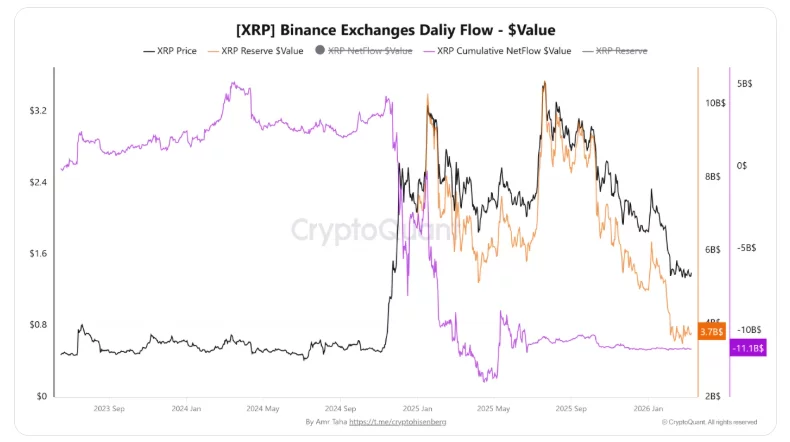
Earlier in 2025, reserves on Binance exceeded $10 billion during peaks in January and July. Those periods were followed by steep corrections that pushed XRP prices below $1.20.
The continued decline in reserves, down from roughly $3.9 billion on March 6, could indicate that traders are withdrawing XRP from exchanges, often interpreted as a signal of accumulation or long-term holding.
If the buyback initiative coincides with shrinking exchange supply, the combination could create upward pressure on prices.
XRP price analysis
Based on the latest XRP/USDT daily chart, the token remains locked in a consolidation phase despite the broader bullish narrative.
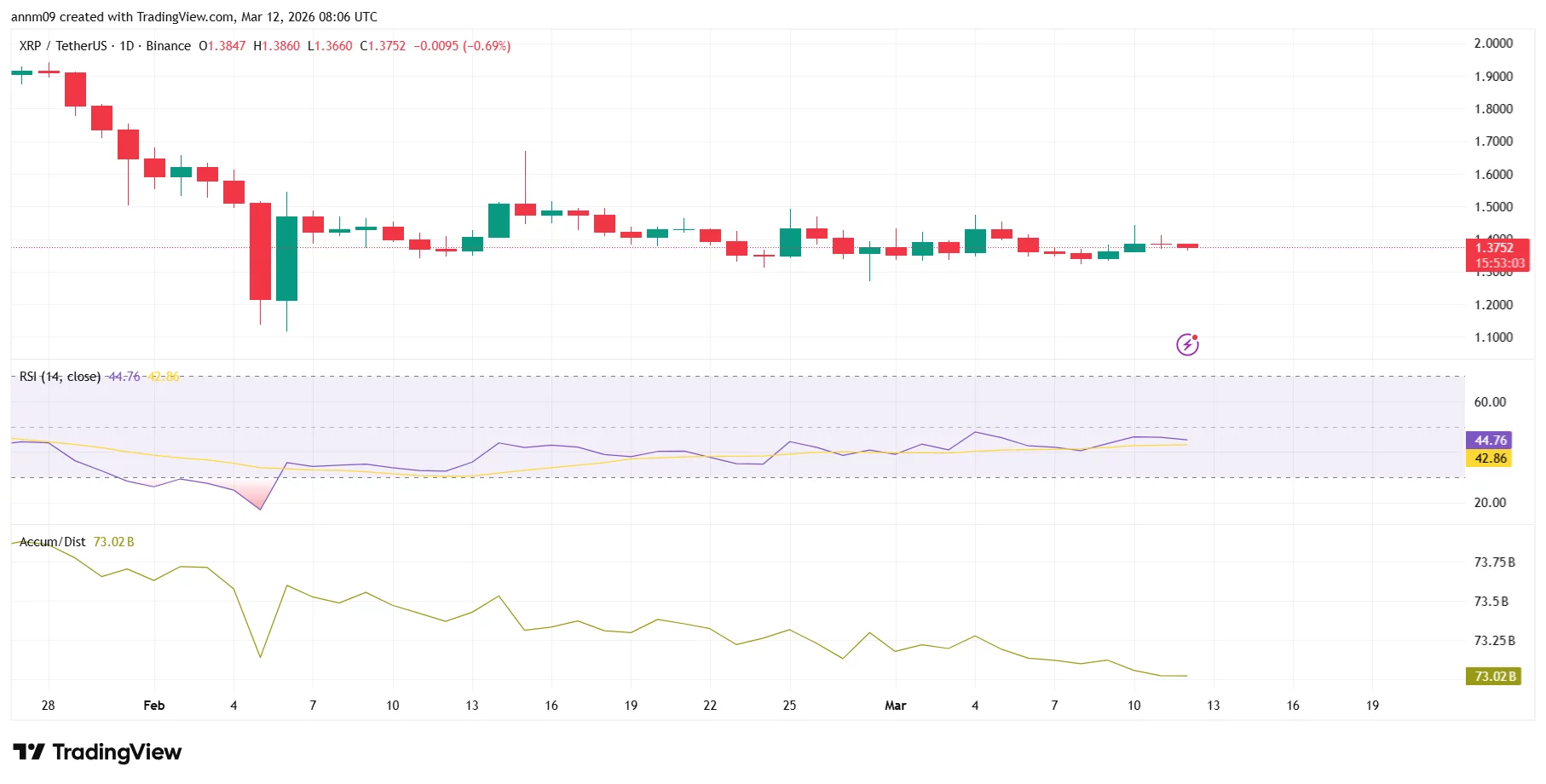
XRP is currently trading near $1.37, hovering within a relatively tight range that has formed since early February following a sharp correction from higher levels.
The $1.45–$1.50 zone remains the immediate hurdle for bulls. A decisive breakout above this region could open the door for a push toward the $1.70–$1.80 range.
The chart shows strong support around $1.30, with deeper support near $1.20 if selling pressure intensifies.
The Relative Strength Index (RSI) is currently hovering around 45, indicating neutral momentum. The reading suggests the asset is neither overbought nor oversold, leaving room for a potential move in either direction
Meanwhile, the Accumulation/Distribution indicator continues trending slightly downward, hinting that market participants remain cautious despite improving fundamentals.
For now, the market appears to be waiting for a decisive catalyst. If Ripple’s buyback plan and declining exchange reserves translate into stronger demand, XRP could attempt to break out of its current consolidation range.
Otherwise, the token may continue trading sideways as investors assess the broader crypto market environment.
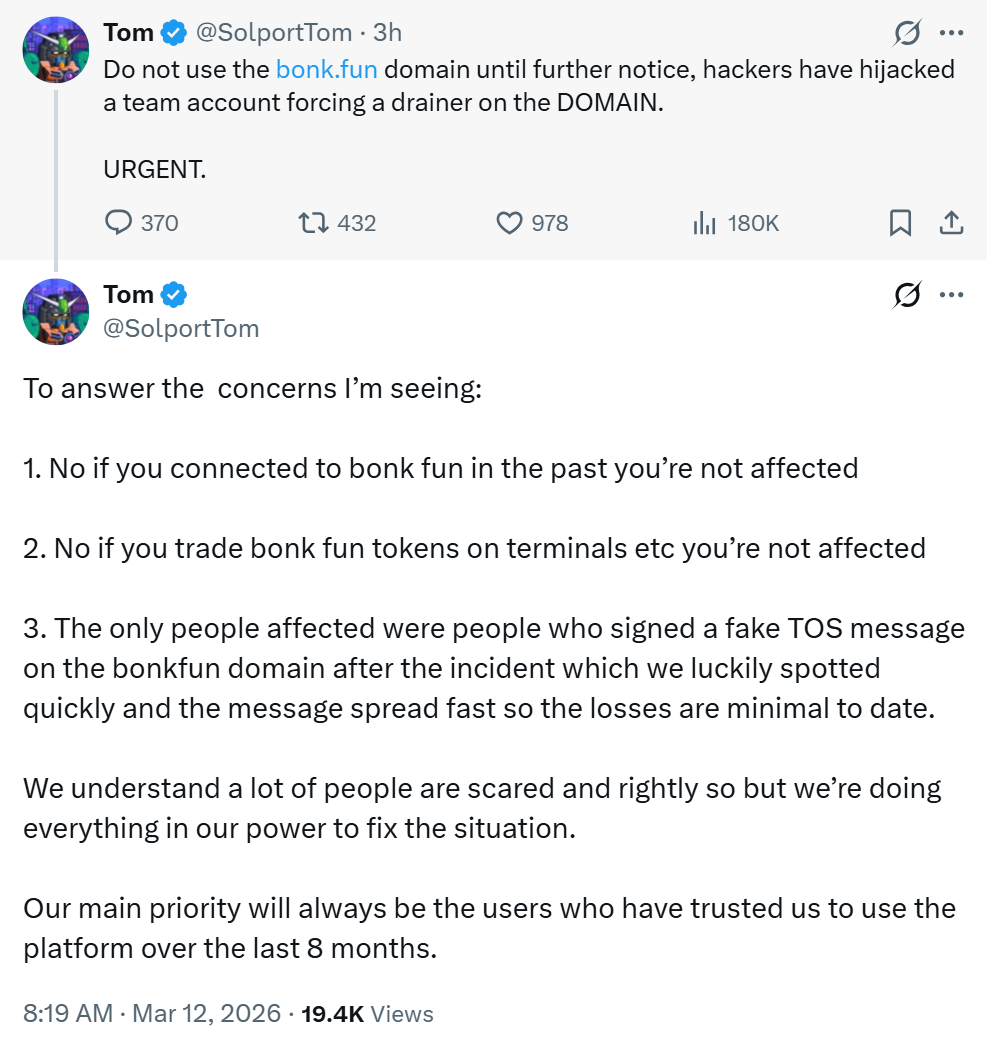
Bonk.fun warned users not to use its site after attackers hijacked the domain and pushed a fake wallet-draining prompt.
The domain of Solana-based platform memecoin launchpad Bonk.fun has been hijacked after attackers gained access to a team account and deployed a wallet-draining scheme through the site.
The Bonk.fun account on X warned users early Thursday not to interact with the website while the team worked to secure the domain. “A malicious actor has compromised the BONKfun domain, do not interact with the website until we have secured everything,” the project wrote in a post on X.
X user Tom, who is an operator behind Bonk.fun, said the attackers used the compromised access to push a fake message designed to trick visitors into signing a malicious transaction.

In a follow-up post, Tom said the exploit targeted users who signed a fraudulent terms-of-service prompt that appeared on the site during the breach. Users who had previously connected wallets to Bonk.fun were not affected, and traders interacting with Bonk-related tokens through external terminals were also safe.
Related: Trust Wallet adds real-time scam address checks for crypto users
Some users report losses
Some users reported losses in replies to the warning posts. One user claimed roughly 50 Solana (SOL) had been drained from their wallet, while another said they lost about 10 SOL. More users claimed varying amounts of losses.
Meanwhile, Tom said the incident was contained quickly and that reported losses appear limited so far. “We understand a lot of people are scared and rightly so but we’re doing everything in our power to fix the situation,” he added.
Cointelegraph reached out to Tom for comment but had not received a response by publication.
Magazine: Bitcoin may take 7 years to upgrade to post-quantum — BIP-360 co-author
[PRESS RELEASE – Singapore, Singapore, March 11th, 2026]
FinCEN-registered platform enables seamless connection between Web3 wallets and compliant USD accounts, providing global users with instant access to fiat financial services.
EvoCash has officially launched its Web3 financial services platform, offering a Web3 wallet-to-USD account bridge that connects cryptocurrency wallets directly to compliant USD accounts. Registered as a Money Services Business (MSB) with the U.S. Financial Crimes Enforcement Network (FinCEN) under the Bank Secrecy Act, the platform provides access to real-time USDT-to-USD conversion and comprehensive fiat on-ramp and off-ramp financial services for users worldwide.
The platform addresses a common challenge in the cryptocurrency ecosystem: converting digital assets into fiat efficiently. Traditional financial institutions often apply additional scrutiny to cryptocurrency-related transactions, which can lead to delays or service limitations for some users — particularly international freelancers, digital nomads, and cross-border businesses. EvoCash provides a crypto-to-fiat infrastructure designed to support these users within a compliance-focused framework.
MSB Registration and Global Compliance Framework
EvoCash’s MSB registration with FinCEN enables legal operation of money transmission and currency exchange services in the United States and internationally. The platform operates under comprehensive Anti-Money Laundering (AML) and Know Your Customer (KYC) procedures aligned with regulatory requirements, enabling global user access without geographic banking restrictions.
Web3-compliant USD accounts are provided through partnerships with financial institutions using For Benefit Of (FBO) account arrangements, keeping user funds safeguarded at the partner bank and clearly segregated from company assets, while maintaining the speed and accessibility crypto users demand — particularly valuable for international users seeking crypto-to-fiat bridge solutions. This structure provides users with access to USD accounts without the restrictions typical of traditional banking.
Key Platform Features for Global Users
EvoCash offers an integrated suite of financial services:
- Real-Time USDT-to-USD Conversion: Instant conversion between stablecoins and fiat currency without multi-day bank delays
- Fiat On-Ramp and Off-Ramp: Bidirectional flows between crypto and traditional currency
- Web3-Compliant USD Accounts: Compliant fiat accounts connected directly to Web3 wallets via partner financial institutions in the U.S.
- Trading and Exchange Services: Multi-asset crypto trading integrated within the platform
- Global Onboarding: Accessible to users worldwide without requiring local banking relationships — critical for international freelancers and digital nomads
- Multichain Support: Asset management across multiple blockchain networks
- Cross-Border USD Payments: Seamless international payment processing
- Access to Traditional Instruments: Holdings in precious metals like gold alongside crypto assets
Solving Banking Friction Globally
Cryptocurrency users worldwide regularly experience frozen bank accounts, delayed withdrawals, and sudden account closures when attempting to convert digital assets to fiat. This challenge is particularly acute for international users across multiple jurisdictions.
EvoCash eliminates these barriers by providing regulatory-compliant infrastructure specifically designed for crypto-native transactions and global operations. Traders can convert profits immediately without waiting periods. Freelancers receiving crypto payments can access USD for everyday expenses instantly — regardless of where they’re located. Digital nomads can maintain USD accounts globally without local banking requirements.
Future Expansion with Visa Integration
The platform is pursuing approval for a Visa card linked to stablecoins, currently under review with issuing partners. Once approved and launched, the card will enable users to spend crypto-backed USD balances at merchants worldwide through integrated stablecoin payments functionality, further bridging digital assets and traditional commerce globally.
EvoCash’s compliance-first approach combined with purpose-built infrastructure for cryptocurrency users positions the platform as a leading crypto-to-fiat bridge connecting Web3 and traditional financial systems.
About EvoCash
EvoCash is a Web3 financial services platform registered as a Money Services Business (MSB) with FinCEN under the Bank Secrecy Act. The platform operates as a crypto-to-fiat bridge connecting decentralized finance and traditional financial systems through Web3-compliant USD accounts, real-time USDT-to-USD conversion, fiat on-ramp and off-ramp services, trading and exchange services, and multi-asset financial tools. EvoCash provides users with access to real-time stablecoin-to-USD conversion, global onboarding, cross-border USD payments, and multichain support, all within a secure, compliance-focused infrastructure. USD‑denominated accounts are provided through partner financial institutions in the U.S. using FBO account structures, so client funds are held and safeguarded at the partner bank and kept separate from EvoCash’s own funds. For more information, users can visit evocash.org.
Binance Free $600 (CryptoPotato Exclusive): Use this link to register a new account and receive $600 exclusive welcome offer on Binance (full details).
LIMITED OFFER for CryptoPotato readers at Bybit: Use this link to register and open a $500 FREE position on any coin!
Crypto World
Wyden Adds VALR to its Global Liquidity Network, Expanding Institutional Digital Asset Access in South Africa and Beyond
[PRESS RELEASE – Zurich/Johannesburg, Switzerland/South Africa, March 12th, 2026]
Wyden, the global leader in institutional digital asset trading technology, today announced the integration of VALR, the largest crypto exchange in Africa by trade volume, into its market-wide network of liquidity connectors.
The partnership marks a significant milestone in Wyden’s strategic growth in South Africa. Through this integration, Wyden’s institutional clients gain seamless, direct access to VALR’s deep liquidity pools, including the world’s deepest ZAR-denominated crypto markets. VALR’s extensive offering of 100+ crypto assets, including tokenized stocks and private credit as well as crypto bundles, will now be accessible through the Wyden trading platform.
By combining Wyden’s end-to-end trade lifecycle automation, Smart Order Routing (SOR), and best execution capabilities with VALR’s comprehensive range of crypto assets spanning spot margin, perpetual futures, and OTC services, financial institutions can now navigate the South African and global digital asset markets with increased efficiency and reduced operational risk.
The integration ensures that Wyden clients can execute large-scale trades with best execution while maintaining the rigorous compliance standards required by European regulators and the FSCA, under which VALR is licensed.
Commenting on the integration, Andy Flury, Wyden’s Founder and President of the Board, said: “South Africa represents a strategically vital market as we continue to expand our global institutional footprint. By integrating VALR, we are providing our clients with unparalleled access to the deepest liquidity in the region and a broad range of innovative assets. VALR’s commitment to regulatory excellence and institutional-grade infrastructure aligns perfectly with Wyden’s mission to provide banks and brokers with the most reliable and efficient trading technology available.”
Farzam Ehsani, Co-Founder and CEO at VALR, added: “This integration with Wyden represents a major step forward in bridging global institutional demand with Africa’s deepest crypto liquidity. It further solidifies VALR’s position as a leading infrastructure and liquidity provider not only across the continent but also on the international stage, empowering institutions, businesses, and individuals with seamless, compliant, and secure access to our comprehensive range of digital assets.”
As South Africa continues to establish itself as a sophisticated regional hub for digital asset regulation and trading, the partnership provides a robust gateway for global and local financial institutions.
About Wyden
Wyden is the global leader in institutional digital asset trading technology. By covering the entire trade lifecycle and supporting seamless custody, core banking, and portfolio management system integration as well as full trade lifecycle automation, the Wyden platform streamlines digital assets trading. Engineered by a team of trading system veterans and crypto asset experts, Wyden offers best-in-class integrated infrastructure solutions that meet the highest institutional needs. Headquartered in Zurich, Wyden runs several product hubs in Poland and has offices in Singapore and New York.
To learn more, visit www.wyden.io
About VALR
Founded in 2018 and headquartered in Johannesburg, VALR is backed by leading investors including Pantera Capital, Coinbase Ventures, GSR, and Fidelity’s F-Prime Capital. As a global crypto exchange, VALR offers a comprehensive suite of products—including Spot Trading, Spot Margin, Derivatives, Staking, Crypto Bundles, Borrowing & Lending, OTC services, VALR Invest, and VALR Pay. Licensed by South Africa’s FSCA and with regulatory approval in Europe, VALR serves over 1.7 million users and 1,800 corporate and institutional clients worldwide. The exchange is dedicated to advancing a just financial future that upholds human dignity and the unity of mankind.
For more information, visit valr.com.
Binance Free $600 (CryptoPotato Exclusive): Use this link to register a new account and receive $600 exclusive welcome offer on Binance (full details).
LIMITED OFFER for CryptoPotato readers at Bybit: Use this link to register and open a $500 FREE position on any coin!


Bloomberg reported Thursday that US prosecutors urged a federal judge to reject Sam Bankman-Fried’s request for a new criminal trial, arguing that the former FTX chief failed to meet the legal standard for a retrial.
According to the report citing court documents, prosecutors said Bankman-Fried’s claim that new witnesses could undermine the government’s case does not meet the legal standard required to grant a retrial.
Prosecutors reportedly argued that testimony cited by Bankman-Fried from former FTX executives Ryan Salame and Daniel Chapsky did not amount to newly discovered evidence because both men were known to the defense before the 2023 trial.
The prosecutors’ response marks the latest procedural step in Bankman-Fried’s effort to overturn his conviction tied to the collapse of FTX, the crypto exchange whose failure triggered one of the industry’s biggest scandals.
Related: SBF seeks new FTX fraud trial, citing new witness testimony
Court has yet to rule on retrial request
Bankman-Fried filed the motion for a new trial in February, arguing that testimony from former executives could challenge the prosecution’s account of FTX’s financial condition before its collapse.
The defense argued that testimony from Salame and Chapsky could weaken the government’s narrative presented to jurors during the trial. Judge Kaplan later ordered prosecutors to respond to the motion by March 11.
The judge has not yet ruled on whether the motion will proceed. Bankman-Fried separately continues to appeal his conviction in the US Court of Appeals for the Second Circuit.
Related: Hollywood star-turned-skeptic releases trailer for anti-crypto doc
A jury convicted Bankman-Fried in November 2023 on seven counts of fraud and conspiracy related to the misuse of customer funds at FTX and its sister trading firm, Alameda Research. He was later sentenced to 25 years in prison.
Pardon speculation runs alongside court challenges
Bankman-Fried’s court efforts have unfolded alongside public speculation that he may be seeking a presidential pardon.
On Feb. 1, the former FTX CEO praised US President Donald Trump’s crypto stance in social media posts, adding to scrutiny over whether he was trying to build political support while pursuing legal relief.
That speculation has so far gone nowhere publicly. On Jan. 9, Trump reportedly told The New York Times he had no intention of pardoning Bankman-Fried, leaving an appeal and retrial motion as his main avenues for overturning his conviction.
Magazine: All 21 million Bitcoin is at risk from quantum computers

Indian Wells recap: Novak Djokovic, Jack Draper and one of the points of the year

NVIDIA- and Uber-backed Nuro is testing autonomous vehicles in Tokyo

Scarborough Open Air Theatre 2026 summer breaks records


-
Business6 days ago
Form 8K Entergy Mississippi LLC For: 6 March
-

 News Videos3 days ago
10th Algebra | Financial Planning | Question Bank Solution | Board Exam 2026
-

 Fashion6 days ago
Weekend Open Thread: Ann Taylor
-

 Crypto World3 days ago
Paradigm, a16z, Winklevoss Capital, Balaji Srinivasan among investors in ZODL
-
 Tech1 day ago
A 1,300-Pound NASA Spacecraft To Re-Enter Earth’s Atmosphere
-
 Sports7 days ago
499 runs and 34 sixes later, India beat England to enter T20 World Cup final | Cricket News
-

 Politics6 days ago
Top Mamdani aide takes progressive project to the UK
-

 Business2 days ago
ExxonMobil seeks to move corporate registration from New Jersey to Texas
-

 Sports4 days ago
Braveheart Lakshya downs Lai in epic battle to enter All England Open final | Other Sports News
-

 Sports5 days ago
Three share 2-shot lead entering final round in Hong Kong
-

 NewsBeat15 hours ago
Residents reaction as Shildon murder probe enters second day
-

 NewsBeat7 days ago
Piccadilly Circus just unveiled ‘London’s newest tourist attraction’ and it only costs 80p to enter
-

 Entertainment5 days ago
Hailey Bieber Poses For Sexy Selfies In New Luscious Lip Thirst Traps
-

 Business4 days ago
Search for Nancy Guthrie Enters 37th Day as FBI Probes Wi-Fi Jammer Theory
-

 Business1 day ago
Search Enters Sixth Week With New Leads in Tucson Abduction Case
-
 NewsBeat2 days ago
Pagazzi Lighting enters administration as 70 jobs lost and 11 stores close across Scotland
-

 Tech2 days ago
ChatGPT will now generate interactive visuals to help you with math and science concepts
-

 Tech3 days ago
Despite challenges, Ireland sixth in EU for board gender diversity
-

 Business3 days ago
Search Enters 39th Day with FBI Tip Line Developments and No Major Breakthroughs
-

 NewsBeat19 hours ago
I Entered The Manosphere. Nothing Could Prepare Me For What I Found.