
Crypto World
Morgan Stanley raises BlackRock Bitcoin ETF stake by 23%



Morgan Stanley has increased its reported holding in BlackRock’s spot Bitcoin ETF by 23% to about 16.5 million shares while adding exposure to Ether, Solana, and several crypto-linked companies during the second quarter.
Summary
- Morgan Stanley added roughly 3.04 million shares of BlackRock’s IBIT during Q2.
- Its IBIT position was valued at $549 million as of June 30.
- Holdings in BlackRock’s Ether ETF increased by 202% to 4.6 million shares.
- New positions included Morgan Stanley’s Bitcoin fund and two Solana investment products.
The U.S. Securities and Exchange Commission filing signed on Aug. 11 showed that Morgan Stanley held about 16.5 million shares of BlackRock’s iShares Bitcoin Trust, up from approximately 13.4 million shares at the end of the first quarter.
The addition of roughly 3.04 million IBIT shares represented a quarterly increase of about 23%. However, the reported value of the position fell by nearly 18%, from around $667 million to $549 million, as Bitcoin’s price declined during the three months ended June 30.
Morgan Stanley submitted the report as a combination Form 13F covering positions held by several related managers. The Q2 regulatory filing contained 45,905 entries with an aggregate reported value of about $1.89 trillion.
A Form 13F provides a quarter-end view of certain U.S.-listed securities held by institutional investment managers. It does not identify every transaction made during the quarter, disclose short positions, or establish that every reported share represents a proprietary investment by Morgan Stanley itself.
Morgan Stanley has added its own Bitcoin fund
Alongside the larger IBIT position, Morgan Stanley reported 2.57 million shares of the Morgan Stanley Bitcoin Trust, valued at approximately $43.3 million on June 30. The position was new because MSBT began trading during the second quarter.
Morgan Stanley launched the Bitcoin fund on NYSE Arca on April 8 with an annual management fee of 0.14%. The product holds Bitcoin and seeks to follow its spot price after accounting for expenses and other liabilities.
MSBT’s fee came below the 0.25% charged by both BlackRock’s IBIT and Fidelity’s Wise Origin Bitcoin Fund. The Grayscale Bitcoin Mini Trust charges 0.15%, placing Morgan Stanley’s product one basis point below that rate at launch.
Despite offering its own fund, Morgan Stanley continued to hold larger positions in products run by competing asset managers. Its $549 million IBIT position was more than 12 times the value of the reported MSBT holding at the end of June.
Several other Bitcoin fund positions also increased. Morgan Stanley added shares of the Grayscale Bitcoin Mini Trust ETF and the Bitwise Bitcoin ETF, while its Fidelity Wise Origin Bitcoin Fund holding rose by nearly 38%.
As crypto.news reported on Aug. 8, MSBT later added about 232.5 BTC worth $15.05 million as Bitcoin traded near $65,000. Blockchain intelligence platform Arkham estimated that the purchase raised the fund’s balance to 6,563 BTC, valued at more than $426 million at the time.
The fund-level Bitcoin balance differs from Morgan Stanley’s 13F position in MSBT shares. An ETF’s digital assets back all outstanding shares, while the 13F records the shares reported by Morgan Stanley and the affiliated managers covered by the filing.
Ether and Solana fund positions have increased
Ether exposure rose across two funds during the quarter. Morgan Stanley increased its holding in BlackRock’s iShares Ethereum Trust ETF by about 202%, taking the position to approximately 4.6 million shares.
The bank also reported around 5.1 million shares of the Grayscale Ethereum Staking Mini ETF, an increase of roughly 26% from the previous quarter. Both products provide exposure to Ether through securities traded in the United States, although their structures, fees, and treatment of staking rewards differ.
Solana appeared in the filing through two new positions. Morgan Stanley reported approximately $4.25 million in shares of the Grayscale Solana Staking ETF and about $2.26 million in the Fidelity Solana Fund.
The positions preceded Morgan Stanley’s launch of its own Solana and Ethereum products after the quarter had ended. On July 28, the bank launched Ethereum and Solana exchange-traded products under the MSSE and MSOL tickers.
Both products charge a 0.14% annual management fee and include staking provisions. Regulatory documents indicate that the Ethereum product may stake between 50% and 80% of its Ether, while the Solana product may stake up to 100% of its SOL holdings.
For U.S. investors, the 13F positions represent exposure through securities available in traditional brokerage accounts rather than direct ownership of Bitcoin, Ether, or Solana. The SEC filing reports the value of the fund shares on June 30, meaning subsequent token-price changes and portfolio transactions are not captured.
Circle and Bitcoin infrastructure holdings have grown
Morgan Stanley made one of its largest crypto-related additions in Circle Internet Group, the company behind the USDC stablecoin. Its reported Circle position increased from about 1.46 million shares in the first quarter to approximately 8.32 million shares at the end of Q2.
The change represented an addition of about 6.86 million shares, leaving the reported position at more than 5.5 times its previous size. Because Circle trades on a U.S. stock exchange, its shares fall within the securities covered by Form 13F rather than being reported as a direct stablecoin holding.
Positions also grew across several Bitcoin mining and digital infrastructure companies. The filing showed additions to Cipher Digital, Core Scientific, Hut 8, and Bitdeer Technologies.
Such equity holdings carry company-specific exposure beyond Bitcoin’s market price. Their values can also depend on electricity costs, debt, mining output, hardware efficiency, and revenue from data centers or high-performance computing operations, according to the individual companies’ public disclosures.
At the same time, Morgan Stanley has expanded the ways its U.S. clients can access digital assets. In July, the bank completed its E*TRADE rollout, allowing eligible customers to buy, sell, and hold Bitcoin, Ether, and Solana for a 0.50% transaction fee through infrastructure provided by Zerohash.
Coinbase and some mining positions have declined
Not every crypto-linked security increased during the quarter. Morgan Stanley reported about 550,000 fewer Coinbase shares than it held at the end of March.
The bank also reduced its CleanSpark position by more than 3.1 million shares. CleanSpark remained among the publicly traded U.S. Bitcoin miners covered by institutional filings, but Morgan Stanley’s Q2 report showed a materially smaller holding.
Bitfarms was removed from the portfolio entirely. Morgan Stanley had reported a position of roughly 8 million shares in the previous quarter before disclosing no corresponding holding on June 30.
Since a 13F only presents positions held on the final day of a quarter, the filing does not provide Morgan Stanley’s purchase or sale prices for IBIT, Circle, Coinbase, CleanSpark, or Bitfarms. It also does not show whether any of the positions were changed after June 30.

Disclosure: This article does not represent investment advice. The content and materials featured on this page are for educational purposes only.
XRP’s potential drop below $1 amid weak sentiment and leverage is shifting attention toward alternative strategies such as UE Crypto’s cloud mining platform.
Summary
- XRP’s latest decline amid Clarity Act uncertainty is drawing attention to UE Crypto’s cloud mining and yield services.
- With XRP trading near recent lows, some holders are exploring UE Crypto as an alternative way to seek digital asset returns.
- Weak XRP volumes and fading momentum have renewed investor interest in UE Crypto’s cloud mining and yield aggregation options.
Due to the renewed delay of the Digital Asset Market Clarity Act, market uncertainty has intensified, and XRP continues to underperform, while UE Crypto’s cloud mining platform and stable yield mechanism have attracted considerable attention.
XRP has underperformed the broader cryptocurrency market, while investors’ interest in UE Crypto’s cloud mining and yield mechanisms has been reignited.
Faced with XRP price volatility and the market uncertainty surrounding the Digital Asset Market Clarity Act, an increasing number of XRP investors are turning their attention to UE Crypto in an effort to hedge against market risks.
UE Crypto positions its cloud mining platform as a new option for XRP holders, aiming to provide them with additional digital asset returns rather than relying solely on price appreciation.
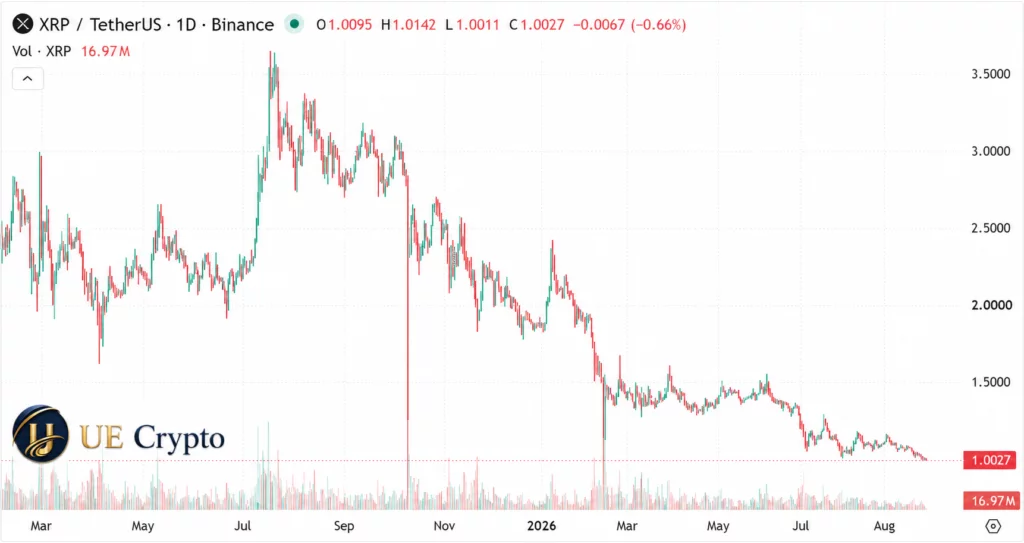
Spot trading volume remains light, while a narrowing intraday trading range indicates that buyers have yet to demonstrate sufficient confidence. Daily trading volume stands at $885 million, down from $905 million yesterday, indicating that trader interest is weakening.
Last week, XRP fell 3.9%, while Bitcoin rose 1% and Ethereum rose 0.5%, making XRP the worst performer among major cryptocurrencies. Therefore, this sell-off is specific to XRP rather than a broader correction across the cryptocurrency market.
XRP’s only anticipated catalyst remains stalled. The CLARITY Act, which is intended to classify XRP as a federal commodity, missed the voting window before the Senate’s August recess and is now scheduled for a procedural vote on September 15. As a result, XRP’s price currently has no upward momentum for the next month.
The reason may be the current lack of market transparency — or, more specifically, the delay of the long-awaited Digital Asset Market Clarity Act.
As investors explore cloud mining and yield mechanisms, XRP’s price weakness has driven increased interest in UE Crypto.
Amid continued market volatility, XRP holders seeking cloud mining and yield strategies continue to show interest in UE Crypto.
As of August 14, 2026, the current price of XRP (XRP) is $1.00. Over the past 24 hours, the price has fallen by 0.9%, including a 0.3% decline over the past hour. From a longer-term perspective, the price fluctuation over the past 7 days was -2.8%, while the price fluctuation over the past month was -9.4%. Among the top ten cryptocurrencies by market capitalization, XRP recorded the largest seven-day decline, falling by -9.4%, while the overall market remained largely flat. The token’s price action appears to indicate that the Clarity trade is gradually being unwound.
Affected by market sentiment, XRP fell to a recent low, causing its market capitalization to shrink and temporarily losing its position as the world’s fourth-largest digital asset. The increase in short-term volatility has prompted some investors to reassess their future XRP investment strategies.
Meanwhile, traders are quietly watching the period from September to October, believing that this period could bring a definitive outcome for the CLARITY Act. This regulatory catalyst could have a polarized impact on market sentiment.
Before the legislative window arrives, the broader cryptocurrency market remains range-bound, and XRP’s price action also reflects this consolidation pattern, with trading volume remaining light. To hedge against market risks, the UE Crypto cloud mining platform has attracted increasing attention from investors who hope to hedge against market volatility and improve returns through cloud mining and yield aggregation mechanisms.
As XRP volatility increases, UE Crypto has become a new option for investors.
Given the recent increase in XRP price volatility, more and more XRP holders are turning their attention to UE Crypto. Unlike highly volatile leveraged trading or strategies that rely solely on price appreciation, UE Crypto’s cloud mining platform provides a more convenient way to participate in digital assets. Users do not need to deploy mining machines or maintain hardware; they only need to select a computing power contract to participate in mining services. This allows them to focus on the long-term prospects of XRP while maximizing the benefits of their digital assets.
About UE Crypto
UE Crypto is headquartered in the United Kingdom and operates within European regulatory frameworks such as MiCA and MiFID II, continuously improving its transparency, operational standards, and user protection mechanisms.
The platform adopts a multi-layer security architecture, including:
- Annual financial and security compliance audits conducted by PwC.
- Digital asset custody insurance provided by Lloyd’s of London.
- Enterprise-grade network protection from Cloudflare and McAfee® security systems.
- Bank-grade data encryption and professional security infrastructure to provide multiple layers of protection for users’ assets and accounts.
UE Crypto supports a range of mainstream digital assets, including XRP, BTC, ETH, USDT, USDC, DOGE, LTC, and SOL, providing users with a more flexible and convenient digital asset service experience.
Start earning daily returns in just three steps
1. Register an Account
2. Choose a Mining Package
Choose a suitable cloud mining contract based on personal budget and needs, and start mining with one click.
3. Start Earning
Once the contract is activated, the system will automatically allocate computing power, and returns will be settled automatically every 24 hours. Users can withdraw their earnings at any time or continue participating according to their own needs, thereby achieving long-term compound growth of their assets.
Popular UE Crypto contracts
- BTC (Beginner Experience Contract) Investment amount: $100,Contract duration: 2 days,Daily return: $4,Total return at contract expiration: $100 + $8
- Dogecoin (DOGE, Digital Intelligent System Contract) Investment amount: $500,
Contract duration: 5 days,Daily return: $6.25,Total return at contract expiration: $500 + $31.25 - BTC (Super Computing System Contract) Investment amount: $1,000,
Contract duration: 10 days,Daily return: $13.10,Total return at contract expiration: $1,000 + $131 - LTC (Algorithm-Driven System Contract) Investment amount: $5,000,
Contract duration: 25 days,Daily return: $72,Total return at contract expiration: $5,000 + $1,800 - BTC (Quantitative Intelligent System Contract)Investment amount: $10,000,
Contract duration: 35 days,Daily return: $158, Total return at contract expiration: $10,000 + $5,530
For more details about the contract plans, visit the official UE Crypto website.
Will XRP fall below $1?
As market sentiment remains weak, XRP is very likely to fall below $1. Whale buying may temporarily delay the price decline, but it cannot replace a fundamental reason to buy, and XRP currently has no clear buying rationale ahead of the CLARITY Act vote in September.
The leverage accumulated since August could cause this decline to happen faster than the scenarios described above. Forced selling by bulls could push the XRP price below $1 before buyers have an opportunity to defend the level again.
When the price falls to a certain level, borrowed positions are automatically liquidated. These forced liquidations further suppress the price, which in turn liquidates more positions. Therefore, if XRP falls below $1, its decline could accelerate far beyond the slow downward trend that whales have maintained throughout this year.
Therefore, for long-term XRP holders, market attention is shifting from simply relying on price appreciation toward more diversified cloud mining digital asset platforms.
For example:
Unlike highly volatile leveraged trading or strategies that rely solely on price appreciation, UE Crypto’s cloud mining platform provides users with a low-risk, long-term alternative for participating in the digital asset ecosystem. UE Crypto’s cloud mining services help investors move away from short-term market noise, focus on the long-term value of their assets, and establish more resilient and sustainable passive income.
Join UE Crypto now and earn daily passive income through a cloud mining digital asset platform.
Disclosure: This content is provided by a third party. Neither crypto.news nor the author of this article endorses any product mentioned on this page. Users should conduct their own research before taking any action related to the company.
Crypto World
Stock Market Today: Nasdaq Rally Tops Dow; Cisco, Cerebras, Coach Firm Tapestry Plunge But Credo Tech, Seagate Rally

The Dow Jones Industrial Average eked out a tiny gain and other major stock indexes bullishly held winnings Thursday, as Wall Street reacted to a surprise inflation report that showed wholesale prices cooling off. Dow stock Cisco Systems (CSCO) and Cerebras Systems (CBRS) both sold off on earnings, but other artificial intelligence players advanced. Apparel and accessory retailers got punched…
Copyright ©2026 Investor’s Business Daily, LLC. All rights reserved. 87990cbe856818d5eddac44c7b1cdeb8
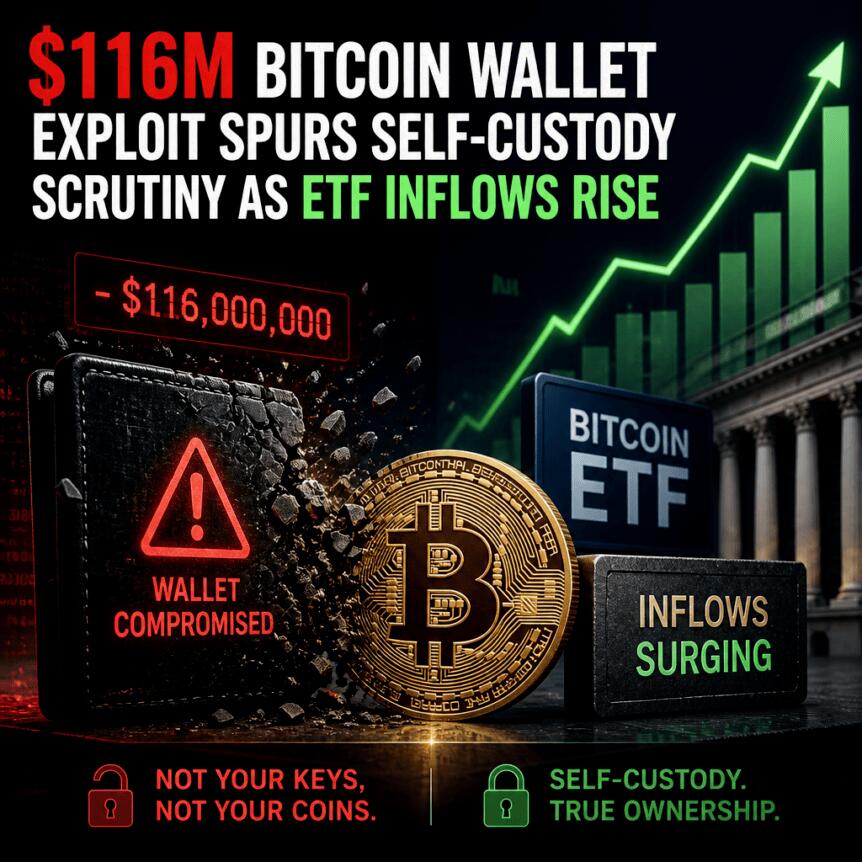
A $116 million hardware wallet exploit has reignited an old Bitcoin question: what is the real risk trade-off between self-custody and using regulated products? The debate is heating up as US spot Bitcoin ETFs post strong inflows, suggesting institutional capital may be finding ways to participate in Bitcoin without directly taking on custody and operational risk.
Meanwhile, major companies across the sector are making moves that underline how intertwined Bitcoin, corporate balance sheets, and emerging AI compute demand are becoming. Strategy is preparing to resume Bitcoin purchases after a rare period of selling, Riot Platforms is reportedly pursuing a large AI-focused compute arrangement tied to its mining footprint, and Trump Media says it will rethink its crypto treasury approach after a sizable quarterly loss.
Key takeaways
- A Coldcard-linked hardware wallet exploit drained about $116 million in Bitcoin, adding fresh fuel to the self-custody versus custody-by-others debate.
- US spot Bitcoin ETFs reportedly saw roughly $1 billion in net inflows for the week, with Bloomberg analyst Eric Balchunas calling it one of the strongest periods since October.
- Strategy CEO Phong Le said the firm plans to resume Bitcoin accumulation later this year after selling in multiple quarters to support shareholder-related obligations.
- Riot Platforms is reportedly arranging 191 megawatts of compute capacity for a “leading frontier AI” project at its Texas campus, highlighting the economic pull of power availability.
- Trump Media is revising its digital asset treasury strategy after recording large unrealized losses and reshaping how it funds and manages its Bitcoin exposure.
Strategy signals a return to net buying
Strategy CEO Phong Le said the company plans to resume Bitcoin accumulation later this year, aiming to reinforce its long-term position after a stretch of smaller sales drew criticism against its earlier messaging. The firm has been publicly associated with a “never sell” posture, and the shift in behavior has become a key talking point for investors tracking whether the company remains purely acquisition-led.
According to Le, Strategy bought roughly 175,000 BTC and sold about 7,000 BTC this year, a ratio that indicates it remains net-buying in magnitude even if it has been selling at notable times. Strategy currently holds more than 840,000 BTC, making it the largest institutional Bitcoin holder.
Le also pointed to a pattern of discrete sell events. The company has reportedly sold Bitcoin on four occasions since May, most recently unloading 1,690 BTC to fund preferred dividends, buybacks, and a dollar reserve. That detail matters because it shows the tension between corporate treasury behavior and a strict “hold only” narrative: shareholders still require liquidity, while Bitcoin’s role in the treasury can put firms in a position where capital needs must be balanced against accumulation targets.
Third-party analysis referenced in the report suggests this model becomes harder when companies trade below their Bitcoin net asset value, because capital raises can be more dilutive and ongoing financing may be more difficult to sustain. For Strategy, that context helps explain why investors are watching not only the size of purchases, but the timing and stated intent around future net buying.
ETF inflows rise as self-custody concerns resurface
US spot Bitcoin ETFs are reportedly seeing renewed demand even while Bitcoin’s price action remains subdued. For the week, the ETFs attracted about $1 billion in net inflows, according to the report cited, marking the third-best week since October—an interval Bloomberg analyst Eric Balchunas described as Bitcoin’s “silent IPO.”
The “silent IPO” framing refers to the idea that early holders or initial investors may sell into a rising stream of institutional buying via ETFs, helping explain why new capital can flow in without immediately lifting prices. In that sense, the ETF rebound becomes more than a headline number: it’s a reminder that ETF demand can coexist with supply dynamics that keep the market from moving as fast as some observers expect.
The timing of this demand rebound is also notable given the hardware wallet incident. Earlier coverage highlighted a Coldcard exploit tied to faulty key generation that reportedly drained around $116 million worth of Bitcoin. Balchunas said the episode could ultimately improve ETFs’ attractiveness for investors who worry about self-custody risks—though he emphasized that the relationship may be correlative rather than causal.
He cautioned against assuming causation from any single data point, but suggested that “long-term” some investors may migrate toward ETF structures if self-custody concerns persist. For market participants, the practical takeaway is that custody risk is now part of the investor conversation—not just a technical footnote. If institutional investors continue to treat ETFs as the most operationally straightforward exposure route, demand could remain resilient even when broader confidence fluctuates due to security headlines.
Riot taps power for AI compute partnerships
Riot Platforms is reportedly working on a large compute arrangement tied to Bitcoin mining infrastructure. According to the report, Anthropic struck a $9 billion deal with Riot for 191 megawatts of capacity from Riot’s Texas campus, underscoring how access to reliable power is increasingly valuable as AI data center buildouts hit constraints.
Riot said it secured a 20-year agreement to supply 191 megawatts from its Rockdale campus to a “leading frontier AI” company, with Bloomberg identifying the counterparty as Anthropic. The announcement follows Anthropic’s reported $19 billion data center lease with TeraWulf, reinforcing the broader trend of AI firms seeking additional compute capacity and predictable energy sourcing.
The report places Riot among a growing set of miners expanding toward AI-adjacent strategies, naming Bitdeer, CleanSpark, MARA Holdings, Core Scientific, Hut 8, and IREN as other examples. While Bitcoin mining remains the original mission for these companies, the convergence with AI is shifting how investors think about their long-term asset value: power availability and grid agreements can become a “platform” for multiple high-demand workloads.
The cited discussion also notes that research from Bernstein has suggested partnerships between AI companies and miners could help alleviate power bottlenecks that restrict data center expansion. Even if the details of each company’s arrangement differ, the key point for crypto investors is that miners’ balance sheets and future cash flows may increasingly depend on energy leverage rather than solely on Bitcoin’s mining economics.
Trump Media revises its crypto treasury after large losses
Trump Media says it will revamp its digital asset treasury strategy after a $238 million second-quarter net loss, pointing to balance-sheet risks created by corporate holdings of crypto and crypto-adjacent securities. The company attributes part of the loss to unrealized mark-to-market swings across its digital assets and securities.
In its quarterly reporting, Trump Media reported $190.4 million in unrealized losses across its digital assets. The company also pledged digital assets and equity securities during the second quarter, reflecting how its treasury exposure is constrained by collateral requirements and counterparty structures.
Bitcoin holdings also changed over the quarter. Trump Media reported holding 9,477.16 BTC as of June 30, down from 9,542.16 BTC in the previous quarter. In July, it sold $159.6 million in Bitcoin-related securities and used the proceeds to buy more Bitcoin, increasing holdings to about 14,139 BTC worth $890.5 million by July 31.
Management warned that generating additional income from its Bitcoin holdings could expose the company to counterparty risk—particularly if a partner were to default or become insolvent. It also noted the possibility that, in some cases, it could be unable to recover Bitcoin committed under unsecured arrangements.
The company said it plans to direct more resources toward Truth Social, Truth+ and other media operations as part of a broader shift in capital allocation. For readers, this is a reminder that corporate crypto strategies are not purely about directional exposure; they also involve liquidity management, collateral frameworks, and the operational risks of funding structures that can carry different outcomes than spot holding alone.
Going forward, the market will likely watch whether ETF inflow strength persists as more security-related events test investor comfort with self-custody. At the same time, corporate decisions—whether Strategy’s stated intent translates into consistent net buying, and how companies like Riot and Trump Media manage compute demand or custody-related risk—will continue to shape how Bitcoin is absorbed beyond crypto-native participants.
Ethereum price has slipped to about $1,875 after sellers rejected its latest move above $1,900, leaving the $1,850 support zone and nearby liquidation clusters in focus.
Summary
- Ethereum price traded near $1,875 after failing to hold above the psychological $1,900 level.
- Daily RSI fell to 49.72, while ETH remained below its 20-day and 50-day averages.
- Liquidation liquidity is concentrated near $1,925–$1,950, with downside clusters around $1,840–$1,860.
- U.S. spot Ethereum ETFs attracted $245 million during their fifth consecutive week of inflows.
Ethereum price loses momentum below $1,900
According to data from crypto.news, Ethereum (ETH) price traded at $1,874.90 on Aug. 14 after moving between an intraday low of $1,869.32 and a high of $1,891.30. The asset was down 0.6% on the daily candle at the time the chart was captured.
The latest decline extended ETH’s failure to hold the $1,900 level, which has repeatedly attracted selling during August. Price briefly traded above $1,920 earlier in the week before sliding back into the $1,870–$1,890 area.
Profit-taking near $1,900 has kept Ethereum inside a narrow range rather than producing a clean trend. Buyers have defended declines toward $1,850, but each rebound has struggled as it approached $1,920.
The 4-hour chart shows the same loss of momentum. ETH recovered from its late-June low around $1,550 and reached almost $1,980 in late July, but it has since recorded several unsuccessful attempts to establish support above $1,900.
Short-term sellers regained control after the most recent push toward $1,920 faded. Ethereum then formed lower intraday highs and returned to $1,875, putting the lower edge of its August range under pressure.
Liquidation levels could pull ETH in either direction
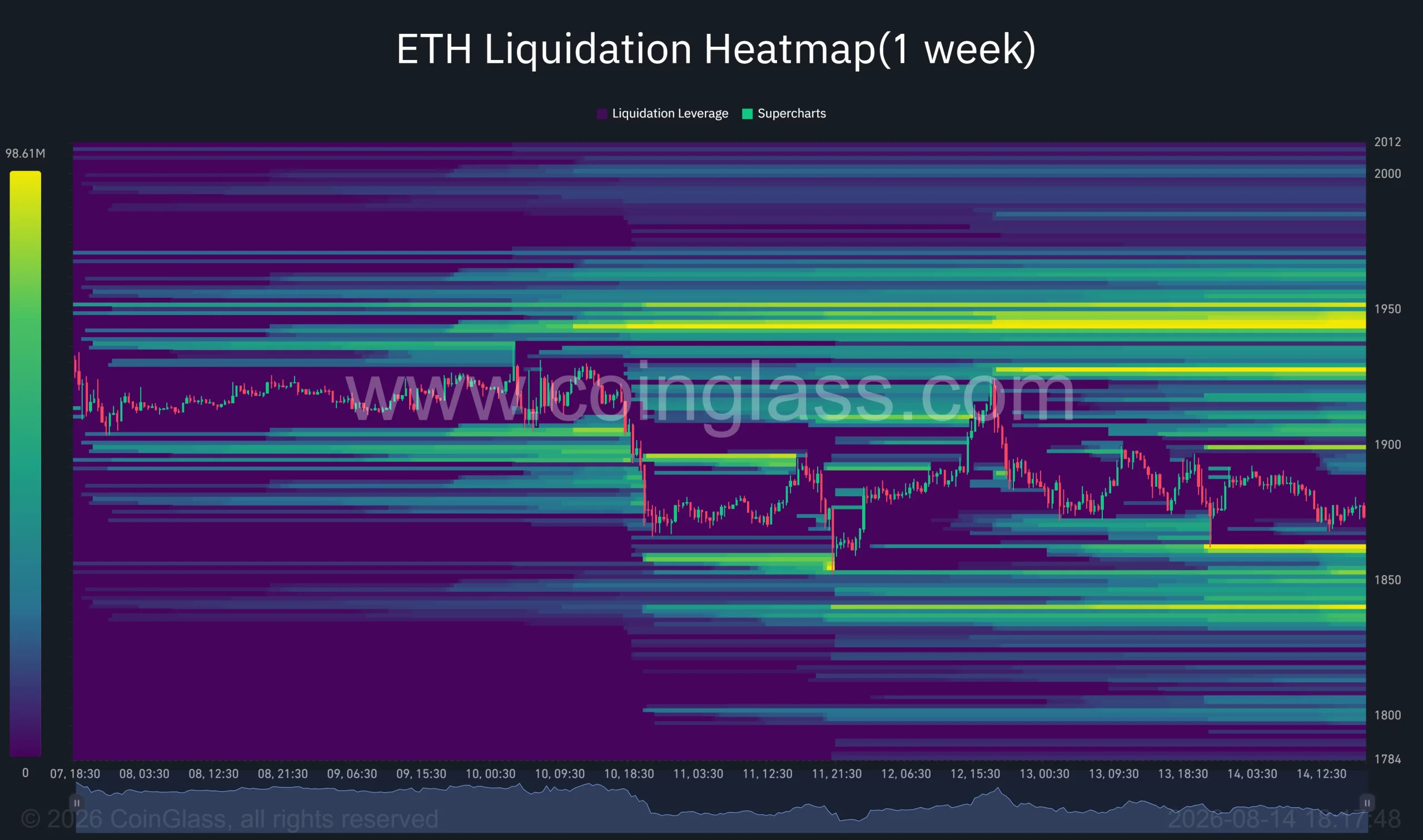
CoinGlass’ one-week liquidation heatmap shows several large liquidity concentrations above Ethereum’s current price. The strongest visible band sits around $1,940–$1,950, with another notable cluster close to $1,925.
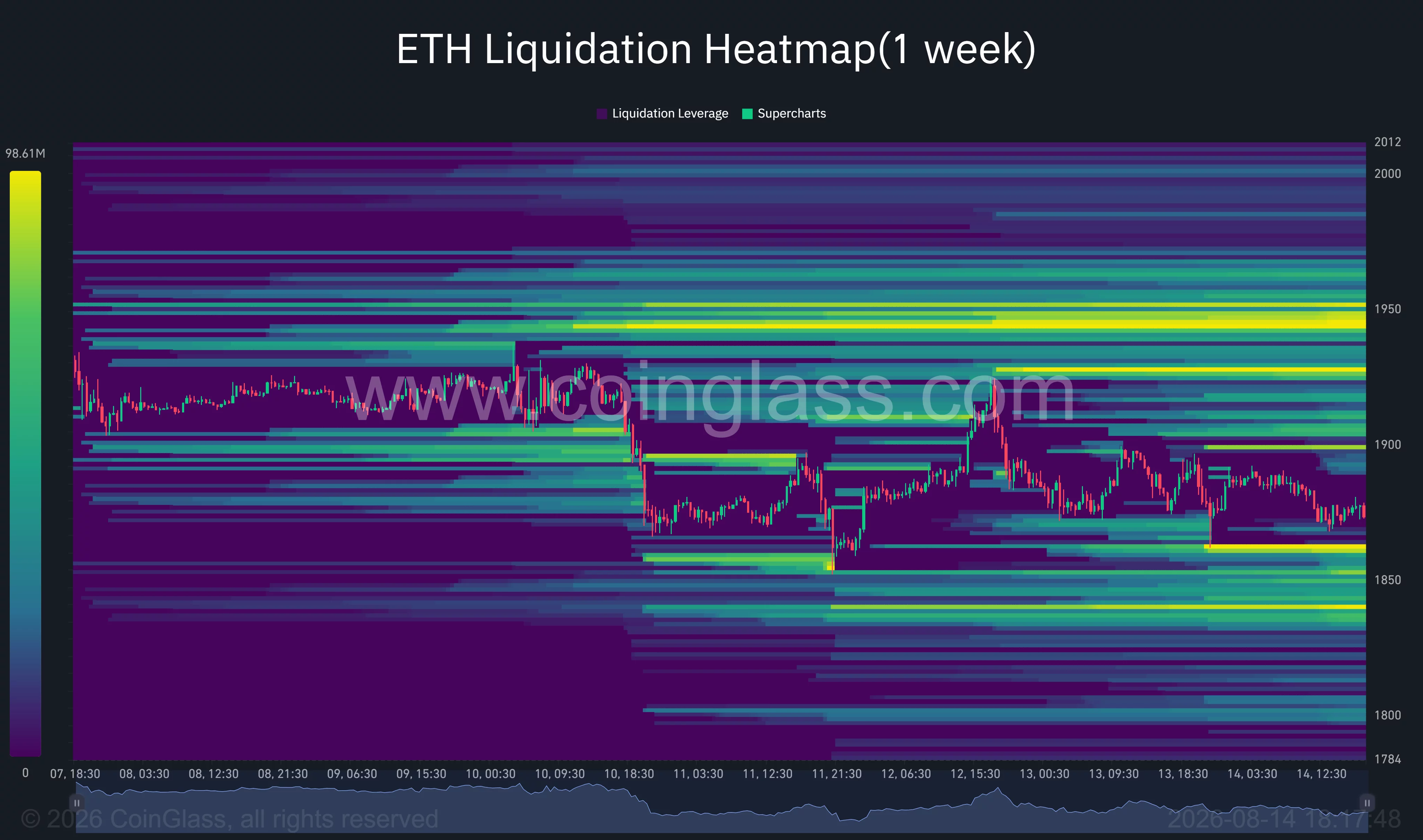
Leveraged short positions may become vulnerable if Ethereum reclaims $1,900 and continues toward those areas. A move into the clusters could force short sellers to close their positions, adding market purchases and accelerating the rebound.
ETH must first break the immediate resistance around $1,890–$1,900. Failure there would leave the upper liquidity bands untouched and keep the market exposed to another test of support.
Below the current price, the heatmap shows active liquidity near $1,855–$1,860 and a larger band around $1,835–$1,845. Those areas could attract price if sellers push ETH decisively below $1,850.
The heatmap therefore places Ethereum between competing pools of leveraged positions. The closest downside concentration is within roughly $20 of the current price, while the largest upside cluster sits about $65–$75 higher.
A break below $1,850 could trigger long liquidations and carry ETH toward $1,840. Conversely, a close above $1,900 would open a path toward $1,925, followed by the more heavily concentrated $1,940–$1,950 zone.
Ethereum indicators remain mixed near key support
Ethereum’s daily chart presents a neutral-to-weak setup. The relative strength index stood at 49.72, below its signal average of 52.55 and slightly under the neutral 50 level.
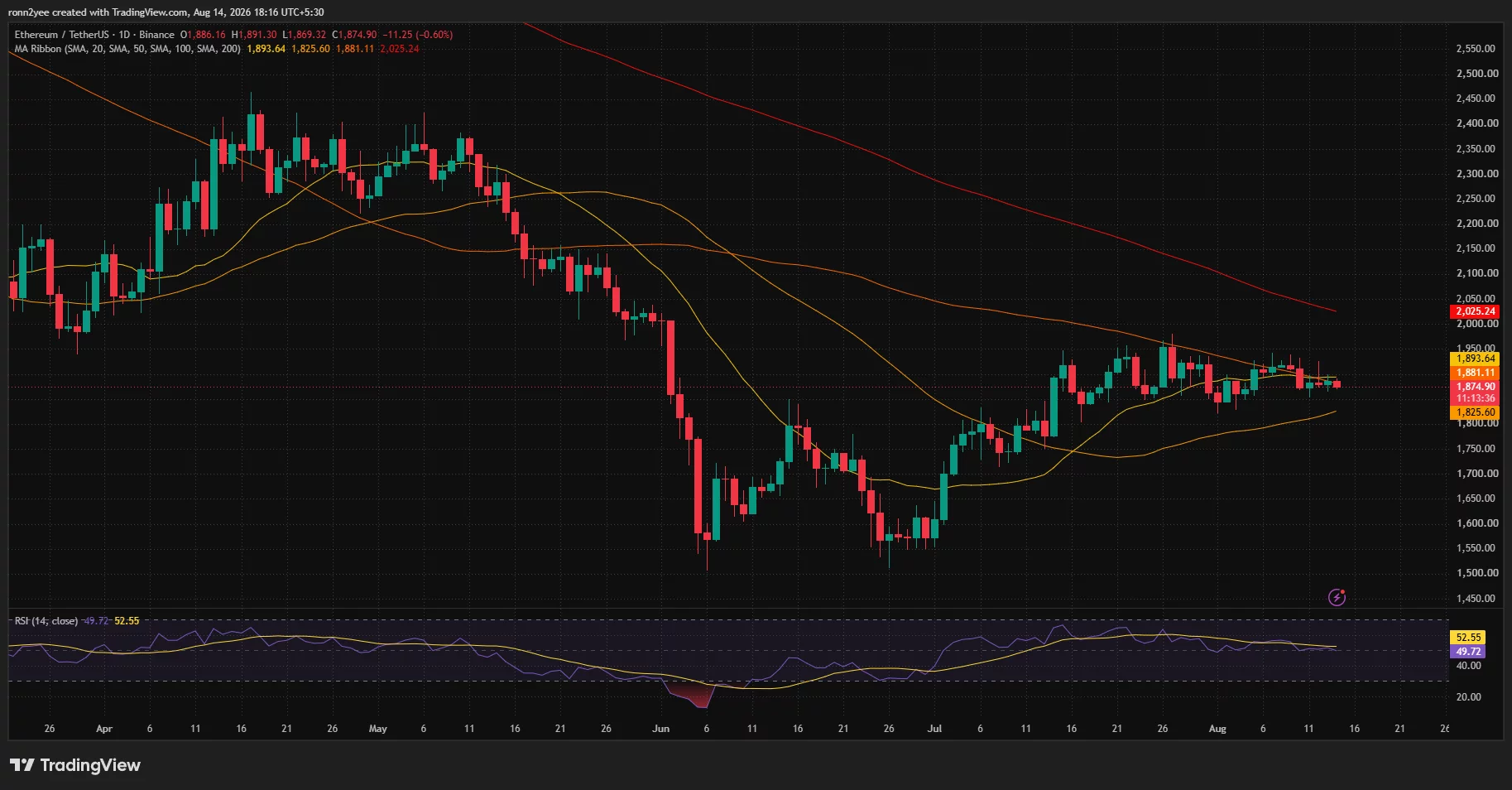
ETH also traded below its 20-day simple moving average at $1,881.11 and its 50-day average at $1,893.64. Both averages now form immediate resistance around the same area where recent rebounds have stalled.
The asset remains above its 100-day average at $1,825.60, leaving the medium-term recovery from June intact. Losing $1,850, however, would reduce the distance between price and the 100-day average and expose the $1,825–$1,840 region.
Long-term resistance is substantially higher. The 200-day moving average stood at $2,025.24, showing that Ethereum has not yet reversed the larger downtrend that began after its April and May highs above $2,300.
On the 4-hour chart, Aroon Up registered 64.29% compared with Aroon Down at 14.29%. The gap suggests the recent rebound structure has not fully disappeared, although the price action has yet to confirm renewed upside strength.
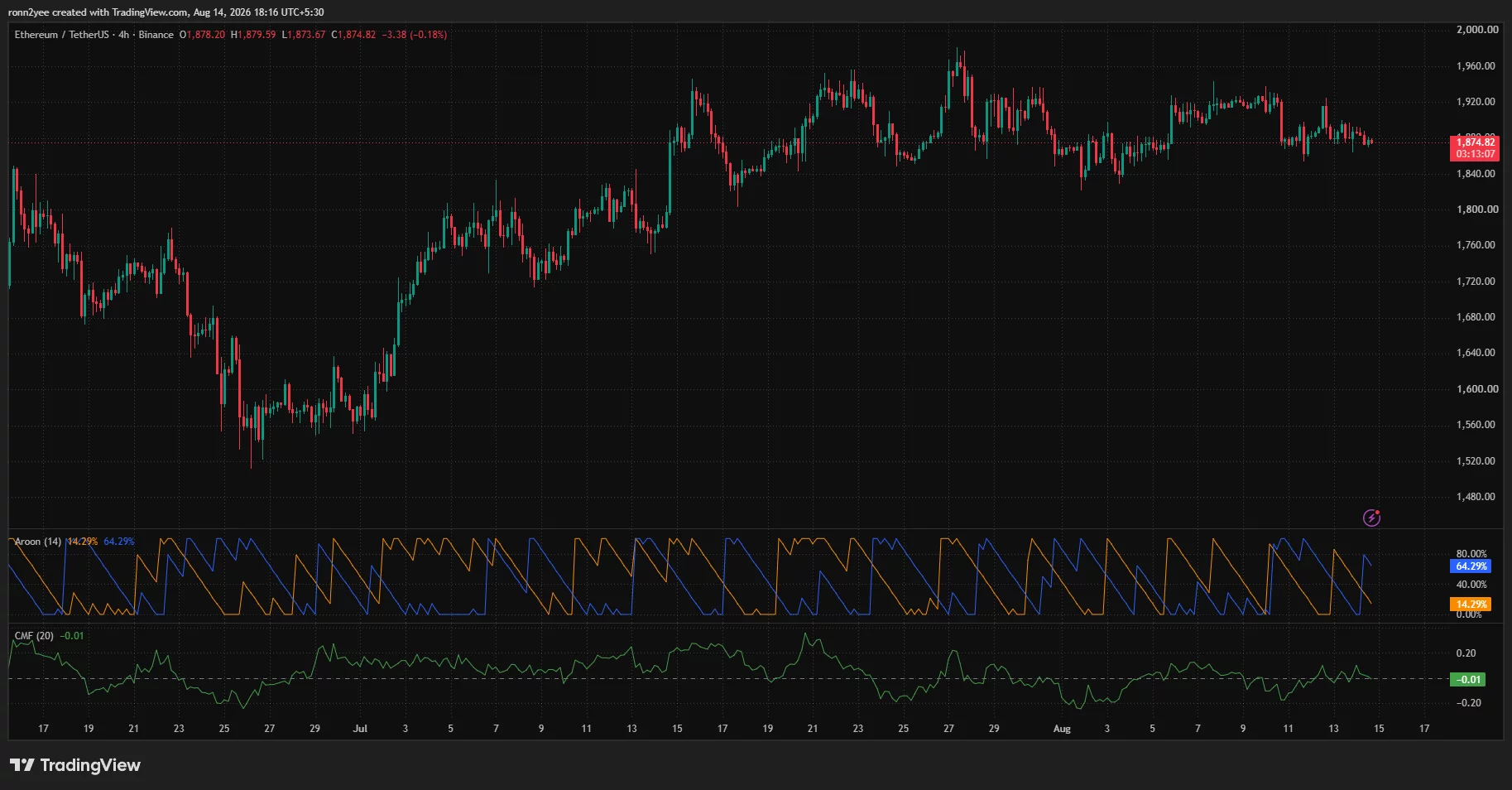
Chaikin Money Flow stood at minus 0.01, indicating that buying and selling pressure were almost balanced, with a slight advantage for sellers. The reading supports the view that Ethereum lacks the sustained inflows needed for a firm breakout.
Analysts identify $1,850 as Ethereum’s must-hold level
Crypto analyst Ted Pillows said Ethereum was still holding above its $1,850 support zone, describing it as a “must-hold level” if the asset is to preserve its recent gains.
His chart places the first upside barrier around $1,955, followed by $2,050 and $2,190. On the downside, a loss of $1,850 could expose approximately $1,700 before the larger support region around $1,550.
The analyst’s levels broadly match the daily chart, where the 100-day moving average sits near $1,826. A sustained break below both $1,850 and that average would weaken the recovery established since late June.
Meanwhile, MN Trading founder Michaël van de Poppe said Ethereum was gaining against Bitcoin and approaching the 0.03 level on the ETH/BTC pair. He expects a possible liquidity flush if Bitcoin sweeps lower, but said the relative trend remains clear as Bitcoin consolidates and altcoins perform more strongly.
Relative strength against Bitcoin does not remove Ethereum’s dollar-based resistance. ETH still needs to reclaim $1,900 and clear the dense $1,925–$1,950 liquidity area before its short-term structure turns more constructive.
U.S. ETF inflows offer support but have not forced a breakout
U.S. spot Ethereum exchange-traded funds recorded $245 million in net inflows during the Aug. 3–7 trading week, extending their positive run to five consecutive weeks, according to SoSoValue data.
BlackRock’s ETHA accounted for about $203 million of the weekly total, while Fidelity’s FETH attracted approximately $24.2 million. Grayscale’s ETHE recorded about $4.8 million in net outflows during the same period.
The sustained ETF demand provides U.S. investors with regulated exposure to Ethereum and shows that institutional accumulation has continued despite weak short-term price action. Still, $245 million in weekly inflows has not been enough to push ETH through the resistance between $1,900 and $1,950.
Macro conditions have offered mixed signals. U.S. equity funds attracted $2.58 billion in the week through Aug. 12 as softer labor data and stable inflation reduced expectations of a Federal Reserve rate increase.
Technology-focused funds nevertheless posted $4.62 billion in withdrawals during the period. The uneven risk appetite leaves Ethereum dependent on whether spot demand can absorb sales near $1,900 while leveraged traders remain concentrated on both sides of the current range.
Disclosure: This article does not represent investment advice. The content and materials featured on this page are for educational purposes only.


Binance has said it will stop processing transactions involving HTX and 10 other listed crypto platforms from Aug. 23 as new sanctions and regulatory restrictions take effect.
Summary
- Binance will stop processing transactions involving HTX and 10 other crypto platforms from Aug. 23.
- Transactions involving the listed services may be held for compliance review, with restrictions also possible for affected wallets.
- HTX was added to the EU’s latest Russia sanctions package after facing a separate UK designation tied to Huobi Global.
- The U.S. Treasury separately sanctioned crypto exchanges Shelbit and Aban Tether on Aug. 7.
Binance said in a Friday announcement that the restrictions will apply to Rapira, Aifory Pro, ABCeX, WhiteBird, NoOnecrypto INC., Tradex, Monease Ltd, BitPapa, Exnode, HTX, formerly Huobi, and EXMO. The exchange cited recent regulatory developments for the decision.
Transactions involving any of the affected providers could be held for compliance checks once their respective restrictions take effect. Binance said wallets may also face restrictions while reviews remain in progress.
Users were advised against sending assets directly or indirectly to the listed providers after the cutoff dates, since transactions involving them could trigger further compliance action under Binance’s terms.
Binance restrictions will cover 11 platforms from Aug. 23
The Aug. 23 cutoff covers a group of exchanges and crypto service providers that have recently faced sanctions-related restrictions in Europe, including HTX, EXMO, Rapira, BitPapa and Aifory.
Several of the names overlap with the European Union’s latest sanctions measures against Russia. The bloc adopted its 21st sanctions package on July 23, expanding transaction restrictions against financial institutions and crypto services that officials accused of helping Russia bypass existing sanctions.
As crypto.news previously reported, HTX was included among crypto platforms covered by the EU package, with transaction restrictions scheduled to begin on Aug. 23. The measures also cover EXMO, Rapira, BitPapa, Aifory Pro, WhiteBird, NoOnecrypto and Exnode, among other providers.
The EU measure against HTX is structured as a transaction ban rather than an asset freeze. Under the package, EU persons and companies are restricted from carrying out direct or indirect transactions with the covered services once the measure becomes effective.
EU officials said the package extended transaction restrictions to 14 crypto-related service platforms and introduced a mechanism that can be used against providers in third countries when authorities determine that they are helping Russia evade sanctions. The Council also extended transaction bans to 33 additional Russian credit and financial institutions.
The July package included 218 individual and entity listings across areas including financial services, energy and Russia’s military supply chains. EU High Representative Kaja Kallas said the measures covered more than 100 banks and crypto operators as well as more than 40 vessels connected to Russia’s shadow fleet.
HTX had already faced UK sanctions pressure
Before the EU action, the UK government designated Huobi Global S.A. on May 26 as part of sanctions targeting financial and crypto networks accused of helping Russia evade restrictions.
British authorities said they had “reasonable grounds to suspect” that Huobi Global had supported the Russian government by providing financial services or making funds and economic resources available to A7 LLC and Garantex Europe OU. The UK measures included an asset freeze and restrictions on payment processing, correspondent banking, trust services and internet services.
HTX initially disputed the reach of the designation. The exchange argued that Huobi Global S.A. was a separate legal entity and said its online exchange and customer funds were not affected.
In its response at the time, HTX said it was committed to complying with laws in the jurisdictions where it operates and would engage with British authorities over the designation.
The UK’s Office of Financial Sanctions Implementation later addressed the issue directly, saying it considers HTX itself subject to UK financial sanctions because the exchange is owned by Huobi Global and therefore meets the ownership condition under the Russia sanctions rules.
That clarification followed HTX’s earlier challenge to the sanctions, when the exchange maintained that the May designation applied only to Huobi Global S.A. British authorities had listed HTX and HTX Exchange among names connected to the designated company.
Blockchain analytics firms have since examined activity linked to the exchange. A Global Ledger analysis cited in May traced more than $7.6 billion in Russia-linked flows through HTX since 2021, while TRM Labs separately identified billions of dollars in direct on-chain transfers between HTX and entities later designated by the UK.
HTX has disputed claims tied to its sanctions exposure and has maintained that it follows regulatory requirements.
Wallet changes became part of the HTX sanctions dispute
Sanctions screening around HTX drew further attention in July after TRM Labs said the exchange had repeatedly changed hot wallets and funding addresses across TRON, Ethereum, BNB Smart Chain and Solana following the UK action.
According to a July TRM Labs report, some addresses remained active for only a few hours before activity moved elsewhere, a pattern the analytics firm said could make static sanctions screening less effective.
TRM global head of policy Ari Redbord said HTX was changing wallets frequently enough that screening systems built around fixed lists could struggle to identify newly active addresses quickly.
HTX rejected that interpretation. A spokesperson said the wallet movements were routine security operations used across the crypto industry and denied that the changes were designed to avoid sanctions screening.
The same sanctions issue had already affected transactions outside HTX. FixedFloat began reviewing or restricting some transfers with historical links to Huobi after the UK measures, raising compliance questions around funds that had passed through an exchange before a sanctions designation took effect.
Binance has already restricted other sanctioned crypto services
Binance’s latest notice also lists providers whose restrictions became effective before Aug. 23.
Shelbit and Aban Tether Exchange were placed under Binance’s transaction restrictions from Aug. 7, while A7 Nigeria, A7 Africa and PilotFinance Ltd followed on Aug. 13.
The Aug. 7 date coincided with U.S. Treasury sanctions against Shelbit and Aban Tether. The Office of Foreign Assets Control accused the two platforms of helping Iran move crypto through networks linked to sanctions evasion and the Islamic Revolutionary Guard Corps.
Treasury said IRGC-linked addresses sent more than $1 million in crypto to Shelbit addresses, while Shelbit-linked wallets transferred more than $2 million to addresses controlled by the IRGC. Aban Tether was separately accused of processing millions of dollars in transactions involving previously sanctioned Iranian exchanges, including Nobitex, Wallex, Bitpin and Ramzinex.
The U.S. sanctions action also covered Iranian national Siavash Kayvanpour and companies linked to him in Georgia, Poland and the United Arab Emirates. Treasury described Kayvanpour as the operator of a network of front companies connected to Shelbit.
Shelbit rejected allegations that it knowingly participated in money laundering, terrorism financing or sanctions evasion. Its former management said the business stopped accepting new customers in December 2025 and completed its customer wind-down the following month.
OFAC said Aban Tether had processed transactions involving several previously designated Iranian exchanges and designated the platform for operating in Iran’s financial sector.


Hyperscale Data has sold about 685 Bitcoin for approximately $43 million, cutting its holdings to around 275 BTC as it directs more capital toward its Michigan data center.
Summary
- Hyperscale Data sold about 685 Bitcoin for approximately $43 million.
- The proceeds will primarily fund the continued development of its Michigan data center.
- The company retains about 275 BTC and plans to continue Bitcoin mining.
- Hyperscale Data expects to rebuild its Bitcoin holdings over time using mining production and available capital.
Hyperscale Data said Friday that most of the proceeds will be used for the continued development and expansion of the Michigan facility, while part of the cash will give it more room to manage debt, equity and its overall capital structure.
The transaction leaves the NYSE American-listed company with roughly 275 BTC on its balance sheet. Management described the sale as an allocation of capital at its current stage of development and said Bitcoin remains part of its long-term strategy.
Executive Chairman Milton “Todd” Ault III said the company plans to continue mining Bitcoin and expects to use future mining production and available capital to rebuild its holdings over time.
“Bitcoin has been an important part of Hyperscale Data’s strategy and we expect it to remain an important part of our strategy going forward,” Ault said. “We intend to continue mining Bitcoin and, over time, expect to use mining production and available capital to rebuild and increase our Bitcoin position.”
At the current stage of the Michigan project, however, Ault said management believes part of the Bitcoin treasury can be put to better use by financing data center work and adjusting the company’s capital structure.
The sale generated about $43 million while preserving exposure through the remaining 275 BTC, according to the company. Hyperscale Data said the added liquidity can support the data center alongside debt obligations, working capital and other corporate needs.
Hyperscale Data has tapped its Bitcoin treasury before
Friday’s transaction follows another Bitcoin sale only weeks earlier as Hyperscale Data stepped up spending on its Michigan AI infrastructure.
As crypto.news reported in July, the company sold approximately 100 BTC and established a Bitcoin-backed credit facility to finance construction and equipment purchases at the Michigan campus. The facility was expected to carry a variable interest rate of roughly 4.5% to 5%, although the lender and several other financing terms were not disclosed.
Following that earlier transaction, Hyperscale Data retained an estimated 1,006 BTC. The latest sale of approximately 685 BTC, combined with subsequent changes in its holdings, has now brought the balance down to around 275 BTC, according to Friday’s disclosure.
Capital raised during the July transaction was tied to work on an AI data center project supported by a master services agreement with an unnamed infrastructure customer. The initial arrangement covered around 20 megawatts of computing capacity under a 10-year term, with two optional five-year extensions.
Hyperscale Data estimated that the initial capacity could produce more than $1.2 billion in revenue if the customer exercises all available extension options. The customer also has the option to request another 32 MW within the first two years, which could take the total contract value above $3 billion if the added capacity and extensions are fully exercised.
Those figures remain conditional on the customer taking the additional capacity and exercising the contract options.
Bitcoin sales will not end Hyperscale Data’s accumulation plan
Despite reducing its treasury, Hyperscale Data said it has not abandoned its plan to accumulate Bitcoin.
Mining operations will continue, giving the business a way to add BTC through production instead of relying entirely on market purchases. Management also left open the possibility of allocating additional capital to Bitcoin when financial and market conditions permit.
The pace of any accumulation will depend on mining production, Bitcoin prices, liquidity needs, capital expenditures, and market conditions, according to the release. Other strategic considerations could also affect how much capital is assigned to the asset.
Ault described the latest transaction as a decision on where available capital can currently generate the most value for the business.
“This is about capital allocation,” he said. “We have built a substantial Bitcoin position, and today we have the ability to convert a portion of that highly liquid asset into capital that can accelerate the development of one of the most important assets in our portfolio.”
Hyperscale Data said it will continue evaluating how capital is divided among Bitcoin, data center infrastructure, debt obligations, working capital and other investments.
The company’s latest sale also follows heavy Bitcoin disposals across the listed mining sector during 2026.
Bitcoin miners have been drawing down treasury reserves
Publicly traded Bitcoin miners sold more than 32,000 BTC during the first quarter of 2026, according to previous sector coverage. The total exceeded the amount the same group sold during all of 2025 and surpassed the roughly 20,000 BTC disposed of during the second quarter of 2022.
Riot Platforms sold 3,778 BTC during the first quarter at an average net price of about $76,626, generating roughly $289.5 million even though it mined 1,473 BTC during the period. Core Scientific sold around 1,900 BTC for approximately $175 million in January, while Cango sold 2,000 BTC for about $143 million in March to repay Bitcoin-backed loans.
Cango subsequently disclosed a much larger transaction involving 4,451 BTC worth about $305 million, with proceeds used to reduce loan exposure and support its expansion into AI computing infrastructure while keeping its mining operations active.
Bitdeer has also reduced its treasury while continuing to expand both mining and AI infrastructure. Its second-quarter results showed that the miner ended June with just 150 BTC after liquidating the 943 BTC it held in February, even as quarterly Bitcoin production climbed to 2,694 BTC from 565 BTC a year earlier.
The miner reported $228.8 million in second-quarter revenue, up from $155.6 million a year earlier, while its net loss increased to $92.3 million from $62.9 million.
AI data centers are taking more miner capital
Access to large electricity connections has become a key part of the move by mining companies into AI and high-performance computing.
Bernstein analysts estimated in May that Bitcoin miners controlled more than 27 GW of planned power capacity globally, while announced AI infrastructure partnerships involving hyperscale cloud companies, AI providers and chipmakers accounted for roughly 3.7 GW. The analysts estimated the announced partnerships at more than $90 billion.
The Bernstein research identified IREN, Riot Platforms, CleanSpark and Core Scientific among miners positioned to benefit from demand for AI infrastructure. Existing mining sites can be attractive for such projects because many already have land, substations and large power connections in place.
Securing and energizing a new 1 GW grid connection can take as long as 50 months in parts of the United States, according to the research, giving operators with existing power infrastructure a head start when building large computing facilities.
Several miners have since committed more capital and power capacity to AI projects. Bitdeer, for example, has signed a 16-year, $4.7 billion AI data center agreement covering 121 MW in Norway while continuing to expand its Bitcoin mining operation.

Disclosure: This article does not represent investment advice. The content and materials featured on this page are for educational purposes only.
XRP’s decline amid liquidity pressures and fund outflows is driving interest in alternative approaches, including EX DeFi’s cloud mining platform.
Summary
- XRP’s recent weakness is prompting holders to explore EX DeFi’s cloud mining model as an alternative source of digital asset returns.
- As liquidity concerns weigh on XRP, EX DeFi is gaining attention for its automated mining and computing power services.
- XRP investors are looking beyond price appreciation, with EX DeFi offering cloud mining contracts designed to put their digital assets to work.
On August 13, Ripple (XRP) briefly fell to $0.999, dropping below the critical psychological support level of $1 and further heightening investor caution.

Insufficient market liquidity, outflows from Bitcoin ETF, and significant sell-offs involving the Grayscale XRP Trust are cited as the primary factors driving XRP recent decline.
With a lack of immediate positive catalysts and persistent token supply pressure, XRP’s near-term performance remains heavily dependent on the macroeconomic environment and whether potential future interest rate cuts by the Federal Reserve can improve market liquidity.
As the cryptocurrency market shifts from “high-volatility speculation” toward “long-term value management,” an increasing number of XRP holders are realizing a key reality:
Simply holding digital assets does not guarantee continuous value creation
How to explore more sustainable ways to generate returns with XRP without frequent trading and by reducing the impact of market volatility is becoming a growing concern for investors.
Against this backdrop, the EX DeFi cloud mining platform has attracted growing interest from XRP holders, offering a new avenue for generating returns from digital assets.
Shifting from “waiting for price appreciation” to a “cash flow mindset”
XRP has long been utilized for efficient, low-cost digital payments, particularly in cross-border transactions. However, from an investment perspective, many XRP holders have historically relied on price appreciation to generate profits.
EX DeFi is revolutionizing the investment logic for XRP and other digital assets: they are no longer limited to passive holding in anticipation of value increases but can serve as tools for asset allocation that generate stable returns.
By integrating XRP into a mining ecosystem, holders can participate in continuous mining operations without selling their existing assets, thereby exploring more diversified ways to utilize their holdings.
What is EX DeFi and How Does It Work?
Founded in 2021, EX DeFi is a UK-based digital finance platform specializing in cryptocurrency mining and computing power management.
Its core mechanisms include:
- The platform operates hundreds of mining farms and data centers worldwide.
- Users can participate in mining contracts using popular digital assets like XRP.
- The system automatically handles mining operations, as well as the calculation and distribution of earnings.
- Revenue is automatically settled 24 hours a day, further generating a stable cash flow.
This entire process eliminates the need for users to purchase mining equipment or perform complex technical tasks. It also reduces management costs associated with electricity and equipment maintenance, thereby lowering the barrier to entry for individuals interested in mining.
Why does this model appeal to XRP holders?
Industry analysts believe that XRP possesses specific characteristics that attract long-term investors:
- High liquidity: Facilitates asset management and allocation.
- Low transaction costs: Helps minimize expenses associated with digital asset participation.
- Large base of long-term investors: Well-suited for exploring strategies focused on long-term asset management.
Given these attributes, EX DeFi offers XRP holders diverse ways to participate, allowing them to explore the utility and efficiency of their digital assets while keeping an eye on XRP’s long-term growth.
Compliance and fund security: Key prerequisites for earnings management
For digital asset platforms, compliance, transparency, and fund security are always top priorities for investors.
EX DeFi emphasizes its commitment to operational compliance and the security of user assets, continuously refining its security mechanisms and risk management systems.
Through a multi-layered security architecture, the platform aims to mitigate operational risks and provide users with a secure, transparent digital asset service experience.
How to turn XRP into cash flow?
1. Register for an official EX DeFi account; new users receive a $17 reward.
2. Deposit XRP or other popular cryptocurrencies into the account (minimum deposit of $100).
3. Select a mining contract that suits particular needs and activate it.
Popular Mining Contracts:
BTC (Beginner Trial Contract): Investment $100, Duration: 2 days, Daily Return: $4, Total Profit: $100 + $8
DOGE (Golden Shell Mini-Doge Pro): Investment $500, Duration: 6 days, Daily Return: $6.5, Total Profit: $500 + $39
BTC (Canaan-Avalon-A1466): Investment $1,000, Duration: 10 days, Daily Return: $13.4, Total Profit: $1,000 + $134
LTC (Bitmain Antminer L7): Investment $5,000, Duration: 20 days, Daily Return: $73.5, Total Profit: $5,000 + $1,470
BTC (Bitmain S19K-Pro): Investment $10,000, Duration: 30 days, Daily Return: $161, Total Profit: $10,000 + $4,830
Click here for more details on popular cloud mining contracts.
4. The system operates automatically and calculates the relevant returns.
The entire process requires no specialized technical knowledge or additional purchases of mining equipment, resulting in a low barrier to entry and a high level of automation.
Summary
As the digital asset market becomes increasingly institutionalized and investors focus more on long-term value, finding ways to utilize assets in more diverse ways has become a key area of market interest. EX DeFi offers XRP holders an opportunity to earn passive income, allowing them to generate consistent and stable returns from their cryptocurrency holdings without being affected by the volatility of the digital asset market and frequent trading.
When XRP moves beyond passive “holding” to enhanced asset utilization efficiency, the landscape of digital asset management may undergo significant changes.
For more information, visit the official EX DeFi platform.
Disclosure: This content is provided by a third party. Neither crypto.news nor the author of this article endorses any product mentioned on this page. Users should conduct their own research before taking any action related to the company.


Disclosure: This article does not represent investment advice. The content and materials featured on this page are for educational purposes only.
A player reportedly deposited 1 million USDC on 1win and backed Paris Saint-Germain at 1.74 odds against Aston Villa, receiving a $1.749 million USDC payout after the win.
Summary
- A $1 million USDC wager on PSG highlights how crypto whales are moving beyond traditional trading and into online entertainment.
- 1win’s latest whale-sized payout underscores how large crypto holders are increasingly using digital assets across entertainment platforms.
Just this week, a player deposited 1,000,000 USDC and placed the full amount on Paris Saint-Germain to beat Aston Villa, at odds of 1.74. They won, almost immediately producing a $1,749,000 USDC payout from the entertainment and prediction platform, 1win.
The win rakes in a huge reward for the user, but it also shows that whales are no longer limiting themselves to exchanges, DeFi protocols and token markets. The player is part of 1win’s Crypto Ambassador Program, connecting the whale-sized transaction directly with the crypto-native community the platform is actively building.
This is proof that large digital-asset holders are using crypto directly inside entertainment platforms, with some of the transaction sizes now looking more like institutional trades than ordinary online bets.
The rise of the crypto VIP
The traditional crypto “whale” is usually discussed in terms of wallet movements, exchange deposits or major token positions. But as digital assets become easier to use outside trading, high-value users are expanding into gaming, prediction markets, esports and online betting.
For these users, merely accepting stablecoins is no longer much of a differentiator.
A whale moving hundreds of thousands, or millions, of dollars cares about transaction speed, withdrawal capacity, dedicated support and the ability to move easily between different entertainment products. That is creating a new kind of VIP ecosystem.
1win’s model combines casino, sportsbook, esports and crypto products with a tiered VIP structure that includes cashback, personal management, concierge-style support, private events and travel. The Ambassador Program adds a community layer to the strategy, and the company is recruiting people already active in crypto and online communities to become visible participants in the ecosystem.
The seven-figure winner is a clear example of a crypto-native participant engaging with entertainment platforms at whale scale.
The withdrawal matters
For high-value users, a large advertised betting limit means little if withdrawing becomes difficult after a win. That is why the 1,749,000 USDC case stands out.
Crypto creates a level of transparency traditional payment systems usually do not. Bank transfers largely disappear into private financial infrastructure, while blockchain movements can be observed publicly. That gives large deposits and withdrawals reputational significance. In this instance, the transaction provides a visible example of whale-scale crypto activity on 1win and, crucially, a successful large withdrawal after the winning bet.
Entertainment is becoming another crypto use case
The broader story is that crypto-native entertainment is increasingly becoming its own category, bringing together gaming, sports, esports, prediction products, social communities and Web3 infrastructure, and attracting a different kind of player.
The users driving that shift are changing because they are not newcomers buying crypto specifically to gamble. Some already hold meaningful digital balances and increasingly expect to use those assets directly across the internet.
For entertainment platforms, winning those users means competing on more than bonuses. It means building faster payment rails, stronger VIP services, crypto-native communities and experiences designed around people already comfortable moving significant value on-chain.
The win at hand captures that transition unusually well: a member of a crypto-focused ambassador ecosystem moved seven figures into an entertainment platform, made a major sports wager, won and successfully withdrew the resulting funds.
For the emerging crypto-entertainment market, that full cycle of community, deposit, play, win and withdrawal is an important signal of where crypto and entertainment are headed.
Disclosure: This content is provided by a third party. Neither crypto.news nor the author of this article endorses any product mentioned on this page. Users should conduct their own research before taking any action related to the company.

Oil futures stumbled Thursday as two key reports point to weaker global demand for oil in 2026. CME Group data shows U.S. crude oil prices are off morning lows but down 1.7% to $81.88 a barrel in afternoon action. The global Brent benchmark fell 1.5% to $87.66 a barrel. Crude oil prices bounced back over the past week as faith…
Copyright ©2026 Investor’s Business Daily, LLC. All rights reserved. 87990cbe856818d5eddac44c7b1cdeb8
MSCI revived the index threat that deepened October’s Bitcoin crash, opening a consultation that flags Strategy (formerly MicroStrategy) for potential removal from its benchmarks.
The framework avoids naming digital assets entirely, yet the companies caught in its net look remarkably familiar.
What Happened During October’s Crash
The original scare landed on October 10, 2025. MSCI proposed treating firms whose digital-asset holdings exceeded 50% of total assets more like investment funds than operating businesses.
Strategy stood squarely in the crosshairs. The world’s largest corporate Bitcoin holder faced estimated passive outflows of $2.8 billion from MSCI trackers alone.
Broader adoption would have hurt considerably more. Analysts projected sales of up to $8.8 billion if other index providers followed the same approach.
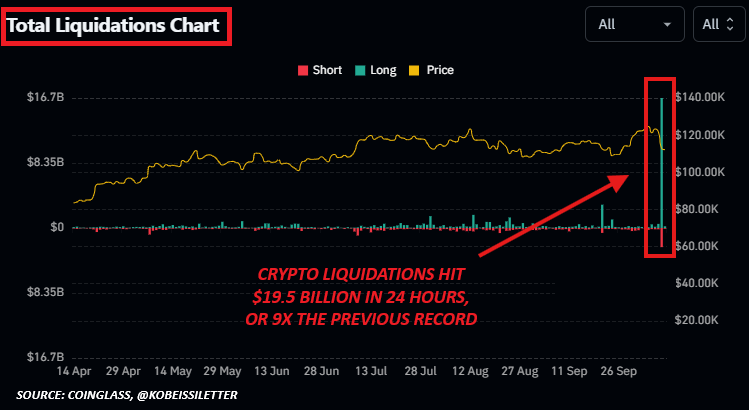
The timing amplified everything. That same session brought roughly $19 billion in leveraged liquidations, with Bitcoin dropping more than $15,000 from its peak near $126,000 one month earlier.
Follow us on X to get the latest news as it happens.

Trump’s tariff threat and extreme leverage drove the initial crash. The index proposal added a structural overhang that many believe prevented a swift recovery.
MSCI eventually retreated in January 2026. Industry pushback succeeded, including Strategy’s argument that it operates a substantial software business rather than functioning as a passive fund.
How the New Framework Actually Works
The threat has now returned in different clothing. MSCI opened a broader consultation in August 2026 on the eligibility of non-operating companies in general. The new approach relies on quantitative screens. Companies first fail a core test when operating assets fall below 50% of total assets.
Five additional ratios follow that threshold. They measure operating intensity, expense intensity, cash flow, fair-value exposure, and capital dependence, with four failures rendering a firm ineligible.
Simulations produced predictable results. Testing the rules against ACWI IMI using May 2026 data flagged Strategy, Japan’s Metaplanet, and uranium holder Yellow Cake for deletion.
Existing constituents receive some protection. Companies must fail across two consecutive periods before removal takes effect.
Strategy responded forcefully on X. The company argued that index providers should measure markets rather than decide which assets companies may own, adding that neither Bitcoin nor Strategy needs MSCI.
Why Bitcoin Would Feel This Only Indirectly
The timing carries particular weight. Strategy has already shifted from pure accumulation toward active liquidity management, including some Bitcoin sales to build cash reserves.
The mechanism deserves precision, however. The forced sale of MSTR shares by passive funds would not require Strategy to dump Bitcoin directly.

The indirect damage matters more. Such pressure could compress the premium at which the stock trades relative to its Bitcoin holdings, making future capital raises less efficient.
That efficiency underpins the entire model. Weakening it would remove one of the cycle’s key structural buyers from the market. Bitcoin trades near $62,849, roughly 50% below the record high above $126,000 reached in October 2025, according to BeInCrypto data.
Subscribe to our YouTube channel to watch leaders and journalists provide expert insights.
The calendar now sets expectations. Feedback closes September 30, results arrive by October 16, and any changes target the November 2026 index review.
Whether history repeats itself remains genuinely uncertain. What the episode confirms is how tightly Bitcoin’s price action has become entangled with the corporate treasury model.
The post One October 2025 Crypto Black Friday Catalyst is Back: Is Bitcoin in Danger? appeared first on BeInCrypto.

How XRP holders can break out of the dilemma and earn $10,000 a day

CJ Abrams is so bad defensively

Marvel’s Wolverine arrives complete on disc, just as physical gaming fades


-

 Fashion9 hours ago
Weekend Open Thread: Ann Taylor
-

 News Videos7 days ago
Can Astrology Help Find Gold and Silver Trends? A Financial Astrology Guide
-

 Business6 days ago
Datadog: Best Of Breed For Multiple Reasons
-

 Business6 days ago
How to Start a Cleaning Business: A Step-by-Step Guide
-

 Business6 days ago
BDC Weekly Review: Private BDC Q2 Numbers Are Strong
-
 Business4 days ago
Oil Price Today (August 11): Crude oil rises to $88 after Trump’s compensation demand dents Hormuz opening. Here’s why
-
 NewsBeat3 days ago
Communication cards help banking customers access services or report scams
-
 Entertainment7 days ago
10 R-Rated Drama Movies That Can Be Called Masterpieces
-

 Fashion5 days ago
Amazon Sundays: Closet Care Before Fall
-

 Business7 days ago
SharkNinja Keeps Eating
-

 Politics6 days ago
Be quiet, Miriam! – spiked
-

 Business6 days ago
5 Things You Must Know About Jorge Messi, the Father and Longtime Agent Who Shaped Lionel Messi’s Career
-

 Business7 days ago
Mutual Fund Manager Scoops Up Beaten-Down Stocks
-
 Crypto World4 days ago
Why Did Nvidia Stock Fall on Monday Despite a $500 Billion Wall Street AI Deal?
-

 Politics5 days ago
Ben-Gvir’s crocodile project halted but abuses at Ketziot Prison continue
-

 Politics5 days ago
The Church of England’s ruinous reparations racket
-

 Politics7 days ago
Calls to permanently pedestrianise central Belfast following festival success
-

 Politics5 days ago
Saudi Arabia used 86% of missile stockpile defending Iran attacks
-

 Crypto World7 days ago
A Deep Dive Into One Of The Most Significant Hacks In Recent Memory
-

 Crypto World7 days ago
Bitcoin ETFs draw $853.5M in five-day inflow streak
You must be logged in to post a comment Login