

Crypto World
Morgan Stanley unlocks Bitcoin, Ethereum and Solana on E*TRADE



Morgan Stanley has completed the rollout of Bitcoin, Ethereum, and Solana trading on E*TRADE, charging eligible clients a 0.50% fee on each transaction.
Summary
- E*TRADE now allows eligible clients to trade Bitcoin, Ethereum, and Solana for a 0.50% fee.
- Morgan Stanley plans crypto transfers and a move to its Digital Trust bank later this year.
- The rollout complements Morgan Stanley’s Bitcoin holdings, crypto ETFs and Galaxy Digital lending arrangement.
E*TRADE announced in a press release that supported customers can now buy, sell and hold the three digital assets directly through its brokerage platform. Zerohash provides the underlying crypto infrastructure and holds the assets in linked customer accounts.
Each transaction carries a 50-basis-point fee, according to E*TRADE. While the current service covers trading and custody, the brokerage expects to introduce crypto transfers later this year, allowing clients to move supported assets into and out of their accounts.
Following a pilot launched in May, the completed rollout makes the service available to all eligible E*TRADE customers. Morgan Stanley had first disclosed plans to add direct spot crypto trading in 2025.
Morgan Stanley is expanding several crypto services at once
E*TRADE’s launch comes as Morgan Stanley prepares to add two exchange-traded funds tied to Ethereum and Solana. As previously reported by crypto.news, amended S-1 filings for both products indicated that their launches were approaching, although the filings did not provide a confirmed trading date.
Earlier this year, Morgan Stanley also launched a spot Bitcoin ETF, becoming the first bank to offer such a product, according to the original report. SoSoValue data showed that the fund had accumulated $384 million in net assets at the time of reporting.
Direct trading gives E*TRADE customers another route to crypto exposure alongside Morgan Stanley’s investment funds. Unlike ETF shares, the new service allows eligible users to hold the underlying Bitcoin, Ether and Solana through Zerohash, while the planned transfer feature would give customers more control over moving those assets.
Morgan Stanley had also increased its tracked Bitcoin balance by nearly 1,000 BTC over the two weeks preceding July 11, according to a crypto.news report published that day. The purchases lifted its reported holdings above 5,700 BTC at the time.
Digital Trust is set to take over the crypto service
Later this year, E*TRADE expects to move the crypto offering from Zerohash to Morgan Stanley Digital Trust, the group’s planned national trust bank. The brokerage linked that transition to the introduction of transfer services but did not provide a specific launch date.
Morgan Stanley applied to the Office of the Comptroller of the Currency earlier this year for a crypto-focused national trust bank charter. Its application placed the firm alongside Coinbase, Crypto.com and Ripple, while the OCC has already granted Ripple conditional approval.
Circle has also received OCC approval to establish a national trust bank focused on digital assets. The USDC issuer had secured conditional approval in 2025 alongside BitGo, Fidelity and Paxos.
Morgan Stanley Wealth Management added another crypto route in June through a referral agreement with Galaxy Digital. Under the arrangement, eligible high-net-worth clients can lend Bitcoin, Ether and Solana to Galaxy and receive shares in spot crypto investment products, including the Morgan Stanley Bitcoin Trust.
Taken together, the ETRADE rollout, pending ETF launches and Digital Trust application place trading, investment products, lending referrals and custody infrastructure within Morgan Stanley’s disclosed crypto plans. Each service remains subject to separate eligibility rules, fees and regulatory arrangements set by the companies involved.

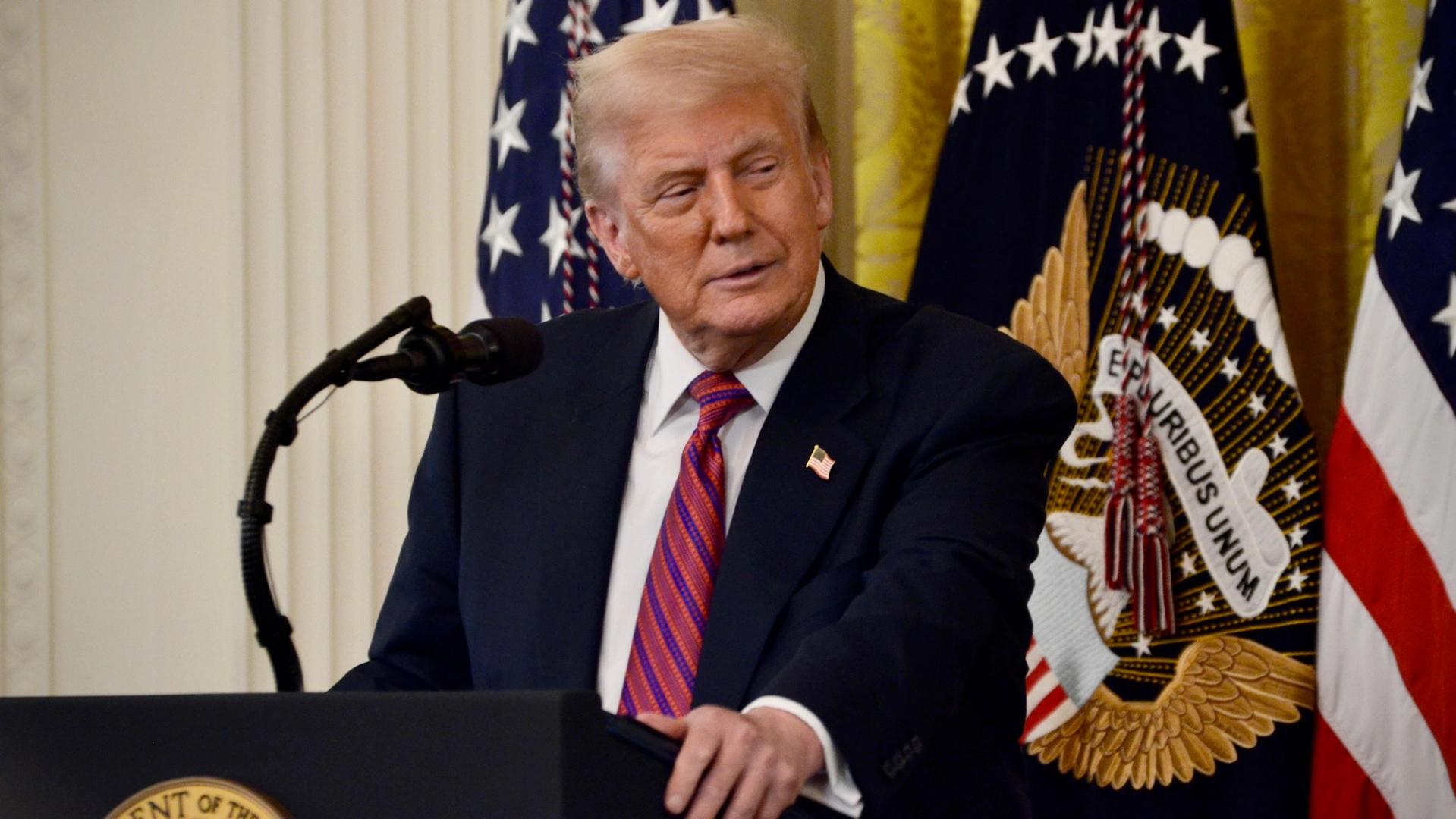
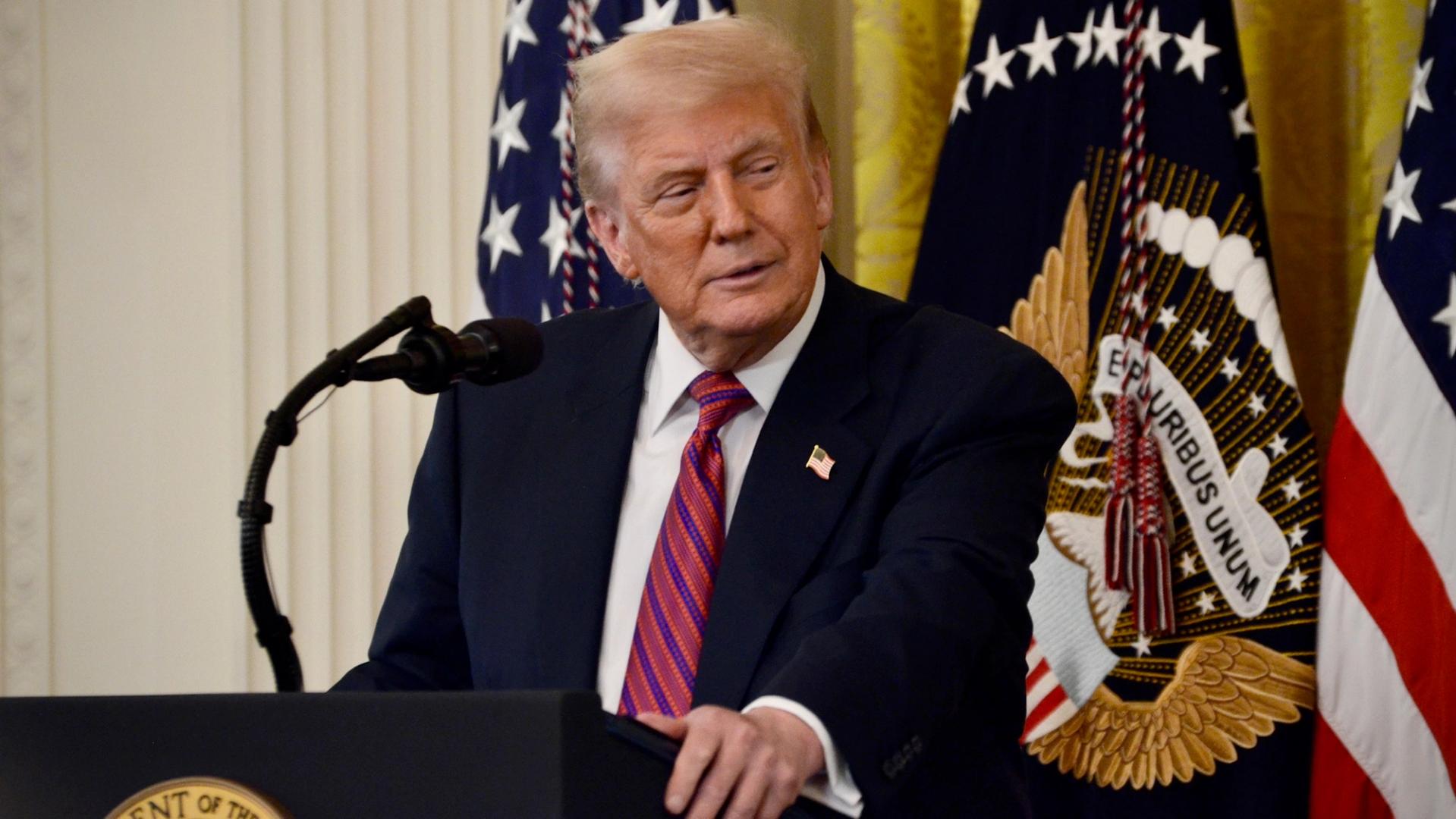
The lack of an ethics provision remains one of the biggest sticking points. Sen. Ruben Gallego (D-Ariz.), one of two Democrats who voted to advance the bill out of the Senate Banking Committee, has repeatedly said he will not support the legislation on the Senate floor without a bipartisan ethics provision. Other Democrats have raised similar concerns over conflicts of interest involving public officials and digital assets.
As of Friday, there had been no public readout from Thursday’s White House meeting, and no bipartisan ethics language had emerged, leaving one of the bill’s largest obstacles unresolved.
If passed, the Clarity Act would establish a federal framework for digital asset markets by drawing a clearer line between assets regulated by the Securities and Exchange Commission (SEC) and those overseen by the Commodity Futures Trading Commission (CFTC). Supporters argue the measure would replace years of regulation through enforcement with rules written by Congress.
Industry executives reiterated that message during a House hearing Friday marking one year since the chamber passed the legislation.
“The community has already done the hard work,” Nova Labs executive Sarah Aberg told lawmakers, arguing that regulatory uncertainty delayed investment in the Helium wireless network after the SEC sued the company in a case that was later settled. “Clarity is not a call for deregulation; it is a call for the right regulation from the right regulator.”


“Both Stripe and PayPal do approximately the same amount of payment volume, but Stripe has about one-fifth the net revenue,” Hadick said. “From a financial perspective, this is obviously accretive, and it helps them connect their merchant processing business, which is at risk of being commoditized, with a broad subset of PayPal’s more than 400 million accounts.”
Hadick also cautioned that executing a deal of that size would be difficult. “M&A integration in something of this size is incredibly hard,” he said.
Beyond merchant payments
Eric Queathem, CEO of Velocity, said the acquisition would also give Stripe access to one of the world’s largest consumer payments ecosystems, providing a platform to expand beyond merchant payments.
The proposed acquisition would also determine who controls the consumer side of blockchain-based payment infrastructure, complementing Stripe’s existing merchant network and stablecoin capabilities.
Several executives said the competitive focus has shifted from proving blockchain technology works to controlling distribution.
Pankaj Bengani, founder and CEO of Meld, agreed with Larbi that the race is on.
“The race has shifted from proving the technology works to owning distribution,” said Bengani, adding that “stablecoins have graduated from experiment to core payments infrastructure.”
Citi analysts reached a similar conclusion in a research note, writing that stablecoin competition has become “a default-setting game,” with scale accruing to whichever stablecoin becomes the default across the largest merchant, consumer wallet or autonomous transaction base, rather than to the issuer with the best technology.


China’s Kimi K3 has climbed to first place on the Frontend Code Arena, prompting former White House crypto czar David Sacks to warn that US regulation could weaken America’s position in the AI race.
Summary
- Kimi K3 topped the Frontend Code Arena and posted strong results across other AI benchmarks.
- David Sacks warned that strict US rules could weaken America’s position against China.
- Moonshot AI plans to release Kimi K3’s open weights by July 27.
Sacks described the benchmark result as concerning because Kimi K3 also performed close to leading models across several other evaluations. He argued that restrictions on data centers, state-level rules and proposed federal reviews could slow American developers while Chinese companies continue building advanced systems.
“This is how you lose the AI race,” Sacks wrote.
According to Sacks, the United States became a technology leader during the internet era by allowing companies to develop products without seeking government approval in advance. He believes Washington should follow a similar approach to AI while using targeted rules to address specific safety risks.
Kimi K3 strengthens China’s position in advanced AI development
Moonshot AI built Kimi K3 with 2.8 trillion parameters, a one-million-token context window and native multimodal capabilities. The company designed the model for lengthy coding assignments and agent-based workflows that require systems to complete several connected tasks.
Moonshot AI reported that its Kimi Delta Attention system delivers decoding speeds up to 6.3 times faster when processing one-million-token contexts. Its Attention Residuals technology also improves training efficiency by about 25% while adding less than 2% to the total cost, according to the company.
Beyond the Frontend Code Arena, Kimi K3 recorded an Elo score of 1,668 on GDPval v2. The reported result placed it above GLM-5.2, GPT-5.5, and Claude Opus 4.8, although Claude Fable 5 retained a higher score.
On AutomationBench-AA, the Chinese model achieved a 53% score and took first place in the test for agent-led software-as-a-service workflows. Results published through nextjs.org/evals also placed Kimi K3 ahead of Fable while showing comparable task success in less time, according to the report.
Moonshot AI has released Kimi K3 through Kimi.com, Kimi Work, Kimi Code and the Kimi API. The company expects to make the model’s open weights available by July 27, giving developers another way to test and adapt its capabilities.
US restrictions face scrutiny as foreign AI models advance
Sacks linked Kimi K3’s performance to an intensifying debate over how Washington should oversee frontier AI. His criticism covered proposals for federal pre-approval, limits on data center construction and the growing number of AI rules introduced by individual states.
At the federal level, the US government has approved limited access to Anthropic’s Claude Mythos 5 for roughly 100 businesses and agencies. In a letter to Anthropic co-founder Tom Brown, Commerce Secretary Howard Lutnick said selected partners could use the model under specific safeguards.
“I have determined that appropriate safeguards are in place to permit certain trusted partners to access the Claude Mythos 5 Model.”
While Sacks acknowledged that AI safety requires government attention, he argued that other countries would not copy American restrictions. Under his assessment, rules that delay infrastructure construction or model development could leave US companies competing against foreign laboratories operating under fewer limits.
President Donald Trump has also used competition with China to support his technology and digital-asset agenda. Trump has urged the Senate to pass the CLARITY Act, arguing that delayed crypto legislation could allow China to gain ground, while his administration has promoted the United States as the “crypto capital of the world.”
Sacks’ response to Kimi K3 applies the same competitive argument to artificial intelligence: address clear risks without placing approval barriers in front of US developers.
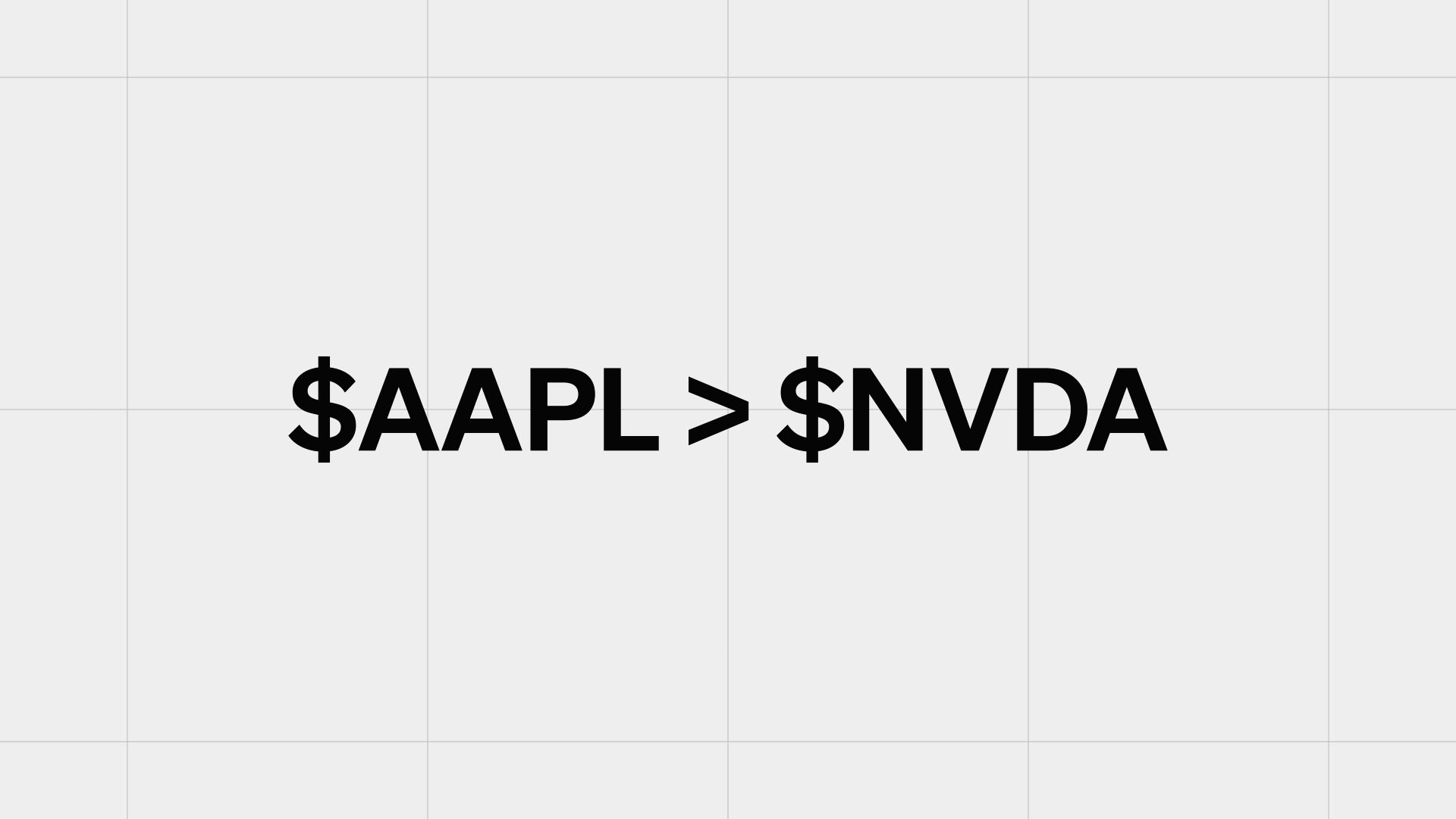
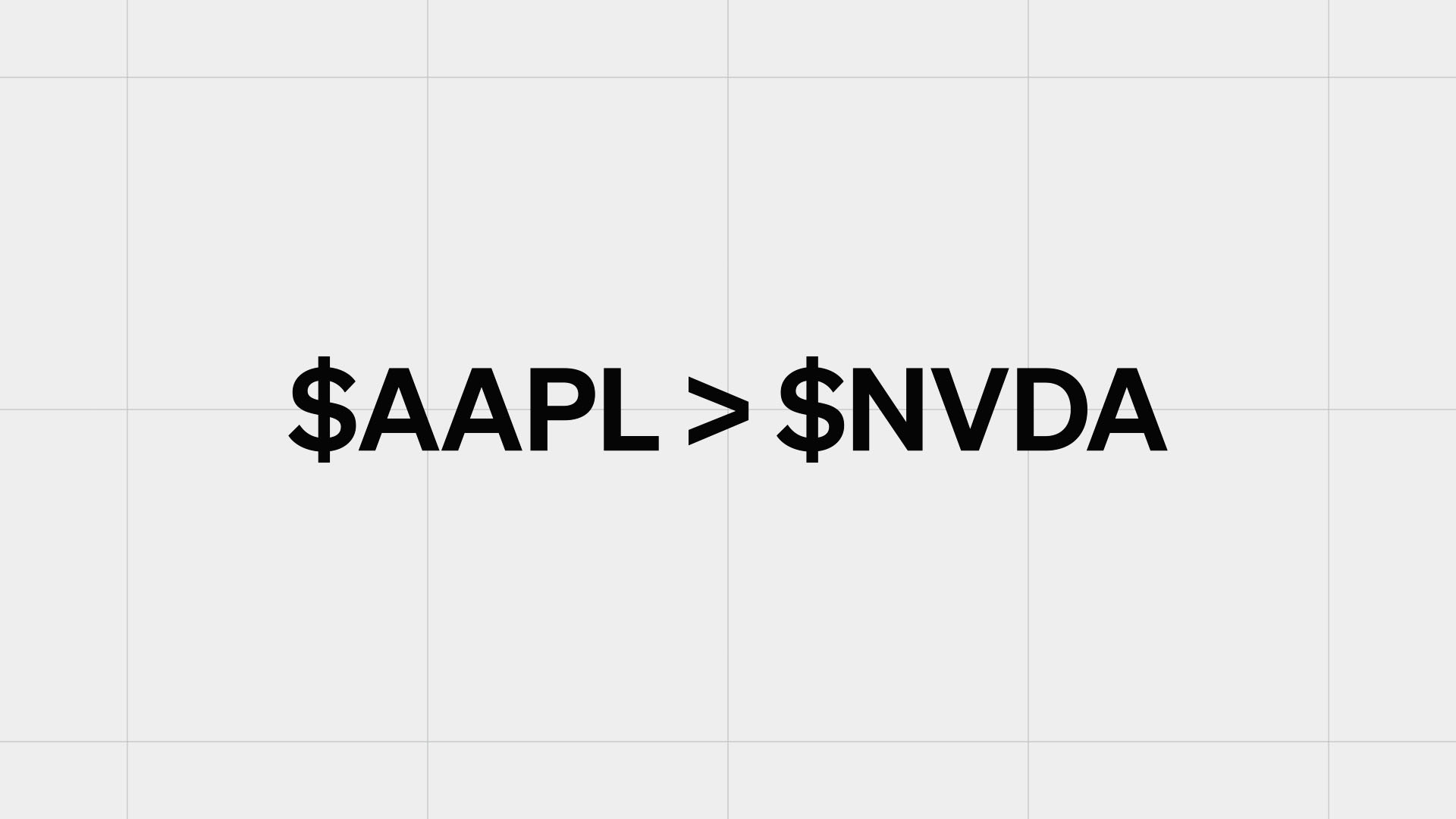
Apple overtook Nvidia as the world’s most valuable publicly traded company after it hit an all-time high of $334.95 per share just 10 minutes into Friday’s trading session.
This valuation put the company above $4.92 trillion.
At the same time, Nvidia traded at $199.38, down 4% from Thursday’s close. This valued the company at $4.83 trillion — more than $100 billion behind Apple.
Although it was an all-time high for Apple, it wasn’t its first time atop the world’s leaderboard. It was also the world’s most valuable publicly-traded company in April 2025.
Nvidia has worn the crown for the vast majority of the past year, including 12 months since June 2025.
The switchover had more to do with Nvidia dropping than Apple rallying. Apple’s shares barely moved in morning trading, whereas Nvidia dropped more than 3%.
Apple rewarded for conservative AI spending
Wall Street spent July backing away from AI’s biggest spenders and reallocating to stalwarts. Apple entered Friday up 22% this year, far outperforming Nvidia’s more modest 7% after Nvidia’s 2025 outperformance.
Investment has slowly rotated out of pure AI names into memory component makers like Micron and Sandisk.
A bit of discretion about spending on AI has benefited Apple.
HSBC upgraded Apple to buy Friday with a $366 target, citing modest CapEx of 2.5% of sales versus the far more aggressive 39% of sales by hyperscalers.
Apple’s AI suite, meanwhile, cleared a registration hurdle with Beijing’s internet regulator this week — opening up a major market.
Nvidia’s slide is two months old. The stock peaked in mid-May and has shed more than $800 billion since. Apple, in contrast, has added that much back to its market cap since last month.
This morning’s selloff briefly left Nvidia trading near 20 times forward earnings, its cheapest in about seven years and less than even chocolate maker Hershey at 21x.
Apple, re-crowned for opting out of the biggest expenditures during the AI arms race, costs about 34x times forward earnings.
Read more: South Korea’s stock market is officially more volatile than BTC
Nvidia and Apple still racing neck-and-neck
Nvidia’s business has obviously not broken.
On Thursday, it announced 27,500 Rubin GPUs for Japan, billed as “the world’s first national AI infrastructure for physical AI.” The project is bankrolled by a Tokyo sovereign ministry.
The chipmaker also became the first company worth $4 trillion last July, and the first past $5 trillion in October.
Commenting on Apple overtaking Nvidia today, Segal Marco Advisors’ Benjamin Hall told Reuters, “I don’t see any meaningful distinction. Nvidia [is] likely to be a significant participant in whatever happens going forward.”
The market agreed quickly. By 10:30am in New York, Nvidia reclaimed its top spot at about $4.94 trillion. Apple’s turn this morning lasted about 50 minutes in total.
As prices continue to fluctuate intraday, it is possible that Apple could regain its top slot before the close of trading.
Got a tip? Send us an email securely via Protos Leaks. For more informed news and investigations, follow us on X, Bluesky, and Google News, or subscribe to our YouTube channel.

Nvidia’s venture arm NVentures likely owns 141,834 Revolut shares worth about $196 million, UK filings suggest. Neither company has ever said how big the stake is.
A routine paper trail revealed what no press release did. It links the world’s top AI chipmaker to a bank with 16 million crypto users.
The Stake Nvidia and Revolut Never Announced
Tech Funding News spotted the filings on Friday. A statement at Companies House, Britain’s company registry, lists a likely NVentures LLC entry with 141,834 shares.
At the price from Revolut’s last round, that comes to roughly $195.9 million. It works out to about $1,380 per share. Insiders had rumored a figure near $200 million.
NVentures bought in through the November 2025 share sale. That deal valued Revolut at $75 billion. Coatue, Greenoaks, Dragoneer, and Fidelity led it, per Revolut’s announcement. Revolut said Nvidia’s money would deepen their AI work together. It gave no number.
“This sale also included investment from NVentures (NVIDIA’s venture capital arm), deepening Revolut’s collaboration with the global technology leader in key areas including AI.”
Follow us on X to get the latest news as it happens
The valuation is backed by real profit. Revolut’s 2024 revenue grew 72% to $4 billion. Pretax profit climbed 149% to $1.4 billion.
The price may soon climb again. Bloomberg reported in June that Revolut weighs a new share sale at $115 billion. That is a 53% jump in about seven months.
CEO Nik Storonsky has ruled out an IPO before 2028. Until then, these sales are the only way staff and early backers can cash out.
For Nvidia, the timing is notable. The chipmaker just briefly lost its crown as the world’s most valuable company to Apple.
Crypto Licenses Stack From London to Dubai
Why bet on Revolut? Its license shelf keeps filling up.
In March, Revolut launched as a fully licensed UK bank for its 13 million British customers. A US bank charter application awaits a decision.
On July 15, Dubai’s Virtual Assets Regulatory Authority (VARA) gave Revolut in-principle approval for a crypto license. It covers trading and brokerage through the app and Revolut X, its standalone crypto exchange. Final sign-off is still pending.
The UAE is moving fast on crypto rules. A regulated dirham stablecoin just reached exchanges there.
Europe tells the same story. Revolut moved to delist Tether’s USDT under MiCA rules. The ECB also picked it to test the digital euro.
Each new license makes Nvidia’s quiet $196 million look more deliberate. The next filing may show whether it doubles down at $115 billion.
The post NVIDIA Quietly Holds $196 Million Stake in Crypto-Friendly Revolut appeared first on BeInCrypto.
Ethereum price has fallen as much as 3.5% to $1,820 on July 17 after its latest rally stalled below $2,000 and weak Democratic support for the CLARITY Act hurt sentiment across the crypto market.
Summary
- Ethereum price fell 3.5% after its latest rally failed to break the $2,000 resistance.
- Weak Democratic support for the CLARITY Act hurt sentiment and triggered leveraged liquidations.
- ETH must reclaim $1,875, while a break below $1,800 risks deeper losses.
According to data from crypto.news, Ethereum (ETH) later recovered to around $1,835, but sellers erased most of the gains recorded during its push to $1,940 earlier this week. A Politico report that Senate Democrats do not currently support the market structure bill reduced its chances of securing the 60 votes needed for passage.
Democratic lawmakers have demanded conflict-of-interest restrictions tied to President Donald Trump’s crypto holdings before supporting the legislation. Analysts now assign the bill less than a 30% chance of passing this year, according to Barron’s, while Congress faces a narrowing window before its August recess.
At the same time, more than $400 million in leveraged crypto positions were liquidated over the past 24 hours, according to CoinGlass data.
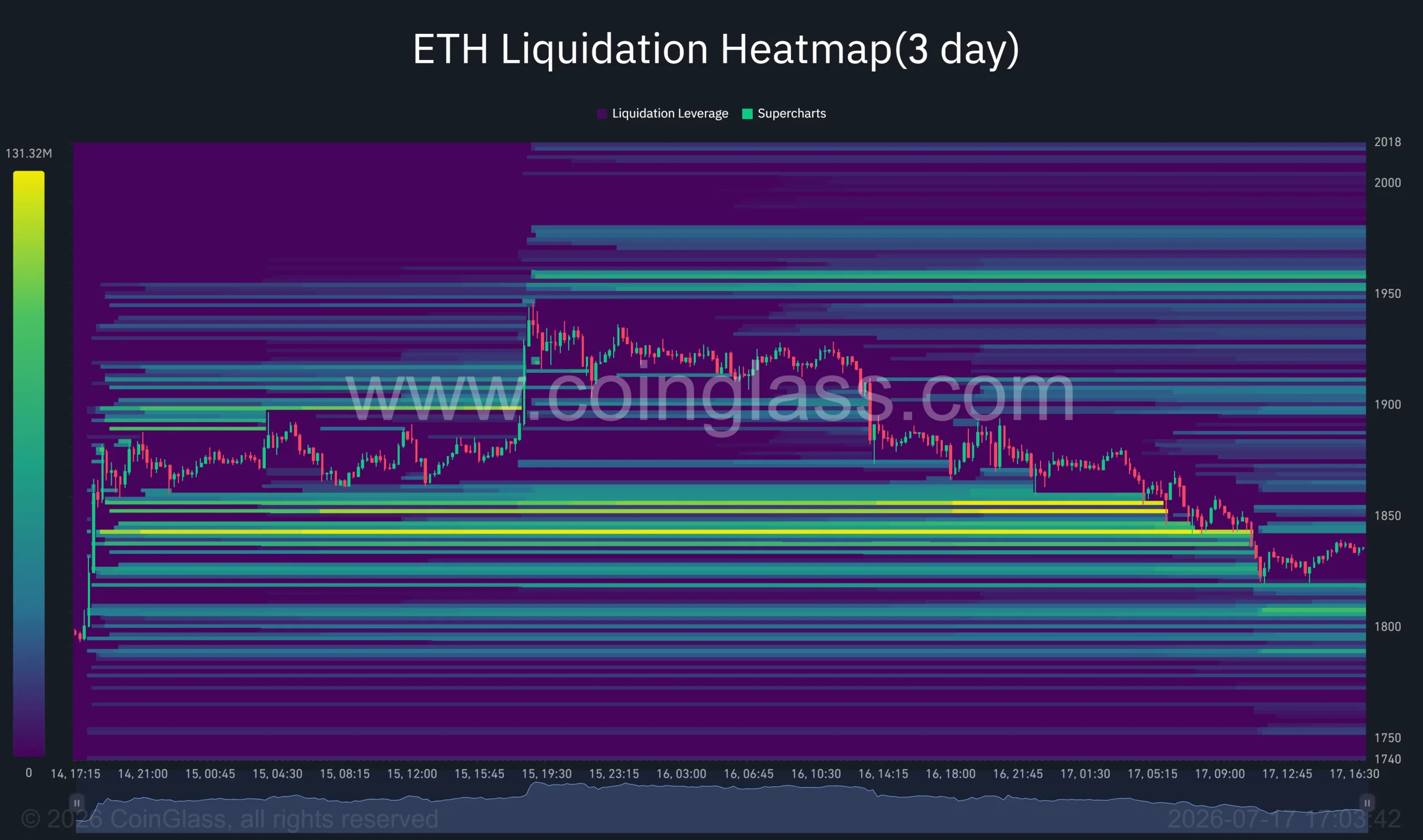
CoinGlass’ three-day ETH liquidation heatmap shows dense leverage around $1,800–$1,810, placing the zone just below Ethereum’s current price. On the upside, liquidation clusters sit near $1,845–$1,860, while the largest overhead concentration appears around $1,950–$1,960.
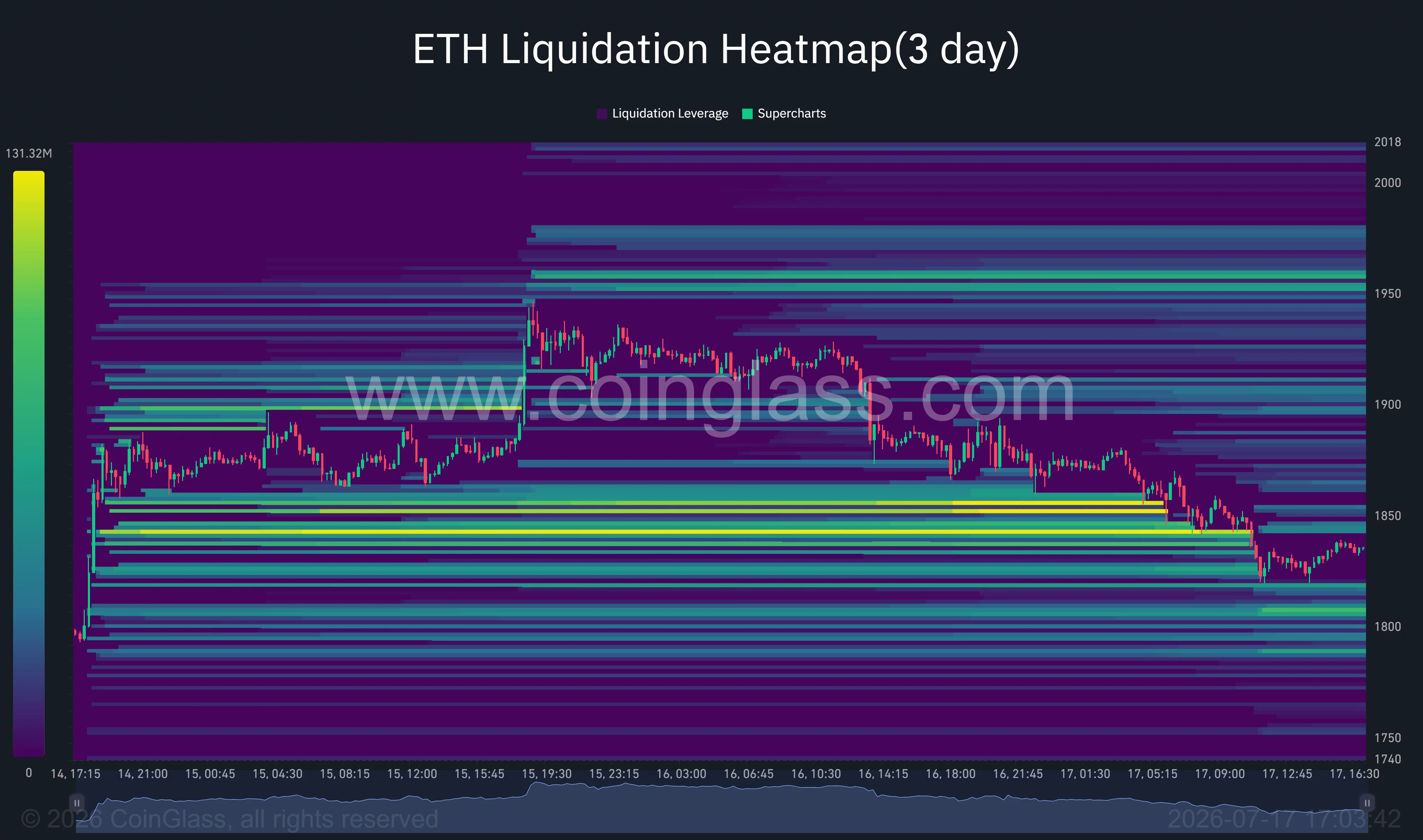
A move through $1,860 could therefore accelerate toward $1,950, but a break below $1,800 may trigger another wave of long liquidations.
U.S. spot Ethereum ETFs have offered only limited support. The funds attracted $84.42 million during the week ended July 11, breaking eight consecutive weeks of net outflows, but Fidelity’s FETH recorded a $15.4 million withdrawal on July 13. ETF demand has therefore remained uneven despite ETH’s recovery from its late-June low near $1,500.
Economic data added pressure as initial jobless claims fell to a two-month low of 208,000. June retail sales rose 0.2%, while core sales advanced 0.5%, prompting some economists to lift second-quarter growth estimates to as high as 2.4%.
Those figures reduced expectations for aggressive Federal Reserve rate cuts. The 10-year Treasury yield climbed to 4.596%, while the two-year yield reached 4.179%, raising the opportunity cost of holding risk assets such as Ethereum.
Ethereum must reclaim $1,875 before another $2,000 test
Ethereum’s daily chart shows that the rebound lost strength after reaching approximately $1,940. ETH has since returned to the $1,832 breakout level, which previously capped several recovery attempts during June and early July.
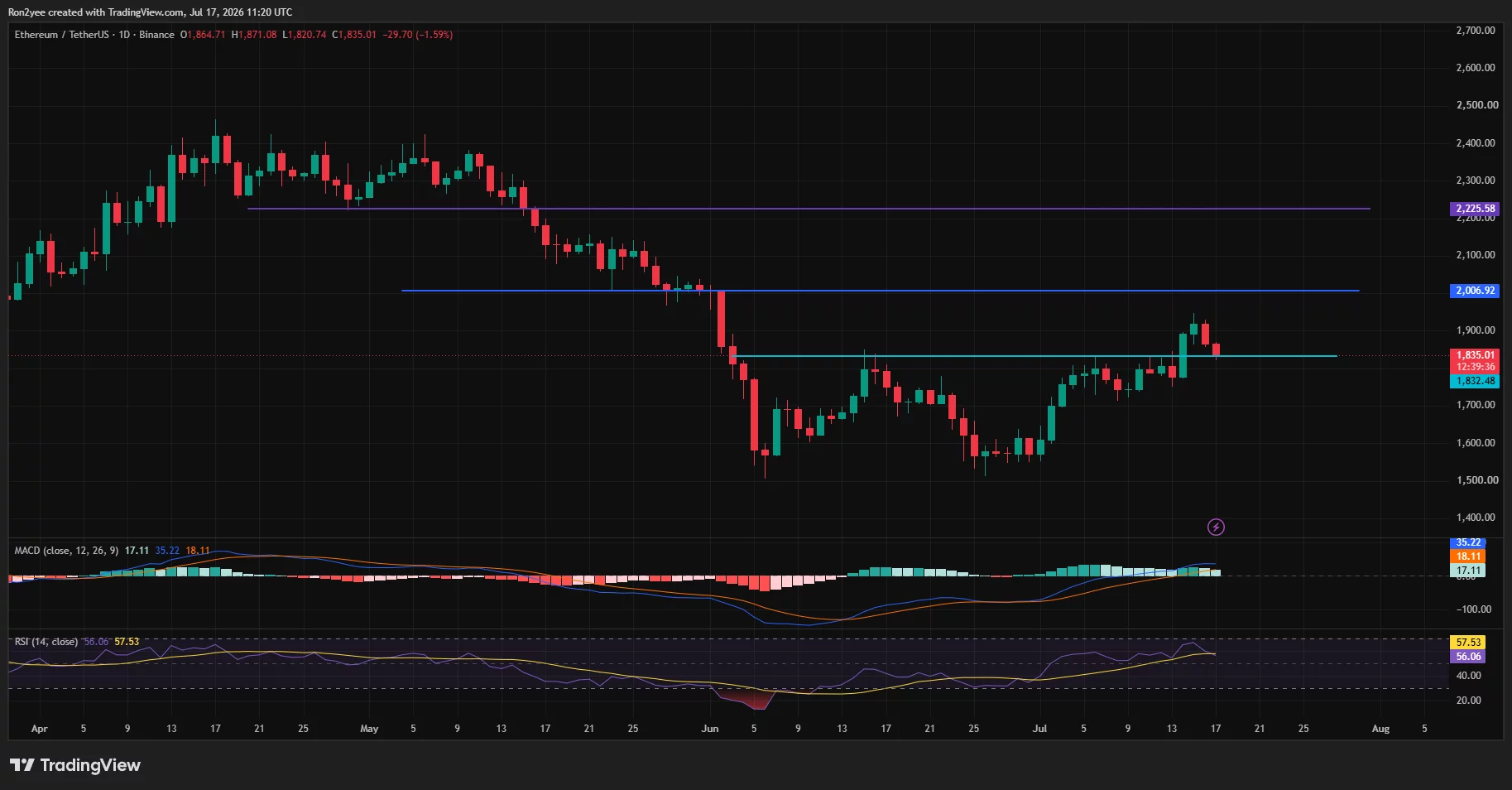
Daily momentum remains positive but has started to weaken. The MACD line stands at 35.22 against a signal line of 18.11, with the histogram still above zero at 17.11. The relative strength index has slipped to 56.06 and now sits below its moving average at 57.53, showing that buyers have lost some control without pushing ETH into bearish momentum.
On the four-hour chart, ETH has dropped below the Bollinger Band midpoint at $1,874. The lower band near $1,796 now forms the next volatility-based support, while the upper band at $1,952 sits just below the psychological $2,000 barrier.
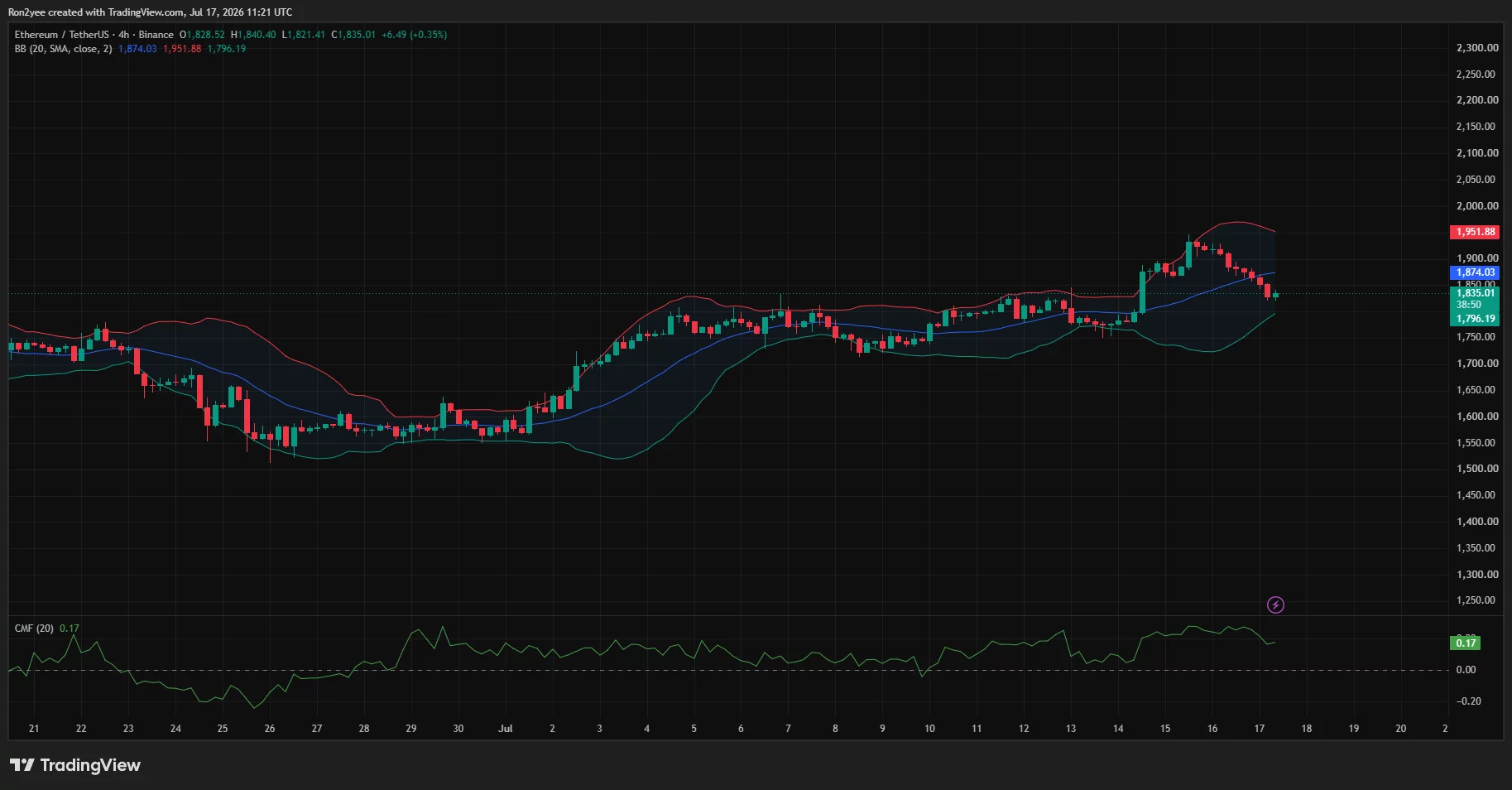
Chaikin Money Flow remains positive at 0.17, showing that capital has not fully left the market. Buyers must recover $1,875 and then clear the $1,940–$1,952 area before ETH can challenge the daily resistance at $2,006. A successful daily close above that level would expose the next major chart barrier near $2,225.
A close below $1,800 would put the recovery at risk
According to analyst Ted Pillows, Ethereum has entered an important support zone after surrendering its recent gains.
“A daily close above $1,850 should happen; otherwise, Ethereum will end up giving all its short-term gains.”
Failure to hold the $1,800–$1,832 area would strengthen the bearish case and expose the four-hour lower Bollinger Band near $1,796. Below it, the daily structure leaves room for a decline toward $1,715, followed by the June support region between $1,550 and $1,600.
The bullish case therefore requires a close above $1,850, followed by a recovery to $1,875. Continued ETF withdrawals, higher Treasury yields, fresh technology-stock losses, or further delays to the CLARITY Act would invalidate that path and keep $2,000 out of reach.
Disclosure: This article does not represent investment advice. The content and materials featured on this page are for educational purposes only.
Dogecoin price has fallen 3.17% to $0.071 on July 17 as its exchange-traded funds completed one month without recording fresh inflows.
Summary
- Dogecoin price fell 3.17% to $0.071 as its ETFs completed one month without fresh inflows.
- T. Rowe Price allocated 1.28% of its new active crypto ETF to DOGE.
- A break below $0.0711 could expose Dogecoin to declines toward $0.070 and $0.068.
SoSoValue data shows that U.S. Dogecoin ETFs attracted no new capital between June 17 and July 17, despite the meme coin gaining additional exposure through T. Rowe Price’s newly launched active crypto fund. The products also posted $871,000 in net outflows during July.
The weak ETF figures have accompanied a steep decline in DOGE, which has lost about 54% since reaching $0.156 in January. Dogecoin’s latest drop has brought the token back to a support area that buyers have repeatedly defended since late June.
During the same period, the meme coin sector has suffered a $1.2 billion sell-off, according to the original market report. The decline indicates that T. Rowe Price’s entry has yet to revive demand for DOGE among retail or institutional investors.
T. Rowe Price exposure has failed to revive DOGE demand
T. Rowe Price launched its first actively managed cryptocurrency ETF on July 16, adding Dogecoin alongside Bitcoin, Ethereum and several other digital assets. The asset manager oversees about $1.8 trillion and supplied $15 million in seed capital to the fund.
According to the fund allocation, Dogecoin received a 1.28% weighting. The position consists of roughly 2.6 million DOGE worth about $192,000, making it a limited part of the ETF’s portfolio.
Bloomberg ETF analyst Eric Balchunas described T. Rowe Price as a legacy stock picker. In his assessment, the firm’s decision to hold Dogecoin alongside larger cryptocurrencies gives the meme coin a degree of Wall Street recognition.
Even with the new allocation, SoSoValue data indicates that existing Dogecoin ETFs have failed to attract fresh money for a full month. The T. Rowe Price product is set to become the fourth ETF offering exposure to the largest meme coin by market capitalization, according to the original report.
Dogecoin price remains exposed below $0.0755
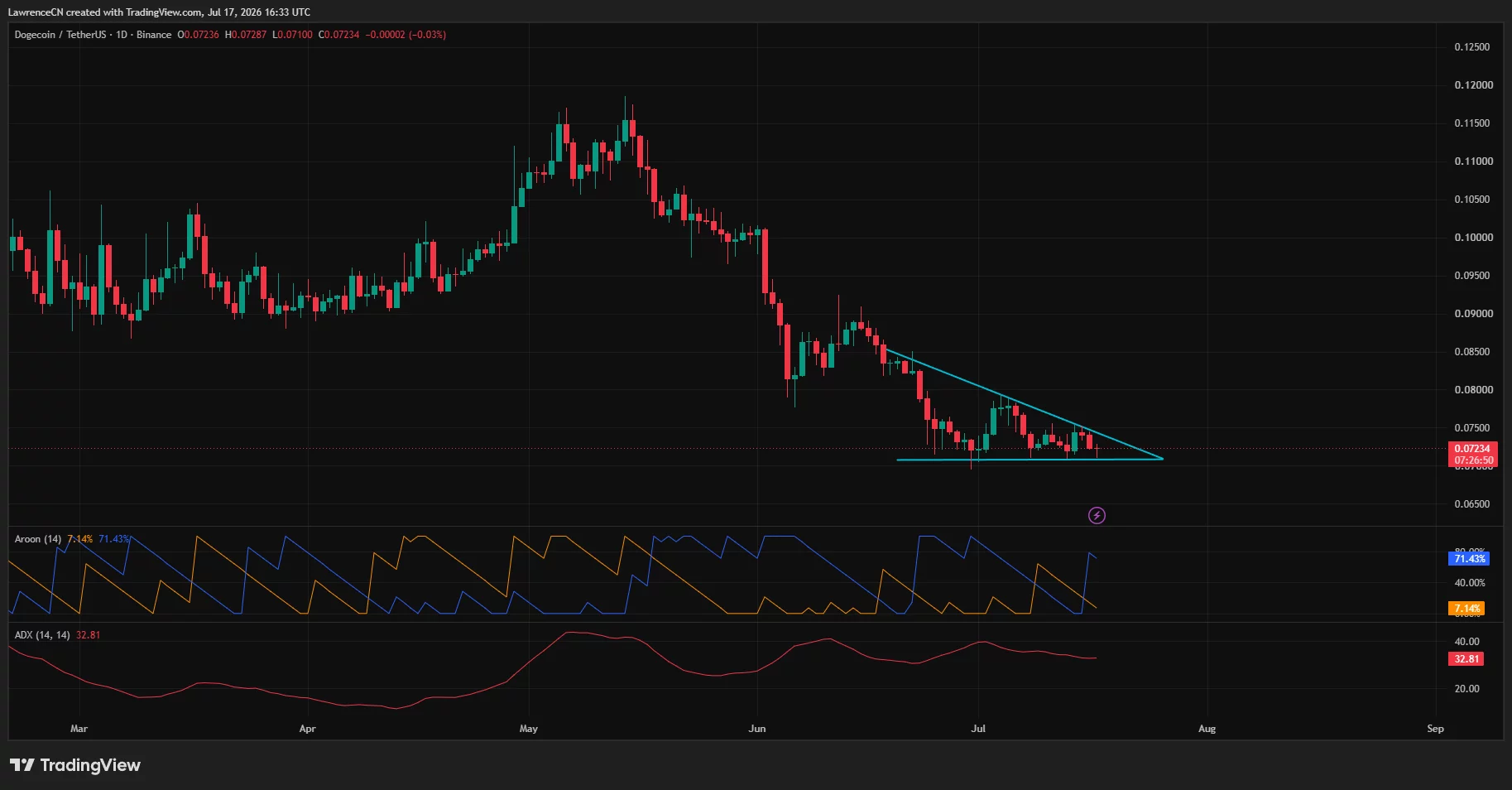
The daily DOGE chart shows a descending triangle, with a series of lower highs pressing the price toward horizontal support near $0.071. The structure would remain bearish unless DOGE breaks above the falling trendline and the nearby $0.0755 resistance level.
Momentum readings on the same chart favor sellers. TradingView places Aroon Down at 71.43% and Aroon Up at 7.14%, while the Average Directional Index stands at 32.81. An ADX reading above 25 indicates that the current trend retains strength.
On the 4-hour chart, the MACD line is below its signal line and shows a negative histogram, both pointing to continued selling pressure. The Relative Strength Index is also at 42.89, below its moving average of 46.75, suggesting that buyers have not regained short-term momentum.
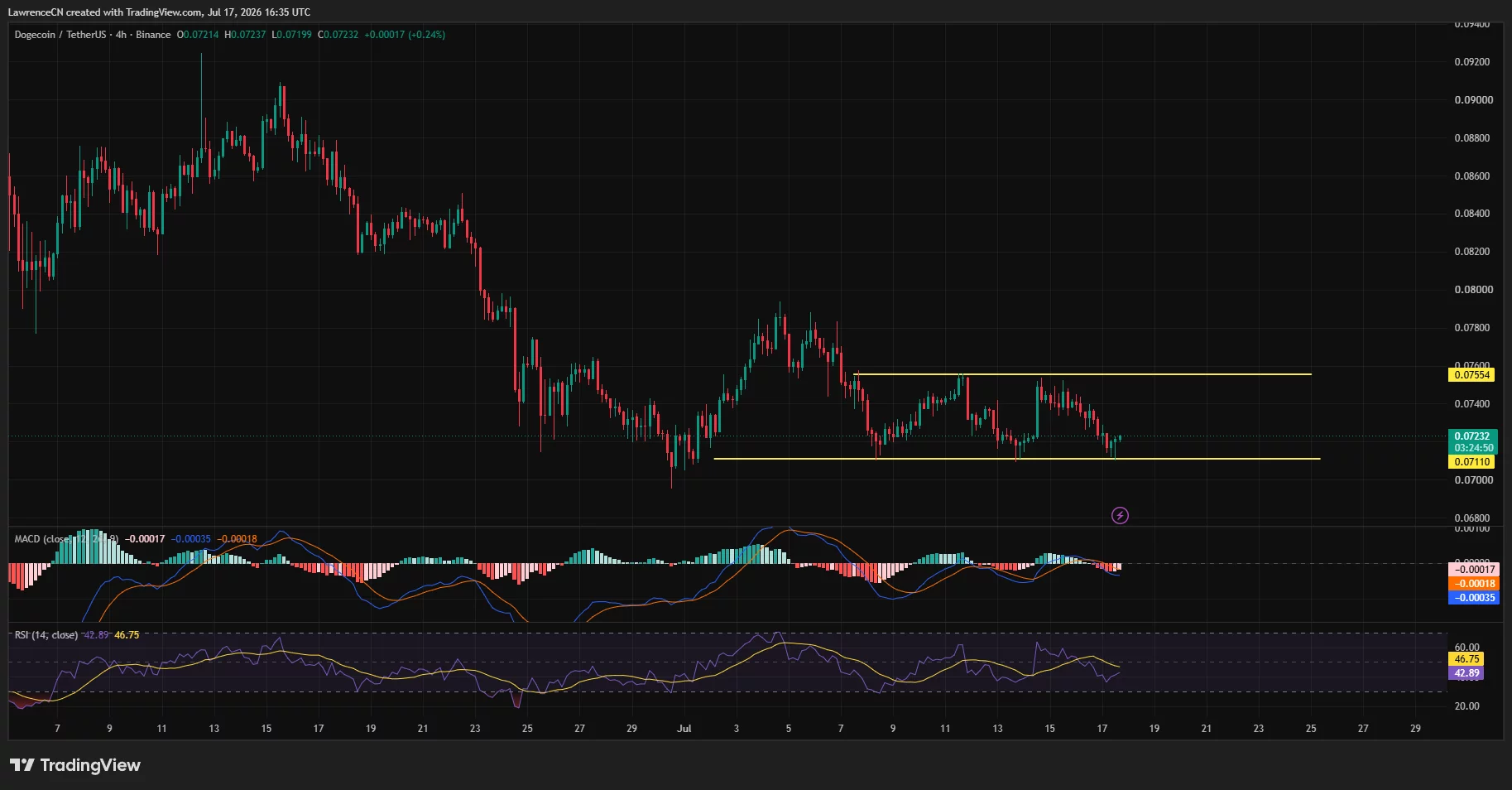
A confirmed 4-hour close below the $0.0711 range floor could expose $0.070, followed by $0.068 and $0.065, based on the support levels visible on TradingView. Conversely, a rebound above $0.0755 would break the current range and place the July high near $0.079 back in view.
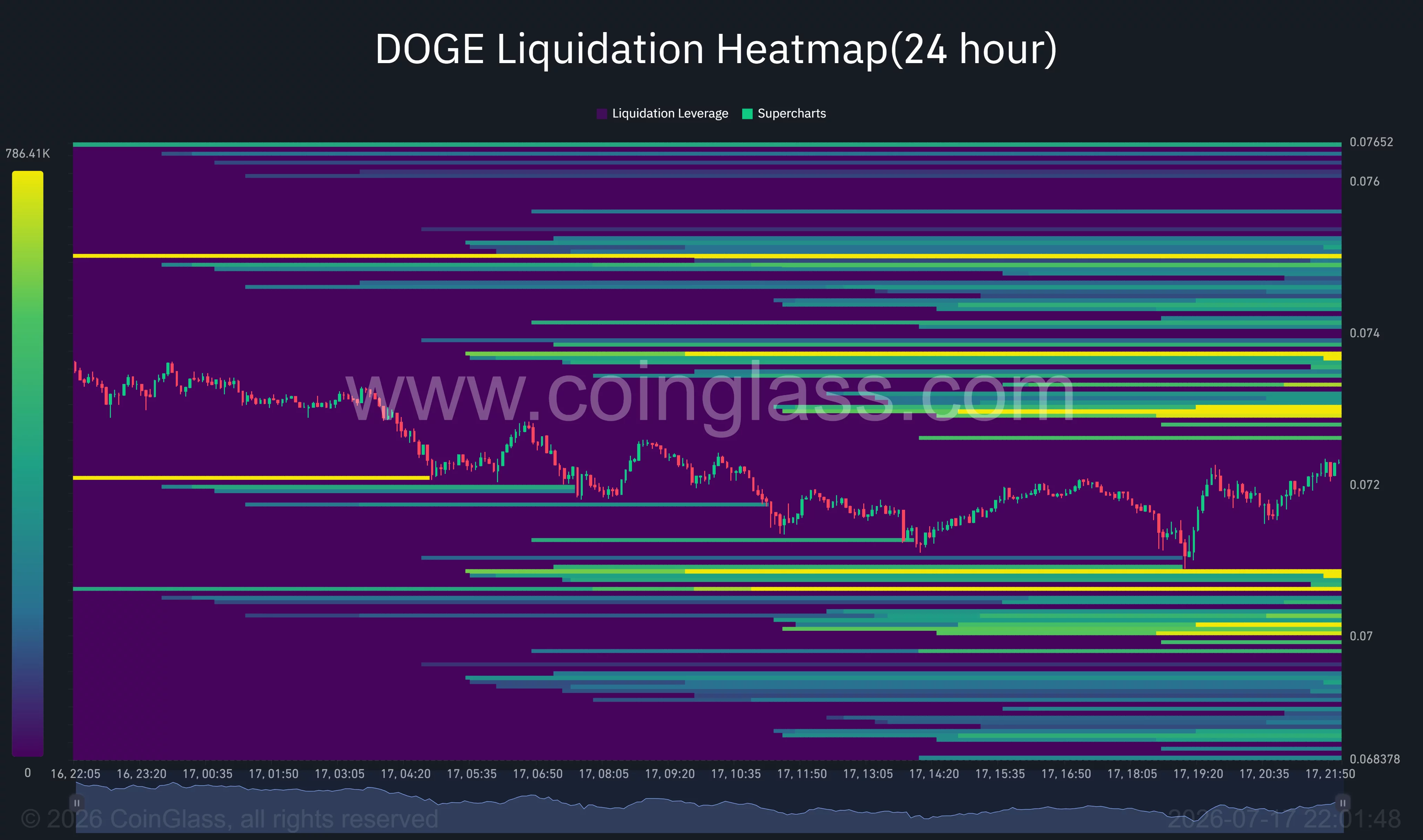
CoinGlass’ 24-hour liquidation heatmap places notable leveraged positions around $0.073 and $0.075 above the market. Below the current price, concentrated liquidity near $0.0705 and $0.070 could attract DOGE if the $0.0711 support fails.
Disclosure: This article does not represent investment advice. The content and materials featured on this page are for educational purposes only.
OKX Europe has launched a one-way conversion feature allowing customers to deposit USDT and convert it into USDC, offering a regulated migration path as the European Union’s Markets in Crypto-Assets (MiCA) rules limit support for the world’s largest stablecoin.
According to a company announcement shared with Cointelegraph, the feature lets customers deposit Tether’s USDt (USDT) into their OKX Europe account and convert the tokens into USDC (USDC), one of the largest stablecoins available under the European Union’s MiCA framework.
Tether has not obtained authorization to issue USDT under MiCA, prompting many European platforms to restrict deposits, delist trading pairs or convert customer balances into compliant alternatives as the European Union completed the framework’s rollout on July 1.
OKX Europe said the feature is designed for customers whose existing platforms no longer accept USDT or plan to migrate their balances automatically. The exchange said conversions can be completed at the customer’s discretion rather than through a platform-imposed deadline.
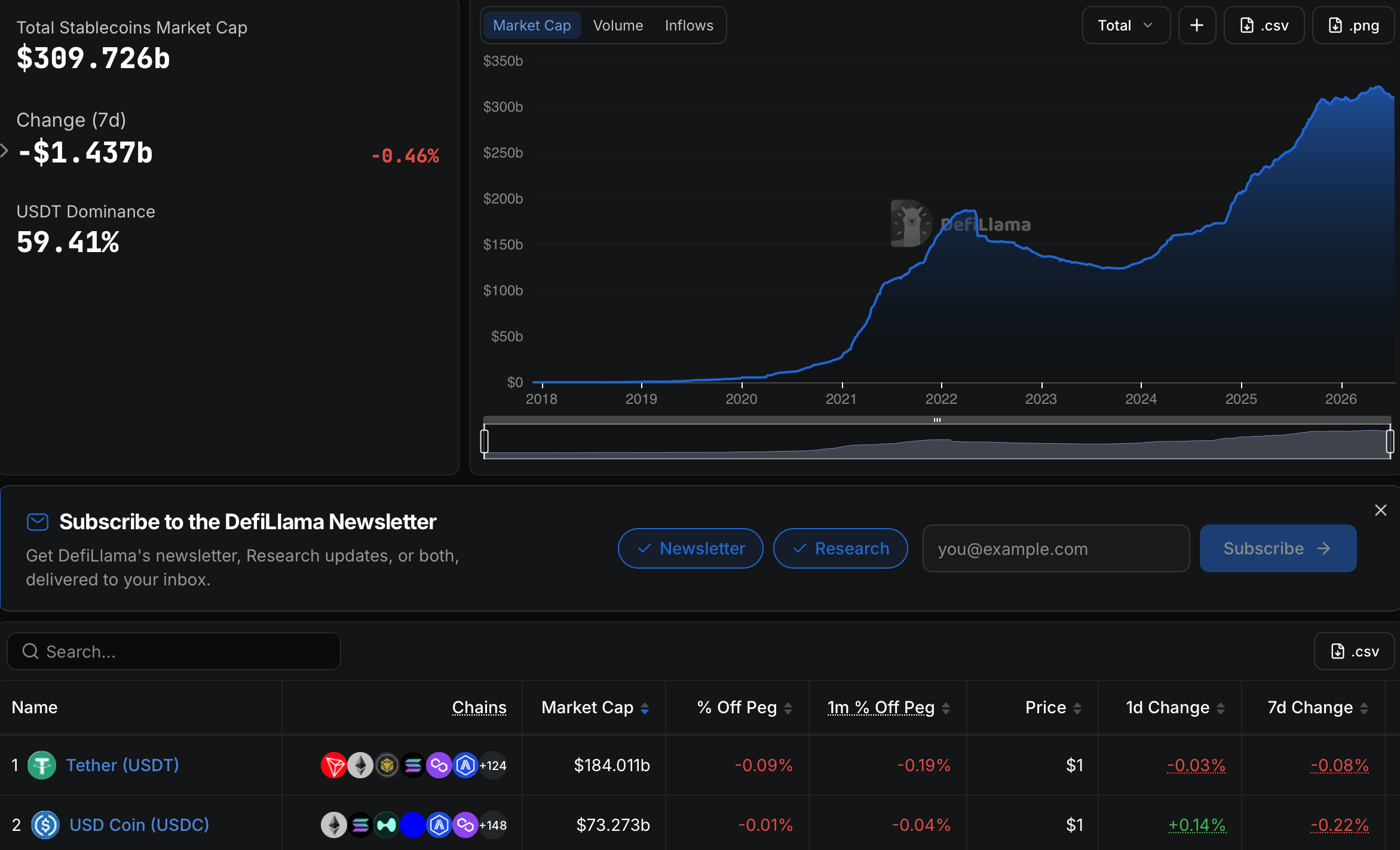
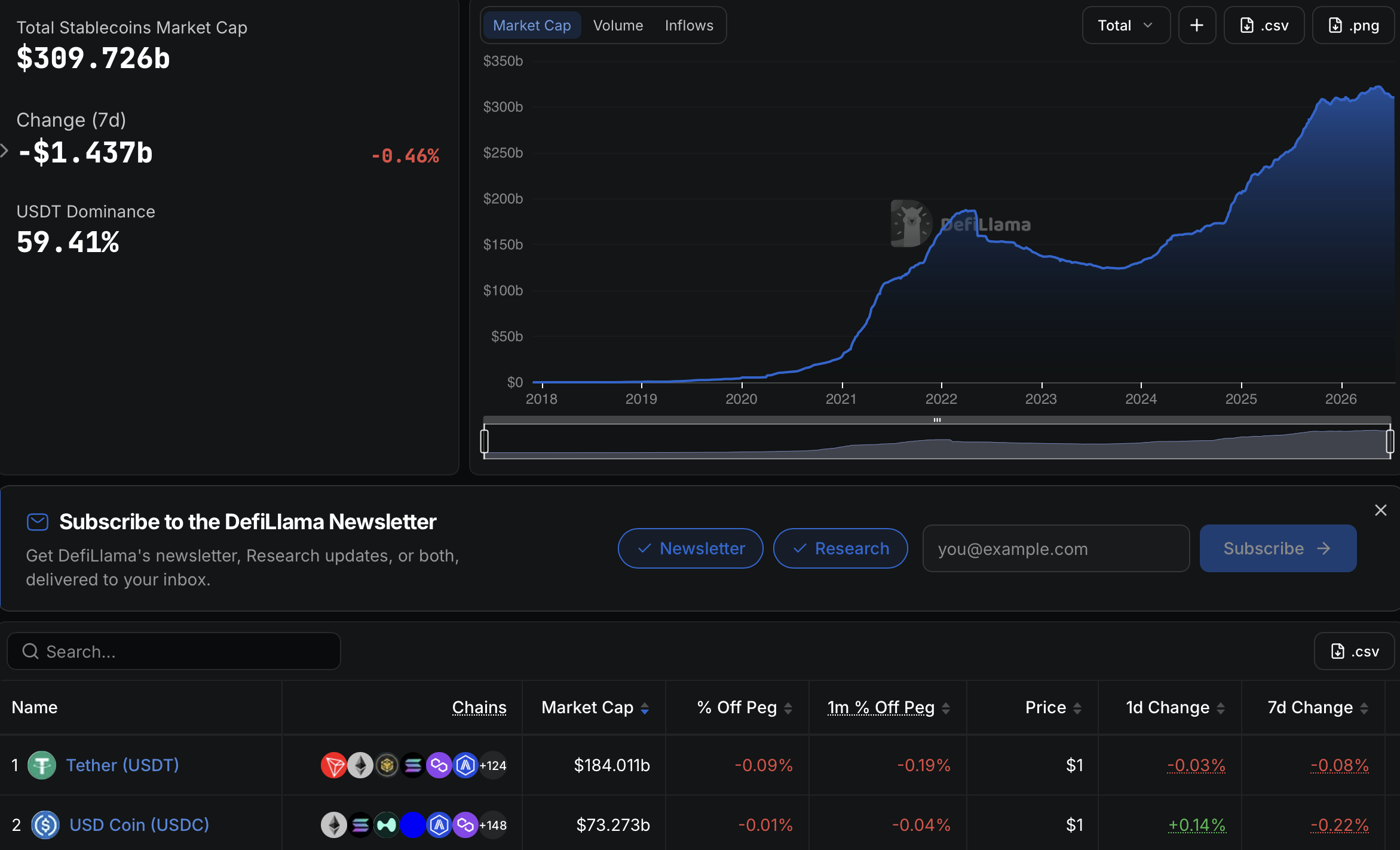
The move comes even as USDT remains the dominant stablecoin globally. According to DefiLlama, Tether accounts for about 59% of the nearly $310 billion stablecoin market, with a market capitalization of roughly $184 billion, compared with about $73 billion for Circle’s USDC.
OKX Europe serves customers across 30 EU and European Economic Area countries under its MiCA license.
Source: DefiLlama
Related: ESMA adds 14 new CASPs to MiCA register as licensing slows
Why did Tether reject MiCA?
Tether has defended its decision not to seek MiCA authorization for USDT, even as the move prompted many European crypto platforms to delist or restrict the stablecoin. Since the EU’s regulatory framework began taking effect in late 2024, exchanges across the region have been shifting users toward MiCA-compliant alternatives.
Tether CEO Paolo Ardoino has repeatedly criticized MiCA, arguing its reserve requirements create unnecessary risks for stablecoin issuers by requiring a portion of reserves to be held with European credit institutions.
In a May 2025 interview with Cointelegraph, Ardoino described the framework as “very dangerous when it comes to stablecoins,” saying Tether chose not to pursue authorization despite the likelihood that USDT would lose support on European exchanges.
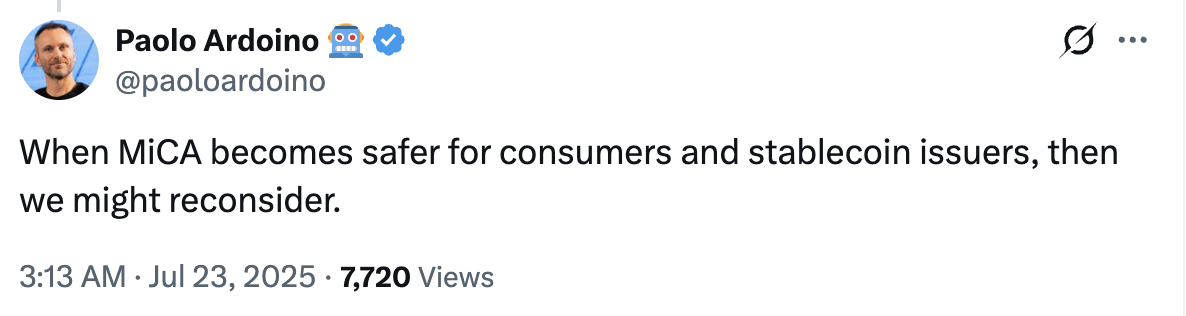
The company has shown little sign of changing course. In a July 2025 post on X, Ardoino said Tether would reconsider seeking MiCA authorization only “when MiCA becomes safer for consumers and stablecoin issuers.”
Source: Paolo Ardoino
Recently, digital banking platform Revolut said it will stop supporting USDT for customers in the European Economic Area and Switzerland, giving users until Aug. 31 to sell or withdraw their holdings before automatically converting any remaining balances into their base currency.
Magazine: The British Virgin Islands are a top crypto hub no one ever talks about: Here’s why


Donald Trump-founded Trump Media announced that Wall Street trading firms will be offered paid access to the president’s Truth Social posts before they’re shared with the public — a move that could be interpreted as selling insider trading information.
Specifically, firms will be able to pay for a Truth Social interface that grants “real-time access to posts from the highest-ranking Truth Social accounts” milliseconds before they’re published online.
Trump Media and Technology Group runs Truth Social, the social media app where President Trump’s account boasts 12.9 million followers.
Kathleen Clark, a conflict-of-interest expert at Washington University School of Law described the new services as “more brazen corruption,” and “an improper exploitation of government power to enrich himself.”
She added, “He’s selling expedited, privileged access to information about what he is doing as president.”
Read more: ANALYSIS: Mapping Donald Trump’s growing crypto empire
Trump Media is reportedly running at a loss, and hopes to boost its coffers by monetizing “proprietary assets” within the app.
Its new service will target multi-billion-dollar trading firms competing for increasingly early access to breaking news. Any amount of time they can claw back before news becomes public is key to making a profitable trade.
Truth Social claims that its data was already being copied by some firms, and that these third-party operations would be blocked by the company in favor of its own monetized access.
Trump administration a magnet for insider trading allegations
This paid-for access appears on its face to be a light form of insider trading from an administration that’s already been plagued with numerous allegations and investigations.
Indeed, reporting from CNN this week found Trump had used his Truth Social account to promote multiple big-name companies days after he had purchased hundreds of thousands of dollars’ worth of stock in said companies.
It claims that 20 different companies, including Nvidia, Tesla, and American Eagle, were promoted on his account days after he bought their stock.
Meanwhile, the US government’s long-time teleprompter was put on unpaid administrative leave after he allegedly made over $100,000 using Trump’s pre-written speeches to insider trade on prediction market Kalshi.
Gabriel Perez allegedly bet on dozens of prediction markets involving Trump speeches across a three-month period alone and was later flagged by the Commodity Futures Trading Commission.
The agency is reportedly seeking to settle with Perez, who has worked for Trump since 2016.
This is just one instance of the numerous signs of insider trading within Trump’s administration in relation to prediction market trades. Signs of insider trading also appeared in markets involving military actions against Venezuela’s Nicolás Maduro, and Iran.
Read more: Trump documents meltdown over Iran war on Truth Social
Insider trading and leaks are also allegedly taking place across futures oil markets, and also allegedly within ongoing US and Iran peace talks.
Drop Site reports that during these talks, Iranian officials warned Vice President JD Vance that Trump’s Special Envoy Steve Witkoff and his son-in-law, Jared Kushner, were exploiting insider negotiations to profit in financial markets, and risk undermining any deal.
Last month, Trump also pardoned Stephen Buyer, a republican who served almost two years in prison after he used insider information to trade stocks based on the around te merger of T-Mobile and Sprint.
Got a tip? Send us an email securely via Protos Leaks. For more informed news and investigations, follow us on X, Bluesky, and Google News, or subscribe to our YouTube channel.

Bitcoin’s path toward a potential macro bottom is once again being traced with onchain “supply in loss” timing and investor cost-basis models that suggest the market’s late-bull momentum may be fading.
In a new read of historical patterns, K33 Research highlighted that more than half of the BTC supply has been held at a loss for the first time in this bear market—an inflection point that, in past cycles, has tended to precede the final leg of drawdowns and the start of a sturdier post-bottom recovery window.
Key takeaways
- According to K33 Research, BTC supply in loss crossed 50% on June 5, marking a key bear-market threshold.
- K33 says the period from that 50% crossing to a macro bottom has ranged from 13 to 101 days in historical bear markets.
- As of July 17, CryptoQuant data shows supply in loss at 46%, implying the “countdown” is still in progress.
- CryptoQuant’s realized cap variance model (RCV) is reported to be in the bottom 6% of its historical range, with a Z-score at -2.35—consistent with late-stage bear conditions.
Why supply in loss is again driving “bottom” timing
In its H1 2026 Round-Up report, K33 Research pointed to a classic onchain metric: the share of Bitcoin held at a loss, based on investor cost-basis versus current market price.
K33 frames supply in loss as a practical yardstick for where Bitcoin often is in the lifecycle of a bear market. The firm noted that once this measure moves above 50%, the subsequent time to a macro bottom has historically been limited to a relatively defined “window”—with the shortest observed case lasting just 13 days in 2022.
In longer or more drawn-out drawdowns, the metric has taken considerably more time. K33 cited examples from prior cycles: in 2018, the decline required 23 days after the 50% supply-in-loss mark; in 2014, Bitcoin continued to drop for roughly 101 days after the same threshold was reached.
For the current cycle, K33 said the 50% crossing occurred on June 5. With about 42 days having elapsed since that point, the current “bottom window” is now described as the second-longest on record for Bitcoin among bear markets studied—an observation that matters because it suggests this drawdown phase is not yet compressed into the earliest historical end-game, even if it is moving into the later stages.
K33 also added that returns over the year after these threshold-driven periods “tend to be very solid,” reinforcing why traders and long-term investors continue to watch the supply-in-loss gauge rather than relying solely on price action.
What the latest onchain readings imply for timing
While K33 anchored the narrative to the 50% supply-in-loss break, CryptoQuant’s dashboard data provides the near-term checkpoint. In earlier commentary, Axel Adler Jr., an onchain analytics contributor on CryptoQuant, suggested supply in loss was roughly “two months away” from levels historically associated with bear-market bottoms.
As of July 17, CryptoQuant data puts supply in loss at 46%. Combined with the June 5 crossing reported by K33, that difference helps explain why analysts are still treating the move as a countdown rather than a completed cycle signal: the market is below the historical 50% threshold only after having crossed it, and the current reading indicates the “loss-heavy” ownership phase is easing but not yet fully resolved.
For investors, the key is not the exact day count but the relationship between supply-in-loss behavior and how markets tend to transition from capitulation-heavy distribution toward stabilization. If the metric continues to normalize in line with past bear-market arcs, it supports the notion that risk may be tilting toward the later stages of the drawdown rather than the beginning of a fresh leg lower.
Cost-basis models add a “late bear market” signal
Beyond supply in loss timing, CryptoQuant also pointed to an investor cost-basis indicator it described as showing rare readings. The model in focus is realized cap variance (RCV), which compares realized cap to market cap and then tracks that spread relative to its rolling historical distribution.
In a CryptoQuant QuickTake blog post published on Thursday, contributor Crazzyblockk explained that RCV is designed to isolate how stretched or compressed investor cost basis has become versus current valuation, using the variance itself rather than price alone.
“When that variance compresses into deeply negative z-score territory, the emotional premium built during rallies has largely been priced out. The metric doesn’t read narrative, it reads the distribution of capital.”
The same post said the RCV currently sits in the bottom six percent of its historical range. It also highlighted the standardized Z-score value at -2.35, describing this as an indication that Bitcoin may be in the later stages of a bear market.
CryptoQuant’s commentary went further by noting precedent: the post reported that previous stretches spent extended time below a -2.0 Z-score—citing late 2018, mid-2022, and early 2015—before being associated with forward twelve-month returns above 75%. The historical comparison matters because it positions the present reading not just as “bear market,” but specifically as a regime that has tended to precede substantial improvement after the bottom phase.
The most extreme example referenced was a Z-score of -4.68 in November 2018, which the post said landed almost exactly on Bitcoin’s cycle bottom near $3,792.
What to watch next as the “countdown” unfolds
For now, the most actionable takeaway is that two independent onchain lenses—K33’s supply-in-loss threshold timing and CryptoQuant’s realized cap variance regime—are pointing to the same broad phase: late-stage bear market conditions rather than an early, fresh destabilization. Readers should watch how quickly supply in loss continues to drift down from the 50% crossing and whether RCV remains pinned in deeply negative Z-score territory, since those are the signals most likely to confirm whether the cycle bottom window is narrowing or extending further.

How “Financial Psychology” Pays Off Forever – Morgan Housel

Binface to Reality TV: All the fringe candidates fighting Nigel Farage in Clacton by-election

Enhancing Interview Performance with AI


-

 Fashion7 days ago
Weekend Open Thread: Nutriplenish Leave-In Conditioner
-
 NewsBeat1 day ago
London Mayor Sadiq Khan handed a peerage by Keir Starmer alongside 15 other Labour figures… just days before the PM leaves No10
-

 Crypto World2 days ago
CFTC blocks Kalshi from unwinding Michigan trades after court order
-

 Politics2 days ago
Young campaigners urge incoming PM to act on outdoor junk food ads
-

 Business2 days ago
Nvidia Stock Slips After Big Tuesday Rally as Huang Confirms Vera Rubin Chip Is Now in Production Today
-
 Entertainment2 days ago
Disney’s Most Ambitious Failed Star Wars Attraction Is Coming to SDCC
-

 News Videos3 days ago
XRP BOMBSHELL… XRP OMBOARDED FOR TRANSACTIONS!!!
-

 Tech4 days ago
Get Your ESP32 Sunny Side Up With This Solar Dev Board
-

 Crypto World21 hours ago
Injective Submits SEC Transfer-Agent Registration to Onchain Ownership Records
-

 NewsBeat6 hours ago
Registration is now open for March for Men with Kev 2026
-

 Tech3 days ago
Dark Secrets Emerge When Jailbreaking LLMs
-

 Business2 days ago
Palantir Shares Rise After Expanded Nvidia Partnership and Fresh Analyst Upgrades Ahead of Earnings Day
-

 News Videos11 hours ago
Money | Class 12 Economics | CBSE Board Exam 2026-27
-
 Sports2 days ago
New Cornerback Enters Vikings Trade Rumor Mill
-

 Business16 hours ago
Banco Bilbao Vizcaya Argentaria, S.A. (BBVA) Discusses Global Macro Environment and Economic Outlook for Core Markets Transcript
-
 Tech4 days ago
Cloudflare Precursor Watches Your Mouse and Keyboard To Decide If You Are Human
-

 News Videos4 days ago
how to make coin bank box with cardboard #scienceproject #money #diy #shorts
-
 Entertainment2 days ago
Vicki Gunvalson Defends Discussing Heather Dubrow’s Money
-
Crypto World3 days ago
Ripple, Coinbase, Circle Join Linux x402 Foundation to Help Shape AI Payments
-

 Crypto World20 hours ago
Claude Fable 5 Slips to Second in AI Coding Leaderboard
You must be logged in to post a comment Login