

Crypto World
Morpho rolls out Midnight for fixed term lending on Base



Morpho has officially launched its fixed-rate lending protocol Midnight on Base, adding a new credit layer to its onchain lending network as it seeks to bring fixed-rate, fixed-term borrowing closer to traditional financial markets.
Summary
- Morpho has launched Midnight on Base, bringing fixed rate and fixed term lending to its onchain credit network.
- The protocol allows lenders and borrowers to negotiate loan terms directly instead of relying on variable rate pricing models.
- Morpho said Midnight is built to support institutional and retail lending, with more than $11 billion already deposited across its lending network.
The Block reported that Midnight is now live after Morpho first introduced the protocol through its white paper in May, expanding the project’s lending stack beyond Morpho Blue, its variable-rate lending protocol. The rollout begins on Base, with Morpho planning to extend support to additional blockchain networks over time, although the company has not provided a timeline.
Unlike most decentralized lending protocols that rely on floating interest rates, Midnight allows borrowers and lenders to negotiate loan terms directly, including interest rates, maturity dates, and counterparties. Morpho co-founder and CEO Paul Frambot said the protocol was built to mirror the structure of traditional credit markets, where fixed-rate borrowing remains the standard.
“Fixed-rate lending is fundamental to how global credit markets operate,” Frambot said. “Without it, onchain markets remain incomplete.”
According to Morpho, Midnight complements rather than replaces Morpho Blue. While Blue continues to provide variable-rate lending through isolated lending markets, Midnight introduces fixed-rate, fixed-term credit using an intent-based peer-to-peer matching system that separates pricing and risk management from onchain execution.
Midnight introduces a different lending model
Morpho said lenders and borrowers can negotiate their own loan conditions instead of relying on pricing formulas embedded within a protocol. The company said the design is intended to support institutional and retail participants while enabling financing backed by tokenized real-world assets, structured credit products and repo-style transactions.
Responding to questions about competing protocols including Pendle Finance, Term Finance and Notional Finance, Frambot told The Block that earlier fixed-rate products were largely built on top of variable-rate lending systems.
“In past attempts, fixed rates were built on top of variable rates, which was imperfect,” Frambot said. “The right approach is to build fixed rates at the primitive level, and layer variable-rate products on top.”
Morpho had already outlined this approach when it published the Midnight white paper in May. At the time, the project described Midnight as an intent-based primitive for peer-to-peer lending that introduces customizable loan terms while remaining noncustodial and open source. Unlike Morpho Blue’s pool-based architecture, Midnight matches lending intents directly between participants and externalizes both pricing and risk management.
The protocol’s documentation also described fixed-term loan positions as transferable assets, allowing secondary markets to form around existing credit positions instead of keeping loans locked until maturity. Morpho argued that this structure could make onchain credit markets behave more like conventional bond and term loan markets.
Existing network provides early liquidity
Morpho believes Midnight’s architecture addresses one of the main problems faced by previous fixed-rate lending protocols.
In an earlier blog post, the project said previous designs required lenders to commit capital before borrowers arrived, leaving liquidity fragmented across different maturities. According to Morpho, Midnight instead uses an offer-based system where lenders continue earning variable yields through Morpho Blue until their fixed-rate offers are accepted.
Once an offer is matched, liquidity is sourced only for that transaction, while positions sharing the same maturity remain fungible. Morpho said this allows users to enter or exit positions before maturity without dividing liquidity across separate markets.
Frambot also identified the protocol’s offer-book architecture as another distinguishing feature. Because Midnight launches within Morpho’s existing lending ecosystem, he said the protocol can immediately connect with more than 30 independent curators already managing billions of dollars through Morpho Blue. He added that multi-market offers, programmable compliance tools and callback functionality allow capital to remain productive in variable-rate markets until a fixed-rate match occurs.
Institutional lending remains a key focus
Midnight arrives as Morpho continues expanding its institutional lending business.
In June, Morpho Association raised $175 million in one of decentralized finance’s largest funding rounds, with Paradigm, a16z Crypto and Ribbit Capital leading the investment alongside Apollo Funds, Circle Ventures, VanEck, Ledger Cathay and several other investors. Fortune reported at the time that the transaction valued Morpho at approximately $2 billion, although the company did not disclose a valuation in its official announcement.
Morpho said the funding would support technical development, commercial integrations and wider adoption of its open credit infrastructure. Frambot said at the time that the project was building an open credit network capable of connecting capital providers with borrowers without relying on fragmented lending systems.
The company also said its lending network now holds more than $11 billion in deposits. According to Morpho, companies including Coinbase, Kraken, Bitwise Asset Management and Société Générale’s regulated digital asset subsidiary, SG Forge, already use its infrastructure to build onchain credit products. Earlier company announcements also listed Binance, Anchorage Digital and Galaxy Digital among organizations integrating Morpho’s lending software.
Coinbase’s onchain lending product already operates on Morpho Blue. Asked whether the exchange intends to integrate Midnight into that service, a Coinbase spokesperson told The Block that the company has nothing to announce at this stage.
Although Coinbase did not comment further, Frambot said multiple platforms, institutions and partners have expressed interest in using Midnight.

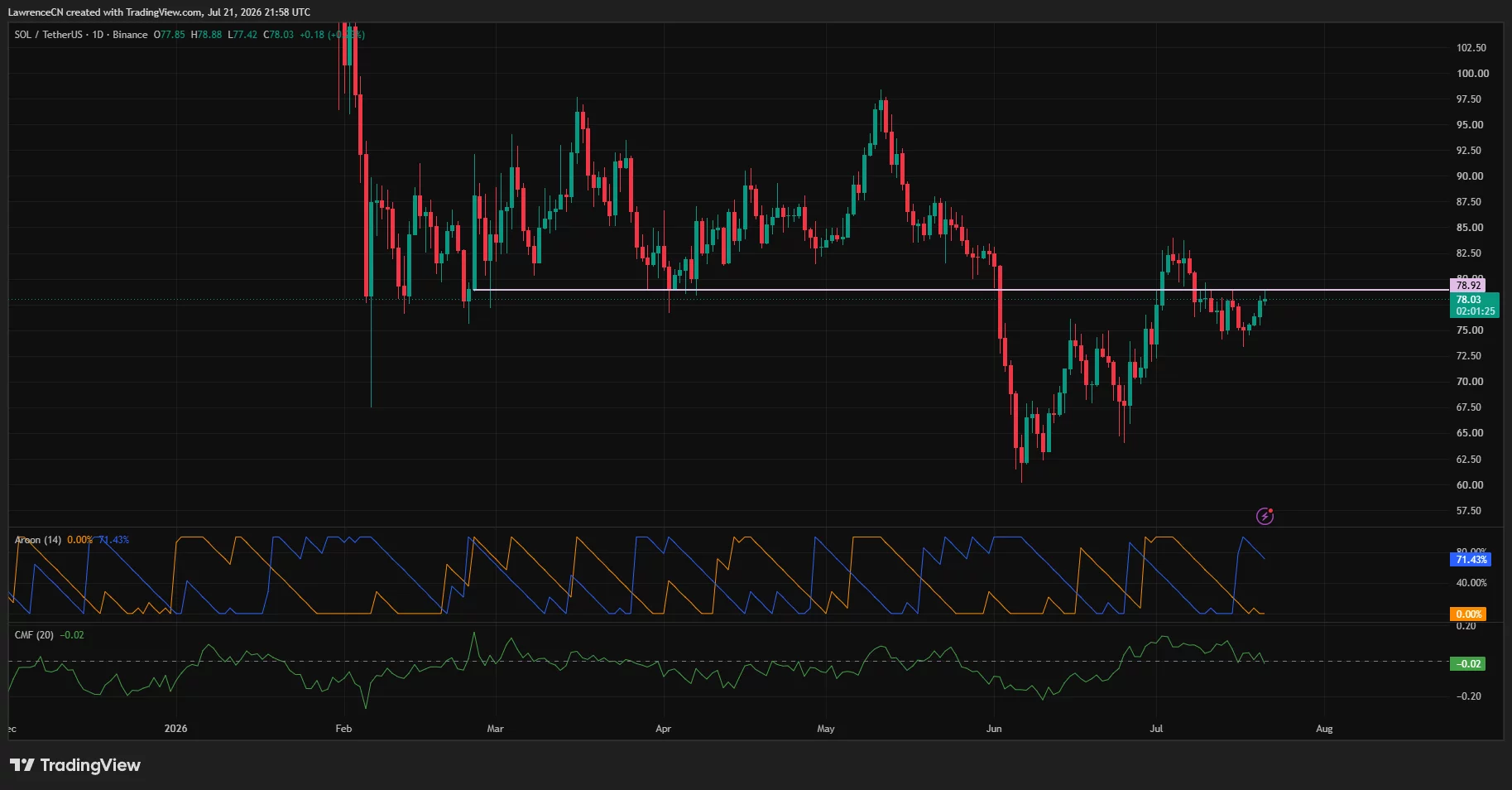
Solana price has climbed to $78 after buyers defended support near $74, though repeated failures below $80 and lingering concern over the BONK governance attack have kept market sentiment cautious.
Summary
- Solana price has recovered to $78 but must close above $80 to confirm a breakout.
- SOL trades above four key moving averages, while liquidity clusters could trigger a short squeeze.
- A loss of the $75.55 support would expose $72.50 and the June range floor near $67.
According to data from crypto.news, Solana (SOL) price traded at $78.03 at press time, up marginally over the past 24 hours after moving between an intraday low of $77.42 and a high of $78.88. The token has recovered about 5% from its July 18 low but remains below the $82–$84 zone reached earlier this month.
Confidence across the Solana ecosystem took a hit after an attacker drained nearly $20 million from the BonkDAO treasury. According to crypto.news, the attacker spent roughly $4.4 million to acquire enough BONK to meet the governance threshold, then passed a proposal with 99.9% approval.
The incident did not compromise Solana’s base layer, but it exposed weak safeguards within a major ecosystem project. BonkDAO had low voter participation, no execution delay, and enough concentrated voting power for one participant to control the result, according to crypto.news analysis.
Meanwhile, demand through regulated investment products has provided some support. U.S. spot Solana exchange-traded funds recorded $8.36 million in net inflows on July 6, their strongest day in nearly two months, according to data from SoSoValue. Early-July inflows reached about $5.75 million during one full trading week, with no daily outflow reported over the period.
Geopolitical pressure remains a hurdle for high-beta cryptocurrencies. Brent crude settled at $91.01 on July 21 after U.S.-Iran hostilities, and Houthi threats against Red Sea shipping routes raised concern over energy supplies. The dollar index also advanced to 101.16 as traders increased bets that higher oil costs could keep the Federal Reserve focused on inflation, Reuters reported.
A stronger dollar and renewed rate-hike expectations usually reduce demand for speculative assets. Solana may therefore need both crypto-market strength and less pressure from energy prices to sustain a move beyond nearby resistance.
Solana needs a daily close above $80 to unlock the next range
The daily chart places SOL directly below resistance at $78.92, a level that previously acted as support in February, April and early June. Buyers briefly reclaimed it during the first half of July, but price slipped back underneath after stalling near $83.
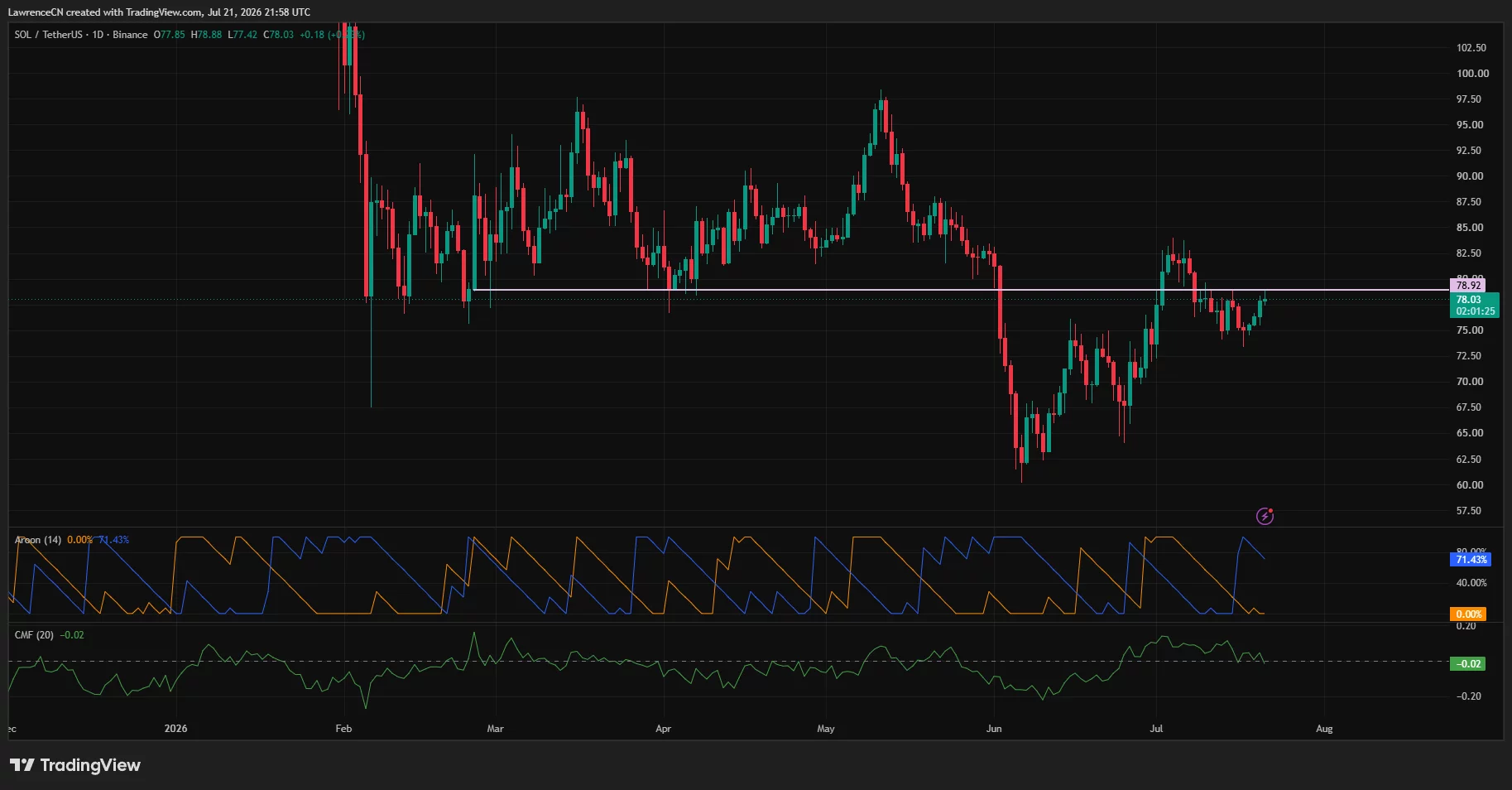
A daily close above $78.92 would clear the first barrier, while $80 remains the psychological level required to confirm a breakout. Beyond it, the July swing highs between $82.50 and $84 form the next supply zone. A close above $84 could open the route toward $90 and the previous range high near $97.60.
Daily momentum favors another test. The Aroon Up reading stands at 71.43%, while Aroon Down has fallen to zero, showing that recent highs carry more weight than recent lows. However, the Chaikin Money Flow remains slightly negative at -0.02, which shows that capital inflows have not yet matched the price recovery.
According to crypto trader Daan Crypto Trades, SOL has reached a “key high timeframe region” that will decide whether bulls can attack the upper end of the range.
“Either the bulls push through and set a higher low here to take a stab at the range high in the $90s. Or this rejects here and dribbles back down to that mid $60s area.”
The 4-hour chart offers a more constructive setup. SOL trades above its 20-period moving average at $77.01, its 50-period average at $76.42, its 100-period average at $77.60 and its 200-period average at $75.55. Regaining all four lines has placed short-term control with buyers.
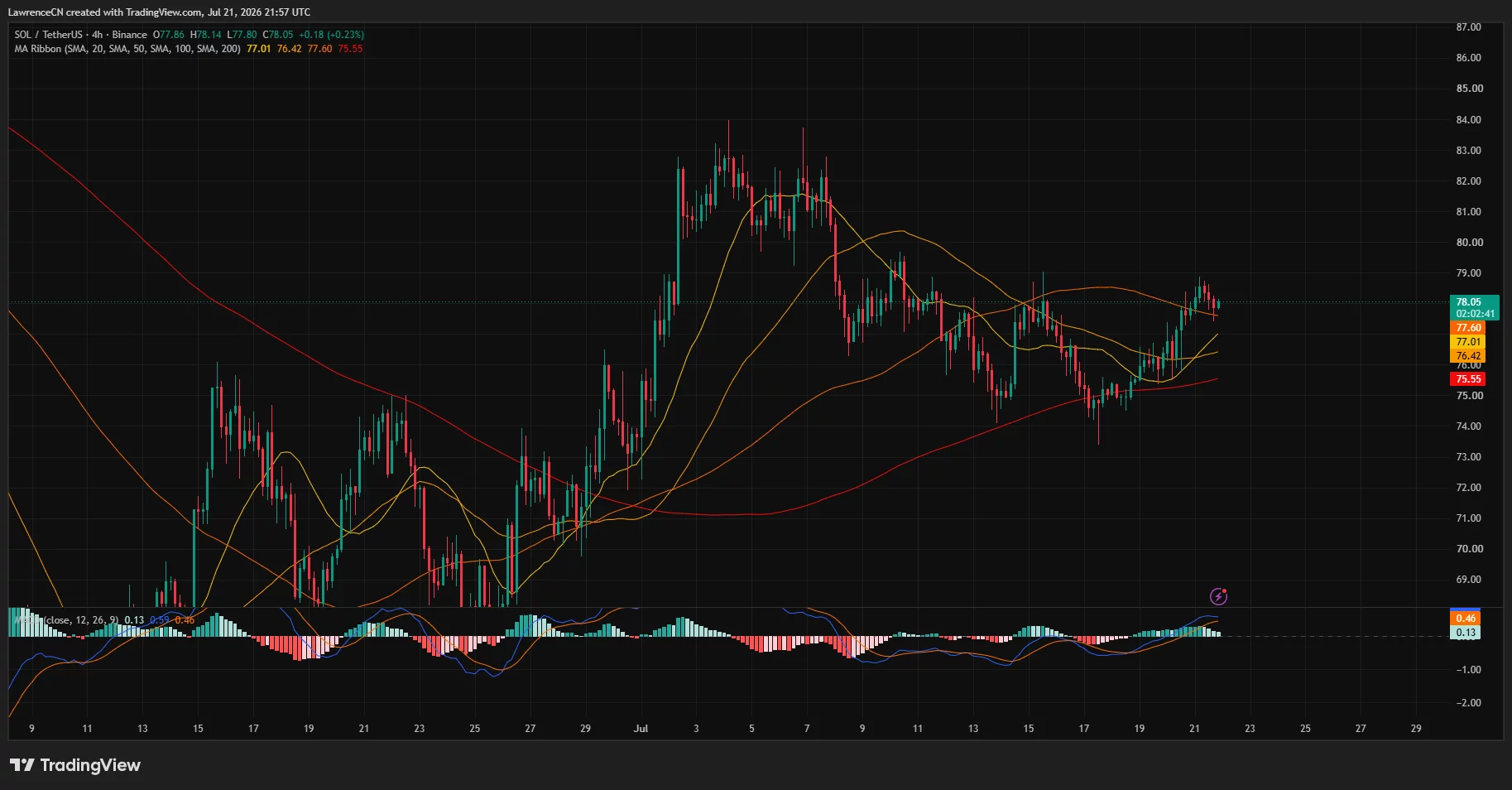
The 4-hour MACD remains above its signal line, although its histogram has narrowed to 0.13. Momentum has therefore stayed positive, but buyers need stronger follow-through before the move can extend through $80.
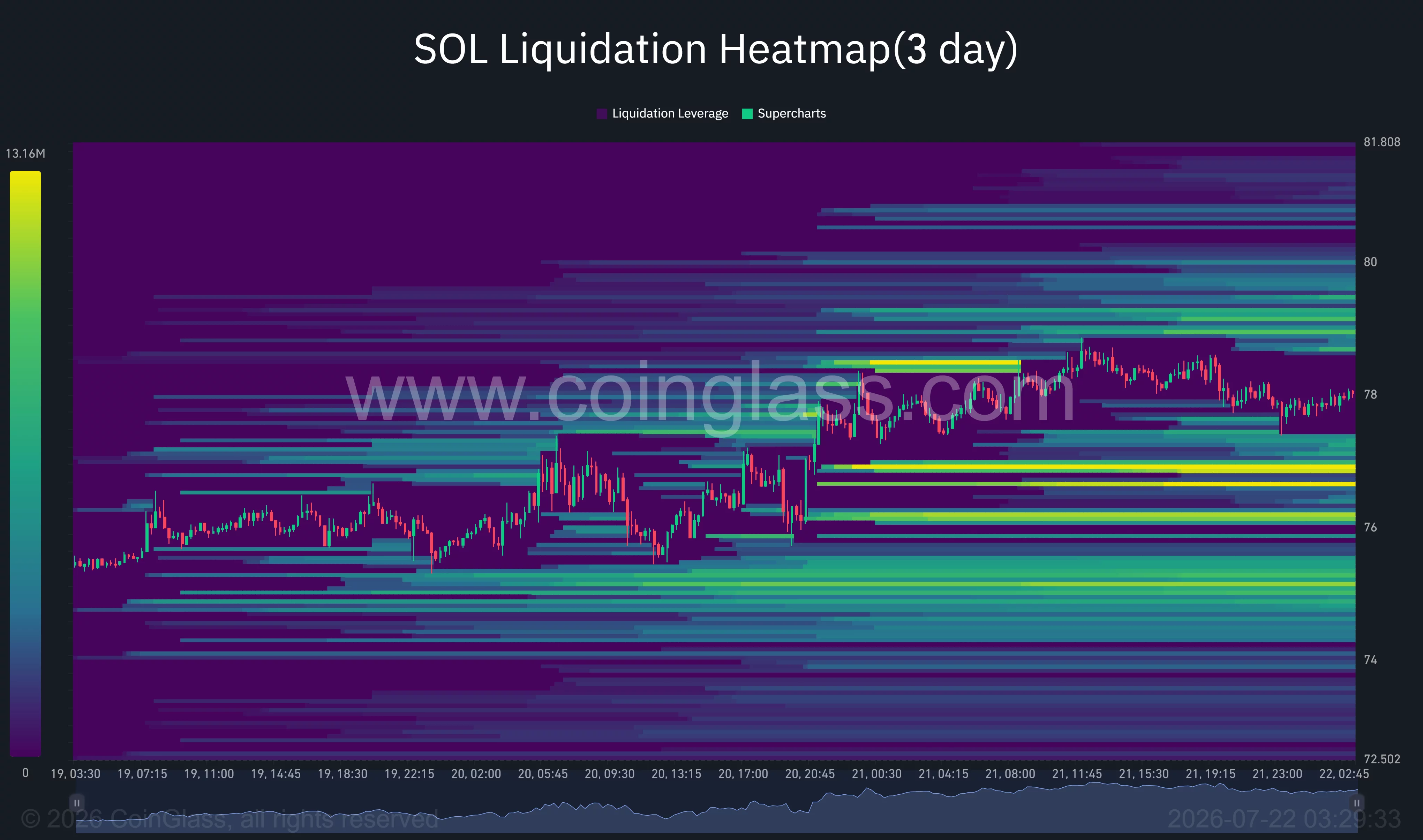
Derivatives liquidity could help accelerate a breakout. CoinGlass’ three-day liquidation heatmap shows concentrated short-liquidation bands near $78.50, $79.20 and $80.60. A move through $79 could force leveraged bears to close positions and add market buy orders, creating the conditions for a quick test of $81.
Loss of $75.50 would invalidate the bullish setup
Below the market, the largest nearby liquidation pools sit around $76.80, $76.10 and $75. A downturn through those levels could trigger long liquidations and pull SOL toward $74, where buyers stepped in during the latest retracement.
The 4-hour 200-period moving average at $75.55 serves as the main invalidation line. A sustained close below it would return SOL beneath its moving-average cluster and expose $72.50, followed by the June range floor near $67.
Oil above $90, further U.S.-Iran escalation, or another Solana ecosystem security incident could strengthen the bearish case. For now, the charts support another attempt at $80, but SOL must close above that level with stronger capital inflows to turn the recovery into a confirmed breakout.
Disclosure: This article does not represent investment advice. The content and materials featured on this page are for educational purposes only.


Movement Labs has filed for Chapter 11 bankruptcy with no more than $500,000 in assets and liabilities that could reach $10 million following more than a year of turmoil around the MOVE token.
Summary
- Movement Labs filed for Chapter 11 with up to $10 million in liabilities.
- Rushi Manche holds its largest unsecured claim, worth more than $1.6 million.
- Move Industries says its operations and Movement blockchain development remain unaffected.
Court records show that MVMT Labs submitted its petition on July 15 in the U.S. Bankruptcy Court for the District of Delaware. The original developer of the Movement blockchain listed between $100,001 and $500,000 in assets, up to $10 million in liabilities and as many as 299 creditors.
Former co-founder and chief executive Rushikesh “Rushi” Manche holds the largest unsecured claim at more than $1.6 million, according to the filing. The document also names the Delaware Division of Corporations, Move Industries, Anchorage Digital and security auditor OtterSec among the claimants, with the Delaware agency allegedly owed $459,000.
Despite being removed from the company in May 2025, Manche still owns a 34.25% equity stake in Movement Labs. He previously sued the company in the Delaware Court of Chancery and secured payment of legal expenses connected to a U.S. Department of Justice grand jury investigation into the MOVE launch.
Movement Labs originally served as the main research and development company for Movement Network, which launched as an Ethereum layer-2 using the Move programming language. Meta initially developed Move for its abandoned Libra and Diem digital currency projects.
Before the token controversy, Movement Labs had attracted substantial venture funding. The company raised $38 million in a Series A round led by Polychain Capital, while Reuters reported in January 2025 that it was close to completing another $100 million round at a proposed $3 billion valuation.
MOVE scandal left lasting damage
Movement Labs’ problems intensified after MOVE debuted on exchanges in December 2024. An investigation by CoinDesk found that a market-making agreement handed 66 million MOVE tokens, or about 5% of the supply, to a little-known intermediary called Rentech.
According to internal documents reviewed by CoinDesk, wallets linked to market maker Web3Port sold the tokens one day after MOVE’s exchange debut and generated about $38 million. The sale placed a large share of the publicly traded supply under one counterparty’s control and contributed to a steep fall in the token’s price.
Scrutiny also fell on the structure of the agreement because Rentech appeared in contracts both as a Movement Foundation agent and as a Web3Port affiliate, CoinDesk reported. Rentech denied misrepresenting itself, while Movement co-founder Cooper Scanlon told employees that the project was examining whether it had been misled.
Reviewing the documents, crypto founder Zaki Manian argued that the terms created incentives to raise MOVE’s valuation before selling tokens to retail traders.
“Even participating in a discussion where that’s on paper is insane,” Manian told CoinDesk.
Binance later banned the market-making account for what the exchange described as misconduct and froze the profits linked to the token sales. Movement Network Foundation subsequently announced a $38 million MOVE repurchase plan using the recovered funds and hired outside firm Groom Lake to investigate the agreement.
Leadership changes followed the inquiry. Movement Labs terminated Manche after alleging that he had signed undisclosed agreements, while the company transferred core development responsibilities to the newly formed Move Industries under chief executive Torab Torabi.
Trading disruptions compounded the damage. The Block reported that Binance and Coinbase suspended MOVE trading after the launch controversy, while TradingView data cited in the original report placed MOVE near $0.0108 following the bankruptcy news, with the token gaining less than 1%.
Move Industries remains outside the filing
Move Industries has denied any involvement in the Chapter 11 case and continues to operate the blockchain separately from Movement Labs. Addressing the filing on X, Torabi stressed that the two companies are distinct legal entities.
“Move Industries is operating normally. We continue to put our heads down and build.”
Movement Network Foundation confirmed in December 2025 that Move Industries had become the network’s primary service provider and assumed its main operating duties. Under that arrangement, the foundation remains the independent network steward, while Move Industries handles development, operations and ecosystem work.
Following the corporate separation, Move Industries converted Movement from an Ethereum layer-2 into an independent layer-1 network. The company has since positioned the chain as infrastructure for stablecoin payments, cross-border transfers and remittances in emerging markets.
Movement Labs is the second prominent crypto company to seek U.S. bankruptcy protection in recent months. In May, Nasdaq-listed Bitcoin Depot entered Chapter 11 in the Southern District of Texas to close its crypto ATM business and sell its assets under court supervision.
Unlike Movement Labs, Bitcoin Depot blamed tighter state rules, lower transaction limits, litigation and enforcement pressure for making its model unsustainable. The company took more than 9,000 kiosks offline and included its Canadian entities in the court-supervised process, according to its May 18 announcement.
August 7 — the fast-approaching final day before the Senate’s summer recess — is seen as a major deadline for finishing the Clarity Act this year. Crypto insiders are expecting the bill to get to the floor as soon as the beginning of next week, which would fit with what Senate Majority Leader John Thune had previously indicated. The legislation could require several days to get to a final vote.
Earlier on Tuesday, CoinDesk had reported that a White House official said Trump agreed to “the most comprehensive and wide-ranging ethics provision in history,” though the actual language he’s accepted hadn’t yet been shared with Democrats. As of press time, it was still unclear if Democrats had seen the exact language. Still, the administration argued that it had “bent over backward” to satisfy Democrats, suggesting it would be their fault if the legislation doesn’t advance.
Trump’s agreement to a crypto constraint of his own business ties raises significant questions about how his involvement would be made sufficiently remote to comply with the limit. The president and his family are deeply connected to several crypto business initiatives, including their ownership stake in World Liberty Financial. While Trump has insisted he’s not conflicted as his administration imposes crypto policies that affect his own businesses, Democratic lawmakers have openly accused him of corruption.


A crypto lobbying organization has sued the state of Illinois over a last-minute tax provision inserted into the state budget last month.
The Digital Chamber alleged that Illinois’ Digital Asset Tax Act violated both the U.S. and state constitutions and is preempted by a federal tax law. The lawsuit, filed Tuesday, asks a federal judge to block the Illinois state government from enforcing the tax.
The tax violates the Illinois state constitution’s uniformity and due process clauses, the Commerce Clause of the U.S. Constitution and the Internet Tax Freedom Act by specifying digital asset transactions, the suit said.
The Digital Asset Tax Act was passed and approved on short notice last month, right before the Illinois state government wrapped up its session for the year. The 0.2% tax applies to any entities that are based in Illinois or provide services with gross receipts of over $100,000. The tax takes effect in January.
TDC’s lawsuit said the Internet Tax Freedom Act alone created a rule that “electronic commerce would not be subjected to discriminatory state and local taxation.”

A customer walks into a café in Peru and wants to pay with crypto. The café accepts QR payments, but it has no crypto wallet or special crypto checkout. At that point, the customer would usually need to convert the funds or choose another way to pay.
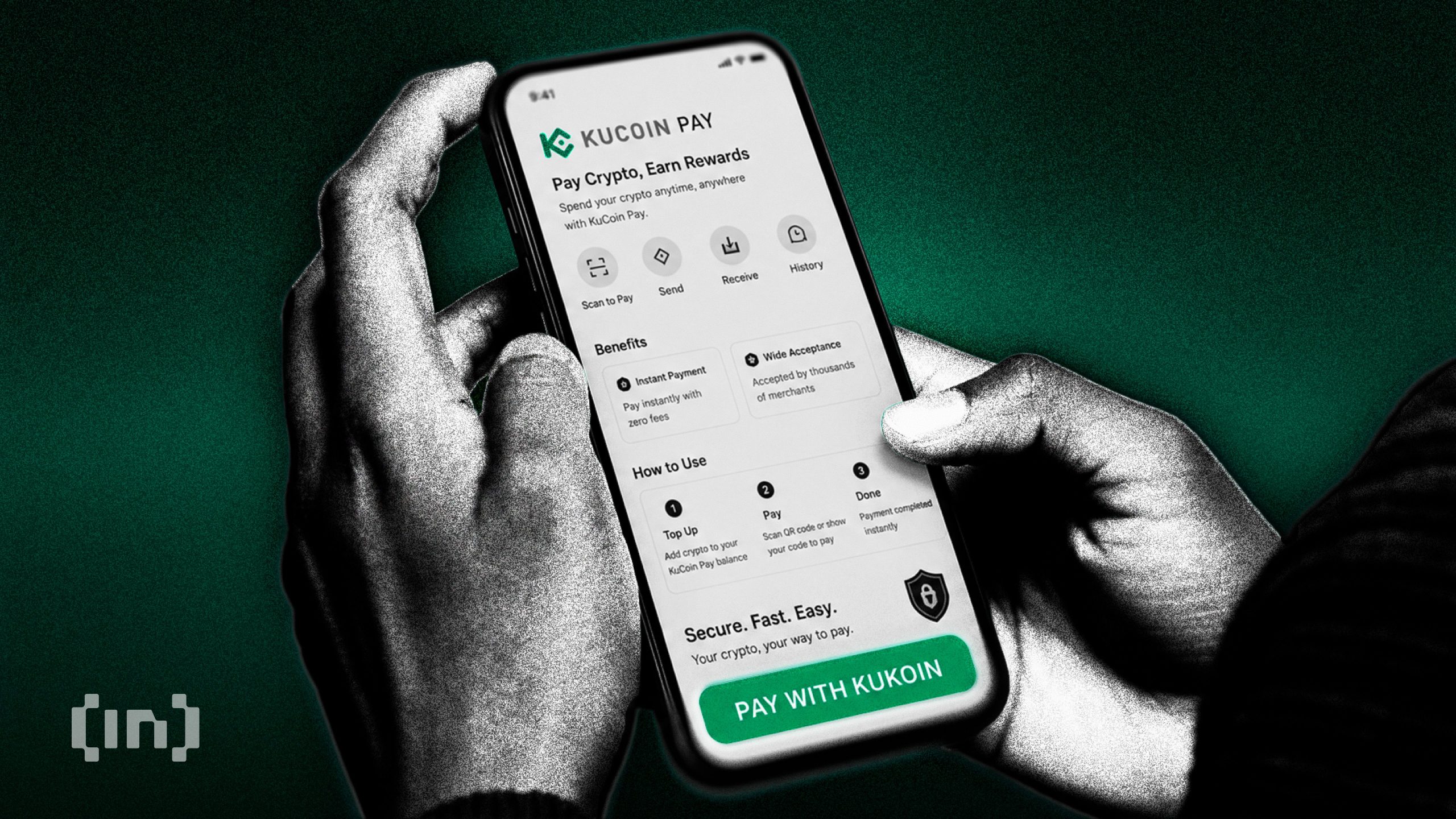
KuCoin Pay is trying to solve this problem by offering a shorter route. The customer scans the café’s existing payment code and pays from their KuCoin crypto balance. The merchant continues using the local payment system already in place.
In June, KuCoin Pay added QR-based access in Argentina and Peru. A separate rollout connected users with bKash and Nagad in Bangladesh, Mexico’s SPEI bank-transfer system, and the MTN and Airtel mobile-money networks in Zambia.
The expansion builds on KuCoin Pay’s earlier integration with Brazil’s Pix network. Its current support pages also indicate broader QR payment coverage across Southeast Asia, alongside Open CryptoPay support in Switzerland.
Together, these integrations point to a larger ambition: making crypto held in a KuCoin account as accessible for everyday payments as funds in a local payment app, even across markets with very different financial systems.
The question is whether this routing layer can turn crypto holdings into payment infrastructure people use regularly.
The Real Product Is Routing
Global crypto networks use common technical standards, while retail payments remain heavily local. A Brazilian merchant expects Pix. Consumers in Bangladesh use mobile wallets. Mexican bank transfers move through SPEI.
That fragmentation creates the last-mile problem for crypto payments. Moving a stablecoin between blockchain addresses can take seconds, yet spending that value still requires a connection to the system used by the recipient.
KuCoin Pay handles that translation inside one interface. In QR-driven markets, the user scans a supported national code. For local transfers, the user selects a network and enters the recipient’s account or phone details. KuCoin then routes the payment through the supported local channel.
The product supports more than 50 cryptocurrencies, including USDT, USDC, Bitcoin, and KCS. KuCoin says the service is designed to offer a simple payment experience, with instant settlement and no payment fees charged by KuCoin.
Approved refunds are returned to the user’s funding account in USDT, although individual merchants may impose their own handling charges.
This model removes blockchain addresses and network selection from the checkout experience. The local payment method remains visible while crypto operates as the funding source.
Local Rails Solve Crypto’s Distribution Problem
In 2026, there is a wider change in how people access financial services. The World Bank’s Global Findex 2025 found that 79% of adults worldwide now have a financial account.
In low- and middle-income countries, 84% own a mobile phone. Mobile money and digitally enabled accounts are already shaping how people receive funds and make payments.
Stablecoins have also reached meaningful scale. Visa estimated that stablecoin supply grew by more than 50% during 2025 to $274 billion. Its adjusted data placed annual transaction volume above $10 trillion after filtering high-frequency trading wallets and automated activity.
Consumer spending remains a much narrower market. Visa’s crypto head said in January that stablecoins still lacked merchant acceptance at scale. Much of their on-chain activity continues to involve trading, treasury movement, or transfers between crypto platforms.
KuCoin’s local-rail strategy addresses that distribution gap. Merchants can remain inside the payment systems they already use. The consumer gains a route from a crypto balance to an existing retail endpoint.
Brazil provides the clearest example. KuCoin Pay users can scan a standard Pix QR code at a participating merchant and pay from the app. The merchant does not need to display a separate crypto wallet address or introduce a new checkout process.
Replicating that experience requires country-specific integrations. Argentina’s interoperable QR network works differently from Peru’s wallet ecosystem.
Bangladesh relies heavily on mobile financial services, while Zambia’s payment market centres on mobile-money operators. The interface can look consistent even when each transaction follows a different route underneath.
A Payment Layer Between Crypto and Local Finance
KuCoin describes the system as a unified technical entry point for local payment routing. That places KuCoin Pay closer to a payment orchestration layer than a simple crypto checkout tool.
“Real-world utility will define the next phase of crypto adoption, and payments are where this shift becomes most visible,” KuCoin Managing Director Alicia Kao said in the company’s Latin America expansion announcement.
KuCard already connects digital assets with merchants through the familiar Visa and Mastercard networks. KuCoin Pay complements this card-based model by extending crypto payments into national QR systems and domestic transfer networks.
This local approach could matter most in markets where cards are less central to everyday payments. It allows KuCoin to enter payment behaviour that has already formed around bank apps, mobile wallets, or phone numbers.
The underlying infrastructure still carries traditional financial dependencies. Local liquidity must be available, compliance rules differ by jurisdiction, and payment failures must be resolved clearly. Currency conversion can also affect the final cost, even when the payment product advertises no transaction fee.
The IMF has warned that stablecoins may lower payment friction while increasing risks around currency substitution and capital-flow controls. Those questions become more important as crypto platforms connect directly with domestic payment networks.
The Next Test Is Repeat Usage
KuCoin’s announcements establish geographic coverage. The platform has reported strong growth in on-chain payment volume, with 25x order growth and 60% growth in service Partner and merchant numbers.
These figures show that crypto payments are undeniably becoming an increasingly important layer of traditional financial infrastructure.
However, the practical test will come from ordinary transactions: users repeatedly paying merchants, transferring to local accounts, or topping up mobile services without encountering delays or unclear costs. Reliable performance across different local networks will matter more than the number of countries listed.
KuCoin Pay has established a credible route from crypto balances into familiar financial systems. Its wider infrastructure claim now depends on showing that people continue using that route after the launch campaigns end.
The post KuCoin Pay Wants Crypto to Blend into Local Payment Rails appeared first on BeInCrypto.
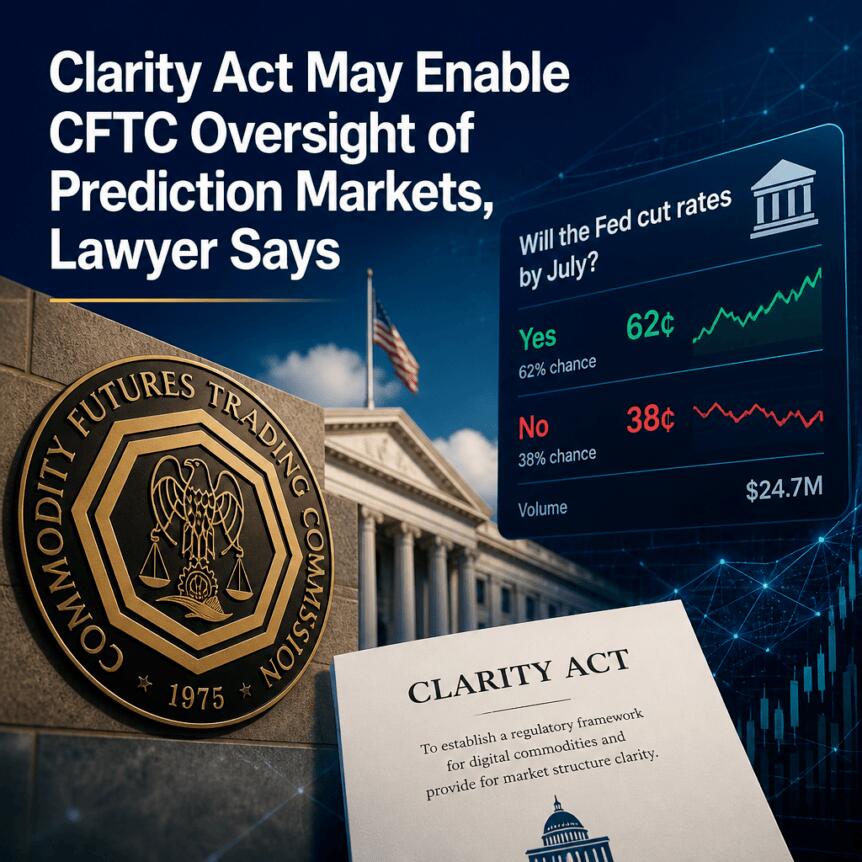
A U.S. House hearing this week zeroed in on who should regulate sports-event prediction markets and what kind of customer protections regulators can realistically enforce as these platforms expand. Lawmakers and legal specialists discussed the Commodity Futures Trading Commission’s (CFTC) role, the agency’s resourcing constraints, and the impact that pending U.S. crypto market-structure legislation—especially the Digital Asset Market Clarity (CLARITY) Act—could have on oversight of prediction market companies.
During a Tuesday session titled “Examining Customer Protections and Market Integrity in Sports Event Prediction Markets,” Carl Kennedy, a partner at Katten Muchin Rosenman, said the CFTC may be “short-staffed” for both regulatory supervision and enforcement of prediction market platforms such as Kalshi and Polymarket. Kennedy argued that the CLARITY Act could help by expanding the regulator’s authority to cover not only digital assets but also the “explosive growth of prediction markets.”
Key takeaways
- A House Agriculture subcommittee hearing highlighted a perceived mismatch between the CFTC’s capacity and the rapid growth of sports prediction markets.
- Experts pointed to the CLARITY Act as a potential vehicle to expand the CFTC’s jurisdiction over prediction markets alongside crypto assets.
- The CFTC chair’s “exclusive jurisdiction” stance has intensified federal-versus-state regulatory conflict involving Kalshi and Polymarket.
- Legislators expect the CLARITY Act’s bill text to be released soon, though details on prediction-market treatment have not yet been made public.
Why lawmakers are pushing on prediction market oversight
The hearing focused on how customer protections and market integrity should work in the specific context of sports event prediction markets. Kennedy’s intervention put a practical lens on the debate: even if the legal framework is clarified, enforcement still depends on agency resources.
He told the committee that the CFTC likely lacks enough staffing to fully address both regulation and enforcement for prediction market platforms. Kennedy’s argument linked this operational challenge to legislative timing—suggesting that any additional authorities from the CLARITY Act would need to come with the capacity to carry them out.
That point matters for market participants because prediction markets often rely on clear rules about how customer funds are handled, how conflicts are addressed, and how platforms maintain orderly trading. In a fast-moving sector, regulators typically face pressure to move quickly while also building the infrastructure to supervise new product types.
The CFTC’s jurisdiction claim and the state-federal clash
Part of the hearing’s urgency comes from ongoing legal and regulatory conflict. The CFTC chair, Michael Selig, has taken the position that the agency has “exclusive jurisdiction” over prediction market companies. Selig’s reasoning is that event contracts traded on these platforms are classified as “swaps,” placing them within the CFTC’s remit.
As Kennedy’s comments and related expert discussion underscored, this approach has fueled disputes with state authorities. Many Democratic senators have characterized the CFTC’s stance as an “assault” on states trying to regulate prediction markets. Several states have pursued legal action against Kalshi and Polymarket over sports-betting-like activity.
One flashpoint involved a Michigan court ruling that Kalshi said put it in an untenable position between state and federal directives. Earlier, reporting noted that Selig ordered Kalshi to ignore the Michigan court ruling—something the company described as creating a difficult compliance bind.
Legal experts quoted in earlier coverage have also suggested that these disputes could ultimately reach the U.S. Supreme Court. The underlying issue is structural: whether states can regulate prediction markets in parallel with the CFTC’s federal authority when the regulator views the contracts as swaps.
What the CLARITY Act could change—and what’s still unknown
In the hearing, attention turned to the CLARITY Act as the most immediate legislative lever on the horizon. Kennedy said the bill could grant the CFTC additional authority to address the “explosive growth” of prediction markets, implying that Congress may be willing to clarify—at least procedurally and jurisdictionally—how these products fit within the commodities regulatory framework.
However, the specific mechanics of how the CLARITY Act would treat prediction markets were not publicly detailed as of Tuesday. In reporting from the hearing session, Republican senators pushing for a vote before August state work periods said they expect to release the bill’s text soon, but no public details were provided on how the legislation would address prediction markets, ethics, or other concerns raised by legal experts.
One signal of the policy pressure surrounding the bill comes from earlier activity in Congress. In June, gambling industry groups petitioned the U.S. Senate to add language to CLARITY that would “explicitly prohibit” event contracts tied to sports and casino-style gaming. The White House has also been linked to ethics-related provisions in the package, with reporting stating the Trump administration “agreed to the most comprehensive and wide-ranging ethics provision in history” and worked to accommodate Democratic concerns.
Taken together, these threads show a tension that markets will watch closely: legislators appear to be trying to expand regulatory clarity for digital assets and related markets, while simultaneously debating whether prediction markets—particularly those resembling sports betting—should face stricter boundaries.
Why the timeline matters for platforms and customers
The sector’s near-term planning depends heavily on what Congress does next. If the CLARITY Act’s language expands the CFTC’s authority, it could potentially reduce some uncertainty for platforms—though it may also intensify legal battles with states if the legislation is interpreted as narrowing state power.
Just as importantly, the hearing made clear that authority alone may not solve the enforcement question. Kennedy’s “short-staffed” framing suggests the market could see continued compliance and supervision gaps even as legal frameworks evolve. For customers, those gaps can translate into uneven protections—especially during periods of rapid growth.
Readers should watch the release of the CLARITY Act text and closely track how it defines prediction markets, customer protection obligations, and the relationship between federal oversight and state regulation. The next legal steps—particularly any moves that could raise questions up the court system—may determine whether the regulatory tug-of-war ends or simply shifts into a new legislative framework.
Crypto World
Bets against SpaceX grow to 32% of float as Elon Musk warns short sellers won’t survive

Samuel Boivin | Nurphoto | Getty Images
Elon Musk warned that investors betting against SpaceX have little chance of survival — even as short sellers boosted their wagers against the company to about one-third of its publicly tradable shares ahead of several key catalysts.
About 206 million SpaceX shares are now sold short, representing roughly 32% of the company’s publicly tradable float and about $25 billion in notional bearish bets, according to estimates from S3 Partners. That’s up from about 185 million shares, or 29% of the float, just last week, and marks a dramatic increase from an estimated 40 million shares, or roughly 5% to 7% of the float, about a month ago.
“We continue to see short sellers adding exposure ahead of several key upcoming catalysts, including the company’s first earnings report as a public company and subsequent lock-up expirations,” Matthew Unterman, head of research at S3, told CNBC.
Musk responded to the growing short interest in a post on X, predicting investors betting against the company would ultimately lose.
“The survival probability of firms who maintain a significant short position in SpaceX over time is very low,” Musk wrote. “I said SpaceX will be worth more than Earth if we achieve our goals. Obviously true.”

SpaceX one month
SpaceX confirmed Tuesday that it will release its first quarterly earnings report as a public company after U.S. markets close on Aug. 4. The results will give investors their first detailed look at SpaceX’s performance since its initial public offering and could provide a fresh test for both bulls and short sellers.
The growing bearish position comes as investors weigh SpaceX’s long-term prospects against its valuation and the possibility of additional shares becoming available after lock-up restrictions expire. Bulls point to the company’s leadership in launch services, Starlink’s expansion, and its artificial intelligence ambitions, while skeptics have questioned how much future growth is already reflected in the stock.
SpaceX shares rose about 3% on Tuesday, snapping a seven-session losing streak after analysts at Macquarie reiterated their outperform rating and urged investors to buy the recent weakness. The stock climbed to around $124, though it remains below its $135 IPO price following a sharp post-listing pullback.
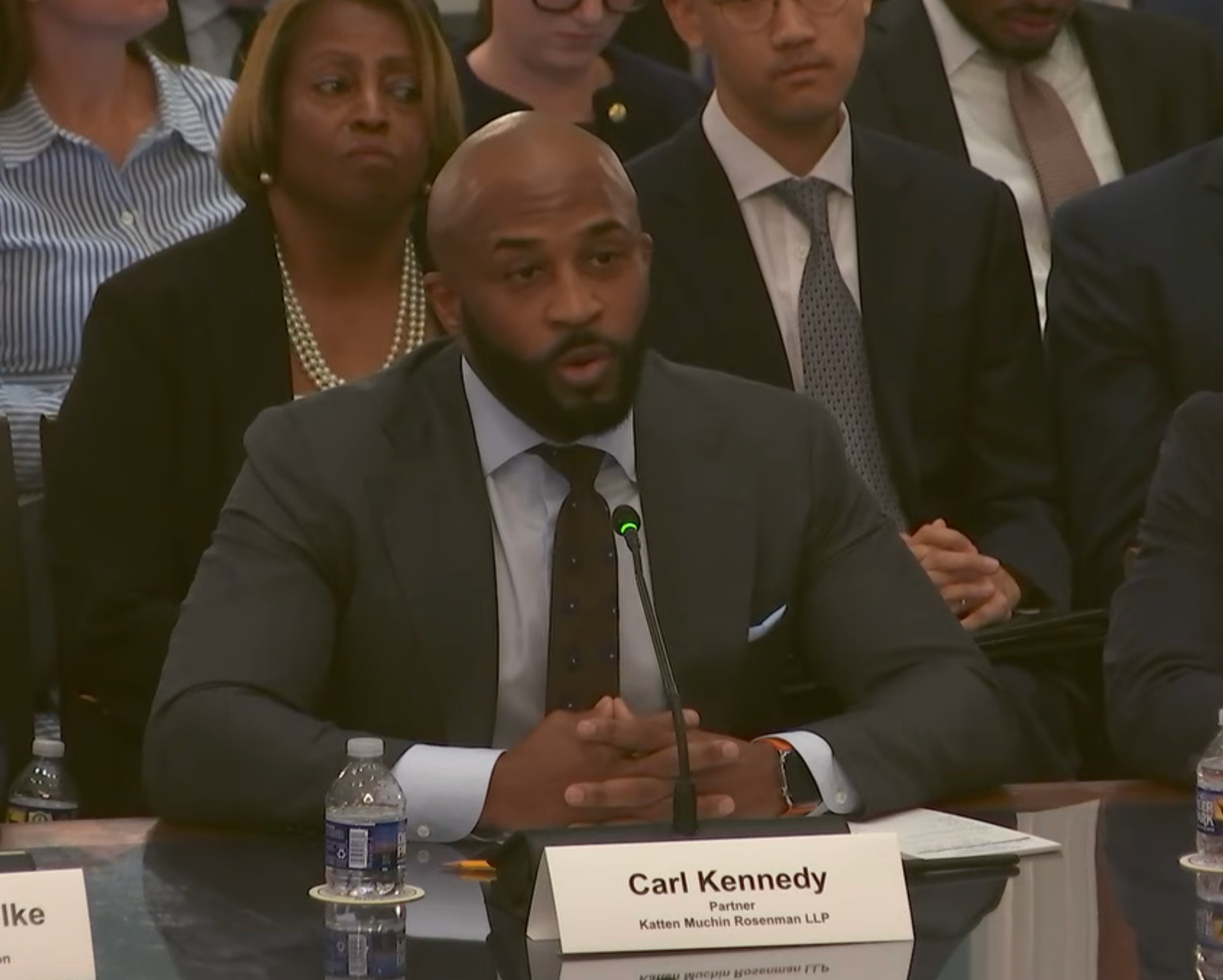
Lawmakers in the US House Committee on Agriculture’s Subcommittee on Commodity Markets, Digital Assets, and Rural Development held a hearing on how the Commodity Futures Trading Commission (CFTC) could address oversight of prediction market companies, including discussions of pending crypto market structure legislation.
In a Tuesday hearing on “Examining Customer Protections and Market Integrity in Sports Event Prediction Markets,” Carl Kennedy, a partner at New York law firm Katten Muchin Rosenman, said that the CFTC was likely too “short-staffed” to fully deal with the regulation and enforcement of prediction market platforms like Kalshi and Polymarket. According to the lawyer, the Digital Asset Market Clarity (CLARITY) Act under consideration in the US Senate could grant the commodities regulator additional authority not only to address digital assets but also the “explosive growth of prediction markets.”
“I do believe that with additional resources — they’re about to perhaps receive additional authorities under the CLARITY Act — with additional resources to address these new asset classes in the cash markets and crypto, as well as to deal with the explosive growth of prediction markets, I think that the CFTC certainly should receive additional resources,” said Kennedy.
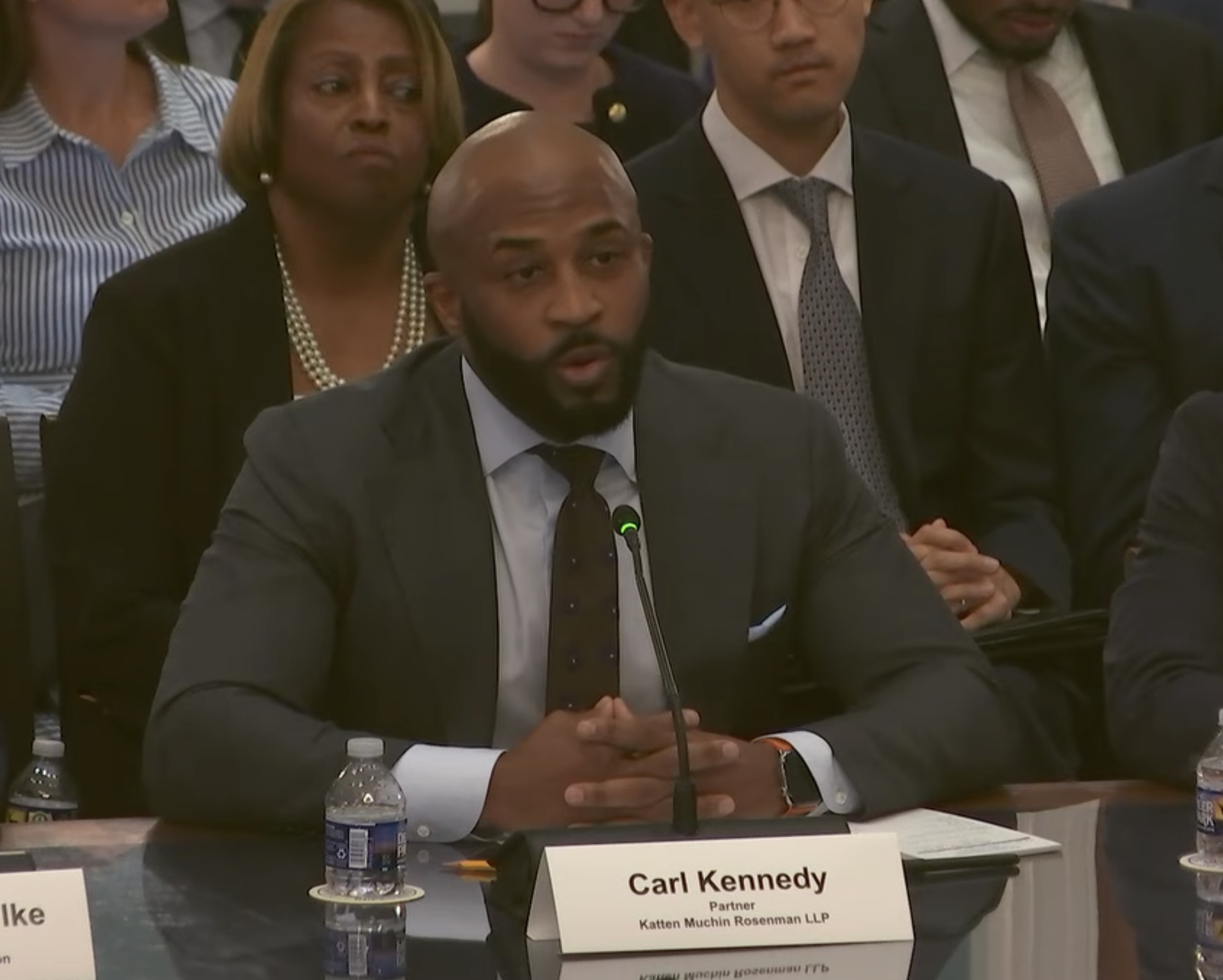
Carl Kennedy at Tuesday hearing. Source: House Committee on Agriculture
Kennedy’s remarks were just one example of legal and regulatory experts chiming in on the CFTC’s approach to handling prediction markets under Chair Michael Selig. Since being confirmed by the Senate in December, the chair has unilaterally taken the position that the agency has “exclusive jurisdiction” over the companies, arguing that event contracts on the platforms are classified as “swaps” under the CFTC’s purview. Selig is the only Senate-confirmed member heading the CFTC in a leadership panel normally consisting of five commissioners.
Related: Trump claims he can ‘future proof’ crypto regulation with CLARITY Act
The CFTC chair’s position has led to what many Democratic senators call an “assault” on state authorities trying to regulate prediction market platforms, with some US states filing lawsuits against Kalshi and Polymarket over sports betting. Last week, he ordered Kalshi to ignore a ruling from a Michigan court, which the company said “put [it] in an impossible position” between state and federal authorities.
Some legal experts expect that one or more of the prediction markets cases could eventually reach the US Supreme Court to address the clash between state and federal regulators.
Text of CLARITY Act expected to be released soon
Republican senators pushing for a vote on the CLARITY Act in Congress before the chamber breaks for August state work periods say they expect to release the bill’s text soon. Details on how the bill could address prediction markets, ethics and other concerns from lawyers were not made public as of Tuesday.
In June, gambling industry groups petitioned the US Senate to add language to CLARITY “that explicitly prohibits event contracts tied to sports and casino-style gaming.” The White House also confirmed reports that the Trump administration “agreed to the most comprehensive and wide-ranging ethics provision in history“ and it had “bent over backward to accommodate [Democrats’] concerns.“
Magazine: Peter Brandt predicts the exact day Bitcoin’s bear market will be over


Jack Mallers said he is stepping down as CEO of Twenty One Capital, the Tether-backed bitcoin treasury company he founded, to focus on his payments firm Strike. "I've decided to step down as CEO of Twenty One," Mallers wrote on X on Tuesday. "My life's work remains Bitcoin. My Bitcoin company is… Read the full story at The Defiant


Morpho, one of the largest onchain lending protocols, launched Midnight, a fixed-rate and fixed-term credit protocol, on the Base network. The team announced that "Morpho Midnight is live," describing it as "fixed rate, fixed term credit markets." Alongside the protocol, Morpho released a new… Read the full story at The Defiant

Kitzbühel 2026: Alexander Bublik vs Facundo Diaz Acosta preview, head-to-head, odds, prediction & betting tips

Apple’s $634M payment to Masimo now set in stone
‘Failure’ Hegseth melts down over questions about Iran war strategy as costs explode


-
 NewsBeat5 days ago
London Mayor Sadiq Khan handed a peerage by Keir Starmer alongside 15 other Labour figures… just days before the PM leaves No10
-

 Fashion4 days ago
Weekend Open Thread – Corporette.com
-

 Politics4 days ago
The House | The City of London can help the new chancellor deliver growth in every postcode
-

 Politics6 days ago
Young campaigners urge incoming PM to act on outdoor junk food ads
-
 Crypto World4 days ago
Two July Windows Left: The CLARITY Act’s Senate Fight and What Failure Means
-

 Crypto World6 days ago
CFTC blocks Kalshi from unwinding Michigan trades after court order
-

 Crypto World4 days ago
Ripple Payments Joins MiCA With 14 Firms, Does It Mean Anything For XRP?
-

 Business6 days ago
Nvidia Stock Slips After Big Tuesday Rally as Huang Confirms Vera Rubin Chip Is Now in Production Today
-

 Politics2 days ago
Democrats look to World Cup watch parties to register thousands of voters
-
 Entertainment6 days ago
Disney’s Most Ambitious Failed Star Wars Attraction Is Coming to SDCC
-

 Crypto World4 days ago
Ripple wins EU-wide access as ESMA adds it to MiCA register
-

 Crypto World14 hours ago
Grayscale Files For Worldcoin ETF, WLD Registers Sharp Rise
-

 Crypto World5 days ago
Injective Submits SEC Transfer-Agent Registration to Onchain Ownership Records
-

 Business6 days ago
Palantir Shares Rise After Expanded Nvidia Partnership and Fresh Analyst Upgrades Ahead of Earnings Day
-

 Tech22 hours ago
Sail Virtually Aboard The “Itanic” With IA-64 Emulator
-
 Tech20 hours ago
Turtle Beach Command Series KB7 review: a nifty screen-equipped gaming keyboard
-

 NewsBeat4 days ago
Registration is now open for March for Men with Kev 2026
-

 NewsBeat1 day ago
Unregistered fitter used Gas Safe logo on business flyers
-
 Sports6 days ago
New Cornerback Enters Vikings Trade Rumor Mill
-

 News Videos5 days ago
Money | Class 12 Economics | CBSE Board Exam 2026-27
You must be logged in to post a comment Login