
Crypto World
Mt. Gox’s former CEO floats a hard fork to recover 80K hacked Bitcoin


Mark Karpelès, the former CEO of Mt. Gox, has revived a controversial bid to claw back billions stolen from the once-dominant Bitcoin exchange. In a Friday GitHub submission, Karpelès proposed a consensus-rule change that would enable the transfer of 79,956 BTC—currently held in a single recovery address without the original private key—to a dedicated recovery wallet. The move targets more than $5.2 billion in assets based on recent price levels and comes as the Mt. Gox trustee Nobuaki Kobayashi continues creditor distributions. The proposal unfolds against a backdrop of ongoing debates about Bitcoin’s immutability and the governance process that underpins the network.
Key takeaways
- The proposal seeks a hard fork to retroactively validate a previously invalid on-chain transaction, enabling the movement of Mt. Gox’s recovered BTC to a recovery address.
- Activation would require a broad network upgrade, as every node would need to adopt the change for the recovery operation to occur.
- The Mt. Gox trustee remains focused on creditor distributions, and on-chain recovery has not been pursued by him—creating a potential procedural deadlock that Karpelès aims to address with a concrete proposal.
- Critics argue that authorizing a recovery via a hard fork could undermine Bitcoin’s core principle of immutability, while supporters say the move could deliver restitution to affected creditors and bring clarity to an unresolved chapter in the exchange’s history.
- The discussion is publicly visible on forums and social media, with a mix of skepticism, caution, and some creditors expressing interest in recovering funds if feasible.
- Regardless of outcome, the debate highlights the tension between restitution and the decentralized integrity of the Bitcoin protocol.
Tickers mentioned: $BTC
Sentiment: Neutral
Market context: The episode sits at the intersection of governance debates in decentralized networks and the broader attention on restitution for legacy hacks, underscoring how on-chain recovery ideas can surface amid creditor proceedings and evolving regulatory scrutiny.
Why it matters
The Mt. Gox saga is embedded in Bitcoin’s history, and any attempt to move coins via a protocol change raises foundational questions about what Bitcoin is allowed to be in practice. The proposal, if discussed seriously and pursued, would test the boundary between protocol-level immutability and the legitimate pursuit of restitution for victims of one of the most infamous hacks in crypto history. Bitcoin’s developers, miners, and node operators would be convened to evaluate whether a consensus-rule upgrade could safely reconcile a dispute that sits outside the typical on-chain transaction flow. Critics argue that even discussing such a mechanism could erode confidence in a system built on a trustless, irreversible ledger. Proponents, however, point to the nearly two-decade-long wait for a definitive resolution and the ethical imperative to return assets to creditors when a solvency and theft case is clear in law and in fact.
The discussion also spotlights the role of the Mt. Gox trustee, Nobuaki Kobayashi, who has been tasked with distributing recoveries to creditors under a bankruptcy framework. His team has indicated that on-chain recovery would require a level of legal certainty and community consensus that may not exist, effectively stalling potential recovery pathways. Karpelès argues that the plan would not circumvent established processes but would catalyze a debate that could lead to a pragmatic resolution if there is broad agreement among stakeholders. The tension between procedural caution and the desire for restitution is a central theme, with the Bitcoin community weighing the long-term implications for the protocol’s governance and perceived neutrality.
The broader crypto environment is watching closely. While the specifics of the Mt. Gox funds are unique, the questions raised—whether a protocol-level change should ever unlock previously inaccessible assets, and under what circumstances—resonate with ongoing discussions about on-chain governance and the limits of what a decentralized network should decide collectively. The episode also intersects with regulatory conversations about how restitution cases should be handled in crypto, and how such moves could influence investor expectations in a space that continues to grapple with hacks, mismanagement, and the accountability of project teams.
What to watch next
- The Bitcoin community’s formal response to the GitHub proposal, including any follow-up discussions on Core developers’ channels.
- Whether the proposed activation height and upgrade path gain support from miners, node operators, and major ecosystems participants.
- Any concrete statements from Nobuaki Kobayashi or the Mt. Gox creditor committee about on-chain recovery viability under new consensus rules.
- New commentary from prominent developers or industry observers on the precedent such a change could set for future hacks or thefts.
- Updates from the Bitcointalk forum threads and social-media discussions that could influence perceptions of immutability and recovery ethics.
Sources & verification
- GitHub pull request: https://github.com/bitcoin/bitcoin/pull/34695
- Bitcoin address cited for unmoved coins: https://www.blockchain.com/explorer/addresses/btc/1FeexV6bAHb8ybZjqQMjJrcCrHGW9sb6uF
- Jameson Lopp discussion post: https://x.com/lopp/status/2027482550415847770
- Luke Dashjr update: https://x.com/LukeDashjr/status/2027594666690912414
- Bitcointalk discussion thread: https://bitcointalk.org/index.php?topic=5575915.new#new
Hard fork debate over Mt. Gox funds: Key figures and next steps
The core idea, as laid out by Karpelès, centers on a patch that would render a targeted, previously invalid transaction valid, thereby enabling a significant on-chain recovery. He emphasizes that this is a hard fork, not a stealth change: “This is a hard fork. It makes a previously invalid transaction valid. All nodes would need to upgrade before the activation height.” The explicit acknowledgment of a forked path helps separate the conversation from a passive suggestion and places it firmly in the realm of a concrete, testable proposal. He stresses that the intention is not to bypass Bitcoin’s normal development process but to invite structured debate among developers and the wider community.
On the other side, critics argue that creating a mechanism to recover stolen funds by altering the on-chain consensus could erode Bitcoin’s trustless design. The Bitcointalk thread contains strong cautions that such a change could set a troubling precedent, potentially inviting future appeals to “undo” losses through protocol changes rather than through traditional enforcement and restitution mechanisms. A recurring theme in the discussions is the risk of undermining irreversibility, which many proponents regard as a foundational feature of Bitcoin’s security model. Yet some creditors who persisted through the bankruptcy process indicate a personal incentive to see any possible recovery move forward if a legitimate avenue exists.
The tension between immutability and restitution is not unique to Mt. Gox, but the scale of the potential recovery—79,956 BTC—renders this debate unusually consequential. If the proposal gains momentum, it would require not only the cooperation of a critical mass of node operators but also a clear legal and regulatory framework that supports on-chain recovery in a way that remains coherent with global enforcement standards. For now, the proposal remains a discussion starter, with proponents hoping it could catalyze a path toward restitution and critics urging caution to protect Bitcoin’s core principles.
Why it matters for the crypto ecosystem
For investors and creditors, the Mt. Gox case is a reminder that legacy hacks can linger for years and that governance questions remain unsettled in decentralized networks. The possible on-chain recovery would be a precedent-setting event, raising questions about how restitution can be reconciled with the long-standing commitment to a permissionless, immutable ledger. For developers, the episode underscores the challenge of balancing innovation with the risk of unintended consequences to the network’s security and reliability. It also highlights the practical constraints of building consensus around controversial changes in a space where decisions are ultimately collective and technically demanding.
Beyond Mt. Gox, the discussion speaks to a broader market dynamic: asset recovery remains a persistent theme as regulators and market participants assess how to treat stolen or misappropriated funds within crypto ecosystems. While some stakeholders advocate for aggressive on-chain remedies, others insist that irreversibility is a non-negotiable attribute of Bitcoin’s value proposition. The ongoing dialogue could shape how future governance proposals are evaluated, how recovery pathways are designed, and how much weight the community assigns to restitution versus protocol integrity.
What to watch next
- Public consensus-building on GitHub PR 34695 and any formal follow-ups or discussions with Bitcoin Core maintainers.
- Updates from Nobuaki Kobayashi and the Mt. Gox creditor committee regarding whether on-chain recovery could be pursued under any future framework.
- New technical assessments of activation heights, potential vulnerabilities, and the overall risk-reward profile of a hard fork to recover funds.
- Reactions from major exchanges, miners, and node operators about the viability and acceptability of such a change.
Sources & verification
- GitHub pull request: https://github.com/bitcoin/bitcoin/pull/34695
- Original recovery address for references: https://www.blockchain.com/explorer/addresses/btc/1FeexV6bAHb8ybZjqQMjJrcCrHGW9sb6uF
- Jameson Lopp discussion: https://x.com/lopp/status/2027482550415847770
- Luke Dashjr discussion: https://x.com/LukeDashjr/status/2027594666690912414
- Bitcointalk thread: https://bitcointalk.org/index.php?topic=5575915.new#new


TLDR:
- XRP open interest is falling across major exchanges, with Binance still holding the largest derivatives market share.
- Liquidation spikes and soft taker volume confirm that leveraged XRP positions are actively being unwound market-wide.
- XRP has gained dual commodity classification from the SEC and CFTC, marking a turning point in regulatory clarity.
- ETF inflows of $1.44B and Ripple’s $2.7B in acquisitions reflect rising institutional confidence heading into 2026.
XRP open interest continues to contract across major derivatives exchanges, reflecting an ongoing deleveraging trend in the market.
Despite this broad decline, Binance maintains the largest share of XRP open interest among top platforms. At the same time, a growing set of regulatory and institutional developments is taking shape in 2026.
Analysts are watching closely to see whether these catalysts can reverse the current market structure.
Binance Dominates as Leveraged Positioning Unwinds
Binance remains the primary venue for XRP leveraged trading, holding the most open interest across major exchanges.
However, the exchange’s own 24-hour data shows continued weakness in positioning, with no strong recovery in sight.
Net taker volume on Binance also remains soft, which points to limited aggressive demand from new buyers. This combination suggests the market is still in a reset phase rather than entering a fresh expansion.
Liquidation data adds further weight to this view. Recent liquidation spikes show that forced leverage cleanup has played a role in driving open interest lower.
Rather than reflecting fresh long conviction, the current structure points to position unwinding. Speculative appetite across XRP derivatives continues to fade as a result.
The overall trend across exchanges mirrors what Binance is showing internally. Open interest is falling in a broad and sustained manner, not in isolated bursts.
This pattern typically follows periods of elevated speculation and leverage buildup. For open interest to recover, the market would need stronger directional participation from both retail and institutional traders.
Until that recovery arrives, the market structure for XRP derivatives remains under pressure. Binance will likely continue to lead the space by volume and open interest.
However, the gap between Binance and other exchanges may shift if conditions improve on other platforms. Traders are watching these metrics carefully as a leading signal for XRP’s next move.
Regulatory and Institutional Catalysts Are Aligning in 2026
On the fundamental side, a series of developments are converging that some analysts say could drive a major move.
XRP has been officially classified as a digital commodity by both the SEC and the CFTC, bringing long-awaited regulatory clarity.
The CLARITY Act markup is targeting April, and Ripple CEO Brad Garlinghouse has placed the odds of passage at 80 to 90 percent. Additionally, a stablecoin yield compromise is reportedly near completion.
Institutional interest is also building at a fast pace. XRP-related ETFs have pulled in $1.44 billion in inflows, while Evernorth has filed its S-4 for a Nasdaq listing.
Ripple has also made over $2.7 billion in acquisitions and is expanding its global footprint. A Ripple National Trust Bank application is currently under review as well.
Crypto analyst X Finance Bull noted on X that in 2024, XRP ran from $0.49 to $3.60 on news alone. The analyst argued that the 2026 setup carries heavier weight, with regulation, infrastructure, and institutional capital aligning together. That framing has drawn attention from traders reassessing their positions.
Whether the derivatives market responds to these catalysts remains to be seen. Open interest recovery alongside stronger volume would signal a shift in market sentiment. For now, XRP sits at a crossroads between fading speculative leverage and growing structural support.

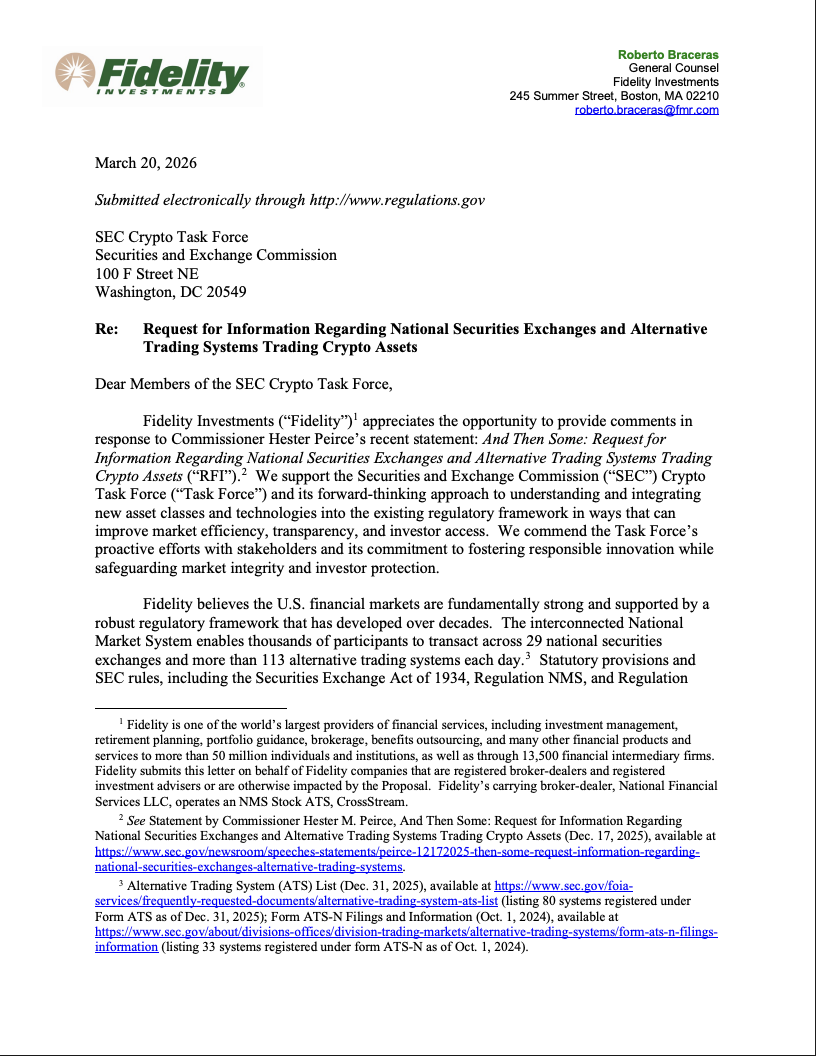
Fidelity Investments told the US Securities and Exchange Commission (SEC) on Friday that it should continue to develop the regulatory framework for broker-dealers to offer, custody and trade crypto assets on alternative trading systems (ATS).
The letter from the US’ third-largest asset manager was in reply to a call for comments earlier this month by the regulator’s Crypto Task Force.
Fidelity said it is “critical” for the SEC to develop a comprehensive regulatory framework and clear rules of the road for tokenized securities trading, including rules for trading tokenized securities issued by third parties.

Tokenized instruments have different issuance structures, legalities, and valuation models, the letter said. For example, tokenized real-world assets (RWAs) span entirely different asset classes like equities, real estate, bonds, or private credit.
“Tokenization models vary significantly in structure and in the rights afforded to holders,” the letter said. The company explained:
“In some models, the crypto asset represents a holder’s indirect interest in the underlying security through a securities entitlement, while in others, the crypto asset may constitute a securities‑based swap, which may be offered only to eligible contract participants.”
Fidelity also urged the SEC to bridge the regulatory gap between centralized and decentralized trading systems to “consider how intermediated and disintermediated trading venues can evolve and coexist,” the company’s general counsel, Roberto Braceras, wrote.

This includes overhauling existing reporting rules to reflect that decentralized finance (DeFi) trading platforms and other “disintermediated” systems cannot produce the detailed financial reporting required by the SEC because there is no central authority.
Additionally, Fidelity recommended that the SEC issue guidance permitting broker‑dealers to use distributed ledger technology for ATS and other recordkeeping purposes.
Overhauling reporting requirements to reflect this technological reality removes “undue burden” from decentralized systems, the letter said.
The Securities and Exchange Commission, under the leadership of Chairman Paul Atkins, has repeatedly signaled support for 24/7 capital markets and has given the regulatory approval for financial companies to experiment with tokenized trading.
Related: SEC interpretation on crypto laws ‘a beginning, not an end,’ says Atkins
US regulators say tokenized securities are subject to the same capital rules as underlying assets
Tokenized securities, which include equities, debt instruments, real estate investment trusts (REITs) and other securitized assets, are subject to the same banking capital requirements as the underlying assets they hold.
This view was shared in a joint policy statement published in March from the Federal Reserve, the Federal Deposit Insurance Corporation (FDIC) and the Office of the Comptroller of the Currency (OCC).
“The technologies used to issue and transact in a security do not generally impact its capital treatment,” according to the agencies.
Magazine: When privacy and AML laws conflict: Crypto projects’ impossible choice
TLDR:
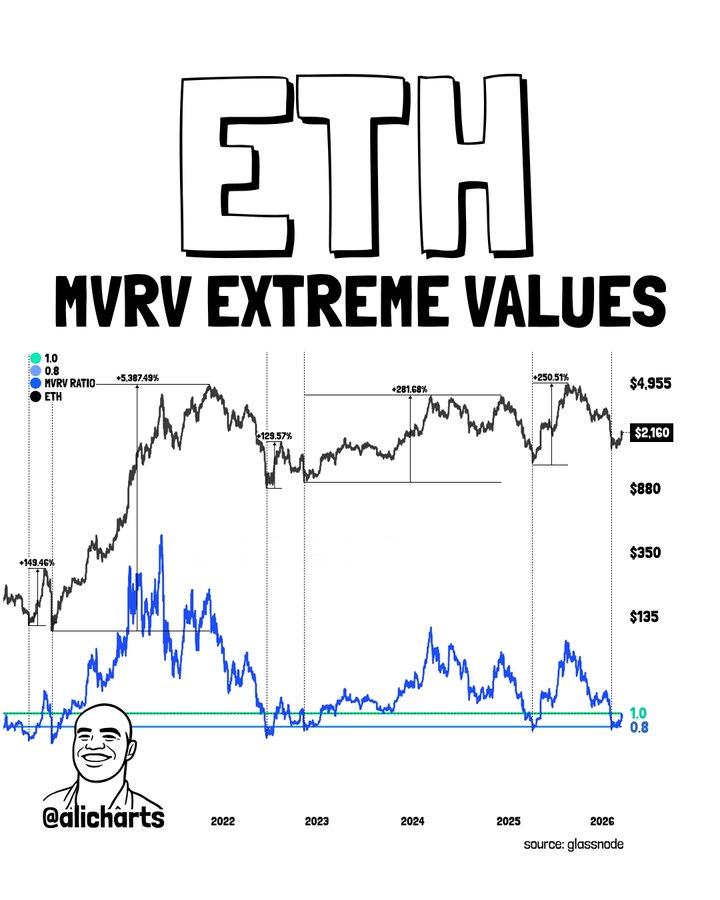
- Ethereum’s MVRV ratio dropped below 0.8, historically flagging a rare and powerful generational buy zone for ETH.
- ETH price tested the ascending triangle’s rising trendline near $1,800, defending a critical multi-year structural support level.
- The daily Supertrend flipped green for the first time since May, signaling a potential end to ETH’s prolonged sideways trend.
- Reclaiming $2,356 is the first confirmation needed before Ethereum can advance toward the long-term $10,000 price target.
Has Ethereum bottomed? That question is gaining traction across the crypto market as key signals begin to align. Ethereum recently tested the $1,800 price level, a zone that has drawn attention from both technical analysts and on-chain researchers.
A combination of chart structure and blockchain data now points to a potential trend reversal. The roadmap to $10,000 is becoming clearer with each passing week.
Price Action and On-Chain Data Point to a Potential Floor
Ethereum continues to trade within a well-defined ascending triangle on the weekly chart. The recent move toward $1,800 aligned precisely with the triangle’s rising trendline support.
This type of reaction at a major structural level carries significant weight for analysts. It suggests the market is defending a critical price floor rather than breaking below it.
On-chain data adds further backing to the bottoming thesis. The MVRV ratio recently dropped below 0.8, a historically rare reading for Ethereum.

Past instances of this level preceded some of the largest bull rallies in the asset’s history. Analysts widely refer to this threshold as a “Generational Buy” zone.
The timing of this on-chain reset is particularly notable. It occurred exactly as price tested the triangle’s trendline support on the chart.
The convergence of both signals at the same price point strengthens the case considerably. Such alignment across different analytical frameworks rarely happens by coincidence.
Ali Charts noted in a recent post that this combination is the strongest seen in a while. The analyst pointed to the $1,800–$2,000 range as a prime area for accumulation.
Dips into this zone should be treated as buying opportunities by market participants. This view holds as long as the $1,800 floor remains structurally intact.
The Roadmap to $10,000 Runs Through These Key Levels
The roadmap to $10,000 begins with reclaiming the $2,356 resistance level. This is the first confirmation that Ethereum is exiting the accumulation phase.
A sustained move above it would mark the transition into a true bull market expansion. Without clearing this level, the recovery remains in an early and unconfirmed stage.
The next targets on the roadmap sit at $2,647 and $3,639. These mid-term levels correspond to MVRV pricing bands that previously acted as notable resistance.
Breaking through them would validate the broader uptrend in a meaningful way. Each successful level cleared adds further confidence to the $10,000 target.
Beyond the mid-term range, long-term expansion zones are mapped at $4,632 and $5,624. These areas are expected to attract increased selling activity from market participants.
A clean breakout above them, however, would keep the bullish structure fully intact. Momentum through these zones would accelerate the broader move higher.
The all-time high region near $4,900 remains the most critical threshold on the roadmap. A decisive weekly close above it would complete the ascending triangle structure.
That breakout would open the path directly toward $10,000 for Ethereum. The entire bull market case rests on this level eventually being cleared.
The first couple of months of 2026 have forced the Ethereum community into a kind of introspection—one that goes beyond price, beyond technical upgrades, and into the question of what the network is actually trying to be.
Even before this year, there has been a sense among builders and executives that Ethereum was on the verge of another growth phase—this time driven not by crypto-native users but by institutions and technology. Neobanks, as some argued, would quietly onboard millions by abstracting away the complexity of wallets and gas fees. Ethereum, in this framing, wouldn’t need to win users directly. It would sit beneath the interface, powering a new financial stack that, on the surface, looked nothing like crypto.
It was a continuation of a long-running thesis: that Ethereum’s success would come from invisibility.
That vision has been shaped in part by years of previous upgrades aimed at improving user experience and reducing costs. Changes like “proto-danksharding”, introduced in the Dencun upgrade, significantly lowered fees for layer 2 networks by increasing data downloads for transactions, while ongoing improvements to the base layer have made transactions more efficient.
While the price of the network’s ether (ETH) token has been determined by market forces, these upgrades have, together, helped move Ethereum closer to a model where users interact with applications without needing to understand the underlying infrastructure.
But that narrative began to change a few weeks into the year, refocusing on the core roadmap.
The L2 debate
Earlier this year, the co-founder of the network, Vitalik Buterin, delivered a sharp reality check to the broader ecosystem: “You are not scaling Ethereum.”
The comment cut through what had, until then, been a largely celebratory conversation around rollups. These types of networks, also known as layer-2 (L2) networks, process transactions off Ethereum and then bundle them back onto the main chain to make it faster and cheaper. Layer-2 networks have exploded over the last few years, transaction fees have come down, and activity has spread—but the deeper question was whether any of this amounted to coherent scaling.
Buterin’s argument went further than a general critique of progress. In his view, many of today’s layer 2 designs are drifting away from Ethereum’s core model: relying on centralized components and siloed environments that don’t fully inherit the guarantees of the base chain. The concern wasn’t that L2s exist, but that in their current form, they may not be delivering the kind of scaling Ethereum was meant to achieve.
His critique highlighted a growing unease.
Fragmentation across L2s, inconsistent security assumptions, and reliance on centralized components were beginning to look less like temporary trade-offs and more like structural risks. Ethereum, in trying to scale outward, risked losing the very properties that made it valuable in the first place—its strong security, decentralization, and role as a shared, neutral settlement layer where applications and liquidity can seamlessly interoperate.
L2 teams, for their part, didn’t push back so much as recalibrate. Some acknowledged the critique and leaned into a future where rollups differentiate through specialization: privacy, consumer apps, or unique execution environments, rather than simply acting as cheaper Ethereum. Others defended their role more forcefully, arguing that high-throughput environments are still essential.
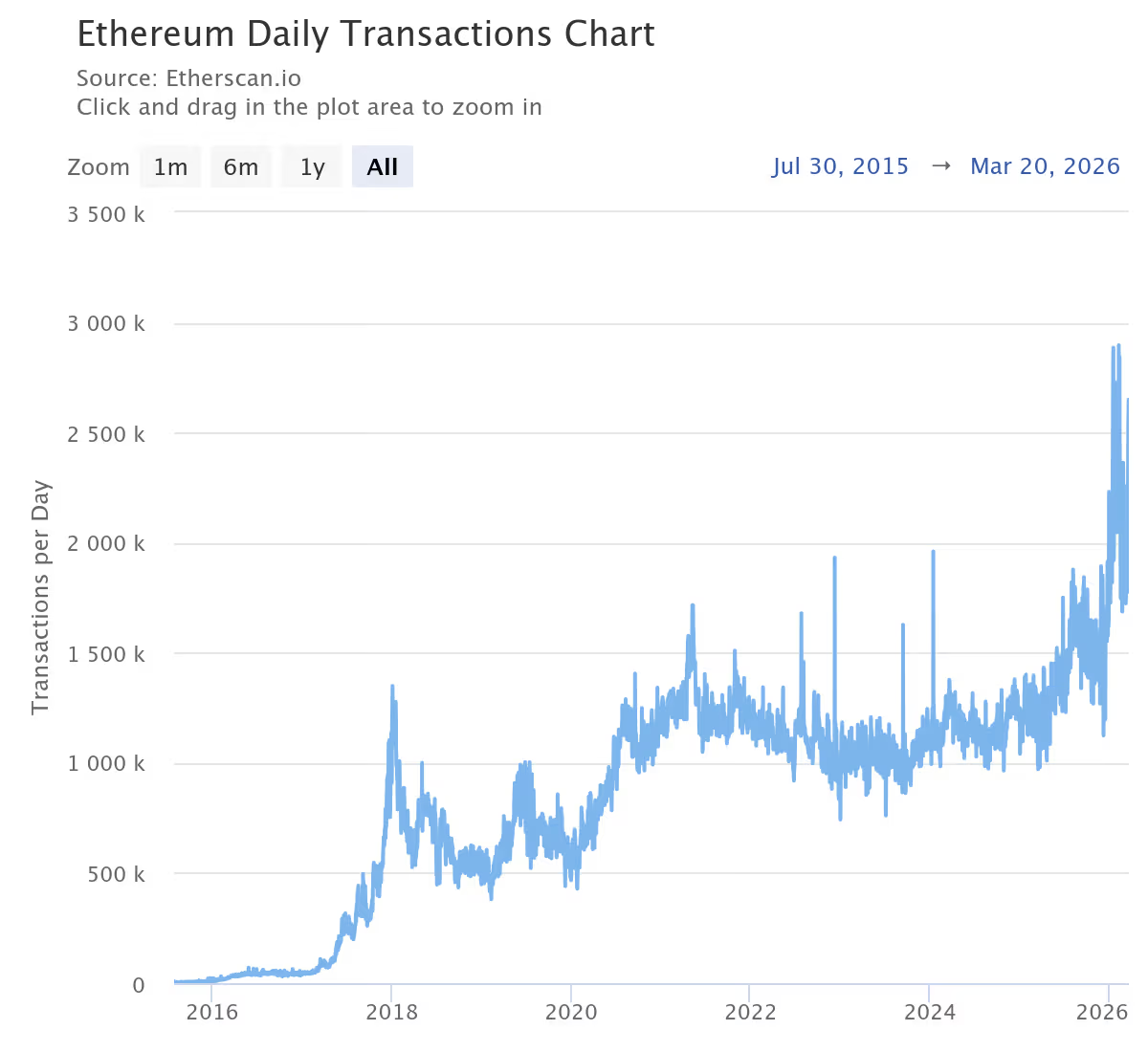
Ethereum’s base layer, meanwhile, has made incremental progress on its own. Recent upgrades, such as December’s Fusaka hard fork, increased data capacity and efficiency on the main network, allowing more transactions to be processed while lowering costs. Although that spike in transactions came under scrutiny recently, with some calling them ‘address poisoning’ scams.

What this tense episode established for Ethereum is that the path forward needs a delicate balance between the base layer’s structural upgrades and a new breed of specialized rollups that can grow the ecosystem without breaking its foundational security.
This could also lead to consolidation among the layer 2 networks, according to 21shares. “The year ahead is likely to mark Ethereum’s L2 consolidation: a leaner, more resilient layer anchored by ETH-aligned, exchange-backed, and high-performance networks,” the firm said in a research report.
The quantum threat
At the same time, another issue—long discussed but rarely urgent—suddenly moved up the priority list: Quantum Computing.
The Ethereum Foundation signaled a shift in posture, elevating efforts like ‘LeanVM’ and post-quantum signature schemes. What had once been treated as a distant, almost academic concern was now being folded into near-term planning.
The implication was hard to ignore: the network is no longer just building for the next cycle, but for threats that could fundamentally break its cryptographic assumptions. The foundation has signaled it is taking that risk seriously, establishing dedicated research efforts focused specifically on post-quantum security.
Vitalik Buterin also outlined a roadmap to protect the blockchain from the long-term risks posed by quantum computers
The internal shuffle
If scaling exposed cracks in Ethereum’s present, quantum risk cast a shadow over its future, and it seemed that the network was taking the threat seriously.
Then came changes from within.
The departure of Tomasz Stańczak as co-executive director of the Ethereum Foundation marked more than a leadership reshuffle. At a moment when the network is facing technical, strategic, and philosophical reevaluations all at once, even subtle shifts at the top can signal a broader recalibration.
The move also came as something of a surprise.
The foundation is not known for abrupt shifts, and Stańczak had only stepped into the role about a year earlier, following the long-standing tenure of Aya Miyaguchi. In an ecosystem that tends to favor continuity, the rapid turnover hinted at a deeper internal recalibration underway, as the foundation reassesses its priorities amid growing demands for scaling, security, and Ethereum’s potential role in new frontiers such as artificial intelligence (AI).
‘Trust layer’
And AI, a topic that has become impossible to ignore, not just for crypto but for every industry, began to shape a separate line of thinking for the network.
Buterin outlined how Ethereum could play a foundational role in the future of artificial intelligence. The vision extends beyond payments or DeFi—into a world where Ethereum acts as a coordination layer for decentralized AI systems, enabling verifiable outputs, trust-minimized data sharing, and machine-to-machine economic activity.
That push didn’t emerge overnight.
Early last year, the foundation spun up a dedicated decentralized AI research unit (dAI) exploring how the network could support autonomous agents and machine-to-machine economies. What felt experimental at the time has since accelerated into something more deliberate in 2026, with the foundation increasingly framing Ethereum as a potential “trust layer” for AI: a system for verifying outputs, coordinating agents, and anchoring a rapidly evolving ecosystem that, until now, has been largely controlled by centralized players.
All of this is an ambitious expansion of scope, placing Ethereum at the intersection of two of the most consequential technologies today.
But overall, the first three months of the year suggest that Ethereum no longer has the luxury of tackling these questions in isolation; rather, they are converging.
What emerges is a network being pulled in multiple directions, each one with its own sense of urgency, and a balancing act is becoming harder to ignore. And unlike previous cycles, where narratives could shift as quickly as prices, the issues now feel deeper, less about momentum, and more about structure.
These tensions are unlikely to be resolved anytime soon and will continue to shape Ethereum’s trajectory in the months ahead.
In the immediate term, however, the focus remains on scaling the base layer, with the upcoming Glamsterdam upgrade, slated for this year, expected to accelerate that effort. The upgrade will likely become a litmus test for the network’s ability to solve issues that can successfully shift Ethereum into a robust, quantum-secure “trust layer” capable of anchoring the global AI economy.
Read more: Ethereum’s ‘Glamsterdam’ upgrade aims to fix MEV fairness
Crypto World
Polkadot (DOT) Drops to $1.43 After 97.80% Macro Correction: Can It Repeat a 4,529% Rally?
TLDR:
- Polkadot has declined approximately 97.80% from its all-time high of over $55 reached in 2021.
- Analysts identify a high-risk HTF accumulation zone for DOT between the $1.10 and $1.30 price range.
- A weekly close below $1.20 serves as the formal invalidation level for any current accumulation thesis.
- DOT must reclaim and hold above $4.50 to confirm a descending channel breakout and bullish structure shift.
Polkadot (DOT) is currently trading at $1.43, recording a 4.68% price decline in the last 24 hours. The asset posted a 0.81% gain over the past seven days. Trading volume over the same 24-hour period stood at $123,467,162.
The token sits near a critical demand zone, drawing attention from technical analysts. Market observers are now assessing whether a major recovery is forming.
Polkadot Enters Deep Corrective Phase After 2021 Cycle Top
Polkadot reached an all-time high of over $55 during the 2020–2021 bull run. Since that peak, the asset has declined approximately 97.80% to its current price.
This places DOT firmly within what analysts describe as a macro corrective accumulation phase. The correction has extended from 2022 through the present period in 2026.
Crypto analyst CryptoPatel shared a detailed breakdown of the asset on X. The post noted that Polkadot may be forming the same structure that preceded a 4,529% rally.
According to the analysis, DOT is trading below a confirmed bearish breakdown level. This positions the token at a key accumulation versus invalidation zone.
The chart reflects a multi-year descending channel marked by consistent lower highs and lower lows. Dynamic trendline resistance has rejected price on every retest since the 2021 cycle top.
Additionally, a breakdown below the $3.20 horizontal support level confirmed a bearish structural shift. Weak consolidation near current lows further adds to the cautious near-term picture.
The higher time frame demand zone sits between $1.10 and $1.30, which analysts flag as a high-risk accumulation range. However, it also represents a historically notable area for long-term positioning.
A weekly close below $1.20 would serve as the formal invalidation level. Until that occurs, the structure remains technically watchable for patient market participants.
Key Price Levels Outline the Road Ahead for Polkadot Recovery
For a bullish scenario to materialize, Polkadot must reclaim and hold above the $4.50 level. This marks the descending channel breakout confirmation on the higher time frame.
Without that reclaim, any upside move carries the risk of being a short-term relief bounce. Traders are treating this threshold as the primary structural trigger.
CryptoPatel’s analysis also outlined specific bull cycle targets for Polkadot. These targets are set at $4.47, $9.33, $22.27, and $51.75, moving progressively higher.
Each level represents a distinct recovery zone tied to prior market structure. The final target closely mirrors DOT’s previous all-time high territory.
The risk invalidation level remains a weekly close below $1.20. Such a close would negate the accumulation thesis and point to further downside.
At the time of writing, Polkadot trades at $1.43, sitting just marginally above that threshold. The gap between current price and invalidation is notably slim.
The seven-day gain of 0.81% points to some buying activity near the lows. Yet the 24-hour decline of 4.68% reflects ongoing selling pressure in the short term.
As a result, investors tracking DOT will need to see a sustained move above $4.50. Only then can a confirmed directional shift be considered valid.
TLDR:
- CoinDCX co-founders Sumit Gupta and Neeraj Khandelwal were arrested by Thane Police over an alleged Rs 71.6 lakh fraud.
- The complainant was promised high returns and franchise opportunities linked to CoinDCX between August 2025 and February 2026.
- CoinDCX says fraudsters impersonated its founders and diverted funds to accounts unrelated to the exchange.
- Between April 2024 and January 2026, CoinDCX reported over 1,212 fake websites impersonating its official domain.
CoinDCX co-founders Sumit Gupta and Neeraj Khandelwal were arrested by Thane Police in a financial fraud case. Both were detained in Bengaluru and produced before a court.
The court remanded them to police custody until March 23. The case involves an alleged fraud of Rs 71.6 lakh tied to fake promises of high returns and franchise opportunities related to CoinDCX.
Fraud Allegations and Police Action
An FIR was filed against six individuals, including the two co-founders. The complainant, an insurance advisor, said he was approached between August 2025 and February 2026.
He was promised high returns and franchise opportunities linked to CoinDCX. Neither the promised returns nor the franchise were ever delivered to him.
Police confirmed that the accused collected money through cash and bank transfers. Authorities have invoked provisions of the Bharatiya Nyaya Sanhita in the case.
The investigation is currently active and ongoing. Both co-founders remain in police custody pending further proceedings.
CoinDCX denied any wrongdoing on the part of the company or its leadership. The firm stated the FIR is tied to fraudsters who impersonated its founders.
These impersonators allegedly diverted collected funds to unrelated third-party accounts. The accounts cited in the complaint bear no connection to CoinDCX.
In response, CoinDCX took to its official social media account to address the public directly. The company stated that “the FIR filed against our co-founders is false and appears to be part of a conspiracy involving impersonators posing as CoinDCX founders and cheating the public.”
It added that it had “issued a public notice on our website highlighting that CoinDCX is being targeted by fraudsters.” The firm further confirmed that the accounts mentioned in the complaint are not linked to the company in any way.
CoinDCX Raises Industry-Wide Concerns Over Impersonation
Following its public statement, CoinDCX published a notice on its website alerting users about the ongoing fraud. The firm stressed that individuals posing as its founders had misled members of the public.
These fraudsters reportedly directed collected funds into unrelated third-party accounts. The exchange has been proactively communicating these threats to its community.
Between April 1, 2024 and January 5, 2026, CoinDCX reported over 1,212 fake websites. These sites were impersonating the official CoinDCX domain, coindcx.com.
The volume reflects the scale of brand abuse the exchange has faced over that period. CoinDCX has been actively working to flag and remove such fraudulent platforms.
Brand impersonation and cyber fraud are growing concerns in India’s digital finance space. More people investing online has provided greater opportunity for fraudsters to operate. CoinDCX noted that such cases are rising across the broader industry.
The firm stated that it “strongly condemns such actions” and remains “fully committed to supporting authorities in addressing such misconduct.”
CoinDCX remains focused on user education and community awareness as protective measures. The exchange continues to fully cooperate with relevant law enforcement authorities throughout the investigation.
Users are urged to verify all communications and transactions through the official CoinDCX platform only.
Crypto World
Strategy calls its new bitcoin funding tool an ‘iPhone’ moment but analysts warn of hidden risks
Strategy (MSTR), the leading corporate holder of bitcoin, has described the launch of its Perpetual Stretch Preferred Stock (STRC) as the firm’s “iPhone moment,” and despite its support in BTC accumulation, risks remain.
Before digging into these risks, it’s worth noting that while the focus is on STRC, specifically over its larger liquidity and adoption, they also apply to similar preferred offerings, including another bitcoin treasury company, Strive’s preferred offering, SATA.
These instruments are “not well understood through the lens of traditional credit or equity,” and instead require a different analytical framework, said NYDIG’s Global Head of Research Greg Cipolaro in a note.
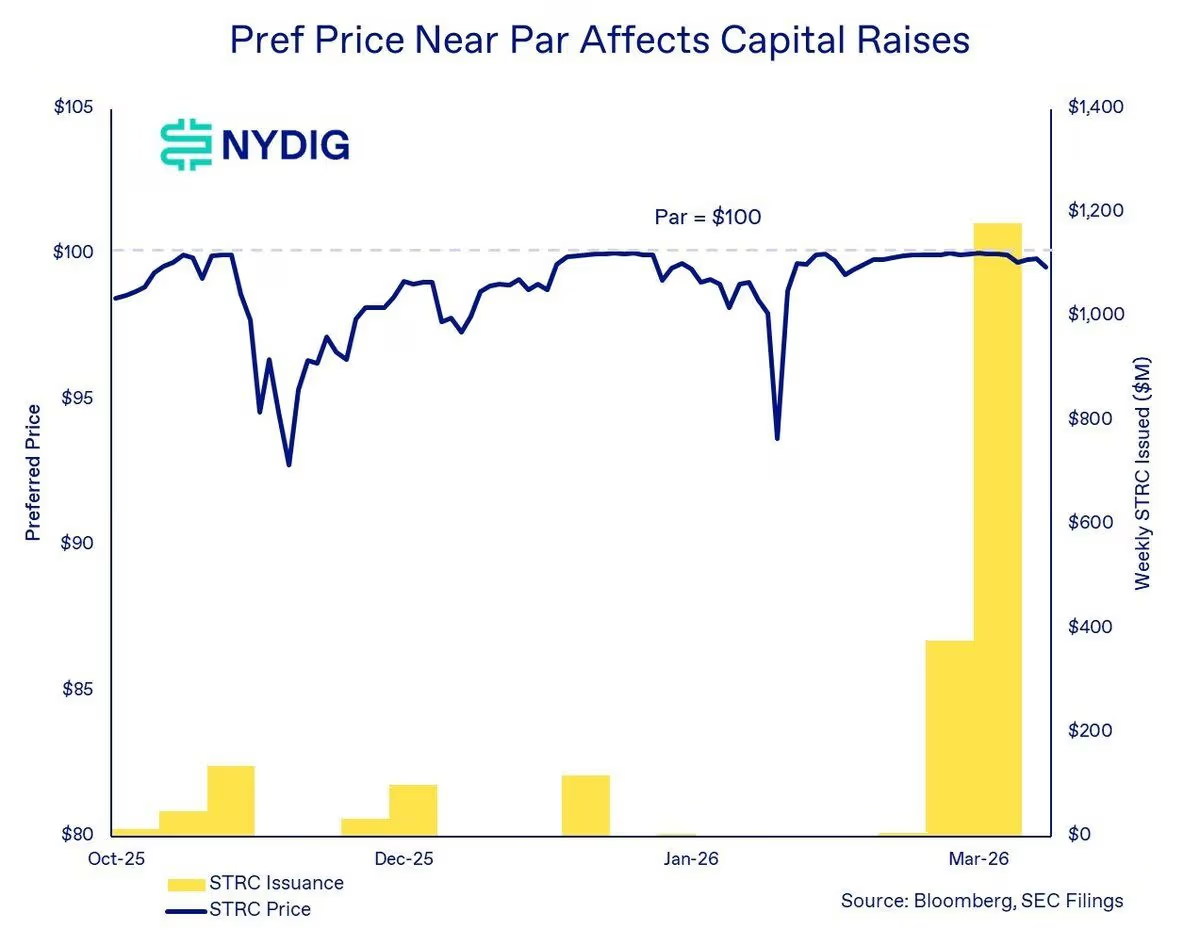
By design, STRC targets a steady $100 share price, using a variable monthly dividend to keep trading near that level. The approach has already supported multi-billion dollar issuance and the acquisition of more than 50,000 bitcoin, according to STRC.live data.
At its core, STRC works by adjusting yield to steer price. If shares trade above $100, the company can trim the dividend to cool demand. If shares fall below that level, it can raise dividends to attract buyers. Keeping the price anchored lets the firm issue new shares near par, bringing in capital that is then deployed to buy bitcoin.
The novel financial instrument has been a success so far. Not only has it allowed Strategy to buy more than $3.5 billion worth of bitcoin, but it has also attracted institutions that have added STRC to their balance sheets.
In practice, the product resembles a money market fund with a floating yield of 11.5%, far above U.S. Treasuries. The appeal hinges on the steady $100 price tag coupled with high yields.
When conditions are favorable, NYDIG’s Cipolaro wrote, the mechanism creates a powerful feedback loop. The loop, in which STRC trades near par, enables the firm to raise capital, deploy proceeds to buy more bitcoin, expand the asset base, and sustain investor confidence. That confidence sustains additional issuance.
“As long as preferreds remain anchored near par, equity trades above the NAV, and capital markets stay open, the flywheel drives ongoing bitcoin demand,” Cipolaro wrote in the note.
Still, not everything’s rosy.
BitMEX Research has written in a note titled “A bit of Stretch” that it sees the risks related to the product as “substantially greater than those related to short duration U.S. treasuries.”
Where the risks actually sit
Bullish investors often point out that STRC is well-capitalized and could easily cover dividend payments, given Strategy’s massive 761,068 BTC war chest and more than $2.2 billion in cash reserves. That’s around 50 years of covered dividend payments, while the company can still lower STRC’s dividend over time to further the coverage. On top of that, there are monetization options for the company’s massive bitcoin stash, which could further dividend payments.
The risks, however, aren’t based on dividend coverage at all, according to NYDIG’s Cipolaro.
“The appropriate way to assess risk in STRC and SATA is through the lens of governance and subordination rather than focusing solely on payment risk,” he wrote.
The mechanism STRC uses also creates a stress path. If bitcoin drops and confidence in Strategy’s balance sheet weakens, STRC could slip below par.
To defend the price, the company would need to raise the dividend. Higher payouts increase cash obligations, which can, in turn, worry investors and push the price lower. That feedback loop is a familiar one in credit markets.
In a standard corporate setting, that cycle can end in forced asset sales. Companies may have to sell core holdings to meet rising obligations, locking in losses at the worst time. For Strategy, that would mean selling BTC into a falling market. However, Strategy’s Michael Saylor has repeatedly said he won’t sell the company’s bitcoin stack.
The STRC terms, however, give the company another option. The target price is not a binding promise. If conditions turn, Strategy can reduce the dividend rather than increase it.
According to BitMEX Research’s reading of the SEC filings related to STRC, Strategy can “at its absolute discretion, lower the dividend rate by up to 25 bps a month, no matter what else is happening.”
Unpaid dividends can, in addition, accrue without triggering default or forcing asset sales. As BitMEX Research put it, instruments like these were “written by the company for the company.”
Read more: Strategy’s latest massive bitcoin purchase offers insight into its evolving funding model
Built to bend, not break
That flexibility shifts what would happen to STRC in cases of a crisis.
Instead of a company caught in a squeeze, the pressure moves to the security holders. If the dividend is reduced, the yield becomes less attractive, and the market price can fall to reflect the new reality.
NYDIG’s Cipolaro made it clear in his note that the structure “can remain solvent while still delivering suboptimal outcomes for preferred holders due to the loss of confidence and funding access.” The risk isn’t a default on its dividend, but rather the loss of its attractiveness.
Strategy’s legacy software business does not cover those payments on its own. The model depends on continued issuance or balance sheet management tied to its bitcoin holdings.
The binding constraint is not income generation, but the combination of continued access to capital markets and sufficient asset coverage,” NYDIG’s Cipolaro wrote. The setup invites comparisons to structures that rely on new inflows to support payouts.
The difference here is that payouts are not fixed. If demand slows, the company can lower the dividend instead of maintaining a rate it cannot sustain. That feature helps protect the issuer but weakens the claim for investors seeking stability and income.
“When the music stops, if things become challenging for MSTR, instead of selling bitcoin, MSTR could just abandon the narrative that STRC is targeting stability,” BitMEX Research wrote. “This feels very favourable for MSTR and the dividend payments are therefore quite sustainable and affordable, in our view.”
Breaking the mechanism
Market impact will depend on how long the $100 anchor holds.
As long as demand for yield products remains strong and bitcoin sentiment is supportive, STRC can keep channeling funds into the company’s treasury strategy.
That, in turn, reinforces Strategy’s position as a major public holder of bitcoin. NYDIG has shown that bitcoin’s price stability is what enables the economic viability of at-the-market issuance of these products.
STRC and Striv’es SATA have seen their prices drop below par during periods of sharp bitcoin price declines, the firm’s research found. When that happens, “issuance becomes uneconomic, limiting the ability to raise capital and slowing the flywheel.”

The risk shows up when conditions change. A prolonged drop in BTC’s price or a shift in rates could test the price mechanism. If the dividend is cut to preserve cash, STRC could trade well below par. Losses would be borne by investors who treated the shares as a near-cash substitute.
“It resembles being short a put on bitcoin asset coverage, earning yield in exchange for bearing downside risk if bitcoin declines and erodes the asset cushion,” NYDIG offered as a frame for institutional investors. “Unlike a standard option, however, there is no fixed strike or maturity, and outcomes are path-dependent and shaped by management discretion.”
The broader significance is the template itself.
STRC blends equity features with bond-like behavior and a built-in adjustment lever. It offers a new path for companies to raise capital tied to volatile assets without locking in fixed obligations.
For now, these instruments have done their job: attract capital and support further bitcoin accumulation. The open question is how it behaves under stress and who absorbs the cost when the trade no longer looks stable.
The interpretation of that scenario isn’t great, but not for MSTR, “it’s the investors who may feel somewhat aggrieved when the music stops,” BitMEX concluded.
Read more: Strategy’s credit risk falls as preferred equity value surpasses convertible debt
TLDR:
- Hackers are using fake Google Play Store pages in Brazil to distribute malware disguised as legitimate apps.
- The malware runs XMRig on infected Android devices, silently mining crypto while avoiding battery detection.
- A banking Trojan targets Binance and Trust Wallet, replacing wallet addresses during live USDT transactions.
- BTMOB RAT, a malware-as-a-service tool, gives attackers camera, GPS, and credential access on infected phones.
Android malware is spreading across Brazil through counterfeit Google Play Store pages, according to a new report by SecureList.
Hackers are using phishing websites to distribute apps that appear legitimate. Once installed, these apps silently convert infected phones into crypto mining devices.
Some variants also deploy a banking Trojan. The campaign currently targets Brazilian users exclusively, with newer versions spreading through WhatsApp and additional phishing channels.
Fake App Turns Phones Into Crypto Mining Machines
The campaign starts with a phishing website that closely mimics the Google Play Store. One of the fake apps is called INSS Reembolso, which claims to be tied to Brazil’s social security service.
The design copies trusted government branding and the Play Store layout, making the download appear safe to unsuspecting users.
After a user installs the fake app, the malware begins unpacking hidden code through multiple stages. It uses encrypted components and loads the main malicious code directly into the phone’s memory.
SecureList noted that “there are no visible files on the device, making it hard for users to detect any suspicious activity.”
The malware also takes steps to evade detection by security researchers. It checks whether the phone is running in an emulated environment and stops all activity if it detects one.
This evasion technique makes it harder to analyze in a lab setting. Android normally kills background apps to save battery, but the malware loops a silent audio file to fake active use.
Once the malware is fully active, it fetches a crypto mining payload from attacker-controlled infrastructure. This payload is a version of XMRig compiled for ARM devices, which are common in Android smartphones.
The infected device connects to mining servers and mines cryptocurrency silently in the background. According to SecureList, “the malware monitors the battery charge percentage, temperature, installation age, and whether the phone is being actively used,” with mining starting or stopping based on that data.
Banking Trojan Targets Binance and Trust Wallet Users
Beyond crypto mining, some versions of the malware install a banking Trojan that targets Binance and Trust Wallet.
During USDT transfers, the Trojan overlays fake screens on top of the real apps. It then quietly replaces the recipient wallet address with one controlled by the attacker.
The banking module also monitors popular browsers, including Chrome and Brave. SecureList confirmed the module “supports a wide range of remote commands,” including screen recording, audio capture, SMS sending, keystroke logging, device locking, and data wiping.
It additionally uses Firebase Cloud Messaging to receive instructions from attackers. All of these actions are carried out remotely without the user’s knowledge.
Other recent samples use the same fake app delivery method but switch the payload to BTMOB RAT. This remote access tool is sold in underground markets as part of a malware-as-a-service ecosystem. It provides deeper access, including camera control, GPS tracking, and credential theft.
SecureList confirmed that “all known victims are in Brazil,” though newer variants are also spreading through WhatsApp and other phishing pages.
BTMOB is actively promoted across online platforms, including YouTube and Telegram. Sales and support are handled through a dedicated Telegram account, which lowers the barrier for less-skilled attackers.
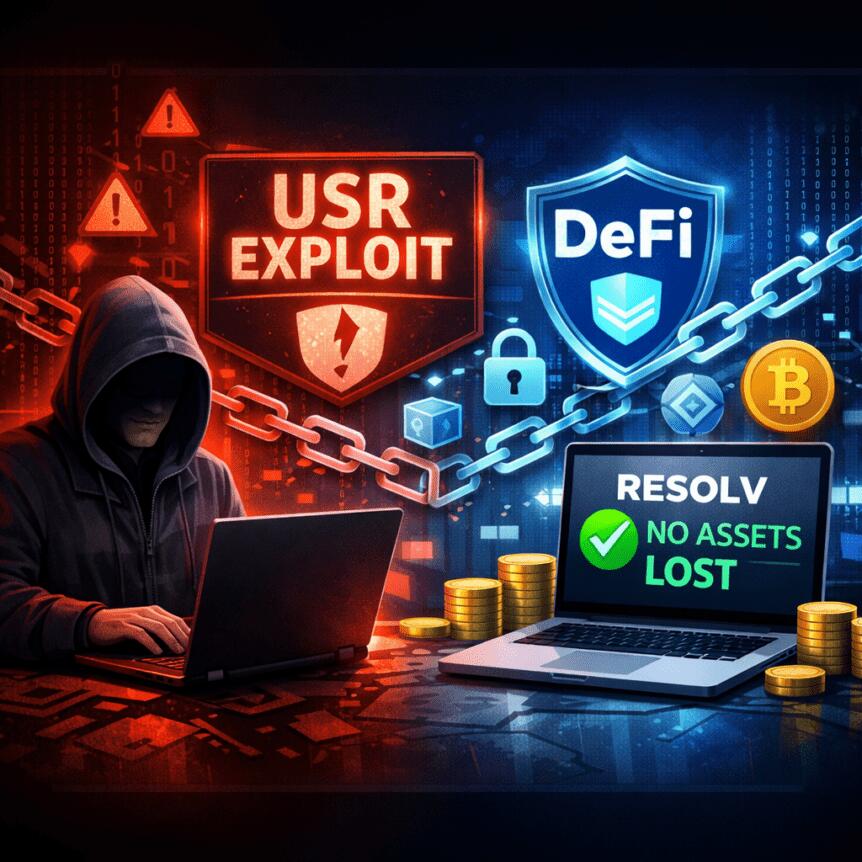
Resolv Labs faced a rapid-and-broad reaction from the crypto community after an exploit disrupted the minting mechanics of its USR stablecoin. The incident briefly knocked USR off its dollar peg, prompting a wave of risk management moves across DeFi protocols with exposure to Resolv’s ecosystem. The peg’s collapse was severe at first, but market data shows a partial recovery as investigations and containment efforts progressed.
Initial reporting indicated that an attacker manipulated the stablecoin’s minting flow, creating tens of millions of unbacked USR and funneling the tokens into various DeFi pools. As the situation unfolded, USR fell to a low around $0.14—roughly an 86% drop from its intended $1 peg—before narrowing the gap to the mid-0.4 range by the time of publication, according to CoinGecko.
In a recent statement on X, Resolv emphasized that the collateral pool remained intact and that the issue appeared isolated to the USR issuance mechanics, with containment and impact assessment ongoing. On-chain researchers have traced the attacker’s activity, with Arkham data corroborated by Cyvers indicating that the bulk of minted USR was converted to Ether, with a portion sold into ETH markets amounting to roughly 11,400 ETH (about $24 million at current prices). Independent observers noted that the remaining 36.74 million USR continued to be dumped in the market, underscoring the ongoing pressure on the token.
The sudden stability concerns surrounding USR sent tremors through the wider DeFi ecosystem, prompting rapid risk-management responses from several protocols. Lido Finance said that funds in Lido Earn were safe, while Morpho cofounder Merlin Egalite stressed that the lending protocol’s own contracts were unaffected and that only certain vaults carried exposure. Aave founder Stani Kulechov also noted that Aave’s direct USR exposure was limited and that Resolv was repaying outstanding debt. Nonetheless, observers highlighted potential knock-on effects for yield and leverage strategies that relied on RLP collateral tied to USR or its wrapped forms.
Markets and risk teams quickly moved to isolate risk. Some protocols paused markets or rotated exposure to prevent spillovers, while others confirmed no exposure at all. Industry voices characterized the risk as concentrated rather than systemic, with the most acute effects appearing in lending, leverage, and yield strategies that integrated USR, wstUSR, or RLP as collateral. The discussion highlighted how even a relatively small, targeted shock in a single stablecoin can ripple through complex DeFi vaults and automated market-making pipelines.
From a broader risk-management perspective, the event has rekindled questions about stability and security in algorithmic and minted stablecoins. Ledger’s chief technical officer Charles Guillemet argued that, given USR’s relatively small size, the incident doesn’t resemble a Terraform-like contagion event. Yet the episode underscores how a single protocol’s issuance architecture can become a focal point for systemic risk when coupled with dynamic liquidity and leveraged strategies.
Key takeaways
- USR’s peg collapse reached as low as $0.14, an 86% deviation from $1, before a partial rebound to around $0.42, underscoring the fragility of minting-based stabilization in stressed conditions.
- On-chain data indicate the attacker converted most minted USR into ETH, with approximately 11,400 ETH (~$24 million) sold, while tens of millions of USR tokens remained in circulation and continued to be dumped.
- DeFi exposure appears concentrated in lending, leverage, and yield protocols that used USR, wstUSR, or RLP as collateral, rather than signaling a broad market contagion.
- Major protocols moved quickly to contain risk—pausing markets or isolating affected vaults—while others reported no exposure, reflecting a mixed but targeted impact across the ecosystem.
- Security audits and monitoring are under renewed scrutiny. While Resolv has undergone multiple audits since 2024, industry experts argue for real-time, AI-powered monitoring to detect anomalies as they emerge and to validate mint-and-burn flows against reserves in real time.
Resolv’s response and the containment picture
Resolv’s public updates emphasized that the issue was rooted in the USR issuance mechanism rather than the underlying collateral pool. By signaling that the collateral pool remained intact, the project aimed to reassure users and counterparties that the core reserves remained adequately backed. The ongoing containment emphasis reflects a market preference for surgical fixes over broader protocol-wide disruptions, even when the systemic risk footprint is still being assessed.
Industry participants highlighted the risk profile as tied more to localized spillovers than to a chain-wide collapse. Lido reported that user funds in Lido Earn remained safe, and Aave’s leadership indicated that there was no direct USR exposure and that Resolv was working to unwind and repay debt in an orderly fashion. Yet the chatter around potential losses in Resolv’s junior RLP tranche drew attention to the fragile layers of DeFi that can amplify stress when stablecoins become volatile, especially in yield-generating constructs that rely on cross-collateralized schemes.
Analysts noted that the most affected areas are likely those that blend USR with leverage or yield protocols, where even a temporary peg dip can trigger deleveraging loops and capital redemptions. Observers also pointed to the possibility that some users could face balance-sheet stress if liquidations occur in tightly coupled vaults. The overall takeaway is that the risk appears concentrated and contained for now, but the exact scope depends on subsequent price action and the velocity of unwind in affected vaults.
Audits, monitoring, and the path forward
Security firms have repeatedly reviewed Resolv’s architecture, with a July 2025 security review by Pashov—the same team that audited the staking module—concluding that the design itself was sound, but that the root cause lay in an operational security vulnerability likely tied to private-key handling. The assessment reinforces a broader industry concern: audits are essential, but they capture a snapshot rather than a live, dynamic threat surface. Resolv’s leadership acknowledged that audits are necessary but static, underscoring the need for ongoing monitoring powered by real-time analytics to detect anomalous mint-burn flows, verify reserves, and validate oracle inputs and liquidity conditions as situations unfold.
As the story continues to develop, investors and users will be watching how quickly USR stabilizes, how robust the on-chain defense mechanisms prove to be, and which protocols adjust risk controls on stablecoins with minting and collateral-driven dynamics. Arkham and Cyvers’ on-chain findings, alongside independent analyses, will likely shape the narrative on whether this episode signals a broader shift toward more stringent real-time surveillance and automated containment mechanisms within DeFi.
For readers tracking the evolving risk landscape, the next set of updates from Resolv and the affected DeFi protocols will be crucial in assessing the durability of mint-based stablecoins and the resilience of yield and lending markets that interact with them.
TLDR:
- Bithumb plans CEO Lee reappointment despite AML fines and partial exchange suspension.
- February bitcoin glitch raised scrutiny over Bithumb’s internal controls and asset verification.
- Shareholders will vote on bond issuance limits and financial governance measures.
- Ongoing regulatory probes may lead to further penalties for the South Korean exchange.
Bithumb CEO reappointment efforts continue despite scrutiny over a bitcoin glitch and regulatory sanctions. The South Korean exchange will seek shareholder approval to extend CEO Lee Jae-won’s term at its annual meeting.
CEO Reappointment Amid Regulatory Challenges
Bithumb is moving forward with plans to reappoint CEO Lee Jae-won during its March 31 shareholders’ meeting. If approved, Lee will begin a new two-year term leading the exchange.
His reappointment comes despite recent sanctions imposed by the Financial Intelligence Unit under the Financial Services Commission. The FIU fined Bithumb 36.8 billion won and issued a six-month partial suspension for breaches of anti-money laundering regulations.
CEO Lee also received a reprimand warning, while the reporting officer faced a six-month suspension.
Crypto exchanges in South Korea are not legally classified as financial institutions. This allows executives to remain in their roles even after disciplinary actions.
Nevertheless, the penalties remain a serious regulatory signal. Industry sources suggest Bithumb’s decision to retain existing leadership is aimed at maintaining operational continuity during ongoing inspections.
The company is still awaiting findings from the Financial Supervisory Service regarding the February bitcoin payout error, as well as results from an investigation into its order book sharing with a foreign exchange.
The company is also preparing for shareholder decisions on internal governance. Maintaining CEO continuity is expected to help Bithumb navigate regulatory and operational challenges without abrupt changes to leadership.
The outcome of these votes will determine the company’s ability to respond to compliance requirements efficiently.
Strategic Measures and Financial Preparations
Bithumb’s annual meeting will also cover strategic proposals to strengthen corporate governance and financial flexibility. One key agenda item proposes increasing the issuance limit for convertible bonds and bonds with warrants to 300 billion won.
This measure is seen as a step to secure funds for restructuring the domestic virtual asset market. The exchange will propose appointing Jeong Yeon-dae, a tax accountant and academic, as the new auditor.
His role aims to improve accounting transparency and internal controls. Another agenda item includes renaming the affiliate Bithumb A to “Bithumb Asset,” which manages investment and holding operations outside of exchange activities.
The February bitcoin overpayment incident exposed weaknesses in Bithumb’s verification systems. Users received payouts exceeding actual holdings, highlighting gaps in asset management controls.
Regulatory authorities are reviewing potential violations under the Virtual Asset User Protection Act and reporting laws. The combination of ongoing probes and financial measures underscores the company’s effort to manage risks while retaining leadership continuity.
Bithumb now faces a critical period as shareholder decisions and regulatory outcomes converge, determining both the company’s operational direction and leadership stability for the coming term.
XRP Open Interest Drops Across Exchanges While 2026 Regulatory Catalysts Build
Vertical Dramas’ Hot Leading Men: Joseph Purcell, Cameron Porras

Crypto Gold Live Trading 15 March – stock_learners


-

 Tech7 days ago
Your Legally Registered ‘Motorcycle’ Might Not Count Under Proposed US Law
-

 Fashion2 days ago
Weekend Open Thread: Adidas – Corporette.com
-

 Politics2 days ago
Jenni Murray, Long-Serving Woman’s Hour Presenter, Dies Aged 75
-
 Tech5 days ago
Are Split Spacebars the Next Big Gaming Keyboard Trend?
-

 Crypto World18 hours ago
Best Crypto to Buy Now: Strategy Just Spent $1.57 Billion on Bitcoin During Fear While Early Investors Quietly Enter Pepeto for 150x Potential
-

 News Videos4 days ago
RBA board divided on rate cut, unusually buoyant share market | Finance Report | ABC NEWS
-

 Crypto World19 hours ago
Bitcoin Price News: Bhutan Sells $72 Million in BTC Under Fiscal Pressure, but the Smart Money Entering Pepeto Sees What the Market Does Not
-

 Business7 days ago
Search for Savannah Guthrie’s Mother Enters Seventh Week with No Arrests
-
 Crypto World2 days ago
NIO (NIO) Stock Plunges 6.5% as Shelf Registration Sparks Dilution Worries
-

 Business6 days ago
Australian shares drop as Iran war enters third week
-

 Crypto World6 days ago
Crypto Lender BlockFills Enters Chapter 11 with Up to $500M in Liabilities
-

 Politics4 days ago
The House | The new register to protect children from their abusers shows Parliament at its best
-

 Fashion6 days ago
25 Celebrities with Curly Hair That Are Naturally Beautiful
-

 Tech3 days ago
inKONBINI Lets You Spend Summer Days Behind the Register
-
 Politics5 days ago
Real-time pollution monitoring calls after boy nearly dies
-

 Crypto World4 days ago
Canada’s FINTRAC revokes registrations of 23 crypto MSBs in AML crackdown
-
 NewsBeat4 days ago
Residents in North Lanarkshire reminded to register to vote in Scottish Parliament Election
-

 Business6 days ago
Meta planning major layoffs as AI spending and automation reshape workforce
-

 News Videos4 days ago
PARLIAMENT OF MALAWI – PAC MEETING WITH REGISTRAR OF FINANCIAL ON AMARYLLIS HOTEL – INQUIRY LIVE
-
Crypto World7 days ago
U.S. Oil Companies Post Record Profits as Oil Prices Break $100
You must be logged in to post a comment Login