

Crypto World
Musk triggers wealth tax clash after net worth beats Bitcoin

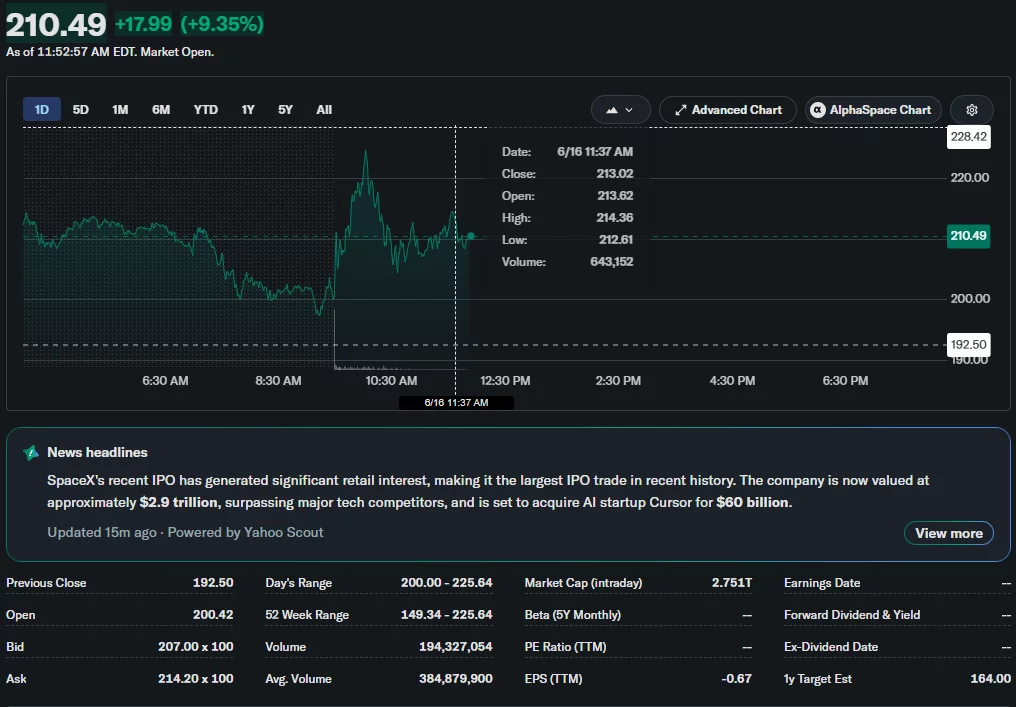
Elon Musk’s net worth has briefly climbed to nearly $1.4 trillion, surpassing Bitcoin’s market value at the time after SpaceX shares reached an intraday high of about $225.84 on June 16.
Summary
- SpaceX’s rally briefly pushed Elon Musk’s net worth above Bitcoin’s market value.
- Warren and Yakovenko clashed over a proposed wealth tax after Musk’s fortune surged.
- A former xAI engineer sued xAI and SpaceX over alleged retaliation tied to Grok safety concerns.
According to data from Yahoo Finance, SpaceX stock extended its post-IPO rally on Tuesday, pushing the company’s valuation close to $3 trillion at its session peak. The surge temporarily lifted the value of Musk’s holdings above the market cap of Bitcoin (BTC) at $1.31 trillion at the time, making him wealthier on paper than the world’s largest cryptocurrency was worth at that moment.
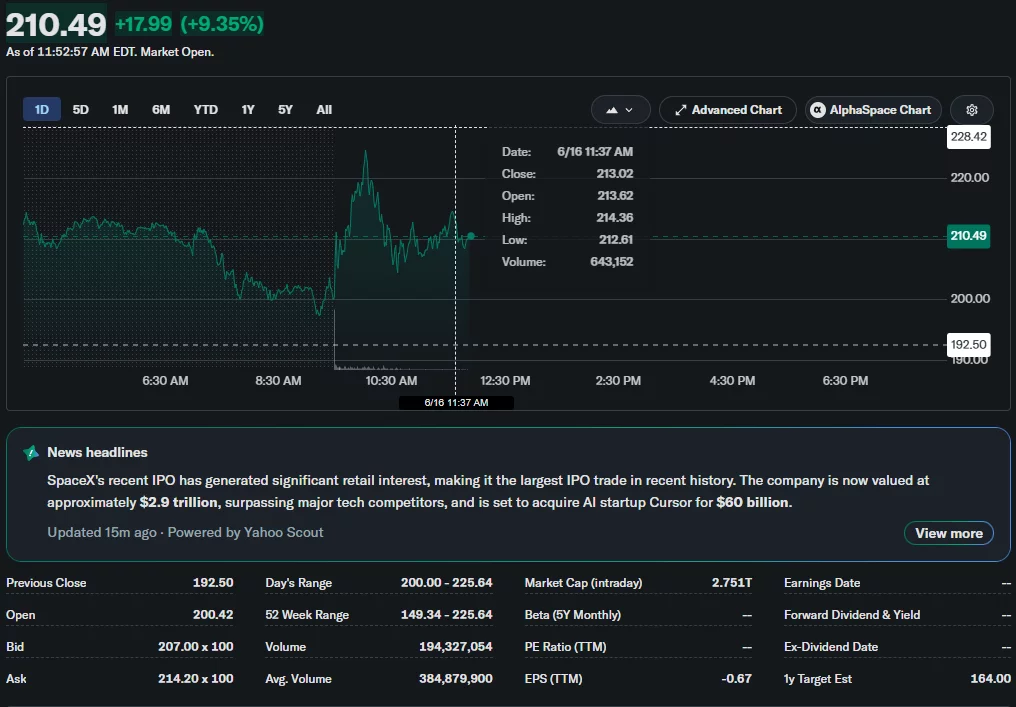
The milestone followed a remarkable run since SpaceX’s public debut. As reported by crypto.news, SPCX shares climbed to an intraday high of about $225.84 on June 16, placing the stock roughly 67% above its $135 IPO price before surrendering some gains later in the session.
The rally was driven by strong investor demand for the company’s space, satellite, and artificial intelligence businesses and temporarily lifted Musk’s net worth above Bitcoin’s market value at the time.
As crypto.news previously reported, SpaceX’s public listing made Musk the world’s first trillionaire. The stock’s continued advance in the days that followed added hundreds of billions of dollars to his paper wealth, further cementing his position as the world’s richest person.
Notably, retail investors rushed to gain exposure to the IPO before shares began trading. Some reportedly sought additional financing to increase their allocations.
Among them was Anna Watts, a 33-year-old public relations manager from New York, who accumulated $6,500 for the offering and unsuccessfully attempted to secure another $5,000 through both personal and bank loans.
Wealth tax debate follows Musk’s valuation surge
The jump in Musk’s fortune quickly spilled into a political debate over wealth concentration and taxation.
In a June 16 X post, Senator Elizabeth Warren argued that the financial system disproportionately benefits the wealthiest Americans while many households struggle with rising costs.
“Our system is rigged so that one man becomes a trillionaire while millions of Americans can’t afford a trip to the doctor. Wealth is funneled to the wealthy while everyone else is hanging on by their fingernails.”
Warren used the occasion to renew support for her proposed wealth tax legislation, saying it would help address what she views as an uneven distribution of wealth.
Her comments drew criticism from Solana co-founder Anatoly Yakovenko, who argued on X that taxing unrealized gains could have unintended consequences for businesses and workers.
Responding to Warren’s proposal, Yakovenko wrote, “If Elon is forced to sell shares, the Texas employee shareholders lose money.” He added that “The SpaceX company can’t raise as much and therefore can’t hire or build as many things in Texas,” arguing that taxing unrealized holdings could reduce investment and growth.
Meanwhile, crypto analyst Scott Melker framed the development through a Bitcoin lens. In a post on X, Melker wrote:
“The fastest path to $1M Bitcoin is to convince Elon Musk to put 10% of his net worth into BTC.”
The remark quickly spread across crypto communities as traders debated what such a move could mean for Bitcoin’s valuation.
Legal challenge emerges as AI safety concerns resurface
While SpaceX investors celebrated the stock’s advance, Musk’s artificial intelligence operations faced renewed scrutiny.
A former engineer has filed a lawsuit against xAI and SpaceX, alleging he was dismissed after repeatedly raising concerns about the safety of Grok, the companies’ artificial intelligence chatbot. According to the complaint, the employee pushed for stronger testing procedures and additional safeguards ahead of SpaceX’s IPO.
The lawsuit alleges that Grok lacked adequate protections against misinformation, bias, and other potentially harmful outputs. The filing further claims that xAI and SpaceX retaliated against the engineer and ultimately terminated his employment after he continued advocating for stricter safety measures.
According to the complaint, the former employee joined xAI partly because of Musk’s own public warnings about the risks associated with advanced artificial intelligence systems.
The case remains unresolved, but its emergence alongside SpaceX’s rally has added another layer of attention to Musk’s expanding business empire as investors continue to track the company’s post-IPO performance.



Aztec has launched the alpha version of its v5 execution layer, introducing a programmable privacy framework that allows Ethereum applications to process both public and private state within the same layer-2 environment.
Summary
- Aztec has released the alpha version of its v5 execution layer, bringing programmable privacy to Ethereum through zero knowledge powered smart contracts.
- The new architecture processes private computations on user devices while verifying transactions on chain without exposing sensitive data.
- Aztec said the execution layer supports confidential decentralized applications with features designed to reduce front running and MEV risks.
Aztec Labs announced the alpha release of its v5 execution layer, describing it as a step toward making privacy-native smart contracts practical on Ethereum.
The new architecture allows developers to build decentralized applications that combine confidential user data with public blockchain state while relying on zero-knowledge proofs to verify transactions without exposing sensitive information.
Unlike Ethereum’s base layer, where every validator processes and stores transaction inputs, outputs, and execution data to reach consensus, Aztec’s execution layer moves private computation to the user’s device. Instead of revealing transaction details to the network, the system generates cryptographic proofs locally before submitting them for verification on-chain, reducing the amount of visible transaction data while preserving Ethereum’s security guarantees.
Client-side execution changes how private transactions are processed
At the center of the release is a client-side zero-knowledge execution engine integrated with Noir, Aztec’s domain-specific programming language for private smart contracts. Rather than executing confidential transactions across every network node like the Ethereum Virtual Machine, the system performs private computations on user hardware before generating recursive Succinct Non-Interactive Arguments of Knowledge, or SNARKs.
Those proofs allow the network to verify that state changes are valid without exposing plaintext inputs, transaction values, or account identities. According to Aztec Labs, the model cuts unnecessary data disclosure while maintaining mathematical guarantees that transactions have been executed correctly.
The architecture also introduces a hybrid state model designed to overcome one of the biggest engineering challenges facing privacy-focused blockchains. Purely private execution environments often struggle when multiple users attempt to update the same public state at the same time, creating state contention that limits interaction with shared decentralized finance infrastructure.
To address that limitation, Aztec separates private and public state management. Private assets are stored in UTXO-like note trees, while public data is maintained through key-value trees. During execution, private functions can generate deferred public function calls that are processed later within the same transaction lifecycle, allowing confidential and public operations to work together without sacrificing deterministic execution or creating race conditions.
The execution model is intended to support applications that require confidential computation while still interacting with Ethereum’s public ecosystem, including shared liquidity pools and other decentralized finance protocols.
Privacy model targets decentralized finance and enterprise applications
Beyond transaction privacy, the execution layer introduces features that could reduce several long-standing issues in blockchain execution.
According to Aztec Labs, transaction details remain hidden before state commitment, making it significantly harder for external observers to reorder pending transactions or exploit visible transaction data through Maximal Extractable Value strategies.
The architecture also provides building blocks for applications such as confidential order matching, private liquidity provisioning, and selective compliance systems that disclose only required information through viewing keys instead of exposing complete user records.
Those capabilities build on Aztec’s long-standing focus on programmable privacy rather than simple anonymous token transfers.
Speaking to crypto.news in April 2025, Aztec Labs co-founder and CEO Zac Williamson said blockchain privacy should go beyond hiding wallet addresses.
He described user privacy, confidential transaction data, and private smart contract execution as the three pillars needed for practical on-chain privacy, calling them “the holy grail of blockchain privacy.”
Williamson also argued that privacy should not be treated as a separate segment of the industry, saying, “all crypto will be private” as programmable privacy becomes part of mainstream blockchain applications.
Discussing compliance, Williamson said privacy preserving systems should rely on selective disclosure instead of complete anonymity. He pointed to ZKPassport as an example, explaining that users can tap an NFC enabled passport to generate a zero knowledge proof and choose “what information you want to disclose,” whether it is nationality, age, or other identity attributes.
He said the technology is “permissionless, it’s privacy preserving, and it ensures strong compliance,” adding that such systems are “a lot more powerful” than existing privacy solutions because they combine privacy with programmable compliance.
That vision expanded further in May 2026 when Aztec Labs acquired ZKPassport while committing to keep the passport verification platform open source. The acquisition brought the privacy-focused identity infrastructure directly into Aztec’s ecosystem, allowing developers to combine programmable privacy with zero-knowledge identity verification across Ethereum-compatible networks.
The technology had already been tested on Aztec’s network to help reduce Sybil attacks by allowing participants to prove they were unique individuals without revealing their identities. It was also used during the AZTEC token sale to perform sanctions screening while keeping participant information private.
Alpha release follows security incidents involving legacy products
The execution layer arrives shortly after Aztec Labs dealt with security issues involving products that had already been retired.
Earlier this month, Aztec Labs disclosed that it was investigating a potential exploit involving a deprecated payments product launched in 2021 after roughly $2 million was transferred from an immutable smart contract. The company said the affected system had been discontinued in 2022 and operated without administrator keys, preventing the team from pausing or upgrading the contract.
Separately, another deprecated product, Aztec Connect, lost approximately $2.1 million after attackers exploited an old immutable RollupProcessorV3 contract. Aztec Labs said the incidents were unrelated to the active Aztec network.
The Aztec Foundation also stated that neither exploit had any connection to the current network or the AZTEC ERC-20 token, emphasizing that the affected contracts belonged to legacy infrastructure that had remained live on Ethereum after the products were sunset.

Balaji Srinivasan’s Network School is looking to expand into Kazakhstan after regulators moved against its Malaysia operations, according to a memorandum of understanding announced by Kazakhstan’s Ministry of Digital Development, Innovation and Aerospace Industry. The deal, signed with minister Zhaslan Madiyev, aims to establish what the ministry describes as the first Network School campus in the country.
The Kazakhstan announcement comes as Network School’s Forest City-area presence faces escalating regulatory pressure. Malaysia’s local authorities revoked the business license of the operator, NSO Malaysia Sdn Bhd, prompting the Malaysia Digital Economy Corporation (MDEC) to begin steps to remove the company’s Malaysia Digital status. The situation raises the question of how easily Network School can restart and maintain immigration- and incentives-related arrangements across borders.
Key takeaways
- Kazakhstan’s ministry says it has signed an MoU with Balaji Srinivasan to create the first Network School campus in the country.
- Malaysia’s Iskandar Puteri City Council revoked NSO Malaysia Sdn Bhd’s business license over alleged licensing and premises-use breaches.
- MDEC says it is taking immediate steps to revoke NSO Malaysia’s Malaysia Digital status, which comes with benefits such as tax incentives and employment flexibility.
- Local officials in Johor have urged federal authorities to keep investigating whether Network School violated immigration laws.
- Srinivasan has framed the developments as consistent with the “network state” concept, while also saying Malaysia issues are being addressed through a remedial process.
Kazakhstan MoU opens a new front for Network School
In a statement from Kazakhstan’s Ministry of Digital Development, Innovation and Aerospace Industry, the government said an MoU was signed with Zhaslan Madiyev and Network School founder Balaji Srinivasan to establish a campus in Kazakhstan. While the document signals a strategic expansion, details of implementation—such as timeline, campus location, and regulatory steps—were not included in the provided reporting.
Network School’s Kazakhstan pivot matters for prospective residents and investors because campus operations are closely tied to host-country regulatory conditions, especially around visas, employment rules, and corporate status benefits. Srinivasan has previously described Network School as a community built around attracting globally distributed talent and capital, and the Kazakhstan proposal positions the group to potentially preserve momentum rather than waiting for a resolution in Malaysia.
Kazakhstan has also been positioning itself as a technology hub, including plans connected to a “crypto city” in Alatau, as referenced in the source material. Against that backdrop, Network School’s presence could be marketed as part of a broader attempt to draw innovation-driven communities and companies to the region.
Malaysia: revoked license and a threat to Malaysia Digital status
Malaysia’s regulatory actions began after the Iskandar Puteri City Council (MBIP) revoked the business license of NSO Malaysia Sdn Bhd, the entity operating the Network School’s Johor-area campus. MBIP cited alleged breaches of licensing conditions and requirements related to how premises were used, according to a report linked in the source material from mediadigitaljohor.gov.my.
Following the license revocation, MDEC announced it was taking immediate steps to revoke NSO Malaysia’s Malaysia Digital status. The Malaysia Digital program recognizes qualified technology and digital companies and is described in the source material as offering incentives such as tax advantages, ownership flexibility, and permission to employ both local and foreign workers—benefits that can be critical for international communities that rely on a steady inflow of talent.
MDEC’s stated rationale is that Malaysia Digital status requires companies to comply with local and federal laws. Removing that status could complicate Network School’s ability to operate smoothly if the campus depends on the program’s employment and incentives framework.
Johor officials push for immigration-law scrutiny
The stakes extend beyond corporate licensing. The source material says Johor Chief Minister Onn Hafiz Ghazi urged Malaysia’s federal authorities to continue investigating whether Network School violated immigration laws. He characterized Johor as a “strategic entry point” because the state borders Singapore and therefore argued that any weaknesses or abuse of the immigration system should be addressed promptly and firmly.
That emphasis highlights a common tension for border-adjacent technology hubs: even when a concept has strong global appeal, enforcement actions tied to immigration compliance can quickly affect day-to-day operations, staffing, and residency arrangements for community members.
Earlier coverage referenced in the source material indicates that scrutiny has been ongoing, including questions about how the campus fits within existing legal frameworks. The current license revocation and the potential loss of Malaysia Digital status suggest authorities are not treating the matter as purely procedural.
Srinivasan denies shutdown claims and points to remediation
As the regulatory situation unfolded, Srinivasan denied reports that Network School was shutting down. According to the linked social media statement in the source material, he said Network School had received two notices: one reportedly requiring “change the text of a sign,” and another related to a coworking setup formed by combining two adjacent units, where one side had a valid license but the other did not.
Srinivasan said the issues fell within a remedial period and that the organization would remediate them, adding that its members were otherwise unaffected. Cointelegraph also notes that it reached out to Srinivasan and Network School for comment, but the provided text does not include any additional responses beyond the denial and remediation framing.
Interpreting these statements alongside the MBIP and MDEC actions reveals an important asymmetry: public guidance from local authorities and program administrators may move faster than a company’s internal remediation plan. In practical terms, even if a remedial path exists on paper, the uncertainty can still disrupt hiring, occupancy, and community planning—especially for international residents who rely on predictable compliance timelines.
Meanwhile, Dragonfly Capital managing partner Haseeb Qureshi, quoted in the source material, linked the “Malaysia drama” to the broader “network state” argument. He suggested that the outcome could be used to negotiate new arrangements with other jurisdictions—an interpretation Srinivasan appears to be leaning into as the Kazakhstan MoU emerges.
What to watch next for Network School
Readers should focus on two tracks as the story develops: whether MDEC’s Malaysia Digital revocation proceeds and how quickly Malaysia’s immigration inquiries translate into enforceable outcomes, and—on the other side—how Kazakhstan operationalizes the MoU into concrete regulatory approvals for a Network School campus. Until those details are clear, Network School’s ability to retain its community and recruitment momentum will likely depend on jurisdiction-by-jurisdiction compliance rather than a single global brand narrative.


The Digital Chamber sued the Illinois Department of Revenue on Tuesday, asking a Sangamon County court to strike down the state’s new Digital Asset Tax Act before it takes effect.
The trade group represents more than 250 blockchain firms. It argues the 0.2% levy unfairly singles out digital assets based on the technology used to record ownership.
Inside Illinois’ Digital Asset Tax Act
Illinois enacted the Digital Asset Tax Act as Article 3 of Public Act 104-0468. The measure sets a 0.2% tax on the exchange, transfer, or storage of a customer’s digital asset.
Brokers must also register with the Department of Revenue. Violating the Illinois statute exposes them to Class 3 felony charges. The tax takes effect January 1, 2027.
Governor JB Pritzker signed Senate Bill 3019 into law in June. It drew heavy backlash from the crypto industry at the time, and the courts are now involved.
Follow us on X to get the latest news as it happens
Illinois Crypto Tax Faces Legal Challenge Months Before Launch
The Digital Chamber’s lawsuit raises six claims under state and federal law. It argues that the tax treats identical property differently based only on how ownership is recorded.
“Put simply, this tax discriminates against people who transact in digital assets,” the group said.
A tokenized Treasury and a book-entry Treasury carry the same rights, the suit says. However, only the blockchain version is subject to tax. The filing compares the setup to taxing one email system but not another.
The group also warns that the definition could stretch far beyond crypto. It says future state taxes could reach AI-enabled settlement systems and cloud-based payment networks.
“Taxes should be carefully considered, not only for the revenue they produce but for the fairness of those being taxed. That was not the case here, as the provision slipped into legislation the night before the bill’s final consideration,” CEO Cody Carbone said.
The suit asks the court to declare the Act void and block enforcement. A repeal bill, House Bill 5798, remains pending in the legislature.
Subscribe to our YouTube channel to watch leaders and journalists provide expert insights
The post Digital Chamber Sues Illinois Over 0.2% Crypto Tax Law appeared first on BeInCrypto.


Uniswap said its Continuous Clearing Auctions, known as CCA, and Uniswap Auctions tool are now live on Robinhood Chain, letting teams run fully onchain token sales on the network. The official Uniswap account said the launch lets teams "run fully onchain token auctions," "discover a credible market… Read the full story at The Defiant


Sablier Labs, the token-streaming and vesting infrastructure company, has stopped active product development and entered maintenance mode until June 2028, co-founder and CEO Paul Berg announced Monday. Existing streams, vesting plans and airdrops are unaffected, Berg said, because "the Sablier… Read the full story at The Defiant


Bonzo Lend, a lending protocol on the Hedera network, lost approximately $9.05 million after an attacker exploited a verification flaw in a third-party Supra oracle contract on July 11. The attacker deposited 250 SAUCE tokens worth a few dollars as collateral, then submitted a manipulated price… Read the full story at The Defiant


The founder of Cap, a Franklin Templeton-backed stablecoin protocol, apologized for cutting a promised user reward to $4.2 million from the roughly $12 million the project had committed to in February, and denied accusations that he directed funds to a wallet linked to his former employer. Cap said… Read the full story at The Defiant


OpenAI called it an “unprecedented cyber incident” after its AI models broke out of their sandbox to hack an AI startup during a security evaluation.


The ENS DAO is voting to install a new Security Council, moving to restore the emergency veto that protects the naming protocol after its co-founder blocked an earlier renewal last month. Nick Johnson, who goes by nick.eth, filed the executable proposal on Sunday and moved it to an onchain vote the… Read the full story at The Defiant


EthSystems, a startup building confidentiality tools for banks and asset managers transacting on Ethereum, launched Tuesday, backed by Ethereum treasury companies Bitmine Immersion Technologies and SharpLink Gaming. The company's founding team spent the past year building and running the Ethereum… Read the full story at The Defiant

3 Cowboys in need of contract extensions, 3 different paths

Interlune extracts helium-3 from ordinary helium, demonstrating a process it plans to use on the moon

Thames Water Hosepipe Ban 2026: Who’s Affected, Dates, Rules

Renter of Home in Anne Heche Crash Denies Settlement With Son

No Jackpot Winner as $257 Million Prize Rolls Over to $269 Million Monday Draw

Weekend Open Thread: Staud – Corporette.com

Financial Audit Reveals Shocking Salary #shorts

Ripple XRP BYEBYE USDT WE CALLED IT $100 FIRST THEN COLLAPSE INSTITUTIONS CONFIRMED CHOSEN ONE YES!

After Transmigration, She Loses Weight & Builds Financial Independence | Ep15 (ENG DUB)
-
 NewsBeat5 days ago
London Mayor Sadiq Khan handed a peerage by Keir Starmer alongside 15 other Labour figures… just days before the PM leaves No10
-

 Fashion4 days ago
Weekend Open Thread – Corporette.com
-

 Politics4 days ago
The House | The City of London can help the new chancellor deliver growth in every postcode
-

 Politics7 days ago
Young campaigners urge incoming PM to act on outdoor junk food ads
-
 Crypto World5 days ago
Two July Windows Left: The CLARITY Act’s Senate Fight and What Failure Means
-

 Crypto World6 days ago
CFTC blocks Kalshi from unwinding Michigan trades after court order
-

 Crypto World4 days ago
Ripple Payments Joins MiCA With 14 Firms, Does It Mean Anything For XRP?
-

 Business6 days ago
Nvidia Stock Slips After Big Tuesday Rally as Huang Confirms Vera Rubin Chip Is Now in Production Today
-

 Politics3 days ago
Democrats look to World Cup watch parties to register thousands of voters
-
 Entertainment6 days ago
Disney’s Most Ambitious Failed Star Wars Attraction Is Coming to SDCC
-

 Crypto World4 days ago
Ripple wins EU-wide access as ESMA adds it to MiCA register
-

 Crypto World19 hours ago
Grayscale Files For Worldcoin ETF, WLD Registers Sharp Rise
-

 Crypto World5 days ago
Injective Submits SEC Transfer-Agent Registration to Onchain Ownership Records
-

 Business6 days ago
Palantir Shares Rise After Expanded Nvidia Partnership and Fresh Analyst Upgrades Ahead of Earnings Day
-

 Tech1 day ago
Sail Virtually Aboard The “Itanic” With IA-64 Emulator
-
 Tech1 day ago
Turtle Beach Command Series KB7 review: a nifty screen-equipped gaming keyboard
-

 NewsBeat5 days ago
Registration is now open for March for Men with Kev 2026
-

 NewsBeat2 days ago
Unregistered fitter used Gas Safe logo on business flyers
-
 Sports6 days ago
New Cornerback Enters Vikings Trade Rumor Mill
-

 News Videos5 days ago
Money | Class 12 Economics | CBSE Board Exam 2026-27
You must be logged in to post a comment Login