

Crypto World
Mutuum Finance (MUTM) V1 Protocol: Feature Expansion & DeFi



DeFi cryptocurrency Mutuum Finance has launched its V1 protocol on the Sepolia testnet, introducing the core mechanics of its lending and borrowing system. The team also stated that an additional feature is scheduled to be rolled out next week as development continues.
Mutuum Finance Protocol Upgrade
In a recent statement published on X, the team confirmed that it is working on several upcoming features while refining key components of the codebase, including optimizations to the Stability Factor. According to the update, a new protocol feature is expected to be released in the coming week.
The project has reported more than $20.6 million raised to date, with over 19,000 holders of its MUTM token, currently priced at $0.04. In the same update, the team noted that the Sepolia testnet version of its lending and borrowing protocol has surpassed $90 million in testnet total value locked (TVL), reflecting simulated liquidity activity during beta testing.
Lending and Borrowing with Mutuum Finance
In the current beta version, users can interact with the protocol’s core functionality. The interface displays a protocol overview including total liquidity, available liquidity, and total variable debt. Four assets are currently supported for minting and interaction on testnet: ETH, USDT, LINK, and WBTC. The portfolio section provides data on net worth, net APY, Stability Factor, and total supplied and borrowed balances, with mtTokens also integrated into the current version of the platform.
When users supply assets to the platform, they receive corresponding mtTokens as proof of deposit. For example, supplying WBTC results in the issuance of mtWBTC. These tokens accrue value over time based on the applicable APY, which is determined by pool utilization.
By depositing $10,000 worth of USDT into the protocol, users receive mtUSDT in return. If the average annual percentage yield (APY) is around 4–5% over a one-year period, the position could generate approximately $400 to $500 in passive income, depending on pool utilization and borrowing demand. In addition, users can stake their mtTokens within the safety module, where eligible participants receive dividends denominated in MUTM tokens.
On the borrowing side, collateral is required to secure loans and protect the protocol against default risk. Rather than selling assets, users can post them as collateral and borrow against their value. For example, an investor holding $1,000 worth of ETH who does not wish to liquidate the position can deposit that ETH as collateral and borrow USDT. The borrowed stablecoins can then be used for expenses or deployed into other investments, while the user retains exposure to potential upside in ETH. Once the borrowed amount and accrued interest are repaid, the full collateral can be withdrawn.
Audited Protocol
Mutuum Finance has undergone a security audit of its lending and borrowing protocol conducted by Halborn, a blockchain security firm that has also performed audits for major projects such as Solana. In addition, the MUTM token smart contract was reviewed by CertiK, receiving a Token Scan score of 90 out of 100.
In partnership with CertiK, Mutuum Finance has established a bug bounty program with a reward pool of up to $50,000, aimed at identifying potential vulnerabilities and strengthening protocol security.
The total supply of MUTM is capped at 4 billion tokens. A portion of this allocation is designated for incentives, including giveaways, leaderboard bonuses, and other community reward programs.
Mutuum Finance continues to advance development of its lending and borrowing protocol as testing progresses on the Sepolia network. With additional features scheduled for rollout and security reviews completed, the project remains focused on refining its infrastructure ahead of full deployment.

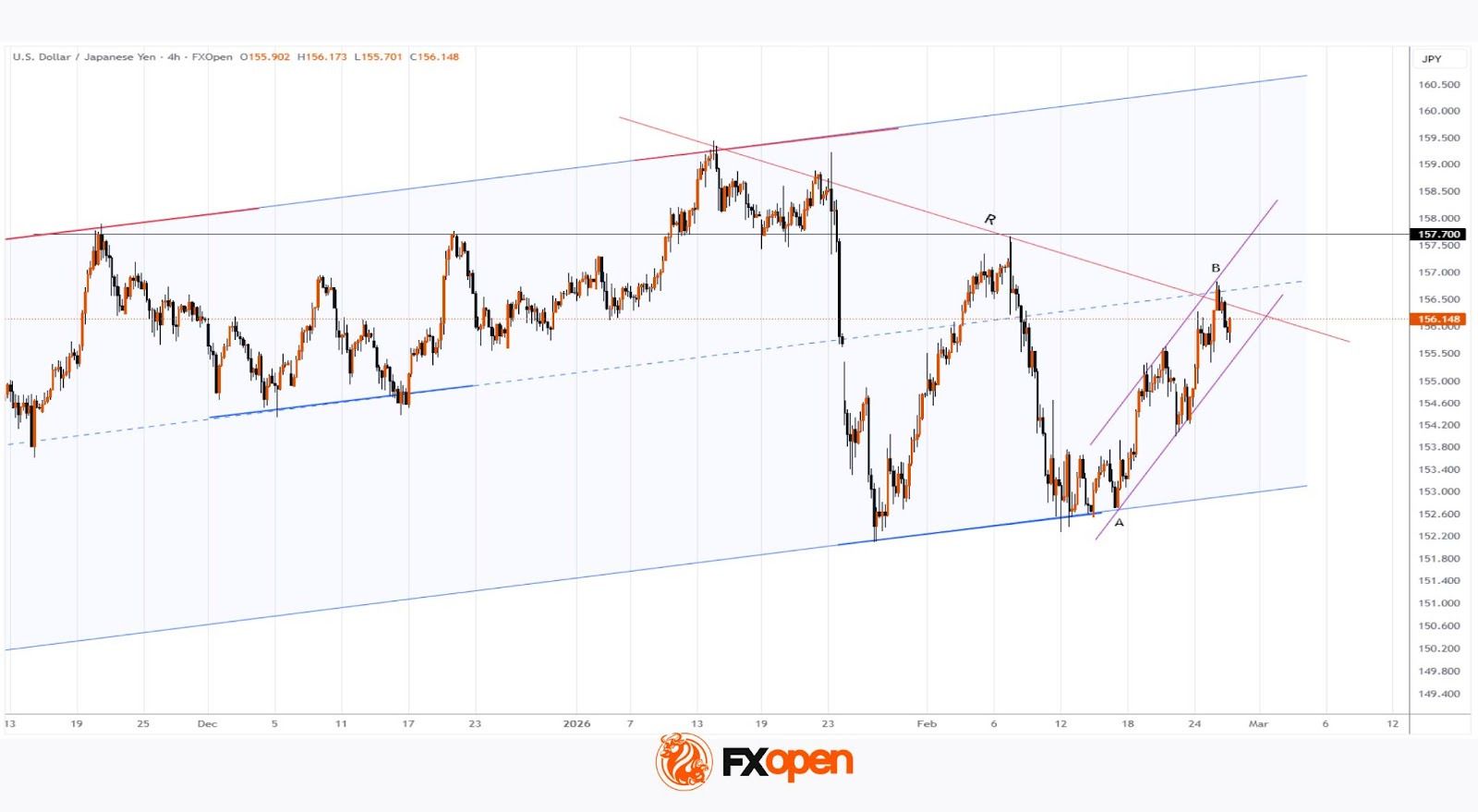
As the USD/JPY chart shows, the pair posted solid bullish momentum in the second half of February. This move was driven by a combination of fundamental factors, including:
→ The appointment of two academics to the central bank’s board, both regarded as strong advocates of economic stimulus through a weaker yen and accommodative lending conditions.
→ Concerns over further interest rate hikes, voiced by Japanese Prime Minister Sanae Takaichi during a meeting with Bank of Japan Governor Kazuo Ueda.
Expectations of a softer yen led to renewed weakness in the currency (A→B), forming the upward trajectory highlighted in purple.
However, on Wednesday the pair retreated, which appears to be an interim pullback from point B. Technical analysis of the USD/JPY chart suggests that extending the move along the purple trajectory may prove challenging.
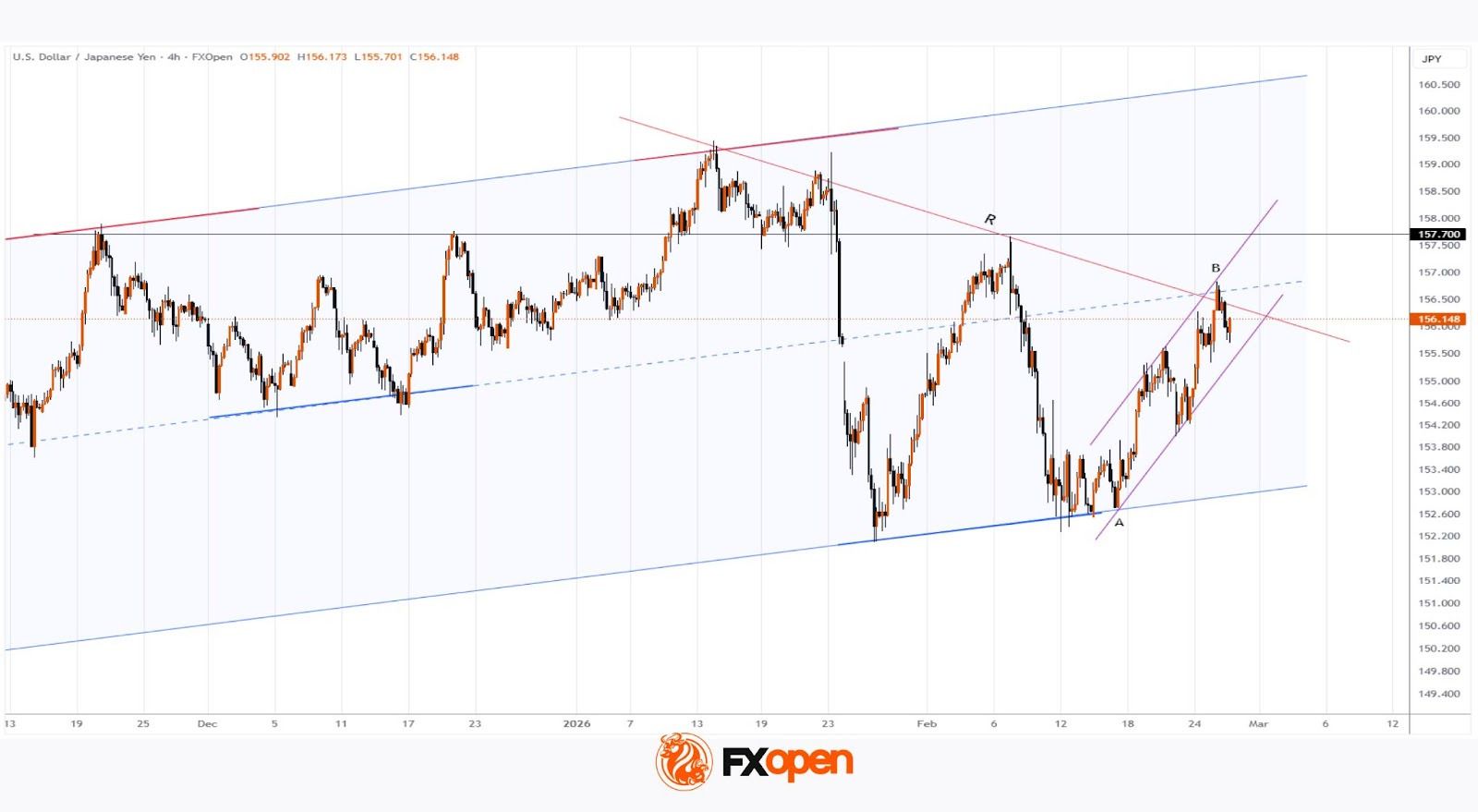
Factors that could favour the bears include:
→ The median line of the ascending channel (constructed from key reversal points marked by thicker lines). The median often acts as a balance zone where supply and demand converge and trends lose momentum.
→ The proximity of the significant 157.70 resistance level, which already acted as resistance in 2025. Although price broke above it in January 2026 (with the level briefly showing signs of support), following the sharp sell-off on 23 January it once again served as a barrier for bulls on 9 February.
→ Trend line R, drawn through the lower highs of 2026.
Therefore, it cannot be ruled out that the lower purple boundary may be breached by bears, potentially leading the market into a period of consolidation while awaiting fresh economic and political catalysts.
Trade over 50 forex markets 24 hours a day with FXOpen. Take advantage of low commissions, deep liquidity, and spreads from 0.0 pips (additional fees may apply). Open your FXOpen account now or learn more about trading forex with FXOpen.
This article represents the opinion of the Companies operating under the FXOpen brand only. It is not to be construed as an offer, solicitation, or recommendation with respect to products and services provided by the Companies operating under the FXOpen brand, nor is it to be considered financial advice.
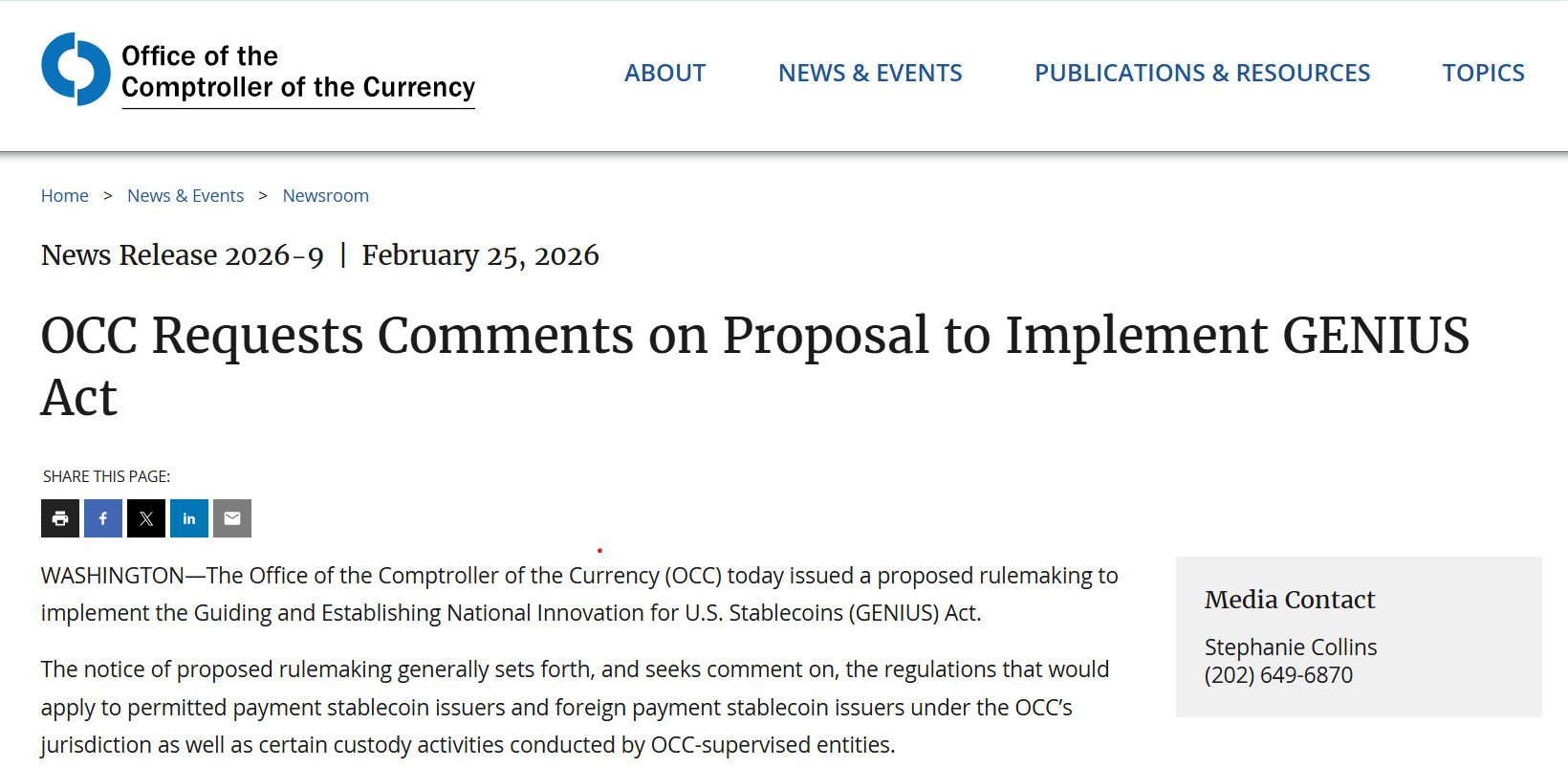
The US Office of the Comptroller of the Currency (OCC) has dropped a 376‑page proposal to implement the Guiding and Establishing National Innovation for US Stablecoins (GENIUS) Act that looks to settle the ongoing stablecoin yield fight.
The proposal is open to public comment for 60 days from Wednesday’s publication date, and sets out detailed rules for permitted payment stablecoin issuers under the OCC’s jurisdiction.
Supervised entities would be barred from paying any form of interest or yield, whether in cash, tokens, or other consideration, “solely in connection with the holding, use, or retention” of a payment stablecoin, consistent with section 4(a)(11) of the GENIUS Act.
Thania Charmani, partner at global law firm Winston & Strawn, commented on X that the OCC proposed to “resolve the debate on stablecoin yield through rulemaking,” potentially clearing the way for the Digital Asset Market Clarity Act of 2025 (CLARITY) to “proceed without that provision.”
How the OCC proposal implements GENIUS on yield
GENIUS, enacted in July 2025, created a federal framework for payment stablecoins and restricted issuance in the US to licensed permitted issuers such as bank subsidiaries, new federal stablecoin issuers, and certain large state‑regulated firms.

The OCC’s draft rule translates that statutory framework into operational constraints, including tight limits on how GENIUS‑regulated issuers can structure economics around their stablecoins.
The proposal goes a step further, adding a rebuttable presumption that an issuer is violating the ban on paying yield if it has an arrangement to pay yield to an affiliate or “related third party” and that entity then pays yield to holders of the issuer’s payment stablecoin.
Related: Ripple CEO confirms White House meeting between crypto, banking reps
Issuers can try to rebut the presumption by submitting written materials to the OCC, but the agency stresses the “close nexus” between issuer payments and end‑holder yield and frames such structures as “highly likely” attempts to evade the statute.
The proposal also draws two explicit carve‑outs. It “is not intended to prevent” merchants from independently offering discounts for using payment stablecoins, and it does not bar an issuer from sharing profits from the stablecoin with a non‑affiliate partner in a whitelabel arrangement.
What the proposal means for CLARITY and Coinbase
If the OCC’s proposed rule is finalized as drafted, it would have direct implications for the separate CLARITY Act debate over stablecoin rewards.
CLARITY drafts have focused on whether digital asset service providers should be allowed to pay yield or rewards on payment stablecoin balances, a point of contention that has already caused friction between industry stakeholders, such as Coinbase.
By using GENIUS implementation to prohibit yield at the issuer level, the banking side of the framework effectively establishes a no‑yield baseline for GENIUS‑compliant payment stablecoins.
For Coinbase and similar firms that have argued they should be able to offer yield on stablecoin balances while operating within a fully regulated US framework, the message is clear:
Stablecoin yield and GENIUS‑compliant, OCC‑supervised payment stablecoins are being put on opposite sides of a regulatory line.
Big Questions: Is China hoarding gold so yuan becomes global reserve instead of USD?
In the traditional DeFi model, capital is often “locked.” Whether it is sitting in a lending vault or providing liquidity in a DEX, that capital is siloed — restricted to one protocol, one function, and one yield source at a time. For users, this fragmentation creates a “liquidity trap,” forcing them to manually bridge their assets between platforms, incur high gas costs, and miss out on real-time market opportunities.
Today, Venus Protocol, the leading lending platform on BNB Chain, and Fluid, the pioneers of a connected liquidity architecture that unifies lending, borrowing, trading into a single system of modular liquidity infrastructure, are proud to announce a strategic alliance. Together, we are launching Venus Flux—the first Unified Liquidity Layer designed specifically for the BNB Chain ecosystem.
What is Venus Flux?
Let your liquidity Flux, watch your yield grow.
Venus Flux is not just a new interface, it represents a fundamental re-engineering of how capital moves onchain. By integrating Fluid’s unified liquidity architecture, which connects lending positions, borrowing capacity, and DEX liquidity at the protocol level, Venus Flux introduces a new Smart Liquidity engine for BNB Chain.
Instead of remaining idle, deposited assets are transformed into a dynamic liquidity stream. With a single deposit, users can simultaneously access lending, borrowing, and trading liquidity within one unified system-maximizing capital efficiency without manual coordination.
Core Capabilities: Lend, Borrow, Multiply, Swap
Venus Flux simplifies the complex DeFi landscape into four integrated pillars:
- Lend (Automated Optimization): Users can supply assets to the Liquidity Layer through Lend. These funds are deposited into a shared, protocol-agnostic pool that can be utilized across the entire stack, automatically routing capital to optimized yield sources without requiring users to manage multiple positions.
- Borrow (Capital Efficiency Redefined): Leveraging Fluid’s advanced liquidation engine, users can access higher Loan-to-Value (LTV) ratios than previously possible on BNB Chain, allowing for greater borrowing power with lower liquidation friction.
- Multiply (One-Click Leverage): For power users, the Multiply feature automates complex looping strategies. Amplify your exposure and yield with a single transaction, removing the need for tedious manual cycles.
- Swap (Integrated Liquidity & Execution): The native DEX embedded into the protocol allows users to swap directly within Flux, enabling efficient position rebalancing, liquidation handling, leverage execution and unwinding. By integrating swaps at the protocol layer, Flux minimizes friction, reduces transaction overhead, improves liquidation outcomes and ensures optimal execution across Lend, Borrow, Multiply and flows.
The Innovation Frontier: Smart Debt & Smart Collateral
The defining strength of Venus Flux lies in its proprietary “Smart” features that unite lending and trading into one fluid experience:
- Smart Collateral: Traditionally, collateral is “dead” capital. With Venus Flux, your collateral works double-time. It can simultaneously act as liquidity in a DEX (earning swap fees) while continuing to back your loan. This creates a multi-layered yield stack from a single capital base.
- Smart Debt:It allows you to turn your borrowed funds into productive liquidity by routing them into DEX AMM positions. Rather than being purely a cost, the debt can earn trading (LP) fees, which can offset the borrowing cost (APR). In certain market conditions, it may even generate positive yield—so you can borrow while still being paid.
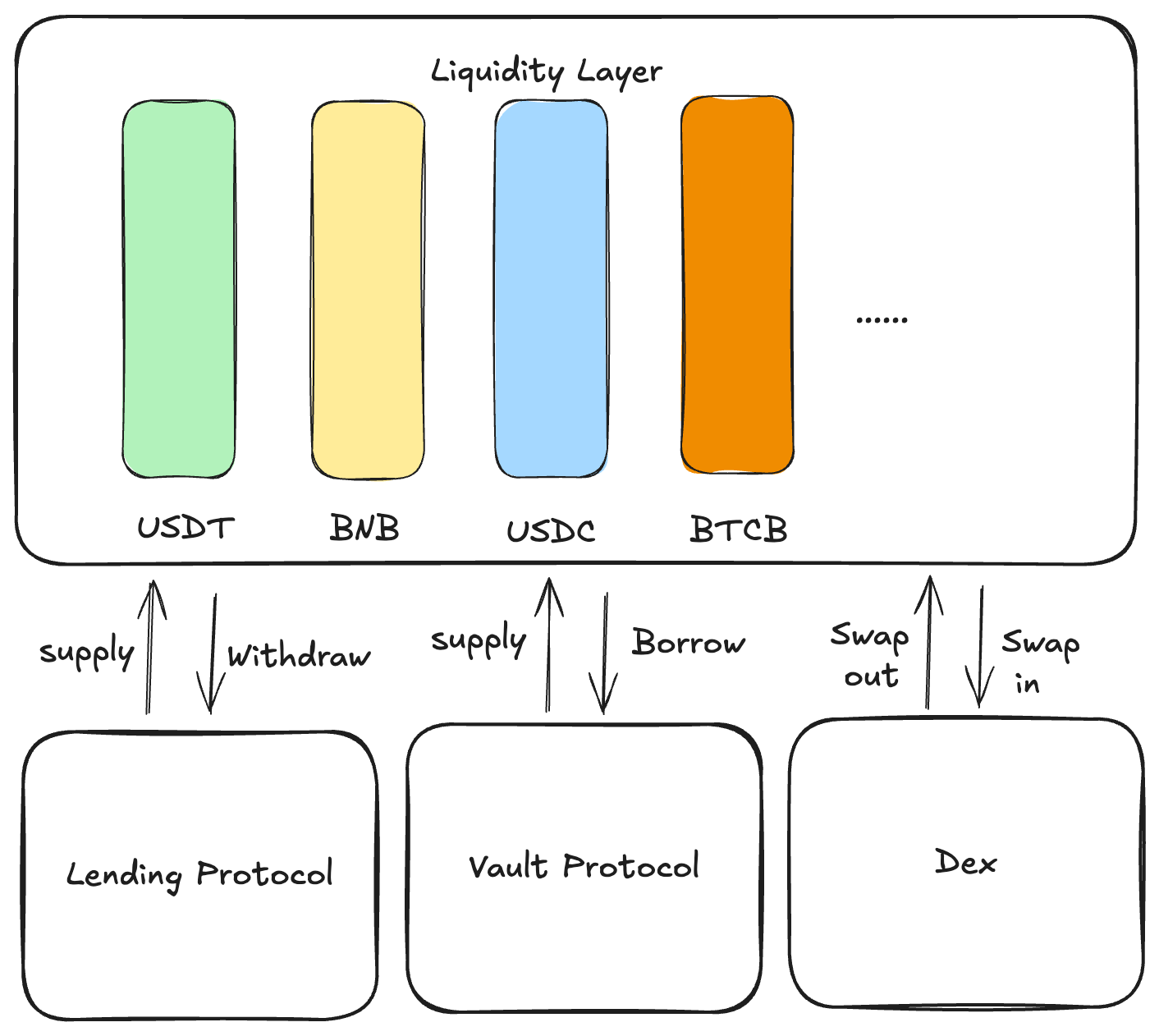
How the Liquidity Layer Works Under the Hood
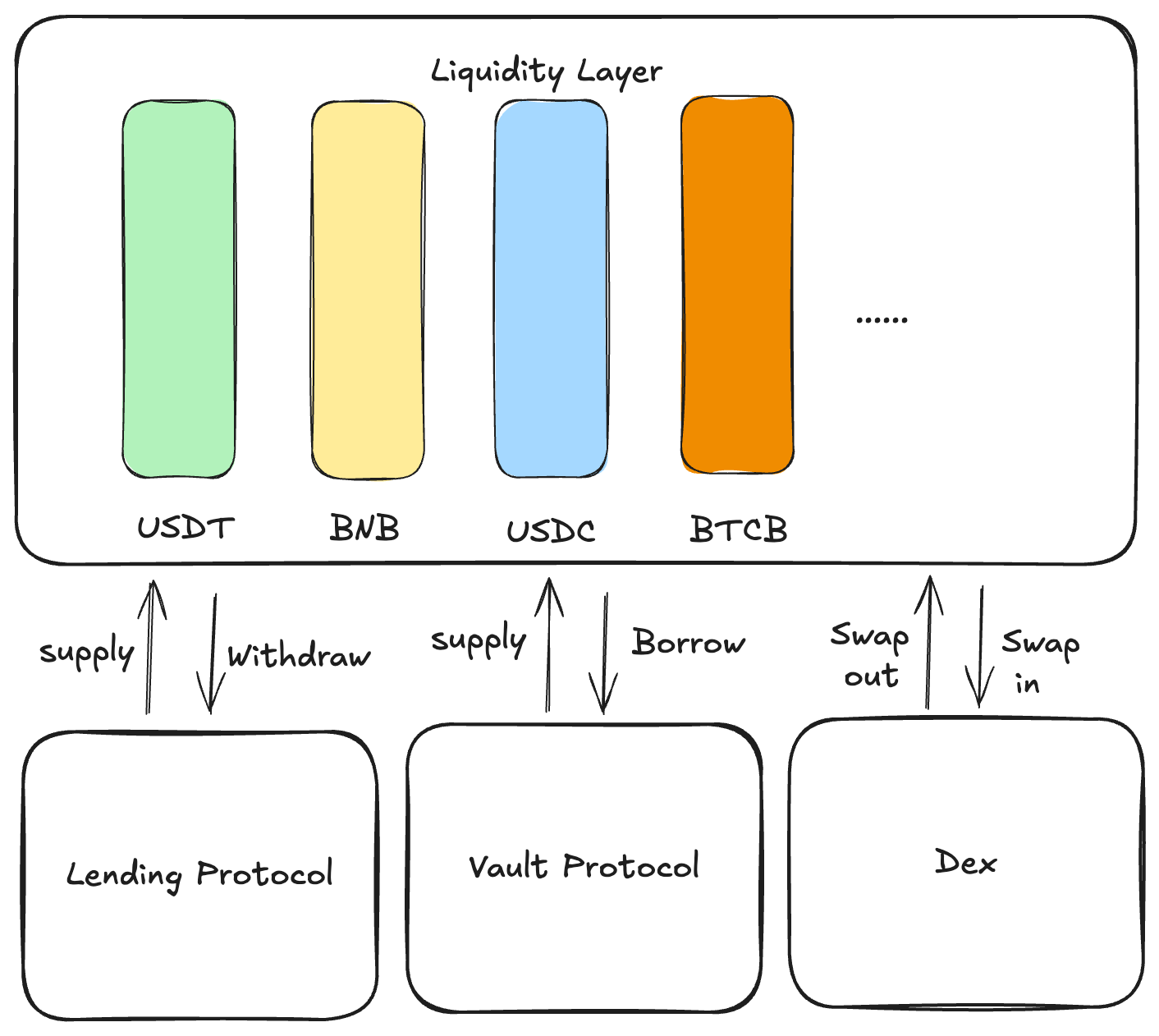
The Liquidity Layer serves as the core of the overall architecture, holding and managing all system-wide liquidity. All ledger states and accounting are unified and settled at this layer, ensuring a single, reliable source of truth across the system.
When users deposit assets, those funds can be automatically rebalanced across different protocols without requiring manual intervention. For example, assets designated as Smart Collateral are recorded as supplied liquidity within the lending index system while simultaneously being deployed as LP positions in DEX protocols.
These assets dynamically rebalance according to AMM mechanics, allowing capital to shift as needed. Thanks to the Liquidity Layer, users do not need to manually move assets between protocols—their positions are automatically reconciled and reflected in their balances through the unified settlement layer.
Because liquidity is shared across protocols, Smart Collateral can earn lending yield while simultaneously capturing DEX LP fees, significantly improving overall capital efficiency.
A Strategic Alliance for the BNB Ecosystem
This collaboration combines the strengths of two DeFi powerhouses. Venus Protocol provides the liquidity depth and long-standing trust of a BNB Chain pioneer, while Fluid provides the technological velocity to make that liquidity smarter and more efficient.
“Venus Flux represents a leap forward in our mission to provide the most robust and capital-efficient money markets on BNB Chain,” said Leon, Head of BD at Venus Labs.
“By partnering with Fluid, we are delivering a more advanced lending market experience to our users while introducing a new DEX product within the Venus ecosystem.”
“Venus Protocol is the biggest and most trusted money market on BNB Chain, with scale and real user demand that few protocols achieve,” said Samyak Jain, Co-Founder and CTO at Fluid.
“Bringing Fluid’s Liquidity Layer to Venus Flux is exciting because it allows that liquidity to move more efficiently across lending, borrowing, and trading — unlocking institutional-grade market mechanics for institutions, professional traders, and retail users alike.”
The Future of BNB Chain Starts Now
Venus Flux is now live, paving the way for a more liquid, transparent, and optimized financial future on BNB Chain. Whether you are a retail user looking for a “set-and-forget” yield or a DeFi native seeking to push capital efficiency to its limit, the era of Unified Liquidity has arrived.
Experience the FLUX. Grow your yield. Visit Venus Flux to get started.
About Venus Protocol
Venus is the leading lending protocol on the BNB Chain. Established in 2020, Venus was the first lending protocol and continues to provide the deepest lending liquidity for key assets on the BNB Chain.
About Fluid
Fluid is the world’s most capital-efficient Liquidity Layer for finance that can support an entire ecosystem of financial products on top of it. Connects lending, borrowing, trading and more financial products into one seamless onchain system.
With $5B+ in Total Market Size and $190B+ in cumulative volume, Fluid is redefining capital efficiency across finance.
Crypto World
Is Jane Street holding Bitcoin below $150K? Jeff Park explains the “grey window” in ETFs


As Bitcoin enthusiasts question why the digital asset hasn’t yet hit the $150,000 milestone despite massive ETF inflows, Jeff Park, Head of Alpha Strategies at Bitwise, has provided a sobering look at the plumbing of the financial system.
Summary
- Jeff Park, Head of Alpha Strategies at Bitwise, argues Bitcoin’s failure to hit $150,000 isn’t manipulation but ETF structure.
- Authorized Participants (APs) can hedge ETF exposure using futures instead of buying spot Bitcoin, weakening the direct link between ETF inflows and price appreciation.
- The shift to in-kind redemptions and OTC sourcing may reduce public exchange buying pressure, potentially muting Bitcoin’s explosive upside.
Bitwise’s Jeff Park says Bitcoin ETFs, not Wall Street, are capping BTC price
In a detailed post on X, Park argues that the “villain” isn’t a single firm like Jane Street, but rather the structural architecture of the Bitcoin (BTC) ETF itself.
According to Park, Authorized Participants (APs) operate within a “grey window” of Regulation SHO. While standard traders must locate shares before shorting, APs are exempt due to their role in creating and redeeming ETF shares.
This allows them to maintain positions with a level of capital efficiency and duration that is “indistinguishable from a regulatory arbitrage.”
The most critical revelation involves how these institutions hedge. Typically, an arbitrageur would buy spot Bitcoin to close a price gap.
However, if an AP chooses to hedge using Bitcoin futures instead of the underlying asset, the “spot was never bought.” This breaks the link between ETF demand and spot price appreciation.
Furthermore, the recent transition to “in-kind” redemptions has removed the “structural governor” that previously forced spot buying. APs can now source Bitcoin through private OTC desks with minimal market impact, effectively bypassing the public exchanges where price discovery happens.
Park concludes that while no firm is explicitly “manipulating” the market, the current regulatory framework, designed for traditional assets, is fundamentally at odds with Bitcoin’s mission.
The result is a system where the “middle” of the trade escapes categorization, potentially muffling the explosive price growth investors expected.
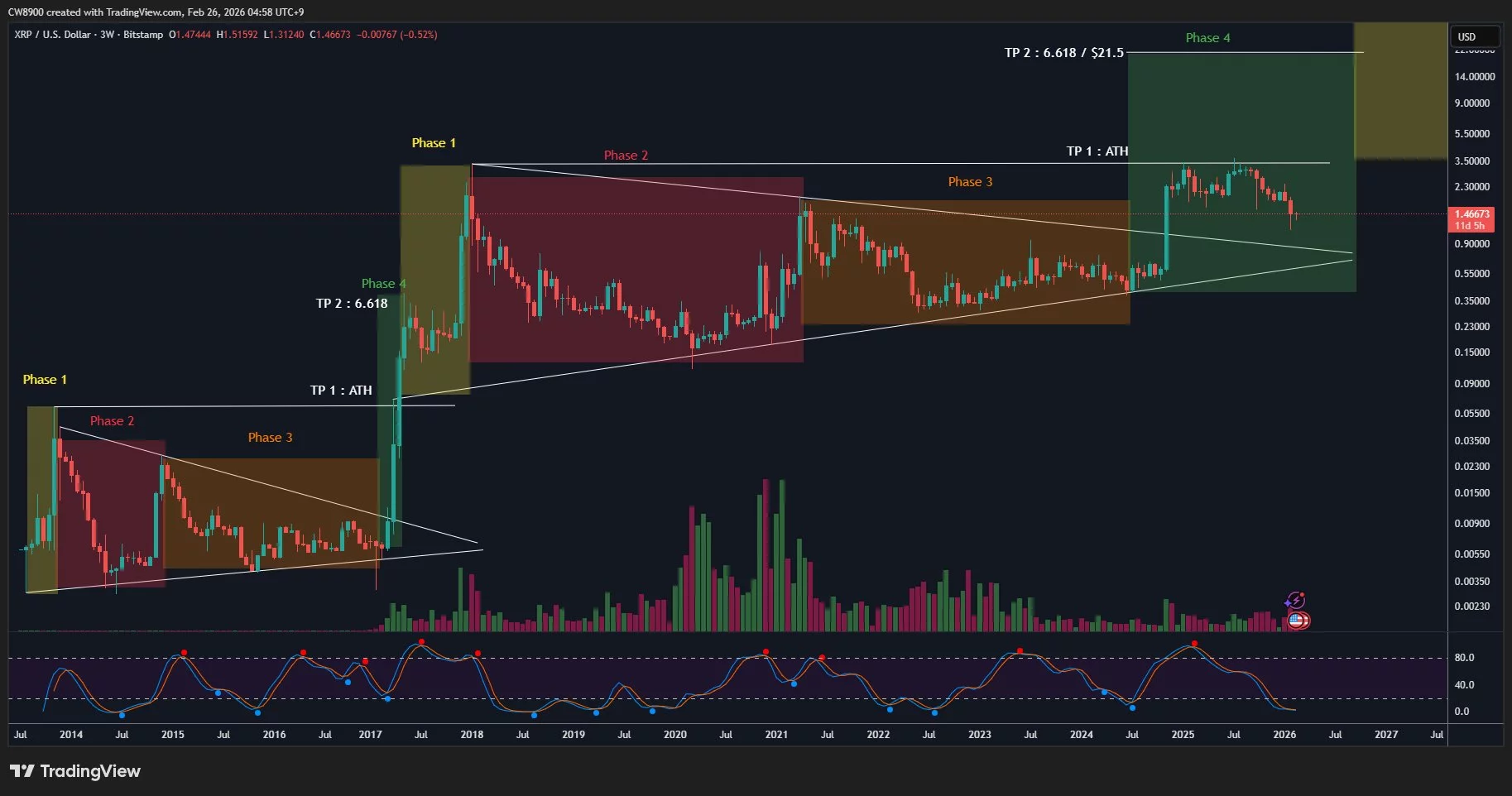
XRP is hovering around the $1.43–$1.46 region after a volatile February, with traders closely watching for signs of a broader trend reversal. One analyst now believes the token is on the verge of entering what he calls a “Phase 4” rally.
Summary
- A trader predicts XRP is nearing a “Phase 4” rally, citing a potential golden cross and bullish candlestick shift.
- XRP must break above its 50-day SMA to confirm short-term bullish momentum.
- Failure to hold current levels could invalidate the bullish retest and expose $1.20 support.
In a recent post, the trader said: “A trend reversal signal for XRP is imminent.”
The trader’s long-term chart outlines a multi-cycle structure divided into four phases. Historically, Phase 1 marked accumulation and breakout, Phase 2 a corrective consolidation, and Phase 3 a prolonged compression within converging trendlines.
The current structure shows XRP price recently breaking above a multi-year symmetrical triangle before pulling back toward the upper trendline, a classic retest scenario.
The highlighted “Phase 4” zone projects an expansion phase targeting previous all-time highs first (TP1: ATH), followed by an extended Fibonacci projection near $21.5 (TP2: 6.618), though such levels remain highly speculative.
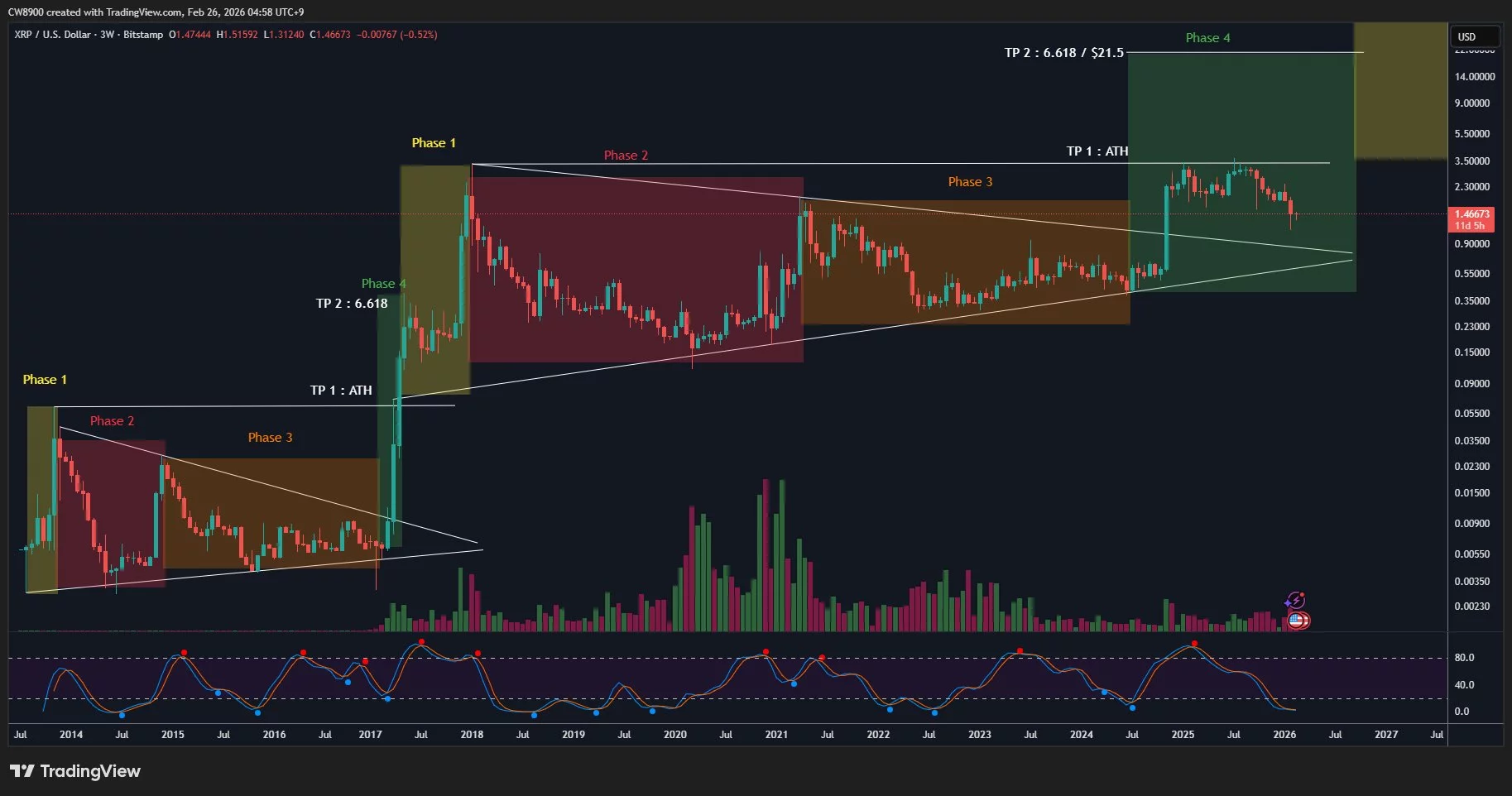
XRP price tests key resistance as momentum slowly rebuilds
On the daily timeframe, XRP’s price action shows stabilization after a sharp drop earlier this year. The 14-day RSI sits near 44, recovering from oversold territory but still below the neutral 50 mark, suggesting momentum is improving but not yet decisively bullish.
Meanwhile, XRP remains below its 50-day simple moving average (SMA), currently near $1.69, which acts as immediate resistance. A sustained move above this level could strengthen the bullish case and confirm short-term reversal momentum.
On the downside, key support lies near $1.30–$1.35, with stronger structural support around $1.20. A breakdown below those levels would invalidate the bullish retest narrative.
For now, XRP sits at a technical crossroads with traders watching closely to see whether this is merely consolidation or the beginning of Phase 4.
The Core Team said they continue with the updates, and the latest is right around the corner.
Despite the ongoing community backlash and questions regarding the migration state, the team behind Pi Network announced a new set of protocol upgrades that are currently in progress, and the deadline is March 1.
In the meantime, the native token has been quite volatile as of late, and we will review its most recent performance.
March 1 Deadline for Nodes
Similar to the updates outlined by the team in mid-February, the new protocol improvements will be rolled out gradually. In this second step, the deadline is set for the upcoming Sunday (March 1).
As with the February batch, all network nodes are required to complete this step before the deadline to “remain connected to the network.”
Protocol upgrades in progress (Step 2 – Deadline: March 1): The Pi Mainnet blockchain protocol continues to undergo a series of upgrades. All Mainnet nodes are required to complete this step before the deadline to remain connected to the network. Details here:…
— Pi Network (@PiCoreTeam) February 25, 2026
The explanatory post actually refers users to the Pi Nodes page on the project’s website. In it, the team reiterates previous statements about the importance of nodes within the Pi Network ecosystem, as they referred to them as the “fourth role.” Once again, they reminded that nodes have to run on laptops and desktops instead of mobile phones.
Pi Nodes, similar to other blockchains, are responsible for validating transactions on the distributed ledger and resolving challenges in maintaining a “distributed currency by having to come to a “consensus” on the order of new transactions that are being recorded.”
You may also like:
In Pi Network’s case, the consensus algorithm is based on SCP, which allows nodes to form trusted groups, referred to as quorum slices, and only agree to transactions that are in complete alignment.
“Unlike most other crypto projects, the Pi Node will continue to follow the philosophy of user-centric design. Instead of requiring deep technical knowledge to set up a node, everyday people will be able to do that by installing a desktop application on their computers,” said the team.
PI Price Update
Pi Network’s native token went through some intense volatility in the past few weeks, which included a sporadic 35% daily surge a few weeks back that pushed it beyond $0.20. However, it was quickly rejected there and driven to under $0.16 during the market-wide crash earlier this week.
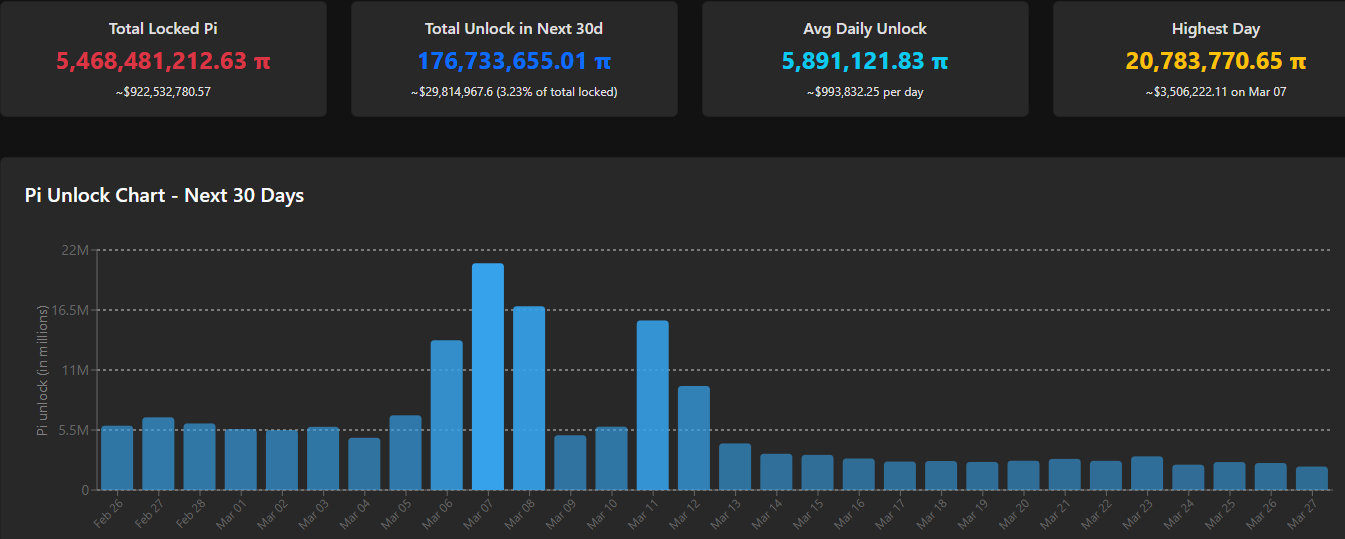
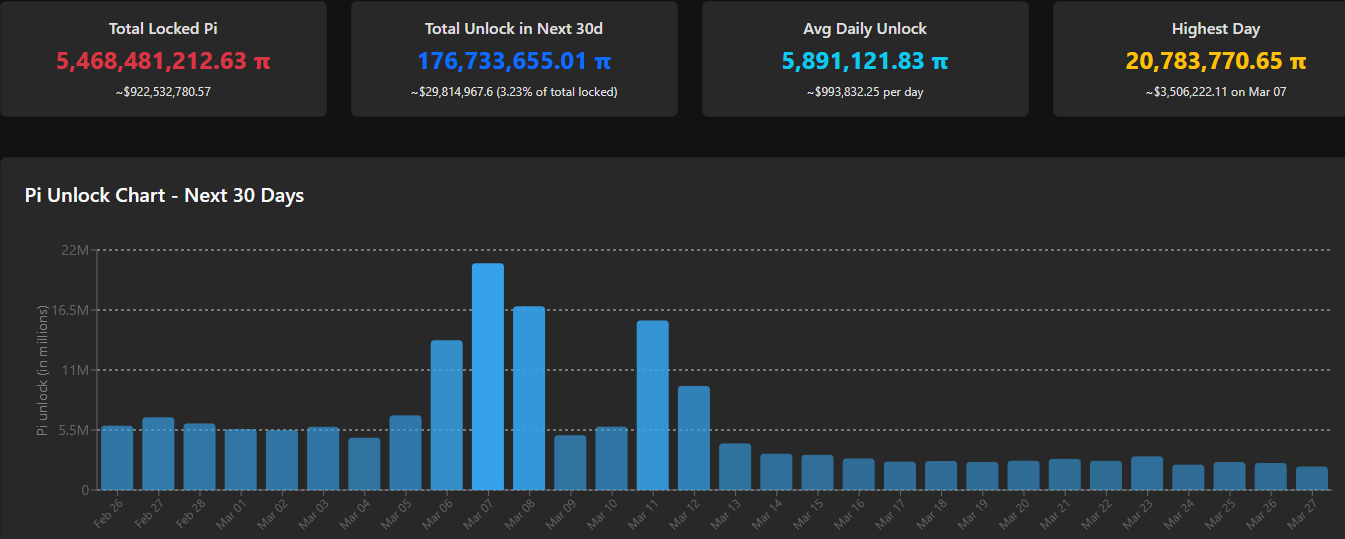
With BTC and the alts rebounding yesterday and today, PI followed suit and now sits inches away from $0.17. The upcoming unlocking schedule has some troubling news for next week, but the following several days should ease the pain, with around 5.5 million tokens to be released daily.
On March 7, though, that amount will skyrocket to almost 22 million, followed by 16.5 million a day later. These large unlocks could increase the immediate selling pressure.
Binance Free $600 (CryptoPotato Exclusive): Use this link to register a new account and receive $600 exclusive welcome offer on Binance (full details).
LIMITED OFFER for CryptoPotato readers at Bybit: Use this link to register and open a $500 FREE position on any coin!
Disclaimer: Information found on CryptoPotato is those of writers quoted. It does not represent the opinions of CryptoPotato on whether to buy, sell, or hold any investments. You are advised to conduct your own research before making any investment decisions. Use provided information at your own risk. See Disclaimer for more information.
DOT, STABLE, and UNI have rocketed the most in the past day, with gains of over 20% in some instances.
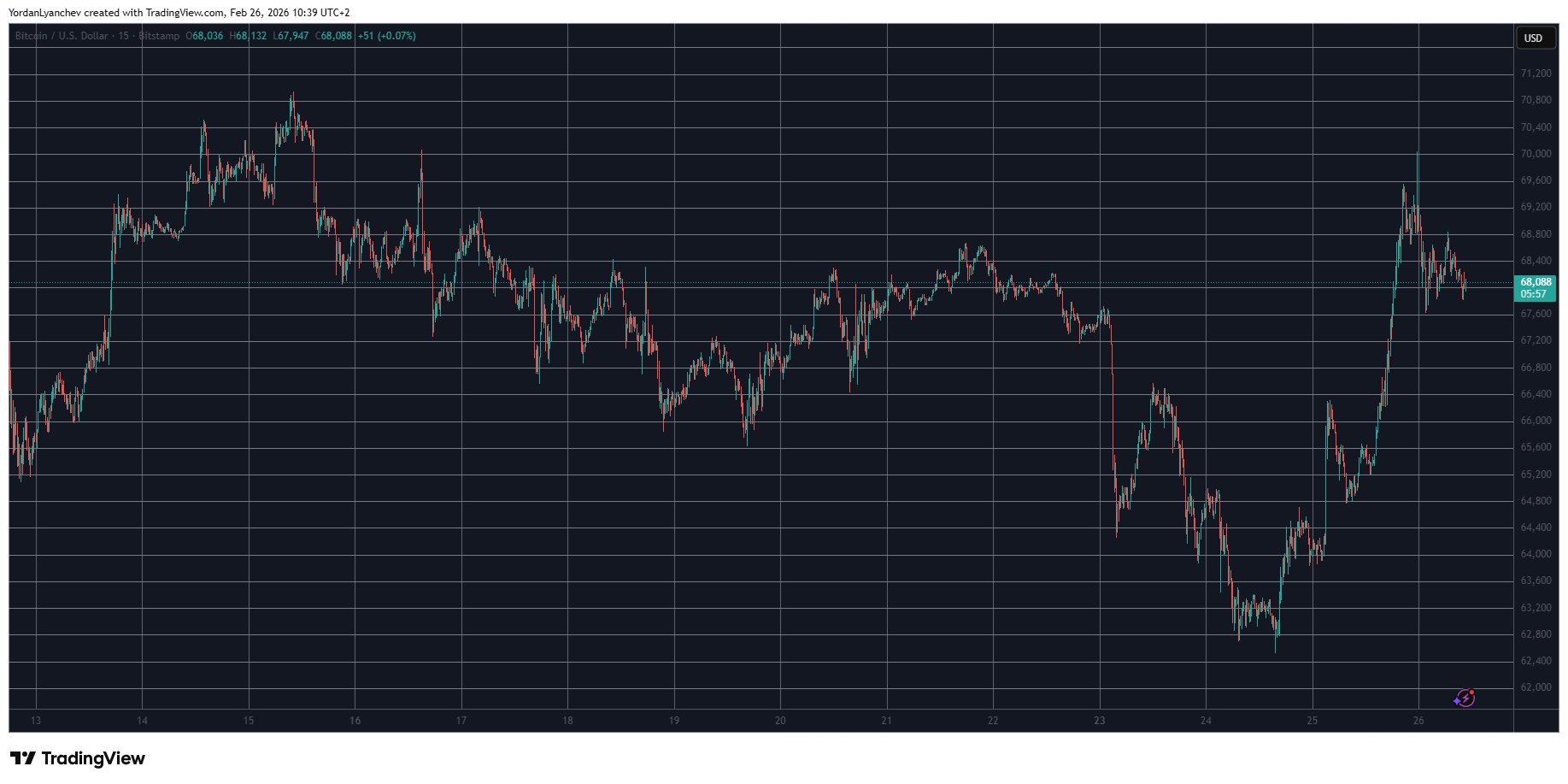
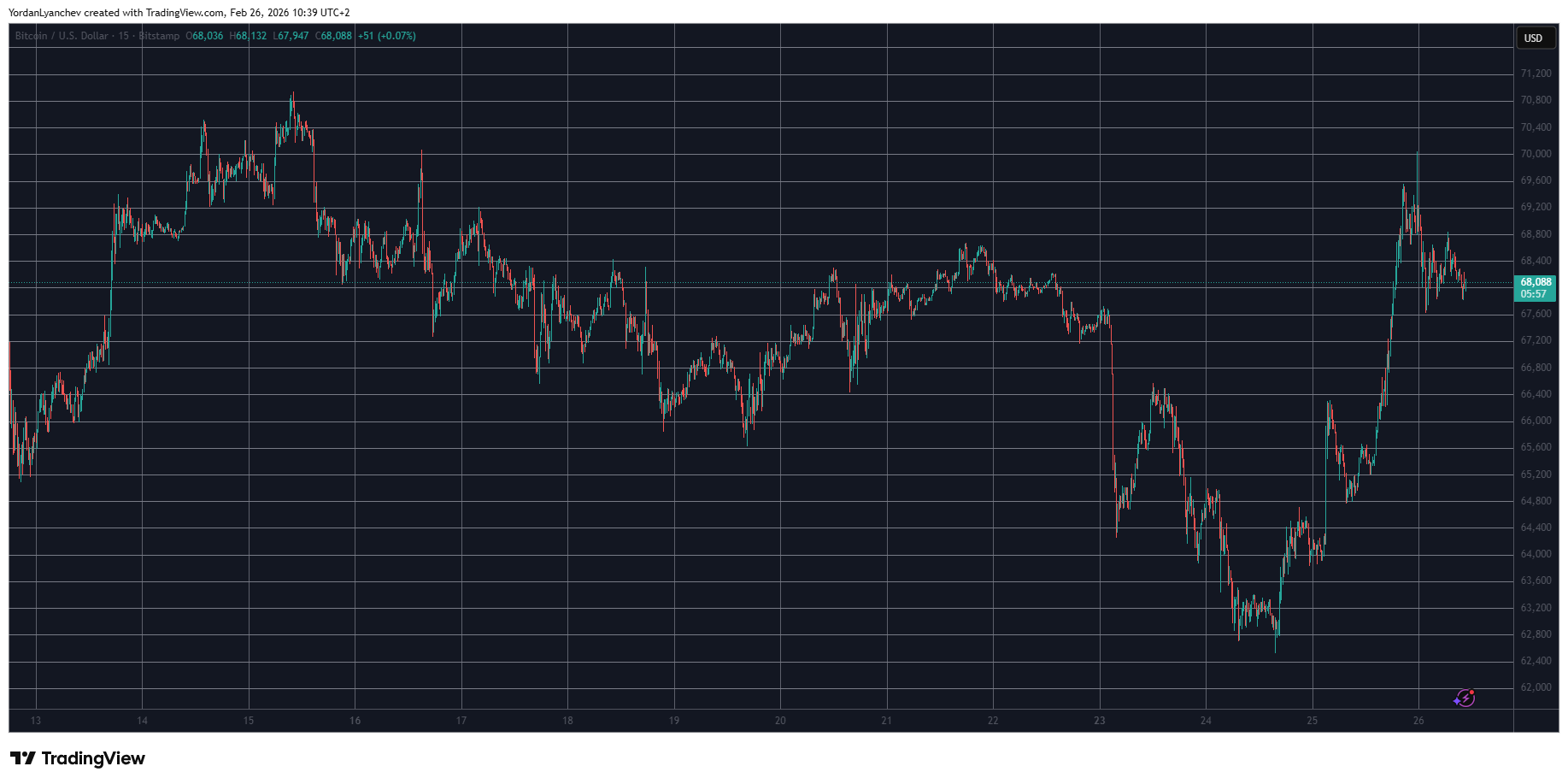
After dumping to a new local bottom of $62,500, bitcoin went on a tear yesterday, surging by over eight grand to $70,000, where it faced immediate selling pressure.
Many altcoins have produced even more impressive gains over the past day, with ETH reclaiming the $2,000 level, and ADA surging by double digits to almost $0.30.
BTC Tapped $70K
After last week’s rejection at $70,000, bitcoin spiraled down for a few consecutive days and dipped to $65,600 last Thursday. It reacted well to this decline and jumped toward $69,000 during the weekend, where it was stopped again after the latest developments on the tariff front, prompted by the US Supreme Court and the subsequent Trump actions.
Although BTC remained relatively still at first, it plunged when the legacy futures markets opened. In just over an hour, the asset plummeted to $64,400 before it rebounded to $66,400.
That appeared to be a dead-cat bounce, and BTC quickly began to lose value again. This time, the nosedive drove it to a three-week lot of $62,500. The bulls finally stepped up decisively at this point and prevented another leg down. Just the opposite; bitcoin exploded out of the gate and soared to $70,000 for the first time in over a week.
It couldn’t break above that level, and has declined by two grand since. However, it’s still 4.5% up on the day, and its market cap has returned to $1.360 trillion on CG. Its dominance over the alts remains inches above 56%.
Alts Rocket
Ethereum, which some analysts believe might have already bottomed out, is back above $2,000 after an impressive 8% daily surge. XRP has reclaimed the $1.40 line after a 5.5% pump. SOL, DOGE, CC, BNB, and HYPE have marked similar gains, while LINK has soared by 9%.
ADA has outperformed the rest of the larger-cap alts. A 10% surge has driven it to almost $0.30. DOT is today’s top performer, having soared by 24% to roughly $1.60. STABLE, UNI, and NEAR follow suit.
The total crypto market cap has recovered $120 billion since the recent low and is up to $2.425 trillion on CG.

Binance Free $600 (CryptoPotato Exclusive): Use this link to register a new account and receive $600 exclusive welcome offer on Binance (full details).
LIMITED OFFER for CryptoPotato readers at Bybit: Use this link to register and open a $500 FREE position on any coin!
Disclaimer: Information found on CryptoPotato is those of writers quoted. It does not represent the opinions of CryptoPotato on whether to buy, sell, or hold any investments. You are advised to conduct your own research before making any investment decisions. Use provided information at your own risk. See Disclaimer for more information.
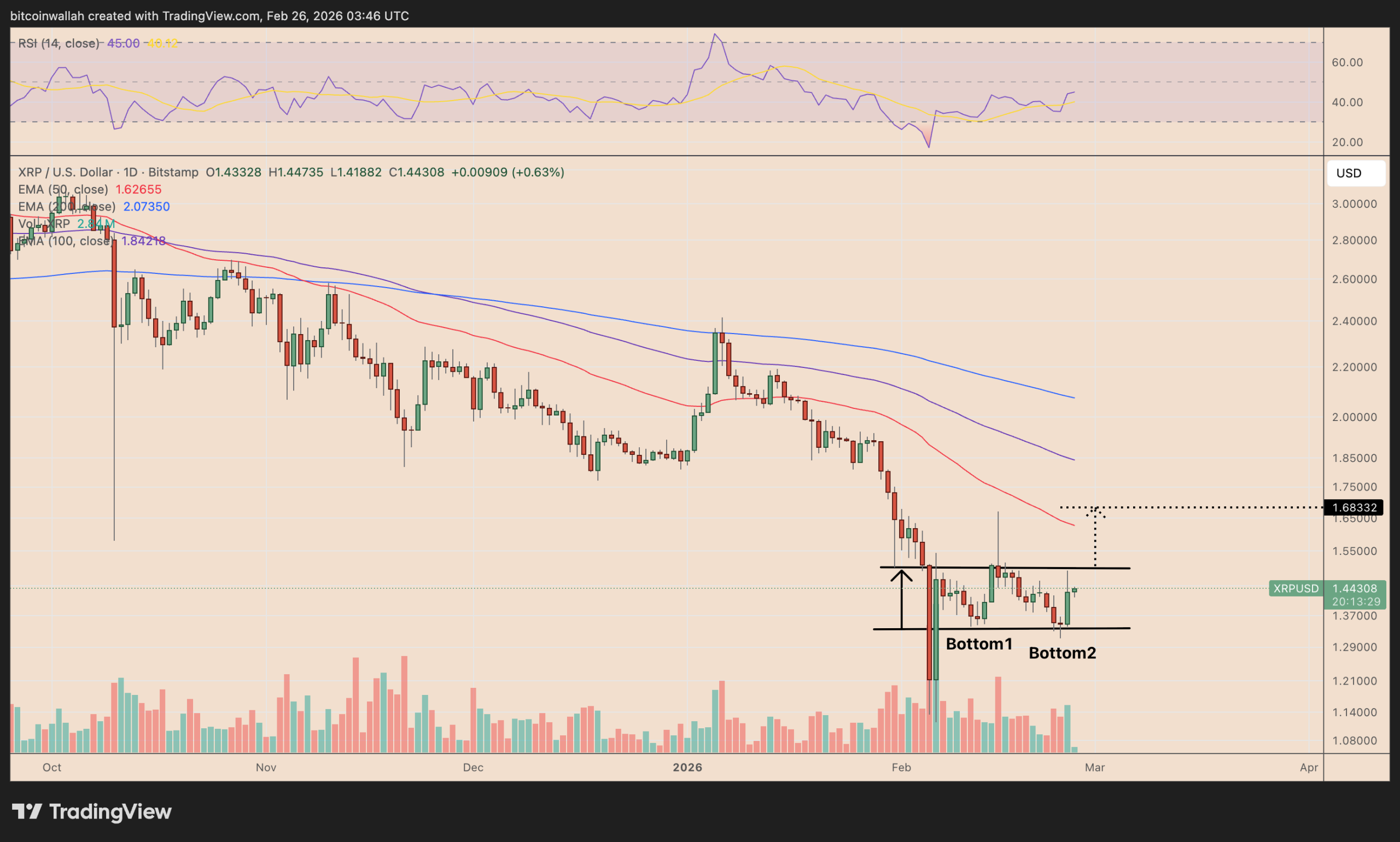
A convincing bullish reversal setup and hints of easing whale distribution may push the price of XRP up by 20% or more in March.
XRP (XRP) is down more than 50% since October 2025, with five consecutive monthly losses. Can March finally snap the bearish streak?
Key takeaways:
-
XRP’s double-bottom setup targets 20% upside in March.
-
Whale selling has cooled and larger-holder balances are rising, improving the bullish outlook.
Double bottom hints at 20% XRP rally
As of Thursday, XRP was forming what appeared to be a double bottom pattern after holding the $1.30–$1.35 support area twice in February.
A double bottom forms when the price hits the same floor twice an rebounds. It resolves on a breakout above the neckline, often setting an upside target equal to the pattern’s height from the breakout level.

For XRP, the neckline sits near $1.50. A decisive break above it increases the odds of XRP rising to $1.68–$1.70 by March, roughly 20% above the current levels.
XRP whale flows improve recovery chances
XRP net flows are shrinking toward neutral levels after spending months in distribution phase, according to data resource CryptoQuant.
As of Thursday, the total whale flow on a 90-day moving average was around -3.29 million XRP compared to roughly -33.50 million XRP in December. This shows that whale outflows have substantially decreased despite the 25% price drop in the same period.

At the same time, XRP supply held by wallets with at least 1,000 tokens has resumed its upward trajectory in recent weeks, suggesting that whales have stopped selling and may be re-accumulating near current lows.

A similar easing in whale flows occurred in April 2025, which preceded an XRP rebound of over 50%.
Therefore, a clean flip above zero would signal net accumulation and strengthen the case for XRP to follow through toward its $1.68–$1.70 double-bottom target in March.
What could spoil the bullish XRP scenario?
The $1.68–$1.70 area is above XRP’s 50-day exponential moving average (50-day EMA, the red trendline), a level the price has failed to break throughout February.
A pullback from the 50-day EMA could keep XRP from hitting its double-bottom target. That may further trigger a bear pennant scenario with the price target at around $1, down about 30% from the current price levels.
Related: $209B exited altcoins over the last 13 months: Did traders rotate into Bitcoin?
Macro risks are another headwind. The return of the AI-driven risk-off trade and US–Iran tensions can drain liquidity from high-beta assets, making it harder for XRP to sustain a breakout even if the chart setup currently looks promising.
This article does not contain investment advice or recommendations. Every investment and trading move involves risk, and readers should conduct their own research when making a decision. While we strive to provide accurate and timely information, Cointelegraph does not guarantee the accuracy, completeness, or reliability of any information in this article. This article may contain forward-looking statements that are subject to risks and uncertainties. Cointelegraph will not be liable for any loss or damage arising from your reliance on this information.
A large crypto trader lost roughly $8.2 million after a leveraged bet on the ARC perpetuals market unraveled on the decentralized derivatives platform Lighter, forcing the exchange to tap its backstop liquidity and trigger auto-deleveraging to manage risk.
In a series of posts on X, the platform explained that the whale built a very large long position over several days, pushing total open interest in the ARC (ARC) market to about $50 million, while roughly 600 traders and market makers took the opposite side.
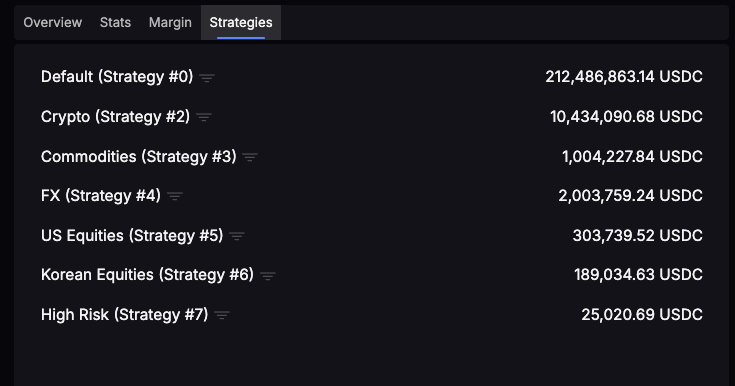
The trade began to fail when ARC’s price dropped around 6:00 pm ET on Wednesday. About $2 million of the position was liquidated on the order book, and the remaining position was moved into Lighter’s liquidity provider pool (LLP), where it was handled under a high-risk strategy category.
The platform then activated auto-deleveraging (ADL), meaning some profitable short traders were partially closed so the system could safely unwind the position. At one point, the LLP briefly absorbed about 200 million ARC, worth roughly $14.7 million, before the position was reduced further as prices continued falling.
Related: How South Korea is using AI to detect crypto market manipulation
Risk caps limit LP losses to $75,000
Even with the large liquidation, losses to liquidity providers were limited. Lighter said only about $75,000 was affected because the ARC market was isolated in a separate risk bucket rather than exposing the exchange’s entire liquidity pool. Short traders who held positions against the whale were profitable.

“In the end, the big long trader lost around 8.2M USDC (USDC), LLP lost 75k, and the short traders who took the risk of betting against this position were profitable,” Lighter wrote.
Following the incident, Lighter added new safeguards to the market. In a pop-up message on its website, the platform said it introduced a $40 million open interest cap on ARC and moved the pair under a capped liquidity strategy with approximately $100,000 USDC in allocated capital. If that liquidity is exhausted, the system now automatically transitions to ADL to close risk.
The exchange also said similar caps may be applied to other assets.
Related: How pig-butchering crypto scams turn trust into a financial weapon
Manipulation concerns on decentralized platforms
The incident comes amid concerns over price manipulation on decentralized trading platforms. In August last year, four whales were accused of manipulating the price of Plasma (XPL) token on Hyperliquid after the asset jumped about 200% to above $1.80 within minutes.
In June, DeFi protocol Resupply also suffered a security breach in its wstUSR market, resulting in roughly $9.6 million in losses after an attacker manipulated prices through its integration with the synthetic stablecoin cvcrvUSD.
Magazine: Bitcoin may take 7 years to upgrade to post-quantum — BIP-360 co-author


Ethereum co-founder Vitalik Buterin has outlined sweeping changes to the network’s core consensus design following the release of the Ethereum Foundation’s new “strawmap,” a long-range technical roadmap aimed at accelerating layer-1 upgrades through the end of the decade.
Summary
- Vitalik Buterin outlined plans to reduce Ethereum slot times from 12 seconds toward as low as 2 seconds, with finality potentially dropping to 6–16 seconds.
- The Ethereum Foundation’s “strawmap” sketches seven forks through 2029, targeting faster UX, gigagas throughput, post-quantum security, and privacy.
- Upgrades include erasure-coded P2P networking, reduced attester counts, Minimmit-based finality, and eventual quantum-resistant cryptography.
Vitalik Buterin explains Ethereum Strawmap vision
In a detailed post, Buterin walked through one of the roadmap’s central goals: “fast L1,” which seeks to progressively reduce slot times and dramatically cut finality. Ethereum’s current average finality sits at roughly 16 minutes.
Under the proposed trajectory, slot times could gradually fall from 12 seconds to as low as 2 seconds, while finality could shrink to between 6 and 16 seconds using a one-round BFT-style algorithm known as Minimmit.
Buterin emphasized that slot time reductions would occur incrementally, potentially following a “sqrt(2) at a time” formula, and only when proven safe. Key enablers include peer-to-peer networking upgrades using erasure coding to improve block propagation efficiency, as well as architectural adjustments that reduce signature aggregation overhead by limiting the number of attesters per slot.
The strawmap, introduced by Ethereum Foundation researcher Justin Drake, presents five long-term “north stars”: fast L1, gigagas L1 throughput, teragas L2 scaling, post-quantum security, and native privacy. It spans seven projected forks through 2029, with upgrades grouped across consensus, data, and execution layers.
Buterin noted that many of the most invasive changes, including quantum-resistant hash-based signatures, may be bundled together in a gradual “ship of Theseus” style replacement of Ethereum’s consensus system.
While the document is described as a coordination tool rather than an official roadmap, it signals a push toward faster user experience, stronger cryptography, and end-to-end formal verification.

USD/JPY Pulls Back After a Period of Gains

Aaron Carter’s Mom Claims His Ex Made ‘Illegal’ Withdrawals From Accounts, Ex Denies

A public inquiry into grooming gangs in Scotland is a victory for survivors


-

 Video6 days ago
XRP News: XRP Just Entered a New Phase (Almost Nobody Noticed)
-

 Politics4 days ago
Baftas 2026: Awards Nominations, Presenters And Performers
-

 Fashion6 days ago
Weekend Open Thread: Boden – Corporette.com
-

 Sports3 days ago
Women’s college basketball rankings: Iowa reenters top 10, Auriemma makes history
-

 Politics3 days ago
Nick Reiner Enters Plea In Deaths Of Parents Rob And Michele
-

 Crypto World2 days ago
XRP price enters “dead zone” as Binance leverage hits lows
-

 Business4 days ago
Mattel’s American Girl brand turns 40, dolls enter a new era
-

 Business4 days ago
Law enforcement kills armed man seeking to enter Trump’s Mar-a-Lago resort, officials say
-

 Tech2 days ago
Unsurprisingly, Apple's board gets what it wants in 2026 shareholder meeting
-
 NewsBeat11 hours ago
Manchester Central Mosque issues statement as it imposes new measures ‘with immediate effect’ after armed men enter
-

 NewsBeat9 hours ago
Cuba says its forces have killed four on US-registered speedboat | World News
-

 Business2 days ago
True Citrus debuts functional drink mix collection
-
 NewsBeat3 days ago
‘Hourly’ method from gastroenterologist ‘helps reduce air travel bloating’
-

 Tech4 days ago
Anthropic-Backed Group Enters NY-12 AI PAC Fight
-

 NewsBeat4 days ago
Armed man killed after entering secure perimeter of Mar-a-Lago, Secret Service says
-

 Politics4 days ago
Maine has a long track record of electing moderates. Enter Graham Platner.
-

 Business5 hours ago
Discord Pushes Implementation of Global Age Checks to Second Half of 2026
-
 NewsBeat1 day ago
Police latest as search for missing woman enters day nine
-

 Crypto World1 day ago
Entering new markets without increasing payment costs
-
 Sports3 days ago
2026 NFL mock draft: WRs fly off the board in first round entering combine week