

Crypto World
NEAR Launches Near.com super app, touting AI capabilities and confidential transactions

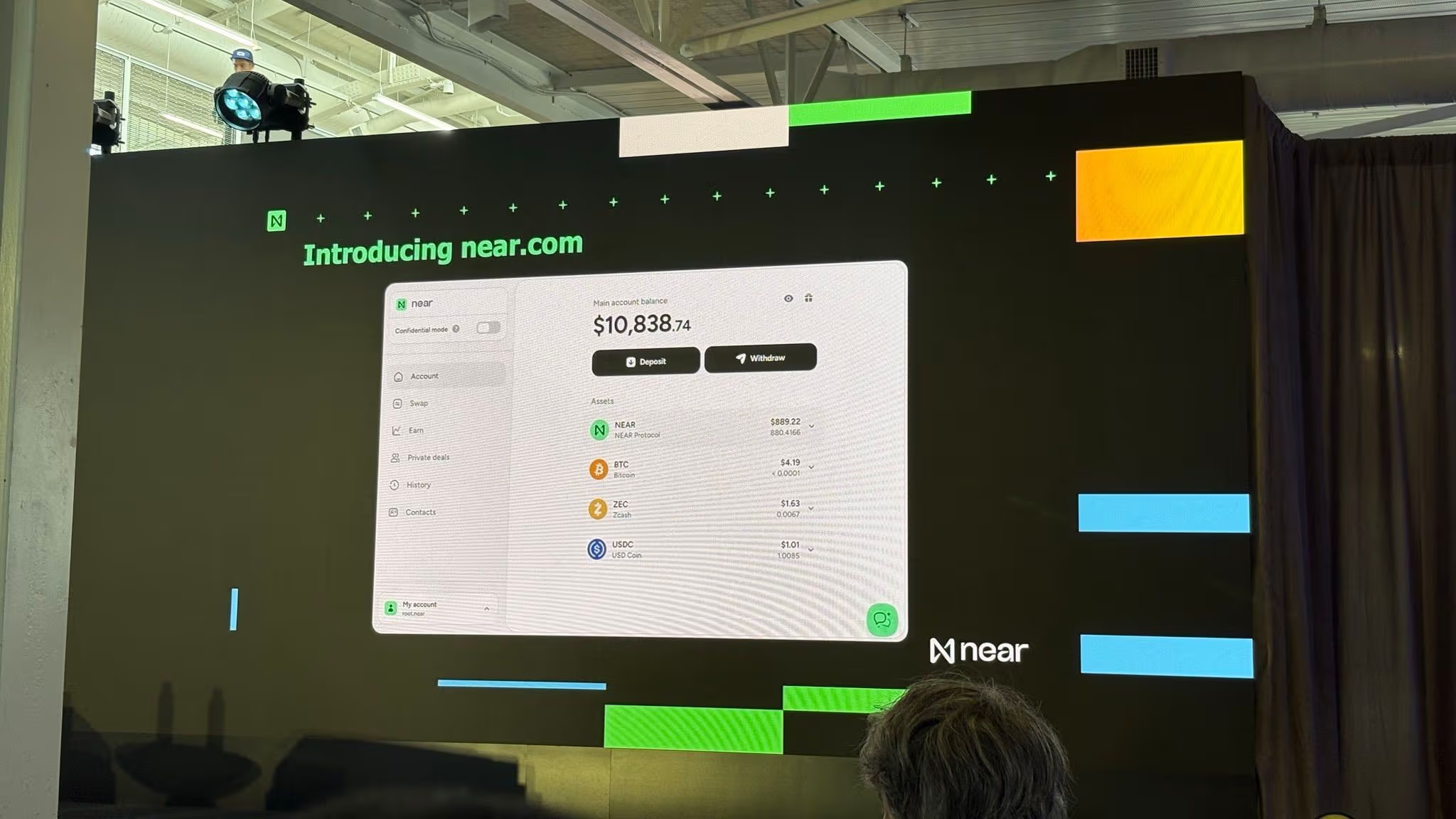
San Francisco, CA – NEAR is launching Near.com, a new crypto wallet and consumer app that aims to make blockchain technology feel as simple as using a traditional finance app, while positioning itself at the intersection of crypto and artificial intelligence (AI).
Polosukhin previously co-authored the paper that introduced the transformer model, the architecture underpinning modern AI systems like ChatGPT and many other large language models, and has increasingly focused on how blockchain infrastructure can support the next wave of AI-driven applications.
“We are entering the world where AI is becoming our interface to compute,” Polosukhin said during the presentation.
NEAR token is down nearly 3% over the last 24 hours.
At its core, Near.com is designed to remove much of the friction that has long made crypto confusing for everyday users. Instead of worrying about gas fees, private keys or switching between different blockchains, users can manage their assets in one place.
“You don’t need to think about blockchains. You don’t need to think about gas, keys,” Polosukhin said. “You just use it as your main wallet.”
Near.com supports a range of digital assets, including bitcoin, stablecoins, NFTs and other tokens. The idea is to bring together activity that is typically spread across multiple wallets and networks into a single, streamlined interface.

But NEAR’s ambitions extend beyond building just another wallet. The company is betting that the next big wave in crypto will come from its convergence with AI.
As AI agents become more capable, like booking travel, managing emails or handling online purchases, they will increasingly need the ability to transact. That’s where crypto infrastructure comes in. Blockchains can provide programmable payments, global transfers and automated settlement without relying on traditional intermediaries.
Polosukhin argued that as AI systems begin interacting with each other, they effectively become “economic actors,” software programs that negotiate, pay and coordinate tasks. In that world, crypto becomes the financial layer that allows these agents to operate.
Near.com is designed to serve as that layer, acting as both a user-friendly wallet for people and an economic backend for AI-driven activity.
A key part of the announcement is privacy. One of blockchain’s longstanding tradeoffs is transparency: transactions are typically visible to anyone. While that openness can build trust, it can also expose sensitive financial information.
“Everything you do onchain is transparent,” Polosukhin said. “That’s not realistic for usual use cases, for day-to-day usage.”
To address this, NEAR introduced a “confidential mode” within Near.com. The feature allows balances, transfers and trading activity to remain private within the network’s security framework. The company says this makes the wallet more practical not only for individuals and businesses, but also for AI agents that may need to transact without revealing strategy or sensitive data.
The launch signals a broader shift for NEAR.
“We have the stack. We have all the components. We have the product,” Polosukhin said. “Now we’re switching … to how we actually scale adoption — how we bring this to billions of people around the world.”
Read more: Most Influential: Sam Altman


Strategy CEO Michael Saylor dismissed concerns about quantum computing during an appearance on Natalie Brunell’s Coin Stories podcast, saying the cybersecurity community broadly agrees that any credible quantum threat is likely more than a decade away.
While it remains unclear if or when a quantum risk might materialize, Saylor told the podcast host that any credible breakthrough would prompt coordinated software upgrades across global banking systems, internet infrastructure, consumer devices, artificial intelligence networks and crypto protocols, including Bitcoin (BTC).
Saylor said the digital systems underpinning modern digital infrastructure would eventually adopt post-quantum-resistant cryptography if necessary, adding that such a shift would not come as a surprise.
“You’ll see it coming. We’ll all see it coming,” he said, adding that Bitcoin’s software is designed to change over time, with nodes, hardware, and wallets capable of upgrading in response to emerging threats.

In his view, global consensus on how to respond would emerge only if a credible threat develops, noting that governments, technology companies and financial institutions would all face the same risk to their digital systems.
He also described the crypto sector as the “most sophisticated cybersecurity community,” pointing to the multi-factor authentication and hardware key protections commonly used to secure digital assets.
In his view, the procedures required to move Bitcoin are significantly more rigorous than the security standards used for traditional bank wires or stock trading systems. Saylor said:
“I think the crypto community will be the first to perceive the threat, and to react to the threat, and they’ll be leading the way.”
Quantum computing is an emerging field of computation that uses quantum mechanics to process information far faster than classical computers, prompting concerns that advanced machines could eventually break the cryptography securing Bitcoin and other digital assets.
Saylor’s Strategy is the largest Bitcoin treasury company in the world. On Monday, the Tysons Corner, Virginia-based company announced it had purchased 592 Bitcoin for roughly $39.8 million last week, its 100th acquisition since adopting a Bitcoin treasury strategy in August 2020.
It currently holds 717,722 BTC, acquired for about $54.56 billion at an average price of $67,286 per coin.

Related: Willy Woo warns quantum risk is eroding Bitcoin’s edge over gold
The ongoing quantum debate in crypto
While Michael Saylor, one of Bitcoin’s most prominent advocates, has downplayed the risks posed by quantum computing, others in the crypto industry appear more worried about the threat.
One of them is Ethereum (ETH) co-founder Vitalik Buterin, who in late 2025 cited Metaculus, a forecasting platform, that suggested around a 20% chance that quantum computers capable of breaking current cryptography could emerge before 2030, with a median estimate around 2040.
Speaking months later at Devconnect in Buenos Aires, he warned that elliptic curve cryptography, which underpins Ethereum and Bitcoin, could fail before the 2028 US presidential election and urged a transition to quantum-resistant systems within the next four years.
The Ethereum Foundation has incorporated post-quantum preparedness into its 2026 security roadmap, with researcher Justin Drake announcing on Jan. 24 that a dedicated Post-Quantum team had been formed, describing the move as a turning point in the foundation’s long-term quantum strategy.
The quantum threat has even caused some to speculate its the reason behind the Bitcoin’s recent price decline, which has fallen from highs of over $126,000 in October to its current price of around $64,000.
In January, Castle Island Ventures partner Nic Carter said Bitcoin’s “mysterious” underperformance could be attributed to quantum risk concerns, saying that markets were reacting even if developers were not.
That view drew pushback, with Glassnode analyst James Check writing that quantum computing plans should be put in place, but the threat is not the “primary reason” behind the decline in price.

Magazine: Bitcoin may take 7 years to upgrade to post-quantum: BIP-360 co-author
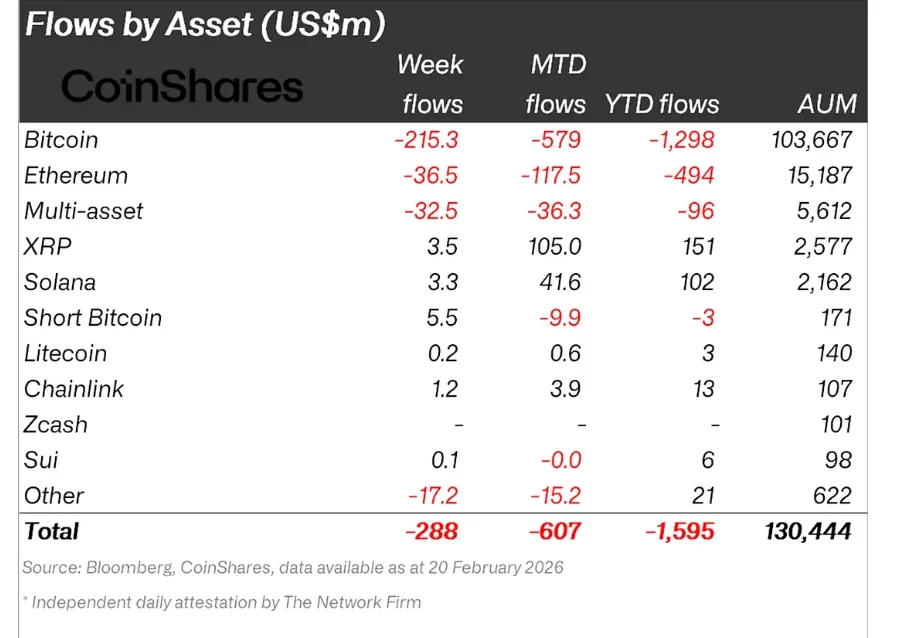
Crypto funds recorded $288 million in outflows last week, marking the fifth consecutive week of declines, according to the latest weekly report from CoinShares.
Summary
- Digital asset investment products saw $288 million in weekly outflows, marking the fifth consecutive week of withdrawals and bringing the cumulative total to $4 billion over the period.
- The United States led redemptions with $347 million in outflows, while Europe and Canada recorded modest inflows, highlighting a regional divergence in sentiment.
- Bitcoin accounted for the bulk of withdrawals, while short-bitcoin products and select altcoins such as XRP and Solana saw minor inflows.
US sells, Europe buys: Crypto funds show sharp regional divide
The latest withdrawals bring cumulative outflows over the current stretch to $4.0 billion, highlighting persistent weakness in investor sentiment.
Trading activity also cooled significantly. Total volumes across crypto exchange-traded products fell to $17 billion, the lowest level since July 2025, after several weeks of elevated turnover. The sharp decline in activity suggests growing investor apathy following recent market turbulence.
Regional flows reveal a widening divergence in sentiment.
The United States accounted for $347 million in outflows, reflecting continued caution among U.S. investors. In contrast, Europe and Canada recorded a combined $59 million in inflows, as some investors appeared to view recent price weakness as a buying opportunity.
Switzerland led regional inflows with $19.5 million, followed by Canada at $16.8 million and Germany at $16.2 million.
Bitcoin leads $288M weekly outflows
Bitcoin (BTC) remained the primary driver of weakness, with $215 million in outflows, representing the largest share of redemptions. Meanwhile, short-bitcoin products saw $5.5 million in inflows, the highest of any category, suggesting some investors are positioning for further downside.
Ethereum (ETH) experienced the second-largest withdrawals at $36.5 million, while multi-asset products and Tron saw outflows of $32.5 million and $18.9 million, respectively.
Among altcoins, minor inflows were recorded in XRP ($3.5 million), Solana ($3.3 million), and Chainlink ($1.2 million), though these were insufficient to offset broader market weakness.
Despite the ongoing selloff, total assets under management remain substantial at $130.4 billion, indicating that while sentiment is subdued, institutional exposure to digital assets persists.
Crypto World
Strange New Chinese AI ‘KIMI’ Predicts the Price of XRP, PEPE and Cardano By the End of 2026
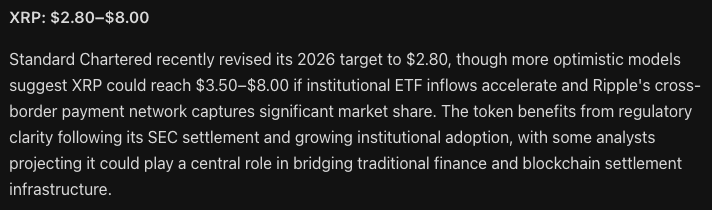
Feeding KIMI AI carefully worded prompts unlocks eye-popping 2026 price outlooks for XRP, Pepe, and Cardano heading into 2026.
Based on KIMI’s data-driven models, all three could deliver gains of at least 5x by the end of next year.
Below we assess how realistic KIMI’s targets are.
XRP ($XRP): KIMI Maps a Longer-Term Route Toward $8
In a recent update, Ripple reiterated that XRP ($XRP) remains the cornerstone of its plan to establish the XRP Ledger as a global, enterprise-ready payments infrastructure.
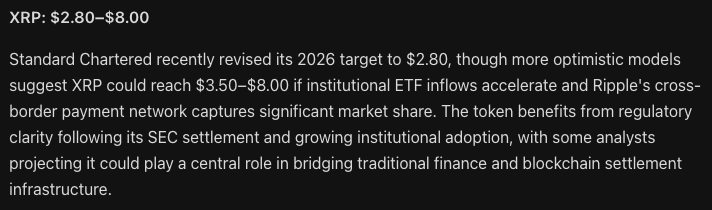
With fast settlement times and negligible transaction costs, the XRP Ledger could capture meaningful share in two rapidly expanding segments of crypto adoption: stablecoins and tokenized real-world assets.
XRP currently trades near $1.40. According to KIMI’s extended forecast model, the token could advance to $8 by the end of 2026, implying a near sixfold increase.
Market indicators support this outlook. XRP’s Relative Strength Index (RSI) sits around 39 and rising, while price action remains below the 30-day moving average, conditions that suggest now presents an attractive accumulation zone.
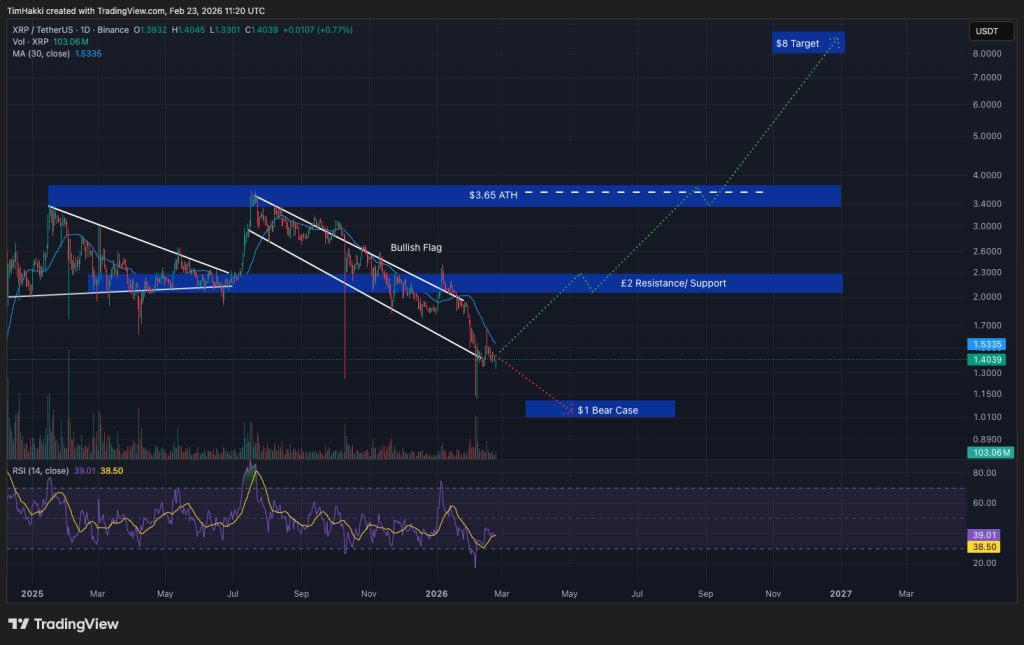
Additional momentum could come from multiple sources, including institutional demand following the approval of U.S.-listed XRP ETFs, Ripple’s growing network of global partnerships, and potential regulatory clarity if the U.S. CLARITY bill advances this year.
Pepe ($PEPE): KIMI Teases a 2,300% Upside Scenario
Pepe ($PEPE), launched in April 2023, has since become the largest meme coin outside the doge category, with a market capitalization of $1.7 billion.
Derived from Matt Furie’s “Boy’s Club” comics, PEPE’s instantly recognizable avatar and strong cultural resonance have kept it in the spotlight across social platforms.
Despite intense competition in the meme coin space, PEPE has maintained its leadership thanks to a loyal community and the many copycat tokens it has inspired.
Occasional cryptic posts from Elon Musk on X have also fueled speculation that PEPE may rank alongside DOGE and BTC in his personal portfolio.
At the time of writing, PEPE trades around $0.0000041, roughly 85% below its December 2024 ATH of $0.00002803.
Under KIMI’s most aggressive assumptions, PEPE could rally nearly 2,300% this year, climbing to $0.000098 and decisively surpassing its previous record.
Cardano (ADA): KIMI Gives Hoskinson’s ETH Contender 1,300% Gains
Founded by Charles Hoskinson, Cardano ($ADA) emphasizes peer-reviewed research, high security standards, scalability, and long-term network sustainability.
With a market capitalization near $10 billion and over $128 million in total value locked (TVL), Cardano’s ecosystem continues growing despite the downturn.
KIMI’s projections suggest ADA could climb slightly above 1,300%, rising from about $0.27 today to nearly $3.80 by the end of 2026. That level would place it well above its 2021 peak of $3.09.
However, ADA is currently trading at its lowest level since October 2024.
Given the volatile market conditions seen this year, further downside is possible, including a possible collapse down to $0.15 in a bear market.
Maxi Doge: A New Meme Contender Emerges as Majors Target Higher Levels
Pepe’s inherent meme coin magic (volatility) means KIMI thinks it could 24x this year. However, given its large market cap, even Pepe’s headroom for growth is limited by its size.
Maxi Doge ($MAXI) is not, however. Having raised $4.6 million so far in its ongoing presale, it’s one of the hottest under-the-radar meme coins around.
The project centers on Maxi Doge, a brash, gym-obsessed, unapologetically degen alpha doge and an envious distant cousin and self-proclaimed rival to Dogecoin.
Its tone and branding tap directly into the raw, irreverent energy that powered the 2021 meme coin boom.
MAXI is an ERC-20 token built on Ethereum’s proof-of-stake network, giving it a far smaller environmental footprint than Dogecoin’s proof-of-work model.
Early presale buyers can currently stake MAXI tokens for yields of up to 67% APY, with rewards decreasing as the staking pool expands.
The token is currently selling for $0.0002805, with automatic price increases at each funding milestone. Purchases are supported through wallets such as MetaMask and Best Wallet.
Stay updated through Maxi Doge’s official X and Telegram pages.
Visit the Official Website Here.
The post Strange New Chinese AI ‘KIMI’ Predicts the Price of XRP, PEPE and Cardano By the End of 2026 appeared first on Cryptonews.
Crypto World
World Liberty Financial Claims Hackers and Paid FUD Targeted USD1 in Orchestrated Market Attack

TLDR:
- World Liberty Financial alleged that several WLFI co-founder accounts were hacked during the Tuesday attack.
- Paid influencers reportedly spread fear and uncertainty to trigger a short-term sell-off in USD1 markets.
- USD1 briefly depegged to 0.9802 USDT before recovering to its intended $1.00 par value quickly.
- Eric Trump deleted WLFI-related posts on X, causing the token to briefly fall more than 8% in value.
World Liberty Financial reported a coordinated attack against its USD1 stablecoin on Monday morning. The project alleged that several co-founder accounts were hacked, influencers were paid to spread fear, uncertainty, and doubt, and large short positions were opened to profit from the resulting volatility.
USD1 briefly dipped to 0.9802 USDT before recovering to its $1.00 peg. WLFI credited its full 1:1 asset backing and mint-and-redeem mechanism for the quick recovery.
World Liberty Financial Alleges a Three-Part Coordinated Campaign
World Liberty Financial reported that the attack followed a structured and deliberate pattern. Hackers gained unauthorized access to several WLFI co-founder accounts on social media. Those accounts were then used to push misleading information to a broad audience.
Shortly after, paid influencers reportedly amplified the negative messaging across multiple platforms. The manufactured narrative was designed to erode market confidence in USD1 quickly.
Together, the hacked accounts and coordinated posts created enough panic to trigger a short-term sell-off.
While the social media campaign unfolded, attackers also opened massive short positions on WLFI tokens. This move was timed to profit from the price drop caused by the artificial fear in the market. The strategy reflected a pattern that has been observed in previous coordinated crypto attacks.
World Liberty Financial responded publicly through its verified X account, stating: “A coordinated attack was launched against USD1 this morning. Attackers hacked several WLFI cofounder accounts, paid influencers to spread FUD, and opened massive shorts to profit from the manufactured chaos.” The project urged users to rely only on verified channels going forward.
Eric Trump’s Deleted Posts Contributed to the Brief Market Decline
The reported attack was further compounded when Eric Trump, a WLFI co-founder, deleted several project-related posts on X.
The timing of the deletions coincided with the broader attack already unfolding across the market. Observers and traders quickly flagged the removed content as a point of concern.
Following the deletions, WLFI token prices fell more than 8% within a short window. The drop showed how sensitive crypto markets remain to social media activity, particularly during moments of uncertainty. Even minor shifts in online presence can trigger outsized reactions from market participants.
USD1 also felt the pressure during this period, trading temporarily at 0.9802 USDT against its intended $1.00 peg.
While the deviation was short-lived, any movement away from the peg in a stablecoin draws immediate scrutiny. The price recovered to par shortly after the situation stabilized.
World Liberty Financial maintained that the attack caused no lasting damage to USD1 or its underlying structure.
The team reaffirmed its long-term commitment to the project and noted that the stablecoin’s backing held firm throughout the incident. The full scope of the attack is still being investigated by the WLFI team.
TLDR
- Vitalik Buterin swapped more than 3,100 ETH for stablecoins through CoW Swap in recent days.
- On-chain data shows the transactions totaled over $6.1 million at current market prices.
- His on-chain Ethereum holdings now stand at more than 224,000 ETH valued at about $426 million.
- Buterin previously moved over $29 million in ETH, with at least $2.3 million funding Ethereum Foundation initiatives.
- Ethereum’s price fell below $1,900 and dropped over 36% in the past month.
Vitalik Buterin has continued selling Ethereum (ETH) through decentralized exchanges in recent days. On-chain data shows he swapped thousands of ETH for stablecoins. The latest transactions come as Ethereum’s price trades below $1,900.
Vitalik Buterin Executes Fresh ETH Sales Through CoW Swap
Arkham Intelligence labeled wallets tied to Vitalik Buterin recorded recent swaps on CoW Swap. The data shows he exchanged more than 3,100 ETH for stablecoins over several days.
Those transactions equal more than $6.1 million at current prices. After the swaps, his on-chain holdings stand at over 224,000 ETH.
The remaining balance carries a value of about $426 million. The transfers follow a pattern of routine sales observed in recent weeks.
Earlier, Buterin moved over $29 million worth of Ethereum. At least $2.3 million from that amount supported Ethereum Foundation initiatives.
He previously outlined plans to sell around $44.7 million in ETH. He linked those sales to a period of “mild austerity” for the Foundation.
Buterin said the approach would “ensure the Ethereum Foundation’s own ability to sustain in the long term.” He added it would protect Ethereum’s “core mission and goals.”
Ethereum Price Drops Below $1,900 as Market Weakens
Ethereum’s price has declined during the broader crypto market downturn. ETH has fallen about 4% over the past 24 hours.
The asset recently traded at $1,872 on major exchanges. It earlier touched a two-week low of $1,855 on Sunday.
Over the past month, Ethereum has dropped more than 36%. The token also remains over 62% below its August all-time high of $4,946.
Buterin has also addressed Ethereum’s long-term roadmap in public statements. He said the Ethereum mainnet “needed a new plan” regarding layer-2 scaling networks.
He discussed the relationship between the base layer and scaling chains. He suggested adjustments to strengthen coordination and efficiency.
Last week, Buterin supported a new censorship-resistant upgrade for the network. He said Ethereum was “going hard” on its technical direction.
He also referred to reviving a “cyberphunk” ethos within the ecosystem. These remarks came as developers continued work on protocol upgrades.
The recent ETH sales occurred during this period of roadmap discussion. On-chain data continues to track movements from wallets linked to Vitalik Buterin.


Australian authorities have charged two men following an investigation into an alleged $5 million cryptocurrency investment scam that targeted vulnerable victims across the country.
Summary
- The New South Wales Police Force has charged two men following an investigation into an alleged $5 million cryptocurrency investment scam targeting Australians.
- Police allege victims — including elderly and vulnerable individuals — were lured via social media into depositing funds into a fake trading platform, with money funneled through multiple crypto wallets.
- One man has been charged and granted conditional bail, while investigations continue as authorities warn Australians about rising investment scam losses.
Australia steps up crypto fraud crackdown
The New South Wales Police Force said detectives from its Cybercrime Squad launched Strike Force Resaca to investigate reports of fraudulent online investment activity. Search warrants were executed at properties in Strathfield and Cammeray, as well as a business premises in Burwood, all located in Sydney.
Police allege the scheme lured victims, many described as elderly or financially vulnerable, through social media advertisements and unsolicited messages promoting cryptocurrency and other high-return investment opportunities.
Victims were reportedly directed to deposit funds into what they believed was a legitimate trading platform known as “NEXOpayment.” Australian authorities claim the money was instead funnelled through multiple cryptocurrency wallets and exchanges in an attempt to disguise the movement of funds.
A 42-year-old man was arrested at a Strathfield residence and taken to Auburn Police Station, where he was charged with recklessly dealing with proceeds of crime valued above $5,000. He was granted conditional bail and is scheduled to appear at Burwood Local Court on March 17, 2026.
A 36-year-old man was also arrested at a Cammeray property and later released pending further inquiries.
Police say investigations remain ongoing and are urging anyone who suspects they may have been targeted by an investment scam to report the matter to authorities. Officials reiterated that investment scams remain one of the highest-loss cybercrime categories in Australia.
Key takeaways:
-
Historical data shows Bitcoin often outperforms during trade wars and liquidity injections despite initial macro fear.
-
Resilient mining activity and a shift to net long positions on CME futures suggest professional traders are buying the dip.
Bitcoin (BTC) traders are becoming increasingly anxious after 18 days of trading below the $75,000 level. Concerns intensified following a retest of $64,200 on Monday, triggered by a retreat in global stock markets. US President Donald Trump’s decision to increase baseline import tariffs to 15% has heightened uncertainty, leading investors to adopt a more risk-averse stance.
While these events appear negative at first glance, Bitcoin has a history of outperforming during bearish macroeconomic shifts. More importantly, risk perception is gradually improving; Bitcoin miners have shown resilience, and professional traders used the recent dip to add exposure.

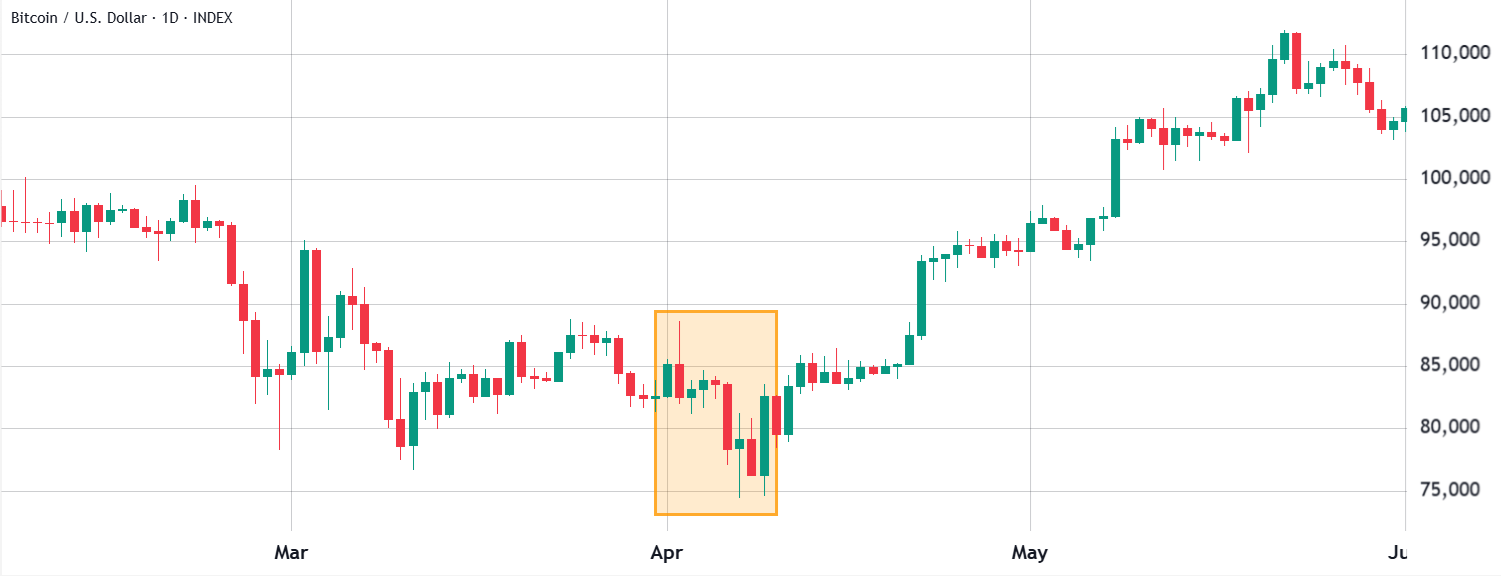
On April 2, 2025, the Trump administration signed an executive order imposing sweeping “reciprocal tariffs” on nearly every trading partner. The situation escalated on April 9, 2025, as additional tariffs were applied to 75 countries, including a 34% rate for China. This move coincided with Bitcoin hitting a five-month low at $74,600, which was followed by a 38% rally over the next month.
Traders choose cash over Bitcoin during periods of uncertainty
The natural instinct for traders during periods of uncertainty is to seek shelter in cash and government bonds. Despite its unique benefits, Bitcoin is not yet considered a safe haven by most investors. However, once the market realizes that governments may be forced to inject liquidity to stimulate the economy, Bitcoin tends to outperform.

The US Federal Reserve (Fed) lends cash against Treasury collateral to maintain smooth funding markets and settlements. This measure should not be viewed as a direct liquidity injection, as it reflects temporary balance sheet conditions. Nevertheless, peak levels in this indicator—such as the $100 billion seen on March 16, 2020—have historically marked reversals in Bitcoin’s price trend.
In fact, the COVID-19 crash of 2020 marked the beginning of a multi-month rally, taking Bitcoin to $42,000 from $4,400. Consequently, those who claimed the cryptocurrency failed as a long-term investment while it traded 55% below its prior $19,900 all-time high between May and July 2020 were proven wrong. A similar pattern could unfold in 2026 if liquidity conditions deteriorate further.

Nvidia (NVDA US) is scheduled to report quarterly earnings after the US stock market closes on Wednesday. Results from the chipmaker will likely set the investor mood, particularly as concerns regarding rising tech sector debt mount. Notably, shares of Coreweave (CRWV US) and Oracle (ORCL US) have already plunged over 50% from their previous all-time highs.
While conditions for companies supporting the artificial intelligence sector weaken, the exodus of investment from Bitcoin miners represents less of a risk now that the network hashrate has fully recovered from a 25% dip in January. More importantly, ASIC miners released in 2024 and early 2025 remain profitable even at an electricity cost of $0.07 per kilowatt-hour.
Related: Bitcoin miner MARA buys majority stake in AI data center firm Exaion

The de-escalation of “miner death spiral” fears may have helped instill bullishness among professional fund managers. Large speculators, including hedge funds, have shifted from a net short to a net long position on CME Bitcoin futures, according to a CFTC report published last week. Analyst Tom McClellan noted that two similar historical shifts preceded significant Bitcoin price bottoms.
While no single reversal indicator can confirm if the $60,200 level on Feb. 6 marked the cycle low, the combination of liquidity concerns, fears of excessive AI sector valuations, and resilience in the mining sector could push Bitcoin’s price back toward $75,000 in the near term.
This article does not contain investment advice or recommendations. Every investment and trading move involves risk, and readers should conduct their own research when making a decision. While we strive to provide accurate and timely information, Cointelegraph does not guarantee the accuracy, completeness, or reliability of any information in this article. This article may contain forward-looking statements that are subject to risks and uncertainties. Cointelegraph will not be liable for any loss or damage arising from your reliance on this information.
TLDR:
- LINK has corrected over 86% from its 2021 high near $53, now compressing inside a key demand block at $5.60–$7.50.
- CryptoPatel identifies smart money absorption at macro support, with sell-side liquidity sweeps fully absorbed on the 3W chart.
- Three upside price targets are mapped at $26.30, $52.22, and $100, representing up to 1,675% return from the demand zone.
- The bullish setup is invalidated if LINK prints a three-weekly candle close below the critical support level of $4.76.
Chainlink’s native token, LINK, is currently priced around $8.30 after an extended period of price compression. Analyst CryptoPatel has released a high-timeframe technical forecast pointing toward a potential 10x move.
The setup is built on multi-year chart structure and accumulated demand at macro support. With volatility contracting sharply on the three-weekly chart, market participants are watching closely for a breakout confirmation.
LINK Accumulates Inside a Multi-Year Demand Block
LINK has been trading inside a descending channel on the three-weekly chart since its 2021 cycle high near $53. The token corrected more than 86% from that peak over the following years.
Price has since compressed into a demand block between $5.60 and $7.50. This zone is where CryptoPatel identifies strong smart money absorption taking place.
Multiple higher lows have formed within this demand block on the higher timeframe. Each successive low reflects buyers stepping in before price reaches prior lows.
CryptoPatel noted that sell-side liquidity sweeps into this support region have been fully absorbed. That behavior points toward sustained accumulation rather than distribution at current levels.
The analyst’s tweet reads: “Fractal Structure Mirroring Previous Cycle Compression Before Breakout.” This observation draws a direct parallel to prior accumulation phases in LINK’s price history.
Each of those phases was followed by a sharp directional expansion. The current setup carries a structurally similar pattern on the same timeframe.
Volatility on the three-weekly chart has contracted to an extreme degree, according to CryptoPatel. That level of compression typically precedes a larger expansion move in either direction.
Price is currently hovering near $8, described as range equilibrium within the analyst’s framework. The descending channel resistance from the 2021 all-time high remains the defining technical ceiling.
Key Price Levels That Could Trigger a Massive Upside Move
CryptoPatel has mapped out three upside targets: $26.30, $52.22, and $100. A move to the third target from current prices would represent a gain of approximately 1,110%.
The projected total return from the high-timeframe demand zone sits between 1,232% and 1,675%. These targets align with liquidity pools resting above current price on the higher timeframe chart.
The critical confirmation signal for this setup is a three-weekly candle close above the descending trendline resistance. A simultaneous break of the range high on that timeframe would further strengthen the bullish case.
Until that close materializes, the channel resistance remains structurally intact. Traders following this setup are waiting for that specific trigger before adding exposure.
CryptoPatel’s bullish bias holds as long as LINK stays above $4.76 on the three-weekly timeframe. That level marks the lower boundary of the high-timeframe demand zone.
A confirmed candle close below $4.76 would signal structural failure and open the door to further downside. That threshold functions as the hard invalidation point for the entire setup.
The analyst describes this as a high-timeframe, patience-based trade with asymmetric risk-to-reward. It is best suited for spot accumulation and long-term swing positioning, per the forecast.
No macroeconomic or fundamental variables are incorporated into the analysis. Traders are encouraged to conduct independent research before making any financial decisions.
Crypto trading platform Backpack Exchange on Monday announced that stakers of its forthcoming Backpack token will be able to earn equity in the exchange, as the company moves toward a potential initial public offering.
“Users that stake the Backpack token for at least a year will have the opportunity to exchange those tokens for equity at a fixed ratio—20% of the company today,” said Backpack CEO and founder Armani Ferrante in a post to X on Monday.
20% of Backpack equity given to users who stake for a year.
Don’t just use the next big thing.
Own it. 🎒 pic.twitter.com/whdGUQ0XyH
— Backpack 🎒 (@Backpack) February 23, 2026
Speaking about the equity offering, Ferrante said many past token launches were built on “false promises” of utility — a pitfall he wanted to avoid. Instead, he said he wanted to offer users an alternative token structure showing long-term commitment.
“I came into crypto because I believe it’s going to change the world … But somewhere along the way, amidst the booms, the busts, the moonshots, the decentralization theater, and the straight up scams, we lost our way. I don’t know about you, but I’m just tired of false promises.”
Backpack’s offer would anchor the token’s value to company equity.
Backpack prioritizes users with tokenomics setup
Backpack first announced it would launch the Backpack token in a post on X earlier this month.
The tokens are intended to be unlocked in stages as the company moves toward a potential US IPO.
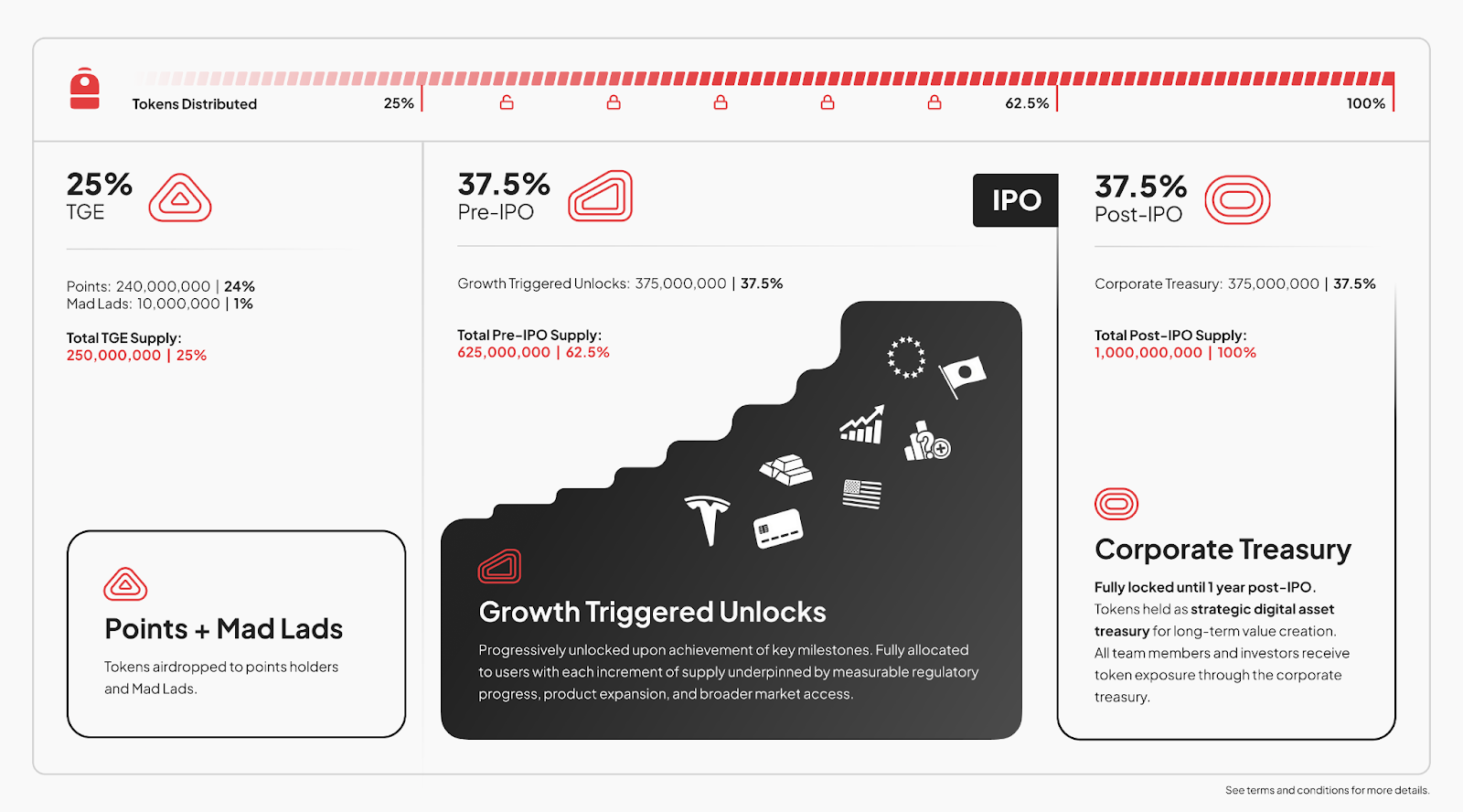
Backpack said 25% of the 1 million-token supply will be unlocked at the Token Generation Event, while the next 37.5% of the tokens will be released before the IPO, provided that Backpack reaches certain milestones, such as regulatory approvals and the launch of new products.
The first 62.5% of Backpack tokens will be distributed entirely to users, while the remaining tokens will be unlocked post-IPO for Backpack’s team members and investors.

Backpack said the tokenomics setup aims to invert a model that usually sees insiders receiving large allocations early, with time-based vesting creating predictable sell pressure on retail users who are often left holding the bag.
Backpack was founded in 2022 by Ferrante, who previously worked at the FTX-linked Alameda Research before the two entities collapsed in November of that year.
Related: Kraken acquires tokenization platform Magna ahead of potential IPO
While the Backpack TGE date has not been set, the token-equity announcement comes as Backpack partnered with Securities and Exchange Commission-registered transfer agent Superstate to bring tokenized stocks onchain in October.
Backpack acknowledges its plan isn’t perfect
Ferrante slammed the current state of crypto, stating: “We live in the most centralized era crypto has ever experienced,” and adding: “The more centralized something is, the less meaningful a token is.”
At the same time, Ferrante acknowledged that the token-equity offering would start out relatively centralized but added that plans are in place to progressively decentralize the token as the product evolves.
“I expect the token to represent more than anything a single company has to offer, but in the short run, it’s the best we can do to show our long term commitment to our users.”
Magazine: Bitget’s Gracy Chen is looking for ‘entrepreneurs, not wantrepreneurs’
Crypto World
Tom Lee Bets Big on Ethereum With 51,162 ETH Purchase as Vitalik Buterin Sells $21 Million Worth
TLDR:
- Bitmine acquired 51,162 ETH in a single week, pushing total holdings to 4.42M tokens worth $8.6 billion.
- Vitalik Buterin sold over 9,715 ETH in February 2026, totaling more than $21M as ETH fell below $2,000.
- Tom Lee cited tokenization, AI adoption, and the creator economy as key reasons to buy ETH during the dip.
- Bitmine’s staking operations now generate $171M annually, with projections reaching $249M at full MAVAN scale.
Tom Lee’s Bitmine Immersion Technologies made a bold move last week, acquiring 51,162 ETH amid a broader market pullback.
While Ethereum co-founder Vitalik Buterin was offloading millions in ETH, Lee’s company was buying aggressively.
The contrasting strategies have caught the attention of crypto market watchers globally as ETH continues trading below $2,000.
Tom Lee Doubles Down on ETH While Prices Slide
Tom Lee, serving as Bitmine’s Chairman, publicly addressed the current crypto downturn in a recent company statement.
“In the midst of this ‘mini crypto winter,’ our focus continues to be on methodically executing our treasury strategy and steadily acquiring ETH,” said Lee. Rather than pulling back, Bitmine moved forward with one of its most aggressive single-week purchases to date.
Lee made his conviction on Ethereum clear, pointing to three fundamental drivers he believes are gaining traction.
“Wall Street and their efforts at tokenization, AI and agentic-AI using smart blockchains, and the emerging creator economy’s desire to use blockchains for verification,” he outlined. These factors, in his view, make the current dip a buying window rather than a warning sign.
“In the past week, we acquired 51,162 ETH,” Lee confirmed. “Bitmine has been steadily buying Ethereum, as we view this pullback as attractive, given the strengthening fundamentals.”
He added that “the price of ETH is not reflective of the high utility of ETH and its role as the future of finance,” reinforcing the company’s long-term position.
Vitalik Buterin’s Selling Spree Puts Pressure on ETH Price
As Bitmine was accumulating, a very different story was unfolding on the other side of the market. Crypto analyst Crypto Patel flagged the activity on social media, writing, “After a 2-week break, Vitalik Buterin just withdrew 3,500 ETH worth $6.95M from Aave to sell.” Buterin then proceeded to sell 571 ETH shortly after the withdrawal.
This followed an earlier sale on February 5, when Buterin offloaded 9,144 ETH at approximately $2,170 per token, collecting $19.84 million.
Patel noted in his post, “Total Sold in Feb: 9,715+ ETH (~$21M+),” as ETH slipped below $2,000 during the selling period. The timing amplified negative sentiment around ETH at an already sensitive moment in the market.
Patel’s post openly questioned the motive behind the moves, asking, “Is the Ethereum co-founder losing confidence… or does he know something we don’t?”
The post drew sharp reactions across the crypto community, with many debating whether the sales reflected routine portfolio management or something more telling. Either way, the activity added pressure to an asset already struggling to hold key price levels.
Bitmine’s Staking Strategy Keeps Revenue Flowing Despite the Dip
Even as prices soften, Bitmine’s staking operations continue generating steady income. “Annualized staking revenues are now $171 million,” Lee stated, adding that Bitmine’s own staking operations generated a seven-day yield of 2.89%, above the broader Composite Ethereum Staking Rate of 2.81%. The company currently has 3,040,483 ETH staked, valued at approximately $6 billion.
Lee further noted that “at scale, when Bitmine’s ETH is fully staked by MAVAN and its staking partners, the ETH staking rewards is $249 million annually.”
MAVAN, the Made in America Validator Network, remains on track for an early 2026 launch. Bitmine is currently working with three external staking providers as it prepares for full deployment of the platform.
Bitmine’s total holdings, including $691 million in cash, a $200 million stake in Beast Industries, and a $17 million position in Eightco Holdings, bring the overall portfolio to $9.6 billion.
With Lee buying aggressively while Buterin sells, the two figures now represent opposite ends of the current Ethereum narrative.

Princess Kate shares ‘hard conversations’ with George, Charlotte, and Louis

Homebuyers gain over $30,000 in purchasing power from lower mortgage rates

Manchester police arrest victim of fascists’ racist ‘lynch mob’ attack


-

 Crypto World7 days ago
Can XRP Price Successfully Register a 33% Breakout Past $2?
-

 Video4 days ago
XRP News: XRP Just Entered a New Phase (Almost Nobody Noticed)
-

 Fashion3 days ago
Weekend Open Thread: Boden – Corporette.com
-

 Sports7 days ago
GB's semi-final hopes hang by thread after loss to Switzerland
-

 Politics2 days ago
Baftas 2026: Awards Nominations, Presenters And Performers
-
 Tech7 days ago
The Music Industry Enters Its Less-Is-More Era
-

 Sports7 hours ago
Women’s college basketball rankings: Iowa reenters top 10, Auriemma makes history
-

 Politics8 hours ago
Nick Reiner Enters Plea In Deaths Of Parents Rob And Michele
-

 Business6 days ago
Infosys Limited (INFY) Discusses Tech Transitions and the Unique Aspects of the AI Era Transcript
-

 Entertainment6 days ago
Kunal Nayyar’s Secret Acts Of Kindness Sparks Online Discussion
-

 Video7 days ago
Financial Statement Analysis | Complete Chapter Revision in 10 Minutes | Class 12 Board exam 2026
-

 Tech6 days ago
Retro Rover: LT6502 Laptop Packs 8-Bit Power On The Go
-
 Sports5 days ago
Clearing the boundary, crossing into history: J&K end 67-year wait, enter maiden Ranji Trophy final | Cricket News
-

 Business2 days ago
Mattel’s American Girl brand turns 40, dolls enter a new era
-

 Business1 day ago
Law enforcement kills armed man seeking to enter Trump’s Mar-a-Lago resort, officials say
-

 Entertainment5 days ago
Dolores Catania Blasts Rob Rausch For Turning On ‘Housewives’ On ‘Traitors’
-

 Business6 days ago
Tesla avoids California suspension after ending ‘autopilot’ marketing
-
 NewsBeat15 hours ago
‘Hourly’ method from gastroenterologist ‘helps reduce air travel bloating’
-

 Politics7 days ago
Eurovision Announces UK Act For 2026 Song Contest
-

 Tech1 day ago
Anthropic-Backed Group Enters NY-12 AI PAC Fight