

Crypto World
NEAR Protocol Spurs AI Token Rally with 50% Gain, Eyes on $5 Target


NEAR Protocol (NEAR) showed notable strength on Friday, jumping 34% in a single day to around $2.32 as AI-focused tokens lead a broader rally tied to NEAR’s upcoming network upgrades and Nvidia’s bullish revenue outlook. The token is about 50% higher than seven days ago and roughly 115% up over the last 90 days, with trading volume briefly exceeding $1 billion in the session.
The move comes as NEAR unveiled a slate of upgrades aimed at AI integration, privacy enhancements and scalable performance—steps investors see as signaling deeper utility for developers and users within the NEAR ecosystem. In tandem, Aurora, the Ethereum-compatible layer built on NEAR, pushed an update to its Aurora Intents Widget, integrating ADI Chain as a new entry point to streamline cross-chain swaps, deposits and application flows for users.
Key takeaways
- NEAR surged about 50% over the past week, reaching six-month price highs near $2.34.
- Upgrades centered on privacy, AI integration and scaling boosted investor confidence and helped push NEAR’s 24-hour trading volume above $1 billion.
- A breakout from a multi-year wedge pattern sets a target near $5.75 if NEAR can clear resistance in the $2.60–$3.00 zone.
- AI-oriented tokens were broadly supported by market momentum, with Nvidia’s AI leadership and upbeat earnings outlook underpinning the sector’s strength.
NEAR price rallies amid upgrade program
Data from market observers show NEAR’s rebound accelerating earlier in the week, with the price climbing from a low near $1.48 to a peak around $2.34 on Friday—a gain of roughly 58% from that trough. The surge was accompanied by a surge in liquidity, with daily volume jumping to about $1.15 billion, reflecting intensified buying pressure and broad interest in the ecosystem.
The move also triggered notable short liquidations as traders positioned for a break above key levels, with liquidations surpassing $9.85 million when NEAR rallied through the $2.30 region. The upward move aligns with NEAR’s ongoing upgrade path, which places renewed emphasis on privacy protections, AI integration and scalable throughput—the kinds of enhancements investors have cited as catalysts for asset demand within the NEAR network.
At the same time, Aurora announced enhancements to its cross-chain experiences. The Intents Widget update adds ADI Chain as a new entry point, designed to enable smoother cross-chain swaps, deposit flows and application orchestration for users moving assets or building on NEAR’s platform.
AI tokens riding the broader momentum
The NEAR ascent is part of a wider revival in AI-themed crypto assets. Tokens such as Grass (GRASS), OpenServe (SERVE) and Artificial Superintelligence Alliance (FET) registered meaningful intraday gains—up more than 27%, 21% and 11%, respectively—mirroring the sector-wide enthusiasm for AI-enabled ecosystems. Collectively, the market capitalization of AI and big-data crypto projects rose about 8% over the past 24 hours to roughly $21.44 billion, signaling renewed investor interest in AI-native narratives alongside traditional market drivers.
That sector-wide bounce sits against a backdrop of Nvidia’s continued dominance in the AI accelerator market. Industry observers note Nvidia’s control of a substantial share—roughly 81–90% in this space—and the company’s ongoing earnings narrative. In its latest results, Nvidia reported robust Q1 2026 profits and projected a revenue opportunity reaching $1 trillion through 2027, reinforcing the viability of compute-heavy AI ecosystems that rely on NEAR’s growing AI-oriented capabilities and developer-friendly environment.
Historically, Nvidia-driven events have tended to coincide with upside for NEAR. Notably, a rally in February followed Nvidia’s earnings release, when NEAR surged more than 50% in a short span. The current sequence echoes that pattern: a favorable Nvidia backdrop combined with NEAR’s technical breakout and upgrade-driven catalysts contributing to broader upward momentum for the token.
What could drive NEAR higher from here?
From a technical standpoint, NEAR has just emerged from a multi-year falling wedge pattern. The immediate hurdle sits in the $2.60–$3.00 area, a zone that includes several moving averages on the weekly chart. A clean break above this resistance would open a measured ascent toward the wedge’s implied target near $5.75, which would be roughly 160% above the current price. The relative strength index has moved into the mid-60s, signaling building upside momentum but not yet extreme overbought pressure.
Market observers like Michael van de Poppe have highlighted NEAR as exhibiting one of the market’s more bullish charts, noting that as long as the $1.40 level remains a floor, the path toward higher resistance levels remains plausible. The consensus among analysts cited in market commentary is that a sustained hold above the $2 level could cement the larger-term breakout, while a failure to clear the $2.60–$3 band could reintroduce consolidation risks.
investors should watch not only the price action but the ecosystem’s ongoing upgrade cadence. If privacy, AI integration and cross-chain usability continue to advance without major delays, NEAR could see sustained demand for block space and services, translating into higher activity, bookings and a longer-term re-rating of the token’s utility value.
Looking ahead, traders will want to see whether NEAR can sustain momentum through upcoming supply zones and whether the broader AI-narrative continues to attract capital into both NEAR and related ecosystems such as Aurora. The next crucial inflection will likely hinge on whether buyers can decisively clear the $2.60–$3.00 resistance corridor and maintain a constructive weekly trend that validates the breakout thesis.
What remains uncertain is how macro market dynamics, regulatory developments and the pace of AI-adoption across chains will interact with NEAR’s upgrade trajectory. Nonetheless, current data points and the Nvidia backdrop suggest the headline driver remains the confluence of technical breakouts, upgrade-driven utility, and a widening AI-focused investment appetite that could keep NEAR and its peers in the spotlight in the near term.
Readers should monitor NEAR’s price not in isolation but in the context of ecosystem progress, including cross-chain flow efficiency, privacy-improvement milestones and the broader risk-on sentiment that has re-emerged in crypto markets as AI narratives re-accelerate.



Strive’s Bitcoin linked preferred stock SATA is emerging as a key credit market instrument while its common equity ASST gains traction in public markets, reshaping how institutions finance large Bitcoin treasuries through yield bearing securities rather than straight spot purchases.
Summary
- Michael Saylor highlights SATA and ASST as the “most interesting story” in Bitcoin capital markets
- Strive uses SATA proceeds to buy thousands of BTC while paying double digit yield
- Strategy’s STRC preferreds have funded roughly $1 billion in recent Bitcoin purchases
- New Bitcoin backed preferred structures are reshaping corporate capital stacks and investor access
In a post on X, MicroStrategy executive chairman Michael Saylor wrote that “the most interesting story in Bitcoin (BTC) right now is the rise of $SATA in the credit markets and the embrace of $ASST by the equity capital markets,” pointing squarely at Strive’s Bitcoin treasury strategy as a bellwether for the next stage of institutional adoption.
SATA is Strive’s perpetual preferred equity that pays a high fixed yield funded by a growing Bitcoin balance sheet, while ASST is the firm’s Nasdaq listed common stock that has effectively become a publicly traded wrapper around an expanding BTC treasury.
Strive disclosed in a March update that it had increased the SATA dividend rate by 25 basis points to 12.75 percent annually, declaring a quarterly payout of $1.0625 per share and extending its dividend reserve to 18 months, backed by a mix of cash, cash equivalents and Strategy’s STRC preferreds.
How are SATA and ASST changing Bitcoin finance
Those enhancements came on top of an earlier move where Strive allocated $50 million of its own corporate treasury into STRC, underscoring how the firm sits at the junction of Bitcoin denominated credit and equity structures that increasingly fund BTC accumulation without issuing traditional debt.
According to a recent report, Strive has accumulated roughly 13,741 BTC after buying an additional 113 BTC for about $7.75 million at an average price near $68,577 per coin, placing it as the ninth largest corporate Bitcoin holder with a treasury valued at approximately $950 million at early April prices.
At the same time, the firm’s capital stack relies heavily on SATA issuance above the $100 par level, a price point that unlocks at the market programs and allows Strive to sell more preferred shares into demand from income seeking investors while funneling proceeds into further BTC purchases.
Why Saylor calls SATA and ASST the key Bitcoin story
Saylor’s praise reflects a broader shift in how Bitcoin exposure is packaged, with MicroStrategy’s own Stretch preferred stock STRC already surpassing $10 billion outstanding and financing multi billion dollar BTC acquisitions through perpetual, yield bearing securities rather than dilutive equity raises or conventional bonds.
One recent filing shows Strategy bought 13,927 BTC for approximately $1 billion funded entirely through STRC sales, lifting its corporate Bitcoin stash to nearly 781,000 BTC without issuing new common shares, a pattern that underscores how preferred stock has become a primary driver of incremental BTC demand.
Research from NYDIG argues that STRC and SATA “represent a new category of bitcoin linked financing” defined less by traditional cash flow based credit metrics and more by asset coverage, market confidence and continued access to capital markets, a structure that can amplify buying when securities trade near par but also stall issuance if sentiment turns.
Strive’s own messaging frames Bitcoin as “the most secure, transparent, and resilient reserve asset available to corporations today,” positioning SATA as a way to transform that reserve into double digit yield for investors while ASST becomes a liquid equity claim on a leveraged BTC balance sheet.
In the background, market data shows preferred issuance has already funded more than 2,500 BTC in incremental demand via STRC alone over a short window, equivalent to several days of new mining supply, while Strive’s SATA IPO raised roughly $149.3 million that was largely recycled into additional BTC purchases.
That reflexive loop between high coupon preferreds like SATA, specialized instruments such as STRC and equity capital via ASST is exactly what Saylor is pointing to as “the most interesting story” in Bitcoin today, because it turns BTC from a simple buy and hold asset into the core collateral for a growing multi layer credit and equity ecosystem.
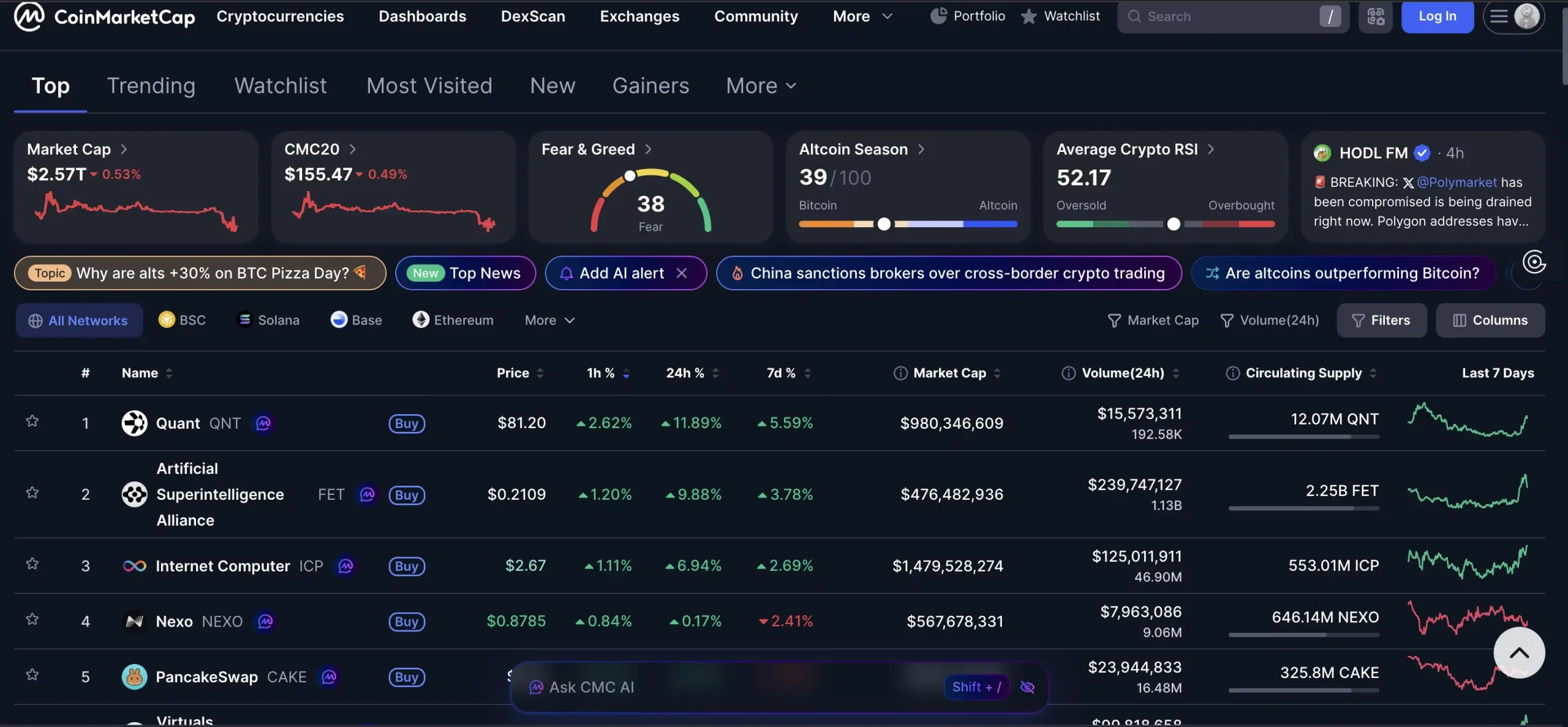
NEAR Protocol has surged more than 21% in 24 hours to top the day’s major crypto market gainers, while edgeX slipped nearly 8 among the top 100 assets by market capitalization.
Summary
- NEAR Protocol climbed 21.14 to 2.20
- Worldcoin, FET, Quant and Celestia also posted strong daily gains
- edgeX dropped 7.76, underperforming other large cap tokens
- AI and interoperability narratives resurfaced despite broader market churn
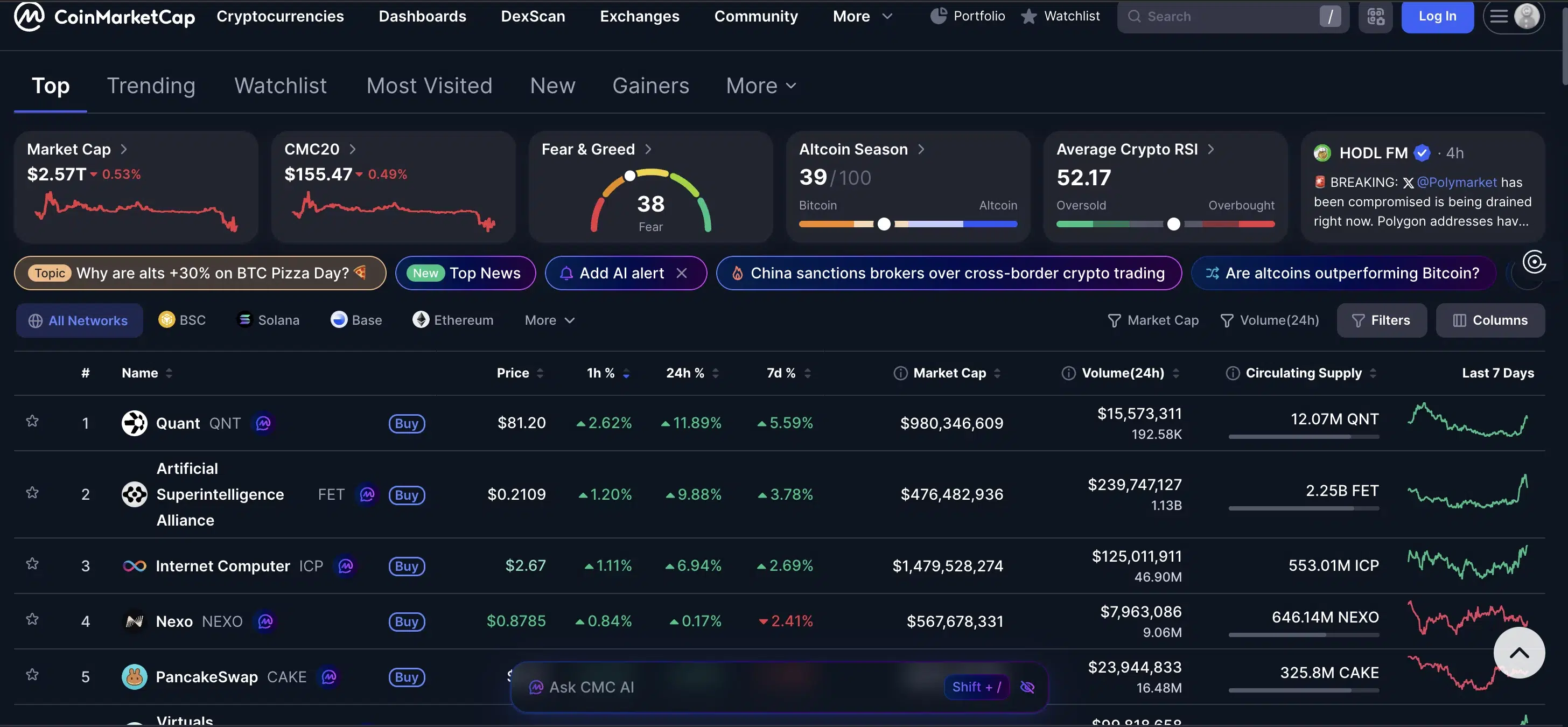
According to CoinMarketCap’s gainers and losers dashboard, NEAR Protocol (NEAR) topped the day’s performance table among the top 100 cryptocurrencies by market capitalization, rising 21.14% in the last 24 hours to trade around 2.20. The move extended a broader upswing for the layer 1 network, which markets itself as a high performance, AI native execution layer designed to support intelligent agents and decentralized applications.
Why are NEAR and AI tokens leading today
CoinMarketCap data shows that Worldcoin’s (WLD) token followed as the second best performer, gaining 12.39 to about 0.2947, while Artificial Superintelligence Alliance’s (FET)token advanced 9.05 to 0.2105 over the same period. Both tokens sit at the intersection of identity or AI infrastructure and crypto, underscoring how speculative capital continues to cluster around artificial intelligence narratives even as many large caps trade sideways.
Quant’s QNT token also broke higher, adding 8.76% on the day to roughly 79.28, while modular data availability project Celestia’s TIA climbed 8.74 to around 0.445. These gains come after periods of heavy drawdowns for both projects, with earlier analysis noting that TIA had suffered double digit intraday declines in January as emissions and weak demand weighed on price, and QNT remained well below its all time high above 400.
What is driving the divergence with edgeX
While major AI and infrastructure tokens pushed higher, edgeX was among the notable laggards in the same top 100 basket, falling 7.76 on the session. Data from market trackers shows edgeX currently trades around the 1.20 to 1.50 range with a market capitalization above 500 million and a 24 hour trading volume in the high tens of millions, making its daily slide stand out against rising liquidity.
edgeX underperformance comes even as the decentralized exchange promotes a high performance model for perpetual and spot trading across multiple chains, with full self custody and no centralized order book. The pullback suggests profit taking or rotation away from DEX tokens, at least for the day, as traders reprice tokens tied more explicitly to AI infrastructure and cross chain interoperability narratives.
For NEAR, the day’s move fits into a longer repositioning of the project as a platform for the “agentic future,” with the team describing the network as an execution layer built for AI native applications, where agents can own assets, make decisions and transact across networks. In a recent explainer, the NEAR team wrote that the protocol is “a modular, high speed protocol designed for AI to act on behalf of users,” emphasizing that the blockchain serves as the trusted backend for identity, data and settlement while AI handles user facing intent.
Worldcoin’s rally comes against the backdrop of a controversial tokenomics overhaul, after the project co founded by OpenAI chief executive Sam Altman announced that it will slash its daily token unlock rate by 43 from July 24, reducing combined emissions from roughly 5.1 million WLD per day to about 2.9 million. “On July 24 2026, the unlock rate for all token allocations will automatically decrease,” the team said, arguing that lower issuance could improve the token’s long term supply demand profile even as the project continues to face regulatory scrutiny over its biometric data collection model.
FET’s gains also follow renewed attention on the Artificial Superintelligence Alliance, the umbrella entity created in 2024 when Fetch.ai, SingularityNET and Ocean Protocol merged to build open, decentralized AI infrastructure. The alliance describes itself as “the largest open source, independent entity in Artificial General Intelligence research and infrastructure,” with FET now the single asset powering the new ecosystem after it replaced the individual tokens used by the three projects prior to the merger.
Across these moves, the day’s tape sends a clear signal about where speculative attention is rotating inside the top 100. Tokens aligned with AI, identity and interoperability themes are attracting fresh flows, while at least one high profile DEX token has slipped, leaving edgeX bulls to decide whether today’s drop represents a short term setback or the start of a more sustained repricing.


Bitfire stablecoin ambitions are accelerating even as the Hong Kong crypto firm posts a HK$245 million half-year loss.
Summary
- Bitfire expects a net loss of up to HK$245 million for the six months through March, nearly 19 times larger than its HK$12.3 million loss a year earlier.
- HK$152 million of the loss came from a decline in the value of Bitfire’s held crypto assets, reflecting weak market conditions in the period.
- Bitfire is expanding into stablecoins and asset management, citing strong demand from institutional and ultra-high-net-worth clients onboarded since August 2025.
Bitfire reported a profit warning on May 21 disclosing a net loss of up to HK$245 million ($31.28 million) for the six months through March 2026. The loss is nearly 19 times larger than the HK$12.3 million recorded in the same period a year earlier.
The company blamed the widening loss primarily on a HK$152 million value decline on held crypto assets. Rising expenses tied to professional services, customer capabilities and research and development also contributed to the shortfall.
Why Bitfire is accelerating its stablecoin push despite mounting losses
Bitfire CEO Livio Weng has described stablecoins as a “core pillar” of Hong Kong’s Web3 ecosystem and said the firm will prioritise integrating compliant Hong Kong stablecoins into its clearing and settlement systems.
The company has onboarded hundreds of institutional and ultra-high-net-worth clients since its August 2025 strategic upgrade, all of whom have expressed demand for stablecoin access.
Hong Kong’s HKMA awarded its first batch of stablecoin issuer licences in April 2026, with approval granted only to HSBC and Standard Chartered Bank. That restricted rollout positions Bitfire as a potential integration partner for compliant stablecoins rather than an issuer itself. Bitfire operates under SFC Types 1, 4, and 9 licences plus a Trust and Company Service Provider licence.
What the stablecoin opportunity looks like for Bitfire
Hong Kong’s regulatory framework creates a compliance-bounded market that larger global exchanges cannot easily enter. Bitfire’s positioning as a licensed virtual asset manager serving institutional clients gives it a structural advantage in introducing compliant stablecoins to that client base. Crypto.news has reported on the HKMA’s push to tighten virtual asset dealer and custody rules alongside the stablecoin licensing regime.
Bitfire’s spending blitz on professional services and R&D suggests it is building infrastructure to service institutional stablecoin demand that cannot yet be fully captured under Hong Kong’s restricted rollout pace. Crypto.news has also tracked Hong Kong’s effort to deepen institutional engagement across all licensed virtual asset platforms.
The Zcash upgrade roadmap includes three advances targeting a 300% speed boost as ZEC gained 73% in a month.
Summary
- Zcash’s NU7, planned as the network’s ninth upgrade, will introduce Zcash Shielded Assets and a Network Sustainability Mechanism with more than 90% community support.
- Project Tachyon aims to scale shielded transaction throughput to thousands of TPS using proof-carrying wallets and oblivious synchronisation.
- FROST v3 brings threshold signatures with cheater detection by default, with the Zcash Foundation expecting finalisation in 2026 as part of the Z3 tech stack.
The Zcash Foundation outlined a three-pronged technical roadmap building toward NU7, its ninth planned network upgrade. The SEC also closed its investigation into the Zcash Foundation on May 20 with no enforcement action, removing a major regulatory overhang.
NU7 is planned to introduce Zcash Shielded Assets, allowing user-defined tokens within shielded pools with full Zcash-grade privacy, alongside a Network Sustainability Mechanism that modernises fee mechanics. Community sentiment polling found more than 90% support among ZCAP members and coinholders for Project Tachyon and Orchard Quantum Recoverability as NU7 priorities.
What each of the three upgrades does
Project Tachyon scales Zcash’s shielded throughput using proof-carrying wallets and oblivious synchronisation, targeting thousands of transactions per second. The upgrade removes runaway state growth for validators, eliminating the rising marginal cost that currently limits Zcash’s scale.
Crypto.news has tracked Zcash’s capital rotation dynamics and the structural drivers behind its recent 73% monthly rally.
FROST v3 brings flexible threshold signatures to Zcash shielded transactions with cheater detection enabled by default and stronger memory protection. The Foundation expects FROST v3 and ZIP-312 finalised in 2026 as part of the Z3 stack integrating Zebra, Zaino, and Zallet with built-in Tor support.
Why the quantum angle is driving fresh interest in Zcash
ZEC’s 73% monthly gain coincides with growing market attention to quantum-resistant protocols. Zcash’s zero-knowledge proof technology, which now underpins major Ethereum layer-2 networks, is being re-rated as infrastructure rather than speculation.
Crypto.news has covered the quantum threat timeline, including research showing Bitcoin’s elliptic curve cryptography requires approximately 2,330 logical qubits to break.
The NU7 upgrade includes Orchard Quantum Recoverability, enabling recovery pathways for keys that might become vulnerable to future quantum hardware. Citi’s analysis, as crypto.news reported, found a quantum attack on major financial institutions could put $2 to $3.3 trillion of GDP at risk. NU7’s quantum recovery component positions Zcash as one of the few protocols actively preparing for that scenario.
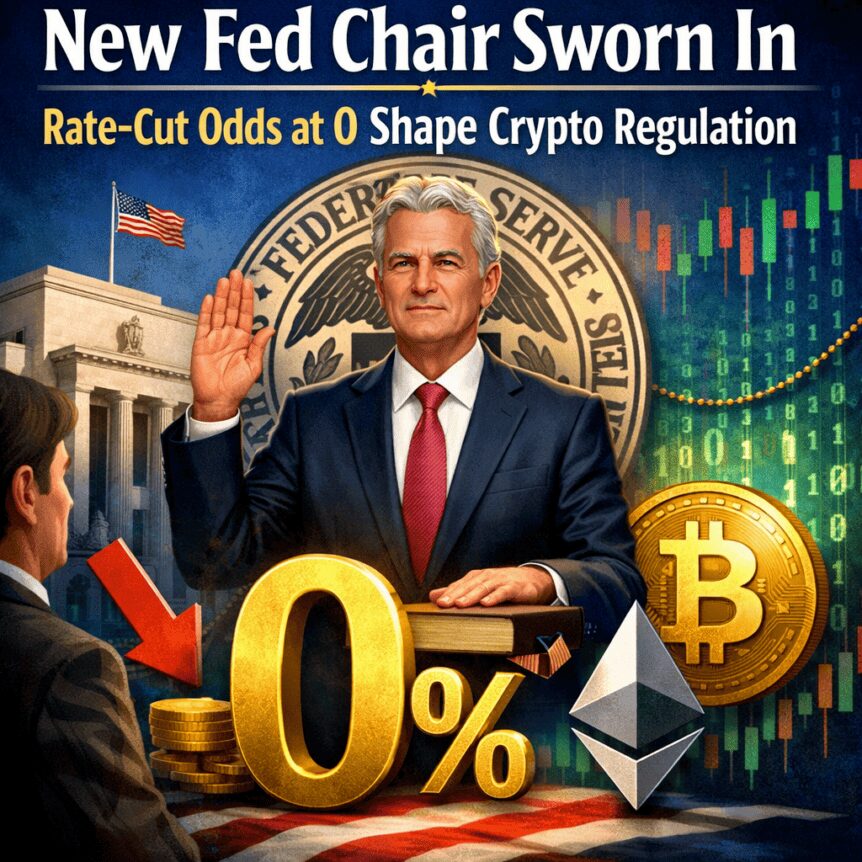
Kevin Warsh was sworn in on Friday to lead the United States Federal Reserve, inaugurating a new chapter in U.S. monetary policy management. In a backdrop of heightened policy scrutiny, financial markets continued to price in a restrictive rate path through 2026, with little expectation of near-term easing. The development arrives at a time when crypto markets and traditional risk assets are sensitive to shifts in central-bank signaling and the regulatory landscape surrounding financial markets remains an area of intense oversight and policy debate.
During the ceremony, the White House described Warsh as a governor who will remain independent from the Executive Branch on monetary-policy decisions. President Donald Trump, who attended the event, emphasized a focus on robust employment and economic growth while acknowledging the nation’s debt challenges. The central theme echoed in the administration’s public remarks was that sustained growth would be the primary mechanism to manage the country’s fiscal position, a narrative that, in market terms, translates to careful calibration of interest-rate policy rather than abrupt shifts in monetary stimulus.
“We want to stop inflation, but we don’t want to stop greatness,”
The remarks, which drew mixed responses from investors and economists, underscored the ongoing debate over how quickly the Fed will adjust policy in the wake of recent macro developments. The market’s read on the path of policy remains a key variable for investors in crypto and other risk assets, given how changes in rates influence leverage, liquidity, and the cost of capital.
Key takeaways
- The Fed has a new chair in Kevin Warsh, whose tenure begins with heightened attention to how monetary policy will be signaled going forward, including how inflation and growth dynamics will be weighed.
- Markets centralize expectations around a rate path that foregoes 2026 rate cuts, with traders interpreting the environment as conducive to a higher-for-longer stance.
- CME Group’s FedWatch tool indicates a low probability of near-term cuts, with a tangible probability of a 25 basis point hike at the next FOMC meeting and a rising likelihood of rate adjustments at subsequent gatherings.
- Current Fed funds target range stands at 3.50%–3.75%, situating policy in a tightening posture relative to prior periods and impacting liquidity conditions across asset classes, including crypto markets.
- Policy expectations carry implications for risk assets and regulatory dynamics, reinforcing the need for clear AML/KYC, licensing, and cross-border supervisory coordination as crypto markets interface with traditional financial rails.
Warsh era and the policy trajectory: implications for crypto markets
The appointment of a new Fed chair typically introduces a degree of policy uncertainty as markets recalibrate around the new leadership’s approach to inflation and growth. In this instance, the market’s baseline view, as reflected in CME Group data, calls for no cuts to benchmark rates in 2026, with potential adjustments primarily in the form of selective tightening at upcoming meetings if inflation or growth trajectories warrant it. At the June FOMC meeting, a subset of traders assigns a non-zero probability to a 25 basis point rate increase, illustrating a continued bias toward policy restraint rather than accommodation.
Current indications place the federal funds target range at 3.50%–3.75. The June, July, and December meetings loom large for market participants who must assess the balance between cooling inflation and sustaining growth. The July forecast, which shows a meaningful but modest probability of a hike, alongside a substantial share of participants expecting a December move, suggests a policy environment characterized by vigilance rather than a clear pivot toward looser policy.
From a crypto-market perspective, the absence of imminent rate cuts generally lowers the short-term tail-risk for risk assets in some scenarios, yet it also constrains the upside potential for speculative growth plays that are sensitive to liquidity and financing conditions. Lower interest rates historically tend to boost risk-on assets by reducing the cost of capital, but a sustained tightening or a higher-for-longer stance can restrain liquidity and raise discount rates used in asset valuation. In practice, this dynamic translates into more careful risk management and greater emphasis on fundamentals for market participants, including those within the crypto ecosystem.
Regulatory and policy considerations for the crypto sector
The Fed’s policy stance operates within a broader regulatory ecosystem that increasingly scrutinizes crypto markets for compliance, transparency, and regulatory alignment. For institutions that bridge crypto and traditional finance—exchanges, custodians, banks, and corporate treasuries—the trajectory of U.S. monetary policy interacts with enforcement priorities and licensing frameworks. In the United States, policy outcomes intertwine with ongoing discussions around AML/KYC requirements, licensing regimes, and cross-border supervisory standards that shape how crypto activities are conducted and reported.
While monetary policy chiefly governs liquidity and inflation, it has indirect but meaningful implications for compliance programs and risk management practices in crypto-firm operations. For example, stablecoins that rely on fiat liquidity need robust reserve-management policies and transparent disclosures to satisfy regulatory expectations, especially in a environment where central banks project a disciplined rate path. The regulatory conversation extends to enforcement and policy alignment across agencies, reinforcing the importance of robust governance, anti-money-laundering controls, and clear lines of responsibility for digital-asset activities that intersect with traditional financial markets.
Analysts and compliance teams will also watch how policymakers coordinate with international standards and regional frameworks. In the European Union, for instance, MiCA (Markets in Crypto-Assets) continues to shape licensing, risk disclosures, and operational requirements for crypto service providers. While the Fed’s leadership change primarily affects the U.S. macro landscape, global firms must consider how differing regulatory tempos and cross-border oversight will influence liquidity, settlement infrastructure, and market access. As crypto markets remain highly interconnected with traditional finance, shifts in the U.S. policy stance can ripple through funding channels, banking partners, and cross-border settlement arrangements.
According to Cointelegraph, the broader policy conversation remains focused on ensuring that innovation does not outpace safeguards, with authorities emphasizing transparency, consumer protection, and systemic resilience as central objectives. This context matters for institutions evaluating regulatory risk, product design, and the potential need for licensing or registration in multiple jurisdictions. The evolving policy terrain underscores the importance of aligning crypto operations with robust compliance frameworks, including ongoing due diligence on counterparties, custodial risk management, and clear governance structures to address regulatory expectations.
Closing perspective
Warsh’s installation as Fed chair comes at a moment when markets anticipate a measured and disciplined policy path that prioritizes inflation control while preserving growth. For the crypto sector, the implications are twofold: liquidity dynamics will continue to influence asset prices and funding conditions, and the regulatory environment will intensify scrutiny around compliance, licensing, and cross-border conduct. Investors and institutions should monitor upcoming FOMC communications, inflation data, and enforcement signals from U.S. and international regulators as these elements collectively shape the risk and operating environment for digital-asset activities in the months ahead.
In the near term, market participants should stay attuned to the Fed’s communications and the evolving regulatory posture, as both will redefine the interplay between macro policy, financial stability, and crypto-market resilience. As policy and enforcement priorities become more clearly articulated, crypto firms, banks, and institutional investors may adjust strategic plans to align with the anticipated regulatory and macroeconomic trajectory.
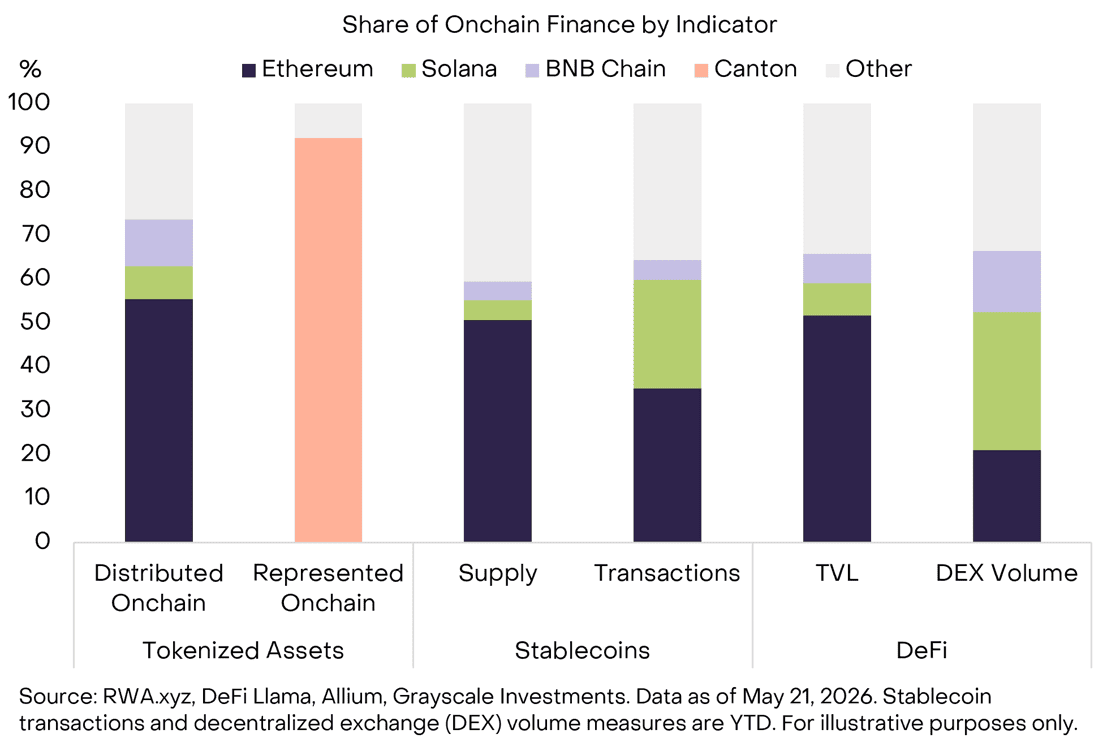
Ether’s (ETH) long-term investment case is drawing fresh attention as Ethereum continues to lead in key areas of onchain activity and decentralized finance, despite the altcoin losing 28% of its value this year. The network still hosts roughly $43 billion in DeFi liquidity, more than $165 billion in stablecoins, and about 55% of tokenized assets tracked across public blockchains.
Data from Token Terminal also shows that the market capitalization of tokenized exchange-traded funds (ETFs) exceeds $400 million, with Ethereum accounting for 76.9% of the market share.
Referencing the data above, crypto analyst Tanaka said,
“These are the pieces I believe will continue to lead the market in the mid to long term. And if we look at the current data, Ethereum is still the most important settlement layer for these narratives.”
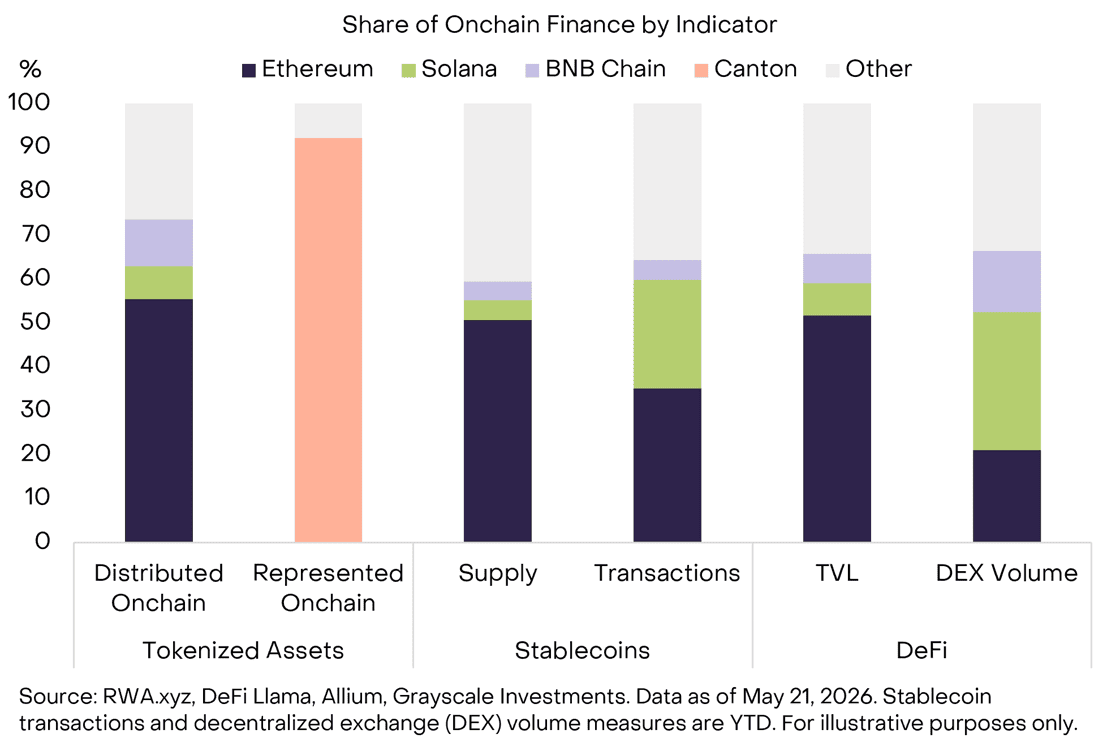
Share of onchain between different chains. Source: X
Ethereum staking activity has also continued to climb despite the 28% price decline in 2026. Network data showed staked ETH reached nearly 39.1 million coins, or about 32% of the total ETH supply, spread across more than 896,000 active validators.
Validator entry demand also remained elevated, with over 3.49 million ETH waiting in the staking entry queue, resulting in a wait time of more than 60 days, while the exit supply remains at a minimal 7,424.
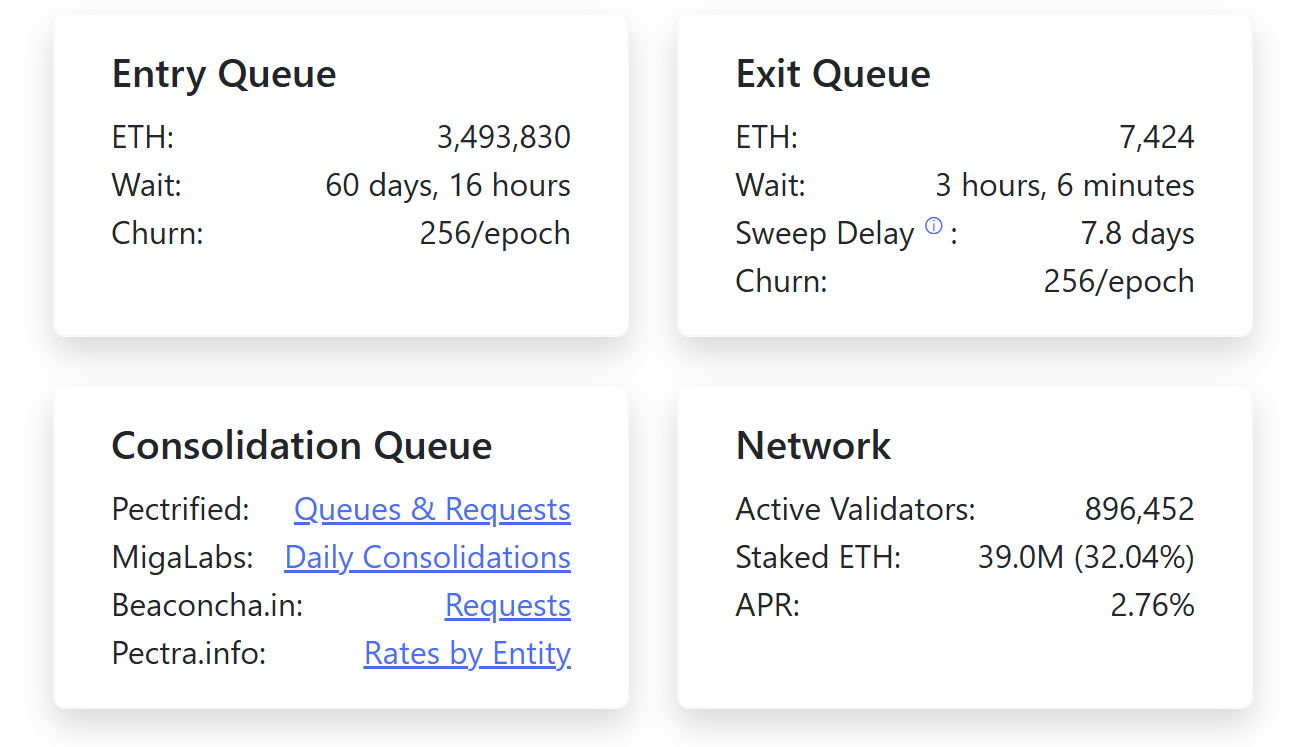
Ethereum validator queue. Source: Validator Queue
The long validator queue matters because it shows that large amounts of ETH continue to move into staking despite weaker prices this year.
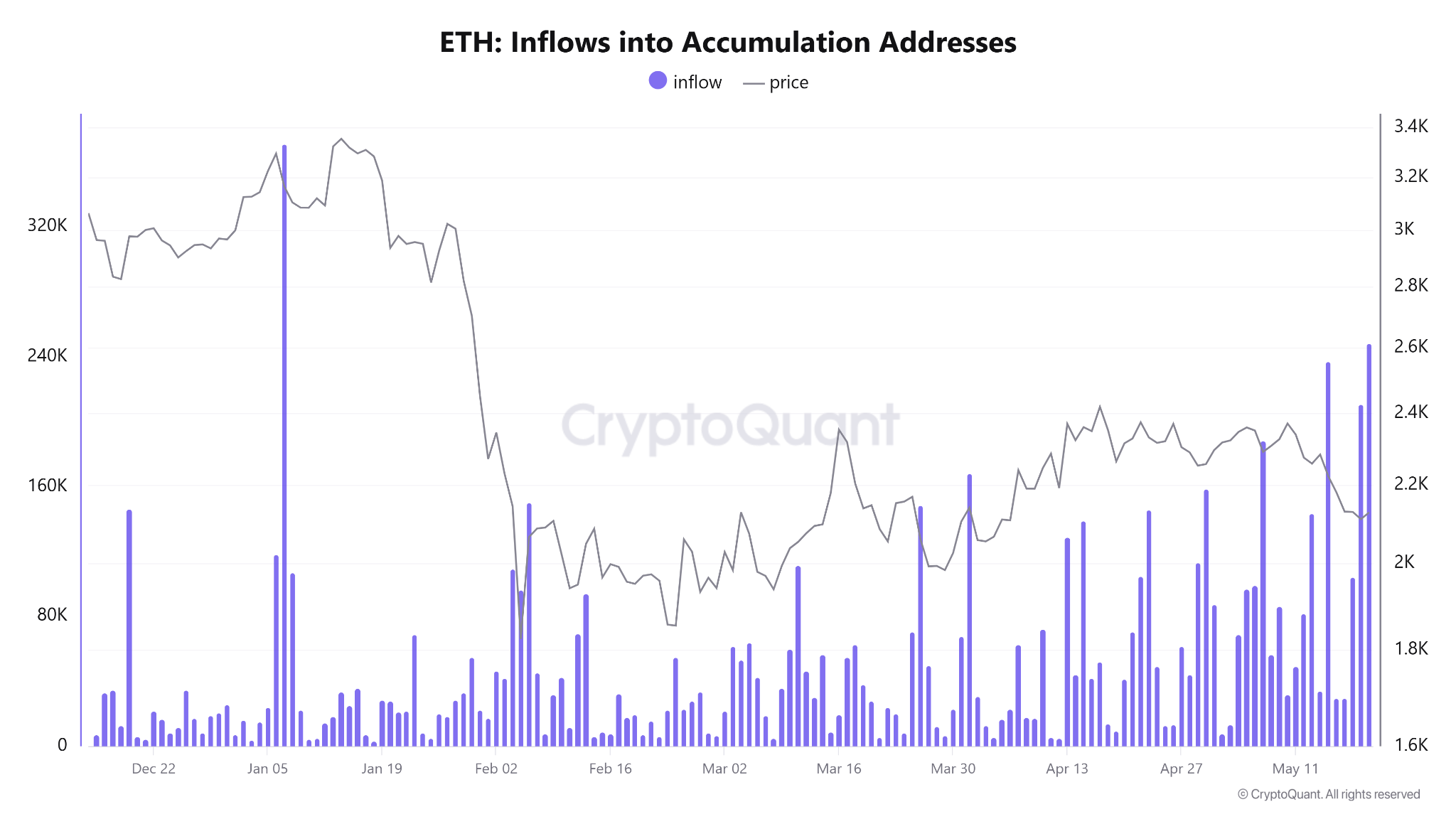
CryptoQuant data added also highlights an Ether accumulation trend. ETH inflows into accumulation addresses reached 248,400 ETH on May 20, marking the strongest single-day inflow since Jan. 6. These wallets are often associated with long-term holders, as they exhibit limited selling activity.
ETH inflows into accumulation addresses. Source: CryptoQuant
Related: Harvard dumps entire ETH position after just one quarter
ETH analysts watch the historical buy zone
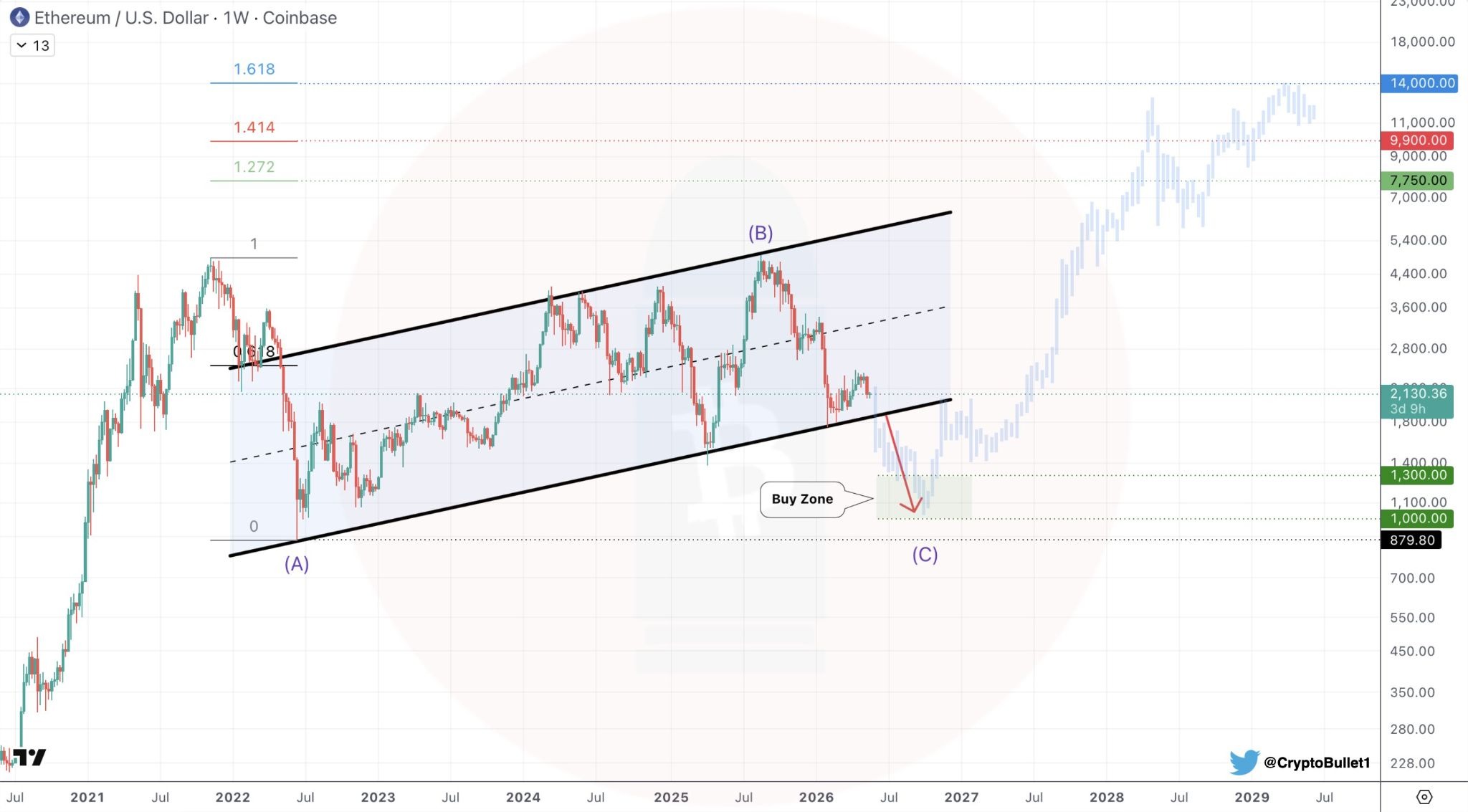
Trader Crypto Bullet said Ether’s weekly chart still shows a multi-year accumulation range between $1,000 and $5,000. The analyst views the past several years as a period in which buyers slowly built positions before a larger trend developed.
Crypto Bullet said ETH could still revisit the $1,000 to $1,300 area, calling it a possible final capitulation zone before the next cycle expansion. The analyst also mapped out long-term upside targets of $7,700- $14,000 for the 2027–2029 period.
ETH/USD, one-week chart. Source: X
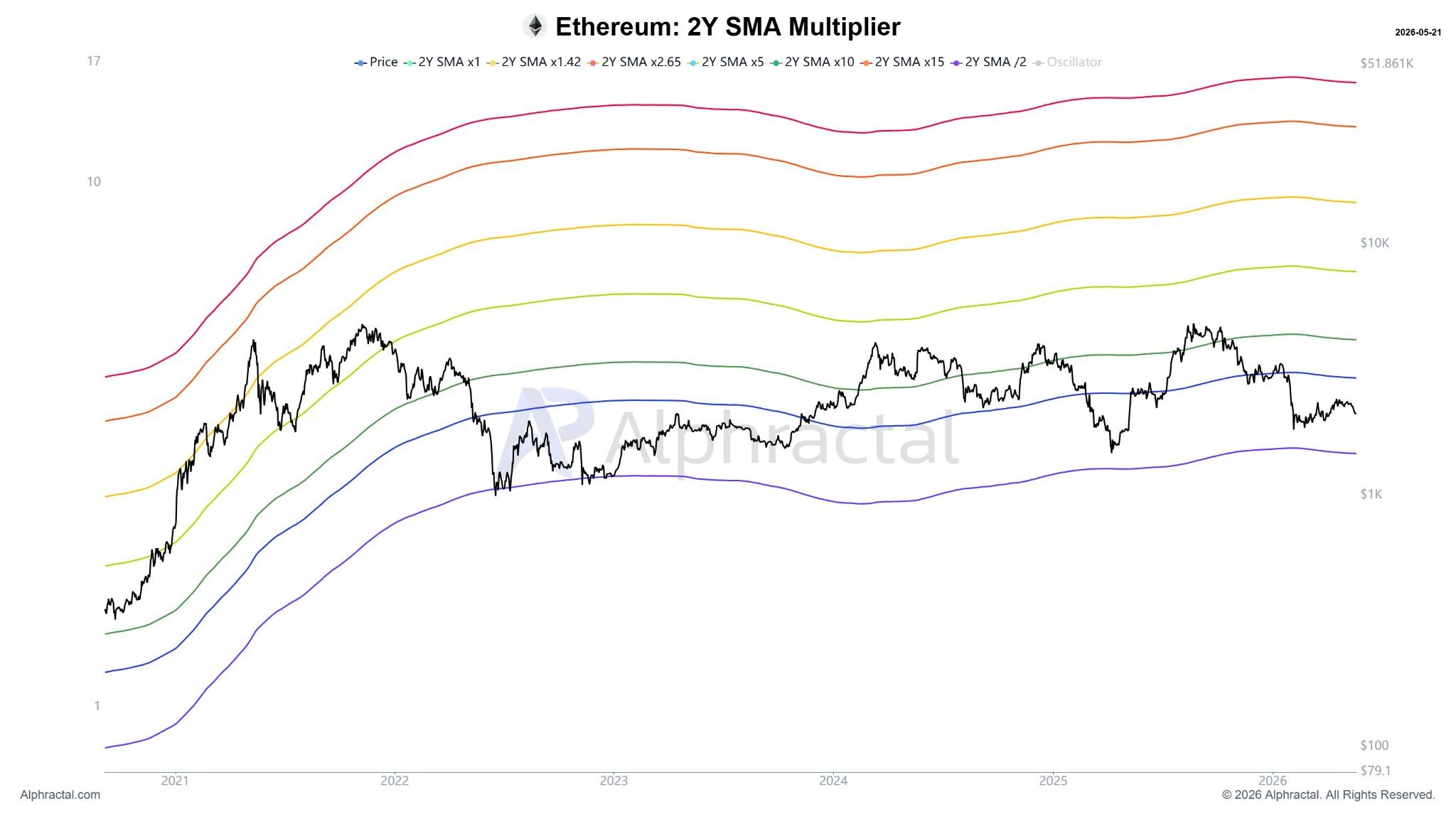
Onchain analyst Rei pointed to Ether’s position on the two-year simple moving average multiplier model from Alphractal. The model compares ETH price to its average over the past two years to identify periods when ETH traded above or below its average.
Ethereum recently dropped below the chart’s two-year SMA x1 band, which is the baseline average price of ETH over the past two years. Traders often view the x1 level as a fair-value zone during normal market conditions.
Higher bands like x1.42 and x2.65 have historically appeared during overheated phases of a bull market when ETH traded far above its long-term average.
The price is now moving closer to the lower 2Y SMA/2 band, shown in purple on the chart. Rei said,
“History shows that whenever $ETH approaches or touches this zone (like in late 2022), the market usually establishes a highly reliable, cyclical “accumulation zone.”
Ethereum: 2Y SMA multiplier indicator. Source: X

The Bitcoin community marked the 16th anniversary of “Pizza Day” this week, recalling the first recorded real-world use of Bitcoin to buy goods. In May 2010, Laszlo Hanyecz offered 10,000 BTC for two Papa John’s pizzas, a transaction that is widely cited as the moment Bitcoin proved it could function as a medium of exchange outside the digital realm. At the time, that 10,000 BTC held a value of about $41; today, at current prices, it would be worth well into the hundreds of millions, and at Bitcoin’s all-time high near $126,000 in October 2025, the group’s Pizza Day investment would have surpassed $1.2 billion.
“Bitcoin Pizza Day is one of the most important moments in crypto history because it transformed Bitcoin from an internet experiment into a real economic network,” said Nischal Shetty, founder of crypto exchange WazirX. He noted that the milestone demonstrated, in concrete terms, that a decentralized digital asset could facilitate tangible commerce rather than remain a niche curiosity. In 2010, the Bitcoin network handled only a few hundred transactions per day, with little in the way of payment infrastructure, service providers, or institutional participation.
Bitcoin Pizza Day transformed Bitcoin from an internet experiment into a real economic network, proving that a decentralized digital asset could facilitate real-world commerce.
Hanyecz’s purchase underscored a core question that has animated the space for years: could Bitcoin ever function as a reliable, everyday payment rail? In the early days, the ecosystem lacked scalable payment rails and broad commercial acceptance, and the idea of Bitcoin as a mainstream means of payment was far from settled. Yet the episode remains a landmark in crypto lore, illustrating the long arc from digital novelty to a powered, real-world economy.
Beyond the historical anecdote, the broader narrative around Bitcoin has evolved toward a deeper conversation about adoption by individuals, businesses, and even states. The industry has watched as nations and policymakers weigh how digital assets fit into currencies, financial infrastructure, and international commerce.
Related: Missouri advances a strategic Bitcoin reserve bill, highlighting how jurisdictions are considering formal use cases for Bitcoin beyond private, voluntary payments.
Key takeaways
- Pizza Day commemorates the first real-world Bitcoin transaction, when 10,000 BTC bought two Papa John’s pizzas in 2010, valued then at about $41.
- At current prices, the 10,000 BTC involved would be worth several hundred million dollars; at Bitcoin’s October 2025 all-time peak, the position would exceed $1.2 billion.
- The early period featured minimal on-chain activity and almost no payment infrastructure, underscoring how far the network has evolved toward broader real-world use.
- Nation-state discussions around Bitcoin have intensified, including proposals for strategic reserves and tax incentives for Bitcoin payments in some jurisdictions.
- Reports from Iran in 2026 suggested toll payments for ships passing the Strait of Hormuz could be settled in Bitcoin, USDT, or yuan, but on-chain evidence of BTC toll payments remains unclear to date, with USDT appearing as the payment method of choice in practice.
From pizza proof to policy ambitions
The Pizza Day moment sits at the intersection of history and policy. Early on, observers argued that Bitcoin’s value proposition lay not just in its scarcity or technology, but in its ability to enable peer-to-peer exchanges without intermediaries. The pizza transaction became a symbol of that potential, a reminder that a decentralized network could be used to exchange value for everyday goods. As time passed, proponents argued that such use would grow from curiosity to utility, a transition that would be tested by the evolution of payment rails, infrastructure, and mainstream acceptance.
In recent years, the conversation shifted toward how Bitcoin might fit into the broader financial and geopolitical landscape. In 2024, the discourse around nation-state adoption gained momentum, with discussions around tax incentives for Bitcoin payments and the creation of strategic reserves in some jurisdictions. A notable example cited by observers is Missouri’s HB2080, which sought to advance a formal framework for Bitcoin-related reserves and related policies. The coverage reflects a broader trend: policymakers and observers increasingly treat Bitcoin not merely as an investment or a technology experiment, but as a potential component of national financial strategy.
Beyond domestic policy, the international arena has also featured statements about how digital assets could participate in cross-border trade. In April 2026, reports emerged that Iranian officials considered allowing oil shipments crossing the Strait of Hormuz to settle tolls in Bitcoin, along with US dollar stablecoins and the Chinese yuan. The Bitcoin Policy Institute summarized the landscape and noted that, at the time of publication, there was no on-chain evidence of BTC toll payments in practice; instead, stablecoins such as USDT had become the preferred payment method for toll settlements in related discussions. The institute’s researchers also highlighted a timeline tracking Iran’s evolving stance on digital assets as part of a broader analysis of state-level adoption.”
While the Iranian narrative drew attention, observers emphasized that true on-chain adoption—payments settled entirely in BTC for large-scale tolls or cross-border commerce—remains to be demonstrated. The prevailing practical dynamic appears to hinge on stablecoins and other fiat-pegged tokens for transaction efficiency and regulatory clarity, even as the philosophical case for Bitcoin as a settlement layer continues to gain advocates.
A timeline graphic from the Bitcoin Policy Institute maps the state of play around Bitcoin, Hormuz, and the wider geopolitical context, illustrating how the conversation has evolved from niche enthusiasm to policy-oriented discourse. For researchers and practitioners, the key takeaway is that government interest in Bitcoin and other digital assets has matured into concrete policy discussions, even if the fulsome deployment remains nascent and contingent on regulatory, technical, and logistical developments.
In examining these developments, many market watchers stress that the real impact for investors and builders hinges on how quickly and credibly policymakers translate rhetoric into workable frameworks. The divergence between high-level policy talk and on-chain activity—especially in areas like toll payments or cross-border settlements—highlights both opportunities and uncertainties ahead.
As the debate continues, the pizza transaction endures as a cultural anchor for Bitcoin’s utility narrative, while policy conversations push the industry toward tangible, if imperfect, integration with existing financial systems. The coming years will reveal whether Bitcoin can sustain momentum as a practical payment instrument at scale or whether it remains primarily a store of value and a vehicle for institutional experimentation.
For those tracking these developments, the next important milestones include any verified instances of BTC-based toll payments or cross-border settlements and the progress of state-level policy experiments that could set precedents for broader adoption. The tension between Bitcoin’s core ethos of decentralization and the regulatory expectations of nations remains a defining dynamic for the asset class in the years ahead.
Further reading: Big Questions: Can Bitcoin save you from the Cantillon Effect?

Disclosure: This article does not represent investment advice. The content and materials featured on this page are for educational purposes only.
SHRMiner launches free crypto mining service for BTC, XRP, DOGE, LTC, and ETH passive income seekers.
Summary
- SHRMiner launched a free cloud mining service for BTC, XRP, DOGE, LTC, and ETH holders in 2026.
- The platform promotes beginner-friendly cloud mining without hardware costs or advanced technical knowledge.
- SHRMiner says it operates 150+ renewable-powered mining farms serving over 5 million global users.
As cryptocurrencies gain increasing popularity worldwide, more and more investors are seeking ways to generate a steady stream of passive income without the need for expensive hardware or specialized skills.
SHR Miner’s new free mining service allows holders of BTC, XRP, DOGE, LTC, and EHT to easily earn passive income without expensive equipment or specialized technical knowledge.

In the rapidly evolving world of cryptocurrency, simplicity and high returns are paramount. For those seeking an accessible, entry-level investment method to generate a steady income with minimal effort, cloud mining undoubtedly presents a highly attractive option.
This article will delve into the concept of cloud mining, using the leading brand SHRMiner as a case study to demonstrate how it can help its users achieve daily earnings of $8,900, or even more.
The appeal of cloud mining
Due to its ease of use and convenience, cloud mining has long been highly favored by cryptocurrency enthusiasts. Unlike traditional mining, it requires no expensive hardware, specialized technical expertise, or constant monitoring.
Cloud mining simplifies the process, enabling anyone — regardless of their level of experience — to participate in the cryptocurrency revolution. Instead of investing in costly mining equipment and managing complex systems, users simply lease mining algorithms from remote data centers to earn a share of the profits.
Recently, the UK-based cloud mining platform SHRMiner officially launched a new “free cloud mining service.” Designed specifically for holders of mainstream cryptocurrencies, such as BTC, XRP, DOGE, LTC, and ETH, this service offers users a new opportunity to participate in cryptocurrency mining with no barriers to entry.
Meanwhile, SHRMiner has also launched a new mobile application, enabling users to manage their mining activities anytime, anywhere — effectively ushering in the “era of mobile mining.”
SHRMiner: The perfect blend of laziness and profit
SHRMiner takes the simplicity of cloud mining to the extreme, making it the ideal choice for novice users. The platform’s user-friendly interface ensures that even newcomers to the world of cryptocurrency can get started with ease.
For SHRMiner, simplicity is not a weakness, but rather the path to success. As a pioneer in cloud mining services, SHRMiner operates over 150 mining farms worldwide — equipped with more than 600,000 mining devices powered entirely by modern renewable energy sources — and has earned the trust and support of over 5 million users thanks to its stable returns and robust security.
How can SHRMiner serve as a source of passive income?
The entire process takes just three simple steps to start earning income:
1. Register an Account
By visiting the SHRMiner official website, users can register a free account in less than 2 minutes and receive a $15 sign-up bonus. This bonus helps users quickly experience the platform’s services and earn $0.60 per day from the free trial contract.
2. Select a Cloud Mining Plan
Choose a cloud mining plan that aligns with needs and budget. The platform offers a wide range of flexible plans — ranging from $100 to $200,000 — to accommodate the diverse investment goals of different users.
3. Start Earning
Upon purchasing a contract, earnings are automatically settled within 24 hours, requiring no additional management or manual intervention. Users may withdraw their earnings to their cryptocurrency wallet addresses at any time to suit their needs, or they may choose to reinvest their profits to capitalize on the power of compound interest.
The primary advantage of this model lies in its significant lowering of the barrier to entry. Users need not research specific mining hardware models or hash rate configurations, nor do they need to set up their own system environments; they simply need to register an account, deposit assets, and select a mining plan to begin generating returns.
SHRMiner Platform Advantages:
- Supports daily automatic settlements.
- Requires no additional electricity or maintenance costs.
- Utilizes advanced ASIC mining hardware, powered by renewable energy sources including hydroelectric, wind, and solar power.
- Supports multi-currency mining: Earn major cryptocurrencies such as BTC, XRP, ETH, DOGE, USDC, USDT, SOL, LTC, BCH, and more.
- Features SSL encryption and DDoS protection, along with a real-time earnings dashboard for convenient monitoring of mining performance.
- 100% Remote Access: Enjoy full access without the need for physical hardware via the SHRMiner app or web browser, complemented by 24/7 online technical support.
- Affiliate Program: Refer friends to earn commission rewards of up to 4.5%, with the opportunity to receive additional bonuses of up to 30,000.
Examples of Common Contracts:
Contract Name
Price
Profit
Days
Principal+TotalReturn
NewUserExperienceAgreement
$100
$4
2
$100+$8
Bitdeer Sealminer A2 Pro
$500
$6.25
5
$500.00 + $31.25
Litecoin Miner L9
$1000.00
$13.00
10
$1000.00 + $130
Bitcoin Miner S21 XP Imm
$5000.00
$70.00
25
$5000.00 + $1750
Bitcoin Miner S21e XP Hyd
$10000.00
$150.00
35
$10000.00 + $5250
ANTSPACE HW5
$50000.00
$900.00
45
$50000.00 + $40500
After purchasing a contract, earnings will be automatically credited to an account within 24 hours. (Hash rate, investment amount, duration, and earnings vary for different contracts. For more contract information, please visit the official SHRMiner website or click on “Contract Details” to view.)
Unimaginable money-making opportunities
What sets SHRMiner apart is its extraordinary daily passive income potential; users have the opportunity to earn $8,900 — or even more — every day, thereby realizing their dream of getting rich online. Imagine generating substantial income without the need for constant effort or complex setups — that is precisely what SHRMiner offers.
Safety and sustainability
In the mining sector, trust and security are paramount; SHRMiner fully recognizes this and places user safety at the forefront. Committed to transparency and legitimacy, SHRMiner ensures that investments are protected, allowing investors to focus on profitability. All mining facilities utilize clean energy, making our cloud mining operations carbon-neutral. By harnessing renewable energy, we safeguard the environment from pollution while delivering superior energy efficiency.
In short
For those who are looking for ways to generate passive income, cloud mining is an excellent choice. When utilized effectively, these opportunities can help users effortlessly accumulate cryptocurrency wealth on “autopilot,” requiring only a minimal time commitment. At the very least, they should be far less time-consuming than any form of active trading. Passive income is the ultimate goal for every investor and trader, and with SHRMiner, maximizing passive income potential has never been easier.
For more information, visit the official website.
Disclosure: This content is provided by a third party. Neither crypto.news nor the author of this article endorses any product mentioned on this page. Users should conduct their own research before taking any action related to the company.
Crypto World
MP Materials (MP) Achieves Rare Perfect Bullish Consensus From All Wall Street Analysts

Key Points
- Barclays launched coverage of MP Materials with an Overweight rating and set a price target of $69.
- The company now enjoys unanimous Buy ratings from all 18 Wall Street analysts—an exceptionally rare achievement.
- Shares rose 5.1% Friday to $64.85, following Thursday’s 9.3% surge.
- The stock has rallied more than 220% over the past year, fueled by strategic U.S. government rare earth initiatives.
- GuruFocus calculates the shares are trading 116% above intrinsic value, while insiders have divested $44.5M worth of stock recently.
Shares of MP Materials extended their rally Friday following Barclays’ decision to initiate coverage with bullish commentary. Trading at $64.85, the stock advanced 5.1% after analyst Richard Garchitorena unveiled an Overweight rating alongside a $69 price objective late Thursday.
This addition brings the analyst roster to 18—with every single one recommending a Buy. For context, typical S&P 500 companies see Buy-rating ratios hovering around 55% to 60%. Achieving 18 out of 18 bullish calls is extraordinarily uncommon.
The consensus price target among these analysts averages approximately $80, suggesting meaningful upside from current levels.
Friday’s climb built on Thursday’s remarkable session, when MP Materials surged 9.3% before the Barclays report even surfaced. The broader rare earth space participated in the rally: USA Rare Earth climbed 7.6%, Ramaco Resources advanced 5.4%, and Rare Earths Americas posted a 3.5% gain.
Sector Catalysts Behind the Movement
Washington has intensified efforts to break China’s dominance over rare earth extraction and refinement. Multiple federal agreements with domestic operators have introduced guaranteed pricing mechanisms and equity participation—structural shifts that have transformed the sector’s profitability outlook.
This favorable policy environment has powered MP’s extraordinary 222% climb over the trailing 12 months. Such explosive returns typically introduce heightened volatility, potentially contributing to Thursday’s sharp price action.
Not all rare earth stocks participated in Thursday’s advance, however. Neo Performance Materials tumbled 7.6% after announcing the sale of its Greenland rare earth asset to Greenland Mines for $35 million. Market participants appeared disappointed with the valuation—despite Neo’s original 2022 acquisition price of roughly $3.5 million, delivering a tenfold return. A simultaneous equity offering priced at $28.75 also pressured shares.
Valuation Concerns Merit Attention
The investment case for MP Materials contains notable complexities. According to GuruFocus, the stock carries a GF Value of $29.62, implying current pricing exceeds estimated fair value by approximately 116%. The forward price-to-earnings ratio registers at 204.15—elevated by virtually any standard.
The company’s GF Score stands at 61 out of 100, indicating moderate prospects for sustained outperformance. While growth metrics and momentum indicators score favorably, valuation receives the lowest possible rating of 1 out of 10.
Recent insider transactions warrant consideration as well. During the past three months, company insiders have liquidated $44.5 million in shares while purchasing only $1 million.
MP Materials controls and operates the Mountain Pass facility in California—North America’s sole large-scale rare earth mining and processing operation. The enterprise commands a market capitalization near $11.42 billion.
Friday’s broader equity markets also posted gains, with the S&P 500 advancing 0.6% and the Dow Jones Industrial Average rising 0.7%.



MARA security spending reached $4.3 million in 2025, including $430,000 to armor CEO Fred Thiel’s vehicle.
Summary
- MARA’s 2026 proxy filing revealed $4.3 million in total CEO security spending in 2025, including $430,000 to armor Fred Thiel’s personal vehicle.
- Physical attacks on crypto holders rose 75% in 2025 to 72 confirmed incidents totalling $41 million in known losses, according to CertiK data.
- Coinbase spent $7.6 million protecting Brian Armstrong in 2025, while Gemini committed $400,000 per month to secure the Winklevoss twins.
MARA Holdings’ 2026 proxy filing disclosed $4.3 million in total personal security spending for CEO Fred Thiel in 2025, including $430,000 specifically for vehicle armoring. The scale reflects a broader industry response to a wave of physical attacks targeting crypto executives.
Physical attacks on crypto holders rose 75% in 2025, reaching 72 confirmed incidents and $41 million in known losses according to CertiK data. Jameson Lopp has tracked a roughly threefold increase in wrench attacks between 2023 and 2025.
Why MARA is spending millions on CEO protection
Wrench attacks are physical coercions in which attackers force victims to surrender digital assets or private keys. MARA currently holds 38,689 BTC, making CEO wealth a publicly visible and targetable security concern.
Crypto.news has tracked MARA’s Q1 2026 results including a $1.3 billion net loss and its pivot toward AI infrastructure. Crypto.news has also reported on MARA selling $1.5 billion in Bitcoin to fund that transition.
The MARA proxy also noted that the company’s annual meeting will be held virtually on June 18, 2026. CEO Thiel’s 2025 total compensation including security will be voted on by shareholders at that meeting.
How MARA’s security spend compares to the broader industry
Coinbase spent approximately $7.6 million on Armstrong security in 2025, more than 20% above the prior year and higher than most Wall Street bank CEOs. Gemini disclosed $400,000 per month for the Winklevoss twins, roughly $4.8 million annually.
The security surge is concentrated at firms with large, publicly visible Bitcoin treasuries. The spending gap between crypto and traditional finance reflects how public blockchain holdings create a searchable threat surface that traditional bank executives do not face.
At the Bitcoin 2026 conference in Las Vegas last month, high-profile speakers moved through the venue with personal bodyguards. The Bitcoin price page tracks holdings data that makes executive wealth publicly visible and therefore targetable.

Agatha Christie Finally Returns With New Detective Series

Mohamed Salah is one of Liverpool’s three greatest ever players – but one last goal remains

XRP: 24,000%


-

 Fashion8 hours ago
Holiday Weekend Open Thread – Corporette.com
-

 Fashion6 days ago
On the Scene at Gucci’s Cruise Show in New York City: Mariah Carey, Kim Kardashian, Lindsay Lohan, Iman, and More!
-

 Politics7 days ago
Watch: far-right flag-fanatics run over victim, attack locals – Setup By the Left wing for your entertainment
-

 Fashion7 days ago
Trending Western Style Vests Perfect for Summer
-

 Crypto World1 day ago
Blockchain.com files with SEC for U.S. IPO
-

 Fashion6 days ago
Amazon Sundays: Memorial Day Hosting
-

 Entertainment6 days ago
Off Campus Easter Eggs Explained: Characters, Stories, More
-
 Crypto World6 days ago
Intesa Sanpaolo’s crypto holdings jump to $235M as XRP enters
-
Business6 days ago
Australia defends property tax changes designed to fix ‘broken’ housing
-
 Crypto World4 days ago
Revolut Launches Dogecoin Debit Card Across UK and EU
-

 Politics7 days ago
Anti-Zionists attacked in Jerusalem as ethnofascists chant race-hate
-

 Tech1 day ago
WhatsApp ads could make Irish debut after discussions with DPC
-

 Sports1 day ago
2026 CJ Cup Byron Nelson leaderboard: Brooks Koepka finds putting stroke in Round 1
-
Politics6 days ago
Wings Over Scotland | The Land Of No Laws
-

 Politics6 days ago
Cassidy defiant as Trump's revenge campaign closes in
-

 Business6 days ago
Equinor ASA (EQNR) Shareholder/Analyst Call Prepared Remarks Transcript
-
 NewsBeat2 days ago
Charity run by Reform leader Malcolm Offord accused of ‘law breaking’ over Scottish registration
-

 Crypto World19 hours ago
Trump Media’s Bitcoin Stash Shrinks Again as 2,650 BTC Lands on Crypto.com
-

 Business7 days ago
Tracking Berkshire Hathaway Portfolio – Q1 2026 Update
-

 Business7 days ago
Week Ahead: Rising U.S. Rates Underpin Greenback
You must be logged in to post a comment Login