Crypto World
Next-Gen KYC Accuracy Through Intelligent Document Processing

Know Your Customer (KYC) has decisively moved beyond a regulatory formality to become a strategic risk, trust, and growth enabler for banks. In 2025-2026, surging digital onboarding volumes, cross‑border customer profiles, and heightened enforcement by global regulators mean that even minor inaccuracies in KYC document processing can lead to onboarding delays, supervisory scrutiny, or long‑term reputational impact. Manual and rule‑based verification systems, once sufficient, are now overwhelmed by document diversity, real‑time onboarding expectations, and increasingly sophisticated identity fraud.
This is where AI KYC document processing reshapes compliance execution. By combining Intelligent Document Processing Services, machine learning, and contextual validation, banks are achieving materially higher accuracy and faster decision cycles. Industry trend data shows that financial institutions globally are investing heavily in AI and automation for compliance, with the adoption of advanced AI tools in AML/KYC rising significantly in 2025. This shift reflects recognition that KYC document automation and AI for KYC compliance are now essential for operational efficiency and regulatory confidence rather than optional enhancements.
The Real Problem with Traditional KYC Document Processing
Banks process millions of documents every year – identity proofs, address verification records, income statements, corporate incorporation documents, and beneficial ownership disclosures. Traditional KYC workflows struggle under four systemic constraints:
- High error rates driven by manual data entry and unstructured document formats
- Limited fraud detection unable to identify synthetic identities or subtle manipulation
- Prolonged onboarding cycles, often stretching from days to weeks
- Regulatory exposure, caused by incomplete, inconsistent, or non‑auditable data
Research shows that outdated KYC systems contribute significantly to compliance workload and errors, prompting banks to adopt Intelligent Document Processing Solutions designed for compliance‑heavy workflows.
How AI Transforms KYC Document Processing at the Core
AI integration in KYC is not about replacing compliance teams; it’s about augmenting regulatory intelligence and decision accuracy.
1. Intelligent Document Ingestion and Classification
Modern intelligent document processing automation platforms use deep learning to automatically classify incoming documents, passports, national IDs, utility bills, bank statements, and corporate filings, irrespective of layout, language, or format. Unlike traditional OCR, AI models understand document intent and contextual data, ensuring key attributes such as name, date of birth, and address are extracted with semantic accuracy.
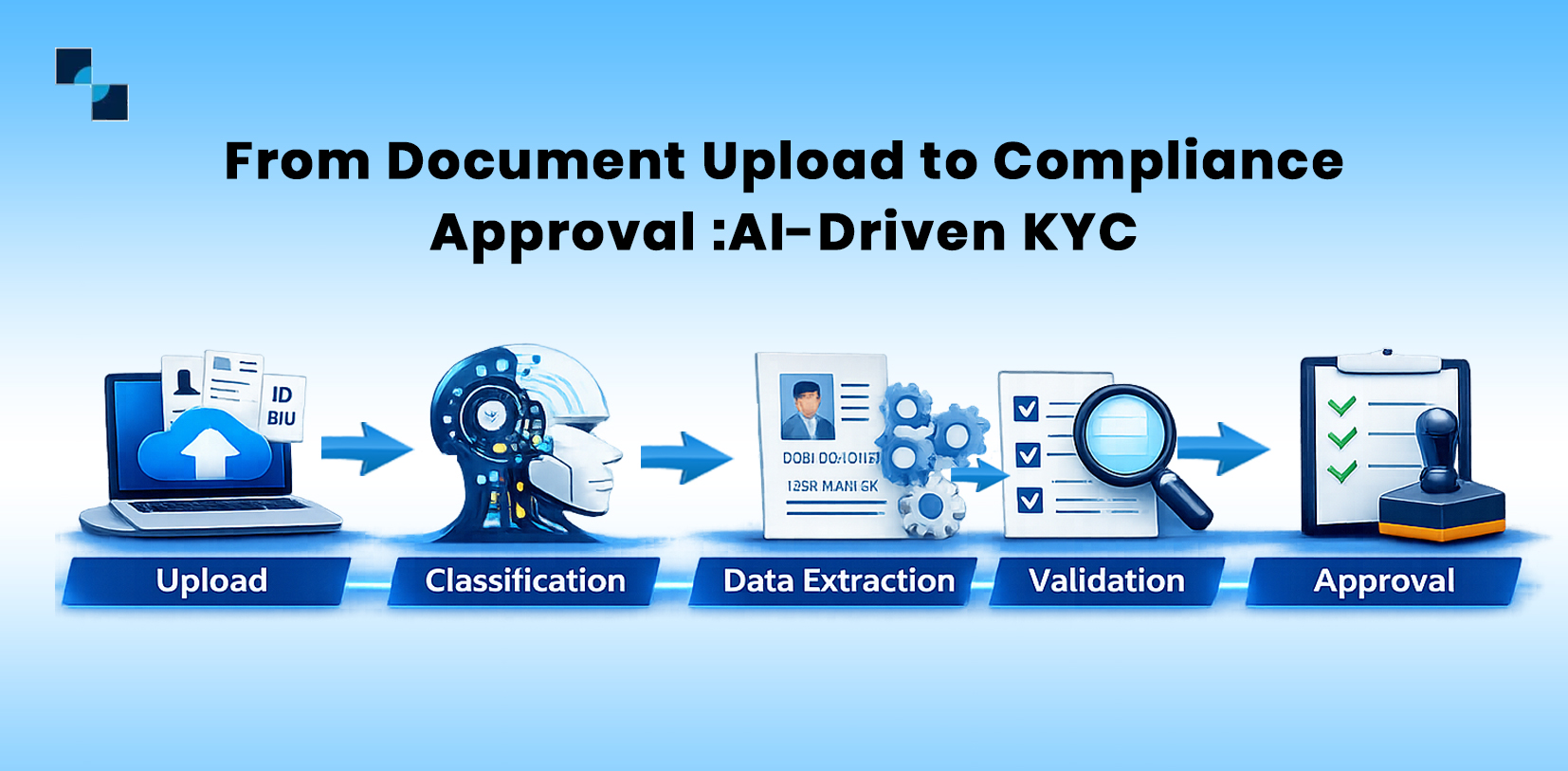

Note: this is just an AI-generated image for reference; you can use your own creativity to make it better
2. AI‑Powered Data Extraction with Context Awareness
Traditional OCR captures characters; AI KYC document processing captures meaning. By combining Natural Language Processing (NLP) and computer vision techniques, banks can extract structured data even from low‑quality scans, handwritten forms, and multi‑format documents. AI models automatically cross‑validate extracted fields across multiple documents, significantly reducing mismatches and false rejections.
Smarter KYC Automation for Modern Banks
3. Automated Cross‑Verification and Fraud Detection
Advanced KYC AI solutions provide transformative improvements over legacy systems. AI engines can automatically:
- Cross‑verify customer data against sanctions lists, politically exposed persons (PEP) databases, and watchlists
- Match identity documents with biometric verification, selfie comparisons, and liveness checks
- Detect manipulation indicators such as font inconsistencies, altered metadata, or visual tampering
AI‑enhanced models in newer compliance platforms also help reduce false positives and speed up investigations, which boosts both efficiency and risk coverage.
4. Continuous KYC and Regulatory Alignment
Static, point‑in‑time KYC reviews are no longer sufficient. Banks now deploy AI for KYC compliance to enable continuous customer risk monitoring. AI systems automatically flag:
- Address or identity changes
- Behavioral risk deviations
- Expired or mismatched documents
This approach aligns with evolving global frameworks, including FATF’s risk‑based guidance and enhanced due diligence norms across key jurisdictions.
Why Intelligent Document Processing is a Compliance Multiplier
Banks adopting Intelligent Document Processing Services report measurable impact across accuracy, speed, and compliance readiness. While exact market figures vary by analyst:
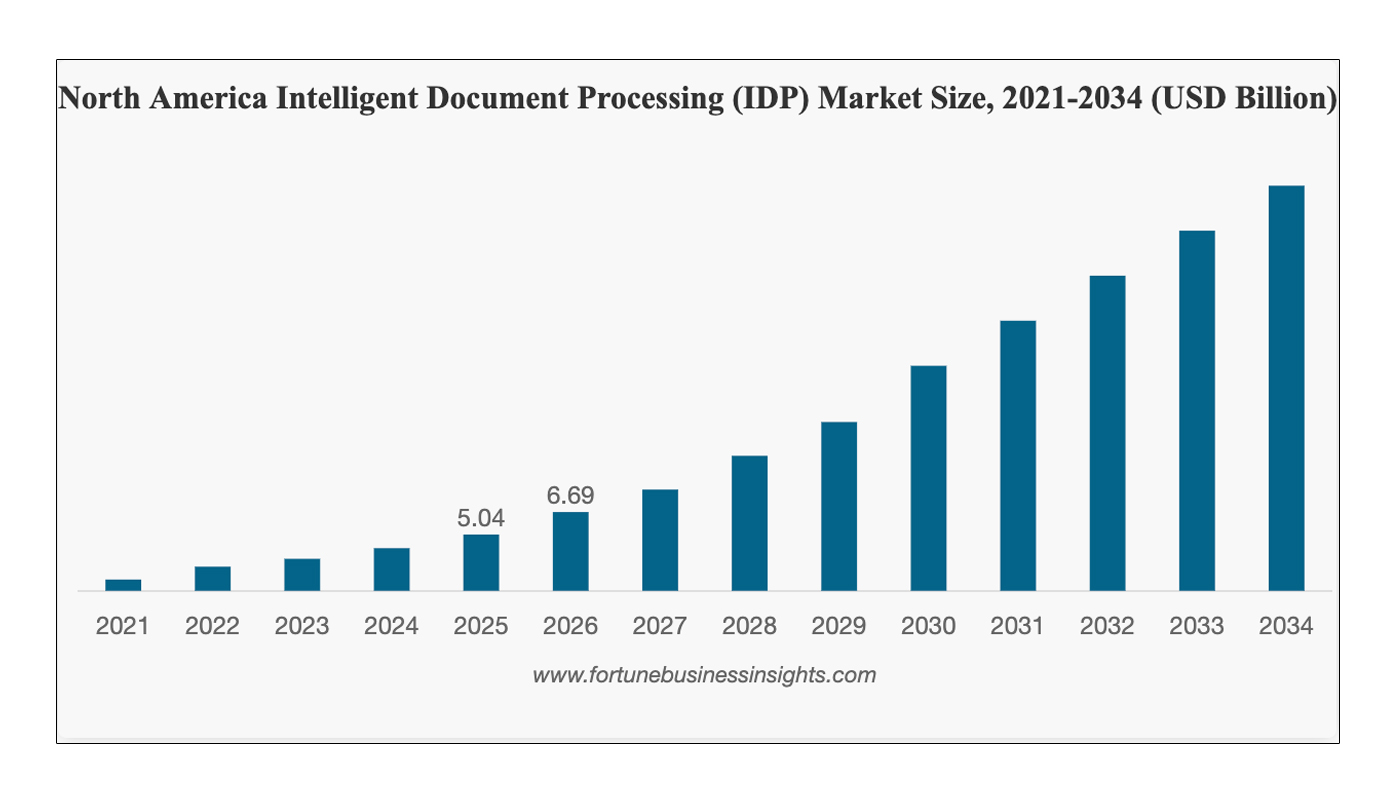

https://www.fortunebusinessinsights.com/intelligent-document-processing-market-108590?
- The Intelligent Document Processing market was valued at about USD 10.57 billion in 2025 and is projected for strong growth through 2034, driven by AI and automation demand across industries, including finance.
- Independent research also estimates the global IDP market could expand significantly by 2030 as AI‑enabled solutions scale.
These trends underscore why KYC document automation and KYC AI solutions are becoming mission‑critical for banks – they turn raw document data into reliable, audit‑ready insights while reducing manual bottlenecks.
Expert Insights: The Role of AI in KYC Compliance
“AI-driven document intelligence is becoming foundational to financial compliance.” – Gartner, Market Guide for Intelligent Document Processing
It clearly highlights that KYC document automation is now a competitive differentiator, not merely a regulatory necessity.
Step-by-Step Approach to AI-Powered KYC Integration
Step 1: Deploy Domain‑Specific AI Models
Generic OCR cannot meet compliance needs. Banks must adopt systems trained on financial and identity documents.
Step 2: Embed Human‑in‑the‑Loop Validation
AI handles scale; compliance experts handle exceptions, ensuring regulatory defensibility.
Step 3: Ensure Explainability and Auditability
Every AI decision should be traceable. Regulators increasingly expect transparency, not black‑box automation.
Step 4: Integrate with Core Banking and AML Systems
True KYC document processing automation integrates seamlessly with CRM, AML, and risk engines.
AI-Powered Compliance, Real-Time Accuracy
Common Mistakes Banks Make with AI KYC
Despite rising AI adoption, many KYC initiatives fail due to:
- Over‑reliance on generic automation platforms
- Ignoring jurisdiction‑specific regulatory nuances
- Weak governance over AI models and data pipelines
Industry research indicates that strategic and implementation gaps, not technology limitations, are often the primary source of AI compliance project challenges.
The Strategic Payoff: Accuracy, Trust, and Scale
When implemented correctly, AI for KYC compliance delivers:
- Near‑zero onboarding errors
- Faster customer acquisition
- Stronger regulatory confidence
- Scalable, cross‑border compliance
Banks no longer need to choose between speed and accuracy. With mature KYC document processing automation, they achieve both at an enterprise scale.
Accuracy is the New Compliance Currency
AI is not just an innovation – it is the backbone of modern KYC. By leveraging Intelligent Document Processing Services and end‑to‑end KYC document processing automation, banks can transform KYC from a cost center into a strategic advantage. Precision, speed, and regulatory confidence now move together.
Antier enables banks and financial institutions to deploy enterprise‑grade advanced KYC AI solutions aligned with global regulatory standards. With deep expertise in AI‑led compliance automation, Antier helps organizations achieve accuracy at scale without compromising governance or trust.
Frequently Asked Questions
01. What is the significance of Know Your Customer (KYC) in banking today?
KYC has evolved from a regulatory formality to a strategic enabler for risk management, trust, and growth, particularly as digital onboarding volumes and regulatory scrutiny increase.
02. How does AI improve KYC document processing for banks?
AI enhances KYC document processing by increasing accuracy, speeding up decision cycles, and enabling better fraud detection through Intelligent Document Processing Services and machine learning.
03. What challenges do traditional KYC workflows face?
Traditional KYC workflows struggle with high error rates, limited fraud detection, prolonged onboarding cycles, and regulatory exposure due to outdated systems and manual processes.