

Crypto World
Oil slides as Trump 15% tariffs hit demand outlook



Brent, WTI fell ~3–5% Monday after Trump’s 15% tariffs and easing Iran war risk.
Summary
- Brent and WTI declined sharply, testing key technical support levels as futures markets repriced lower demand from higher U.S. import tariffs.
- Trump lifted temporary tariffs from 10% to 15% on all U.S. imports after a Supreme Court ruling, a move analysts say will weigh on trade, industry and fuel consumption.
- Iran–U.S. nuclear talks in Geneva cut perceived war risk, reducing the geopolitical premium in crude even as Goldman Sachs still expects a 2026 surplus with modest WTI forecast tweaks.
Oil prices declined sharply on Monday as markets reacted to increased U.S. tariffs and developments in diplomatic negotiations with Iran, factors that analysts said are reshaping near-term expectations for crude demand and supply.
Brent and West Texas Intermediate (WTI) crude both fell, testing key technical support levels, according to market data.
President Donald Trump raised temporary tariffs from 10% to 15% on all U.S. imports over the weekend, according to a White House announcement. The increase followed a U.S. Supreme Court ruling that struck down the previous tariff program.
Financial markets responded with gold prices rising and U.S. equity futures declining. Market analysts stated that oil prices were affected by the same risk-averse trading sentiment. Higher tariffs typically reduce trade volumes, weaken industrial output, and suppress fuel demand, factors that are considered bearish for crude prices, according to commodity analysts.
A third round of nuclear negotiations between the United States and Iran is scheduled for Thursday in Geneva, Oman’s foreign minister confirmed. Iranian officials have indicated the country may offer concessions on its nuclear program in exchange for sanctions relief, according to diplomatic sources.
Concerns about potential military conflict in the Middle East had recently supported higher oil prices, but that geopolitical risk premium has diminished as traders assign a lower probability to supply disruptions from the region, market observers said.
Goldman Sachs forecasts the global oil market will remain in surplus in 2026, assuming no major disruption to Iranian supply, the investment bank stated in a research note. The bank revised its fourth-quarter price forecasts, citing lower inventories among Organisation for Economic Co-operation and Development (OECD) countries as a factor in its WTI adjustment.
Market direction remains uncertain in the short term due to unresolved factors including tariff policy, Iran diplomacy, and the Russia-Ukraine conflict, suggesting continued volatility in oil prices, according to market analysts.



Recent Buterin-linked ETH sales arrive as ether extends a multi-month downtrend from last year’s highs above $4,900.
Vitalik Buterin has ramped up ETH sales again. On-chain data revealed that the Ethereum co-founder sold 1,869 ETH worth roughly $3.67 million over the past two days.
During the same period, Ethereum’s native token declined from about $1,980 to $1,850, a drop of over 5%.
ETH Sales
The transaction pattern is similar to a previous episode, when Buterin sold 6,958 ETH worth approximately $14.78 million, which coincided with a sharper 22% price slide from $2,360 to $1,825, according to an update shared by blockchain analytics firm Lookonchain.
The latest sales came a day after Lookonchain flagged Buterin’s withdrawal of 3,500 ETH from Aave. ETH has been under pressure as the broader market downtrend continues since the crypto asset reached highs above $4,900 in August last year.
Sales linked to Buterin have exceeded 8,000 ETH since February 2, as per data. Earlier this year, Buterin said he would withdraw and liquidate 16,384 ETH and explained that the funds would be directed toward ecosystem development, open-source software efforts, as well as infrastructure support as the Ethereum Foundation enters what he called a phase of “mild austerity.”
Despite the recent disposals, on-chain intelligence from Arkham Intelligence disclosed that Buterin continues to hold more than 224,000 ETH, which is valued at around $429 million at current market prices. An earlier Arkham analysis of Buterin’s wallet activity revealed that Buterin’s wealth remains overwhelmingly tied to ETH’s price performance, with limited diversification into other assets.
In contrast to Buterin’s recent ETH sales, Erik Voorhees is moving in the opposite direction. The ShapeShift founder has begun buying back ETH after selling a large portion last year.
You may also like:
About a year ago, Voorhees sold 11,616 ETH for approximately $33.94 million at an average price of $2,922. More recently, he spent around $20.38 million in USDC to repurchase 9,911 ETH at an average price of $2,057.
Fragile Market Condition
Crypto market account Whale Factor warned that Ether is approaching a “massive crossroads” and pointed to a recent breakdown below a long-standing trend line, followed by a sharp 41% sell-off, which was characterized as severe and destabilizing for market structure.
According to Whale Factor, the altcoin is now trading near a critical support zone around $1,750. If this level fails to hold, the downside risk could accelerate and potentially lead to a deeper decline similar to conditions seen earlier in the year. ETH is also facing thin liquidity, meaning fewer buyers are present to absorb selling pressure, which could amplify price moves.
Binance Free $600 (CryptoPotato Exclusive): Use this link to register a new account and receive $600 exclusive welcome offer on Binance (full details).
LIMITED OFFER for CryptoPotato readers at Bybit: Use this link to register and open a $500 FREE position on any coin!


It is February 2026. Two years ago, the industry was obsessed with the mantra of onboarding the next billion users. It was a rallying cry that echoed through every conference hall from Dubai to Tokyo. Today, as the dust finally settles on the implementation of the United States’ GENIUS Act and the European Union’s fully operational Markets in Crypto-Assets (MiCA) framework, the fundamental question has shifted. We are no longer asking if mass adoption will happen, or even when. Instead, we are asking why it doesn’t look like the cyberpunk revolution we once imagined.
To understand this paradox, where crypto is ubiquitous in systemic finance yet still feels like a foreign concept to the layperson, BeInCrypto spoke to a panel of industry leaders who are building the bridges: Fernando Lillo Aranda (Zoomex), Vivien Lin (BingX), Griffin Ardern (BloFin), Dorian Vincileoni (Kraken), Federico Variola (Phemex), and Michael Ivanov (Arcanum Foundation).
Their collective verdict? The technology is ready. The regulations are (mostly) written. The final hurdle is no longer the code, it is the culture.
The UX Revolution: From Seed Phrases to Smart Accounts
For over a decade, the primary barrier to entry was the fear factor. Crypto was notoriously unforgiving. The industry’s greatest strength, sovereignty, was also its greatest weakness. Lose your 24-word seed phrase, and you lose your life savings. Send a transaction to the wrong hex code, and your funds vanish into the ether. In 2026, we have to ask, has the single mistake era finally ended?
Dorian Vincileoni, Head of Regional Growth at Kraken, offers a refreshingly honest assessment that cuts through the marketing hype. While technology has leaped forward, the core ethos of crypto, total individual responsibility, remains a psychological stumbling block that code alone cannot solve.
Vincileoni admits:
“Can we honestly say a non-technical person is safe? Not entirely, and pretending otherwise would be dishonest. The user experience has improved dramatically, but self-custody still carries responsibility, and responsibility is not intuitive for everyone.”
However, Vincileoni notes that the industry has undergone a massive paradigm shift. We have moved away from the binary choice of Centralized Exchange or Dangerous Self-Custody. Instead, we have entered the age of Smart Accounts.
“Better interfaces, account abstraction, and smarter safeguards are reducing the cost of human error,” Vincileoni explains.
“The real shift is not eliminating risk entirely, but giving users choices. Some will prefer full sovereignty, others will accept guardrails. Mass adoption will come from respecting both.”
This technological evolution is best exemplified by the rise of ERC-4337 and similar standards across various chains. Michael Ivanov, CEO of Arcanum Foundation, emphasizes that the entry journey is still being paved, and it requires specialized tools to protect the user from themselves.
“Nowadays we still have a long way to go for simplification of the entry journey,” Ivanov observes.
“From our side, we are working on the easy way to make it happen. We have developed several Telegram Web Apps (TWA) with efficient risk management layers designed specifically to help users avoid losing their funds, even if they make several mistakes.”
Ivanov’s point is crucial. In 2026, the killer UX isn’t a prettier wallet, it’s a safety net. The industry is finally acknowledging that the average person wants the benefits of blockchain, speed, transparency, and global reach, without needing a degree in computer science to keep their money safe.
The Killer App of 2026: Convergence, Not Casinos
If 2021 was defined by the explosive (and often irrational) NFT boom, and 2024 was the year of the Bitcoin ETF, then 2026 is defined by something far more functional, Convergence. The search for a crypto-native application that would change the world has largely been abandoned in favor of making existing financial systems work ten times better.
Fernando Lillo Aranda, Marketing Director at Zoomex, argues that the industry spent too much time looking for a killer app that lived entirely inside the Web3 bubble. The real breakthrough happened when Web3 started leaking into the real world.
“To reach that inflection point, we first need to understand why mass adoption hasn’t happened yet,” Lillo Aranda states.
“One of the key missing pieces has been clear real-world utility beyond speculation. The real ‘killer app’ of 2026 is the convergence between Web3 financial infrastructure and everyday financial use cases.”
Lillo Aranda points out that centralized exchanges (CEXs) are no longer just trading platforms; they are becoming the primary financial interface for the digital generation.
Aranda adds:
“Centralized exchanges face a major challenge here, their traditional Web2 competitors — banks — have spent years adapting and developing crypto-like services. Meanwhile, forward-thinking CEXs have been working in parallel on bringing Web3 closer to daily life.”
What does this look like in practice? It’s not about decentralized social media or on-chain governance for the masses.
Lillo Aranda explains:
“Products such as crypto-linked cards, seamless access to traditional markets like equities, instant profit withdrawals for everyday spending, and high-yield savings alternatives that outperform Web2 offerings are what will truly onboard the next wave of users.”
“When Web3 stops feeling like a separate ecosystem and instead becomes a better financial layer for everyday life, adoption will follow naturally—not because of speculation, but because it simply works better.”
Michael Ivanov sees the killer app as a multi-pronged spear, with different tools for different demographics. For the younger, digital-native generation, the entry point isn’t banking, it’s entertainment.
“At first glance, there is no single killer app near, but for a specific audience, it could be new Web3-integrated MMO games,” Ivanov suggests.
“We still believe that each audience needs their own way into Web3. For some, it’s crypto banking; for others, it’s an immersive economy where they actually own their digital progress.”
The Stablecoin Economy: Are We Done With Fiat?
The most successful product in the history of crypto isn’t Bitcoin, it’s the stablecoin. In 2025, stablecoin transaction volume surpassed that of major credit card networks in several key corridors. This has led many to wonder: are we approaching the “End of Fiat” for daily spending?
Vivien Lin, Chief Product Officer at BingX, sees a world where the lines are blurring, but warns against expecting a sudden overnight revolution. The transition is stealthy.
“We are moving in that direction, but it will be gradual rather than absolute,” Lin observes.
“Stablecoins are increasingly being used for payments because they are fast, low-cost, and global, especially for cross-border commerce and online services. For many merchants, accepting stablecoins already makes more sense than dealing with traditional payment rails.”
However, Lin injects a dose of realism into the hyper-bitcoinization narrative.
“Fiat will not disappear from daily spending anytime soon. Over time, as infrastructure and regulation mature, the distinction between the two will matter less to the end user.”
In other words, in 2026, the user might be paying with a digital dollar, and they won’t necessarily care if it’s a CBDC, a bank-issued stablecoin, or a decentralized one like LUSD, as long as the transaction clears.
Griffin Ardern from BloFin offers a more cautious, macro-economic perspective. He argues that the perceived stability of a nation’s sovereign credit is the ultimate decider of stablecoin adoption.
“This is unlikely to happen in the short term,” Ardern says of a complete shift away from fiat.
“While many merchants are starting to accept stablecoins, they are currently treated more like ‘money market funds’ than fiat alternatives. Although the collateral risk of stablecoins is among the lowest in the crypto market, it is still significant compared to traditional tier-one assets.”
Ardern notes that the fiat-free dream is largely a product of geography.
“In countries with relatively poor sovereign credit, users are willing to take on this collateral risk because the alternative is worse. But in countries with good sovereign credit, users are usually only willing to convert a limited amount of cash into stablecoins for specific use cases.”
He also points out the merchant-side friction:
“Merchants will also accept stablecoins only in limited quantities to avoid introducing extra operating risks to their balance sheets.”
Despite these hurdles, for the power users and digital nomads, the transition is already complete. Michael Ivanov serves as a living example of this reality. “The future is here,” he says.
“I use crypto-linked cards almost everywhere in the world with no need to pay with fiat. However, we still need to push through government and regulatory issues in many countries to make this the standard, not the exception.”
The Final Boss: Perception and the Trust Deficit
If the technology is robust, the products are useful, and the regulations provide a framework, why aren’t we seeing 100% adoption? The answer, according to our experts, lies in the Final Boss of the industry – public perception.
Federico Variola, CEO of Phemex, believes that we have reached a point where building more tech won’t solve the problem. The industry is no longer limited by its rails, but by its reputation.
“Mass adoption is closer than many think,” Variola asserts.
“Most younger users have already interacted with crypto in some form, and access has become much easier through centralized exchanges and intuitive wallets. The remaining challenge is perception.”
Variola argues that the scars of the 2022-2023 era still haunt the collective consciousness.
“The barriers are no longer technological or regulatory; the rails are already in place. What’s needed now is a more constructive public narrative so skeptical users feel comfortable engaging. Adoption is less about building new tools and more about the market being in the right psychological conditions.”
This sentiment is echoed by Mike Williams (Toobit), who emphasizes that the industry must move from selling dreams to providing education. Trust, in 2026, is built through transparency and understanding, not through celebrity endorsements or price-action hype.
Michael Ivanov summarizes the multi-faceted nature of the hurdle:
“It is a complex web of reasons. Surely including regulation issues, a lingering lack of trust, and the fact that many Web3 apps still have a complicated usability profile for someone used to the simplicity of Instagram or Amazon.”
Conclusion: The Era of Invisible Crypto
As we navigate the landscape of 2026, the insights from Zoomex, BingX, BloFin, Kraken, Phemex, and Arcanum paint a picture of an industry that has finally matured beyond its rebellious, speculative adolescence. We have stopped trying to destroy the banks and have instead started the arduous task of upgrading the world’s financial operating system.
The Killer App of this era isn’t a single platform, it is the Seamless Experience. It is the crypto-linked debit card that pays out yield in real-time (Zoomex). It is an MMO game where your legendary sword is a liquid asset (Arcanum). It is the cross-border payment that settles in seconds for a fraction of a cent without the user ever seeing a blockchain explorer (BingX).
Mass adoption doesn’t look like a revolution led by people waving private keys in the streets. It looks like a quiet, efficient migration to better tools. It looks like convenience. As Federico Variola correctly notes, the tools are ready. The world just needs to decide it’s ready to trust them.
The transition to a Web3-powered world is happening one invisible transaction at a time. By the time we reach the end of 2026, the question won’t be when will crypto be used in everyday life? The answer will simply be: Look around, it already is.
Special thanks to Fernando Lillo Aranda, Vivien Lin, Griffin Ardern, Dorian Vincileoni, Federico Variola, and Michael Ivanov for their contributions to this report.

Check out how SHIB users can protect themselves.
Shiba Inu’s price may have declined substantially over the past several months, but its community remains among the biggest ones in the crypto space.
That said, it is no wonder that scammers often target the so-called SHIB Army using various and sophisticated attacks.
The Latest Danger
Just hours ago, Shibarium Trustwatch (an X account dedicated to warning Shiba Inu users about potential threats) sounded the alarm about multiple fraud attempts involving the SOU NFT.
The team asserted that the non-fungible token in question will never be airdropped to users’ wallets, and that eligible claimants can do so only through Shiba Inu’s official website.
“Do not click on shared, shortened, or copied links. Scammers often create fake websites that look identical to the real one in order to steal funds. Always type the official address directly into your browser and verify you are on the correct domain before connecting your wallet. Never share your private keys or seed phrase with anyone under any circumstances,” the alert reads.
One person commenting on the post was LUCIE , the pseudonymous marketing strategist of Shibarium. They urged the SHIB Army to remain vigilant, warning that fake ads impersonating Uniswap have already led to substantial user losses. They added that crypto scams and exploits have siphoned off roughly $370 million in January alone.
What Is SOU NFT?
The security of Shiba Inu’s layer-2 scaling solution, Shibarium, was breached in September last year, with some reports suggesting the attacker used a flash loan to purchase 4.6 million BONE tokens.
The incident severely disrupted the protocol’s activity, with daily transactions collapsing from millions to only a few hundred. Some analysts have repeatedly argued over the past months that Shiba Inu’s price resurgence may heavily depend on Shibarium’s revival.
You may also like:
After the attack, Shiba Inu’s team created SOU (“Shib Owes You”) NFTs to compensate users for their losses. Each non-fungible token represents a verified claim recorded on Ethereum that shows the amount owed and the amount already repaid.
“You can hold the NFT and wait for repayment, or transfer it if you choose. Think of it like a digital IOU that lives forever on the blockchain instead of a promise in a spreadsheet,” the team recently explained.
Binance Free $600 (CryptoPotato Exclusive): Use this link to register a new account and receive $600 exclusive welcome offer on Binance (full details).
LIMITED OFFER for CryptoPotato readers at Bybit: Use this link to register and open a $500 FREE position on any coin!

On February 12th, a company formerly known as The Singing Machine, yes, the one that sold karaoke equipment, wiped billions off the global logistics sector with a single press release.
The company, now rebranded as Algorithm Holdings, has a $6 million market cap and reported a net loss of nearly $3 million last quarter. Yet within hours of claiming its “AI logistics platform” could scale freight volumes by 300-400%, CH Robinson, one of the largest freight brokerages on the planet—plunged 24%. The entire Russell 3000 trucking index had its worst day since Liberation Day.
This wasn’t a one-off. It was the fifth time in ten days.
The Pattern Is the Story
In just ten days, the same sequence played out across eight different sectors: software, private credit, insurance, wealth management, real estate, logistics, drug distribution, and commercial office space. Different industries. Different companies. Different announcements. Identical market reaction: dump first, analyze later.
A Jefferies trader named it the “SaaS Apocalypse.” The name stuck. But what we’re actually watching isn’t a market efficiently pricing disruption. It’s something more dangerous.
Wall Street has developed an autoimmune disorder. The immune system — risk repricing — is attacking healthy tissue because it can no longer distinguish between what’s real and what’s noise.
The Real Damage Isn’t on the Stock Ticker
When CH Robinson drops 24% in a day, that’s not just a number. That’s a board meeting next week, a hiring freeze next month, and a Q2 roadmap getting torn apart to make room for a performative AI strategy, whether or not a coherent one actually exists.
Stock drops don’t just reflect reality. They create it.
Companies whose stocks crater on AI fears start behaving as if AI is an existential threat today even when the actual technology is years away from touching their core business. Innovation budgets get redirected from real product development to headline-friendly AI partnerships. Headcount gets cut. Not because AI replaced anyone, but because the market priced in the expectation that it would.
The stock market may recover in a week. The organizational damage will take years.
Three Categories the Market Is Treating as One
Here’s where the panic becomes a genuine mispricing:
Category 1: Real disruption, happening now. SaaS companies built on per-seat pricing models are legitimately at risk. AI coding tools like Cursor are growing faster than almost any software product in history. Palantir posted 70% revenue growth. The assumption that all software bottlenecks on humans are already breaking down. These companies need to adapt fast.
Category 2: Real disruption, but not this quarter. Wealth management, insurance brokerage, financial advisory. An AI tax planning tool doesn’t replace a wealth advisor whose core value is trust, behavioral coaching, and relationship management. These sectors will change, but on a 3-5 year horizon, not by earnings season.
Category 3: The market has completely lost the plot. A former karaoke company’s press release does not invalidate CH Robinson’s relationships with 100,000 shippers, its proprietary freight data, or its ability to manage the physical and regulatory complexity of cross-border logistics. CBRE’s property transaction expertise doesn’t evaporate because Claude can draft a lease summary.
The market is pricing all three categories identically. That’s the error and that’s where the opportunity lives.
The Career Asymmetry Nobody Is Talking About
If you work in any of these sectors, the scare trade is creating a very sharp split.
The people most at risk right now aren’t those whose jobs AI can actually replace. They’re the ones in cost centers at companies whose stock just dropped, anyone whose contribution is synthesis, summarization, or aggregating other people’s work. You’re now competing with a tool that does that faster and cheaper, and the CEO just became very aware of it.
But here’s the asymmetry: every company panicking about AI is about to spend heavily on AI capabilities. That spending creates roles, budgets, and career paths that didn’t exist three months ago.
The most valuable person in every org chart being redrawn right now is the domain translator, someone who can walk into a room of panicking executives and say: Here’s what Claude can actually do with our contract review workflow. It handles 70% of initial analysis accurately. Here’s where it fails, here’s where we need a human check, and here’s how we cut review time by 40% and outside counsel spend by $200K. This is the implementation plan.
That person doesn’t exist at most companies right now. The technical people know the models but not the business. The business people know the workflows but haven’t used the tools. The consultants know neither — just the frameworks.
The gap between “I’ve heard AI can do this” and “I’ve tested it and here’s exactly what it does for our business” is a canyon. The scare trade just made crossing that canyon the most valuable thing anyone in any organization can do.
The Bottom Line
AI disruption is real. But it’s not evenly distributed, and the market’s current method of pricing it—sector-wide panic triggered by press releases from $6 million companies—is creating a mispricing so severe it’s simultaneously a historic investment opportunity and a historic reallocation of organizational attention.
The companies that will lose are the ones that mistake market panic for strategic signal. The ones that gut their product teams, sign a splashy AI partnership, and pray the stock recovers.
The companies that win will use the panic as cover to invest in genuine AI capability in the domain expertise that makes AI actually useful, and in the people who understand both the tech and the business well enough to know where real leverage lies.
Somehow, a karaoke company helped kick all of this off.
Bitcoin (BTC) battled US sellers at Monday’s Wall Street open amid mixed feelings over the short-term BTC price outlook.
Key points:
-
Bitcoin price targets include a $60,000 drop as well as a recovery amid uncertain moves.
-
Bitcoin attempts to absorb repeat rounds of selling into the TradFi trading week.
-
US tariffs remain the key macro catalyst on the radar.
Bitcoin outlook splits with BTC in “tricky place”
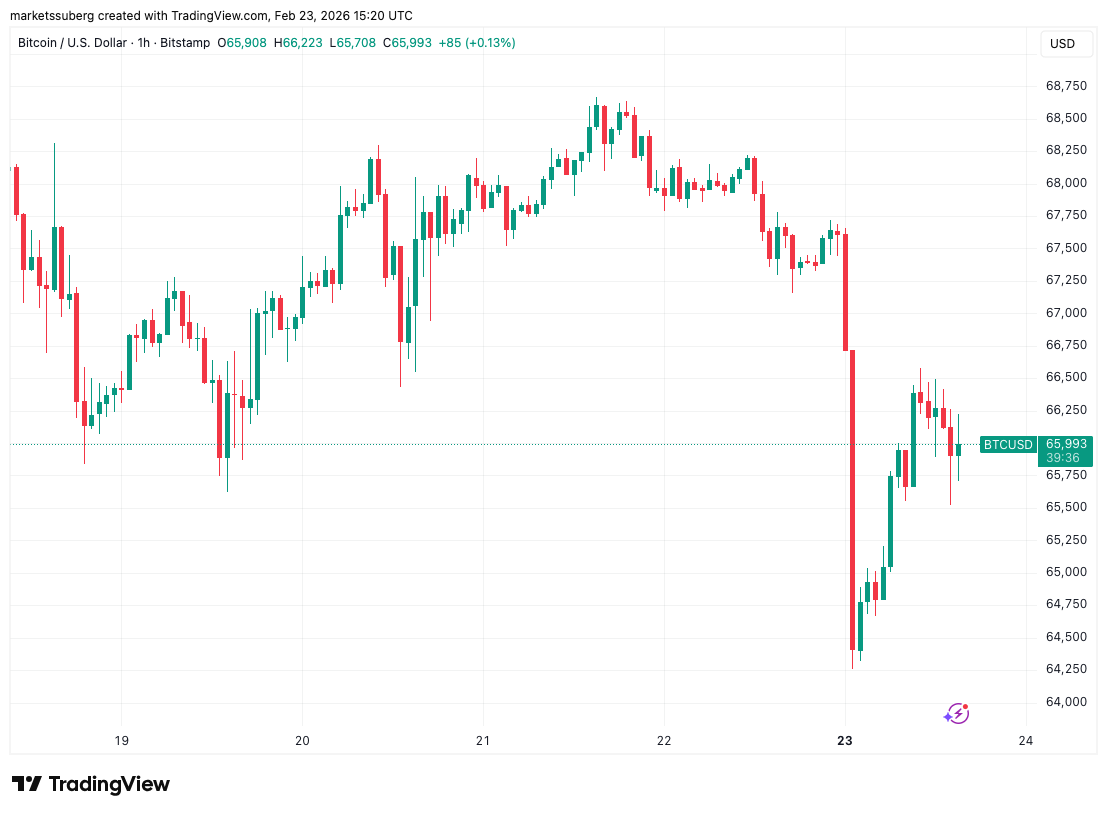
Data from TradingView showed rangebound market moves focusing on $66,000, with BTC/USD down around 2.5% on the day.

US weakness compounded an already bearish start to Monday, with sell-side pressure clearly in evidence at the weekly open.
“$BTC flushed 4.5K in one move,” crypto analyst IT Tech, a contributor onchain analytics platform CryptoQuant, wrote in his latest market commentary on X.
IT Tech described current price moves as indicating “confusion,” warning that the day’s $62,250 lows could come in for a retest.
“The long cluster at 64.2K got partially swept. If 65K fails, we retest it. Support: 65K → 64.2K / Resistance: 66.5K → 68.7K,” he summarized.

Trader Jelle eyed a potential sweep of the $60,000 mark should bulls fail to build a foundation in the current narrow range.
Others were more hopeful. Commentator Exitpump flagged an ongoing tentative recovery in the Coinbase Premium as an early sign that conditions might improve.
“We had aggressive spot buying, but it stopped for now, funding is negative and Coinbase premium is almost back. Tricky place, but I am bullish here,” Exitpump told X followers.

Crypto trader, analyst and entrepreneur Michaël van de Poppe had similar feelings on the day.
“Pretty good wick on the markets for $BTC,” he wrote about the local lows.
“That would be a signal that this won’t continue to fall, however, it still needs to hold above $65K and get continuation in the coming days to clearly signal this. First steps are great.”

Tariffs provide “immediate catalyst” for crypto
US stocks continued a nervous start to the week on futures, thanks to the threat of fresh US trade tariffs.
Related: Hodlers have ‘given up’ at $65K: Five things to know in Bitcoin this week
The 15% blanket levies were announced by President Donald Trump over the weekend after the Supreme Court struck down some previous measures.
🇺🇸 JUST IN: Donald Trump says he can use licenses and approved tariffs in a absolutely “terrible” way against countries he claims have taken advantage of the US. pic.twitter.com/ZEXY9hI7NA
— Cointelegraph (@Cointelegraph) February 23, 2026
Responding, trading company QCP Capital described the tariff debacle as an “immediate catalyst” for Bitcoin.
“This escalation has added another layer of policy uncertainty at a time when macro risk appetite is already thinning,” it wrote in its latest “Asia Color” market update.
QCP also attempted to find a reason for optimism, noting the lack of a broad market flush around the headlines.
“After several aggressive flushes this year, both the scale of volatility spikes and the intensity of liquidation cascades have somewhat moderated,” it continued.
“Even on the latest tariff headline from Trump, spot didn’t immediately gap lower on the news as it typically has in prior episodes, instead softening into the Asia open. That shift in reaction function is notable.”
This article does not contain investment advice or recommendations. Every investment and trading move involves risk, and readers should conduct their own research when making a decision. While we strive to provide accurate and timely information, Cointelegraph does not guarantee the accuracy, completeness, or reliability of any information in this article. This article may contain forward-looking statements that are subject to risks and uncertainties. Cointelegraph will not be liable for any loss or damage arising from your reliance on this information.

TLDR
- U.S. same-store sales grew 3.7% in Q4, beating analyst estimates of 3.47%
- Revenue hit $1.54B, up 6.4% year-over-year and $20M above expectations
- EPS came in at $5.35, slightly below the consensus estimate of $5.37–$5.39
- Quarterly dividend raised by more than 14%, the latest in a string of increases
- DPZ stock climbed as much as 6% at Monday’s open following the results
Domino’s Pizza had a busy Monday morning. The pizza giant posted Q4 results that sent its stock climbing nearly 6% at the open, fueled by strong domestic sales, a dividend hike, and its 32nd consecutive year of international same-store sales growth.
U.S. same-store sales rose 3.7% for the quarter. That beat analyst expectations of 3.47% growth, driven by value-focused promotions and new menu items.
International same-store sales told a slightly different story. Growth came in at 0.7% for the quarter per Investing.com, or 1.9% according to Seeking Alpha’s figures, both reflecting pressure in markets like Australia and Japan where competition is fierce and demand has been soft.
Total revenue for Q4 reached $1.54 billion, a 6.4% increase from the same period last year. That came in roughly $20 million ahead of what analysts had penciled in.
Earnings per share landed at $5.35, up from $4.89 a year earlier — a 9.4% jump. But it missed the consensus estimate, which ranged between $5.37 and $5.39 depending on the source.
The stronger profit figure was helped by $80 million in share buybacks during the year, which reduced the weighted average share count.
Dividend Boost
Domino’s raised its quarterly dividend by 14.4%. That’s a meaningful bump and came alongside what the company described as company-wide profit growth of 9%.
Revenue growth was supported by a 1.7% increase in food basket pricing, higher franchisee profits, and improved sales in both domestic and international markets.
Margin Pressure
Not everything moved in the right direction. The U.S. company-owned store gross margin narrowed sharply, falling 540 basis points to 15.5%. Higher insurance, labor, and food costs were to blame.
Overall gross margin, which includes international markets, told a better story — expanding 50 basis points to 39.7%.
CEO Russell Weiner pointed to the company’s “Hungry for MORE” strategy as the driver behind the results. “In 2025 we demonstrated that when we execute our Hungry for MORE strategy, it delivers MORE sales, MORE stores, and MORE profits,” he said.
Looking ahead, Weiner said the company expects to “meaningfully increase” its market share in the U.S. quick-service pizza category in 2026.
DPZ stock has declined 15.6% over the past 12 months. The stock was trading at $403.04 in premarket on Monday, up 4.8% at that point.

Bitcoin price is consolidating after recent volatility, trading within a neutral structure. The crypto king has struggled to establish a decisive trend over the past two weeks.
Currently, Bitcoin remains rangebound, reflecting balanced pressure between buyers and sellers. This equilibrium suggests that investor behavior from here will likely determine the next directional move.
Worry From Whales, Support From MTHs
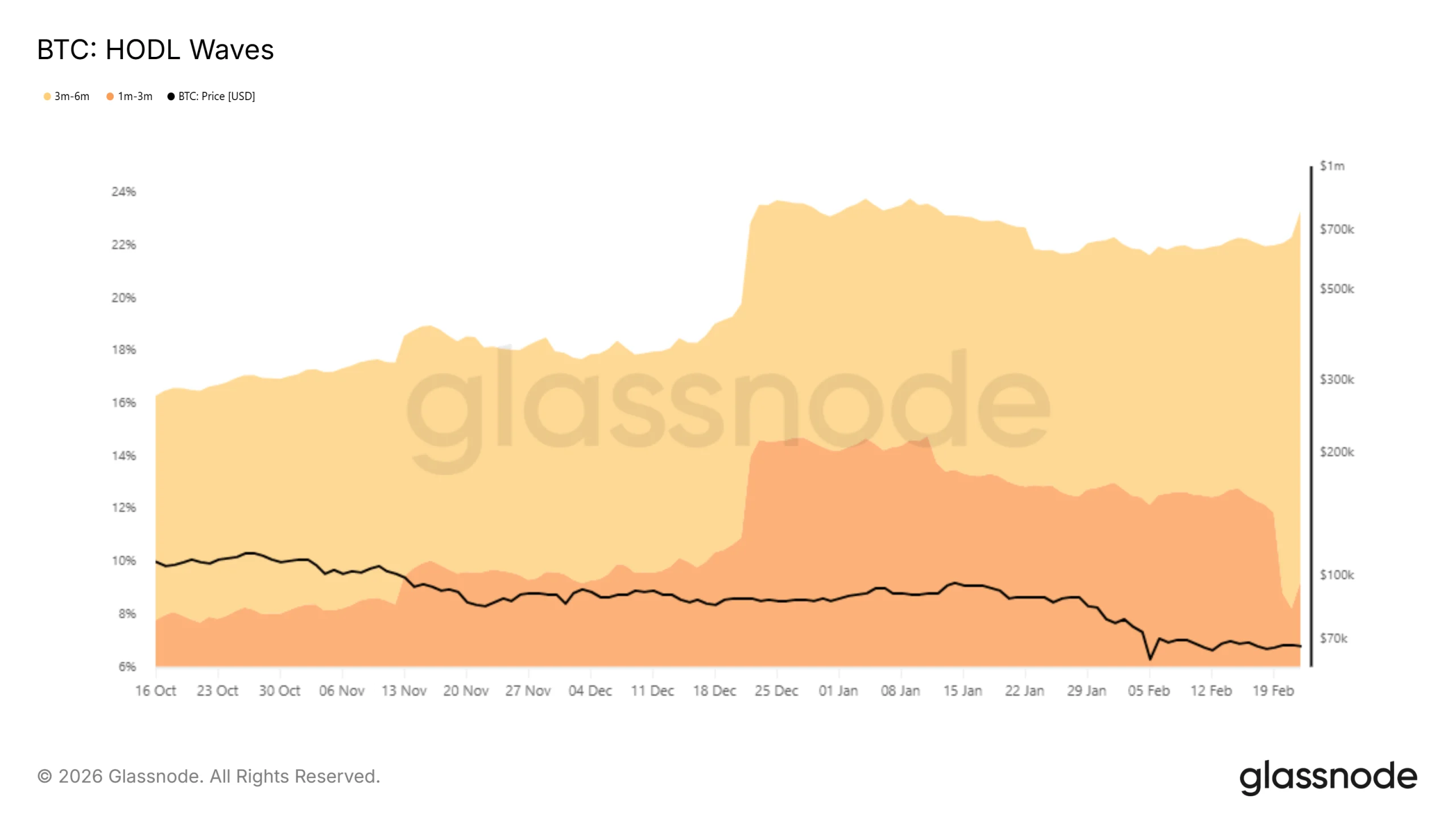
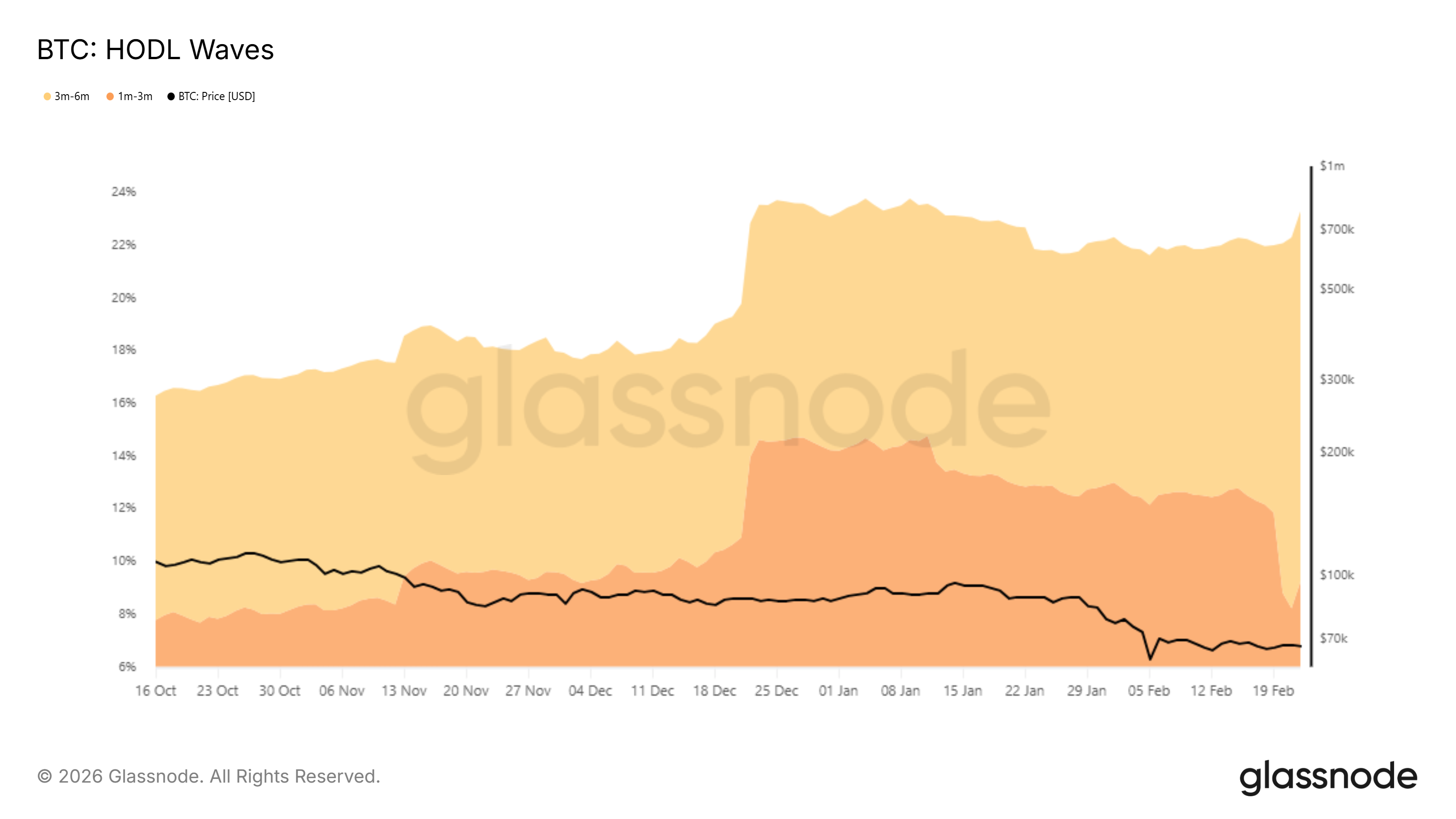
On-chain data indicates that younger holders are choosing to HODL rather than exit positions. HODL waves show that the supply held by investors aged one to three months has declined by 5%. This supply has matured into the three- to six-month cohort, signaling reduced short-term selling.
This shift reflects improving holder resilience despite recent drawdowns. Bitcoin investors who remain underwater are not engaging in panic-driven liquidation. Instead, coins are aging into longer-term categories, which historically supports price stability. Reduced short-term distribution often limits downside volatility and strengthens structural support zones.
Want more token insights like this? Sign up for Editor Harsh Notariya’s Daily Crypto Newsletter here.
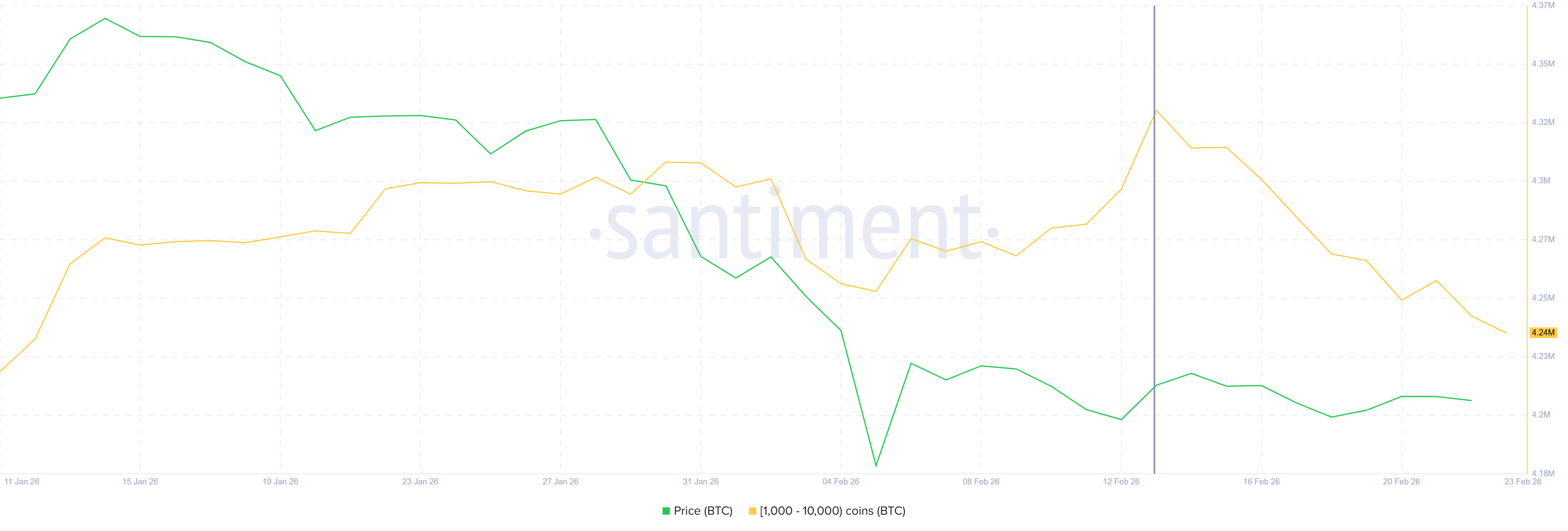
While some holders’ behavior appears stable, whale activity presents a contrasting dynamic. Since February 13, large holders have moved approximately 900,000 BTC, valued at $60 billion. This transfer activity suggests that significant capital may be preparing to exit positions following limited price appreciation.
Persistent whale selling can introduce supply shocks, particularly in range-bound conditions. Large distributions increase overhead resistance and weaken bullish momentum. If critical holders grow increasingly impatient, sustained selling pressure could undermine BTC’s stability and elevate the probability of a broader correction.
BTC Price Breakout or Breakdown Ahead?
Bitcoin is trading at $66,188 at the time of writing after slipping below the $67,394 support level. The asset remains confined between $65,000 and $70,000. This consolidation range reflects ongoing equilibrium. A decisive breakout or breakdown will likely define the next major move in Bitcoin price.
Over the past two weeks, BTC has formed a symmetrical triangle pattern. Price action shows no clear directional bias. However, continued whale selling could tip the balance downward. A breakdown below the triangle support may send Bitcoin toward $64,142. Losing that level would expose BTC to a potential decline toward $60,000. Notably, a recent long lower wick signaled dip buying interest.
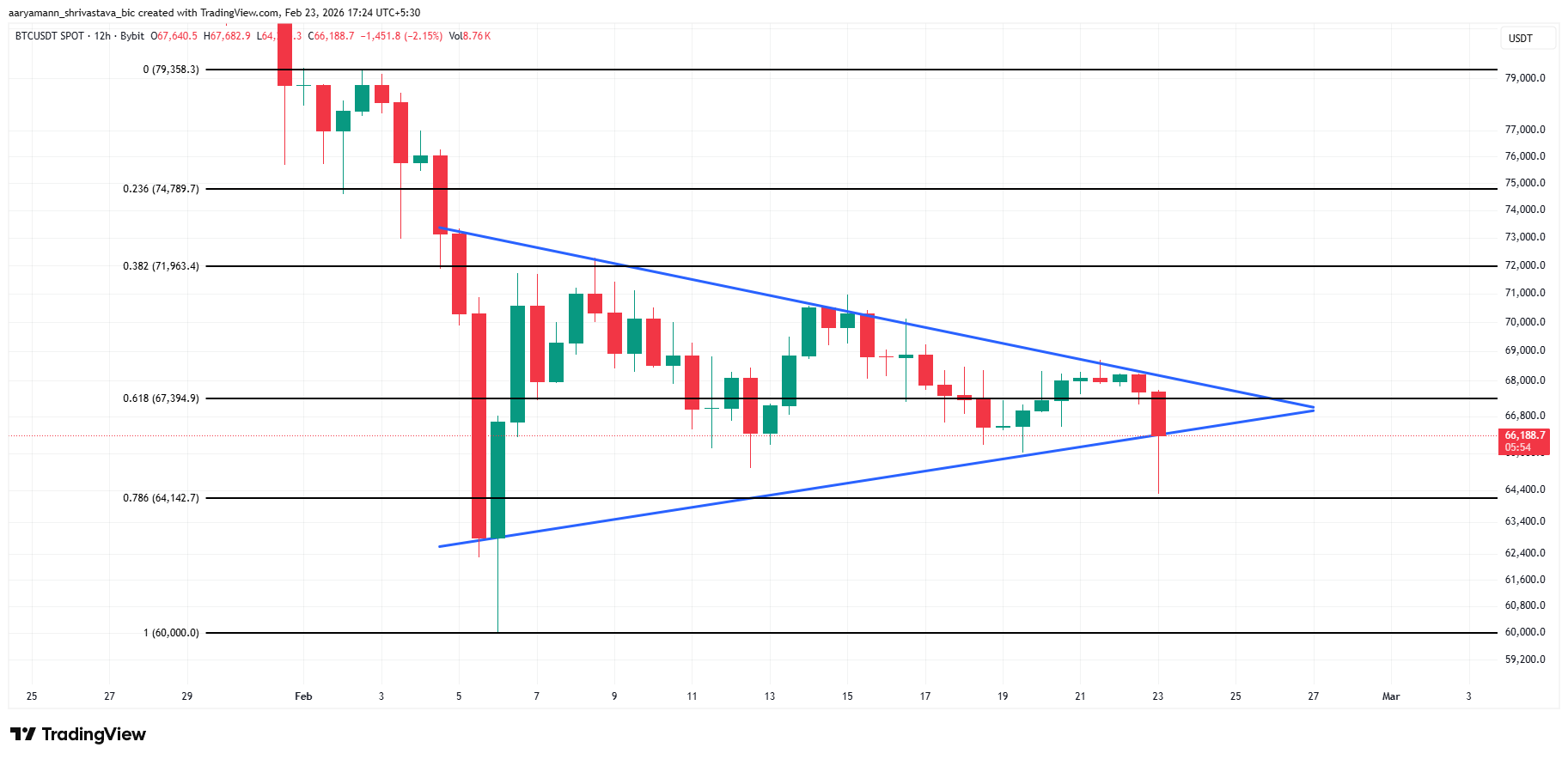
Conversely, if whale distribution slows and mid-term holders transition into long-term holders, recovery prospects could strengthen. Renewed demand may trigger a breakout above the range resistance. A sustained move toward $71,963 would invalidate the immediate bearish outlook. Clearing that level could extend gains toward $74,789, restoring bullish momentum in the broader crypto market.
Missouri lawmakers advanced House Bill 2080 to the House Commerce Committee on February 19, taking a significant step toward establishing a state-run Bitcoin Strategic Reserve Fund.
Sponsored by Representative Ben Keathley, the legislation mandates a five-year holding period for digital assets and positions Missouri alongside other Republican-led states aggressively integrating cryptocurrency into public finance.
Key Takeaways
- HB 2080 authorizes the State Treasurer to custody Bitcoin for a minimum of five years.
- The fund relies exclusively on private gifts and grants, prohibiting taxpayer funding for purchases.
- Missouri joins Arizona and Texas in competing to formalize state-level digital asset reserves.
Missouri Legislation Revives Crypto Treasury Push
HB 2080 would amend Chapter 30 of Missouri law to allow the State Treasurer to receive and hold Bitcoin. This is Representative Ben Keathley’s second try after a similar bill failed in March 2025. Now it has been perfected and sent to the House Commerce Committee, showing the issue is back on the agenda.
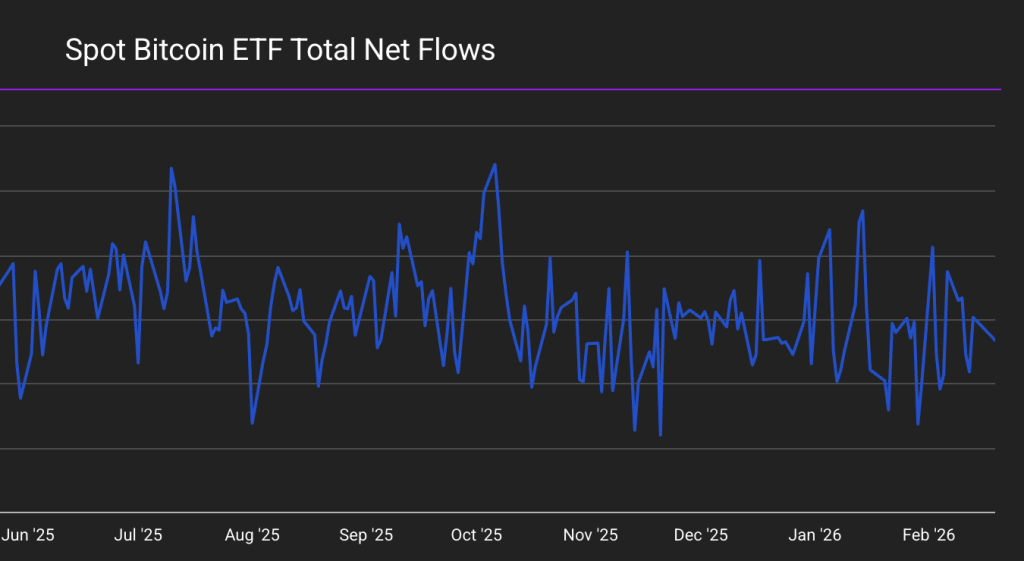
The timing is interesting. While Missouri is pushing a long term Bitcoin reserve, recent data shows spot Bitcoin ETFs have logged multiple weeks of outflows, hinting that short term institutional demand has cooled.
If approved, the reserve would go live by August 28, 2026. Supporters frame it as a hedge against federal inflation, focusing on long term strategy rather than daily price swings.
Strict Holding Periods and Funding Mechanics
The bill is clear on one thing. Any donated Bitcoin must be held for at least five years before it can be sold or transferred.
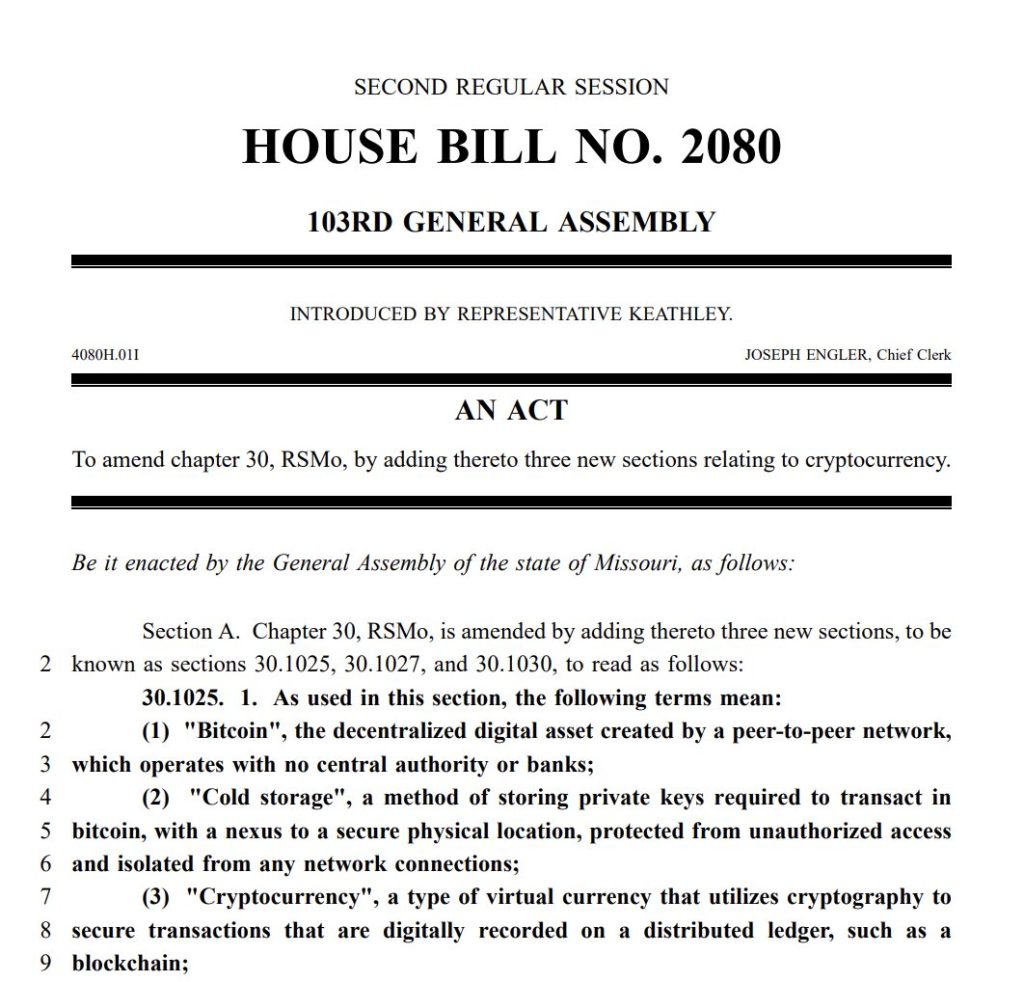
The Treasurer would have to use cold storage, keeping private keys offline to reduce security risks.
There is also a transparency layer. The state must publish reports every two years covering fund activity, security audits, and transactions.
State Policy Joins Federal Momentum
Missouri is not acting alone. Several states are racing to position themselves as crypto friendly hubs. By creating a legal path to hold Bitcoin, lawmakers hope to attract talent and capital.
NEW: — Bitcoin.com News (@BitcoinNews) February 17, 2026

 Arizona's Digital Assets Strategic Reserve Fund bill (SB1649) cleared the Senate Finance Committee in a 4-2 vote.
Eligible assets explicitly include #Bitcoin, $XRP, Digibyte, and stablecoins.  The bill now advances to the Rules Committee. pic.twitter.com/kpN6ds0dBv
The broader regulatory backdrop is also shifting. Federal discussions around clearer crypto rules are gaining momentum, which could make state level reserves easier to expand in the future.
Right now, the bill only allows donation based accumulation. But it sets a precedent. If federal clarity improves, that framework could grow.
If HB 2080 passes, Missouri becomes an early test case for putting decentralized assets inside a state treasury system.
Discover: Here are the crypto likely to explode!
The post Missouri Advances Bitcoin Reserve Bill to House Committee in Policy Push appeared first on Cryptonews.
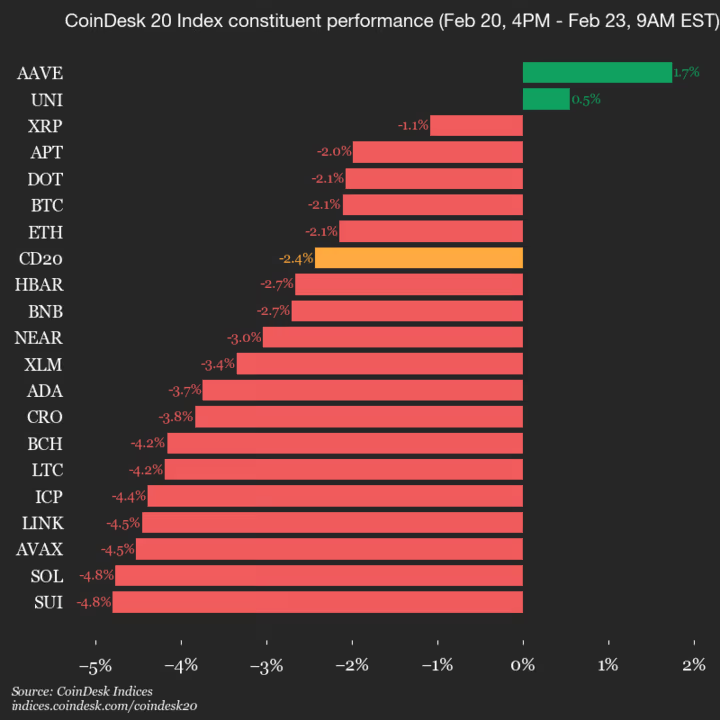
CoinDesk Indices presents its daily market update, highlighting the performance of leaders and laggards in the CoinDesk 20 Index.
The CoinDesk 20 is currently trading at 1917.67, down 2.4% (-47.79) since 4 p.m. ET on Friday.
Two of the 20 assets are trading higher.

Leaders: AAVE (+1.7%) and UNI (+0.5%).
Laggards: SUI (-4.8%) and SOL (-4.8%).
The CoinDesk 20 is a broad-based index traded on multiple platforms in several regions globally.


- Ethereum traded around $1,921 as Bitcoin bounced from lows of $65,000.
- Analysts are bullish on ETH despite $36 million in weekly outflows from ETH investment products.
- ETH could revisit $1,500 or bounce as macro pressures ease to target $3,000.
Ethereum price is struggling to break above $2,000 as losses seen over the weekend extend into early US trading hours on Monday.
Bitcoin fell to below $65,000, ETH dropped to $1,848, and Solana pared gains to under $80.
The sell-off across crypto has accelerated in recent weeks amid negative sentiment, resulting in huge capital outflows from crypto-related investment products.
Ethereum sees further capital outflows
Downside pressure for BTC has cascaded into top altcoins, and the latest down move for ETH coincides with losses for US equity futures ahead of opening on Monday, February 23, 2026.
Risk-off sentiment has flared after an initial risk-on outlook hit markets amid the US Supreme Court’s decision on President Donald Trump’s tariffs.
The dump for top coins alludes to overall weakness, and one indicator of this trajectory is the fifth consecutive week of net outflows from digital asset investment products.
Ethereum hit over $36 million in weekly outflows last week, bringing month-to-date flows to -$117 million and year-to-date flows to over $494 million.
That marked a fifth consecutive week of outflows and coincides with ETH struggling to decisively breach the $2k level.
Analysts on ETH price outlook
ETH’s slump below $2k aligns with institutional selling and macro and geopolitical risks.
According to analysts at QCP, investors have priced in new tariff risks as well as geopolitical tensions, and ETH has shown weakness similar to BTC.
ETH has witnessed nearly $500 million in ETF outflows year-to-date, but rather than being bearish about it, analysts say outflows mirror trade unwinds and are not a “structural exit”.
“Options still show a downside bias in both $BTC and $ETH, but skew is less extreme, suggesting positioning is cleaner and panic hedging has eased. ETF outflows also appear more consistent with trade unwinds than a structural exit,” QCP posted on X.
Short-term price movement for ETH may also align with whale selling, with Ethereum co-founder Vitalik Buterin among those who have recently sold ETH.
Crypto Rover says “large ETH whales are underwater,” and previous instances have historically highlighted bottoms.
Large $ETH whales are underwater. 🐋
Last 3 times this happened it marked bottoms. pic.twitter.com/FfNZv7QuPK
— Crypto Rover (@cryptorover) February 23, 2026
Despite this, some crypto treasury companies, led by Bitmine, have doubled down on the altcoin as they weigh the “buy-the-dip” opportunity.
Whales who sold earlier, like ShapeShift founder Erik Voorhees, are also buying ETH again.
As such, there’s a possibility the coin may fail to reclaim and hold above the psychological level, risking further declines to the $1,500 level.
However, recovery for Bitcoin to above $74,000 could signal a shift in broader market sentiment. Ethereum will target $2,300-$3,000 as initial supply wall risk areas.

Vitalik Buterin Accelerates ETH Sales Amid Renewed Market Weakness

Conor Boyle: Anti-wealth policies fuel a cycle of doom

Cavaliers Exposed Again in Loss to Shorthanded Thunder


-

 Video7 days ago
Bitcoin: We’re Entering The Most Dangerous Phase
-

 Crypto World6 days ago
Can XRP Price Successfully Register a 33% Breakout Past $2?
-

 Video4 days ago
XRP News: XRP Just Entered a New Phase (Almost Nobody Noticed)
-

 Fashion3 days ago
Weekend Open Thread: Boden – Corporette.com
-

 Sports7 days ago
GB's semi-final hopes hang by thread after loss to Switzerland
-

 Politics1 day ago
Baftas 2026: Awards Nominations, Presenters And Performers
-
 Tech6 days ago
The Music Industry Enters Its Less-Is-More Era
-

 Business6 days ago
Infosys Limited (INFY) Discusses Tech Transitions and the Unique Aspects of the AI Era Transcript
-

 Entertainment5 days ago
Kunal Nayyar’s Secret Acts Of Kindness Sparks Online Discussion
-

 Video6 days ago
Financial Statement Analysis | Complete Chapter Revision in 10 Minutes | Class 12 Board exam 2026
-

 Tech5 days ago
Retro Rover: LT6502 Laptop Packs 8-Bit Power On The Go
-
 Sports4 days ago
Clearing the boundary, crossing into history: J&K end 67-year wait, enter maiden Ranji Trophy final | Cricket News
-

 Business1 day ago
Mattel’s American Girl brand turns 40, dolls enter a new era
-

 Business23 hours ago
Law enforcement kills armed man seeking to enter Trump’s Mar-a-Lago resort, officials say
-

 Entertainment5 days ago
Dolores Catania Blasts Rob Rausch For Turning On ‘Housewives’ On ‘Traitors’
-

 Business5 days ago
Tesla avoids California suspension after ending ‘autopilot’ marketing
-
 NewsBeat6 hours ago
‘Hourly’ method from gastroenterologist ‘helps reduce air travel bloating’
-

 Politics6 days ago
Eurovision Announces UK Act For 2026 Song Contest
-

 Tech22 hours ago
Anthropic-Backed Group Enters NY-12 AI PAC Fight
-

 NewsBeat21 hours ago
Armed man killed after entering secure perimeter of Mar-a-Lago, Secret Service says