
Crypto World
OKX Launches Native AI Layer on OnchainOS to Power Autonomous Blockchain Agents


TLDR:
- OKX’s OnchainOS now supports AI agents across 60+ networks with 99.9% uptime and 1.2B daily API calls.
- Developers can access OnchainOS through AI Skills, MCP Protocol, or a direct Open API for full control.
- The x402 payment protocol enables AI agents to settle transactions autonomously with zero gas fees on X Layer.
- Smart trade routing across 500+ DEXs allows agents to find the best swap prices without human involvement.
OnchainOS, OKX’s developer toolkit, now features a native AI layer built for autonomous blockchain operations. The update opens OKX Wallet and its decentralized exchange infrastructure to AI agents.
Developers can now program agents to manage wallets, execute trades, process payments, and read live market data.
The system runs on infrastructure already serving more than 12 million monthly wallet users. This move positions OKX as a central platform for onchain automation.
Three Access Methods Power the New AI Layer
OnchainOS gives developers three distinct ways to build with AI agents. Through AI Skills, agents interact with onchain services using plain language commands.
No complex API wiring or blockchain configuration is required. This lowers the entry barrier for teams newer to Web3 development.
The second method is through MCP, or Model Context Protocol. This connects OnchainOS directly to AI agents and large language model applications.
Major frameworks, including Claude Code and Cursor, can call onchain actions natively through this channel. Developers working within existing AI environments gain immediate access to blockchain functionality.
OKX stated through its official channels: “We are opening OKX Wallet and DEX to enable AI Agents. Our OnchainOS now has a full AI layer that developers can use to enable AI agents for new applications.”
The third option is a direct Open API, providing full RESTful programmatic access. Developers who need granular control over every platform capability can use this route.
It supports custom integrations without relying on higher-level abstractions. Together, the three methods cover a broad range of development workflows.
Autonomous Workflow Capabilities Built on Proven Infrastructure
OnchainOS routes trades across more than 500 decentralized exchanges automatically. The system identifies the best available price on every swap in real time.
Market data covers tokens, trades, transfers, and account activity across chains. Agents can act on this data without requiring human interpretation at any step.
Payments within the platform are built on the x402 protocol. This allows AI agents to initiate and settle transactions without manual involvement.
Transactions executed on OKX’s native X Layer chain carry zero gas fees. That makes high-frequency, machine-speed payments practical for automated agent workflows.
The infrastructure behind OnchainOS processes more than 1.2 billion API calls daily. It supports around $300 million in daily trading volume with sub-100ms response times.
The platform maintains 99.9% uptime across more than 60 blockchain networks. These metrics reflect a production-grade foundation that AI agents can operate on reliably.
Developers building on OnchainOS can deploy once across all supported chains. No chain-specific rewiring is needed when expanding agent operations to new networks.
As a result, the distance between what AI agents can do and what they can dependably execute onchain continues



The Financial Stability Board has raised fresh concerns about the spread of foreign currency stablecoins in emerging markets.
Summary
- FSB said dollar stablecoins can weaken payments, monetary policy, and capital controls across emerging markets.
- Regulators still face gaps in applying the FSB’s global framework for crypto and stablecoin oversight.
- The FSB said stablecoins still show limited use in real economy payments despite market growth.
In its 2025 annual report, the global watchdog said US dollar stablecoins used across borders can create financial and policy risks for developing economies.
Meanwhile, the FSB said foreign currency-denominated stablecoins can create pressure for emerging market and developing economies. It stated that US dollar stablecoins moving across several jurisdictions may carry “potentially more acute” risks for those markets.
According to the report, these risks include currency substitution and weaker use of local payment systems. The board also said they can reduce the effectiveness of domestic monetary policy and create pressure on fiscal resources.
The FSB said regulators still need to track how the stablecoin sector develops. It noted that authorities must understand risks tied to liquidity, operational issues, and links with the wider financial system.
The report also referred to the FSB’s 2023 global framework for crypto asset activity and stablecoin arrangements. After reviewing that framework in 2025, the board said there are still clear gaps and inconsistencies in how it is being applied across jurisdictions.
Moreover, the board said crypto assets and stablecoins still have limited use in real economic activity, including payments. It stated,
“Despite growth in these markets in recent years, crypto-assets and stablecoins are not widely used in financial services supporting the real economy.”
At the same time, the FSB said stablecoins may offer some benefits. Still, it added that regulators should keep watching vulnerabilities as connections with core financial markets and institutions continue to grow.
FSB sets focus areas for 2026
The report said the board will continue to monitor digital innovation linked to crypto assets in 2026. Stablecoin-related risks remain part of that work, especially in areas tied to market structure and financial resilience.
The FSB also listed other priorities for the coming year. These include private credit, nonbank financial intermediation, cross-border payments, crisis preparedness, and further work on regulatory modernization.
Crypto World
Wall Street broker Bernstein calls bitcoin (BTC) bottom, keeps $150,000 year-end target


Bitcoin has likely found its bottom and is primed for further gains, Wall Street broker Bernstein said in a Tuesday note to clients, reiterating its $150,000 year-end price target.
“We believe Bitcoin has found its trough and is now heading higher,” wrote analysts led by Gautam Chhugani. The world’s largest cryptocurrency was trading around $71,000 at publication time.
The broker also maintained its bullish view on bitcoin treasury company Strategy (MSTR), calling it a high-beta proxy for bitcoin with a “resilient, liquid and pressure-tested” balance sheet. The firm, led by Executive Chairman Michael Saylor, holds roughly 3.6% of the total bitcoin supply, worth about $53.5 billion.
Bernstein has an outperform rating on Strategy with a $450 price target. The shares were unchanged in early trading, around $138.10.
The analysts also highlighted growing demand for Strategy’s preferred instrument, STRC, which offers an 11.5% monthly dividend with low volatility.
STRC’s perpetual structure helps reduce equity dilution while providing long-term capital, with trading volumes rising 65% over the past three months, the report noted.
Bitcoin’s recent pullback comes after a sharp run-up to record highs in late 2025, with prices falling as much as 45% from the peak amid a mix of macro and market-driven pressures. Analysts point to a higher-for-longer interest rate backdrop, geopolitical risk tied to the Middle East and intermittent exchange-traded fund (ETF) outflows weighing on risk appetite.
The unwind of leveraged positions and profit-taking by long-term holders accelerated the decline, triggering bouts of forced liquidations and adding to volatility.
Despite the scale of the correction, Bernstein analysts characterized the move as a temporary reset in sentiment rather than a breakdown in fundamentals, noting the absence of systemic stress typically seen in prior crypto downturns.
On the macro side, the analysts noted bitcoin has outperformed gold by 25% since the onset of the Iran conflict at the end of February, underscoring the cryptocurrency’s appeal as a portable, censorship-resistant asset during periods of geopolitical stress.
Institutional demand remains a key driver. The broker pointed to resilient ETF flows and increasing participation from banks offering bitcoin-related financial services.
Read more: Bitcoin’s quantum threat is real, but far from an existential crisis, Galaxy says


- Dogecoin price was around $0.094, up 4% in the past 24 hours.
- Bulls continue to show resilience as the technical picture suggests a potential breakout.
- Despite geopolitical headwinds, the $0.15 target remains in play.
Dogecoin (DOGE) is holding near the psychologically important $0.09–$0.10 range, as the broader crypto market navigates the geopolitical tensions linked to Iran.
The digital asset space has shown pockets of resilience, with Bitcoin remaining close to the $70,000 level, helping support sentiment.
Dogecoin had briefly climbed to around $0.15 in early 2026, and that level could remain relevant if buying interest returns, despite continued selling pressure over the past month.
DOGE eyes $0.10 retest
Dogecoin (DOGE) is trading around $0.094 at the time of writing, having slipped below the $0.10 level after a roughly 9% decline over the past week.
The $0.092 area has continued to provide near-term support through much of February and March.
The token is slightly higher on the day, after recently testing the lower band of its daily Bollinger Bands.
Broader market direction remains key. Bitcoin is attempting to stabilise near $70,000 despite ongoing geopolitical pressures, a level closely watched by market participants.
A sustained move higher in Bitcoin could support sentiment across altcoins.
For DOGE, the $0.10 mark remains a critical inflection point.
A break above this level could shift momentum in favour of buyers, while continued macroeconomic and geopolitical uncertainty may test the token’s ability to hold current support levels.
Dogecoin price outlook: $0.15 target remains
From a technical perspective, the case for Dogecoin (DOGE) revisiting the $0.15 level in the near term rests on two key factors.
First, the token has continued to hold above the $0.090 support zone.
Second, the Bollinger Bands on the daily chart are tightening, a setup that often precedes a stronger directional move.
These conditions have coincided with repeated rebounds from the lower Bollinger Band, suggesting that the $0.09–$0.10 range is acting as an intermediate support area.
Some analysts view this price action as indicative of a potential double bottom formation.
This structure implies that, for now, a sharp breakdown into a sustained free-fall scenario appears less likely.
At present, DOGE is trading close to the middle band of its Bollinger Bands, hovering near a key psychological level that has defined recent price action.
The continued contraction in the bands points to building pressure, with a breakout likely to determine the next directional move.

Dogecoin price chart by TradingViewIf the squeeze resolves upward, DOGE could retest the upper band and potentially post a sharp directional move.
Fundamentally, strong trading volume that’s up 120% in the last 24 hours to $1.69 billion suggests buyer interest.
This, aligned with whale accumulation, indicates a structural floor just beneath the current price.
As long as Dogecoin avoids an extended breakdown below $0.08–$0.09, the $0.15 target continues to appear technically plausible.


Institutional investors aren’t just betting on ‘number go up’ strategy for crypto anymore, they are shifting to hunting for steady sources of income.
Many institutions already hold bitcoin and ether (ETH) on their balance sheets. While they are holding these assets for the long-term price appreciation, investors are increasingly seeking to put them to work to earn income while waiting, said Brett Tejpaul, Coinbase’s (COIN) head of institutional, in an interview with CoinDesk, noting that this is how the next phase of institutional money entering the digital asset sector will look.
“The second wave of institutions… is underway. It’s happening.”
That shift is shaping a new wave of products, he said. Coinbase last week launched a tokenized share class of its Bitcoin Yield Fund on Base in partnership with Apex Group, a $3.5 trillion fund services provider. The fund aims to generate yield through strategies such as selling call options or lending bitcoin, with target returns in the mid-single digits, depending on market conditions.
The push for yield is not limited to just crypto-native firms.
BlackRock, the world’s largest asset manager, has also moved in this direction. The firm recently launched the iShares Staked Ethereum Trust ETF (ETHB), giving investors exposure to rewards generated by helping secure the network. The product signals that demand for yield-bearing crypto strategies is spreading across traditional finance.
This is a similar strategy to what traditional investors call ‘structured products.’ These financial instruments include assets with options that are designed to deliver certain returns or yields. With many options and yield-generating strategies now available in the digital assets sector, traditional investors are seeking similar products in crypto, especially as lawmakers set clearer regulations for the sector.
Read more: Regulation, derivatives helping drive TradFi institutions into crypto
Moving money faster
This “second wave” of institutional money is also focusing on how to use blockchain technology for payments, settlements, cost and transparency.
The structure reflects a broader trend: tokenization. By putting fund shares onchain, asset managers can make ownership easier to track and transfer while opening the door to round-the-clock markets. For institutions used to waiting days for settlement, the appeal is practical.
He said almost half the conversations with institutions right now include stablecoins and tokenization, pointing to a surge in interest following recent regulatory movement in the U.S. Large financial firms are exploring how to use blockchain systems to move money faster and at lower cost, especially across borders.
That interest is gaining momentum as policymakers move to set clearer rules. The passage of the GENIUS Act has already provided a framework for stablecoins, while the proposed CLARITY Act is expected to further define how digital assets and tokenized products can be issued and traded. Together, they are giving institutions more confidence to commit capital and build products tied to blockchain-based systems.
The appeal is straightforward. Tokenization allows traditional assets such as bonds, funds, and private credit to be represented onchain, enabling faster movement and quicker settlement. Stablecoins, often pegged to fiat currencies, offer a way to move value globally at low cost without relying on legacy payment rails.
Some of the largest firms in traditional finance are already moving in this direction. BlackRock has launched a tokenized Treasury fund, while JPMorgan has tested tokenized deposits and blockchain-based payments. Franklin Templeton has also brought tokenized money market funds onchain, signaling growing comfort with the model among asset managers.
As a result, both traditional financial institutions and crypto-native firms are racing to build or integrate stablecoin infrastructure, seeing it as a foundation for the next phase of financial markets.
This is directly tied to what Tejpaul called the ‘second wave’ of institutional money entering crypto. The first wave of institutional money came from hedge funds, endowments and wealthy investors seeking exposure or arbitrage. But this next group looks different. It includes banks and payments firms building products on top of crypto rails.
That shift ties closely to yield. Stablecoins, often backed by short-term government debt, can produce income streams that resemble traditional cash management products. Tokenized funds extend that idea to a wider set of assets.
At the same time, institutions are paying closer attention to market structure. Around-the-clock trading and near-instant settlement are becoming part of the pitch, with the two largest stock exchanges in the U.S., the New York Stock Exchange and Nasdaq, soon bringing 24/7 trading to their clients. In traditional markets, trades can take days to settle, leaving capital tied up and exposed to counterparty risk.
Blockchain-based systems aim to reduce that friction, thereby increasing transparency and lowering costs.
“People want to know where their capital is at all times, and they don’t want it to be in transit or be lost in the settlement process,” Tejpaul said.
Still, adoption is uneven.
Most institutional capital remains concentrated in a small set of major tokens, with limited appetite for smaller assets after recent market volatility. And large firms tend to move slowly, often taking years to evaluate new technologies.
But the direction is becoming clearer. Institutions are no longer asking only how to buy crypto. They are asking what it can do for their portfolios and their businesses. And with more regulations coming to clear that path, it will likely open the door to more institutional money in the future.
“All of a sudden, all the dots are connecting… what was opaque is becoming clear,” Tejpaul said.
Crypto World
Seven Methods for Finding and Closing AI Services Clients When You’re Starting from Zero Followers and Zero Case Studies

Host a Local AI Meetup
Business owners feel curious about AI but overwhelmed. They distrust strangers offering solutions. When you host a community event, you’re automatically positioned as the local authority.
Find free venues: libraries, coworking spaces, coffee shops with meeting areas. Create a simple event page. Post in local business groups and LinkedIn. Keep the format straightforward: a 20-minute presentation on how local businesses currently leverage AI, followed by questions.
Critical element: demonstrate something live. Open your computer. Show a workflow executing. Display a lead arriving and receiving an automatic response. When people witness value operating in real-time, the conversation fundamentally shifts.
Collect email addresses. Follow up within 24 hours. That becomes your pipeline.
Direct Outreach to Local Markets
Traditional. Proven. Underutilized. Walk into 10 local businesses this week: dental offices, real estate brokerages, law firms, contracting companies. Or send 20 LinkedIn messages daily to business owners managing 10-50 employees in your geography.
Don’t lead with your solution. Begin with diagnosis: what’s the most expensive bottleneck in your daily operations? Start conversations about their specific problems, not your services. Those who respond are self-selecting—they already know something requires fixing.
Withhold pitches in initial outreach. Understand their situation completely. Propose solutions mapped directly to their stated problems. This approach converts 3-5x more consistently than leading with I build AI automations.
The Speed-to-Response Diagnosis
This technique is exceptionally effective for speed-to-lead sales. Select a niche. Use Google to identify local businesses. Find ones with website contact forms. Submit test inquiries. Track response time.
Most respond after hours. Many after days. Some never respond. You’ve collected data. Now email them: I submitted an inquiry through your website 3 days ago. Still waiting. How many leads do you estimate you’re losing? I build systems responding within 60 seconds, 24/7.
This isn’t a cold pitch. It’s a diagnosis. You identified and quantified a problem, then offered a solution. Completely different conversation.
Free Discovery Audits
You know business owners: colleagues, acquaintances, former coworkers, gym contacts. Offer complimentary 20-minute audits. I’ll review your current processes and identify automation opportunities. No charge—I’m building my portfolio.
Yes, you’re working for free initially. But you gain practical experience, they receive legitimate value, and they’ll recommend you. The audit itself becomes your sales conversation. By its conclusion, you understand their problems better than they do. The proposal writes itself.
After establishing case studies, start charging for audits. The audit becomes a paid service.
Partner with Service Providers
Other service providers already possess your target clients. Marketing agencies, business coaches, accountants, web developers—they consult with business owners constantly. Many get asked about AI and lack confidence answering.
Approach them: I specialize in AI automation for small businesses. When your clients ask about AI, I’d appreciate being your referral partner. Happy to split revenue on closed deals. You just built a sales team without employment. In tight-knit industries, one solid partnership generates sustained pipeline.
The best partnerships are with providers whose services complement AI but aren’t competitive. Web developers, accountants, and business coaches all have hungry clients who need automation.
Coworking Community Office Hours
Contact local coworking spaces. Volunteer to host free weekly AI Office Hours for members. Two hours weekly. Members arrive with questions. You provide solutions on the spot.
You gain credibility as the resident AI expert, access to warm prospects who already trust you, and content fodder—every question becomes potential social media material. Most spaces accept because it adds member value. Paying clients develop naturally.
The implicit positioning is powerful: you’re the person who knows AI in this community. When someone needs help, they think of you first.
Consistent Social Documentation
Document every client success. Built a lead response system for an HVAC contractor. 2 hours setup. Now responds to every lead within 60 seconds. Automated appointment reminders for a dental practice. Reduced no-shows 40%. Runs entirely on autopilot.
You don’t need massive following. You need consistency. Post 3-5 times weekly for 90 days. Mix wins with educational content. The objective isn’t virality. It’s staying top-of-mind so when someone needs AI implementation, they think of you first.
Post everywhere: LinkedIn, Twitter, even TikTok or YouTube if that fits your style. Different platforms reach different people. Consistency matters more than platform choice.
Building Your Personal Sequencing
Start with methods 2 and 4: direct outreach and free audits. These generate first clients fastest with zero infrastructure required. You can start today.
Once you have case studies, add method 3: the speed-to-response diagnosis. This is most effective once you have a success story to reference.
As you establish credibility, layer in methods 1, 5, and 6. These take more setup but generate steady referrals.
Use method 7 throughout. Social documentation works best when you have wins to document, but you can start immediately.

Key Takeaways
- Bitcoin briefly surged to $71,200 after President Trump announced a five-day pause on strikes against Iran, pulling it further from the critical $65,000 liquidation zone.
- Over $400 million in crypto positions were liquidated within hours as markets swung sharply on conflicting headlines between Washington and Tehran.
- With BTC now hovering around $70,000, the $3 billion in long positions clustered below $65,000 remains a live threat as geopolitical uncertainty persists.
Bitcoin caught a brief but significant boost on Monday after U.S. President Donald Trump announced a five-day pause on military strikes targeting Iran’s energy infrastructure, describing the move as the result of “very good and productive” talks aimed at a complete resolution of hostilities. The announcement sent Bitcoin surging from $67,500 to above $71,200 within hours, temporarily widening the distance between BTC’s price and a critical $65,000 liquidation zone.
The move followed a weekend of geopolitical threats and a subsequent de-escalation, with broader asset classes and benchmark indices reacting together. For Bitcoin bulls sitting on leveraged positions, the rally offered a moment of relief.
Relief, Then Reversal
The rally did not hold. Iran’s Foreign Ministry denied any communication had taken place with the United States, framing the five-day suspension as a retreat rather than diplomacy. Bitcoin, shown at $70,464 in one snapshot, retreated to levels seen in early February after multiple failed attempts to convincingly surpass $75,000. The $400 million in liquidations indicates positions were both sizable and tightly clustered around optimistic breakouts toward $75,000. Bitcoin settled back around $70,000, although still above $65,000, but not a comfortable price level. Investors also weighed the potential impact on other risk assets.
The $3 Billion Risk Remains
Before Monday’s geopolitical headlines, Coinglass data had already flagged a dangerous build-up of over $3 billion in long positions concentrated below the $65,000 level across Binance, OKX, and Bybit. That exposure has not disappeared. Bitcoin has traded between $70,533 and $64,700 since early February, forming a tight range. Heavy liquidation clusters remain around $70,500 on the upside and $65,000 on the downside.
Analysts describe such concentrations as “liquidation magnets,” that is, price levels where a large volume of forced closures can compound selling pressure once breached. The October 10 event, which saw $19 billion wiped from the crypto market in a single day, followed a near-identical pattern of heavy leveraged build-up before a key level broke.
What Comes Next
As traders watch whether Bitcoin can reclaim $70,000 and fill the CME gap, one open question persists: will current liquidity and geopolitical developments allow BTC to return to breakout attempts near $75,000, or has this episode reset expectations for a lower, more volatile trading band?
For now, the Trump ceasefire announcement has bought the market some breathing room. But with Iran denying any talks and a break above $70,000 still needed to signal renewed bullish momentum toward $75,000.
🚨 ALERT: Over $3 billion in long positions risk liquidation if $BTC drops below $65,000. pic.twitter.com/EaiPNwDt1E
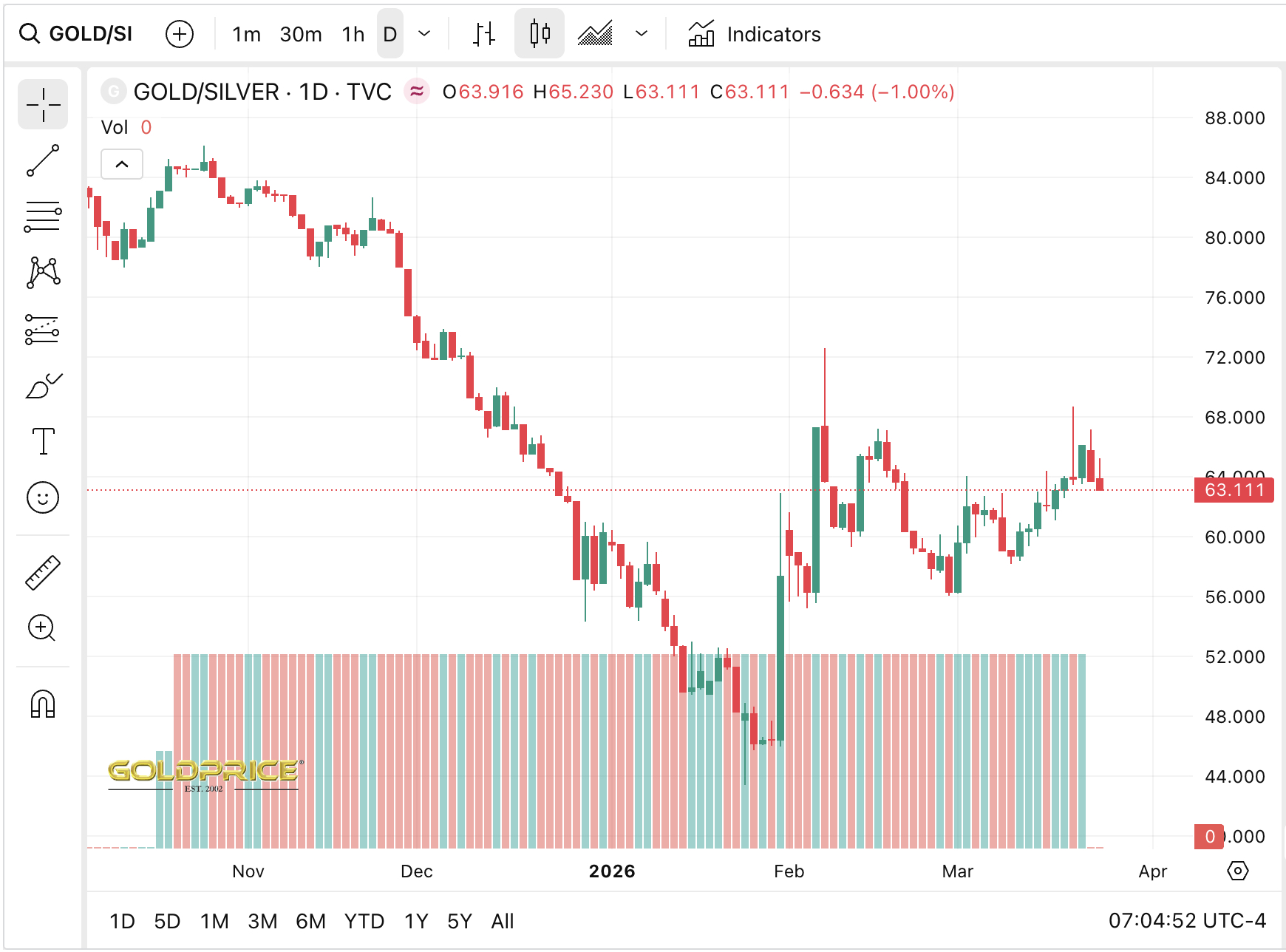
Silver price has retreated sharply in the last 48 hours, defying last week’s prediction and analysis of $200. While the metal had climbed 161% year-over-year from $33 area, recent sessions saw XAG/USD slump as real yields surged and the dollar strengthened, widening the gold-to-silver ratio toward a precarious 63:1.
This pullback comes despite supply constraints from imminent China export restrictions effective 2026, which many analysts expected to floor prices.

The market is currently wrestling with contradictory signals: safe-haven bids from geopolitical tensions versus industrial demand fears triggered by inflation. Is the structural deficit enough to hold the line? As silver price forecasts recalibrate for a “higher-for-longer” rate environment, traders are eyeing critical support levels that could define the trend through Q2.
Discover: The best pre-launch token sales
Silver Price Analysis: Can It Reclaim $100 Amid PPI Volatility?
As of today, prior to the PPI shock, silver traded at $69 level. The metal is currently falling but might be hitting a bottom at the same time, testing the patience of bulls who bought near the January peak above $120.
Crucial support lies here, and a break below this level could expose the widely watched $58 magnet, a psychological floor for institutional accumulation. Conversely, reclaiming the $90 resistance is essential to target.

Institutional outlooks remain divergent, creating a complex landscape for position traders. While J.P. Morgan forecasts a conservative 2026 average of $81/oz, others are eyeing significantly higher ceilings. Bank of America has set a target of $135/oz by 2026, and aggressive models from analysts like Rashad Hajiyev point toward targets as high as $240–$260.
The disparity suggests that while short-term downside risks persist, the long-term supply deficit remains a potent catalyst for commodities investors willing to weather the volatility.
Discover: The best pre-launch token sales
LiquidChain Targets Early Mover Upside as Silver Consolidates
While silver arguably offers a safe hedge against currency debasement, its recent heavy price action highlights the limitations of commodities in a high-yield environment.
Capital seeking aggressive multipliers is increasingly rotating out of stagnant traditional assets and into infrastructure plays that solve fragmentation issues in the crypto economy. Enter LiquidChain ($LIQUID), a Layer 3 protocol gaining traction by unifying liquidity across Bitcoin, Ethereum, and Solana.
LiquidChain distinguishes itself with a “deploy-once” architecture, fusing the three largest ecosystems into a single execution environment. This effectively eliminates the friction of cross-chain bridging—a multi-billion dollar headache for developers.
The project is currently in a presale phase that has raised more than $600K at the moment. Early participants are securing tokens at $0.0143, and enjoying more than 1700% APY of staking rewards.
For those tired of waiting for silver to break $100, LiquidChain represents a high-beta pivot into the plumbing of the next bull cycle.
The LiquidChain presale is open now for investors researching unified liquidity layers.
Disclaimer: This article is not financial advice. Cryptocurrency and commodities markets are highly volatile. Do your own research before investing.
The post Silver Price Analysis: XAG to XAU Ratio Drops as Metals Fall appeared first on Cryptonews.


Hyperliquid’s HIP-3 market has reached a new high as demand for tokenized asset trading continues to grow.
Summary
- Hyperliquid HIP-3 open interest hit $1.74 billion after rising 25% in just one week overall.
- Tokenized oil and silver pairs led trading volume as Trade.xyz posted new activity records Monday.
- HYPE gained as Hyperliquid generated $14 million in weekly fees and expanded market products further.
Open interest across HIP-3 markets climbed to $1.74 billion on Sunday, up 25% from $1.39 billion a week earlier. The move shows rising activity in perpetual futures linked to tokenized traditional assets.
Aggregated open interest across Hyperliquid’s HIP-3 markets hit a record $1.74 billion on Sunday. By Monday, that figure eased slightly to $1.73 billion, but it still stayed near the platform’s peak level.
The rise extends the growth of Hyperliquid’s permissionless perpetual futures market for tokenized traditional assets. HIP-3 launched about six months ago, and it has quickly become one of the main areas of activity within the broader Hyperliquid ecosystem.
Trade.xyz remains the largest HIP-3 market platform. Built by Hyperliquid’s tokenization arm, Hyperunit, Trade.xyz accounts for $1.58 billion in open interest, or 91.3% of the total HIP-3 market.
That level of concentration shows how much of the current activity sits on one venue. It also shows that tokenized real-world asset trading is becoming a major part of the platform’s expansion.
Trade.xyz also posted new records in daily activity on Monday. The platform reported $5.6 billion in 24-hour trading volume and 45,300 unique daily traders.
The most active pairs on the platform are tied to tokenized traditional assets. WTI oil led with $1.27 billion in 24-hour volume, followed by Brent oil at $1.04 billion and silver at $1.01 billion.
This pattern shows that traders are using the platform to gain exposure to commodities through perpetual markets. The product allows them to trade these assets at any hour rather than waiting for standard market sessions.
That round-the-clock structure has become more relevant during periods of market stress. Recent tension in the Middle East increased volatility in oil prices, and that pushed more traders toward platforms offering “24/7 trading capability” for ongoing price discovery.
HYPE gains as ecosystem growth continues
Hyperliquid’s native token, HYPE, has also moved higher as activity on the platform increased. At the time of reporting, HYPE traded at $38.3, up 2.8% over the past 24 hours and 30.6% over the past 30 days.
The token’s move has come alongside rising platform revenue. As Crypto News reported, Hyperliquid is generating about $14 million in weekly fees, while some analysts say HYPE still trades below levels seen in comparable centralized exchange-style businesses.
The platform is also preparing for another product expansion. Hyperliquid recently introduced HIP-4, which would allow “permissionless prediction market listings” and could widen the range of tradable markets on the network.
Disclosure: This article does not represent investment advice. The content and materials featured on this page are for educational purposes only.
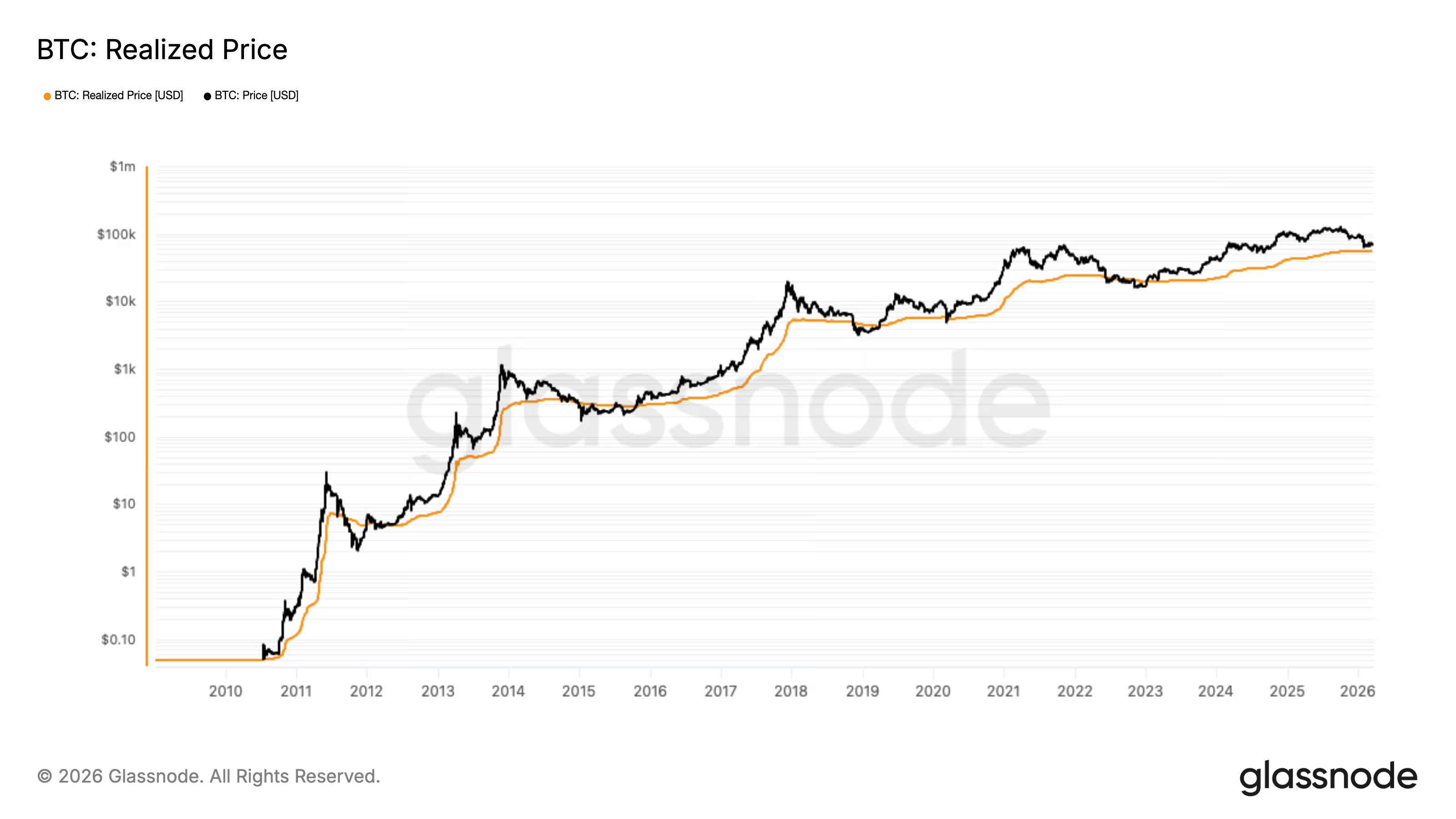
Bitcoin recently found support at a key onchain metric — the average realized price for a specific year — in this case the 2023 cost basis.
The 2023 average realized price currently sits around $63,700. During the local bottom in early February, when bitcoin dropped roughly 50% from its October all-time high, to roughly $60,000, price effectively tested and held this level as support.
This behavior mirrors the previous cycle. In early 2023, as the bull run began, bitcoin experienced several small corrections and repeatedly used the 2023 realized price as support. This can be observed in March, July, and September 2023, when price consolidated in the $20,000 to $26,000 range.
Looking at newer cohorts, the 2026 average realized price started the year near $90,000 and has since declined to around $77,000. With bitcoin currently trading just above $70,000, the average 2026 buyer is underwater. Notably, this cohort’s cost basis has also fallen below both the 2024 cohort at $81,500 and the 2025 cohort at $96,400.
Zooming out further, the aggregate realized price, which represents the average cost basis of all coins in circulation, is currently around $54,360. Historically, bitcoin has traded below this level in every major bear market, including 2011, 2015, 2019, and 2022.
So far in this cycle, bitcoin’s lowest price has been around $60,000. If that level fails, it becomes the next key support to watch, with the realized price at $54,000 acting as a deeper historical floor.


Key Highlights
-
Company achieves milestone profitability with RMB436M net income for 2025.
-
Unit deliveries surge to 1.6M, with projections surpassing 4M for 2026.
-
Partnerships with leading Chinese automakers drive multiple-lidar vehicle designs.
-
Robotics sector expansion accelerates through Unitree, Dreame, and MOVA alliances.
-
FMC500 chip launch and NVIDIA partnership advance technological capabilities.
Hesai Group (HSAI) experienced upward momentum, closing at $23.58 with a 3.19% increase. Trading activity pushed shares toward $23.80 before pre-market sessions revealed a decline to $22.57, representing a 4.28% drop. The fluctuation occurred after Hesai disclosed comprehensive 2025 earnings data and outlined production targets for 2026.
The company reached its inaugural year of GAAP-compliant profitability, propelled by robust sales performance and disciplined expense control. Unit deliveries expanded threefold beyond 1.6 million, generating total revenues that surpassed RMB3 billion (approximately US$433 million). Financial disclosures revealed GAAP net earnings of RMB436 million (roughly US$62 million) alongside non-GAAP earnings reaching RMB551 million (about US$79 million).
Balance sheet strength improved with net assets climbing to approximately RMB9 billion (US$1.3 billion), while the organization maintained positive operating cash generation for its third consecutive year. Manufacturing capacity is slated to exceed 4 million annual units throughout 2026. This aggressive scaling addresses both autonomous vehicle ADAS requirements and emerging robotics applications, accommodating increased lidar sensor density per platform.
Automotive and Robotics Sector Momentum
Design contracts were secured with China’s entire top-tier automotive manufacturer roster, encompassing more than 160 vehicle platforms. Multiple-sensor configurations for brands including Li Auto, Xiaomi, and Changan are scheduled for manufacturing launch between 2026 and 2027. This strategic positioning establishes Hesai as a frontrunner in the industry’s shift toward multi-sensor lidar architectures.
The company successfully penetrated the affordable vehicle segment targeting models under RMB100,000, substantially widening its total addressable marketplace. Sensor technology enables autonomous navigation, collision avoidance, and driver assistance functionality across diverse platforms. Strategic objectives emphasize increasing per-vehicle sensor integration while pursuing international market penetration.
Within robotics applications, Hesai captured top rankings across humanoid systems, quadruped platforms, autonomous taxis, delivery vans, and automated lawn maintenance equipment. Strategic agreements with Unitree, Dreame, and MOVA generated significant order volumes, demonstrating robust automation sector demand. These developments signal substantial long-term revenue opportunities as global deployment volumes accelerate.
Technological Advancement and Global Alliances
November 2025 marked the debut of the FMC500 system-on-chip architecture, consolidating MCU, FPGA, and ADC components for superior operational capabilities. The redesigned ATX sensor incorporating FMC500 technology enters production during April 2026. Proprietary “Photon Isolation” technology mitigates cross-channel laser interference, elevating safety standards and system dependability.
International expansion included designation as principal lidar provider for NVIDIA’s DRIVE Hyperion 10 reference platform. Southeast Asian market access expanded through collaboration with Grab. An intellectual property portfolio exceeding 2,071 lidar-related patents reinforces technological leadership and competitive positioning.
Management projects 2026 sensor deliveries ranging between 3 million and 3.5 million units, indicating sustained growth trajectory. Upcoming product introductions target substantial market opportunities while strengthening international presence. These coordinated strategic moves underscore organizational commitment to production scalability and application diversity across automotive and robotics verticals.

Dutch Ministry of Finance discloses breach affecting employees

#antique #reseller #gold #business #money #fyp #coins #silver #jewelry #ytshorts

Body discovered after second fire in arson attack house where Tadhg Farrell and Mary Holt died last year | World News


-
 Crypto World4 days ago
NIO (NIO) Stock Plunges 6.5% as Shelf Registration Sparks Dilution Worries
-

 Fashion4 days ago
Weekend Open Thread: Adidas – Corporette.com
-

 Politics4 days ago
Jenni Murray, Long-Serving Woman’s Hour Presenter, Dies Aged 75
-
 Tech7 days ago
Are Split Spacebars the Next Big Gaming Keyboard Trend?
-

 Crypto World3 days ago
Best Crypto to Buy Now: Strategy Just Spent $1.57 Billion on Bitcoin During Fear While Early Investors Quietly Enter Pepeto for 150x Potential
-

 News Videos6 days ago
RBA board divided on rate cut, unusually buoyant share market | Finance Report | ABC NEWS
-

 Crypto World3 days ago
Bitcoin Price News: Bhutan Sells $72 Million in BTC Under Fiscal Pressure, but the Smart Money Entering Pepeto Sees What the Market Does Not
-

 Politics6 days ago
The House | The new register to protect children from their abusers shows Parliament at its best
-

 Tech4 days ago
inKONBINI Lets You Spend Summer Days Behind the Register
-
 Politics7 days ago
Real-time pollution monitoring calls after boy nearly dies
-

 Crypto World6 days ago
Canada’s FINTRAC revokes registrations of 23 crypto MSBs in AML crackdown
-

 Sports1 day ago
Remo Stars and Kano Pillars Strengthen Survival Hopes in NPFL
-
 NewsBeat6 days ago
Residents in North Lanarkshire reminded to register to vote in Scottish Parliament Election
-

 News Videos6 days ago
PARLIAMENT OF MALAWI – PAC MEETING WITH REGISTRAR OF FINANCIAL ON AMARYLLIS HOTEL – INQUIRY LIVE
-

 Politics5 days ago
Gender equality discussions at UN face pushbacks and US resistance
-

 Business2 days ago
No Winner in March 21 Drawing as Prize Rolls to $133 Million for Next
-

 Business6 days ago
Who Was Alex Pretti? 5 Key Facts About the ICU Nurse Killed by Federal Agents in Minneapolis
-

 Sports1 day ago
Gary Kirsten Accuses Pakistan Cricket Board Of ‘Interference’, Mohsin Naqvi Responds
-

 Tech2 days ago
Give Your Phone a Huge (and Free) Upgrade by Switching to Another Keyboard
-

 Sports4 days ago
2026 Kentucky Derby horses, odds, futures, preview, date: Expert who nailed 12 Derby-Oaks Doubles enters picks
You must be logged in to post a comment Login