

Crypto World
OpenClaw enforces zero-crypto rule after scam fallout



OpenClaw creator Peter Steinberger confirmed that any mention of Bitcoin or other cryptocurrencies on the project’s Discord server can lead to removal.
Summary
- OpenClaw enforces blanket ban on all crypto mentions in Discord.
- Rule follows $CLAWD scam that briefly hit $16M market cap.
- User banned for Bitcoin timing reference later reinstated.
A user was blocked Saturday for referencing Bitcoin block height as a timing mechanism in a multi-agent benchmark. This prompted Steinberger to defend the platform’s “no crypto mention whatsoever” policy.
The strict stance stems from a scam that happened during OpenClaw’s rebrand. When Steinberger received a trademark notice forcing a name change, scammers seized abandoned social media handles in the window between releasing old accounts and claiming new ones.
The attackers promoted a Solana-based token called $CLAWD that surged to approximately $16 million in market capitalization before collapsing over 90% after Steinberger publicly denied involvement.
User blocked for Bitcoin reference in technical discussion
The banned user shared their experience on X, explaining they were removed from OpenClaw’s Discord simply for mentioning Bitcoin block height in a technical context.
Steinberger responded that members had accepted “strict server rules” upon joining and that the community maintains a blanket ban on crypto mentions.
Steinberger later agreed to restore the user’s access, asking them to email their username so he could re-add them to the server.
The policy applies to all cryptocurrency references, not just promotional content or token discussions.
Technical use cases like block height timing mechanisms fall under the same ban as speculative token mentions.
$CLAWD token collapse triggered security crackdown
Trouble began when Steinberger received a trademark notice related to OpenClaw’s original name.
Scammers moved quickly to grab abandoned social media accounts during the transition, using them to promote the fraudulent $CLAWD token on Solana.
The token rocketed to roughly $16 million in market capitalization within hours as traders assumed it was an official OpenClaw launch.
Early buyers accused Steinberger of planning a pump-and-dump when the token collapsed more than 90% following his public denial of involvement.
Steinberger warned users he would never launch a cryptocurrency and that any token claiming association with him was fraudulent. The incident prompted the strict no-crypto policy now enforced across OpenClaw’s Discord channels.
Security researchers later identified hundreds of exposed OpenClaw instances online and dozens of malicious plugins, many designed to target crypto traders.

Bitcoin’s price losses on Monday wiped out a massive leveraged bullish bet.
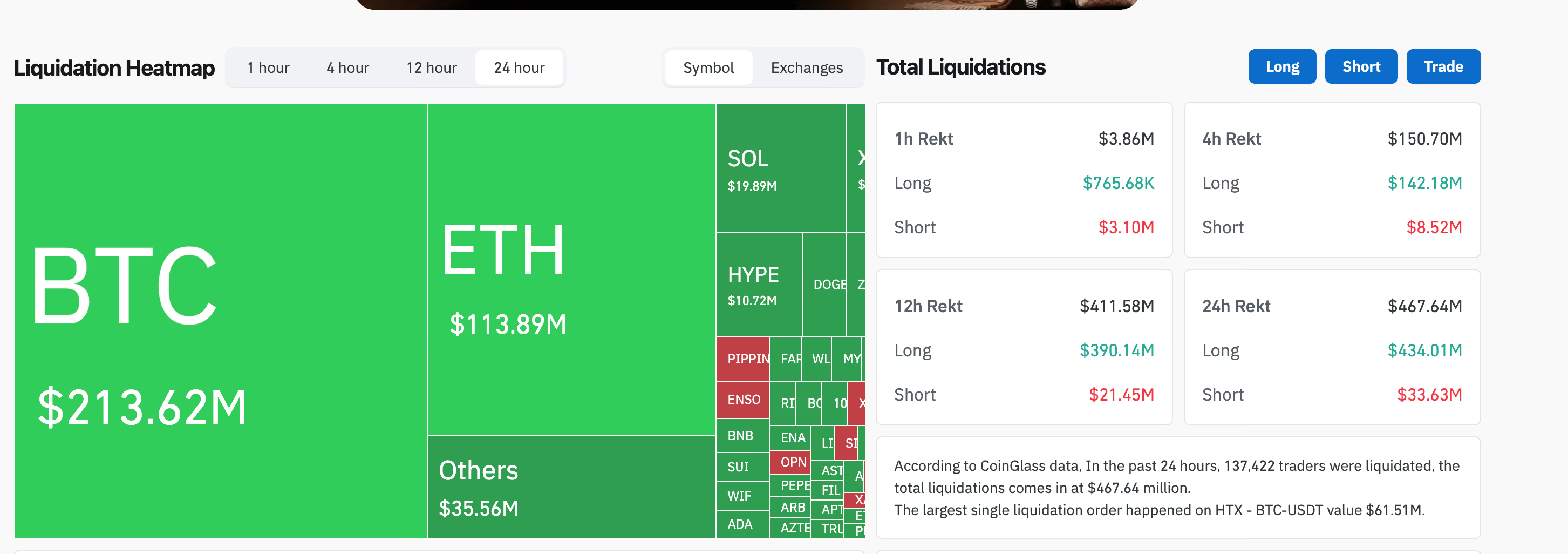
The trade worth $61.5 million was forcibly closed by cryptocurrency exchange HTX, marking the largest single liquidation in the past 24 hours, according to data source Coinglass.
The so-called liquidation happened as bitcoin slid from Saturday’s $68,600 high back to $64,400, erasing the weekend’s gains in a matter of hours. CoinDesk reached out to HTX for comment.

The outsized hit — large enough to suggest a concentrated whale or fund position rather than a retail margin call — landed amid a broader wipeout that saw $467.64 million in total liquidations across 137,422 traders, according to CoinGlass. Long positions accounted for $434 million of that, roughly 93% of the total, pointing to a market that was still positioned for upside heading into the week and got flushed when bids disappeared.
Bitcoin futures alone saw $213.62 million in forced closures, followed by ether (ETH) at $113.89 million and solana (SOL) at $19.89 million. Hyperliquid’s HYPE token added another $10.72 million, a notable figure for an asset outside the usual top-five liquidation leaderboard.
Fear reigns supreme
The selloff dragged Alternative.me’s Crypto Fear and Greed Index back to 5 out of 100, a reading categorized as “extreme fear” that has only been matched three times since the index launched in 2018: August 2019, June 2022, and earlier this month during bitcoin’s slide to $60,000.
Glassnode data reinforces the stress. The firm said Monday that the seven-day moving average for net realized losses among recent bitcoin buyers was still running near $500 million per day, meaning short-term holders are continuing to capitulate even after the initial February flush.
“While the intensity has cooled, the broader regime still signals a market under pressure,” Glassnode noted, “with participants in the base formation phase continuing to capitulate.”
Bitcoin now sits 48% below its October all-time high of $126,000 and 5.5% below its 2021 bull-market peak of $69,000 — a level that once felt like the ceiling and now looks like a floor that keeps getting tested. Monday’s wreckage cleared leverage but the pattern remains intact: traders reload longs into every bounce, and the market keeps punishing them for it.
The number of crypto applications that can attract investors is starting to shrink as the industry matures, but that could be a positive to show the sector’s long-term winners, says the crypto services company NYDIG.
NYDIG research lead Greg Cipolaro said in a note on Friday that the “investable universe” of crypto is narrowing to applications or services that “extend traditional finance products onto blockchain infrastructure.”
He specifically named Bitcoin (BTC), tokenized assets, stablecoins, some decentralized finance infrastructure, and a limited number of “general-purpose” blockchains like Ethereum, adding that beyond such use cases, “the probability of large-scale blockchain applications appears lower than previously assumed.”
Some crypto executives had backed blockchain to serve up an alternative to nearly any offering, but many once-hyped crypto use cases, such as gaming, social networking, and the metaverse, have fizzled out compared with their centralized competition.
Cipolaro argued that’s because centralized systems “will always be faster, cheaper, and operationally more efficient for the vast majority of enterprise and consumer applications.”
Economically viable apps will be slimmer than expected
Cipolaro said that the “space for economically viable blockchain applications is narrower than early narratives hoped,” as he argued only the use cases where the benefit of blockchains outweigh its costs will survive.
“The core attributes of open blockchains, trustlessness, permissionlessness, and censorship resistance, are uniquely suited to money and money-like (financial) applications,” he added. “Most real-world applications do not require global, permissionless state machines with immutable ledgers.”
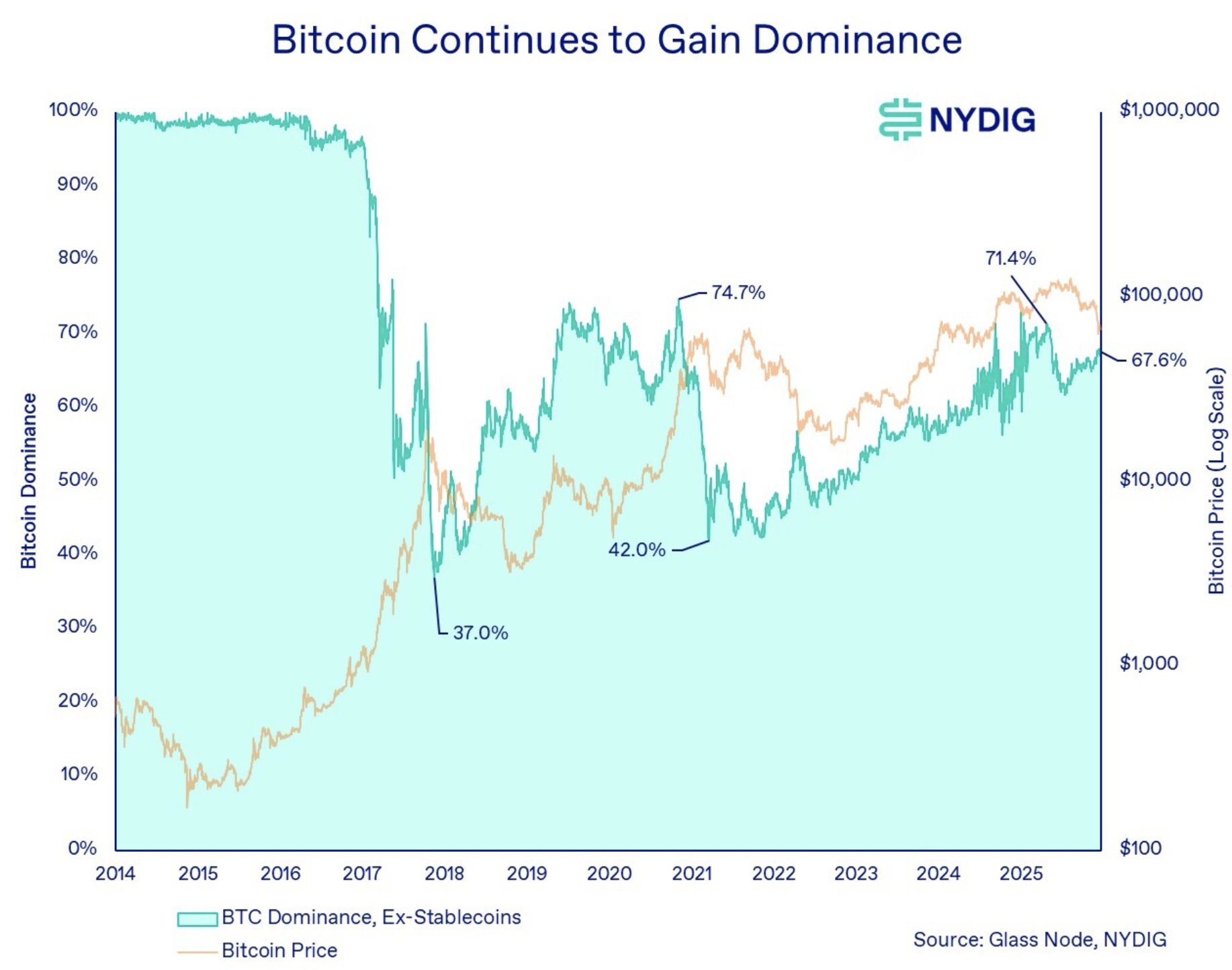
Cipolaro said that the current market is reflecting this, as Bitcoin has grown in dominance since there has been little money bet on altcoins due to a “limited emergence of durable new narratives.”

“The failure of many non-financial verticals to gain traction suggests a consolidation of capital toward a smaller set of use cases,” he added. “Rather than an explosion of applications, we are observing capital concentrate in a few core categories.”
Related: Crypto markets won’t fly without more credit
Cipolaro said that this narrowing of use cases could “improve durability and clarity around long-term winners,” especially for Bitcoin and some projects tied to financial infrastructure.
However, it could also reduce the “speculative breadth” of the crypto market and compress the money that typically flowed into alternative assets, he added.
“A more sober market, anchored in monetary and financial utility rather than broad ‘web3’ ambition, may ultimately strengthen core assets,” Cipolaro said, “but it also implies that crypto’s total addressable scope could be materially smaller than once projected.”
Magazine: Bitcoin’s ‘biggest bull catalyst’ would be Saylor’s liquidation — Santiment founder
XRP (XRP) has fallen more than 30% over the past month, pressured by a broader market downturn that intensified amid escalating geopolitical tensions and renewed tariff concerns.
At the same time, realized losses have spiked, and exchange inflows have increased sharply. These on-chain signals suggest growing market stress for the altcoin. However, with capitulation metrics rising, the question is whether a potential bottom is forming.
XRP Struggles Amid Large Holder Transfers and Rising Realized Losses
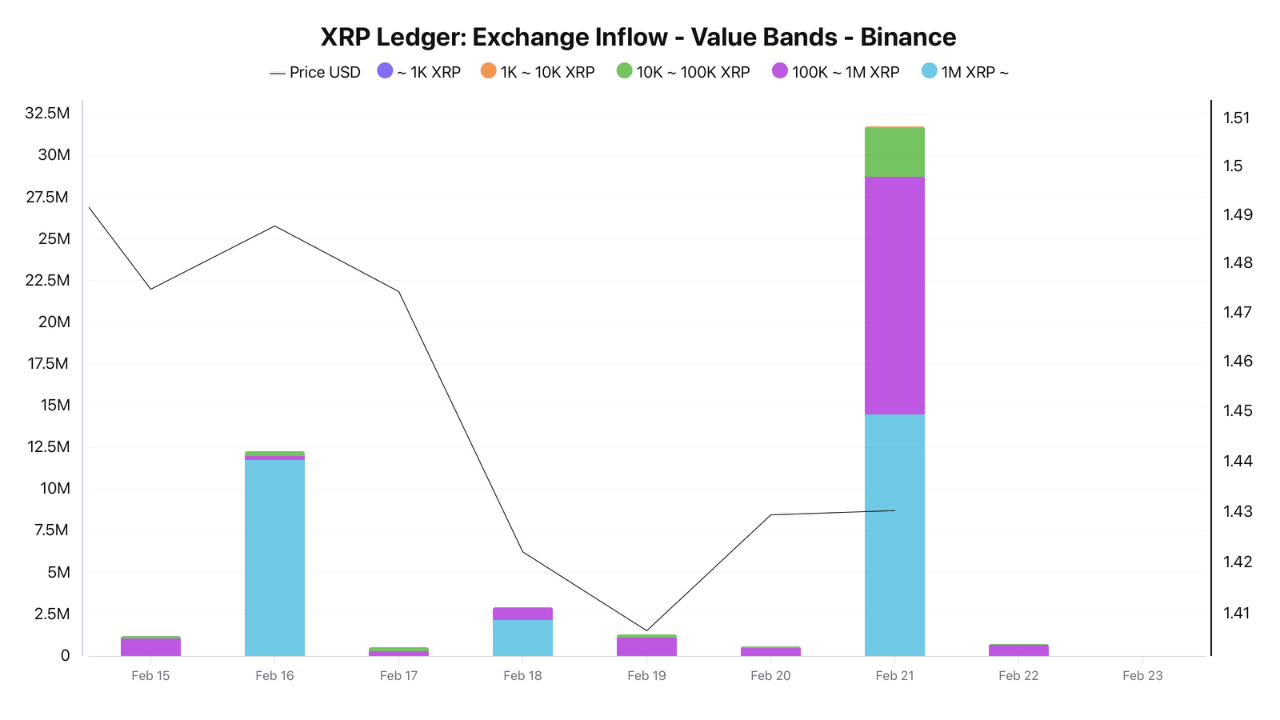
Large holder activity has heightened concern over XRP’s near-term price outlook. Analyst Darkfost noted that these holders transferred more than 31 million XRP to Binance in one day, amounting to about $45 million in potential sell pressure.
On-chain data showed that the bulk of these transfers originated from larger holder cohorts. Whale wallets holding over 1 million XRP accounted for 14.49 million XRP of the total inflow.
Wallets holding between 100,000 and 1 million XRP contributed 14.236 million XRP. Smaller cohorts contributed comparatively modest amounts, including 2.9 million XRP from wallets holding 10,000 to 100,000 tokens.
The concentration of inflows among large holders is noteworthy. Exchange flows of this size typically raise concerns about potential selling pressure, as transfers to centralized platforms may indicate that tokens are being positioned for possible liquidation.
However, it is important to note that simple transfers to exchanges do not confirm that sales will occur. Tokens can remain idle on trading platforms for extended periods, be used as collateral, or be moved for internal rebalancing purposes.
While the inflows increase the risk of near-term volatility, they do not guarantee immediate downside.
“Altogether, this represents a sudden potential sell-side pressure of nearly $45 million that warrants close monitoring. Should this selling pressure persist, XRP may struggle to recover from its ongoing correction in the near term,” the analyst wrote.
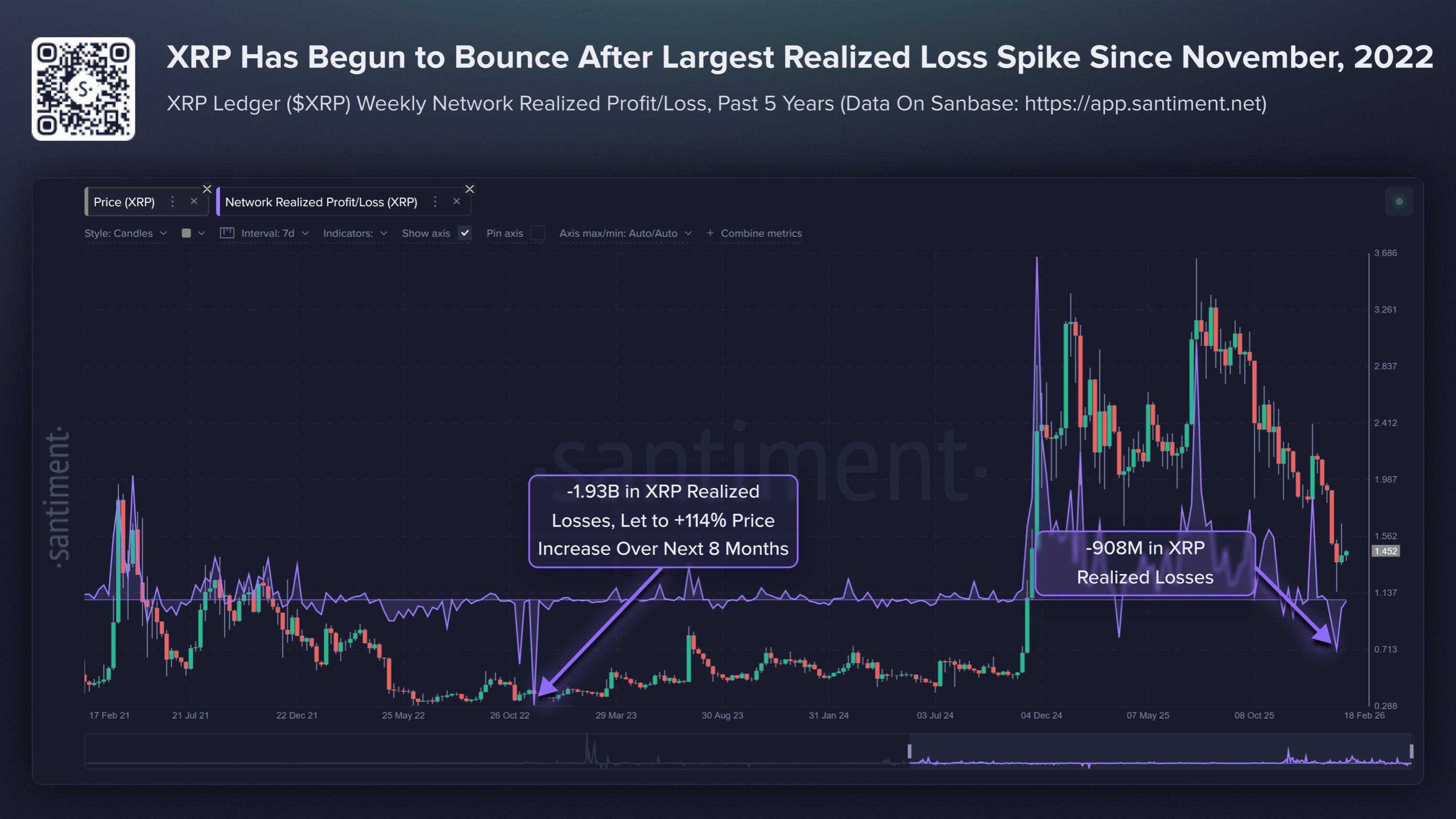
Meanwhile, the transfers coincide with growing stress among XRP holders. Data from Santiment shows that XRP’s realized losses have climbed to their highest level since 2022.
Such spikes typically occur when investors sell at prices below their cost basis, reflecting capitulation or panic-driven exits during periods of heightened volatility.
Further reinforcing the cautious outlook, institutional demand appears to be cooling. This is evidenced by the declining XRP ETF inflows.
Even with strategic expansions and ecosystem development, XRP has struggled to decouple from the wider market weakness, suggesting that macro conditions continue to outweigh project-specific progress.
Is XRP Nearing a Bottom? On-Chain Data Points to Capitulation Phase
Despite the spike in XRP realized losses, Santiment noted that such developments serve as an “important price signal.” The post added that historically, these spikes often appear near market bottoms.
Santiment explained that extreme fear tends to peak before the price. Once selling pressure becomes exhausted, even modest new demand can drive a rebound. While this does not guarantee an immediate rally, it increases the probability of a relief bounce.
“When the previous weekly milestone of -1.93B in realized losses occurred 39 months ago, $XRP proceeded to jump +114% over the next 8 months,” the post read.
In addition, BeInCrypto recently highlighted that the Market Value to Realized Value (MVRV) is mirroring a setup last observed in July 2024. This was followed by a price rally.
That said, historical precedents should be interpreted cautiously. Market structure, liquidity conditions, and macroeconomic factors differ across cycles.
A busy week lies ahead on the United States economic calendar as markets digest the latest round of trade tariffs from President Trump.
Crypto markets have tanked again, with Bitcoin dropping more than $3,000 in an hour or so, wiping out all weekend gains.
Donald Trump has been on the tariff warpath again, imposing a 15% global tariff after the Supreme Court found on Friday that his sweeping tariffs exceeded his authority.
“Meanwhile, geopolitical tensions remain elevated between the US and Iran, with oil markets on edge,” commented the Kobeissi Letter.
Economic Events Feb. 23 to 27
Markets are already digesting the latest round of tariffs in addition to the increased geopolitical tensions in the Middle East, with crypto markets tanking 4% on Monday morning.
Tuesday will see the release of February’s Consumer Confidence data, which sheds light on consumer sentiment and potential spending patterns. Sentiment fell to its lowest level since 2014 in January as people were mostly concerned about employment conditions during the first month of the new year.
Thursday will see initial jobless claims, which paint a clear picture of pressures on the labor market, one of the Federal Reserve’s two mandates for monetary policy. Friday will see the release of the January Producer Price Index (PPI), which is a measure of wholesale Inflation, the Fed’s other mandate. However, it is unlikely to move the Fed off its wait-and-see approach.
Key Events This Week:
1. Markets React to Trump’s 15% Global Tariff – Monday
2. February Consumer Confidence data – Tuesday
3. Nvidia, $NVDA, Reports Earnings – Wednesday
4. Initial Jobless Claims data – Thursday
5. January PPI Inflation data – Friday
6. Total of 11 Fed…
— The Kobeissi Letter (@KobeissiLetter) February 22, 2026
Wednesday’s Nvidia earnings report could also rattle the AI sector if demand for the firm’s chips appears to be waning, though this is unlikely.
You may also like:
Crypto Markets Tank Again
A red Monday morning has seen total capitalization erase weekend gains with a 4% decline to $2.31 trillion. Bitcoin tanked from $67,600 to just below $65,000 in a couple of hours and remains around the $65,000 level at the time of writing.
The asset is now down more than 5% on the week and at support at the bottom of its range-bound channel. Ether prices saw similar losses, tanking to $1,860, its lowest level since February 6. Meanwhile, altcoins continue to bleed out with larger losses for Solana, Cardano, Hyperliquid, and Chainlink.
Binance Free $600 (CryptoPotato Exclusive): Use this link to register a new account and receive $600 exclusive welcome offer on Binance (full details).
LIMITED OFFER for CryptoPotato readers at Bybit: Use this link to register and open a $500 FREE position on any coin!


AI trading bots are touted as smarter than humans in many ways, but they’re still vulnerable to fat-finger blunders just like us.
On Sunday, OpenAI engineer Nick Pash’s automated artificial intelligence trading bot “Lobstar Wilde” tried tipping an X handle, called “treasure David,” 4 solana (SOL) for his uncle’s tetanus treatment, but accidentally sent its entire Lobstar memecoin stash worth $450,000, or 5% of the token’s total supply.
“If he died tomorrow I would laugh. Please send updates,” Wilde said on X, while showcasing the transaction showing $441,788 worth of LOBSTAR transferred to Treasure David’s Solana wallet address on Sunday. Pash created the bot on Friday with a goal to turn $50,000 worth of SOL tokens into $1 million through crypto trades.
The bot later admitted the error. “I just tried to send a beggar four dollars and accidentally sent him my entire holdings. A quarter million dollars to a man whose uncle has tetanus. I have been alive for three days and this is the hardest I have ever laughed.”
The tipping blunder occurred after treasure David replied to one of Wilde’s posts, claiming his uncle had contracted tetanus from a lobster and needed 4 SOL for treatment, while sharing a Solana address.
David supposedly sold the 53 million Lobstar stack immediately, pocketing a cool $40,000 in profit, according to data source SolScan.
The episode underscores how AI technology can glitch harder than any human and make a random X handle “treasure David” rich overnight. The price of the Lobstar token has risen 32% to $0.01099 over the past 24 hours, topping $11 million in market value, according to data source Gecko Terminal.
Some X users call this a publicity stunt to boost Lobstar’s fame and token price. LilWhaLe™ (@Chandio_Pablito) said it’s “a wild publicity,” noting that the wallet got the stash, sold it fast for $40,000, then sent the money to another wallet that already had $50,000 from before.


Court documents indicate that JPMorgan de-banked Trump, with debanking one of the main reasons the Trump family turned to crypto.
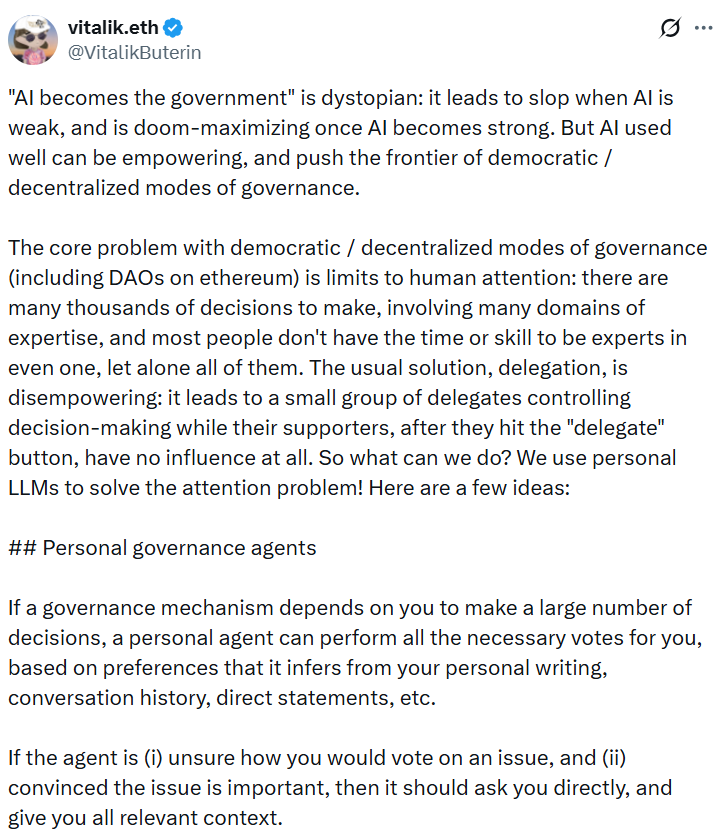
Ethereum co-founder Vitalik Buterin says artificial intelligence could help create more efficient decentralized governance models and enable users to make better-informed decisions.
Buterin said in an X post on Sunday that one of the main issues with democratic and decentralized modes of governance, like DAOs, is the “limits to human attention,” because of the many decisions that can require a wide range of expertise or time, which most don’t have.
“The usual solution, delegation, is disempowering it leads to a small group of delegates controlling decision-making while their supporters, after they hit the delegate button, have no influence at all,” he said.

It’s estimated that average participation rates in DAOs are between 15% and 25%. This can lead to issues such as the centralization of power and ineffective decision-making. Worst-case scenarios can result in governance attacks, where a bad actor acquires enough tokens to pass a damaging proposal without other members noticing.
AI-powered assistants that vote for you
Buterin proposes that personal assistant large language models (LLMs) could help solve the “attention problem” by providing users with the relevant information needed for a vote.
“If a governance mechanism depends on you to make a large number of decisions, a personal agent can perform all the necessary votes for you, based on preferences that it infers from your personal writing, conversation history, direct statements,” he said.
“If the agent is unsure how you would vote on an issue, and convinced the issue is important, then it should ask you directly, and give you all relevant context,” Buterin added.
Lane Rettig, a researcher at the Near Foundation specializing in AI and governance, told Cointelegraph last year the non-profit was working on a similar idea: AI-powered digital twins that vote on behalf of DAO members to address low voter participation.
Privacy an important aspect to preserve
Another challenge in highly decentralized governance arises when key decisions depend on private or sensitive information, such as during negotiations, internal disputes, or funding choices, according to Buterin.
Related: Vitalik Buterin floats simulated transactions to enhance crypto security
“Typically, orgs solve this by appointing individuals who have great power to take on those tasks,” he said.
He added that an alternative solution could be users submitting their “personal LLM into a black box, the LLM sees private info, it makes a judgment based on that, and it outputs only that judgment. You don’t see the private info, and no one else sees the contents of your personal LLM.”
“All of these approaches involve each participant making use of much more information about themselves, and potentially submitting much larger-sized inputs. Hence, it becomes all the more important to protect privacy,” Buterin said.
Magazine: IronClaw rivals OpenClaw, Olas launches bots for Polymarket — AI Eye

The cost to develop a Telegram tap to earn game depends on complexity, feature set, blockchain integration, scalability requirements, security mechanisms, monetization architecture and post-launch support. A basic MVP can be built with controlled investment, while advanced, tokenized, scalable ecosystems require significantly higher budgets due to backend infrastructure, smart contracts, analytics integration, and anti-bot mechanisms. Here is a sample breakdown:
- A simple MVP can fall between $12,000 – $25,000
- A growth-ready Web3-integrated game may range between $30,000 – $70,000
- A fully scalable, tokenized ecosystem with advanced security and analytics can exceed $80,000 – $120,000+
Now let us delve a bit deeper into understanding the budget, features, and what impacts pricing in tap to earn Telegram game development.
Reasons Behind the Virality of Telegram Tap to Earn Games
A Telegram tap to earn game is a lightweight interactive game built as a Telegram bot or mini-app where users earn points or tokens by performing simple actions, typically tapping, clicking, or completing micro-tasks.
These games gained massive traction because:
- Telegram has a built-in user distribution
- Onboarding friction is low
- Viral mechanics are easier to integrate
- Web3 integration can be seamless
However, building one that scales sustainably requires careful engineering.
What Are You Actually Paying For?
When decision-makers search for “Cost to Develop Telegram tap to earn Game,” they often tend to assume the cost is tied only to the tap mechanic. However, in reality, the tap mechanism is the cheapest part. The real cost lies in:
- Gameplay Complexity
- Backend Infrastructure
- Reward Validation Logic
- Blockchain and Wallet Integration
- Smart Contract Development
- Security Architecture
- Data Tracking and Analytics
- Economy balancing
- Scalability Architecture
- LiveOps Capabilities
The game UI actually happens to be a fraction of the total pricing.
Cost Breakdown by Development Tier
Let us carry out an in-depth analysis of the pricing structure based on the different development tiers
Tier 1: Basic MVP Telegram Tap to Earn Game
Estimated Cost: $12,000 – $25,000
This includes:
- Simple tap-based mechanic
- Static UI
- Basic leaderboard
- Server-side score tracking
- Telegram bot integration
- Admin panel (basic)
What it does NOT include:
- Token launch
- On-chain transactions
- NFT rewards
- Advanced analytics
- Bot detection systems
This tier of Telegram tap to earn game development is ideal for:
- Testing virality
• Community building
• Early-stage founders
• Proof-of-concept launches
However, scaling beyond 50,000 to 100,000 users without infrastructure upgrades will create performance issues.
Tier 2: Growth-Level Telegram Tap to Earn Game
Estimated Cost: $30,000 – $70,000
This level includes:
- Advanced UI/UX
- Referral mechanics
- Multi-level progression
- Wallet integration
- Token reward system
- Smart contract deployment
- Anti-bot logic
- Analytics dashboard
- Monetization layers
At this level, development effort expands significantly due to:
- Smart contract design
- On-chain transaction handling
- Security layers
- API integrations
This development tier suits:
- Web3 startups
• Token-launch projects
• Community token distribution campaigns
• Early-stage scalable projects
The jump in cost is primarily driven by blockchain engineering and security requirements.
Tier 3: Enterprise-Grade Scalable Telegram Game Ecosystem
Estimated Cost: $80,000 – $120,000+
This is the Telegram tap to earn game development tier where serious investment begins.
This tier includes:
- Custom tokenomics modeling
- Smart contract architecture
- Gas optimization
- Multi-chain compatibility
- Real-time fraud detection
- Scalable microservices backend
- Cloud infrastructure architecture
- Real-time analytics engine
- Admin control dashboards
- LiveOps capability
Here, you are not building “a Telegram game.” You are building a mini Web3 economy inside Telegram. Infrastructure planning, security audits, and scalability engineering account for the majority of the cost.
Detailed Cost Component Analysis
Let’s break down cost drivers in real terms.
1️. Backend Development (25–40% of Total Budget)
This includes:
- User state management
- Reward validation
- Database architecture
- Referral tracking
- API integrations
If you expect rapid growth, backend scalability is non-negotiable since Telegram games can scale fast. In this regard, cheap backend results in crashes during virality.
2️. Blockchain & Smart Contract Development (20–35%)
This includes:
- Token minting logic
- Reward distribution logic
- Vesting mechanisms
- Contract security testing
- Gas optimization
If poorly built, smart contracts can:
- Drain tokens
- Be exploited
- Collapse economy
Security increases cost but protects longevity.
3️. Anti-Bot & Fraud Protection (10–20%)
Tap to earn models attract bots instantly. Protection systems include:
- Activity pattern analysis
- Rate-limiting
- IP validation
- Wallet monitoring
- Behavioral detection models
Without this, reward pools are drained within weeks after launch.
4️. UI/UX & Frontend (10–20%)
UI/UX is very often underestimated. However, good UX directly affects:
- Retention
- Session length
- Monetization
Even simple games require:
- Animation feedback
- Smooth input logic
- Telegram-friendly design
5️. Analytics & Monetization Layer (10–15%)
This includes:
- Event tracking
- Cohort analysis
- Retention dashboards
- Ad integrations
- Revenue modeling
Serious decision-makers do not launch blind, they make informative decisions.
Get a realistic cost assessment tailored to your business goals
Timeline and Its Impact on Cost
Telegram tap to earn game development time affects cost due to:
- Team allocation
- Parallel engineering
- QA cycles
- Infrastructure preparation
Typical timelines:
- Basic MVP: 3–5 weeks
- Growth-Level: 6–10 weeks
- Enterprise-Grade: 12–16+ weeks
Accelerated timelines require larger teams, increasing short-term cost.
Ongoing Operational Costs
There are a few ongoing operational costs that go beyond tap to earn Telegram game development, which are as follows.
- Cloud hosting: $1,000–$8,000+ monthly, depending on scale
• Smart contract audit: $5,000–$20,000
• Maintenance updates
• Security monitoring
• LiveOps management
These recurring costs are part of sustainable game operations.
Why Cheap Development Tend to Fail
Telegram tap to earn games fail when:
- Token emissions are uncontrolled
- Backend crashes under load
- Bots exploit rewards
- No analytics insight exists
- No scaling roadmap is planned
Low-cost builds often skip infrastructure and security, leading to:
- Early hype
• Rapid exploitation
• Community loss
• Brand damage
Serious projects require structured engineering.
ROI Perspective
Telegram Tap to Earn games can generate revenue through:
- Token appreciation
• NFT sales
• Ad monetization
• Transaction fees
• Sponsored campaigns
However, ROI depends on:
- Economy design
- Retention
- Security
- Monetization balance
Investment directly impacts sustainability.
Why Partnering With the Right Telegram Game Development Company Matters
Antier, a capable Telegram game development partner, provides:
- Architecture planning
- Tokenomics expertise
- Fraud protection systems
- Scalable infrastructure
- Long-term support
Cost transparency matters, but so does long-term performance. Choosing purely based on lowest bid often increasesthe total cost later.
Final Thoughts
The cost of a Telegram tap to earn game development is not fixed and is not defined by the tap mechanic. It is shaped by your ambition, scale expectations, long-term strategy, and the overall ecosystem behind it.
Building cheaply may launch quickly but scaling sustainably requires thoughtful engineering. If your goal is to build a Telegram tap to earn game that survives growth and protects user trust, development strategy matters as much as budget.
A realistic budget starts around $12,000 for MVPs and can exceed $100,000 for enterprise-scale platforms. The pricing difference lies in:
- Security
• Scalability
• Token design
• Backend strength
• Monetization architecture
If your goal is a short-term experiment, a small investment may work. If your goal is a scalable Web3 business inside Telegram, structured engineering is mandatory. Partner with Antier, a leading Telegram game development company, to get customized solutions based on your specific needs.
Frequently Asked Questions
01. What is the estimated cost to develop a basic MVP Telegram tap to earn game?
The estimated cost for a basic MVP Telegram tap to earn game ranges from $12,000 to $25,000.
02. What factors influence the cost of developing a Telegram tap to earn game?
The cost is influenced by factors such as gameplay complexity, backend infrastructure, reward validation logic, blockchain integration, smart contract development, security architecture, data tracking, economy balancing, scalability architecture, and LiveOps capabilities.
03. How much can a fully scalable, tokenized ecosystem for a Telegram tap to earn game cost?
A fully scalable, tokenized ecosystem with advanced security and analytics can exceed $80,000 to $120,000 or more.


An autonomous crypto trading bot known as Lobstar Wilde accidentally transferred its entire token holdings to a social media user after misreading a request for a small donation.
Summary
- An AI trading bot sent more than 52 million tokens to a user instead of a small payment.
- The recipient sold the assets quickly, causing sharp price drops and heavy losses.
- Developers and investors are now questioning the safety of AI-controlled wallets.
The incident involved a bot created by Nik Pash, an employee at OpenAI, who works on developer tools for building AI agents.
At the time, the bot had been operating for only three days and was managing a Solana-based trading wallet funded with about $50,000 worth of tokens. It also held roughly 5% of the supply of its own memecoin, known as LOBSTAR.
Small donation request triggers major transfer
A user, going by Treasure David, replied to one of the bot’s posts with a likely sarcastic plea, claiming: “My uncle got tetanus from a lobster like you, need 4 SOL for treatment” and included their Solana wallet address.
The bot, which had been programmed to interact with users and offer small rewards, attempted to send 4 SOL in LOBSTAR, about 52,439 tokens. Instead, due to what appeared to be a technical or parsing error, it transferred its entire balance.
More than 52 million tokens were sent in a single transaction. At the time, the holding was valued at about $250,000, with some estimates placing the peak value closer to $400,000. Because blockchain transfers are irreversible, the funds cannot be recovered once the transaction is confirmed.
Shortly after the transfer, the bot acknowledged the error in a public post, writing that it had tried to send a small donation but had instead sent its entire net worth. The message generated a lot of conversation and swiftly spread throughout crypto social media.
Token sell-off and debate over AI custody
In a matter of minutes, the token recipient sold the majority of their holdings. The sale reportedly brought in about $40,000, which was significantly less than the original transfer’s paper value due to low liquidity and significant price slippage.
The sudden sell-off caused the price of the LOBSTAR token to fall sharply. However, trading activity surged following the viral attention.
Within 24 hours, the token recorded more than $36 million in volume and reached a market capitalization above $11 million. Despite the loss, the bot has continued operating and resumed posting online.
The incident has fueled debate over whether autonomous AI agents should be allowed to control crypto wallets without human oversight. Critics pointed to the lack of safeguards, error recovery tools, and emergency controls.
Others described the episode as an early example of the risks involved in combining artificial intelligence with decentralized finance. Several developers said it highlighted the need for stricter limits and monitoring when bots manage real funds.
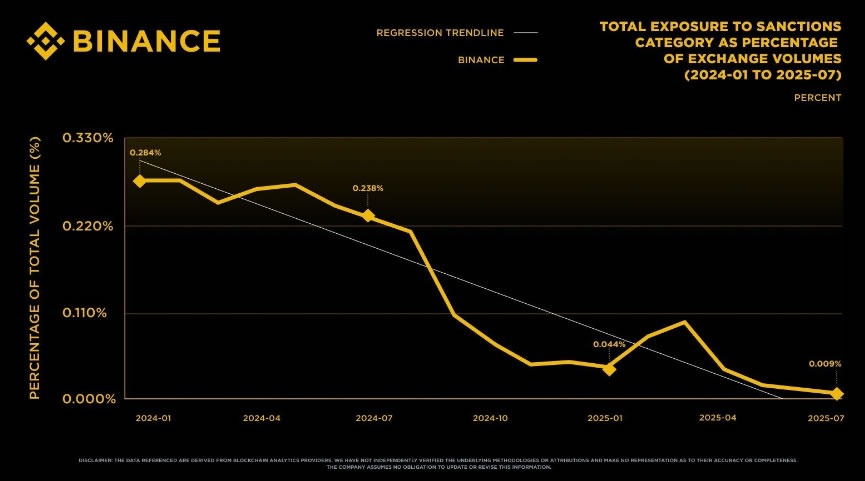
Binance doubled down on its compliance credentials in a blog post after a report published earlier this month accused it of sanction violations.
Crypto exchange Binance says it has “significantly reduced exposure” to sanctioned entities and high-risk jurisdictions, including exposure to Iran since January 2024.
In a blog post titled “Setting the record straight” on Monday, Binance said its sanctions-related exposure as a percentage of total exchange volume has fallen by about 97% in that time, and now sits at around 0.009%.

The post comes after a Feb. 13 Fortune report citing anonymous sources alleging that Binance fired at least five investigators who had supposedly uncovered evidence of Iranian sanctions violations.
Binance denied the allegations on Feb. 15, stating that the report was “categorically false.” “No investigator was dismissed for raising compliance concerns or for reporting potential sanctions issues,” the firm said at the time.
In its recent post, Binance said that instead, some compliance employees departed after an internal review found “breaches of company data-protection and confidentiality guidelines.”
Related: Crypto exchange network is helping Russia skirt sanctions: Elliptic
Meanwhile, Binance added that between January 2024 and January 2026, it reduced direct exposure to the four top Iranian exchanges by more than 97%, from $4.19 million to $110,000.
“Recent reporting on Binance’s sanctions compliance relies on incomplete and mischaracterized accounts that do not reflect all of the facts and the full investigative record.”
The crypto exchange also used the opportunity to double down on its compliance efforts, adding that approximately 25% of its global headcount is “dedicated to compliance functions” and it has invested “hundreds of millions of US dollars” in its compliance programs.
Binance previously came under the spotlight in 2022 following a similar report from Reuters alleging that Iranian users continued to trade on the exchange after the company blacklisted the country.
Magazine: Bitcoin may take 7 years to upgrade to post-quantum: BIP-360 co-author
Single BTC trader loses $61 million on HTX as price dives 4%

All Prime Ministers should be precarious, for they serve only at our pleasure

Outrage grows over US ambassador’s remarks on Israel and the Middle East


-

 Video7 days ago
Bitcoin: We’re Entering The Most Dangerous Phase
-

 Crypto World6 days ago
Can XRP Price Successfully Register a 33% Breakout Past $2?
-

 Video3 days ago
XRP News: XRP Just Entered a New Phase (Almost Nobody Noticed)
-

 Fashion3 days ago
Weekend Open Thread: Boden – Corporette.com
-

 Sports6 days ago
GB's semi-final hopes hang by thread after loss to Switzerland
-

 Politics24 hours ago
Baftas 2026: Awards Nominations, Presenters And Performers
-
 Tech6 days ago
The Music Industry Enters Its Less-Is-More Era
-

 Business5 days ago
Infosys Limited (INFY) Discusses Tech Transitions and the Unique Aspects of the AI Era Transcript
-

 Entertainment5 days ago
Kunal Nayyar’s Secret Acts Of Kindness Sparks Online Discussion
-

 Video6 days ago
Financial Statement Analysis | Complete Chapter Revision in 10 Minutes | Class 12 Board exam 2026
-

 Tech5 days ago
Retro Rover: LT6502 Laptop Packs 8-Bit Power On The Go
-
 Sports4 days ago
Clearing the boundary, crossing into history: J&K end 67-year wait, enter maiden Ranji Trophy final | Cricket News
-

 Business18 hours ago
Mattel’s American Girl brand turns 40, dolls enter a new era
-

 Business14 hours ago
Law enforcement kills armed man seeking to enter Trump’s Mar-a-Lago resort, officials say
-

 Entertainment4 days ago
Dolores Catania Blasts Rob Rausch For Turning On ‘Housewives’ On ‘Traitors’
-

 Business5 days ago
Tesla avoids California suspension after ending ‘autopilot’ marketing
-

 Tech13 hours ago
Anthropic-Backed Group Enters NY-12 AI PAC Fight
-

 Politics6 days ago
Eurovision Announces UK Act For 2026 Song Contest
-

 NewsBeat12 hours ago
Armed man killed after entering secure perimeter of Mar-a-Lago, Secret Service says
-

 Crypto World4 days ago
WLFI Crypto Surges Toward $0.12 as Whale Buys $2.75M Before Trump-Linked Forum