

Crypto World
Paul Grewal exits Coinbase before crypto’s biggest Senate battle



On July 8, Paul Grewal notified Coinbase that he was resigning as chief legal officer and corporate secretary, effective July 31. The company disclosed the departure in an 8-K filing the next day, and by Thursday evening the announcement had rolled through crypto media with the tone usually reserved for a retiring general. Grewal will move into an advisory role from August 1 through October 31, collect a lump sum equal to 3 months of base salary when the advisory period ends, keep the restricted stock units scheduled to vest on August 20, and remain on the board of Coinbase National Trust Company, the entity behind the company’s federal trust charter push at the Office of the Comptroller of the Currency. He says he is joining a startup he has not named.
Summary
- Paul Grewal is leaving Coinbase as chief legal officer just weeks before the Senate’s decisive CLARITY Act vote.
- The article examines Grewal’s role in Coinbase’s legal victories and why the industry’s biggest regulatory battle is shifting from courts to Congress.
- Coinbase’s leadership reshuffle signals a move from defending crypto in court to building regulated financial products.
The timing is the story. Grewal leaves at the end of the very month in which the CLARITY Act, the market structure bill he spent years advocating, faces its decisive Senate window. A merged draft is expected the week of July 13. Floor action is targeted for the week of July 20. The Senate breaks on August 7, and most analysts treat that recess as the effective deadline for passage in 2026. The lawyer who fought the Securities and Exchange Commission to a standstill is walking out of the command tent 2 weeks before the armistice vote.
That reading makes for a good headline, and it deserves an immediate correction: nothing in the record suggests Grewal is fleeing a losing fight. The more interesting question is the opposite one. What does it mean when the most consequential legal officer in crypto decides his work is finished before the law that would ratify it exists? The answer says a great deal about where Coinbase thinks the industry now stands, and about how much of the legal war was actually won in courtrooms versus how much still hangs on 7 undecided Democratic senators.
Six years that defined a legal era
Grewal arrived at Coinbase in the summer of 2020, hired away from Facebook, where he served as vice president and deputy general counsel, to replace Brian Brooks as the company’s top lawyer. Before Silicon Valley, he sat as a federal magistrate judge in the Northern District of California, a background that shaped the posture Coinbase would become famous for: when the government came, the company would not settle quietly. It would litigate, publicly and on principle.
His first major assignment was taking the company public. Coinbase listed on Nasdaq in April 2021 through a direct listing, the first crypto exchange to reach American public markets, a process that required convincing securities lawyers, auditors, and a skeptical SEC review apparatus that a crypto business could meet public company standards. The listing gave Coinbase a currency, a disclosure regime, and a legitimacy that would matter enormously in the fights ahead.
The defining fight arrived in June 2023, when the SEC under Chair Gary Gensler sued Coinbase, alleging the company operated as an unregistered securities exchange, broker, and clearing agency. Legal observers widely described the case as existential, not just for Coinbase but for the American crypto industry, because the theory behind it would have swept most token trading into the securities regime by enforcement rather than by rulemaking. Grewal ran the defense and paired it with offense.
Coinbase petitioned the SEC to write actual crypto rules, then sued when the agency refused. It fought in court to unearth internal SEC documents about the agency’s approach to the asset class. It moved its legal domicile from Delaware to Texas. And it poured resources into the political layer, with Coinbase becoming one of the largest funders of the Fairshake political apparatus, contributing $25 million alongside matching amounts from Ripple and Andreessen Horowitz.
The endgame came after the 2024 election. The SEC under new leadership dropped the Coinbase case in 2025, part of a broad retreat from the enforcement-first strategy, and the industry pivot from courtrooms to Congress produced the GENIUS Act for stablecoins, a fight crypto.news chronicled through its own bruising Senate negotiation, and then the CLARITY Act for market structure.
Grewal’s own summary, posted on X, was uncharacteristically sweeping: after helping take the company public, fighting the SEC and winning, moving the company from Delaware to Texas, and working to get GENIUS and soon CLARITY passed into law, now was his time for new adventures. He called leading the legal team through the biggest fight of the industry the single greatest achievement of his 6-year tenure.
It is hard to argue with the scoreboard. When Grewal joined, the American legal question was whether the industry would survive its regulator. When he resigned, the question was which of two friendly regulators would supervise it.
Anatomy of the SEC fight, and why it mattered beyond Coinbase
The Coinbase case deserves a closer look, because its mechanics explain both Grewal’s reputation and the industry’s current legislative posture.
The SEC’s June 2023 complaint was not a fraud case. It alleged no theft, no misrepresentation, no customer harm. The theory was structural: that a large share of the tokens trading on Coinbase were unregistered securities, which made Coinbase itself an unregistered exchange, broker, and clearing agency all at once. If that theory prevailed, every American platform listing those tokens faced the same triple liability, and registration was not a realistic cure because the SEC’s existing forms and rules were written for equities and had no workable application to token markets. The industry read the suit as an attempt to regulate by enforcement what the agency declined to address by rulemaking, and Coinbase built its defense around exactly that asymmetry.
Grewal’s strategic insight was to refuse the defendant’s crouch. Coinbase had already filed a rulemaking petition in July 2022 asking the SEC to write crypto-specific rules. When the agency ignored it, Coinbase sued to compel a response, eventually winning a court order forcing the SEC to explain itself, and an appellate rebuke when the explanation proved thin. In the main enforcement case, the company pursued discovery into the agency’s internal deliberations, seeking documents about how officials themselves discussed token classification, a move that transformed the lawsuit from a compliance dispute into an examination of the regulator’s own consistency. The judge in the Southern District of New York allowed core claims to proceed but also certified questions that exposed how unsettled the doctrine was. None of this guaranteed victory. What it did was raise the cost of the SEC’s strategy, publicly and procedurally, until a change of administration made retreat the path of least resistance.
The dismissal in 2025 was, as observers noted at the time, a massive win for Grewal, Coinbase, and the industry. It was also, and this is the part that matters for July 2026, a win by default. The core legal question, which tokens are securities and under what test, was never answered by a controlling appellate decision. The SEC withdrew; the doctrine did not change. That unfinished quality is why Coinbase pivoted its entire public affairs machine toward Congress, and why Grewal spent his final 18 months as much in Washington as in court. The company understood that it had won a battle of attrition, not a ruling it could cite forever.
The political arm of that pivot operated at a scale American finance had rarely seen from a single company. Coinbase became one of the top corporate political donors of the 2026 midterm cycle, with disclosed contributions exceeding $35 million by some tallies, most of it flowing through the Fairshake network of political action committees, which entered the year with roughly $193 million on hand. Whatever one thinks of that spending, it purchased something litigation never could: a House that passed the CLARITY Act 294 to 134 in July 2025, and a Senate Banking Committee that advanced it 15-9 in May 2026, as crypto.news has tracked through every procedural turn since.
The succession, and what it signals
Coinbase paired the departure with a reorganization that reveals how the company sees its next phase. Molly Abraham, a vice president of legal who joined Coinbase in March 2021 and previously served as general counsel of an electric aircraft startup, becomes general counsel and corporate secretary. Ryan VanGrack, another legal vice president who ran much of Coinbase’s courtroom strategy and previously served as general counsel at Citadel Securities, takes a newly created post as vice chairman and head of corporate affairs, a public-facing role focused on governments, regulators, and industry relationships worldwide. Faryar Shirzad continues as chief policy officer, keeping the Washington operation under unchanged leadership through the CLARITY endgame.
Read the org chart as a statement. The general counsel role goes to an operator whose framing of the moment, in her own words, is that the next chapter is all about building products. The combat portfolio, the part of the job that made Grewal a public figure, gets split into a diplomatic post for VanGrack and an unchanged policy shop under Shirzad. Coinbase is reorganizing its legal function from a war department into a foreign ministry, which is exactly what a company does when it believes the shooting war is over.
The market agreed, or at least did not object. COIN barely moved on the news, a nonreaction worth pausing on. A chief legal officer departing a company whose valuation spent years hostage to litigation risk would once have been a sell signal. In July 2026 it was a footnote, which is itself a measure of how thoroughly the legal overhang has drained out of the stock. The shares have other problems, trading around $165, closer to their 52-week low near $139 than to the high above $444, but those problems are market beta and revenue mix, not subpoenas.
There is also continuity where it counts. Grewal keeps his seat on the board of Coinbase National Trust Company and will keep working on the OCC trust charter, which received conditional approval earlier this year. The charter is arguably the most important regulatory project Coinbase has left, a federal banking-adjacent license that would anchor its custody and payments ambitions, and the company is keeping its most experienced regulatory hand attached to precisely that file.
The war that is not actually over
Here is the counterargument, and it is not a strawman: the general is leaving before the war ends, because the war has not ended.
The CLARITY Act is not law. It is a bill that needs 60 Senate votes and currently commands, by the most generous count, 55. The merged Banking and Agriculture text, reportedly more than 70 pages longer than earlier versions, has not been released. The ethics dispute over the Trump family’s estimated $2.3 billion in crypto holdings has broken multiple tentative compromises, and Democrats including Kirsten Gillibrand have said flatly that there is no bill without an ethics provision.
Even the two Democrats who advanced the bill in committee, Ruben Gallego and Angela Alsobrooks, have conditioned their floor votes on that fix. Law enforcement groups are fighting the developer protection language, a split crypto.news examined in detail, and a separate standoff over vacant SEC and CFTC commissioner seats has produced an amendment from Senator Amy Klobuchar that would freeze the new CFTC rulebook until 4 commissioners are confirmed. Galaxy Research puts 2026 passage at 50%. A coin flip is not a victory parade.
And the legal victories Grewal won are, in a strict sense, reversible. The SEC dropped its case; it did not lose a final judgment on the merits at the appellate level. The agency’s current posture is a policy choice by the current commission, formalized in an administrative framework that Chair Paul Atkins himself calls a bridge to legislation. A bridge built by one commission can be dismantled by the next. The entire argument for the CLARITY Act, made loudest by Coinbase itself, is that enforcement peace without statute is a ceasefire, not a treaty. By that logic, the company’s chief legal officer is departing during the ceasefire, with the treaty unsigned.
The rebuttal to the rebuttal is about comparative advantage. The remaining work is legislative, and Grewal was never the legislative arm. Shirzad runs policy. Fairshake and the industry coalition run the political money, with Coinbase reportedly among the largest corporate political donors of the 2026 cycle.
The final 3 weeks of the CLARITY fight will be decided by Senate floor mechanics, White House ethics negotiations, and 7 individual Democratic calculations, none of which a chief legal officer controls. What a chief legal officer controls, litigation posture against the SEC, is precisely the front that went quiet. On the battlefield where Grewal fought, the war really is over. On the battlefield where it continues, he was always a supporting actor.
What Coinbase is becoming without him
The company Grewal leaves behind is deliberately outgrowing the category he defended. Over the past year Coinbase has launched stock and ETF trading for all US users on a 24/5 schedule, partnered with Yahoo Finance to pipe research traffic into trades, agreed to acquire The Clearing Company to build regulated prediction markets, rolled out perpetual-style futures through its CFTC-regulated derivatives arm, secured a UK investment services authorization to add equities and derivatives for British users, and pushed deeper into stablecoin infrastructure with custom stablecoin issuance for businesses. Management now describes the goal as the everything exchange, one venue for crypto, equities, derivatives, and prediction markets.
That strategy quietly reframes the legal risk profile. An everything exchange answers to the SEC, the CFTC, the OCC, state regulators, and foreign authorities simultaneously, but it answers to them as a conventional, licensed financial institution, not as a defendant arguing about what a token is. The stakes of token classification shrink as the revenue mix diversifies away from spot crypto trading. In that world, the highest-value legal work is licensing, integration, and regulatory relationship management, which is the portfolio VanGrack and Abraham now split.
The stablecoin business shows the same migration from combat to competition. Coinbase’s economics lean heavily on its USDC arrangement with Circle, and the live threats there are commercial and regulatory-technical: the OCC’s February stablecoin rule extending the GENIUS Act yield ban to affiliates, bank lobby pressure on stablecoin yield that crypto.news has covered as a $6 trillion standoff, and the market share fight in which, as crypto.news reported, USDC has been beating Tether where trading volume actually lives. None of that is litigation. All of it is the next general counsel’s problem.
The risks Coinbase is accepting
A fair accounting has to name what the company gives up, because a transition this clean still carries costs.
The first is institutional memory in a crisis. Abraham has been at Coinbase for more than 5 years and, in Grewal’s words, fought in the trenches on the company’s most important legal battles, so this is not a cold start. But the specific muscle Grewal built, the willingness to sue a federal agency, to litigate discovery against a regulator, to take a public position and absorb the retaliation risk, is a temperament as much as a skill set.
Companies tend to hire for the war they just fought or the peace they expect. If the political environment flips after the 2026 midterms, or after 2028, and a future SEC revives the enforcement playbook against a Coinbase that now touches equities, derivatives, prediction markets, and banking-adjacent custody, the surface area for a hostile regulator is larger than it was in 2023, and the wartime commander will be at a startup.
The second is signaling risk in Washington during the most delicate month of the CLARITY fight. Grewal was one of the industry’s most credible witnesses precisely because he carried a federal judicial pedigree into rooms full of skeptical staffers. His departure does not remove Coinbase from the negotiation; Shirzad’s team remains fully engaged, but it does remove a specific voice at a moment when the bill’s opponents are arguing that the industry seeks impunity, not clarity. Senators reading the news can take it either way: as evidence the industry has matured past its combative phase, or as evidence that the people who understood the fight best are cashing out before the terms are final.
The third is concentration of the remaining legal risk in exactly the areas where Grewal’s successors are least tested. The OCC trust charter, the UK authorization, the Clearing Company acquisition review, and the state-by-state rollout of prediction markets are all licensing and approval processes where the counterpart is a regulator with discretion, not a plaintiff with a burden of proof. Grewal stays attached to the trust charter file, which mitigates the largest single item, but the portfolio as a whole now belongs to a legal team whose public track record is shorter than the ambitions it must clear.
None of these risks is disqualifying, and all of them are the ordinary price of succession. They are worth stating because the alternative narrative, that this transition is costless because the SEC fight ended, quietly assumes the regulatory weather of 2026 is permanent. Nothing in crypto’s history supports that assumption.
The precedent watchers should actually care about
Executive departures in crypto usually mean one of three things: scandal, disagreement, or completion. The filings, the send-off from regulators and industry figures, and the succession design all point to the third. But completion has its own information content, and two audiences should read it carefully.
For the industry, Grewal’s exit marks the formal end of the enforcement era as a career-defining battlefield. The generation of crypto lawyers who made their names fighting the SEC between 2020 and 2025 is dispersing into startups, advisory roles, and policy shops. The next generation will make its name on implementation: CFTC registration regimes, trust charters, MiCA passporting, bank partnerships. That is a less heroic practice, and a far larger one.
For CLARITY watchers, the exit is a mild but real confidence signal. Companies do not let their most famous legal asset walk during a live existential threat. Coinbase’s revealed preference, releasing Grewal to an advisory role while leaving the policy team untouched, says the company assigns low probability to a world where it needs a wartime chief legal officer again soon. It could be wrong. If the bill dies in August and a future administration revives enforcement, this July will look like the moment the industry demobilized early. If the bill passes, it will look like the moment the first company knew.
The calendar Grewal leaves behind is compressed enough to summarize in one paragraph. The week of July 13: the merged CLARITY text arrives, and its ethics language, or the absence of it, sets the tone for everything after. The week of July 20: the targeted floor window, contested by a defense spending bill and dependent on Majority Leader Thune scheduling time. August 7: the recess begins, and with it, by the estimate of Stifel, Galaxy, and Senator Lummis alike, the effective end of the 2026 window.
Somewhere in that stretch, Gallego, Alsobrooks, and at least 5 colleagues decide whether the ethics compromise on offer is defensible back home. Grewal’s last day as chief legal officer, July 31, lands in the middle of the count. If the Senate acts before he clears out his office, the timing that looked like a general leaving early will read instead as a handoff executed at the exact moment the mission is completed. Few executives get to choose their exit that precisely. Fewer still get the legislative calendar to cooperate.
Grewal himself put the stakes of his tenure in terms that will outlast the news cycle: the legal wins helped ensure crypto not only had a future in the United States, but could flourish. The first half of that claim is now hard to dispute. The second half is a bill sitting on the Senate calendar, waiting on a merged draft, an ethics compromise, and 7 votes. The general can leave because the outcome of his war is no longer in doubt. Whether the peace gets written into law is now, fittingly, out of the lawyers’ hands.

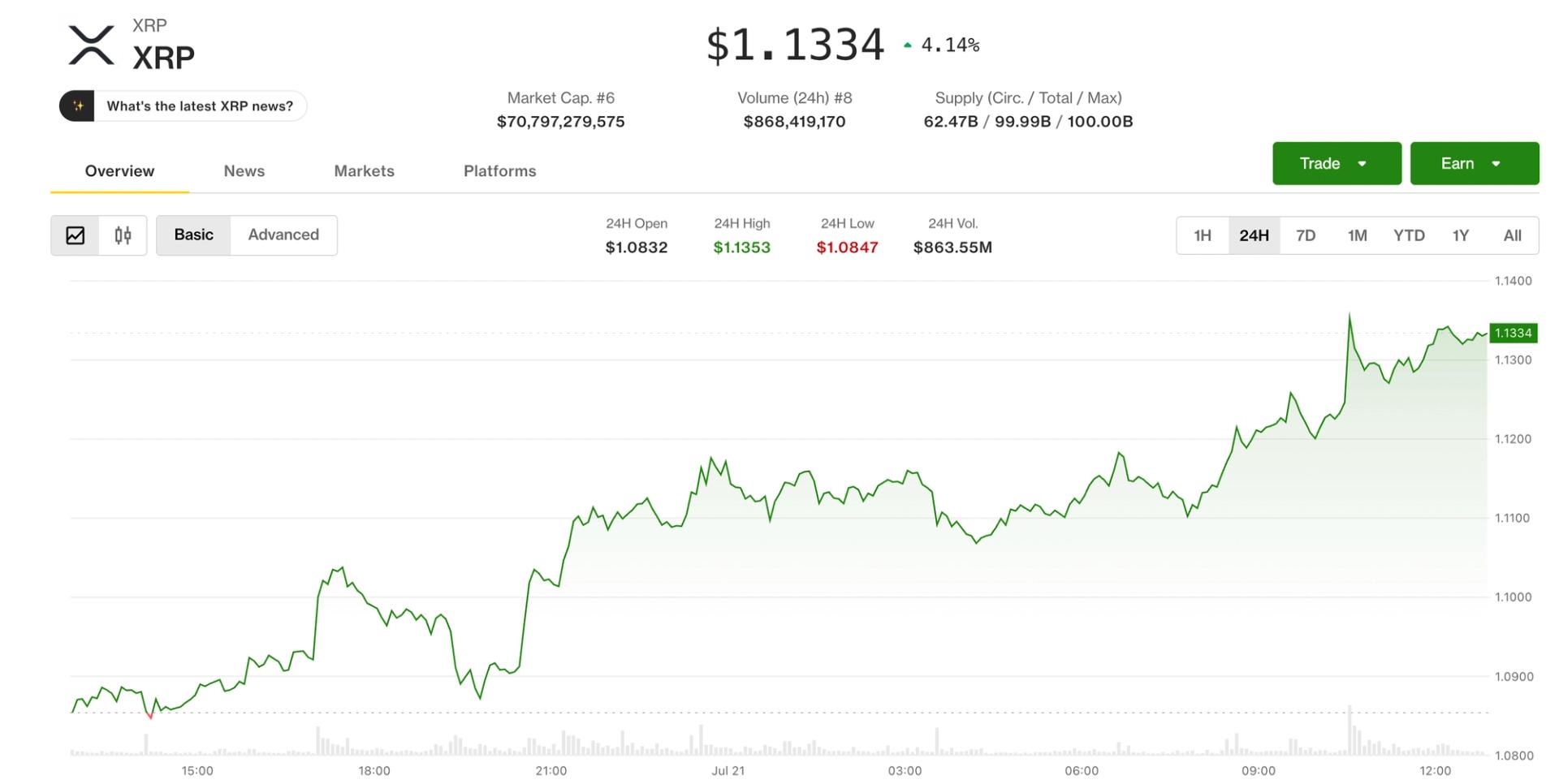
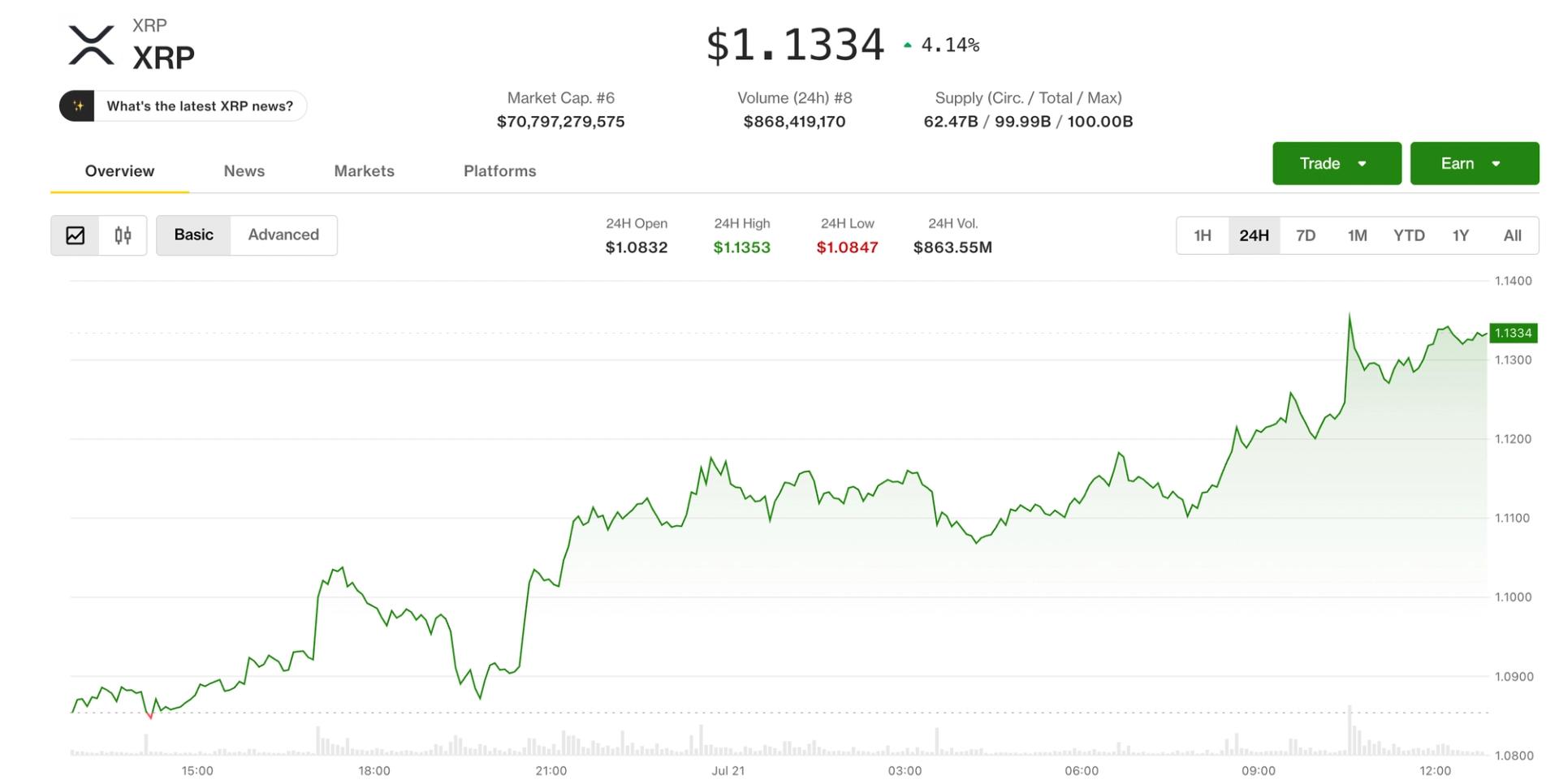
• Volume increased during the breakout attempt, with CoinGecko showing 24-hour trading volume of about $1.27 billion.
• XRP held above the $1.08-$1.10 area through the session, keeping the short-term recovery structure intact.
Technical Analysis
• The key short-term level is $1.13. A sustained break above it would confirm the triangle breakout watched by traders and bring $1.35 into focus.
• The hourly structure has tightened into a symmetrical triangle, with price compressing between lower highs and higher lows before the latest push higher.
• The daily chart remains more cautious. XRP is still trading inside a descending channel, with the 100-day and 200-day moving averages above price and sloping lower.
• The $1.24-$1.28 area remains the bigger resistance zone because it lines up with the channel’s upper boundary and major moving averages.
• Support remains strongest around $1.02-$1.06, where buyers have repeatedly stepped in over recent weeks.
What traders should watch
• $1.13 is the immediate breakout level. Holding above it would strengthen the short-term bullish setup.
• $1.14 is the next nearby level after marking the top of the latest 24-hour range.
• $1.24-$1.28 is the major resistance zone that XRP needs to clear before the daily chart turns meaningfully stronger.
• $1.02-$1.06 remains the key demand zone. Losing it would expose $0.88-$0.92.


The Coinbase-backed Ethereum layer-2 is preparing to expand its financial offerings as it pivots away from its earlier social-first strategy.
U.S. Senator Bernie Sanders has renewed his criticism of the crypto industry, placing digital asset groups alongside other well-funded political interests during a campaign event supporting Minnesota Lieutenant Governor Peggy Flanagan’s Senate bid.
Summary
- Bernie Sanders pledged to challenge crypto while campaigning for Minnesota Senate candidate Peggy Flanagan publicly.
- Crypto-backed PACs have become major election spenders as lawmakers debate new digital asset regulation nationwide.
- Fairshake and allied groups continue deploying industry funds across closely watched congressional races in 2026.
In a July 21 post on X, Sanders wrote, “Together, we are going to take on crypto, the AI industry, AIPAC and other billionaire super PACs.” He added that the campaign aimed to send Flanagan to the U.S. Senate. The comments focused on political spending and industry influence rather than cryptocurrency prices or blockchain technology.
Meanwhile, Sanders made the remarks while campaigning with Flanagan in Minneapolis. His statement grouped crypto with industries and political organizations that he says can use large financial resources to shape elections. He did not name a specific crypto company or political action committee in the post.
The timing comes as crypto-backed political groups spend heavily ahead of the 2026 midterm elections. As previously reported, Public Citizen estimated that the crypto industry had contributed about $189 million during the current election cycle by late June. Ripple- and Coinbase-backed groups, including Fairshake, have remained among the largest sources of industry political funding.
The spending has moved beyond national lobbying campaigns and into individual congressional races. Crypto.news reported in June that Fairshake-linked groups had deployed more than $8 million ahead of several closely watched primaries in Maryland, New York and Utah.
Fairshake and its affiliated groups have generally backed candidates viewed as supportive of clearer digital asset rules. Major industry companies, including Ripple, Coinbase and Andreessen Horowitz, have provided funding to the broader network over recent election cycles.
Crypto PACs become a larger force in the 2026 elections
The industry’s political spending has already appeared in several election results. In Maryland, as crypto.news reported, Adrian Boafo won a Democratic primary after receiving support from crypto-linked political groups. Fairshake affiliates also spent in other Democratic contests where digital asset policy formed part of the wider campaign debate.
The same network has also backed Republican candidates. In Alabama, a Fairshake-linked PAC spent more than $12 million supporting Barry Moore during his Senate primary and runoff campaign, according to related coverage. The activity shows that the groups have directed funding across party lines rather than limiting their spending to one political party.
Sanders’ latest remarks place him on the other side of that spending campaign. His criticism centers on the role of large political donors and corporate interests in elections. The July 20 statement did not call for a crypto ban or identify a new legislative proposal targeting digital assets.
Instead, Sanders framed crypto as one of several well-funded interests that Flanagan and her supporters would oppose. That distinction matters because his post focused on political influence rather than announcing a new position on individual cryptocurrencies, exchanges or blockchain networks.
Sanders has maintained pressure on crypto policy
The statement follows other recent moves by Sanders involving digital asset policy. In June, he joined Senator Elizabeth Warren and Representative Bobby Scott in asking the U.S. Labor Department to withdraw a proposal that could expand access to crypto and other alternative assets inside 401(k) retirement plans.
Moreover, the lawmakers argued that retirement savers could face volatility and weaker investor protections if plan providers added digital assets without enough safeguards. The Labor Department’s proposal would not require employers to offer crypto, but it would allow plan managers to consider alternative investments under existing fiduciary duties.
Sanders has also remained part of a wider group of lawmakers raising concerns about crypto regulation, investor protection and potential conflicts involving public officials. Those debates continue as Congress considers market structure rules and other legislation that could define how the U.S. treats digital asset companies.
At the same time, industry-backed political organizations have increased spending as those policy debates move through Congress. Previous crypto.news coverage found that Fairshake affiliates had spent about $7 million on selected Democratic primary races while lawmakers continued negotiating the CLARITY Act.
Minnesota race brings crypto politics onto the campaign stage
Sanders’ support for Flanagan now brings that national fight over political money into Minnesota’s Senate race. His July 20 message did not provide details about what “take on crypto” would mean in legislative terms, leaving the phrase tied mainly to the campaign’s broader criticism of wealthy industries and super PAC spending.
Crypto-funded groups have not remained on the sidelines in 2026. Their spending has already reached congressional primaries, Senate races and wider efforts to support candidates who favor industry-backed regulatory policies. Critics such as Sanders continue to frame that activity as part of a broader fight over large donors and political influence.
The debate is likely to remain active as the U.S. moves closer to the midterm elections and Congress continues work on digital asset legislation. Fairshake and allied groups still have substantial resources available, while lawmakers who oppose parts of the crypto industry’s policy agenda are making campaign finance a larger part of their response.
Crypto World
Coinbase's Jesse Pollak Hands Base App to Cobie, Says Social Bet Was 'Definitively Wrong'


Jesse Pollak, the Coinbase executive who created Base, handed the consumer Base app back to Coinbase and named crypto investor Jordan Fish, known as Cobie, to lead it, while admitting that his two-year bet on onchain social products and creator coins was a mistake. Pollak said in a post on X on… Read the full story at The Defiant


Wanchain’s Cardano-to-BNB Chain bridge has reportedly suffered an exploit that drained about 515 million NIGHT from its Cardano-side treasury, according to blockchain security firm BlockSec.
Summary
- BlockSec said roughly 515 million NIGHT left Wanchain’s Cardano bridge treasury during the reported exploit.
- Midnight said its core network remained secure, describing the incident as isolated to bridge infrastructure.
- NIGHT fell more than 30% as investigators examined possible signature reuse in Wanchain validator logic.
The incident triggered heavy selling of Midnight’s native token and sent NIGHT down more than 30% within 24 hours.
BlockSec’s Phalcon said its initial investigation pointed to a possible flaw in the TreasuryCheck validator used by the bridge. The security firm stressed that its findings remain preliminary. Meanwhile, the Midnight Foundation said the incident affected third-party bridge infrastructure rather than the Midnight blockchain itself.
BlockSec points to possible signature reuse flaw
According to BlockSec, the reported Wanchain Cardano bridge exploit may stem from the way the TreasuryCheck validator creates messages for signing. The firm said the validator combines 14 fields of varying lengths without adding clear separators or recording the length of each field. That structure could allow different sets of data to produce the same final byte string.
BlockSec said this could create a path for a signature reuse attack. An attacker may be able to reorganize field values while keeping the same signed message, allowing a previously valid signature to authorize a different transaction.
The firm said it reached its initial view after examining the onchain Plutus V2 code and the transaction linked to the reported attack. The investigation remains ongoing, and Wanchain had not published a full technical postmortem at the time of writing.
The security firm said a more structured encoding method could have prevented this type of ambiguity. Its analysis noted that the contract already contained Cardano’s SerialiseData function, but the bridge did not appear to use it when building the signature hash. BlockSec said encoding each field with clear boundaries would prevent two different data sets from producing an identical signed message.
Wanchain originally launched cross-chain support for NIGHT between Cardano and BNB Chain in December 2025. The bridge allows users to move the token between the networks through cross-chain infrastructure operated by Wanchain. Cardano’s official ecosystem directory describes WanBridge as using threshold-signature relayers to connect Cardano with EVM and non-EVM networks.
Midnight says the core network remains secure
The Midnight Foundation initially said it was investigating reports of an incident involving the Wanchain Cardano-to-BNB bridge and bridged NIGHT. It later issued a clarification saying the event was limited to Wanchain’s third-party bridge infrastructure.
“The incident is isolated to the Wanchain Cardano–BNB bridge and does not involve the Midnight Network itself,” the foundation said.
It added that Midnight’s protocol, validators, consensus system and core infrastructure continued to operate normally. The organization said it was working with Wanchain as the bridge operator continued its investigation.
The distinction matters because the reported attack involved tokens held to support cross-chain transfers rather than a change to NIGHT’s total supply. NIGHT is Midnight’s native governance token and also generates DUST, the network resource used for transactions and smart contract execution. Midnight lists the token’s total supply at 24 billion.
Midnight operates as a privacy-focused Cardano partner chain with a dual-token economic model built around NIGHT and DUST. The project launched its mainnet in March 2026, while NIGHT remains publicly transferable and tradable.
NIGHT sinks as hundreds of millions of tokens move
NIGHT sold off sharply as reports of the bridge incident spread. CoinGecko data showed the token trading near $0.0186, down about 31% over 24 hours. At those prices, 515 million NIGHT would carry a market value of roughly $9 million to $10 million. The value can move quickly because of the token’s volatility.
The large movement of NIGHT created immediate selling pressure because hundreds of millions of tokens reportedly left the bridge treasury within a short period. However, the Midnight Foundation has not said that the Midnight protocol itself created new tokens or suffered a consensus failure. Its statements have consistently described the event as a cross-chain bridge issue.
The price decline reversed part of NIGHT’s earlier market gains since Midnight’s launch. As crypto.news reported in March, NIGHT rose more than 20% around the mainnet rollout. The token has since faced a more volatile market, and the latest bridge incident has brought renewed attention to the risks created when native assets move through third-party infrastructure.
Bridge security remains a recurring problem across crypto
The reported Wanchain incident follows several bridge attacks in 2026. As previously reported, Taiko halted parts of its network after a verification problem affected its bridge system. Other recent incidents involved Verus Protocol, Axelar-linked routes and older Aztec infrastructure.
A separate crypto.news guide on cross-chain bridge security explains that bridges often hold large pools of assets while relying on complex systems to verify transactions between networks that cannot communicate directly. Weaknesses in message validation, signer systems and smart contract logic have repeatedly provided attack routes.
The Wanchain case remains under investigation. BlockSec has presented a possible technical cause, while Midnight has limited its confirmed assessment to the bridge layer. Wanchain still needs to provide a full account of the transaction flow, the exact vulnerability, the status of bridged NIGHT
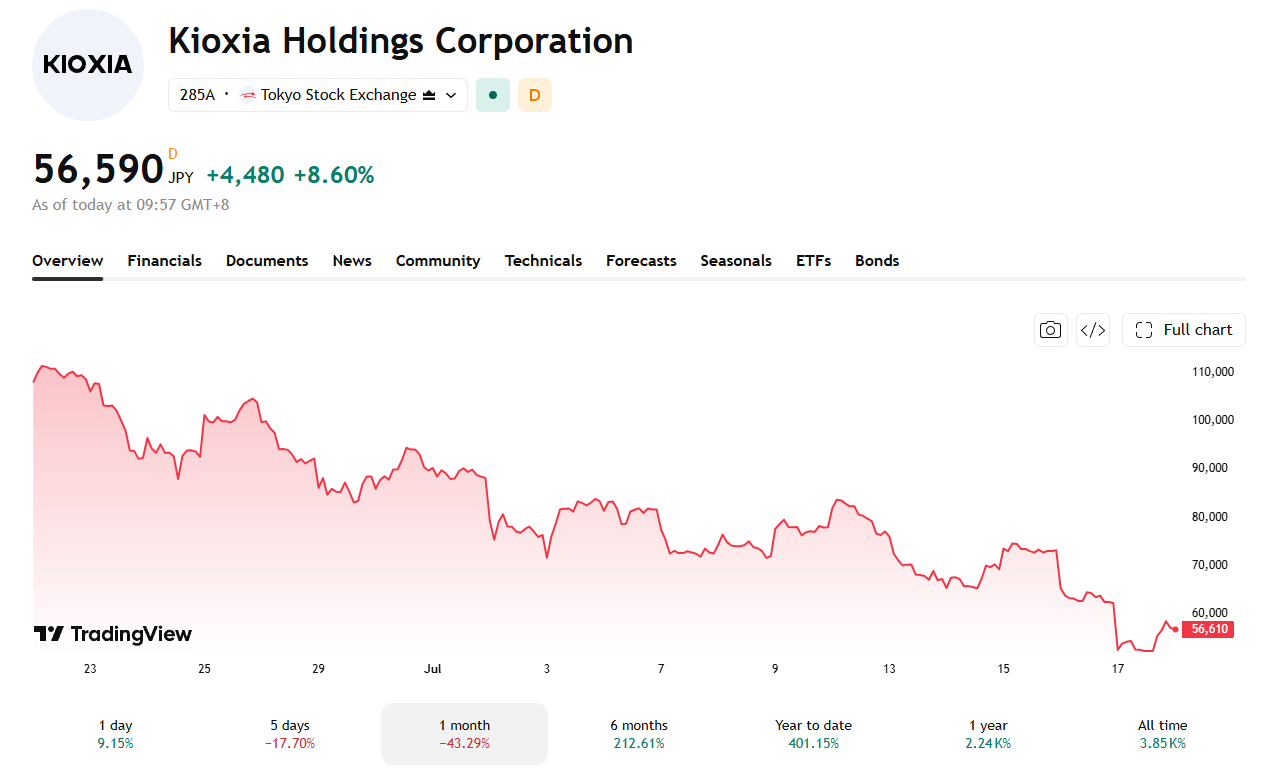
Japan’s Kioxia Holdings Corporation (285A) stock crashed 45% in a month, but Wall Street analysts still expect it to climb another 118% from here.
That gap raises an obvious question. Why do so many analysts still back a stock that crashed this fast?
The Bull Case Analysts Are Sticking To
Kioxia shares fell to a low of ¥52,110 last Friday, but have managed a small comeback, up nearly 9%, to ¥55,860 on Tuesday, July 21. However, this still leaves the stock down 42% for the month, currently.
This is especially noteworthy given Kioxia hit a record high of ¥111,250 on June 22, making it briefly Japan’s largest company by market cap, overtaking Toyota.
Despite this boom-and-bust, Kazuyoshi Saito, senior analyst at Iwai Cosmo Securities, still holds his target at ¥132,000.
“The fundamentals have not changed at all,” Saito said.
He argues the AI-driven demand story remains solid. He expects the shares to recover once technical selling fades.
Meanwhile, Nomura Securities raised its target from ¥115,000 to ¥126,000 last week. Huaxing Research lifted its target above ¥100,000 around the same time. The consensus target near ¥121,959 implies about 118% upside from Tuesday’s close.
Why the Bulls Look Out of Step With the Chart
Kioxia’s chart doesn’t look like a stock about to rally 118%. The stock’s boom-to-bust reversal has wiped out most of this year’s gains.

Some analysts say the memory stock rally has run too far, not just cooled off.
In contrast, Ikio Mitsuishi, portfolio manager at Aizu Securities, expects Kioxia to stay weak until at least late August. He said investors may avoid piling back into one stock so fast. Many could rotate into cheaper, less volatile names instead.
A Pattern That Goes Beyond Kioxia
Kioxia isn’t the only Asian chipmaker swinging this hard. SK Hynix’s Nasdaq-listed shares have surged more than 20% in a day, then dropped double digits days later.
The wider chip selloff across Japan has erased trillions of yen in market value this month.
The real test for Kioxia bulls isn’t the target price. It’s whether Asia’s chip-stock volatility settles down before earnings season arrives.
The post Kioxia Crashed 45% in a Month: Why Are Analysts Still This Bullish? appeared first on BeInCrypto.
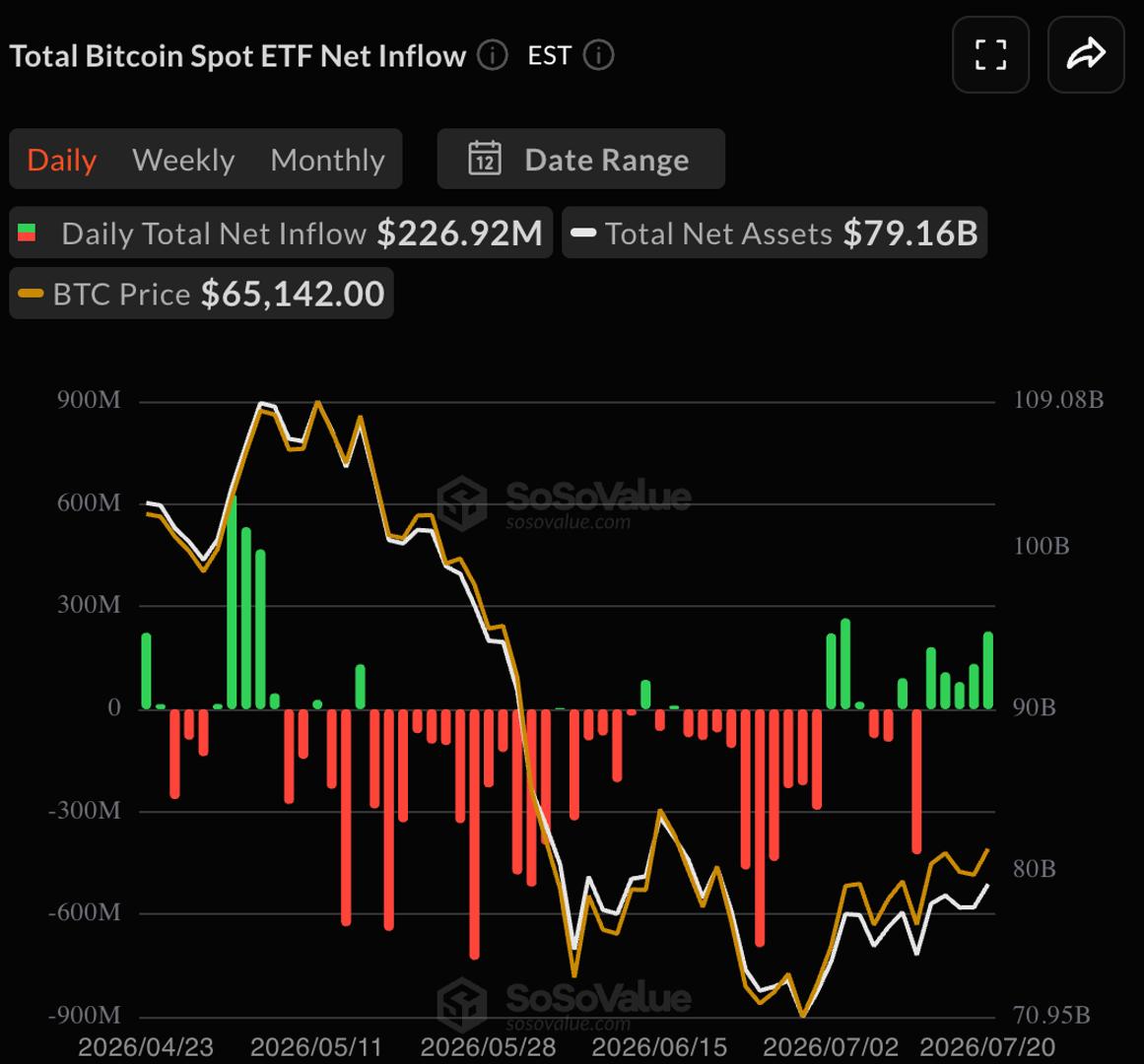
U.S. spot bitcoin ETFs took in about $227 million on July 20, a fifth consecutive day of net inflows for the first time since late April, per SoSoValue data. Ether ETFs added about $38 million, led by BlackRock’s ETHA.
The five-day run has pulled in roughly $727 million, the most sustained stretch of buying since the record outflows of June. Total bitcoin ETF assets have climbed back to about $79 billion from a July low near $75 billion. BlackRock’s ETHA drove the ether side with about $34 million.
Bitcoin has held its range near $63,000 as last week’s chip-driven selloff paused, and the return of the ETF bid is the piece that had been missing through a quarter of mostly outflows.
The test is what it holds through. The Fed meets July 28 and 29, and Big Tech earnings land this week, with Alphabet, Tesla and Intel reporting the numbers that will show whether AI spending, the trade bitcoin has moved with all month, is still climbing.


UK politicians want to know the extent to which the country’s banks have choked-off cryptocurrency firms by refusing them bank accounts and introducing restrictions on crypto-related payments, in a cross-party inquiry kicked off on Tuesday.
The UK’s Crypto and Digital Assets All-Party Parliamentary Group (APPG) is chaired by Lord Vaizey of Didcot, the former UK Government Minister for the Digital Economy, and Labour MP Gurinder Singh Josan CBE, according to a press release.
Ever since crypto came into being, difficulties around attaining banking relationships have made life hard for players in the space, with a systematic debanking of firms and individuals, particularly in the U.S. being referred to as “Operation Chokepoint 2.0.”
Several major UK banks have also introduced restrictions on crypto-related payments, the APPG said in a statement. As such the inquiry will focus on a dearth of bank accounts for crypto businesses, including associated professional services such as insurance.
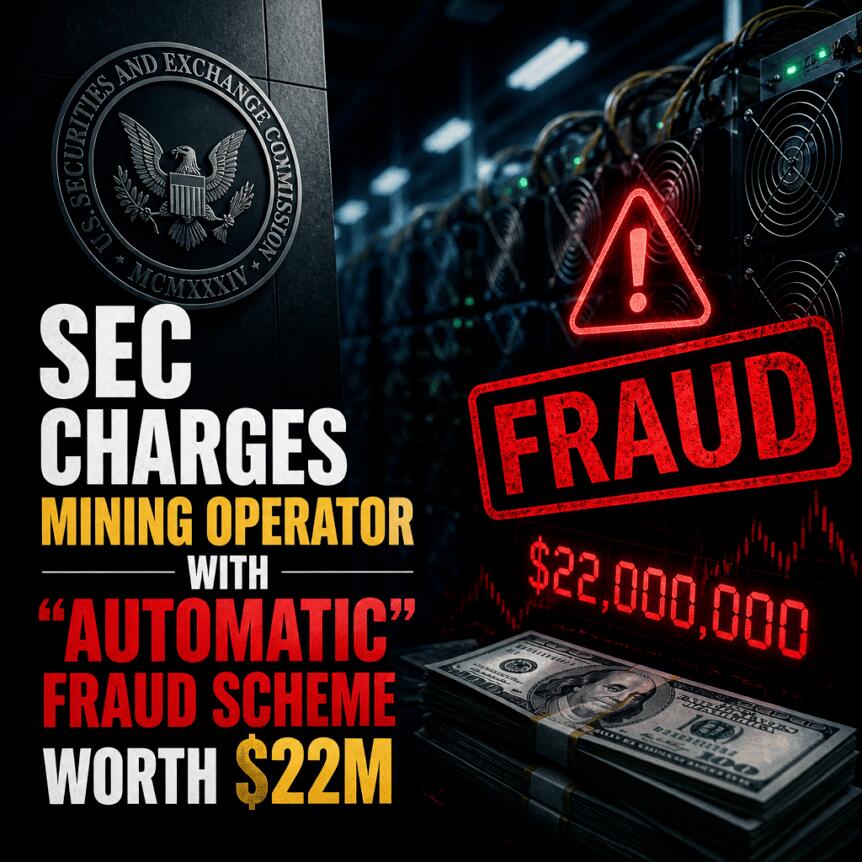
The U.S. Securities and Exchange Commission (SEC) has filed a lawsuit against crypto mining investment firm Mining Automatic and its founder, Zan Shaikh, accusing them of raising $22 million from investors while allocating only a small portion of the money—about 13%—to mining operations.
According to the SEC’s complaint, the scheme was run through Massachusetts-based Bright Vision Distribution LLC. The agency alleges the business collected funds from more than 380 investors between June 2023 and May 2025, promising monthly, guaranteed returns tied to cryptocurrency mining.
Key takeaways
- The SEC alleges investors were promised guaranteed monthly returns from mining, despite the company generating far less revenue from mining than it paid out.
- Proceeds, according to the SEC, were heavily directed toward advertising and personal or unrelated expenditures rather than mining operations.
- The SEC says Mining Automatic stopped making investor payments by March 2025 and that investors had not recovered their principal.
- The regulator is also signaling a broader shift toward rulemaking for digital assets alongside enforcement actions.
SEC alleges mining payouts didn’t match promised returns
The core allegation in the SEC’s complaint is that the promotional claims did not reflect the operation’s financial reality. The agency states that Mining Automatic advertised payouts as returns from crypto asset mining while its mining activities allegedly produced only about $1.1 million.
Meanwhile, the SEC claims investors received roughly $1.8 million in purported returns. The agency argues that the shortfall required payments to be funded using money from other investors, describing the operation as having “some of the hallmarks of a Ponzi scheme.”
In addition to questioning the returns model, the SEC points to how investor funds were used. The complaint alleges that about $7 million was spent on advertising to attract additional investors, while Shaikh purportedly used investor money for real estate, vehicles, entertainment, and transfers into personal accounts.
Fundraising scope and alleged investor exposure
In its filing, the SEC says Bright Vision Distribution LLC collected the $22 million from more than 380 investors over a two-year span, from June 2023 through May 2025. The SEC also alleges that as the program unraveled, payments stopped by March 2025.
Once payments halted, the SEC contends that none of the investors had recovered their original investment amounts. The complaint states that more than $20 million in principal remains unpaid, according to the SEC’s allegations.
For investors and market participants, the lawsuit underscores a recurring risk in the crypto-adjacent “yield” space: returns tied to mining or other on-chain activities can be presented in a way that obscures financing gaps, and “guaranteed” payout language can draw closer scrutiny from securities regulators.
Regulator seeks penalties and restrictions on Shaikh
The SEC is seeking multiple remedies in the case, including disgorgement and civil penalties. The agency also requests permanent injunctions and asks the court to bar Shaikh from selling securities and from serving as an officer or director of a public company.
These requests reflect the SEC’s typical enforcement posture in cases that it frames as securities fraud and unregistered securities activity, particularly where the regulator argues investor money was misused and returns were not supported by the underlying business model.
The complaint is publicly available on the SEC’s website: SEC litigation document.
Enforcement arrives amid SEC’s stated rulemaking push
While the Mining Automatic case focuses on alleged wrongdoing by a specific operator, it is also landing during a broader period in which the SEC has emphasized building clearer regulatory frameworks for digital assets. Under Chair Paul Atkins, the agency has increasingly pointed to rulemaking efforts rather than relying solely on enforcement.
In June, the SEC published its 2026–2030 Strategic Plan, identifying blockchain technology, tokenization, and crypto market infrastructure among its long-term priorities while reaffirming its investor-protection mandate. Later, in July, the SEC outlined a 2026 rulemaking agenda that includes potential new rules for crypto broker-dealers, digital assets traded on national securities exchanges and alternative trading systems, and possible exemptions or safe harbors for certain digital asset offerings. (The SEC’s agenda was covered in earlier reporting by Cointelegraph: SEC crypto rule changes 2026 agenda.)
At the same time, congressional activity is also aimed at reshaping how U.S. oversight works across agencies. A proposed legislative package—referred to as the Digital Asset Market Clarity Act—would, if enacted, clarify the respective roles of the SEC and the Commodity Futures Trading Commission (CFTC). The bill is expected to face a key Senate vote before the August recess, according to the broader legislative timeline described alongside recent crypto oversight coverage.
In that context, the Mining Automatic lawsuit functions as both a case-specific warning and a signal of where the SEC may draw lines: where a company offers “investment” arrangements with promised returns, the regulator may treat the arrangement through a securities lens—especially when the underlying economics do not appear to support the payout structure.
What to watch next
Investors and builders should watch how the court addresses the SEC’s allegations about the mismatch between advertised mining returns and the company’s stated mining revenue, as well as whether the SEC’s accompanying push toward digital-asset rulemaking eventually narrows the space for similarly structured “guaranteed return” offerings. In the meantime, the case adds another enforcement datapoint for anyone evaluating crypto-linked investment products marketed as stable, predictable yield.
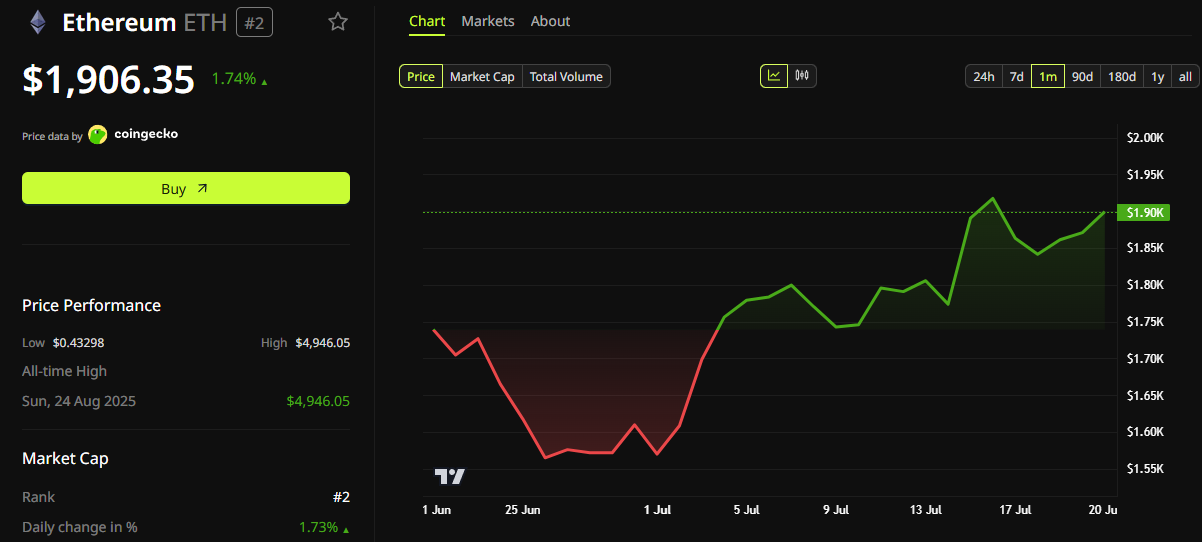
Arthur Hayes bought another 1,332.5 ETH ($2.53 million) today, according to on-chain tracking data shared on X. The purchase extends a buying streak from the BitMEX co-founder. It also renews attention on Ethereum’s institutional demand story.
Hayes sold 6,000 ETH at a roughly $606,000 loss in June. He then reversed course with a series of buybacks in July as some discuss Ethereum’s role in the next bull run for crypto.
Hayes Extends a Pattern of ETH Accumulation
The latest purchase follows Hayes’ return to Ethereum earlier this month. He acquired roughly 1,939 ETH then across two OTC-style transactions. That reversal came weeks after his June exit.
Critics have flagged Hayes’ record of praising tokens like HYPE, ZEC, and WLD before quietly exiting those positions. Ether trades at $1,906, up 1.74% over 24 hours, with a market capitalization over $230 billion.

Some See Institutional Demand Driving the Next Cycle
With some larger accumulation and whale movement around ETH, some are noting a broader shift in Ethereum’s bull case toward institutions. Bitmine Immersion Technologies Chairman Tom Lee argues that Wall Street adoption now drives Ethereum’s growth, not crypto-native speculation. He points to BlackRock’s tokenized BUIDL fund and Robinhood Chain’s use of ETH as a gas token.
“Unlike the crypto bear market of 2022, Wall Street is building on Ethereum.”
— Tom Lee
The staking data backs that thesis. Ethereum’s staking ratio hit an all-time high of above 33% at the end of June, according to CryptoQuant. BlackRock helped drive that shift when it launched the iShares Staked Ethereum ETF, which locks most of its holdings in staking contracts.
Institutions and ETFs held more than 9% of Ethereum’s total supply as of last year, and that share has likely grown since. Also last year, Standard Chartered’s Geoff Kendrick argued that Ethereum treasuries are among the strongest institutional crypto trades available, citing staking yield and stronger valuations compared with Bitcoin and Solana treasury vehicles.
Hayes’ latest buy may reflect conviction in that institutional thesis. Or it may just be another short-term trade. The coming days should make it clearer.
The post Ethereum Could Lead the Next Bull Market: Is Hayes Preparing with More Buys? appeared first on BeInCrypto.

Bolton’s Bumps, Boobs and Buggies walking groups return

Complete Hints and Solution to Puzzle Number 1136

Ripple-linked token up 4% as traders watch breakout toward $1.35


-
 NewsBeat5 days ago
London Mayor Sadiq Khan handed a peerage by Keir Starmer alongside 15 other Labour figures… just days before the PM leaves No10
-

 Fashion4 days ago
Weekend Open Thread – Corporette.com
-

 Politics3 days ago
The House | The City of London can help the new chancellor deliver growth in every postcode
-

 Politics6 days ago
Young campaigners urge incoming PM to act on outdoor junk food ads
-

 Crypto World5 days ago
CFTC blocks Kalshi from unwinding Michigan trades after court order
-
 Crypto World4 days ago
Two July Windows Left: The CLARITY Act’s Senate Fight and What Failure Means
-

 Crypto World3 days ago
Ripple Payments Joins MiCA With 14 Firms, Does It Mean Anything For XRP?
-

 Business5 days ago
Nvidia Stock Slips After Big Tuesday Rally as Huang Confirms Vera Rubin Chip Is Now in Production Today
-

 Politics2 days ago
Democrats look to World Cup watch parties to register thousands of voters
-
 Entertainment6 days ago
Disney’s Most Ambitious Failed Star Wars Attraction Is Coming to SDCC
-

 Crypto World3 days ago
Ripple wins EU-wide access as ESMA adds it to MiCA register
-

 Crypto World4 days ago
Injective Submits SEC Transfer-Agent Registration to Onchain Ownership Records
-

 Business5 days ago
Palantir Shares Rise After Expanded Nvidia Partnership and Fresh Analyst Upgrades Ahead of Earnings Day
-

 Tech7 hours ago
Sail Virtually Aboard The “Itanic” With IA-64 Emulator
-
 Tech4 hours ago
Turtle Beach Command Series KB7 review: a nifty screen-equipped gaming keyboard
-

 News Videos6 days ago
XRP BOMBSHELL… XRP OMBOARDED FOR TRANSACTIONS!!!
-

 Tech6 days ago
Dark Secrets Emerge When Jailbreaking LLMs
-

 NewsBeat4 days ago
Registration is now open for March for Men with Kev 2026
-

 NewsBeat20 hours ago
Unregistered fitter used Gas Safe logo on business flyers
-
 Sports5 days ago
New Cornerback Enters Vikings Trade Rumor Mill
You must be logged in to post a comment Login