
Crypto World
Pepe price rallies over 20% amid market rebound, can it reclaim its February highs?

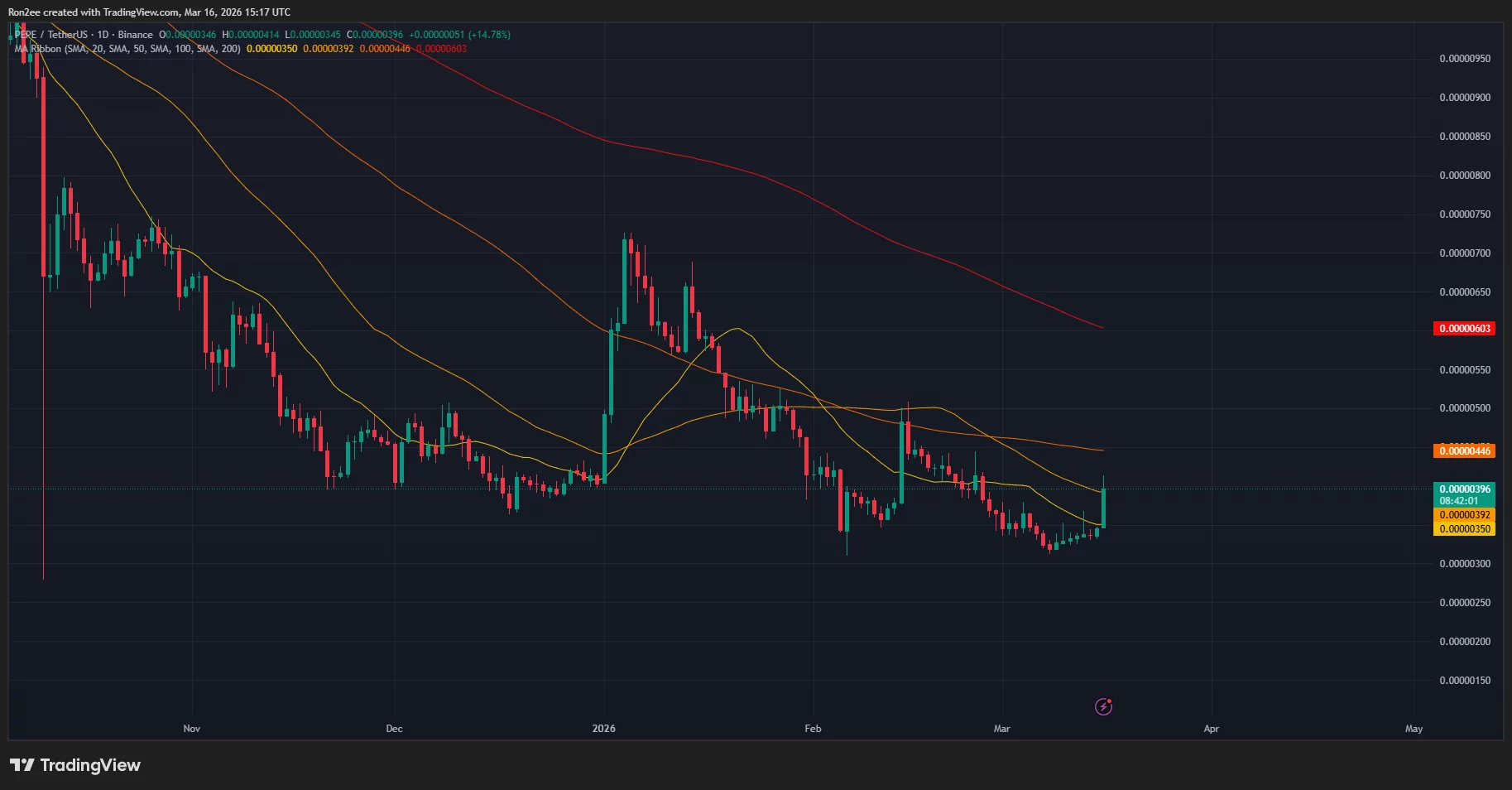
Pepe price rose as the best performer in the crypto market amid a market-wide recovery triggered by Bitcoin’s surge past $74,000 support.
Summary
- Pepe price jumped about 21% to a two-week high as the broader crypto market rebounded following Bitcoin’s surge above the $74,000 level.
- Trading activity surged sharply, with PEPE’s daily volume rising more than 380% as nearly $1 billion worth of the token changed hands.
- Technical indicators show bullish momentum building, with PEPE moving above key moving averages while traders watch resistance near the 100-day SMA.
According to data from crypto.news, Pepe (PEPE) price shot up 21% to a two-week high of $0.000040 as of last check on Monday, March 16. Despite this, it still remains nearly 19% below its February high of $0.0000049.
Pepe’s gains came primarily due to a broader market recovery that followed Bitcoin’s surge past the $74,000 resistance level, which boosted investor demand for risk assets. Ethereum (ETH) was also up 8% at the time of writing, while other major coins such as XRP, SOL, DOGE, and ADA also marched higher.
As a high-beta memecoin, PEPE amplified the gains of the broader market, outperforming the global average with its staunch rebound today.
PEPE’s rebound was further fueled by a notable surge in trading activity. Over the past 24 hours, its daily trading volume shot up over 380% as nearly $1 billion worth of Pepe coin exchanged hands between traders.
Technical indicators seem to suggest that the Pepe price could still have steam left to sustain its rally at least over the following sessions.
Notably, the Pepe price has surged past the 20-day and 50-day moving averages as it formed a god candle today. This explosive vertical movement indicates strong buying pressure and a shift in market sentiment.
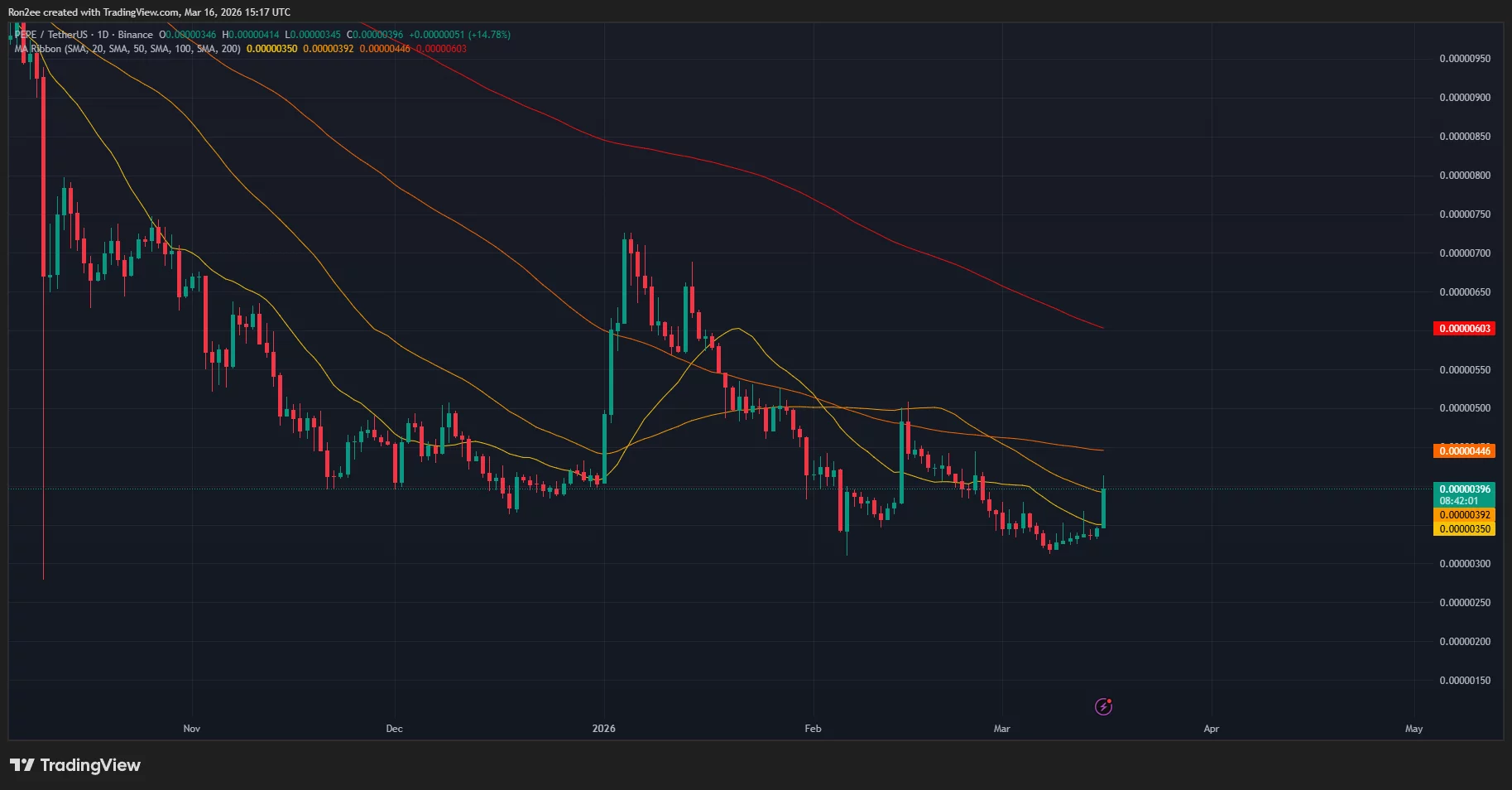
The next target for PEPE stands at the 100-day SMA at $0.0000044, which represents a key resistance level that bulls must flip to confirm a long-term trend reversal.
Momentum indicators like the MACD and RSI show that bulls were still holding the upper hand in the current market structure. The MACD lines were pointing upwards after a bullish crossover, confirming that upward momentum is accelerating.
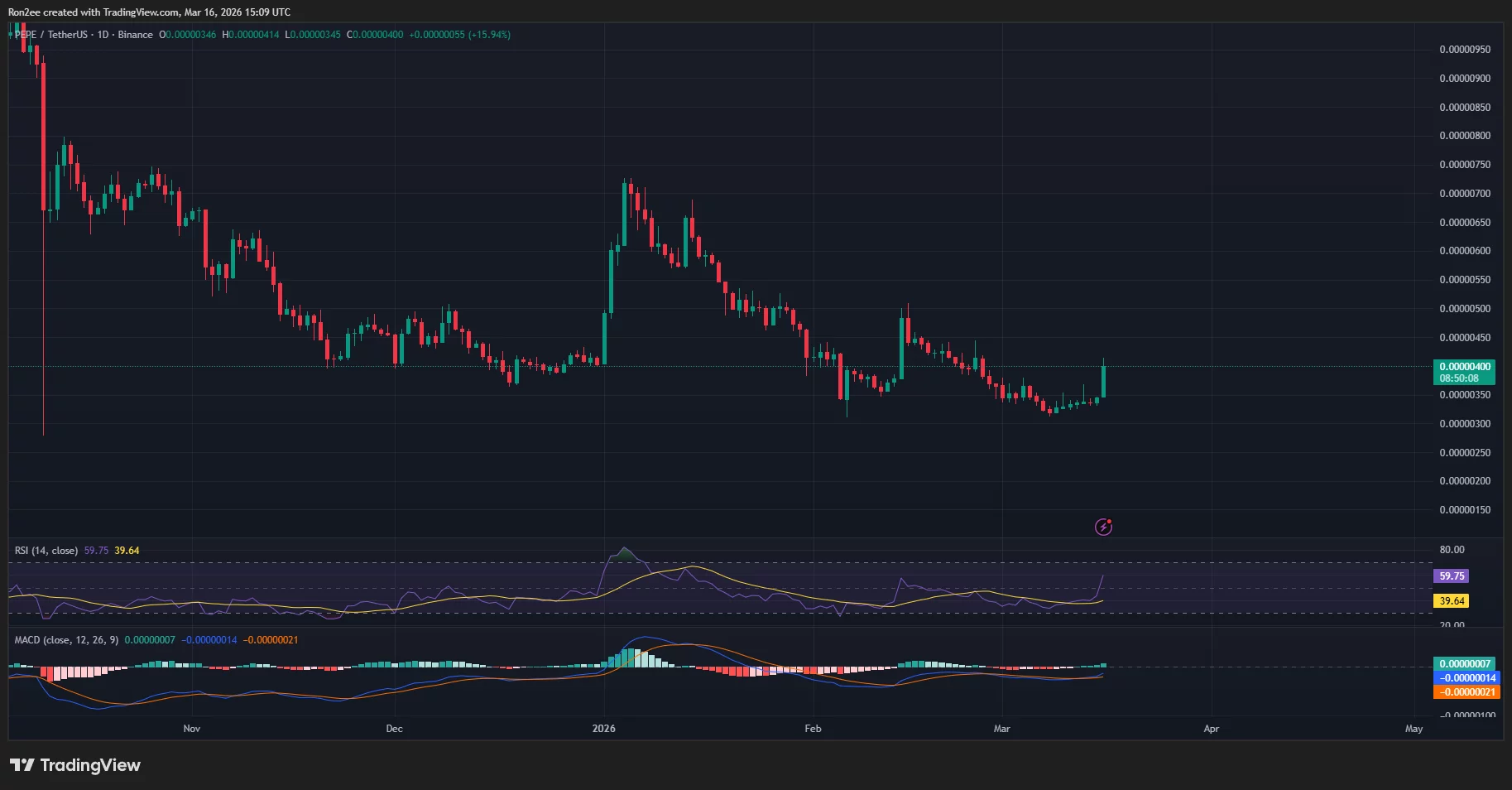
Meanwhile, the RSI has recently surged past the neutral threshold with still room before hitting overbought levels where a reversal usually takes place. This suggests that the current rally has not yet reached a point of exhaustion.
However, there remains a risk to Pepe’s ongoing rally, as is common with highly speculative meme coins with no fundamental utility.
The risk is that Pepe’s rally could likely be a dead cat bounce, a temporary recovery in a declining market where an asset falls back after staunch rallies, as seen for Pepe coin today.
Without sustained organic demand or a broader market breakout, these gains can quickly evaporate as early investors move to take profits.
In case of a retracement, $0.0000039, which aligns with the 50-day SMA, would act as an immediate support level. If this floor fails to hold, the price could slide further to retest lower liquidity zones, potentially wiping out today’s gains.
Disclosure: This article does not represent investment advice. The content and materials featured on this page are for educational purposes only.



The crypto market rose 3.5% to $2.6 trillion on Monday, March 16, as investors returned to risk assets after rotating from traditional hedges.
Summary
- The crypto market rallied as Bitcoin surpassed the $74K resistance as investors rotated away from traditional safe-haven assets.
- Demand for crypto ETFs returned with $1.34 billion in inflows into spot Bitcoin ETFs and nearly $180 million in inflows into Ether-linked funds this month.
- The Crypto Fear and Greed Index has moved back to neutral levels.
Bitcoin (BTC), the world’s leading crypto asset, rallied 4% to break above the $74,000 resistance level for the first time in over five weeks, while Ethereum (ETH) was up 6% over the past 24 hours, trading at $3,243 at press time.
Other major altcoins such as XRP (XRP), Solana (SOL), and Dogecoin (DOGE) recorded gains ranging between 4% and 5% each. Some of the top performers of the day were Pepe (PEPE), Polkadot (DOT), and Bonk (BONK), all of which brought in double-digit gains.
As prices rose, it triggered liquidations of highly leveraged traders in the crypto derivatives markets. According to data from CoinGlass, crypto liquidations mounted to $370 million, with the majority coming from short sellers who were forced to buy back their positions.
The total open interest of the market went up 8% over the last trading session, increasing liquidity across the board and providing the necessary momentum to push the market higher.
The crypto market surged as investors turned toward Bitcoin and other risk assets amid escalating geopolitical tensions in the Middle East that have driven crude oil prices to multi-year highs.
Notably, oil benchmarks like Brent and West Texas Intermediate (WTI) have moved above $95 each. Iran aims to push prices as high as $200 over the coming weeks, sparking global concerns regarding runaway inflation.
Investors seem to be rotating capital from safe-haven assets like gold into cryptocurrencies, likely eyeing digital assets as a better hedge against currency debasement. Notably, the gold price has dropped back under $2,500 after hitting record peaks earlier, while silver prices have dipped by 3% over the past 24 hours.
Data from SoSoValue shows that institutional demand for crypto ETFs has also seen an uptick. U.S. Bitcoin ETFs have drawn in $1.34 billion in net inflows so far in March, while their Ethereum counterparts have experienced $180 million in inflows. In comparison, the SPDR Gold Trust (GLD) has faced consistent outflows over the last two weeks.
The crypto market rebound was a standalone event that deviated from the traditional Asian stock markets today. Notably, Chinese stock indices like the Hang Seng and Shanghai Composite dropped by over 0.70%, while Japan’s Nikkei 225 dropped by over 1.2%.
Market rose as investors bought the U.S.-Iran war news
Crypto prices also rallied today as investors appear to be buying the dip following the initial shock of the U.S.-Iran conflict.
While Bitcoin fell sharply before military actions between the two nations escalated, hitting lows near $63,000 in late February, the current rally suggests the market has already priced in the immediate risks of war.
Crypto Fear and Greed Index returns to neutral threshold
The market rebound also comes as investor sentiment seems to have improved significantly from weeks earlier. The Crypto Fear and Greed Index reading has moved back to neutral levels of 40, up from the extreme fear zone of 16 seen at the beginning of March. As of now, the neutral sentiment seems to have stabilized the floor for major assets.
Will Bitcoin price keep rising?
Looking ahead, the key drivers that will decide the near-term trajectory for the crypto market include the Federal Reserve interest rate decision scheduled for Wednesday and the ongoing progress regarding the conflict in Iran.
Economists generally expect the Federal Reserve to leave interest rates unchanged between 3.50% and 3.75% while hinting at a continued status quo as inflation remains elevated.
If the military conflict shows signs of de-escalation, we could see a sustained relief rally in digital assets. However, any hawkish commentary from the Fed regarding sticky inflation could quickly dampen the current market enthusiasm.
Meanwhile, analysts at Marex also pointed to improving spot market signals that may be supporting the current recovery.
“The Coinbase premium turning positive for the first time in 10 weeks is the kind of detail investors should pay attention to,” Marex analysts noted in a statement to crypto.news.
“It suggests that spot demand is finally returning onshore rather than the move being driven purely by leverage. When the premium flips positive, rallies tend to hold better because real money is lifting offers instead of traders simply closing short positions.”
Disclosure: This article does not represent investment advice. The content and materials featured on this page are for educational purposes only.
Crypto World
Remittix Could Sit Amongst Top Crypto Assets Like Cardano and Solana by the End of 2026

Cardano and Solana have taken years to build a position within the market that many of the original cryptocurrency investors can only dream of.
That is to say, they have built a position within the market as large, liquid, and well-known cryptocurrencies safely nestled within the upper echelon of the cryptocurrency market. Both Cardano and Solana have accomplished this by building support within the developer community.
Now, a different project is being discussed in the same breath. Remittix (RTX), currently priced at $0.13 and having raised $29.7 million in private funding, is generating the kind of early momentum that investors who tracked Cardano and Solana in their formative stages will find familiar.
The Case for Remittix Reaching Top-Tier Status
Cardano is currently trading at $0.2619, down 1.06% on the day. It has a market capitalization of $9.45 billion and a trading volume of $371.55 million, which is up 41%. It is interesting to note that its trading volume is increasing in a period when markets are generally weak.

It is also continuing to enhance its DeFi and smart contract offerings with its ongoing developmental releases. Additionally, it has a proof-of-stake blockchain that has gained traction among institutions as a possible solution for projects looking for a more energy-efficient alternative to the traditional proof-of-work-based blockchain network.
The price of Solana is currently trading at $87.88. This is a decrease of 0.17% on the day. The market capitalization is $50.2 billion, while the trading volume is $2.12 billion, which is down by 57.69%. Solana is considered to be among the most used blockchain networks within the crypto world.

It is a preferred blockchain because of its gas fees and transaction speeds. That is why it is a preferred choice for decentralized applications that are consumer-facing. Cardano and Solana have come to where they are today because of their focus on providing a solution to real-world problems for real-world users.
Cardano solved the problem of providing a blockchain that had rigorous design and peer review. Solana solved the problem of providing high-speed, low-cost transactions. Remittix is providing a solution to the problem of moving funds between cryptocurrencies and traditional bank accounts.
What Remittix Is Building Toward
The argument for Remittix sitting alongside Cardano and Solana by the end of 2026 rests on product delivery, market size, and exchange accessibility. Remittix is targeting the $19 trillion global payments market with a PayFi platform that enables crypto-to-fiat transfers across 30-plus countries. That use case is not speculative. Cross-border remittances and international business payments are among the largest and most persistent frictions in global finance.
The Remittix Wallet is already live on the Apple App Store as a fully functional cryptocurrency wallet. Community coverage of the wallet’s development has been consistent since launch, and the app has crossed 100,000 downloads before a single major CEX listing. Crypto-to-fiat functionality will be integrated into the wallet once the PayFi platform is complete, and a Google Play release is in progress for Android users.
With $29.7 million raised in private funding and RTX currently at a low price of just $0.13, Remittix enters the exchange listing phase with verifiable product traction and an investor base that has been growing steadily. Future listings on BitMart and LBank are confirmed, with additional top-tier CEX announcements expected as the project reaches further milestones.
The Foundations Remittix Has Built Before Listing:
- Live wallet on the App Store with 100,000+ downloads
- CertiK-audited smart contracts and fully verified team
- $29.7M in private funding, 723.8M tokens in holder wallets
- Crypto-to-bank transfers at launch across 30+ fiat currencies
- 15% USDT referral rewards claimable daily via dashboard
Holders can also earn 15% of each referred purchase paid in USDT, through the Remittix referral program. That passive income structure rewards community participation before the token has even reached the open market, a feature that neither Cardano nor Solana offered at equivalent stages of their development.

How Projects Move from Early-Stage to Top-Tier
Cardano and Solana both spent time as early-stage altcoins before the crypto market recognised their full potential. What separated them from the hundreds of projects that did not scale was a combination of working technology, real user adoption, and access to liquidity through centralized exchanges.
Remittix currently has working technology in the form of a live wallet. Real user adoption is building through downloads and referral activity. Exchange liquidity is the next stage, with confirmed listings on the way and further announcements expected.
For crypto investors identifying the best crypto to buy now at an early stage, the comparison to Cardano and Solana is not about price targets. It is about recognising the structural conditions that allow a project to grow from a private funding round into a recognised digital asset with sustained market presence.
Discover the future of PayFi with Remittix by checking out their project here:
Website: https://remittix.io/
Socials: https://linktr.ee/remittix
Disclaimer: This is a Press Release provided by a third party who is responsible for the content. Please conduct your own research before taking any action based on the content.

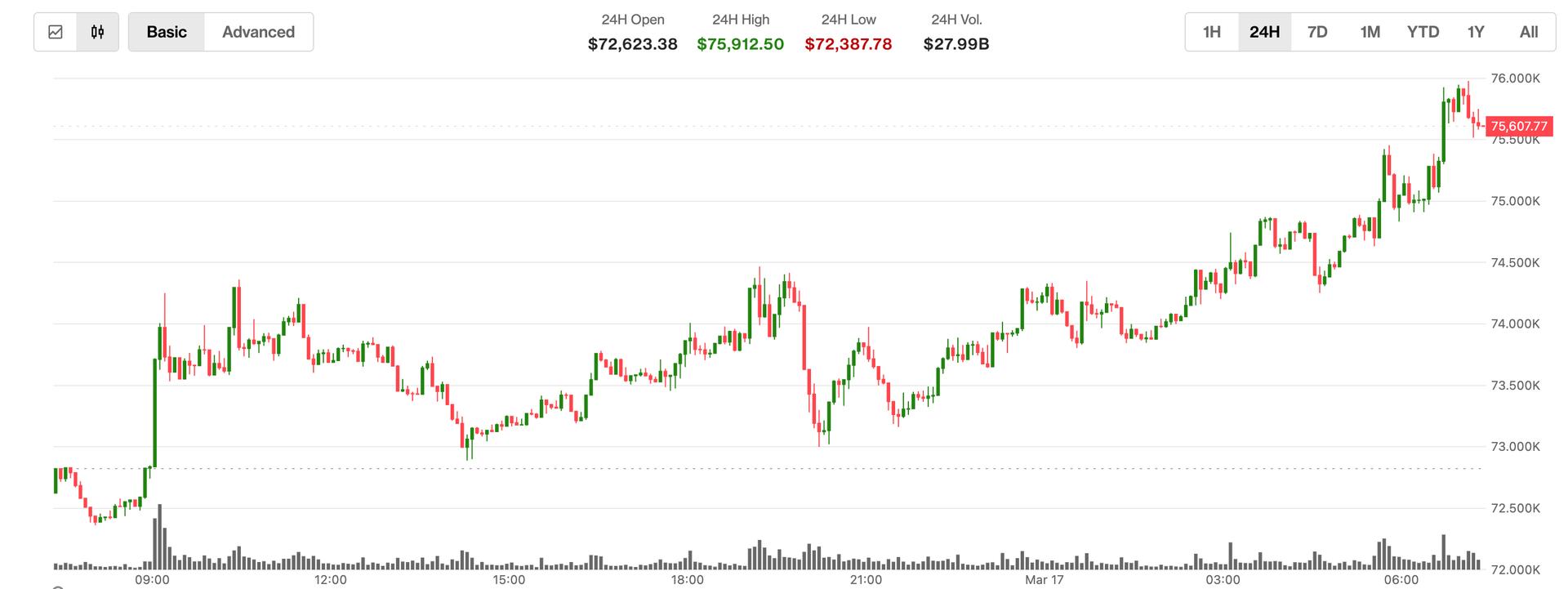
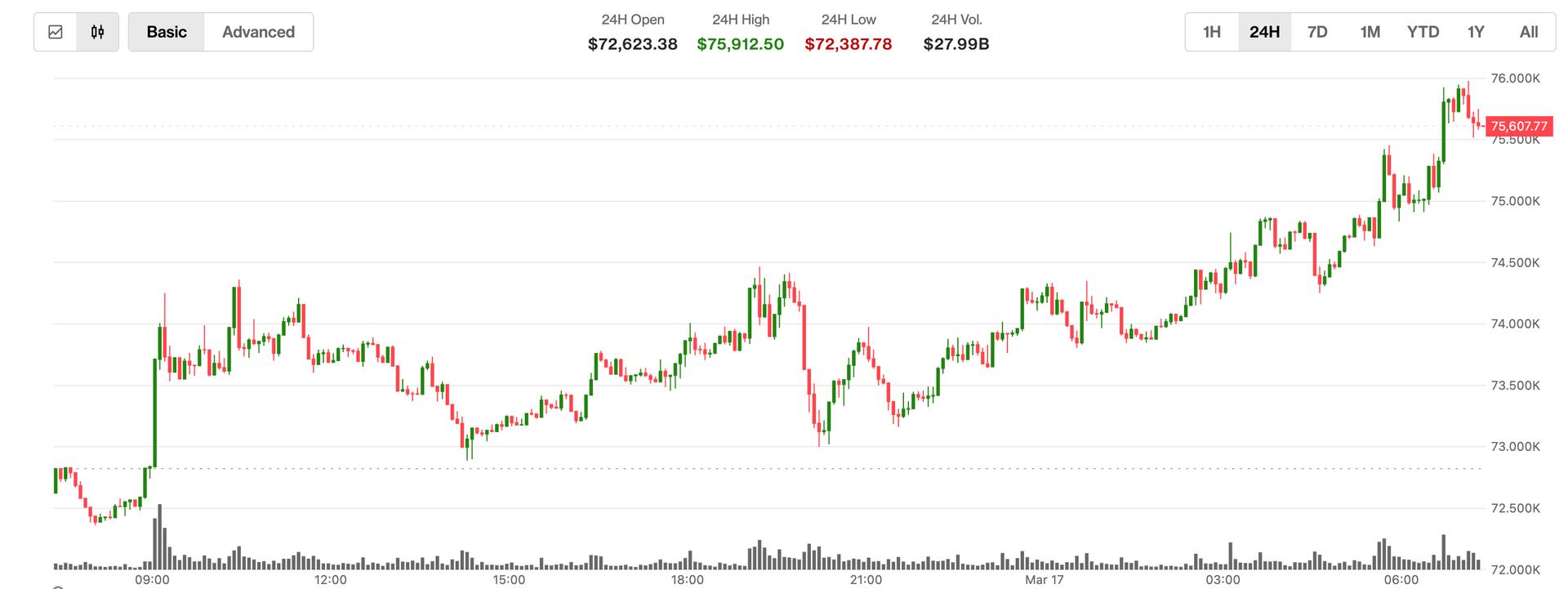
Bitcoin surged past $75,000 early Tuesday, helped by shifting dynamics in the derivatives market.
Prices hit a high of $75,800, convincingly topping the long-term resistance corridor between $73,750 and $74,400, which reversed price trends three times since 2024, according to CoinDesk data.
The so-called bullish breakout happened as traders closed bearish short positions initiated during the early February sell-off.
“In bitcoin, the recent move has been driven largely by sizeable put selling around the $55,000 and $60,000 strikes, as traders increasingly recognized that these options were unlikely to expire in the money with only days remaining. The unwinding of these downside hedges has contributed to the latest bullish price action,” Markus Thielen, founder of 10x Research, said in a note to clients.
A put option is a derivative contract that gives the right to sell the underlying asset, in this case, BTC, at a fixed price before a certain date. Traders buy puts when they think the price might fall or when they want protection against losses. It’s basically an insurance against price drops, while a call option provides upside exposure.
Traders aggressively bought put options at $60,000 and lower levels in early February as bitcoin crashed, nearly hitting the $60,000 on some exchanges. However, since then, market sentiment has stabilised, forcing traders to reassess their bearish positions.
The unwinding of these bearish bets also has second-order bullish effects.
“The selling or closing of Bitcoin put options reduces downside hedging pressure and forces market makers to buy BTC to rebalance their exposure, creating supportive flows that can push prices higher,” Thielen said.
CoinDesk warned last week that the rally could accelerate as prices near $75,000, largely due to market makers’ expected hedging activities.
So far, however, there has not been a significant upside call buying. This suggests the move has so far been driven more by hedge unwinds than by aggressive bullish positioning, Thielen explained.
Altcoins surge
Bitcoin’s rally has lifted the broader crypto market, with the CoinDesk 20 Index gaining 5% to 2,202 points over the past 24 hours.
Ether (ETH) has gained nearly 8% to $2,360, helped by increasing demand for bullish options bets. XRP (XRP) and solana (SOL) have gained 8% and 4%, respectively.
ZEC, PEPE, DOT, and VIRTUAL are other standout performers.
Crypto World
South Korea’s Hana Financial and Standard Chartered partner to explore crypto and stablecoins


South Korea’s Hana Financial Group has signed a memorandum of understanding with the Standard Chartered Group to collaborate on digital asset initiatives.
Summary
- Hana Financial Group has signed a memorandum of understanding with Standard Chartered to cooperate on digital asset initiatives, including potential work around stablecoins.
- The partnership brings together the two banks’ global networks and financial expertise as they explore cryptocurrency-related services.
- Hana has continued to expand its digital asset footprint through custody services and stablecoin research.
Local media reports from March 16 claim that the two institutions plan to leverage their combined expertise and global networks to expand their presence in traditional finance.
As part of the partnership, the two companies will also explore joint initiatives in digital finance involving cryptocurrencies. Reports suggested the plans also include stablecoins.
“The partnership between Hana Financial Group and Standard Chartered Group, leveraging their extensive global networks and diverse financial know-how, will serve as a strong competitive edge in the global financial sector.’ Ham Young-joo, Chairman of Hana Financial Group, said in an accompanying statement.
‘We will create new growth opportunities by generating synergies in future financial domains, including digital assets,” he added.
Recently, both firms have been stepping up their involvement in digital asset markets as banks around the world look to integrate blockchain-based financial services.
Hana Financial Group is one of South Korea’s major financial conglomerates, and it has already explored stablecoin issuance through a partnership with KB Financial Group and Shinhan Financial Group.
As reported by crypto.news on Nov. 10, 2025, Hana will work with the other financial groups and major technology companies to develop the infrastructure required for potential Korean won pegged stablecoins and related digital payment systems.
Back in 2023, Hana partnered with crypto custodian BitGo to develop its digital asset custody services. Subsequently, the two and local telecommunications giant SK Telecom set up BitGo Korea, where Hana owns a 25% stake.
Meanwhile, Standard Chartered has launched products tied to crypto ETFs and has also ventured into other crypto-facing institutional services, including spot crypto trading desks and regulated digital asset custody.
Earlier this month, it was revealed that the banking giant was also set to receive a stablecoin issuance license in Hong Kong as part of the city’s effort to build a regulated digital asset ecosystem. It had previously signalled plans to issue a Hong Kong dollar pegged stablecoin through a joint venture.

Cardano Returns to Top 10 by Market Capitalization
Cardano moved back into the top ten cryptocurrencies after a broad market rebound lifted several major tokens. The asset gained nearly ten percent in daily trading and strengthened its market position. Consequently, the rally pushed Cardano ahead of Hyperliquid in overall valuation.
Cardano now holds an estimated market capitalization of about $10.34 billion. That figure places the asset tenth among global cryptocurrencies. Meanwhile, Hyperliquid follows closely with a market value of nearly $10 billion.
The rebound followed a strong week for digital assets across the market. Major tokens advanced as equity markets recovered and risk appetite improved. At the same time, altcoins rose faster than Bitcoin during the recent trading sessions.
Altcoin performance outpaced Bitcoin during the latest surge. Cardano gained roughly nine percent within twenty-four hours while Bitcoin added about three percent. Therefore, traders shifted toward higher volatility assets during the rally.
Market indicators also showed renewed strength across alternative cryptocurrencies. The altcoin season index climbed to forty-eight out of one hundred. That level marked the highest reading in more than two months.
ADA Futures Activity Signals Strong Leverage Demand
Derivatives data also supported the upward move in Cardano’s price. Open interest in ADA futures increased sharply during the same period. The metric rose by nineteen percent and reached about $508.67 million.
This expansion outpaced growth recorded in many large cryptocurrencies. Bitcoin futures open interest increased about seven percent during the same period. Consequently, Cardano led derivatives growth among major digital assets.
Funding rates across perpetual contracts remained positive as trading volume increased. Positive funding typically signals stronger demand for long positions in futures markets. Moreover, cumulative volume deltas indicated buyers dominated trading activity.
Higher open interest often reflects stronger participation in leveraged trading. Market participants used futures contracts to amplify exposure during the rally. As a result, derivatives markets played a central role in recent price movements.
These developments also coincided with broader optimism in the altcoin market. Trading activity increased as prices rose across several tokens. Therefore, Cardano benefited from both market momentum and derivatives demand.
Van Rossem Hard Fork Signals Upcoming Network Upgrades
Developers continue preparations for Cardano’s upcoming protocol update known as the Van Rossem hard fork. The upgrade aims to introduce improvements within the network’s next development phase. Implementation will begin with the release of Cardano Node version 10.7.0.
The update will serve as an integration point for multiple ecosystem tools. According to Intersect, the release will include features beyond standard hard fork functionality. In addition, developers plan iterative improvements to the existing 10.6.x node series.
Testing will begin across preview and pre-production networks before the final launch. These environments allow developers to confirm stability before mainnet activation. After successful testing, the upgrade will transition to the live blockchain.
The node release represents a key step in Cardano’s technical roadmap. Engineers expect the version to support additional development across decentralized applications. Consequently, the upgrade may expand network functionality and ecosystem tools.
Further minor updates may follow after the initial release, depending on performance results. Developers will evaluate system behavior during integration and testing stages. Therefore, the hard fork process will continue through several coordinated upgrade phases.
Crypto World
Synthetix extends sUSD rewards on Infinex for 8 weeks as mainnet launch approaches: Synthetix


Synthetix has extended its sUSD deposit rewards campaign on Infinex for 8 weeks, supporting peg stability as the protocol enters its mainnet public launch phase.
Synthetix has extended the sUSD deposit rewards campaign on Infinex for an additional 8 weeks, the protocol announced Monday. The extension comes as Synthetix perps enters public launch on mainnet and core contributors fine-tune the SLP vault. The incentive program rewards users for holding sUSD on Infinex while supporting peg stability.
Previous extensions of the sUSD rewards campaign have offered yields up to 18% APY and distributed thousands of OP tokens weekly to depositors. The program provides users a productive way to deploy their sUSD holdings while contributing to the stability of the stablecoin during critical infrastructure upgrades.
Sources: Synthetix Blog
This article was generated automatically by The Defiant’s AI news system from publicly available sources.
OpenSea has postponed the rollout of its native token, SEA, citing difficult market conditions and a readiness gap. The token, initially scheduled to launch on March 30, will be delayed as the company seeks to ensure the product is properly aligned with its multi-chain ambitions. CEO Devin Finzer emphasized on X that SEA would only go live once the project is fully prepared, signaling a cautious approach amid a broader crypto market pullback. The move reframes SEA’s role within OpenSea’s broader plan to transition from a solely NFT marketplace into a “trade everything” platform across tokens, culture, art, and ideas, a vision the company began outlining when SEA was first announced in October. The token was touted as a means to reduce trading fees, provide creator incentives, and enable governance on a platform that also contemplates NFTs and tokenized collectibles.
Key takeaways
- OpenSea has delayed the SEA launch beyond the March 30 target, with no new date provided, citing unfavorable market conditions and readiness concerns.
- The postponement preserves the plan to integrate SEA into a broader “trade everything” app across multiple chains, including features like perpetual futures, but signals a longer ramp‑up period.
- Waves 3–6 participants can opt for refunds of platform fees retained by OpenSea during those campaigns, though refunds would forfeit Treasure Chest rewards tied to those periods.
- OpenSea’s user activity and the NFT market overall remain in a downswing, with NFT market cap sliding from roughly $3.2 billion on Jan. 15 to about $1.62 billion after broader volatility and platform closures.
- Market data show tokenized activity briefly outweighed NFT trade in 2025–26, reflecting the company’s emphasis on token-centric rewards and cross‑chain liquidity as it pursues the next phase of growth.
Tickers mentioned: $SEA
Sentiment: Neutral
Market context: The delay sits amid a broader contraction in crypto markets and a softer NFT sector, where on-chain activity has cooled after a 2021–2022 boom and a multiyear consolidation phase. OpenSea’s move underscores the tension between ambitious product roadmaps and macro conditions that affect funding, risk appetite, and token launches.
Market context: The NFT market remains fragile, with trading volume and creator activity fluctuating as liquidity shifts and investors reassess risk. Data show a shift toward token-based activity in some periods, while several high‑profile NFT marketplaces reduced footprint in early 2026, illustrating a sector-wide recalibration.
Market context: As OpenSea weighs its long-term strategy, the industry watches how tokenized incentives, governance mechanics, and cross‑chain capabilities interact with evolving regulatory scrutiny and evolving consumer demand for digital assets.
Why it matters
The decision to push SEA’s launch back reflects a broader pattern: even well‑funded, market‑leading platforms are prioritizing readiness and user experience over aggressive timelines in a climate of heightened volatility. By delaying, OpenSea signals a willingness to constrain product rollout until the balance of factors—technology, security, governance design, and market demand—aligns more closely with its long‑term goals. The move also highlights a cautious approach to tokenization within a space where regulatory expectations and investor sentiment are still taking shape.
SEA’s original promise tied to a multifaceted roadmap: discounted trading fees for users, creator incentives, and a governance mechanism for NFT drops, tokens, and collections. The plan to build a “trade everything” app across multiple chains—announced in the same period—hinted at a broader ambition: to transform the platform from an NFT marketplace into a comprehensive digital‑asset hub. The delay thus risks a postponement of those governance and economic features, at least until OpenSea confirms the stability and security required for a multi‑chain experience.
At the same time, the company has signaled continued investment in core user outreach. Finzer has stressed that OpenSea is aiming for a high‑quality launch, describing the product as a long‑term project rather than a one‑off event. The roadmap includes building a new mobile app to support the vision, paired with an emphasis on a user experience that feels both “home” and non‑custodial. In a space where product missteps can trigger rapid user churn, the emphasis on a measured launch is a notable shift from momentum-driven token debuts to risk‑controlled deployment.
The macro backdrop also matters. Data from Dune Analytics show OpenSea’s token and NFT volume spiking in mid‑2023 and peaking at roughly $3.3 billion in October, followed by a notable pullback in November. The NFT market’s trajectory remained under pressure into 2026, with weekly and monthly metrics reflecting a sector recalibration rather than a broad revival. The broader market narrative—ranging from shared liquidity challenges to shifting risk sentiment and regulatory scrutiny—contributes to the caution around SEA’s timing.
Within the NFT ecosystem, the shift in activity is palpable. OpenSea has long led the market in terms of volume, but the space has seen several high‑profile platform closures in early 2026, including Rodeo and Nifty Gateway, underscoring the sector’s tightening environment. OpenSea’s pivot toward a multi‑chain “trade everything” framework leans into a longer‑horizon thesis: what began as an NFT marketplace could evolve into a broader, cross‑asset digital commerce platform, assuming regulatory clarity and consumer demand align with technical execution.
OpenSea’s leadership has framed the mobile app as a cornerstone of this transformation, saying the team is building toward a future where non‑custodial crypto is more approachable on handheld devices. While the SEA launch is on hold, the company’s public messaging underscores a commitment to quality over speed, signaling that any future rollout will be accompanied by a robust security and user‑experience framework rather than a rushed early deployment.
Finally, the shift also prompts a broader reflection on the market’s appetite for native tokens tied to large platforms. While liquidity and speculative interest can propel early token activity, sustained adoption hinges on tangible utility and governance credibility. OpenSea’s decision to defer may be interpreted as a recognition that playgrounds for experimentation in 2023–2024 must now mature into tangible, user‑facing products with enduring value in a more cautious macro environment.
What to watch next
- OpenSea announces a new target date for the SEA launch or confirms a continued postponement while advancing preparatory milestones.
- Updates on Waves refunds for Waves 3–6 participants and the treatment of Treasure Chest rewards for participants who opt in or out.
- Progress on the new OpenSea mobile app and its cross‑chain trading capabilities, including any verifiable milestones or beta releases.
- Further data on NFT market activity and tokenized trading volumes to gauge whether the market is stabilizing or continuing to contract.
Sources & verification
- OpenSea CEO Devin Finzer’s post on X explaining the postponement and market conditions: https://x.com/dfinzer/status/2033637755838992569
- OpenSea’s October announcement referencing SEA and the “trade everything” plan: https://x.com/dfinzer/status/1979200646763929835
- Dune Analytics data on OpenSea token and NFT volume: https://dune.com/rchen8/opensea
- CoinGecko NFT market stats showing global NFT market cap trends: https://www.coingecko.com/en/nft/global-stats
- Reports on NFT market dynamics and major platform closures: https://cointelegraph.com/news/rodeo-becomes-2nd-nft-platform-announce-closure-this-week
- Additional context on Nifty Gateway and Bybit NFT marketplace closures: https://cointelegraph.com/news/nifty-gateway-shutdown-nft-marketplace-closure-2026
- Related coverage on Bybit NFT marketplace closure: https://cointelegraph.com/news/bybit-shuts-down-its-nft-marketplace
OpenSea delays SEA launch as NFT market cools
The decision to push SEA’s debut back is framed by a confluence of macro softness and product readiness concerns. OpenSea’s leadership argues that the token’s utility—discounted trading fees, creator incentives, and governance—will only be realized when the underlying platform and its cross‑chain ambitions are ready to scale securely. In the interim, the company aims to deliver a mobile experience aligned with the broader “trade everything” mandate, a strategic shift that seeks to bring non‑custodial crypto closer to mainstream usage.
As the market digests this delay, observers will be watching whether SEA can maintain relevance by aligning incentives with user onboarding, ensuring governance processes are transparent, and delivering on cross‑chain functionality without compromising security. The NFT market’s trough period and the broader regulatory and liquidity environment will continue to shape how quickly OpenSea can convert a long‑term vision into tangible user value. The company’s execution in the coming quarters will be a test case for whether large platforms can balance ambitious product roadmaps with the realities of a more cautious market backdrop.
Crypto World
FATF shifts stablecoin oversight to secondary markets, expands monitoring beyond on- and off-ramps: Financial Action Task Force


The FATF’s latest report pivots regulatory focus from deposit/withdrawal monitoring to tracking peer-to-peer transactions across personal wallets, with issuers now expected to freeze illicit assets on-chain.
The Financial Action Task Force released a new report on March 16, 2026, signaling a major shift in stablecoin regulation toward comprehensive secondary market monitoring. Rather than limiting compliance checks to entry and exit points, the FATF now demands oversight of stablecoins’ entire lifecycle, including peer-to-peer transactions conducted through personal wallets. The update reflects mounting concerns about illicit activity: stablecoins currently account for 84% of unlawful cryptocurrency transactions, according to the report.
The FATF’s expanded mandate requires stablecoin issuers and virtual asset service providers to employ advanced analytics—including multi-hop tracing across multiple transactions—to identify and exclude sanctioned and high-risk addresses from circulation. Issuers are expected to directly freeze on-chain assets flagged through this analysis, closing visibility gaps that previously allowed illicit funds to move through decentralized wallet networks. This represents a significant escalation from earlier guidance focused solely on know-your-customer checks at institutional on- and off-ramps.
Sources: Chainalysis (FATF Secondary Market Monitoring Report, March 2026)
This article was generated automatically by The Defiant’s AI news system from publicly available sources.

Key Takeaways
- International coalition addresses approval phishing attacks on cryptocurrency holders.
- Three-nation task force deploys resources to combat wallet authorization fraud.
- Ontario-led teams implement transaction freezing and wallet security protocols.
- American and British agencies deploy real-time threat detection systems.
- Cryptocurrency-related fraud totals $14 billion in 2025, spurring enhanced cooperation.
Law enforcement officials from three major nations have initiated a coordinated campaign against digital currency theft. The collaborative effort, designated Operation Atlantic, addresses fraudulent schemes exploiting wallet authorization mechanisms to drain user accounts. Participating agencies are working to detect criminal activity, retrieve stolen assets, and minimize ongoing financial damage.
The initiative brings together Canada’s Ontario Securities Commission and Ontario Provincial Police with American and British counterparts. The U.S. Secret Service and the United Kingdom’s National Crime Agency provide additional resources for this international undertaking. This operation expands upon earlier efforts addressing widespread cryptocurrency-related criminal activity.
The campaign specifically addresses fraudulent tactics where perpetrators manipulate victims into authorizing harmful blockchain operations. After obtaining these permissions, criminals rapidly transfer digital assets beyond easy retrieval. Law enforcement personnel will actively surveil questionable transactions and alert endangered users without delay.
Ontario Spearheads Prevention and Asset Recovery Initiatives
Canada’s securities regulator employs sophisticated analytical tools to identify vulnerable crypto wallets operating on various blockchain networks. Collaboration with federal and provincial police enables rapid freezing of unauthorized transfers. The program additionally assists affected individuals in strengthening access controls against subsequent breaches.
A preceding 2024 program called Project Atlas successfully located more than 2,000 vulnerable accounts spanning 14 nations. Investigators secured $24 million in misappropriated cryptocurrency while preventing $70 million in additional fraudulent activity. These earlier accomplishments shaped the international framework now supporting Operation Atlantic.
Canadian investigators depend on instantaneous surveillance capabilities and seamless partner communication. Specialists identify suspicious authorization patterns and act before complete account depletion occurs. Blockchain forensics enable asset recovery efforts across multiple jurisdictions.
American and British Agencies Strengthen Cross-Border Response
The United States Secret Service collaborates with federal prosecutors in Washington, D.C., to monitor authorization fraud schemes as they unfold. Intelligence sharing with Canadian and British authorities enables immediate disruption of active criminal operations. Federal investigators prioritize identifying organized crime groups while pursuing asset repatriation.
British authorities deploy the National Crime Agency alongside the Financial Conduct Authority to detect malicious digital wallet operations. Regulatory enforcement actions accompany educational initiatives on asset protection strategies. This partnership accelerates response times against transnational fraud networks.
Operation Atlantic emerges amid escalating worldwide losses from cryptocurrency scams, totaling $14 billion in 2025. Criminal organizations increasingly exploit psychological manipulation, artificial intelligence-generated materials, and commercialized phishing infrastructure. Law enforcement officials emphasize that authorization-based fraud remains among the most significant dangers facing crypto wallets globally.
Operation Atlantic demonstrates a coordinated multinational strategy by Canadian, American, and British authorities against digital currency theft. Through pooled investigative capabilities and continuous surveillance systems, law enforcement seeks to discourage criminal activity. The initiative underscores the expanding magnitude and complexity of international cryptocurrency fraud operations.

Bitcoin has continued its recovery, extending a third straight week of gains as institutions show renewed interest and large-scale purchases surface. The leading crypto briefly touched the high $74,500s, a level unseen since early February, amid a confluence of bullish signals: a surge in spot-market demand, heftier ETH-like inflows into related vehicles, and fresh capital committed to acquiring more BTC. Market observers point to a constructive backdrop even as traders debate whether the current momentum will culminate in a sustained breakout or a temporary rebalancing within a broader accumulation phase.
Key takeaways
- Bitcoin traded to about $74,509, marking a multi-week rally and placing the price within sight of the mid-$70k range.
- Strategy, the largest public Bitcoin holder, added 22,237 BTC for roughly $1.57 billion, signaling formidable institutional conviction.
- US-listed spot Bitcoin ETF inflows continued, with net weekly flows surpassing $763 million, underscoring a renewed institutional appetite.
- Tokyo-based Metaplanet announced a $255 million private placement aimed at funding additional BTC purchases, signaling ongoing strategic capital deployment.
- Analysts highlighted a shift in market structure toward a more favorable setup, even as price action still tested resistance and futures activity rose.
Tickers mentioned: N/A
Sentiment: Bullish
Price impact: Positive. The price recovery and sustained flows point to upside potential as institutional demand returns.
Trading idea (Not Financial Advice): Hold. The current momentum is supported by inflows and large buyers, but the absence of a definitive breakout leaves room for consolidation.
Market context: The latest price action comes amid improving liquidity in digital-asset markets and a broader re-pricing of risk as institutions revisit BTC allocations against a backdrop of macro cues and ETF demand.
Why it matters
The renewed flow of capital into Bitcoin appears to be anchored by concrete, verifiable purchases from established institutional players. Michael Saylor’s Strategy, the largest public holder of BTC, disclosed a significant expenditure of $1.57 billion to acquire 22,237 BTC, reinforcing the narrative that deep-pocket buyers view BTC as a core treasury asset in a world of rising macro volatility. This move not only enlarges the company’s BTC reserve but also signals a broader willingness among institutions to deploy capital in a manner that could influence market psychology and liquidity in the near term.
Beyond individual buyers, the sustained inflows into exchange-traded BTC products point to a broader legitimization of Bitcoin as an investable asset class among mainstream institutions. Bloomberg’s reporting noted that net flows for the 12 US-listed spot Bitcoin ETFs surpassed $763 million in a single week, the third consecutive week of inflows. That cadence suggests a shift in risk appetite and a growing comfort with regulated vehicles designed to provide regulated exposure to the asset class, which could attract further flows as products evolve and regulatory clarity broadens.
On the demand side, new capital commitments from Metaplanet—a Tokyo-listed company with a history of corporate Bitcoin treasuries—underscore persistent interest in building on-chain exposure through structured, scalable means. The firm announced a $255 million private placement intended to fund a new instrument to buy more Bitcoin, signaling strategic intent to scale up holdings over time. Metaplanet CEO Simon Gerovich framed the fundraising as enabling a continued “march towards 210,000 BTC,” illustrating how corporate treasuries are increasingly aligning long-term Bitcoin strategies with capital-raising activities.
Analysts have offered a mixed but increasingly constructive read on the technical backdrop. Bitfinex researchers suggested that Bitcoin was entering the week with renewed momentum and had reclaimed the $70,000 level, a milestone that tends to attract further attention from traders and institutions alike. They also emphasized that the market structure had improved meaningfully, even as BTC had not yet decisively breached local highs. The emphasis on structure hints at a market that may be shifting away from pure price momentum toward a more sustainable consolidation underpinned by improving funding conditions and healthier open-interest dynamics.
Other industry voices highlighted a notable transition from a seller-dominated regime to one where leverage and long positioning are increasing. Hyblock’s analysis described a regime shift: after a period of selling pressure and shrinking open interest, traders began increasing long-side leverage, and open interest rose while perpetual funding cycles grew supportive of a move higher. This transition is important because it can indicate whether the current rally has legs beyond a test of immediate resistance levels, or whether it could stall without stronger spot-market demand to accompany futures-driven upside.
Taken together, the incoming data points to a market that is gradually healing from the risk-off mood that dominated late last year. The convergence of large-scale purchases, ETF inflows, and improving market structure suggests institutions are returning to BTC as a strategic exposure rather than a speculative bet. However, the narrative remains nuanced: while the headline numbers are supportive, price action has yet to enact a clean breakout above prior range highs, and traders will be watching whether the rate of inflows can persist in the face of evolving macro signals and potential regulatory developments.
What to watch next
- Track the trajectory of US-listed spot BTC ETF inflows in the coming weeks to gauge sustained institutional demand.
- Monitor Metaplanet’s private placement timeline and any additional warrants or instruments tied to BTC purchases.
- Watch for a potential test of resistance around recent highs and whether a sustained breach could attract further buying from both retail and institutions.
- Keep an eye on the March 18 FOMC meeting and any remarks that could affect risk sentiment and liquidity conditions in crypto markets.
- Observe changes in futures open interest and perps funding rates for signs of shifting market dynamics beyond spot demand.
Sources & verification
- Bitcoin price action and commentary from Cointelegraph and linked sources discussing price levels and recent movements.
- Strategy’s reported Bitcoin purchases totaling 22,237 BTC for $1.57 billion.
- Bloomberg reporting on ETF inflows into US-listed spot Bitcoin ETFs, including weekly net flows above $763 million.
- Metaplanet’s $255 million private placement and its stated objective related to BTC acquisitions.
- Bitfinex analysis on Bitcoin momentum ahead of the FOMC meeting and the evolving market structure.
Bitcoin climbs as institutional appetite returns and ETF inflows surge
Bitcoin (CRYPTO: BTC) continued its ascent into the mid-70k zone as institutional demand and regulated exposure rekindled confidence in the market. The price move reflected more than technical breakout fever: it mirrored a broad shift in investor posture, with major buyers expanding exposure and market watchers noting a constructive shift in the underlying flow dynamics. The confluence of investor inflows, large-scale purchases, and corporate treasury activity points to a market that is increasingly driven by strategic allocation rather than pure momentum.
Over the previous week, Strategy’s sizable buy supported the narrative of a rising baseline for BTC holdings, reinforcing the idea that the asset is gaining legitimacy as a long-term treasury asset for prominent institutions. The $1.57 billion deployment to acquire 22,237 BTC not only expands the firm’s BTC reserves but also serves as a public signal that the appetite for regulated, large-scale exposure remains intact. This development dovetails with ETF inflows that have kept the narrative buoyant, suggesting that more traditional financial rails are channeling money into Bitcoin via accessible vehicles that can meet risk-management preferences and fiduciary constraints.
Meanwhile, Metaplanet’s capital-raising activity adds another layer of narrative complexity. By pursuing a $255 million private placement to fund further Bitcoin acquisitions, the company demonstrates how corporate treasuries are increasingly willing to deploy capital through structured instruments designed to facilitate ongoing accumulation. The statement from Metaplanet’s leadership underscored a long-term horizon—“towards 210,000 BTC”—as a demonstration of commitment to scale exposure in a manner that can weather short-term volatility.
Technical observers have framed the current environment as one of improving market health rather than a one-way sprint. Bitfinex highlighted that Bitcoin had reclaimed the $70,000 mark and was entering a period of higher momentum ahead of macro events, while noting that the market had not yet broken out of local range highs. The absorption-to-emissions ratio (AER) and rising futures open interest echoed a market gradually aligning with the structure seen during earlier phases of the bull cycle, suggesting that the rally could be partly price-discovery driven by institutional positioning rather than a sudden spike in spot demand alone.
In this context, traders are weighing the balance between spot-driven demand and derivatives-driven positioning. Hyblock’s assessment emphasized a regime shift: after a period dominated by selling pressure and risk-off behavior, the market appears to be embracing leverage on the long side in tandem with rising open interest. If this trend persists, the path of least resistance could favor a continued consolidation within a higher range, with the potential for a breakout if the current inflows stabilize and macro conditions remain supportive.
As investors parse the evolving landscape, the question remains whether BTC can sustain above-the-curve momentum or whether price action will pause to allow a broader consolidation. The combination of substantial private capital commitments, regulated inflows, and improving market structure provides a framework for cautious optimism, albeit with an awareness that macro surprises and regulatory developments could alter the risk-reward calculus in crypto markets.

Black music ‘makes up 80% of UK recorded music revenue over past three decades’

Why is the crypto market up today? (March 16)

Young and Restless 2-Week Spoilers March 16-27: Nikki Forced Out of Her Home & Patty Gloats Over Victory!


-
 Tech6 days ago
A 1,300-Pound NASA Spacecraft To Re-Enter Earth’s Atmosphere
-
Crypto World3 days ago
HYPE Token Enters Net Deflation as HyperCore Buybacks Outpace Staking Rewards
-

 Business6 days ago
ExxonMobil seeks to move corporate registration from New Jersey to Texas
-

 Fashion3 days ago
Weekend Open Thread: Addict Lip Glow
-

 Tech6 days ago
ChatGPT will now generate interactive visuals to help you with math and science concepts
-
Sports2 days ago
Why Duke and Michigan Are Dead Even Entering Selection Sunday
-

 NewsBeat5 days ago
Residents reaction as Shildon murder probe enters second day
-

 Business6 days ago
Search Enters Sixth Week With New Leads in Tucson Abduction Case
-

 Business1 day ago
Search for Savannah Guthrie’s Mother Enters Seventh Week with No Arrests
-

 Business3 days ago
US Airports Launch Donation Drives for Unpaid TSA Workers as Partial Government Shutdown Enters Fifth Week
-

 NewsBeat6 days ago
I Entered The Manosphere. Nothing Could Prepare Me For What I Found.
-
Crypto World2 days ago
Coinbase and Bybit in Investment Talks: Could Bybit Finally Enter the US Crypto Market?
-

 Sports5 days ago
PWHL, Senators discussing plan to keep Charge in Ottawa
-

 Business3 days ago
Country star Brantley Gilbert enters growing non-alcoholic beer market
-

 Business16 hours ago
Australian shares drop as Iran war enters third week
-

 Crypto World6 days ago
Will Chainlink price reclaim $10 amid volatility squeeze?
-

 Sports3 days ago
College Basketball Best Bets: Conference Tournament Semifinal Picks
-

 Crypto World16 hours ago
Crypto Lender BlockFills Enters Chapter 11 with Up to $500M in Liabilities
-

 Politics6 days ago
Trump Says Middle East Is ‘Very Lucky’ That He’s President
-
 Crypto World5 days ago
Three Binance Charts May Be Hinting at Bitcoin’s Next Move


You must be logged in to post a comment Login