

Crypto World
Piper Sandler says Strait of Hormuz to remain closed for months and oil to hit new highs


Piper Sandler isn’t buying the talk that an Iran deal is nearing, telling clients that the Strait of Hormuz will largely stay closed and oil will hit new highs.
“We think the Strait of Hormuz remains largely closed for months yet, meaning shortages become more urgent and oil hits new highs this Summer,” according to a recent note from the investment bank’s energy and macro teams.
West Texas Intermediate Futures are down since Friday but bounced back some on Tuesday with mixed messaging on a possible Iran deal over the long weekend. The U.S. military said it conducted “self-defense strikes” in southern Iran, which included targeting Iranian missile launch sites and vessels placing mines around the Strait of Hormuz. The news came after President Donald Trump said Saturday that an agreement with Iran has been “largely negotiated“, with details to be announced shortly. Meanwhile, Iran’s foreign ministry has said navigation through the vital shipping channel “will have costs.”
Piper Sandler said it has very little confidence that the commercial traffic through the Strait would return to even 50% of its pre-crisis levels, either next week or next month.
The U.S. has been “unwilling to press the fight” because the scale of Iran’s retaliation could have broader implications for its neighbors and may further disrupt global supply chains, the note said.
The bank also argued that Iran’s leaders are unwilling to settle for any compromise because they believe they have leverage, reinforcing concerns that the Strait closure could extend for months.

WTI crude, YTD
Various economies in the Middle East, Asia and Europe rely heavily on shipment through the Strait, which is particularly important for oil and LNG exports from the Middle East to Asia. The narrow passage that once carried about one-fifth of the world’s seaborne oil has seen historic dips, with tracking data showing vessel traffic falling sharply to near zero since the war escalated.
WTI crude futures neared $120 a barrel during the onset of the conflict, but were last trading around $94 a barrel. If Piper Sandler’s call for a new high comes true, it would send quite a jolt to the global economy and undermine the stock market comeback that has come as oil traded off that war-time high.

Crypto World
The Best Crypto to Invest in Right Now as XRP ETF Draws $5.3M and Cardano Builds Toward August Catalyst

The best crypto to invest in right now reveals itself when capital moves before headlines catch up. XRP spot ETFs pulled $5.3 million in weekly net inflows on June 18 while Bitcoin ETFs posted outflows per CoinGecko, and Cardano’s Leios testnet launches June 23 with the SEC spot ETF threshold landing in August per CoinMarketCap.
The wallets that captured the biggest returns in every past cycle shared one habit. They bought infrastructure setups before the product went live, and one presale is pulling heavier committed capital right now than anything sitting on exchanges.
Altcoin ETF Rotation Signals Where Smart Money Goes Next
On June 18, XRP-focused ETFs absorbed $5.3 million while Bitcoin products saw net redemptions per CoinGecko. Chainlink landed the official oracle deal for FIFA World Cup 2026 prediction markets through ADI Predictstreet per PRNewswire.
Cardano’s Leios protocol hit 705,000 lines of code with the testnet going live June 23, while CME ADA futures complete their six-month window in August, opening the door for Grayscale’s spot ETF per CoinMarketCap. Every signal points at institutional capital rotating into real infrastructure while retail sits on the sidelines in extreme fear.
Best Crypto to Invest in Compared: Chainlink, Cardano, and the Presale That Stands Apart
Pepeto: The Entry No Listed Token Can Match This Cycle
Anyone who sat through the last bull run holding nothing life-changing knows that feeling. The same builder who pushed Pepe past $11 billion is back on Pepeto alongside a senior Binance developer, and both SolidProof and Coinsult reviewed the entire contract set.
Every wallet that caught the biggest returns last cycle shares one move: they committed before the market priced in what they saw.
PepetoSwap runs a working zero-fee trading engine today, and its scanner reads every token contract for exploit code before a dollar touches the pool. Presale entries cost $0.0000001877, and 170% APY staking compounds every position while the Binance listing timeline draws closer. The best crypto to invest in this cycle fills in real time because the gap between entry and listing carries the entire return.
Locking in through Pepeto at this price sets up the kind of return that rewrites a financial story, and the $10.28 million committed during extreme fear proves the outcome is calculated.
Chainlink (LINK) Price at $8.02 as FIFA Oracle Deal Fuels Network Demand
Chainlink (LINK) trades at $8.02 per CoinMarketCap, sitting 85% below its $52.99 all-time high. The FIFA World Cup 2026 oracle partnership settled billions in prediction bets, and active Chainlink addresses hit 5,679 in June.
Changelly projects $7.73 to $10.03 for 2026. A $1,000 buy targeting $10 returns about $1,247, real but measured. From $8.02 the path to portfolio-level returns stretches months, and the best crypto to invest in for that move sits earlier in its lifecycle.
Cardano (ADA) Price at $0.1639 as Leios Testnet and ETF Threshold Approach
Cardano (ADA) trades near $0.1639 per CoinMarketCap, down 94% from its $3.10 all-time high. The Leios testnet launches June 23 and the SEC spot ETF threshold arrives in August. 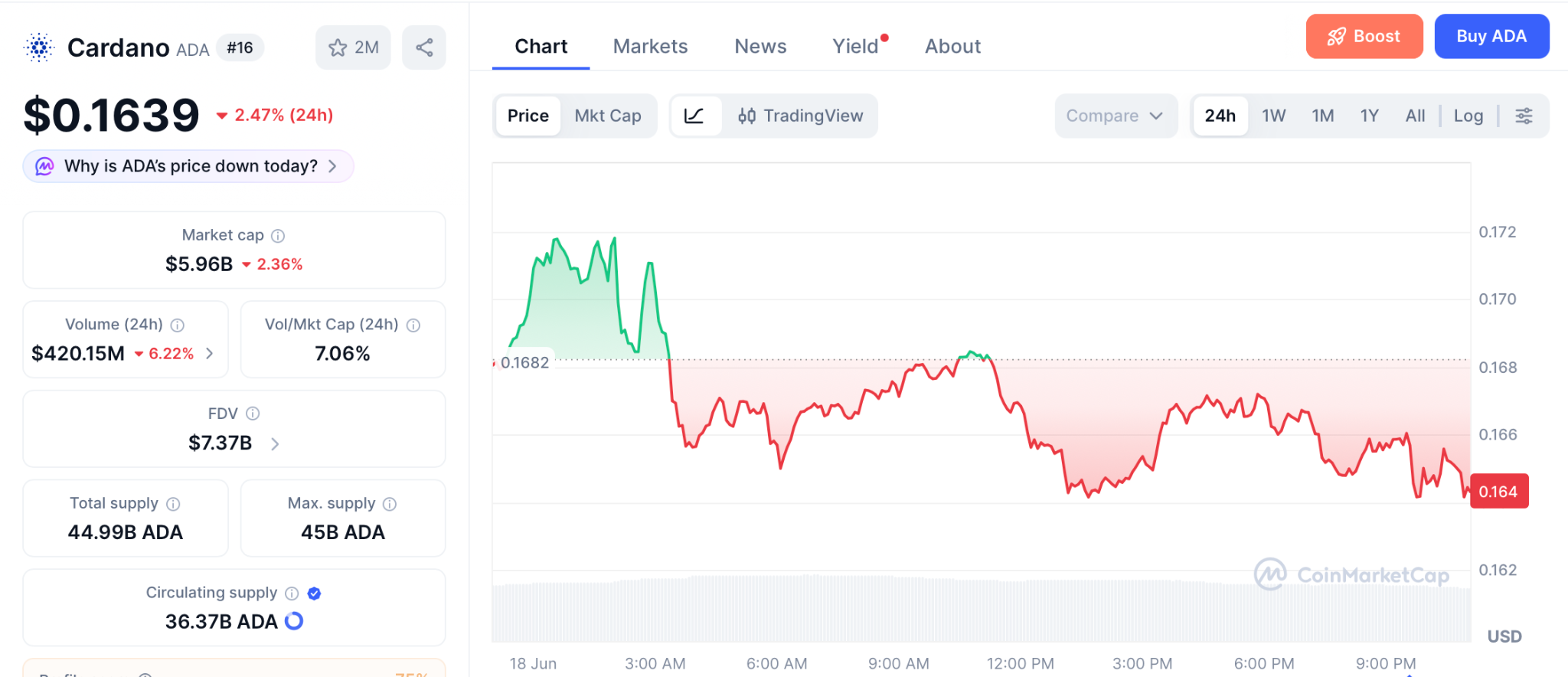
Coinpedia targets $0.28 by late 2026 if the breakout above $0.22 holds. A move from $0.1639 to $0.28 gives roughly 70% upside, solid for a large-cap hold but nowhere near the return math inside a presale at $0.0000001877 with a verified builder and listing ahead.
Conclusion
A 25% gain on LINK or a 70% recovery on ADA is not the kind of return that changes anything about the way you live, and the best crypto to invest in has always been the one you find before the listing when $250 can still become over $1 million like it did for one PEPE wallet and $8,000 can touch billions like Shiba Inu.
And Pepeto is sitting at $0.0000001877 right now with the same builder who proved this at $11 billion, a live exchange, verified audits, and 170% APY while the Binance listing gets closer.
So this is about whether you take the entry that erases the debt and turns one decision into the best crypto to invest in story you tell forever, or close this page and carry the same regret from the last cycle because you knew and did not move through Pepeto.
Click To Visit Pepeto Website To Enter The Presale

FAQs
What is the best crypto to invest in right now ahead of the next listing catalyst?
Pepeto stands out as the best crypto to invest in right now with $10.28 million raised at $0.0000001877, backed by the original Pepe builder and a former Binance developer. The SolidProof audit and live zero-fee exchange separate this entry from every other presale on the market.
How does Chainlink (LINK) at $8.02 compare to Pepeto for portfolio returns?
Chainlink at $8.02 targets roughly 25% toward $10 resistance following the FIFA World Cup oracle deal per CoinMarketCap. Pepeto targets 150x from $0.0000001877 through its upcoming Binance listing, with 170% APY staking compounding every position daily.
Disclaimer: This is a Press Release provided by a third party who is responsible for the content. Please conduct your own research before taking any action based on the content.

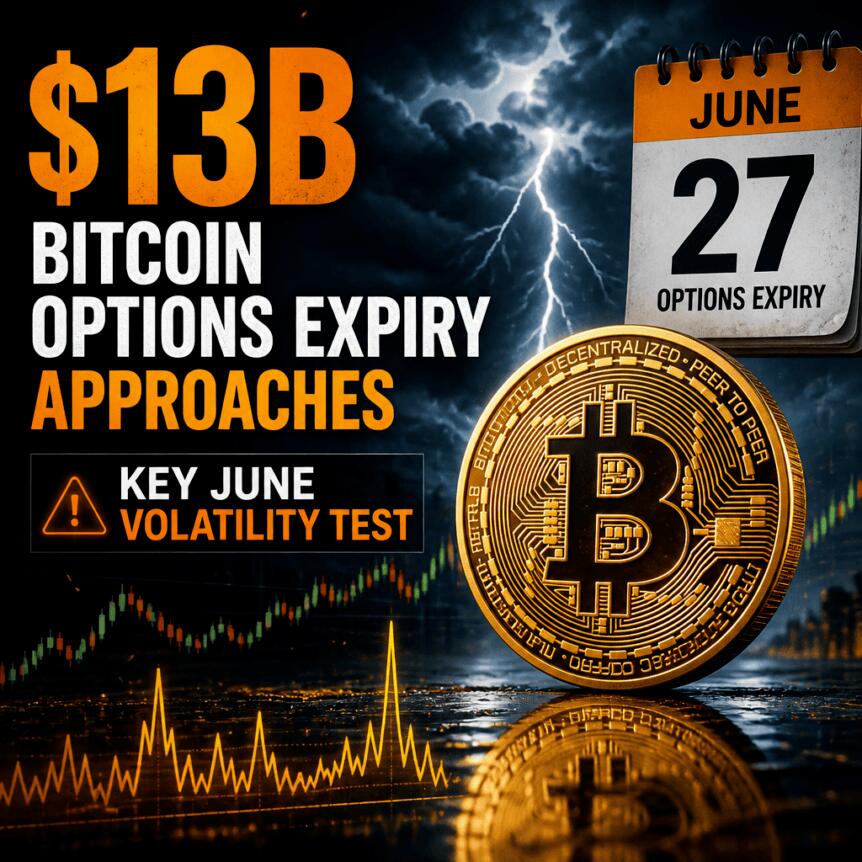
Bitcoin is approaching a key options expiration on June 26 with a skewed derivatives landscape that could make it harder for bulls to regain control. With roughly $13 billion in Bitcoin options open interest set to expire, market structure currently points toward downside risk—at least for the near-term window around the monthly settlement.
According to data from Deribit, where most of the activity is concentrated, put options (sell) are positioned more favorably than call options (buy). That imbalance has traders watching not only the current price around the $63,000 area, but also whether the positioning traps bullish momentum as the expiry approaches.
Key takeaways
- Deribit’s June 26 options open interest totals about $13B, with puts holding the advantage versus calls.
- Calls are heavily concentrated above $72,000, leaving upside bets more vulnerable if BTC fails to rebound quickly.
- Puts show less concentration at the deep-down strike area, increasing their odds of retaining value across more price outcomes.
- Market concentration matters: Deribit accounts for about 79% of the options open interest.
Deribit dominance and why the strike mix matters
Options positioning is not just about totals—it’s also about where the contracts are concentrated across strike prices. Deribit is the center of the June 26 contract universe, holding $10.4 billion in open interest, or 79% of the market share. OKX is next with around 6%, while Binance and CME each account for 5%. Bybit follows at 4%.
On Deribit specifically, total call open interest is about $6 billion, but 78% of that call exposure is tied to strikes at $72,000 or higher. With less than a week until expiration, that type of concentration is typically less forgiving if price fails to climb quickly.
Put options tell a different story. Deribit’s put open interest is about $4.5 billion, and only 28% of it is dependent on BTC falling to $57,000 or below. In practical terms, that means a larger share of put exposure could remain relevant across a wider range of downside scenarios leading into settlement.
The broader implication for holders of call options is straightforward: if BTC doesn’t regain higher levels fast enough, a major portion of call OI may lose effective value. Meanwhile, the structure of the put book creates a more durable hedge profile for bears as the expiry nears.
Strategy activity, ETF flow pressure, and regulatory uncertainty
The derivatives setup doesn’t exist in a vacuum. Earlier bullish expectations appear to have been influenced by spot buying and optimism around the US policy outlook—but the macro signals have shifted.
Some of the earlier bullish overreach is traced to Strategy’s aggressive BTC accumulation in April and May. The firm added 62,841 BTC in four weeks, a move that helped support price strength and pushed BTC above $73,000 in May. However, sentiment deteriorated as US-listed spot Bitcoin ETFs began experiencing outflows starting in mid-May, according to coverage linked to Cointelegraph’s reporting on ETF outflows beginning in mid-May.
Market pressure also intensified alongside regulatory uncertainty. Bulls had placed hopes on the Digital Asset PARITY Act, which—if passed—would have aimed to exempt certain mining and staking rewards from taxes until sold. Those hopes faded as the outlook worsened, and the market reacted to Strategy’s sale of 32 BTC, as referenced in Cointelegraph coverage at Strategy’s purchase activity and related context. The resulting ETF outflows added further weight to the bearish narrative, even as parts of traditional markets showed strength.
For investors, the key tension is that bullish spot narratives are not translating into consistent support in derivatives positioning. When ETF flows weaken and regulatory timelines become less favorable, call-side conviction often struggles to hold through expiry cycles—even if large holders continue to buy at times.
What the June 26 expiry scenarios suggest for bulls
With calls clustered above higher strikes and puts distributed across a broader downside band, the June 26 outcomes are currently modeled to favor bearish instruments. Based on current price trends and the cited open interest distribution, four scenario bands have been outlined for the Deribit expiry at June 26:
- $57,000–$61,000: net result favors puts by $3.4 billion
- $61,001–$65,000: net result favors puts by $2.7 billion
- $65,001–$69,000: net result favors puts by $1.7 billion
- $69,001–$71,000: net result favors puts by $1 billion
Even under a bullish attempt to regain ground, the structure remains unfavorable for call holders. The analysis indicates that a 12% rally from around $63,000 would not be enough to swing the June expiry decisively in favor of calls. That doesn’t necessarily confirm control through the next month, but it does suggest that the June 26 settlement could weigh on bullish sentiment as traders reset positions for July.
Investors should note the asymmetry: for calls to materially benefit, BTC likely needs to move toward—and ideally sustain above—levels where the call OI is concentrated, particularly around the $72,000 and higher strikes. If price remains below that zone, call-side exposure may decay faster with time, while put-side positions can still retain value across more moderate downside outcomes.
Why this matters beyond one expiry
Monthly options expirations often act like psychological and liquidity inflection points. When call dominance is absent and put advantages remain consistent across plausible price ranges, traders may treat rallies as less “clean” and more likely to face selling pressure into key levels.
Going forward, the market will likely focus on whether BTC can regain levels fast enough to challenge the concentrated call strikes before June 26. Until then, the most immediate question for traders is whether the current bearish derivatives balance will amplify sell pressure into settlement—or whether a late-stage rebound can force a repricing of call value as expiration approaches.

Hsiao-Wei Wang has stepped down as the Ethereum Foundation’s co-executive director and board member following the end of her sabbatical.
Vitalik Buterin praised her role in shaping Ethereum’s research culture and building the ecosystem’s community.
Ethereum Foundation Hit By Another High-Profile Exit
Wang took to social media to announce her departure from the non-profit after a long career break that she says gave her the space to reflect on life’s priorities.
“After my sabbatical, I have decided to step down as co-executive director and board member of the Ethereum Foundation effective today,” she wrote.
She revealed that Bastian Aue, another executive at the organization, had guided the transition while she was on her break. Reflecting on her time at the foundation, Wang said she was proud of what the community had achieved and credited its continued growth to the builders, researchers, educators, validators, users, and other contributors who support the network.
The EF has experienced several high-profile departures across its team this year, with senior figures like Tomasz Stańczak, Julian Ma, Carl Beek, Tim Beiko, Trent Van Epps, and Barnabé Monnot all leaving. The latest exit from the board now leaves Vitalik Buterin, Patrick Storchenegger, and Aya Miyaguchi as its remaining members.
This has led to a lot of uncertainty and speculation from the community, with some seeing the exits as evidence of internal disagreements and governance issues. But Ryan Berckmans, a long-time community figure, says people are looking at it the wrong way, and that the organization is still very committed to the network.
Meanwhile, Wang said she is still figuring out what comes next, but remains a proud member of the community. Her announcement ended with an acknowledgment of its role in driving the ecosystem forward, and a thank you to those who contributed along the way.
Buterin Praises Wang’s Contribution
Wang assumed the co-executive director job last year alongside Stańczak, leading the organization through one of its toughest periods. Buterin acknowledged the former’s decade-long contribution to the ecosystem, noting that she has always handled her work with the utmost skill and grace.
“She handled the task skillfully and gracefully, and has constantly strived to find and insist on outcomes that are right both for the Ethereum protocol and for the human beings that build and maintain it,” he wrote.
Recalling her early days at the foundation, he praised her for helping make Ethereum’s research and consensus work more organized and accessible and for building a strong community in Taipei through people and events.
The post Ethereum Foundation Co-Executive Director Hsiao-Wei Wang Steps Down appeared first on CryptoPotato.
-
A stress test that showed both strengths and weaknesses
When large sums leave a financial system quickly, hidden weaknesses often become visible. In traditional finance, such situations often lead to emergency lending programs, withdrawal limits or government-backed bailouts.
Decentralized finance (DeFi) works differently.
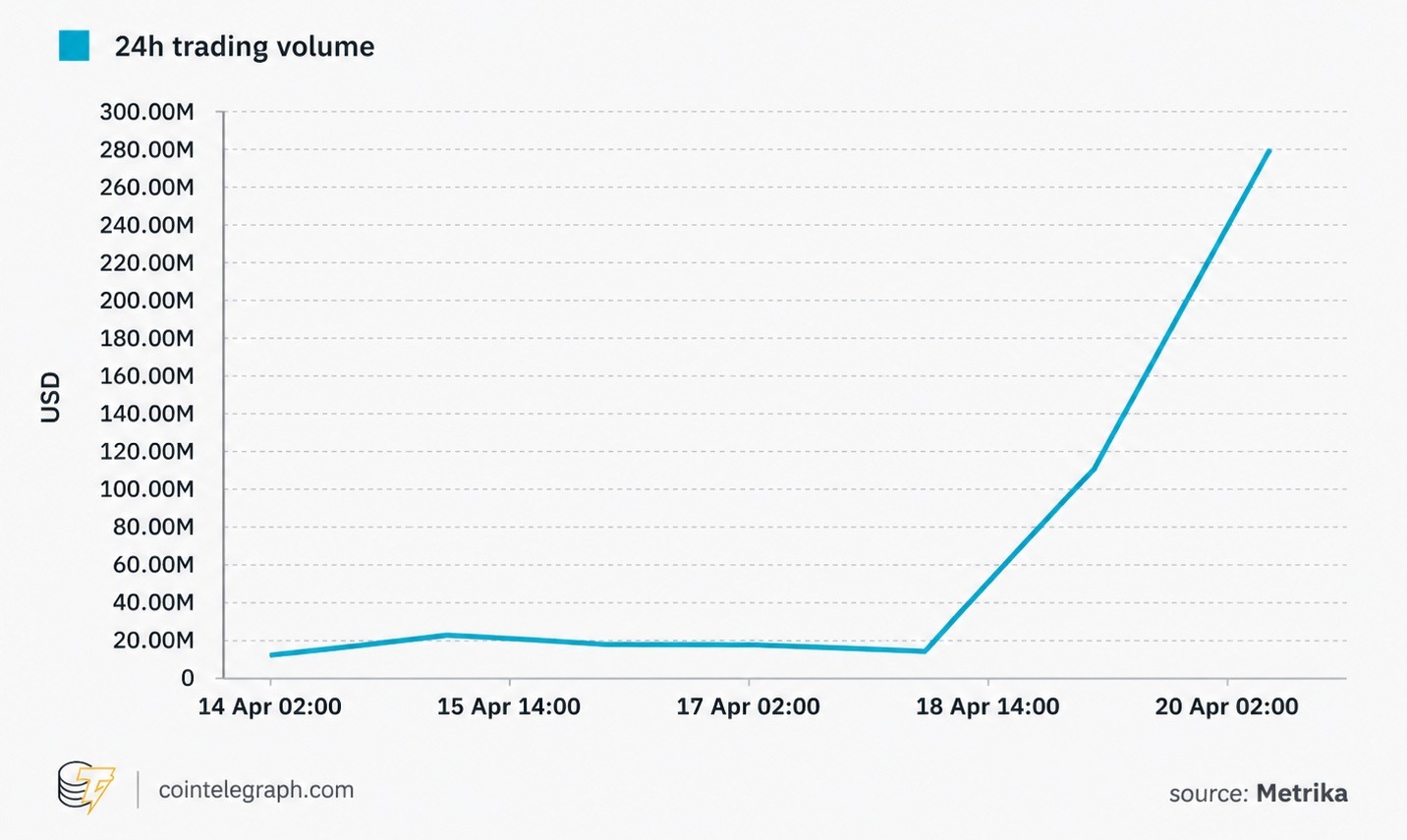
Aave is one of crypto’s biggest lending platforms. In April 2026, users withdrew about $8.45 billion from the protocol after the KelpDAO rsETH bridge exploit raised concerns across DeFi markets.
Aave’s own smart contracts were not compromised. The pressure came from an external rsETH bridge incident that affected Aave through collateral, borrowing and liquidity channels. The protocol’s core logic continued to function, but the episode was not smooth. Some markets came under severe liquidity pressure, and emergency controls were used to contain the damage.
That made the outcome more complicated. Aave avoided a full breakdown, but the event also showed how quickly stress can spread when assets, collateral and liquidity are closely connected.
For Aave founder Stani Kulechov, the event showed that DeFi had become more mature. But independent analysts reviewing the same data took a more cautious view.
While Aave survived, many questioned whether surviving the event was enough to answer concerns about the real strength of DeFi lending protocols.
-
What led to the $8.45B in withdrawals
The pressure did not begin with a hack on Aave itself. It began with the KelpDAO rsETH bridge exploit in April 2026.
Attackers stole about $292 million worth of rsETH from KelpDAO’s LayerZero bridge. That raised concerns about whether some rsETH tokens were fully backed. The concern quickly spread because rsETH was used across DeFi, including as collateral in Aave markets.
This created a direct problem for Aave. If collateral tied to rsETH lost trust or value, lenders could face bad-debt risk. Users began withdrawing funds as they tried to reduce their exposure before conditions became worse.
The withdrawals then added pressure to Aave’s liquidity. As more users pulled funds, some markets became highly utilized. In simple terms, most of the available liquidity had already been borrowed or withdrawn, making it harder for some users to exit immediately.
The incident showed how an external asset problem can still affect a lending protocol. In DeFi, assets often move across bridges, lending markets and other protocols. A problem in one part of the system can quickly affect another.
That is what made the episode look like a DeFi bank run. Users were not waiting for branches to open or banks to approve transfers. They could react in real time. But the event also showed an important limit: users can try to withdraw at any time, but actual withdrawals still depend on available liquidity and protocol conditions.
Did you know? The largest bank runs in history often unfolded over days or weeks. In DeFi, similar events can happen within hours because blockchain protocols never close, and users can move funds instantly from anywhere in the world.
-
Stani Kulechov’s view: The system held firm
Kulechov framed the incident as evidence of Aave’s resilience. In his view, the core protocol worked as designed, even during a period of heavy stress.
That distinction matters. Aave did not suffer a protocol exploit, but the markets around it still came under pressure.
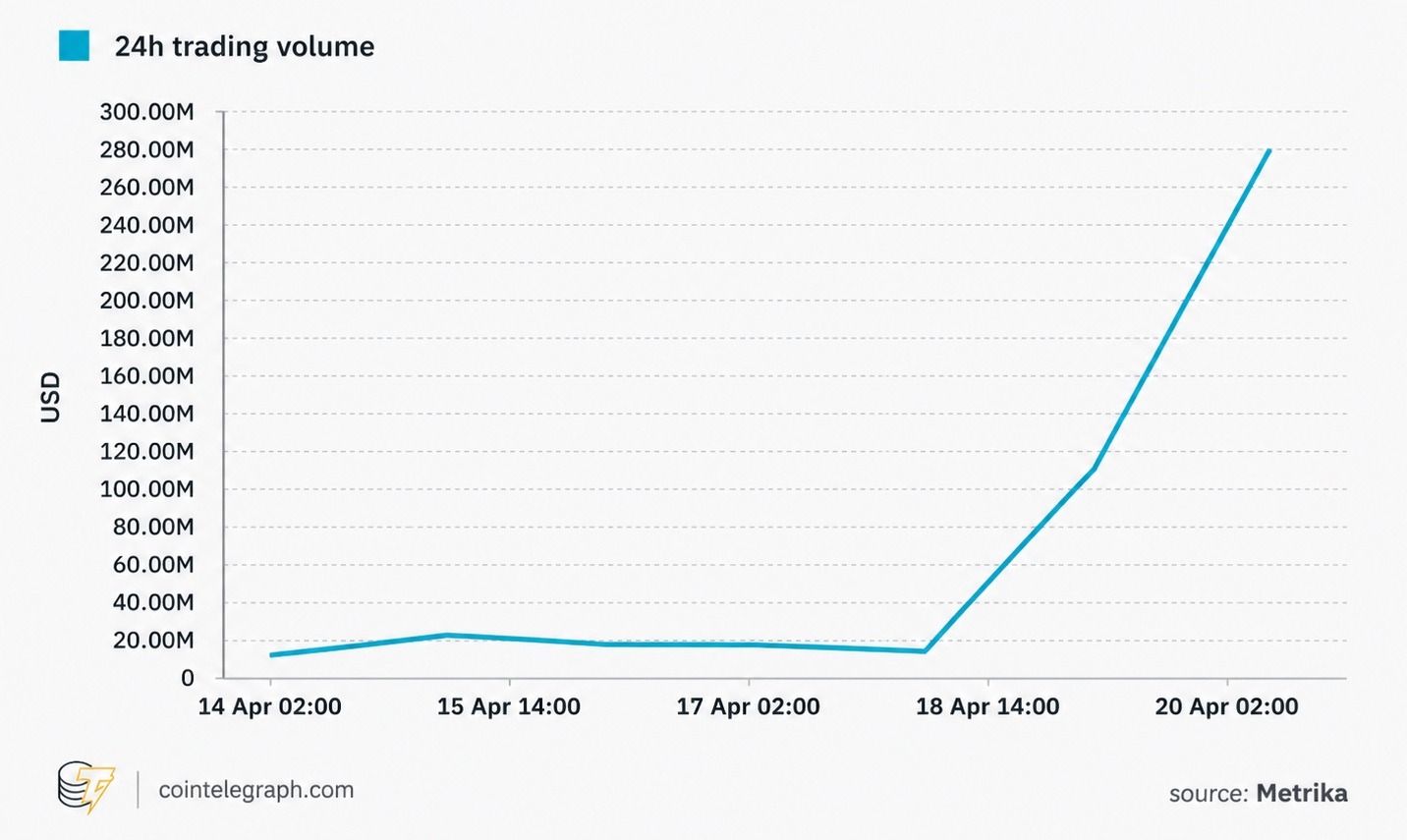
As withdrawals increased, some markets reached full utilization. That meant liquidity became limited in those markets, making it harder for some users to withdraw immediately. Aave’s risk managers also had to use built-in controls, including emergency freezes and changes to risk parameters, to contain the damage.
Seen this way, Aave did pass an important real-world stress test, but not without strain. Supporters of the platform point to several features that set DeFi apart from traditional finance.
- Collateral is visible on-chain.
- Risk settings are publicly available.
- Liquidations follow smart contract rules.
- Anyone can inspect protocol activity in real time.
These features can reduce some of the information gaps that have contributed to banking crises in the past. But they do not remove every risk. DeFi lending protocols can still face problems from external assets, bridges, liquidity shortages and fast-moving user behavior.
To supporters, Aave’s survival showed that open, rule-based systems can keep operating under heavy pressure. To critics, the incident showed that transparency alone is not enough. DeFi can still require emergency action when liquidity stress spreads across connected markets.
-
Survival does not mean safety
Critics warn against treating the outcome as full proof that Aave’s design is safe. The protocol survived, but that does not mean every part of the system worked perfectly.
Stress events can be read in different ways. Strong design may explain part of Aave’s performance, but favorable market conditions may have also helped.
External analysts noted that large exposure remains concentrated across many DeFi platforms. When a small group of users controls very large positions, their actions can affect the stability of the whole protocol.
Concentration risk has long been a concern in traditional finance. The same concern applies to DeFi.
If several major borrowers close their positions at the same time during market stress, the impact could be bigger than current risk models expect.
Avoiding a crisis this time does not guarantee the same result next time.
Did you know? Aave first launched in 2017 under the name ETHLend. It later rebranded and grew from a peer-to-peer lending marketplace into one of the largest liquidity pool-based lending protocols in crypto.
-
How Aave manages risk
Aave is more than a basic lending platform. Over time, it has added several layers of protection to help reduce wider risks.
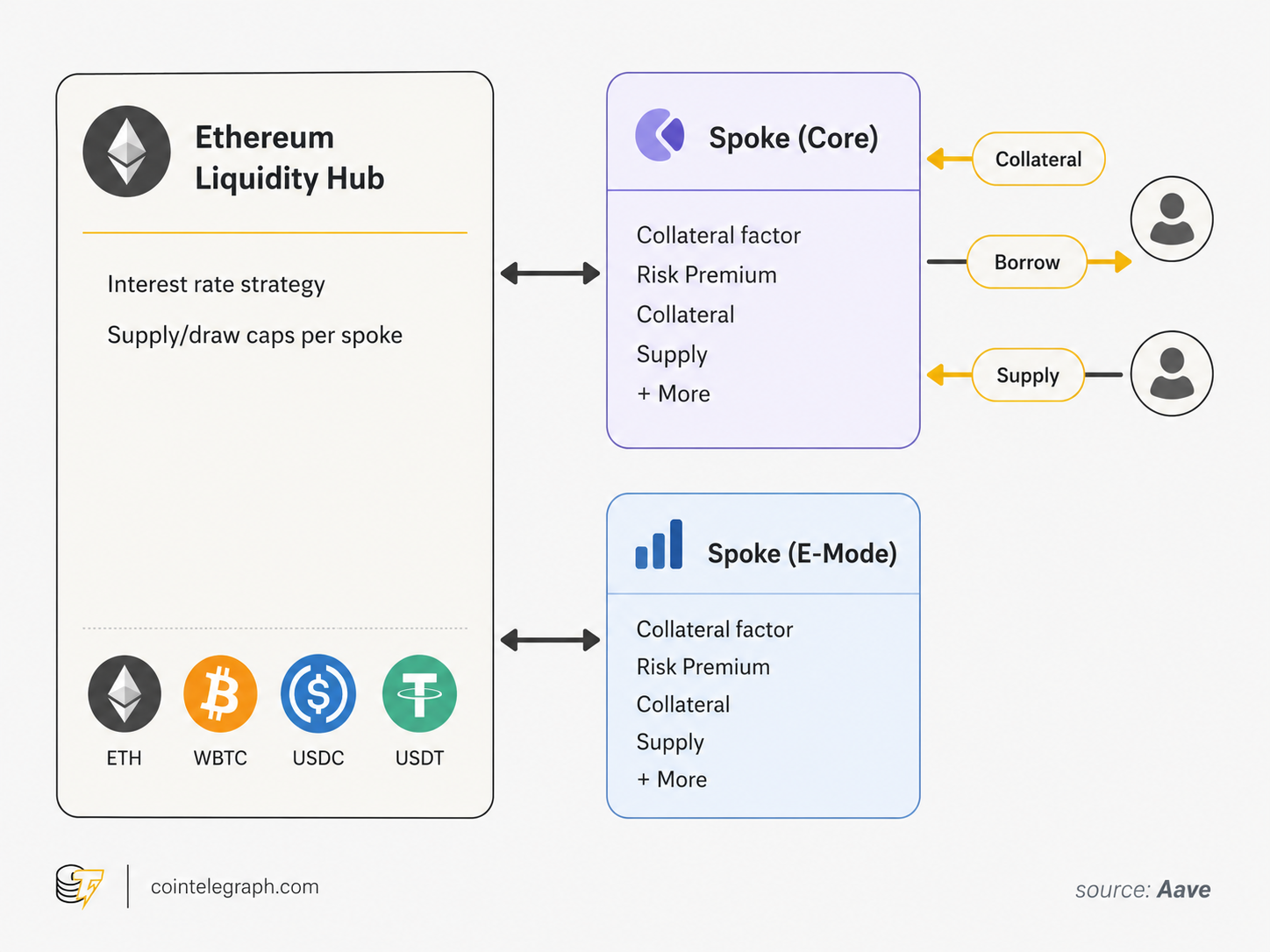
Borrowers on Aave can take loans only within set loan-to-value limits. Liquidation thresholds decide when collateral can be sold. Supply caps limit how much exposure can build around certain assets. Borrow caps limit how much users can borrow.
Isolation Mode helps limit the impact of higher-risk collateral. Efficiency Mode, known as E-Mode, uses special settings for assets that usually move together. Governance, supported by expert risk advisers, adjusts these settings when needed.
During the recent withdrawal surge, these safeguards generally worked as planned. Core protocol functions continued, but some markets came under strain. Utilization reached 100% in major pools, limiting withdrawals for some users.
Still, observers argue that DeFi risk management needs to keep improving. Governance decisions can still take time, and risk models may not adjust quickly enough during fast-moving events.
Stress tests often rely on past events, which may miss new types of spillover risk. The real task is not only to avoid earlier problems. It is also to prepare for threats that have not appeared yet.
-
The hidden risk of connected DeFi platforms
One of DeFi’s biggest strengths is also one of its biggest risks. The same connections that make it useful can also make it fragile.
Composability allows applications to connect and work together. Funds placed in one protocol can support activity in another. This helps new products grow faster and can make the system more efficient. But it also creates more links between platforms.
A loan on one platform may depend on collateral from another. That collateral may then be tied to leveraged positions across other systems. Over time, this can create a complex financial network.
In normal market conditions, composability opens up possibilities that are difficult to find in traditional finance. But during stressful periods, it can increase the risk of problems spreading from one platform to another.
A platform’s strength cannot be judged in isolation. The condition of the wider DeFi system also matters.
Did you know? Traditional banks carry out regular stress tests under regulatory supervision. In DeFi, stress tests often happen unexpectedly in live markets, with real users, real assets and no chance to rehearse.
-
What users should take away
For depositors and investors, the episode is an important reminder. A protocol’s size and reputation should not be confused with complete safety. Users need to understand the assets supporting the protocols they use.
Governance proposals also deserve close attention because they decide the protections around deposited funds. Diversification still matters, even in DeFi.
For builders, the takeaway is just as clear. They should design for extreme conditions and keep testing their basic assumptions. They also need to recognize that transparency alone does not remove wider risks.
The incident shows that strength is best judged through repeated performance across several tests, not one event. One stress test provides evidence, but it does not provide certainty.
-
Aave passed this test, but questions remain
Aave’s ability to handle roughly $8.45 billion in withdrawals deserves attention. The protocol kept working during one of the largest liquidity shocks DeFi has faced.
The result is important, but it should not be treated as the final word on Aave’s risk profile.
Supporters see it as proof that open and transparent systems can survive panic without bailouts or emergency measures. Critics, however, see it as a sign that hidden weaknesses may still exist beneath the surface.
Both views have some truth.
Aave showed that DeFi can withstand heavy pressure. The bigger challenge is making sure that strength holds when the next crisis arrives in an unexpected way.
Key takeaways:
- Puts (sell) options dominate the June 26 expiry with net advantages of $1B to $3.4B, leaving bulls exposed.
- Despite Strategy buying BTC again, heavy call (buy) positioning above $72,000 will likely reinforce bearish momentum.
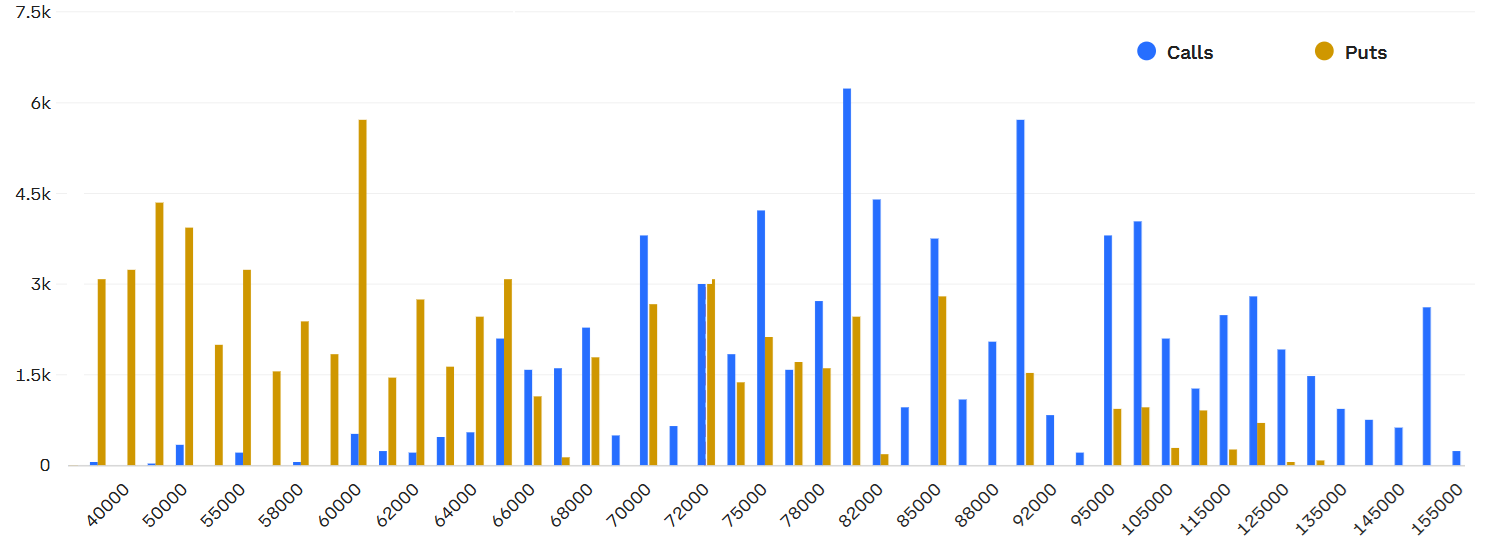
$13 billion in Bitcoin (BTC) options open interest is set to expire on June 26, potentially giving bears fresh ammunition for more downside pressure on BTC price. Bitcoin’s 14% price drop in June so far has caught bulls flat-footed, since most call (buy) options were stacked at $68,000 or higher. Will this monthly expiry open the door for a July recovery?
Deribit options dominate the scene with $10.4 billion in open interest, representing a 79% market share. OKX sits in second at 6%, followed by Binance and CME at 5% each, and Bybit with 4%. It’s worth digging into how Deribit traders are positioned ahead of the monthly expiry.
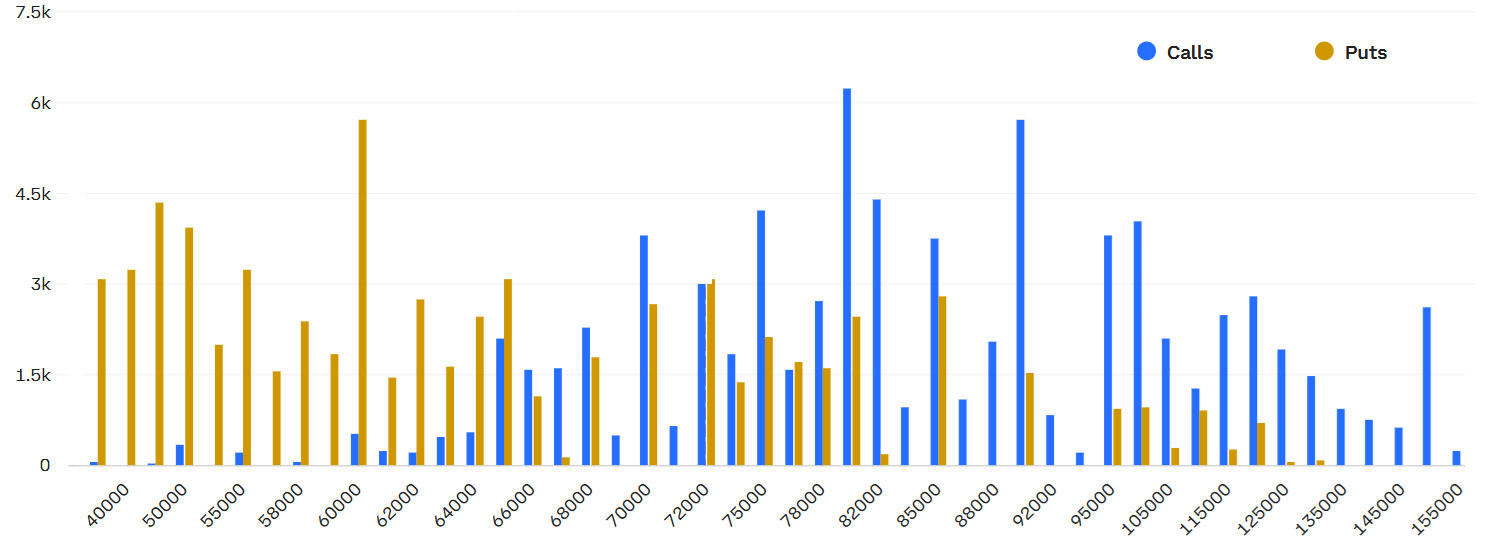
Bitcoin June 26 options open interest at Deribit, BTC. Source: Deribit
Total call options open interest at Deribit hit $6 billion, but 78% of that sits at $72,000 or higher. With less than a week to go, the effective open interest will likely shrink fast. In contrast, out of the $4.5 billion in put (sell) options open interest, only 28% hinge on Bitcoin falling to $57,000 or below. This setup makes matters significantly worse for bulls overall.
Bitcoin bulls made the wrong call on Strategy and US regulation
Some of the bulls’ over-the-top optimism traces back to Strategy’s (MSTR US) aggressive BTC buying spree in April and May. The firm added 62,841 BTC in just four weeks, helping push prices above $73,000 in May. But sentiment soured as US-listed spot Bitcoin ETFs saw outflows kick off in mid-May.
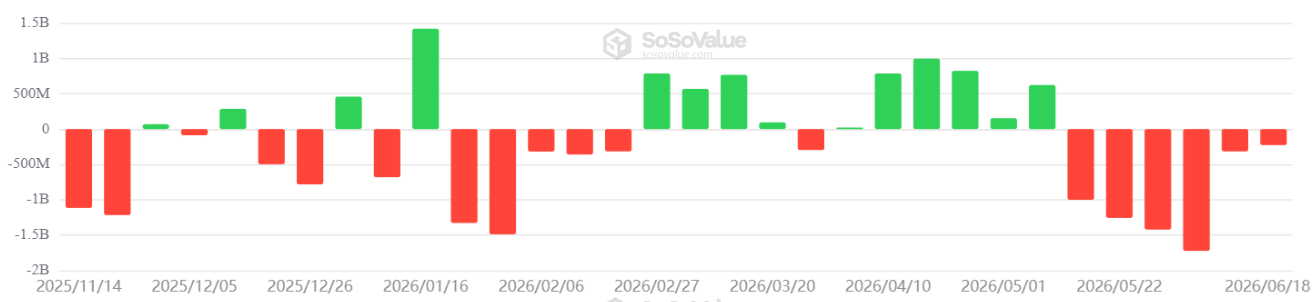
US-listed spot Bitcoin ETFs weekly net flows, USD. Source: SoSoValue
Hopes for quick passage of the Digital Asset PARITY Act in the United States also faded. The bill would have spared mining and staking rewards from taxes until sold. The market took another hit from Strategy’s sale of 32 BTC and the resulting ETF outflows, even as excitement around tech stocks grew after Google (GOOG US) and Nvidia’s (NVDA US) cash raises.
Related: Bitcoin decouples from tech stocks–Is $60K BTC’s next stop?
Bulls still have time to cut losses, but puts clearly hold the stronger hand right now. Here are four likely scenarios for Friday’s BTC options expiry at Deribit based on current price trends:
- Between $57,000 and $61,000: The net result favors the put (sell) instruments by $3.4 billion.
- Between $61,001 and $65,000: The net result favors the put (sell) instruments by $2.7 billion.
- Between $65,001 and $69,000: The net result favors the put (sell) instruments by $1.7 billion.
- Between $69,001 and $71,000: The net result favors the put (sell) instruments by $1 billion.
Even a 12% rally from the current $63,000 level won’t flip the June expiry in favor of calls. While this doesn’t lock in bear control for July, the expiry outcome will probably weigh on bullish sentiment heading into the new month.

Morgan Stanley has lodged amended S-1 registration statements with the Securities and Exchange Commission for its Solana and Ethereum ETFs.
The development is a positive sign of ongoing engagement with the regulator, while the final launch dates remain dependent on the review timeline.
Morgan Stanley Moves Closer to ETH & SOL ETF Launch
The Wall Street bank updated the filings on Thursday, disclosing that both funds would hold a 0.14% sponsorship fee. Bloomberg ETF analyst Eric Balchunas commented on the development, noting that this rate would be the lowest in the ETH and SOL ETF markets worldwide.
“Morgan Stanley Ether and Solana ETFs nearing launch. The fee on each is going to be 14bps, making them the cheapest in the U.S. and world,” he wrote.
For context, Grayscale’s Mini Ethereum Trust (ETH) offers the lowest sponsorship fee of 0.15%, while Franklin Templeton’s SOEZ ranks at the bottom among SOL ETFs with a rate of 0.19%.
The documents also show that Morgan Stanley has included staking arrangements for both investment products, with plans to stake a portion of their held assets to generate additional rewards. Figment and Galaxy Blockchain Infrastructure have been selected as the staking providers for the funds.
Furthermore, the custodians will be paid a 5% fee for their services, whilst the remaining 95% stays in the fund. For investors, this means that they can earn staking rewards as well as the potential gains from the exposure to SOL and ETH’s price.
Morgan Stanley first filed their application with the SEC for a SOL and ETH ETF in January 2026, with the latest revision being the second time they were altered. If the regulator greenlights both ETFs, the former is expected to trade under the ticker MSOL, while the latter under MSSE.
MSBT Surpasses $300M Mark
The firm also filed for its Morgan Stanley Bitcoin Trust (MSBT) around the same time and was later launched in April, debuting with $34 million on its first day and offering a competitive 0.14% sponsorship fee. The product also experienced a zero outflow streak during its first month, with only one day since then (May 29) seeing capital go out.
Meanwhile, the latest data from SoSoValue shows that spot BTC ETFs recorded a net outflow of $90.66 million on June 18, with most of these investment products remaining in the negative territory for the past few weeks. But MSBT had the largest single-day inflow of $10.43 million, bringing its total net inflow to $301 million.
The post Morgan Stanley Files Amendments, Clearing Path for Cheapest ETH, SOL ETFs appeared first on CryptoPotato.
Crypto World
Bitcoin Slides as Warsh Stays Hawkish and Markets Await a Lasting US-Iran Agreement: Weekly Recap
It was another eventful and volatile week in the cryptocurrency markets (and beyond), which began with promising news on the war front in the Middle East that all concerned parties had agreed to a deal. However, it’s not that simple.
In the meantime, bitcoin’s price had struggled to break above $64,000 until Sunday evening, when Trump’s promise of a deal was announced to the world. The cryptocurrency reacted with an immediate surge that pushed it to $66,000 within hours and above $67,000 on Monday to mark a multi-week peak of its own.
However, the subsequent rejection was right around the corner. In the hours leading up to the Wednesday FOMC meeting, which was the first under the Federal Reserve’s new Chairman, BTC dropped below $65,000 and then jumped to $66,400. However, once the Fed confirmed that it won’t lower the rates, as essentially everyone anticipated, and then Kevin Warsh’s speech showed his hawkish tone, bitcoin slipped once again.
It kept sliding in the following days and dipped to a weekly low of $62,300 earlier today. This also came amid growing concerns that the memorandum of understanding between the US and Iran might not come to fruition. However, the two hotheads in the mix, Israel and Hezbollah, reportedly agreed to a ceasefire earlier today, due to begin at 14:00 BST on Friday.
BTC reacted with another uptick, going above $63,000 as of press time. It’s likely that the cryptocurrency will gain further traction if the actual permanent deal is signed, as it was promised, today, but the broader market remains fragile, especially with the uncertainty around Strategy and its controversial STRC shares. More on that, a bit later.
For now, BTC remains in the red weekly, and so are BNB, DOGE, XMR, CC, BCH, and ADA. In contrast, HYPE, XLM, WLD, UNI, and RAIN have marked double-digit gains.
Market Data

Market Cap: $2.26T | 24H Vol: $75B | BTC Dominance: 56.1%
BTC: $63,230 (-1.3%) | ETH: $1,700 (+0.85%) | XRP: $1.14 (-0.9%)
This Week’s Crypto Headlines You Can’t Miss
Strive CEO: Sharp STRC, SATA Drops Were Leverage Liquidations, Not Credit Failures. Despite making another $100 million bitcoin acquisition this week, Saylor’s Strategy attracted some controversy due to its STRC shares. The financial vehicle has fallen well below its intended price of $100, and a crash on Thursday increased the FUD even though Strive’s CEO defended the product and the issuer behind it.
Bitcoin Dips Below $64K Again: Here’s How Whales Reacted. With bitcoin’s price instability and consistent weakness, large whales, those holding at least 1,000 units, had increased their holdings to their highest levels in over three months. They control almost 36% of BTC’s available supply now.
Morgan Stanley Files Amendments, Clearing Path for Cheapest ETH, SOL ETFs. Months after launching its Bitcoin ETF, the banking behemoth filed amendments for its two ETH and SOL filings. If approved, the new financial vehicles will be the cheapest of the bunch and will include staking arrangements.
BlackRock Rolls Out Bitcoin Income ETF as Demand for Covered Calls Grows. Speaking of ETFs, the world’s largest asset manager launched its iShares Bitcoin Premium Income ETF (BITA) to expand its product lineup with a yield-focused vehicle.
Illinois Passed the Most Anti-Crypto Law in the US: Miles Jennings. On June 17, Illinois officials enacted the Digital Asset Privilege Tax Act, which was called “one of the most anti-crypto laws in the US” by Andreessen Horowitz’s Miles Jennings. It imposes a 0.2% tax on the exchange, transfer, and custody of cryptocurrencies, with no meaningful exemptions for routine self-custody moves.
Bitmine Adds $135M in ETH, Closing In on 5% of Ethereum Supply. The broader market’s weakness has not deterred Bitmine from reaching its goal of owning 5% of Ethereum’s total supply. In the latest acquisition spree, the company said it had acquired almost 77,000 ETH for $135 million, bringing its total to 5,620,754 tokens.
Charts
This week, we have a chart analysis of Ethereum, Ripple, Cardano, Binance Coin, and Hyperliquid – click here for the complete price analysis.
The post Bitcoin Slides as Warsh Stays Hawkish and Markets Await a Lasting US-Iran Agreement: Weekly Recap appeared first on CryptoPotato.
Arthur Hayes has sold 6,000 Ethereum at a loss after accumulating nearly $10.6 million worth of ETH in recent days, even as other large investors continue adding to their holdings around a major support zone.
Summary
- Arthur Hayes sold 6,000 ETH at a $606,000 loss after accumulating nearly $10.6 million worth of Ethereum days earlier.
- Lookonchain data shows K3 Capital and a Chun Wang-linked wallet acquired more than 17,000 ETH despite recent weakness.
- Technical indicators and liquidation data place Ethereum at a critical support zone near $1,700, with major liquidity sitting around $1,800.
According to blockchain tracking platform Lookonchain, the BitMEX co-founder accumulated approximately 5,900 ETH over the past few days at an average purchase price of $1,793 per token. Data shared by the platform showed that Hayes later sold 6,000 ETH for roughly $10.14 million at an average price of $1,690, locking in an estimated loss of about $606,000.
The transaction comes as Ethereum struggles to regain momentum after failing to hold above key resistance levels during a recent recovery attempt. ETH was trading near $1,700 at the time of writing, well below its April peak above $2,400.
As reported by crypto.news earlier, a wallet linked to Hayes received 3,000 ETH worth approximately $5.42 million from market maker Flowdesk on June 15. The transfer took place as Ethereum and the wider crypto market rallied after easing geopolitical tensions in the Middle East improved investor sentiment at that time.
Why are some large investors still accumulating ETH?
While Hayes reduced exposure, on-chain data cited by Lookonchain points to continued buying activity among other major holders.
The platform reported that investment firm K3 Capital withdrew 10,000 ETH worth approximately $16.9 million from Binance. Separately, a wallet linked to entrepreneur Chun Wang acquired another 7,650 ETH valued at nearly $12.9 million.
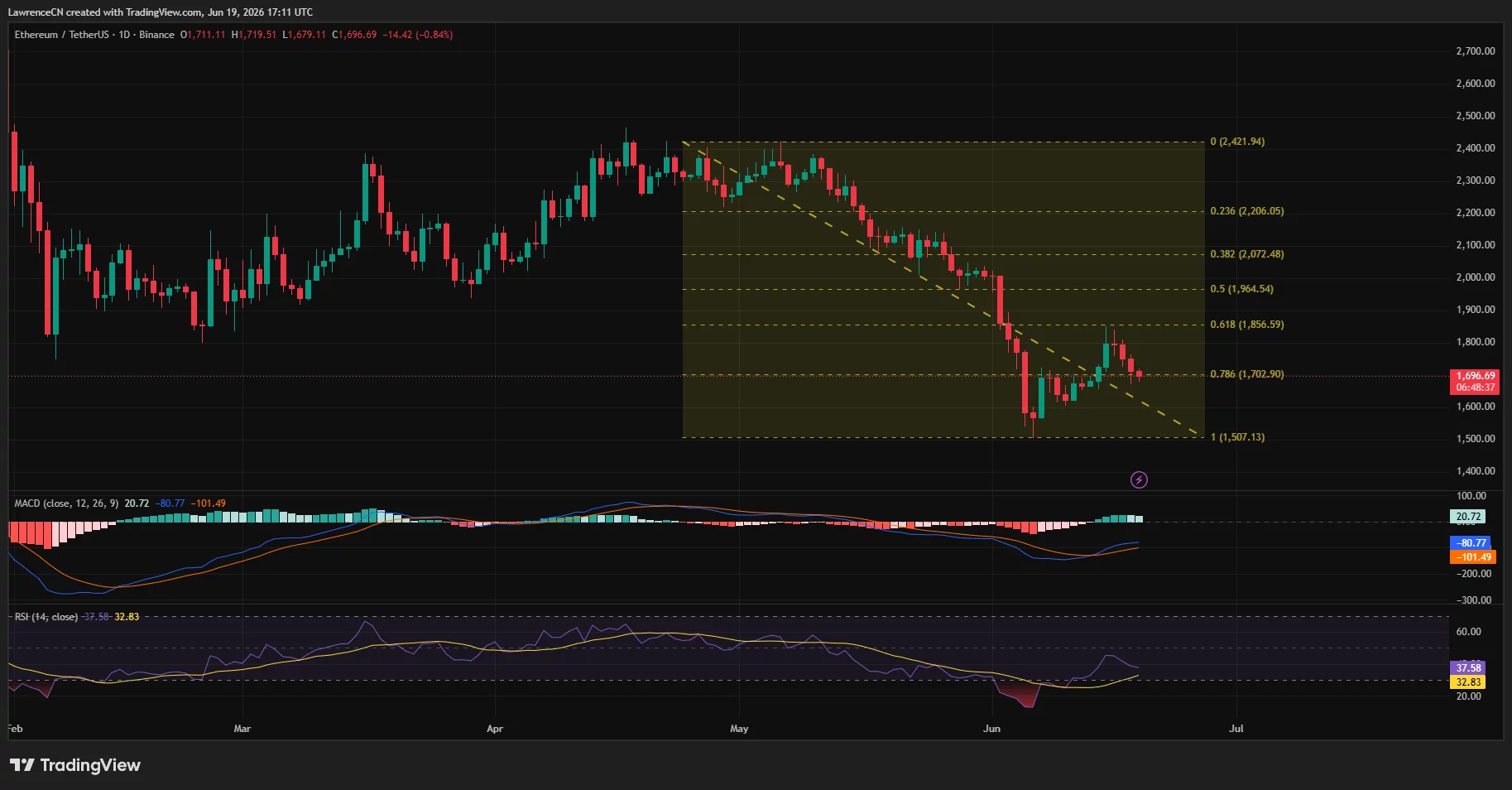
These purchases arrived as Ethereum was testing an area that several technical indicators identify as an important support zone. On the daily chart, Ethereum (ETH) remains close to the 78.6% Fibonacci retracement level near $1,703, a level traders often monitor for potential trend stabilization following steep corrections.
Recent price action has produced mixed signals. Although Ethereum rebounded from its June low near $1,507, the recovery stalled below the 61.8% Fibonacci retracement level around $1,856.
Daily RSI remains below the neutral 50 mark, while the MACD indicator is still positioned beneath the zero line, suggesting that buyers have yet to establish a sustained reversal.
Where could Ethereum move next?
Liquidation data indicates that leveraged traders are heavily positioned around several nearby price zones.
CoinGlass liquidation heatmaps show notable liquidity clusters between $1,780 and $1,820, with one of the largest concentrations sitting near the $1,800 level. Such areas often attract price movement as traders seek liquidity and leveraged positions are forced to close.
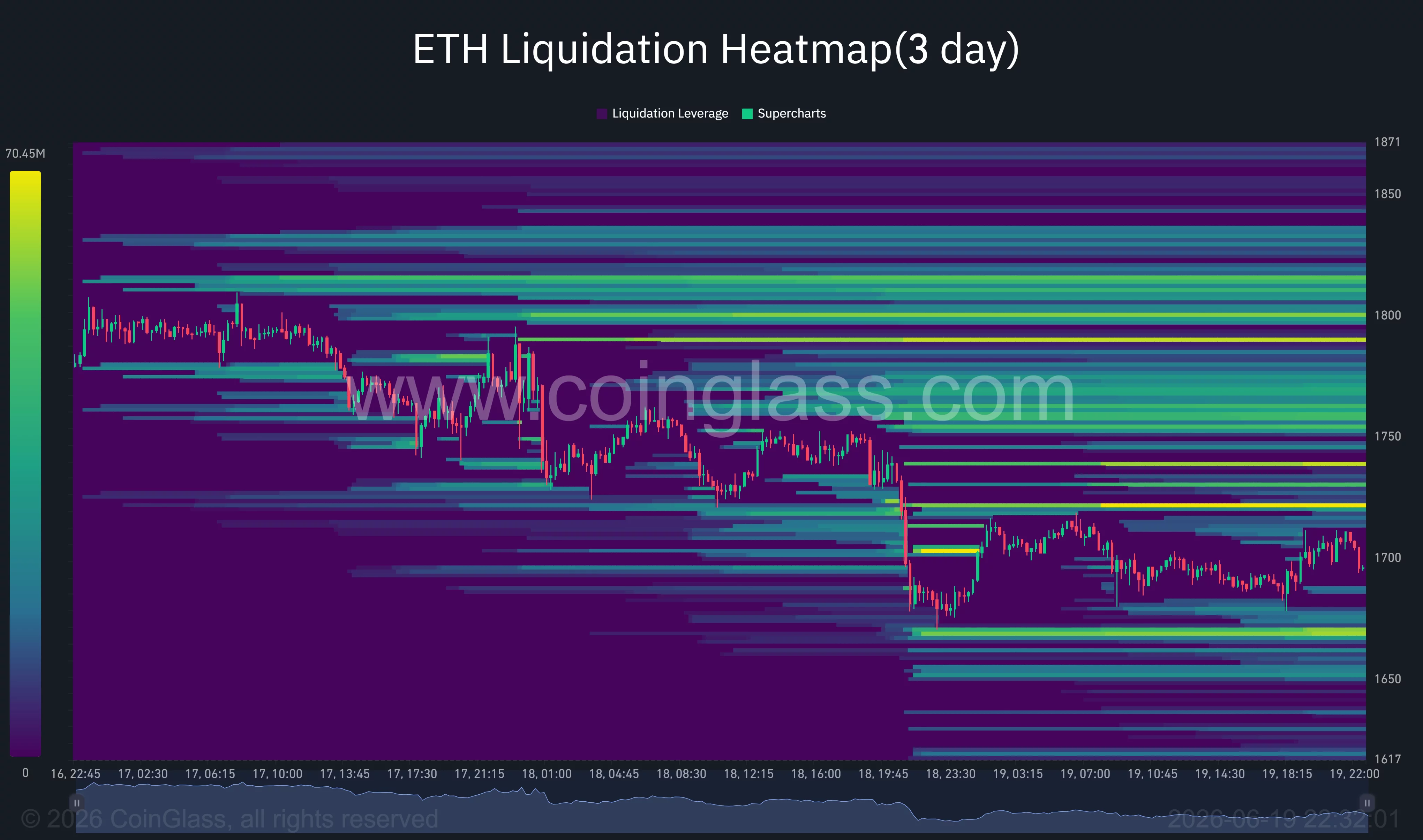
Additional technical analysis shared by market commentator Team LAMBO suggests Ethereum recently faced rejection from a confluence resistance area tied to Fibonacci levels and descending trendline resistance.
In a June 19 X post, the analyst argued that a clear trading range has developed between roughly $1,500 and $1,800, with a breakout beyond either boundary likely determining the next significant move.
The 4-hour chart presents a similar picture. Ethereum remains below a descending trendline that has capped rallies since early May, while the Supertrend indicator continues to signal bearish conditions.
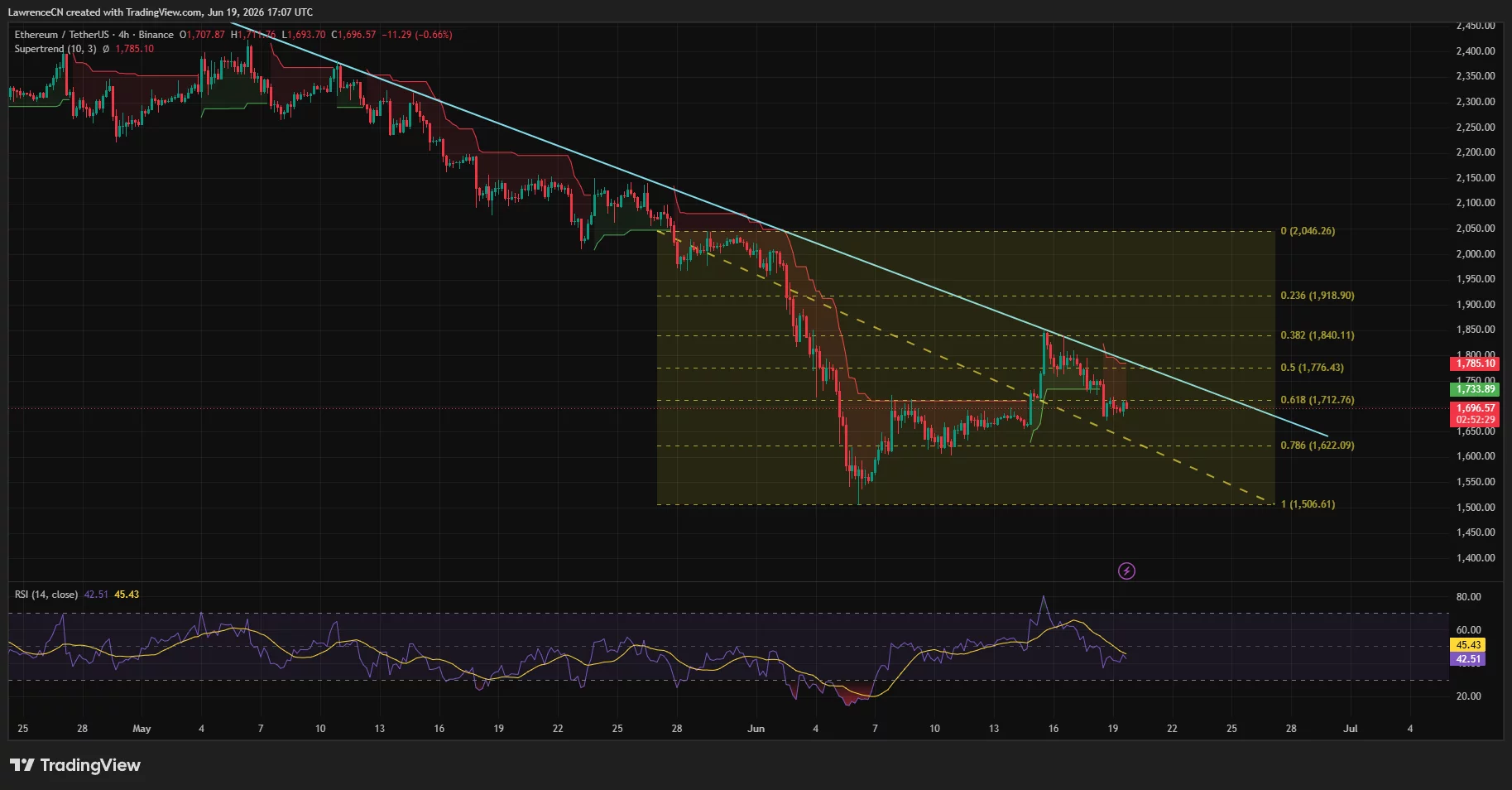
A move above resistance near $1,780 and the large liquidity pocket around $1,800 could expose higher targets near $1,856. Failure to defend support around $1,700, however, could place renewed focus on the $1,620 area and eventually the June low near $1,507.
Disclosure: This article does not represent investment advice. The content and materials featured on this page are for educational purposes only.
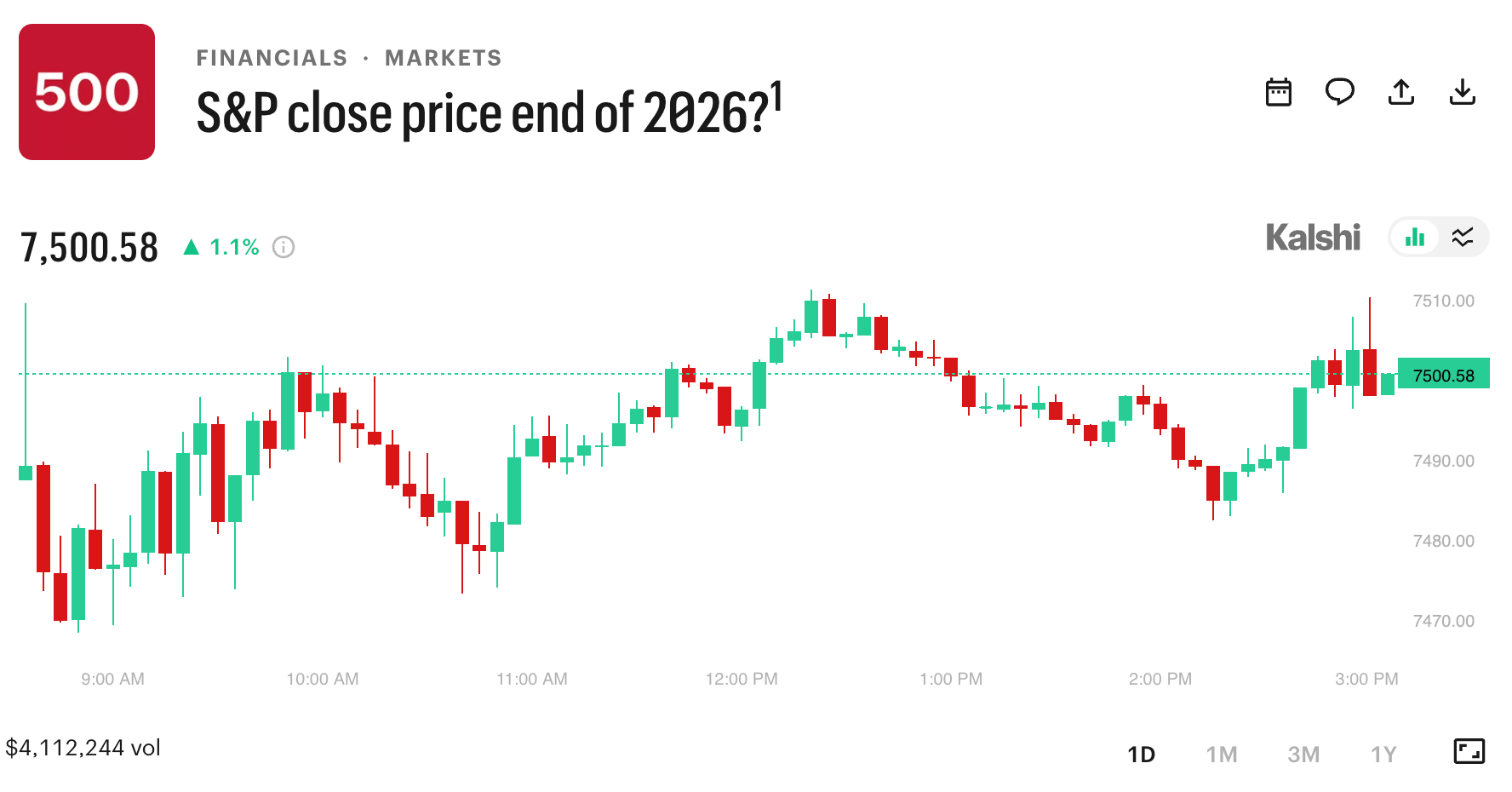
Financial services giant Charles Schwab will reportedly enter the prediction markets business by offering customers wagers on the S&P 500.
According to a Friday Wall Street Journal report, Charles Schwab is planning to launch options contracts allowing users to place yes-or-no wagers on the performance of the S&P 500 stock market index. The move, expected to roll out in a matter of months as part of a partnership with Cboe Global Market, could mark the company’s first into prediction markets.
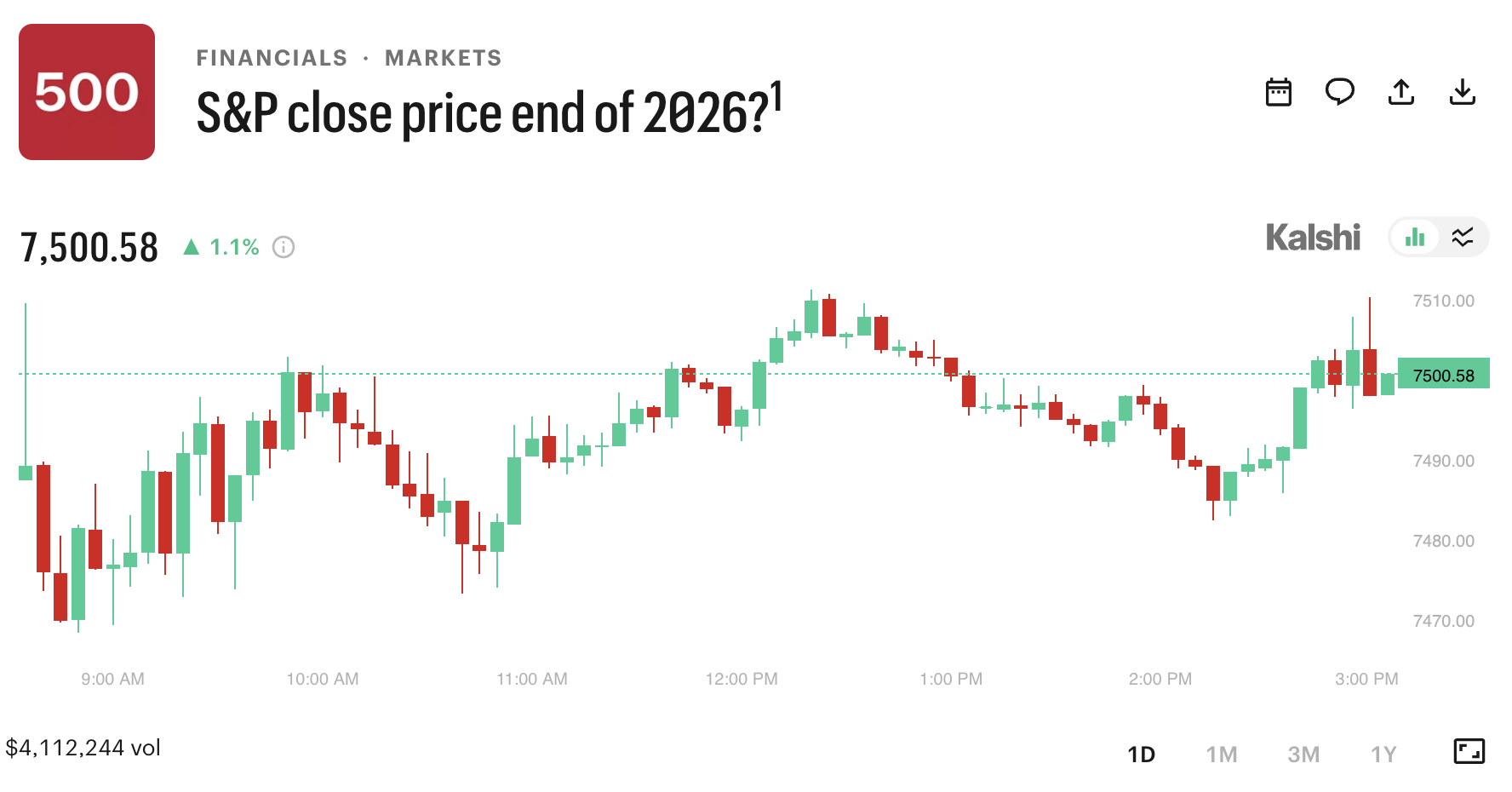
Source: Kalshi
While prediction market platforms like Kalshi and Polymarket offer a variety of event contracts based on the outcome of events, including those tied to politics, sports, weather and companies, the Charles Schwab product will reportedly only include yes-or-no bets on whether the S&P 500 closes above or below a target price. Cryptocurrency exchanges like Coinbase have also moved closer to prediction offerings with many projecting the market will reach $1 trillion in annual volume by 2030.
In May, Charles Schwab announced the launch of spot Bitcoin and Ether trading for retail clients, marking the company’s move deeper into digital asset services. The company reported a net income of $2.5 billion for the first quarter of 2026.
Both Polymarket and Kalshi already offer similar event contracts related to predictions on the S&P 500.
Prediction markets are still under scrutiny by lawmakers
Although the market continues to grow, many state-level authorities and members of US Congress are calling for oversight of platforms like Kalshi and Polymarket. In addition to the potential for elected officials to profit from using nonpublic information on the platforms, many state gaming authorities have challenged their ability to offer event contracts related to sports.
The US Commodity Futures Trading Commission (CFTC) under Chair Michael Selig has taken the position that event contracts on prediction markets qualify as “swaps” and the agency has exclusive jurisdiction for regulation and enforcement. Many of the cases connected to Kalshi, Polymarket, the CFTC, and state authorities continue to be litigated.
Magazine: Should users be allowed to bet on war and death in prediction markets?
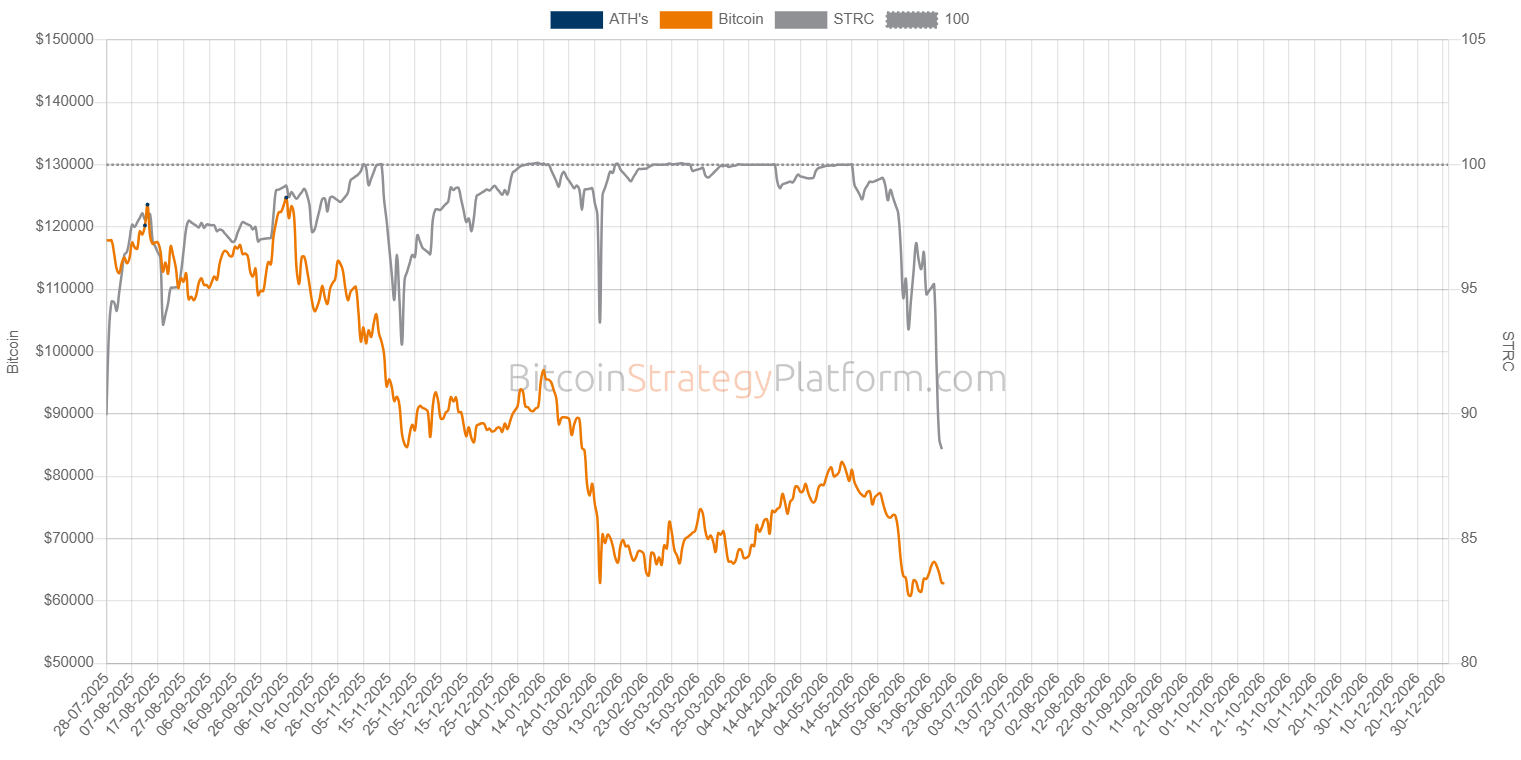
Digital credit faced its first real stress test this week, as MicroStrategy’s STRC preferred stock crashed, prompting critics to declare the Bitcoin-backed asset class dead.
Bitcoin (BTC) itself has weathered the same obituaries many times before. On-chain data now tells a different story, with network activity climbing to multi-year highs even as the price slides.
What Digital Credit Actually Means
Digital credit is a young class of income-generating securities backed by Bitcoin. Companies holding large Bitcoin reserves issue structured products such as preferred equity and convertible notes.
They use the proceeds to buy more Bitcoin. The aim is straightforward. Long-term BTC appreciation should outpace the dividends and interest those products owe.
Strategy, formerly MicroStrategy, built the clearest example with its STRC preferred stock. STRC has a $100 par value and pays a high, variable yield near 12% per year.
When the shares trade at or above par, Strategy issues more shares and routes the cash into Bitcoin. That mechanism turns STRC demand into BTC on the balance sheet.
Strategy frames the whole stack in plain terms. It calls bitcoin digital capital, STRC digital credit, and its common stock digital equity. The pitch attracted income-focused investors seeking Bitcoin exposure without holding the coin.
They earn a steady yield while Strategy carries the price risk.
Convertible notes and other preferreds follow the same logic. Each one borrows against future Bitcoin gains to buy more BTC today.
From 2025 through 2026, these vehicles became a major source of fresh Bitcoin demand. STRC-linked buying funded far more bitcoin than spot ETFs over the same stretch.
The First Real Stress Test
Critics declared digital credit dead this week, and some of the criticism landed. STRC was marketed as a lower-volatility way to hold Bitcoin exposure.
Instead, it broke par. The preferred shares fell to an intraday low near $82, roughly 18% below $100.

Several pressures hit at once. The asset class is less than a year old, and leveraged STRC positions are unwinding while Bitcoin forms a bottom. Capital is also competing with AI listings and a crowded IPO pipeline.
The wider market mirrors that strain. Total value locked across Decentralized Finance (DeFi) fell from about $170 billion in October 2025 to near $72 billion now.

That marks a drop of more than 55% and signals a broad flight from risk. The selling pressure on STRC did not happen in isolation. The structure also fed on itself. Because STRC trades under par, Strategy has paused new share sales through its market program.
That limits its ability to keep buying Bitcoin, the very engine behind the model. A higher variable dividend, meant to defend par, now reads as a distress signal rather than a reward.
Rival treasury preferreds with higher yields have also pulled capital away. Together these forces explain why critics reached for the word dead. Still, the death call looks premature. Analyst @therationalroot argues that a failure here is very unlikely.
Strategy holds enough cash to cover dividends for at least seven months. Its Bitcoin reserve could fund those same payments for decades.
The market still flinched at one move. In late May, Strategy sold a small batch of bitcoin to fund STRC distributions for the first time. The sale was tiny against its overall holdings. Yet it fed the fear that the model would bend when Bitcoin fell hard.
This remains the first true downturn for an asset class barely a year old. Bitcoin has carried that same dead label through every deep bear market and returned each time.
Bitcoin’s Network Tells the Opposite Story
While digital credit takes its punches, the Bitcoin network looks anything but dead. CryptoQuant’s Network Activity Index broke above its trend for the first time since mid-2024.
It has climbed since January 2026 and has held above trend since late March. That creates a clear divergence, with activity rising while the price falls.
The index measures how heavily the chain gets used, from transaction volume to address activity. A reading above trend points to real expansion rather than a quiet network.
Daily transaction counts and average transactions per block both sit near record highs. The catch sits in the detail.

Transactions below 0.01 BTC now make up about 80% of daily activity, up from under 50% in 2023. Much of the surge comes from OP_RETURN usage tied to Runes and Ordinals inscriptions.
OP_RETURN lets users attach small data to a transaction, which token and inscription projects rely on heavily. These generate large volumes of low-value transactions rather than big economic transfers.
That distinction matters for how the surge gets read. A busy chain is not the same as a chain moving more value.
The mempool has swelled to its highest transaction count since late February 2025. Congestion sits mostly in the low-fee cohorts.
Sustained non-financial activity could raise fees for economic transactions over time. Even so, the core signal stands, and the chain is busier than it has been in years. Michael Saylor has made similar arguments about resilient demand.
A Pulse, Not a Eulogy
Bitcoin trades near $62,400, down about 3% on the day and far from its highs. Both digital credit and the Bitcoin network have been written off before.
The timing tells its own story. Doubts about digital credit grew louder exactly as Strategy’s preferred shares slid below par.
The on-chain numbers cut against that gloom. A network this active rarely fits the picture of a dying asset. That gap between price and usage is the core tension to watch. Falling prices and rising activity rarely sit together for long.
The data suggests both still have a pulse. Whether STRC reclaims par and network activity keeps climbing will decide if this moment marks a bottom or a warning.
The post Is Bitcoin-Backed Digital Credit Dead After MicroStrategy’s STRC Crash? appeared first on BeInCrypto.

Aura’s impressive e-ink photo frame doesn’t even look digital

Cryptocurrency | English Short Story

No Oil Demand Peak in Sight, OPEC Says


-

 Business5 days ago
No Jackpot Winner as $257 Million Prize Rolls Over to $269 Million Monday Draw
-
 Crypto World5 days ago
Zimbabwe Requires Crypto Businesses to Register Annually Under New FIU Regulations
-

 Crypto World7 days ago
Bitget enters Argentina’s regulated crypto market through PSAV registration
-

 Tech7 days ago
NanoClaw integrates JFrog registries to secure AI agent downloads
-
 Entertainment5 days ago
Matt Damon’s Viral Sci-Fi Thriller Has Taken Over HBO Max
-

 Business5 days ago
Anthropic staff to meet White House officials next week, Axios reports
-

 Tech5 days ago
As AI companies race to go public, who else is along for the ride?
-
 Crypto World5 days ago
Bitcoin could crash to $48,000, if this historical pattern is triggered
-

 Politics5 days ago
“Israel’s” ban on ICRC visits ruled illegal, but Knesset moves to stop them permanently
-
 NewsBeat5 days ago
Warning of disruption as Cardiff Crossrail works to start
-

 News Videos5 days ago
Financial Accounting | Last Day Revision Strategy and Booster | CMA Inter – June 2026
-
 NewsBeat5 days ago
what doctors are seeing in ebike crashes
-
 NewsBeat5 days ago
Tributes to former deputy head teacher at Cambridge school among death and funeral notices
-

 Entertainment6 days ago
Deion Sanders Shares Powerful Post After Viral Advice To Deiondra
-
 Entertainment5 days ago
Kate Middleton Glare Goes Viral After Kids Booed At Royal Event
-

 Crypto World5 days ago
XRP ETFs Outperform As Bitcoin And Ethereum Funds Extend Outflow Trend
-
 Crypto World5 days ago
Market Preview: SpaceX (SPCX) IPO Record, Federal Reserve Meeting, and Iran Nuclear Agreement
-

 Tech5 days ago
Over 400 Arch Linux packages compromised to push rootkit, infostealer
-

 Business5 days ago
Invesco Quality Income Fund Q1 2026 Commentary
-
 Entertainment7 days ago
44 Years Later, This Is the Greatest Star Trek Quote in Sci-Fi History
You must be logged in to post a comment Login