

Crypto World
Playbook for WEEX Cup 2026: Data Intelligence, Predictive Insight, and $1M in Community Rewards


Every World Cup produces a moment nobody saw coming. This year, WEEX, a world leading crypto exchange, gave its community three ways to get ahead of it: a live prediction data report with Foregate, a $1,000,000 Dice Rush campaign, and an interview with football legend Michael Owen that ended up predicting the tournament’s biggest upset before it happened.
The Guide That Reads the Tournament Like a Market
WEEX teamed up with ForeGate, the Solana-based on-chain prediction market, to publish the ForeGate 2026 World Cup Winning Guide — a living report tracking advancement odds, likely matchups, and title paths as the tournament unfolds.
The idea was simple: treat football like a market, not a guessing game.
Where most World Cup content freezes on kickoff day, this one kept moving — updated as results came in, odds shifted, and underdogs made their case. While the tournament kept changing, WEEX made sure the data changed with it.
WEEX Cup: Where Every Roll Could Be Worth $1,000,000

Alongside the data, WEEX built something louder: WEEX Cup – Dice Rush, a World Cup-themed event backed by a $1,000,000 USDT prize pool, plus trial fund, token rewards and more!
The mechanics are built for momentum, not complexity:
- Earn dice — complete tasks like deposits, trading, or inviting friends
- Roll to win — move across the board, unlock BTC, ETH, USDT, coupons, and more
- Stack points — unlock milestone rewards and enter WEEX Cup match predictions
- Back a champion — use points to support the team you believe will lift the trophy, then share the prize pool with everyone who called it right
Users who picked less-favored outcomes were positioned for bigger rewards — a mechanic that turned out to be more prophetic than anyone expected.
The numbers tell the story. Over 100,000 users have joined the event so far. More than $1,000,000 in rewards has already been distributed, with top winners claiming over $2,000 each.
One line sums up the design philosophy: the crowd isn’t always right, and the ones who bet against it get paid more for being early.
When WEEX and Michael Owen Predicted the Upset Before It Happened
Weeks before Cape Verde became the story of the tournament, WEEX COO Andrew Weiner sat down with football legend Michael Owen to talk about what makes this World Cup different.
One line from that conversation stands out now:
“When you’re in the minority of opinion, you have the biggest chance for the biggest value.”
Owen went further, pointing to the tournament’s expansion to 48 teams as fertile ground for exactly this kind of surprise:
“There’s possible value in certain situations — it’s down to people to try to find it.”
Then Cape Verde happened.
A nation of 546,000 people, ranked outside the world’s top 70, playing in its first-ever World Cup — and it didn’t just show up. It drew Spain 0-0. It drew Uruguay 2-2. It drew Saudi Arabia 0-0, advancing out of the group stage without winning a single match, one of only five teams in World Cup history to do so.
Then, in the round of 16, Cape Verde held reigning champions Argentina to a 1-1 draw through regulation time — before finally falling 3-2 in extra time.
Four matches. Three former World Cup champions faced. Zero regulation-time losses.
It was, by every measure, the value Owen had described weeks earlier — found by a team nobody was pricing in.
A football legend called it before the tournament even started. That’s the kind of insight WEEX brought to its community.
WEEX’s World Cup Journey: Three Moves, One Idea
Report, game, and conversation weren’t three separate campaigns. They were one belief, expressed three ways:
The best value in football — and in markets — is rarely where everyone’s already looking.
WEEX didn’t just watch the World Cup happen. It built tools to help its community read it, play it, and occasionally, predict it before the world caught on.
Disclaimer: This information does not hold any official affiliation, sponsorship, or endorsement with FIFA or any official international football governing body.
About WEEX
Founded in 2018, WEEX has developed into a global crypto exchange with over 6.2 million users across more than 150 countries. The platform emphasizes security, liquidity, and usability, providing over 1,200 spot trading pairs and offering up to 400x leverage in crypto futures trading. In addition to the traditional spot and derivatives markets, WEEX is expanding rapidly in the AI era delivering real time AI news, empowering users with AI trading tools, and exploring innovative trade to earn models that make intelligent trading more accessible to everyone. Its 1,000 BTC Protection Fund further strengthens asset safety and transparency, while features such as copy trading and advanced trading tools allow users to follow professional traders and experience a more efficient, intelligent trading journey.
Follow WEEX on social media
Instagram: @WEEX Exchange
Tiktok: @weex_global
Youtube: @WEEX_Official
Discord: WEEX Community
Telegram: WeexGlobal Group
The post Playbook for WEEX Cup 2026: Data Intelligence, Predictive Insight, and $1M in Community Rewards appeared first on BeInCrypto.

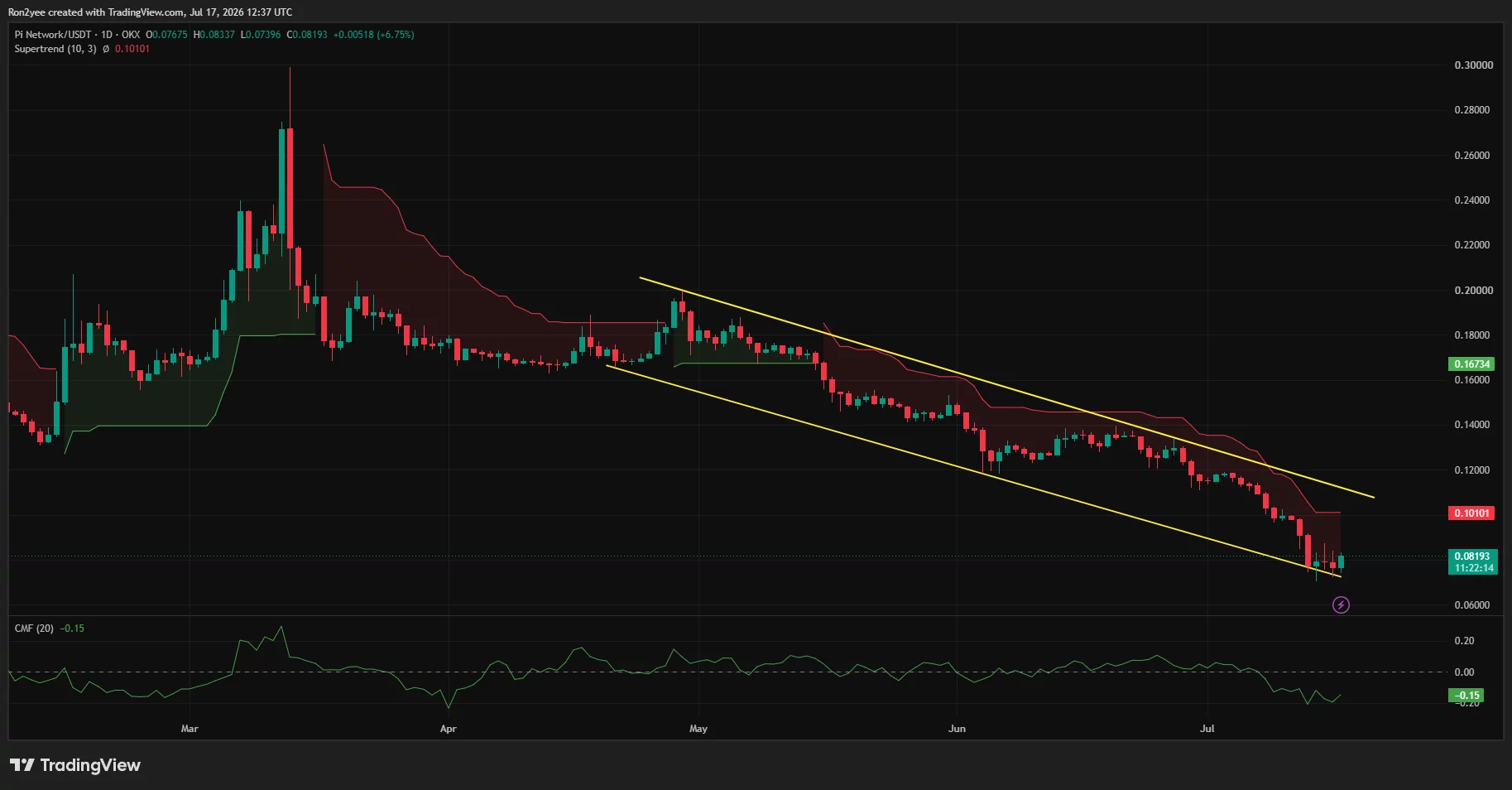
Pi Network price has surged more than 13% to an intraday high of $0.083 after the Core Team confirmed a Protocol v25 upgrade for July 22, lifting retail sentiment around the battered token.
Summary
- Pi Network price surged over 13% after the Core Team scheduled its Protocol v25 upgrade.
- Rising open interest and a possible triple bottom supported PI’s rebound from record lows.
- Negative money flow and daily token unlocks could limit gains above $0.083.
According to data from crypto.news, Pi Network (PI) price traded near $0.082 at press time after rebounding from its July 14 record low around $0.071. The advance stood out as Ethereum, Solana, and other high-beta cryptocurrencies fell alongside a global technology-stock rout.
Protocol v25 and leveraged demand have fueled the rebound
Pi Network’s Core Team confirmed that Protocol v25 will improve network stability and add tools for more efficient, privacy-preserving smart contracts. The team also introduced a redesigned Mining App menu intended to simplify access to ecosystem features and applications. Pi Network’s announcement gave traders a dated catalyst after PI lost about 27% over the previous week.
Derivatives traders quickly increased their exposure. PI futures open interest rose to $10.73 million from $10.44 million a day earlier. Rising leverage, combined with thin order books, likely helped accelerate the move as bearish positions faced pressure above $0.080.
Meanwhile, Pi Network’s retail-heavy market structure helped the token move independently of large-cap altcoins. Global technology shares fell on July 17 as investors reduced leveraged exposure to semiconductor and AI stocks, while renewed Middle East tensions pushed oil prices higher.
U.S. initial jobless claims also dropped to 208,000 from 216,000, another sign of resilience in the labor market. Firm economic data can reduce the case for Federal Reserve rate cuts, a development that usually hurts speculative assets. PI’s network-specific catalyst outweighed that pressure during Friday’s session.
On the lower-time-frame chart, PI has formed three troughs around $0.073–$0.075, creating a possible triple bottom. The pattern requires a decisive close above its neckline near $0.082–$0.083. A confirmed breakout could open a move toward $0.086, where the chart shows the next short-term target.
According to trader Crypto With Gopal, buyers have repeatedly defended the same support zone.
“Support has held multiple times—now all eyes are on the breakout. Market sentiment is turning increasingly bullish.”
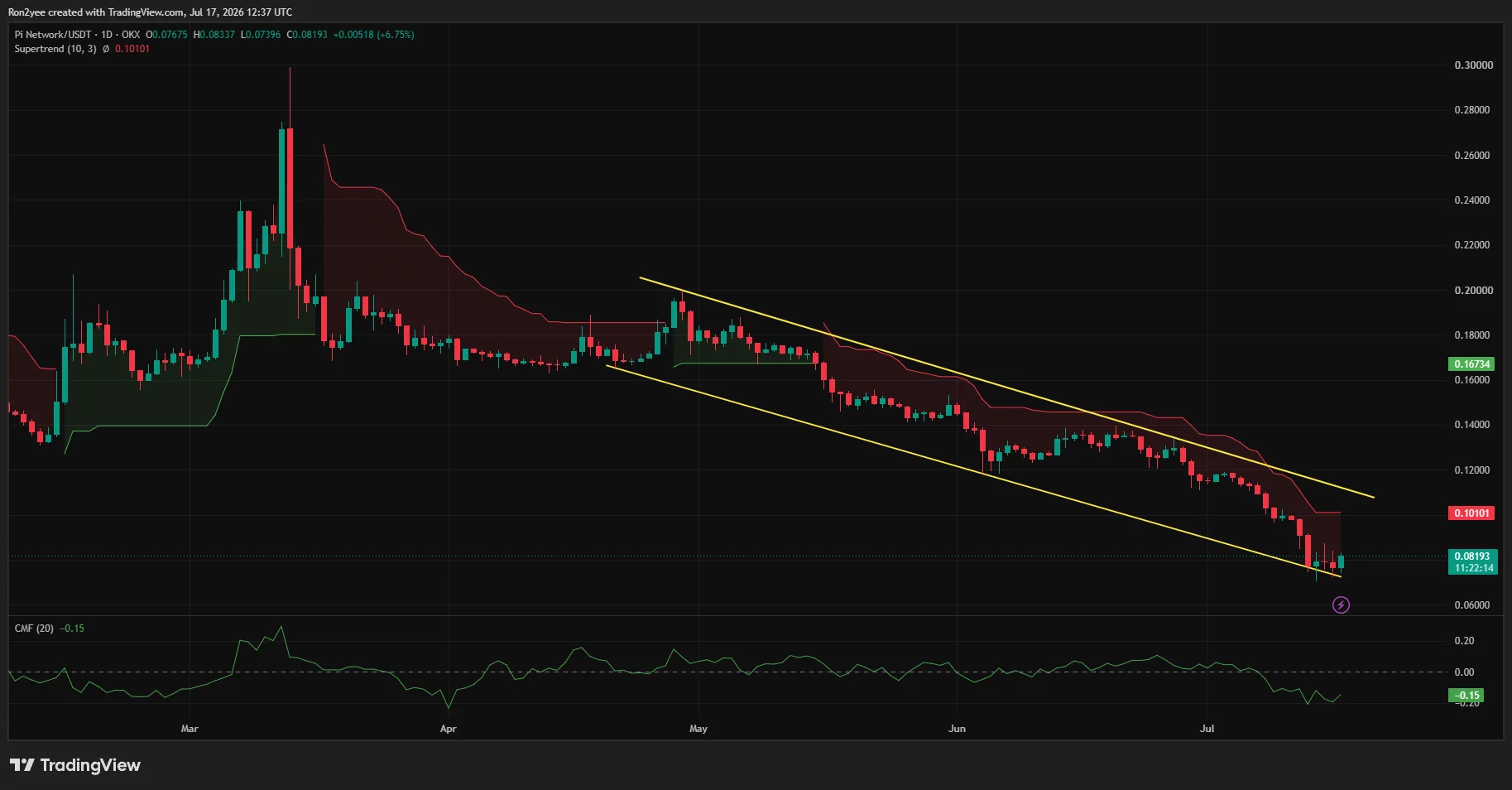
The daily chart presents a tougher test. PI remains inside a descending channel that has controlled price action since late April, while the Supertrend stays bearish at $0.101. A rebound toward that level would still leave the token beneath the channel’s upper boundary, now located around $0.108.
Weak money flow and token unlocks threaten the recovery
Chaikin Money Flow remains negative at approximately -0.15, which shows that capital outflows still exceed inflows despite Friday’s bounce. PI must push the indicator above zero and reclaim $0.101 before the daily chart supports a durable trend reversal.
Supply also remains a structural risk. PiScan data showed roughly 127.5 million PI scheduled to unlock over a 30-day period, equal to an average of about 4.25 million tokens per day. Continued releases could limit gains unless network activity creates enough demand to absorb the new supply.
A rejection from $0.083 would weaken the triple-bottom setup and return attention to $0.074. A daily close below that support would invalidate the recovery thesis and expose the record-low region near $0.071, with the descending channel allowing further losses toward $0.065.
Disclosure: This article does not represent investment advice. The content and materials featured on this page are for educational purposes only.


“The real prize is the yen side of onchain settlement, one of the most strategic positions in Asian finance over the coming decade, and that is exactly what SBI is building toward,” he added.
One technical limitation remains. JPYSC does not yet support withdrawals to external wallets.
“Regarding JPYSC, its use is currently limited to accounts within SBI VC Trade, and it does not yet support withdrawals to external wallets or remittances and settlements via public blockchains,” the spokesperson said.
For now, that limits JPYSC’s use outside SBI’s own platform. Investors cannot yet move the stablecoin to external wallets or use it to settle transactions across public blockchains.
Sota Watanabe, CEO of Startale Group, which works with SBI Holdings on JPYSC, said the company’s continued investment in digital assets reflects what he sees as growing institutional confidence in blockchain infrastructure.
“SBI Holdings’ continued commitment to digital assets likely signals confidence in the future architecture of global finance,” Watanabe told CoinDesk.
He said blockchain is increasingly being viewed as financial infrastructure rather than an emerging technology, adding that Japan is well-positioned to lead the sector due to its regulatory framework and financial institutions.
SBI expansion
SBI agreed to buy Tokyo-based cryptocurrency exchange Bitbank for around $289 million in June. The acquisition is expected to close in October, subject to regulatory approval. SBI previously acquired crypto exchange Bitpoint in 2022. The firm also led a $76 million Series C funding round for institutional exchange EDX Markets and a $25 million Series C round for crypto risk manager Gauntlet, the spokesperson said.
Crypto World
ether.fi Partners with Nexus Mutual to Protect Against ETH Slashing at Institutional Scale
[PRESS RELEASE – London, United Kingdom, July 17th, 2026]
ether.fi, the leading onchain neobank for digital asset management, has selected Nexus Mutual to provide crypto’s largest-ever ETH Slashing Cover. The cover protects ether.fi‘s validators against up to 15,000 ETH worth of slashing penalties.
As ether.fi continues to see rapid adoption from both retail and institutional audiences, securing industry-leading protection against slashing risk for ether.fi users is critical. Over the last year, ether.fi has been systematically strengthening their stack across infrastructure, risk management, operational security and real-time defense systems.
Since ether.fi operates one of the largest validator sets on Ethereum, slashing is a real tail risk for them. By working with Nexus Mutual, ether.fi has mitigated this with protection that kicks in to secure against validator losses. This cover was calculated to protect ether.fi in even the most extreme scenarios and represents more than all historical losses from ETH slashing combined.
“We’ve always believed the safest protocols will ultimately win. That’s why we’ve invested heavily in audits, operational security, staking architecture, and now the largest insurance program in the industry. We are excited to partner with Nexus Mutual to make this a reality,” said Mike Silagadze, Founder & CEO of ether.fi.
“We’ve known the ether.fi team since before it was ether.fi, and they’ve been focused on risk from day one. Covering their users for up to 15,000 ETH in slashing penalties is a historic step, and we’re proud they chose Nexus Mutual to take it with them,” said Hugh Karp, Founder of Nexus Mutual.
About ether.fi
ether.fi is the leading onchain neobank for digital asset management. With $6B+ in AUM across Cash (crypto card), Stake (restaking), and Liquid (liquid restaking derivatives), ether.fi has established category dominance in crypto neobanking. It’s the rare institutional-grade product built for consumer adoption.
About Nexus Mutual
Nexus Mutual is the first crypto insurance alternative. Since 2019, they have covered more than $7 billion against smart contract hacks, slashing, and other digital asset risks. As the industry leader, they have become a trusted partner for everyone from individuals to institutions to help manage onchain risk.
The post ether.fi Partners with Nexus Mutual to Protect Against ETH Slashing at Institutional Scale appeared first on CryptoPotato.
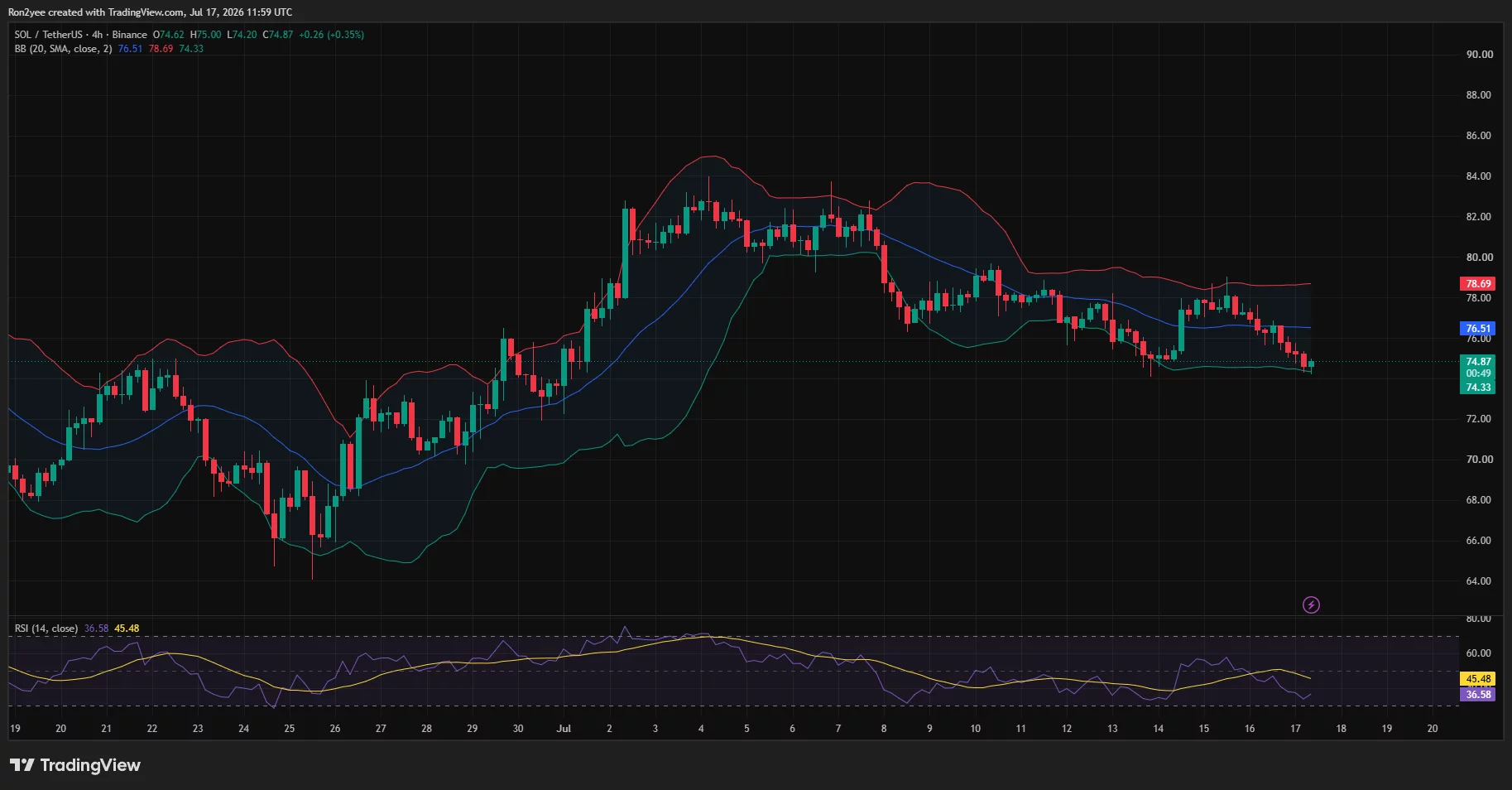
Solana price has fallen nearly 4% to about $74 after a rejection near $77, as a global technology sell-off and leveraged long liquidations have pushed traders toward caution.
Summary
- Solana price tests $74 support after losing its rising trendline and facing weak four-hour momentum.
- A recovery above $76.50 could trigger short liquidations and drive SOL toward $78–$80.
- Losing $74 would expose the daily Supertrend support at $69.60 and deepen downside risks.
According to data from crypto.news, Solana (SOL) price extended its decline on July 17 after failing to hold above the $76.50–$77 resistance area. Selling accelerated as semiconductor shares led losses across global markets, with Nasdaq 100 futures down 1.8%, Japan’s Nikkei 225 off 4%, and Taiwan’s benchmark plunging more than 6%.
The drop can partly be attributed to the rout due to doubts over stretched artificial intelligence valuations and leveraged retail positions.
Strong U.S. data added pressure on speculative assets. Initial unemployment claims fell to 208,000 from 216,000, while June retail sales rose 0.2%. The 10-year Treasury yield climbed toward 4.60%, and the dollar strengthened, raising the cost of holding high-beta assets such as Solana.
Institutional demand has provided only limited relief. U.S. spot Solana exchange-traded funds attracted $8.36 million on July 6, their strongest daily intake in almost two months, per data from SoSoValue. However, the inflow was not enough to prevent SOL from retreating from its early-July high near $83.
Solana price can rebound if bulls reclaim $76.50
On the 4-hour chart, SOL trades near $74.87 and has reached the lower Bollinger Band at $74.33. The middle band at $76.51 now serves as immediate resistance, while the upper band sits at $78.69. A 4-hour close above the midpoint would give buyers another chance to test the $78–$80 region.
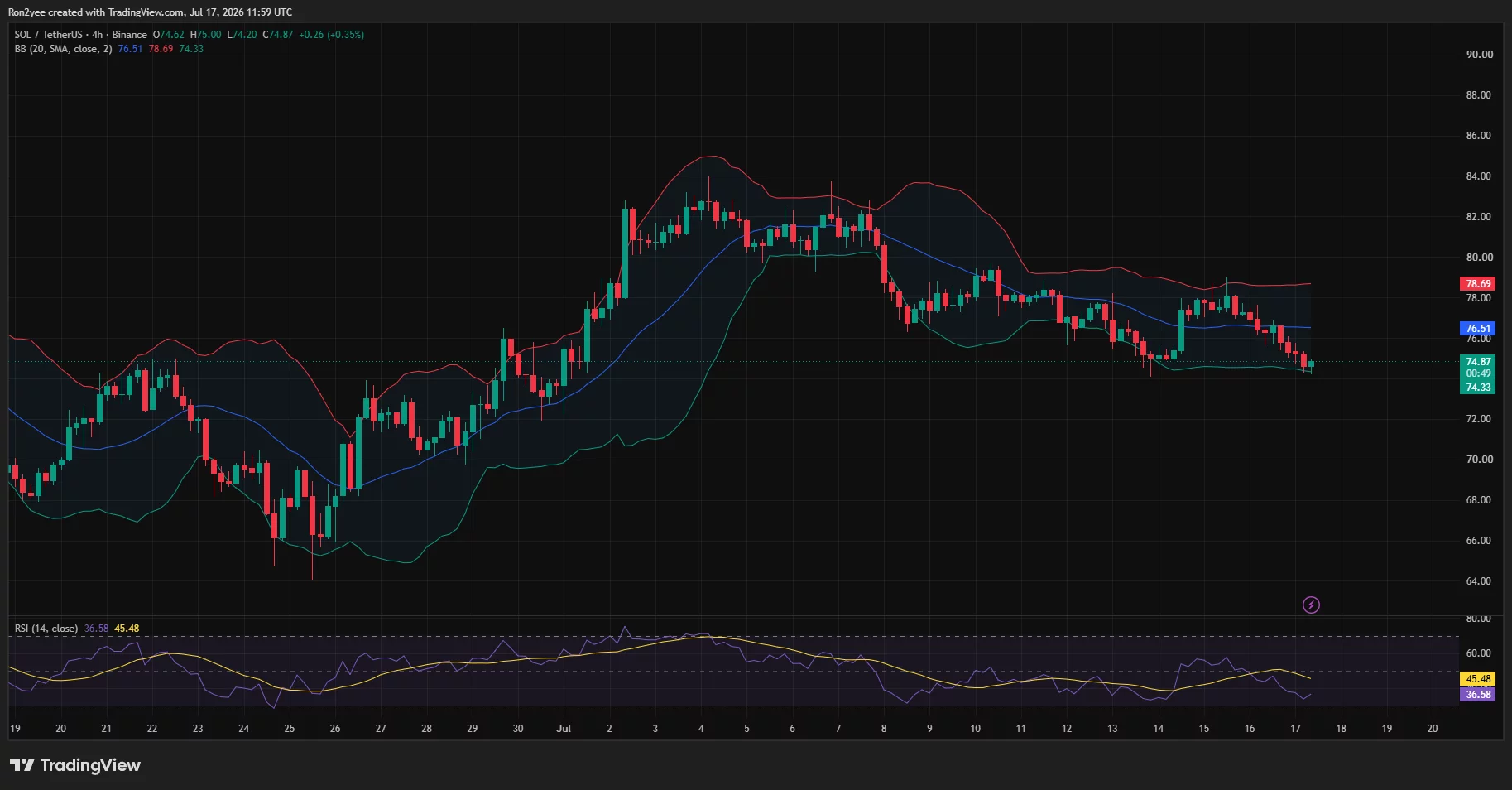
Momentum remains weak but is approaching levels where relief rallies can develop. The 4-hour relative strength index has dropped to 36.58, below its signal average of 45.48 but still above the oversold threshold of 30. Price has also formed a sequence of lower highs since its July 4 peak near $83.
According to crypto analyst SatoshiOwl, SOL has reached a support area after breaking beneath an ascending trendline.
“Hold here and we could see a relief bounce back toward $78–$80. Lose it, and a deeper flush becomes much more likely.”
Ali Charts offered a longer-term counterpoint, noting that the TD Sequential indicator has produced a buy setup on Solana’s monthly chart. The analyst described it as a potential early warning of a macro trend change, although the monthly setup requires confirmation from shorter time frames.
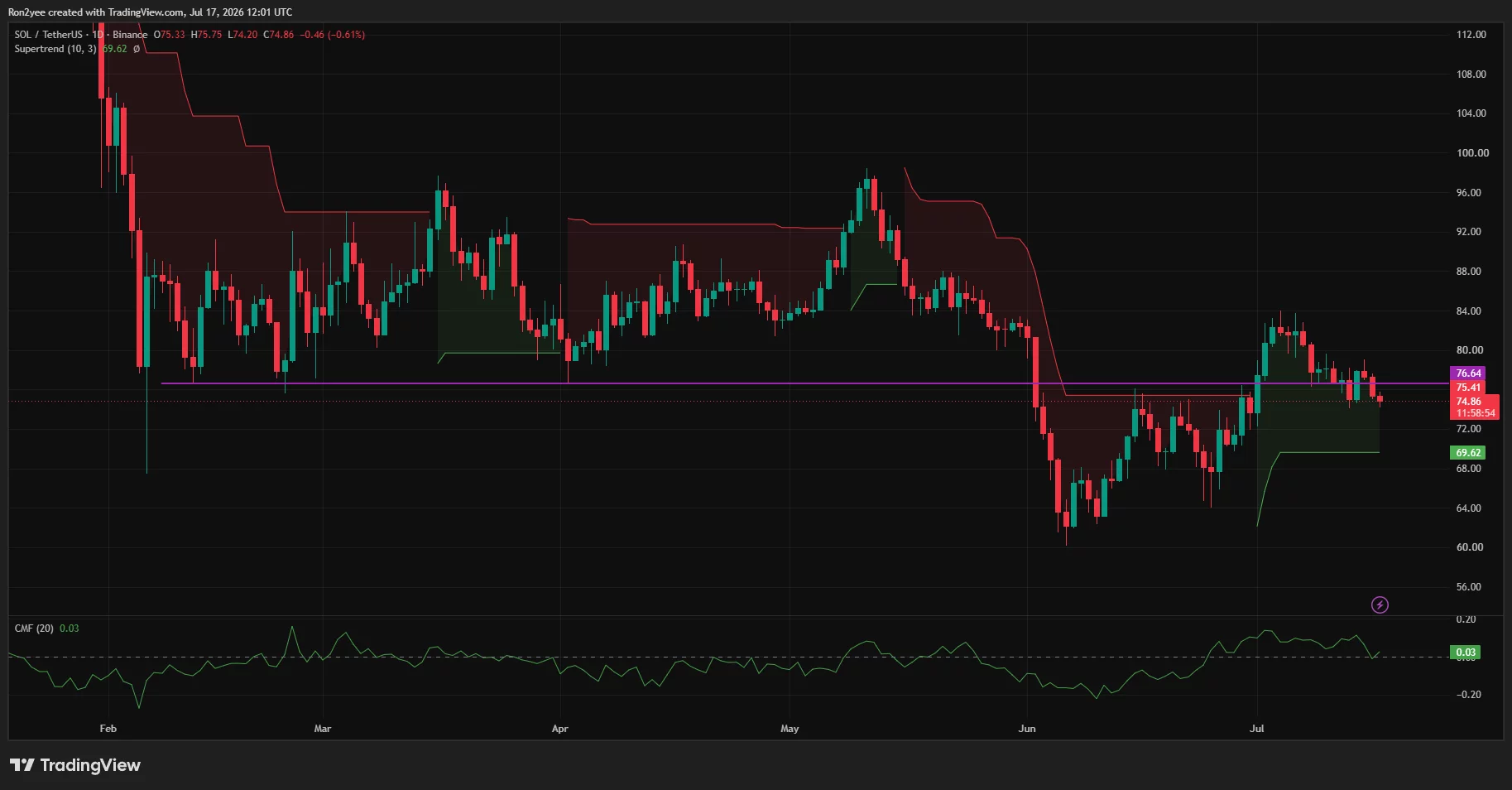
The daily chart remains constructive above the Supertrend support at $69.62. Chaikin Money Flow stands at 0.03, which shows that capital flow is still marginally positive despite the latest sell-off. SOL must first recover the former horizontal support at $76.64 before the daily structure can improve.
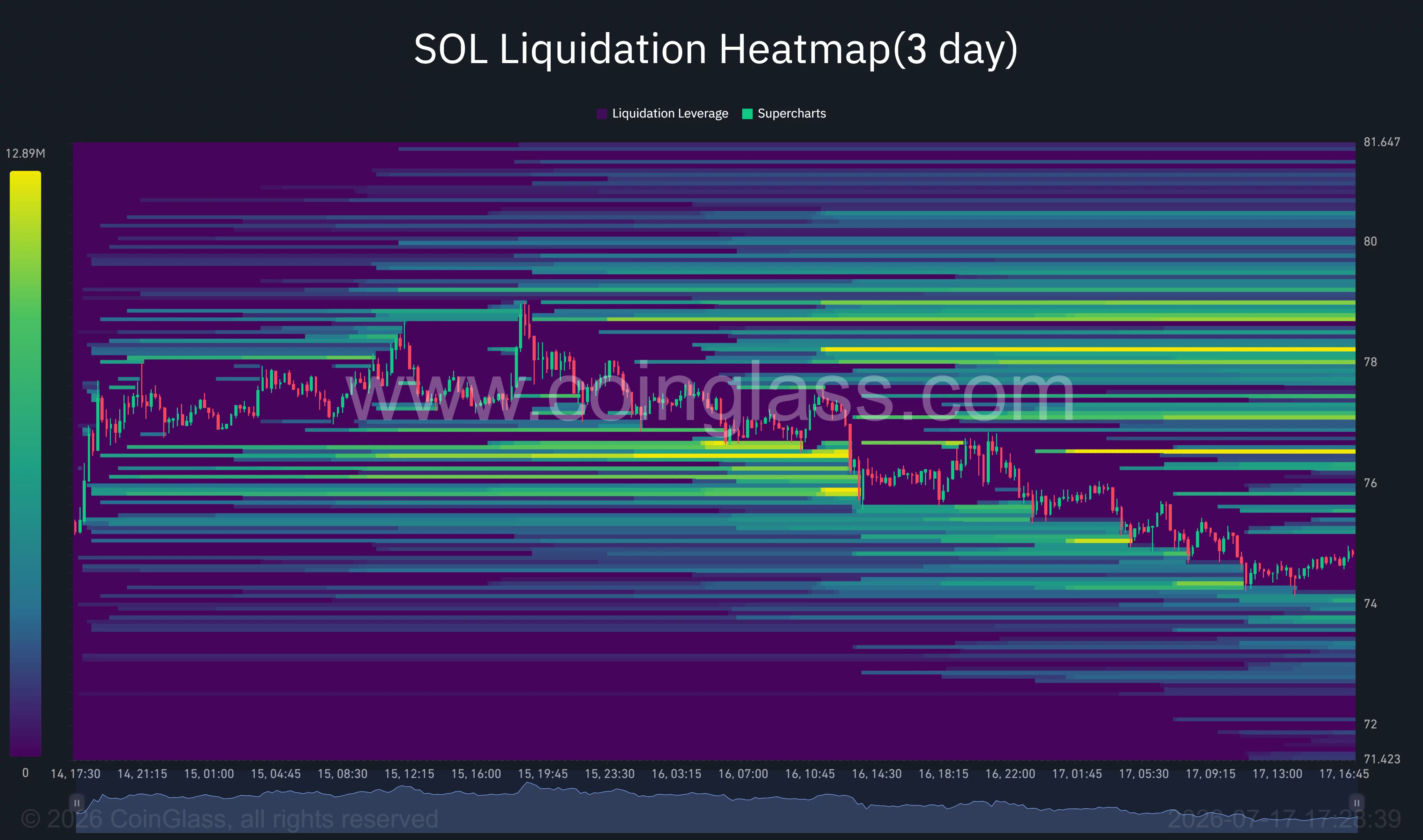
CoinGlass’ three-day liquidation heatmap places the nearest large pools of leveraged positions above the market. Dense clusters sit near $76.50–$76.70, $78, and $78.70, making those levels possible price magnets if SOL rebounds. A move through $76.70 could liquidate short positions and accelerate a recovery toward $78.
A break below $74 would expose the $69.60 support zone
Downside risk will rise if SOL closes decisively below the $74–$74.30 area. The heatmap shows less concentrated liquidity immediately beneath the current price, leaving room for a quicker decline toward $72 before the daily Supertrend level near $69.62 comes into play.
A loss of $69.62 would invalidate the remaining bullish daily setup and expose the June recovery base between $64 and $66. Macroeconomic pressure could deepen that move if Treasury yields continue higher, technology shares extend their decline, or renewed U.S.-Iran tensions lift oil prices and reduce demand for risk assets.
For now, SOL remains caught between weak four-hour momentum and positive daily capital flow. Bulls need $76.50 back to target the liquidity stacked near $78–$80, while a failure to protect $74 would place the $69.60 trend support at risk.
Disclosure: This article does not represent investment advice. The content and materials featured on this page are for educational purposes only.
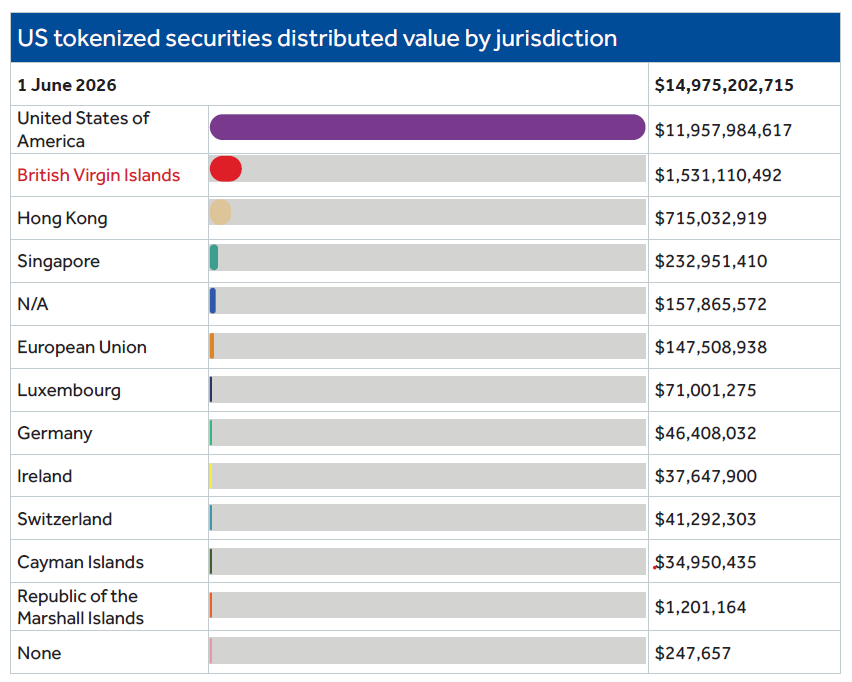
More than $1 out of every $10 of the world’s tokenized US Treasuries is issued by a company incorporated in the British Virgin Islands.
That places the small Caribbean territory behind only the United States as a key jurisdiction for the rapidly growing asset class, according to BVI Finance.
BVI Finance’s Destination Digital report in June found that BVI entities accounted for approximately $1.5 billion of the $14.98 billion global market for tokenized US Treasuries as of June 1.
A growing list of digital asset firms now call the British Virgin Islands home, including Kraken’s parent company, Payward, Bitstamp (recently acquired by Robinhood), 1inch and Bitfinex.
The territory boasts a stablecoin market cap of about $1.2 billion held in BVI-linked addresses and has roughly 28,000 stablecoin asset holders.
More than 25 virtual asset service providers (VASPs) have been approved under the BVI’s VASP regime, and, according to Bernstein Research, the Islands host 305 tokenized securities — the highest count for any single jurisdiction in the RWA.xyz dataset.
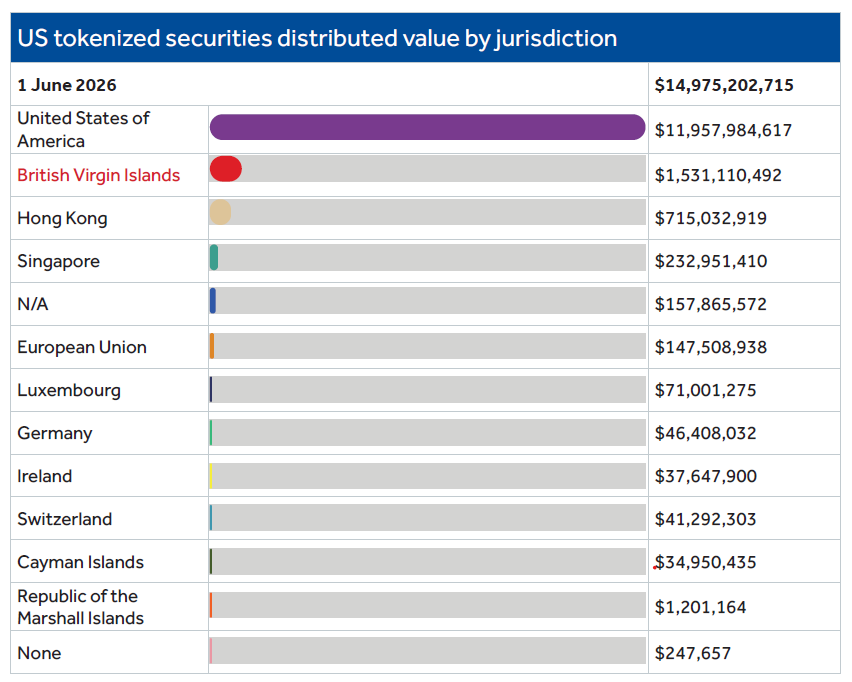
US tokenized securities distributed value by jurisdiction. Source: Destination Digital
The statistics suggest the Virgin Islands has become one of the world’s top crypto hotspots, but the reality is a little more nuanced.
Tokenized assets are designed to be borderless, and crypto projects often have the choice of which offshore jurisdiction to incorporate in.
In most cases, digital asset companies aren’t physically relocating to the Virgin Islands; they’re simply using the territory to incorporate legal entities, such as token issuers, treasury vehicles, holding companies or special purpose vehicles (SPVs).
Crypto companies aren’t just choosing BVI for tax reasons
Andrew Jowett, a partner at Appleby (BVI) Ltd who advises digital asset businesses on corporate structuring, told Cointelegraph that clients researching the BVI typically compare several jurisdictions, such as the Cayman Islands, United Arab Emirates, Singapore and Switzerland.
Despite long-held assumptions about offshore Caribbean tax havens, tax neutrality is no longer the primary driver.
Related: Dubai crypto market hits 50 licensed firms after new VARA approval
“The overriding factor for choosing the BVI has been digital asset regulation and not tax,” Jowett said. The British overseas territory does have attractive tax policies, and imposes no corporate income tax or capital gains tax on BVI companies.
But all the leading crypto hubs now have favorable crypto tax policies, meaning it’s no longer the deciding factor.
The Cayman Islands imposes no corporate income tax or capital gains tax, and the UAE has zero personal income tax or federal corporate tax on qualifying free zone entities.
“Tax neutrality is table stakes,” said Saeed Al-Marri, chief executive of digital asset infrastructure firm Ethra, which is incorporated in the BVI. He added that the BVI provides legal certainty and clarity, factors he said will determine which jurisdictions survive institutional adoption.
LTP is an institutional digital asset infrastructure provider that operates regulated entities in the BVI, Hong Kong, Australia and the UAE. Its founder and chief executive, Jack Yang, told Cointelegraph that while favorable taxation is relevant for cross-border structures, it is secondary to legal and regulatory certainty as tokenization moves further into institutional finance.
“A tax-neutral structure that cannot pass review by banks, custodians, auditors, investment committees, or regulators has limited practical value,” he said.
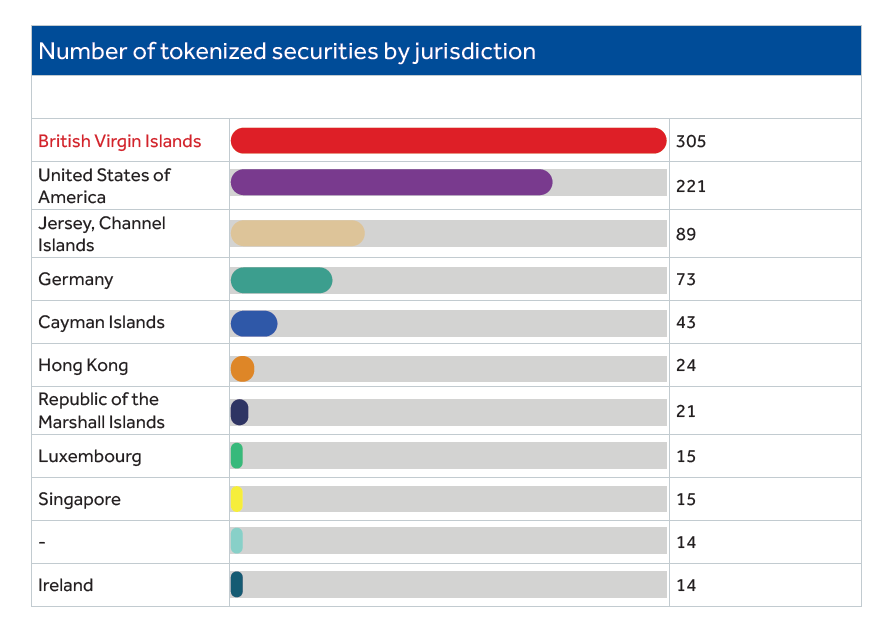
Number of tokenized securities by jurisdiction. Source: Destination Digital
Orest Gavryliak, chief legal officer at decentralized exchange aggregator 1inch, which is incorporated in the BVI, said that more and more decentralized finance (DeFi) protocols are choosing jurisdictions that provide predictable rules, rather than simply the lowest tax burden.
“Jurisdiction isn’t exactly becoming irrelevant, but its role is changing,” Gavryliak told Cointelegraph. “Protocols are increasingly weighing factors such as regulations, institutional credibility and long-term sustainability.”
Crypto hubs now compete on legal infrastructure
Jurisdictions vying to be “crypto hubs” like Singapore and the UAE increasingly compete via favorable legal infrastructure and licensing regimes, such as Singapore’s Payment Services Act and Dubai’s Virtual Assets Regulatory Authority (VARA) rulebooks.
The BVI introduced the Virtual Assets Service Providers Act (VASP Act) in 2023, overseen by the BVI Financial Services Commission (FSC).
Compared with many larger financial centers, it offers a speedy turnaround, responds to VASP applications within six weeks and aims to complete the review process within six months, according to BVI Finance and FSC guidance.
Jowett said beyond favorable tax regimes, clients prioritize “ease of launch” and efficient corporate structuring, which has long been part of the BVI’s appeal. Companies can be set up quickly, the legal framework is flexible, and ongoing reporting is generally lighter than in onshore jurisdictions.
Related: Cayman Islands Web3 foundations jump 70% as CARF reporting rules arrive
The Virgin Islands has also historically been favored because it offers more corporate confidentiality than many larger financial centers.
While BVI companies are still subject to anti-money laundering (AML) and know-your-customer (KYC) requirements, beneficial ownership information is held by registered agents rather than a public register, which reduces disclosure requirements.

British Virgin Islands. Source: Destination Digital
However, none of the companies interviewed by Cointelegraph cited tax neutrality or greater corporate confidentiality as deciding factors for incorporating in the BVI, pointing instead to legal certainty, regulatory clarity and corporate flexibility.
Incorporating, not physically relocating to the Virgin Islands
Yang told Cointelegraph that LTP does not employ full-time staff “on the ground.” Instead, the entity is overseen by its board and supported by staff from elsewhere in the LTP group.
The same distinction can be seen elsewhere in the industry. Kraken’s parent company, Payward, is incorporated in the BVI, but the exchange’s operations are primarily based in the United States, while 1inch’s team and operations are spread across multiple jurisdictions.
The BVI isn’t winning the race to attract glitzy headquarters or large-scale engineering teams. Instead, it has become the legal home for many digital asset businesses, while much of the work happens elsewhere. For jurisdictions competing to attract the industry, that just may be enough.
Magazine: Singapore isn’t a ‘crypto hub’ — it’s something better: StraitsX CEO


Japanese financial services group SBI Holdings has acquired a majority stake in Holdbuild, the parent company of Singaporean crypto platform Coinhako, after receiving regulatory approval from Singapore’s central bank.
The approval from the Monetary Authority of Singapore (MAS) enabled SBI to acquire company shares from existing shareholders through a capital injection, making Coinhako a consolidated subsidiary of SBI, the company announced on Thursday.
Coinhako holds a Major Payment Institution license under MAS through its subsidiary, Hako Technology Pte. Ltd. SBI announced its intent to acquire a majority stake in the Singaporean crypto exchange in February.
SBI said it plans to combine Coinhako’s customer base and regional network with its own financial services and digital asset businesses, including its JPYSC stablecoin initiative.
Related: Coinbase Ventures tops crypto VC list for H1 2026
Financial terms of the transaction were not disclosed. SBI did not immediately respond to Cointelegraph’s request for details on the deal.
The acquisition is part of SBI’s broader expansion in digital assets. Earlier this month, the company led a $76 million Series C funding round for institutional crypto exchange EDX Markets. It also shared plans to acquire Bitbank for $289 million, aiming to create one of Japan’s largest crypto exchanges.
SBI deepens crypto industry involvement in Asia
SBI described Singapore as a key hub in its digital asset strategy and said the acquisition would strengthen its presence in Southeast Asia. SBI said it plans to hold its first overseas branch managers’ meeting in Singapore this summer to strengthen its local business foundation.
SBI has accelerated its digital asset expansion in recent months through acquisitions, investments and tokenization initiatives. This week, the company partnered with Ondo Finance to bring tokenized Japanese stocks and integrate its JPYSC stablecoin for settlement and collateral.
In February, SBI and Startale Group unveiled Strium, a layer-1 blockchain focused on tokenized securities and real-world assets. The network is designed to support 24/7 trading, tokenized equity settlement and institutional financial applications as SBI expands its digital asset infrastructure across Japan and overseas markets.
Magazine: Dubai tops Asian crypto hubs, Taiwan passes crypto laws: Asia Express
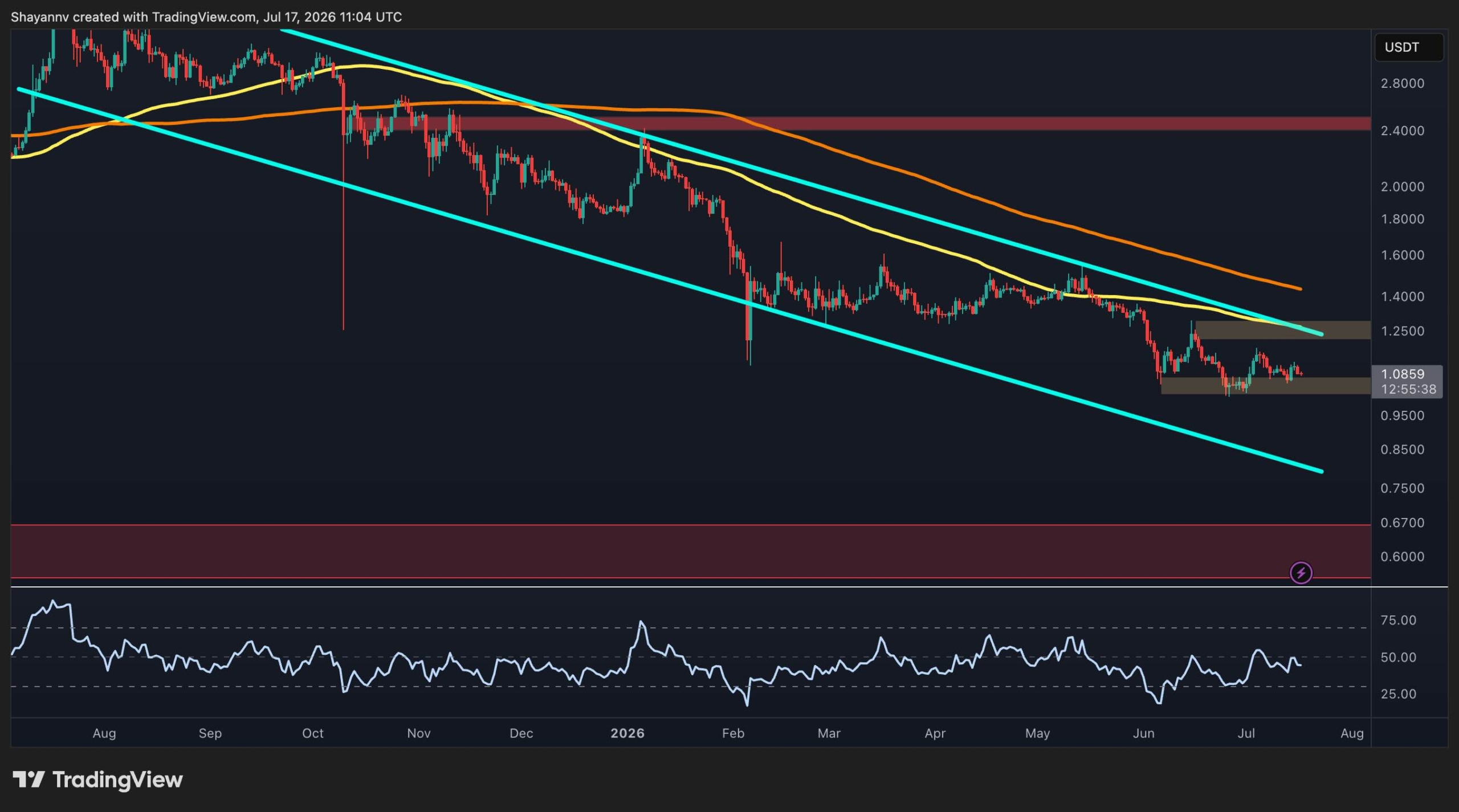
XRP remains under pressure across both its USDT and BTC trading pairs, with the broader market structure still favoring sellers. While the token has managed to stabilize above nearby support on the dollar chart, its Bitcoin pair continues to print lower highs and lower lows, highlighting persistent relative weakness.
Ripple Price Analysis: The USDT Pair
The daily chart shows XRP trading around $1.08 after an extended decline within a well-defined descending channel. Although the asset has recently moved sideways instead of extending its losses, the broader trend remains bearish as it continues to trade below both the 100-day and 200-day moving averages. These levels are also sloping downward, reinforcing the prevailing negative momentum.
Following the sharp breakdown in June, XRP has established a consolidation range between the $1 support zone and the $1.25 resistance area. Buyers have repeatedly defended the lower boundary, but every recovery attempt has been rejected before reclaiming the declining 100-day moving average or breaking above the channel’s higher boundary, indicating that bullish momentum remains limited.
A breakout above the $1.25 resistance would be the first sign that buyers are regaining control and could expose the descending channel’s upper boundary as the next major hurdle. Until then, the broader structure continues to favor further downside, with a loss of the $1 support opening the door toward significantly lower demand zones.
The RSI is hovering near the neutral 50 level, reflecting the current balance between buyers and sellers after weeks of heavy selling pressure. However, without a decisive bullish breakout, the indicator does not yet suggest a meaningful shift in trend.
The BTC Pair
The XRP/BTC daily chart paints an even weaker picture. The pair has remained inside a long-term descending channel for nearly a year while consistently trading beneath both the 100-day and 200-day moving averages, highlighting sustained underperformance against Bitcoin.
After several failed recovery attempts during May and June, XRP/BTC has finally dropped below the key horizontal support around 1,720 sats. This level has repeatedly attracted buyers over the past few months, but each rebound has produced another lower high, signaling that selling pressure continues to dominate.
On the upside, the next important resistance sits around the 1,850 sats region, where previous support has turned into resistance. A move above this area would improve the short-term outlook, but the descending channel and the 200-day moving average near 2,000 sats remain the primary barriers to a broader trend reversal.
Meanwhile, the RSI remains below the midpoint, suggesting that momentum still favors the sellers. Unless XRP/BTC can reclaim key resistance levels and break its long-term bearish structure, the pair appears vulnerable to another test of the channel’s lower boundary, which is now located around 1,500 sats.

The post Ripple Price Analysis: Weakening XRP Momentum Raises Risk of a Sub-$1 Drop appeared first on CryptoPotato.


ECB’s Piero Cipollone said stablecoin adoption could erode bank deposits, but the digital euro will keep banks at the center of payments.


The part that rattles valuations is the license. K3 is open-weight, with the full model due for public release on July 27. Anyone will be able to download it, run it on their own hardware, and pay nobody.
Anthropic released Fable 5 last month, and OpenAI shipped GPT-5.6 a week ago, both closed and metered. The assumption underwriting hundreds of billions of dollars in AI infrastructure spending is that frontier capability stays scarce, expensive and American.
A free Chinese model at the top of a coding leaderboard is a direct argument against that.
Meanwhile, Moonshot’s domestic rivals took it worst, with Z.ai falling about 27% and MiniMax about 16%.
For crypto, the headwinds run through the tape rather than through anything onchain. Bitcoin has spent this entire week taking direction from semiconductors.
Last Friday, it rose 4% on the day South Korea’s Kospi jumped 8% and SK Hynix priced $26.5 billion of American depositary shares. This Friday, it fell because a model release in Beijing made the same trade look expensive.
There is, however, a more concrete exposure underneath.
Bitcoin miners have spent two years repositioning themselves as AI data center landlords, signing long-term leases with model developers on the assumption that demand for training and inference compute keeps rising.
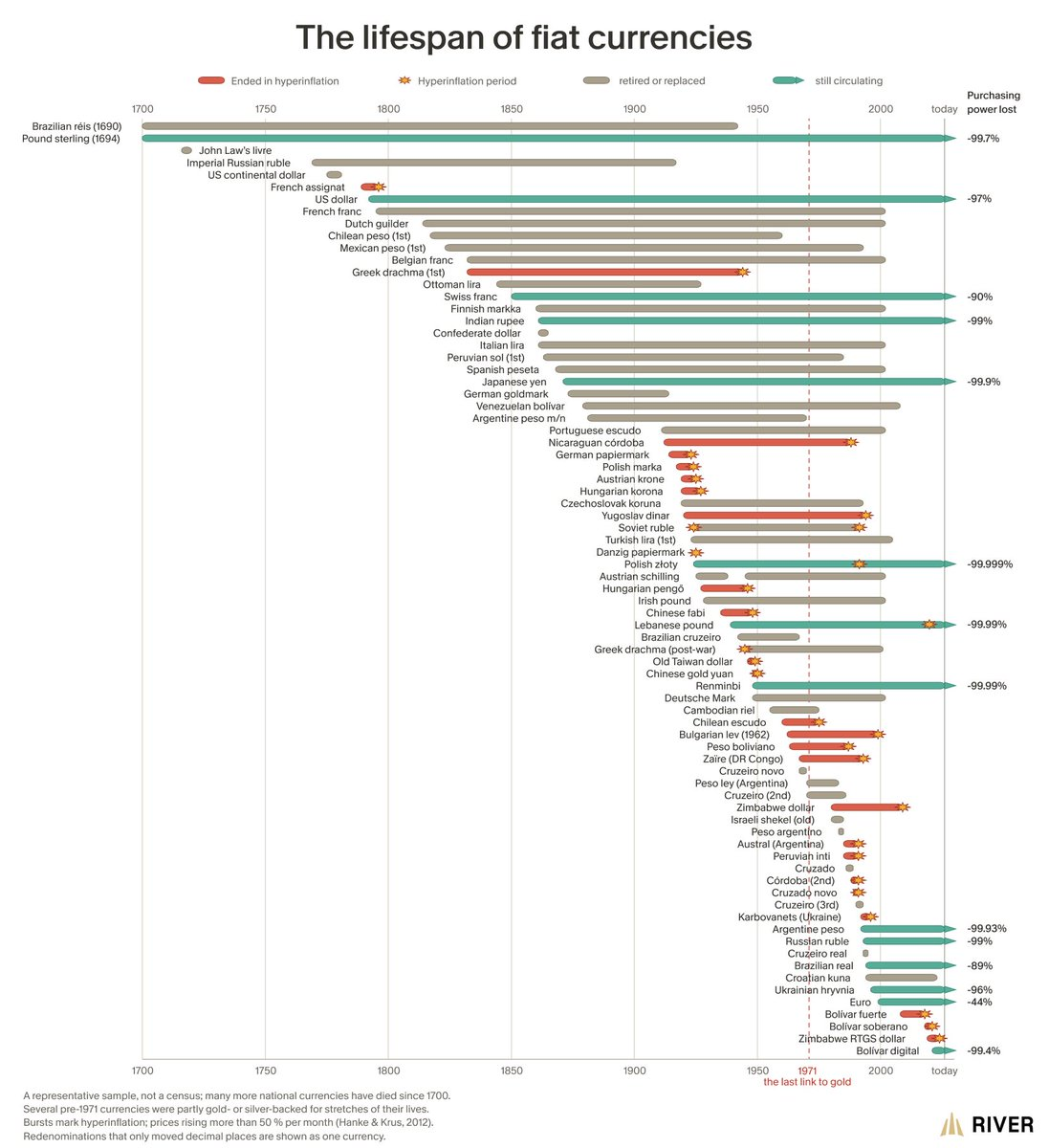
Michael Saylor is making the case for Bitcoin (BTC) with a history lesson. The MicroStrategy chairman shared River research tracking over 60 government currencies since 1700. His point is simple. Paper money keeps failing, and Bitcoin was built to fix that.
River, a Bitcoin financial services firm, published the chart this week. It claims the average fiat currency lasts just 27 years.
326 Years of Fiat History Behind Saylor’s Bitcoin Pitch
The chart tells a grim story. Dozens of currencies died in hyperinflation, defined by economists Steve Hanke and Nicholas Krus as prices rising by more than 50% in a month.
Germany’s papiermark (or Paper Mark) went that way in 1923. Hungary’s pengő followed in 1946, when prices doubled roughly every 15 hours. Zimbabwe’s dollar collapsed in 2008.
The survivors did not do much better. The US dollar has lost 97% of its buying power. The British pound is down 99.7%, and the Japanese yen 99.9%. Even the euro, the youngest and best performer, has lost 44% since 1999.
River is upfront about the chart’s limits. It calls the data a representative sample, not a census, and notes many pre-1971 currencies had partial gold backing. That year gets its own dashed line, marking when the dollar cut its final tie to gold.

“Fiat currency is the problem. Companies, institutions, securities, and technologies that strengthen Bitcoin are part of the solution. We can debate ideas without mistaking allies for enemies,” Saylor commented.
Follow us on X to get the latest news as it happens
Notably, Michael Saylor’s next-decade Bitcoin outlook calls the pioneer crypto a digital property whose strength lies in its base layer barely changing. He sees Bitcoin as scarce global capital for final settlement, not mainly for everyday payments.
His bigger bet is that Bitcoin will support a new financial system built on digital capital, credit, and money.
River Says Most Cryptocurrencies Fail the Same Test
River’s warning is not just about fiat. The firm says the average cryptocurrency does not even last a year. Nearly all of them fall to zero when priced in Bitcoin.
“All of these currencies suffer from the same problem: Centralized power and an infinite money supply. Bitcoin was designed to outlast all fiat currency,” the firm said in its post.
Meanwhile, not everyone agrees that Bitcoin’s design is settled. StarkWare CEO Eli Ben-Sasson recently challenged Bitcoin’s fixed cap, arguing lost keys will shrink the usable supply forever.
Chainalysis estimated that up to 3.79 million BTC were already unrecoverable by 2017. Supporters rejected his 4% issuance fix, since 95.5% of all Bitcoin now exists.
The market adds a twist to Saylor’s pitch. Bitcoin trades near $63,252, down about 47% in a year.

MicroStrategy still holds 843,775 BTC, the largest corporate stash, even after selling 3,588 BTC this month, its biggest sale since 2022.
History says fiat money fades. The coming months will test whether investors still believe Bitcoin is the escape.
The post MicroStrategy’s Saylor Pitches Bitcoin Bull Case With 300 Years of Fiat History appeared first on BeInCrypto.

XRP FED CHAIR LIVE NOW!!! CRYPTO PUMPS

First Reform UK police commissioner elected

Ready Capital Corporation (RC) Shareholder/Analyst Call Prepared Remarks Transcript


-

 Fashion7 days ago
Weekend Open Thread: Nutriplenish Leave-In Conditioner
-
 NewsBeat23 hours ago
London Mayor Sadiq Khan handed a peerage by Keir Starmer alongside 15 other Labour figures… just days before the PM leaves No10
-

 Crypto World2 days ago
CFTC blocks Kalshi from unwinding Michigan trades after court order
-

 Business1 day ago
Nvidia Stock Slips After Big Tuesday Rally as Huang Confirms Vera Rubin Chip Is Now in Production Today
-

 Politics2 days ago
Young campaigners urge incoming PM to act on outdoor junk food ads
-
 Entertainment2 days ago
Disney’s Most Ambitious Failed Star Wars Attraction Is Coming to SDCC
-

 News Videos3 days ago
XRP BOMBSHELL… XRP OMBOARDED FOR TRANSACTIONS!!!
-

 Tech3 days ago
Get Your ESP32 Sunny Side Up With This Solar Dev Board
-

 Crypto World17 hours ago
Injective Submits SEC Transfer-Agent Registration to Onchain Ownership Records
-

 Tech3 days ago
Dark Secrets Emerge When Jailbreaking LLMs
-

 Business1 day ago
Palantir Shares Rise After Expanded Nvidia Partnership and Fresh Analyst Upgrades Ahead of Earnings Day
-
 Sports2 days ago
New Cornerback Enters Vikings Trade Rumor Mill
-

 News Videos7 hours ago
Money | Class 12 Economics | CBSE Board Exam 2026-27
-

 NewsBeat2 hours ago
Registration is now open for March for Men with Kev 2026
-
 Business13 hours ago
Banco Bilbao Vizcaya Argentaria, S.A. (BBVA) Discusses Global Macro Environment and Economic Outlook for Core Markets Transcript
-
 Tech4 days ago
Cloudflare Precursor Watches Your Mouse and Keyboard To Decide If You Are Human
-

 News Videos4 days ago
how to make coin bank box with cardboard #scienceproject #money #diy #shorts
-
 Entertainment2 days ago
Vicki Gunvalson Defends Discussing Heather Dubrow’s Money
-
Crypto World3 days ago
Ripple, Coinbase, Circle Join Linux x402 Foundation to Help Shape AI Payments
-
 Crypto World16 hours ago
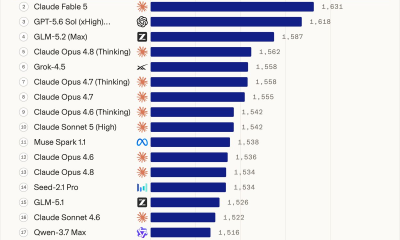
Claude Fable 5 Slips to Second in AI Coding Leaderboard
You must be logged in to post a comment Login