
Crypto World
Plus Why ZunaBet Is Gaining Attention in 2026

DraftKings and Bet365 occupy different corners of the online gambling world but they share one thing — they are among the most recognised names in the industry globally. DraftKings built its brand in the United States through daily fantasy sports before becoming a major licensed sportsbook and casino operator. Bet365 built its dominance in the UK and international markets over two decades of consistent operation. Both are large, well-funded, and deeply embedded in the markets they serve.
In 2026 a third name has been appearing alongside them in player searches and comparison discussions. ZunaBet launched this year as a crypto-first casino and sportsbook and has been drawing attention from a specific segment of players — those who are comfortable with cryptocurrency, want faster withdrawals, expect larger game libraries, and want loyalty programs that state their value clearly rather than hiding it behind points conversion tables.
This article looks at what DraftKings and Bet365 offer, where their limitations are, and why ZunaBet is gaining the visibility it is among a new generation of online gambling players.
DraftKings: Strengths and Limitations
DraftKings is one of the dominant forces in US online gambling. It holds licences across multiple US states, operates a well-developed sportsbook, and carries a casino product that has grown significantly since the platform expanded beyond its daily fantasy sports origins. Its brand recognition in the US market is substantial — built through years of marketing investment, sports partnerships, and a user base that followed it from fantasy sports into real-money gambling.
The sportsbook is genuinely strong. DraftKings has invested heavily in its betting product — competitive odds, wide market coverage across major US sports, live betting, and an app that has been refined over years of use. For US-based sports bettors operating within a licensed, regulated framework it is a credible and well-built product.
The casino product is solid but not exceptional by the standards of what is now available elsewhere. The game library carries a reasonable selection of slots, table games, and live dealer content. It is sufficient for the mainstream player it was designed to serve.
Where DraftKings draws consistent criticism is on the payment side and the loyalty program. Withdrawals process through fiat banking infrastructure with timelines that frustrate players who expect digital speed. Crypto support is limited — Bitcoin in select states through a process that does not reflect native crypto infrastructure. Dynasty Rewards, DraftKings’ loyalty program, operates on a points system that many players find difficult to calculate real value from.
For players operating within licensed US states who want a reliable regulated experience with strong traditional sports coverage, DraftKings serves that need well. For players who prioritise crypto payments, game library depth, and transparent loyalty returns it is less well suited.
Bet365: Strengths and Limitations
Bet365 is one of the largest online gambling operators in the world by revenue and one of the most recognised brands in international markets. It has been operating since 2000 and has built a reputation for reliability, wide market coverage, and a genuinely comprehensive sportsbook that covers sports and events that smaller operators do not reach.
The sportsbook is where Bet365’s reputation is strongest. Competitive odds, an enormous range of markets across global sports, in-play betting on events that most platforms would not cover, and a live streaming service that lets players watch events they are betting on. For serious sports bettors who want the widest possible market coverage, Bet365 is a difficult platform to argue against on sportsbook depth alone.
The casino product is substantial. Bet365 carries a large game library from established providers and has been adding live dealer content significantly over recent years. The platform is polished and the experience is consistent across devices.
Bet365’s limitations follow a similar pattern to DraftKings. Fiat-first payment infrastructure means withdrawals process through banking channels with associated timelines. Crypto support is minimal. The loyalty program — Bet365’s VIP scheme — is invite-only for the upper levels and opaque in its structure for the general player base. The game library is large but not exceptional at the provider diversity level compared to what dedicated crypto casino platforms now carry.
Bet365’s geographic restrictions are also a factor — the platform is unavailable in several major markets including most US states, leaving a significant global player base unable to access it.
ZunaBet: What a 2026 Platform Looks Like When Built From Scratch
ZunaBet launched in 2026, owned by Strathvale Group Ltd and operating under an Anjouan gaming license. It is registered in Belize and managed by a team with over 20 years of combined industry experience. It does not operate under US state licences or UK Gambling Commission regulation — it is built as an internationally accessible, crypto-first platform.
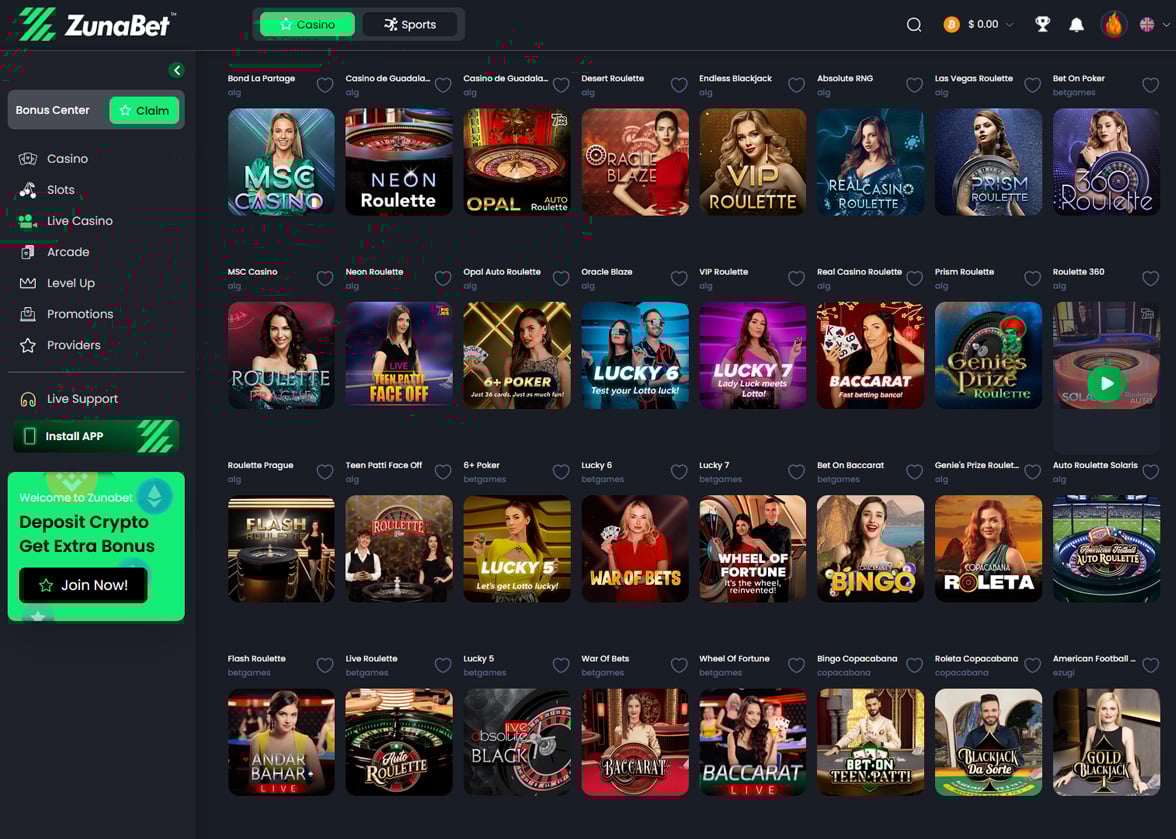
The game library is 11,294 titles from 63 providers. Put that next to DraftKings and Bet365 and the scale difference is significant. Slots dominate the catalogue but the live dealer section and RNG table games are substantial. Providers include Evolution, Pragmatic Play, Hacksaw Gaming, Yggdrasil, and BGaming among many others. Sixty-three providers means genuine variety across mechanical approaches, volatility profiles, and design philosophies rather than volume built around a small number of suppliers.
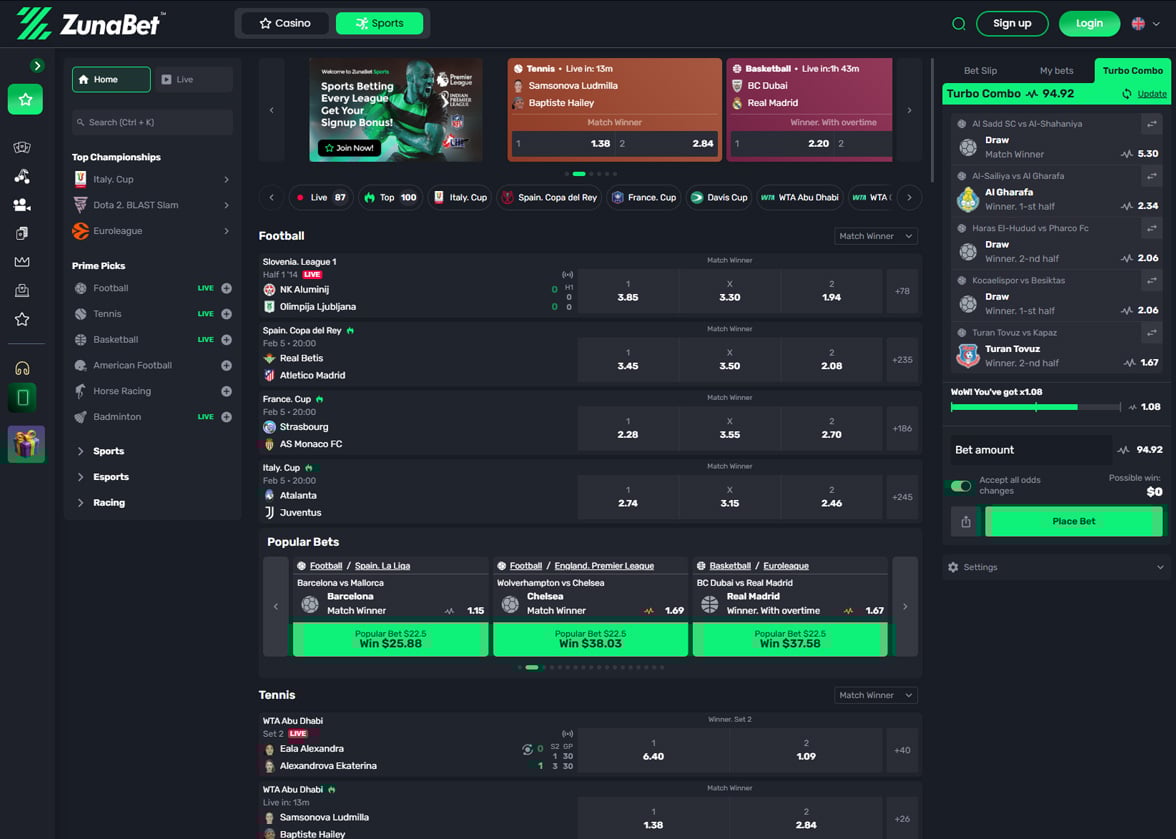
The sportsbook covers football, basketball, tennis, NHL, and other major global sports alongside a full esports offering — CS2, Dota 2, League of Legends, and Valorant. Virtual sports and combat sports are also available. For players who bet on both traditional sports and esports in the same session, ZunaBet consolidates everything under one account and one loyalty program.
Payment support covers more than 20 cryptocurrencies natively — BTC, ETH, USDT across multiple chains, SOL, DOGE, ADA, XRP, and others — with no platform processing fees and withdrawals settling in minutes. Apps run on iOS, Android, Windows, and MacOS with 24/7 live chat support.
Crypto vs Traditional: The Infrastructure Difference
The comparison between ZunaBet and the traditional platforms on payment infrastructure is not a matter of degree — it is a structural difference with practical consequences.
DraftKings and Bet365 were built on fiat banking. Their payment systems route through banks, card networks, and e-wallet processors. A Bet365 withdrawal processed through a UK bank transfer takes one to three business days on a good week. A DraftKings withdrawal through PayPal takes 24 to 48 hours. These are the platform’s better options — standard bank transfers take longer.
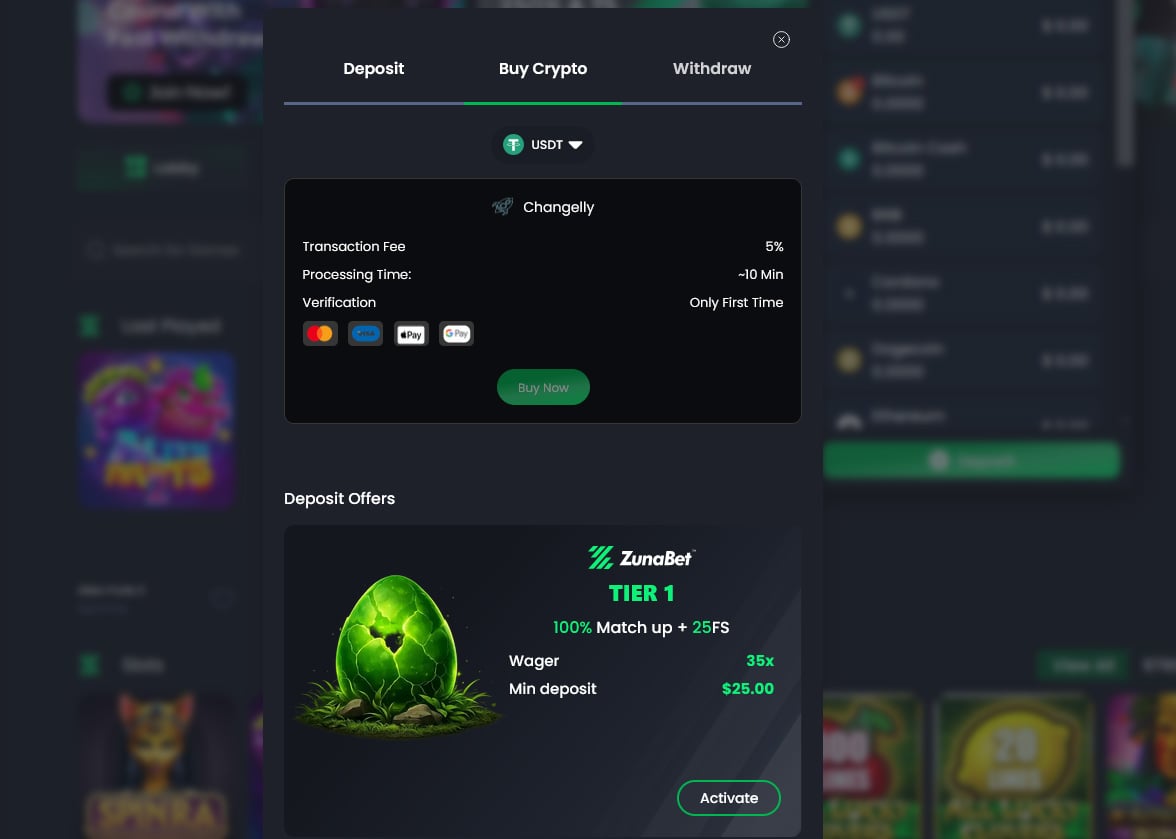
ZunaBet was built crypto-first. Withdrawals settle in minutes because the infrastructure was designed to handle them at network speed rather than through intermediaries. For a player who has experienced both, the difference is immediately felt and permanently remembered. The five-day wait becomes unacceptable once the alternative is known.
The coin support breadth adds further distance. DraftKings supports Bitcoin in limited states. Bet365 has minimal crypto support. ZunaBet supports twenty-plus coins natively. For players who hold diverse crypto portfolios the practical difference is significant — no forced conversions, no third-party processing, no fees beyond standard network costs.
Loyalty Programs: Three Different Models
The loyalty program comparison across the three platforms reflects the different eras in which they were built.
DraftKings Dynasty Rewards operates on a points accumulation model. Players earn Dynasty Dollars through play, convert them through a tier structure, and redeem for various options. The value is real but the calculation is not straightforward and the effective return per dollar spent requires effort to determine.
Bet365’s VIP program is largely invite-only at the meaningful tiers. The general player base has limited visibility into what the loyalty structure actually delivers at levels they can realistically reach. For most players it functions as a background benefit rather than a calculable return.
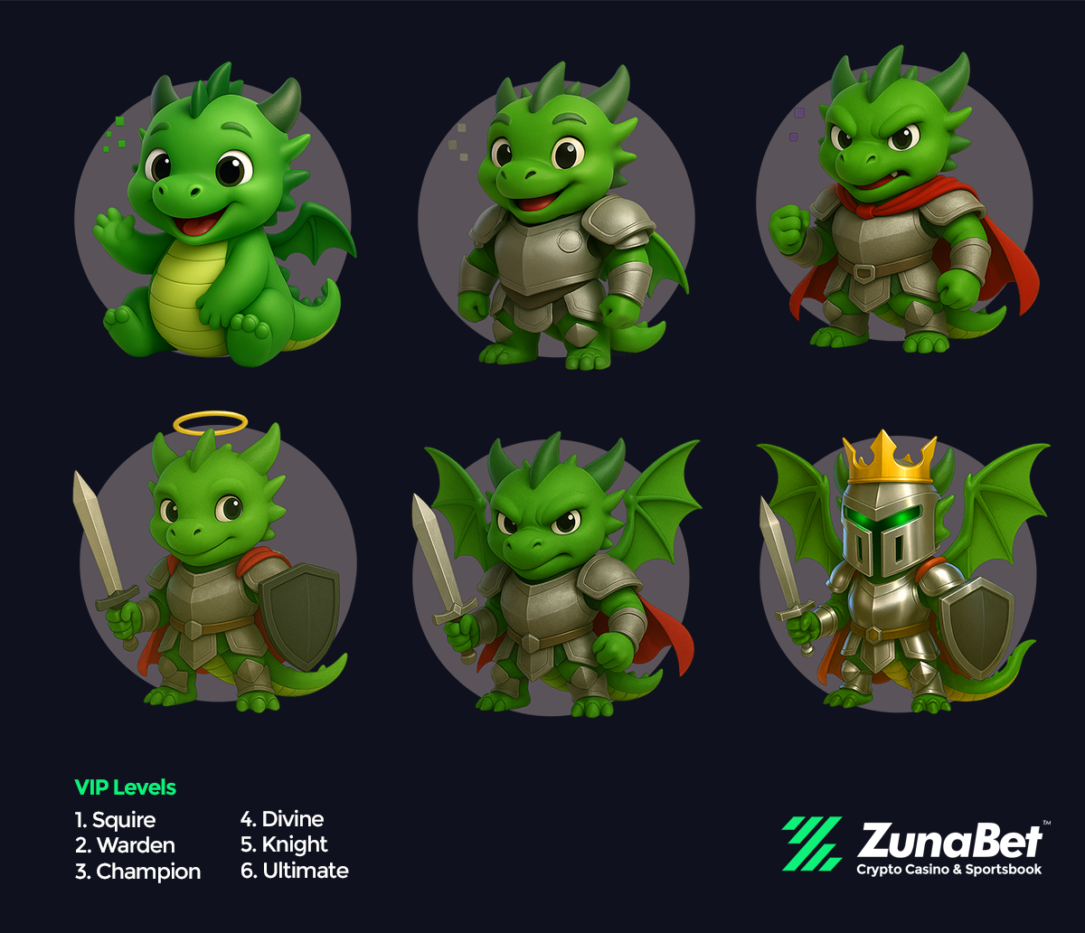
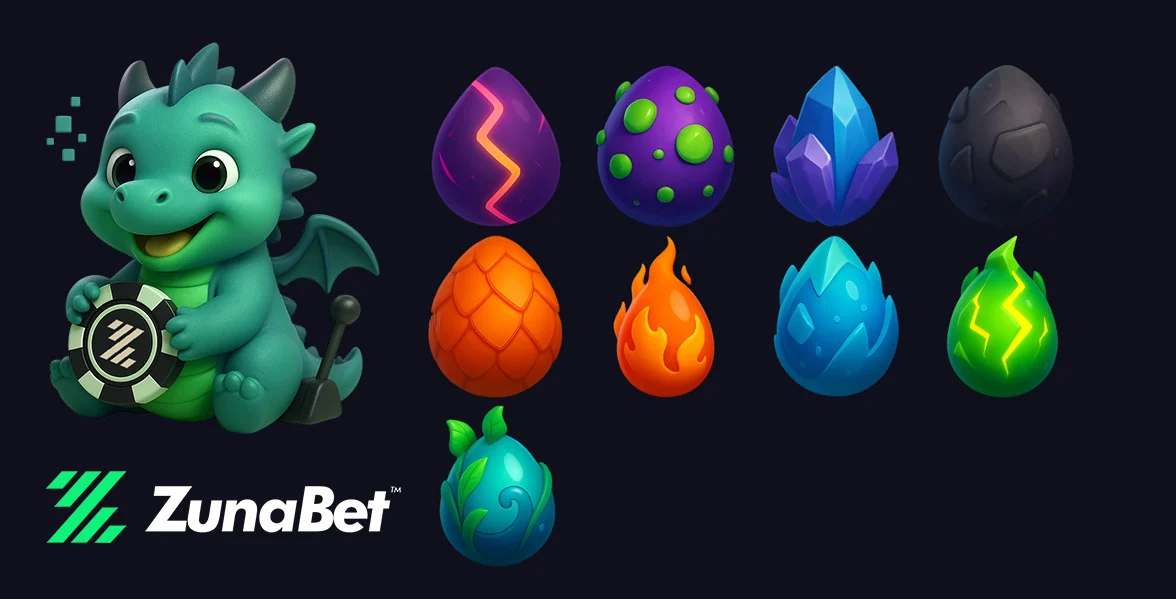
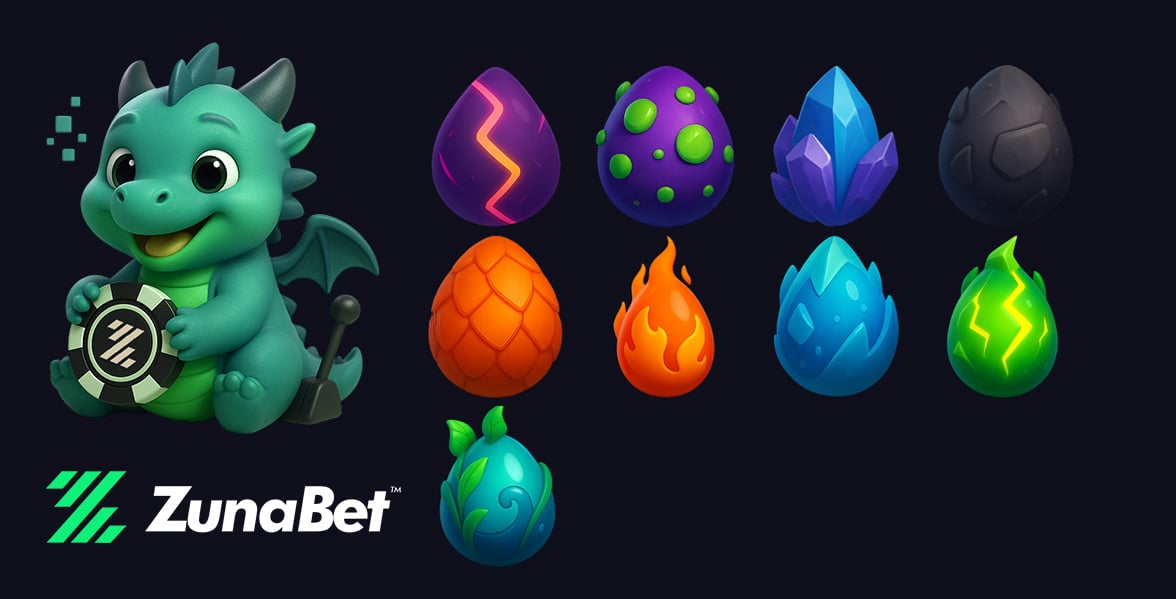
ZunaBet’s dragon evolution loyalty system runs across six clear tiers — Squire, Warden, Champion, Divine, Knight, and Ultimate — with a gamified mascot called Zuno and direct rakeback rates of 1%, 2%, 4%, 5%, 10%, and 20%. These are cash returns on activity. No conversion. No invite-only upper tiers. No calculation required beyond multiplying activity by the stated percentage. A player at the Ultimate tier receives 20% back on everything. Additional benefits at higher tiers include up to 1,000 free spins, VIP club access, and double wheel spins.
The difference in transparency is stark. A player can calculate their ZunaBet loyalty return in seconds. The equivalent calculation for DraftKings requires reading the Dynasty Rewards structure and for Bet365 requires being invited to a tier that reveals what it offers.
The Welcome Bonus
New players at ZunaBet receive a bonus across three deposits totalling up to $5,000 plus 75 free spins. The first deposit receives a 100% match up to $2,000 with 25 free spins. The second receives 50% up to $1,500 with 25 spins. The third receives 100% up to $1,500 with 25 spins.
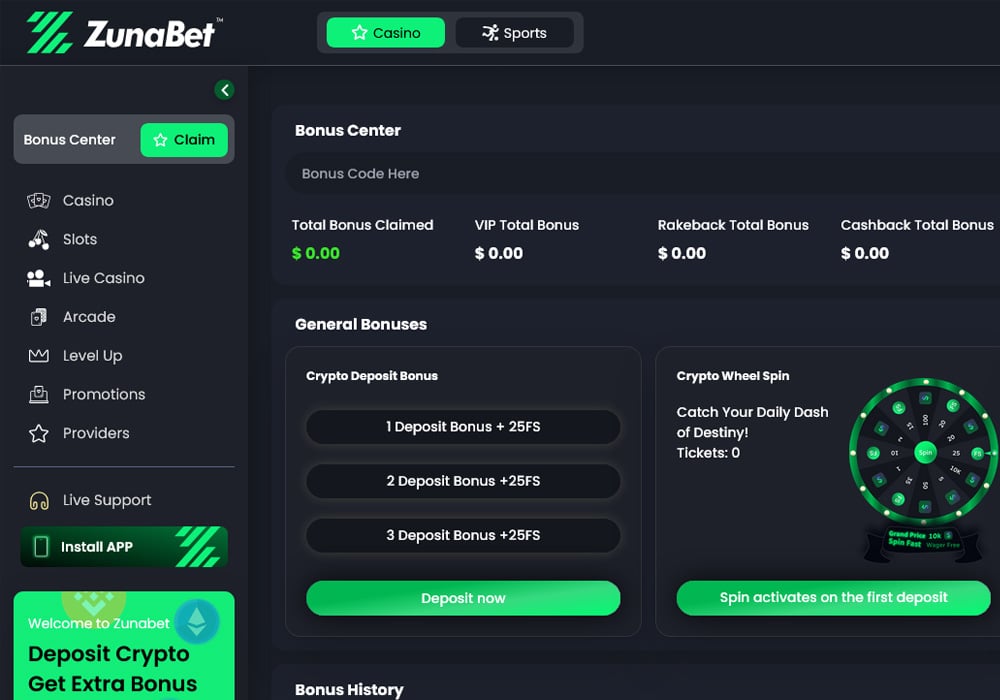
DraftKings and Bet365 both offer welcome bonuses competitive within their respective regulated markets. The terms and structures vary by jurisdiction and are updated regularly. ZunaBet’s multi-deposit structure is designed to give players time to explore a platform of this scale before the promotional period ends rather than front-loading everything into a single session.
The Honest Assessment
DraftKings wins on US state regulatory compliance, brand recognition, and traditional sports depth for US-based players. It is the right choice for a player who needs a licensed US operator and wants a reliable, familiar experience.
Bet365 wins on international sportsbook depth and market coverage. For a serious sports bettor outside the US who wants the widest possible range of markets it is a strong platform with a long track record.
ZunaBet wins on game library scale, crypto payment infrastructure, loyalty program transparency, esports coverage, and coin support breadth. For the player who prioritises these dimensions — and a growing number do — it is the most complete option currently available.
ZunaBet launched in 2026 and is still building the operational track record that DraftKings and Bet365 have accumulated over years. That gap is real. But what it launched with represents where online gambling is going rather than where it has been — and for the new generation of players driving that direction, it is the platform they keep finding when they search.
Disclaimer: This is a Press Release provided by a third party who is responsible for the content. Please conduct your own research before taking any action based on the content.



Publicly traded crypto miners have defied broader market pressure in 2026, delivering meaningful gains as the sector broadens beyond pure mining into AI and high-performance computing (HPC). According to data from Bitcoinminingstock.io, all ten of the largest publicly traded mining stocks are positive for the year, with year-to-date gains ranging roughly from 5% to about 85%.
Leading the pack is TeraWulf, Inc., which is up about 85%, followed by Hut 8 Corp. at roughly 67% and Riot Platforms, Inc. around 46%. Other notable movers include Core Scientific, Inc., up about 40%, and Applied Digital Corporation, up about 37% for the year. At the lower end, Bitdeer Technologies Group has inched higher by around 5%, while American Bitcoin Corp.—a Trump-linked mining and treasury venture formed by Hut 8 and backed by Eric Trump and Donald Trump Jr.—is down roughly 29%.
These gains come as Bitcoin (BTC) itself has faced macro headwinds, continuing to trade lower on the year—roughly a 20% decline YTD—despite a recent 30-day climb of about 17%. The contrast underscores how miners are benefiting from strategic shifts in operation and the broader demand for compute infrastructure beyond pure coin mining.
Source data for the mining stock performance is provided by Bitcoinminingstock.io, with price context for BTC tracked by CoinGecko.
Related: Canaan, Tether deepen partnership on immersion-cooled mining systems
Key takeaways
- All of the top publicly traded Bitcoin miners are up Year-to-Date, signaling a shift in profitability and strategy even as BTC weakens on the macro front.
- Several leading miners are expanding into AI and HPC data centers, seeking revenue diversification beyond traditional coin mining.
- Early-stage capacity and partnerships point to a broader trend of repurposing mining hardware for enterprise compute workloads, including GPUs for AI cloud services.
- Industry watchers highlight potential strategic pivots at large miners, with some evaluating or pursuing AI-centric campuses and joint ventures as a path to growth.
Mining becomes AI infrastructure: a new growth axis
Industry activity in early 2026 underscores a deliberate pivot from pure Bitcoin mining toward AI-centric data center operations. Riot Platforms’ latest quarterly results illustrate this shift in real time. The company reported $167.2 million in revenue for the first quarter of 2026, with its data center business contributing $33.2 million. That performance helped offset softness in core mining revenue, and CEO Jason Les described the quarter as an “inflection point,” signaling its transition toward a revenue-generating data center operator rather than a pure mining company. Riot’s Q1 results illustrate the trend toward diversified compute offerings.
Core Scientific is pursuing a similar transformation, outlining plans to convert a Texas site into an AI-focused data center campus with up to 1.5 gigawatts of capacity, including around 1 gigawatt available for lease. The company intends to repurpose roughly 300 megawatts currently dedicated to Bitcoin mining for data center operations, signaling a shift in asset utilization as demand for GPU-based AI workloads grows. Core Scientific AI data center plans document this pivot.
HIVE Digital Technologies has also leaned into AI and HPC growth, recording a 219% year-over-year increase in quarterly revenue as it builds out its AI compute capabilities and signs significant GPU-related contracts. The company secured a $30 million contract to deploy Nvidia GPUs for enterprise AI cloud customers, underscoring the sector’s appetite for GPU-backed compute capacity. HIVE AI/HPC expansion details.
In parallel, MARA Holdings announced the acquisition of a 64% stake in Exaion, a French AI data center company, expanding its footprint within AI-focused infrastructure. The move aligns with the broader push by mining firms to monetize their hardware through data-center-scale AI workloads. MARA-Exaion deal coverage.
Signals of consolidation and strategic reorientation
A recent Bernstein note on IREN Limited — the largest publicly traded miner by market capitalization — pointed to the possibility of repurposing existing mining sites for GPU-centric workloads, potentially signaling a broader industry shift away from BTC mining in certain assets. The research outlines a pathway where some sites may sunset mining activities in favor of AI and cloud compute capacity, a development that would have profound implications for capacity planning, energy use, and capital allocation within the sector. Bernstein analysis discusses this potential pivot.
The broader price backdrop remains a critical backdrop to these shifts. While BTC has logged a notable dip year-to-date, the strength in diversified revenue streams from data centers and AI HPC workloads could insulate miners from pure price cycles. Investors are watching how quickly these new revenue engines scale and whether they dampen sensitivity to BTC’s price moves over the coming quarters.
What this means for investors and the sector
For investors, the upward move in mining equities despite BTC’s softness suggests that the earnings mix matters as much as, if not more than, the underlying cryptocurrency price. The transition from a commodity-like mining model to an integrated compute platform—where energy efficiency, capacity utilization, and contract-backed AI workloads drive revenue—could redefine the sector’s risk-return profile. Companies are increasingly exporting Bitcoin-friendly infrastructure into enterprise-grade AI and HPC services, potentially broadening total addressable market and creating more resilient cash flows during crypto price downturns.
However, the transition is not without risk. The pace of AI demand realization, the ability to secure long-term leases for large-scale data centers, and the regulatory environment surrounding crypto mining and data-center operations will shape outcomes in the near term. Bernstein’s note on IREN highlights one path of potential pivot, but actual execution will depend on competitive dynamics, energy prices, and access to reliable GPU supply chains. As miners test new business models, ongoing earnings clarity from management teams will be essential for investors weighing whether to treat these firms as traditional miners or diversified compute service providers.
Meanwhile, BTC’s price trajectory will continue to interact with the sector’s evolution. A sustained drag on headline prices could be offset by stronger data-center revenues and long-term GPU contracts, but a meaningful reversal in BTC could alter the calculus for capacity deployment and asset monetization. The coming quarters will be telling as miners publish updated results that reflect the degree to which AI and HPC ventures contribute to top-line growth and margin stability.
Readers should keep an eye on earnings updates from Riot Platforms, Core Scientific, HIVE Digital Technologies, and MARA, along with any new partnerships that expand GPU supply and enterprise AI deployments. The industry’s tilt toward AI-driven revenue could reshape how investors evaluate risk, diversify exposure, and anticipate the next phase of growth beyond traditional Bitcoin mining.
Bitcoin price context and the evolving AI/HPC strategy together will mark the near-term trajectory for publicly traded miners, and the next set of earnings calls should illuminate whether the sector’s expansion into AI infrastructure translates into sustainable, value-adding growth.
TLDR:
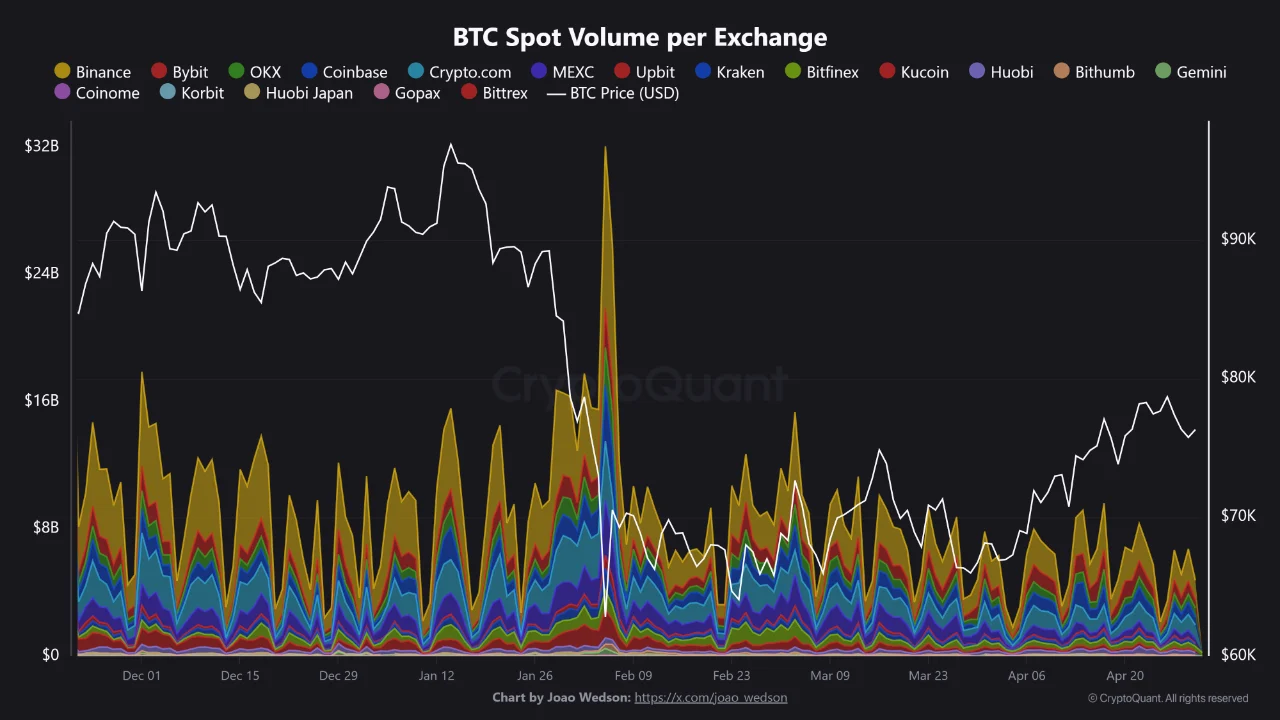
- Bitcoin has maintained higher highs and higher lows since the $65,000 low, but volume has not followed the price recovery.
- Binance controls 25% of total exchange volume, nearly double Bybit’s share, making its data the most critical market indicator.
- Sustained low spot trading volumes since February raise concerns that the current rally may lack the strength for a real breakout.
- A genuine breakout above $80,000 requires a significant return of spot buyer demand, or a sharp reversal remains a real risk.
Bitcoin is currently facing strong resistance at the $80,000 level. The price has been climbing steadily, but trading volumes in spot markets remain unusually low.
This divergence between price and volume has raised questions about the rally’s legitimacy. Market watchers are now questioning whether this upward move is sustainable.
The situation calls for close attention to on-chain data and exchange activity before drawing any firm conclusions.
Binance Data Remains the Market’s Most Reliable Compass
Bitcoin has held a bullish structure since bouncing off the $65,000 support level. The market has printed a series of higher highs and higher lows since that recovery.
However, the volume accompanying this price climb has not kept pace with the gains. That disconnect is what has analysts on edge heading into the $80,000 zone.
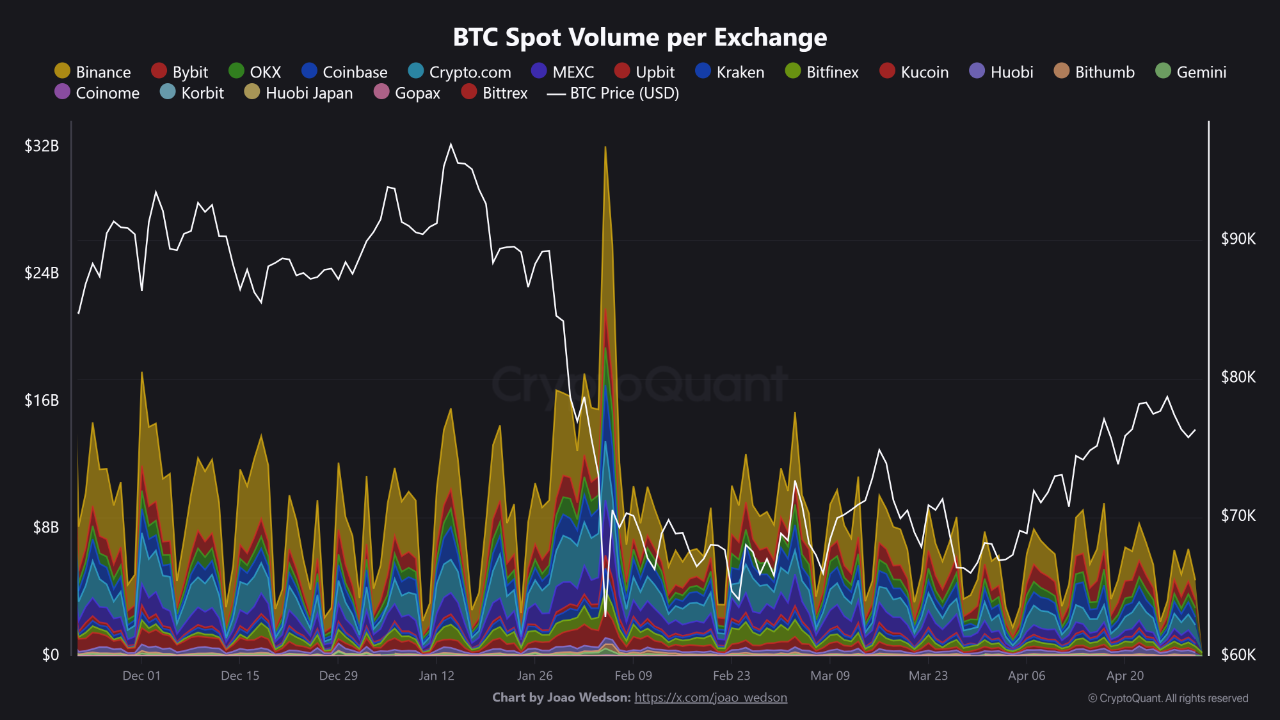
Binance continues to hold the largest share of trading activity among major exchanges. The platform accounts for roughly 25% of total volume across major crypto venues.
Source: Cryptoquant
Its trading volume is nearly twice that of Bybit, its closest rival. Because of this, Binance data carries the most weight when reading overall market direction.
When one exchange holds that level of dominance, its data shapes how traders interpret price movement globally.
A volume spike on Binance would carry far more weight than the same move on any other platform. Conversely, the absence of volume there is equally telling. Right now, the data from Binance is not pointing toward strong buyer conviction.
The lack of volume confirmation since February adds another layer of concern. Spot trading activity has remained subdued even as Bitcoin pushed higher.
Without spot buyers driving the price, the rally could be resting on thinner ground. This is a pattern worth monitoring closely as the $80,000 level comes back into focus.
Volume Confirmation Holds the Key to a Real Breakout
Low-volume rallies carry a well-known risk in financial markets: they often attract aggressive sellers near resistance. Bitcoin approaching $80,000 without rising volume fits this profile closely.
Traders may be walking into a setup designed to trap buyers before a sharp move lower. This is what analysts refer to as a bull trap.
The concept of liquidity hunting also comes into play here. Large market participants sometimes push prices toward key levels to trigger stop orders and collect liquidity.
A move to $80,000 without real demand behind it could be exactly this kind of setup. Once that liquidity is taken, prices can reverse sharply.
For the breakout above $80,000 to hold, spot buyers need to return in force. A sustained surge in buying volume would signal that demand is genuine and broad-based.
Without that, any move above resistance is at risk of reversing quickly. The burden of proof sits firmly on the bulls at this stage.
Bitcoin has shown resilience since the $65,000 low, and the higher high structure is not something to dismiss entirely. Yet history shows that price without volume is a fragile combination.
Traders would do well to watch volume trends in the coming sessions closely. That data, more than price alone, will determine whether $80,000 becomes support or a ceiling.

TLDR:
- Pi Network has set a firm May 15 deadline for all Mainnet nodes to complete the Protocol 23 upgrade.
- The Protocol 23 upgrade takes longer than usual, so node operators are urged to begin the process early.
- Pi Node version 0.5.4 is available for Windows, Mac, and Linux via the Pi Desktop application download.
- SuperNodes must maintain a 24/7 connection and pass KYC verification to actively participate in consensus.
Pi Network has announced a mandatory upgrade to Protocol 23 for all Mainnet nodes, with a deadline set for May 15.
The upgrade is described as taking longer than usual to complete, so node operators are advised to plan accordingly.
This development marks another step in Pi Network’s ongoing effort to build a more decentralized and user-driven blockchain infrastructure, as the project continues to expand its node participation framework.
Protocol 23 Upgrade Requirements for Mainnet Nodes
Pi Network shared the upgrade announcement through its official channel, stating that all Mainnet nodes must complete the Protocol 23 upgrade before the May 15 deadline to remain connected to the network.
The Core Team noted that this particular upgrade requires more time than previous updates, urging node operators not to delay the process.
The Pi Node software is currently available at version 0.5.4 and can be downloaded for Windows, Mac, and Linux systems.
Operators access the upgrade through the Pi Desktop application, which serves as the gateway for running and managing node activity on the network.
Node operators are grouped into three participation levels: Computer App users, Nodes, and SuperNodes. SuperNodes carry the heaviest responsibility, as they must maintain a 24/7 connection and actively participate in the consensus process that writes transactions to the Pi ledger.
The selection criteria for Nodes and SuperNodes include uptime reliability, a stable internet connection, sufficient hardware performance, and prior contributions to the Pi community. Applicants who meet these thresholds and pass KYC verification are enrolled to serve in the network.
Pi Node’s Role in Progressive Decentralization
Pi Network’s node infrastructure is built on the Stellar Consensus Protocol (SCP), where nodes form trusted groups called quorum slices.
These groups only validate transactions that their trusted peers also agree to, creating a layered security model rooted in community trust.
The security circles established by mobile miners on the Pi app aggregate into a global trust graph. This graph feeds directly into how SuperNodes and Nodes form their quorum slices, linking mobile participation to the broader consensus mechanism.
Unlike traditional proof-of-work systems, Pi’s node model is designed for everyday users running standard desktops or laptops.
The goal is to reduce the technical barrier to participation, making node operation accessible without requiring deep blockchain expertise.
As Pi Network moves further through its Testnet roadmap — covering the Selection, Revision, and Live Testnet stages — the Protocol 23 upgrade supports the infrastructure needed for real transaction testing.
The Core Team has stated that the centralized layer used during testing will eventually be removed once the Mainnet reaches full operational status.
When players research online gambling platforms the same names tend to dominate the early results. DraftKings and Bet365 have been at the top of those results for long enough that they have become the default reference points for any comparison. Searching for a sportsbook, a casino, or an online gambling platform in most major markets will surface one or both of them within the first few results.
In 2026 something is changing in those searches. ZunaBet is appearing alongside the established names with increasing frequency — not as a brand that outspent its way into visibility but as a platform that players are actively seeking out after finding what DraftKings and Bet365 offer and asking whether there is something that does more of what they specifically need.
This article looks at all three. What DraftKings and Bet365 offer, what their limitations are for certain player types, and why ZunaBet is appearing in searches that used to produce only two results.
DraftKings: The Platform That Defined US Online Gambling
DraftKings did not become the dominant US online gambling brand by accident. It was positioned at the right moment — an established daily fantasy sports operator with brand recognition and a user base when the Supreme Court ruling opened state-by-state sports betting across the US. The conversion from fantasy sports audience to licensed gambling customers was faster than most competitors could manage and the platform has built on that foundation consistently.
The sportsbook is the product’s core strength. American sports are covered with a depth and cultural fluency that reflects a platform built by people who understand the US betting market from the inside. NFL, NBA, MLB, NHL, college sports — the markets that US bettors care most about are handled at a level that international competitors rarely replicate for this specific context. The app has been refined through years of player feedback and works reliably across devices.
The casino component has grown steadily alongside the sportsbook. A reasonable game library, live dealer content, and the table game standards that US casino players expect. It serves the mainstream US casino audience adequately.
The limitations are structural and well documented among players who have moved past casual engagement with the platform. Withdrawals process through fiat banking with timelines that can stretch to several business days depending on method. Crypto support is limited to Bitcoin in select states and is not a native infrastructure — it is an addition to a fiat system. Dynasty Rewards gives players points that convert through a structure many find less rewarding than the headline tier benefits imply. The platform is geographically restricted to licensed US states.
Bet365: The Platform That Defined International Sports Betting
Bet365 has had more time than almost any competitor to build and refine its product. Operating since 2000, it has constructed a sportsbook that is genuinely without peer on breadth of market coverage — major global sports at full depth, minor leagues that other operators do not price, in-play markets on events that competitors abandon after pre-match, and a live streaming service that lets players watch events within the platform as they bet on them.
For the serious international sports bettor the Bet365 sportsbook is the standard against which everything else is measured. Twenty-five years of market relationship building produces something that newer platforms are still working toward.
The casino product has developed alongside the sportsbook. A large library, strong live dealer content from established providers, and a platform experience that is polished and consistent across devices.
The limitations are significant for specific player profiles. Geographic restrictions eliminate it from the US market and several other significant jurisdictions. The loyalty program delivers meaningful rewards through an invite-only VIP structure that the general player base cannot access — most players operate without a clear or transparent loyalty pathway. Crypto support is minimal. Payment infrastructure follows fiat banking standards with the associated processing timelines.
ZunaBet: The Third Name Players Are Finding
ZunaBet launched in 2026, owned by Strathvale Group Ltd and operating under an Anjouan gaming license. Registered in Belize and managed by a team with over 20 years of combined industry experience, it operates as an internationally accessible crypto-first platform — not a licensed US operator, not a UK regulated platform, but a product built around what a specific and growing segment of players is actively searching for.
The game library is where the product makes its most immediate statement. ZunaBet carries 11,294 titles from 63 providers. That number sits significantly above what either DraftKings or Bet365 carries on the casino side. Slots make up the largest category as they do across the industry, but the live dealer section draws from Evolution’s full catalogue and the RNG table game section covers multiple variants across providers. Hacksaw Gaming, Pragmatic Play, Yggdrasil, BGaming, and dozens of others contribute content with genuinely different mechanical approaches. A player moving from DraftKings or Bet365 to ZunaBet’s casino finds a library that is not just larger but structurally more varied in ways that sustain long-term engagement.
The sportsbook covers football, basketball, tennis, NHL, and other major global sports. Where it extends beyond both established platforms for a growing audience is the esports section — CS2, Dota 2, League of Legends, and Valorant as genuine markets. Virtual sports and combat sports complete a sportsbook that was built to be comprehensive rather than adequate.
Payment support covers more than 20 cryptocurrencies natively — BTC, ETH, USDT across multiple chains, SOL, DOGE, ADA, XRP, and others. No platform processing fees. Withdrawals settling at network speed in minutes. Apps across iOS, Android, Windows, and MacOS with 24-hour live chat support.
Why Crypto vs Fiat Is the Central Comparison
The payment infrastructure comparison between ZunaBet and the two established platforms is the most structurally significant difference in the whole comparison. It is not a matter of features — it is a matter of architecture.
DraftKings and Bet365 were built on fiat banking. Their payment systems are embedded in infrastructure designed before cryptocurrency was a relevant consideration for mainstream gambling platforms. Adding crypto support to a fiat platform produces a crypto-adjacent experience rather than a native one — coins are accepted but routed through processing layers that introduce delays inconsistent with what cryptocurrency is designed to deliver.
ZunaBet was built in 2026 with cryptocurrency as the payment foundation. The result is a withdrawal experience that reflects what crypto infrastructure actually enables — transactions settling in minutes regardless of the day or time, no banking intermediaries, no fees beyond standard network costs. Players who have used both systems do not choose between them neutrally. The experience of a minute-long withdrawal versus a three-day bank transfer is not a preference distinction — it is a quality of life distinction that permanently reframes what acceptable looks like.
For the growing segment of players who hold and use cryptocurrency as their primary financial instrument, the question of whether a platform has native crypto infrastructure is not a feature preference. It is the baseline qualification for being worth their time.
Loyalty Programs: Three Systems, Three Philosophies
The loyalty program comparison across DraftKings, Bet365, and ZunaBet illustrates three different philosophies about what regular players deserve to know about what their activity earns.
DraftKings Dynasty Rewards tells players their points balance and tier position. What those points are actually worth in cash terms requires navigating a conversion and redemption structure that experienced players consistently find less favourable than first impressions suggested.
Bet365’s VIP program tells most players very little. The meaningful tiers are invitation-only and the general player base operates without transparency about what long-term engagement earns them or how to progress toward the levels where it matters.
ZunaBet’s dragon evolution loyalty system tells players their exact rakeback rate before they make a single deposit. Six tiers — Squire, Warden, Champion, Divine, Knight, and Ultimate — with a gamified mascot called Zuno and direct rakeback rates of 1%, 2%, 4%, 5%, 10%, and 20% respectively. Every tier is open to every player. Every rate applies to all activity including sportsbook bets. No conversion process, no invitation requirement, no opacity about what engagement is worth.
A player at ZunaBet’s Ultimate tier receives 20% of their activity value back as a direct cash return. That figure is calculable before joining, verifiable during membership, and consistent across every session. Additional tier benefits — up to 1,000 free spins, VIP club access, double wheel spins — build on a core structure that already delivers substantial transparent value.
The three systems reflect three different answers to the question of what transparency in loyalty means. DraftKings provides partial transparency. Bet365 provides minimal transparency for most players. ZunaBet provides complete transparency from the moment a player considers joining.
The Welcome Bonus
ZunaBet new players receive a bonus across three deposits totalling up to $5,000 plus 75 free spins. First deposit matched 100% up to $2,000 with 25 free spins. Second deposit matched 50% up to $1,500 with 25 spins. Third deposit matched 100% up to $1,500 with 25 spins.
DraftKings and Bet365 both offer welcome promotions competitive within their regulated markets. Terms vary by jurisdiction and are updated regularly — players should verify current offers directly on each platform. ZunaBet’s multi-deposit structure gives players time to explore a platform of this scale before the promotional period ends.
A New Generation of Players and What They Are Looking For
The players who are adding ZunaBet to their consideration set alongside DraftKings and Bet365 share a profile that is becoming more common rather than less. They hold cryptocurrency as a primary financial instrument. They follow esports alongside traditional sports. They have done enough research to know what a points-based loyalty program actually returns and found it insufficient. They expect withdrawals to be measured in minutes because they know that is what the technology enables.
For this player DraftKings and Bet365 represent the previous generation of platform — well-built products for a different player type. ZunaBet represents the current generation — a platform designed around how the audience that is growing actually behaves rather than how the audience that built the market once behaved.
ZunaBet is a 2026 platform and its operational track record is still developing. That context matters and players should factor it into their decisions. Long-term trust is built over time and ZunaBet is still in the early stages of that process.
But the question in the article title — are players also considering ZunaBet alongside DraftKings and Bet365 — has a clear answer in 2026. Yes. And the more they compare on the specific dimensions that matter to them, the more the comparison favours a platform built for the player they are rather than the player they used to be.
Disclaimer: This is a Press Release provided by a third party who is responsible for the content. Please conduct your own research before taking any action based on the content.
TLDR:
- The TOTAL2 altcoin market cap continues to compress between rising support and long-term resistance since the 2021 peak cycle.
- Repeated higher lows suggest steady accumulation, while sellers show reduced pressure across each trendline retest phase.
- Momentum indicators remain neutral, reflecting reduced volatility and a lack of decisive breakout confirmation in the current structure.
- Market remains at a decision zone where a breakout requires strong volume expansion and sustained resistance break.
TOTAL2 altcoin market cap continues to trade within a long-standing convergence pattern as support holds and resistance tightens across cycles.
This is drawing attention to whether the multi-year structure resolves into expansion or extends further consolidation in the coming sessions across the market.
Multi-Year Compression Structure at Key Support
TOTAL2 continues to trade inside a tightening multi-year structure that has developed since the 2021 cycle peak.
Price action remains anchored by a rising support trendline that has consistently produced higher lows across multiple market phases.
Each interaction with this support zone in the altcoin market cap has shown reduced selling pressure compared to earlier cycles.
Market structure behavior suggests accumulation is taking place gradually, with volatility compressing between support and resistance boundaries.
Historical reaction points indicate that buyers have consistently stepped in near the lower trendline during corrections.
Despite repeated tests of resistance, TOTAL2 has not produced sustained breakdowns below key structural support.
Such behavior keeps the broader formation intact, with compression continuing across higher timeframes and narrowing price movement.
Market participants continue to monitor whether current support levels can sustain another rotation within the established range.
TOTAL2 altcoin market cap positioning near long-term support has historically preceded expansion phases when demand strengthens.
Current conditions show limited volatility expansion, with price behavior remaining compressed between defined structural boundaries.
The pattern continues to reflect controlled accumulation phases often observed before major directional market shifts.
Support retention remains the key structural factor guiding short-term market stability in the TOTAL2 altcoin market cap.
Momentum Compression and Breakout Triggers
Momentum readings across the TOTAL2 have gradually reset after extended periods of directional indecision.
Oscillators are now positioned closer to neutral territory, reflecting reduced volatility pressure across broader market conditions.
Trading activity remains balanced, with no dominant breakout direction confirmed within the current consolidation structure.
A sustained move above the horizontal resistance level would be required to confirm upward expansion in the TOTAL2 altcoin market cap.
Without volume confirmation, price action risks remaining within the existing range for an extended period. Market structure suggests that compression is still active, with participants awaiting stronger directional cues.
Historical cycle behavior shows that similar setups often precede sharp moves once resistance is cleared. Market observers continue to track whether altcoin market cap maintains support during ongoing consolidation.
Price stability near current levels reflects ongoing equilibrium between buyers and sellers across longer timeframes. A confirmed breakout scenario would require expanded participation and stronger inflows across altcoin segments.
Until that condition is met, TOTAL2 altcoin market cap is likely to remain range bound. Volatility compression continues to define current market behavior across major support and resistance zones.
Market participants remain focused on structural confirmation before assigning directional bias to the asset. TOTAL2 altcoin market cap continues to trade within defined structure levels intact

How many people brushed off crypto, watched a coin run wild, and then wished they had moved sooner? That regret hits hard, which is why many eyes are now chasing the best crypto presale to buy now before another big price jump slips away.

BlockchainFX ($BFX) is getting close to launch while SIREN keeps giving the market fresh price news and sharp chart action. One project is still in crypto presale mode, one already showed what crazy upside can look like, and both tell a story worth watching.
BlockchainFX ($BFX): The best crypto presale to buy now for trading crypto, stocks, forex, and gold in one app
BlockchainFX ($BFX) is not just another token with a cool name and big promises. It is a licensed multi asset trading app built to bring crypto and traditional markets into one place. That matters because most traders still jump between apps to buy Bitcoin, track stocks, trade forex pairs, or check gold.
BlockchainFX ($BFX) wants to fix that mess with one Web3 platform, 500+ assets, and a beta app that is already live. This is the kind of setup that grabs attention because it aims at a giant market gap, not just a meme run. In simple terms, it gives community members one hub instead of five tabs and twelve headaches. That is a huge reason many are calling it the best crypto presale to buy now.
Here is why the BlockchainFX ($BFX) price story is getting traction in BFX crypto presale 2026 talk:
- Raised: $14.43M+
- Current price: $0.035
- Launch price: $0.05
- Participants: 24,250+
- Bonus code: CEX60 for 60% more $BFX
- Timer: until June 1 at 6pm Dubai time
That setup matters because the math is easy. A buy at $0.035 with a confirmed launch price of $0.05 means a built in gain before public trading even starts. That kind of gap is why early buyers keep moving in while the countdown is still live. It is not random excitement. It is a clear price step with a public trigger.
Feature
Why it matters
500+ assets
Trade crypto, stocks, forex, gold, and ETFs in one app
70% fee sharing
50% to stakers, 20% to buybacks, with token burn support
Visa card perks
Presale buyers can unlock Metal and 18K Gold BFX cards
Trading credits
Up to $25,000 for top tiers
Daily rewards
Early buyers can earn USDT and $BFX before launch
Security
Audited by CertiK and Coinsult, with KYC by Solidproof
The utility side is strong too. BlockchainFX ($BFX) says 70% of trading fees go back to the community, with 50% for staking rewards and 20% for buybacks. Then 50% of bought back tokens get burned. That is the kind of model people notice because it ties usage to rewards instead of feeding only the platform. Add in the Visa card access, Apple Pay and Google Pay support, and daily USDT rewards, and the project starts to look less like a dream and more like a business with teeth.
The Founder’s Club angle adds more fuel. A $1,000 buy unlocks entry perks, while larger levels add bigger token bonuses, trading credits, and stronger USDT rewards. Legend tier members can reach an 80% bonus plus $25,000 in trading credits. That is a serious carrot for early adopters who want more than a basic entry.
Big announcement: CEX60 is live and BlockchainFX ($BFX) is closing in on the $15M launch trigger
This part is where people start sitting up straight. BlockchainFX ($BFX) has a clear launch rule. Once the presale hits $15M, the token launches. That means the project is now right near the line, with $14.43M+ already raised. That gap is tiny. Blink too long and the chance to grab $0.035 could be gone.
Then comes the real kicker. Code CEX60 gives 60% more $BFX coins until June 1 at 6pm Dubai time. That is the kind of deal that can change someone’s entry size in a big way. A buyer who waits may lose the lower price and the extra allocation at the same time. There is also a 10% referral link program, plus a top buyer prize pool worth $100,000, with $50,000 in $BFX for 1st place. This is why BlockchainFX ($BFX) price news keeps getting stronger in crypto presale discussions.
SIREN ($SIREN) price news shows what the market does to doubters
SIREN ($SIREN) is a clean reminder that the market does not wait for late buyers. The recent chart shows SIREN around $0.71 after a wild run that pushed near $4.7 at its peak. That is roughly a 6x move from today’s zone to the high, and it turned doubt into pain fast.
A lot of people likely looked at SIREN ($SIREN), shrugged, and moved on. Then the chart ripped, the candles got huge, and the same crowd had front row seats to a move they did not catch. That is crypto in one brutal lesson. Missed chances sting, but fresh chances still show up.

Best crypto presale to buy now?
SIREN ($SIREN) already proved how fast price action can make people freeze, then regret. BlockchainFX ($BFX) is still in the part of the story where early buyers can act before public launch. That alone makes the setup feel very different for anyone still hunting a second shot.
The BlockchainFX presale is live at $0.035, with launch set at $0.05 once $15M is reached. Code CEX60 adds 60% more $BFX until June 1 at 6pm Dubai time, and the 10% referral reward adds another push. For many, that is the best crypto presale to buy now.
Disclosure: This content is provided by a third party. Neither crypto.news nor the author of this article endorses any product mentioned on this page. Users should conduct their own research before taking any action related to the company.
TLDR:
- Polymarket April fees hit $43.36M, driven by higher trading activity across global prediction markets
- Polymarket Global contributed $37.81M while the US added $5.55M, covering over 97% of total fees
- Annualized revenue nears $520M as prediction market usage expands across macro and event contracts
- Smaller rivals like Limitless and BNB Chain grow but remain far behind Polymarket’s liquidity dominance
Polymarket April fees data signals a sharp expansion in on-chain prediction market activity, driven by record trading volumes and rising participation across global and US venues, as fee generation scales toward new highs and reshapes market behavior in the 2026 cycle.
Fee Expansion and Revenue Structure
Pushed by intensified trading flows, Polymarket fees reached $43.36 million during April 2026, marking a sharp acceleration in on-chain prediction market revenue generation across global and US venues within a single reporting cycle period.
Global venue activity contributed $37.81 million while US operations added $5.55 million, together accounting for a dominant share of total platform fee output.
Revised taker fee structures implemented in late March 2026 supported higher monetization across event contracts and sustained elevated engagement levels across categories.
Annualized revenue pace approached $520 million, reflecting consistent participation across prediction markets despite shifting volatility conditions tied to macro and crypto events.
Fee concentration remained heavily skewed toward Polymarket Global, reinforcing liquidity clustering and faster price discovery across high-activity contract segments.
This structure created persistent trading depth, where repeated market entry and exit cycles supported sustained fee accumulation throughout the month.
Liquidity effects amplified during high-profile event windows, increasing transaction frequency and strengthening platform revenue consistency across contracts.
Combined, these factors positioned Polymarket April fees at record levels, aligning with broader adoption trends in decentralized prediction market infrastructure. This trajectory reflects stronger user engagement patterns across on-chain venues.
This is without reliance on traditional exchange intermediaries or centralized market structures, as activity continues shifting toward real-time probabilistic information trading models, globally expanding further.
Liquidity Concentration and Market Competition
Competition across prediction markets expanded alongside Polymarket’s dominance, although fee distribution remained heavily concentrated among leading platforms throughout April 2026.
Limitless recorded $1.71 million in fees, reflecting emerging traction within niche prediction market segments driven by differentiated contract structures and incentives.
BNB Chain ecosystem activity collectively surpassed $800,000 in fees, led by platforms such as PancakeSwap Prediction, Predict Fun, and Opinion.
These platforms emphasize gamified participation models embedded within broader decentralized finance environments, targeting retail users through simplified interaction layers.
Despite growth in smaller ecosystems, liquidity depth remained significantly higher on Polymarket, supporting faster execution and tighter spreads across contracts.
Market participants continued to gravitate toward dominant venues where order book efficiency improved price discovery and reduced slippage.
This concentration reinforced network effects, as higher liquidity attracted additional volume and strengthened platform dominance over fragmented competitors.
Although earlier platforms like Augur pioneered decentralized prediction markets, current activity shows a shift toward more scalable, user-friendly infrastructures.
Fee data across April 2026 indicates ongoing divergence between large liquidity hubs and smaller experimental prediction ecosystems across blockchain networks.
Trading behavior across these venues suggests continued preference for depth, execution speed, and market reliability, reinforcing established leaders while allowing smaller platforms to maintain incremental growth within specialized niches across evolving digital market systems globally.


Brazil’s central bank has banned electronic foreign exchange (eFX) providers from using stablecoins, bitcoin or other cryptocurrencies to settle overseas remittances.
BCB Resolution No. 561, published April 30, updates rules for eFX, Brazil’s regulated system for digital international payments, purchases, withdrawals and transfers. The rule takes effect October 1, with adaptation deadlines running into 2027.
Payments between an eFX provider and its foreign counterparty must move through a foreign exchange transaction or a non-resident real-denominated account in Brazil, with cryptocurrencies barred as an option.
A remittance firm cannot take reais from a customer, convert the funds into USDT, USDC or bitcoin and settle the payment abroad on a blockchain.
The rule does not ban crypto trading. Investors can still buy, sell, hold and transfer cryptocurrency through authorized virtual asset service providers under Resolution BCB No. 521, which took effect February 2. Resolution 561 closes the back-end payment rail used by regulated eFX firms.
The change targets companies like Wise, Nomad and Braza Bank that had built stablecoin settlement into cross-border flows. Nomad, for example, uses Ripple’s network to move funds between Brazil and the U.S. and settle in stablecoins, while Braza Bank issued a real-backed stablecoin on the XRP Ledger.
Brazil’s crypto market is moving $6 billion to $8 billion a month, with stablecoins accounting for roughly 90% of volume, per Receita Federal data. The country ranked fifth in global crypto adoption in 2025, up from tenth a year earlier. About 25 million Brazilians hold or transact in crypto.
The resolution also restricts eFX to BCB-authorized institutions: banks, Caixa Econômica Federal, securities and FX brokers, and payment institutions acting as e-money issuers or acquirers. Firms without authorization can keep operating but must apply by May 31, 2027. They must use segregated accounts for client funds and file detailed monthly reports.
Resolution 561 expands eFX in one direction. Providers can now handle transfers tied to financial and capital market investments in Brazil or abroad, capped at $10,000 per transaction. The same limit applies to digital payment solutions not integrated with e-commerce platforms.
The rule is the second front in a broader regulatory push. In March, industry associations representing more than 850 companies pushed back against extending Brazil’s IOF financial transaction tax to stablecoin operations.
Brazil’s regulator is drawing a line for crypto to exist in the market, but not as eFX settlement infrastructure.

Bitcoin has yet to reclaim the $100,000 level, a psychological threshold it hasn’t topped in nearly five months. MN Trading Capital founder Michael van de Poppe argued that the market doesn’t require a fresh, narrative-driven catalyst to push BTC higher. Instead, he suggested, price action will generate its own momentum as long as traders respect mathematical and accumulation-driven levels.
In a Friday post on X, van de Poppe asked, “What narrative will bring Bitcoin to $100K?” He followed with a straightforward premise: “There doesn’t need to be a narrative that pushes the price upwards. Price moves upwards, and the narrative will create itself.” He contended that core technicals—statistical thresholds, liquidity pockets, and disciplined accumulation—remain the most reliable guideposts for buyers, even as attention shifts to other corners of tech markets.
“Price moves upwards, and the narrative will create itself.”
Beyond BTC, market attention has rotated toward technology equities, particularly in artificial intelligence. By the close of Friday’s session, Nvidia (NVDA)—the largest AI-focused stock by market capitalization—was up about 5% for the year-to-date, while Bitcoin remained down roughly 10% over the same period. This relative strength in AI equities has coincided with a broader perception that the crypto narrative is competing for focus with other high-conviction growth areas.
Bitcoin hasn’t traded above $100,000 in almost five months
The last instance BTC breached the $100,000 mark occurred on Nov. 13, a period that followed the Oct. 10 liquidation event that traders pegged as a catalyst for a months-long downturn, estimated by participants to have reached roughly $19 billion in liquidity destruction. Since then, Bitcoin pressed as low as $60,000 in February before staging a partial rebound. At the time of writing, BTC was around $78,250, according to CoinMarketCap, reflecting a partial recovery but no reassertion of the $100k ceiling.
Data compiled by CoinMarketCap also shows BTC’s performance over a 30-day window, with the digital asset up about 14.5% in that period. The counterpoint remains stark against a backdrop where AI-led markets have drawn capital away from crypto narratives and toward technological shifts in other sectors.
Is a “big narrative” really required to drive BTC higher?
Among market participants, there is a debate about whether Bitcoin needs a macro or thematic narrative to reassert a multi-month rally. Some argue that external catalysts—macroeconomic policy, inflation trends, or regulatory developments—could tilt risk appetite back toward crypto. Others contend that such a narrative is never strictly necessary if price action meets technical prerequisites for higher lows and expanding liquidity pockets.
Veteran trader Peter Brandt offered a measured view on one potential regulatory catalyst: the CLARITY Act, which aims to establish clearer rules for crypto firms in the United States. Brandt told Cointelegraph in December that while the legislation would be a positive step for the industry, it is unlikely to act as a major catalyst for a sustained ascent in Bitcoin’s price. He described the act as “not a world-shaking macro development” but still a meaningful step that should not be ignored.
CLARITY Act: potential policy boost or modest catalyst?
The policy debate around the CLARITY Act has persisted amid ongoing discussions about stablecoin yield provisions and other crypto-specific regulatory details. Coinbase chief legal officer Faryar Shirzad indicated this week that “It’s time” for the CLARITY Act to reach fruition, particularly in light of the latest policy compromises surrounding stablecoins. His comments framed the act as a necessary umbrella for the industry, even as traders weigh its likely impact on asset prices.
Meanwhile, policy chatter has intersected with broader political discourse. Patrick Witt, White House crypto advisor, spoke at the Bitcoin Conference in Las Vegas this week and suggested that a “big announcement” regarding President Donald Trump’s proposed Bitcoin reserve could come within weeks. The precise substance of the claim remained under wraps, but the signal underscored how policy and political plans can influence market sentiment even when they do not immediately translate into price moves.
What this means for traders and builders
Viewed against the current price backdrop, these developments underscore a few practical takeaways for market participants. First, Bitcoin’s failure to break the $100k ceiling despite months of price action challenges the assumption that a single catalyst will instantly flip the narrative. Second, the market’s attention cadence appears to be bifurcating: AI equities drawing capital and crypto watchers awaiting regulatory clarity that could reduce uncertainty and unlock institutional participation.
From a technical standpoint, several accumulation zones remain relevant for longer-term players. Van de Poppe’s emphasis on “math, statistics, and logic” aligns with a broader view that patient accumulation at key support and demand pockets can precede a renewed rally, even if the immediate narrative does not materialize in the headlines.
For developers and builders, the CLARITY Act represents a potential regulatory anchor that could lay groundwork for clearer compliance pathways and more predictable operating conditions in the U.S. market. The balance in play is between policy certainty and the opportunity cost of delayed institutional adoption while compliance frameworks are clarified. Until policy specifics are resolved, builders should continue to prioritize transparent disclosures, robust risk controls, and cross-border strategy to navigate shifting regulatory expectations.
In sum, the market appears to be waiting for a convincing blend of technical strength and policy clarity. While BTC’s price action remains glacial near the $100k threshold, the confluence of accumulation signals, macro policy signals, and sector rotation will likely shape the next leg. Investors should monitor regulatory developments, especially any formal CLARITY Act milestones, alongside price action near established accumulation zones, as a possible prelude to a renewed BTC bid.
As markets digest this mix of technicals and policy signals, the next few weeks could reveal whether Bitcoin can sustain a leg higher without a singular, dominant narrative—and whether policy clarity will unlock a broader re-engagement from traditional and institutional players.
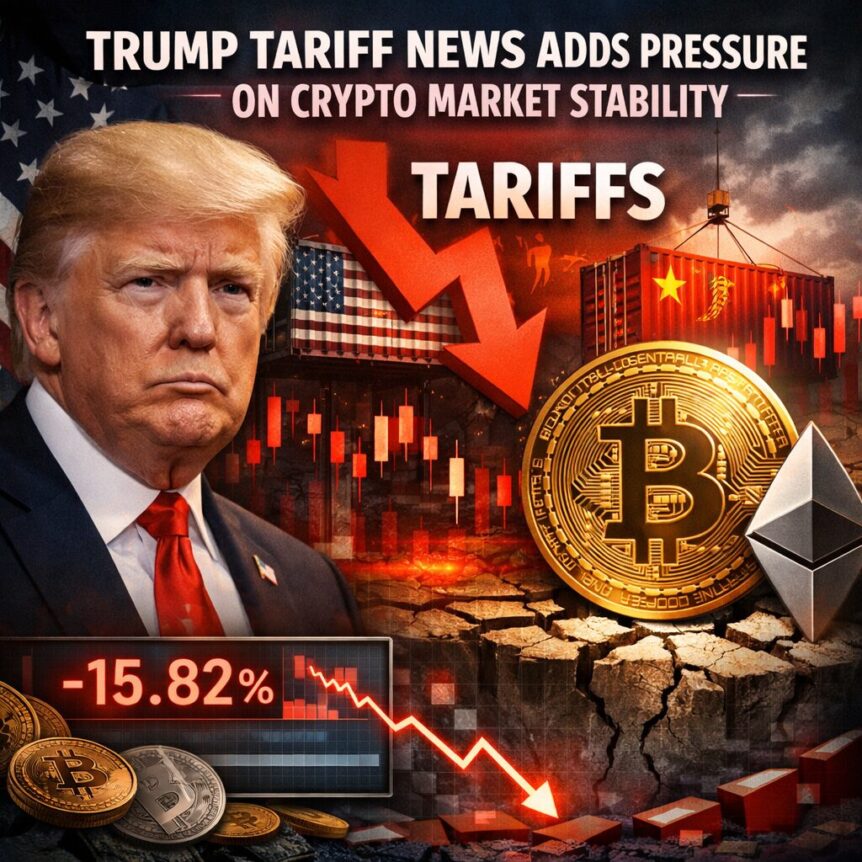
Donald Trump announced a 25% tariff on European Union cars and trucks on May 2, 2026. The measure will take effect next week and applies to all EU vehicle imports into the United States. The policy excludes companies manufacturing within the U.S.
BREAKING: President Trump announces he is raising tariffs on cars and trucks coming into the US from the EU to 25%.
President Trump says this is due to the EU “not complying with out fully agreed to trade deal.” pic.twitter.com/IKzYxrVloh
— The Kobeissi Letter (@KobeissiLetter) May 1, 2026
IN THIS COMING CRASh possibly a Grest Drpression…. Will you be “FU’CD UP or LU’CD UP.”
So far….in the crashes of 1987, 2000, 2008, 2015, 2019, 2022 I got richer not poorer.
And again in coming giant crash of 2026-27….I plan on growing richer not poorer.
I wish the same for…
— Robert Kiyosaki (@theRealKiyosaki) April 28, 2026
The Trump tariff news is significant; it raises macroeconomic uncertainty. Although the policy targets the auto sector, analysts note that its broader effects could influence the future of crypto markets through liquidity and investor sentiment.
US-EU Trade Tensions Return
The announcement has intensified tensions between the United States and the European Union. EU officials have criticized the move and signaled possible countermeasures.
Historically, such trade disputes disrupt supply chains and capital flows. As a result, markets often react with increased volatility and cautious positioning.
Trump Tariff News and Crypto Market Reaction
So far, crypto markets have not shown a sharp reaction. Bitcoin and major altcoins remain within recent trading ranges. However, investors are closely monitoring key indicators.
Analysts note that crypto markets often respond gradually to macroeconomic events. Price movements typically follow changes in liquidity rather than initial headlines.
Liquidity Pressure and Bitcoin Outlook
Rising trade tensions may strengthen the U.S. dollar and tighten global liquidity. These conditions have historically created pressure on Bitcoin and other digital assets.
At the same time, investors may shift capital toward safer assets. This trend can reduce short-term demand for crypto and affect price momentum.
Kiyosaki Crash Warning and Market Sentiment
Robert Kiyosaki added to market caution with a recent warning about a potential downturn between 2026 and 2027. In a public statement, he said, In a crash, recession and depression, great assets go on sale.
IN THIS COMING CRASh possibly a Grest Drpression…. Will you be “FU’CD UP or LU’CD UP.”
So far….in the crashes of 1987, 2000, 2008, 2015, 2019, 2022 I got richer not poorer.
And again in coming giant crash of 2026-27….I plan on growing richer not poorer.
I wish the same for…
— Robert Kiyosaki (@theRealKiyosaki) April 28, 2026
Trade Conflicts and Crypto Volatility
Previous tariff disputes have influenced crypto markets. During earlier trade tensions, Bitcoin experienced periods of volatility linked to global uncertainty.
Today, crypto markets show stronger correlation with macroeconomic conditions. Increased institutional participation has made digital assets more sensitive to global policy shifts.
What Investors Should Watch Next
Investors are tracking Bitcoin dominance, capital inflows, and overall risk sentiment. Any escalation in US-EU tensions could influence these indicators.
As of May 2, 2026, crypto markets remain stable following the tariff announcement. Market participants are now watching for EU responses and upcoming economic data releases.

Ripple Is Has A Vested Interest In Making XRP Succeed – So Is $20/XRP The First Hurdle?

DWP PIP claimants nearing State Pension age could get 10-year award

How The Raunchy College Comedy Was Dismantled By Its Own Lies

Manchester United reach agreement with Casemiro over contract clause amid transfer speculation

US brings back mandatory military draft registration

Steven Gerrard disagrees with Gary Neville over ‘shock’ Chelsea and Arsenal claim | Football


-

 Tech5 days ago
Register Renaming | Hackaday
-

 Politics5 days ago
Drax board avoid their own AGM, accused of greenwashing & environmental racism
-

 Tech5 days ago
Why Blue Badges Disappeared From Toyota Hybrids
-

 Tech5 days ago
Images of Samsung’s rumored smart glasses have leaked
-
 Sports6 days ago
IPL 2026: Ruturaj Gaikwad registers slowest fifty of the season, enters all-time unwanted list | Cricket News
-
 Tech1 day ago
Trump’s 25% EU auto tariff breaches Turnberry Agreement that also covers semiconductors and digital trade
-

 NewsBeat6 days ago
LK Bennett closes all stores after entering administration
-

 Fashion4 days ago
Kylie Jenner’s KHY Enters a New Era with ‘Born in LA’
-

 Business4 days ago
Most Commercial Energy Audits Miss the Real Losses
-

 Crypto World4 days ago
CFTC’s AI will review U.S. crypto registration applications, chairman tells CoinDesk
-

 Business5 days ago
(VIDEO) Charlize Theron Climbs Times Square Billboard to Promote New Netflix Thriller ‘Apex’
-

 Tech7 days ago
Microsoft to roll out Entra passkeys on Windows in late April
-

 Business3 days ago
Barclay Brothers Avoid Bankruptcy: HSBC Drops High Court Petitions After IVA Deal
-
 Sports1 day ago
Paul Scholes issues Marcus Rashford reality check as agreement emerges over Man United star
-

 Tech6 days ago
OpenAI’s Sam Altman apologizes for not reporting ChatGPT account of Tumbler Ridge suspect to police
-
 Business3 days ago
Tesla Officially Registers Elon Musk’s Stock: What Investors Need to Know
-

 Tech7 days ago
OpenAI CEO apologizes to Tumbler Ridge community
-

 Tech4 days ago
Get Ready for More Brain-Scanning Consumer Gadgets
-

 News Videos7 days ago
16 Cryptos Just Became LEGAL Commodities (Full List)
-

 Tech6 days ago
Dyson Vacuums And The Curse Of Cooked Capacitors
You must be logged in to post a comment Login