Crypto World
Polymarket Breaks $478 Million Record

Polymarket recorded a single-day notional trading volume of $478 million, with the politics category alone accounting for $220 million, nearly half of total daily activity.
Elsewhere, rival prediction market Kalshi was on the receiving end of user backlash after a controversial contract over the Khamenei market.
Polymarket Sets Historic Record as Geopolitical Tensions Drive Crypto Betting
Prediction markets surged to historic highs as the United States and Israel launched coordinated strikes on Iran.

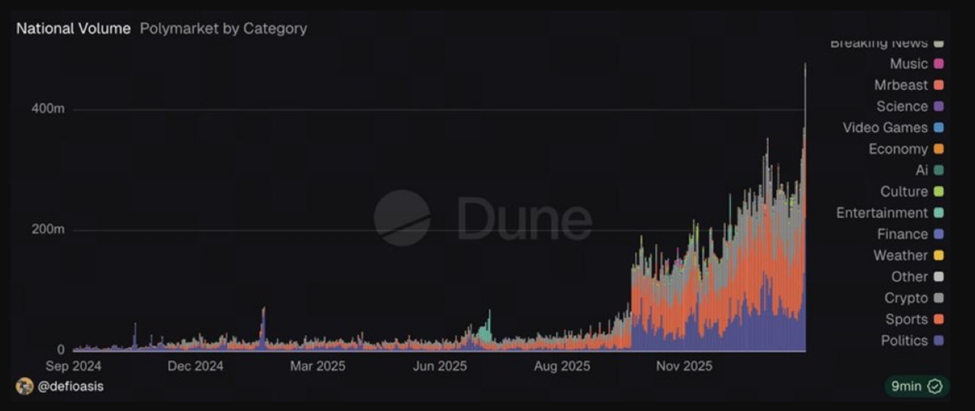
Polymarket reached an all-time high across the platform and its political markets. According to data aggregated by Defioasis, Polymarket’s spike coincided directly with the strikes.
It signals the platform’s capacity to price geopolitical events faster than TradFi markets or polling models.
Certain strike-timing contracts set their own records, with individual trades clearing up to $90 million, reflecting the massive liquidity flowing into the platform.
However, the traction was also marred by allegations of insider trading, with Bubblemaps identifying at least six addresses that profited approximately $1.2 million from bets tied to the Iran conflict.
The surge in activity shows how prediction markets are increasingly blurring the line between financial speculation and geopolitical forecasting, drawing attention from traders, lawmakers, and regulators.
The timely pricing of real-world events demonstrates the efficiency of blockchain-based markets. However, it also raises concerns about transparency and fairness, particularly when wallets appear to perfectly anticipate outcomes.
Kalshi Faces Backlash Over Khamenei Market, CEO Defends Settlement and Ethics
Meanwhile, Kalshi, a US-regulated prediction market, faced its own controversy with the contract titled “Ali Khamenei out as Supreme Leader?”
The market, which had accumulated over $50 million in total volume, saw roughly $20 million traded on strike day alone.
Following Khamenei’s reported death during the strikes, critics argued the platform had effectively created a proxy death market, despite its stated rules against profiting from death outcomes.
Kalshi CEO Tarek Mansour addressed the backlash on X (Twitter), emphasizing that all positions would be settled at pre-death last-traded prices. Meanwhile, post-death positions would be fully reimbursed, including all trading fees.
Mansour defended the market’s design as consistent with U.S. regulations. He noted that leadership changes in Iran carry significant geopolitical, economic, and national security implications. This, he said, makes such markets relevant without directly incentivizing death.
“A market on Ali Khamenei’s out as Supreme Leader was important because leadership changes in Iran have a major impact on the world order,” Mansour wrote, outlining that traders could still profit or lose based on legitimate political outcomes rather than mortality.
The settlement process, he explained, adhered strictly to the CFTC-filed contract terms, which referenced the last-traded price prior to Khamenei’s death, even amid ambiguities in reporting timelines.
On the one hand, Polymarket is setting new benchmarks for trading volume amid geopolitical tension. Meanwhile, Kalshi is facing ethical scrutiny.
Both events highlight the potential and the risks of prediction markets. These platforms offer unprecedented speed and transparency in pricing world events.
However, as February 28 demonstrated, they also amplify ethical dilemmas and regulatory attention during crypto-driven speculation.