
Crypto World
Polymarket Pursues Full U.S. Return Through CFTC Approval Talks


Polymarket is pursuing a regulatory pathway to reopen its main prediction markets platform to users in the United States, according to Bloomberg, which cited people familiar with the matter. The development would signal a broader US re-entry for the firm, following a limited return last year via a regulated QCEX-based setup that still blocks American users from the main exchange.
The contemplated relaunch hinges on obtaining approval from the US Commodity Futures Trading Commission (CFTC) to lift the long-standing prohibition on US-based customers. A full reinstatement would require a formal CFTC commission vote. Bloomberg noted that the process could be facilitated by four vacant commissioner seats, potentially reducing the number of votes needed to advance the matter.
The move comes against a backdrop of heightened regulatory scrutiny of prediction markets in the United States, where rivals such as Kalshi have established a stronger domestic footprint even as the sector faces ongoing enforcement and legal questions at both state and federal levels. Polymarket’s potential US comeback would, if successful, intensify competition in a market that regulators closely monitor for compliance with registration, licensing, and consumer-protection standards.
Polymarket declined to comment to Cointelegraph about the Bloomberg report.
Key takeaways
- Polymarket is seeking CFTC clearance to restore full US access to its main prediction markets platform, a move that would require a formal vote by the agency’s commissioners.
- The bid follows the 2022 CFTC settlement, which forced Polymarket to block US users and imposed a $1.4 million civil penalty for unregistered event contracts.
- A complete US relaunch would contribute to competition with Kalshi, which has gained traction domestically and holds relationships with major crypto platforms such as Coinbase.
- US enforcement activity and state actions remain a material risk for Polymarket and other prediction platforms, including ongoing lawsuits and investigations into the use of event contracts for gambling or illegal betting.
- Polymarket’s US operations have progressed only gradually, with a late-2025 comeback that began with a waitlist-based app focused on sports contracts, followed by broader market ambitions.
Regulatory backdrop and potential implications for US operations
The regulatory framework governing prediction markets in the United States rests primarily with the CFTC, which regulates commodity and derivative instruments and enforces registration and anti-fraud provisions. Polymarket’s 2022 settlement underscores the risk profile for platforms offering event-based contracts to US residents without appropriate registration or oversight. A formal CFTC vote to lift the ban would represent a significant legal milestone that could determine whether Polymarket can operate its core exchange in the United States on par with international platforms.
The transition would also intersect with broader policy considerations around digital markets, consumer protection, and financial innovation. While MiCA governs EU-based crypto-asset activities and has implications for cross-border services, the US approach remains characterized by federal agency actions and state-level enforcement. For market participants, the outcome could influence licensing strategies, KYC/AML controls, and compliance architectures required to service US customers at scale.
As regulators continue to scrutinize prediction markets, any relaunch would be weighed against enforcement history and ongoing legal challenges. Reports indicate that Wisconsin’s top law enforcement official filed a lawsuit on April 23 against Kalshi and Polymarket, alongside other firms such as Coinbase, Robinhood, and Crypto.com, alleging that these platforms facilitate illegal sports betting through event contracts. Separately, federal authorities—the CFTC and the Department of Justice—have pursued cases related to the use of event contracts in ways that may contravene US restrictions, including allegations tied to a US service member using non-public information to place bets on Polymarket’s international exchange via VPN access. These actions illustrate the current enforcement environment that any relaunch would navigate.
In practice, a successful US relaunch would necessitate robust licensing frameworks, rigorous consumer protections, and clear delineations of which markets fall under securities, commodities, or other regulatory categories. The interagency dynamics—encompassing the CFTC, the DOJ, and state authorities—would shape the pace and scope of any permitted activities. For exchanges and banks evaluating partnerships or custody arrangements, the decision to re-enter the US market would hinge on the ability to demonstrate compliant operations across borders and to manage enforcement risk effectively.
Market dynamics, performance, and enforcement risk in the US landscape
Polymarket’s position in the US prediction-market landscape has evolved alongside regulatory pressure. The platform previously accounted for the majority of activity in the field, but its dominance has come under pressure from a growing competitor base and heightened scrutiny. A Dune-derived assessment cited on Datadashboards suggested Polymarket once captured a substantial share of notional volume, though subsequent scrutiny of volume reporting has prompted questions about measurement and methodology. Meanwhile, Kalshi has expanded its domestic footprint and secured integration with major platforms, contributing to a more competitive environment for compliant prediction-market operators.
Despite higher visibility for Kalshi, Polymarket remains entangled in enforcement scrutiny that spans both federal and state channels. The Wisconsin action is indicative of a broader regulatory push against “event contracts” that resemble sports betting, highlighting the risk of civil actions that could affect platform viability and investor confidence. In parallel, ongoing investigations into cross-border activity—coupled with combatting unregistered contracts—underscore the regulatory challenges that accompany any attempt to relaunch the main US exchange at scale.
From a compliance perspective, the reintroduction of Polymarket into the US market would demand rigorous AML/KYC controls, transparent disclosures regarding contract types and settlement mechanisms, and robust risk-management measures to monitor for potential abuse or manipulation. For institutional observers, the development raises questions about licensing pathways, the consistency of state-by-state enforcement, and the potential for harmonized standards across multiple jurisdictions as digital prediction markets continue to mature.
Historical context and what a US relaunch would entail
Polymarket’s US trajectory has long been conditioned by regulatory decisions. The 2022 settlement setting a cap on the company’s US operations was a pivotal turning point, creating a permanent constraint that any broader US return must address. The company’s late-2025 comeback, characterized by a limited, waitlisted US app rolled out with sports-focused contracts, represented a cautious, incremental approach—intended to test compliance readiness while rebuilding user trust and infrastructure. A broader relaunch would require not only regulatory clearance but also scalable compliance programs, clear product classifications, and a plan to align with evolving enforcement expectations.
Against this backdrop, competition with Kalshi—already a domestic market leader and a recognized provider for major crypto exchange Coinbase—takes on strategic significance. A successful US relaunch for Polymarket could expand the range of state- and federally regulated offerings available to institutions seeking hedging tools or research data, while simultaneously increasing the regulatory and operational complexity for market participants who rely on these platforms for legitimate, compliant risk assessment.
Closing perspective
Any decision to lift the US ban and authorize Polymarket’s main exchange would represent a meaningful inflection point for the prediction-market ecosystem, with broad implications for licensing, cross-border operations, and enforcement alignment. As regulators, industry players, and market participants monitor evolving developments, the path forward will hinge on clear regulatory clarity, robust compliance infrastructure, and demonstrated adherence to applicable laws and standards. The coming months will clarify whether a formal CFTC vote materializes and how policymakers balance innovation with consumer protection and market integrity.



Los Angeles, California, April 29, 2026 – RealOpen, the leading platform for buying real estate with crypto, today announced the conclusion of its collaborative “Fast Moves, Fast Payments” Holiday Campaign with TRON, the leading settlement layer for stablecoin transactions. The campaign, which ran from November 17, 2025, through February 28, 2026, offered eligible U.S. homebuyers up to 50,000 USDT in rewards for purchasing property through RealOpen using USDT on the TRON blockchain, illustrating the network’s real-world use across both everyday payments and high-value transactions.
RealOpen combines the reliability of traditional real estate with the speed and efficiency of crypto. Through its platform, buyers can purchase any property on the market and fund the purchase directly with digital assets, making blockchain-powered homebuying accessible without sacrificing the familiarity of conventional real estate transactions.
Over the course of the campaign, RealOpen recorded 343 user sign-ups, with 27 completing KYC verification, and approximately $9.4 million in USDT on TRON verified by new users. A total of 69 real estate agents were onboarded through the accompanying 2025 TRON Real Estate Challenge, signaling increased industry participation in crypto-enabled property transactions.
“The Fast Moves, Fast Payments campaign showed why TRON is such a strong settlement layer for real-world assets. We saw hundreds of new users engage, dozens of agents onboard, and nearly $10M in USDT on TRON verified through RealOpen. Modern capital needs modern payment rails – and TRON is well-positioned to power that shift,” said Johnny Schiro, Executive Vice President at RealOpen.
The campaign builds on a proven track record. Earlier in 2025, RealOpen successfully closed multiple real estate transactions funded directly in USDT on TRON. Developments such as Pearl Homes’ Hunter’s Point, a net-zero master-planned community on Florida’s Gulf Coast, also promoted crypto acceptance via RealOpen, expanding blockchain-based settlement into broader residential markets.
TRON’s infrastructure underpins the campaign’s viability. The network processes more than $22 billion in daily transfer volume, with a circulating supply of $86 billion in USDT. The network is leveraged by over 376 million self-custodial accounts and accounts for approximately 65% of global USDT retail transfers under $1,000 – making it one of the largest resources for stablecoin liquidity across blockchain networks. Its near-instant finality and low transaction costs make it a practical settlement layer for time-sensitive, high-value transactions like real estate closings.
The TRON and RealOpen collaboration reflects the increasing role of stablecoins in real-world financial activity. As demand grows for faster, more transparent capital movement, the campaign demonstrates how blockchain infrastructure is already supporting practical use cases in the U.S. housing market, positioning USDT on TRON as a viable settlement rail for real estate transactions at scale.
About RealOpen
RealOpen is the easiest and most efficient way for high-net-worth crypto holders to purchase real estate. The company bridges digital assets and property transactions, validating on-chain funds, converting crypto to fiat for closing, and enabling fast, seamless funding. RealOpen partners with leading builders, brokers, and crypto ecosystems to bring real-world asset ownership into the Web3 era– where buying a home can move as fast as the blockchain itself.
Media contact
John Bauer
About TRON DAO
TRON DAO is a community-governed DAO dedicated to accelerating the decentralization of the internet via blockchain technology and dApps.
Founded in September 2017 by H.E. Justin Sun, the TRON blockchain has experienced significant growth since its MainNet launch in May 2018. TRON hosts one of the largest circulating supply of USD Tether (USDT) stablecoin, which currently exceeds $86 billion. As of April 2026, the TRON blockchain has recorded over 378 million in total user accounts, more than 13 billion in total transactions, and over $26 billion in total value locked (TVL), based on TRONSCAN. Recognized as the global settlement layer for stablecoin transactions and everyday purchases with proven success, TRON is “Moving Trillions, Empowering Billions.”
TRONNetwork | TRONDAO | X | YouTube | Telegram | Discord | Reddit | GitHub | Medium | Forum
Media contact
Yeweon Park

The U.S. Federal Trade Commission has reached a settlement with Celsius Network founder Alexander Mashinsky that imposes a permanent ban on promoting asset-related products and requires a $10 million payment tied to a larger, largely suspended civil judgment of $4.72 billion. The stipulated order was entered by Judge Denise L. Cote in the Southern District of New York this week, marking another milestone in the regulatory fallout from Celsius’s 2022 collapse.
The order states that Mashinsky is “permanently restrained and enjoined” from advertising, marketing, promoting, offering or distributing any product or service that can be used to “deposit, exchange, invest, or withdraw assets.” It also preserves the FTC’s ability to pursue the full monetary judgment if Mashinsky misstates or omits assets in disclosures related to the case, keeping open the potential for additional consumer redress or enforcement if new material misstatements emerge.
The $4.72 billion monetary judgment in favor of the FTC remains largely suspended, with Mashinsky required to pay $10 million to the FTC. The order also provides for a potential alternative payment path: the $10 million obligation could be satisfied by delivering at least that amount to the U.S. Department of Justice under the forfeiture order in Mashinsky’s criminal case. This structure is designed to balance immediate consumer redress with ongoing enforcement leverage should disputes over asset disclosures arise.
The settlement extends the legal consequences stemming from Celsius’s 2022 failure, even as Mashinsky faces broader penalties from other proceedings. In May 2025, Mashinsky was sentenced to 12 years in prison after pleading guilty to commodities fraud and securities fraud, with prosecutors contending that he misled Celsius customers about the company’s profitability, investment risks, and the safety of customer funds.
Excerpt from the court filing. Source Court Listener
Suspended judgment can be revived
The order clarifies that while the majority of the judgment remains suspended, the suspension is conditional. The Federal Trade Commission can seek to lift the suspension if it proves that Mashinsky failed to disclose a material asset, misstated the value of an asset, or made another material misstatement or omission in his financial disclosures. If the suspension is lifted, the full $4.72 billion judgment would become immediately due, subject to credits for payments already made under the FTC order, amounts paid to consumers through the DOJ forfeiture order in the criminal case, or payments demonstrated by Mashinsky to consumers via other defendants, including through the Celsius bankruptcy process.
The arrangement is notable for its attempt to preserve a broad consumer-redress milestone while avoiding an immediate, large liquidity demand on Mashinsky. It also signals a persistent regulatory emphasis on ensuring that asset-related advertising and fundraising activity by figures associated with failed crypto ventures remains under close scrutiny.
Regulatory and policy implications for the crypto sector
From a regulatory perspective, the case underscores the escalating use of civil enforcement tools to address consumer harms tied to asset-related claims in the crypto space. The FTC’s settlement with Mashinsky complements existing criminal and civil proceedings, illustrating how monetary, injunctive, and forfeiture pathways can be combined to deter misleading representations and to constrain the promotion of financial products tied to digital assets.
For exchanges, wallets, and other market participants, the decision reinforces the expectation of robust disclosure controls and clear boundaries around endorsing or promoting products that touch on deposits, exchanges, investments, or withdrawals of assets. Institutions operating in the U.S. market—ranging from fintechs to traditional banks engaging with crypto custody or liquidity facilities—may find themselves reinforcing AML/KYC diligence, asset disclosures, and governance practices to align with evolving enforcement expectations. The case also sits within a broader policy landscape that includes ongoing debates about licensing frameworks, consumer protection standards, and cross-border coordination in crypto regulation.
Although the action originates in the United States, commentators and policymakers frequently view it within a global context of converging standards. The Celsius matter intersects with discussions around compliance obligations for asset-backed activities, the delineation of security versus non-security crypto offerings, and the balance between enforcement jurisdiction and international cooperation. In parallel, regulators continue to refine rules around stablecoins, banking access, and the treatment of customer funds in insolvency and bankruptcy scenarios, all of which influence how firms plan product design, disclosures, and risk management.
Notably, the case is tied to a broader enforcement trajectory involving Celsius and its executives, including the criminal charges and the related DOJ forfeiture framework. For research and compliance teams, the evolving posture of the FTC, DOJ, and SEC (where applicable) highlights the importance of risk-based monitoring for asset-related promotions, disclosures, and marketing claims across corporate entities associated with crypto platforms.
Closing perspective
As authorities maintain a multimodal enforcement approach, the Mashinsky settlement serves as a reference point for risk assessment, governance, and compliance in the crypto ecosystem. Analysts and compliance officers will be watching for any revival of the suspended judgment and for further actions linked to asset disclosures or other material misstatements, signaling how regulators calibrate redress against ongoing penalties in high-profile industry cases.
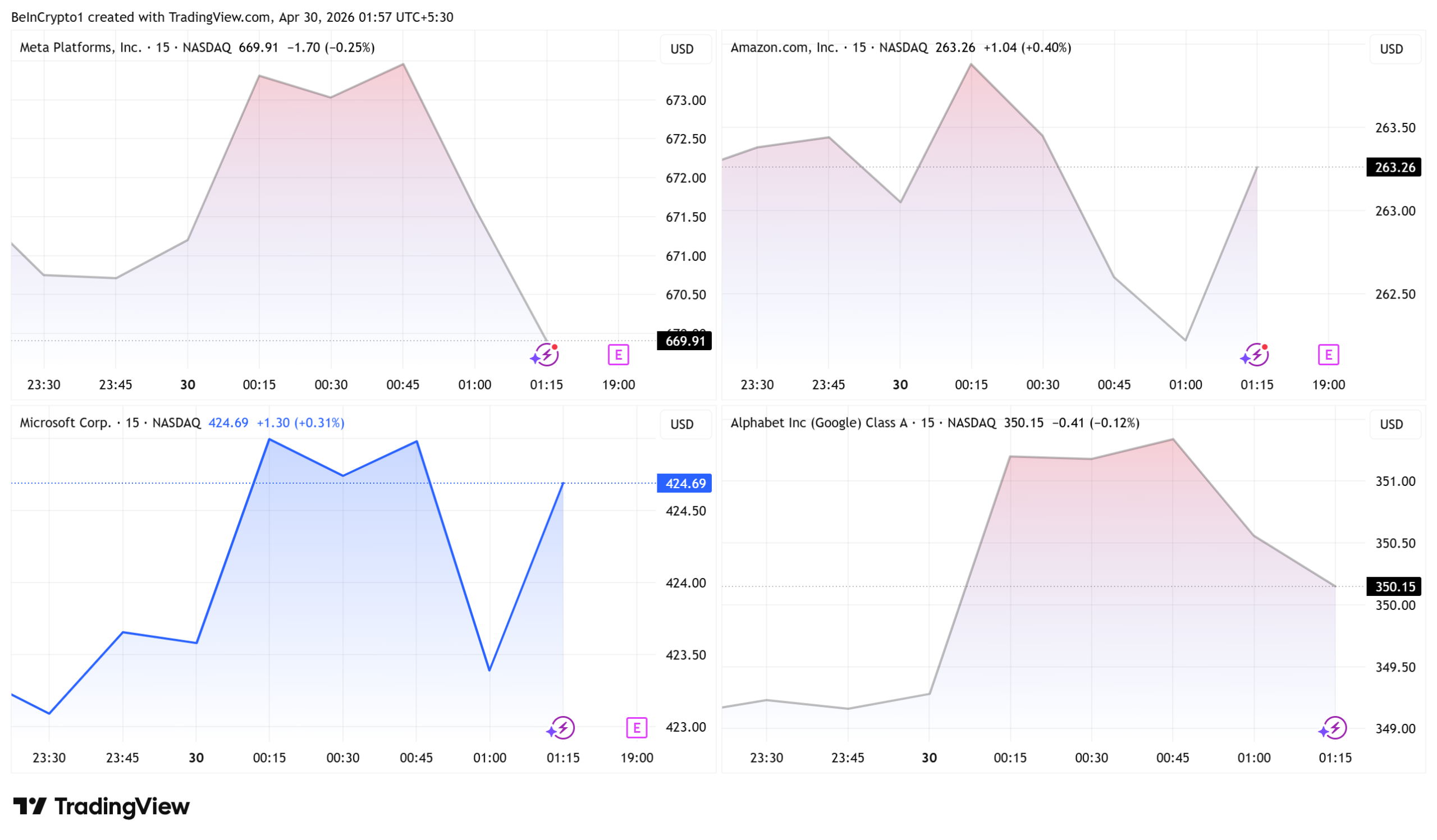
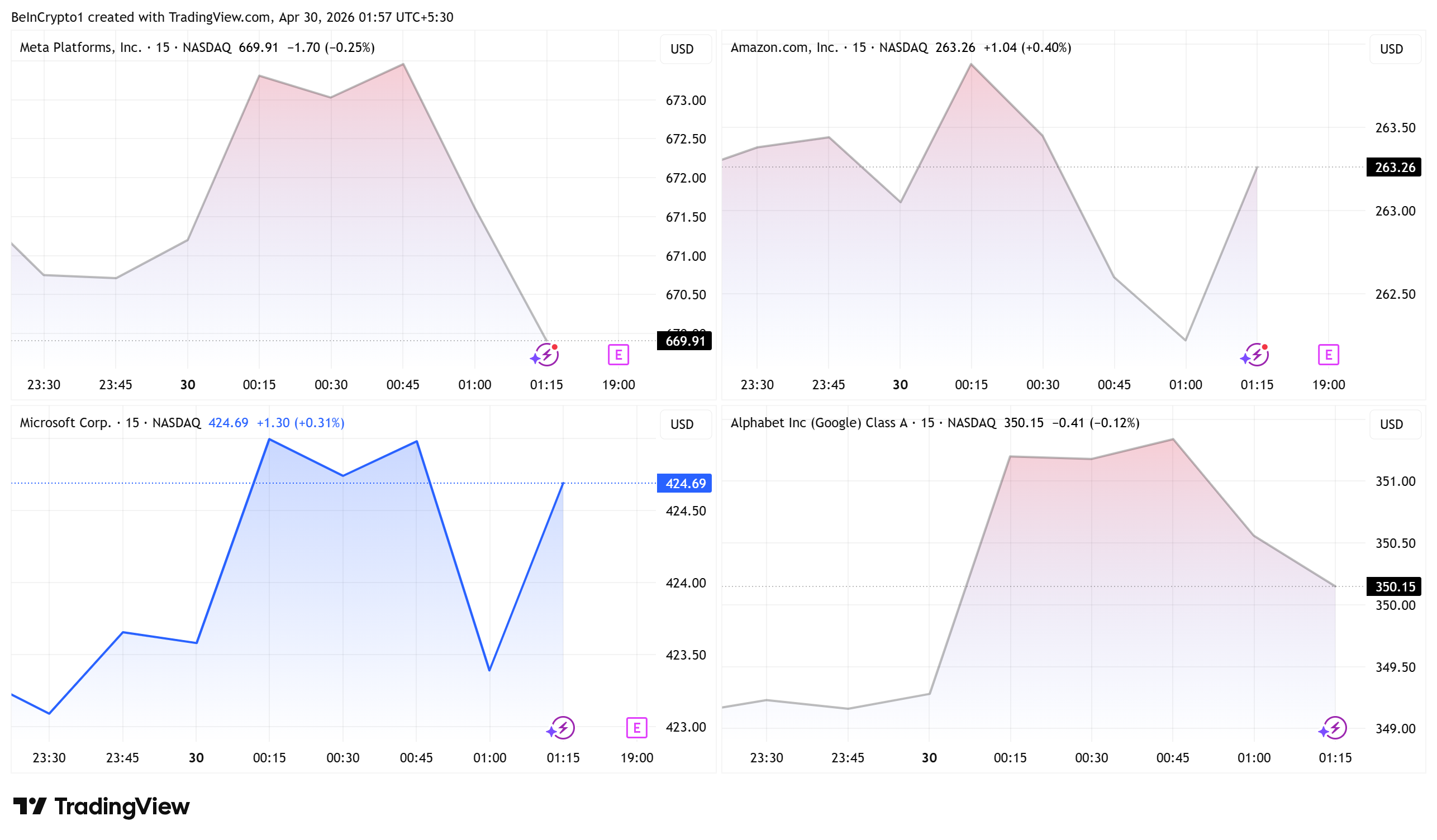
Amazon, Meta, Microsoft, and Alphabet all topped Wall Street revenue forecasts on Wednesday. However, aggressive capital spending plans triggered after-hours selloffs and pressured tech-correlated risk assets.
Meta dropped 6% after raising its 2026 capital spending guide, while Microsoft and Amazon slipped on AI buildout costs. Alphabet was the lone gainer, lifted by cloud strength.
Big Tech Q1 Earnings Show Cloud Driving the Growth
Amazon reported first-quarter net sales of $181.5 billion, up 17% year over year. Earnings per share came in at $2.78 against a $1.62 estimate. The retailer guided second-quarter sales to between $194 billion and $199 billion, well above consensus.
Microsoft’s fiscal third-quarter revenue reached $82.89 billion, up 18% year over year, while operating income climbed to $38.4 billion. Microsoft’s AI business now runs at a $37 billion annualized revenue rate, up 123% year over year.
Meta posted $56.3 billion in revenue and earnings of $10.44 per share. The figure was boosted by an $8 billion one-time tax benefit.
Alphabet delivered $109.9 billion in revenue. Google Cloud sales of $20 billion topped Wall Street estimates by nearly $2 billion.
AI Capex Push Past $650 Billion Spooks Investors
The headline figure is the spending. Meta raised full-year 2026 capital spending guidance to between $125 billion and $145 billion. The company cited higher component costs and added data center capacity for AI workloads.
Combined 2026 capex across the four hyperscalers is on track to exceed $650 billion, according to industry estimates. Investors are increasingly worried that depreciation and operating costs will outpace near-term AI revenue contributions.
That tension explains the after-hours moves. Meta’s 6% slide and Microsoft’s 2.5% drop reflect a market more focused on payback timelines than on top-line beats.
Crypto Markets Watch the Risk-Asset Spillover
Bitcoin (BTC) has tracked the Magnificent 7 closely throughout 2026. Wednesday’s prints will help shape near-term sentiment across digital assets.
Cloud and AI strength may eventually support tokens tied to compute and decentralized infrastructure narratives.
However, persistent capex anxiety could drag tech-correlated risk assets, including Bitcoin and Ethereum (ETH), into May. Apple’s report and the PCE index are next on the calendar.
The coming sessions will show whether investors treat this $650 billion spend as discipline or as overreach.
The post Big Tech AI Capex Tops $650 Billion as Q1 Earnings Beats Pressure Bitcoin Risk Trade appeared first on BeInCrypto.

Bullish is expanding its institutional reach by extending its integration with Ripple Prime to offer direct access to Bitcoin options trading. The move adds BTC options to the existing connectivity Ripple Prime provides for spot, perpetual and futures through its prime brokerage network.
The upgrade links Ripple Prime’s users to Bullish’s regulated Bitcoin options markets, with trades funded through existing sub-accounts and eligible collateral supported in stablecoins such as Ripple USD (RLUSD).
RLUSD is a USD-pegged stablecoin designed for payments, settlement and use as collateral in digital asset markets. Its market capitalization sits around $1.57 billion, according to DeFiLlama.
The two firms said they plan to introduce cross-venue margin access, enabling institutions to manage collateral across exchanges and over-the-counter desks from a single account to boost capital efficiency.
Ripple Prime operates as the company’s institutional prime brokerage platform, formed after its $1.25 billion acquisition of crypto prime broker Hidden Road in 2025. It offers multi-asset brokerage, clearing and financing services and reported clearing more than $3 trillion in volume in 2025.
Bullish notes that its Bitcoin options venue ranks among the largest by open interest for crypto-settled contracts. The integration is live, allowing Ripple Prime clients to begin accessing the options markets immediately.
Reflecting the broader market backdrop, Bullish’s share price has trended lower over the past year, retreating more than 60% from its September peak and trading around $36.58 as of this writing. Early in the session, the stock was down roughly 8% according to Yahoo Finance data.
Key takeaways
- Institutional access: Ripple Prime users can trade Bullish’s BTC options directly, leveraging existing sub-accounts without new onboarding.
- Collateral in RLUSD: Trades can be funded and collateralized with RLUSD, a USD-pegged stablecoin with a market cap near $1.57 billion (DefiLlama).
- Cross-venue margin on the roadmap: The partners plan cross-venue margin access to improve capital efficiency by consolidating collateral across venues and OTC desks.
- Ripple Prime’s scale: The platform, built after the Hidden Road acquisition, reported more than $3 trillion in volume cleared in 2025, underscoring institutional demand for prime brokerage services.
- Industry context: BTC options activity remains sizable, with Deribit dominating the space alongside CME, OKX, Binance and Bybit, and Coinbase having completed the Deribit acquisition in 2025 to consolidate a leading options venue.
Industrial momentum: BTC options deepen institutional risk management
Bitcoin options trading has gained traction as institutions increasingly use derivatives to hedge volatility and manage downside risk. Options give traders the right, but not the obligation, to buy or sell BTC at a specified price, providing a tool to navigate sudden price swings while preserving capital.
Industry context is evolving rapidly. In August 2025, Coinbase finalized its acquisition of Deribit, consolidating the largest crypto options venue under a single platform and accelerating access to spot, futures and options in a unified ecosystem.
On the corporate treasury front, momentum persists as Bitcoin-focused firms explore more active derivatives programs. For example, Nakamoto disclosed an actively managed derivatives program in 2026, employing BTC as collateral for options-based strategies intended to generate income from volatility while hedging downside risk.
Over the past year, BTC options markets have remained robust. Total open interest stood at about $32.8 billion as of late April 2026, up from roughly $30.8 billion a year earlier, with occasional peaks above $50 billion during periods of heightened activity, according to CoinGlass. While Deribit remains the dominant venue by open interest, liquidity is spread across CME Group, OKX, Binance and Bybit in varying shares.
These dynamics highlight how the market’s infrastructure—spanning major venues, prime brokers and stablecoin collateral—still shapes liquidity and access for institutional players. The Bullish–Ripple Prime integration fits within a broader trend of consolidating professional-grade crypto derivatives within multi-venue ecosystems, aiming to simplify risk management and optimize capital efficiency for large holders and institutions.
What to watch next
Looking ahead, investors and traders should monitor how quickly cross-venue margin access is implemented and adopted in practice, as well as how collateral flows evolve across Ripple Prime, Bullish and other venues. The convergence of prime brokerage services, BTC options liquidity and stablecoin collateral will likely influence both hedging behavior and the appetite for long-tail derivatives in institutional portfolios.

Disclosure: This article does not represent investment advice. The content and materials featured on this page are for educational purposes only.
WHITE TECH secures MiCA authorization in Croatia to operate as a regulated crypto-asset service provider.
Summary
- WHITE TECH secures MiCA authorization in Croatia, enabling regulated crypto services under EU-wide compliance standards.
- HANFA has approved WHITE TECH as a CASP, strengthening its role in regulated crypto exchange and custody services.
- WHITE TECH enters the EU’s unified MiCA framework, expanding compliant crypto-asset services across regulated markets.

WHITE TECH, part of the W Group ecosystem and majority-owned by Volodymyr Nosov, Founder and CEO of WhiteBIT, has received authorization from the Croatian Financial Services Supervisory Agency (HANFA) to operate as a crypto-asset service provider (CASP) under the European Union’s Markets in Crypto-Assets (MiCA) regulation.
Within the W Group ecosystem, WHITE TECH serves as a core infrastructure component, focusing on crypto exchange services, enabling seamless conversion between crypto-assets and fiat, as well as the execution of crypto-asset transfers for businesses and users.
The authorization enables WHITE TECH to provide a range of regulated crypto services, including the exchange of crypto-assets for fiat currencies and other crypto-assets, transfer services, as well as custody and administration of crypto-assets. The company will operate under HANFA supervision, in line with MiCA’s requirements for governance, risk management, and user protection.
WHITE TECH is among the first companies in Croatia to receive authorization under MiCA, entering the EU’s unified regulatory framework at an early stage. MiCA establishes consistent rules across member states, aimed at increasing market transparency and strengthening trust in the crypto-asset sector.
The milestone reflects the company’s continued growth trajectory as part of the broader W Group ecosystem, reinforcing its commitment to regulated markets.
About W Group
W Group is a global fintech ecosystem that makes blockchain and crypto easy, secure, and accessible for everyone. It is built on the values of security, professionalism, and innovation, serving 35 million users across 150 countries worldwide. At the center of W Group is WhiteBIT, the largest European crypto exchange by traffic, offering over 900 trading pairs, 340+ assets, and supporting 8 fiat currencies. WhiteBIT collaborates with Visa, FACEIT, FC Barcelona, Juventus FC, and the Ukrainian national football team.
Disclosure: This content is provided by a third party. Neither crypto.news nor the author of this article endorses any product mentioned on this page. Users should conduct their own research before taking any action related to the company.


Three DeFi protocols across NEAR, Base, and Sui were drained on Tuesday. One of them, a $3.46 million Sweat Economy incident, later turned out to be a foundation rescue.
Bloomberg analyst James Seyffart used the cascade to needle Crypto Twitter’s AI-versus-crypto debate. He suggested the bigger threat to digital assets is the same one as always.
Tuesday’s Drain Cascade
Blockaid raised the alarm at around 1.36 p.m. UTC. Roughly 13.71 billion Sweat Economy (SWEAT) tokens, about 65% of total supply, moved through an attacker address.
On-chain analysts including former NEAR core contributor Zacodil traced the activity to an April 27 contract redeploy. The redeploy added refund_first and refund_second methods.
A single refund_second call returned 13.63 billion SWEAT, worth about $2.63 million, to 53 addresses.
Hours earlier, the Syndicate Commons bridge on Base lost 18.5 million SYND tokens worth $330,000 to $400,000. The proceeds were bridged to Ethereum.
On Sui, Aftermath Finance paused its perpetuals protocol after losing roughly $1.14 million USDC.
Seyffart Pushes Back on the AI vs Crypto Frame
Crypto Twitter has spent April arguing that AI will end crypto. AI agents and AI infrastructure are absorbing the venture capital that altcoins once drew.
Attention has rotated to AI projects, leaving alts without a narrative driver. And on-chain AI agents will eventually make human-led crypto projects redundant, the more aggressive version of the thesis goes.
People are asking — Is AI the end of crypto? quipped James Seyffart, an ETF analyst at Bloomberg.
The implied point is that crypto’s chronic problem is not external competition. The same protocol-level vulnerabilities that drained SYND, USDC, and SWEAT in one afternoon are arguably the bigger threat.
Sweat Economy operates the move-to-earn ecosystem behind Sweatcoin, competing with STEPN. The token price held steady through the episode.
Sweat Economy’s X account stayed silent all day, and the team has not yet explained what vulnerability prompted the redeploy.
The post Tuesday’s Cascade Shows Why AI Is Not Crypto’s Real Problem As DeFi Drains Pile Up appeared first on BeInCrypto.
Crypto World
Securitize and Computershare Enable Tokenized Equity Issuance for Over 25,000 U.S.-Listed Stocks

TLDR:
- Securitize and Computershare open a tokenization path for over 25,000 U.S.-listed stocks onchain.
- Issuer-Sponsored Tokens represent real shares, not derivatives, and fit within existing regulatory frameworks.
- Issuers can add tokenized shares alongside DRS and traditional holdings without altering capital structure.
- Computershare manages records and corporate actions for ISTs, keeping the issuer-shareholder relationship intact.
Securitize has reached an agreement with Computershare to support U.S.-listed companies in issuing equity in tokenized form.
The partnership allows issuers to offer Issuer-Sponsored Tokens alongside traditional shares without altering their capital structure.
These tokens represent actual shares, not derivatives or wrappers. The move opens a pathway for millions of investors to hold equities in tokenized form across more than 25,000 listed stocks.
Issuer-Sponsored Tokens Bring Shares Directly Onchain
Securitize and Computershare structured the agreement to keep the direct issuer-shareholder relationship intact. Issuers can add ISTs alongside traditional shares, including Direct Registration System holdings.
No changes to the existing capital structure are required under this framework. This design makes the transition straightforward for companies already working with Computershare.
Securitize took to X to announce the milestone to the broader market. The firm posted that the agreement enables a new pathway for issuers to bring their shares onchain.
It also noted that companies gain more flexibility in how they issue shares. Shareholders, in turn, get more choice in how they hold their equity.
ISTs are actual shares represented in token form on a blockchain. They are not derivatives, synthetic assets, or wrapped versions of equities.
This structure sets them apart from many existing tokenized asset products in the market. ISTs are designed to fit within current regulatory frameworks without requiring new legislation.
Shareholders can opt for traditional share certificates, DRS, or the new tokenized format. The flexibility does not affect ownership rights or corporate action entitlements.
Holding in any of the three forms maintains the same investor protections. This approach creates consistency across all available holding types for retail and institutional investors.
Computershare’s Role Extends Market Access Across 25,000 U.S. Stocks
Computershare will handle record-keeping and corporate actions for ISTs under the agreement. The transfer agent manages these functions while preserving the issuer-shareholder relationship throughout.
This support structure keeps operations familiar for issuers already on the Computershare platform. It also reduces the operational burden of adding a tokenized equity option.
The agreement covers U.S.-listed clients, a pool that includes over 25,000 publicly traded stocks. That list includes major names such as Apple, Tesla, and Nvidia.
Any company listed on a U.S. exchange and working with Computershare can adopt ISTs. The potential scale of adoption is wide if issuer demand continues to grow.
Securitize described the development as a major step forward for tokenization. On X, the firm stated that the milestone opens the door for millions of investors to hold equities in tokenized form.
The statement reflects a growing appetite for blockchain-based financial infrastructure in traditional markets. More companies are now exploring ways to integrate distributed ledger technology into conventional equity issuance.
This agreement connects established transfer agent infrastructure with blockchain-based issuance. Issuers and investors gain practical options without disrupting existing processes.
Companies do not need to restructure their capital to participate. The partnership positions both firms at the center of an evolving equity issuance landscape.



U.S. Senator Thom Tillis is trying to haul the long‑stalled CLARITY Act into a Senate Banking markup that would simultaneously settle Washington’s stablecoin‑yield fight and advance Cynthia Lummis‑backed protections for non‑custodial crypto developers.
Summary
- Senator Thom Tillis wants the Clarity Act moved into Senate Banking’s markup stage after the May recess.
- Tillis says there is “significant consensus” on the bill and promises to release stablecoin yield text 4–5 days before a hearing.
- He also backs Senator Cynthia Lummis’ framework on limiting the use of 1960-era criminal laws against software developers.
U.S. Senator Thom Tillis is pushing to move the long-debated CLARITY Act into the Senate Banking Committee’s formal review process, setting up a decisive fight over how Washington will treat stablecoin yield and crypto developers. Crypto journalist Eleanor Terrett wrote on X that Tillis plans to “push the Clarity Act into the Senate Banking Committee’s markup stage as soon as possible,” adding that he told colleagues there is now “a significant consensus” on the path forward.
Speaking in Congress, Tillis said he will ask the committee chair to schedule a hearing after the upcoming congressional recess and pledged to publish updated legislative text on stablecoin yield “four to five days” before that session so industry and other stakeholders can review it in advance. He emphasized that “most concerns from the banking sector regarding the risks associated with stablecoin yield have been addressed” in recent negotiations and urged any institutions with remaining objections to “participate in good faith to improve the legislation.”
Those comments land after weeks of behind-the-scenes talks in which banks and crypto firms have clashed over whether paying yield on stablecoin balances should be tightly constrained or allowed under certain conditions, a dispute that has already delayed markup once. As FinTechWeekly reported, draft compromise language Tillis previously circulated would prohibit digital asset providers from offering yield “directly or indirectly on stablecoin balances” in ways that are economically equivalent to bank interest, while still permitting narrowly defined, activity-based rewards tied to payments or platform use.
Lummis framework and developer protections
In his latest remarks, Tillis also said he “generally supports” the legislative framework advanced by Senator Cynthia Lummis on issues such as the potential impact of applying 1960 criminal provisions to software developers and law enforcement’s role in crypto enforcement. That is a reference to concerns around 18 U.S.C. § 1960, the federal money-transmitting statute that some regulators have interpreted broadly enough to cover non‑custodial code, a reading Lummis has warned could “criminalize Americans offering non-custodial crypto asset software services,” according to a 2024 letter from her office.
Lummis and allies have pushed for clear protections for “non-controlling developers” who write or update open-source blockchain software without ever taking custody of user funds, arguing they should not be treated as money transmitters, while law enforcement continues to target actors that actually run financial services. A February proposal described by Cryptopolitan would codify that distinction so that only entities with actual control over customer assets face licensing and criminal exposure.
Taken together, Tillis’s comments signal that U.S. crypto legislation is moving into a more substantive phase on two fronts: defining what kinds of stablecoin rewards are permitted, and drawing a line between protocol developers and intermediaries that handle money. In a previous crypto.news story, market commentators warned that unresolved U.S. rules around yields and custody were already weighing on product design, while another crypto.news story underscored how regulatory clarity could help bridge the gap between on-chain signals and institutional participation in assets like Bitcoin.
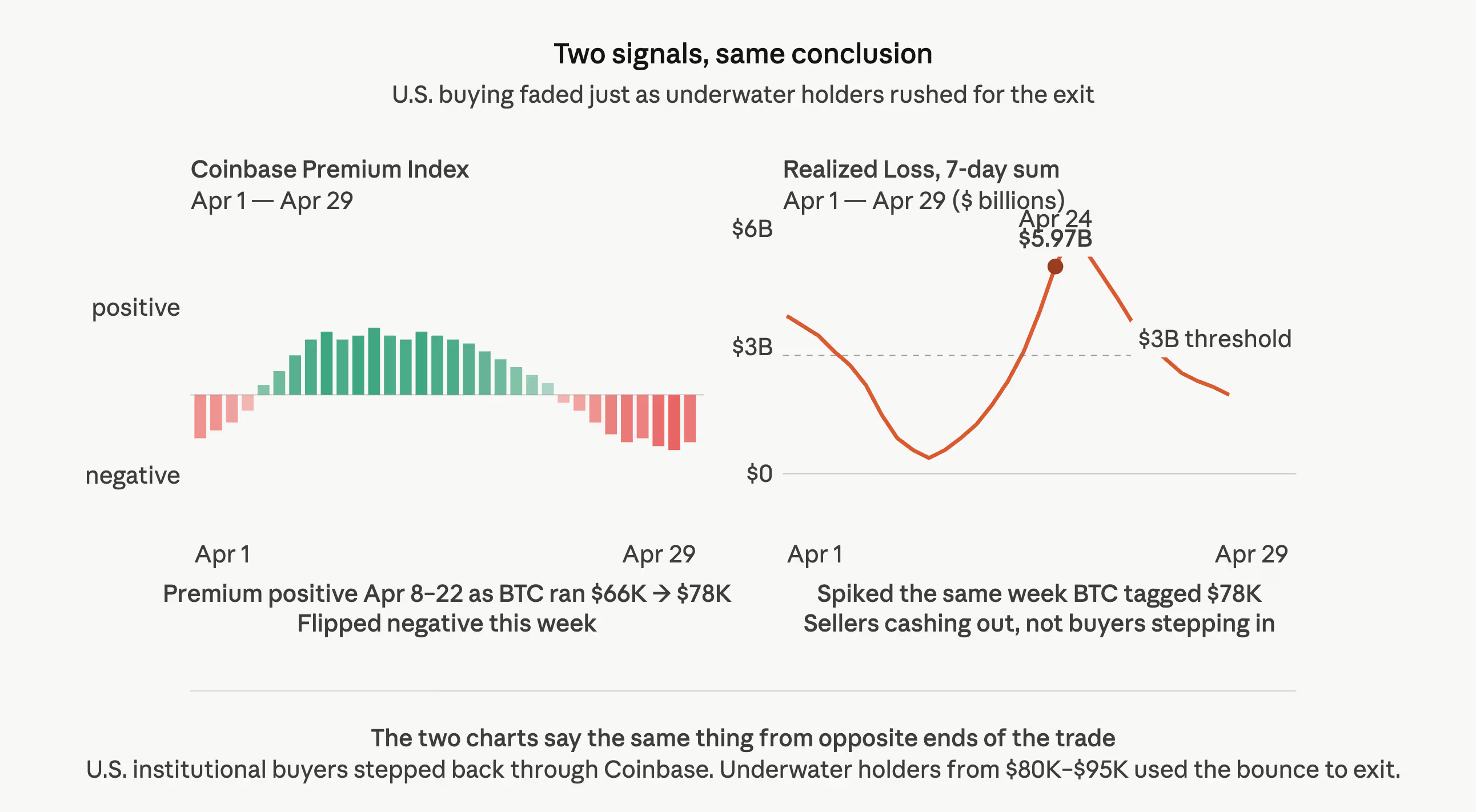
The U.S. bid that drove April’s rally is fading.
Bitcoin’s Coinbase Premium, the difference between the price on Coinbase (COIN) — which caters mainly to U.S. customers — and on offshore exchanges, flipped negative this week for the first time since early April, CryptoQuant data show.
The metric ran consistently positive from April 8 through April 22, the same window that took bitcoin from $66,000 to a local high near $78,000. The premium peaked around April 22 and has rolled over since.
Coinbase is widely used as a proxy for U.S. institutional and dollar-denominated flows, so a persistent negative reading means American investors are consistently paying less than the rest of the world. They’re either selling more aggressively or simply not showing up.
Onchain data tells the same story from the other side.
Bitcoin Realized Loss 7-day Sum, which tracks the total dollar value of coins moved at a loss across the network, spiked to $5.97 billion on April 24 as bitcoin traded near $78,000.
Realized Loss is recognized only when holders sell coins below the price at which they originally bought them.
A print near $6 billion at $78,000 means the sellers were buyers at higher prices. CryptoQuant analyst Axel Adler Jr. said in a report the cohort likely entered between $80,000 and $95,000 during late 2025 and early 2026, using the April bounce as an exit rather than a reentry point.

The two datasets are indicative of U.S. institutional buyers slowing their bid through Coinbase right as the holders increased selling activity. Bitcoin was recently trading around $76,000.
What traders watch from here is whether the Realized Loss metric continues to fall as the underwater supply works through. The reading has already declined from its April 24 peak to $4.7 billion by April 28, suggesting the seller cohort is thinning.


Four of the Magnificent Seven (Mag 7) tech giants are still on track to meet their massive artificial intelligence (AI) spending targets this year, according to their earnings report.
The companies that have reported quarterly earnings post-market on Wednesday are Microsoft (MSFT), Alphabet (GOOG), Meta (META) and Amazon (AMZ), with a combined market cap of approximately $12 trillion.
Previously, an analysis by Bridgewater Associates flagged that the four companies are expected to spend roughly $650 billion together on AI infrastructure in 2026. While most of them didn’t break out their AI spending in their latest earnings, they seem on track to continue their spending spree in the sector.
The investment has significant implications for the digital asset sector, particularly for bitcoin miners, who are increasingly pivoting away from mining toward hosting computers for AI as part of their revenue diversification strategy. The bitcoin miners already have data centers ready and powered up to host a massive amount of machines that are needed for AI computing. Facing a margin squeeze from lower bitcoin prices and increased competition, miners have started lending their data centers to AI firms to diversify their revenue streams.
AI-linked bitcoin mining stocks with exposure to hyperscaler infrastructure deals include IREN (IREN), which was down about 0.3%, TeraWulf (WULF) and Cipher Digital (CIFR), which fell 0.5%. Meanwhile, following the results, Microsoft was down over about 2.4% in after-hours trading, Alphabet up 6%, Meta down 6.6% and Amazon down 3.7%. Bitcoin was down about 0.9% in the last 24 hours.
The next big test of overall market sentiment and miners will come when chipmaker Nvidia reports earnings on May 20.
Here is what the tech giants reported and said during their earnings.
Microsoft
Microsoft reported fiscal Q3 2026 revenue of $82.9 billion, beating the $81.4 billion consensus, with EPS of $4.27 against the $4.06 estimate, according to FactSet data.
“We are focused on delivering cloud and AI infrastructure and solutions that empower every business to eval-max their outcomes in the agentic computing era,” said Satya Nadella, chairman and chief executive officer of Microsoft, noting that the firm’s AI business brought in $37 billion, up 123% year-over-year.
Alphabet
Alphabet pointed to AI as a core driver of growth and reported capital expenditures of $35.67 billion for the quarter, slightly below estimates of $36.39 billion.
“Our AI investments and full stack approach are lighting up every part of the business,” Alphabet CEO Sundar Pichai said, linking gains in Search and Cloud to AI-driven demand. Google Cloud revenue rose 63% to $20 billion, fueled in part by “enterprise AI Solutions and enterprise AI Infrastructure,” showing how AI is shaping both product usage and enterprise adoption.
Alphabet reported Q1 2026 revenue of $109.9 billion, beating the $107 billion consensus, with EPS of $2.81 against the $2.63 estimate.
Amazon
Amazon reported Q1 2026 revenue of $181.5 billion, beating the $177.2 billion consensus, with EPS of $2.78 against the $1.63 estimate. AWS revenue came in at $37.6 billion against the $36.92 billion estimate.
Amazon said free cash flow fell sharply over the past year, pointing to a surge in infrastructure spending. The company noted the drop was “driven primarily by a year-over-year increase of $59.3 billion in purchases of property and equipment,” adding that “this increase primarily reflects investments in artificial intelligence.” The shift shows how heavily Amazon is leaning into AI, even as it weighs on near-term cash generation.
Meta
Meta pointed to rising AI infrastructure costs as a key driver of spending, reporting $19.84 billion in capital expenditures for the quarter and raising its full-year outlook to $125–145 billion, up from its prior guidance of $115–$135 billion. The increase reflects “higher component pricing this year and, to a lesser extent, additional data center costs to support future year capacity,” the company said, underscoring how AI buildout is driving investment.
CEO Mark Zuckerberg framed the push more directly, calling it a “milestone quarter” tied to AI progress and adding, “We’re on track to deliver personal superintelligence to billions of people.”
Meta reported Q1 2026 revenue of $56.31 billion, beating the $55.5 billion consensus, with EPS of $10.44 against the $6.67 estimate.

Cautious Status for Aliyah Boston and Lexie Hull Ahead of Dallas Wings Preseason Game

Joby Demos Its Air Taxi In NYC

Infinix GT50 Pro vs POCO X8 Pro?! #testedbykenn

Manchester United reach agreement with Casemiro over contract clause amid transfer speculation

US brings back mandatory military draft registration

Steven Gerrard disagrees with Gary Neville over ‘shock’ Chelsea and Arsenal claim | Football


-

 Tech2 days ago
Register Renaming | Hackaday
-

 Fashion5 days ago
Weekend Open Thread – Corporette.com
-
Crypto World4 days ago
Hyperliquid $HYPE Rally Builds Momentum as AI Sector Enters Prove-It Phase
-

 Business6 days ago
Patterson-UTI Energy, Inc. (PTEN) Q1 2026 Earnings Call Transcript
-
 Sports3 days ago
IPL 2026: Ruturaj Gaikwad registers slowest fifty of the season, enters all-time unwanted list | Cricket News
-

 Politics2 days ago
Drax board avoid their own AGM, accused of greenwashing & environmental racism
-

 NewsBeat4 days ago
LK Bennett closes all stores after entering administration
-

 Crypto World5 days ago
Michael Saylor says BTC winter is over. Market analyst disagrees, says bitcoin was in a pullback
-
 Sports7 days ago
Tim Bradley names the current best in the world: “Better than Inoue and Usyk”
-

 Fashion23 hours ago
Kylie Jenner’s KHY Enters a New Era with ‘Born in LA’
-
Entertainment7 days ago
Michael B. Jordan and Austin Butler's “Miami Vice” movie will bring the action back to the '80s
-
 Entertainment4 days ago
Mariah Carey Slams Deposition Claims In Brother’s Lawsuit
-
Business7 days ago
Altimmune prices $225 million public offering at $3 per share
-
Entertainment6 days ago
Russell Brand Had Sex With 16 Year Old When He Was 30
-

 Business24 hours ago
Most Commercial Energy Audits Miss the Real Losses
-
Crypto World6 days ago
Is Algorand One of the Few Quantum-Resistant Blockchains? Here’s What the Data Shows
-
 NewsBeat6 days ago
Trump threatens to review UK’s claim to Falkland Islands and punish Nato allies over Iran war disagreement
-

 Business7 days ago
SL Green Realty: Dividend Cut And Record Leasing Fuel Their Potential Recovery
-

 Sports6 days ago
2026 NFL Draft tonight: Time, TV channel, where to watch, order
-

 Tech2 days ago
Images of Samsung’s rumored smart glasses have leaked
You must be logged in to post a comment Login