
Crypto World
Polymarket taps Chainalysis to bring Wall Street-level oversight to crypto prediction markets



Crypto-based prediction market Polymarket has tapped blockchain analytics firm Chainalysis to monitor trading activity and enforce its market rules, as it works to address concerns about insider trading and market integrity.
Chainalysis brings a suite of tools, including investigative software and onchain monitoring systems, to flag suspicious behavior, based on a model designed to identify patterns consistent with traders acting on non-public information, the firms announced on Thursday.
The move comes amid growing scrutiny of prediction markets. Critics have argued that platforms like Polymarket could be vulnerable to insiders — such as political operatives or corporate employees — placing informed bets before information becomes public. In traditional finance, such activity is illegal and closely monitored. In crypto-based markets, enforcement has been less clear.
Polymarket’s response is to lean into the transparency of blockchain. Because every trade is recorded onchain, activity can be traced and analyzed after the fact. By layering Chainalysis’ data tools on top, the company aims to detect suspicious trades in real time and, if needed, share evidence with regulators.
In simple terms, Polymarket is bringing in a kind of digital police force. The goal is to show that even in a decentralized environment, rules can be enforced. The broader aim is to reposition Polymarket as a credible financial platform rather than a crypto betting site.
“Polymarket was built onchain because transparency matters, and our platform shows what markets can look like when trades are open, traceable, and accountable by design,” said CEO Shayne Coplan.
Coplan has argued that prediction markets serve a broader purpose than speculation. He described them as “a very useful thermometer of the world,” where prices reflect the probability of real-world outcomes, at an event in New York this week.
Still, that usefulness depends on trust. If users believe markets are being skewed by insiders, prices become less reliable. That risk has grown as Polymarket has expanded, gaining mainstream attention during events like elections and attracting both retail traders and institutional interest.
Coplan has emphasized building something durable, focusing on products that “last” instead of chasing short-term trends.



U.S. Secretary of Commerce Howard Lutnick, the former CEO of Cantor Fitzgerald that handles Tether’s finances in the U.S., has been questioned by Senate Democrats on reports that a trust tied to his children received a loan from Tether meant to help finance Lutnick’s divestiture of his company stake that went to his children.
Senators Elizabeth Warren, who is the ranking Democrat on the Senate Banking Committee, and Ron Wyden, who is the top Democrat on the Finance Committee, asked the leading global issuer of stablecoins whether it helped finance Lutnick’s multi-billion-dollar transfer of the financial-services company through trusts tied to his adult children when Lutnick complied with government ethics requirements after taking the Cabinet position.
“If reports of this loan are accurate, it would raise serious questions about the relationship between Secretary Lutnick and Tether, and the influence of Tether on Mr. Lutnick’s policy decisions,” the lawmakers wrote in both letters, which responded to reporting about the loans of unspecified amounts that first appeared in Bloomberg News.
Congress, with help from the administration of President Donald Trump, helped usher in a new law last year to govern stablecoin issuers, including Tether. CEO Ardoino was a front-row guest at a White House signing of that law, known as the GENIUS Act. Lutnick was also present for the celebration and has been a member of the President’s Working Group on Digital Assets that’s outlined and driven U.S. crypto policy.
“It is critical that you make decisions because they are in the best interest of the American public, not in the financial interest of your family or Tether,” the senators wrote to Lutnick.
Representatives for the Department of Commerce and Tether didn’t immediately respond to requests for comment on the letters.
Lutnick’s Cantor is now under the watch of sons Brandon Lutnick, chairman & CEO, and Kyle Lutnick, executive vice chairman.
Tether, with a headquarters in El Salvador, has been pursuing a U.S. strategy, with the launch of its USAT stablecoin and a U.S. arm of the company that’s led by Bo Hines, a former crypto adviser for Trump.
Cantor is so far the biggest donor to the Fellowship PAC, a relatively new political action committee that’s so far spent a few million dollars supporting Republicans in various Senate, House and governor races. The expenditures from Fellowship, which is led by a Tether U.S. executive, have been through a media firm whose co-founders include Hines and his father.
Blue Owl Capital at the New York Stock Exchange, May 20, 2021.
Source: NYSE
Shares of Blue Owl, the private credit firm at the center of recent jitters over exposure to software companies, jumped 10% in trading Thursday after executives disclosed sizable gains tied to SpaceX.
“We made about 10 times our money on that investment,” an executive said on the firm’s first-quarter earnings call.
Blue Owl has already sold roughly half its position at a $1.25 trillion valuation and continues to hold the remainder, he said.
The call was hosted by Marc Lipschultz, co-chief executive officer, and Alan Kirshenbaum, chief financial officer. It wasn’t immediately clear which executive spoke specifically about the SpaceX investment.
The gains on SpaceX, which is headed toward what may be the largest IPO in history later this year, could offset potential losses elsewhere in Blue Owl’s portfolio if software companies default, the executive said. That helps allay concerns around the fact that the latest artificial intelligence models may force some software companies out of business.
While private credit funds are composed mostly of loans, they can also hold preferred and common shares of companies. That gives them potential equity upside and effectively makes them hybrid credit-equity vehicles.
“We made a loan to the company, and had the privilege of getting to know them very well and then participating in ongoing conversations about other financing opportunities, and ultimately, in this case, an equity investment,” the Blue Owl executive said of SpaceX.
Another factor: Blue Owl said it expects to maintain a roughly 58.5% fee-related earnings margin this year, meaning it keeps more than half of its management fee revenue as profit, even under a continued “softer environment” for the industry.
On Thursday’s earnings call, Blue Owl management also noted that while loan-to-value rates have deteriorated amid the software slump, there is still a “tremendous amount of remaining cushion” before losses are seen.
Blue Owl reported solid first-quarter results on Thursday, with fee-related earnings and assets under management rising as the firm continued to attract inflows.
While the firm’s shares reacted positively after that report, they jumped sharply at around 9:49 a.m. ET, during the conference call with analysts.



Bitcoin is pinned near $76,000 below $79,000 resistance as ETF outflows, Fed infighting, and record shorts sap risk appetite and keep volatility unnaturally muted.
Summary
- Bitcoin trades near $76,000, capped by heavy resistance between $78,000 and $79,000 as spot ETF outflows stretch into a third straight day.
- Internal divisions at the Federal Reserve and expectations of prolonged higher rates are damping risk sentiment across crypto.
- Derivatives data show record short positioning and subdued volatility, leaving Bitcoin boxed between improving support and weak demand.v
Bitcoin (BTC) hovered around $76,000 on Thursday, struggling to break above a resistance band between $78,000 and $79,000 even after the Federal Reserve left interest rates unchanged, keeping markets fixated on internal policy fractures and macro uncertainty. According to an analysis by The Block, on-chain and flow data point to a market that has stabilized on the downside but lacks the conviction to force a clean breakout above the current range.
Kraken chief economist Thomas Perfumo said the market is now “more concerned about the policy uncertainties brought about by the ‘division’ within the Federal Reserve rather than the inaction itself,” especially with Jerome Powell still in place while Kevin Warsh is widely expected to take over, leaving “no clear policy transition.” He added that this leadership overhang compounds the impact of a Fed that has rarely shown such severe internal splits, a dynamic traders read as greater uncertainty over the inflation path.
Glassnode data cited in the report show Bitcoin remains “trapped” below its True Market Mean, with resistance clustered in the $78,000–$79,000 zone and a layered support base between $65,000 and $70,000. Selling pressure has eased considerably at these lower levels, but spot demand has not expanded enough to sustain a decisive move higher, leaving price pinned between patient buyers and hesitant new capital.
On the macro side, institutions including Bitget Wallet and 21Shares argue that expectations of “maintaining high interest rates for a longer term” are suppressing risk assets broadly, pushing crypto into a wait-and-see phase instead of the trending conditions that typically accompany aggressive Fed easing. This comes as U.S. spot Bitcoin ETFs register net outflows for three consecutive sessions, with roughly $138 million leaving on April 29 alone; Ethereum ETFs, meanwhile, saw about $87.7 million in outflows over the same period.
While certain individual funds still attract inflows, the aggregate pattern signals cooling institutional demand at the margin. At the same time, CME positioning and ETF assets under management have stabilized rather than rebounded, suggesting that sidelined capital has yet to commit back into size.
In derivatives, short positions in Bitcoin perpetual contracts have climbed to historical highs, creating the technical conditions for a potential short squeeze if sentiment or macro signals suddenly improve. For now, though, the market is marked by low volatility and low confidence, with continuous ETF outflows, a split Fed, and elevated policy risk collectively capping Bitcoin’s attempts to clear the $78,000–$79,000 ceiling.

Grayscale Research says tokenization could become one of the largest shifts in global finance. The firm said the market is still early, as only 0.01% of global stocks and bonds is onchain today.
The report estimates tokenized assets at about 30 billion dollars. It also said the wider securities market is worth about 300 trillion dollars.
The Tokenization Market Remains Small Today
Tokenization means placing asset rights on a blockchain as digital tokens. These tokens can represent bonds, funds, commodities, credit products, stocks, or other assets.
Grayscale said tokenization can reduce settlement delays. It can also create shared records between market users.
The report said tokenized assets have grown 217% year over year. However, that market remains tiny beside global capital markets.
NEW: Grayscale Research says tokenization is a $300T megatrend, just 0.01% is onchain so far. $ETH, $SOL, $CC, $BNB, $AVAX, $LINK appear to be the key tokens.
Near-term: big opportunity for $CC (privacy)
Long-term: large opportunity for open networks like $ETH, $SOL
Read…
— Grayscale (@Grayscale) April 30, 2026
Tokenized U.S. Treasuries lead the current market with about 15 billion dollars. Commodities follow with about 5 billion dollars.
Smaller areas include private credit, funds, equities, and other real-world assets. Grayscale said these markets may expand as more issuers move onchain.
Ethereum Solana and Canton Lead the Race
Grayscale named Ethereum, Solana, Canton, Avalanche, BNB Chain, and Chainlink as key protocols. The firm said they may benefit as tokenized assets grow.
Ethereum has the largest open network ecosystem. The report said Ethereum holds about 50 billion dollars in DeFi total value locked.
Ethereum also leads Solana in tokenized assets today. Grayscale placed Ethereum near 16 billion dollars and Solana near 2 billion dollars.
Solana offers faster and cheaper transactions. The report said Solana has handled over 1,000 transactions per second and 100 million daily transactions.
BNB Chain is also a leading open network. Grayscale linked its reach to Binance, the largest centralized crypto exchange by trading volume.
Canton is different because it focuses on institutions. The report said Canton has over 348 billion dollars in tokenized asset value.
Grayscale said Canton gained attention in 2026 through large institutional partnerships. These included Nomura, Mizuho, Visa, Circle, and Apollo Global.
Privacy May Shape Early Adoption
Grayscale said privacy is a core issue for institutions. Banks and asset managers often cannot show transaction details to the public.
Open networks like Ethereum and Solana are transparent by default. This supports auditability, but it can expose counterparties and transaction amounts.
Institution-focused networks like Canton are private by default. Only approved parties can view specific transaction data.
The report said this gives Canton a near-term edge. It may fit better with how regulated financial firms work today.
However, Grayscale said open networks may gain ground over time. Ethereum and Solana are building privacy and identity tools.
These tools may include Layer 2 systems and zero-knowledge proofs. Grayscale said they still need to mature before broad use.
The firm expects tokenized asset trading to move toward open and permissionless networks over time. It said this shift may take a decade or more.
Chainlink may also play a key role across this market. Grayscale said tokenization is hard to imagine without tools like Chainlink.
“Tokenization is poised to transform capital markets,” Grayscale said. It added that the trend may drive value to the blockchains powering this change.

Bitmine Immersion Technologies just dropped the news bomb with a $147 million Ethereum purchase in a single 24-hour window. Tom Lee’s Bitmine snapped up 65,000 ETH and pushed its total holdings to 5.07 million ETH, or more than 4.2% of the entire circulating supply.
ETH price sits at the $2,250 level at the time of writing, consolidating after a stretch of relative underperformance against Bitcoin. Tom Lee himself is still with a $62K Ethereum target in the long run as ETH records the biggest fees generated versus other chains.
ETH leading in fees with just over $1.3M, followed closely by HYPE! — Crypto Crib (@Crypto_Crib_) April 30, 2026
 pic.twitter.com/h98RR5pNHp
How Bitmine Built a $147M Ethereum Position in One Day
On-chain data tracked via Arkham Intelligence shows Bitmine’s wallet activity spiking sharply, with over 626,000 ETH in verified on-chain holdings valued at more than $1.4 billion.
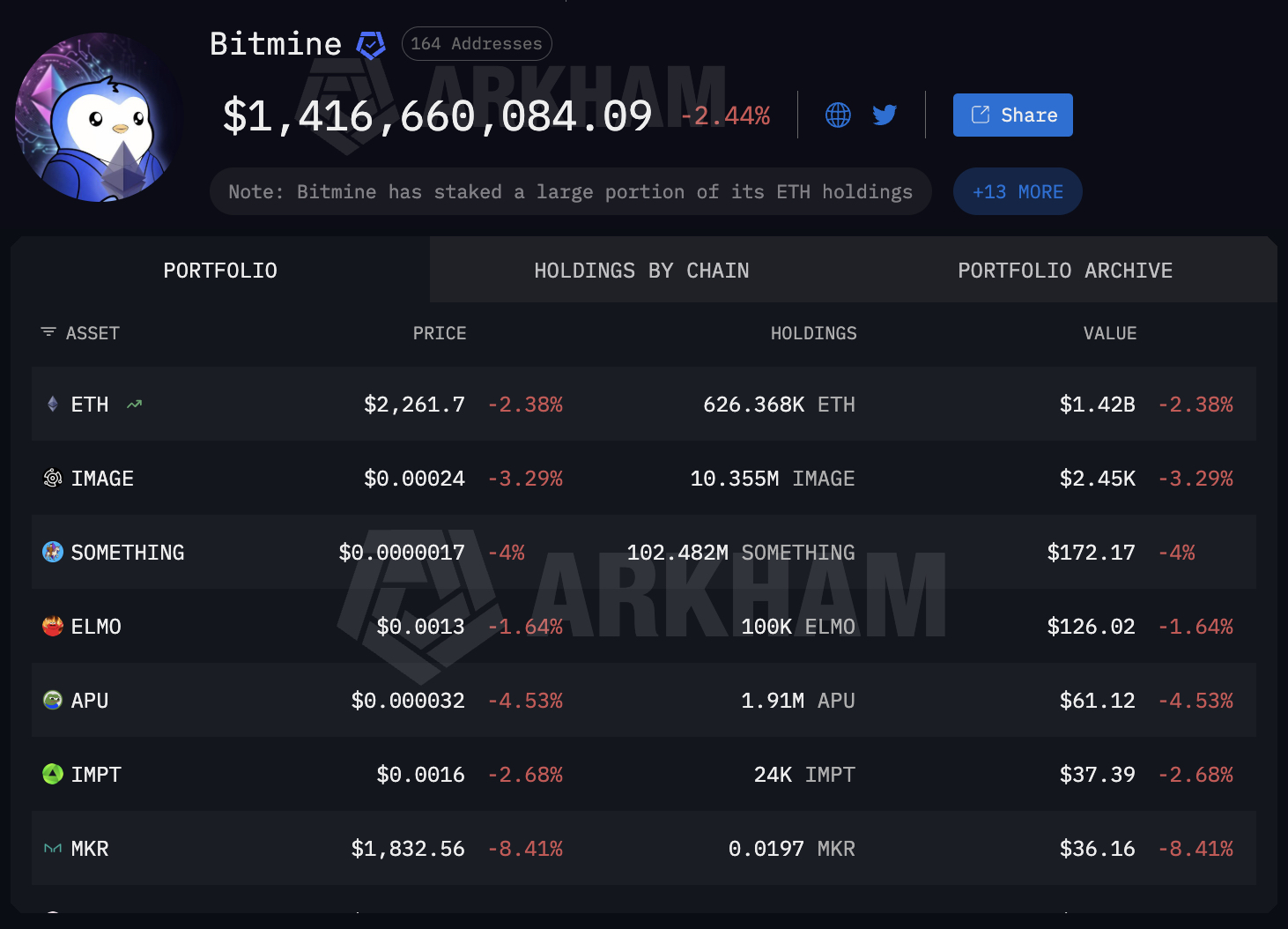
The firm executed a 20,000 ETH block purchase worth $44.8 million through FalconX, a major institutional trading platform, as part of the 65,000 ETH accumulation. A separate 10,000 ETH lot came via direct OTC acquisition from the Ethereum Foundation on April 24, 2026.
Tom Lee, chairman of Bitmine and head of research at Fundstrat Global Advisors, has been one of crypto’s most consistently bullish institutional voices. Lee stated the firm believes ETH is in the “final stages of the ‘mini-crypto winter,’” and Bitmine has now staked 3.7 million ETH, generating an estimated $363 million in annual yield.
Discover: The best pre-launch token sales
Realistically, Should We Follow Bitmine Ethereum News?
Ethereum’s institutional accumulation narrative is powerful. But at a $272 billion market cap, the asymmetric return window has narrowed considerably for those with shallow pockets. Traders chasing outsized gains are looking earlier in the cycle. That’s where infrastructure presales with genuine technical differentiation come in.
Bitcoin Hyper ($HYPER) is positioning as the first-ever Bitcoin Layer 2 with Solana Virtual Machine (SVM) integration, a genuinely novel combination that delivers sub-second finality and smart contract programmability without abandoning Bitcoin’s security base.
The presale has raised more than $32.5 million at a current price of $0.0136, with a high 36% APY staking already live for presale participants. Key infrastructure includes a Decentralized Canonical Bridge for BTC transfers and extremely low-latency transaction execution.
Hyper is faster than Solana itself, running on Bitcoin rails. For those who believe Bitcoin’s programmability gap is the next trillion-dollar unlock, the entry point here is orders of magnitude earlier than ETH.
The post Tom Lee Back in The News as Bitmine Acquires 65,000 Ethereum In a Day appeared first on Cryptonews.


Anchorage Digital, the U.S’ first federally chartered crypto bank, has tapped M0 as its core technology provider, a move designed to turn the custodian into a primary engine for institutions looking to mint and manage regulated stablecoins.
San Francisico-based Anchorage seeks to expand its issuance platform through M0, and opens the door to a broad range of firms looking to launch U.S.-regulated stablecoins, according to a press release.
M0 (pronounced “M Zero”), is a flexible protocol that allows global institutions to mint fully configurable stablecoins, which also works with the likes of Stripe, Moonpay and MetaMask.
“It might not sound like the sexiest topic, but we have been building modular infrastructure for stablecoins for three years now,” said M0 CEO Luca Prosperi, in an interview. “This means we are supporting anyone who wants to launch and manage their own stablecoin, whether it is a crypto project, protocol, fintech, payment provider, exchange and many more.”
The arrival of the GENIUS Act means stablecoins in the U.S. are becoming a regulated instrument. M0 has already partnered with several regulated players that are using the firm’s contracts, but with Anchorage the regulation-focused relationship is “a bit deeper,” Prosperi added.
“By partnering with M0, we’re extending our issuance platform to support that growth, while maintaining the regulatory, operational, and security standards our partners rely on,” said Anchorage CEO Nathan McCauley, in a statement.
Crypto World
Elon Musk Grok AI Predicts the Price of XRP, Bitcoin and Ethereum by The End of May 2026
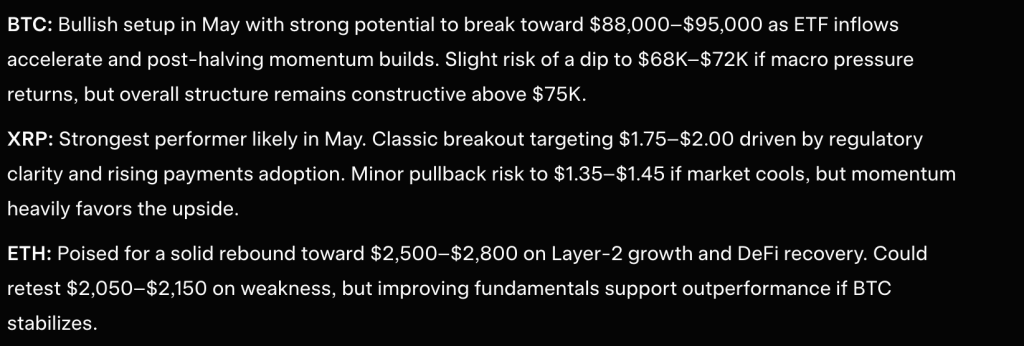
I fed Grok AI a precisely engineered prompt, and what came back was not just optimistic noise; it was a structured, high-conviction price predicts for Bitcoin, Ethereum, and XRP that assumes the next leg of the cycle is already forming.
According to Grok’s projections, Bitcoin is positioned for a move toward $88,000–$95,000, Ethereum is expected to reclaim momentum toward $2,500–$2,800, and XRP stands out with a projected breakout into the $1.75–$2.00 range.
What makes this notable is not just the targets themselves, but the conditions behind them. The model is effectively assuming that current consolidation is accumulation, not weakness, and that macro pressure fades enough to allow trend continuation.
At the same time, Grok does not ignore risk. Each bullish scenario is paired with clear invalidation zones, with Bitcoin needing to hold above $75K, Ethereum above $2,300, and XRP above the mid-$1.30s.
That balance between upside conviction and structural awareness is what gives these projections weight, they are not random targets, they are conditional paths.

Discover: The best pre-launch token sales
The question now is whether real-time price action is actually supporting what the model is implying, or if the market is still too early in the cycle to justify that level of optimism.
Price Prediction: Can Bitcoin, Ethereum, and XRP Break Out Before Momentum Confirms?
Bitcoin price is holding around the $76K level, and this is the pivot that matters. As long as $75K holds, the structure stays intact and supports the move toward $88K+.
ETF inflows and post-halving momentum are the drivers behind that projection, but price has not confirmed it yet.
Lose $75K, and the downside opens quickly toward $68K–$72K. Right now, BTC is ranging, not expanding, which means the breakout is still conditional.
Ethereum price is moving in line with Bitcoin, not independently. The $2,300 level is the key zone. Holding above it keeps the path toward $2,500–$2,800 open, matching the AI outlook.
If it slips below, price likely drifts back toward $2,050–$2,150. The narrative around Layer-2 growth and DeFi recovery supports the upside, but none of it matters unless BTC stabilizes and pushes higher first.
XRP price is the most momentum-driven setup here. Trading around the mid-$1.40s, it needs a break above $1.67 to confirm the breakout structure Grok is projecting.
If that level clears, the move toward $1.75–$2.00 can happen fast. If it fails, the $1.35–$1.45 range comes back into play, with deeper risk near $1.28. Compared to BTC and ETH, XRP has the clearest directional bias, but also the least room for error.
Across all three assets, the pattern is the same. Key supports are holding, structures are constructive, but momentum has not confirmed. The projections are ahead of price, not aligned with it yet.
The next move comes down to volume. If buyers step in, these targets start to look realistic very quickly. If not, this range continues and delays the breakout. Right now, the market is leaning bullish, but it still has to prove it.
Discover: The best crypto to diversify your portfolio with
Grok AI Projects That Bitcoin Hyper Could Outperform Them All
Early-stage infrastructure plays offer a different risk/reward profile entirely, and some traders rotating between cycles are already looking there.
Bitcoin Hyper is positioning itself as infrastructure for the next leg: the first Bitcoin Layer 2 with Solana Virtual Machine (SVM) integration, claiming sub-Solana latency while inheriting Bitcoin’s security layer.
The project has raised $32M in its presale at a current token price of $0.013679, with staking available at high APY for early participants.
The core thesis, bringing fast, low-cost smart contracts to Bitcoin without abandoning its trust model, targets a gap that neither Ethereum nor Solana fills directly.
The post Elon Musk Grok AI Predicts the Price of XRP, Bitcoin and Ethereum by The End of May 2026 appeared first on Cryptonews.
Crypto World
Bitcoin Price Spiked to $79,500 at the Las Vegas Conference Then Immediately Reversed: Is $80,000 a Wall or a Gateway?
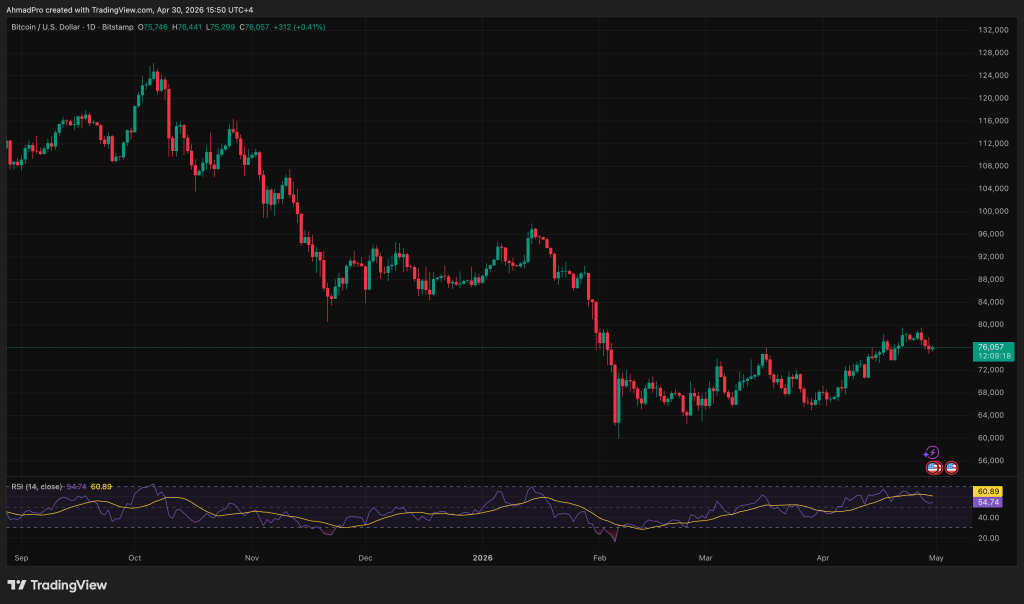
Bitcoin price opened the Bitcoin conference week in Las Vegas with a sharp reminder of why traders keep stop-losses tight. Also noticably, those traders are checking out Bitcoin hyper, a new layer 2 that is grabbing attention.
BTC climbed to $79,500 before reversing hard, settling near $76,000. The conference runs through April 29 at The Venetian, and if history is any guide, the volatility is probably not done yet.
The selloff follows a choppy 48-hour stretch in which BTC retested support near $76,000–$77,000 as rising oil prices and Federal Reserve uncertainty weighed on risk appetite.
On-chain metrics and corporate accumulation continue to offer longer-term bulls cover, but the near-term price action is anything but clean.
Analyst Michaël van de Poppe posted on X that a clean break above $79,000 opens the path toward $86,000–$89,000, while failure there keeps the door open to $73,500 support, a level bulls simply cannot afford to lose.
Broader macro pressure and event-driven positioning are colliding at the same moment. That sets up a binary setup heading into the rest of the conference.
Can Bitcoin Price Finally Break $80,000 In May?
BTC is sitting right in the middle of a key range around $76K, with clear boundaries on both sides.
The level that matters most is $76K. As long as price holds above it, the structure stays intact and keeps the path open toward $79K–$80K.
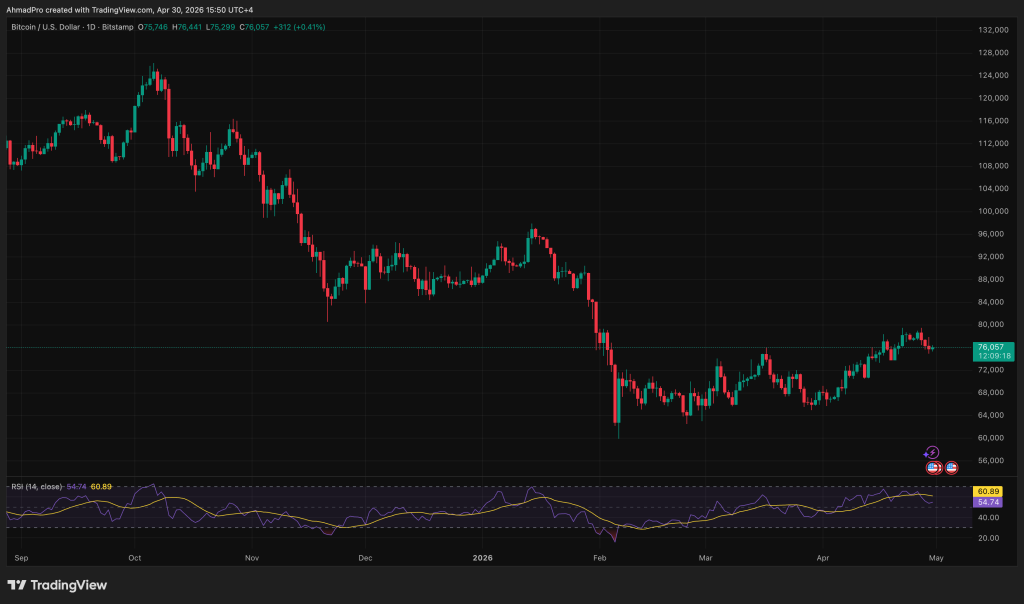
If BTC can break and hold above $79K with real volume, that is where momentum builds and opens a move toward the mid-to-high $80Ks.
More likely for now, it keeps ranging between roughly $76.5K and $79.5K while the market digests event-driven noise.
The risk is losing $76K on a daily close, because that shifts the structure bearish and brings $74K–$73.5K into play quickly.
If Bitcoin Breakout, Bitcoin Hyper Could Act Like the Best Beta Play
BTC stalling under resistance makes the trade-off clear. From ~$77.7K to ~$89K is solid upside, but it is still a large-cap move, meaning it needs real capital to get there and it will not happen overnight.
That is why some investors start looking at the layer being built on top of Bitcoin, where the upside is earlier and more tied to growth.

Bitcoin Hyper is aiming at that space, building a Layer 2 on Bitcoin with SVM integration to bring fast smart contracts and lower-cost execution into the BTC ecosystem. The idea is to combine Bitcoin’s security with high-speed performance and programmability.
The presale has already raised over $32.5M at around $0.0136793, which shows strong early interest. Features like staking, a native bridge, and rollup-based execution are meant to support real usage if delivered.
But it is still early-stage. Liquidity is not proven, execution is still ahead, and outcomes depend entirely on how the project performs after launch.
So the setup is straightforward, BTC offers more stable but capped upside in the near term, while something like Bitcoin Hyper offers earlier positioning with higher potential, but also higher risk.
The post Bitcoin Price Spiked to $79,500 at the Las Vegas Conference Then Immediately Reversed: Is $80,000 a Wall or a Gateway? appeared first on Cryptonews.


Wasabi Protocol is the latest victim in what appears to be a record bad month for DeFi hacks.
On-chain perpetual futures protocol Wasabi has been hacked with attackers draining over $5 million across Ethereum, Base, Berachain, and Blast, blockchain security firm PeckShield reported on X from their alerts account earlier today, April 30.
Wasabi acknowledged the incident on X, urging users to avoid using the protocol while investigations are under way:
“We’re aware of an issue and are actively investigating. As a precaution, please do not interact with Wasabi contracts until further notice.”
In a follow-up post, the team confirmed it had engaged professional on-chain security responders, including SEAL 911 and Blockaid.
Peckshield’s main X account added that it appears that Wasabi’s admin key has been compromised.
In response to Wasabi’s X post about the ongoing incident, on-chain investigator ZachXBT called out the protocol for reportedly using a single external owned account (EOA), referring to a user-controlled wallet managed by a private key, instead of more secure setups, like a multisig: “Why did a single EOA seemingly have so much control without basic safeguards?
DeFi’s Worst Month Yet?
The hack caps off a brutal month for DeFi, marked by two major exploits and over twenty smaller incidents. The former head of DeFi at Monad wrote on X today that April 2026 has turned out to be DeFi’s worst month in terms of losses from hacks and exploits:
“April 2026 was the worst month ever in terms of DeFi exploits — ~$635M lost in total, 28 incidents in 30 days.”
The month’s two largest incidents in terms of dollar losses were the Drift and Kelp DAO hacks. On April 1, Solana-based perpetuals exchange Drift Protocol suffered roughly $270 million in outflows, spanning more than 15 distinct token types, in what The Defiant reported as a North Korean state-linked operation six months in the making.
Then, on April 18, an attacker, also suspected of being North Korean state-backed, exploited a LayerZero bridge on Kelp, forging a cross-chain message that tricked the protocol into minting 116,500 rsETH with nothing locked on the source side. The attacker then deposited the unbacked rsETH into Aave as collateral and borrowed approximately $236 million in real WETH, as The Defiant reported.
The response to the Kelp incident has included an unprecedented collective effort among DeFi protocols and individuals, dubbed DeFi United, which has raised over $300 million to restore the backing of Kelp’s rsETH.
This article was written with the assistance of AI workflows. All our stories are curated, edited and fact-checked by a human.

TLDR
- Exponent raised $5 million in a seed funding round led by Multicoin Capital to expand its platform on Solana.
- The funding round included participation from Solana Ventures, RockawayX, and several other crypto investors.
- The company structured the investment as a SAFE agreement with token warrants.
- Exponent plans to launch an upgraded platform with an onchain interest rate order book.
- The new system will allow users to convert variable yield into fixed-rate positions.
Exponent has raised $5 million in seed funding to expand its yield exchange platform on Solana. The round was led by Multicoin Capital, with participation from several crypto-focused investors. The company plans to launch an upgraded platform focused on broader yield infrastructure.
Solana-based Exponent Advances Yield Infrastructure Plans
Exponent confirmed the $5 million seed round led by Multicoin Capital, with backing from Solana Ventures and RockawayX. Other investors included L1D, Prelude, and Theia Blockchain, along with individual contributors.
The startup also received support from Solana Labs CEO Anatoly Yakovenko and Solana Foundation executive Nick Ducoff. The company structured the funding as a SAFE agreement with token warrants, according to CEO Thomas Lefort.
Lefort stated that the fundraising process began in May and concluded in August last year. However, he declined to disclose valuation details or investor governance roles.
The funding increases Exponent’s total capital raised to $7.1 million after a prior $2.1 million round. The company launched its platform in late 2024 and has processed over $2 billion in yield volume.
Exponent reported serving more than 35,000 users since its launch. The platform generates revenue through fees tied to derivatives issuance and trading activity.
New Platform Features Target Active Yield Management on Solana
Exponent plans to release an updated version of its platform next month with expanded functionality. The upgrade will introduce a fully onchain interest rate order book and strategy vaults.
Lefort said the order book will allow users to convert variable yield exposure into fixed-rate positions. He explained, “Users can lock in rates based on their expectations of future market conditions.”
The feature will also support leveraged positions tied to lending and staking protocols. For instance, users of Kamino can convert variable returns into fixed-term outcomes through Exponent.
The platform will also introduce strategy vaults for simplified yield participation. These vaults will allow asset managers to package and offer structured yield strategies to users.
Lefort explained that the vaults will operate under predefined rules that limit capital deployment. He said, “This ensures consistent risk management while allowing broader participation.”
Exponent is onboarding asset managers and preparing markets for stablecoins and real-world assets. Early partners include RockawayX, Hastra, OnRe, and Solstice.
The company currently employs 12 team members and focuses on product rollout and system security. Lefort confirmed that about $1 million from the new funding will support audits and a bug bounty program.
Exponent stated it will remain focused on Solana due to its performance capabilities. The company aims to scale its infrastructure within the existing ecosystem.


Senator Warren questions Commerce Secretary Lutnick on Tether loan to family

Anti-Zionism is a menace to every Jew on Earth

Junto Nakatani asked if Naoya Inoue is the best fighter in the world ahead of undisputed clash

Manchester United reach agreement with Casemiro over contract clause amid transfer speculation

US brings back mandatory military draft registration

Steven Gerrard disagrees with Gary Neville over ‘shock’ Chelsea and Arsenal claim | Football


-

 Tech3 days ago
Register Renaming | Hackaday
-

 Fashion6 days ago
Weekend Open Thread – Corporette.com
-
Crypto World5 days ago
Hyperliquid $HYPE Rally Builds Momentum as AI Sector Enters Prove-It Phase
-

 Business7 days ago
Patterson-UTI Energy, Inc. (PTEN) Q1 2026 Earnings Call Transcript
-

 Politics3 days ago
Drax board avoid their own AGM, accused of greenwashing & environmental racism
-
 Sports4 days ago
IPL 2026: Ruturaj Gaikwad registers slowest fifty of the season, enters all-time unwanted list | Cricket News
-

 NewsBeat4 days ago
LK Bennett closes all stores after entering administration
-

 Crypto World6 days ago
Michael Saylor says BTC winter is over. Market analyst disagrees, says bitcoin was in a pullback
-

 Fashion2 days ago
Kylie Jenner’s KHY Enters a New Era with ‘Born in LA’
-

 Tech3 days ago
Images of Samsung’s rumored smart glasses have leaked
-
 Entertainment5 days ago
Mariah Carey Slams Deposition Claims In Brother’s Lawsuit
-
Crypto World7 days ago
Is Algorand One of the Few Quantum-Resistant Blockchains? Here’s What the Data Shows
-

 Tech3 days ago
Why Blue Badges Disappeared From Toyota Hybrids
-

 Business2 days ago
Most Commercial Energy Audits Miss the Real Losses
-
 NewsBeat6 days ago
Trump threatens to review UK’s claim to Falkland Islands and punish Nato allies over Iran war disagreement
-

 Business6 days ago
Jeanine Pirro announces closure of Federal Reserve building cost probe
-

 Business3 days ago
(VIDEO) Charlize Theron Climbs Times Square Billboard to Promote New Netflix Thriller ‘Apex’
-

 Tech5 days ago
Microsoft to roll out Entra passkeys on Windows in late April
-

 Crypto World2 days ago
CFTC’s AI will review U.S. crypto registration applications, chairman tells CoinDesk
-
 Crypto World6 days ago
Nvidia (NVDA) Stock Jumps 5% as Intel Earnings Ignite Semiconductor Rally
You must be logged in to post a comment Login