

Crypto World
Prime Brokers Push Wall Street Access to Prediction Markets: Report


US-based prime brokers are quietly positioning themselves to give hedge funds and large institutions direct access to Kalshi’s prediction markets, a move that signals growing institutional interest in event-based betting markets. A Bloomberg report from March 11, 2026, indicates that Clear Street and Marex Group Plc are both lining up access for their clients in the near term. Clear Street, valued at over $12 billion, is expected to clear Kalshi trades as early as late March, while Marex, with a current valuation around $2.6 billion, plans a staged rollout over the coming months. The development underscores a broader shift as predictively driven markets gain traction among mainstream financial players, even amid regulatory ambiguity surrounding their legality and oversight.
Key takeaways
- Prime brokers plan to enable client access to Kalshi’s prediction markets within weeks, signaling rapid institutional onboarding.
- Kalshi’s leadership frames 2026 as a tipping point for institutional adoption, highlighting the market’s utility as data on future events and hedging tools.
- Hedge funds and other large institutions have begun approaching Kalshi contractors for direct market access, indicating a demand-driven expansion.
- Regulatory uncertainty remains a central hurdle, with debates over whether prediction markets fall under sports-betting rules and concerns about insider trading.
- Industry leaders, including Nasdaq and CME, are calling for clearer rules to support broader US adoption of prediction markets, signaling potential regulatory alignment or pathways forward.
Sentiment: Neutral
Market context: The push by prime brokers sits at the intersection of expanding interest in reputation-based forecasting markets and ongoing regulatory scrutiny. As major exchanges press for clarity, policymakers in the U.S. are weighing how prediction markets should be treated in relation to traditional securities and gaming rules, shaping the pace at which institutions can experiment with these platforms.
Why it matters
The entry of prime brokers into Kalshi’s ecosystem represents more than a new distribution channel. It signals a potential inflection point for prediction markets, where institutions view event outcomes as a tool for hedging risk, benchmarking forecasts, and generating returns. Kalshi’s CEO, in a LinkedIn post, has argued that institutional adoption will accelerate in 2026 as the market’s utility becomes clearer—citing the ability of these markets to provide data on future events and a framework for hedging real-world positions. This perspective aligns with broader industry narratives that such markets can function as a complementary data layer for traditional asset classes and macro strategies.
The practical appeal for institutions is twofold: first, the ability to hedge corporate or portfolio risk using event-based contracts; second, an opportunity to participate in markets that CNBC, CNN, Bloomberg, and Fox increasingly reference alongside conventional tickers. Yet, this enthusiasm exists within a regulatory gray zone, particularly around whether certain prediction market offerings resemble sports betting and how insider information may flow through these platforms. The tension between potential financial utility and compliance risk is a central theme shaping how quickly banks and brokers move from exploration to formalized access.
Industry participants have underscored that regulatory clarity is prerequisites for scalable adoption. Executives from Nasdaq and CME recently urged regulators to establish a clearer framework for prediction markets in the United States, arguing that consistent rules protect investors and foster market integrity. The CFTC has signaled its role in overseeing such markets, while the SEC has indicated it will also be involved in defining the boundaries for these instruments. The convergence of these regulatory positions will heavily influence whether institutional traction continues or stalls as cases and compliance questions proliferate across state and federal levels.
What to watch next
- Kalshi trade launches at Clear Street are expected in late March, with additional brokers like Marex rolling out in the ensuing months.
- Regulatory clarity on the classification of prediction markets—whether they fall under sports-betting or another regulatory category—will shape product design and participant eligibility.
- Key lawsuits and ongoing regulatory actions in the U.S. will test the resilience of prediction markets amid a landscape of diversified enforcement.
- Public statements from major exchanges and regulatory bodies, including updates from the CFTC and SEC, will indicate the pace of broader adoption and potential compliance requirements.
- Institutional hedging strategies using Kalshi and similar platforms may become more visible as fund managers assess risk-off and risk-on environments amid macro volatility.
Sources & verification
- Bloomberg report dated March 11, 2026, detailing prime brokers’ race to give Wall Street access to Kalshi’s prediction markets.
- LinkedIn post by Kalshi CEO Tarek Mansour discussing expected acceleration of institutional adoption in 2026 and the market’s broader utility.
- Reuters coverage of Nasdaq and CME executives calling for clearer rules to support prediction-market adoption in the U.S.
- Statements from the Nasdaq and CME discussions about regulatory alignment, and the CFTC/SEC roles in overseeing the sector.
- Related reporting mentioning Kalshi and Polymarket valuations and potential fundraising coverage in mainstream outlets.
Institutional access to Kalshi’s prediction markets gains momentum
Institutional appetite for prediction markets is expanding as prime brokers gear up to broaden access to Kalshi’s event-led contracts. The Bloomberg report paints a picture of late-March milestones for Clear Street, which is expected to clear the first Kalshi trade soon, and Marex, poised to follow in the coming months. The strategic move signals that major financial intermediaries view prediction markets not as speculative oddities but as components of a diversified risk management toolkit. In this view, there is a push to translate the insights from prediction markets into tradable risk-management signals for complex, multi-asset portfolios.
Kalshi’s leadership has framed 2026 as a turning point, arguing that the utility of prediction markets extends beyond speculation into practical data sources for forecasting and hedging. The company’s CEO, in a LinkedIn post, emphasized that institutional adoption will accelerate as more large players recognize the markets’ potential to quantify futures scenarios and hedge exposures. As he noted, the space is no longer an early-adopter niche but a core pillar of the financial ecosystem, with billions flowing weekly through these markets. This perspective is echoed by mainstream media outlets—CNBC, CNN, Bloomberg, and Fox—who regularly cite Kalshi alongside traditional market indicators, underscoring a shift in perception from novelty to necessity.
Nevertheless, the path forward is not without friction. Clear Street and Marex acknowledge a regulatory gray area surrounding prediction markets, alongside active litigation across the United States related to sports betting and other matters. Industry participants stress the importance of robust governance and clear rules to ensure investor protection and market integrity as adoption scales. The broader regulatory dialogue—pursued by exchanges and oversight bodies alike—aims to delineate permissible activities, address insider-trading concerns, and establish a stable framework within which institutions can transact with confidence.
In parallel, major exchanges have publicly called for regulatory clarity to facilitate US adoption. Nasdaq’s chief executive executive highlighted the need to bring options markets under a familiar rule framework, suggesting that a well-defined construct could enable investors to participate in a predictable regulatory environment. The SEC and CFTC have signaled their respective roles in overseeing emerging prediction-market activity, a development that could unlock more comprehensive product design while ensuring critical guardrails remain intact. The dynamic underscores a broader industry trend: practical finance increasingly sits at the intersection of regulatory alignment and innovative market structures, where data-driven decision-making and risk mitigation converge.
What it means for the market
For traders and investors, the potential mainstreaming of Kalshi and prediction markets offers an additional source of informational signals—complementing traditional data feeds with market-based expectations about future events. It may also prompt portfolio managers to incorporate event-based hedges into strategic plans, especially for scenarios with high impact on sectors or individual holdings. The regulatory dialogue surrounding these markets will be pivotal; a clear, harmonized framework could spur broader participation, elevate liquidity, and reduce friction for institutions seeking to deploy these instruments as part of diversified risk management strategies.


TLDR
- Changpeng Zhao’s wealth is pegged at $110 billion by Forbes, securing him the 17th position globally
- This valuation positions CZ above Microsoft co-founder Bill Gates, who sits at $108 billion
- Zhao challenged the assessment publicly, noting cryptocurrency valuations collapsed more than 50% in 2026
- CZ’s fortune stems primarily from owning approximately 90% of Binance equity, rather than cryptocurrency tokens
- The exchange commands roughly 38% of worldwide crypto trading volume and pulled in an estimated $16–17 billion during 2024–2025
Changpeng Zhao, who founded the cryptocurrency exchange Binance, now ranks above Microsoft co-founder Bill Gates in wealth, according to fresh estimates from Forbes. The publication’s March 10 assessment values Zhao’s fortune at roughly $110 billion.
This valuation secures Zhao the 17th spot on Forbes’ worldwide billionaire rankings. Gates trails slightly behind at approximately $108 billion.
Zhao established Binance, which has become the dominant force in cryptocurrency trading globally. His tenure as chief executive ended in 2023 following a guilty plea to charges related to inadequate anti-money laundering compliance.
The legal settlement required Zhao to pay $50 million personally and complete a four-month sentence at a California correctional facility. Separately, Binance settled with authorities for $4.3 billion in fines.
Though no longer serving as CEO, Zhao reportedly maintains ownership of roughly 90% of Binance’s equity. This substantial stake forms the foundation of his estimated net worth.
Financial experts place Binance’s valuation near $100 billion. The platform facilitates tens of trillions in trading activity annually between spot markets and derivatives.
The exchange captures approximately 38% of worldwide cryptocurrency trading activity. Revenue projections suggest Binance pulled in $16 billion to $17 billion throughout 2024 and 2025 combined—roughly 2.5 times Coinbase’s $6.6 billion yearly intake.
Zhao responded skeptically to Forbes’ wealth calculation soon after its publication. Writing on X on March 11, he highlighted that digital asset prices had declined over 50% during 2026 and questioned the logic behind an increased net worth estimate.
“Wish they can apply some common sense and basic logic,” he wrote.
How Exchange Owners Can Gain During a Market Downturn
Cryptocurrency trading platforms generate income through transaction fees independent of price direction. Market turbulence typically drives higher trading activity, potentially boosting exchange earnings even as asset values contract.
This mechanism may account for why Binance’s valuation remained stable or expanded despite broader market contraction.
Zhao’s personal cryptocurrency portfolio hasn’t shown similar resilience. His reported holdings of approximately 1,400 Bitcoin depreciated roughly 25% over twelve months, now worth about $100 million. This represents only a minor fraction of his total estimated wealth.
Some observers on social platforms suggested Zhao profited from short positions during October 10’s crypto market collapse, which triggered massive liquidations in derivatives trading. Zhao refuted these claims directly, stating: “Never shorted.”
Where Bitcoin, Ethereum, and XRP Stand Now
When Forbes released its assessment, Bitcoin was exchanging hands near $71,000, with Ethereum hovering around $2,080 and XRP trading close to $1.40.
Binance additionally operates BNB Chain, a blockchain platform with its own native cryptocurrency. The ecosystem maintains a market capitalization approaching $88 billion.


Key Highlights
- February saw Bullish (BLSH) record $76 billion in spot volume—a 62.6% monthly increase and the highest level since October 2025.
- The exchange surpassed Coinbase (COIN) to claim the third spot among centralized crypto exchanges by spot trading volume.
- Bullish captured 5.06% of the spot market, exceeding Coinbase’s 4.59% share.
- Total centralized exchange volume declined 2.41% in February to $5.61 trillion, marking the weakest performance since October 2024.
- Binance maintains its leadership position, though its market dominance reached its lowest level since October 2020.
Bullish ($BLSH), the institutional-grade cryptocurrency exchange that debuted on the New York Stock Exchange last year, has achieved a significant milestone by breaking into the top three global exchanges ranked by spot trading volume.
This achievement materialized in February when the exchange registered $76 billion in spot transactions—representing a robust 62.6% increase compared to the previous month.
This impressive growth elevated Bullish’s market share to 5.06%, marking a 2.04 percentage point gain from January. The performance enabled the platform to overtake Coinbase ($COIN), which concluded February with a 4.59% market share.
BLSH shares advanced 1.25% following the announcement, while COIN stock increased 1.07%.
February’s trading volume represented Bullish’s strongest monthly performance since October 2025, particularly noteworthy given the subdued market conditions throughout the period.
Bitcoin remained largely confined to a $60,000-$70,000 trading range during February. Such consolidation typically suppresses speculative activity, which often results in diminished volumes industry-wide.
Aggregate spot and derivatives trading across centralized exchanges contracted 2.41% in February to $5.61 trillion—representing the weakest monthly total since October 2024.
Spot volume specifically decreased 3.01% to $1.50 trillion. Derivatives trading declined 2.41% to $4.11 trillion, accounting for 73.2% of total centralized exchange volume.
Institutional Strategy Insulates Bullish During Market Lull
Bullish’s business model centers on serving institutional participants rather than retail investors. This strategic positioning appears to have protected the exchange from broader volume declines affecting retail-focused competitors.
The platform has simultaneously been diversifying its service portfolio. Recent additions include prediction market trading capabilities, a feature some exchanges have introduced to maintain engagement during periods of reduced volatility.
Wall Street analysts maintain a Moderate Buy consensus rating on BLSH, comprising four Buy recommendations and two Hold ratings issued over the past three months. The consensus 12-month price target stands at $48.17, suggesting approximately 29.5% potential upside from present levels.
Binance Retains Leadership Despite Declining Market Share
Binance continues to dominate the exchange landscape. The platform processed $331 billion in spot trading volume during February, corresponding to approximately 22% market share.
However, this 22% figure represents Binance’s smallest monthly market share since October 2020. The trend indicates trading activity is increasingly distributed across multiple competing platforms.
February data sourced from CCData via CoinDesk’s February Exchange Review.


Bitcoin is facing resistance just above $70,000, but the bulls have kept up the pressure, increasing the possibility of a rally to $74,508.

Bank of England Deputy Governor Sarah Breeden told UK lawmakers that the central bank is open to alternative ways to manage stablecoin risks other than imposing holding limits.
Speaking before the House of Lords Financial Services Regulation Committee on Wednesday, Breeden said the proposed holding limits are designed to prevent a mass migration of deposits from banks into stablecoins, arguing it could curtail lending and reduce credit availability for businesses and households.
“We are genuinely open to other ways of achieving the objective. I think you’ve heard from other people as part of your inquiry that this risk to the provision of credit is real.”
“We proposed holding limits as a way of managing that risk. We are open to feedback on other ways of achieving it. But I think you would expect us as the financial stability authority to ensure that there isn’t a precipitous drop in credit to the businesses and households in the UK,” Breeden added.
Industry groups have criticized the proposed limits, floated at between 10,000 and 20,000 British pounds ($13,368 to $26,733), arguing it would signal that the UK is hostile to crypto and drive businesses offshore, while stifling innovation and undermining economic growth.
Self-custody wallets holding stablecoins not “permissible”
Last November, the Bank of England released a consultation paper outlining its proposed regulatory framework for sterling-denominated systemic stablecoins, inviting public feedback through Feb. 10.
The central bank flagged that it would continue monitoring the risks associated with unhosted wallets, such as reduced oversight of transactions.
However, Breeden ruled out self-custody wallets holding stablecoins, telling lawmakers that users holding stablecoins in self-custody wallets outside regulated entities such as exchanges won’t be covered by the UK’s regulatory regime.
“There is this concept of an unhosted wallet, you haven’t got a wallet provider who is a regulated entity who is ensuring that AML [anti-money laundering] KYC [know your customer] criteria are complied with. Unhosted wallets will not be permissible in the UK; they are permissible in the US regime,” Breeden said.

Sterling stablecoin applications will open before end of 2026
The Financial Conduct Authority, which regulates the UK financial services industry, has established a regulatory sandbox that will allow several firms to test stablecoin products and services in Q1 2026.
Related: Stablecoin inflows rebound to $1.7B as Washington battles over yield rules
Even though the Bank of England is still consulting and finalizing rules for sterling stablecoins, companies can start applying to launch their coins before the end of 2026.
“I hear some say that the UK is behind. I simply don’t recognize that. We’ll be welcoming applications from stablecoin issuers by the end of this year,” Breeden said.
“On the substance of our regime, the guiding principle is that a stable coin used as money in the economy should be as robust as the money we use today issued by banks.”
Magazine: How crypto laws changed in 2025 — and how they’ll change in 2026


Oil is the single most vital commodity, wielding an overbearing influence on all corners of the global economy. This reality was made painfully clear by recent war-led oil price spikes above $100 a barrel and the resulting financial market jitters.
Yet, for all its immense importance, the machinery powering global oil trading largely remains archaic. It is dominated by massive legacy exchanges, extensive paperwork, and high barriers to entry that can deter all but the largest players.
Baron Lamarre, co-founder of the International Digital Exchange (INDEX) — a blockchain-based platform for tokenized oil, and identified as a former head of trading at Petronas — aims to revolutionize this.
His vision is to put oil on the blockchain, with each LITRO token representing 1 litre of real crude, targeting an early 2027 debut. The token’s value will be indexed to popular global oil benchmarks such as Brent and West Texas Intermediate.
“Litro’s testnet and product demo roll out March through May 2026, with official launch in January 2027,” Lamarre told CoinDesk in an interview, highlighting the project’s clear developmental timeline.
This project stands out for its ambition to remain strictly grounded in the real world. In contrast, much of the wider digital asset market remains flooded with speculative tokens bearing little connection to Main Street.
Even the burgeoning Real World Asset (RWA) market, which reportedly stands at over $25 billion today, is predominantly driven by the tokenization of financial instruments such as government bonds.
It is specifically designed to modernize what it describes as the $6 trillion global oil market’s outdated, paper-based systems. Traditional commodity deals often drag through long supply chains involving multiple banks and clearinghouses, frequently delaying settlements by up to 90 days and locking up billions in vital capital.
This issue is especially acute now, with conflicts in the Middle East disrupting supply chains and spiking market volatility. The current system, dominated by traditional exchanges like CME and ICE, often leaves a broad range of smaller and mid-sized investors sidelined due to high capital requirements and a lack of direct access.
Verified reserves
LITRO’s tokenization aims to resolve this by layering verified digital reserves on the blockchain, promising faster, more accessible, and more transparent trading.
Here’s how it works: Oil producers pledge their certified reserves to the INDEX platform. These reserves are then meticulously verified by independent auditors for quantity, authenticity, and ownership of the crude before any LITRO tokens are minted. While the physical oil remains securely in custody at the producer’s facility, the legal title to that oil is digitally assigned to the INDEX system.
“Only audited and verified reserves can be tokenized,” Lamarre explained, emphasizing that the tokens are minted on a strict 1:1 basis with physical oil volume. He added that the project is currently being built on Arbitrum, an Ethereum scaling solution, while maintaining compatibility with any EVM-compatible blockchain.
Physical Redemption
A key appeal for traders, Lamarre asserts, is LITRO’s 24/7 liquidity and the promise of direct redemption. Holders of the token can redeem it for cash or, in theory, for physical crude oil delivery.
“Redemption for physical oil is part of the design,” Lamarre said.
The platform boasts a sophisticated “smart logistics routing system” to facilitate this. This system is designed to match oil grades, arrange vessels and terminals, issue electronic bills of lading and certificates, and coordinate delivery.
This means that, eventually, token holders can take physical custody of the barrels they own digitally. Its intelligence layer connects digital tokens to physical delivery mechanisms, leveraging IoT sensors, AIS vessel tracking, and AI-driven optimization to automate the entire redemption-to-delivery process.
Early Stages
The project is still in its early stages. Lamarre noted that INDEX is currently in discussions with Capital Union Bank to join as a banking partner. Other investor and partner deals are expected to be finalized once the Minimum Viable Product (MVP1) is completed by the end of March 2026.
If Lamarre and his team successfully execute this ambitious vision, it could mark a significant and necessary shift in how global energy markets operate, transitioning from the closed silos of traditional finance to transparent, 24/7 blockchain rails.


Metaplanet, Asia’s largest publicly listed bitcoin holder, isn’t just buying bitcoin anymore but wants to build the ecosystem around it.
The Tokyo-listed company, which holds 35,102 BTC, announced Thursday the creation of Metaplanet Ventures K.K., a wholly-owned subsidiary that will invest in companies building regulated bitcoin financial infrastructure in Japan.
The total investment over the next two to three years is expected to be approximately JPY (¥) 4 billion (roughly $27 million), funded by cash flows from Metaplanet’s existing bitcoin income business.
The subsidiary will operate across three programs. The first is a venture investment arm targeting seed through growth-stage companies across lending, collateral, payments, Lightning, stablecoin technology, custody, compliance, derivatives, tokenization, and investment products.
The focus is Japan first, with a selective global mandate to bring talent and technology into the Japanese market.
The second is an incubator for early-stage bitcoin and digital asset infrastructure companies in Japan, providing seed capital and access to Metaplanet’s distribution channels, platforms, and investor network.
The third is a grants program for bitcoin open-source developers, educators, researchers, and community organizers in Japan, aimed at strengthening the domestic talent pipeline.
The first investment is already lined up, with Metaplanet Ventures is making a ¥400 million (roughly $2.7 million) investment into JPYC Inc., a yen-denominated stablecoin issuer, scheduled for April through a loan from the parent company.
The strategic rationale ties directly to Japan’s regulatory timeline.
The country expects to reclassify bitcoin as a regulated financial asset by January 2028, which Metaplanet argues will require massive domestic infrastructure build-out across custody, settlement, compliance, lending, and payment rails that doesn’t yet exist at scale.
As such, Metaplanet was careful to note that its “core focus remains the accumulation and long term holding of Bitcoin as a treasury reserve asset, unchanged.”
Meanwhile, the company said it expects no material impact on consolidated financial results for the fiscal year ending December 31, 2026.
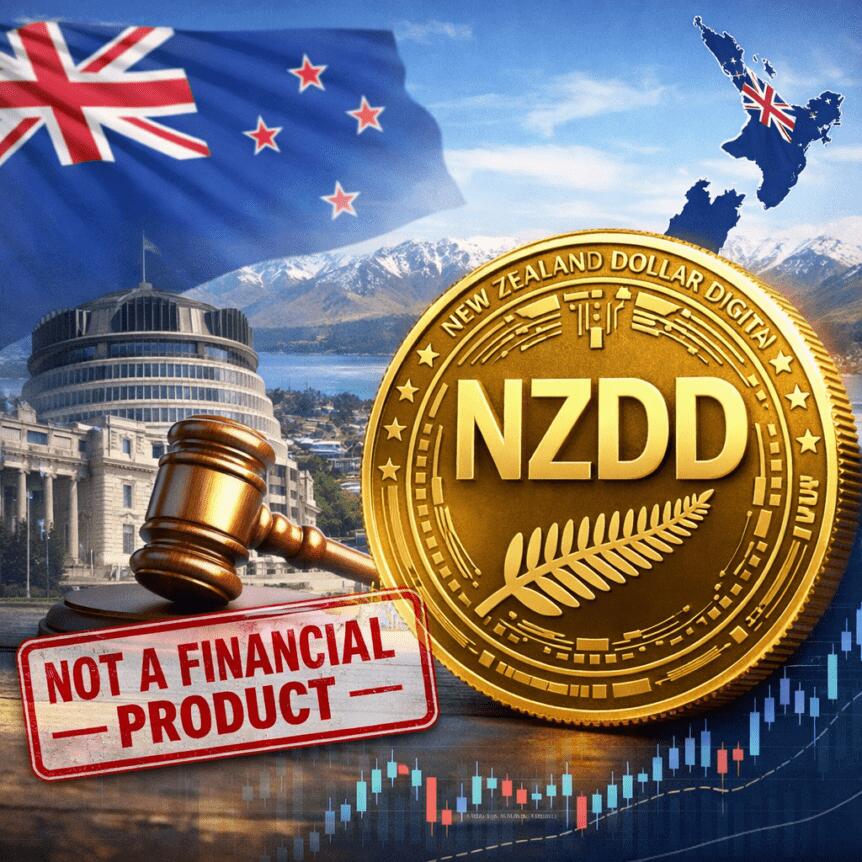
New Zealand’s financial regulator has designated a local currency-pegged stablecoin, NZDD, as not a financial product—a distinction that a leading law firm says could sharpen regulatory clarity for stablecoins and fintech pilots. The Financial Markets Authority (FMA) published the designation in a designations notice tied to its fintech sandbox initiative. The authority stressed that NZDD’s economic substance is that it is not a debt security, not an investment, and that holders do not receive income, interest, or other gains. While the move is product-specific, it signals a pragmatic approach to financial innovation that seeks to balance market access with investor protections.
Key takeaways
- The designation confirms NZDD is not treated as a debt security or an investment under current rules, setting a clearer expectation for issuers and users of currency-pegged stablecoins in New Zealand.
- The ruling stems from the FMA’s fintech sandbox, illustrating how live testing of digital assets can inform regulatory design without broad-brush sweeping conclusions.
- Officials caution that the designation applies to the specific product and version of NZDD described in the notice and does not constitute a blanket policy for all stablecoins.
- The FMA intends to broaden the sandbox with an on‑ramp or restricted license for FinTech firms, a step that could ease market access while preserving protective guardrails that can be adjusted as firms mature.
- Market context signals notable interest in New Zealand’s crypto space: Protocol Theory estimated that about half of the country’s population is either crypto investors or considering investing, while DataCube Research projects the local crypto market could reach roughly $254 billion in value.
Tickers mentioned:
Market context: The designation arrives amid a wider regulatory push to balance innovation with safeguards as the crypto sector matures. Regulators in multiple jurisdictions are carving clearer pathways for digital assets through sandbox tests and phased licensing regimes, with IMF guidelines on stablecoin risks serving as references for policy discussions and industry practices.
Sentiment: Neutral
Price impact: Neutral. The article describes regulatory actions and sandbox plans rather than market moves or price data.
Trading idea (Not Financial Advice): Hold. The development represents regulatory clarity and potential for future licensing, but no immediate market positioning is warranted from these announcements alone.
Market context: The NZDD designation comes as New Zealand trial sites a broader push to align financial innovation with consumer protections. Regulators in various jurisdictions are testing frameworks that support fintech and tokenized assets while delineating when traditional securities rules apply. IMF guidelines on stablecoin risks are among the reference points cited by policymakers and industry observers as they weigh designations, licensing paths, and cross-border standards. For readers following this space, the New Zealand case adds to a growing mosaic of how regulators distinguish stablecoins from conventional debt or equity instruments without stifling innovation.
Why it matters
The FMA’s designation of NZDD as not a financial product marks a deliberate regulatory stance that could influence how issuers approach digital assets within New Zealand’s borders. By clarifying that NZDD is not a debt security and does not promise income, the regulator provides a concrete example of how a currency-pegged stablecoin might be classified in a way that does not automatically trigger securities laws. This distinction matters for issuers seeking to pilot new digital instruments within a governed framework, as it can reduce uncertainty around product design, disclosures, and investor protections required in the sandbox environment.
Law firm MinterEllisonRuddWatts, which advised the NZDD issuer in relation to its sandbox participation, described the move as an important step toward broader regulatory certainty for stablecoins in the country. The firm stressed that the designation is not a general ruling on all stablecoins but a product-specific decision that may serve as a reference point for future iterations and other token designs. The acknowledgment that policy can evolve in parallel with technological innovation underscores a regulated but adaptive approach—one that seeks to embrace fintech growth while maintaining guardrails to guard consumer interests.
Beyond the legal classification, the FMA’s sandbox expansion signals a practical pathway for market participants. Officials have indicated plans to introduce an on‑ramp or restricted license for FinTech firms as part of the sandbox, with the aim of providing regulated access to the market under targeted restrictions that could be gradually relaxed as a company demonstrates capability and compliance. This incremental licensing approach could lower the barrier to entry for crypto-enabled services and related fintech ventures, enabling more experimentation under supervision rather than in a purely speculative, unregulated milieu. The move also aligns with international norms seen in other jurisdictions that favor controlled innovation over outright prohibition, a stance that could attract startups seeking a compliant foothold in the Asia-Pacific region.
Public interest in New Zealand’s crypto ecosystem remains high. A 2024 Protocol Theory report noted that nearly half of the country’s roughly 5.2 million residents are already crypto investors or actively considering investment, underscoring the market’s potential. DataCube Research projects the domestic crypto market could reach about $254 billion in value, a horizon that reinforces why regulatory clarity matters for participants ranging from exchanges and wallet providers to developers building compliant tokenized financial products. All of these threads—the clarity on NZDD, the sandbox expansion, and the broader market milieu—illustrate a regulatory environment that seeks to foster responsible innovation while acknowledging the need for ongoing policy refinement.
As New Zealand continues to refine its approach, observers will be watching for how NZDD’s designation influences subsequent product classifications and licensing decisions within the sandbox. Will other stablecoins or tokenized instruments gain similar determinations, and how quickly will the on‑ramp licenses be rolled out to accommodate growing interest? The answers will shape the next phase of crypto and fintech activity in the country, potentially setting a model for other small economies navigating the balance between innovation and oversight.
What to watch next
- Details of the on-ramp or restricted FinTech license as part of the FMA sandbox expansion, including eligibility criteria and any phased rollout timeline.
- Whether additional stablecoins or digital assets will receive product-specific designations under the sandbox framework.
- Any further guidance from the FMA or related agencies on the regulatory treatment of crypto assets and fintech innovations beyond NZDD.
- Updates to IMF-stated guidelines or international standards that could influence New Zealand’s ongoing regulatory evolution.
Sources & verification
- FMA stablecoin designation notice detailing NZDD’s classification and the sandbox link: https://www.fma.govt.nz/business/legislation/secondary-legislation/designations/financial-markets-conduct-ecdd-holdings-limited-stablecoin-designation-notice-2026/
- MinterEllisonRuddWatts article on the first-of-its-kind designation: https://www.minterellison.co.nz/insights/first-of-its-kind-designation-nzdd-stablecoin-declared-not-a-financial-product
- FMA expands sandbox page announcing broader licensing options: https://www.fma.govt.nz/news/all-releases/media-releases/fma-expands-sandbox/
- IMF guidelines referenced in industry discussion: https://cointelegraph.com/news/imf-guidelines-stablecoin-risks-regulations
- Protocol Theory 2024 report on NZ crypto investor prevalence: https://hub.easycrypto.com/news/the-next-wave-of-crypto-users-in-new-zealand#:~:text=New%20research%20by%20Protocol%20Theory,ownership%20for%20building%20financial%20freedom.
- DataCube Research projection for New Zealand’s crypto market: https://www.datacuberesearch.com/new-zealand-fintech-cryptocurrency-market
Regulatory clarity and market momentum in New Zealand
The case of NZDD demonstrates how regulators can pursue a nuanced recognition of new financial instruments without stifling experimentation. By drawing a clear line between what constitutes a financial product and what does not, the FMA provides a navigable path for issuers, developers, and investors who are eager to participate in a digitized financial landscape. The sandbox framework, with its potential on‑ramp licenses, offers a controlled environment in which firms can test products, governance structures, and consumer protections before expanding into broader markets. In a world where stablecoins and tokenized assets attract increasing policy attention, New Zealand’s approach adds to a growing set of case studies that illustrate how a thoughtful, phased regulatory model can support innovation while maintaining systemic safeguards.
What it means for the wider crypto ecosystem
For developers, exchanges, and fintechs operating in or eyeing New Zealand, the designation and the sandbox expansion could lower friction for compliant product launches and pilot programs. For investors, it signals a regulatory environment that distinguishes between stablecoins with real-world utility and instruments that fall under traditional securities rules. And for policymakers, it offers a live example of how to balance innovation with investor protection, a balance that many jurisdictions continue to strive for as the crypto economy matures and scales. As international dialogue around stablecoins evolves, New Zealand’s measured, evidence-based approach may serve as a practical blueprint for other regulators seeking to modernize financial legislation without compromising safety and resilience.


New Zealand’s financial regulator has ruled that a local currency-tied stablecoin, NZDD, isn’t a financial product, a move a local law firm says is an important step toward regulatory clarity.
The Financial Markets Authority (FMA) said on Wednesday that the new designation for the stablecoin pegged to the New Zealand dollar resulted directly from a financial technology sandbox pilot the regulator is running.
“The economic substance of the NZDD stablecoin is that it is not a debt security, as the NZDD stablecoin is not an investment, and no income, interest or other gain is paid to the NZDD stablecoin holder,” the FMA said.
Law firm pegs designation as a step in the right direction
New Zealand law firm MinterEllisonRuddWatts, which said it acted for NZDD issuer ECDD Holdings in relation to its participation in the FMA sandbox, called the new designation an important step toward regulatory certainty for stablecoins in the country.
“However, it is important to note that the designation relates to a specific product and version of a stablecoin, being the NZDD in the form described in the designation notice and does not constitute a general determination as to the regulatory treatment of all stablecoins,” the firm said.
“The designation signals a pragmatic approach by the FMA to financial innovation that is consistent with developments in comparable jurisdictions and provides a foundation from which further pathways can be developed,” it added.
Sandbox pilot to expand with new license
The FMA also announced it’s planning to introduce an on-ramp or restricted license for FinTech firms as part of its sandbox pilot.
Related: New Zealand bans crypto ATMs in crackdown on criminal cash conversions
“Our financial system is changing faster than ever before. This new type of licence will support firms to get access to the market with some restrictions in place that can be removed as the firm grows,” FMA chief executive Samantha Barrass said.
A 2024 report by Web3 consumer research firm Protocol Theory estimated that nearly 50% of New Zealand’s 5.2 million population are either current crypto investors or are considering investing.
Separately, data analytics firm DataCube Research projects New Zealand’s crypto market will be worth around $254 billion.
Magazine: All 21 million Bitcoin is at risk from quantum computers
TLDR
- Hackers took control of Bonk.fun’s domain and deployed wallet-draining malware on the platform
- Users affected were those who approved a fraudulent terms-of-service prompt following the compromise
- Previously established connections and transactions through external terminals remained unaffected
- Originally branded as LetsBONK, the service went live in April 2025
- By late 2025, Bonk.fun’s market dominance plummeted from 84% to a mere 7%
On March 12, Bonk.fun—a Solana-powered meme coin launchpad supported by Raydium and the BONK token—issued an urgent alert advising users to steer clear of its website after cybercriminals hijacked a team member’s account and embedded wallet-draining malware into the domain.
Tom, the platform’s operator posting from the handle @SolportTom, disclosed the security incident on X and instructed users to avoid accessing the site pending resolution. The official Bonk X account echoed this warning.
According to Tom, the attack exclusively impacted users who approved a deceptive terms-of-service authorization on the compromised platform following the breach. Historical site connections and transactions executed via third-party trading interfaces remained secure.
An investigation into the incident is currently ongoing. While the team hasn’t revealed the total financial damage, Tom indicated that swift detection and rapid community notification helped contain the losses.
“We’re employing every available resource to resolve this matter,” Tom stated, emphasizing that users who’ve placed their trust in the platform over the past eight months remain the team’s top concern.
Launched in April 2025 through a collaboration between the BONK community and Raydium, Bonk.fun enables users to create tokens on Solana without any programming knowledge, utilizing dynamic logarithmic bonding curves. The platform previously operated under the name LetsBONK.
Bonk.fun’s Dramatic Market Share Collapse
In the months following its debut, the platform surpassed Pump.fun to capture 84% of Solana’s launchpad sector by mid-2025. This commanding position proved temporary.
By year-end 2025, Bonk.fun’s market control had crashed to merely 7%, based on analytics from Dune. Monthly revenue tumbled to approximately $84,000, while Pump.fun generated over $720,000 during the equivalent timeframe.
The downturn resulted from unsustainable reward systems and a deceleration in successful token deployments. Pump.fun countered by initiating substantial buyback programs, acquiring Kolscan, and enhancing its infrastructure capacity.
In early 2026, Bonk.fun eliminated creator fees entirely in an attempt to recapture users. This strategy produced a brief revenue surge toward the end of January 2026.
Platform Lost Traction Prior to Security Breach
The rebound was short-lived. Pump.fun introduced fresh incentive programs and recaptured more than 70% of the market by February 2026.
This breach fits within a wider trend affecting the cryptocurrency sector. Phishing operations that manipulate users into authorizing malicious transactions on compromised domains have been escalating. Throughout 2025, fraudulent proceeds from such schemes approached $17 billion.
The Bonk.fun team continues to advise all users against accessing the website until they can verify the platform’s security has been fully restored.
At the time of publication, no specific loss amount from the hack has been publicly disclosed.
Crypto World
Across’s acx rockets 80%, massively beating bitcoin, on plans to dump its DAO structure
A DeFi protocol just proposed going private as its stewards believe the current DAO structure is creating a hurdle to close institutional deals.
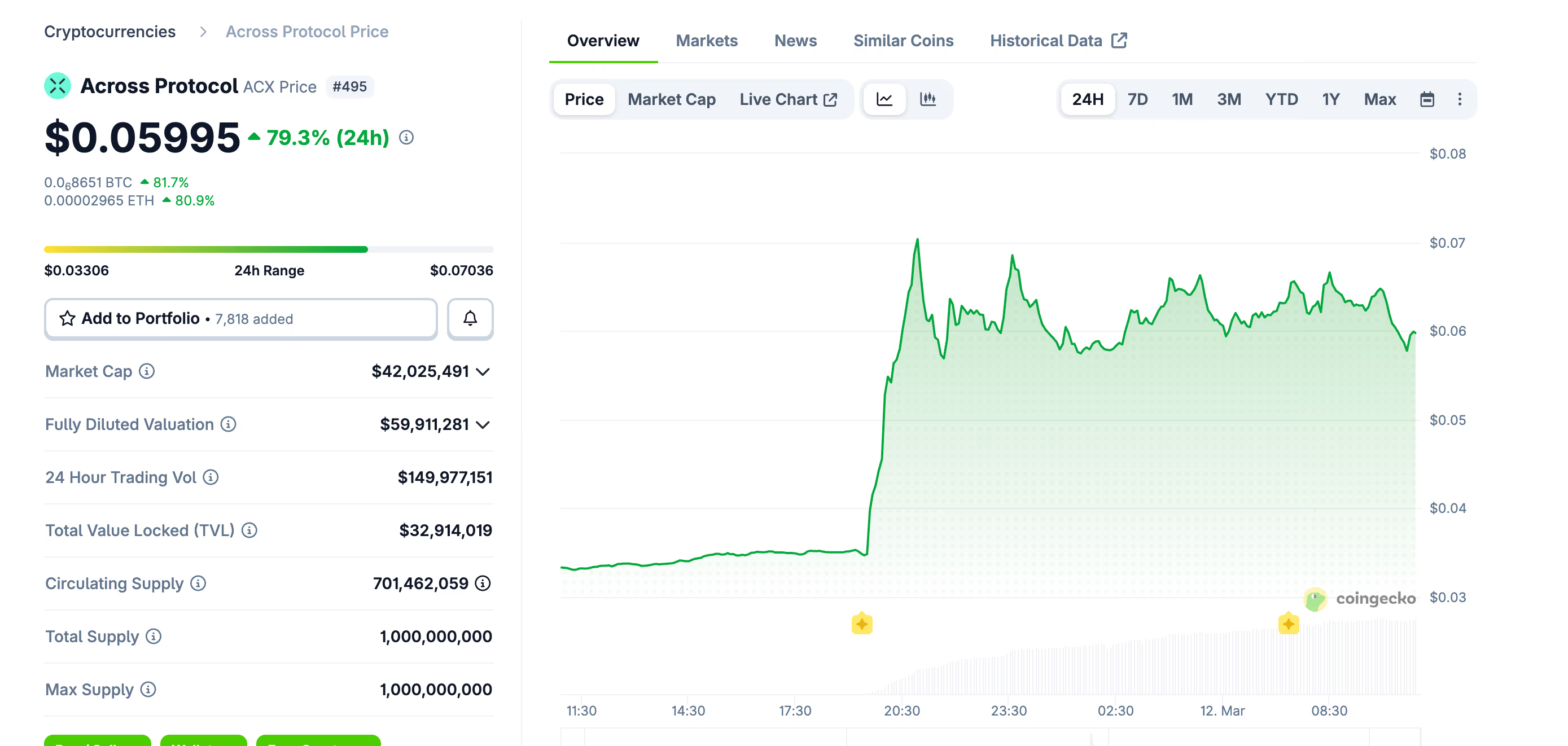
Across Protocol’s ACX token jumped 80% to $0.06 on Thursday after the team behind the cross-chain bridging platform published a ‘temp-check’ proposal to dissolve its token structure and convert into a traditional U.S. C-corporation.
“As Across deepens our work with institutional and enterprise partners, the token and DAO structure has materially impacted our ability to close partnerships and integrations,” the proposal reads. “Transitioning to a traditional legal entity would meaningfully improve our ability to enter enforceable contracts, structure revenue agreements, and deliver more value to Across stakeholders.”
“At current ACX valuations, we believe the Across Protocol is significantly undervalued. The proposed structure gives us an opportunity to explore new ways to foster growth while acting in the best interests of the broader Across community.”
A temp check in DeFi governance is essentially a non-binding poll that gauges community sentiment before a formal vote. It lets the team see whether there’s enough support to proceed as an official governance proposal, which is then voted on by token holders.
The move would give token holders two choices: exchange their ACX for equity in the new company, or sell their tokens for USDC at $0.04375, a 25% premium to the previous 30-day average trading price.
The token was trading at roughly $0.033 before the proposal went live. The immediate surge to $0.07 before settling around $0.06 reflects the market pricing in the buyout floor, though the current price already sits well above the proposed $0.04375 buyout, suggesting traders are betting on either a higher offer or that the equity option is worth more.

In comparison, BTC is currently trading flat, according to CoinDesk market data. The CoinDesk 20, which measures the performance of the largest digital assets, is also trading flat.
The mechanics are straightforward. A new entity called “AcrossCo” would hold all protocol IP and manage development. Token holders above 5 million ACX could convert to equity directly.
Smaller holders could access equity through a no-fee SPV structure with a minimum of 250,000 ACX, roughly $10,000 at current prices. Everyone gets treated equally at a 1:1 token-to-share ratio regardless of size.
Those who don’t want equity get the USDC buyout at the 25% premium. The buyout window would open within three months of the proposal passing and stay open for six months, funded by the protocol’s liquid assets.
A community call is scheduled for March 18, formal discussion runs through March 25, and a Snapshot vote would follow on March 26. If it passes, the conversion would begin in early April.
Is the DAO vision dead?
DeFi proponents spent years arguing that tokens and DAOs were superior to traditional corporate structures for building decentralized infrastructure.
Across is one of the first protocols to publicly argue the opposite, that the token structure is actively holding back growth and that a C-corp would deliver more value to the same stakeholders.
Risk Labs acknowledged the token has been “significantly undervalued” and described the proposal as a chance to “double down on Across” through a structure that institutional partners actually understand.
The 24-hour trading volume of $149 million is roughly 3.5 times the token’s market cap, reflecting the intensity of speculative interest around the proposal.
Whether that interest translates into support for the conversion or simply a trade on the buyout premium is what the next two weeks of governance discussion will determine.
Vikings RB Aaron Jones Has Swerved

Manufact raises $6.3M as MCP becomes the ‘USB-C for AI’ powering ChatGPT and Claude apps

Jack Draper stuns Novak Djokovic to reach Indian Wells quarter-finals


-
Business6 days ago
Form 8K Entergy Mississippi LLC For: 6 March
-

 News Videos3 days ago
10th Algebra | Financial Planning | Question Bank Solution | Board Exam 2026
-

 Fashion6 days ago
Weekend Open Thread: Ann Taylor
-

 Crypto World3 days ago
Paradigm, a16z, Winklevoss Capital, Balaji Srinivasan among investors in ZODL
-
 Tech1 day ago
A 1,300-Pound NASA Spacecraft To Re-Enter Earth’s Atmosphere
-
 Sports7 days ago
499 runs and 34 sixes later, India beat England to enter T20 World Cup final | Cricket News
-

 Politics6 days ago
Top Mamdani aide takes progressive project to the UK
-

 Business2 days ago
ExxonMobil seeks to move corporate registration from New Jersey to Texas
-

 Sports4 days ago
Braveheart Lakshya downs Lai in epic battle to enter All England Open final | Other Sports News
-

 Sports4 days ago
Three share 2-shot lead entering final round in Hong Kong
-

 NewsBeat13 hours ago
Residents reaction as Shildon murder probe enters second day
-

 NewsBeat7 days ago
Piccadilly Circus just unveiled ‘London’s newest tourist attraction’ and it only costs 80p to enter
-

 Entertainment5 days ago
Hailey Bieber Poses For Sexy Selfies In New Luscious Lip Thirst Traps
-

 Business4 days ago
Search for Nancy Guthrie Enters 37th Day as FBI Probes Wi-Fi Jammer Theory
-

 Business1 day ago
Search Enters Sixth Week With New Leads in Tucson Abduction Case
-
 NewsBeat2 days ago
Pagazzi Lighting enters administration as 70 jobs lost and 11 stores close across Scotland
-

 Tech3 days ago
Despite challenges, Ireland sixth in EU for board gender diversity
-

 Tech7 days ago
ACIP To Discuss COVID ‘Vaccine Injuries’ Next Month, Despite That Not Being In Its Purview
-

 Tech2 days ago
ChatGPT will now generate interactive visuals to help you with math and science concepts
-

 Business2 days ago
Search Enters 39th Day with FBI Tip Line Developments and No Major Breakthroughs