

Crypto World
Propinder Launches Free Prop Firm Comparison Tool For Trading Challenges



The FXStreet platform helps traders compare drawdowns, profit targets, restrictions and platform compatibility according to their experience and risk profile.
Barcelona, July 21, 2026: FXStreet has launched Propinder, a free prop firm comparison tool designed to help traders identify prop trading challenges that align with their experience, risk tolerance, platform preferences and country of residence. The platform presents key challenge conditions in a structured format before traders commit any money.
Profile-based prop firm comparison
Propinder begins with a profiling questionnaire that takes less than two minutes to complete. Traders provide information about their level of experience, preferred trading platform, approach to risk and country of residence.
The platform combines these inputs with aggregated and anonymized information from traders with similar profiles. It then presents a shortlist of prop trading challenges that users can explore and compare.
Propinder does not predict whether a trader will pass a challenge or recommend that the trader purchase a particular product.
Challenge rules displayed before payment
Prop trading challenges can have similar account sizes and profit targets while applying substantially different operating conditions.
These differences may include:
- The type and calculation of drawdown.
- Daily and maximum loss limits.
- Time limits.
- Instrument restrictions.
- Rules affecting trading around news events.
- Trading platform compatibility.
- Requirements for achieving profit targets.
Propinder presents these conditions in a comparable format so traders can evaluate how each challenge works before paying an entry fee.
The platform covers different prop trading models, including instant funding firms, evaluation-based challenges and firms offering futures programs.
Commercial agreements do not determine rankings
Propinder is not owned by a prop trading firm.
FXStreet states that prop firms cannot pay to obtain a higher position in the results and that challenges associated with affiliate partners do not receive preferential treatment.
Listings are created using publicly available challenge information and the results generated by Propinder’s profiling methodology.
“We are here to make sure that when a trader reads the conditions, they understand them before it costs them anything,” said Javier Hertfelder, CEO of Propinder.
Built by FXStreet in partnership with Swiset
Propinder is a product of FXStreet, the financial media company that has provided market and trading information for more than 25 years.
The platform was developed in partnership with Swiset, a trading technology provider serving brokers, prop firms and trading communities.
Swiset provides technology supporting trader profiling, performance analysis and challenge data management. FXStreet is responsible for the Propinder product and its approach to information, comparison and transparency.
Free access for traders
The Propinder profiling questionnaire, challenge comparison results and displayed rule information are available without charge.
The platform does not have a paid subscription or premium access tier.
Traders can access Propinder at propinder.com, review the suggested challenges and explore individual prop firm pages.
The final decision remains with the user. Information provided by Propinder should not be interpreted as trading, investment or financial advice.
About Propinder
Propinder is a free prop firm comparison tool that helps traders explore prop trading challenges according to their experience, risk tolerance, platform preferences and country of residence. The platform presents information about drawdowns, profit targets, time limits, restrictions and platform compatibility in a comparable format. Propinder uses aggregated and anonymized profile information and does not provide trading advice or predict challenge outcomes. Propinder is a product of FXStreet developed in partnership with Swiset. More information is available at propinder.com.
The post Propinder Launches Free Prop Firm Comparison Tool For Trading Challenges appeared first on BeInCrypto.

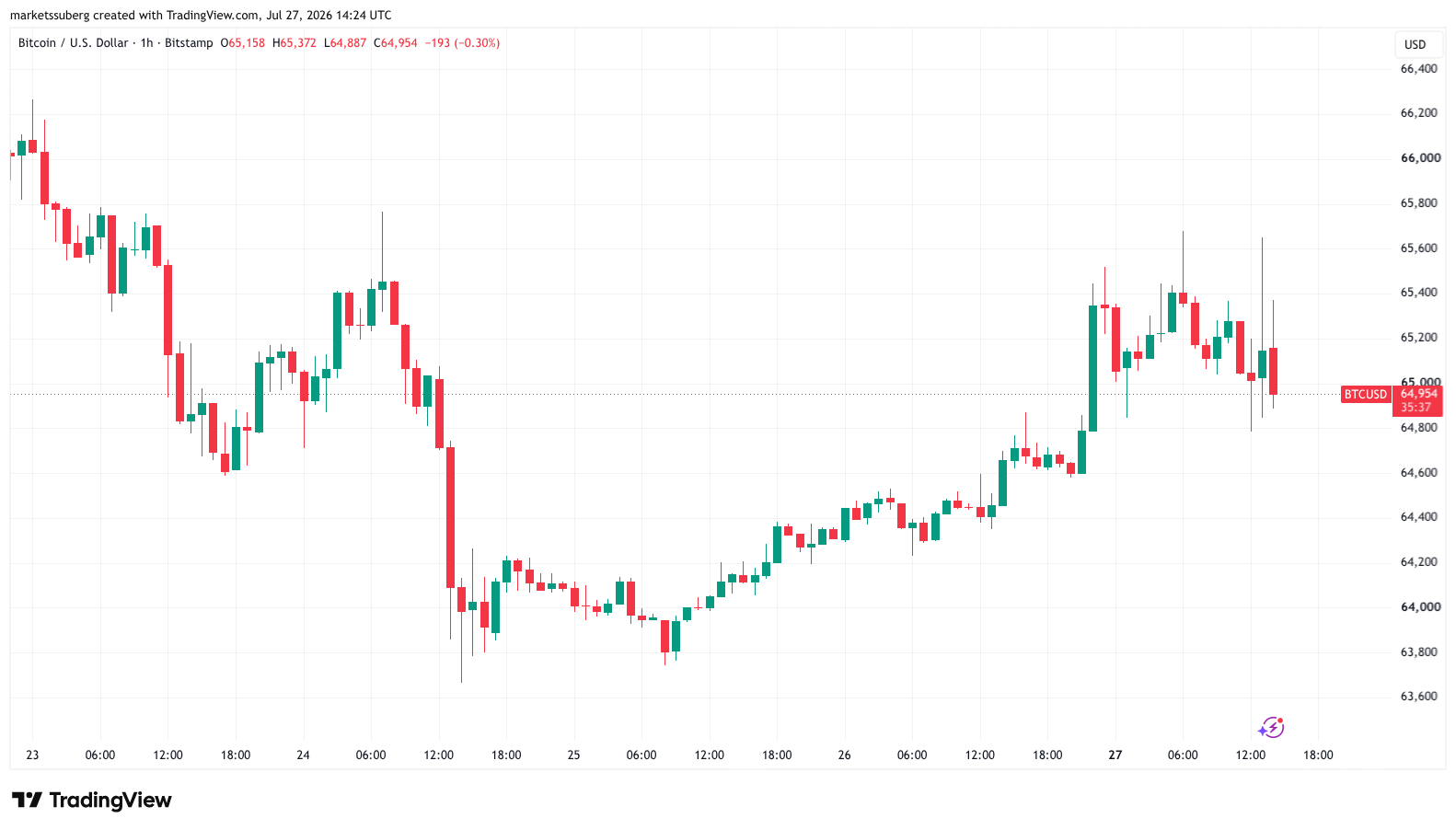
Bitcoin (BTC) sought to build on local highs at Monday’s Wall Street open as US stocks opened in the green.
Key points:
- Bitcoin approached new local highs with the start of the week’s first US trading session.
- Stocks also opened higher amid relief over a hiatus in the US-Iran war and potential progress on reopening the Strait of Hormuz.
- BTC price action defended two daily moving averages on Sunday’s weekly close.
Bitcoin follows stocks higher as Iran news offers risk-asset tailwind
Data from TradingView showed BTC/USD spiking to near $66,000 as markets reacted to a pause in strikes between the US and Iran.
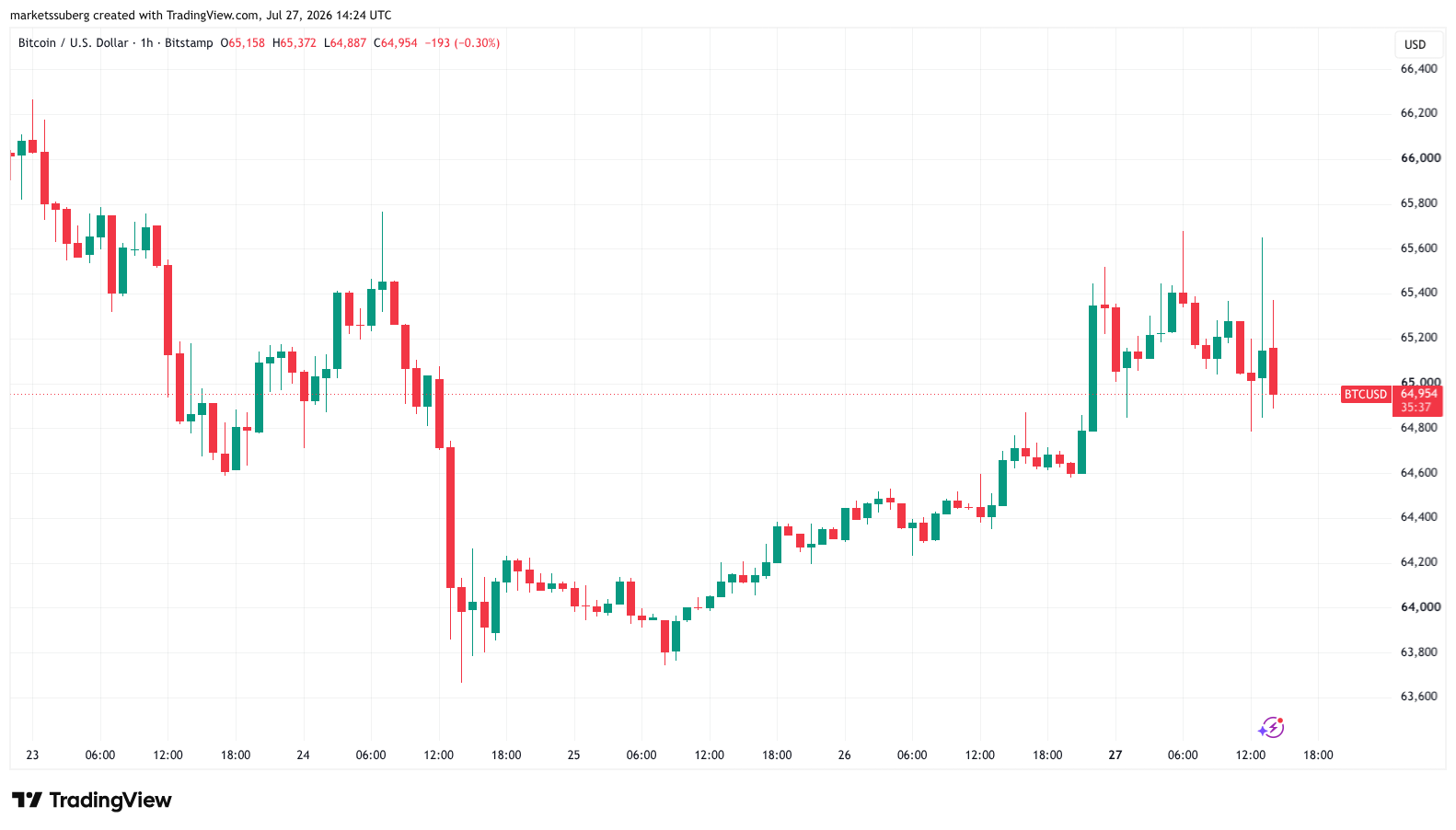
BTC/USD one-hour chart. Source: Cointelegraph/TradingView
Additional reports cited an Iranian foreign ministry spokesman announcing that Tehran and Oman were “trying to establish mechanisms regarding maritime traffic” through the Strait of Hormuz, a key global oil route currently closed.
US WTI crude oil fell toward $82 per barrel on Monday before a modest rebound. The S&P 500 and Nasdaq Composite Index were both up by around 0.3% at the time of writing.
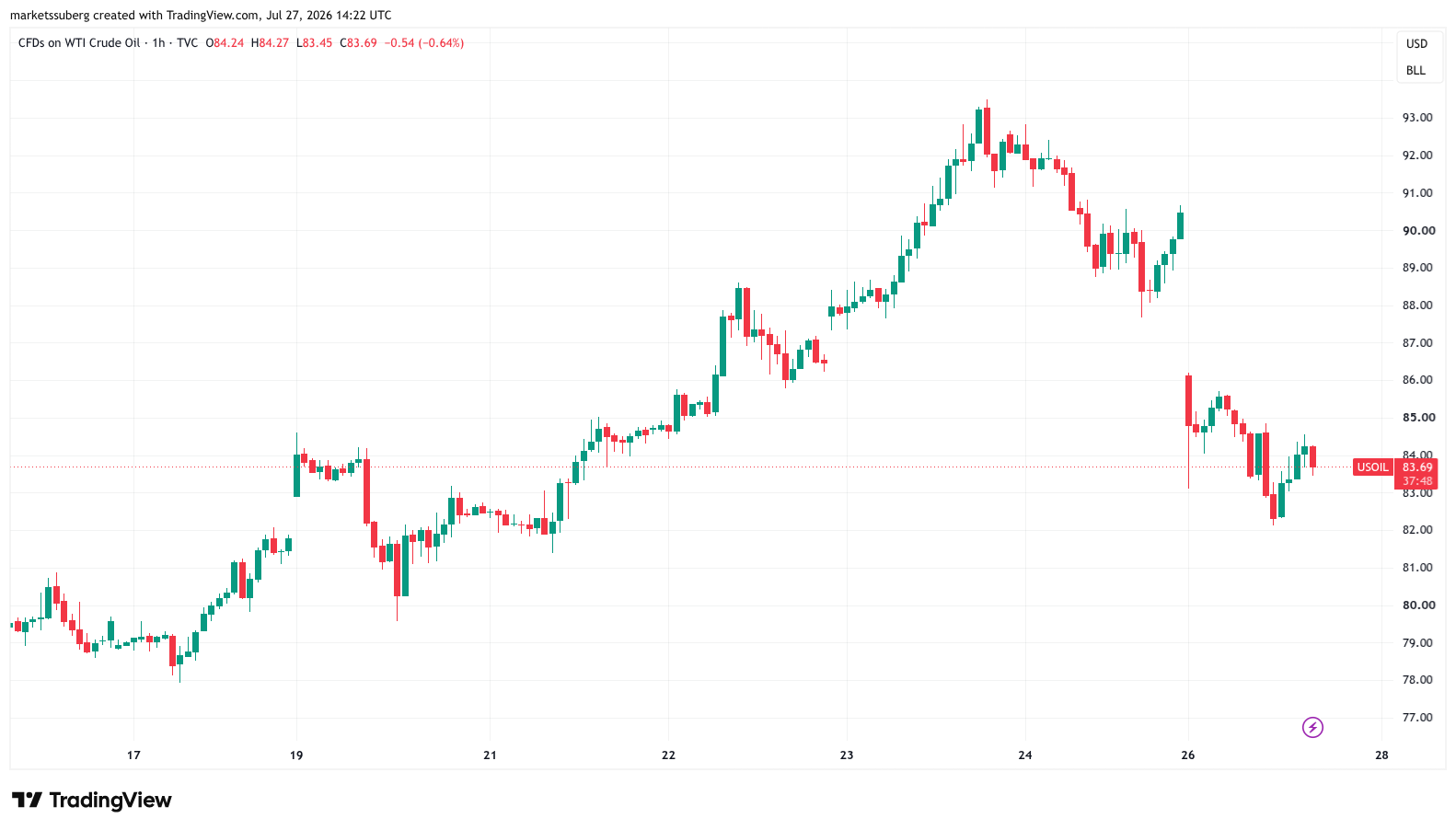
CFDs on US WTI crude oil one-hour chart. Source: Cointelegraph/TradingView
Acknowledging a potential stumbling block in the form of higher US bond yields, trading company QCP Capital voiced that they were anticipating tailwinds for the crypto market going forward.
“Digital assets have generally outperformed equities in July despite a more challenging macro backdrop,” the firm wrote in its latest Market Color analysis.
“BTC and ETH are up approximately 11.6% and 24.6% month-to-date, respectively, even as higher Treasury yields and periodic risk-off sentiment have weighed on broader markets.”
QCP referenced developments around the CLARITY Act, a key piece of proposed crypto legislation still under consideration.
“Market attention also remains on developments surrounding the proposed CLARITY Act, which continues to be closely followed by digital asset participants given its potential implications for the US regulatory framework,” it continued.
BTC price support holds but remains fragile
Among Bitcoin traders, caution mixed with quiet optimism over BTC price action on shorter time frames.
Related: Rate path still divides investors: Five things to know in Bitcoin this week
Crypto trader and analyst Michaël Van de Poppe highlighted that BTC was holding the 21-day and 50-day simple moving averages (SMAs) as support. These stood at $64,289 and $63,261, respectively.
“This is a strong signal for the markets to be betting on the long side of this asset, however, it’s still a little fragile,” he wrote in ongoing updates on X.
“I’d much prefer to see a strong move to $66,000-67,000 over the next 1-3 days to see a continuous bid coming in.”
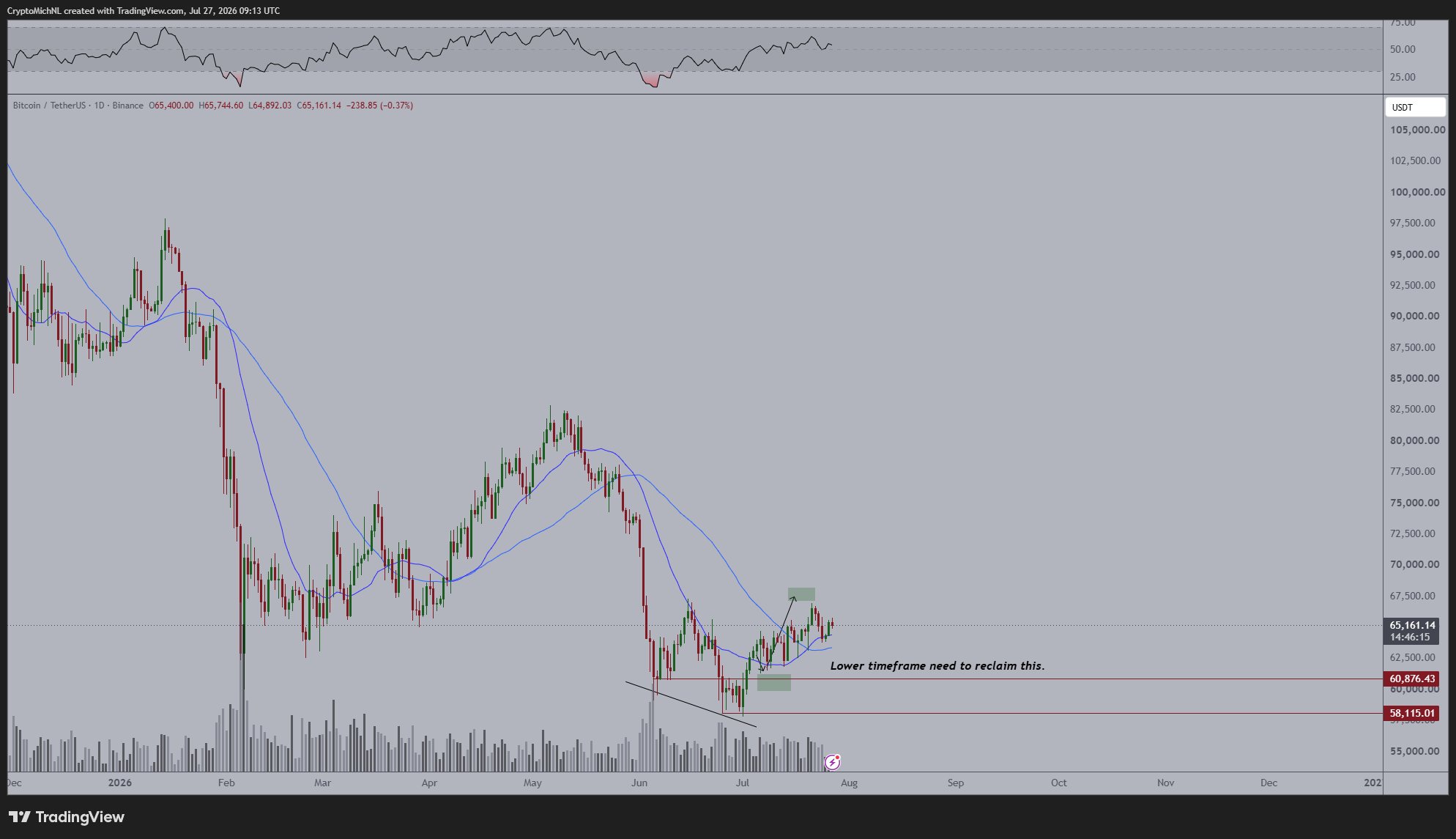
BTC/USDT one-day chart. Source: Michaël Van de Poppe on X.com
Data from CoinGlass showed crypto short liquidations spiking as the market rose, with these nearing $250 million over a 24-hour period.
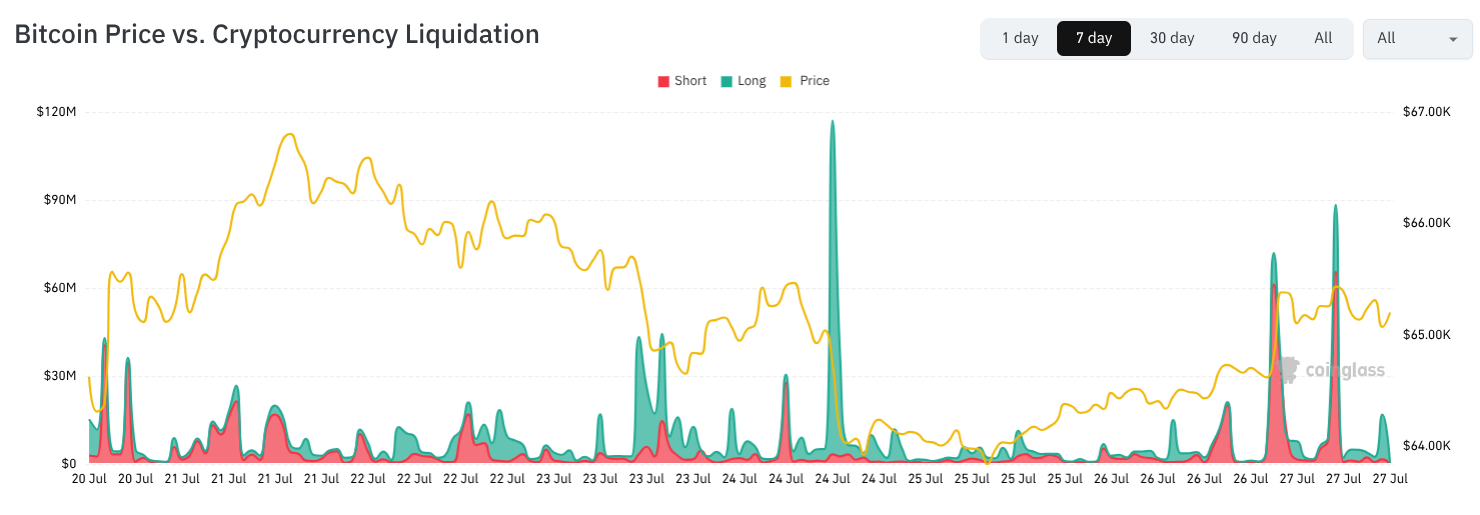
BTC/USD vs. crypto liquidations (screenshot). Source: CoinGlass

On a show that averages 4.1 million viewers across TV and online channels, a prominent comedian and political commentator didn’t hold back in laying out the Trump connections to digital assets. Oliver painted crypto as being the family’s main business concern, outpacing real estate.
Whereas Trump initially called Bitcoin a scam and flagged crypto as a ‘disaster waiting to happen,’ he has reinvented himself now as the ‘first crypto president.’ His recent financial filings show his personal income exceeds $2.2 billion in his first year back in office, $1.2 billion of which is from crypto.
The President and First Lady have each launched their own meme coins, both of which crashed 92% and 99% from early highs. An estimated 1 million retail traders lost a total of $3.8 billion trading $TRUMP. Oliver suggested that the President was offering White House access in exchange for investment in the meme coin in some cases.
John Oliver breaks down how Donald Trump’s personal income hit $2.2 billion in his first year back in office, with $1.4 billion of it coming from the family’s crypto businesses.
John Oliver: “His recent financial filings show that in just his first year back in office, his… pic.twitter.com/tgafNgDcHr
— ileri 𖣂 (@0xileri) July 27, 2026
‘Maximum Sketchiness’: The Murky World of World Liberty Financial
The show host criticized what he viewed as dodgy deals being made under the umbrella of Trump-owned World Liberty Financial venture. These include TRON’s Justin Sun making a $45 million investment prior to an SEC fraud case settlement against him. The case was then dismissed with no admission of wrongdoing and settled for $10 million. Former SEC chief of staff Amanda Fischer described this as a ‘sweetheart deal’.
Oliver also noted that Emirati royals brokered a deal with World Liberty Financial that personally netted Trump $263 million, and that shortly afterward, US restrictions on UAE access to advanced Nvidia AI chips were lifted.
The comedian described crypto as “a perfect vehicle to funnel money” to the Trump family, mirroring the words of ethics attorney Virginia Canter on the subject, adding that Trump is “exploiting crypto sketchiness for maximum profit.”
Oliver’s Stance on Crypto Regulations
One key aspect of the show was the messaging on the CLARITY Act, a hotly discussed regulatory framework being proposed for crypto.
Oliver described the Act as moving regulatory oversight and power from the SEC to the CFTC, which he stated is ‘a small federal agency with little to no enforcement power’. The proposed regulations have been lauded by many in the crypto industry.
However, Last Week Tonight pointed out that the introduction of a new asset class, digital commodities, gives the CFTC exclusive jurisdiction over spot and cash markets for those assets, potentially weakening regulatory powers that could counteract government corruption.
The show host also insinuated that the nebulous nature of the Trump family’s crypto dealings works in the President’s favor.
“If these conflicts of interest were as easy to understand as Jimmy Carter and his peanut farm I think there would be a lot more alarm about just how flagrantly corrupt and compromised Trump looks here,” said Oliver.
In the host’s view, the American public is complacent about what could be viewed as crypto corruption from a sitting president simply because it is difficult for a layperson to understand, causing him to stress the need for ‘proper guardrails.’
As it stands, the CLARITY Act is not yet law, with its odds of passing this year dropping to just 31% recently on prediction markets.
The post ‘Perfect Vehicle to Funnel Money’: John Oliver Slams Trump’s Crypto Foray on HBO appeared first on CryptoPotato.
Crypto World
What are perps, anyway? Everything you need to know about crypto’s hottest trading instrument


Perpetual swaps, also called perpetual futures or “perps” for short, are the dominant trading instrument in the crypto market, processing an estimated $40 to 50 trillion a year in volume. They dwarf spot trading, and they are the product that professional traders, hedge funds and retail speculators reach for when they want leveraged exposure to the price of bitcoin or tther without owning the underlying asset. Despite their ubiquity, the mechanics that make them work are not widely understood.
To understand perps, it helps to understand what came before them. In traditional finance, leveraged exposure to an asset typically comes through a futures contract, an agreement to buy or sell something at a set price on a specific date. When that date arrives, the contract expires and settles. Traders who want to maintain their position must roll it into the next contract.
In crypto’s early days, this practice created persistent problems. Futures traded at a premium to the spot price of bitcoin, a concept known as basis, which confused retail traders who wanted straightforward directional exposure. And every time a contract expired, positions closed regardless of whether traders wanted them to. BitMEX, the derivatives exchange founded by Arthur Hayes and Ben Delo in 2014, spent the better part of a year shortening contract durations trying to solve this, moving from quarterly to monthly to weekly to 48-hour to 24-hour expiries, but none of that was enough.
A contract that never expires
The perpetual swap, which Delo developed and BitMEX launched in May 2015, resolved the problem by eliminating the expiry date entirely, creating a derivative contract that tracks the price of an asset indefinitely. There is no settlement date, no rolling and no expiry. Traders can hold a position for hours or years. This created an immediate structural challenge: without an expiry date to act as an anchor, nothing would naturally force the contract price back toward the spot price of the underlying asset. BitMEX solved this through a mechanism that has since become the industry standard.
Every eight hours, a payment is exchanged between traders on opposite sides of the market. If the perpetual swap is trading above the spot price, indicating excess demand for long positions, traders who are long pay traders who are short. If the perpetual swap is trading below spot, the payment runs the other way. The exchange takes no cut. The rate of this payment, known as the funding rate, is calculated based on how far the perpetual swap price has deviated from spot over the preceding eight-hour window. The further the deviation, the higher the rate. This creates a self-correcting equilibrium. When longs are being charged a substantial funding rate, it becomes expensive to hold the position, which reduces demand and pulls the price back toward spot. Market makers accelerate this process by shorting the perpetual swap and buying spot whenever a meaningful premium opens up, capturing the difference as profit. The funding rate mechanism is now used, in essentially the same form, by every major derivatives exchange in the world.
The role of leverage
The other defining feature of perpetual swaps is leverage. Most exchanges allow traders to control positions significantly larger than their deposited capital, with limits varying by platform and jurisdiction. At BitMEX in its prime, leverage of up to 100 times was available, meaning a 1% move in Bitcoin’s price would produce a 100% gain or loss on a fully leveraged position. To manage the risk this creates for the exchange, perpetual swap platforms use automated liquidation systems. If a trader’s losses approach the value of their deposited margin, the system closes the position before it can go negative, protecting the exchange from absorbing the deficit. The speed and reliability of that liquidation engine became a key competitive differentiator in the early years of the market, and remains central to how exchanges compete today.
Perpetual swaps are now the primary venue for price discovery in crypto. When bitcoin moves sharply, the move typically originates in perp markets before spreading to spot. The structure Delo built in 2015 has proven durable enough that regulators in the U.S. are now exploring its application to traditional assets, with the CME potentially listing perpetual swaps on equities. What began as a workaround for the limitations of crypto futures has become one of the most traded financial products in the world.
USDC issuer Circle Internet Group has acquired assets from IBM’s blockchain patent portfolio in a bid to expand its intellectual property holdings.
The portfolio includes more than 680 patent families and nearly 1,000 issued patents worldwide covering core blockchain technology, banking, financial services, insurance, enterprise infrastructure, supply chain verification, and secure cloud operations.
The financial details of the deal were not disclosed.
IBM Patent Deal
Circle said the acquisition makes it the largest holder of blockchain patents in the United States. According to the stablecoin issuer, the expanded patent portfolio will support products including USDC, Circle Payments Network, Arc, as well as its lineup of on-chain products and agentic financial tools. The two companies also plan to pursue further business opportunities together.
Weighing in on the development, Circle’s General Counsel and Corporate Secretary Sarah Wilson said,
“Intellectual property is critical to advancing our mission and expanding adoption of on-chain infrastructure. IBM has been a pioneer in technological innovation, and this acquisition expands Circle’s ability to advance the infrastructure that powers global, internet-native finance.”
The latest development comes more than three years after the company joined the LOT Network, a global nonprofit that helps protect members from patent lawsuits brought by Patent Assertion Entities (PAEs). The main objective was to lower legal risks while supporting the development of blockchain-based products and services.
Later that year, it secured its first patent for Parallel Block Processing, which enables multiple pieces of information to be processed simultaneously while maintaining the serial validation of blocks.
Other Initiatives
Earlier this month, Circle received approval from the US Office of the Comptroller of the Currency to roll out First National Digital Currency Bank, N.A., which will operate as Circle National Trust. The charter will allow the stablecoin issuer to provide fiduciary crypto custody services and is expected to eventually manage USDC reserves under OCC supervision. Over time, custody services may also become available to a limited group of institutional clients.
It also joined the Linux Foundation’s x402 Foundation as a premier member, along with other industry players such as Ripple, Coinbase, and Solana Foundation, among others. The initiative aims to support the development of an open standard for internet-native payments that enables AI agents, APIs, and applications to transact over HTTP.
Separately, BNY Mellon expanded its partnership with Circle by adding USDC to its Digital Asset Custody platform. This integration lets institutional clients store, transfer, mint, and redeem the stablecoin while strengthening the bank’s role as the primary custodian of USDC reserves.
The post Circle’s IBM Patent Deal Brings Nearly 1,000 Blockchain Patents appeared first on CryptoPotato.

HashKey Holdings says it has consolidated its exchange operations into a single user-facing platform, bringing together what were previously separate apps for different regions. In an announcement released Monday, the Hong Kong digital asset services firm said customers across Hong Kong, “Global,” Singapore, and the Middle East (Dubai) will use the same application—while compliance controls are handled according to each jurisdiction’s legal requirements.
The update reflects a broader shift away from early “regional silo” exchange models, where licensing and front-end products were often kept separate to reduce compliance complexity. HashKey’s approach is built around a principle it describes as “unified entry, localized compliance.”
Key takeaways
- HashKey has merged its HashKey Exchange and HashKey Global into one platform and one application for users across multiple regions.
- The front-end experience is centralized, while regulatory compliance is managed based on each customer’s legislative domain.
- HashKey frames the change as a move from earlier jurisdiction-by-jurisdiction exchange silos toward a unified model.
- Other major exchanges have implemented similar structures, though with different ways of routing users to local legal entities.
One app across regions, with compliance tailored locally
HashKey said it has consolidated core jurisdictional hubs—including Hong Kong, Singapore, the Middle East (Dubai), and Bermuda—under a single platform and application. While the firm’s statement emphasizes that the “front-end” is unified, it also stresses that the system is designed to remain compliant with local frameworks by managing compliance requirements in line with each user’s jurisdiction.
Under HashKey’s model, users download the same application, but the platform applies localized compliance handling across the Hong Kong, Global, Singapore, and Middle East regions. In practical terms, that means the product experience is simpler to access, even though the legal and regulatory obligations still differ by geography.
Why unified platforms are becoming more common
HashKey’s announcement positions the merger as an evolution from the early days of virtual asset trading. In those early stages, many licensed exchanges operated through regional silos—separate platforms, separate apps, and often separate operational setups—to make it easier to compartmentalize compliance.
According to HashKey, its updated structure is intended to preserve compliance benefits while reducing friction for users who operate across or move between markets. The promise is a single front-end that can simplify access to systems expected to remain aligned with local regulatory requirements, as compliance is managed within the platform rather than through separate customer-facing products.
For traders and liquidity providers, a unified application can also reduce the risk of confusion around which interface, account type, or supported features apply in different jurisdictions. For the operator, it can streamline development and user onboarding workflows by consolidating the customer entry point while maintaining jurisdiction-specific controls in the background.
How this compares with other exchanges’ structures
HashKey is not alone in moving toward centralized user experiences paired with jurisdiction-specific legal coverage.
As one comparison, the article notes that OKX presents its website and mobile apps as one platform. However, OKX’s terms reportedly assign customers to different providers based on residence. In other words, the customer-facing “one app” concept is paired with a legal routing layer that maps users to the appropriate entity depending on where they are.
Kraken provides another example. The announcement referenced that Kraken consolidated a Dutch broker entity—BCM—into its platform after acquiring it in September 2024. Kraken has also expanded its European offering through a MiCA structure: the firm reportedly began serving the EEA through its Irish MiCA entity in August, suggesting that compliance alignment is achieved within a unified operational framework.
These comparisons underscore that while the “single platform” idea is spreading, implementations can differ. The key variable is how an exchange ties a unified front-end to jurisdiction-appropriate regulatory responsibility—whether by assigning users to distinct providers behind the scenes or by applying compliance processes localized to each customer’s jurisdiction.
What users should watch after the consolidation
HashKey’s transition to a single application across multiple regions raises questions that matter most to customers: how onboarding flows will change, how jurisdiction-specific feature access will be reflected in the user experience, and whether account management will remain seamless when users interact with region-specific compliance requirements.
For regulators and industry observers, the merger is also a useful test case for whether exchanges can maintain strong compliance controls while consolidating products and codebases—an approach that could become more attractive as regulatory regimes mature and operational efficiency becomes a competitive differentiator.
Readers should watch for further details on the rollout mechanics, such as how HashKey handles user migration from previously separate platforms and how the unified app communicates jurisdiction-dependent limitations, if any. As the exchange environment continues to tighten, the ability to centralize the user interface without diluting regulatory obligations will likely be a key measure of operational readiness.


More than a dozen digital asset treasury companies have moved into artificial intelligence and data centres as falling crypto prices weaken demand for the DAT model.
Summary
- More than a dozen crypto treasury companies have pivoted toward AI as investor enthusiasm fades.
- K Wave shares fell 71% after its data-centre shift failed to restore market confidence quickly.
- Falling crypto prices and compressed treasury premiums are pushing listed firms toward new operating businesses.
Bloomberg reported that the shifts have not stopped steep share declines.
K Wave Media has fallen about 71% since its May pivot. Lixte Biotechnology and Alpha Compute have each dropped roughly 33% since announcing their own changes. The figures measure performance after the pivots and do not prove causation.
Digital asset treasury premiums shrink
Digital asset treasury companies use public equity, debt or private placements to buy crypto. The model works best when investors value the company above its token holdings. That premium lets management issue shares and buy more assets.
The structure becomes harder to maintain when crypto prices fall or the stock trades near or below net asset value. New share sales become less attractive, while debt costs remain. VanEck said in January that several DATs faced net asset value discounts, increasing pressure for consolidation and new strategies.
A Bloomberg-syndicated report quoted Renno & Co managing partner Toufic Adlouni as saying the “vast majority are trying to switch gears or are dead or dying.” That is one adviser’s assessment, not a formal count. Still, the pivots show that several boards no longer view crypto accumulation alone as enough.
K Wave abandons its Bitcoin plan
K Wave announced on May 4 that it could redirect up to $485 million from a Bitcoin treasury agreement into data centres, GPU rental operations and AI acquisitions. The plan also included selling its legacy unit and removing about $48 million in debt and related liabilities.
The stock fell almost 25% on the first trading day after the announcement, as crypto.news previously reported. Bloomberg later placed the decline at about 71% from the May reboot. K Wave then sold its remaining 88 BTC to repay $6 million of debt, ending a campaign that once targeted 10,000 BTC.
K Wave said the transformation would build a scalable platform across data centres and computing. That claim remains forward-looking. The company has not yet shown that the new business can replace the investor interest once attached to its Bitcoin plan.
Lixte and Alpha Compute choose new businesses
Lixte entered the DAT market in 2025 by buying 10.5 BTC and 300 ETH for about $2.6 million. The company said crypto represented roughly 43.6% of its treasury and authorised an allocation of up to 50%.
In June 2026, Lixte agreed to acquire NOMAD Transportable Power Systems and said it planned to become NOMAD Power Solutions. The proposed business would provide mobile battery storage for data centres facing grid delays. Bloomberg reported that Lixte shares fell about 33% after the announcement.
AlphaTON Capital launched a Toncoin treasury strategy in September 2025, targeting about $100 million in TON and Telegram infrastructure. It rebranded as Alpha Compute in April 2026 and shifted toward GPU services, confidential computing and AI infrastructure.
Bloomberg said Alpha Compute shares have fallen about 33% since the rebrand. The company has reported AI contracts and acquisitions, but a new sector label has not restored its treasury premium.
AI offers revenue but demands more capital
AI data centres can produce revenue through computing contracts, hosting and power supply. That differs from a treasury model that relies mainly on asset appreciation and capital-market access. Crypto miners have also moved toward AI because they already control power connections, buildings and cooling equipment.
However, AI infrastructure requires heavy upfront spending, electricity, specialised chips and long customer contracts. Companies that struggled to fund crypto purchases may face similar limits. Battery systems, space projects and small modular reactors also involve long development periods and regulatory risk.
Related crypto.news coverage found that the treasury-company group has shifted from accumulation toward selective asset sales. K Wave exited Bitcoin, while Empery Digital sold part of its holdings to fund an AI data-centre strategy. Some treasury stocks traded at or below their crypto asset value as investors stopped paying large premiums for the corporate structure.
The pivots do not mean every DAT will leave crypto. Larger companies may continue raising capital and holding tokens. For smaller firms, AI offers an operating-revenue story. Early share-price results show that markets still want evidence of funding, customers and execution before rewarding the change.
Crypto World
TRX Futures Listing Launches on Bitnomial, Broadening Regulated U.S. Derivatives Access to TRON

TRON DAO, the community-governed DAO dedicated to accelerating the decentralization of the internet through blockchain technology and decentralized applications (dApps), today announced the futures listing of TRX, the native utility token of the TRON network, on Bitnomial, a CFTC-regulated U.S. exchange and clearinghouse.
The new futures listing introduces a regulated derivatives market for TRX, the native utility token of the TRON network, giving eligible U.S. traders and institutions an additional way to manage exposure through exchange-traded futures. The listing represents continued progress in the development of regulated financial products tied to the TRON ecosystem.
TRX powers activity across the TRON blockchain, including transaction fees, smart contract execution, decentralized applications, and on-chain governance. The network has become a leading platform for stablecoin settlement, supporting more than $90 billion in circulating USDT and over $26 billion in total value locked (TVL), while processing billions of transactions across its global user base.
“The launch of the TRX futures contract on Bitnomial expands the ways market participants can access and manage exposure to the TRON ecosystem through a regulated U.S. venue,” said Justin Sun, Founder of TRON. “As digital assets become more integrated into traditional financial markets, regulated products like TRX futures help provide market participants with additional tools to access and manage exposure to blockchain-based assets.”
“TRX is one of the largest digital assets by market capitalization, backed by one of the most established networks in crypto, and now has a regulated US futures market to match, live today on Bitnomial Exchange,” said Michael Dunn, President of Bitnomial Exchange. “Institutions and traders can hedge and express views on TRX with portfolio margining across positions and settlement through Bitnomial Clearinghouse. Additionally, six months of trading history on a CFTC-regulated futures market meets a key milestone for enabling spot ETFs under the SEC’s generic listing standards.”
Bitnomial, LLC, headquartered in Chicago, is a derivatives exchange company that owns and operates U.S. CFTC-regulated exchange (DCM), clearinghouse (DCO), and clearing brokerage (FCM) subsidiaries. Bitnomial offers leveraged spot, perpetuals, futures, options, and prediction markets on a single unified exchange and clearinghouse with digital asset margin and settlement capabilities.
The launch of TRX futures follows Bitnomial’s earlier introduction of spot trading for TRX, expanding the range of regulated products available for the asset within the U.S. market. It also builds on broader institutional momentum for the TRON ecosystem, including the availability of TRX custody and staking through Anchorage Digital, the first federally chartered crypto bank in the United States.
As demand for regulated digital asset products continues to increase, the availability of TRX futures on Bitnomial offers market participants additional tools for trading and portfolio management while further connecting the TRON ecosystem with traditional financial markets.
All Bitnomial futures contracts are offered by, and subject to the rules of, Bitnomial Exchange, LLC.
About TRON DAO
TRON DAO is a community-governed DAO dedicated to accelerating the decentralization of the internet via blockchain technology and dApps.
Founded in September 2017, the TRON blockchain has experienced significant growth since its MainNet launch in May 2018. Until recently, TRON hosted the largest circulating supply of USD Tether (USDT) stablecoin, which currently exceeds $90 billion. As of July 2026, the TRON blockchain has recorded over 395 million in total user accounts, more than 14 billion in total transactions, and over $27 billion in total value locked (TVL), based on TRONSCAN. Recognized as the global settlement layer for stablecoin transactions and everyday purchases with proven success, TRON is “Moving Trillions, Empowering Billions.”
TRONNetwork | TRONDAO | X | YouTube | Telegram | Discord | Reddit | GitHub | Medium | Forum
About Bitnomial, LLC
Bitnomial, LLC, headquartered in Chicago, is a derivatives exchange company that owns and operates U.S. CFTC-regulated exchange (DCM), clearinghouse (DCO), and clearing brokerage (FCM) subsidiaries. Bitnomial offers leveraged spot, perpetuals, futures, options, and prediction markets on a single unified exchange and clearinghouse with digital asset margin and settlement capabilities.
The post TRX Futures Listing Launches on Bitnomial, Broadening Regulated U.S. Derivatives Access to TRON appeared first on BeInCrypto.
Crypto researchers claim crypto exchange BitMart is processing withdrawals at a dramatically slow rate after it announced plans to shut down its operations next year.
BitMart claimed that after assessing its “operating conditions, market environment, and future strategic direction,” its operations would cease to exist on January 31, 2027 — a decision at odds with its seemingly bullish outlook.
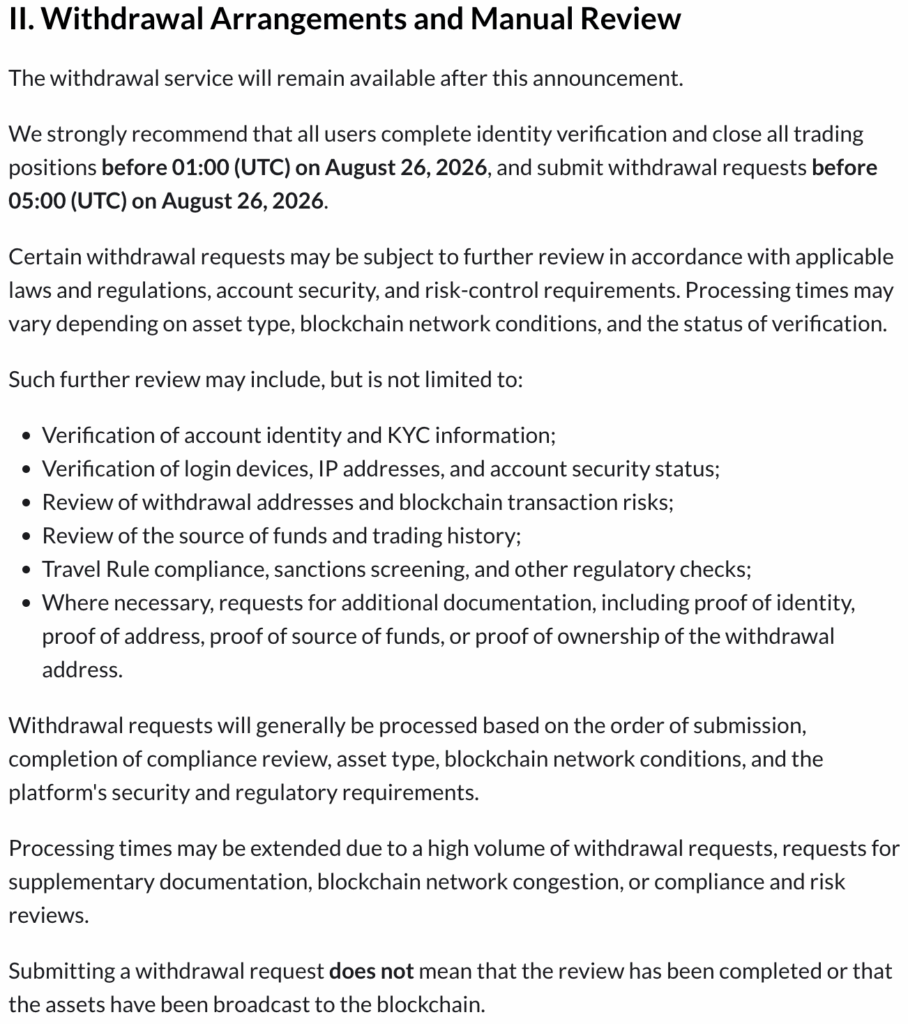
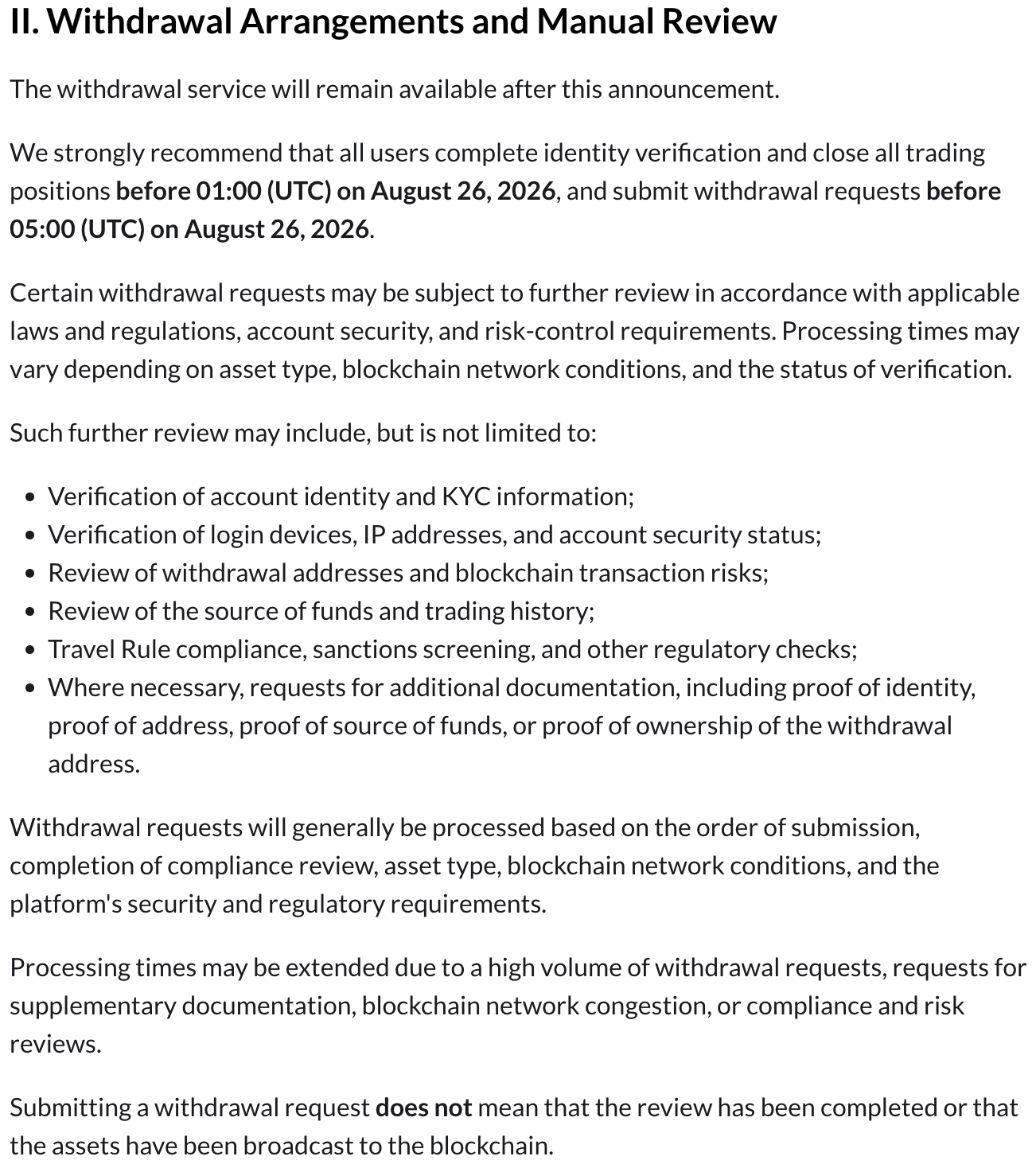
Deposits, new account registrations, and new trades have already been disabled, and by August 21, all services will cease except for withdrawals.
It “strongly” recommends that users submit withdrawal requests before August 26.
Additionally, the exchange warned that because it “generally” processes withdrawals based on the order of submission, “processing times may be extended due to a high volume of withdrawal requests.”
Crypto researcher Quang noted that in the 24 hours after BitMart’s announcement, the exchange only processed 63 withdrawal requests, together worth around $800,000.
They assessed that users with large balances will likely be waiting a long time, and that if you have anything less than $10, “you might as well say goodbye to it.”
Read more: European Union sanctions Justin Sun’s HTX
Crypto analyst Lookonchain also noted that by 7:40 pm EST, the exchange had stopped processing withdrawals for the past eight hours.
The exchange’s API appears to paint a slightly different picture, however. Despite shutting down, it still appeared to have processed $1.8 billion in 24-hour volume.
At time of writing, BitMart is ranked third on CoinGecko for 24-hour volume, behind Binance with $6 billion and Poloniex with over $2 billion.
BitMart was supposed to last another eight years
BitMart had presented a bullish outlook for its operations in this year’s H1 report published earlier this month.
A license to operate in Australia was secured, and the company was expanding in Europe via a partnership with Zero Hash.
Transaction volume was up 300%, BitMart’s assets under management grew roughly “256% period-over-period,” and it had just launched its own prediction market.
BitMart CEO Nathan Chow also said that, “BitMart is eight years old this year. We intend to be here for the next eight, and we are building accordingly.”
He said, “H1 2026 was a market that punished platforms optimizing for the last cycle and rewarded platforms building for the next one. Our numbers reflect that choice.”
Nobody told Chow BitMart was closing
Despite Chow’s statements, he appears not to have gotten the memo about BitMart’s closure.
After its announcement, Chow posted on X claiming “I was not involved in the decision announced today, not consulted on it, and not informed of it. I learned of it when it became public.”
Read more: BitMEX to close, but what about its $270M insurance fund?
He says BitMart told him on July 24 that his role was being terminated and would start winding down immediately. For the next two days, he had no involvement with the company.
Chow thanked his colleagues whom he worked with, and said that he is concerned for BitMart’s users and its employees.
Month of failing crypto firms
Several crypto firms have made major negative announcements this month.
Today, the crypto-based data storage firm Storj announced that it was filing for Chapter 11 bankruptcy.
Crypto firm Movement Labs also filed for Chapter 11 bankruptcy, crypto exchange BitMex announced it was shutting down, and Justin Sun’s HTX was sanctioned by the EU.
In Storj’s case, the firm would continue to operate after the restructuring and give token holders a stake in the newly restructured firm.
Protos has reached out to BitMart for comment and will update this piece should we hear anything back.
Got a tip? Send us an email securely via Protos Leaks. For more informed news and investigations, follow us on X, Bluesky, and Google News, or subscribe to our YouTube channel.


Founded in 2018 as SEBA Bank and rebranded as AMINA in 2023, the lender is overseen by the Swiss Financial Market Supervisory Authority, FINMA. It is one of a small number of regulated banks focused on digital assets. The company offers crypto trading, custody, staking and lending services to institutional and professional investors, and has expanded into Abu Dhabi, Hong Kong and India.
The crypto industry has embraced public markets over the past year, with listings from companies including Circle Internet (CRCL), CoinDesk’s owner Bullish (BLSH), Gemini Space Station (GEMI), BitGo (BTGO) and Figure (FIGR) marking the sector’s strongest IPO wave since 2021.
While the deals initially drew strong investor demand, post-listing performance has been uneven as weaker crypto prices, slowing trading activity and a broader risk-off environment weighed on valuations.
This has prompted some private companies to delay or reconsider their own public market plans. Several major crypto firms, including Kraken parent Payward, Ethereum app builder Consensys, wallet provider Ledger and asset manager Grayscale, have delayed IPO plans while waiting for markets to improve.
As of year-end 2025, AMINA reported 74.6 million francs ($91 million) in Tier 1 capital. It has raised roughly $245 million from investors including Julius Baer, DeFi Technologies and BlackRiver Asset Management.


Technology, artificial intelligence, and prediction market companies spent record sums lobbying Washington in the first half of 2026. New federal disclosures filed this month show the scale of the push.
Anthropic nearly tripled its federal lobbying, outpacing rival OpenAI by more than $1 million.
Anthropic Outspends OpenAI on Federal Lobbying
The Financial Times reported that Anthropic nearly tripled its lobbying expenditure to $3.53 million. The firm added the Treasury Department to its list of lobbied agencies for the first time this quarter.
OpenAI nearly doubled its own spend to a record $2.22 million. Federal rules on new model releases now sit at the top of the industry agenda. Companies also want influence over data center construction, power supply, and more.
“The lobbying offensive has been as much about deterring regulation as making the case for an affirmative government industrial policy that supports the industry,” Amba Kak, co-executive director of AI Now Institute, said.
Follow us on X to get the latest news as it happens
Issue One Counts 324 Lobbyists Across Six Companies
Overall, Issue One counted $41 million in combined spending from January to June. That covers 11 major technology, social media, and AI companies and their trade associations.
The total works out to more than $226,000 per day. The figure rose 8% from $38 million in the same period of 2025.
Six of those companies retained 324 lobbyists during the second quarter alone. The group covers Alphabet, Anthropic, Meta, Microsoft, Nvidia, and OpenAI. That equals roughly one lobbyist for every 1.5 members of Congress.
Meta led second-quarter spending at nearly $6 million. Alphabet followed with $5.3 million, Microsoft with about $3 million, and Nvidia with $1.25 million.
Anthropic reported $1.97 million in lobbying spending for the quarter, its highest since it began lobbying in March 2024. OpenAI spent $1.2 million over the same three months. Notably, four years ago, Anthropic, Nvidia, and OpenAI had no federal lobbyists.
The spending is not limited to tech and AI companies. Prediction market operators have also stepped up their efforts in Washington.
BeInCrypto reported that Kalshi spent $990,000 on lobbying in the first half of 2026. Including outside firms, its total reached nearly $1.8 million. Polymarket keeps a smaller footprint.
Subscribe to our YouTube channel to watch leaders and journalists provide expert insights
The post Anthropic Nearly Tripled Its Lobbying Bill to $3.53 Million in Six Months appeared first on BeInCrypto.
Wellness Influencers Are Pushing ‘Natural’ and Unproven Alternatives to Adderall

The Bitcoin 2026 Bear Market Outlook

Ryanair tells passenger ‘buy your own plane’ after request for new feature


-

 Fashion3 days ago
Weekend Open Thread: Brooks Brothers
-

 Crypto World6 days ago
Grayscale Files For Worldcoin ETF, WLD Registers Sharp Rise
-

 NewsBeat6 days ago
How a former Blue Peter presenter stunned America’s Got Talent judges
-

 Tech15 hours ago
Intel is reversing course and bringing hyper-threading back to its server chips
-

 Tech7 days ago
Sail Virtually Aboard The “Itanic” With IA-64 Emulator
-
 Tech7 days ago
Turtle Beach Command Series KB7 review: a nifty screen-equipped gaming keyboard
-
 Business5 days ago
New Jersey voter registration controversy explained: How 6,600 noncitizens got on the rolls, and what happens next
-
 Entertainment6 days ago
Johnny Depp’s R-Rated Gothic Cult Classic Gets New Release Ahead of Sydney Sweeney Remake
-

 Crypto World5 days ago
Ethics, other provisions in crypto Clarity Act to be further discussed
-

 Politics4 hours ago
Luke Littler dismantles Gerwyn Price to retain title in Blackpool
-
 NewsBeat7 days ago
Shanghai science forum photos show China’s AI and robotics advances in rivalry with US
-
 Sports19 hours ago
Commonwealth Games boxing: Jadumani Singh seals dominant 5-0 win over Pakistan’s Sumama Rehman to enter quarter-finals | Commonwealth Games News
-

 Sports4 days ago
2026 3M Open leaderboard: Scottie Scheffler finds putter in Round 1, sits three back
-

 News Videos4 days ago
The Peugeot Family: How 200 Years of an “Old Money” Dynasty Died in A Boardroom
-

 Fashion3 days ago
16 Dresses for the High Summer Event
-

 Politics1 day ago
Spain sweeps the board at 2026 World Cup with individual awards
-

 Crypto World7 days ago
Andrew Cuomo joins OKX board as crypto exchange expands in U.S.
-
 Entertainment3 days ago
A New Post-Apocalyptic Gundam Anime Series Blasts Into SDCC
-

 News Videos18 hours ago
BITCOIN JUST ENTERED THIS CRITICAL ZONE…
-

 Crypto World1 day ago
XRP Ledger adds $2.6B as RWA inflows rank second
You must be logged in to post a comment Login