
Crypto World
Proposed US Stablecoin Yield Restriction May Fuel International Crypto Competition


Key Takeaways
- Proposed US restrictions on stablecoin yields may redirect investors to international platforms.
- Foreign jurisdictions could capture early-adopter advantages in stablecoin return offerings.
- Asian financial hubs prioritize blockchain infrastructure, tokenization, and enterprise stablecoins
- Clear regulatory frameworks overseas may draw capital away from American crypto markets.
- Global competition for stablecoin yield services escalates as nations refine regulatory approaches.
A proposed American prohibition on stablecoin yield distributions could catalyze international markets to develop competing alternatives. Nations beyond US borders may rapidly introduce yield-bearing products that domestic users cannot legally access. This regulatory divergence could fundamentally alter stablecoin business models as foreign regulators and issuers adapt to emerging market dynamics.
Current US Senate deliberations on cryptocurrency legislation include a contentious proposal to limit third-party platforms from offering stablecoin yields. Traditional banking interests have advocated for this restriction, while digital asset proponents strongly oppose it, creating ongoing political gridlock. This regulatory vacuum presents significant opportunities for international competitors to capture market share in stablecoin services.
Yield generation has become a primary attraction for stablecoin holders, enabling passive returns on digital dollar equivalents. Should the United States implement restrictive measures, other nations may accelerate development of permissive regulatory structures. Foreign stablecoin providers could consequently secure competitive positioning, capturing investment capital currently domiciled in American markets.
International Markets Positioned to Offer Stablecoin Returns
Australia and comparable regulatory environments have established specific exemptions allowing stablecoin issuers to distribute yields to holders. These progressive frameworks enable product innovation while maintaining compliance with broader financial regulations. Currently, most global stablecoin platforms restrict yield payments to avoid conflicts with traditional banking regulations.
Should American lawmakers proceed with prohibition measures, the international competitive landscape could transform dramatically, encouraging worldwide regulators and issuers to reconsider their stablecoin yield strategies. Leading financial centers may leverage this regulatory gap to enhance their cryptocurrency service ecosystems. This dynamic could intensify rivalry among jurisdictions competing to dominate digital dollar infrastructure.
Stablecoin yield platforms may experience accelerated international expansion if US limitations take effect. Emerging markets could introduce superior yield rates or novel structural approaches to attract users. American investors may increasingly seek offshore alternatives offering greater flexibility in stablecoin products.
Asian Financial Institutions Embrace Blockchain Infrastructure
Prominent Asian financial institutions are concentrating investment on blockchain technology frameworks rather than direct cryptocurrency holdings. They are investigating tokenization of traditional financial instruments and institutional stablecoin issuance as strategic priorities. This approach emphasizes distributed ledger applications while treating speculative crypto assets like Bitcoin and Ethereum as peripheral concerns.
Asset management firms demonstrate greater engagement with cryptocurrency product creation, attempting to diversify client portfolio options. Less restrictive custody regulations enable them to examine stablecoin yield structures more aggressively. These institutions carefully evaluate partnership opportunities to ensure regulatory compliance and robust security protocols.
Stablecoin yield products are becoming increasingly central to Asian financial planning. Regulatory transparency and technological readiness shape institutional deployment decisions. Accordingly, international stablecoin ecosystems may experience significant diversification as global participants respond strategically to American policy developments.




The US, UK, and Canada have today launched a new joint initiative aimed at raising awareness of crypto fraud while simultaneously tackling crypto-related organized crime.
Known as “Operation Atlantic,” the initiative will see the US Secret Service (USSS), the UK’s National Crime Agency (NCA), and Canada’s Ontario Provincial Police contact victims, and potential victims, of crypto fraud and advise them on how to keep their crypto assets safe.
A USSS spokesperson told Protos that the operation will last a week, and that the agencies are working alongside “private industry partners” to identify and contact victims of approval phishing.
They added, “Law enforcement personnel will then provide advice and instructions on how to secure their assets to prevent further losses. Additionally, teams will work to trace and seize stolen funds with the goal of victim restitution.”
Read more: How to stay safe on-chain: Three crypto users lose $876K within hours
One particular crypto scam known as “approval phishing” is highlighted in the initiative. This involves a victim signing off on a fake wallet approval request that gives hackers access to their funds.
Some scammers have drained over $600,000 worth of crypto assets through approval phishing. Last year, one of “the largest supply chain attack[s] in history” used approval phishing to redirect funds to a hacker’s account.
This case, despite its scale, only drained $0.05.
The USSS deputy assistant director for the office of field operations claims, “Approval phishing and investment scams cost victims millions in financial loss each year.”
They also claim that Operation Atlantic “will identify and disrupt these scams in near real-time denying criminals the ability to further profit from their crimes.”
Recognising that scammers often impersonate trusted bodies, the NCA and USSS have created a dedicated phone number and webpage to make it easier for callers to verify legitimacy.
Operation Atlantic was inspired by a 2024 Canadian-led program called “Project Atlas.” In this case, $70 million in funds was reportedly kept from scammers while $24 million in stolen funds were frozen.
One crypto fraud body disbands, another takes its place
Last year, the Trump administration disbanded the Justice Department’s crypto enforcement agency in line with an executive order. The agency was created to tackle “complex investigations and prosecutions of criminal misuses of cryptocurrency.”
Since then, the scale of crypto scams orchestrated by criminal gangs in South Asia has been scrutinized by the US and China, and led to the creation of the US “Scam Center Strike Force.”
This body, which aims to bring scam leaders to justice, partnered with social media giant Meta to help take down 150,000 Facebook accounts. The joint operation with Thai authorities led to the arrest of 21 people.
Thailand’s neighbour, Cambodia, has also led a widespread crackdown against crypto scam compounds that reportedly led to the deportation of 48,000 people detained from raids.
Got a tip? Send us an email securely via Protos Leaks. For more informed news and investigations, follow us on X, Bluesky, and Google News, or subscribe to our YouTube channel.
Ripple’s new partner praised it for its infrastructure.
In a statement called “real-time cross-border payouts into the US and Canada,” i-payout, which is a global payments platform enabling businesses to deliver fast, compliant payouts to workers, merchants, and partners, said it has tapped Ripple Payments to enhance its platform.
The main goal of the collaboration is to “enable fast, transparent cross-border payouts” into the two North American markets, while “reducing settlement delays and minimizing working capital requirements for global platforms.”
Integrating Ripple Payments will allow i-payout to leverage “enterprise-grade digital asset infrastructure to accelerate settlement, improve payment transparency, and support high-volume cross-border payout flows.”
“The digital marketplace is important to the future, and Ripple is the right partner to take us there.” — Eddie Gonzalez, President, i-payout
Ripple Payments helps i-payout deliver real-time payouts into the U.S. & Canada, from days to seconds. 🌎
See how →… pic.twitter.com/WWNmJc9utQ
— Ripple (@Ripple) March 16, 2026
The company was founded almost two decades ago, and it operates as an API-first payout platform. The statement reads that before tapping Ripple, cross-border payments into North America could take days to be completed, which ties up working capital and limits how quickly platforms could deliver funds to users.
Last week, the company behind the popular XRP token outlined plans to secure an Australian Financial Services License, which would allow it to expand its payments offering further in the country to financial institutions, fintech businesses, and enterprises.
Separately, Ripple also began a share buyback program to repurchase up to $750 million in shares from employees and investors. According to Bloomberg, this would put its valuation at a whopping $50 billion.
You may also like:
Binance Free $600 (CryptoPotato Exclusive): Use this link to register a new account and receive $600 exclusive welcome offer on Binance (full details).
LIMITED OFFER for CryptoPotato readers at Bybit: Use this link to register and open a $500 FREE position on any coin!


Strategy and Bitmine both announced fresh crypto buys today, while Metaplanet revealed its latest capital raise.
Strategy and Bitmine — the two largest digital asset treasury companies by crypto holdings — disclosed fresh crypto acquisitions on Monday, continuing the aggressive accumulation that defined their activity last week.
Strategy acquired 22,337 BTC for approximately $1.57 billion at an average price of ~$70,194 per Bitcoin. The Michael Saylor-led firm now holds 761,068 BTC, acquired for a total of ~$57.61 billion at an average cost of about $75,696 per coin — meaning the entire treasury sits just 1.8% underwater at current prices, with BTC currently trading around $74,300.
The buy is Strategy’s largest this year so far, and 4,343 BTC larger than the previous purchase, disclosed last week, which had an average per coin price of $70,946, as The Defiant reported.
MSTR shares were trading around $146, up about 5% on the day so far, according to Yahoo Finance.
Also today, March 16, the CEO of Metaplanet, Simon Gerovich, added to that momentum, announcing a new capital raise for the Japanese Bitcoin treasury firm. Metaplanet raised $255 million from investors, and said an additional monetization of its equity could bring in another $276 million. The move gives the firm up to $531 million to invest in Bitcoin, toward Metaplanet’s goal of holding 210,000 BTC.
Per data from Bitcointreasuries, Metaplanet is currently the fourth-largest Bitcoin DAT, holding 35,102 BTC.
ETH Moves
Bitmine Immersion Technologies, the dominant Ethereum treasury company, also reported a fresh purchase this week. Bitmine announced today that its ETH holdings have reached 4,595,562 tokens, at an average price of $2,185 per token. The firm bought 60,999 ETH in the past week, per a press release. The latest purchase is only slightly larger than the previous week’s of 60,976 ETH, but both are notably above Bitmine’s average weekly buy of 45,000-50,000 ETH.
Bitmine now owns 3.81% of the total ETH supply, advancing toward its stated “alchemy of 5%” target. Chairman Tom Lee also noted that Bitmine acquired 5,000 ETH directly from the Ethereum Foundation to enable the EF to fund its operations without selling into the open market.
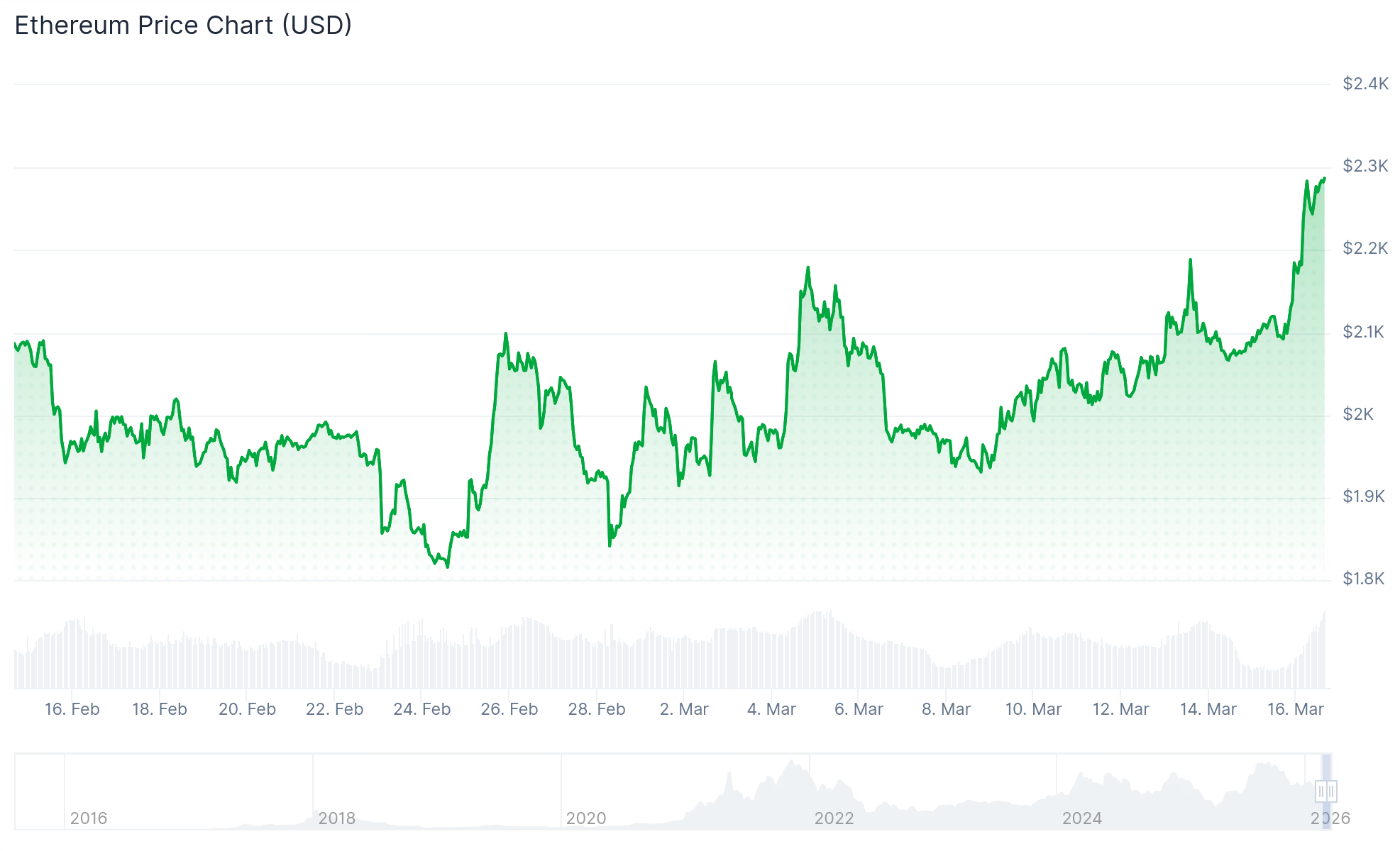
BMNR shares rallied 11% today, trading at $22.80, per Yahoo Finance. The spot price of ETH is up over 9% today to trade near $2,300.
The moves are part of a broader wave of institutional DAT activity. As The Defiant reported in August, DAT companies collectively held over $100 billion in digital assets at the time, led by publicly listed companies such as Strategy, Metaplanet, and SharpLink Gaming. The crypto treasury strategy for public firms moved from an experiment, led by Strategy, to a trend last year, as The Defiant reported.
This article was written with the assistance of AI workflows. All our stories are curated, edited and fact-checked by a human.
Crypto World
Ethereum Mainnet Reclaims Activity Dominance as Pepeto the God of Frogs Draws $7.99 Million and HYPE Rallies
The crypto market news today is looking strong for Ethereum holders and anyone watching network activity. Recent data shows that Ethereum’s mainnet is seeing a comeback in daily active addresses, beating all layer 2 solutions combined for the first time in months, according to CoinDesk.
This shift is one of the most significant stories in crypto market news today because it proves the base layer still matters. Meanwhile, the real presale opportunity lies with Pepeto the God of Frogs, a mythology backed project positioned for massive returns because of its real meme economy infrastructure.
Ethereum’s mainnet is now processing more daily active addresses than all Layer 2 networks combined. The comeback shows that even with higher fees, users still value the security that only the base layer delivers.
High value transactions, DeFi protocols, and institutional capital are choosing mainnet. This puts Ethereum as a key holding heading into 2026, per Bloomberg.
Top market movers to position in for 2026
1. Pepeto the God of Frogs: The mythology that commands $7.99 million
If you are hunting for a mythology that transforms a presale into a movement, Pepeto the God of Frogs is building a kingdom on real infrastructure that has drawn $7.99 million from believers across the meme economy. The God of Frogs mythology solves the meme economy’s critical infrastructure problem by uniting swapping, bridging, and verification under one kingdom.
PepetoSwap delivers zero tax cross chain meme trading. Pepeto Bridge connects fragmented liquidity. Pepeto Exchange curates only verified tokens for the kingdom. All three products are close to being ready under the PEPE cofounder’s direction. SolidProof has verified every contract that anchors the kingdom. The PEPE cofounder who built $7 billion commands the build with his reputation staked alongside the believers.
Over $7.99 million has flowed into the presale, with the God of Frogs sitting at just $0.000000186 per token while over 4 billion tokens have been permanently burned. The mythology targets 269x at $0.00005 and 537x at $0.0001, and 200% APY staking compounds every position daily.
The mythology is not aesthetic decoration. It is the cultural force that transforms meme coin traders into loyal kingdom subjects who carry conviction through every market condition.
2. Ethereum
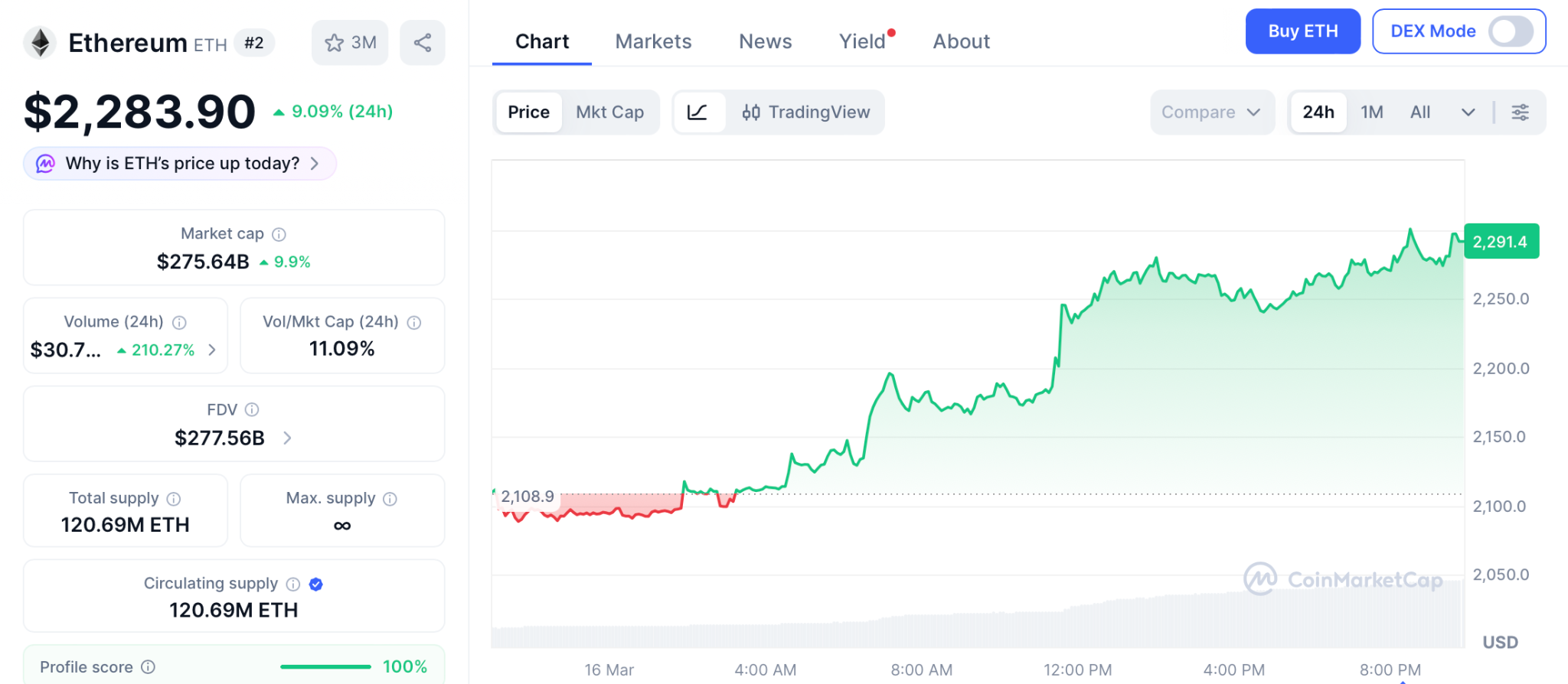
ETH trades at $2,283 on March 16 according to CoinMarketCap. Mainnet dominance returning is some of the most bullish crypto market news today for holders.
Smart contract activity and DeFi protocols are still building on mainnet because that is where the real security exists. Price projections for late 2026 call for ETH to push toward $2,600 to $3,000 if the bull cycle continues and institutions keep accumulating.
3. Hyperliquid
HYPE trades at $36 on March 16. The project has seen major activity on its network, including significant daily revenue and leading open interest figures. Bullish price targets sit in the $40 to $55 range by year end if market conditions stay strong.
Conclusion
The crypto market news today confirms that the strongest presale opportunities combine mythology, infrastructure, and founder credibility into something that commands conviction. The God of Frogs has spoken. The kingdom is being built on SolidProof verified contracts, three products approaching launch, and a mythology that commands loyalty no marketing budget can manufacture.
The gates will not remain open much longer. When exchange listings arrive and the God of Frogs enters the open market, the presale believers will rule the kingdom while everyone else watches from outside.
Click To Visit Pepeto Website To Enter The Presale

FAQs
What is the biggest crypto market news today for traders?
Ethereum mainnet reclaiming activity dominance is major. But the real opportunity is Pepeto the God of Frogs with $7.99 million in presale capital, SolidProof verification, and three meme economy products approaching exchange listings.
Why is Pepeto the God of Frogs attracting so much capital?
The PEPE cofounder’s $7 billion track record, SolidProof verified contracts, and three infrastructure products create a mythology that commands conviction no marketing can replicate.
How does Pepeto compare to Ethereum for long term growth?
Ethereum provides stability but limited percentage upside from its massive market cap. Pepeto the God of Frogs at $0.000000186 with the PEPE cofounder offers return potential ETH cannot structurally deliver.
Disclaimer: This is a Press Release provided by a third party who is responsible for the content. Please conduct your own research before taking any action based on the content.
On-chain data shows that two early crypto investors purchased millions of dollars worth of ETH today, while Bitmine continued its weekly purchases.
Ethereum (ETH) is outpacing other large-cap crypto assets today, March 16, gaining over 9% in the past 24 hours. The price surge comes against a backdrop of large ETH buys, including from two early crypto investors, on-chain data shows.
ETH briefly touched $2,300 today and is currently trading around $2,280, up 9% on the day. Bitcoin (BTC) is up 2.8% today, while the remaining top-20 large-caps are mostly seeing gains between 2-6%. After ETH, Layer 1 Cardano (ADA) is up the most, gaining about 8% today, while total market cap surged 3.4%.
While today’s rally pushed ETH to its highest price in a month, the asset is still down about 30% from its mid-January levels, when ETH was trading over $3,300, and over 50% below its all-time high near $5,000, which it hit last August.

The move has been accompanied by a flurry of high-profile accumulation. Erik Voorhees, the founder of ShapeShift and one of Bitcoin and crypto’s earliest and most vocal advocates, today purchased nearly $50 million worth of ETH via two separate transactions at an average price of $2,098 per token, Lookonchain reported, citing data from Arkham. The on-chain analytics firm noted that this is Voorhees’ first ETH purchase in two years.
Separately, Arkham also today flagged that pseudonymous early Ethereum participant 0xbilly — who was an active voice in governance forums in Ethereum’s early days — purchased more than $17 million worth of ETH for about $2,270 per coin.
Corporate accumulation, at least from the largest ETH holders, is also continuing. Today, Tom Lee’s Bitmine announced its latest ETH purchase — slightly higher than last week’s and well above its weekly average — continuing to double down on its target of holding 5% of the Ethereum supply, as The Defiant reported.
Meanwhile, 5,000 ETH of Bitmine’s latest buy (worth over $10 million) was purchased from the Ethereum Foundation itself in an over-the-counter sale over the weekend.
The surge comes at a moment of renewed discussion and interest in Ethereum’s roadmap. The Ethereum Foundation recently outlined its 2026 protocol priorities, with a focus on scalability, user experience, and security ahead of the anticipated Glamsterdam upgrade. More recently, on Friday, the Foundation published the EF Mandate, a part manifesto, part guide for the ecosystem and the EF that has sparked renewed debate.
This article was written with the assistance of AI workflows. All our stories are curated, edited and fact-checked by a human.


The deal values Abra at $750 million pre-money.
Digital asset wealth management platform Abra is heading to the public markets. Abra Financial Holdings announced today it has entered into a definitive business combination agreement with New Providence Acquisition Corp. III (Nasdaq: NPACU). The combined company is expected to list on Nasdaq under the ticker “ABRX.”
Founded in 2014, Abra offers institutions and high-net-worth clients a suite of crypto-native services, including segregated custody, trading, yield strategies, collateralized lending, and advisory, through its SEC-registered investment advisor.It recently launched USDAF, a yield-bearing Solana-native synthetic dollar, extending its reach into decentralized finance (DeFi).
The deal values Abra at $750 million pre-money, with existing backers — including Blockchain Capital and Pantera Capital — rolling 100% of their interests into the combined entity. The transaction could deliver up to $300 million in cash held in trust, subject to redemptions. Cantor Fitzgerald is acting as financial and capital markets advisor to Abra.
Abra previously faced some regulatory headwinds. The SEC filed charges against Abra’s parent entity, Plutus Lending, for failing to register its Abra Earn lending product and for operating as an unregistered investment company. The case was ultimately settled in August 2024, with Abra consenting to an injunction and agreeing to pay civil penalties without admitting or denying the allegations.
This article was written with the assistance of AI workflows. All our stories are curated, edited and fact-checked by a human.
Crypto World
South Korea fines Bithumb $24 million, orders 6-month partial suspension over AML violations


Bithumb, one of South Korea’s leading crypto exchanges, has been fined by the country’s anti–money laundering and counter-terrorism financing agency.
South Korea’s Financial Intelligence Unit (FIU) has slapped a 36.8 billion won ($24.6 million) fine and ordered a six-month partial suspension after finding millions of violations of the country’s anti-money laundering rules.
The sanctions stem from violations of the Act on Reporting and Using Specified Financial Transaction Information, the Financial Services Commission said, according to local media.
According to the FIU, Bithumb committed about 6.65 million violations. Around 3.55 million involved failures to carry out required customer identity verification, while 3.04 million were related to cases where the exchange failed to properly block transactions that should have been blocked.
The suspension targets services for newly registered users. Existing customers will still be able to trade and move funds on the platform, according to initial reports on these sanctions.
Regulators also issued personnel penalties. Bithumb’s chief executive received a reprimand warning, while the exchange’s reporting officer was suspended for six months.
The violations surfaced during on-site inspections of South Korea’s five largest crypto exchanges, Upbit, Bithumb, Coinone, Korbit and Gopax, conducted between 2024 and 2025.
The case comes as South Korean regulators tighten oversight of the crypto market. Last year, the FIU handed Dunamu, the operator of the country’s largest exchange, Upbit, a three-month partial suspension and a 35.2 billion won fine for compliance gaps. Korbit, a rival platform, faced a smaller penalty of 2.73 billion won, along with institutional warnings.
Bithumb, founded in 2014, ranks among the largest exchanges in South Korea by trading volume, according to CoinGecko data. The partial suspension comes just a month after Bithumb mistakenly distributed billions of dollars worth of bitcoin to users.
CoinDesk has reached out to Bithumb for comment, but hasn’t heard back at the time of writing.
Crypto World
PayPay (PAYP) Stock Surges 16% Following Nasdaq IPO Launch and Positive Analyst Coverage

Key Takeaways
- PayPay (PAYP) set its IPO price at $16 per ADS on March 11, coming in under the anticipated $17–$20 range, generating approximately $880 million in proceeds
- The stock launched on Nasdaq March 12 with an opening price roughly 19% higher than the offering price, establishing a company valuation near $12.7 billion
- PAYP closed Friday March 13 at $21.14, representing a 16.41% gain and pushing market capitalization toward $14.1 billion
- Macquarie launched coverage with an Outperform recommendation and $22.90 target, highlighting PayPay’s commanding 65% QR code market position and 72 million user base
- ARK Invest reportedly purchased PAYP shares during the initial surge, while CEO Ichiro Nakayama mentioned potential for Tokyo Stock Exchange dual-listing
PayPay Corporation launched a successful Nasdaq debut last week, trading significantly above its initial public offering price and attracting early analyst attention within its first few trading days. The Japanese mobile payment platform, backed by SoftBank, has officially joined the public markets, capturing considerable Wall Street interest.
PayPay Corporation American Depository Shares, PAYP
The company established its IPO pricing at $16 per ADS on March 11 — a figure that fell short of the marketed $17 to $20 range. This cautious pricing strategy reflected broader market uncertainty stemming from international geopolitical developments. The offering generated approximately $880 million through the sale of roughly 55 million ADSs. Lead underwriters included Goldman Sachs, J.P. Morgan, Mizuho, and Morgan Stanley.
When trading commenced on March 12, PAYP launched approximately 19% above its offering price. The momentum continued building throughout the session.
By the closing bell on Friday March 13, PAYP settled at $21.14 — representing a $2.98 increase, or 16.41% daily gain. Trading volume exceeded 14 million ADSs during the session. The stock reached an intraday peak of $21.98 while touching a low of $19.81.
This Friday closing price elevated PayPay’s market capitalization to approximately $14.1 billion, rising from the roughly $12.7 billion valuation established at the IPO opening. Extended-hours trading showed modest retreat to around $20.80.
The public offering represents the most significant U.S. IPO from a Japanese enterprise in ten years. It additionally marks SoftBank’s first substantial U.S. public market debut of a majority-controlled portfolio investment since Arm’s 2023 listing.
Macquarie Launches Coverage with Bullish Stance
On March 16, Macquarie began coverage of PAYP with an Outperform designation and established a $22.90 price objective.
The investment firm highlighted PayPay’s commanding presence in Japan’s QR code payment ecosystem — controlling approximately 65% market share and serving roughly 72 million users, equivalent to about three-quarters of Japan’s smartphone-equipped population. QR code transactions account for one in five cashless payments across Japan.
Macquarie observed that PayPay is evolving beyond a simple payment wallet into a comprehensive digital financial services platform encompassing money transfers, savings products, lending solutions, and investment services. The platform currently serves around 16 million card holders, maintains 9.7 million bank accounts, and manages 1.54 million securities accounts.
Japan’s cashless payment adoption reached 42.8% in 2024. Government objectives target 65% penetration by 2030, while QR code payment adoption has expanded at a compound annual growth rate of approximately 75% from 2019 through 2024.
Macquarie projects PayPay’s revenue will achieve ¥456.5 billion in the fiscal year concluding March 2027, reflecting 21.6% year-over-year growth, while operating profit is expected to surge 73.6% to ¥135.1 billion.
Future Outlook for PAYP
CEO Ichiro Nakayama ceremonially opened Nasdaq trading on debut day. Subsequently, he has expressed receptiveness to potentially pursuing a dual listing on the Tokyo Stock Exchange.
ARK Invest was documented as having acquired PAYP shares during the early post-listing momentum — demonstrating institutional appetite for the stock.
PayPay is currently executing the integration of Line Pay operations, with complete merger completion scheduled for late March 2026.
For the twelve-month period ending December 31, 2025, PayPay’s payment division gross merchandise volume surpassed ¥15 trillion.

The US Secret Service, UK National Crime Agency, and Canadian authorities have partnered to disrupt fraudulent schemes related to crypto, raise awareness of scams, and recover stolen funds.
In a Monday notice, law enforcement agencies from the three countries — including Canada’s Ontario Provincial Police and the Ontario Securities Commission — said that they had launched “Operation Atlantic,” focusing on identifying people at risk of losing or those who had already lost crypto through “approval phishing” schemes.
“Approval phishing and investment scams cost victims millions in financial loss each year,” said Brent Daniels, deputy assistant director for the US Secret Service’s Office of Field Operations. The agencies said they hope to identify and disrupt these scams in near real-time.

According to blockchain analytics platform Chainalysis, approval phishing scams involve “the scammer trick[ing] the user into signing a malicious blockchain transaction that gives the scammer’s address approval to spend specific tokens inside the victim’s wallet, allowing the scammer to then drain the victim’s address of those tokens at will.”
According to the Ontario Securities Commission, Operation Atlantic built upon the commission’s Project Atlas. The operation was launched in 2024 by the Ontario Provincial Police with the US Secret Service and targeted crypto fraud networks.
The initiative will also work with the Royal Canadian Mounted Police, the City of London Police, the US Attorney’s Office for the District of Columbia and the UK’s Financial Conduct Authority (FCA).
Related: SEC drops case against BitClout founder with prejudice
Are different phishing scams on the rise?
Phishing scams usually involve different methods, seemingly from legitimate sources, that trick users into giving fraudsters access to their crypto wallets. According to crypto intelligence platform Nominis’ monthly report, phishing attacks increased sharply in February, but the amount stolen in crypto-related scams and exploits overall fell to $49 million from $385 million in January.
Chainalysis launched Operation Spincaster in 2024, targeting “approval phishing” scams, which it reported had resulted in $2.7 billion in crypto stolen between May 2021 and July 2024.
Magazine: All 21 million Bitcoin is at risk from quantum computers
Crypto World
Strategy’s STRC Raises $1.18B in One Week, Buying Seven Times Bitcoin’s Weekly Mined Supply
TLDR:
- Strategy purchased 22,337 BTC last week, surpassing seven times the total weekly mined supply of 3,150 coins.
- STRC recorded $2.2B in weekly trading volume, with a single day hitting $740M — rare for any fixed income product.
- The 11.5% STRC dividend is backed by over $2B cash and $55B in Bitcoin, giving investors yield with BTC exposure.
- At its current pace, STRC could raise $16B more in 2025, growing Strategy’s Bitcoin stack by nearly 30% without MSTR dilution.
STRC, Strategy’s preferred stock, has emerged as a powerful Bitcoin accumulation tool in the market. Last week, the instrument raised $1.18 billion for the company in a single week.
Strategy then used those proceeds to purchase 22,337 Bitcoin. That purchase exceeded seven times the weekly mined supply of 3,150 coins.
The scale of this activity is drawing growing attention across both traditional finance and the broader crypto space.
A Fixed Income Product Unlike Any Other
STRC did not exist eight months ago. Yet, it is now generating trading volumes that no other fixed income product can match.
Last week alone, it recorded $2.2 billion in weekly trading volume. On a single day, volume reached $740 million.
Typically, preferred equity products trade quietly in institutional accounts. However, STRC is behaving more like a high-demand growth asset.
Its 11.5% dividend makes it attractive to income-focused investors. At the same time, every dollar flowing into it converts directly into Bitcoin on Strategy’s balance sheet.
The dividend obligation remains fixed and backed by over $2 billion in cash. Strategy also holds over $55 billion worth of Bitcoin as further backing.
This structure gives investors a yield-bearing product with Bitcoin exposure underneath. That combination is rare in traditional financial markets.
As analyst Rob Wallace noted on X, STRC is “becoming the Bitcoin accumulation machine Saylor has always dreamed of.” The product is eliminating thousands of potential future Bitcoin holders by absorbing supply permanently.
Over the last two weeks, STRC raised $1.557 billion in total. That pace, even conservatively projected, could generate another $16 billion before the end of the year.
Strategy’s Supply Absorption and What It Means for Bitcoin
Strategy is currently purchasing Bitcoin at 2.66 times the global daily mining rate. This means the company is absorbing supply far faster than the network can produce new coins.
As that gap widens, available Bitcoin on the open market continues to shrink. The effect on long-term price dynamics is straightforward to trace.
If STRC raises $16 billion more this year as projected, Strategy’s Bitcoin stack would grow by nearly 30%. Notably, this growth would not dilute common MSTR shareholders.
That structure separates STRC from typical equity raises. It also makes the model more sustainable than critics suggest.
Some market observers have called Strategy’s model a Ponzi scheme. However, similar criticism followed Bitcoin at $1, $100, and again at $10,000.
The company’s approach depends on continued belief in Bitcoin’s long-term appreciation. The historical track record of Bitcoin’s price has so far supported that thesis.
The full scale of this machine has not yet been tested in a bull market. That moment, should it arrive, could reshape the pace of institutional Bitcoin accumulation further.

What the 2026 Oscars revealed about the current political mood in Hollywood

Southwest Airlines to end flights at Washington Dulles, Chicago O’Hare airports

US, UK, and Canada launch ‘Operation Atlantic’ to tackle crypto fraud


-
 Tech5 days ago
A 1,300-Pound NASA Spacecraft To Re-Enter Earth’s Atmosphere
-
Crypto World3 days ago
HYPE Token Enters Net Deflation as HyperCore Buybacks Outpace Staking Rewards
-

 Business6 days ago
ExxonMobil seeks to move corporate registration from New Jersey to Texas
-

 Fashion3 days ago
Weekend Open Thread: Addict Lip Glow
-

 Tech6 days ago
ChatGPT will now generate interactive visuals to help you with math and science concepts
-
Sports2 days ago
Why Duke and Michigan Are Dead Even Entering Selection Sunday
-

 NewsBeat5 days ago
Residents reaction as Shildon murder probe enters second day
-
 NewsBeat7 days ago
Pagazzi Lighting enters administration as 70 jobs lost and 11 stores close across Scotland
-

 Business5 days ago
Search Enters Sixth Week With New Leads in Tucson Abduction Case
-

 Business23 hours ago
Search for Savannah Guthrie’s Mother Enters Seventh Week with No Arrests
-

 Business2 days ago
US Airports Launch Donation Drives for Unpaid TSA Workers as Partial Government Shutdown Enters Fifth Week
-
Crypto World2 days ago
Coinbase and Bybit in Investment Talks: Could Bybit Finally Enter the US Crypto Market?
-

 NewsBeat5 days ago
I Entered The Manosphere. Nothing Could Prepare Me For What I Found.
-

 Business7 days ago
Search Enters 39th Day with FBI Tip Line Developments and No Major Breakthroughs
-

 Business2 days ago
Country star Brantley Gilbert enters growing non-alcoholic beer market
-

 Business8 hours ago
Australian shares drop as Iran war enters third week
-
 Crypto World6 days ago
Will Chainlink price reclaim $10 amid volatility squeeze?
-

 Sports5 days ago
PWHL, Senators discussing plan to keep Charge in Ottawa
-

 Crypto World8 hours ago
Crypto Lender BlockFills Enters Chapter 11 with Up to $500M in Liabilities
-

 Sports3 days ago
College Basketball Best Bets: Conference Tournament Semifinal Picks


You must be logged in to post a comment Login