

Crypto World
Pudgy Penguins Boosts Retail Presence With Target Trading Card Debut


Pudgy Penguins is taking another step to move its NFT brand into mainstream retail with a new nationwide rollout at Target stores in the United States. The project says its Vibes Series 3 trading card set will be released through Target, expanding the reach of the trading card game beyond its earlier distribution.
According to a press release shared with Cointelegraph, Vibes Series 3 represents the biggest retail expansion Pudgy Penguins has made for the card line so far and brings the total number of circulated cards to 15 million. The set is also positioned as a more feature-rich edition, adding new gameplay mechanics alongside original artwork, plus appearances from characters associated with the Moonbirds collection.
Key takeaways
- Pudgy Penguins is expanding its Vibes trading card game into U.S. retail via a nationwide Target rollout.
- Vibes Series 3 is described as the project’s largest retail push to date and lifts total circulated cards to 15 million.
- The new card set includes additional gameplay mechanics and original artwork tied to Moonbirds characters.
- Pudgy Penguins continues to market its NFT IP as a broader entertainment franchise through toys, licensing, and blockchain gaming.
A trading card push with retail-first distribution
The move to Target is important because trading cards—unlike on-chain collectibles—rely heavily on physical availability, in-store discovery, and shelf presence. By tying Vibes Series 3 to a major U.S. retailer, Pudgy Penguins is effectively widening the funnel from NFT holders and crypto-native audiences toward casual consumers who may never interact with the underlying Ethereum-based collection.
The project developed Vibes in partnership with Orange Cap Games, and Series 3 is the next step after two prior releases. Pudgy Penguins previously framed Vibes as an avenue to extend its intellectual property beyond digital ownership, and the retail rollout underscores that strategy by prioritizing distribution and physical engagement.
With Vibes Series 3, the project also emphasizes creative integration: the set features original artwork and includes appearances from Moonbirds characters. That kind of cross-collection presence is a way to tap into existing fan communities while giving the franchise a reason to be collected and discussed in the broader collectible market.
From Ethereum collectibles to consumer goods
Pudgy Penguins has spent several years translating its Ethereum NFT brand into consumer products and entertainment experiences. The trading cards arrive after earlier expansion into toys and retail distribution.
In 2023, Pudgy Penguins’ physical toys entered more than 2,000 Walmart stores, and in May 2024 CEO Luca Netz said that more than 1 million toys had been sold during the preceding 12 months, according to a statement shared with Cointelegraph (see PR Newswire).
There is also an incentive layer tied to NFT ownership. The project’s licensing model allows NFT holders to receive 5% of net revenue from physical products featuring their individual penguins. That approach is designed to maintain a connection between on-chain holders and off-chain merchandise—while still building a consumer-friendly storefront.
In other words, Pudgy Penguins is trying to sustain two value paths at once: mainstream retail can expand awareness and adoption of the brand, while its licensing structure aims to keep NFT communities financially and emotionally engaged.
Gaming and entertainment extensions—plus shifting priorities
Retail is only one front in Pudgy Penguins’ efforts to build an entertainment franchise. The project has also pushed into blockchain gaming, describing games as a way to bring its characters to wider audiences.
In 2025, Pudgy Penguins launched the skill-based game Pengu Clash on The Open Network, and at the time Netz pointed to gaming as a vehicle for reaching broader audiences (as covered in a press release shared with Cointelegraph via PR Newswire).
Later, the project released a mobile title called Pudgy Party in August 2025. Pudgy Penguins said at launch that downloads exceeded 1 million. However, the company later said on Monday that it would halt further development of Pudgy Party and redirect resources to a browser-based game called Pudgy World, according to earlier coverage from Cointelegraph (Pudgy Penguins winds down Pudgy Party mobile game).
This pattern—launching one experience while eventually reallocating effort to another—suggests the brand is treating games as iterative experiments. The Target rollout for Vibes Series 3 can be viewed through the same lens: test, measure consumer response, and focus distribution where engagement is strongest.
Why this matters for NFT-linked brands
For NFT projects, the critical question has often been whether their IP can live credibly outside crypto rails. Pudgy Penguins’ strategy—physical products, retail partnerships, and entertainment formats layered around its characters—reflects a broader industry push toward “utility” that doesn’t depend solely on token markets.
The Target expansion is likely to be watched closely because it signals a shift from niche trading circles to mass retail visibility. If the cards perform well, it strengthens the case that NFT-derived IP can function like a conventional entertainment brand, complete with recurring releases, collector mechanics, and cross-brand artwork.
Still, the durability of that model depends on more than shelf placement. Investors and users will likely focus on whether Pudgy Penguins can maintain repeat consumer interest across series, expand its retail presence sustainably, and keep enough momentum in its games and merchandise to avoid the stop-start churn that can affect entertainment launches.
Readers should watch next for how Vibes Series 3 performs in-store and whether Pudgy Penguins’ retail push influences other collectible releases tied to its franchise—especially given the project’s history of shifting resources between gaming products as it searches for the most durable audience fit.

US stocks fell this week as investors reacted to disappointing Big Tech earnings, oil above $100 and sharp swings in semiconductor shares.
The Nasdaq lost around 2% between July 19 and July 25. The S&P 500 fell 0.6%, while the Dow dropped 0.4%. Technology stocks faced the heaviest pressure.
Here are the three biggest US stock market stories retail traders need to know.
Big Tech’s AI Bill Shakes Wall Street
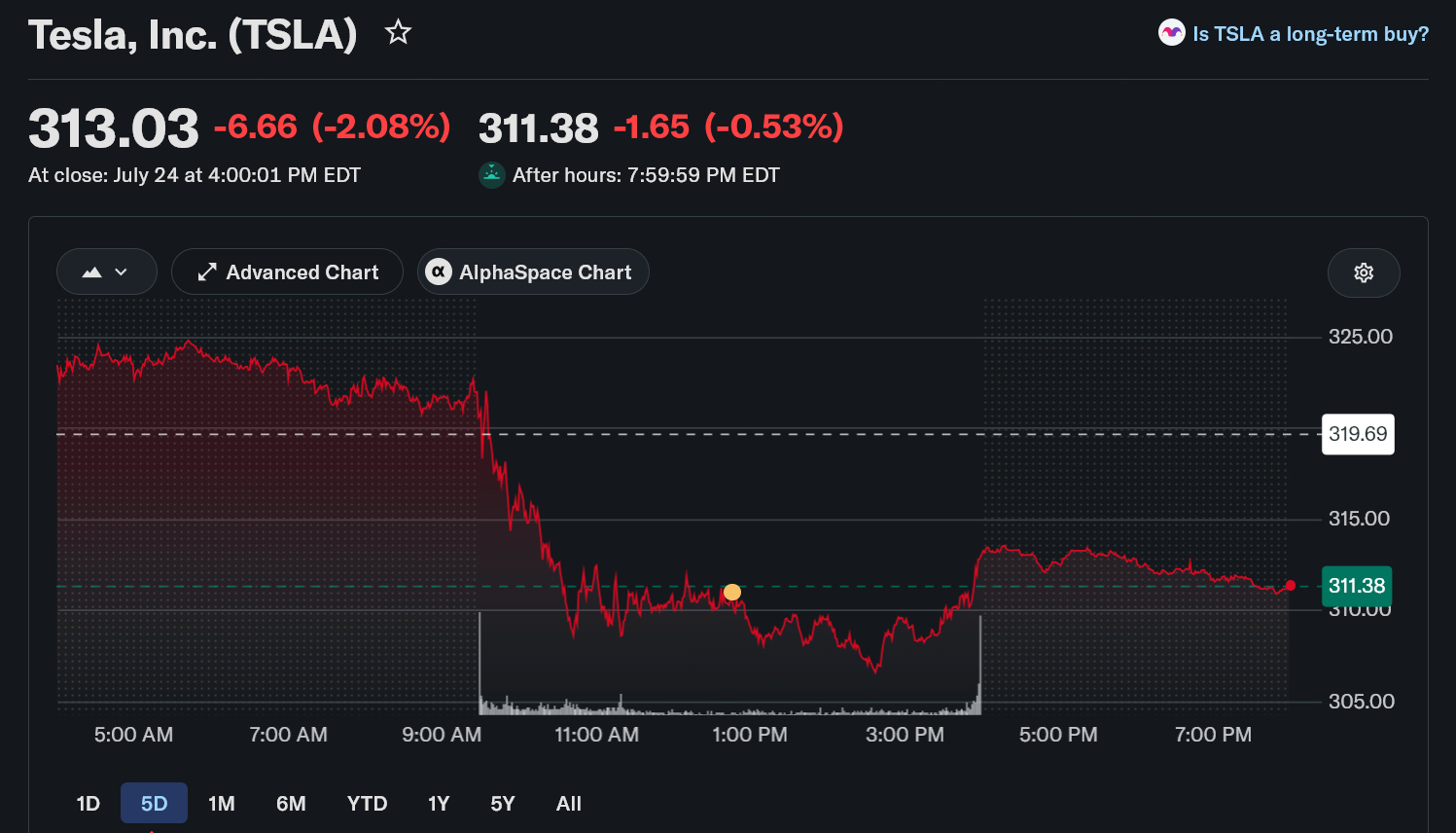
Tesla and Alphabet triggered a broad technology sell-off after their earnings reports raised concerns about the cost of AI investment.
Tesla shares fell 14.5% after the company reported negative free cash flow for the first time in more than two years. Investors also remained concerned about weaker vehicle demand and the cost of funding new products.
Alphabet dropped 7% after raising its expected 2026 capital spending to around $200 billion. The company reported strong cloud growth, but the higher spending forecast overshadowed those gains.

As a result, the Nasdaq fell more than 2% on Thursday. The sell-off also increased pressure on Microsoft, Amazon and Meta ahead of their earnings.
The market has rewarded companies that spend heavily on AI. However, investors now want clearer evidence that this spending will produce stronger profits.
$100 Oil Brings Inflation Fears Back
Brent crude moved above $100 a barrel after rising tensions between the US and Iran raised fears of disruption to global oil supplies.
The price increase quickly spread across financial markets. Treasury yields climbed as traders considered whether higher energy costs could keep inflation elevated.
Higher yields usually put pressure on growth stocks. They reduce the present value of future earnings and make bonds more attractive compared with expensive equities.
The oil rally also hurt companies that depend on fuel or transport. Airlines, logistics firms and consumer businesses could face higher operating costs if crude prices remain elevated.
Meanwhile, energy and defence stocks gained support. Investors moved toward sectors that could benefit from higher oil prices and increased geopolitical risk.
Crypto also faced pressure during the risk-off move. Bitcoin often trades like a high-growth asset when bond yields rise and investors reduce exposure to speculative markets.
Chip Stocks Swing Between Hope and Fear
Semiconductor stocks experienced some of the week’s biggest moves as traders shifted between optimism over AI demand and concern about excessive spending.
The Philadelphia Semiconductor Index rose more than 5% on Tuesday. Micron, Western Digital and Sandisk posted double-digit gains as investors bought the sector after an earlier sell-off.
Super Micro Computer also jumped almost 20% after reporting more than $60 billion in new orders. The update showed that demand for AI servers and data-centre equipment remained strong.
However, the recovery did not last. The semiconductor index fell 4.5% on Friday as wider concerns about AI spending returned.
Intel dropped almost 8% despite issuing stronger-than-expected guidance. Investors focused on its higher investment plans and the cost of competing in advanced chip production.
The moves showed how sensitive semiconductor stocks have become. Strong demand can still support the sector, but high valuations leave little room for disappointing earnings or rising costs.
For retail traders, the main risk remains volatility. AI-related stocks can move sharply even when companies report solid results.
The post Top 3 US Stock Market Stories From This Week appeared first on BeInCrypto.
The firm tracked 113 coins since their token generation event (TGE) price, with only 8 of them now above that price, a median return of -95.7%.
The sample is limited to projects with a market capitalization above $100 million as of July 21, CryptoRank told CryptoPotato.
CryptoRank Study: Eight Exceptions to the Rule
Eight coins included in the survey are in profit, led by HYPE, ONDO, EVA, and NIGHT.
Hyperliquid’s HYPE was up 1,519% from its launch price at the time of the survey’s publication on July 21st. Ondo Finance’s ONDO followed at 101.4%, with EverValue Coin (EVA) and Midnight Network (NIGHT) up a more modest 20.3% and 16.5% respectively.
These figures are revealing, as we can see that even among those that are up, only a small handful showed outsized performance, with six of the eight achieving double-digit increases at best. It’s worth noting that HYPE was also listed in the new S&P Pantera Digital Asset Index, which excluded many high-performing crypto assets, including Bitcoin.
Why the Decline?
CryptoRank states that sell-offs, thin liquidity, and regulatory uncertainty were the main causes of major drawdowns in these projects, although the market has also observed major crashes due to exploits and other factors in the last two years.
Only 7.1% of Tokens Launched Since 2024 Are Still in Profit
Out of 113 projects with a market capitalization above $100M, only 8 are trading above their TGE price, while 105 are already in the red.
This highlights how difficult it has been for newly launched tokens to sustain… pic.twitter.com/PbjCiBD5Jd
— CryptoRank.io (@CryptoRank_io) July 21, 2026
The tokens studied spanned a wide range of niches in the crypto industry, including DeFi, gaming, and various infrastructure projects. The findings come as the broader market recovers, with bitcoin climbing above $66,000 this week on higher ETF inflows and weaker US inflation data.
The post The Harsh Reality of New Crypto: Just 7% of Major Tokens Beat Their Launch Price appeared first on CryptoPotato.

Donald Trump’s threats against Iran and a new wave of tariffs dominated financial markets between July 19 and July 25.
Oil prices climbed as geopolitical risks increased. Meanwhile, trade measures targeting dozens of economies raised fresh concerns about inflation, corporate costs and interest rates.
Here are the five Trump developments that mattered most for markets this week.
1. Iran Threat Sends Oil Above $100
Trump threatened Iran with major military action after further Houthi attacks on commercial shipping. He said Tehran could face consequences if the attacks continued.
The comments immediately increased fears of disruption in the Red Sea and the Strait of Hormuz. Both routes play an important role in global oil and shipping markets.
Brent crude briefly rose above $100 a barrel. Higher oil prices can increase transport and production costs, which may push inflation higher.
That could delay interest rate cuts or force central banks to maintain tighter policy. Technology stocks and Bitcoin also faced pressure as bond yields climbed and investors reduced exposure to riskier assets.
2. Trump’s Tariff Wall Gets Wider
Trump ordered new tariffs of 10% or 12.5% on goods from 60 economies. The affected markets include China, India, the European Union, Japan and South Korea.
The measures cover a large share of US trade. They could raise costs for retailers, manufacturers and companies that rely on imported components.
Businesses may pass some of those costs to consumers. That would keep inflation elevated and make it harder for the Federal Reserve to reduce interest rates.
The tariffs could also hurt corporate profit margins. Consumer goods companies, automakers and technology manufacturers face some of the highest risks.
3. Canada Becomes the Latest Trade Target
Trump announced additional 50% tariffs on around $20 billion of Canadian products. The affected goods include dairy, wine, furniture, cement and sporting equipment.
Energy and critical minerals received exemptions. However, the decision still raised fears of retaliation from Canada and further disruption to North American supply chains.
The Canadian dollar weakened during the week as trade uncertainty increased. US companies that import Canadian products may also face higher costs when the tariffs begin in August.
The dispute could reduce trade between two closely connected economies. It may also increase prices for construction materials and some consumer products.
4. Defence Firms Face a China Supply Chain Test
Trump signed an order tightening restrictions on foreign materials used by US defence contractors. Companies will face tougher rules when seeking permission to buy critical minerals or components from China and other restricted markets.
The order could benefit American rare-earth miners and metal processors. Shares in some domestic suppliers rose after the announcement.
However, defence and aerospace companies may face higher costs during the transition. China remains a major supplier of several minerals used in military equipment and advanced electronics.
Supply shortages could delay production and increase government contract costs.
5. Aluminum Tariffs Get an Investment Clause
Trump introduced a new system linking aluminum tariff relief to investment in US production. Companies that build or expand American smelters may import a matching amount of aluminum at a reduced tariff rate.
The policy could support US aluminum producers and encourage new domestic investment. It could also create higher costs for businesses that cannot qualify for the reduced rate.
Automakers, construction companies and beverage manufacturers use large amounts of aluminum. Any rise in metal prices could affect their margins and eventually reach consumers.
Overall, Trump’s actions this week placed oil, tariffs and inflation back at the centre of market attention. Investors will now watch whether the measures trigger retaliation, higher consumer prices or a wider Middle East conflict.
The post Top 5 Trump News That Moved Markets This Week appeared first on BeInCrypto.


Cointelegraph is committed to providing independent, high-quality journalism across the crypto, blockchain, AI, and fintech industries.
All news, reviews, and analyses are produced with full journalistic independence and integrity. For more details on our standards and processes, please read our Editorial Policy.
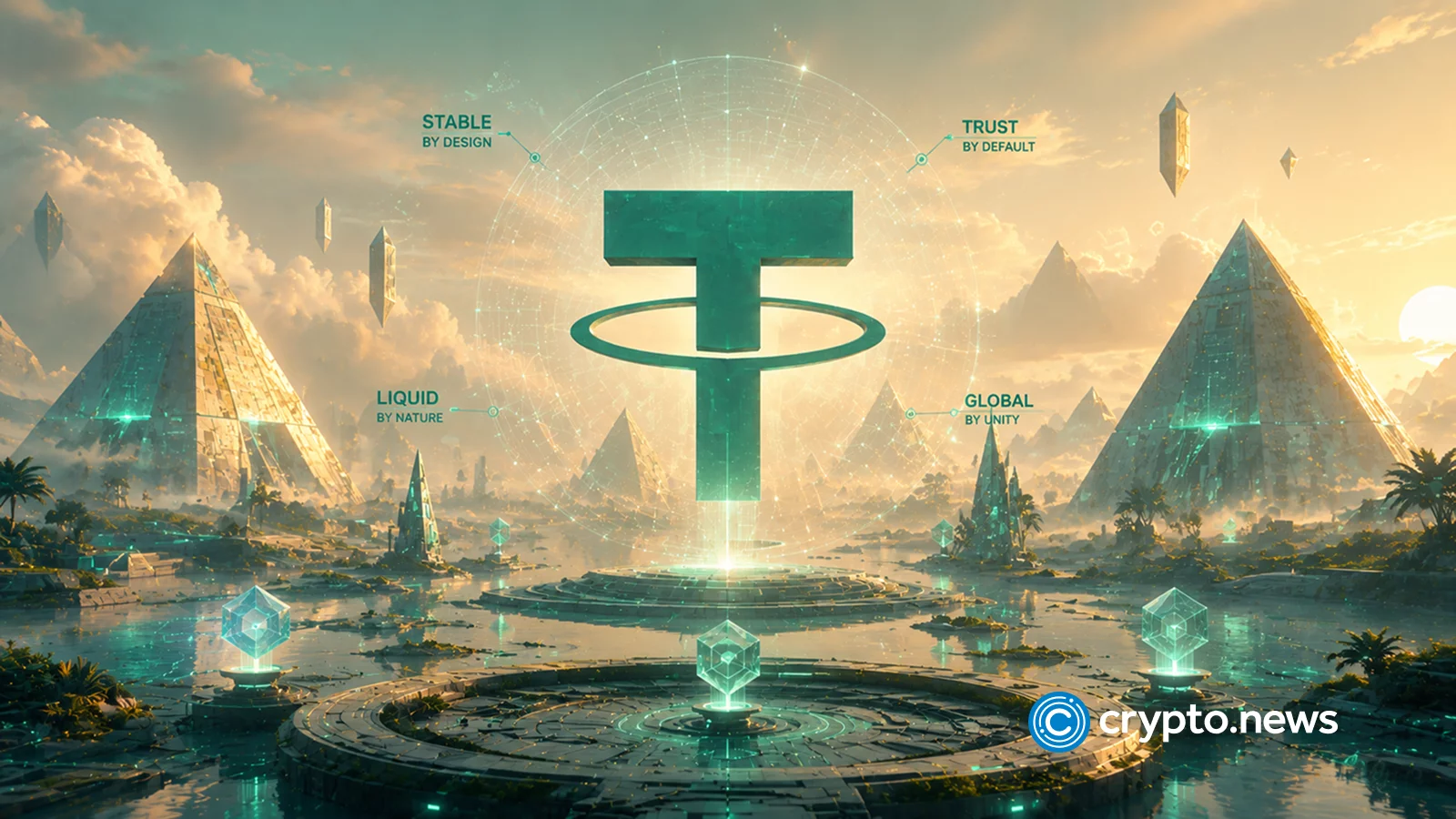
The world’s largest stablecoin now travels between blockchains as USDT0, a version its builders insist is not a wrapped token, while its mechanics lock collateral in an Ethereum vault and mint claims elsewhere. Here is how it actually works, who runs it, what the trust stack contains, and why a gas tank on a new chain runs on it.
Summary
- USDT0 is the omnichain version of Tether’s USDT, launched in January 2025, that lets the world’s largest stablecoin operate on blockchains where Tether has not deployed a native contract.
- It runs on LayerZero’s Omnichain Fungible Token standard: real USDT is locked in a contract on Ethereum, and USDT0 is minted one-to-one on destination chains, with transfers executed by burn-and-mint messaging, not bridge liquidity pools.
- It is operated not by Tether but by Everdawn Labs under license, a structural nuance that defines the trust stack: holders carry Tether’s reserve risk plus the lockbox contract plus LayerZero’s verification layer.
- The system has scaled fast: more than $50 billion in cumulative transfers by late 2025, daily volumes in the hundreds of millions, deployments across chains from Arbitrum to Plasma, and a starring role as the native gas token of Stable’s payments chain.
- The marketing insists USDT0 is not a wrapped token. The mechanics are lock-and-mint. Resolving that tension honestly is most of what a holder needs to understand.
Every successful monetary instrument eventually faces the geography problem: the money is in one place, and the demand is in another. Gold solved it with certificates, banks with correspondent accounts, and Tether, whose USDT is the most used digital dollar on earth, faced it acutely by 2024, when the stablecoin’s natural habitat, Ethereum and Tron, no longer contained the frontier of activity.
New chains launched monthly, each wanting the deepest dollar in crypto, and Tether’s options were unattractive: deploy a native USDT contract on every chain, multiplying operational and compliance surface with each launch, or let third-party bridges wrap USDT into a zoo of incompatible IOUs, the wrapped-asset sprawl that fragmented liquidity and produced some of crypto’s worst exploits.
USDT0, launched in January 2025, is the third option: one canonical collateral pool, on Ethereum, feeding a single standardized representation that travels anywhere, minted and burned by cross-chain messages instead of shuffled through bridge pools.
Eighteen months later, it has moved more than $50 billion cumulatively, colonized the new-chain frontier, and become something no wrapped asset ever was: the native gas token of an entire blockchain. Its operators insist, emphatically, that it is not a wrapped token. Its mechanics are a lockbox and a mint. Both statements are doing work, and understanding the gap between them is the point of this guide.
The mechanics, step by step
USDT0 is built on LayerZero’s Omnichain Fungible Token standard, OFT, and the cleanest way to understand it is to follow one dollar through the system.
Start with issuance. A market maker or exchange holding native USDT on Ethereum deposits it into the USDT0 lockbox, a smart contract on Ethereum mainnet that serves as the system’s single collateral vault. Upon deposit, an equal amount of USDT0 is minted on the destination chain of choice, Arbitrum, Berachain, HyperEVM, Plasma, Stable, or any other connected network. The mainnet USDT never leaves the vault; what circulates elsewhere is the omnichain representation, backed one-to-one by the locked collateral, with supply across all chains reconciled against the vault’s balance and attested through on-chain proof-of-reserves.
Now move it. When a holder sends USDT0 from chain A to chain B, no asset crosses anywhere. The OFT contract on chain A burns the tokens; LayerZero’s messaging layer carries a verified instruction to chain B; the contract on chain B mints the same amount to the recipient. The verification is the system’s load-bearing component: each message is attested by a configurable set of Decentralized Verifier Networks, DVNs, independent parties that confirm the source-chain burn actually happened, and delivered by an executor on the destination chain.
Because transfers are burn-and-mint against one canonical pool, there are no per-chain liquidity pools to drain, no slippage between chain versions, and no bridge inventory to exploit in the way that destroyed earlier designs; the attack surface concentrates instead in the messaging layer and its verifier configuration, which is where any honest risk analysis must spend its time.
Exit works in reverse: burn USDT0 anywhere, unlock native USDT from the Ethereum vault, redeem through Tether’s ordinary channels. The system also extends beyond the dollar, with the same architecture carrying XAUT0, the omnichain version of Tether Gold, and the roster of connected chains has grown to include most of the venues where new stablecoin activity concentrates.
Who actually runs it
Here is the structural fact most coverage elides, and it matters more than any throughput statistic: USDT0 is not operated by Tether.
The system is built and run by Everdawn Labs, a separate company operating under license from Tether, announced as the deployment partner in January 2025 for chains where Tether chose not to run a native mint. Tether’s relationship to the system is that of licensor, collateral issuer, and, as of February 2026, strategic investor in LayerZero Labs itself, an investment that formalized the alignment between the dollar, its omnichain vehicle, and the messaging layer underneath both. The arrangement mirrors patterns elsewhere in stablecoin infrastructure, where issuers increasingly delegate chain expansion to specialized partners instead of operating every deployment themselves.
For a holder, the delegation defines the trust stack, and the stack should be enumerated, not gestured at.
Layer one: Tether’s reserve risk, the same exposure any USDT holder carries, that the collateral behind the dollar is what the attestations say.
Layer two: the lockbox, an Ethereum smart contract whose integrity secures the entire omnichain supply; a flaw there is a flaw everywhere at once.
Layer three: LayerZero’s messaging, specifically the DVN configuration chosen for USDT0, since the verifiers who attest cross-chain messages are the parties who could, in a failure or compromise scenario, authorize mints that should not exist.
Layer four: Everdawn’s operational competence across all of it. Native USDT on Ethereum or Tron is a direct claim on Tether. USDT0 on a frontier chain is a claim on locked USDT, mediated by a contract, a messaging protocol, a verifier set, and an operator.
In calm conditions, the distinction is invisible, the tokens are fungible in practice, and the peg has held. The distinction exists for the other conditions, which is what trust stacks are for.
Wrapped or not? Adjudicating the claim
Everdawn’s positioning is explicit: USDT0 is not a wrapped token or a synthetic asset; it is USDT, extended across blockchains. The mechanics described above are, equally explicitly, lock-and-mint, the same skeleton as every wrapped asset since WBTC. Both claims can be examined honestly, and the resolution is more informative than either slogan.
What the not-wrapped claim gets right is the difference in kind from the wrapped-asset era’s actual pathologies. Classic wrapping was fragmentary: every bridge minted its own IOU, so one dollar became five incompatible tokens across five chains, each backed by a different custodian or pool, each trading at its own slight discount, each an island of risk.
USDT0 is canonical and unified: one standard, one collateral pool, one supply reconciliation, fungible representations everywhere, with the issuer’s blessing and proof-of-reserves attached. It also avoids the liquidity-pool bridge model whose drained pools produced the industry’s worst losses; burn-and-mint against a vault has no inventory to steal on the transfer path. In the dimensions that made wrapped a warning label, fragmentation, unofficial issuance, pool risk, USDT0 is genuinely something else.
What the claim obscures is that the something else still has the wrapped structure’s irreducible core: the circulating asset on the destination chain is a representation, and between it and the underlying dollar sit contracts, messages, and verifiers that native USDT holders do not depend on.
The honest taxonomy is that USDT0 is an official, canonical, issuer-aligned wrapper, the best-constructed version of the category, marketed as the category’s transcendence. Holders should adopt the engineering description rather than the marketing one, not because failure is likely, the system’s eighteen months have been clean, but because the description determines where to look when evaluating any chain, protocol, or yield product built on top of it: at the DVN configuration, the lockbox, and the operator, the three components a native-USDT analysis would never need to mention.
A note on what the numbers above are measuring, because USDT0 statistics arrive in three units that coverage routinely conflates. Cumulative transfer volume, the $50 billion figure, counts every cross-chain movement since launch and grows monotonically; it measures usage of the messaging rails, and a single market maker cycling inventory daily can generate billions of it.
Daily transfer volume, the hundreds of millions, measures current throughput and is the honest activity gauge. And outstanding supply, the amount of USDT locked in the Ethereum vault backing circulating USDT0, measures adoption as a stock: how many dollars actually live on the frontier at any moment, which is the number that matters for assessing both the system’s importance and its blast radius.
The three can tell different stories simultaneously: high cumulative volume with modest outstanding supply describes a busy corridor more than a settled population, and the disciplined reader checks which unit any headline is using before concluding anything.
The public dashboards report all three, and the ratio between daily volume and outstanding supply, the velocity of the omnichain dollar, is quietly the best single indicator of what USDT0 is being used for: high velocity signals bridging and arbitrage traffic, while a falling ratio with growing supply signals the thing the system was actually built for, dollars moving to new chains and staying there.
The precedent stack: how crypto got here
USDT0’s design is best appreciated against the three generations of cross-chain dollar movement it is trying to retire, because each generation’s failure wrote one of its requirements.
Generation one was the custodial wrap, WBTC’s model applied everywhere: a trusted custodian holds the asset, a merchant mints the representation, and the trust is institutional. It worked, and it concentrated risk in single custodians whose failure would orphan every wrapped unit, a structure acceptable for one flagship asset and unworkable for a dollar meant to exist on thirty chains.
Generation two was the liquidity bridge: pools of the asset parked on both sides of a route, with transfers swapping against the inventory. This is the architecture behind the industry’s grimmest leaderboard, the Ronin, Wormhole, and Nomad exploits that together lost billions, because pooled inventory is a honeypot and bridge code guarding it became the most attacked surface in crypto.
Generation three was canonical-but-fragmented: issuers deployed native contracts chain by chain, which eliminated wrapper risk and created its own sprawl, the same dollar as incompatible deployments, unofficial bridged versions filling every gap the issuer had not reached, and users left to guess which contract address was real, a confusion that persists in every wallet’s token list today.
USDT0 is the fourth-generation answer, and its design choices map one-to-one onto the predecessors’ wounds: a single canonical collateral pool instead of custodial fragmentation, burn-and-mint messaging with no pooled inventory to drain, issuer alignment and proof-of-reserves instead of unofficial IOUs, and one standard identity across every chain instead of the address-guessing game.
What it could not design away is the residual that every cross-chain system shares: a verification layer whose honesty the whole structure rests on, which in USDT0’s case is LayerZero’s DVN configuration. The generational history is therefore the fairest way to grade the system, dramatically safer than bridges, structurally cleaner than fragmented wraps, and still, irreducibly, a machine whose security equals the integrity of the parties attesting its messages.
Crypto has not escaped that equation; it has, in USDT0, produced its most disciplined answer to it so far, with the largest dollar in the industry as the test load.
Why it matters: the gas tank case study
The clearest demonstration of what USDT0 changes arrived when Stable, the Tether-ecosystem payments chain, made it the network’s native gas token, the first time the fuel of an entire Layer 1 has been a representation of somebody’s dollar.
The design solves a real problem this publication’s stablechain coverage has examined: on general-purpose chains, users must hold a volatile native asset to move their stable one, an absurdity for payments. Stable’s v1.2.0 upgrade in February retired its earlier wrapped-gas workaround and made USDT0 the chain’s fee asset directly, so a user’s balance and their fuel are the same dollar, with simple transfers gas-exempt entirely.
None of that is possible with mainnet-native USDT, which cannot leave Ethereum; it is possible with USDT0 precisely because the omnichain layer lets a new chain import the world’s deepest dollar at launch, liquidity, brand, and users included, without waiting for Tether to deploy natively.
The same import logic explains USDT0’s spread across the frontier generally: for a new chain, connecting to the standard is the difference between launching with dollars and launching with promises.
The strategic reading completes the picture. USDT0 converts USDT from a multi-chain asset into a network: one vault, many outlets, centrally standardized, and it does so under the Tether ecosystem’s own governance, not through third-party bridges it cannot control.
Every new chain that adopts the standard deepens the moat of the underlying dollar, which is why the system’s growth, $50 billion moved, hundreds of millions daily, a gas tank on a purpose-built chain, is best understood not as bridge traffic but as the largest stablecoin building its own distribution grid. The dollar stays in the vault. The claim on it goes everywhere. Whether that is called wrapping or extension matters less than knowing which one you hold.
A final calibration on scale, because the numbers reframe what kind of object this is. USDT’s total circulation runs in the $150-billion-plus range across all chains, and USDT0’s share of it, while growing fast, remains the frontier slice: the omnichain system’s cumulative $50 billion in transfers and nine-figure daily volumes measure movement, not stock, and the locked collateral backing all outstanding USDT0 is a single-digit percentage of total USDT. That proportion is the honest size of the experiment: the vast majority of the world’s largest stablecoin still lives natively on Tron and Ethereum, where remittance corridors and exchange settlement run on decade-old rails, and USDT0 is the expansion mechanism for everywhere else, the new chains, the payments experiments, the frontier.
The proportion also explains the system’s risk posture from Tether’s side: delegating the omnichain layer to a licensed operator quarantines the frontier’s novel risks, messaging, verifiers, new-chain exposure, away from the core deployments that carry the float. If the omnichain layer ever failed, the damage would be severe for the connected chains and contained for the dollar itself, a separation that is prudent engineering from the issuer’s chair and worth internalizing from the holder’s: USDT0’s guarantees are engineered to protect USDT first.
As the frontier grows into the core, on Stable above all, that proportion will shift, and the omnichain layer’s security budget, scrutiny, and systemic weight will have to grow with it. The system’s first eighteen months earned it the benefit of the doubt. Its next test is carrying a meaningful fraction of the world’s working dollar, which is a different weight class, and the honest summary for any user is the one this guide began with: know which dollar you hold, and know the stack standing between it and the vault.
Frequently Asked Questions
What is USDT0 in one sentence?
USDT0 is the omnichain version of Tether’s USDT: real USDT is locked in a vault contract on Ethereum, and an equivalent amount of USDT0 is minted on destination blockchains, letting the stablecoin operate on networks where Tether has no native deployment, with cross-chain transfers executed by burn-and-mint messaging through LayerZero rather than traditional bridges.
Who issues and operates USDT0?
Everdawn Labs, a separate company operating under license from Tether, not Tether itself. Tether issues the underlying USDT collateral and announced the partnership in January 2025; in February 2026, it also made a strategic investment in LayerZero Labs, whose messaging standard the system uses. The delegation matters for risk analysis: USDT0 holders depend on Everdawn’s operations and LayerZero’s verification in addition to Tether’s reserves.
How is USDT0 different from bridged or wrapped USDT?
Structurally similar, institutionally different. Like wrapped assets, USDT0 is a representation backed by locked collateral. Unlike the wrapped-asset era, it is canonical and unified: one official standard with one Ethereum collateral pool, issuer alignment, proof-of-reserves, and fungible supply across chains, replacing the fragmented, unofficial IOUs of third-party bridges, and using burn-and-mint messaging with no liquidity pools to drain in transit.
What are the actual risks of holding USDT0?
A four-layer stack: Tether’s reserve risk, identical to any USDT exposure; the Ethereum lockbox contract, whose compromise would affect all omnichain supply simultaneously; LayerZero’s messaging layer, specifically the Decentralized Verifier Networks configured to attest transfers, since a compromised verifier set could authorize invalid mints; and Everdawn’s operational execution. Native USDT carries only the first layer, which is the practical difference between the two.
How large is the USDT0 system?
By late 2025, it had processed more than $50 billion in cumulative transfers, with daily volumes reported around half a billion dollars, and deployments spanning chains including Arbitrum, Berachain, HyperEVM, Flare, Ink, Unichain, Plasma, and Stable. The same architecture also carries XAUT0, the omnichain version of Tether Gold.
Why did Stable make USDT0 its gas token?
To eliminate the volatile-gas absurdity for payments: on Stable, the dollar users hold is also the fuel they spend, with simple USDT transfers exempted from gas entirely, which is impossible with mainnet-native USDT since it cannot leave Ethereum. The February v1.2.0 upgrade made USDT0 the chain’s native fee asset, retiring an earlier wrapped-gas design and making Stable the first Layer 1 fueled by a stablecoin representation.
Can USDT0 lose its peg separately from USDT?
In stressed scenarios, yes, temporarily. Because USDT0’s redemption path runs through burning the token and unlocking Ethereum collateral, disruptions to the messaging layer, verifier availability, or the lockbox could impair convertibility even while native USDT trades normally, and market prices on isolated chains could gap accordingly. In normal conditions, arbitrage keeps the representations fungible, and the system’s operating history to date has held the peg.
What should users check before relying on USDT0 on a given chain?
Three things: that the token contract is the official USDT0 deployment rather than a third-party bridge version, the DVN configuration securing that chain’s connection, documented in the official USDT0 materials, and the depth of exit liquidity, either through direct redemption paths or on-chain markets, on the specific network. For protocols building on it, the verifier configuration is the core due-diligence item. This is educational information, not financial advice.
Disclaimer: This article is for information and educational purposes only and does not constitute financial or investment advice. It describes third-party infrastructure whose parameters, deployments, and risk profile can change. Always verify official contract addresses and documentation before transacting. Always do your own research. Information is accurate as of July 24, 2026.
The CLARITY Act has lost momentum after Senate leaders ruled out passage before the August recess. Political disputes surrounding ethics rules and crypto oversight continue to dominate Senate discussions. As a result, attention has shifted toward a possible November window when election pressures may ease.
Election Politics Pushes Clarity Act Beyond August
The CLARITY Act has entered another period of uncertainty after Senate Majority Leader John Thune indicated that lawmakers will not pass it before the August recess. As a result, industry participants now expect the Senate to revisit the legislation later this year. Current discussions now point toward November as the next realistic opportunity for progress.
Wintermute Head of Policy and Advocacy Ron Hammond believes election politics now outweigh legislative momentum despite bipartisan backing. He maintains that the bill still has enough support across party lines to advance. However, political priorities continue to dominate Senate activity before the midterm elections.
The latest delay follows months of negotiations involving lawmakers, regulators, and crypto industry representatives. Supporters continue promoting the bill as a framework for digital asset market regulation. Meanwhile, political disagreements have slowed efforts to move the legislation toward a final Senate vote.
Ethics Debate Adds Pressure to Senate Negotiations
Ethics provisions involving President Donald Trump and other federal officials have become another major issue surrounding the CLARITY Act. Democratic lawmakers continue seeking stronger restrictions on elected officials participating in crypto business activities. Republicans have shown greater willingness to discuss additional safeguards during negotiations.
The latest draft includes Department of Justice oversight for ethics enforcement involving public officials and digital assets. However, several Democratic lawmakers argue that the proposal gives excessive authority to the Justice Department. Consequently, negotiations over governance standards continue without reaching broad agreement.
Political messaging before the elections has also increased pressure on bipartisan negotiations. Senate Minority Leader Chuck Schumer reportedly wants Democrats to emphasize corruption concerns during the campaign period. That strategy could reduce bipartisan cooperation until election-related political activity declines later this year.
The ethics debate has developed alongside wider discussions about regulatory transparency across the digital asset sector. Lawmakers continue balancing market oversight with concerns surrounding conflicts of interest. Therefore, ethics negotiations remain closely linked to the broader regulatory framework within the legislation.
Banking Opposition and Legislative Priorities Create More Obstacles
Hammond also identified banking organizations and other crypto opponents as contributors to the legislative slowdown. According to his assessment, those groups continue extending policy discussions during every negotiation stage. Their continued participation has increased the time required for lawmakers to address outstanding issues.
At the same time, Congress faces an increasingly crowded legislative calendar during the remaining months of the year. Government funding measures require immediate attention before existing deadlines expire. Defense legislation also remains among the Senate’s highest priorities before lawmakers conclude the current session.
Prediction markets now reflect lower expectations for the CLARITY Act becoming law before year-end. Polymarket currently assigns a 37% probability to passage this year, compared with previous expectations above 80%. That decline reflects growing uncertainty surrounding the Senate timetable rather than changes in the bill itself.
The CLARITY Act previously gained bipartisan support after lawmakers sought clearer rules for digital asset markets. Supporters argue that the legislation would define regulatory responsibilities between federal agencies while establishing legal certainty for crypto businesses. Despite that objective, election politics, ethics negotiations, banking opposition, and competing legislative priorities continue delaying Senate action, leaving November as the most discussed period for renewed consideration.


StableChain’s product is Tether’s dollar: gas in USDT, transfers in USDT, yield in USDT. Its native token does none of that, and holders own governance and staking rights over a network whose every cash flow is denominated in someone else’s asset. This is crypto’s value-accrual question in its purest form yet, and it deserves a straight answer.
Summary
- STABLE is the native token of StableChain, the Tether-ecosystem Layer 1 whose defining feature is that users never need it: gas is paid in USDT0, transfers settle in USDT, and simple sends are free.
- The token’s stated jobs are governance and security: holders vote on protocol matters through the Stable Foundation’s framework, and validators stake STABLE to secure the network, earning rewards for doing so.
- The design is deliberate and principled: a payments chain needs a stable fee asset, and separating the security bond from the payment medium is the dual-token architecture’s entire point.
- The uncomfortable corollary is equally deliberate: a token the product never touches must find its value in security demand, governance rights, and any future claim on the network’s USDT-denominated fee flows, the fee-switch question.
- Whether that is enough is the purest version of the debate this publication has tracked across Ethereum, XRP, and the L2s: whether infrastructure success ever becomes token value, now tested on a chain that spelled the separation into its architecture.
Every blockchain token answers one question with its existence: why does this network need me? Bitcoin’s answer is total; the token is the point. Ethereum’s answer is functional: the token is the fuel and the bond. And the new generation of stablecoin chains has produced the strangest answer yet, embodied most cleanly by STABLE, the native token of the Tether-ecosystem chain whose entire design philosophy is that users should never have to touch it.
On StableChain, gas is paid in USDT0, the omnichain version of Tether’s dollar. Balances are USDT. Simple transfers are exempt from fees entirely. The yield products pay in dollar terms. A user can onboard, transact, build, and exit without ever knowing STABLE exists, and that is not an oversight; it is the pitch: a payments chain where the volatile native token has been engineered out of the user’s path completely, which leaves the token itself standing in an interesting place.
STABLE launched alongside the mainnet in December with two stated jobs, governance and staking, and a market price that implies belief in a third: that owning the token means owning something about the network’s future economics. This guide takes the question seriously from both directions: what the token actually does, mechanically, today, and what it would need to become for the belief to be right, because the gap between those two is where every dual-token chain’s story is decided.
What the token actually does
Start with the mechanical inventory, because it is short, real, and frequently misdescribed.
Job one: security. StableChain is a proof-of-stake network, and its validators stake STABLE as the bond that makes consensus honest; misbehavior risks the stake, and diligence earns rewards. This is the token’s hardest, least dismissible function: every proof-of-stake chain needs a bonding asset whose value is endogenous to the network, because a chain secured by staking someone else’s asset, USDT, say, would let an attacker rent security from outside the system it attacks.
The security budget, the total value staked and the rewards paid to maintain it, is denominated in STABLE, funded today primarily through emissions, and it is the one place where the token is structurally irreplaceable. The dual-token design’s honest logic lives here: the payment medium should be stable and external, the security bond should be volatile and internal, and one asset cannot be both.
Job two: governance. STABLE carries voting rights in the network’s governance through the framework stewarded by the Stable Foundation, the independent body launched with the mainnet to run grants, ecosystem programs, and protocol votes. Tokenholder governance over a payments chain means influence over real parameters: fee policy for the non-exempt tiers, the scope of the gas-exempt allowlist, validator-set rules, upgrade schedules, treasury allocation. Governance rights are the token’s most commonly mocked function, crypto’s history is thick with governance tokens whose votes govern nothing consequential, and the mockery should be calibrated: on a chain with a patron as dominant as Tether’s ecosystem, the live question is not whether votes happen but how much of consequence is actually delegated to them, and the honest answer this early is: it is being determined, vote by vote, and the record so far is thin because the chain is young.
And that is the complete mechanical list. STABLE is not gas, not the settlement asset, not the unit of account for the chain’s products, not required to hold, send, or build. The inventory’s brevity is the design, and everything else about the token is a question about the future.
The value question, stated honestly
A token’s price is a claim on future usefulness, so state precisely what a STABLE holder owns a claim on, and what they do not.
They do not own the chain’s product. The product is USDT mobility, and its economics flow elsewhere: the float income on the dollars flows to Tether, the fee revenue on non-exempt transactions accrues in USDT terms, and the network’s growth, more users, more transfers, more integrations, grows the patron’s business directly, the mechanism this publication’s gasless-economics guide details. A million new users transacting entirely in the free tier generate, mechanically, zero fee demand for STABLE, precisely because the design removed the token from their path.
This is the sharpest version yet of the value-accrual gap that runs through crypto’s whole history, Ethereum’s L2s paying pennies to mainnet, XRPL’s agents settling in RLUSD, adoption compounding while the associated token watches, except that on those networks the gap emerged; here it was drafted, deliberately, as a feature.
What holders do own is three claims, in ascending order of speculativeness.
First, security demand: as the value settled on the chain grows, the security budget must grow with it; a chain moving billions cannot be secured by a token worth millions without inviting attack, so a successful StableChain structurally requires a valuable STABLE, with validators and delegators buying and locking it to earn the staking yield. This is real, and it has a known weakness: security demand sets a floor proportional to what attackers could steal, not a valuation proportional to what users transact, and the two numbers can diverge by orders of magnitude.
Second, governance premium: if the parameters tokenholders control become commercially consequential, which fee tiers exist, who gets allowlisted, how the treasury deploys, then influence over them is worth paying for, particularly to businesses building on the chain.
Third, and decisive: the fee switch, the question of whether the network’s USDT-denominated cash flows are ever routed to the token, through staking rewards paid from real fees instead of emissions, buy-and-burn mechanics, or revenue sharing. Every dual-token network eventually faces this fork, and the whole investment case compresses into it: a STABLE whose staking yield is funded by growing USDT fee revenue is equity-like, a claim on a payments business; a STABLE whose yield is funded by its own emissions is a dilution machine wearing a yield costume, paying holders with their own money.
Which fork this chain takes is not yet determined, is squarely within what governance and the Foundation will decide, and is, far more than any adoption metric, the number to watch.
One structural detail deserves its own paragraph before the arithmetic: where STABLE sits in the chain’s launch history, because the token’s distribution is part of its value question. The network arrived through a pre-deposit campaign that drew more than $2 billion from over 24,000 wallets before mainnet, a mechanism this publication’s stablechain coverage has examined as its own fundraising genre, and the token generation that followed allocated STABLE across the founding ecosystem, investors from the $28 million seed round, the Foundation’s treasury, and the community programs the Foundation administers.
The composition matters for both of the token’s jobs. For governance, initial concentration among ecosystem insiders means early votes measure the founding coalition’s intentions more than any community’s, and the decentralization of the holder base is itself one of the signals the grading framework below should track.
For security, the same concentration cuts the other way, benignly: a validator set staked by aligned parties is resistant to hostile accumulation precisely because so much supply sits with the ecosystem, which is the standard early-chain trade: security through concentration now, credibility through distribution later. The unlock and emission schedules, as they publish, convert this from description to data: the float’s growth path determines how quickly the dilution ratio bites, and whose tokens are doing the diluting.
The security-budget arithmetic, worked
The token’s hardest function deserves its numbers worked in public, because security demand is the one claim STABLE holders own unconditionally, and its arithmetic is both the case’s floor and its ceiling.
A proof-of-stake chain’s security budget must answer one question: what does it cost to attack the network, and is that cost comfortably above what an attacker could gain? The attack cost is a function of the staked value, acquiring or corrupting a controlling share of stake, and the gain is a function of what the chain settles: double-spendable balances, censorable payments, extractable value in flight.
For a payments chain aspiring to carry institutional USDT settlement, the gains side scales with throughput and float parked on-chain, which is why the design community’s rule of thumb holds that staked value must grow roughly in line with the value the chain secures, and why a successful StableChain mechanically requires a substantially valuable STABLE: billions settled daily cannot sit on security worth tens of millions without the mismatch itself becoming the vulnerability.
That is the floor argument, and it is real. Its limits are equally arithmetic.
First, security demand prices the bond, not the business: a chain can secure ten billion dollars of daily settlement with, say, low single-digit billions of staked value, generous by current industry ratios, and that number is a ceiling on security-driven token demand no matter how large the payment volumes above it grow. The token’s security case, in other words, scales with the square footage of the vault, not the traffic through the lobby.
Second, the demand is circular at the margin: validators acquire STABLE to earn staking rewards, and if the rewards are emissions, the demand is buying dilution, a loop that adds lock-up but not exogenous value, which is again why the fee-switch question dominates everything; real-fee rewards are the only input that breaks the circle.
Third, the floor is contingent on decentralization actually mattering: a young chain whose validator set is effectively permissioned within a patron’s ecosystem is secured, in practice, by the patron’s reputation as much as by the bond, and the bond’s economic necessity, along with the token’s, grows only as that training-wheel arrangement is genuinely retired.
The security argument for STABLE is therefore best held precisely: it guarantees the token a job, sized to the vault; it does not guarantee the token a valuation, sized to the network; and the distance between those two is, once more, a decision waiting in governance, not a mechanism waiting in code.
The comparisons that calibrate it
Three adjacent cases put boundaries on how this can go, and each maps onto a live possibility for STABLE.
The cautionary case is the pure governance token: assets whose networks succeeded while the token’s claims never matured, votes over nothing binding, fees never routed, value asymptoting toward the governance premium alone, which history prices low. Crypto’s graveyard of DeFi governance tokens trading at fractions of their launch against thriving protocols shows the failure mode is not network failure; it is the network succeeding around the token.
The constructive case is the modern fee-sharing turn: protocols that activated their fee switches, Maker’s burn against DAI revenues in its era, the newer generation of staking modules paying real revenue, and repriced accordingly. The mechanics exist, are well understood, and require only the governance will, which on a patron-dominated chain means the patron’s will: routing USDT fees to STABLE stakers is a decision to share the rail’s economics with tokenholders instead of concentrating them in the ecosystem, and patrons make that decision when tokenholder alignment is worth more to them than the revenue, typically as the validator set decentralizes and the chain’s credibility requires it.
And the sobering case is the gas-token contrast: Ethereum’s ETH, whatever its troubles, is bought by every user by necessity, a demand floor STABLE’s design explicitly forgoes. The dual-token chain trades away that mandatory bid for a better product, stable fees, and the trade’s honesty should be admired even as its consequence is priced: on this architecture, nothing is automatic; every path from network success to token value runs through an explicit decision, by governance, by the Foundation, by the patron, to build the connection.
STABLE is, in that sense, the cleanest experiment yet run on crypto’s oldest question. The chain can succeed enormously; the token participates only if someone decides it should; and the entire due diligence of holding it reduces to a judgment about whether, when, and how generously that decision gets made.
Watch the emission schedule against real fee revenue, watch the first governance votes that touch money, and watch for any fee-switch proposal in the Foundation’s pipeline, because on a chain that engineered the token out of the product, the only thing that can engineer it back in is a vote.
A closing note on how this experiment will actually be graded, because the token’s design guarantees the verdict arrives as a series of documents, not a moment.
The first grading event is every emissions disclosure: the schedule’s dollar value against the chain’s real USDT fee revenue is the dilution ratio, and its trend is the single most information-dense number the token will ever print.
The second is the first governance vote that moves money, a fee-tier change, a treasury deployment, an allowlist decision, because it will reveal whether tokenholder governance on a patron chain is a legislature or a suggestion box, and markets will reprice the governance premium accordingly within the week.
The third is any fee-routing proposal, the fork this guide has argued everything reduces to, and its absence is also information: each quarter the network grows while staking yield remains emission-funded is a quarter of evidence about which fork the ecosystem intends.
And the last is the slow one, validator-set composition, because the security argument matures only as the set opens beyond the founding ecosystem, converting the bond from ceremony into necessity.
None of these events is a price target, and that is the point: STABLE is a claim whose value will be legislated into existence, or not, by identifiable decisions on a public calendar, which makes it, whatever else it becomes, one of the most watchable experiments in token design now running. The chain’s users will never notice any of it, by design. The holders should notice nothing else.
One comparison from outside crypto rounds out the calibration, because the dual-token structure has a traditional-finance cousin worth naming: the exchange operator. A stock exchange’s product is other people’s securities, its fees are denominated in ordinary money, and its own listed shares confer exactly what STABLE confers, governance over the venue and a claim on whatever economics the operator chooses to route to shareholders.
Nobody needs exchange shares to trade on the exchange, and the shares are valuable anyway, because the operator routes real fee revenue to them; the fee switch, permanently on, is the entire business model. The analogy clarifies both what STABLE could become and what it is not yet: exchange operators are valuable because the routing decision was made at incorporation, in the corporate form itself, while a dual-token chain makes the same decision later, optionally, through governance, under a patron whose interests may prefer the revenue concentrated elsewhere.
The distance between STABLE today and the exchange-share model is exactly one decision wide, which is both the bull case’s simplicity and the bear case’s, and it returns the analysis to where the mechanical inventory left it: a token whose two real jobs are secure and decide, holding an option on a third job, collect, that only the second job can exercise.
Frequently Asked Questions
What is the STABLE token in one sentence?
STABLE is the native governance and staking token of StableChain, the Tether-ecosystem Layer 1: validators stake it to secure the network, and holders vote with it on protocol matters, while all user-facing activity, gas, transfers, and settlement, runs in USDT and USDT0, deliberately excluding the native token from the payment path.
Why would a chain design its own token out of the user experience?
Because volatile gas is a payments-product defect. Requiring users to hold a fluctuating native asset to move stable dollars adds friction, unpredictable costs, and onboarding failure, so stablechains denominate fees in the stablecoin itself and exempt simple transfers entirely. The dual-token structure separates roles: stable asset for payments, native token for the security bond and governance, each doing what the other cannot.
If users never need it, where does demand for STABLE come from?
Three sources. Security demand: validators and delegators must acquire and lock STABLE to earn staking rewards, and a chain settling large value structurally needs a large security budget. Governance demand: influence over commercially meaningful parameters, fee tiers, allowlists, treasury, is worth acquiring if those votes bind. And prospectively, fee routing: any future mechanism directing the chain’s USDT-denominated revenues to stakers, the fee-switch question that dominates the token’s long-term case.
What is a fee switch and why does it matter so much here?
A fee switch routes a network’s real revenues to its tokenholders, through revenue-funded staking rewards, buybacks, or burns. It matters acutely for STABLE because the chain’s cash flows are all denominated in USDT: without routing, staking yield comes from STABLE emissions, which is dilution recycled as yield; with routing, the token becomes a claim on an actual payments business. The decision sits with governance and the Foundation, and no commitment has been made either way.
How does STABLE’s situation compare to Ethereum’s ETH?
They occupy opposite ends of the design space. ETH is mandatory: every Ethereum user buys it for gas, creating an automatic demand floor tied to usage, and it doubles as the staking bond. STABLE forgoes the mandatory bid entirely for a better payments experience, keeping only the bond and governance roles. The trade means StableChain’s success does not automatically create STABLE demand; every connection must be built by explicit decision.
What are the main risks for STABLE holders?
The governance-token failure mode: the network thriving while the token’s claims never mature, with emissions diluting holders faster than security and governance demand grow. Concentration risk: a patron-dominated ecosystem may keep economically consequential decisions outside tokenholder reach. And the structural gap between security-budget demand, which scales with what attackers could steal, and the network’s transaction volume, which can be orders of magnitude larger without touching the token.
What signals would show the token’s case strengthening?
Real-fee staking yield: rewards funded by USDT fee revenue rather than emissions. Binding votes on money: governance decisions that actually set fee policy, allowlists, or treasury deployment. A published emission schedule declining against growing fee revenue. And validator-set decentralization that increases the security bond’s importance. The inverse signals, emission-funded yield, ceremonial votes, widening dilution, mark the cautionary path.
Is the dual-token model good or bad design?
It is honest design with a hard consequence. Separating the payment asset from the security bond solves real problems: stable fees, spam-resistant security, and the world’s largest stablecoin gets a purpose-built rail from it. The consequence is that token value becomes a policy outcome rather than a mechanical one, decided by governance rather than usage. Holders are underwriting that policy process, which is a different investment than underwriting the network. This is educational information, not investment advice.
Disclaimer: This article is for information and educational purposes only and does not constitute financial or investment advice. Token designs, governance frameworks, and reward mechanisms described here can change through protocol decisions. Nothing here is a recommendation to buy, sell, or hold any asset. Always do your own research. Information is accurate as of July 24, 2026.
Payments company Wise says it will revisit its application strategy with the US Office of the Comptroller of the Currency (OCC) after the regulator rejected its push to become a national trust bank. In a notice issued Thursday, Wise said it intends to reapply under a GENIUS Act framework—US legislation designed to create a regulated pathway for payment stablecoin activities.
The shift matters because Wise’s original charter plan has now been explicitly denied, and the GENIUS Act is meant to offer clarity for stablecoin issuers and payment providers once regulators finalize the rules. Wise’s next steps will therefore be closely watched by other fintechs weighing stablecoin-related business models in the US.
Key takeaways
- Wise was rejected by the OCC for a national trust bank charter tied to its use of stablecoin-related rails.
- The company plans to submit a new OCC application using a “GENIUS Act framework,” according to its Thursday notice.
- William Blair said Wise is likely to remain “focused on lowering the cost of cross-border transactions” without changing its position on payment stablecoins.
- The OCC cited gaps in Wise’s anti-money laundering (AML) and countering the financing of terrorism (CFT) program and other illicit-finance risks.
- The GENIUS Act—signed in July 2025—provides a regulatory framework for payment stablecoin providers, but pending regulations and missed guidance deadlines leave implementation details uncertain.
Wise pivots toward GENIUS Act framing after OCC denial
Wise’s charter application was denied by the OCC on Tuesday. In its rejection, the agency said Wise failed to demonstrate that it had an effective AML/CFT compliance program and referenced “other illicit finance activity risks.” Those deficiencies formed the basis of the refusal to grant the national trust bank charter.
Rather than abandon the pursuit of a banking charter altogether, Wise now says it will change the way it approaches the application. According to a notice on Wise’s investor relations platform, the company plans to submit a new national trust bank charter application under a “GENIUS Act framework,” tying the filing more directly to the statute that regulates certain payment stablecoin activities in the US.
Investment banking group William Blair indicated that this procedural change is not expected to alter Wise’s underlying stance on payment stablecoins. As reported by William Blair in connection with Wise’s move, Wise remains focused on reducing the cost of cross-border transfers, “agnostic of the rail.”
What the GENIUS Act is intended to do
The GENIUS Act, signed into law in July 2025, is intended to create a clearer regulatory pathway for payment stablecoin providers. The legislation provides a framework for how stablecoins used for payments should be overseen in the United States, with additional regulatory steps required before full implementation.
However, the timeline for operational certainty is not fully in place. Cointelegraph previously reported that federal agencies missed a key deadline to provide guidance on how the GENIUS Act should be implemented before its effective date in January 2027. As a result, even with the law now on the books, market participants may still face uncertainty about how regulators will interpret and apply the framework in practice.
Wise’s reapplication strategy therefore highlights a practical tension in the current US environment: companies are trying to position themselves in line with upcoming stablecoin-focused rules while still needing to satisfy established banking supervision expectations—particularly around AML/CFT controls.
Why the OCC’s AML/CFT reasoning is likely to remain central
Wise’s original denial pointed directly to compliance readiness. The OCC said Wise could not show it had an effective AML and CFT compliance program, and it also cited other illicit finance activity risks.
Even if Wise moves forward under the GENIUS Act framework, the OCC’s stated concerns underline a broader reality for any entity seeking a national trust bank charter: the regulatory bar for compliance programs does not disappear just because a stablecoin statute exists. In effect, Wise’s challenge is twofold—aligning with the GENIUS Act’s payment stablecoin posture while also meeting the OCC’s supervisory expectations around money laundering, terrorist financing, and risk management.
This is likely to be a key point for investors and partners assessing Wise’s prospects. The GENIUS Act framing may change how the application is structured, but it does not negate the OCC’s focus on effective compliance systems.
Stablecoin policy momentum is real—yet approvals have been selective
Following passage of the stablecoin legislation, the OCC has approved several applications for national trust charters from major digital asset firms, including Circle, Ripple Labs, Crypto.com, and Coinbase, according to earlier reporting referenced in the source material. Those approvals suggest that the OCC is actively working through charter requests in the post-stablecoin-bill environment.
At the same time, Wise’s rejection shows that not all applicants will clear the process on the first attempt, especially when regulators identify weaknesses in AML/CFT effectiveness. The differentiation between successful charter applicants and Wise’s denied bid may come down to the OCC’s assessment of risk controls and readiness.
For the broader market, this combination—policy momentum on one side, compliance scrutiny on the other—may influence how payment and stablecoin-adjacent businesses plan their US expansion. Companies may increasingly try to align product plans with GENIUS Act expectations while treating regulator-reviewed compliance architecture as a decisive factor.
As Wise prepares its next filing, the market will watch closely for how the company documents its AML/CFT program and addresses the specific “illicit finance activity risks” cited by the OCC. With final GENIUS Act regulations still pending and federal guidance arriving late relative to the law’s effective date, the coming months could determine how the framework is operationalized for applicants and what additional assurances regulators will require.


Stable exempts USDT transfers from gas. Plasma ships zero-fee sends. Sui made stablecoin transfers free at the protocol level. Every coverage of every launch asks the same question in passing, someone still pays for blockspace, and then moves on. This guide stops and answers it: five funding models, their failure modes, and how to tell which one your free lunch runs on.
Summary
- A wave of chains and wallets now offer gasless stablecoin transfers: Stable’s protocol-level exemption for USDT sends, Plasma’s zero-fee transfers, Sui’s free stablecoin operations, fee delegation on BNB Chain, and wallet-level subsidies on Tron.
- Free is a price, not a cost: validators still expend hardware, bandwidth, and stake to process every transaction, so gasless designs are answers to one question, who pays instead of the user, and there are exactly five answers.
- The five models: token-holder dilution through emissions, foundation treasuries burning finite war chests, cross-subsidy from paid transaction tiers, patron sponsorship funded by an adjacent business, and application-level paymasters passing costs to merchants and apps.
- Each model has a signature failure mode, from inflation death spirals to subsidy cliffs, and each embeds a priority structure: on Sui, paid transactions outrank free ones under congestion, which is what a free tier actually is.
- The stablechain era’s real answer is the patron model: Tether’s float income makes Stable’s free tier a marketing expense against a $100-billion-scale reserve business, which is why the free lunch is real, and why it has an owner.
Crypto has finally built the thing it spent a decade promising: sending digital dollars with no fee, no gas token, no friction, just an amount and an address, like a message. Stable exempts simple USDT transfers from gas at the protocol level. Plasma launched zero-fee USDT sends as its headline feature. Sui made stablecoin transfers free network-wide this spring. BNB Chain and its wallet partners rolled out fee delegation; Tron wallets hand out daily transfer subsidies by the thousand. And every article covering every launch contains the same sentence, worded almost identically each time: the important question is how this is funded, because someone still pays for blockspace.
The sentence is correct, and it is always the last sentence on the subject. This guide is what happens when it is the first. Free transfers are not a technological discovery; they are an accounting decision. Blockspace has real costs, validators run real hardware behind real stake, and a gasless design simply moves the bill from the person clicking send to someone else, chosen by the chain’s designers. There are exactly five candidates for that someone. Learning to identify which one is holding your chain’s bill, and what happens to each under stress, is the actual literacy the gasless era requires.
The cost that does not go away
Before the five models, fix the invariant, because every gasless pitch is engineered to blur it.
Processing a transaction costs resources regardless of what the user pays. Validators execute the computation, store the state change, propagate the data, and bear the capital cost of the stake or hardware that earned them the right to do so. On a fee-market chain like Ethereum, the user’s gas payment compensates exactly this work, and the fee’s second job is just as load-bearing: it rations blockspace, pricing out spam by making every transaction cost something.
A chain that sets the user’s price to zero has not abolished either function. It has committed to compensating validators from another source, and to rationing blockspace by another mechanism, and the entire integrity of a gasless design lives in how honestly those two replacements are engineered.
The rationing replacement is worth understanding first because it is universal. At a price of zero, demand for anything is infinite, so every gasless system imposes non-price limits: allowlists restricting the free tier to specific operations, simple stablecoin transfers but not contract calls, per-account rate limits, wallet-level daily quotas like Tron’s subsidy counts, or, most elegantly and most revealingly, priority markets.
Sui’s design states it plainly: free stablecoin transfers process normally in calm conditions, but under congestion, paid transactions take precedence, free riders queue behind them. That ordering is not a bug; it is the honest shape of every free tier ever built, in cloud computing, in banking, in telecoms: free means lowest quality of service, and the moment the network is worth congesting, the free lane discovers what it actually bought.
A payments product whose settlement time degrades exactly when activity spikes has a property merchants notice, which is why the rationing design deserves as much scrutiny as the funding design in any gasless chain’s documentation.
The five models
Now the funding side: who compensates the validators. Every gasless system in production runs on one of five sources, or a blend.
Model one: holder dilution. The chain pays validators in newly issued native tokens, emissions, and the free tier is funded by inflating the token supply, which means the cost lands on everyone holding the token, silently, pro rata. This is the workhorse of the category; it is how Stable’s validator set is compensated in STABLE while users transact in USDT, and how most new chains bootstrap. Its virtue is that it requires no ongoing treasury decisions; its failure mode is the oldest in crypto: if the token’s price cannot bear the emission schedule, security spend collapses with the price, and the free tier is revealed to have been funded by selling the chain’s future to subsidize its present. The diagnostic question: what is annual issuance worth in dollars, versus the free tier’s resource consumption, and what happens to both if the token halves.
Model two: the foundation war chest. A treasury, raised from investors or a token sale, pays the bills directly, covering validator costs or reimbursing gas. This is the cleanest to verify and the most obviously finite: war chests burn, and the model’s signature failure is the subsidy cliff, the scheduled or unscheduled morning when the program ends and the chain discovers what organic demand at true cost looks like.
Every subsidy this publication has covered, from Robinhood Chain’s 90-day gas holiday to exchange fee promotions, belongs to this family, and the diagnostic question is always the same: what is the burn rate, what is the runway, and what is the announced end state.
Model three: cross-subsidy. The free tier is funded by paid activity on the same chain, priority fees under congestion, contract-call gas from DeFi, sequencer margins on complex transactions, the way free checking is funded by overdraft fees.
This is the only self-sustaining model that requires no external money, and its honest precondition is scale: the paid economy must be large relative to the free one, which inverts the usual pitch. A chain marketing free transfers as its main product while hoping paid activity funds them has the subsidy pointing the wrong way; a chain where free transfers are the loss-leading on-ramp to a large fee-paying economy has a business. The diagnostic: what fraction of validator revenue comes from users versus emissions, today, on the explorer.
Model four: the patron. An adjacent business with its own profit pool sponsors the chain as strategy: the free rail exists to grow the patron’s real product. This is the stablechain era’s defining model, and its clearest example is arithmetic.
Tether earns yield on the reserves backing USDT, a float measured against $100-billion-scale holdings of Treasury bills, which at prevailing rates generates income in the billions annually. Every new USDT holder, every merchant integration, every remittance corridor that a free-transfer chain onboards grows that float, which means Stable’s gas-exempt tier is not charity and not unsustainable: it is customer acquisition, priced as a marketing expense against one of the most profitable businesses per employee on earth.
The same logic runs through every patron chain, payment giants incubating their own rails included, and it cuts both ways: the free tier is as durable as the patron’s strategic interest, and its terms can change when the strategy does. The diagnostic question is not can they afford it, patrons can, but what does the patron get, and what happens when it has it.
Model five: the paymaster. Costs are moved up the application stack: the merchant, the app, the wallet, or the employer sponsors the user’s gas through account-abstraction machinery, the way merchants pay card interchange so shoppers do not. BNB Chain’s fee delegation and app-sponsored transactions across EVM chains are this family. It is the model most like mature payments economics: the party with the business interest in the transaction pays for it, and its limit is adoption friction: someone must integrate, budget, and monitor the sponsorship, which is why paymaster gasless arrives app by app rather than chain-wide.
Before the card detour, one more distinction sharpens the taxonomy: protocol-level gasless versus application-level gasless, because the two feel identical in a wallet and fail completely differently. Protocol-level exemption, Stable’s and Sui’s approach, writes the free tier into consensus rules: every user of the chain gets it, no integration required, and it can only be changed by the chain’s own governance process, which makes it durable, transparent, and slow to modify in either direction.
Application-level sponsorship, the paymaster and wallet-subsidy family, is a private arrangement: this wallet, this app, this merchant covers gas for its own users, funded from its own budget, changeable by a product decision on a Tuesday. The practical difference surfaces at the edges: protocol-level free tiers survive the failure of any single company in the ecosystem, while an app-level subsidy dies with its sponsor’s budget line, and users who learned free on one surface discover, moving to another wallet on the same chain, that the free was never the chain’s at all.
The diagnostic is one question: does the exemption appear in the protocol’s documentation or the app’s marketing? The answer assigns the free tier its durability class before any economics are examined.
The card-network precedent, taken seriously
The five models have a common ancestor outside crypto, and studying it repays the detour, because the payments industry already ran a fifty-year experiment on making transactions feel free, and its results predict where gasless rails are heading with uncomfortable precision.
Card payments feel free to the shopper: no per-swipe fee, rewards paid for using the card, frictionless authorization in two seconds. The economics underneath are the paymaster model at civilizational scale: merchants pay interchange, roughly two to three percent of every transaction in the US, to fund the shopper’s free experience, the rewards, the fraud protection, and the networks’ margins, and the cost re-enters prices invisibly, spread across all shoppers including the ones paying cash.
The structure’s genius, and its lesson for crypto, is that free to the user was never a subsidy phase; it was the permanent product architecture, sustained by moving the bill to the party with the least ability to refuse, the merchant who cannot decline the cards their customers carry, and the least visibility to the person nominally benefiting.
Two further properties followed. The rails became phenomenally profitable precisely because the payer and the chooser were different parties, a separation that blunts price competition. And the fee’s invisibility became politically load-bearing: interchange wars are fought between merchants, networks, and regulators, decade after decade, while shoppers, the beneficiaries of record, remain spectators to the pricing of their own payments.
Now overlay the crypto trajectory. Gasless stablecoin transfers are converging on the same separation: users choose the rail, but patrons, apps, merchants, and tokenholders pay for it, through float, sponsorship budgets, and dilution. If the pattern completes, the endgame is not free payments in any economic sense; it is payments whose price is set in negotiations the user never sees, between chains, patrons, and integrators, exactly as interchange is set today. That is not a condemnation; the card model delivered the most reliable consumer payments in history, but it is the honest destination, and it clarifies what the current gasless land-grab is actually competing for: the position of the network that gets to set the invisible price later.
Every free tier is a bid for that seat, funded accordingly, and users evaluating today’s genuinely free transfers should enjoy them with the card precedent in mind: in payments, free has always been the most carefully engineered price there is.
Reading a chain’s answer
The five models compress into a practical method, because real systems blend them and the blend is the disclosure that matters.
Take the reader’s own test case, Stable, and run it. Users pay nothing for simple USDT transfers: the free tier. Validators stake and earn STABLE: model one, dilution, funds security. Complex transactions and future priority markets pay fees in USDT: model three, cross-subsidy, in its infancy. And behind the whole structure stands the patron whose dollar the chain exists to distribute: model four, the deep pocket that makes the first two sustainable as long as the strategy holds.
The composite answer to who pays on Stable is therefore: STABLE holders via emissions, sophisticated users via paid tiers, and Tether’s float via the strategic umbrella, in proportions that will shift as the chain matures, and that ordering, patron-backed dilution transitioning toward cross-subsidy, is the healthiest available shape for a young payments chain.
The unhealthy shapes are equally recognizable now: a war-chest chain with no patron and no paid economy is a countdown; a dilution chain whose token has no demand story is a slow leak; and any chain that cannot answer the question at all has answered it.
One last reframe earns its place at the end. The question who pays has a companion the gasless era keeps forgetting: what did the payer buy? Card networks made payments feel free to shoppers and built the most profitable toll infrastructure in financial history on the merchant side.
Free checking built the overdraft industry. When crypto’s free transfers are funded by a patron, the purchase is distribution for the patron’s dollar; when funded by dilution, it is growth bought from holders; when funded by paymasters, it is customer experience bought by apps.
None of these is sinister, and all of them are terms, and the entire adult literacy of using gasless rails is knowing that a free transfer is not a gift. It is a price of zero, attached to a bill with someone else’s name on it, and the name is always findable, usually in the tokenomics.
One closing test makes the whole framework portable: the next time any chain, wallet, or app announces free transfers, run the four-question audit this guide has assembled. Who funds it: emissions, treasury, paid tiers, patron, or sponsors, and is the answer documented or inferred? What rations it: allowlists, quotas, or priority queues, and what happens to the free lane under congestion? How long is it promised: a scheduled program with an end date, an open-ended strategy, or silence? And who can change it: a governance vote, a foundation decision, or a patron’s strategy review? Ten minutes with a chain’s documentation and explorer answers all four, and the answers sort every gasless offer into one of three honest categories: a durable product feature backed by a patron or a paying economy, a bootstrap subsidy with a visible cliff, or an unfunded promise.
All three can be worth using; only the first is worth building on, and the difference between using and building is the entire practical stake of the question. A remittance sender exploiting a bootstrap subsidy is arbitraging someone else’s marketing budget, rationally. A merchant integrating settlement on the same subsidy is building a business on a countdown, less rationally.
The gasless era’s genuine achievement, and it is genuine, is that the first category now exists at all: rails where free transfers are the permanent architecture, funded by float economics that outlast any promotion. Its genuine hazard is that the three categories are marketed identically, in the same words, with the same zero, and the only party with an incentive to tell them apart is the reader.
Frequently Asked Questions
Are gasless crypto transfers really free?
Free to the user, never free in cost. Validators still expend computation, storage, bandwidth, and staked capital on every transaction, so gasless designs relocate the bill rather than eliminating it. The funding comes from token emissions diluting holders, foundation treasuries, paid transaction tiers, a strategic patron’s adjacent business, or application-level sponsors, and identifying which is the key question about any gasless chain.
Which chains offer gasless stablecoin transfers today?
A growing set. Stable exempts simple USDT transfers from gas at the protocol level, with USDT0 as its native fee asset for everything else. Plasma launched with zero-fee USDT sends. Sui enabled free transfers for allowlisted stablecoin operations network-wide. BNB Chain supports fee delegation through wallet partners, and Tron wallets like TokenPocket distribute daily transfer subsidies covering network fees.
What stops spam if transactions cost nothing?
Non-price rationing. Gasless systems restrict the free tier to specific operations, impose per-account rate limits or daily quotas, and use priority ordering; on Sui, paid transactions explicitly take precedence over free ones during congestion. Free tiers are lowest-priority service by construction, which is the practical meaning of free: full speed in calm conditions, back of the queue when blockspace is contested.
What is the most sustainable funding model?
Cross-subsidy, where paid activity on the chain funds the free tier, is the only self-contained one, but it requires a large fee-paying economy first. The patron model, a profitable adjacent business sponsoring the rail strategically, is the most durable in practice: Tether’s reserve float income makes Stable’s free tier a customer-acquisition expense, sustainable indefinitely, though on the patron’s terms. Pure war-chest subsidies are finite by definition, and emission funding depends on the token’s price bearing the schedule.
How does Tether’s float pay for free transfers?
Indirectly but decisively. Tether earns interest on the reserves backing USDT, predominantly short-term US government debt, generating billions annually at scale. Growth in USDT usage grows that float, so a chain that removes friction from USDT transfers grows Tether’s revenue without charging users anything. The free tier functions as marketing spend for the reserve business, which is why the model is neither charity nor a countdown.
What are the warning signs of an unsustainable free tier?
A finite treasury with no announced end state or successor model; emissions funding whose dollar value depends on a token with no independent demand; free-transfer marketing with no paid economy developing behind it; and no disclosed answer to the funding question at all. The Robinhood Chain pattern is instructive: activity metrics inflated by a scheduled subsidy face a measurable cliff when it ends, and honest chains pre-frame that cliff.
Do free tiers degrade under congestion?
By design, usually. Where priority markets exist, paid transactions outrank free ones, so free-tier settlement times lengthen exactly when networks are busiest. For casual transfers this rarely matters; for merchant settlement and time-sensitive payments it can, which is why serious payment integrations often pay for priority even on chains with free tiers, and why the congestion behavior belongs in any evaluation of a gasless rail.
What should users check before relying on a gasless chain?
Four items: the funding source, emissions, treasury, cross-subsidy, patron, or paymaster, and its visible runway; the rationing rules, what operations qualify and what limits apply; the congestion policy, whether free transactions queue behind paid ones; and the terms’ changeability, who can end or alter the free tier and with what notice. A price of zero is a term of service, not a property of the network. This is educational information, not financial advice.
Disclaimer: This article is for information and educational purposes only and does not constitute financial or investment advice. Fee policies, subsidy programs, and network designs change frequently and vary by chain. Always verify current terms in official documentation. Always do your own research. Information is accurate as of July 24, 2026.
The European Union has expanded its sanctions against Russia by adding HTX to a new package targeting financial networks. The measures also include several other crypto service providers that allegedly supported sanctions evasion. The move marks another step in the EU’s broader effort to tighten restrictions on financial channels linked to Russia’s war economy.
EU Adds HTX to Latest Russia Sanctions Package
The European Union has included HTX among 18 crypto service providers in its latest sanctions package targeting Russia. The measures aim to disrupt financial networks that allegedly supported sanctions evasion through digital assets. The package also targets banks, oil traders, energy revenue channels, and vessels linked to Russia’s shadow fleet.
EU officials stated that the listed crypto firms allegedly helped Russian users bypass existing sanctions. Authorities expanded the restrictions as part of wider efforts to limit financial activity supporting Russia’s war in Ukraine. The updated sanctions package became public after officials announced the measures on Thursday.
HTX joined the sanctions list despite remaining one of the world’s largest cryptocurrency exchanges. The exchange began operations in China during 2013 before changing ownership in later years. Justin Sun assumed control of the platform in 2022, although HTX continues to describe him as an adviser.
HTX Faces Fresh Pressure Following Earlier UK Action
The latest EU action follows similar restrictions introduced by the United Kingdom several months ago. British authorities included HTX in a sanctions package targeting financial systems linked to Russia’s war economy. That decision attracted significant attention because it affected a major global cryptocurrency exchange.
However, the European Union adopted a different approach from the earlier UK measures. The latest sanctions do not amount to a full designation against HTX under the EU framework. They also do not impose an asset freeze or a complete prohibition on the exchange.
The different structure highlights varying enforcement methods between the European Union and the United Kingdom. Even so, both jurisdictions continue increasing pressure on financial networks connected to Russia. Crypto platforms now face stronger regulatory scrutiny across multiple international markets.
Regulatory Pressure on Crypto Exchanges Continues to Grow
HTX previously stated that regulatory compliance remains a priority across every jurisdiction where it operates. The exchange maintained that it follows applicable legal and regulatory requirements in global markets. It has not yet announced any specific response to the latest European Union measures.
The new sanctions arrive during a period of expanding crypto regulation across Europe. The Markets in Crypto-Assets framework recently completed another important implementation phase across the European Union. Regulators have also increased oversight of exchanges and digital asset service providers operating within the bloc.
The latest sanctions package adds another layer of pressure on cryptocurrency businesses with international operations. Authorities continue targeting financial channels that they believe could support sanctions evasion involving Russia. As a result, compliance expectations for global crypto exchanges continue rising across major regulatory jurisdictions.
The inclusion of HTX reflects the European Union’s broader strategy to strengthen financial restrictions beyond traditional banking institutions. Digital asset platforms have become an increasing focus as regulators address cross-border financial activity involving cryptocurrencies. Authorities believe stronger oversight can reduce opportunities for sanctions circumvention through decentralized financial networks.
HTX remains an established exchange serving users across multiple regions despite increasing regulatory attention. The platform has experienced several ownership and branding changes since its launch as Huobi. Its transformation into HTX followed broader restructuring efforts under Justin Sun’s leadership and advisory role.
The European Union continues expanding sanctions in response to Russia’s ongoing war in Ukraine. Policymakers have repeatedly widened restrictions to include emerging financial technologies alongside conventional payment systems. Crypto service providers have therefore become part of wider enforcement strategies targeting international financial activity.
The latest package demonstrates that regulators now consider digital asset platforms an important element of sanctions enforcement. Authorities continue identifying entities they believe facilitated restricted financial transactions connected to Russia. Consequently, exchanges operating across multiple jurisdictions face growing compliance obligations and increased regulatory examination.
Market participants now expect further regulatory developments as European authorities continue implementing stricter oversight of cryptocurrency businesses. Additional enforcement measures could emerge if regulators identify new channels supporting prohibited financial activity. The latest sanctions therefore reinforce the European Union’s commitment to tightening restrictions across both traditional and digital financial sectors.

Gillian Anderson Reveals Offical X-Files LEGO Set

Unlock Wealth: Your First Step to Financial Success #finance #mindset #money #motivation #success

HMRC issues Making Tax Digital deadline warning to 864,000

Renter of Home in Anne Heche Crash Denies Settlement With Son

No Jackpot Winner as $257 Million Prize Rolls Over to $269 Million Monday Draw

Weekend Open Thread: Staud – Corporette.com
Unlock Wealth: Your First Step to Financial Success #finance #mindset #money #motivation #success

LIFE IS SPIRITUAL FINANCIAL FREEDOM PROGRAM PRESENTS -“BIBLICAL FINANCIAL MINDSET PRINCIPLES”

Incredible New Way to Make Money on Pinterest in 2026 (Full Tutorial)
-

 Fashion1 day ago
Weekend Open Thread: Brooks Brothers
-

 Politics6 days ago
Democrats look to World Cup watch parties to register thousands of voters
-

 News Videos6 days ago
Big Money Is Entering XRP
-

 Tech5 days ago
Sail Virtually Aboard The “Itanic” With IA-64 Emulator
-
 Tech5 days ago
Turtle Beach Command Series KB7 review: a nifty screen-equipped gaming keyboard
-

 Crypto World5 days ago
Grayscale Files For Worldcoin ETF, WLD Registers Sharp Rise
-

 NewsBeat6 days ago
Unregistered fitter used Gas Safe logo on business flyers
-
 Business4 days ago
New Jersey voter registration controversy explained: How 6,600 noncitizens got on the rolls, and what happens next
-
 Entertainment4 days ago
Johnny Depp’s R-Rated Gothic Cult Classic Gets New Release Ahead of Sydney Sweeney Remake
-

 Crypto World3 days ago
Ethics, other provisions in crypto Clarity Act to be further discussed
-

 Tech5 days ago
Watch Flock Safety CEO Garrett Langley discuss the future of surveillance at TechCrunch Disrupt 2026
-
 NewsBeat5 days ago
Shanghai science forum photos show China’s AI and robotics advances in rivalry with US
-

 Crypto World6 days ago
Circle’s President Sold Over 360,000 Shares, The Filings Explain Why
-

 Tech6 days ago
Subway Sandwich Computers Get a Second Life as Gaming Machines
-

 Sports2 days ago
2026 3M Open leaderboard: Scottie Scheffler finds putter in Round 1, sits three back
-

 News Videos2 days ago
The Peugeot Family: How 200 Years of an “Old Money” Dynasty Died in A Boardroom
-

 Fashion2 days ago
16 Dresses for the High Summer Event
-

 Tech6 days ago
The 35 Best Board Games for Family Game Night
-

 Tech6 days ago
How To Use Claude’s Reflect Dashboard And Learn When It’s Time To Touch Grass
-

 Entertainment6 days ago
Stephen Colbert Returns to Social Media After Late Show End
You must be logged in to post a comment Login