
Crypto World
Pyth Network Launches 24/7 Oil Index as Volatility Spikes Amid Iran Conflict



The oracle network’s new composite index blends institutional and onchain data sources to produce a constantly updated crude oil reference price.
Blockchain oracle network Pyth has unveiled what it calls the first continuously updating crude oil composite index, designed to fill pricing gaps left by traditional commodity markets that operate on fixed trading schedules.
The Pyth 24/7 Oil Index aggregates both onchain and offchain data, pulling from institutional trading desks and exchanges during regular hours and from decentralized derivatives venues during nights, weekends, and holidays. The goal is to eliminate stale reference prices during periods when legacy benchmarks like NYMEX WTI futures stop updating.
The launch comes amid extreme volatility in global energy markets. Joint U.S.-Israeli airstrikes on Iran and subsequent Iranian retaliation triggered immediate surges in oil and gas prices and heightened volatility in financial markets.
The cessation of tanker traffic through the Strait of Hormuz and attacks on the region’s oil infrastructure have significantly impacted global supply chains. Roughly 20% of the world’s oil transits the Strait, making any disruption there a systemic risk for global energy pricing.
Pyth noted that onchain commodity trading has surged alongside the crisis. Hyperliquid alone processed over $1 billion in daily WTI oil perpetual volume during recent volatility spikes — activity that occurred largely outside traditional market windows.
Pyth’s oracle model, in which institutional trading firms and market makers publish first-party pricing data directly to the network, gives it a combined view of liquidity across both traditional and decentralized venues.
The oil index is the first in a planned series of proprietary always-on indices spanning commodity, macro, and cross-asset categories.

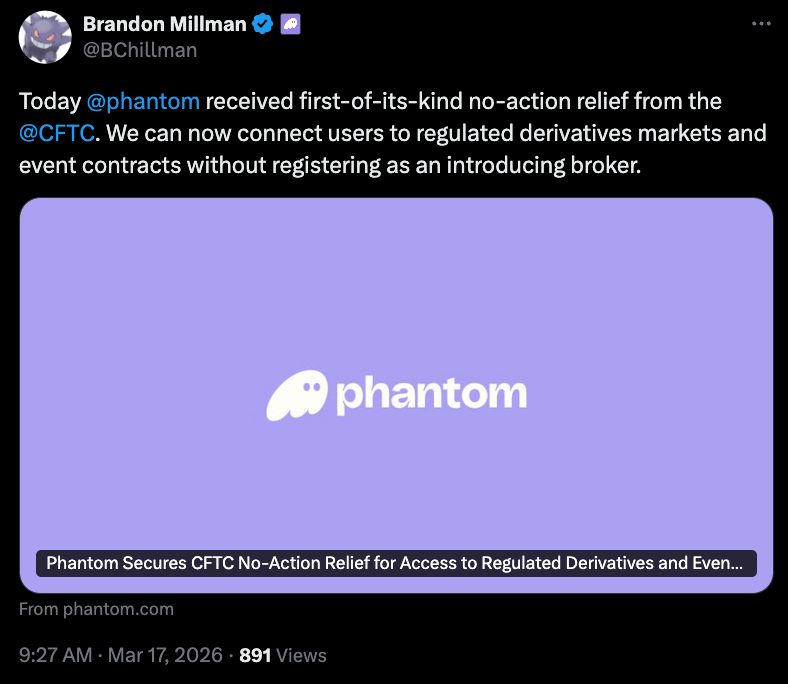
The no-action position taken by the US regulator under Chair Michael Selig will allow the company to engage in certain activities without registering as a broker.
The US Commodity Futures Trading Commission (CFTC) said Tuesday that its Market Participants Division issued a no-action letter in response to a request from crypto wallet provider Phantom Technologies.
A CFTC notice said that the no-action letter would, under certain circumstances, stop the division from recommending that the regulator take an enforcement action against Phantom or its staff for failure to register as a broker.
According to Phantom, the no-action position will allow the company to “act as a non-custodial interface connecting users to a registered exchange […] without taking on the regulatory obligations of an introducing broker.”
“With thanks to the CFTC’s willingness to open their doors to facilitate innovation, we proactively engaged with the CFTC to seek clarity on how a non-custodial interface like Phantom could offer access to regulated markets through a registered partner, without acting as an intermediary that needs its own registration,” said Phantom. “Rather than building first and seeking forgiveness later, we took a different approach to give our users safe and reliable ways to access traditional financial markets.”

The regulator’s no-action response for a crypto company was one of the first taken under the leadership of the CFTC Chair Michael Selig since his US Senate confirmation in December. Selig and former CFTC acting chair Caroline Pham led the commission under US President Donald Trump as it issued several no-action letters for crypto platforms, including Polymarket and Binomial.
Related: Prediction markets boom on Iran bets as Congress eyes ban
CFTC defends authority over prediction markets, plans coordinating with SEC
Selig continues to defend what he called the CFTC’s “exclusive jurisdiction” in overseeing prediction market platforms like Kalshi and Polymarket in the face of a slew of US state authorities filing lawsuits against companies for alleged violations of gambling laws. Last week, he, as the sole CFTC commissioner, proposed a rule that could amend or issue new regulations over event contracts on prediction markets platforms, opening it to public comment.
Amid the tussle over regulating prediction markets, the CFTC and Securities and Exchange Commission (SEC) last week signed a memorandum of understanding in an attempt to end “regulatory turf wars.” Both agencies agreed to adopt a “minimum effective dose” regulatory strategy.
Magazine: Metaplanet’s Japan Bitcoin bet, Bithumb ordered suspension: Asia Express
In contrast, Pi Network’s native token continues to bleed out, dipping below $0.18 earlier today.
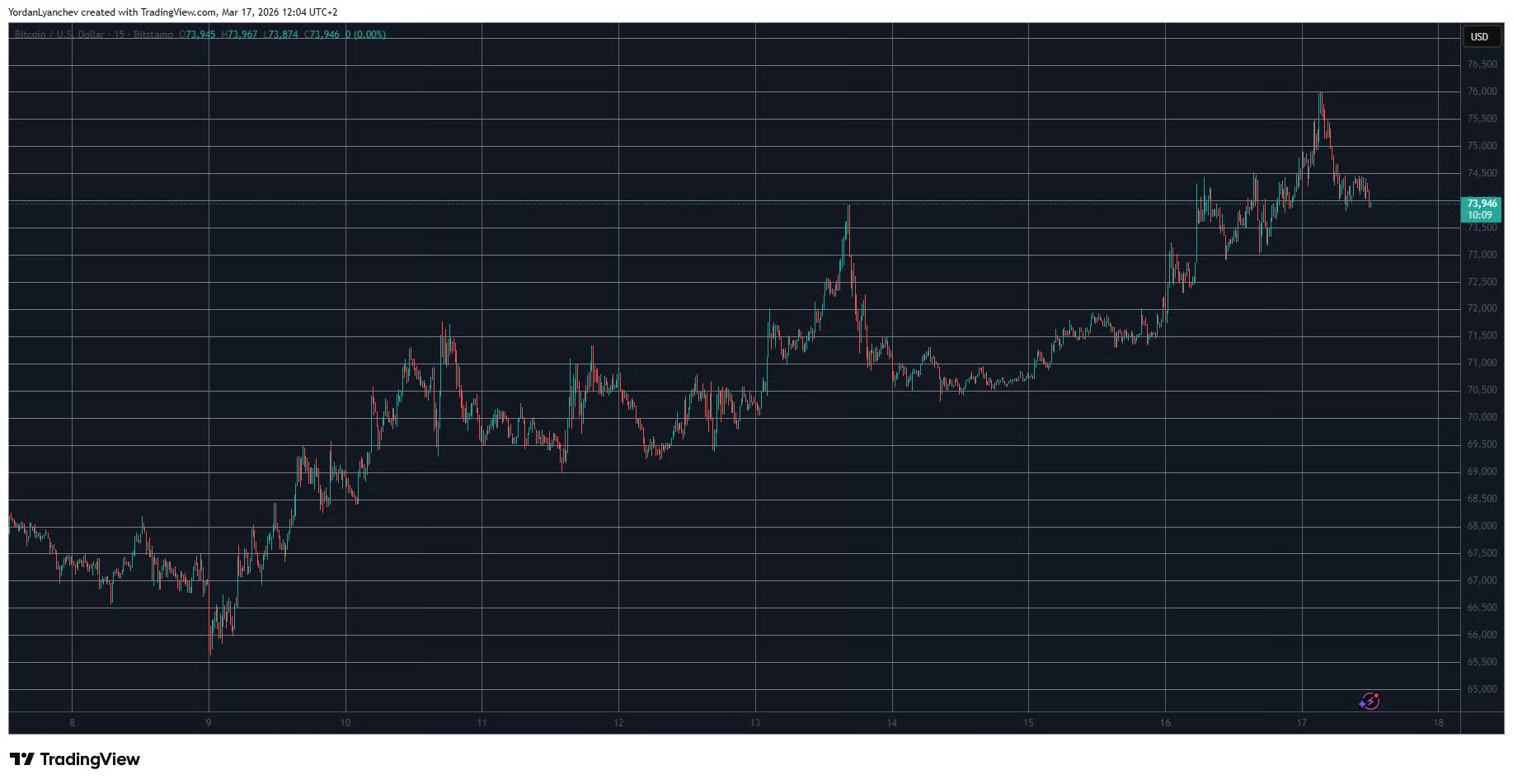
Bitcoin’s price resurgence that started shortly after the beginning of the war in the Middle East reached a new local peak earlier this morning at $76,000, where the asset faced some resistance.
Many altcoins have produced even more impressive gains, with ETH climbing above $2,300, and XRP touching $1.60. ZEC and M, alongside SIREN, FET, and HAS, have even soared by double digits.
BTC Tapped $76K
After dipping to $65,600 last Monday, the bitcoin bulls took command of the overall market performance and pushed the asset toward $70,000 by Wednesday. Although it was stopped there at first after the US CPI numbers came out, the cryptocurrency was more persistent and broke above that level on Friday when it even jumped to a ten-day peak of $74,000.
It was stopped there and driven to just over $70,000 during the weekend as the latest developments on the US/Israel vs Iran front unfolded. Nevertheless, they went on the offensive once again as the business week began. In the span of less than 24 hours, the bulls initiated another major rally, driving bitcoin to $76,000 earlier this morning.
This became its highest price tag since early February. After gaining over $5,000 in a day, though, the asset was primed for a correction that pushed it to $74,000 as of press time. Its market cap is close to $1.480 trillion on CG, while its dominance over the alts continues to struggle below 57%.
ZEC, M on the Rise
Ethereum was stopped at $2,400 this morning, but still trades above $2,300 after a 2% daily increase. XRP sits at $1.50 after a similar pump, and it has surpassed BNB in terms of market cap. HYPE has reclaimed the $40 level after a 3.5% rise, while CC is above $0.15.
ZEC and M have stolen the show from the larger-cap alts, both surging by around 16% to $270 and $1.72, respectively. SIREN, FET, and HASH are up by double-digits as well from the lower caps.
Pi Network’s PI has dumped again in the past 24 hours, losing 10% of value in a drop to $0.18 as of press time.
The total crypto market cap, though, has added $30 billion and is slightly above $2.6 trillion on CG.

Binance Free $600 (CryptoPotato Exclusive): Use this link to register a new account and receive $600 exclusive welcome offer on Binance (full details).
LIMITED OFFER for CryptoPotato readers at Bybit: Use this link to register and open a $500 FREE position on any coin!
Disclaimer: Information found on CryptoPotato is those of writers quoted. It does not represent the opinions of CryptoPotato on whether to buy, sell, or hold any investments. You are advised to conduct your own research before making any investment decisions. Use provided information at your own risk. See Disclaimer for more information.
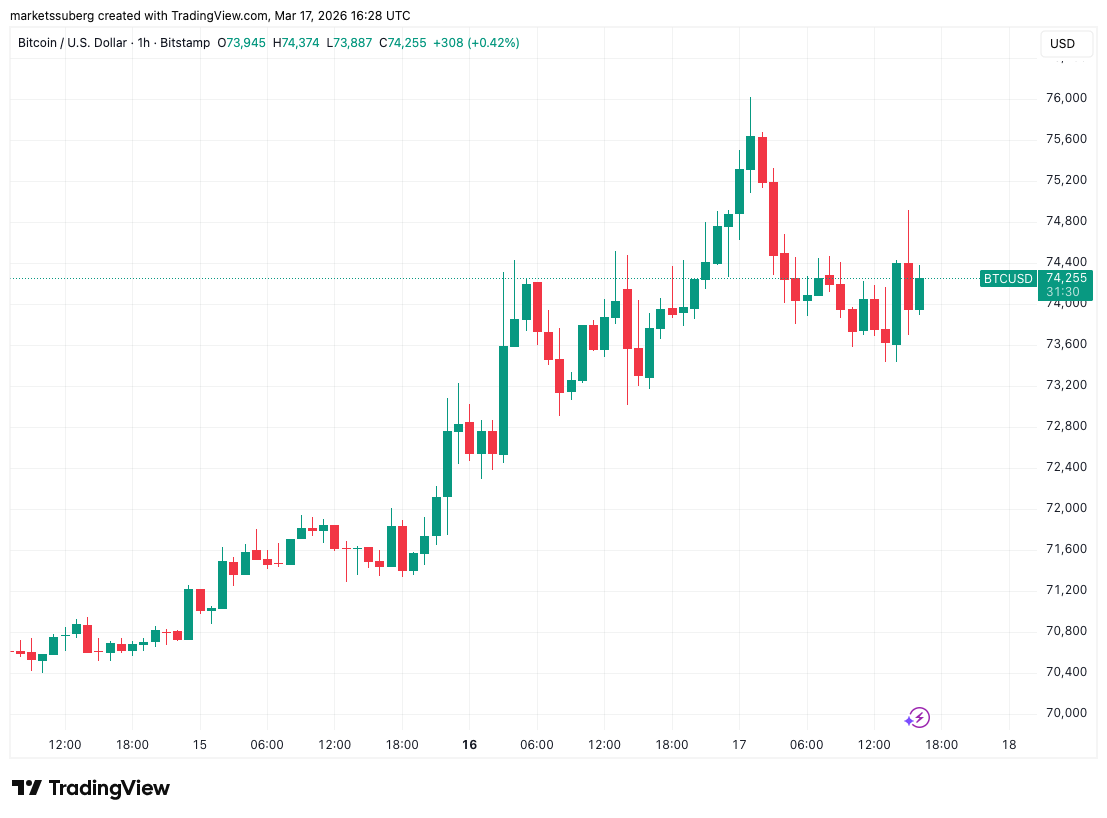
Bitcoin consolidated recent gains in the face of blanket skepticism over its rebound, while gold threatened to give up $5,000 support.
Bitcoin (BTC) circled $74,000 after Tuesday’s Wall Street open as skepticism increased over BTC price strength.
Key points:
-
Bitcoin stalls after a trip to $76,000, with short-term targets including a retreat to $68,000.
-
Traders stand by the long-term bear market thesis for BTC/USD.
-
Gold continues to show weakness, risking the loss of $5,000 per ounce support.
Trader warns against “hyping up” BTC price move
Data from TradingView showed cooling BTC price volatility after a run to new six-week highs of $76,000 to start the daily candle.

This proved unsustainable as heavy resistance sent BTC/USD lower, leading to concerns of a fakeout for Telegram channel Technical Crypto Analyst.
“Bitcoin is trending upward inside a rising channel and approaching the $74K–$79K resistance zone; while structure remains bullish above the trendline, a rejection from current levels could trigger a pullback toward the $68K support area,” it wrote on the day.

Traders stayed wary, doubling down on existing doubts about the fate of Bitcoin’s relief rally.
“Still nothing on HTF that suggests the bear market has bottomed. No divs, no volume at lows, no reversal pattern, etc,” trader Roman wrote in his latest analysis on X, referring to higher time frames.
Roman argued that market participants were “hyping up” a comparatively modest uptick in price, and that history demanded a longer bear market.

On the latter point, trader Jelle agreed, pointing to the 0.618 Fibonacci retracement level as a key price point.
“Every bear market has been shallower than the one before it – but all of them have happened well below the 0.618 retracement, after months of boring sideways PA,” he told X followers.
“Even if we don’t get the usual drawdown, I’m pretty sure the boredom chop is coming. Patience.”

Analyst eyes Bitcoin “outperformance” versus gold
Macro conditions were cooler compared to the start of the week. US stocks continued a modest rebound, while WTI crude oil remained below the $100 per barrel mark.
Related: Bitcoin sparks ‘bull trap’ warning after BTC price rejects at $76K
Gold, however, teased a breakdown from $5,000 support, retesting that level for the third consecutive day.

Calls for Bitcoin to steal the spotlight from the precious metal thus grew louder.
“Stand by for the outperformance of the decade,” crypto analyst James Easton commented on the weekly BTC/XAU chart.

This article does not contain investment advice or recommendations. Every investment and trading move involves risk, and readers should conduct their own research when making a decision. While we strive to provide accurate and timely information, Cointelegraph does not guarantee the accuracy, completeness, or reliability of any information in this article. This article may contain forward-looking statements that are subject to risks and uncertainties. Cointelegraph will not be liable for any loss or damage arising from your reliance on this information.
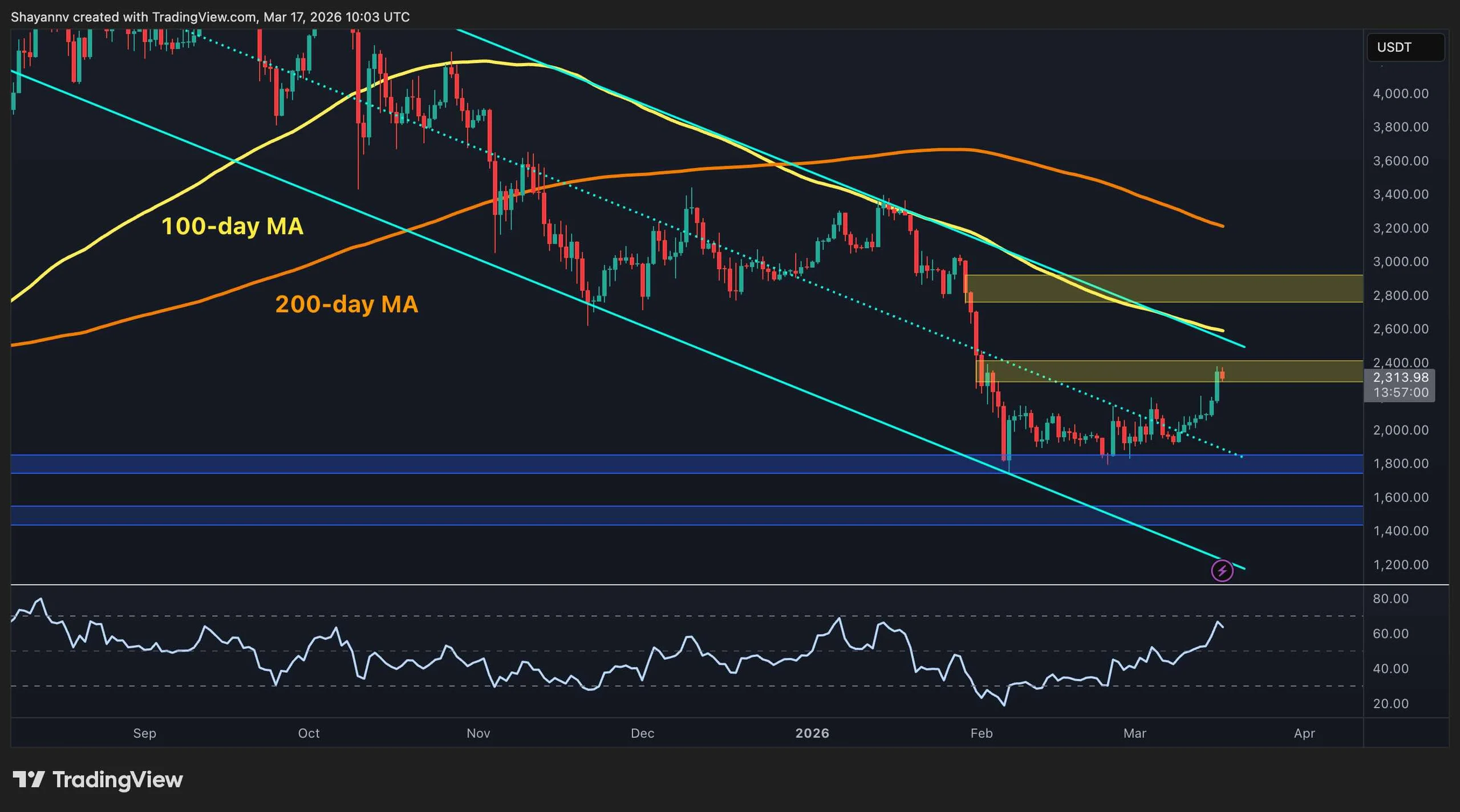
Ethereum is finally showing more upside potential. After spending weeks building a base above the February lows, ETH has now pushed into a key resistance zone, which makes this one of the more important tests since the selloff began. The rebound is real, but it is now approaching an area where sellers previously stepped in.
Ethereum Price Analysis: The Daily Chart
The daily chart has improved, but the broader trend is not fully repaired yet. ETH is still trading below the major 100-day and 200-day moving averages, and the bigger bearish structure from the previous months has not been completely invalidated. Even so, the strong reaction from the $1,800 region confirms that buyers have been defending that area aggressively.
The asset is now trading near the $2,300 to $2,400 supply zone, which is the next major battleground. If buyers manage to turn this area into support, the path could open toward the higher resistance band near $2,800. If not, this move may end up being just a strong relief rally inside a still-damaged higher timeframe structure.
ETH/USDT 4-Hour Chart
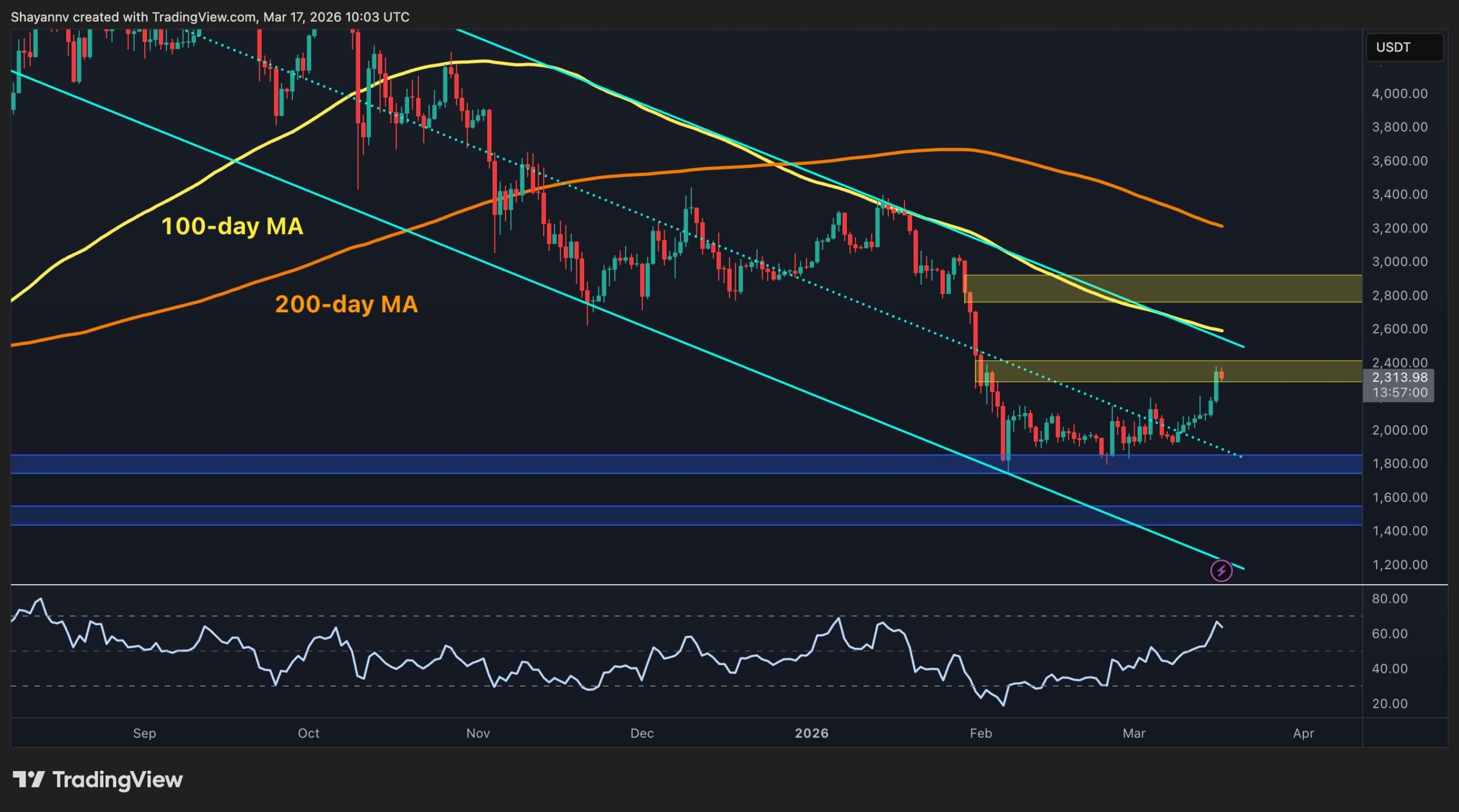
On the 4-hour chart, the recovery looks much cleaner. ETH has been climbing inside an ascending channel, printing higher highs and higher lows, which shows clear short-term control by buyers. The asset has even broken above the channel, pointing to a potentially more aggressive rally, if the current move does not become a fake breakout by dropping back inside the channel. Momentum has also expanded sharply, with RSI pushing into the overbought territory as the price accelerated into resistance.
That said, the market is no longer trading in the middle of the range. It is now testing the upper boundary of the recent advance and pressing into overhead supply at the same time. This usually means the next move matters a lot. It can either be a breakout continuation above the channel and resistance, or a fakeout and drop toward the mid-channel and the $2,000 to $2,100 area.

On-Chain Analysis
The on-chain backdrop is constructive. Ethereum’s 30-day transaction count exponential moving average remains elevated relative to most of the past cycle, even after cooling off from its recent spike.
That suggests network activity has not collapsed with the prior price weakness and that underlying usage is still holding up fairly well. However, it also shows that a potential capitulation phase is happening, as many holders have become active in selling their coins and exiting the market quickly. However, for every seller, there is a fresh buyer.
Overall, the network is showing better participation than price alone might suggest. That does not guarantee immediate upside, but it does support the idea that the recent rebound has a stronger foundation than a purely speculative bounce. If the price can now follow through above resistance, the on-chain picture would start to align much more clearly with a broader recovery thesis.

Binance Free $600 (CryptoPotato Exclusive): Use this link to register a new account and receive $600 exclusive welcome offer on Binance (full details).
LIMITED OFFER for CryptoPotato readers at Bybit: Use this link to register and open a $500 FREE position on any coin!
Disclaimer: Information found on CryptoPotato is those of writers quoted. It does not represent the opinions of CryptoPotato on whether to buy, sell, or hold any investments. You are advised to conduct your own research before making any investment decisions. Use provided information at your own risk. See Disclaimer for more information.

The company’s expansion in Brazil comes after it made big moves in Australia, the US, and Canada.
Ripple announced earlier today that it has significantly enhanced its presence in Brazil by incorporating some of its key features in the local market, including cross-border payments and digital asset custody.
The company’s President highlighted the importance of the Latin American market and praised Brazil for its rapidly developing financial ecosystem.
Ripple Doubles Down in Brazil
The statement published on March 17 reads that Ripple has now become the “only solution in the region capable of serving institutions across the full spectrum of financial needs – from cross-border payments and digital asset custody to prime brokerage and treasury management.”
The firm has also applied for a Virtual Asset Service Provider (VASP) license with the country’s central bank. The move comes after Brazil introduced its cryptocurrency regulatory framework and aims to reinforce Ripple’s “compliance-first approach” that has guided its global operations for over a decade.
After outlining the significance of the Latin American market, Ripple President Monica Long added that “Brazil has built one of the most advanced and forward-thinking financial ecosystems in the world.”
“We’ve spent more than a decade building the trust, licensing, and technology required to operate in regulated markets. Now, with our expanded platform, we can meet institutions across the region with everything they need to compete in the modern financial system,” Long concluded.
Brazilian Institutions Tapping Ripple Payments
The announcement explained that Ripple Custody will bring “bank-grade security, real-time compliance controls, and flexible deployment options to regulated institutions in the region.” Some of those include CRX and Justoken.
In the meantime, Ripple Payments, the end-to-end solution for moving money across borders with over $100 billion in processed volume globally, works with Banco Genial, Braza Bank, Nomad, Azify, ATTRUS, and Frente Corretora.
You may also like:
The company also said that its enterprise-grade stablecoin, RLUSD, has gained “significant traction” in the LATAM region, as institutions look for “trusted, regulated, digital dollar infrastructure.” RLUSD’s market cap has grown past $1.5 billion in less than 18 months after its launch.
The stablecoin has been adopted in Brazil by some of the most prominent exchanges and fintechs, including Mercado Bitcoin, Foxbit, Ripio, Braza Bank, Banco Genial, and others.
Ripple’s big move in Brazil follows similar developments in other regions. It began with a major announcement about an Australian financial license application, followed by a partnership focused on the North American markets.
Binance Free $600 (CryptoPotato Exclusive): Use this link to register a new account and receive $600 exclusive welcome offer on Binance (full details).
LIMITED OFFER for CryptoPotato readers at Bybit: Use this link to register and open a $500 FREE position on any coin!
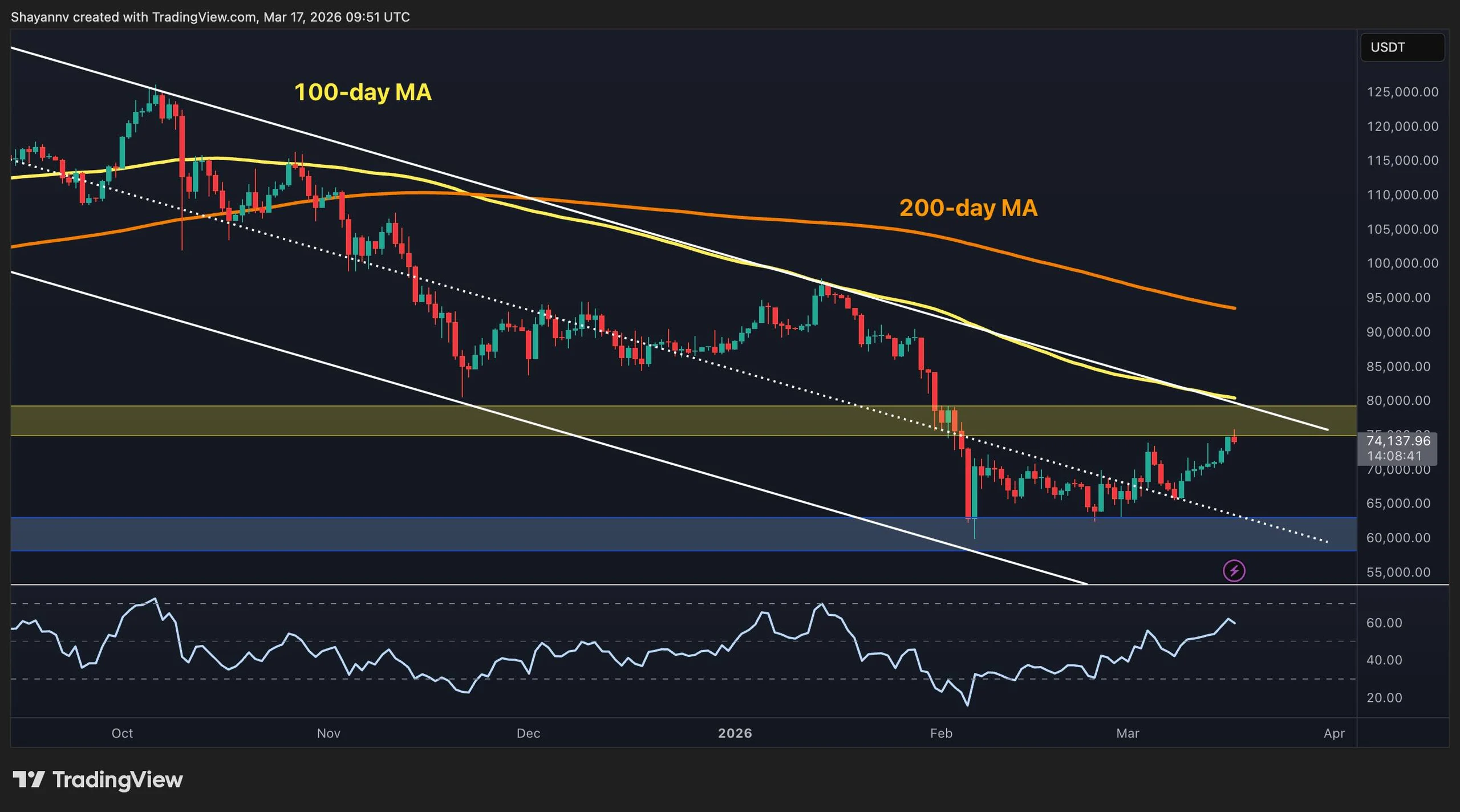
Bitcoin is pressing into a major test. The rebound from the $60,000 area has now extended into the mid-$70,000s, which means the price is no longer just recovering. It is challenging the first real ceiling of this bounce, and that makes the current zone especially important for the next directional move.
Bitcoin Price Analysis: The Daily Chart
The daily chart has improved meaningfully, but the broader trend has not fully flipped yet. BTC is now pushing back into the $75,000 to $80,000 region, which marked the previous breakdown area and has now turned into a heavy supply zone. The price is also approaching the higher trendline of the descending channel again, while still trading beneath both the 100-day and 200-day moving averages, located at $80,000 and $93,000 levels, respectively.
That combination makes the current level a key decision area. If buyers can reclaim this region with a clean daily break, the recovery would start to look much more structural. If not, this could still end up being another lower-high rejection inside the broader corrective trend. For now, the chart is stronger than it was a few weeks ago, but not yet fully repaired.
BTC/USDT 4-Hour Chart
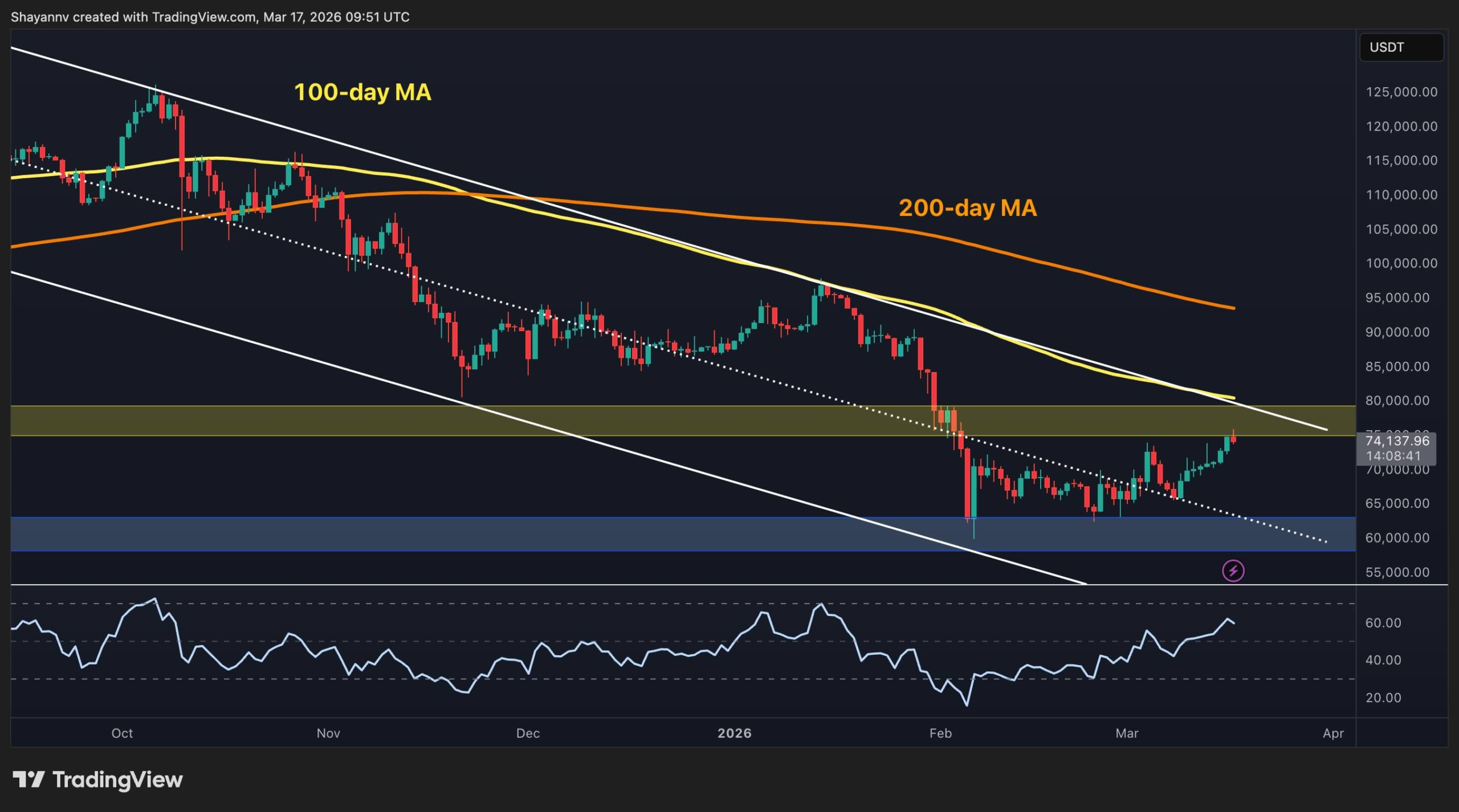
On the 4-hour chart, the structure remains constructive. Bitcoin has continued printing higher lows and highs inside its rising recovery channel, and the latest move has carried the price right into the upper resistance band around $73,000 to $76,000. That shows buyers are still in control in the short term.
Momentum is also firm, with the RSI holding in the upper half of its range and recently pushing higher again. Still, the market is now at a confluence zone where horizontal resistance and the upper trend boundary meet. So this is where continuation needs confirmation. A breakout could open the door to a stronger leg higher, while rejection here would likely drag BTC back toward the middle of the channel.

Sentiment Analysis
From a sentiment perspective, funding rates remain negative even as the price keeps climbing. That is a notable divergence. It shows that derivatives traders are still not leaning aggressively long, and short exposure remains relatively elevated despite the recovery.
That kind of backdrop is often supportive rather than bearish in the near term. When the price rises while funding stays subdued or negative, it suggests the move is not being driven by overcrowded bullish leverage. In other words, sentiment is still cautious, and that leaves room for upside if BTC can break resistance, since the market has not yet reached an overheated condition, and a short liquidation cascade could be the fuel the price needs to jump aggressively.

Binance Free $600 (CryptoPotato Exclusive): Use this link to register a new account and receive $600 exclusive welcome offer on Binance (full details).
LIMITED OFFER for CryptoPotato readers at Bybit: Use this link to register and open a $500 FREE position on any coin!
Disclaimer: Information found on CryptoPotato is those of writers quoted. It does not represent the opinions of CryptoPotato on whether to buy, sell, or hold any investments. You are advised to conduct your own research before making any investment decisions. Use provided information at your own risk. See Disclaimer for more information.
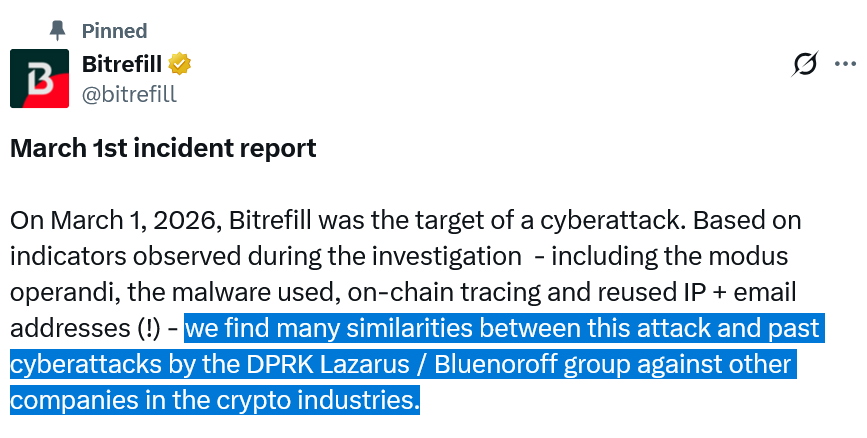
Crypto e-commerce store Bitrefill has revealed it was the victim of a cybersecurity attack on March 1, with the methods used closely resembling those of Lazarus Group, North Korea’s notorious hacking organization.
In a post to X on Tuesday, Bitrefill said the hackers used malware, on-chain tracing, and reused IP and email infrastructure to compromise an employee’s laptop, enabling them to drain funds from the company’s hot wallets while also accessing 18,500 purchase records, potentially revealing “limited customer information.”
Bitrefill said BlueNoroff Group, another North Korean hacking organization with close ties to the Lazarus Group, may have also been involved or been the sole attacker.

Source: Bitrefill
Bitrefill, which enables customers to spend crypto on real-world products and gift cards, said there was no evidence that the hackers extracted its database, suggesting the motive was financial.
“There is no evidence that they extracted our entire database, only that the attackers ran a limited number of queries consistent with probing to understand what there was to steal, including cryptocurrency and Bitrefill gift card inventory.”
While Bitrefill didn’t disclose how much funds were stolen, the company said it “will absorb” those losses from its operational capital.
“Almost everything is back to normal: payments, stock, accounts,” Bitrefill said, adding: “Sales volumes are also back to normal, and we are eternally thankful to our customers for your continued confidence in us.”
Despite many crypto platforms strengthening security measures in recent years, sophisticated hackers have continued to find ways to breach their defenses.
Related: Bonk.fun warns hackers hijacked domain in wallet-drainer attack
Lazarus Group remains the crypto industry’s most formidable threat and was behind the largest hack in crypto history, when it stole $1.4 billion from crypto exchange Bybit in February 2025.
Bitrefill has upped its security measures
Bitrefill said it contacted law enforcement and worked with crypto security firms Security Alliance, FearsOff Security, Recoveris.io and zeroShadow to navigate the cybersecurity incident. Part of its initial response was to turn its systems offline to contain the attack.
Bitrefill said it has already “significantly improved” its cybersecurity practices since the incident.
Those measures include cybersecurity reviews with security researchers and implementing their recommendations, tightening internal access controls and improving monitoring strategies for faster detection and response.
Magazine: China’s ‘50x’ blockchain boost, Alibaba-linked AI mines Bitcoin: Asia Express
Crypto World
SEC and CFTC Issue Joint Crypto Interpretation, Ending Over a Decade of Regulatory Uncertainty

TLDR:
- The SEC introduced a token taxonomy covering digital commodities, collectibles, tools, stablecoins, and securities.
- The CFTC will administer the Commodity Exchange Act in line with the SEC’s new crypto asset interpretation.
- The guidance clarifies how non-security crypto assets can enter or exit the scope of an investment contract.
- Activities like airdrops, protocol staking, and asset wrapping now have clearer treatment under federal securities law.
Crypto assets have taken center stage as the U.S. Securities and Exchange Commission issued a landmark interpretation.
Released on March 17, 2026, the guidance clarifies how federal securities laws apply to crypto assets and related transactions.
The Commodity Futures Trading Commission joined the effort, signaling a unified regulatory approach. Market participants, including investors and innovators, now have clearer guidance on where SEC and CFTC jurisdiction begins and ends.
SEC Establishes a Token Taxonomy for Crypto Assets
The interpretation introduces a coherent token taxonomy covering several categories of crypto assets. These categories include digital commodities, digital collectibles, digital tools, stablecoins, and digital securities.
Each category carries distinct treatment under federal law, providing structure where ambiguity once existed.
Moreover, the guidance addresses how a non-security crypto asset can become subject to an investment contract. It also explains how that same asset can cease to be subject to one. This distinction matters greatly for builders and issuers navigating compliance requirements.
TODAY
: The Commission issued an interpretation that clarifies the application of federal securities laws to crypto assets.
This is a major step to provide greater clarity regarding the Commission’s treatment of crypto assets.
Read the release here: https://t.co/DDykVLHZQI pic.twitter.com/zbLFS2JH6g
— U.S. Securities and Exchange Commission (@SECGov) March 17, 2026
SEC Chairman Paul Atkins stated, “After more than a decade of uncertainty, this interpretation will provide market participants with a clear understanding.”
He added that most crypto assets are not themselves securities, which the former administration declined to acknowledge. The guidance further affirms that investment contracts can come to an end.
Additionally, the interpretation covers activities such as airdrops, protocol mining, protocol staking, and the wrapping of non-security crypto assets.
These are common functions in decentralized networks that previously lacked clear regulatory treatment. The clarity on these activities reduces legal risk for developers and participants alike.
CFTC Aligns With SEC on Harmonized Rules for Crypto Assets
The CFTC’s involvement in the joint interpretation marks a notable step toward harmonized oversight of crypto assets. CFTC Chairman Michael Selig confirmed the agency will administer the Commodity Exchange Act in line with the SEC’s interpretation. This alignment removes a layer of regulatory conflict that has long burdened the industry.
Selig further noted that American builders and innovators had long awaited guidance on the status of crypto assets. He stated, “With today’s interpretation, the wait is over.”
Both chairmen expressed commitment to fostering a regulatory environment where the crypto industry can operate with rational rules.
Furthermore, the joint action is seen as a bridge measure while Congress advances bipartisan market structure legislation.
Chairman Atkins indicated he looks forward to implementing that legislation alongside Chairman Selig. The interpretation complements, rather than replaces, the expected Congressional framework.
The SEC’s interpretation will be published on SEC.gov and in the Federal Register. Market participants are encouraged to review the document to understand regulatory boundaries.
As the legislative process continues, this guidance offers the clearest foundation yet for the U.S. crypto market.
The post SEC and CFTC Issue Joint Crypto Interpretation, Ending Over a Decade of Regulatory Uncertainty appeared first on Blockonomi.
Crypto World
GSR Acquires Autonomous and Architech to Launch Integrated Capital Markets and Treasury Platform for Crypto

[PRESS RELEASE – New York, United States, March 17th, 2026]
GSR, crypto’s capital markets partner, today announced the $57 million acquisition of Autonomous and Architech. The transaction significantly expands the firm’s ability to support tokenized organizations from formation through scale. Autonomous will continue to operate under its existing brand within the GSR group, providing launch operations, operational support, and financial infrastructure for tokenized organizations, while Architech will form the foundation of GSR Digital Asset Advisory, working alongside GSR’s institutional trading, liquidity, and asset management capabilities.
Launching a tokenized network today often requires engaging multiple structuring advisors, token economists, market makers, and listing consultants, typically operating under fragmented mandates and misaligned incentives. GSR’s integrated model replaces that patchwork with a coordinated approach, aligning foundation structuring, governance design, token economics, fundraising and exchange strategy, and long-term capital planning. Clients can also access GSR’s institutional trading, derivatives, and asset management capabilities through its existing, regulated entities.
“The crypto industry has matured, but its capital markets infrastructure remains fragmented,” said Xin Song, CEO of GSR. “Entrepreneurs should not have to allocate significant portions of their token supply to disconnected service providers. By aligning advisory expertise alongside GSR’s institutional trading and asset management capabilities, we provide coordinated support from pre-launch through scale.”
Beyond launch, the platform addresses a structural challenge in crypto: foundations frequently begin life managing substantial digital asset treasuries without the financial infrastructure required to oversee them. GSR is able to provide strategic treasury and capital markets guidance, including:
- Cash and Liquidity Planning – optimizing working capital and banking relationships.
- Cash Flow Forecasting – runway modeling and capital planning.
- Risk Management – structured approaches to manage token volatility and exposures, with execution available through GSR’s trading and derivatives businesses.
- Capital Allocation Strategy – disciplined diversification and portfolio construction, supported by GSR’s asset management and trading capabilities.
Today, many crypto treasuries function primarily as passive holdings of their own tokens. Introducing structured diversification and income strategies can transform those balance sheets into sustainable funding engines without diluting long-term token alignment. Professionalizing treasury management not only strengthens individual networks but supports the long-term stability of the broader ecosystem.
“Crypto foundations are effectively managing large, complex balance sheets from day one,” said James Hutchings, Managing Director, Autonomous. “Integrating with GSR allows us to pair deep advisory expertise with institutional trading infrastructure.”
“Successful tokenization doesn’t end at launch,” added Matt Solomon, CEO, Architech. “It requires coordination across design, liquidity, and long-term financial management. This platform unifies those elements within a first-of-its-kind, integrated offering.”
With this acquisition, GSR advances its strategy to become crypto’s one-stop capital markets partner, delivering institutional standards, aligned incentives, and full-lifecycle support for the next generation of on-chain businesses.
About GSR
GSR is crypto’s capital markets partner, delivering market-making services, institutional-grade OTC trading, and venture backing to founders and institutions. With more than a decade of experience, we provide strategic guidance, market intelligence, and access to a global network to help teams scale. Users can visit www.gsr.io for more information, including the General Terms Business, relevant disclosures, and GSR’s trading terms.
About Autonomous
Autonomous is an end-to-end launch, finance, and operations partner for digital asset projects. With comprehensive white-glove services including fractional CFO/COO services, finance management, treasury operations, payment processing, partner coordination (i.e., exchanges, custodians, market makers, OTC desks), multi-sig and treasury architecture, token minting, liquidity planning, lock/vest administration, grants management, governance support, and banking setup. Autonomous support projects through their full lifecycle, spanning pre-launch preparation, TGE, and go-to-market execution, and post-launch steady-state operations.
About Architech
Architech is the premier advisory firm specializing in fungible token launches and bespoke liquidity strategies. Since its inception in October 2024, Architech has supported token launches totaling over $10 billion in peak fully diluted value. Its core services span mechanism design, market maker facilitation, centralized exchange coordination, GTM strategy, and fundraising.
Binance Free $600 (CryptoPotato Exclusive): Use this link to register a new account and receive $600 exclusive welcome offer on Binance (full details).
LIMITED OFFER for CryptoPotato readers at Bybit: Use this link to register and open a $500 FREE position on any coin!
Crypto World
Crypto.com integrates with South Korea’s largest payment processor to enable tourist crypto payments: Crypto.com and KG Inicis
Crypto.com has partnered with KG Inicis to let foreign travelers pay for goods and services in South Korea using digital assets through the exchange’s merchant network.
Crypto.com has partnered with KG Inicis, South Korea’s largest payment gateway and value-added network provider, to enable cryptocurrency payments for foreign tourists visiting the country. The integration will allow travelers to use digital assets through Crypto.com Pay to purchase goods and services from South Korean merchants connected to KG Inicis’s network.
The partnership represents a real-world expansion of Crypto.com’s merchant payment infrastructure in Asia, one of the exchange’s key growth markets. Merchants using the service will have options for how they settle transactions, addressing a key adoption barrier for crypto payments in traditional retail environments.
Sources: Phemex News | Crypto.com LinkedIn
This article was generated automatically by The Defiant’s AI news system from publicly available sources.

Games Inbox: Is Starfield a good game?

Qfin Holdings, Inc. 2025 Q4 – Results – Earnings Call Presentation (NASDAQ:QFIN) 2026-03-17

CFTC Issues No-Action Letter for Crypto Wallet Provider Phantom


-
 Tech7 days ago
A 1,300-Pound NASA Spacecraft To Re-Enter Earth’s Atmosphere
-
 Crypto World4 days ago
HYPE Token Enters Net Deflation as HyperCore Buybacks Outpace Staking Rewards
-

 Fashion4 days ago
Weekend Open Thread: Addict Lip Glow
-

 Tech2 days ago
Your Legally Registered ‘Motorcycle’ Might Not Count Under Proposed US Law
-
Sports3 days ago
Why Duke and Michigan Are Dead Even Entering Selection Sunday
-

 NewsBeat6 days ago
Residents reaction as Shildon murder probe enters second day
-

 Business2 days ago
Search for Savannah Guthrie’s Mother Enters Seventh Week with No Arrests
-

 Business7 days ago
Search Enters Sixth Week With New Leads in Tucson Abduction Case
-

 Sports6 days ago
PWHL, Senators discussing plan to keep Charge in Ottawa
-

 Business4 days ago
US Airports Launch Donation Drives for Unpaid TSA Workers as Partial Government Shutdown Enters Fifth Week
-
 Tech9 hours ago
Are Split Spacebars the Next Big Gaming Keyboard Trend?
-
Crypto World3 days ago
Coinbase and Bybit in Investment Talks: Could Bybit Finally Enter the US Crypto Market?
-

 NewsBeat6 days ago
I Entered The Manosphere. Nothing Could Prepare Me For What I Found.
-

 Business4 days ago
Country star Brantley Gilbert enters growing non-alcoholic beer market
-

 Business2 days ago
Australian shares drop as Iran war enters third week
-

 Crypto World2 days ago
Crypto Lender BlockFills Enters Chapter 11 with Up to $500M in Liabilities
-

 Sports4 days ago
College Basketball Best Bets: Conference Tournament Semifinal Picks
-

 Politics7 days ago
Trump Says Middle East Is ‘Very Lucky’ That He’s President
-
 Crypto World6 days ago
Three Binance Charts May Be Hinting at Bitcoin’s Next Move
-

 Business5 days ago
Trump demands Powell cut rates as Iran conflict raises energy prices


You must be logged in to post a comment Login