
Crypto World
Quantum threat to Bitcoin is real, but manageable, according to Wall Street broker Bernstein



Wall Street broker Bernstein said the rise of quantum computing poses a credible but manageable threat to Bitcoin and the broader crypto ecosystem, as recent breakthroughs compress timelines for potential attacks on modern cryptography.
Advances such as Google Quantum AI’s reported reduction in qubit requirements suggest the risk is no longer a distant, decade-long concern, the broker noted. Still, the firm cautioned that scaling quantum systems to the level needed to break widely used encryption remains a complex, multi-step challenge.
“Quantum should be seen as a medium to long term system upgrade cycle rather than a risk,” analysts led by Gautam Chhugani said in the Wednesday report.
Quantum computing uses the principles of quantum mechanics rather than classical physics. Instead of binary bits, it relies on qubits that can exist in multiple states at once, a property known as superposition, allowing many possibilities to be processed simultaneously.
Combined with entanglement, this enables quantum systems to solve certain problems, such as breaking encryption, far more efficiently than classical computers.
Quantum computers could eventually weaken cryptographic systems like elliptic curve encryption, which underpin crypto wallets, by solving problems beyond the reach of classical machines. However, the report said the threat spans industries from finance to defense and should be viewed as a manageable, long-term risk rather than an existential one for Bitcoin.
Exposure is concentrated in roughly 1.7 million BTC held in older, “legacy” wallets, while newer practices and protocols reduce vulnerability. Bitcoin mining, which relies on SHA-based hashing, remains effectively secure even in advanced quantum scenarios, the broker said.
Bernstein expects the crypto industry to have sufficient time, around three to five years, to transition toward post-quantum cryptography, with upgrades such as new wallet standards, reduced address reuse and key rotation already under discussion.
One recent academic paper said that attacking the Bitcoin blockchain through quantum mining would demand the energy output of a star.
Read more: Attacking bitcoin mining with a quantum computer would require the energy of a star, academics say



Startale Group is integrating Sunnyside Labs’ Privacy Boost directly into its Sony-backed Soneium super app, giving users fast, self-custodial shielding and zk-powered private payments without sacrificing auditability or everyday UX.
Summary
- Startale Group has selected Privacy Boost, built by Sunnyside Labs, as the official privacy partner for the Startale App, bringing self-custodial onchain privacy to a mainstream consumer crypto platform.
- Privacy Boost will deploy natively on Soneium and integrate into the Startale App via SDK, enabling private transfers, shielding, and privacy-preserving payments with sub-500 millisecond proof generation and over 1,800 transactions per second throughput.
- The deal marks both a milestone for the Startale App as a core entry point to Soneium and Privacy Boost’s first integration into a consumer-facing application, with a roadmap covering payments, Mini Apps, and future card rails.
Startale Group has named Privacy Boost as the official privacy partner for the Startale App, in a move that brings self-custodial, onchain privacy features directly into a consumer gateway to Soneium, the Sony-affiliated blockchain.
Startale App adds native, opt-in onchain privacy
Under the partnership, Privacy Boost will deploy natively on Soneium and integrate into the Startale App, giving users the option to shield assets, send private transfers, and route payments through privacy-preserving flows while retaining control of their keys.
The integration is positioned as a milestone in the Startale App’s evolution into a full consumer front door for the Soneium ecosystem, which is being co-developed by Sony Block Solutions Labs. It also marks the first time Privacy Boost’s technology is embedded in a consumer-facing application, shifting it from infrastructure tooling into an end-user product surface.
The Startale App is designed to make the onchain economy accessible to mainstream users, offering asset management, payments, Mini Apps, and ecosystem reward features in a single interface.
As usage scales, Startale and Sunnyside Labs are explicitly targeting the visibility problem of public blockchains, where balances, transfer sizes, and counterparties are exposed by default.
ZK + TEE stack targets consumer speed and compliance
Privacy Boost brings a hybrid architecture that combines zero-knowledge proofs with trusted execution environments, aiming to deliver private transactions at consumer-grade speed and scale.
The system targets sub-500 millisecond proof generation and throughput exceeding 1,800 transactions per second, while keeping assets in user-controlled wallets and supporting selective auditability for compliance and regulatory checks.
“Not every transaction needs to be private, but every user should have the choice,” said Sota Watanabe, CEO of Startale Group. “With Privacy Boost integrated into the Startale App, privacy becomes something users can enable when it matters. It puts control in their hands to decide when and how they protect their onchain activity. That is what a true SuperApp should deliver.”
As part of the rollout, Privacy Boost will deploy its full protocol stack on Soneium, including smart contracts and TEE infrastructure, making private transfers a native building block for developers on the network. Inside the Startale App, the integration will run via SDK, enabling shielding assets into private pools, private transfers that hide balances and counterparties, and privacy-preserving payment flows intended to support future crypto card functionality.
“Startale is serious about bringing privacy to consumer crypto, from everyday payments and card spending to mini apps,” said Taem Park, co-founder and CEO of Sunnyside Labs. “These are exactly the use cases Privacy Boost was built for, high-performance privacy at consumer scale, with an SDK designed for native application and mini app integration alike.”
The companies say the integration is architected to scale alongside the Startale App’s expansion into new payment flows, Mini Apps, and broader ecosystem integrations, embedding privacy as a default consideration across user interactions rather than an afterthought. For Startale, it fits into a broader mission of “bringing the world on-chain” through Astar Network, Soneium, and consumer products like the Startale App, while Sunnyside Labs positions Privacy Boost as enterprise-grade, self-custodial privacy infrastructure aligned with public-chain principles.


Visa partners with WeFi to enable direct stablecoin spending from self-custody wallets on Visa’s network, bypassing exchanges and pressuring banks’ FX roles.
Summary
- Visa has partnered with WeFi, an “on‑chain bank” founded by Tether co‑founder Reeve Collins, to let users spend stablecoins from self‑custody wallets directly on the global Visa network.
- The rollout begins in select markets across Europe, Asia, and Latin America, with expansion conditioned on local regulatory approvals and a focus on “regulated stablecoins appropriate for everyday transactions.”
- By embedding stablecoins into Visa’s payment rails so settlement happens in the background, the partnership directly bridges DeFi liquidity to millions of merchants and puts pressure on banks’ traditional role in FX and settlement.
Visa’s new partnership with WeFi is designed to make stablecoin balances in self‑custody wallets spendable anywhere Visa is accepted, without users first moving funds through centralized exchanges or bank accounts. WeFi describes itself as a “de‑bank” and “on‑chain bank,” offering both self‑custody and custodial wallets plus card rails, and now tying those directly into Visa so that stablecoin funding and fiat settlement happen behind the scenes while the front‑end looks like a normal card payment.
Stablecoins plug into Visa without parking on exchanges
According to a report from Yahoo Finance, Visa and WeFi will “enable users to utilize stablecoin‑backed balances through familiar payment options,” a model executives frame as merging “on‑chain banking” with Visa’s global network. Mathieu Altwegg, Visa’s head of product and solutions for Europe, said the objective is to “connect new value forms to payment experiences that people are already familiar with, all while adhering to existing regulatory frameworks.”
The rollout starts in select European, Asian, and Latin American markets, with Visa stressing that the initial focus will be on regulated stablecoins that fit into existing licensing regimes such as Europe’s MiCA. A ChainNess summary of the partnership notes that WeFi plans to offer personal IBANs that “can be used like traditional bank accounts,” but with stablecoins as the funding layer and Visa as the acceptance network.
Banks’ FX and settlement role comes under pressure
For users, the pitch is simple: hold stablecoins in a self‑custody wallet, tap a Visa card or use familiar payment flows, and let the conversion and settlement logic run under the hood at the protocol and network layers. As WeFi’s own marketing puts it, the aim is to “bring stablecoins from theory into real, practical utility,” using Visa as the bridge that gives merchants the same experience and risk profile they’re used to, while users stay on‑chain.
That model compresses some of the traditional roles of banks in foreign exchange and cross‑border settlement. If stablecoin balances can fund card payments directly and settle almost instantly through Visa’s networks, banks risk losing a slice of fee revenue historically tied to slow, account‑based FX flows and correspondent banking.
Visa has been building toward this for several years, from its Bridge stablecoin card‑issuing product to a stablecoin payout pilot for gig workers and a more recent partnership with BVNK for stablecoin‑powered Visa Direct payments. The WeFi tie‑up extends that strategy into the realm of self‑custody and “on‑chain banking,” moving stablecoins from the edges of the system into everyday card payments at scale.
A wave of crypto shutdowns is unfolding across the industry this year, hitting projects from trading platforms to analytics tools.
April was no exception, as decentralized email service Dmail said it is shutting down due to high infrastructure costs, failed fundraising and weak token utility.
“In prior cycles, projects could extend runway through new issuance or venture support,” Roshan Dharia, a restructuring advisor and CEO of crypto holding company Echo Base, told Cointelegraph.
“That path is largely closed, so losses are being recognized earlier, and outcomes are more often wind downs than recoveries,” he said.
Crypto built a fast way to raise capital through tokens, but still lacks a framework to unwind it when things go wrong, making it difficult to reorganize claims or coordinate stakeholders once conditions deteriorate.
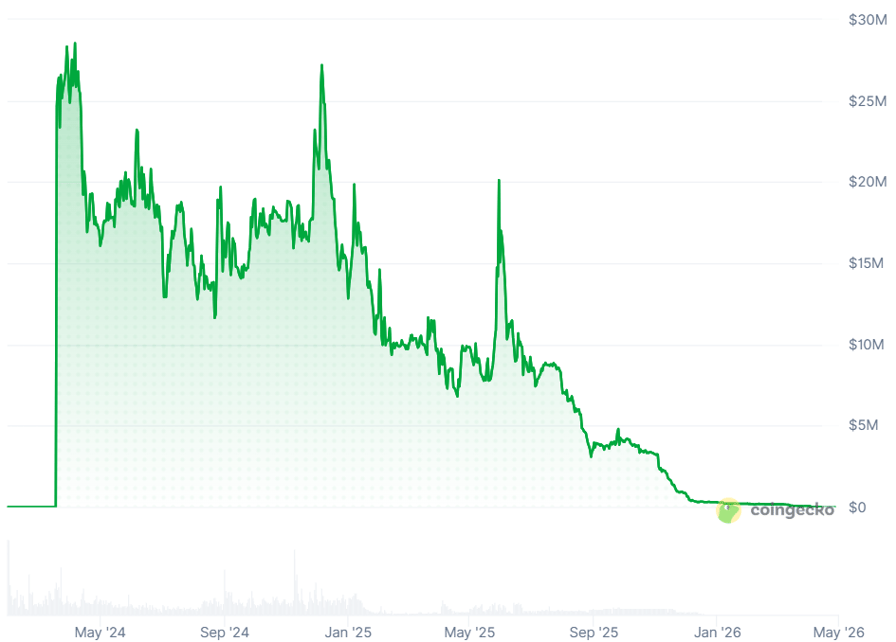
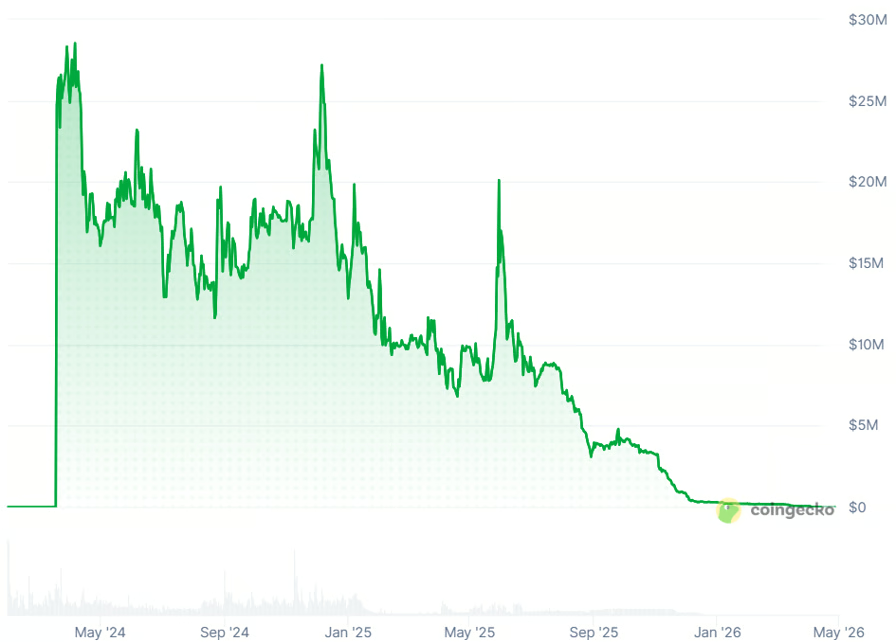
Dmail’s token market cap fell below $1 million in November. Source: CoinGecko
Token funding falters as projects unwind
As market conditions have tightened in recent months, projects are drifting into slow declines instead of the abrupt collapses seen in past crypto downturns. Projects are deteriorating over time as user activity declines, treasuries weaken and funding options narrow.
“You see this in cases like Tally and Step Finance, where there is no single failure point, just a steady decline in treasury value and user activity that compresses optionality over time,” said Dharia.
DAO tooling platform Tally said it was winding down after concluding the market for governance tooling had yet to develop at scale, while Step Finance moved to shut down after a hack, saying efforts to secure financing or a sale failed to produce a viable outcome.
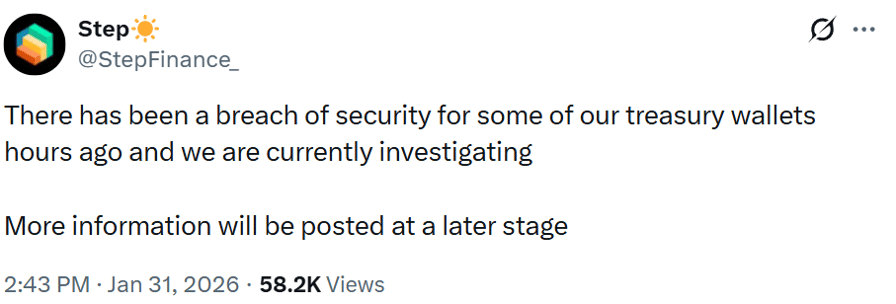
Step Finance suffered a $40 million security breach in January. Source: Step Finance
Related: Ethereum’s EEZ could pull other blockchains into its orbit
Some breakdowns still follow more familiar patterns. BlockFills filed for bankruptcy in March after freezing withdrawals. Its creditor, Dominion Capital, alleged in a lawsuit that the firm commingled customer assets to cover company losses.
Tokens once offered a fallback, allowing teams to raise capital or subsidize growth, but that mechanism is no longer as reliable, Dharia said.
He added:
Earlier cycles treated tokens as a primary funding mechanism with an implied alignment between users, holders and operators. That alignment has proven fragile in stressed scenarios, particularly where token holders lack defined rights or recourse.”
Some are starting to treat tokens as claims that may need to be consolidated or reworked. In March, Across Protocol proposed a token-to-equity buyout. Risk Labs, the team behind Across, said the token and decentralized autonomous organization (DAO) structure limited its ability to close deals with enterprises and institutions.
Crypto lacks a playbook for restructuring
Unlike traditional companies, most crypto projects lack a clear path to restructure once conditions deteriorate. Corporate bankruptcies provide mechanisms to pause obligations, renegotiate with creditors and reorganize capital structures.
In crypto, such avenues are often missing or poorly defined.
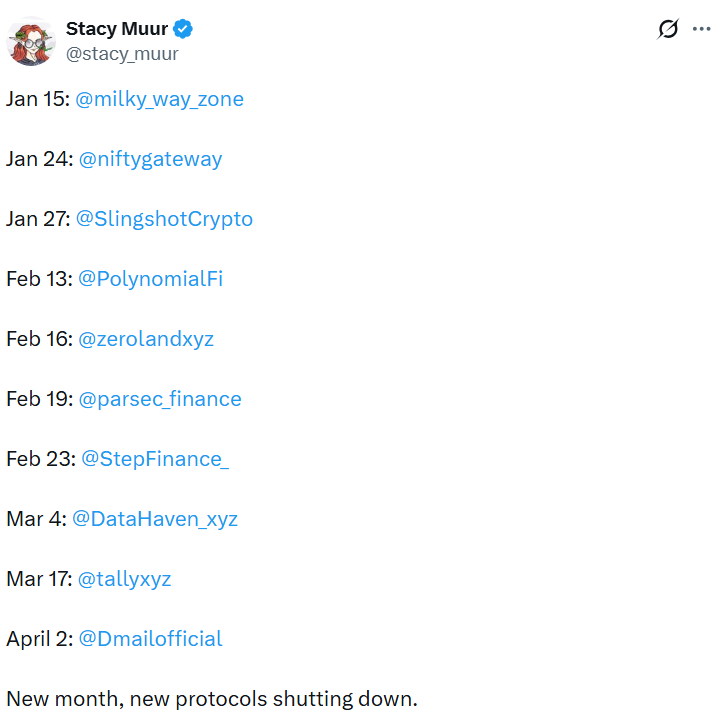
Each month in 2026 had a crypto project announcing shutdowns. Source: Stacy Muur
Related: Prediction market battle gets closer to Supreme Court
Crypto projects often operate through a mix of foundations, offshore entities and token-based communities, with no unified legal structure governing liabilities. In restructuring, token holders typically have no formal claims on assets or cash flows.
That limits what they can do under pressure. Projects are often left choosing between raising new capital on worse terms or shutting down without a clear hierarchy of claims or a way to bind stakeholders to an outcome, entirely.
“Most projects do not have access to formal restructuring tools, and their stakeholder base is fragmented across token holders, equity investors, and users with no clear hierarchy or enforcement mechanism,” said Dharia.
“That makes it difficult to recapitalize, restructure obligations, or run a controlled process to preserve value. In that environment, once liquidity tightens, outcomes tend to default to wind downs or distressed asset sales rather than coordinated recoveries,” he said.
Limited recovery paths in token-based systems
Tokens made it easier and more accessible for crypto companies to raise capital and scale quickly, but offer limited support once conditions deteriorate.
Dharia said the current wave of shutdowns is driven by tighter capital availability and structurally weak balance sheets. Many projects entered the bear market with treasuries heavily concentrated in their own tokens or correlated assets. As prices fell, the runway contracted.
“At the same time, funding channels have narrowed, with more selective venture deployment, weaker token issuance and thinner secondary liquidity limiting both exit and financing options,” Dharia added.
So far this year, projects have more often wound down quietly than attempted formal restructuring. Without clear frameworks to reorganize claims or coordinate stakeholders, recovery paths remain limited.
Some projects have begun exploring ways to consolidate ownership and introduce more formal structures, suggesting parts of the market are starting to adapt after running into the limits of token and decentralized governance models.
Magazine: AI-driven hacks could kill DeFi — unless projects act now
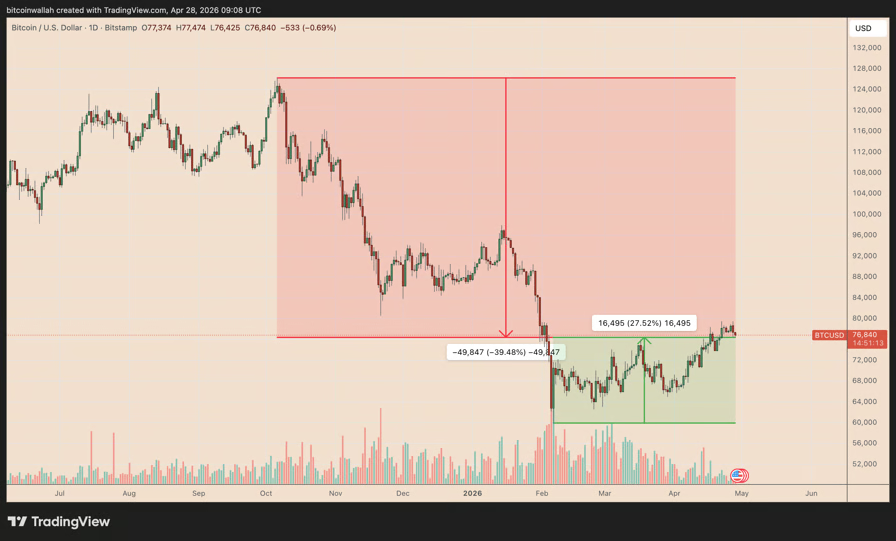
Bitcoin (BTC) is trading roughly 40% below its October 2025 record high near $126,000 despite its ongoing recovery.
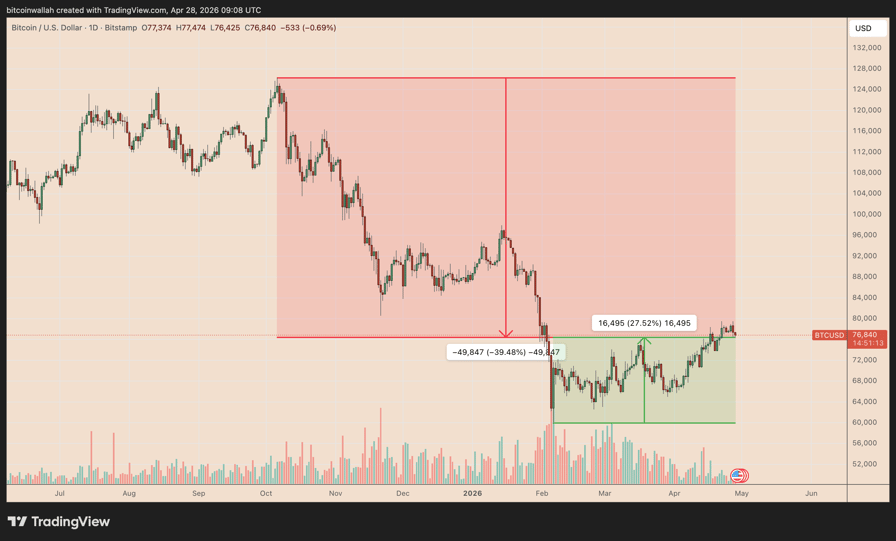
Still, some of the cryptocurrency’s loudest bulls, including billionaire investor Tim Draper and Fundstrat’s co-founder Tom Lee, have not backed down from their $250,000 year-end prediction, a target that would require more than a threefold rally from current levels.
Is that realistic, or is Bitcoin’s latest drawdown a warning that the cycle has already peaked?
Key takeaways:
- Bitcoin’s selloff may resume due to a bearish continuation setup.
- Halving and midterm election fractals appear bearish for the BTC price in 2026.
Veteran trader warns of more BTC price decline
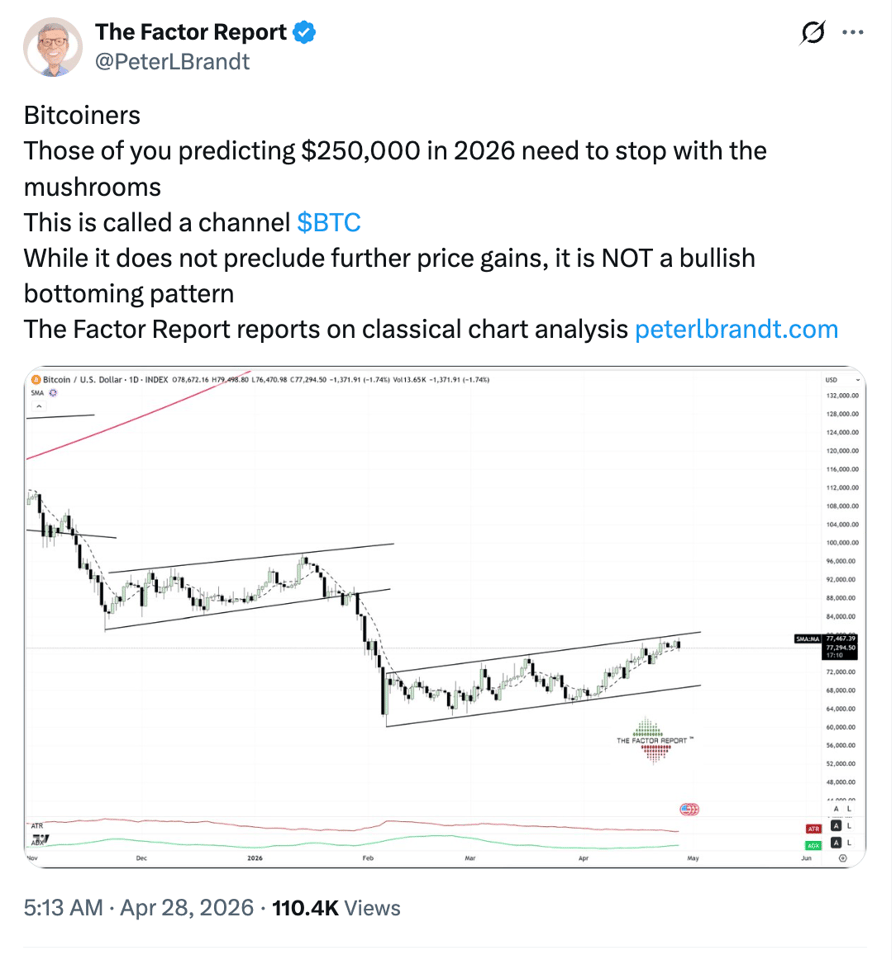
Peter Brandt, a veteran futures market trader, highlighted a channel pattern on the Bitcoin daily chart, which could keep BTC’s odds of rising toward $250,000 this year low.
As of Tuesday, BTC was showing signs of a pullback after testing the upper boundary near $79,500 as resistance. The cryptocurrency risks declining toward the flag’s lower boundary around the $69,000 level by May if the correction persists.
Those of you predicting $250,000 in 2026 need to stop with the mushrooms
This is called a channel
While it does not preclude further price gains, it is NOT a bullish bottoming pattern
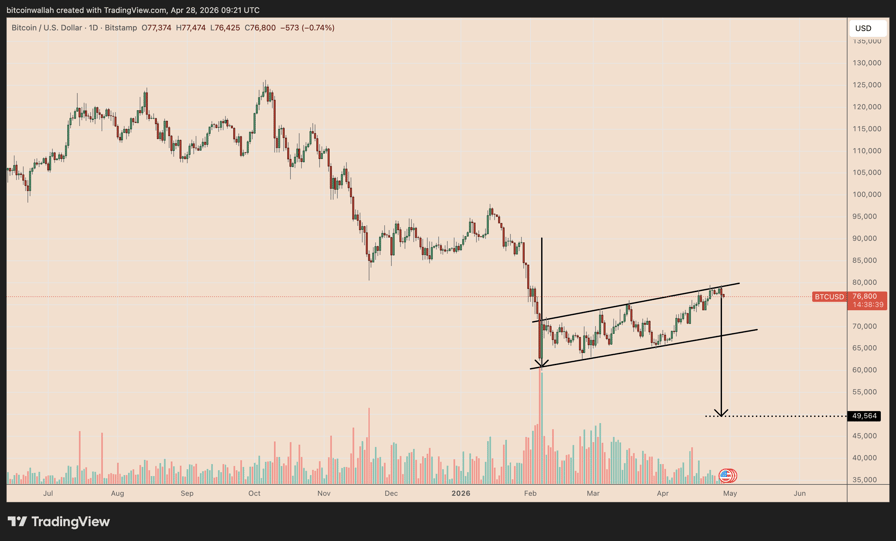
Looking broadly, the channel appears like a bear flag pattern. A break below its lower trend line may push the BTC price under $50,000 if the technical setup plays out as intended.
Bitcoin halving fractals show the bear market is midway
BTC’s price cycles have historically followed a clear pattern tied to its halvings every four years.
Cycle peaks have consistently occurred 12 to 18 months after the event. In 2012, the peak arrived in 12 months. The 2016 halving saw its top in 17 months, while the 2020 halving peaked after 18 months.
The April 2024 halving fits this timeline. Bitcoin hit its all-time high of $126,000 in October 2025, roughly 17–18 months later.
.png?prefix=media%2Fcontent)
Now, in late April 2026 (over 24 months post-halving), BTC trades around $77,000, down 38%–40% from that peak. This alignment suggests the 2025 high may represent the cycle top, casting doubt on new highs for the remainder of 2026.
Bitcoin sell-off may resume in May
A chart by analyst Merlijn The Trader is adding to the cautious narrative, pointing to a recurring “Sell in May” pattern in US mid-term election years.
For instance, BTC dropped 61% in 2014, 65% in 2018, and 66% in 2022, each beginning around May of the election years.
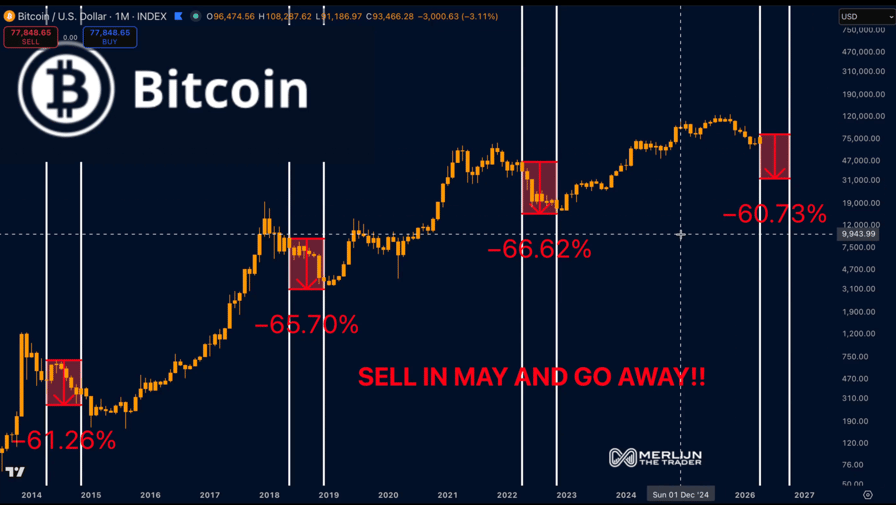
Applying a similar framework to 2026, Merlijn projected a potential decline of over 60%, which would place BTC near the $30,000 level.
In a February report, Capital Group analysts Matt Miller and Chris Buchbinder said midterm elections often raise uncertainty over congressional control and policy direction. As campaign rhetoric heats up in the spring, investors tend to cut risk, slow buying, and brace for volatility.
That backdrop weakens the case for Bitcoin reaching $250,000 by year-end, even though several analysts, including those from Bernstein, see room for a more modest rebound toward the $100,000–$150,000 range.


Ethereum price opened at $2,303.33 on April 28, its lowest morning level in over a week, as renewed concerns over stalled Iran ceasefire negotiations pushed Brent crude back above $104 a barrel and weighed on all major crypto assets heading into the Federal Reserve’s rate decision.
Summary
- Ethereum price opened April 28 at $2,303.33, down 2.8% from Monday’s open of $2,369.84, and continued sliding to $2,278.56 by 7:10 AM ET.
- The selloff was triggered by stalled US-Iran ceasefire negotiations and rising oil prices, with Brent crude returning above $104 a barrel for the first time in several days.
- Bitcoin also fell on the open, down 1.6% despite three straight sessions above $78,000, with the broader market under pressure ahead of the FOMC meeting scheduled for later in the week.
Ethereum price opened the April 28 trading session at $2,303.33, its lowest opening level in over a week, according to data from Yahoo Finance cited in its daily crypto price tracker. The 2.8% drop from Monday’s $2,369.84 open came as crypto investors reacted to two simultaneous macro pressures: stalled peace negotiations between the US and Iran and a sharp return of oil prices above $104 per barrel, both of which contributed to a broad risk-off tone across equities and digital assets heading into the Federal Open Market Committee meeting.
Ethereum Price Drop Driven by Iran Talks Stalling and Oil Returning Above $104
As crypto.news reported, the US-Iran standoff re-escalated last week after Iran distanced itself from the Islamabad summit and insisted that diplomacy rather than the ongoing naval blockade was the only path to further peace talks. The US has maintained its blockade as strategic leverage to secure the complete abandonment of several uranium enrichment facilities, a condition Iran has so far refused to accept. Oil prices surged as a result, with Brent crude reclaiming the $104 level that analysts have repeatedly cited as the threshold above which inflation concerns begin to materially delay Federal Reserve rate-cut expectations. The connection runs directly to crypto: higher oil prices pressure inflation figures, which influence whether the FOMC holds or cuts rates, and rate expectations have been one of the primary macro drivers of Bitcoin and Ethereum price action throughout 2026. Bitcoin also fell 1.6% on the April 28 open despite three straight days of opening above $78,000, reflecting that the Iran-driven pressure affected the entire risk asset complex simultaneously.
How the FOMC Meeting Adds a Second Layer of Uncertainty
Crypto investors are watching the April 28 to 29 FOMC meeting closely. Rates are widely expected to remain unchanged for the third consecutive meeting, but the language in the accompanying statement carries substantial weight given the competing signals: improving US-Iran ceasefire sentiment on one side, rising oil prices and sticky inflation on the other. As crypto.news documented, crypto prices have tracked the Iran-oil-FOMC interplay headline by headline throughout April, with Bitcoin and Ethereum both spiking and reversing on each diplomatic signal as market participants try to price the probability of a ceasefire extending or collapsing. The FOMC statement on April 29 will be the clearest signal yet of whether the Fed intends to hold its current restrictive posture through summer or whether improving underlying data gives it room to signal a cut in the second half of 2026.
Ethereum’s Technical Position as It Tests Key Support
ETH’s drop to $2,278 brings it toward the $2,250 to $2,300 support band that technical analysts have identified as the range that must hold to prevent a test of $2,150. As crypto.news tracked, ETH has already demonstrated its sensitivity to Iran signals, having rallied from $2,153 to a six-day high on April 1 when Iran’s president signaled willingness to negotiate, before giving back gains when that willingness failed to convert into a substantive agreement. The 50-day EMA sits at $2,322, slightly above current prices, making it the nearest technical level that would need to be reclaimed for ETH to reestablish short-term bullish momentum. The RSI reading of approximately 35 signals near-oversold conditions without triggering a clear reversal signal, leaving ETH in a range-bound consolidation that remains entirely subject to the next Iran headline or Fed comment.
Ethereum’s all-time high of $4,953.73 was set on August 24, 2025. As of April 28, ETH has recovered from its $1,837 February low but remains approximately 54% below that peak.


BNB price held above $625 on April 28 as the broader crypto market declined, with Bitcoin down 1.6% and Ethereum at a week low, making BNB one of the few large-cap assets to hold its ground during a day driven by stalled Iran ceasefire negotiations and rising oil prices.
Summary
- BNB price fought to hold above $625 on April 28 as the total crypto market cap shed over $30 billion, with most large-cap assets in the red.
- Binance executed its 35th quarterly auto-burn on April 15, permanently removing 2.14 million BNB worth approximately $1.32 billion from circulation, leaving the total supply below 135 million tokens.
- The first US-listed 2x leveraged BNB ETF, XBNB from Teucrium, launched on April 25, adding a new institutional access layer to BNB’s market structure ahead of the April 28 session.
BNB price was fighting to stay above $625 on April 28 as CryptoPotato reported that most large-cap crypto assets were in the red, with Ethereum below $2,300, XRP below $1.40, and BTC stalling below $77,000. The total crypto market cap shed over $30 billion on the day, but BNB’s relative resilience placed it among the better performers in the top ten by market cap, continuing a pattern of outperformance that has characterized BNB against major altcoins for several weeks.
BNB Price Holds as Market Digests Iran Talks and FOMC Pressure
As crypto.news reported, the April 28 decline was driven primarily by renewed Iran ceasefire uncertainty and a return of Brent crude above $104 a barrel, compressing risk appetite across crypto, equities, and emerging market assets simultaneously. BNB’s relative stability compared to Ethereum and Bitcoin reflects its different demand driver profile: while BTC and ETH price action on April 28 was dominated by macro risk-off flows, BNB’s price is structurally tied to Binance exchange revenue, BNB Chain transaction volume, and the deflationary supply dynamics created by its quarterly auto-burn mechanism. Those internal demand drivers did not deteriorate on April 28, insulating BNB partially from the macro-driven selling that hit assets with less embedded utility demand.
Why the April 15 Burn and XBNB Launch Frame the Current Price Range
The April 28 session takes place less than two weeks after Binance’s 35th quarterly auto-burn on April 15, which removed 2.14 million BNB worth approximately $1.32 billion in what Binance described as one of its largest single quarterly deflationary events. As crypto.news documented, that burn reduced total BNB supply below 135 million tokens, continuing the protocol’s trajectory toward its 100 million hard cap, and analysts at InvestingHaven and Coinpedia separately cited the burn’s deflationary impact as a catalyst for the price range of $590 to $900 they project for BNB in 2026. The launch of Teucrium’s XBNB on April 25, the first US-listed 2x daily leveraged BNB futures ETF, adds a new institutional access layer but also introduces potential amplified selling pressure during market-wide drawdowns, which may partly explain BNB’s tight range on April 28 rather than a sharper fall or a significant gain.
What the BNB Chain Ecosystem Adds to the Price Stability Case
BNB’s performance relative to other altcoins on down days reflects structural demand from within the BNB Chain ecosystem. As crypto.news tracked, BNB Chain has become the leading blockchain for autonomous AI agent deployments, surpassing 150,000 on-chain agents in April 2026, with 43,750% growth since January representing a demand driver that operates independently of macro sentiment. BNB Chain’s 2026 roadmap targets 20,000 transactions per second with sub-second finality, and the network’s 15 million daily transactions and opBNB Layer-2 activity provide a baseline of gas fee burns that continuously remove BNB from circulation. The $628 support level that technical analysts have identified as the critical floor for BNB’s current structure must hold through the FOMC meeting on April 28 and 29 for the bullish scenario targeting $645 to $650 resistance to remain intact.
BNB entered April 28 trading near its 50-day EMA at approximately $625 to $628, in a consolidation range that has held since the April 2 low of $573, representing a roughly 10% recovery that has consistently outpaced Ethereum’s recovery from its own April low.
Galaxy Digital moved roughly 45,000 Ethereum (ETH) worth over $100 million into three crypto exchanges. The transfer raises fresh concerns about institutional selling pressure on the second-largest cryptocurrency.
However, on-chain data shows a contrasting picture. Active addresses, exchange reserves, and corporate accumulation point to structural strength.
Behind Galaxy Digital’s 45,000 ETH Move
Lookonchain data showed that two Galaxy Digital wallets deposited 45,000 ETH across Binance, Bybit, and OKX via multiple transfers.
Follow us on X to get the latest news as it happens
Exchange deposits typically signal potential selling pressure. Still, they do not confirm a sale on their own. The transfers may reflect client orders rather than a directional bet.
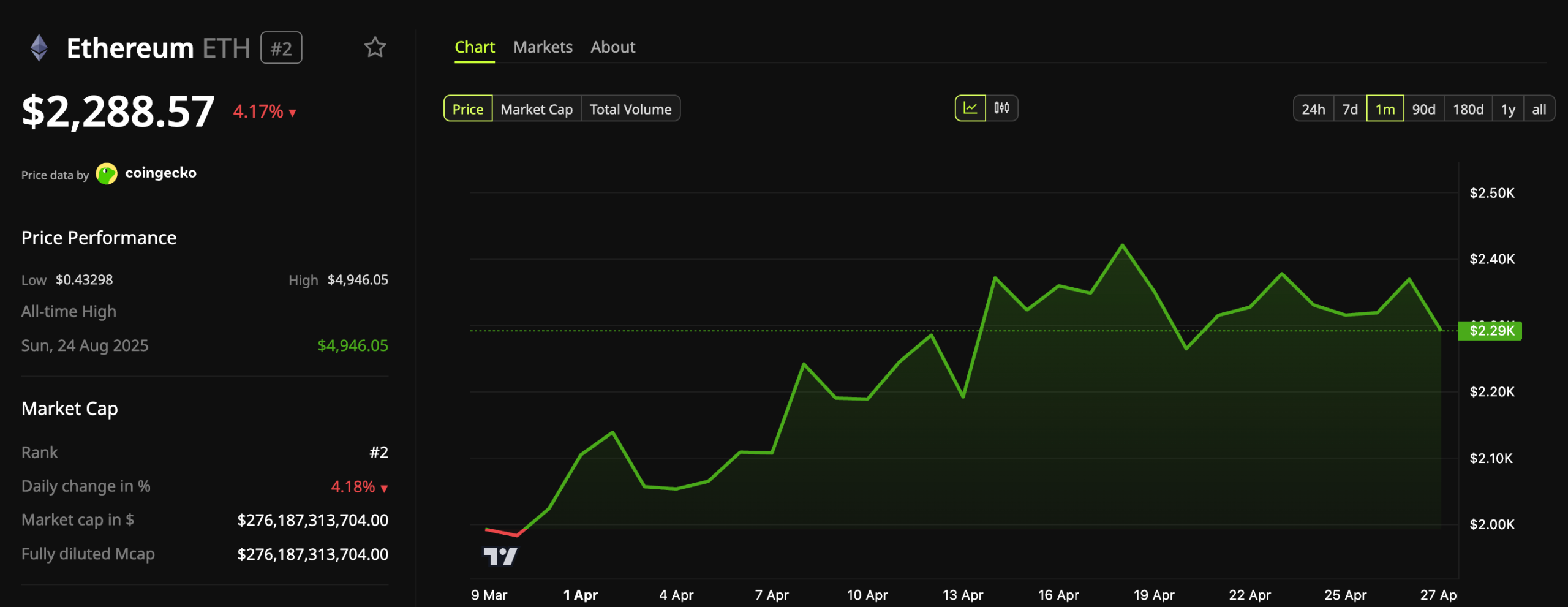
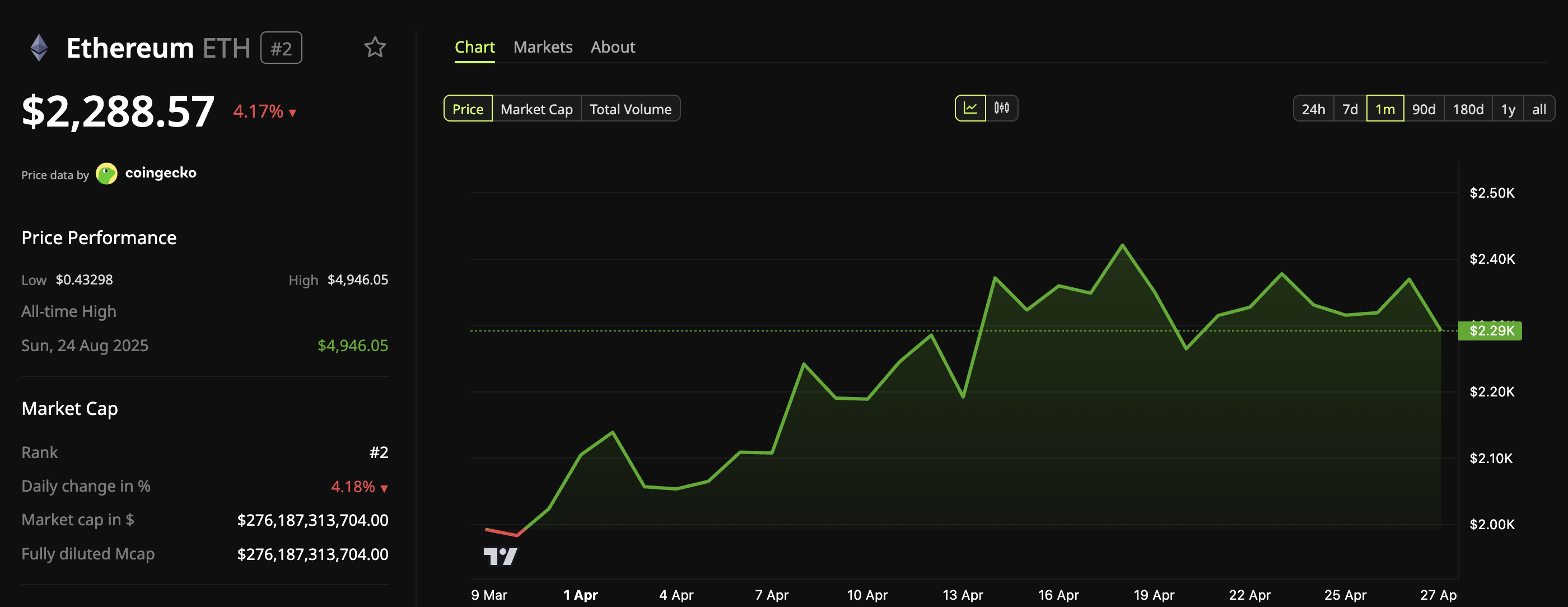
It also comes at a time when Ethereum faces broader market headwinds. The price has declined by 4% over the past day, according to BeInCrypto Markets, which shows ETH trading at $2,288 at press time.
On-Chain Metrics Tell a Different Story
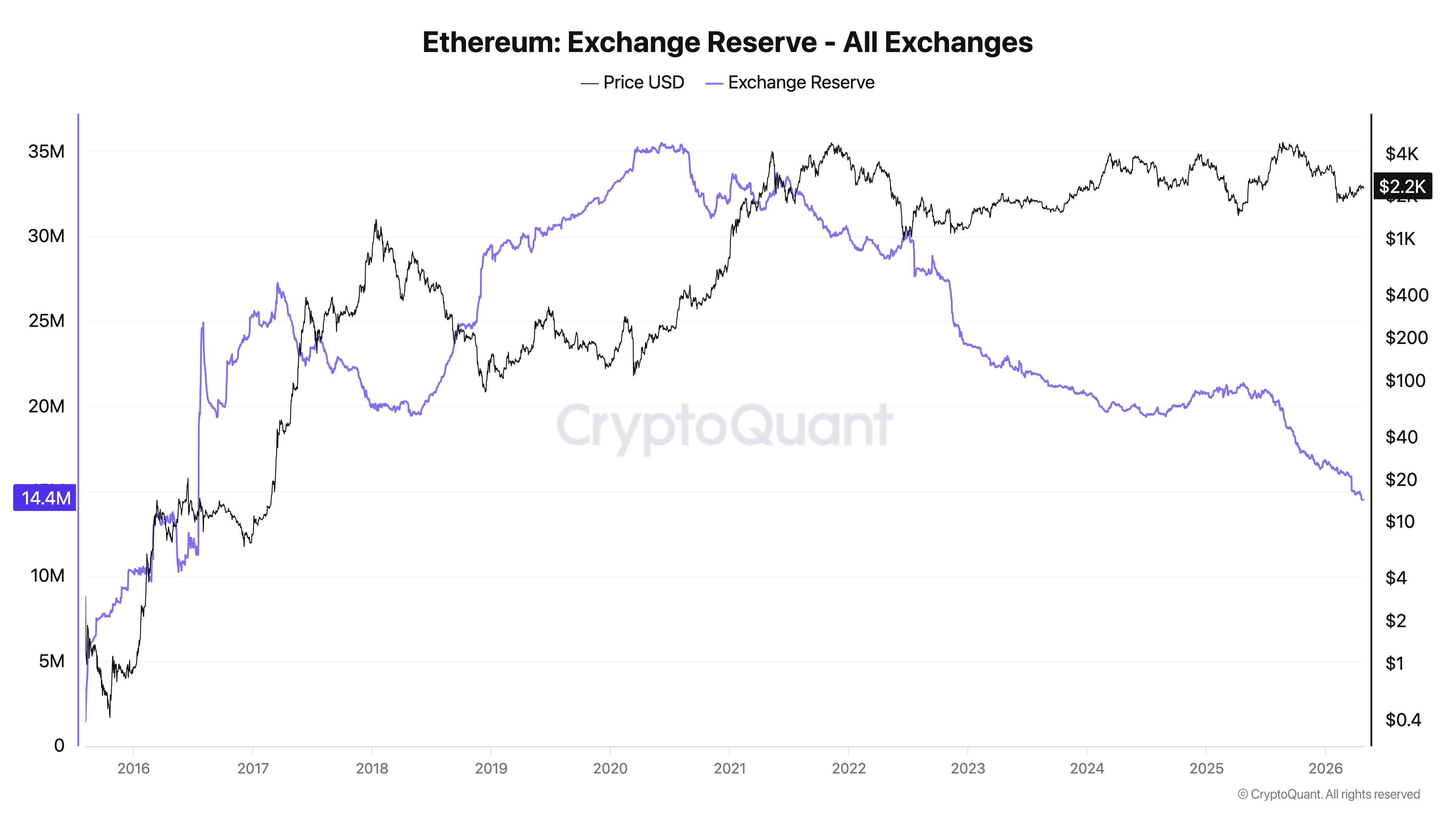
Despite inflows and ETH’s recent price weakness, several indicators are signaling a bullish outlook. CryptoQuant figures place ETH exchange reserves near 14.5 million tokens, the lowest level since 2016. Over 331,000 ETH have been withdrawn from exchanges since April 19, dwarfing the Galaxy inflow.
At the same time, corporate accumulation is also strong. BitMine added 101,901 ETH last week, its largest single-week haul of 2026.
US spot ETH exchange-traded funds (ETFs) have recorded three straight green weeks of inflows, according to SoSoValue. The combination of fund demand and shrinking exchange supply continues to absorb available tokens.
On the network side, an analyst noted a widening disconnect between ETH’s price and network activity. The 100-day moving average of active addresses just printed a record at roughly 587,000.
“The continuous ascent of the active addresses’ SMA 100 is a clear indicator of growing fundamental demand, expanding network adoption, and a highly dynamic ecosystem,” CryptoOnchain wrote. “From an on-chain analysis perspective, this glaring divergence implies that Ethereum may currently be undervalued.”
Beyond Ethereum-specific factors, broader market signals suggest investors are gradually returning to crypto. Binance saw nearly $6 billion in stablecoin inflows across March and April.
At the same time, the Crypto Fear and Greed Index has risen to 47 from 12 just a month earlier, signaling an improvement in market sentiment.
Subscribe to our YouTube channel to watch leaders and journalists provide expert insights
The post Ethereum (ETH) Sell Pressure Concerns Rise, But 4 On-Chain Signals Flash Bullish appeared first on BeInCrypto.

TLDR:
- South Africa’s draft Capital Flow Management Regulations propose approval requirements for all crypto transactions above a set threshold.
- Luno is preparing a formal submission urging the National Treasury to classify locally held crypto assets as onshore assets.
- The draft rules require users to declare all crypto holdings within 30 days of the regulations taking effect in South Africa.
- Luno is collaborating with industry stakeholders to present a unified response aimed at shaping a fair and practical regulatory outcome.
Luno is calling for a fairer regulatory framework as South Africa’s National Treasury reviews its draft Capital Flow Management Regulations.
The proposed rules introduce new controls on crypto asset transactions, including approval requirements and declaration obligations.
Luno, a licensed crypto asset service provider in South Africa, has raised concerns about the practical effects these rules may have on everyday users.
The exchange is preparing a formal submission to the Treasury and is working alongside industry stakeholders to shape a more balanced outcome.
Why Luno Is Pushing Back on the Draft Rules
The draft regulations propose extending exchange control requirements to all crypto asset transactions. This goes beyond the traditional scope of South Africa’s existing capital flow rules. Ordinarily, such controls apply when capital moves across borders, not within the country itself.
Under the current proposal, any transaction to buy, sell, borrow, or lend crypto above a yet-to-be-determined threshold would need National Treasury approval.
This applies even to transactions between two parties located within South Africa. Luno argues that this level of oversight is disproportionate for domestic activity.
LunoGlobal has stated publicly that while it supports modernising the ageing exchange control framework, the current draft poses hurdles for everyday crypto users.
These hurdles, the exchange warns, could slow South Africa’s growth as a global fintech leader. Luno’s concern is that the rules create friction without adequate justification.
The exchange is now collaborating with other crypto industry players to build a collective response. The goal is to ensure that the industry’s voice carries weight in the Treasury’s final decision.
Luno believes a coordinated approach will lead to a more practical and fair outcome for all South African crypto users.
What Luno Wants and How Users Can Participate
At the centre of Luno’s advocacy is a specific classification request. The exchange wants crypto assets held on a licensed local provider to be treated as onshore assets.
This would mean such holdings do not count against offshore investment thresholds like the Single Discretionary Allowance or the Foreign Investment Allowance.
The draft also requires users to declare all crypto holdings within 30 days of the regulations coming into force. Users seeking transaction approval must also state the intended purpose of that transaction.
If the purpose changes, they may be required to sell their crypto assets, adding further complexity to routine activity.
Luno’s formal submission to the National Treasury will advocate for a framework that addresses illicit activity without burdening ordinary users.
The exchange has made clear that compliance and growth should not work against each other. A well-designed framework can achieve both, without unnecessary restrictions.
The public participation phase is currently open, and the Treasury has invited comment from all parties. Members of the public can submit their views by emailing the National Treasury directly.
The full draft regulations are available on the National Treasury’s official website for anyone wishing to review them before submitting comments.


A Manhattan federal judge has denied FTX CEO and co-founder Sam Bankman-Fried’s motion for a new trial, rejecting his claim that there is new evidence.
Judge Lewis Kaplan, who oversaw Bankman-Fried’s trial in 2023 and sentenced him to 25 years in prison in early 2024, wrote in an order on Tuesday that Bankman-Fried’s claim of new evidence and witnesses was baseless.
“This motion appears to be one part of a plan to rescue his reputation that Bankman-Fried hatched and even committed to writing after FTX declared bankruptcy but before he was indicted,” Judge Kaplan wrote.
Bankman-Fried in February had requested a new trial to be overseen by a different judge, making the rare move of filing a motion without consulting his lawyers and while an appeals court was considering his conviction and sentence.
On Wednesday, Bankman-Fried asked to withdraw his request, telling Judge Kaplan he didn’t believe he would “get a fair hearing on this topic in front of you,” which the judge denied.

Sam Bankman-Fried appeared on a podcast in March 2025 while being held at the Metropolitan Detention Center in Brooklyn. Source: YouTube
In his order, Judge Kaplan wrote that Bankman-Fried’s claim that three former FTX executives could counter the government’s arguments that FTX was insolvent was “baseless on multiple independently sufficient levels.”
“None of the witnesses, for example, is ‘newly discovered.’ Bankman-Fried well before trial knew all three of them and purportedly knew also what he hoped they would say were they to testify,” Kaplan wrote.
Bankman-Fried argued that two former FTX executives who didn’t testify — Ryan Salame, the former CEO of FTX’s Bahamian arm and Daniel Chapsky, FTX’s former head of data science — could counter the government’s claims about the exchange’s financial health.
Salame separately pleaded guilty to violating campaign finance laws and operating an illegal money-transmitting business. He was sentenced to seven and a half years in prison in May 2024.
Related: Sam Bankman-Fried ramps up Trump support following Ellison’s release
He also argued that Nishad Singh, FTX’s former engineering lead, who cut a plea deal with prosecutors to avoid jail and testified against Bankman-Fried at trial, changed his testimony “following threats from the government.”
Judge Kaplan said Bankman-Fried could have sought to compel testimony from the trio but didn’t, and his claim that their absence or decision to testify against him was a result of government threats “is wildly conspiratorial and entirely contradicted by the record.”
Bankman-Fried was found guilty on seven criminal charges related to fraud and money laundering, with a jury finding he illegally transferred billions of dollars of FTX customer money to the trading firm Alameda Research to make risky trades that contributed to the exchange’s collapse.
Bankman-Fried is being held in a federal prison in Lompoc, California.
Magazine: How crypto laws changed in 2025 — and how they’ll change in 2026
US AI stocks are heading into a potential breakout window in May 2026. Three of the largest AI-exposed names all report Q1 earnings between May 4 and May 5, and each one carries a distinct technical setup.
One sits at a stretched bull flag with volume divergence underneath. Another is testing a descending channel breakout for the second time. The third is hanging in a relief rally just above its bearish trigger. Together, they define how the AI trade resolves in May.
Advanced Micro Devices (NASDAQ: AMD)
Advanced Micro Devices (AMD) rallied 88.65% since early March, climbing from $187.65 to a peak of $353.93, before pulling back to $314.87 on April 28.
The chart now resembles a bull flag, a continuation pattern where a sharp rally is followed by a tight sideways drift before the next leg up. May’s resolution sets the tone for all key AI stocks to watch, with Q1 2026 earnings due May 5 after market close.
But the volume disagrees with the price. Between February 24 and April 24, AMD trended steadily higher while daily volume stayed flat. That volume divergence signals the rally lacks fresh buying conviction, the kind of fuel needed to defend a stretched price into a high-stakes print. That also explains the start of consolidation.
History shows what happens when AMD prints into weak conviction. The February 4 Q4 2025 earnings were a clean beat. Revenue of $7.66 billion crossed consensus, and Data Center sales hit a record $5.4 billion.
The stock still dropped from $192 within days, a 20% collapse driven by guidance softness and profit-taking after a stretched run.
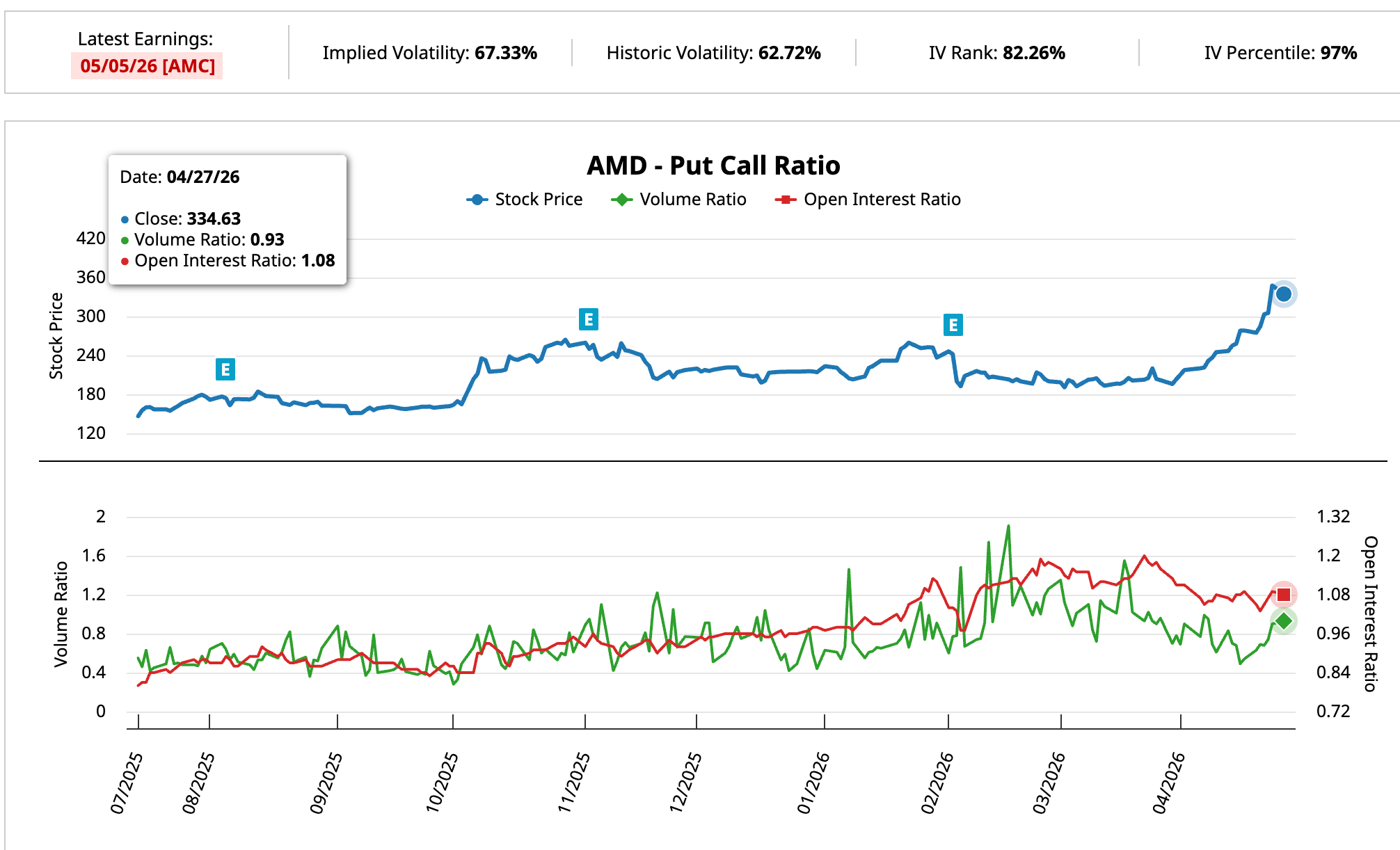
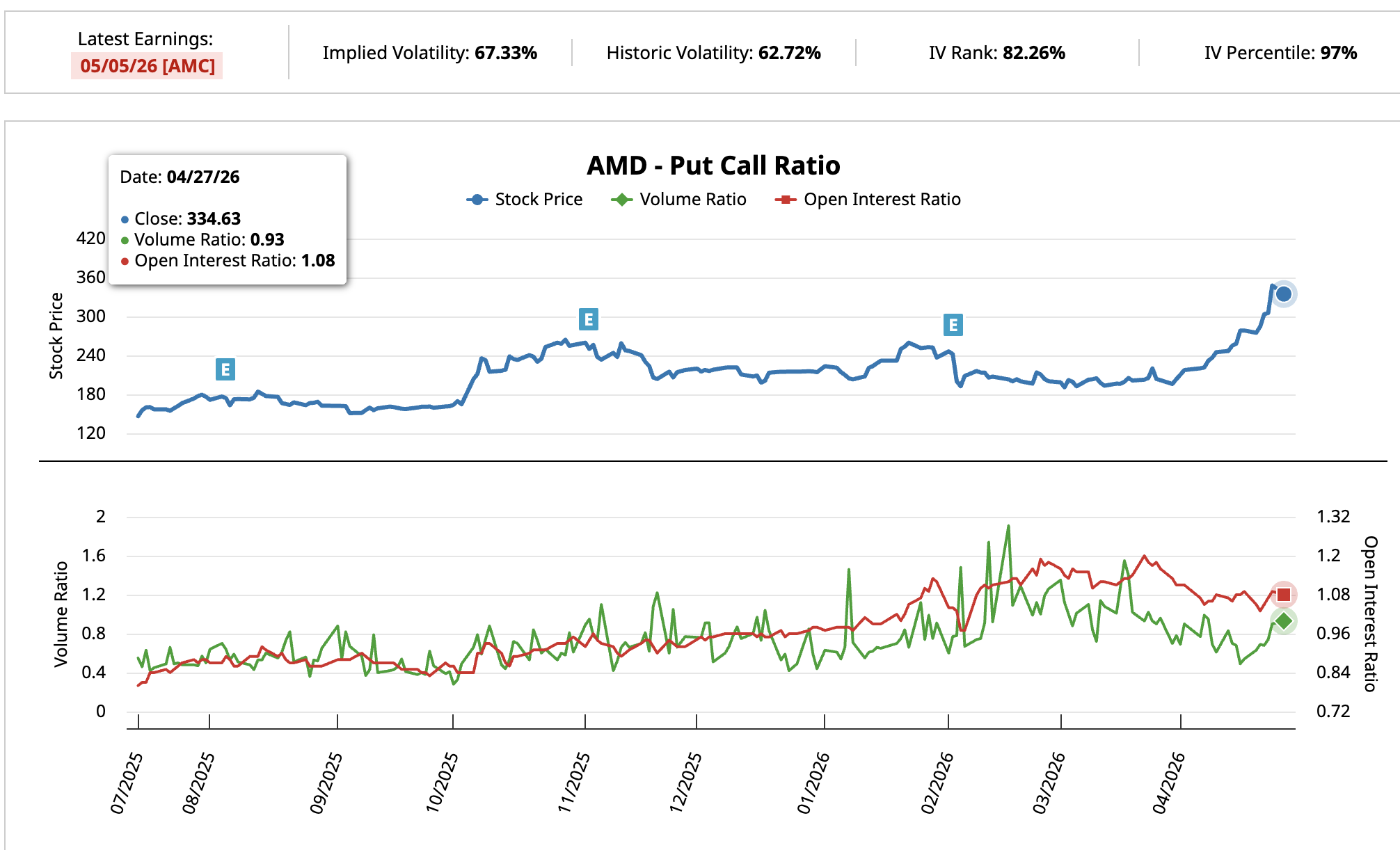
May sets up the same pattern, only louder. AMD now trades higher than the February peak, with put-call open interest over 1 and IV Rank at 82.26%, both signaling that traders expect a violent move.
Therefore, a beat alone may not be enough. Holding $314.69 keeps the flag intact.
Want more insights like this? Sign up for Editor Harsh Notariya’s Daily Newsletter here.
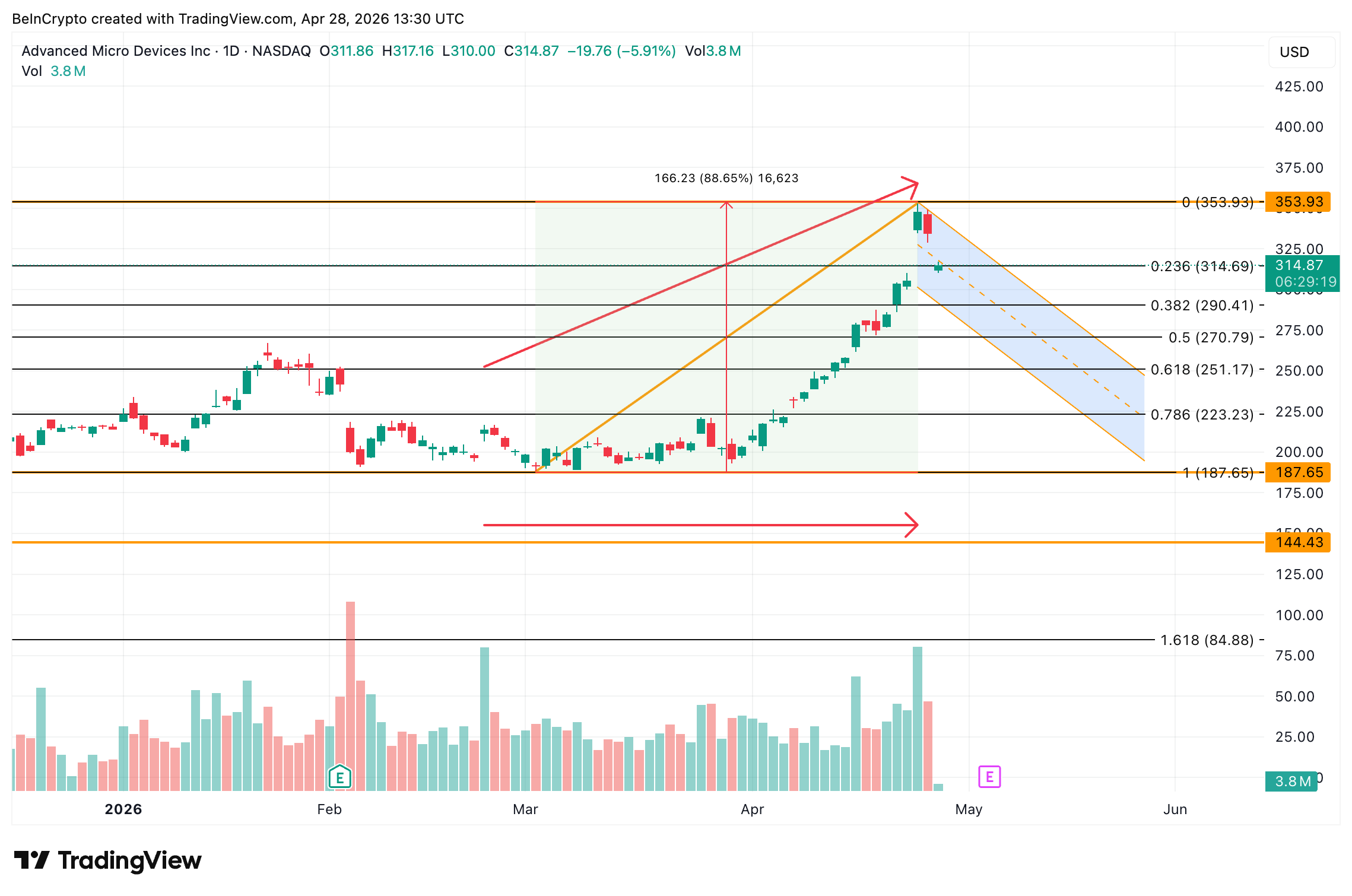
A pullback to $290.41 still allows consolidation. A break under $251.17 invalidates the pattern. A daily close above $353.93 reopens the path to a new high, something that market analysts are looking at.
Palantir Technologies (NASDAQ: PLTR)
Palantir (PLTR) has fallen nearly 25% over the past six months, but the headline isn’t the drop. Since December, the stock has been trading inside a descending channel, a pattern where the price grinds lower between two parallel downward-sloping trendlines. PLTR has tried to break out twice, on March 24 and again on April 22.
Both attempts were near the upper trendline, leaving the stock at $143.20 ahead of Q1 2026 earnings on May 4 after market close.
The setup carries an early reversal signal. Between February 24 and April 10, PLTR carved out a lower low, but the Relative Strength Index (RSI), a momentum gauge measuring price strength on a 0-100 scale, printed a higher low.
That bullish divergence is what powered the rally toward the upper trendline starting April 13.
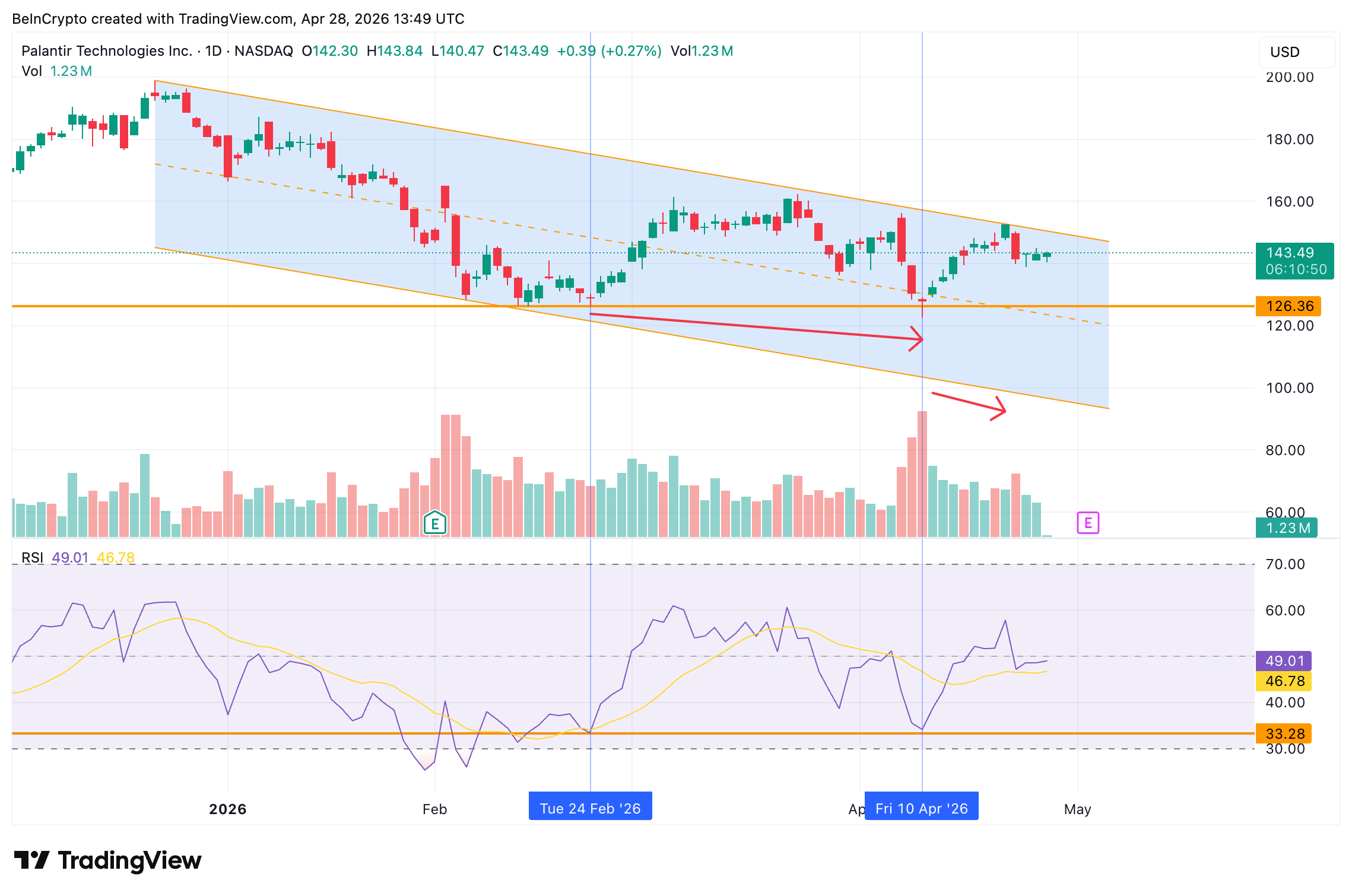
The breakout still failed, and volume explains why. Between April 13 and April 22, the price trended higher while the daily volume trended lower. Without buying conviction, the move could not punch through the resistance even with momentum on its side.
Fundamentals could deliver the volume the chart needs. Wall Street expects $1.54 billion in Q1 revenue, up 74% year over year, and 10 consecutive EPS beats keep the bar high.
The Department of Defense designated Palantir’s Maven Smart System as an official program of record in March, locking in long-term visibility into AI contracts.
The level of math defines May. Holding $140.78, the 0.236 Fibonacci level, keeps the structure intact.
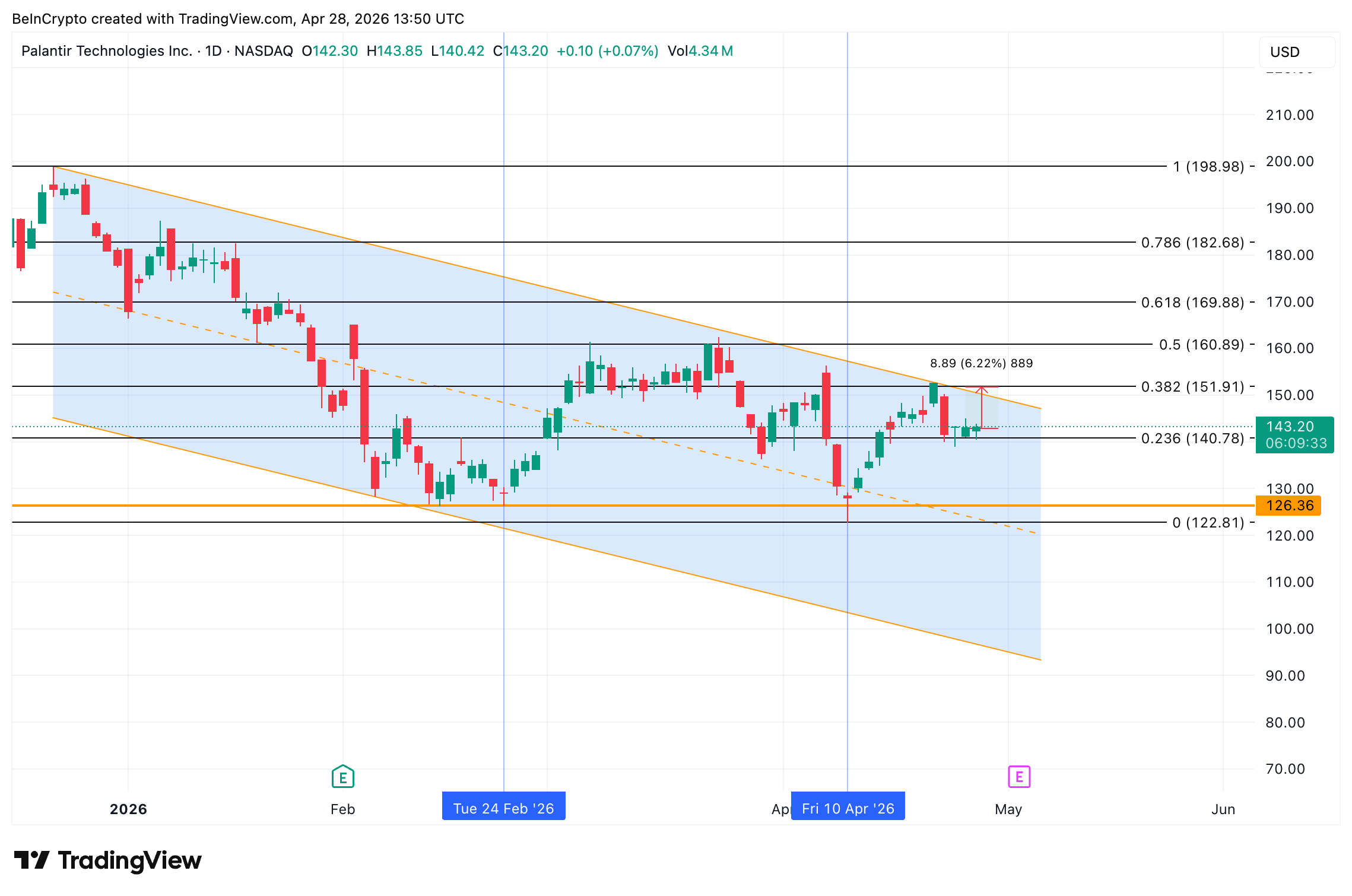
A 6% breakout above $151.91 on high volume opens the path to $160.89 and eventually $198.98. A break under $140 exposes $126.36 and the channel floor near $122.81.
Super Micro Computer (NASDAQ: SMCI)
Super Micro Computer (SMCI) is the cleanest bearish setup among AI stocks to watch in May.
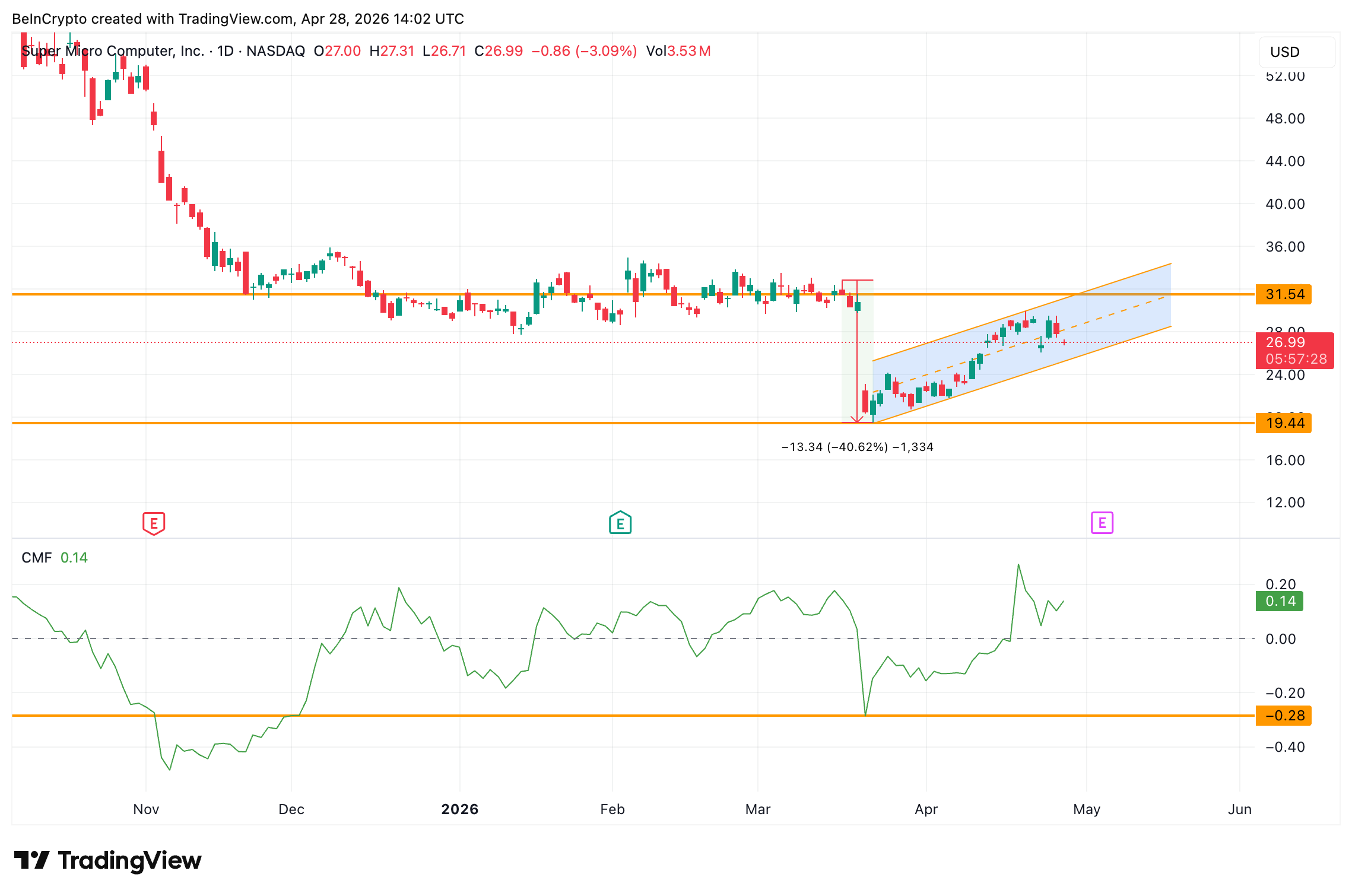
The stock crashed roughly 40%, from $30.79 to $19.30, between March 19 and March 23, after the US Department of Justice indicted co-founder Wally Liaw on charges of smuggling $2.5 billion in Nvidia AI chips to China. SMCI now trades at $26.99 ahead of Q3 FY2026 earnings on May 5.
That indictment broke the institutional bid. The Chaikin Money Flow (CMF) indicator that proxies institutional accumulation or distribution by combining price and volume, collapsed to -0.28 on March 19, the exact day the charges hit. Big money exited together, and the 40% price drop followed.
CMF has since recovered to +0.14, and price has formed a rising channel off the lows. But this is the relief rally inside a broken structure, not a reversal.
Price still sits closer to the channel’s lower trendline, and the fundamental damage has continued to compound.
On April 22, BlueFin Research reported Oracle cancelled 300 to 400 GB300 server racks worth $1.1 to $1.4 billion, allegedly to distance itself from the indictment. Mizuho cut its price target to $25 the same week.
That sets May 5 up as a confirmation print. A guidance miss linked to Oracle or xAI losses would re-trigger the same institutional exit that crushed the stock in March.
The level math reads tight and asymmetric. Losing $27.17 exposes $25.36, and a break there cracks the channel and reopens the $19.48 March low. Reclaiming $34.86 to flip the channel bullish sits nearly 30% away.
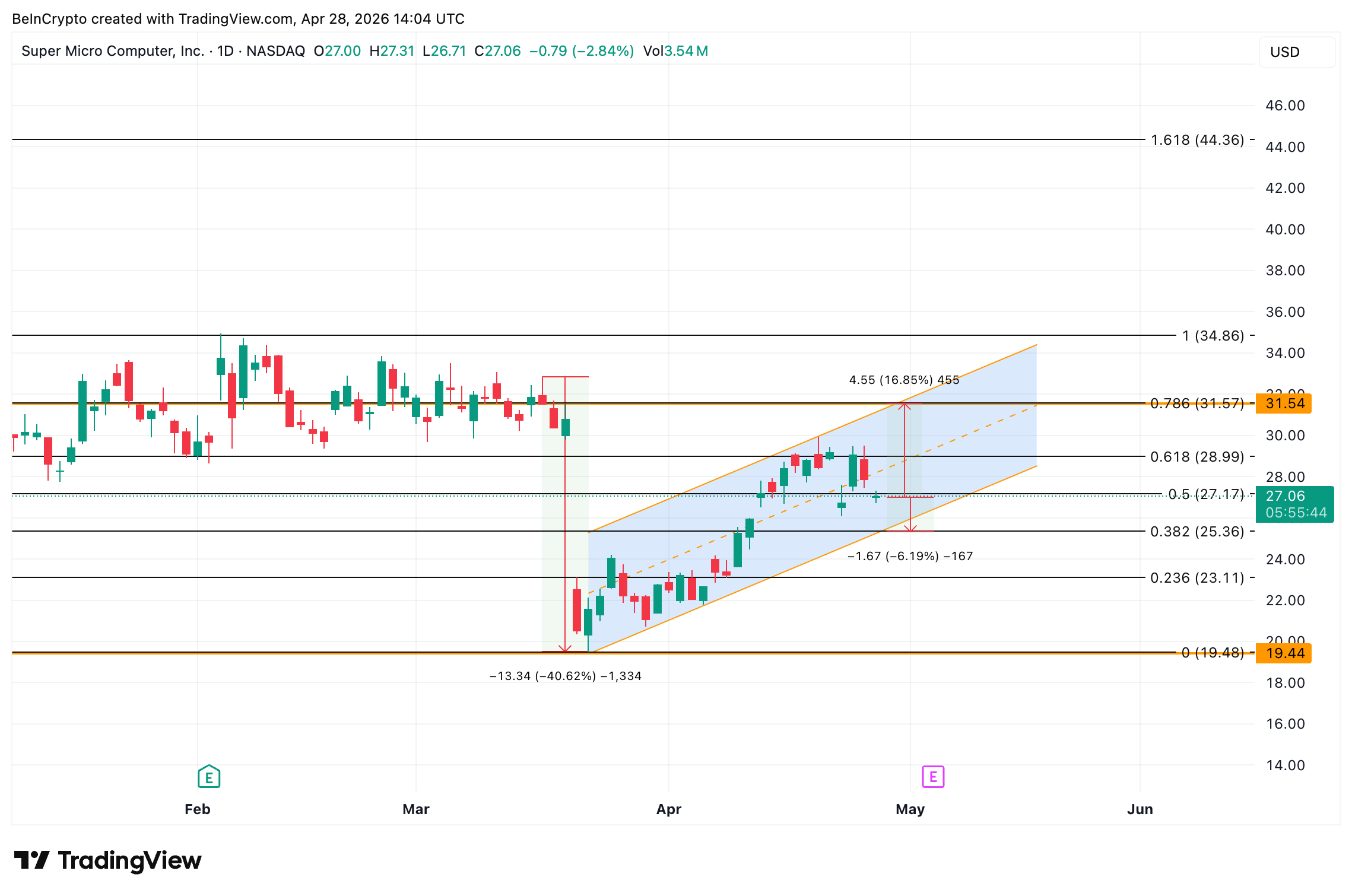
The bearish trigger is just 6% off, making SMCI one of the most tightly wound AI stocks to watch heading into May.
The post 3 AI Stocks to Watch in May 2026 appeared first on BeInCrypto.

Skullcandy Crusher Evo Wireless Headphones Give Bass Fans Exactly What They Want at a Fair Price

BITCOIN BEAR MARKET IS OVER! Silver Rotation Confirms BULL RUN!

King Charles Reminds Congress Of NATO Importance

Manchester United reach agreement with Casemiro over contract clause amid transfer speculation

US brings back mandatory military draft registration

Steven Gerrard disagrees with Gary Neville over ‘shock’ Chelsea and Arsenal claim | Football


-

 Tech1 day ago
Register Renaming | Hackaday
-

 Fashion4 days ago
Weekend Open Thread – Corporette.com
-
Crypto World3 days ago
Hyperliquid $HYPE Rally Builds Momentum as AI Sector Enters Prove-It Phase
-

 Politics6 days ago
Making troops accountable for war crimes threatens US alliance, ex-SAS colonel warns
-

 Politics6 days ago
Disabled people challenge government SEND proposals over segregation concerns
-

 Business5 days ago
Patterson-UTI Energy, Inc. (PTEN) Q1 2026 Earnings Call Transcript
-

 Business7 days ago
Rolls-Royce Voted UK’s Most Iconic Trade Mark as IPO Register Hits 150
-
 Sports3 days ago
IPL 2026: Ruturaj Gaikwad registers slowest fifty of the season, enters all-time unwanted list | Cricket News
-

 Politics1 day ago
Drax board avoid their own AGM, accused of greenwashing & environmental racism
-

 Politics6 days ago
Zack Polanski responds to home secretary’s taser threat
-

 Politics6 days ago
Starmer handler McSweeney to be dragged from shadows by Foreign Affairs Committee
-
Politics6 days ago
Wings Over Scotland | How To Get Away With Crimes
-

 Politics6 days ago
‘Iran is still a nuclear threat’
-
 Business7 days ago
HCL Tech share price tank over 9% after weak Q4. JPMorgan, HSBC & 3 others cut target price
-

 NewsBeat3 days ago
LK Bennett closes all stores after entering administration
-
 Sports6 days ago
Tim Bradley names the current best in the world: “Better than Inoue and Usyk”
-

 Crypto World5 days ago
Michael Saylor says BTC winter is over. Market analyst disagrees, says bitcoin was in a pullback
-

 Business7 days ago
The Job Benefits Most Men Don’t Know to Negotiate
-
Business6 days ago
Altimmune prices $225 million public offering at $3 per share
-
 Entertainment3 days ago
Mariah Carey Slams Deposition Claims In Brother’s Lawsuit
You must be logged in to post a comment Login