

Crypto World
Real estate tokenization’s missing layer


Disclosure: The views and opinions expressed here belong solely to the author and do not represent the views and opinions of crypto.news’ editorial.
Despite the wave of attention RWAs have received over the past couple of years, there’s a sense that everyone is waiting for something to shift. The problem is that many “tokenized” assets are still legal promises dressed up as tokens. Vague token rights, improvised custody and transfer controls, and servicing shortcomings make the whole thing still feel speculative. While the tokenised RWA market sits around $25B (which demonstrates serious growth), it’s still modest in comparison to global markets.
Summary
- Tokens aren’t titles: Many RWAs remain legal promises wrapped in blockchain rails. Without enforceable rights, controlled transfer, and servicing, tokenization stays speculative.
- The UAE is building the legal stack: Through DIFC, ADGM, and the Dubai Land Department, the UAE is treating tokenized real estate as regulated market infrastructure — not a crypto experiment.
- Rights beat throughput: The trillion-dollar RWA opportunity will go to jurisdictions that make token-holder rights unambiguous and enforceable, not to chains with the fastest settlement.
In Dubai, work on this is picking up. The Dubai Land Department has launched Phase II of its Real Estate Tokenization Project, with secondary-market resales scheduled to begin on 20 February 2026. In DIFC, the DFSA’s inaugural tokenization regulatory sandbox drew 96 expressions of interest. In short, the UAE is assembling the regulatory and institutional scaffolding needed to make tokenised real estate scalable – that’s certainly something worth talking about.
The crypto RWA fallacy
The best RWA pitch in crypto happens to be the simplest: take a deed, a fund share, or a receivable, put it on-chain, and let liquidity do the rest. In practice, that often means shipping a minting interface attached to a legal promise that lives somewhere else. The token trades 24/7, but the underlying rights don’t.
When markets tighten, everyone rediscovers the same truth: a token is not a title, nor a court order. Instead, it’s a digital representation recorded on a programmable platform – and it’s notoriously difficult to make it legally and operationally identical to what it claims to represent.
This idea shows up in three places. First, think about enforceability. If token holders can’t clearly understand what they own, what jurisdiction governs it, and how a claim is enforced, the idea of ownership is just branding. As a matter of fact, IOSCO warns that investors may not understand the legal aspects of ownership and transfer rights for tokenised assets, and flags legal uncertainty as a central risk holding back adoption.
Second, consider controlled transfer. Real assets don’t move like meme coins. Eligibility checks, transfer restrictions, and the ability to halt or reverse activity under lawful orders are not optional in institutional markets. OECD research notes that implementing restrictions like forced transfers or trading suspensions can be especially challenging on public, permissionless networks.
Third, there’s servicing. Real estate is an operating system: taxes, insurance, maintenance, tenant issues, distributions, valuations, reporting, audits. Tokenization can streamline records and transactions, but it doesn’t eliminate the admin layer that makes cash flows real and disclosures defensible. Until projects address these issues, RWAs are a bit stuck.
The UAE’s blueprint
If the UAE wins the real estate tokenization boom, it will be because it treated tokenization as a regulated financial product, a market-structure upgrade, and has built rules and institutions around that assumption.
- In DIFC, the DFSA launched a dedicated tokenization Regulatory Sandbox and drew 96 expressions of interest. This is an early indicator that serious firms are looking for a supervised pathway.
- In Abu Dhabi, ADGM has been explicit about positioning itself as a comprehensive regulatory home for digital assets, and it went further by introducing a DLT Foundations regime designed for token issuance and on-chain organisational structures.
- In 2025, the DIFC reported 8,844 active companies, demonstrating rapid year-on-year expansion.
- In Dubai, the Dubai Land Department is running a controlled pilot that explicitly tests governance, investor protection, and operational readiness while enabling secondary-market resale from 20 February 2026.
- The UAE also hosts pools of dry powder that can fund compliant issuance once the infrastructure is credible. Mubadala reported AED 1.2 trillion in assets under management, and Reuters notes Abu Dhabi’s major funds together manage around $1.7 trillion.
The UAE is building something of a regulatory SDK for RWAs — standardized rules, venues, and counterparties that make tokenized real estate deployable.
The winning stack
The projects that scale in the UAE are likely to be regulated market infrastructure that happens to use blockchain. Starting with licensing. In DIFC, the DFSA’s tokenization Regulatory Sandbox provides a supervised route where selected firms can test in a controlled environment and, if successful, transition toward full authorisation.
Next, the packaging has to be familiar. DIFC SPVs (Prescribed Companies) are designed to ring-fence and isolate assets and liabilities (something institutions already understand and can underwrite). Tokenization then simply becomes a distribution and settlement upgrade.
Then comes the hard constraint most crypto-native RWAs avoid – controlled transfer and custody. Institutional markets require governance, safe custody, and clear oversight. ADGM’s FSRA guidance is clear about addressing safe custody, market abuse, and related controls via a thorough regulatory framework.
Finally, the winning stack anchors to the registry. The Dubai Land Department is currently testing tokenization on title deeds within a regulated model, in collaboration with VARA, and moving into a phase that activates secondary resale under a controlled framework focused on governance and investor rights.
Put together, the archetype that wins looks license-first, SPV-based, compliance-native, and obsessed with issuance plus servicing.
The implication for crypto
Here’s the part crypto needs to internalize — the trillion-dollar RWA upside will be won by the players that can make token-holder rights unambiguous, transfers compliant, and cash flows serviceable at scale.
IOSCO makes a good point — investors can end up unsure whether they hold the underlying asset or merely a digital representation, with risks concentrated around legal structure and intermediaries rather than chain throughput.
That’s why the UAE matters to the broader market. The Dubai Land Department is running a controlled tokenization pilot that moves into secondary resale from 20 February 2026, framed around governance, operational readiness, and investor protection. DIFC’s regulator is doing the same at the market-structure level.
For crypto, the chain becomes the settlement, transparency, and automation layer (inside this regulated perimeter). It’s useful precisely because it is programmable, auditable, and interoperable. But pay attention to the jurisdictions and infrastructure providers building enforceable rights – that’s arguably more important right now.




Trescon marks 10 years, delivering 500+ government-backed events and scaling from Bengaluru to Dubai-led MEASA expansion.
Summary
- Founded in 2016 in Bengaluru, Trescon now runs 500+ events across 10+ countries, connecting 250k+ attendees and 3.5k+ investors.
- Dubai FinTech Summit under Dubai Future Finance Week has grown past 9,000 participants, cementing Trescon as a key DIFC partner.
- The firm is expanding from Dubai into Riyadh, Saudi, ASEAN and African markets with new AI, cybersecurity, STEM and deeptech platforms.
Trescon, a business events company, has marked its 10-year anniversary as a provider of government-backed business platforms in the Middle East and North Africa region, the company announced.
The company was founded in Bengaluru in 2016 by Mohammed Saleem, Mithun Shetty and Swarnavo Roy, according to company records. Trescon established its UAE office in 2021, designating Dubai as its regional headquarters.
The firm currently manages four events within Dubai Future Finance Week, organized by the Dubai International Financial Centre (DIFC): Dubai FinTech Summit, Future Sustainability Forum, Future Islamic Finance Forum, and Reg3 Forum, according to the company.
The Dubai FinTech Summit has grown to more than 9,000 participants, according to event data. Trescon has also provided services for government initiatives including the World Police Summit organized by Dubai Police and Dubai Future Forum organized by Dubai Future Foundation.
Over the past decade, the company has delivered more than 500 events globally across 10-plus countries, attracted over 250,000 attendees, generated more than 1 million business connections, and engaged over 3,500 investors, according to company figures.
The company’s leadership team includes Madhukar Dudda, Ummer Shameem, Sanjiv Singh, Anil Kumar, Edward Maben, Christine Davidson, Vimal Bhat and Naveen Bharadwaj, who oversee more than 250 professionals across international offices, according to the company.
“With government-entrusted flagship platforms, delivery must be flawless. At this level, the organiser’s credibility and the government’s reputation are inseparable,” Mohammed Saleem stated.
The company has expanded operations to Riyadh and is pursuing growth in Saudi Arabia, Indonesia, Malaysia, and African markets including Mauritius, according to the announcement. Trescon is developing platforms focused on artificial intelligence, cybersecurity, STEM and deeptech sectors.
“As we enter our second decade, we are scaling that framework across high-growth economies aligned with future technologies, sustainability and capacity building,” Naveen Bharadwaj stated.
Trescon operates with six business divisions across seven global offices. The company’s portfolio includes managed events under Dubai Future Finance Week, alongside event brands including World AI Show, HODL, DATE, CARE for Sustainability and the World FinTech Show, according to company information.
The company focuses on mid-to-large scale leadership platforms, typically hosting 3,000 to 10,000 senior stakeholders, according to its business model description.
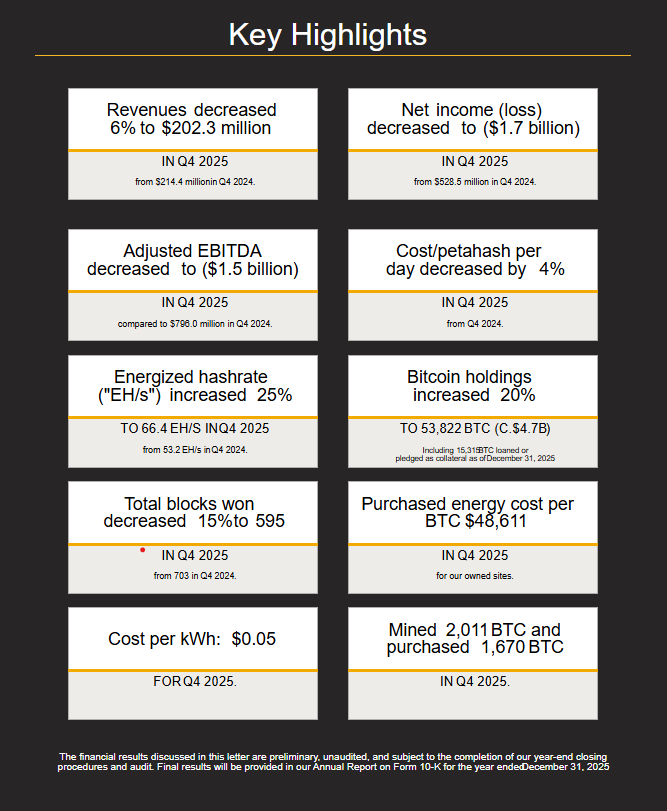
MARA Holdings (MARA) reported a fourth quarter 2025 net loss of $1.71 billion, or $4.52 per diluted share, compared with net income of $528.3 million, or $1.24 per diluted share, in the same period a year earlier.
Its shareholder letter filed with the US Securities and Exchange Commission (SEC) said revenue in Q4 fell 6% to $202.3 million from $214.4 million in Q4 of 2024, as a lower average Bitcoin (BTC) price outweighed the impact of a higher hashrate.
For the full year 2025, Marathon booked a net loss of $1.31 billion, compared with net income of $541 million in 2024, even though its revenue rose to $907.1 million from $656.4 million a year earlier.

The company said that its Q4 net income was hit by a $1.50 billion negative change in the fair value of digital assets and digital assets receivable, reflecting the decline in Bitcoin’s price from around $114,300 on Sept. 30 to roughly $88,800 on Dec. 31, according to data from CoinGecko.
The company’s share price also took a beating, with MARA stock down 46% in the past six months.

On the production side, Marathon said that it mined 2,011 BTC in Q4 2025, down 6% from 2,144 BTC in the prior quarter and 2,492 BTC in the year-earlier period, and 8,799 BTC for the full year, compared with 9,430 BTC in 2024.
Related: Bitdeer sells all Bitcoin, Metaplanet rejects misconduct claims: Asia Express
The company said that it ended 2025 holding 53,822 BTC, including 15,315 BTC loaned or pledged as collateral, with its balance sheet BTC valued at about $4.7 billion at a quarter‑end spot price of $87,498 per coin.
Marathon’s AI and high‑performance compute push
Alongside the numbers, Marathon used its Q4 shareholder letter to outline a multi‑year shift “from a pure‑play Bitcoin miner into an energy and digital infrastructure company,” announcing a strategic joint venture with Starwood Digital Ventures to develop artificial intelligence (AI) and high‑performance compute (HPC) data centers at its power‑rich sites.
Marathon said that the Starwood partnership was designed to support more than 1 gigawatt of IT capacity in its initial phase, with a roadmap that could extend above 2.5 gigawatts over time, and giving Marathon the option to invest up to 50% in individual projects while continuing to mine where power remains attractive.
The company also highlighted its acquisition of a 64% stake in Exaion in February to target “sovereign‑grade” and enterprise AI deployments.
Miners diverge on strategy as drawdown bites
Marathon’s hybrid approach comes as other major miners continue to experiment with different playbooks in response to the latest Bitcoin drawdown.
Hut 8 reported a fourth‑quarter net loss of $279.7 million on Wednesday, as it leans into a $7 billion AI data center lease, while Trump‑backed American Bitcoin reported a $59.5 million Q4 2025 loss on Thursday, yet continues to double down on its mine-and-hoard BTC model.
Magazine: South Korea gets rich from crypto… North Korea gets weapons
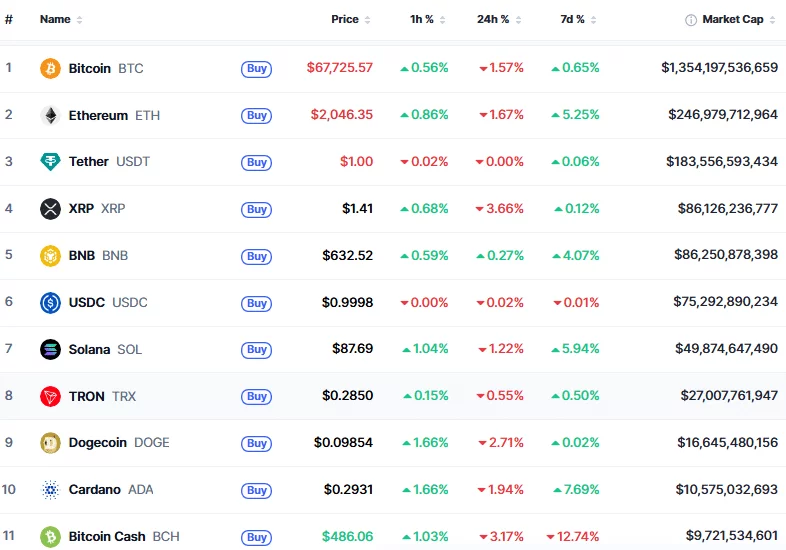
Cardano has made a defiant return to the crypto top 10, reclaiming its spot on CoinMarketCap after ADA price surged nearly 20% over the last 48 hours.
Summary
- Cardano (ADA) surged nearly 20% in 48 hours, reclaiming a top-10 spot on CoinMarketCap and flipping Bitcoin Cash in market capitalization, though ranking discrepancies remain across platforms.
- ADA is trading near $0.292, with RSI near 51 and the Awesome Oscillator turning positive, signaling strengthening bullish momentum as price tests psychological resistance at $0.30.
- Large holders have added over 819 million ADA in six months, while Grayscale raised Cardano’s weighting to 20.2% in its Smart Contract Platform Fund.
This rally allowed the “Ethereum-killer” to flip Bitcoin Cash in market capitalization, signaling a renewed appetite for the asset following months of lacklustre price action.
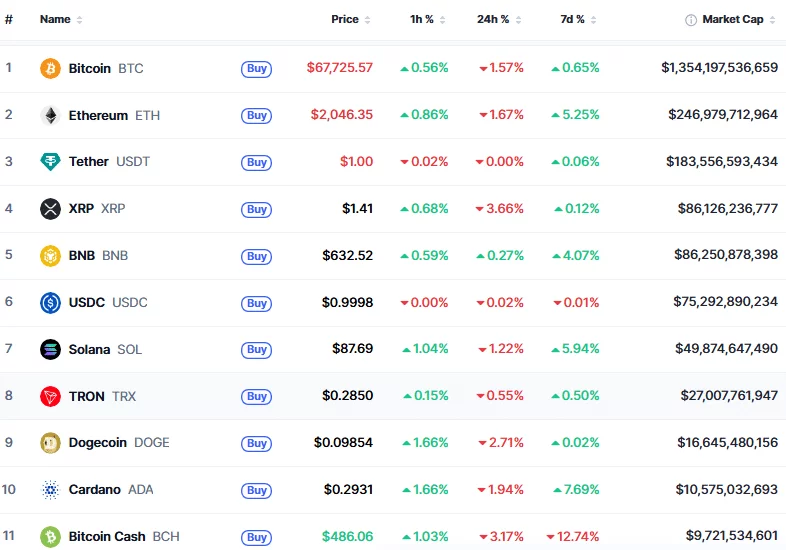
Interestingly, while CoinMarketCap places ADA at #10, the platform CoinGecko currently ranks it 12th. This discrepancy typically arises from how each platform calculates circulating supply and which “wrapped” or staked assets they include in their total market cap valuation.
Regardless of the minor ranking rift, the momentum behind Cardano is undeniable.
ADA price analysis: Bulls eye $0.30 resistance
The attached ADA/USDT daily chart reveals a significant shift in sentiment. After a period of consolidation throughout February, Cardano is currently trading at $0.2921, testing the upper bounds of its recent range.
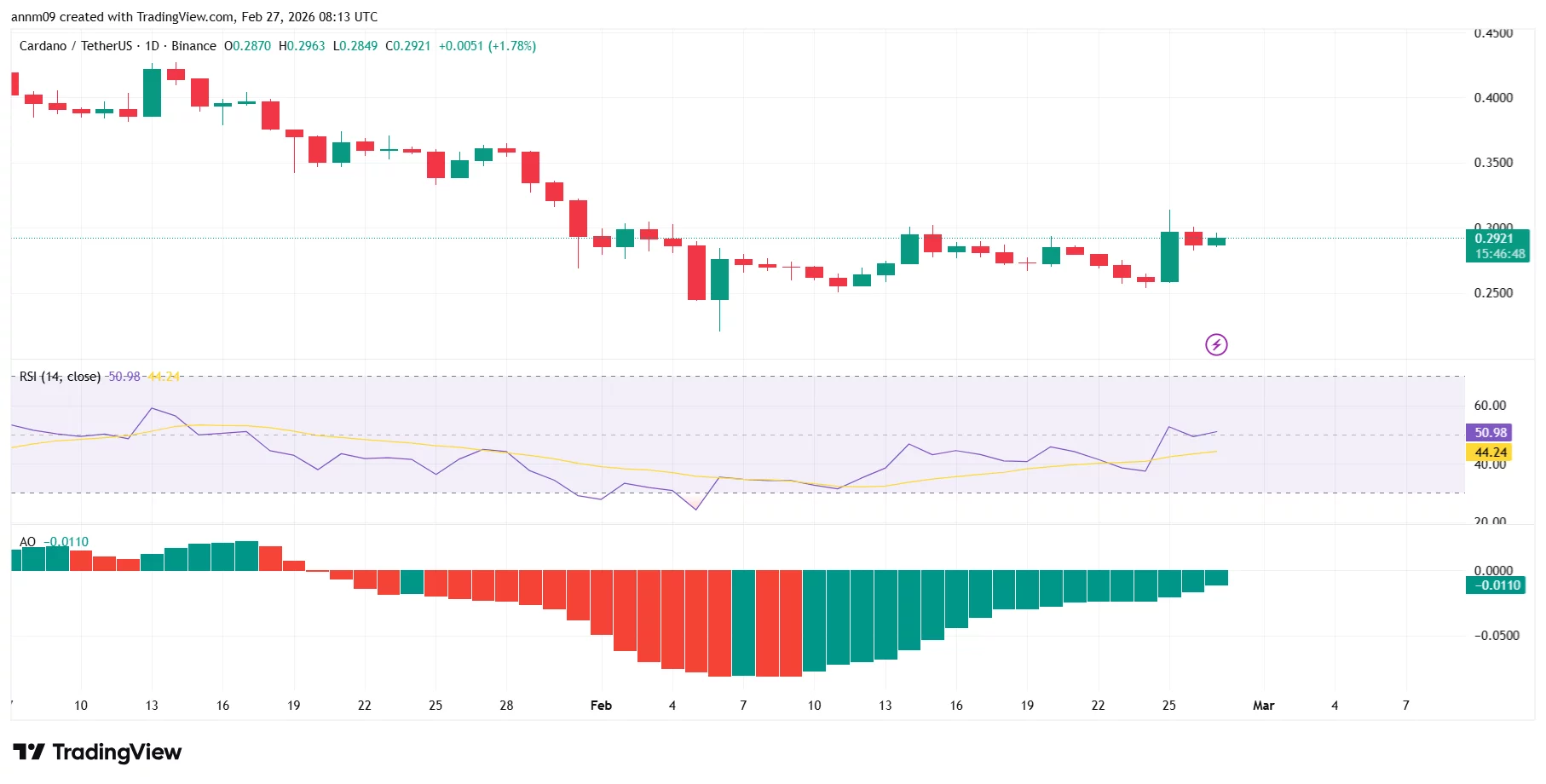
The Relative Strength Index (RSI) sits at 50.98, indicating a neutral-to-bullish momentum with plenty of “room to run” before reaching overbought territory.
Meanwhile, the Awesome Oscillator (AO) has printed its first few green bars above the zero line, suggesting that bullish momentum is finally overtaking the previous bearish trend.
The immediate resistance is a psychological barrier at $0.3000. A daily close above this level could clear the path for a move toward $0.34.
On the downside, solid support is established at the $0.25 level, where buyers aggressively stepped in during early February.
The verdict: Can ADA hold its position?
Whether Cardano holds its top 10 position depends on its ability to flip the $0.30 mark into support. With whale accumulation on the rise and technical indicators flashing green, ADA is well-positioned to maintain its comeback, provided the broader market remains stable.
Recent data from Santiment and other analytics providers suggests a clear divergence between large holders and retail traders.
Over the last six months, “sharks” and “whales” have aggressively increased their positions. Specifically, 819.4 million ADA has been accumulated by this group even as prices hit local lows near $0.26.
Meanwhile, institutional interest is also resurfacing. Grayscale recently increased Cardano’s weighting in its Smart Contract Platform Fund to 20.2%, making it the fund’s third-largest holding.
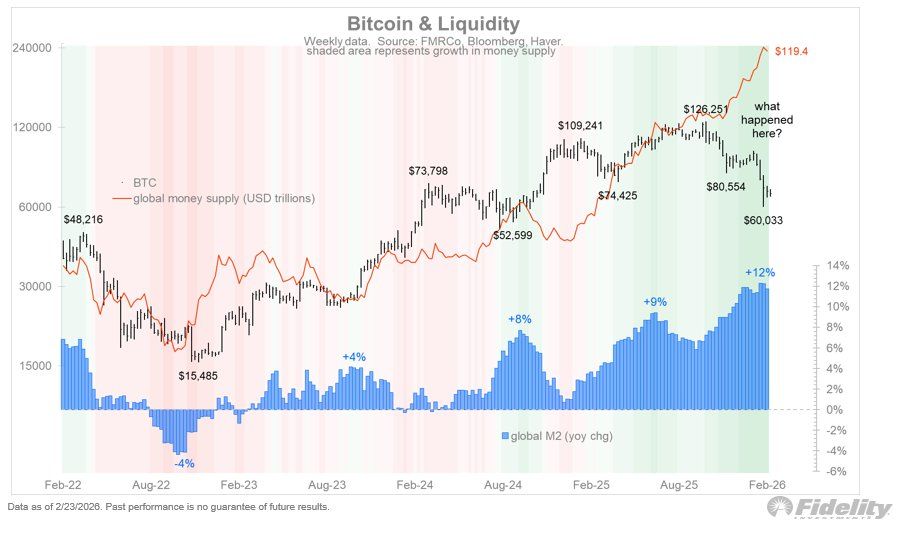
Global money supply surged to a fresh all-time high in December 2025, reinforcing a liquidity backdrop that has historically supported hard assets.
Gold has responded accordingly, maintaining its upward trajectory despite sharp but brief drawdowns. Nonetheless, Bitcoin, often described as “digital gold,” has delivered choppier price action.
Bitcoin’s Dual Identity Weighs on Price as Risk Appetite Fades
Global liquidity has continued to expand at a rapid pace. According to the Kobeissi Letter, global broad money supply rose to a record $144 trillion in December 2025. On a year-over-year basis, it increased by $13.6 trillion or 10.4%.
The December figure marked the third consecutive month of accelerating growth.
“Since the 2020 pandemic alone, money supply has surged +$44 trillion, or +44%. The fastest increase over this period was recorded in February 2021, at +18.7%. Global money creation has never moved this fast outside of a crisis,” the post read.
If global money supply is hitting an all-time high, the classic expectation would be: More liquidity → higher hard assets. Jurrien Timmer, Director of Global Macro at Fidelity, highlighted that gold is behaving according to that script while Bitcoin is not.
Timmer noted that despite volatility and a 21% drawdown earlier this month, gold has remained resilient. He said the metal has behaved as typically seen in a bull market, with sharp but short-lived pullbacks that quickly attract renewed buying interest.
“Gold may be the ultimate hard money asset and it has been following the global money supply in lockstep. Bitcoin is thought to be the same, but as the chart shows below, its price action vis-à-vis global liquidity has been a lot choppier than gold,” he said.
Follow us on X to get the latest news as it happens
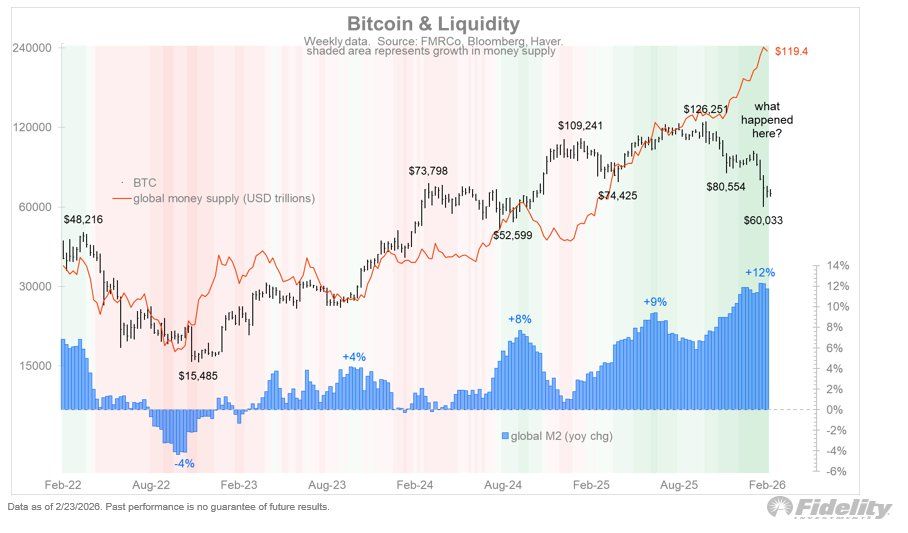
Timmer explained that the reason for the disconnect is simple. According to him, gold is only one thing, i.e, “hard money.” Bitcoin, meanwhile, occupies a dual identity: a potential hard currency on one hand, and a speculative asset on the other.
The Fidelity executive further added that when the rate of change in the software and SaaS index is added to money supply growth, it becomes clear that when the speculative component of the market turns negative, it can easily override the liquidity tailwind that would otherwise support BTC.
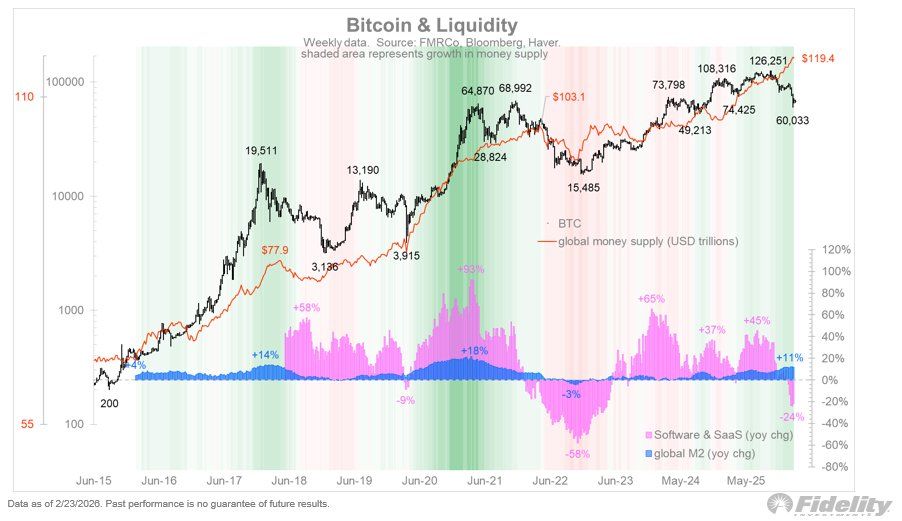
He noted that periods characterized by both expanding liquidity and strong speculative appetite have historically amplified bullish conditions. This often results in powerful bull markets. However, the dynamic works in reverse as well.
“Right now, we have ample liquidity growth but a bear market in speculation. The result: Bitcoin is languishing while gold and the money supply are rallying,” he remarked.
Subscribe to our YouTube channel to watch leaders and journalists provide expert insights
For now, the gap between gold and Bitcoin illustrates that rising liquidity alone does not guarantee crypto’s performance when speculative appetite is contracting. Whether Bitcoin will regain alignment with global liquidity likely depends on speculative interest returning to crypto markets, something that remains uncertain as February 2026 closes.

Key Highlights
- 180-day token lock required for WLFI governance participation
- Enhanced voting influence based on stake amount and lock time
- Annual 2% incentive for engaged governance voters
- Node tiers enable USD1 conversions and exclusive benefits
- USD1 stablecoin scales through banking license and multi-chain deployment
World Liberty Financial has unveiled a governance restructuring initiative that connects voting privileges to extended staking commitments. The framework establishes a six-month minimum lock requirement for previously unlocked WLFI tokens to gain governance access. This strategy seeks to enhance protocol commitment and stimulate broader engagement within the USD1 stablecoin ecosystem.
Governance Structure Redesigned Around Mandatory Lock Periods
World Liberty Financial has released details of a governance model requiring unlocked WLFI holders to commit tokens through staking before voting on protocol decisions. The framework mandates a 180-day lock duration and calculates voting influence according to both stake volume and time remaining in the lock period. Tokens already locked retain their governance capabilities without needing further action.
The system offers a baseline incentive of 2% annually for users who cast votes in a minimum of two governance proposals throughout their staking period. The WLFI treasury serves as the funding source for these incentives and supports continued community alignment. According to the project team, this design prioritizes influence among token holders demonstrating long-term commitment.
For the proposal to become active, it must achieve a quorum representing one billion eligible WLFI tokens. Following quorum achievement, passage requires simple majority support. Current market circulation exceeds 27 billion WLFI tokens.
Multi-Tier Staking Structure and USD1 Ecosystem Development
The governance plan establishes multiple tiers offering distinct advantages corresponding to staking volumes. Token holders committing at least 10 million WLFI achieve Node classification and unlock stablecoin conversion capabilities. These services facilitate direct 1:1 exchanges between USDT or USDC and USD1, alongside direct fiat withdrawal options.
Users staking above 50 million WLFI earn Super Node designation. This advanced tier provides partnership opportunities and potential economic benefits tied to protocol collaborations. The tiered approach is designed to encourage deeper participation and broaden WLFI’s institutional footprint.
The framework also integrates staking advantages with USD1 utilization throughout WLFI Markets. Token stakers receive benefits for USD1 deposits plus supplementary incentives facilitated through DeFi platform Dolomite. The development team anticipates this mechanism will generate consistent demand within the lending infrastructure.
Multi-Chain Stablecoin Growth and Regulatory Strategy
USD1 has been expanding its presence across numerous blockchain networks and platform integrations following its 2025 debut. The stablecoin’s backing consists of cash holdings and U.S. Treasury securities, managed by BitGo with monthly verification reports and multi-chain compatibility. Recent circulation growth accelerated following a significant arrangement involving Abu Dhabi’s MGX fund and Binance.
The initiative has also moved forward with its regulatory positioning through a banking license submission. WLTC Holdings submitted an application to create a national trust bank focused exclusively on stablecoin services. This institution would unify issuance, safekeeping, and conversion functions under single oversight.
WLFI has additionally authorized treasury funds to support USD1 integration across major platforms. The team subsequently introduced World Swap to enable international transfers using USD1 as the settlement mechanism. WLFI Markets continues experiencing increased activity, highlighting the stablecoin’s foundational importance throughout the expanding ecosystem.
TLDR
-
HEICO achieves best-ever first quarter earnings, yet shares decline in early trading.
-
Revenue jumps 14% to reach $1.18B with Flight Support segment leading the charge.
-
Flight Support profitability climbs to 24.5% driven by favorable mix and operational gains.
-
Electronic Technologies expands revenue but faces margin compression from product mix changes.
-
Leverage ratios increase following acquisition activity, though outlook remains optimistic.
Shares of Heico (HEI) experienced downward pressure despite the aerospace and defense supplier delivering its best quarterly earnings performance on record. The stock, which closed at $344.72, retreated to $324.59 during pre-market hours. This pullback came after the company unveiled results demonstrating substantial progress throughout its primary operating divisions.
Company Achieves Best-Ever Quarter With Double-Digit Sales Expansion
Heico’s first-quarter performance demonstrated impressive financial momentum with net income surging to $190.2 million. The company achieved diluted earnings of $1.35 per share, representing a year-over-year advancement. Consolidated net sales jumped 14% to $1.18 billion, showcasing robust demand dynamics.
The company’s operating income climbed to $259.9 million while maintaining healthy profitability levels. EBITDA grew 14% to hit $312 million, demonstrating effective operational leverage. Cash flow from operations declined to $178.6 million, primarily attributable to timing of employee compensation payouts.
Leverage indicators moved higher following a recent strategic acquisition that expanded balance sheet commitments. The net debt to EBITDA ratio climbed to 1.79x while total debt relative to net income also increased. Despite these metrics, leadership expressed strong optimism regarding fiscal 2026 trajectory.
Flight Support Division Powers Results With Organic Expansion
The Flight Support Group demonstrated exceptional performance with revenue climbing to $820 million for the period. Organic demand accelerated 12%, reflecting strength across the division’s diverse product portfolio. Recent acquisition contributions supplemented organic gains and bolstered overall segment results.
The division’s operating income surged 21% to $200.7 million during the quarter. Profitability expansion stemmed from reduced selling, general and administrative expense ratios combined with advantageous product mix dynamics. Elevated repair and overhaul activity further enhanced bottom-line results.
Operating margins within the segment reached 24.5%, surpassing the prior-year comparison. Enhanced operational execution drove the improvement alongside robust end-market demand conditions. The division sustained its positive trajectory and remained a key contributor to consolidated results.
Electronic Technologies Division Faces Margin Headwinds Despite Sales Growth
The Electronic Technologies Group reported net sales of $370.7 million, benefiting from strong demand across aerospace and electronic components markets. Organic revenue growth of 6% helped counterbalance softer performance in space-related product lines. Recent acquisitions contributed incremental revenue and diversified the business mix.
Operating income for the segment decreased to $73.2 million as profitability faced challenges from an unfavorable shift in product composition. Weakness in space-oriented offerings pressured gross margins during the period. Stronger aerospace demand partially mitigated these headwinds.
The division’s operating margin came in at 19.8%, reflecting the evolving product portfolio dynamics. Margin compression persisted as defense and space order patterns shifted throughout the quarter. Nevertheless, the segment’s revenue performance remained solid and aligned with management’s longer-term projections.
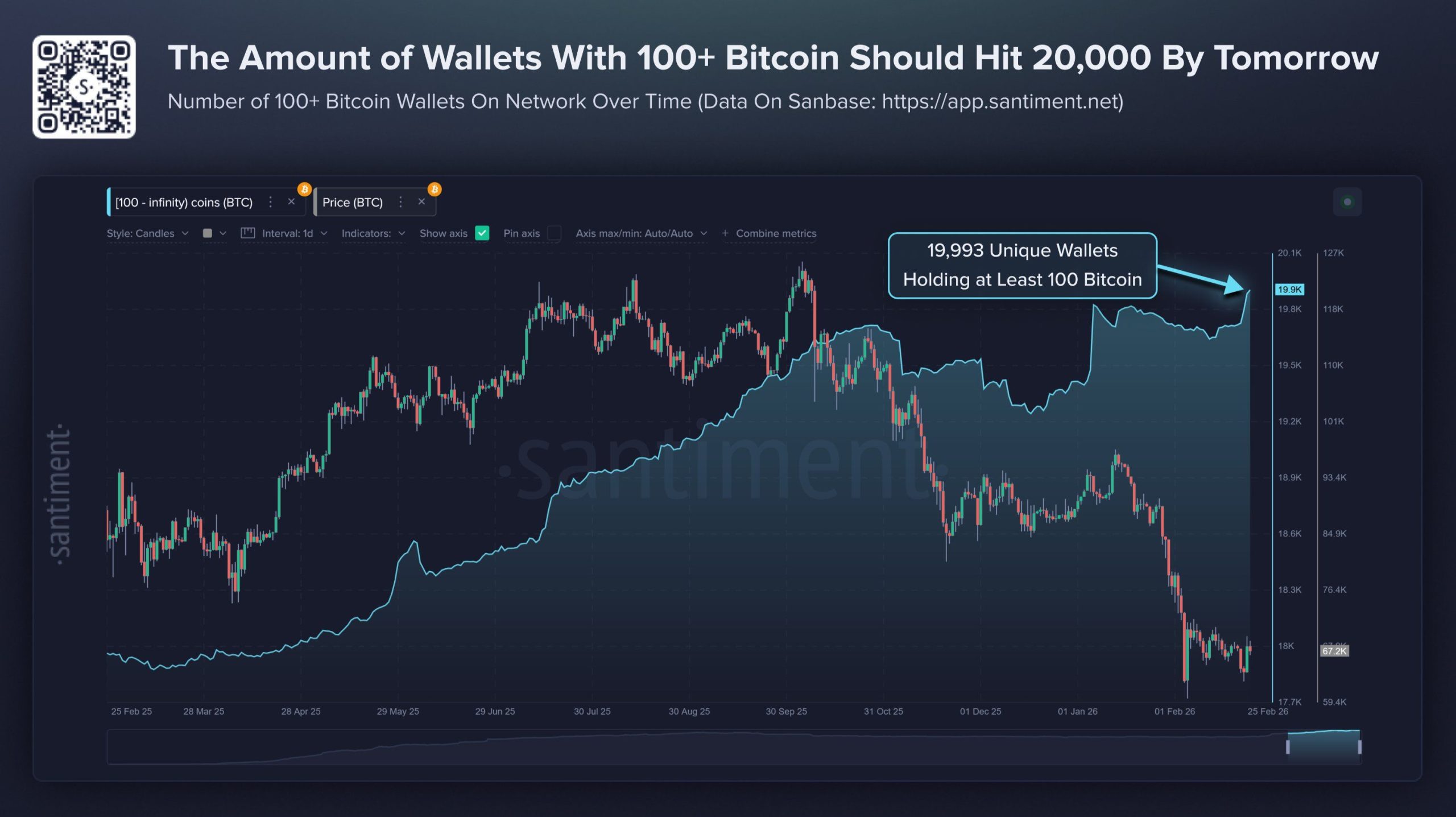
Bitcoin price has drifted lower in recent sessions, reflecting cautious sentiment across the crypto market. BTC continues to struggle beneath key resistance, limiting upside momentum.
Despite the slow decline, structural signals show accumulation beneath the surface. Whether that conviction translates into price recovery is yet to be seen.
Bitcoin Holders Near New Milestone
Santiment data shows Bitcoin is nearing a significant milestone. The network is about to surpass 20,000 wallets holding at least 100 BTC. At current prices, a 100 BTC wallet represents roughly $6.78 million in value.
Such wallets are typically controlled by high-net-worth individuals, institutional investors, funds, or long-term holders. Growth in this category during price pullbacks is often interpreted as a constructive signal. Accumulation during weakness reflects confidence in long-term fundamentals.
Want more token insights like this? Sign up for Editor Harsh Notariya’s Daily Crypto Newsletter here.
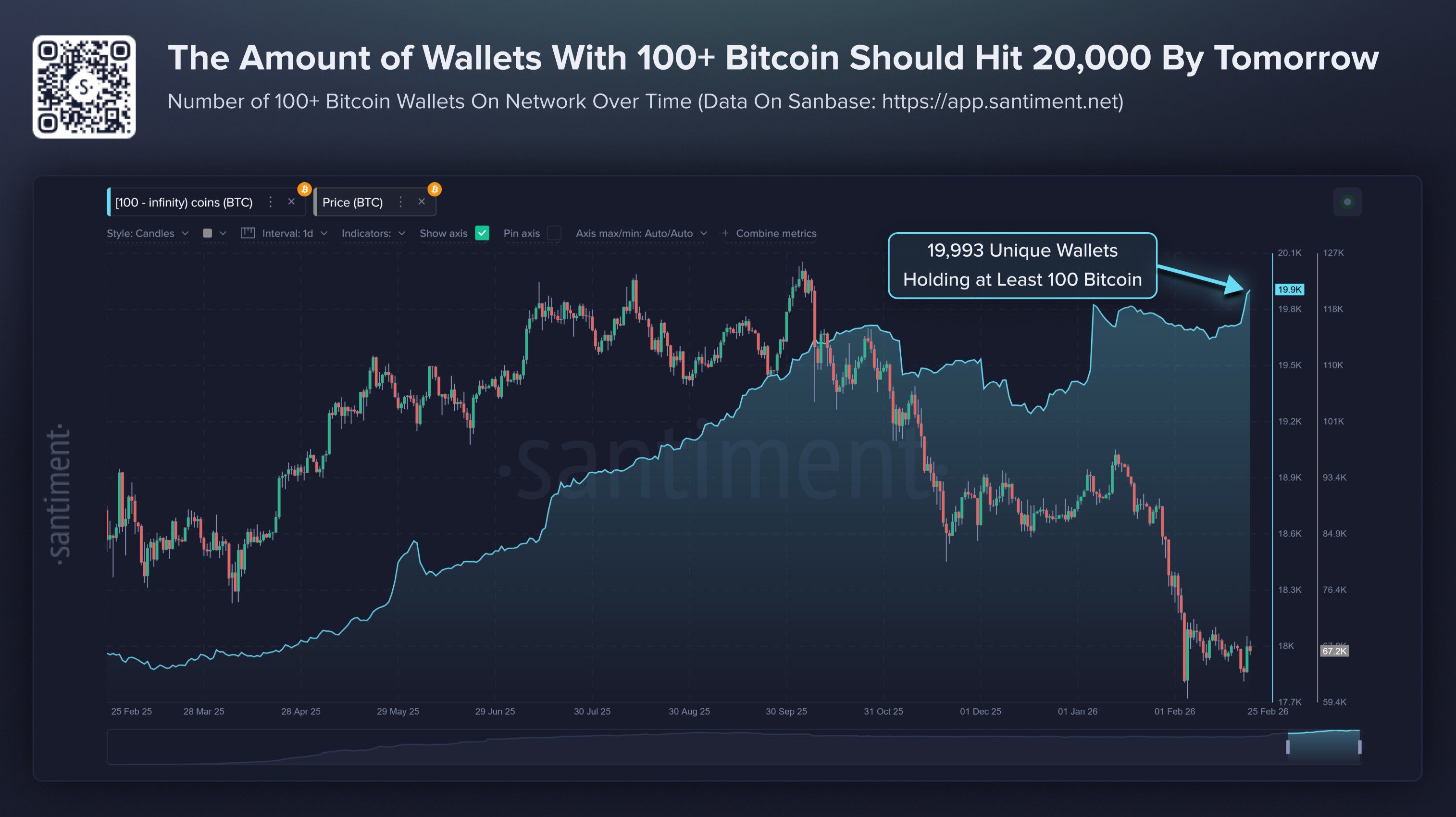
However, the overall percentage of supply held by key stakeholders has not materially increased. This suggests that distribution is occurring across more large holders rather than consolidating within a smaller elite group. While this reduces extreme concentration risk, it also limits aggressive price acceleration. Broader accumulation may stabilize price but not immediately trigger sharp rallies.
Bitcoin Holders Exhibit Mixed Sentiment
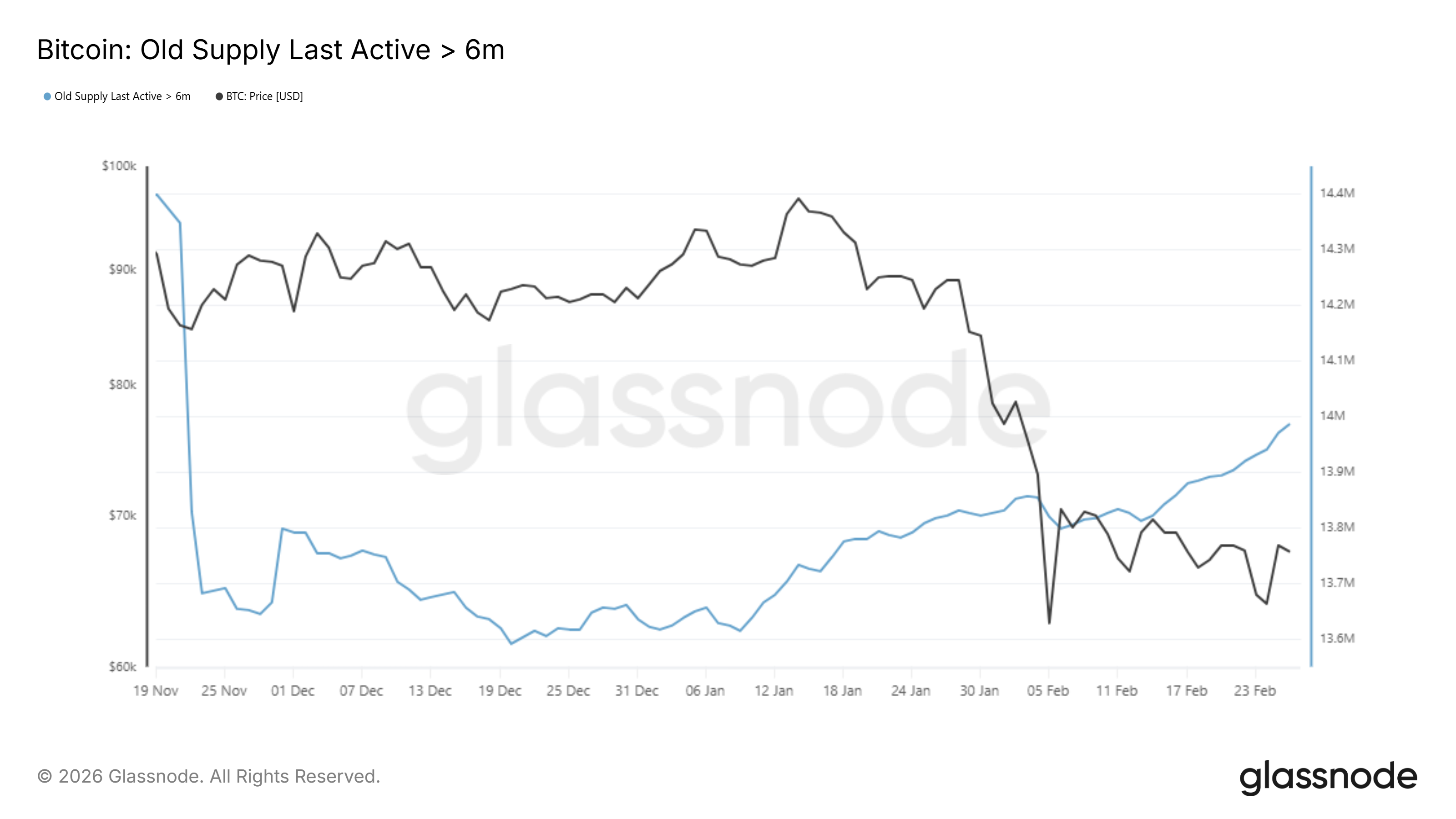
Old supply data adds another layer to the outlook. Old supply refers to Bitcoin that has not moved in at least six months. These coins are often associated with patient, long-term holders.
Over the past three weeks, old supply increased by 188,000 BTC, valued at more than $12.75 billion. Rising old supply indicates that mature hands are choosing to hold rather than distribute. Historically, this behavior has supported longer-term recovery phases when selling pressure diminishes.
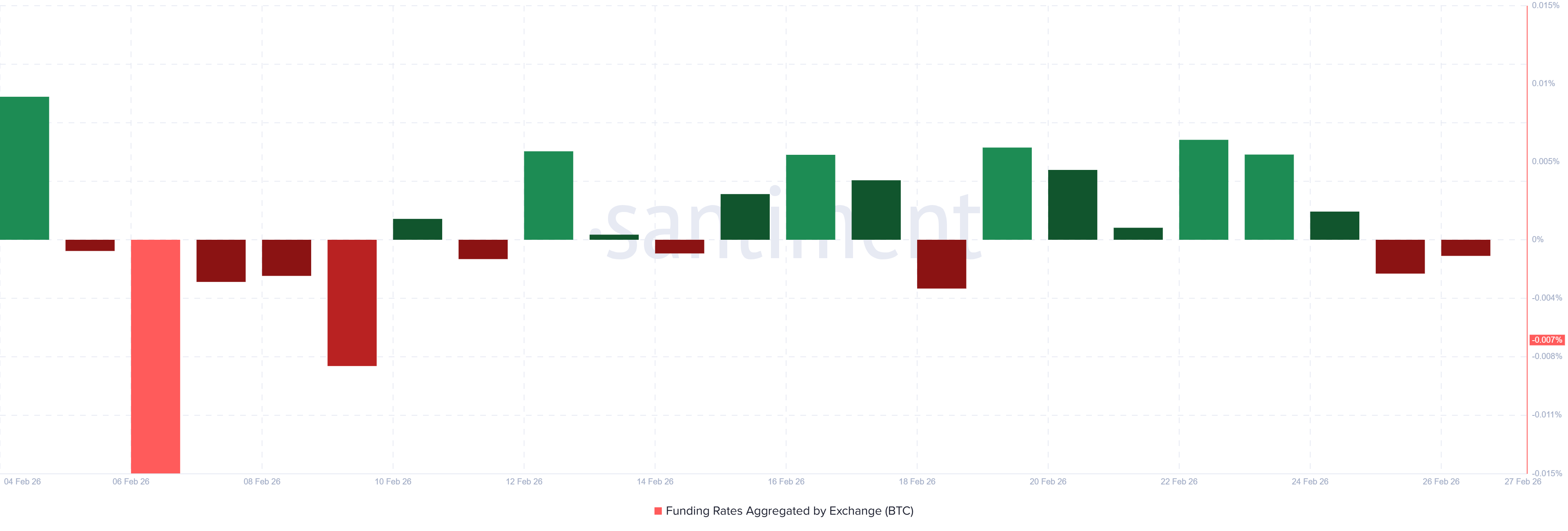
Derivatives data present a more cautious picture. Aggregate funding rates across Binance show that Bitcoin is currently being shorted. Negative funding rates signal that short positions are dominating longs.
Red funding bars over the last 24 hours indicate traders are positioning for potential downside. If short bias persists, BTC may face continued consolidation. Elevated short interest can cap near-term rallies unless a strong catalyst forces short covering.
BTC Price Is Under Slight Pressure
Bitcoin is trading at $67,867 at the time of writing, remaining below the $68,830 resistance level. The asset has formed a mild downtrend line over the past 20 days. A decisive move above $70,000 would shift momentum and signal renewed bullish strength.
Accumulation growth and expanding large wallet counts provide a supportive backdrop. If conviction strengthens and price responds, BTC could break above $70,000. Crossing $72,294 would mark a structural recovery phase and potentially attract renewed inflows.
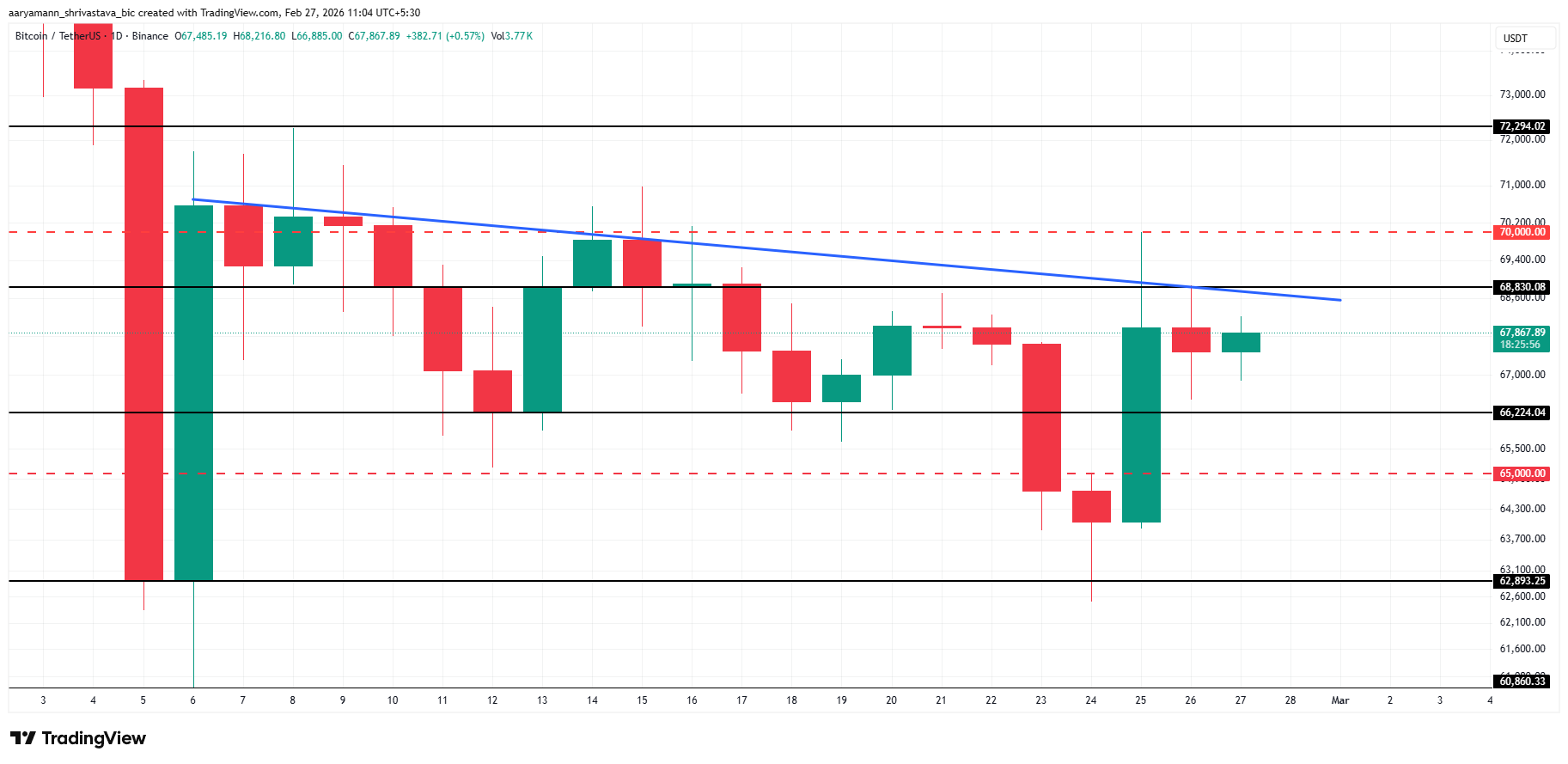
However, divergence between spot accumulation and derivatives skepticism may limit upside. Continued formation of lower highs would reinforce the downtrend line. In that scenario, Bitcoin could slide toward the $66,224 support. A sustained move below this level would invalidate the bullish outlook and extend consolidation pressure.


One of the project’s co-founders explained the latest introduction by the team, which promises to take a “different approach.”
Although a growing number of its vast online community keeps lashing out at Pi Network’s lack of progress in certain areas, the Core Team continues to introduce new initiatives to improve the ecosystem.
One of the latest was the incorporation of Pi ecosystem tokens on Mainnet, and co-founder Chengdiao Fan explained in a detailed video their idea and purpose.
What Are Pi Ecosystem Tokens?
She began by indicating that these new assets are tokens created by the community itself and issued on Pi. They have already been released on the Testnet, while their launch on the Mainnet is being “finalized.” Fan acknowledged the importance of security and technology for the new tokens, but noted that their design is what will set them apart. She believes there’s a significant misalignment between token design and real innovation.
“Tokens on most other crypto networks function primarily as tools to raise capital. Yet, despite this approach, most projects frequently fail to provide real utility and innovation. We see this as a structural problem.”
She explained that Pi Network is positioned differently and its ecosystem allows its users to integrate crypto tokens for products and innovations. It “strongly encourages” real utility as the team believes this is the main driver for long-term stability and success for any blockchain project.
Utility Tokens for User Acquisitions
These assets, through the Pi launch programs, mean that “projects issue tokens to fulfill the need to acquire users for their products and integrate these tokens for utility-based use cases inside their products.” Users will get full access to these new coins through the launch programs and will be able to use them in the products.
Fan added that developing such user-engaging programs that allow them to operate within a startup ecosystem is typically a long and expensive process. However, they can reduce the costs significantly by using Web3 tools from Pi Network, such as the Pi ecosystem tokens. Simultaneously, they can involve users in their projects.
It’s worth noting that acquired users will be able to hold the products accountable for their services. Consequently, Fan said this would guarantee that users get the most for their funds, as weak products will naturally disappear in time.
You may also like:
“Pi ecosystem tokens are not about copying existing token models. In fact, we have deliberately sought to avoid the traditional approach. Because many of the problems in Web3 stem from how tokens have been traditionally designed. And this design will also evolve as it gets iterated in practice,” Fan concluded.
Binance Free $600 (CryptoPotato Exclusive): Use this link to register a new account and receive $600 exclusive welcome offer on Binance (full details).
LIMITED OFFER for CryptoPotato readers at Bybit: Use this link to register and open a $500 FREE position on any coin!
Disclaimer: Information found on CryptoPotato is those of writers quoted. It does not represent the opinions of CryptoPotato on whether to buy, sell, or hold any investments. You are advised to conduct your own research before making any investment decisions. Use provided information at your own risk. See Disclaimer for more information.
Key Takeaways
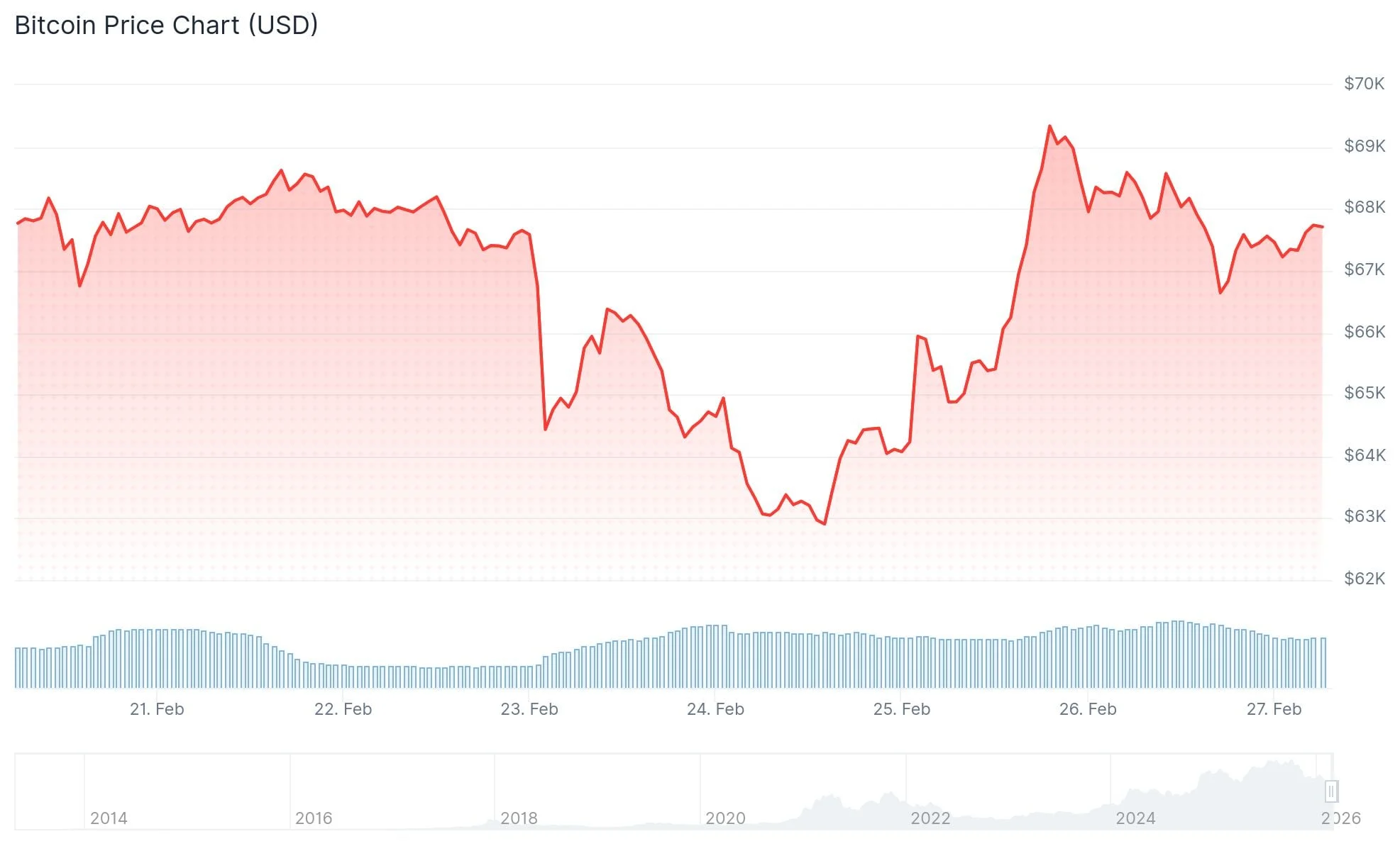
- Bitcoin declined 1.5% on Friday to approximately $67,766 while maintaining a modest 0.6% gain for the week within a constrained price channel
- Market observers characterize the downturn as a leverage liquidation event rather than a directional shift, with demand resuming by Friday’s open
- Alternative cryptocurrencies surpassed Bitcoin’s weekly performance — Cardano climbed 7%, Solana rose 5.5%, Ethereum gained 4.8%, BNB advanced 4.3% — while XRP declined 0.1%
- Nvidia (NVDA) dropped 5.5% following quarterly results, weighing on U.S. equity futures and dragging digital assets lower alongside traditional markets
- Asian stock markets are headed for their strongest February performance since 1998, siphoning investment flows from American exchanges
Bitcoin experienced downward pressure Friday as U.S. equity index futures retreated in the wake of Nvidia’s notable share price decline. The cryptocurrency weakness reflects a wider risk-averse sentiment spreading through international financial markets.
Bitcoin was changing hands near $67,766, representing a 1.5% daily decrease. However, the leading digital currency maintains a 0.6% weekly advance.
Ethereum decreased 1.5% over 24 hours to slightly above $2,047. Both leading cryptocurrencies continue trading within tight boundaries established following the Feb. 5 market correction.
Nvidia tumbled 5.5% Thursday despite surpassing fourth-quarter profit forecasts. The decline seemingly captured market skepticism regarding the sustainability of elevated artificial intelligence expenditure justifying current price levels.
Digital currencies mirrored equity weakness as market participants retreated from higher-risk instruments. This correlation has persisted for several weeks, with Bitcoin demonstrating strong sensitivity to Nasdaq movements.
“The current market action shows Bitcoin behaving like a conventional risk asset,” explained Daniel Reis-Faria, CEO of ZeroStack. “The Nasdaq retreated following Nvidia’s results, and cryptocurrency markets tracked that movement.”
He characterized the decline as a technical adjustment rather than a fundamental shift. “Considerable leverage had accumulated during the recent rally, and when equities weaken, crypto typically serves as the initial de-risking outlet for traders.”
By Friday’s trading session, hourly cryptocurrency returns had reversed into positive territory. This recovery pattern indicates renewed buying interest following overnight liquidations that eliminated excessive leveraged positions.
Alternative Tokens Show Weekly Strength Over Bitcoin
Cardano topped major cryptocurrency performance with a 7% weekly increase. Solana advanced 5.5%, Ethereum gained 4.8%, and BNB rose 4.3%, each surpassing Bitcoin’s weekly results.
XRP represented the sole major token posting negative seven-day returns, declining 0.1% weekly and 3.7% over 24 hours. This relative weakness proved notable considering most alternative cryptocurrencies weathered identical macroeconomic headwinds while preserving gains.
Equity Index Futures and International Capital Movements
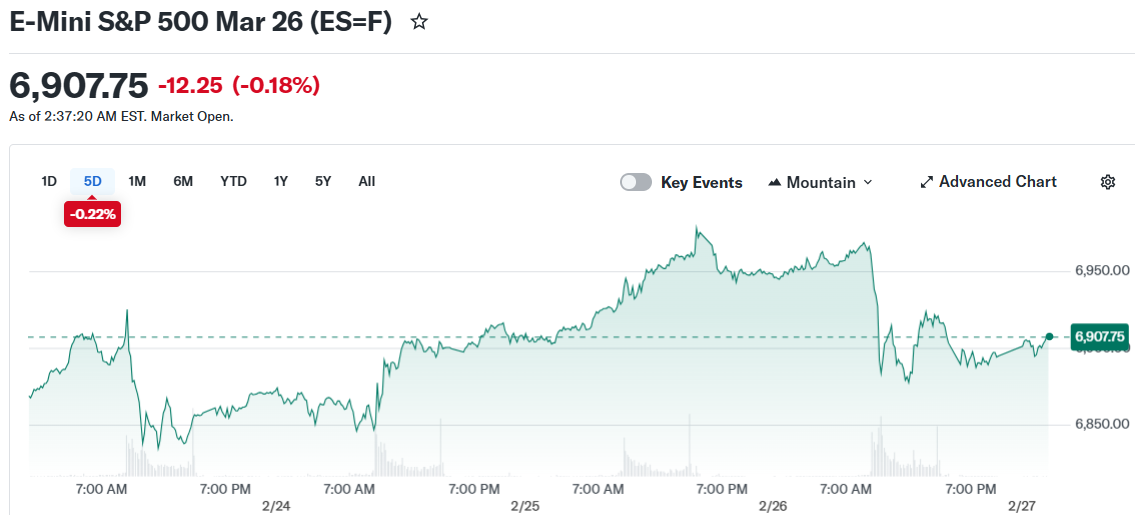
Dow futures retreated approximately 0.6%, S&P 500 futures fell 0.4%, and Nasdaq 100 futures declined 0.3% during Friday’s overnight session.
Asian stock markets are positioned for their most robust February showing since 1998. South Korean technology equities surged approximately 20% this month as capital flows favored AI infrastructure companies.
The MSCI Asia Pacific Index appears set to exceed S&P 500 returns for a third consecutive month. This geographical rotation has redirected investment capital from American markets.
Block shares surged over 23% in after-hours trading following CEO Jack Dorsey’s announcement of nearly 50% workforce reduction, attributing the restructuring to artificial intelligence capabilities transforming company operations.
Market attention now shifts to Friday’s producer price index release, with economic forecasters projecting a 0.3% monthly increase for both headline and core wholesale inflation metrics.
Ripple is transforming how funding and support are distributed across the XRP Ledger ecosystem, shifting toward a more distributed model.
The company announced the changes on February 26. It positions 2026 as a transition point in how builders access capital, mentorship, and technical support on XRPL.
XRP Ledger Enters New Phase as Ripple Expands Funding Channels in 2026
In a recent blog, Ripple noted that since 2017, it has deployed more than $550 million into XRP Ledger ecosystem initiatives, including non-equity grants, builder incentives, strategic partnerships, and growth programs.
The firm noted that 2026 introduces a transition toward a broader, more distributed funding structure. The stated goal is to give builders multiple funding channels.
“As the ecosystem matures, the focus is shifting toward expanding access to funding through more distributed and independent pathways so builders have multiple avenues to scale,” the blog read.
Follow us on X to get the latest news as it happens
As part of the plan, the organization introduced several new and scaled-up initiatives planned for 2026.
XAO DAO is a hybrid Decentralized Autonomous Organization (DAO) built for the XRP Ledger. It will empower members to collectively allocate resources through community grants, feedback loops, and direct DAO proposals. Additionally, this enables fast, low-friction funding for developers and early-stage projects.
“By shifting decision-making power toward a broader group of stakeholders, XAO DAO represents a significant step toward a more resilient and community-led governance model for the XRPL,” the firm said.
XRPL Commons, an independent organization, will continue supporting builders through initiatives like the GLOW program and The Aquarium, a 9-week incubator in Paris that has operated since 2023. The firm is also developing a new regional entity, XRP Asia, to serve the APAC builder community with localized funding and support.
In addition, the University Digital Asset Xcelerator (UDAX), which launched its inaugural cohort with UC Berkeley in fall 2025, is expanding in 2026 to Fundação Getulio Vargas in São Paulo, the University of Oxford, and UC Berkeley again in the fall.
On the institutional side, Ripple is launching a FinTech Builder Program to support startups building institutional-grade financial applications on XRPL.
The blog also revealed that a growing number of venture capital firms are mentoring teams, investing in startups, and connecting XRPL builders with global capital networks. Partner organizations include a100x Ventures, Superscrypt, Reforge, New Form Capital, Dragonfly, Pantera, Franklin Templeton, and Tenity. Their involvement signals broader institutional confidence in XRPL.
To enable access to this expanding ecosystem, Ripple announced that a new dedicated XRPL funding hub will soon launch. This will serve as a single entry point for builders to discover grants, accelerators, and support programs across the entire ecosystem.
XRP Price Slides Despite Ripple’s 2026 Expansion
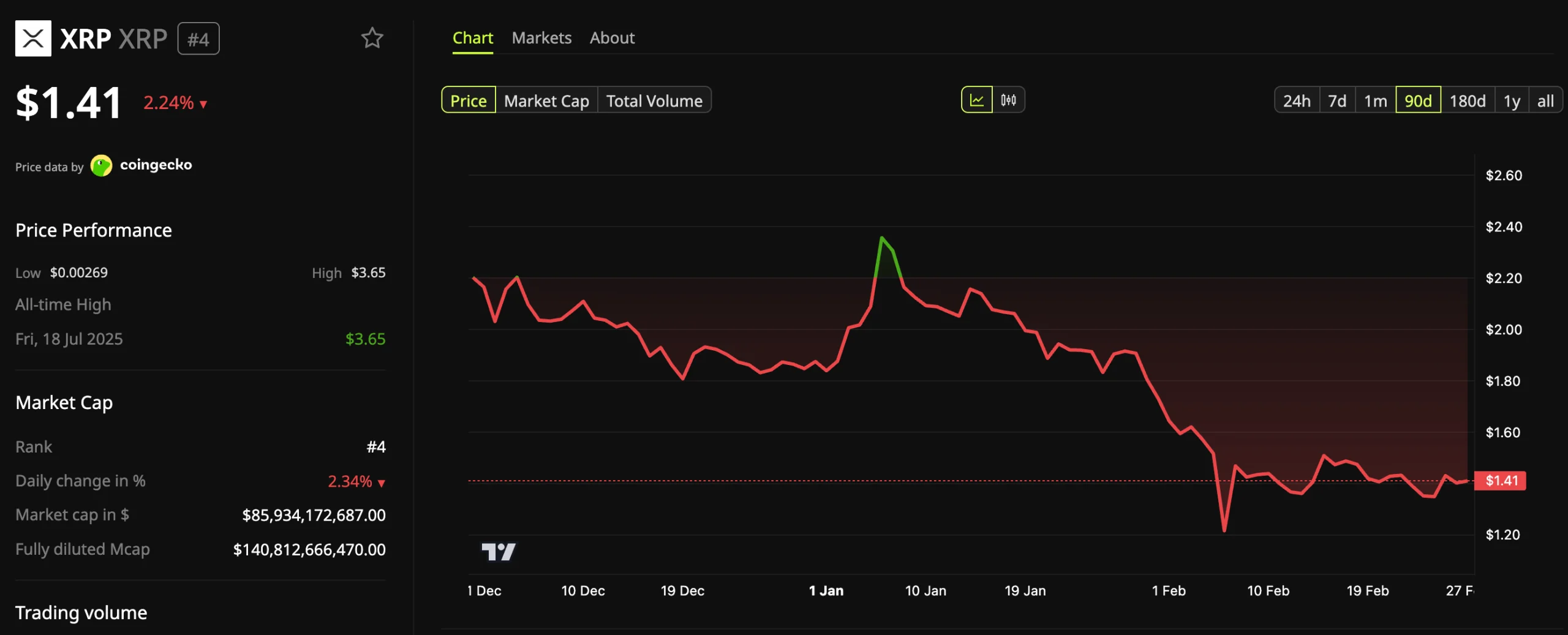
The new initiatives come as XRP’s performance continues to track the broader market. BeInCrypto Markets data shows that the altcoin declined 2.24% over the past day. At press time, XRP was trading at $1.41.
In the short term, the funding shift is unlikely to move XRP’s price. Market performance is typically driven by liquidity conditions, macro trends, and regulatory developments rather than ecosystem restructuring.
Over the medium- to long-term, the impact depends on execution. If the FinTech Builder Program, XAO DAO, and venture participation translate into higher on-chain activity, institutional pilots, and real financial applications, sentiment could strengthen.
Subscribe to our YouTube channel to watch leaders and journalists provide expert insights
Sustained adoption, transaction growth, and deeper integration of XRP into payment or tokenization flows would be required for any structural price effect to occur. Ultimately, usage metrics, not funding headlines, will determine whether this shift supports long-term valuation.

TV’s #1 Sitcom Is Rewriting the Rules With a Major Shake Up [Exclusive]

Greens crush Labour at Gorton by-election in Starmer nightmare leaving him months to save premiership
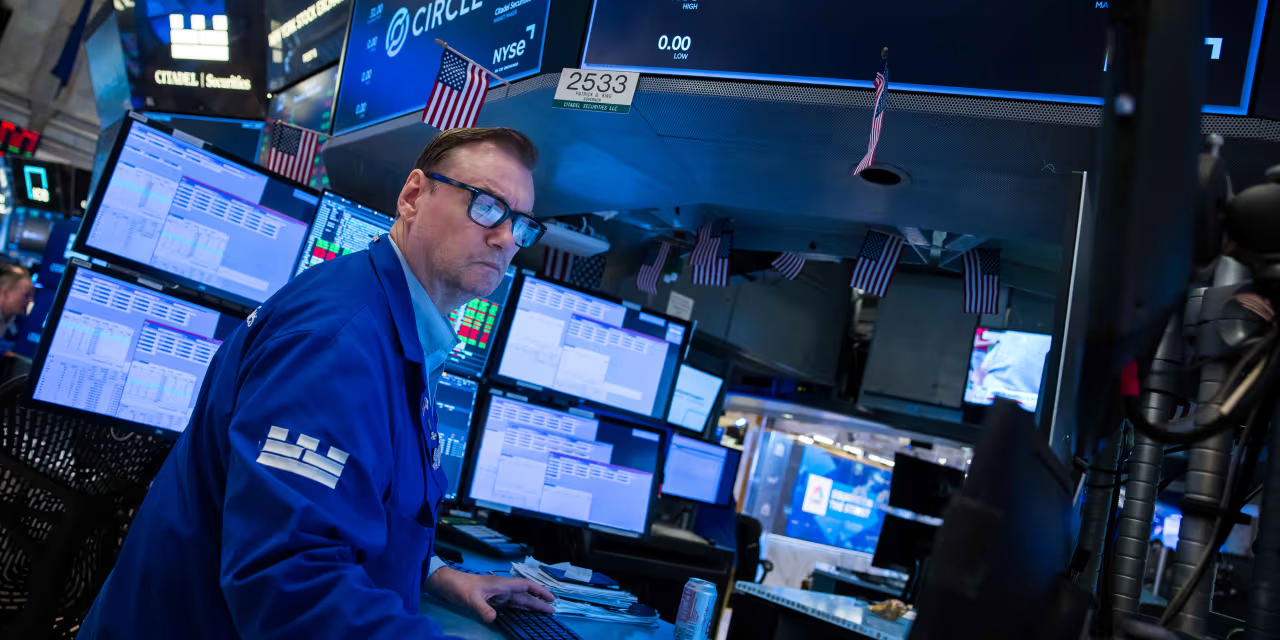
Circle Internet Stock Surges After Earnings. What Crypto Worries?


![Feds break up alleged $15 billion crypto fraud scheme [GRAPHIC]](https://wordupnews.com/wp-content/uploads/2026/02/1772182104_maxresdefault-80x80.jpg)

-

 Politics5 days ago
Baftas 2026: Awards Nominations, Presenters And Performers
-

 Fashion7 days ago
Weekend Open Thread: Boden – Corporette.com
-

 Sports4 days ago
Women’s college basketball rankings: Iowa reenters top 10, Auriemma makes history
-

 Politics4 days ago
Nick Reiner Enters Plea In Deaths Of Parents Rob And Michele
-

 Business3 days ago
True Citrus debuts functional drink mix collection
-

 Politics9 hours ago
ITV enters Gaza with IDF amid ongoing genocide
-

 Crypto World3 days ago
XRP price enters “dead zone” as Binance leverage hits lows
-

 Business5 days ago
Mattel’s American Girl brand turns 40, dolls enter a new era
-

 Business5 days ago
Law enforcement kills armed man seeking to enter Trump’s Mar-a-Lago resort, officials say
-

 Tech3 days ago
Unsurprisingly, Apple's board gets what it wants in 2026 shareholder meeting
-

 NewsBeat1 day ago
Cuba says its forces have killed four on US-registered speedboat | World News
-
 NewsBeat1 day ago
Manchester Central Mosque issues statement as it imposes new measures ‘with immediate effect’ after armed men enter
-
 NewsBeat4 days ago
‘Hourly’ method from gastroenterologist ‘helps reduce air travel bloating’
-

 Tech5 days ago
Anthropic-Backed Group Enters NY-12 AI PAC Fight
-

 NewsBeat5 days ago
Armed man killed after entering secure perimeter of Mar-a-Lago, Secret Service says
-

 Politics5 days ago
Maine has a long track record of electing moderates. Enter Graham Platner.
-
 NewsBeat2 days ago
Police latest as search for missing woman enters day nine
-

 Business1 day ago
Discord Pushes Implementation of Global Age Checks to Second Half of 2026
-

 Crypto World2 days ago
Entering new markets without increasing payment costs
-

 Business12 hours ago
Only 4% of women globally reside in countries that offer almost complete legal equality