
Crypto World
Ripple Announces Institutional Support for Hyperliquid


Ripple integrates Hyperliquid for its prime brokerage solution.
Hyperliquid seems to be the talk of the town lately, and Ripple just announced that its Ripple Prime brokerage platform will support the perp DEX. In other words, the firm’s institutional clients will be able to access on-chain derivatives while cross-margining their exposure to decentralized finance with all other assets that are supported by Ripple Prime.
These include cleared derivatives, OTC swaps, fixed income, forex, and other digital assets.
According to the official release, “clients can access Hyperliquid liquidity while benefiting from a single counterparty relationship.”
Speaking on the matter was Michael Higgins, the international CEO of Ripple Primer, who said:
“At Ripple Prime, we are excited to continue leading the way in merging decentralized finance with traditional prime brokerage services, offering direct support to trading, yield generation, and a wider range of digital assets. This strategic extension of our prime brokerage platform into DeFi will enhance our clients’ access to liquidity, providing the greater efficiency and innovation that our institutional clients demand.”
Ripple continues to expand its product offering while also working on licensing and regulatory issues worldwide. Recently, they secured a preliminary electronic money institution license in Luxembourg.
The move to integrate Hyperliquid into their prime brokerage solution also comes at a time when the decentralized perpetual futures exchange is attracting billions in daily volumes across a variety of assets, providing the deepest on-chain liquidity order book in the industry.
SECRET PARTNERSHIP BONUS for CryptoPotato readers: Use this link to register and unlock $1,500 in exclusive BingX Exchange rewards (limited time offer).



RedotPay is looking to raise $150 million in a pre-IPO round. The Hong Kong based stablecoin payment processor is targeting a $4 billion valuation.
The plan is to lock in capital before a US public listing that could come as early as this year.
What makes it interesting is the context. The company says it is already profitable and has no immediate pressure to raise. There has also been recent executive turnover. And yet the fundraise is moving forward anyway.
Something is being set up here.
- $150 Million Target: RedotPay is seeking fresh capital at a $4 billion+ valuation to support a U.S. IPO as soon as this year.
- Volume Surge: Annualized total payment volume (TPV) hit $10 billion in December, with year-over-year growth exceeding 300%.
- Institutional Backing: Existing investors include Coinbase Ventures and Circle Ventures, signaling strong infrastructure support despite executive turnover.
RedotPay Deal Mechanics: Leveraging Unicorn Status
RedotPay already pulled in $194 million across rounds in late 2025, including a $107 million Series B led by Goodwater Capital. The business generates over $150 million in annualized revenue facilitating crypto-to-fiat spending through traditional payment networks. The fundamentals are there.
JPMorgan, Goldman Sachs, and Jefferies are reportedly lined up as underwriters. The $150 million raised here likely funds compliance infrastructure and market expansion ahead of the public debut.
The timing is deliberate. BlackRock keeps expanding Bitcoin exposure. Institutional appetite is returning. The window for crypto-adjacent IPOs is reopening and RedotPay is moving fast to capitalize on it.
But there are real headwinds. At least five senior executives departed after less than a year. Multiple compliance leadership changes. And the company is currently pursuing a $4 billion valuation without a sitting CFO.
Wall Street is getting selective about crypto IPOs. Compliance disclosures will be scrutinized hard. RedotPay has strong numbers to show. It also has some awkward questions to answer before the listing.
What It Means for the Sector
A $4 billion listing validates stablecoin payments as a standalone vertical and puts pressure on legacy fintechs to integrate or get left behind. Regional banks are already feeling it. Networks like Cari exist specifically because payment flows are bleeding toward crypto-native rails.
For traders, this IPO is a bellwether. If underwriters sell the book at $4 billion despite the executive churn, it signals extreme hunger for crypto infrastructure exposure. If they struggle, it confirms that the compliance discount for offshore-originated firms is still steep and reprices every other private crypto unicorn eyeing a public exit.
Discover: The best new crypto in the world
The post Hong Kong’s RedotPay Targets $150M Pre-IPO Raise for US Listing appeared first on Cryptonews.
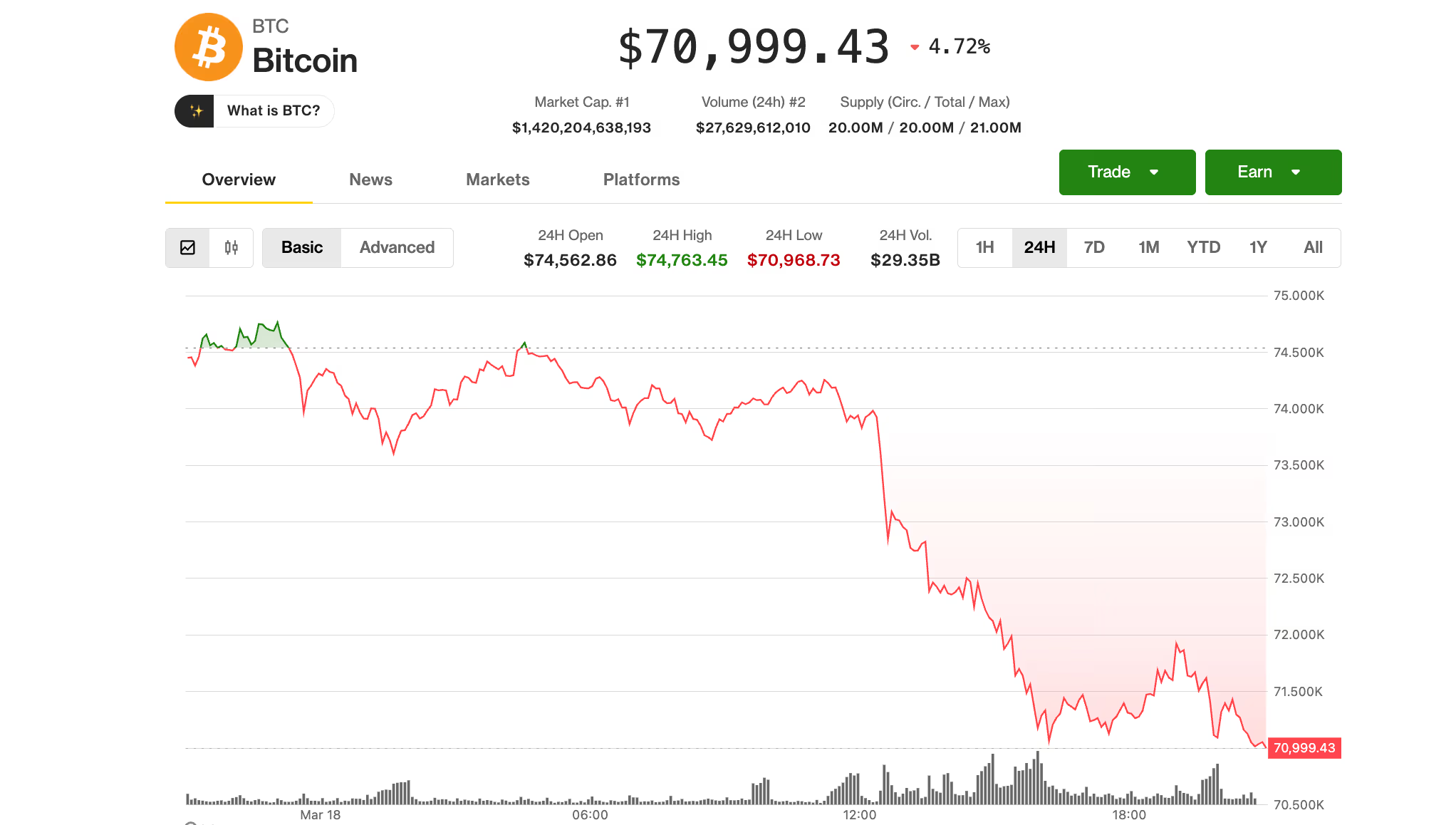
Bitcoin slipped below $71,000 on Wednesday as Federal Reserve Chair Jerome Powell flagged rising oil prices amid the war in Iran as a new inflation risk.
The Fed held interest rates steady as expected, but during his post-meeting press conference, Powell acknowledged that the recent surge in energy prices is already feeding into the central bank’s outlook.
“The oil shock for sure shows up” in higher inflation projections, he said, while cautioning that “nobody knows” yet how persistent the impact will be.
Policymakers raised their 2026 inflation forecast to 2.7% from 2.4%, underscoring concerns that price pressures could remain elevated longer than anticipated.
Despite that, Powell dismissed comparisons to a 1970s-style stagflation, even as the central bank faces growing tension between slowing growth and sticky inflation.
“That’s not the case right now,” he said, noting that unemployment remains near long-run norms while inflation is only modestly above target. “I would reserve the term stagflation for a much more serious set of circumstances.”
“What we have is some tension between the goals, and we’re trying to manage our way through it,” he added.
Cautious markets
Already under pressure prior to the Fed news on poor February inflation data and no sign the war in Iran is letting up, markets fell further late in the session.

Bitcoin late Wednesday afternoon had pulled all the way back to $70,900, down almost 5% over the past 24 hours. Ether (ETH) was sporting a 6.5% decline.
The S&P 500 and Nasdaq closed at the day’s lows, down 1.4% and 1.5%, respectively. Gold extended its decline below $4,850 an ounce, now 3.1% lower on the day at its weakest price in more than a month.
Digital asset-related stocks remained sharply lower, following crypto prices. Strategy (MSTR), the largest corporate BTC holder, and Bitmine (BMNR), the leading Ethereum treasury firm, were 5%-6% lower. Investment firm Galaxy (GLXY) declined almost 7%, while crypto exchange Gemini (GEMI) tumbled 15% to about its lowest level since it went public last year.
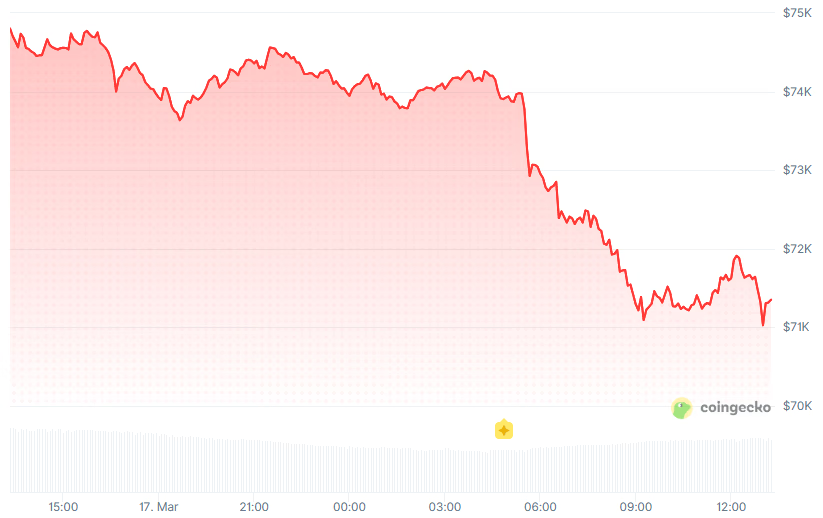
Bitcoin slips 5% as rising U.S. wholesale inflation and ongoing geopolitical tensions weigh on investor sentiment.
Crypto markets erased most of their weekly gains on Wednesday after the Bureau of Labor Statistics reported that U.S. wholesale prices rose sharply in February and the Federal Reserve left interest rates unchanged.
Bitcoin (BTC) is trading at around $71,300, down nearly 5% over the past 24 hours. ETH and SOL fell 6% to $2,190 and $90, respectively.
Meanwhile, Ripple (XRP) dropped by 5%, and BNB by 4%.

The overall crypto market capitalization slipped 4% to $2.52 trillion, according to Coingecko.
PPI Report
February PPI rose 0.7% month-over-month, more than double the 0.3% economists had forecast. Core PPI (ex-food and energy) gained 0.5%, also above the 0.3% consensus. On an annualized basis, headline PPI hit 3.4%, the highest in a year.
Energy prices climbed 2.3% in February, rising in anticipation of a Middle East conflict, and the ongoing US-Israel war with Iran threatens to keep inflation elevated well into the year.
Fed Decision
The central bank held the federal funds rate target range at 3.5% to 3.75%, citing elevated inflation, solid economic growth, and elevated uncertainty over the economic outlook.
The statement specifically flagged that “the implications of developments in the Middle East for the U.S. economy are uncertain.”
Officials indicated they still expect to cut rates once in 2026.
Big Movers
Nearly all of the Top 100 digital assets posted losses over the last 24 hours.
Today’s top gainers are Kaspa (KAS) and Hyperliquid (HYPE).
ASTER and Zcash (ZEC) are the biggest losers, down around 10%.
Around 131,000 leveraged traders were liquidated for $420 million in the past 24 hours, according to CoinGlass. Bitcoin accounted for $136 million, while ETH made up $139 million.
Bitcoin exchange-traded funds (ETFs) recorded inflows of $199 million on Tuesday, marking a seventh straight day of gains.


Changpeng “CZ” Zhao embraced a chance to distance himself from recent accusations against Binance that it has been involved in handling transactions that potentially enabled terrorism financing in Iran.
“I have zero interest in doing that,” said the founder and former chief executive of the exchange, who agreed to leave his company under a criminal settlement with the U.S. “I live in a country that’s being attacked by Iran. Even before that, I was just not interested in that,” he said in a video appearance at the Digital Chamber’s DC Blockchain Summit on Wednesday.
CZ, a resident of the United Arab Emirates, cited a couple of civil lawsuits recently dismissed in U.S. courts that had accused Binance of acting as a conduit for terrorism financing. He also argued that the Iran-tied transactions in question don’t generate fees and wouldn’t offer any business attraction for the firm to get involved in.
“There’s no benefit,” CZ, who’d served a prison sentence and received a pardon from President Donald Trump, said in defense of the implications against his former company.
Binance, the largest global crypto exchange that had settled U.S. anti-money-laundering and sanctions-violation accusations in 2023, sued the Wall Street Journal last week for reporting that it had fired compliance personnel who’d flagged suspicious transactions that may have violated sanctions. Internal investigators had allegedly flagged more than $1 billion in crypto transfers from Chinese clients into wallets linked to Iranian financing networks.
The company has asserted that it couldn’t find evidence that accounts on its platforms had transacted directly with Iranian entities.
CZ, who is close to launching a memoir he’d worked on during his time in prison, said he’s been targeted by false accusations.
“The way they’re attacking, they’re completely using false, baseless information,” he said.
Read More: Binance tells Senate probe no accounts sent crypto directly to Iran


Prediction markets platform Polymarket announced Wednesday the acquisition of Brahma, a financial infrastructure company that built real-time execution and settlement systems for high-volume digital asset and fintech transactions.
“[Brahma has] quickly become an industry leader in building and developing programmable systems across blockchain systems, trading execution, and payments,” said Polymarket in a press release sent via email.
“Building reliable infrastructure across blockchain networks and traditional financial rails is hard — there are no shortcuts,” said Shayne Coplan, Polymarket CEO and founder.
“The Brahma team has shown they can design, operate, and scale complex products for sophisticated users,” he added. “As Polymarket grows, we’re intentionally adding teams that have already solved difficult problems and can execute at a very high level.”
A Polymarket spokesperson told CoinDesk the terms of the agreement are not being disclosed.
Brahma also released a statement Wednesday saying Polymarket acquired its DeFi infrastructure to bring its team and technology into the prediction market company as it seeks to scale its infrastructure suite.
“With this acquisition, our team and our technology live on, to help scale Polymarket and its ecosystem,” the Brahma team said in a post on X. “Our mission to build at the core of crypto continues.”
The acquisition brings Brahma’s team and technology into Polymarket, where they will focus on expanding the platform’s infrastructure and product suite. It also appears aimed at improving
Earlier this month, reports emerged that Polymarket was discussing potential fundraising rounds that could double 2025 valuation to about $20 billion. The discussions remain early and may not lead to finalized investments.
Prediction markets allow users to trade contracts tied to real-world events, including sports, politics and elections. Traders buy and sell contracts based on expected outcomes. The sector has grown significantly, with companies including Coinbase and Robinhood entering the space.
Brahma said it has processed more than $1 billion in transaction volume and over $100 million in total value locked. The company also said that all of its products, including Brahma Accounts, Agents and Swype.fun, will be phased out within 30 days. Users have been instructed to migrate funds and positions via its website and community channels.
Welcome to our institutional newsletter, Crypto Long & Short. This week:
- Ruchir Gupta on how we’re moving toward a true fixed-income market for crypto-native yield.
- Clara García Prieto on bitcoin becoming mainstream collateral, but most are not prepared for its risks.
- Top headlines institutions should pay attention to by Francisco Rodrigues.
- Crypto card volumes hit $140 million record in Chart of the Week.
Expert Insights
When price stops working, yield starts mattering
– By Ruchir Gupta, co-founder, Gyld Finance
There is a pattern that repeats itself across asset classes. Bull markets are simple: buy risk, ride beta, everything looks like genius. Then conditions shift, leverage unwinds, volumes thin and the question changes from “how much did you make” to “what are you actually earning while you wait.”
Crypto is in that shift right now. Prices have corrected significantly, with bitcoin about 50% below its peak. Speculative positioning has compressed. Perpetual funding rates have normalized. For investors holding digital assets through this, yield has become the cushion that makes staying in the trade worthwhile.
Ether (ETH) staking, as measured by the benchmark Composite Ether Staking Rate (CESR), returns roughly 2.5% to 4% annualized. Solana (SOL) validator rewards run closer to 6% to 8%. Lending protocols offer variable rates across collateral types. Crypto-native yield is real, diversified across sources and does not require price appreciation to accrue.
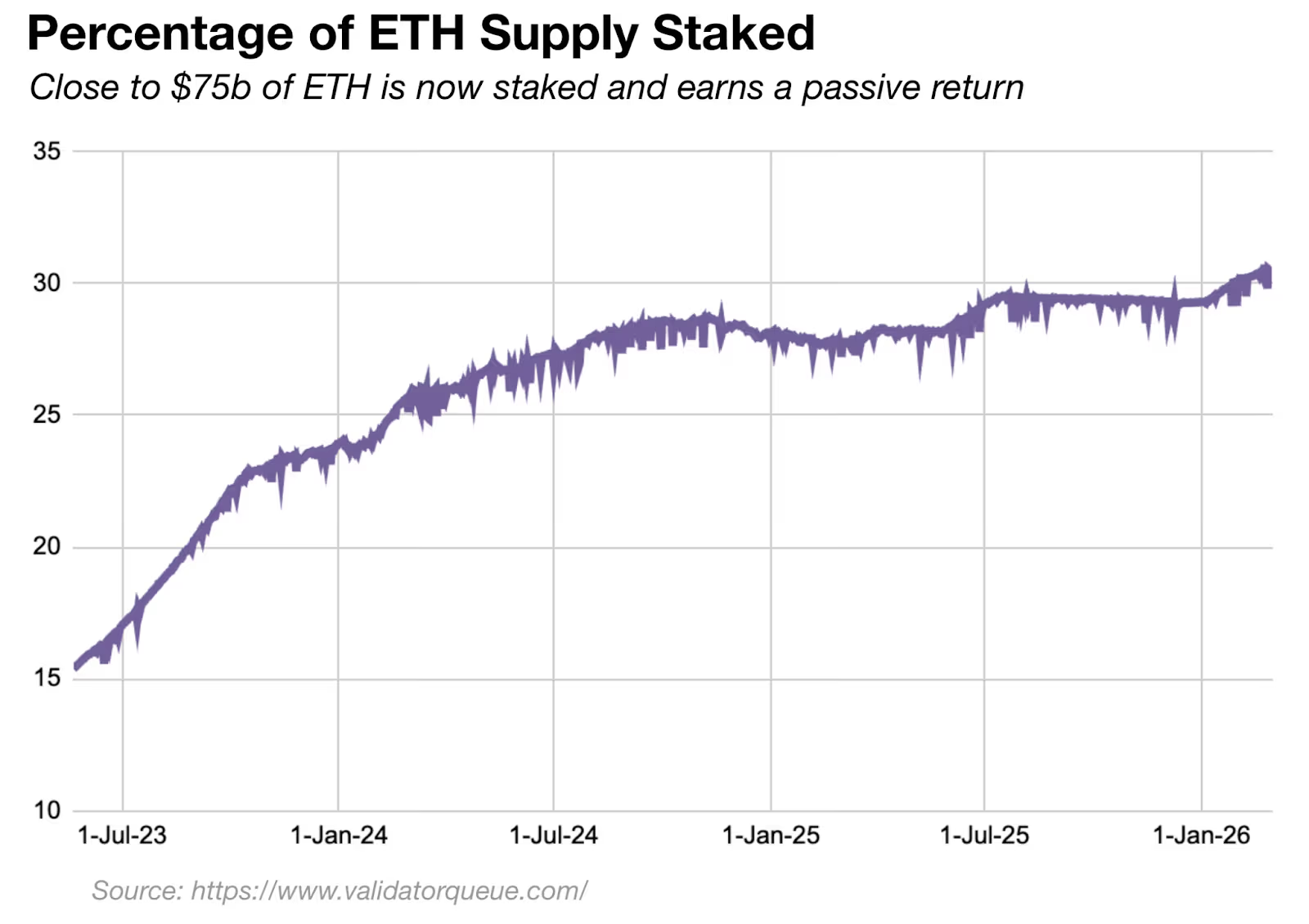
The clearest evidence is in the staking participation data. ETH staking supply has hit all-time highs, with close to 30% of all ETH staked now. That growth continued through periods of significant price weakness. Allocators kept staking regardless of what ETH was doing in spot markets because the yield was there independent of price.

Institutions have noticed. After the SEC provided regulatory clarity around staking in U.S.-registered funds last year, nearly twenty staking-linked ETFs and ETPs have launched or been filed, including BlackRock’s iShares Staked Ethereum Trust and products from VanEck, Grayscale and Fidelity, more than in all previous years combined. Morgan Stanley, which manages roughly $8 trillion in client assets, applied in February for a national trust bank charter from the Office of the Comptroller of the Currency (OCC) to offer crypto custody and staking services to its investment clients.

But every one of these products is, today, a passive fund. You get yield at whatever rate the network happens to be paying, bundled with price exposure, with no ability to manage duration or isolate income from principal. That leaves a lot on the table.
Staking yield has two characteristics that make it particularly interesting as a traded market:
First, rewards are variable and driven by network-level activity. Transaction volumes, validator set size and overall participation all move the rate. Staking rewards behave somewhat like a macro rate: when the network is busy and demand for block space is high, rewards rise; when activity falls, they compress. That variability is not just a risk to be passively absorbed. It is a signal that can be traded.
Second, staking is partly illiquid in a structured way. ETH’s validator entry queue currently runs over two months, meaning capital committed today does not start earning for more than sixty days. That queuing dynamic creates a forward curve. The rate you expect to earn in three months is not the same as the rate available today and the gap between them is something a market should price.
Together, these two features mean staking yield has the ingredients of a proper rates market: a floating benchmark that moves with observable fundamentals, and a term structure created by real illiquidity and expectations of forward network activity. This is exactly the kind of market active managers get paid to navigate.
Capturing that opportunity requires a toolkit that does not yet exist in regulated form: instruments that let you price yield independently of principal, so a buyer can take a view on rate direction without carrying spot exposure; instruments with defined maturities that make the illiquidity premium explicit and tradable; and instruments that separate the income stream from the capital claim entirely, so each can find its natural holder. In traditional fixed income, these are strip bonds, zero coupon instruments and floating-rate notes. They are the building blocks without which you cannot run anything more sophisticated than a passive fund.
Once those instruments exist, the rest follows naturally. The first active staking funds will look like something money market managers do today: rotating across maturities, pricing illiquidity risk and taking views on forward network activity rather than just collecting whatever rate the network is currently paying.
Decentralized finance (DeFi) tackled this problem early, though aimed at a different market and built on different yield sources. Protocols like Pendle Finance have built an elegant yield tokenization engine that separates principal tokens from yield tokens and lets them trade independently. The mechanics work, but the wrapper is unsuitable for institutional capital, as it looks too much like a security in most jurisdictions and lacks regulatory clarity.
What we are moving toward is a genuine fixed income market for crypto-native yield, with term structures, actively managed duration strategies and products that compete on the precision of their yield management rather than simply on access.
Bull markets reward beta. Bear markets reward income. Mature markets reward the ability to manage risk precisely. We are somewhere between the second and third phase, and the infrastructure for that third phase is largely still missing.
Principled Perspectives
Bitcoin as collateral: the shift redefining the financial system
– By Clara García Prieto, founder, BTL
More than five years ago, suggesting that bitcoin could be used as collateral — and that traditional financial institutions might seriously consider it — would have sounded improbable. Today, that scenario is no longer theoretical: bitcoin has entered the financial system and, in doing so, is redefining what we understand as collateral. Bitcoin is not just becoming collateral — it is redefining what collateral means.
As a lawyer, my view is clear: the use of bitcoin as collateral is inevitable, but most participants are not prepared for the risks it entails. In my opinion, this will be the dominant pattern over the next five to ten years.
To understand the magnitude of this shift, it is useful to look at a classic example: a real estate mortgage. In this structure, there is a loan (the principal obligation) and a guarantee (the property) that secures it. Bitcoindoes not fit neatly within the current logic:: it is not tied to a specific jurisdiction, it does not rely on public registries and its control is based on cryptographic keys. This forces us to reinterpret the concept of collateral rather than simply replicate it.
Bitcoin has unique characteristics: it is a digital asset, finite, with a fixed and deterministic supply. Many who hold it — whether individuals or companies — do not to part with it. On the one hand, this is because of its scarcity and potential appreciation; on the other, because of the tax implications of disposing of it. This is where a key shift emerges: obtaining liquidity without selling the asset.
However, there is a structural tension. Bitcoin does not typically depend on intermediaries, but collateralized transactions must depend upon them to some extent. And this is the real critical point.
In centralized models, the primary risk is custody. The user must trust that the entity holding the collateral acts diligently and remains solvent. Translating this to trust to the crypto context is not a minor issue and requires careful analysis of how custody is managed. Traditional financial institutions are already exploring this — for example, by assessing the use of bitcoin ETFs as collateral for institutional clients. The movement has begun, even if we are still only seeing the tip of the iceberg.
In decentralized finance (DeFi), the problem is different. Native bitcoin cannot be used directly, as it requires the use of tokenized representations. This introduces new risks: reliance on smart contracts, protocol risk, potential price discrepancies and the need for active collateral management. Additionally, there may be tax implications, depending on jurisdiction, if the transaction is treated as a taxable event.
At the same time, the use of bitcoin as collateral is beginning to be integrated into corporate treasury strategies. In my view, this will be one of the most relevant developments. Companies with strong liquidity and solid balance sheets can use bitcoin as a strategic asset, reducing their reliance on external financing. Those who adopt it early will have a clear competitive advantage.
That said, bitcoin’s volatility will prevent it from replacing traditional collateral. No financial system can rely exclusively on an asset that can fluctuate significantly over short periods of time, as they require overcollateralization and strict risk management mechanisms.
We are facing a form of collateral with unique characteristics that cannot be ignored. Volatility and the associated risks — custody, counterparty and structural — are real. But so is its potential. The use of bitcoin as collateral is no longer a hypothetical; it will become increasingly common. The question is not whether it will happen, but who is prepared to manage it properly.
Headlines of the Week
– By Francisco Rodrigues
The cryptocurrency industry has kept on slowly maturing over the week, with headlines pointing to the Bitcoin network’s physical resilience, the Ethereum Foundation’s evolution, and further institutionalization of the technology underpinning it.
- Bitcoin can survive 72% of the world’s submarine cables being cut: That’s according to a Cambridge study spanning 11 years and 68 verified cable failures. It found Bitcoin’s physical infrastructure is far more resilient than previously thought.
- Ethereum Foundation publishes new mandate defining its role, core principles: In a 38-page document, the Ethereum Foundation outlined its philosophy and role as a steward of the Ethereum network. The document emphasizes Ethereum’s core mission to enable user self-sovereignty, and that it must preserve censorship resistance, open source, privacy and security.
- European Central Bank unveils tokenized finance plan to bolster EU’s financial autonomy: The European Central Bank published its Appia roadmap, outlining a long-term plan to build a euro-anchored tokenized wholesale financial system using distributed ledger technology and central bank money settlement.
- Mastercard Launches Global Crypto Partner Program with 85+ Companies: Mastercard unveiled its Crypto Partner Program, bringing together more than 85 companies, including Ripple, Solana, Circle, Binance and other major players, to accelerate real-world blockchain use cases in cross-border payments, settlement and consumer crypto spending.
- Prediction markets get tailored U.S. guidance from former foe CFTC: The agency, which was once a legal opponent of certain activity at prediction markets, is now establishing policy for their oversight, with staff-issued advisory to regulated firms and initial guidance rolling out.
Chart of the Week
Crypto card volumes hit $140 million record as Neobank tokens lag behind
Weekly crypto card volumes continue their steady uptrend, reaching a new milestone of $140 million this week driven largely by RedotPay’s dominant $91 million contribution. While the broader Neobank Performance Index (including tokens like Avici and ETHFI) remains down 34% since the start of 2025, it has shown signs of a recent turnaround with a 10% recovery month-to-date. This divergence suggests that while asset valuations are still recovering from yearly lows, the actual utility and transaction volume of crypto cards are scaling to all-time highs.

Listen. Read. Watch. Engage.
Looking for more? Receive the latest crypto news from coindesk.com and market updates from coindesk.com/institutions.
Note: The views expressed in this column are those of the author and do not necessarily reflect those of CoinDesk, Inc., CoinDesk Indices or its owners and affiliates.
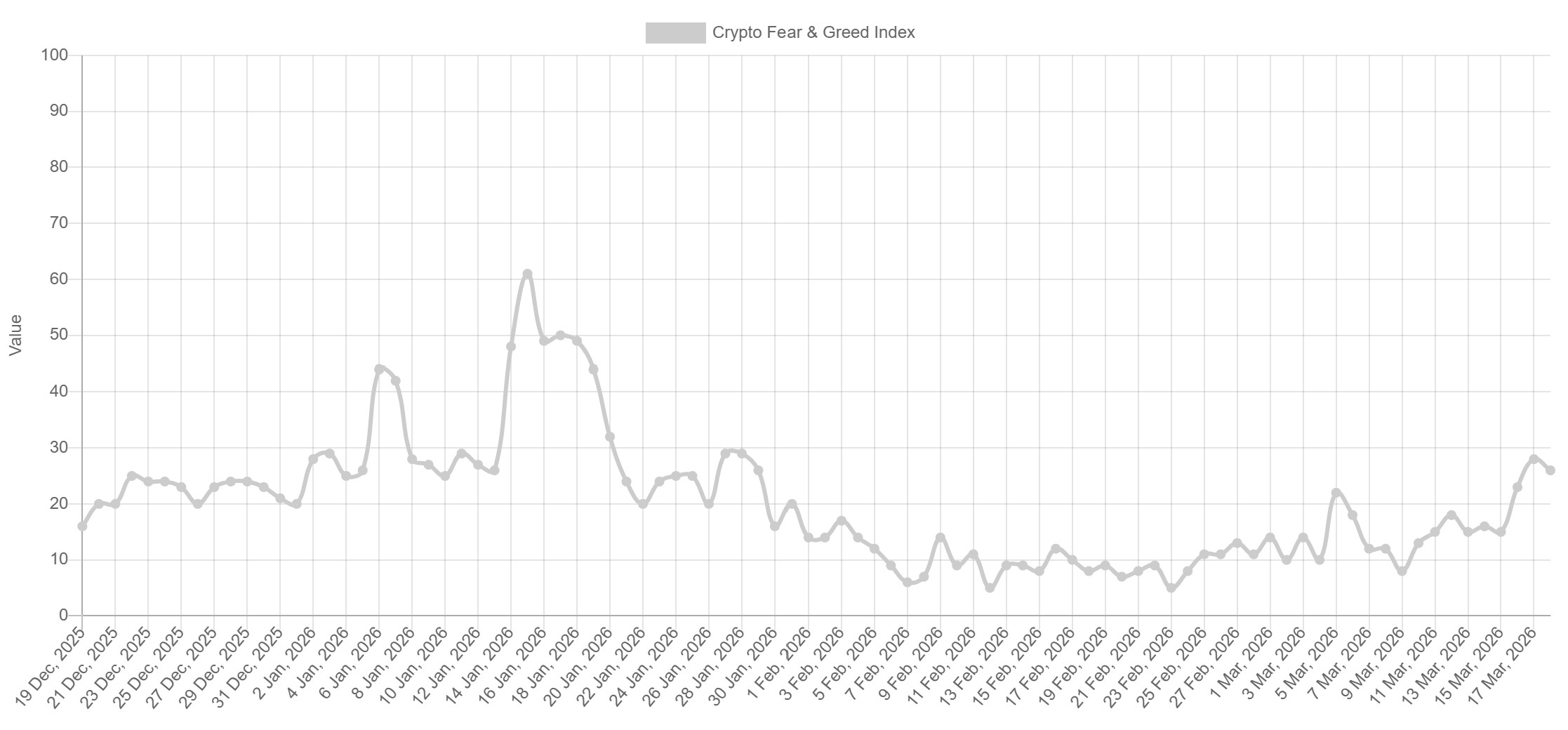
The Crypto Fear & Greed Index remained at 26 on Wednesday, after rising to 28, a day earlier, ending the indicators’ 48-day stretch in the “extreme fear” zone.
The Crypto Fear & Greed index tracks market sentiment using volatility, momentum, volume, and social data. Any reading below 25 signals extreme fear, while higher values reflect an improving risk appetite.

The index reading points to an improvement in market sentiment this week, marking its first exit from extreme fear in over six weeks.
The move coincides with a recovery in the total crypto market capitalization, which has added 7.65% in March, equivalent to roughly $174 billion. This marks the first monthly bullish expansion since September 2025. Before this, the market declined nearly 40%, dropping to $2.28 trillion from $3.65 trillion in the previous five months.

Market researcher Sminston With provided additional context to the Fear & Greed index.
With said that an analysis of the past Bitcoin market cycles shows that buying BTC during fear phases delivered stronger returns over a two to four-year window.
The average gains reached 331% over three years, compared to 100% for BTC entries made during the greed phases. However, over longer time periods (four to five years), the return differences narrowed, with both the entry strategies converging as Bitcoin’s long-term growth trend dominated the price action.

Related: SOL price signal tied to previous 142% rally flashes again: Are the bulls back?
A rise in stablecoin inflows signals liquidity return
Binance exchange flow data shows a shift in capital movement. Binance recorded a $2.2 billion inflow in Tether USDt (USDT) on March 18, marking the largest single-day stablecoin deposit since November 2025.

These inflows represent the available capital, often referred to as “dry powder,” that can be deployed into the crypto markets. The spike coincided with Bitcoin pushing into higher price levels near $75,000 on Monday, linking the liquidity injection with active trader positioning.
Meanwhile, the total stablecoin reserves across exchanges surged to $68.5 billion from a six-month low of $64 billion on March 8, marking a sharp increase of 7%, within a short period.

A rise in exchange-held stablecoins typically signals that participants are preparing to deploy funds into spot or derivatives markets. This indicates that traders are re-entering with the intent to take positions, adding to near-term buying capacity.
Related: Australian crypto shopping surges, but so do banking blocks: Survey
This article does not contain investment advice or recommendations. Every investment and trading move involves risk, and readers should conduct their own research when making a decision. While we strive to provide accurate and timely information, Cointelegraph does not guarantee the accuracy, completeness, or reliability of any information in this article. This article may contain forward-looking statements that are subject to risks and uncertainties. Cointelegraph will not be liable for any loss or damage arising from your reliance on this information.


FTX Recovery Trust announced Wednesday it will distribute roughly $2.2 billion to creditors on March 31 as part of its ongoing bankruptcy recovery process, with additional payments to preferred equity holders scheduled later this year.
The payout marks the fourth distribution under FTX’s Chapter 11 reorganization plan and will go to creditors in both “Convenience” and “Non-Convenience” classes who have completed required onboarding steps, the trust’s statement says. Funds are expected to arrive within 1 to 3 business days via BitGo, Kraken, or Payoneer.
The trust also clarified all distributions are made in U.S. dollars to designated service providers, which then offer options for fiat withdrawal or conversion into digital assets.
The previous distribution to creditors took place from Sept. 30, when the trust announced the release of $1.6 billion, the third major payout since the collapse of the crypto exchange more than three years ago.
Earlier rounds totalled over $6 billion as part of a process aimed at recovering assets for users of the once-prominent cryptocurrency exchange, which collapsed in November 2022, triggering a steep crypto bear market. Sam Bankman-Fried, the founder and CEO of the exchange, is serving a 25-year sentence after being found guilty of seven counts of fraud and conspiracy.
The latest distribution pushes recovery rates higher across several claim classes, the trust said. The statement added that in this fourth distribution, those eligible for distribution classed as “Class 5A Dotcom” would receive an additional 18% (bringing total recovery to 96%), while U.S. customer claims classed as “5B” would reach full recovery at 100%. Those in classes “6A” and “6B” would also recover 100% recovery, each receiving a 15% increment. “Class 7,” meanwhile, would receive a cumulative 120% distribution, the statement said.
FTX said customers who opted to receive funds through a designated distribution provider have waived their right to direct cash payments and must work with those platforms to access their funds.
The estate also set April 30 as the record date for its first payments to preferred equity holders, with payments scheduled for May 29. Eligible holders must complete ownership certification, know-your-customer (KYC) verification and tax documentation to qualify, the trust said.
FTX began outreach to equity holders earlier this year and urged those who have not been contacted to come forward. Further distribution timelines are expected to be announced, the statement concluded.

An eagle is seen framed though construction fence on the Marriner S. Eccles Federal Reserve Board Building, the main offices of the Board of Governors of the Federal Reserve System on September 16, 2025 in Washington, DC, U.S.
Kevin Dietsch | Getty Images News | Getty Images
The Federal Reserve is still expecting to cut interest rates once this year in spite of a spike in oil prices from the Iran war.
The central bank’s so-called dot plot, which shows the anonymous expectations of the 19 individual members, showed a median estimate of 3.4% for the federal funds rate at the end of 2026, the same as what it had projected at the end of last year.
However, a closer look at the overall dot plot showed the balance of projections moved toward fewer reductions, meaning more members are forecasting one reduction from two previously.
“If you notice, the median didn’t change, but there was actually some movement toward — a meaningful amount of movement — toward fewer cuts by people,” Fed Chair Jerome Powell said in his post-meeting remarks. “So four or five people went from two to one, let’s say, two cuts to one cut.”
The Fed kept rates unchanged on Wednesday, voting 11-1 to keep the benchmark federal funds rate anchored in a range between 3.5%-3.75%.
Traders had come into the year hopeful for two interest rate cuts. However, that expectation has been getting pushed out in recent weeks because of data showing hotter inflation that could put the central bank on hold.
In particular, it complicates the job of former Fed Governor Kevin Warsh, who is set to succeed current Chair Powell when his term ends in May. Warsh, who was handpicked by President Donald Trump, has expressed his support for lower rates.
The Fed’s Summary of Economic Projections showed higher inflation projections for the year, as well as a somewhat faster pace of growth.
The forecast for personal consumption expenditures inflation climbed to 2.7% for 2026, up from 2.4% in December. The projection for core inflation, which excludes volatile food and energy prices and is more closely watched by the Fed, also rose to 2.7% from 2.5%.
However, the change in real GDP rose to 2.4% from 2.3% in December.
Fed funds futures were last pricing in just one rate cut in 2026, as well as the greater likelihood that the central bank may remain on hold, according to the CME FedWatch Tool.
— CNBC’s Gabriel Cortes and Jeff Cox contributed to this report.
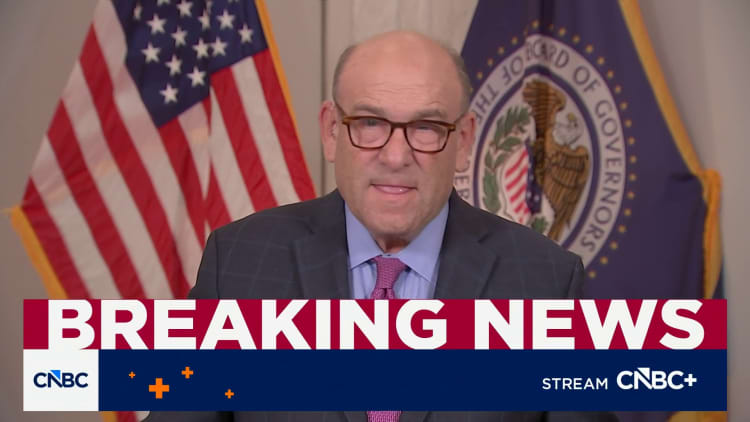

WASHINGTON – The Federal Reserve on Wednesday voted to hold its key interest rate steady as policymakers navigate their way through higher-than-expected inflation readings, mixed signs on the labor market – and a war.
In a widely expected decision, the Federal Open Market Committee voted 11-1 to keep the benchmark federal funds rate anchored in a range between 3.5%-3.75%. The rate sets overnight funding costs for banks but influences a broad range of consumer and business borrowing.
The committee in its post-meeting statement made few changes to its view on the economy, with a slightly faster pace of growth and higher inflation projections for 2026.
Despite the elevated uncertainty, officials again signaled they still expect a few rate cuts ahead. The closely watched “dot plot,” which reflects individual members’ rate projections, pointed to one reduction this year and another in 2027, though the timing remains unclear.
Of the 19 FOMC participants, seven signaled they expected rates to stay unchanged this year, one more than the last update in December. While future years showed a fairly wide disbursement of forecasts, the median outlook is for an additional cut in 2027 before the funds rate steadies out around 3.1% for the long term.
Stocks fell to session lows as the central bank’s decision and comments from Federal Reserve Chair Jerome Powell drew more attention to the threat of persistant inflation.
War’s implications are ‘uncertain’
One factor is the uncertainty associated with the war with Iran that started nearly three weeks ago. The fighting and its impact on the Strait of Hormuz has roiled the global oil market and threatened to keep inflation above the Fed’s 2% target.
“The implications of developments in the Middle East for the U.S. economy are uncertain,” the statement said.
During his news conference, Powell said it was “too soon to know” the impact of the war.
“Near term measures of inflation expectations have risen in recent weeks, likely reflecting the substantial rise in oil prices caused by the supply disruptions in the Middle East,” he said.
Governor Stephen Miran again dissented, favoring a quarter percentage point cut amid rising concerns about the jobs climate. Governor Christopher Waller, who joined Miran in wanting a cut in January, voted this time to hold.
Before the conflict, markets had been pricing in two reductions this year, with a small chance of a third. But rising oil prices and a string of firm inflation readings — entailing data from before the energy shock — have pushed expectations down to at most one cut in 2026.
Faster economic growth seen
In updates to their economic projections, Fed officials see gross domestic product increasing at a 2.4% pace this year, a bit faster than in December. Growth is projected to progress at a solid 2.3% rate in 2027, up three-tenths of a percentage point from the previous outlook.
Officials also upped their inflation outlook for this year. They now expect the personal consumption expenditures price index to reflect a 2.7% inflation rate, both on headline and core. However, they see inflation falling back near the Fed’s 2% target in ensuing years as the impact of tariffs and the war fade. Policymakers continue to expect a 4.4% unemployment rate by year’s end, despite a string of weak payrolls readings.
The Fed’s decision to hold comes against a complicated political backdrop.
President Donald Trump continues to badger Powell and his colleagues to lower rates. Earlier this week, Trump criticized Powell for not calling a special meeting to ease, even with inflation running hot and the uncertainty of the war’s impact.
For his part, Powell presided over what could be his next-to-last meeting as head of the central bank. His term is set to end in May, and Trump has tapped former Fed Governor Kevin Warsh as the successor. Warsh has indicated a preference for lower rates, though he has not issued any recent public statements to indicate where his thinking is now.
Complicating the dynamic further is Trump’s own Justice Department.
U.S. Attorney Jeanine Pirro in Washington has subpoenaed Powell for evidence regarding the Fed’s multibillion-dollar headquarters renovation. Powell, though, has resisted the subpoena, and accused Trump of using it as a pretext to pressure the Fed into lowering rates. A judge sided with Powell on the issue, tossing the subpoenas and agreeing with the notion that the effort was simply to twist Powell’s arm to cut.
However, Pirro has vowed to appeal, and Sen. Thom Tillis, R-N.C., has in turn said he would block Warsh’s nomination in the Senate Banking Committee until the Powell matter is settled. Assuming the court battle continues past May, that would keep Powell in his seat until Warsh is confirmed.
Powell touched on this during the news conference, saying “I have no intention of leaving the board until the investigation is well and truly over, with transparency and finality.”
Once it wraps, Powell is undecided. “I have not made that decision yet, and I will make that decision based on what I think is best for the institution and for the people we serve.”
Powell’s term on the Board of Governors doesn’t expire until early 2028.
Correction: An earlier version of this story misspelled Sen. Thom Tillis’ name.
Hyperfine earnings beat by $0.02, revenue topped estimates

Inside court as three young boys accused of raping girl, 13, cleared

Who Was Alex Pretti? 5 Key Facts About the ICU Nurse Killed by Federal Agents in Minneapolis


![Trump's Worst FEAR Just Came True! [This Happens To Oil Next]](https://wordupnews.com/wp-content/uploads/2026/03/1773864099_maxresdefault-80x80.jpg)

-
 Crypto World5 days ago
HYPE Token Enters Net Deflation as HyperCore Buybacks Outpace Staking Rewards
-

 Tech3 days ago
Your Legally Registered ‘Motorcycle’ Might Not Count Under Proposed US Law
-

 Fashion5 days ago
Weekend Open Thread: Addict Lip Glow
-
Sports4 days ago
Why Duke and Michigan Are Dead Even Entering Selection Sunday
-

 Business3 days ago
Search for Savannah Guthrie’s Mother Enters Seventh Week with No Arrests
-
 Tech1 day ago
Are Split Spacebars the Next Big Gaming Keyboard Trend?
-

 Business4 days ago
US Airports Launch Donation Drives for Unpaid TSA Workers as Partial Government Shutdown Enters Fifth Week
-
Crypto World4 days ago
Coinbase and Bybit in Investment Talks: Could Bybit Finally Enter the US Crypto Market?
-

 Business4 days ago
Country star Brantley Gilbert enters growing non-alcoholic beer market
-

 Business2 days ago
Australian shares drop as Iran war enters third week
-

 Crypto World2 days ago
Crypto Lender BlockFills Enters Chapter 11 with Up to $500M in Liabilities
-

 Sports5 days ago
College Basketball Best Bets: Conference Tournament Semifinal Picks
-

 Politics11 hours ago
The House | The new register to protect children from their abusers shows Parliament at its best
-
 Crypto World7 days ago
Three Binance Charts May Be Hinting at Bitcoin’s Next Move
-

 Business6 days ago
Trump demands Powell cut rates as Iran conflict raises energy prices
-

 Crypto World6 days ago
Senate Votes to Include CBDC Ban in Bipartisan Housing Bill
-

 Fashion2 days ago
25 Celebrities with Curly Hair That Are Naturally Beautiful
-

 News Videos3 hours ago
RBA board divided on rate cut, unusually buoyant share market | Finance Report | ABC NEWS
-

 NewsBeat6 days ago
Deane Road crash near Bolton colleges and university
-

 News Videos6 days ago
Tom Lee: The 100x Opportunity EVEN Bigger Than Bitcoin (New Ethereum Prediction 2026)


You must be logged in to post a comment Login