Crypto World
Ripple Expands Institutional Stack: Will XRP Price React?

Ripple has announced two new partnerships with Figment and Securosys to expand the capabilities of Ripple Custody, its institutional digital asset custody solution.
It is evident that Ripple is currently in an infrastructure arms race to perfect its payment, custody, and staking services for institutions. However, real-world adoption and price have yet to show signs of a breakthrough.
Sponsored
Sponsored
Ripple Expands Custody Offering With Figment and Securosys Partnerships
Ripple said the partnerships are designed to simplify procurement and support faster deployment of custody services for regulated institutions. The move comes shortly after Ripple expanded its custody stack through the acquisition of Palisade and the integration of Chainalysis’s compliance tools.
As part of the partnership with Figment, Ripple will introduce staking functionality. This will allow institutional clients to offer staking services without operating their own validator infrastructure.
The integration is aimed at banks, custodians, and regulated entities seeking exposure to Proof-of-Stake networks while maintaining institutional security and governance standards.
Through Figment’s infrastructure, Ripple Custody clients will be able to support staking on major networks such as Ethereum (ETH) and Solana (SOL).
“By combining Ripple’s enterprise‑grade custody technology with Figment’s secure, non‑custodial staking platform, we’re giving regulated institutions a way to offer staking rewards to their customers on several blockchain networks,” Ben Spiegelman, VP – Head of Partnerships & Corporate Development at Figment, stated.
Separately, Ripple has partnered with Securosys to strengthen the security layer of Ripple Custody. The collaboration adds support for CyberVault HSM and CloudHSM. This gives institutions the option to deploy HSM-based custody either on premises or in the cloud.
According to Ripple, the Securosys integration is designed to address long-standing challenges around HSM adoption. This includes cost, complexity, and slow procurement processes.
Sponsored
Sponsored
Ripple also noted that the addition of Securosys expands the range of supported HSM providers on its custody platform. This provides greater flexibility for institutions operating across multiple regulatory environments.
“By integrating our CyberVault HSM with Ripple Custody, institutions gain an out-of-the-box, enterprise-grade solution that can be deployed quickly, without added complexity, while retaining full control over their cryptographic keys,” Robert Rogenmoser, CEO of Securosys, remarked.
Institutional Focus Fails to Lift XRP as On-Chain Activity Cools
As Ripple continues to strengthen its institutional infrastructure, on-chain metrics from the XRP Ledger indicate that adoption remains moderate. According to data from DeFiLlama, XRPL’s total value locked declined from around $80 million in early January to approximately $49.6 million at press time, reflecting softer DeFi activity on the network.
Stablecoin data points to a similarly gradual pace. Based on DeFiLlama figures, the total stablecoin market capitalization on XRPL stands at roughly $415.85 million, suggesting steady but limited growth.
That said, much of Ripple’s institutional strategy is centered on custody, settlement, and permissioned financial use cases, which may not always be reflected in traditional DeFi metrics such as TVL.
Notably, so far, the expansion of institutional use cases has had a limited impact on XRP’s market performance.

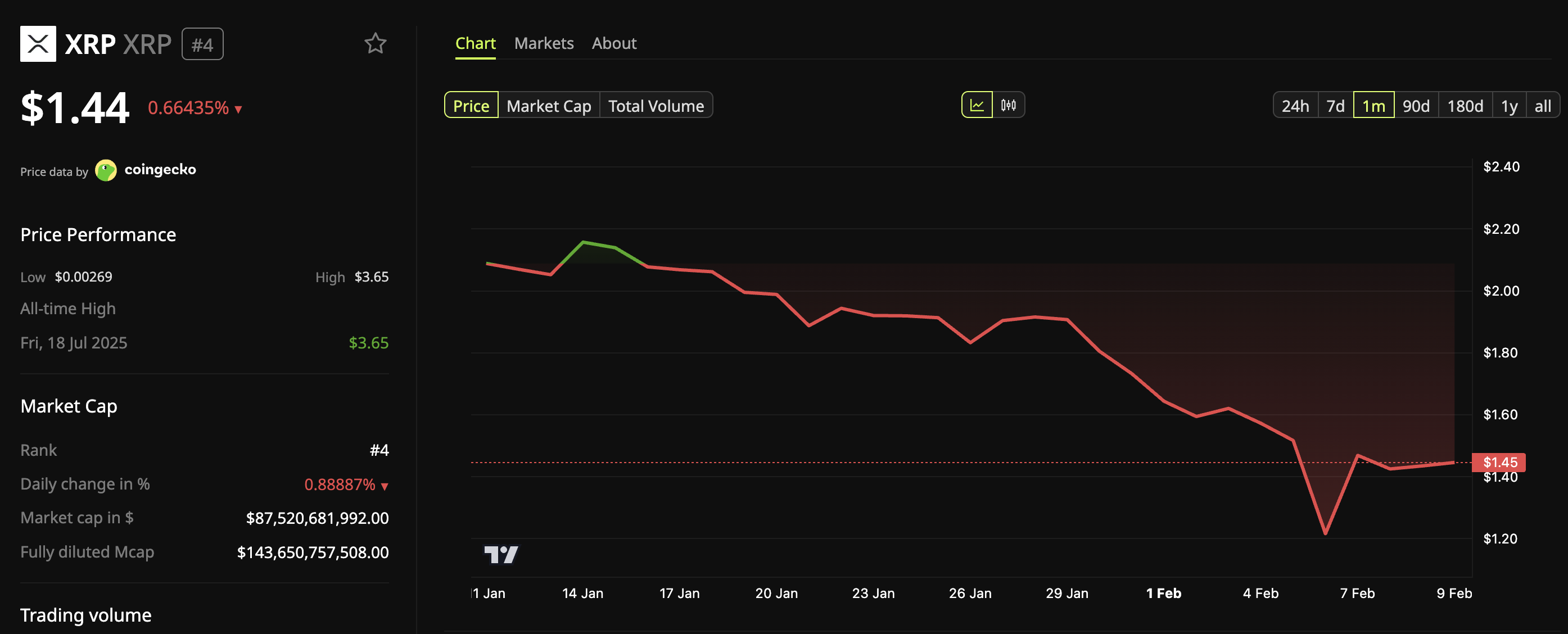
The asset is down nearly 32% over the past month, broadly tracking the wider market downturn. At the time of writing, XRP was trading at $1.44, down 0.66% over the past day.
You must be logged in to post a comment Login