

Crypto World
Ripple News Today and XRP Price Update: July 22

An entity deeply affiliated with Ripple was shortlisted for several recognitions at one of the industry’s most respected hedge fund award ceremonies.
XRP has entered green territory over the past week, while the recent behavior of the whales and renewed interest from institutional investors signal that the bears may lose even more ground in the short-term.
The Prestigious Nominations
The Hedgeweek US Awards – annual industry honors recognizing top-performing hedge funds and leading service providers across the United States – will take place on October 8 in New York.
The nominated companies have been announced, and interestingly, Ripple Prime was included in four of the categories: Prime Broker of the Year: Client Service, Prime Broker of the Year: Technology, Prime Broker of the Year: Specialist Markets, and Prime Broker of the Year: Start-up & Emerging Managers. Competition for the entity will include well-known brokerage firms such as Mirae Asset Securities and Interactive Brokers.
Speaking on the matter was Ripple Prime’s CEO Mike Higgins, who thanked all clients and partners for their “continued trust” in the platform, its solution, and services. He also noted that voting for winners is open.
Whales Are Back
Another recent Ripple-related development is the evident return of big XRP investors. As CryptoPotato reported, whales and sharks holding between 100,000 and 100 million tokens each have added almost 3% more coins to their bags in the past five weeks. At the same time, smaller players (those owning less than 0.01 XRP) have reduced their exposure.
“Historically, XRP price has tended to move more with key stakeholders and against the smallest retail wallets, so this split supports the bullish case behind the bounce,” the analytics platform Santiment explained.
The ETF Front
Institutional investors have also shown renewed appetite toward XRP. SoSoValue’s data shows that lately spot XRP ETFs have attracted millions of dollars of capital, with the last red day being July 8. The past trading week was also in the green, with roughly $7 million in net inflows. However, four out of the five trading days saw no reportable action, which raised some eyebrows.

The launch of these products was highly anticipated across the community, and the first one (which has 100% exposure to the asset) saw the light of day in November 2025. Its issuer is Canary Capital, while prominent companies like Franklin Templeton, 21Shares, Grayscale, and Bitwise followed shortly after. Since day 1, these investment vehicles have generated a cumulative total net inflow of almost $1.5 billion.
XRP Price Outlook
The asset is currently worth around $1.14, representing a 3% increase on a weekly scale. Whale activity and interest in spot ETFs only reinforce the scenario shared by many analysts that XRP is poised for more substantial gains in the short term.
Earlier this week, Ali Martinez labeled $1.13 a level of huge importance, claiming a decisive breakout above could open the door for further upside to as high as $1.30. He later confirmed the setup, saying that XRP has cleared resistance, but the token remains sideways around that line as of press time.
Cryptollica also chipped in. A few days ago, the analyst argued that “there is no better opportunity” than XRP right now, stating that it has reached an all-time low oversold level.
The post Ripple News Today and XRP Price Update: July 22 appeared first on CryptoPotato.

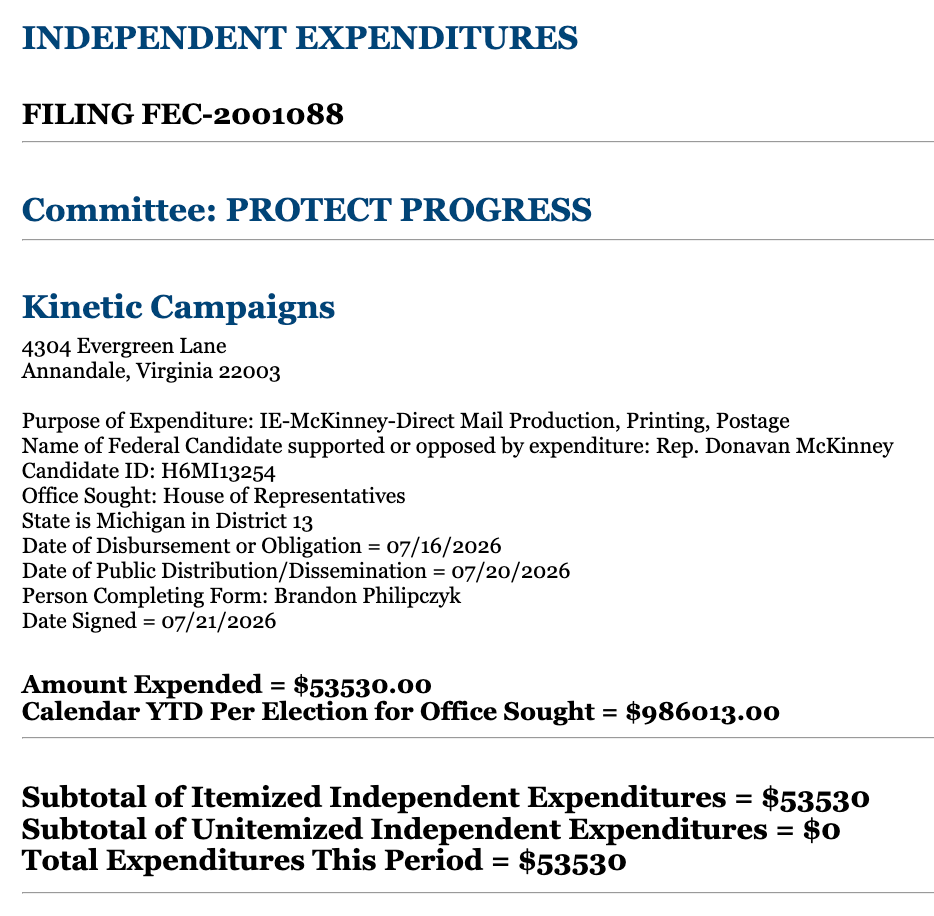
An affiliate of the cryptocurrency-aligned political action committee (PAC) Fairshake is attempting to influence voters in a primary race for Michigan’s 13th congressional district, with about $1 million in media on the line.
In filings with the US Federal Election Commission (FEC) as of Tuesday, the Protect Progress PAC had spent more than $986,000 on ads supportive of Democratic incumbent Shri Thanedar and opposing his challenger, Donavan McKinney. The reported expenditures came two weeks before the Democratic candidates were set to face off in an Aug. 4 primary to determine who will stand in the November general election.
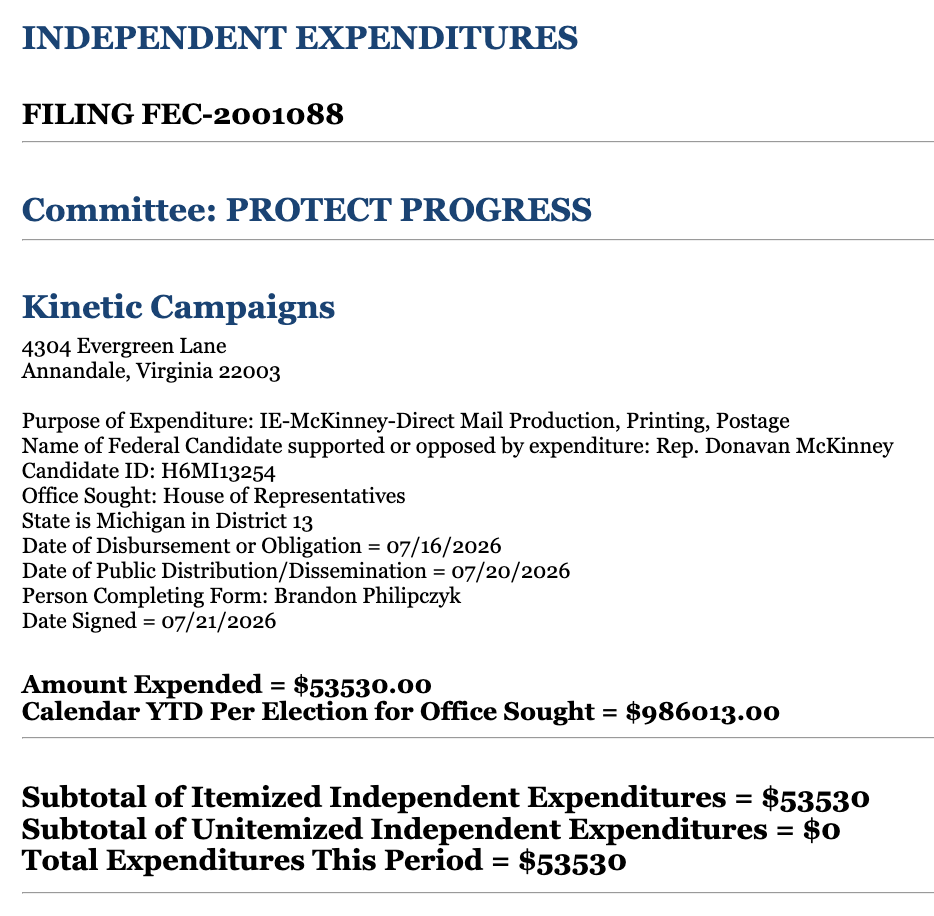
Source: FEC
The media spending echoed Protect Progress’ moves from 2024, when the PAC spent about $1 million supporting Thanedar. That year, he defeated Democratic primary candidates with 54.9% of the vote, and Republican and other party challengers in the November election with 68.6%.
Fairshake and its affiliates reported having $191 million in their war chest to potentially influence voters in key elections. The PACs are just a few of many aligned with the industry attempting to send what they consider “pro-crypto” candidates to the next US Congress. Others included Fellowship, backed by Cantor Fitzgerald and Anchorage Digital, and the Blockchain Leadership Fund, a hybrid PAC backed by Anchorage and Chainlink Labs.
Related: Crypto-backed candidates notch wins in three US state primaries
McKinney did not run against Thanedar in 2024, nor had he appeared to have made any significant public statement directly supporting or opposing digital assets. Thanedar, in contrast, voted for many crypto-related bills while serving in the House of Representatives, including the CLARITY Act, GENIUS Act and Promoting Innovation in Blockchain Development Act. He also reportedly lost more than $600,000 in the second quarter of 2026 after investing $3.7 million of campaign funds into crypto companies.
“Shri has voted for every bill [Donald] Trump and the crypto lobby have brought to Congress,” said McKinney in a Tuesday statement on the PAC spending, adding:
“The crypto lobby is paying my opponent back for helping Trump make over $1 billion since taking office.”
PAC’s sights set on Washington as well
In addition to Protect Progress’ activity in Michigan, the PAC spent more than $100,000 on media supporting Representative Greg Stanton’s reelection bid in Arizona. Like Thanedar, Stanton voted in favor of CLARITY and GENIUS in the House. He won his primary on Tuesday for Arizona’s 4th congressional district with 65% of the vote.
The state of Washington’s party primaries, also scheduled for Aug. 4, could see some influence from a Fairshake affiliate. According to FEC filings, the Defend American Jobs PAC spent more than $65,000 on media to support Amanda McKinney, a Republican running for Washington’s 4th district who has made at least one public statement supporting crypto. Representative Dan Newhouse announced in 2025 that he would not pursue reelection in the district.
Magazine: Will the crypto lobby’s $189M campaign get CLARITY over the line?
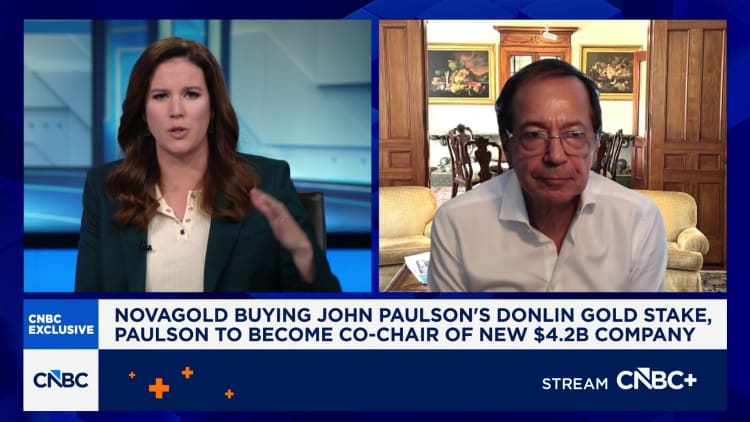

John Paulson, the hedge fund manager who made billions betting against the U.S. housing market before turning bullish on gold, said he believes the precious metal is only in the early stages of a long-term rally.
“I do think we’re in the beginnings or the early stages of a long-term bull market for gold,” Paulson said on CNBC’s “The Exchange” Wednesday. “As people lose faith in paper currencies, gold as an alternative will continue to grow.”
Paulson, whose wager against subprime mortgages became one of the most profitable trades in Wall Street history, shifted his focus to gold in 2009, arguing that the unprecedented fiscal and monetary stimulus following the financial crisis would ultimately weaken the U.S. dollar. Since then, gold prices have roughly quadrupled, topping the $5,000 threshold before pulling back.
The billionaire investor said demand for bullion continues to broaden, led by central banks that have been adding to their reserves alongside growing private-sector interest.
“Gold is becoming the most apt reserve currency in the world, replacing fiat currencies,” Paulson said. “The demand from central banks, for instance, has continued to grow, as has the private sector.”
Paulson also argued that investors stand to benefit more from owning gold miners than bullion itself, particularly companies with large undeveloped reserves.
“I think the greatest way to invest is to invest in early-stage gold stocks,” he said.
Paulson made the comments as NovaGold Resources announced it would acquire Paulson Advisers’ 40% stake in the Donlin Gold project in Alaska. Paulson, who serves as co-chairman of NovaGold, said the company offers investors leveraged exposure to rising gold prices because of its sizable resource base.
“NovaGold has 40 million ounces of gold indicated and measured resources and reserves at the market [capitalization] of $4.2 billion,” Paulson said. “I think the best way to play gold is through stocks like NovaGold, if not NovaGold itself.”
Crypto World
Crypto Industry Pushes for Senate Vote on New CLARITY Act Text as Democrats Blast Ethics Plan


Crypto executives and policy groups called on the Senate to move quickly after Senate Republicans released updated text of the Digital Asset Market Clarity Act on July 22, while key Democrats attacked the draft's approach to policing crypto conflicts of interest among government officials, the… Read the full story at The Defiant
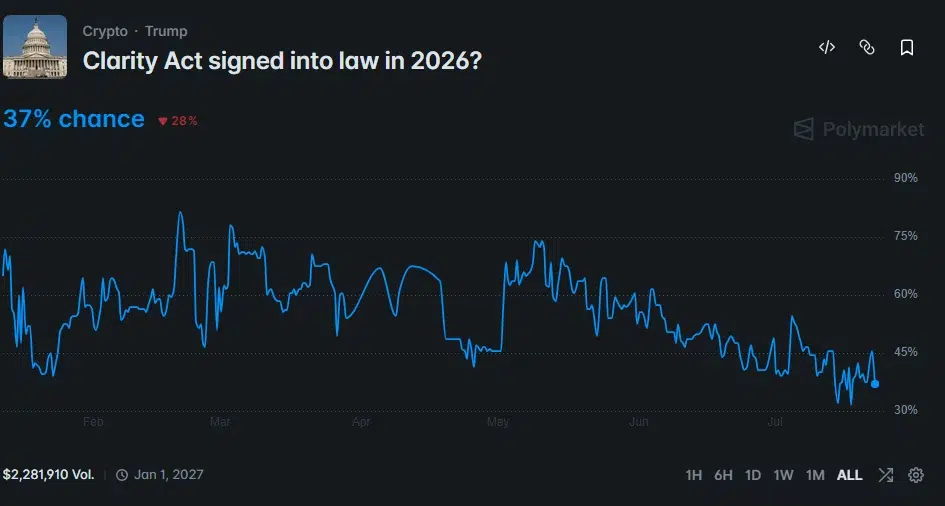
Coinbase shares have fallen 4% to about $169 on July 22 as the CLARITY Act’s 2026 passage odds dropped 15 percentage points from the previous day’s peak.
Summary
- Coinbase stock fell 4% as the CLARITY Act’s passage odds dropped to 37%.
- COIN must reclaim $170.89 to target resistance at $180.70 and $190.51.
- SUI staking and a $150,000 SEC settlement added company-specific catalysts.
Polymarket data places the bill’s chance of passing before the end of 2026 at 37%, down from 52% on July 21, after disagreements emerged over how proposed ethics restrictions should be enforced.
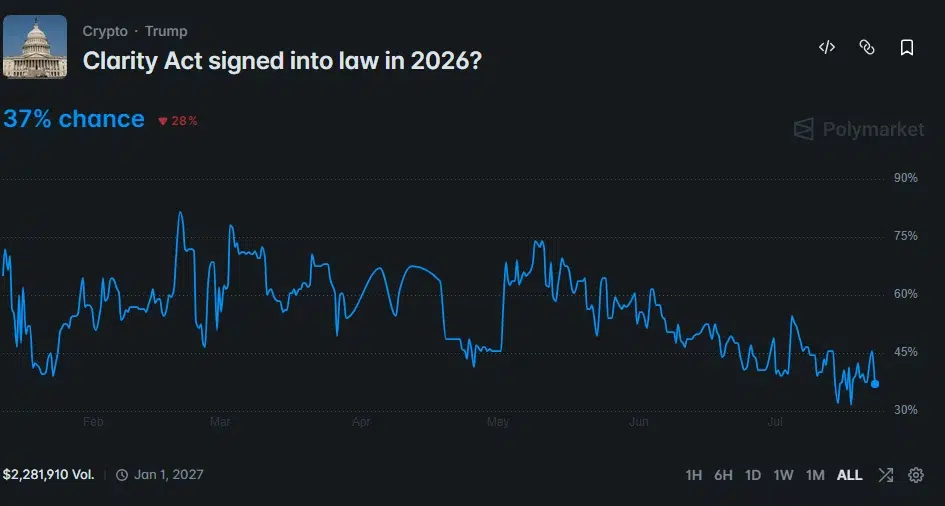
President Donald Trump had agreed to include ethics provisions in the market structure bill, helping lift the probability on Polymarket and sending COIN stock 9% higher on July 21. The compromise, however, failed to secure enough support after some Democratic senators objected to assigning enforcement responsibility to the U.S. Department of Justice instead of state attorneys general.
Senator Angela Alsobrooks described the White House proposal as an “unserious offer” and stated that senators would continue working on language capable of holding all parties accountable. Her comments weakened expectations that the latest concession would end the dispute holding up the legislation.
Republican Senator Thom Tillis also indicated that the text was not ready for a procedural vote. According to Tillis, lawmakers still need to make changes before senators can support advancing the bill, leaving its timetable uncertain despite the renewed negotiations.
Falling bill odds have interrupted COIN’s rebound
Monday’s policy optimism helped Coinbase shares close above $170 for the first time since June 2, but the rally lost momentum as the disagreement in Washington returned. TradingView data shows COIN opened at $172.25 on July 22, reached $174.96 and fell as low as $168.32 before trading near $169.11.
On the daily chart, the latest advance also pushed COIN above a descending trendline drawn from its May high. Tuesday’s decline brought the stock back below the 61.8% Fibonacci retracement at $170.89, making that level the first resistance buyers need to recover.
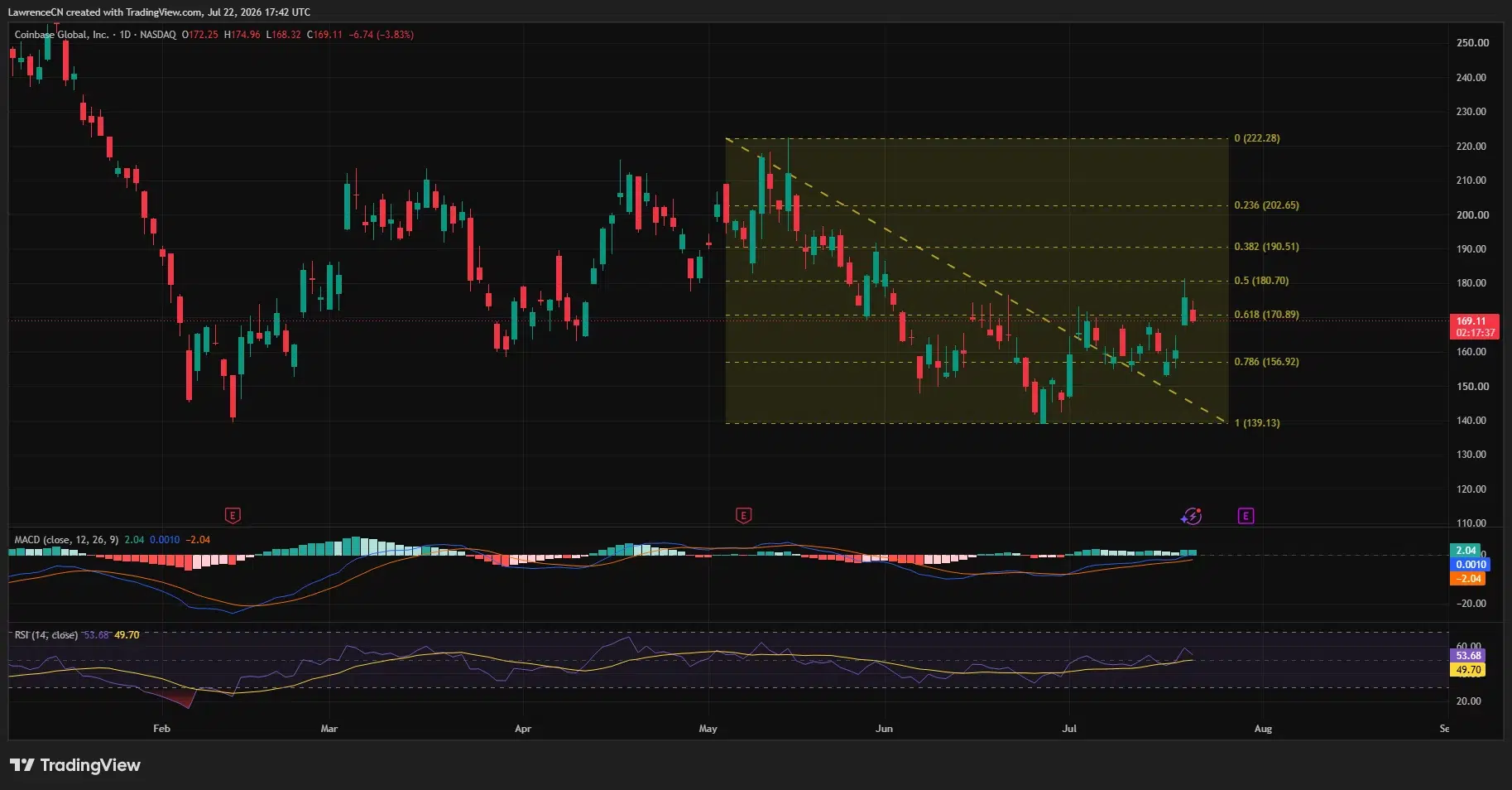
Momentum readings still show some support beneath the pullback. The chart’s moving average convergence divergence line has moved above its signal line, while the histogram has turned positive, a combination that TradingView’s indicator readings associate with improving bullish momentum.
COIN’s relative strength index stands at 53.68, above its moving average of 49.70 and well below overbought territory. According to the chart, this neutral-to-positive reading gives buyers room to extend the recovery if the stock retakes $170.89 and attracts follow-through demand.
Above that barrier, the Fibonacci retracement identifies $180.70 as the next resistance, followed by $190.51 and $202.65. A close above the $180.70 midpoint would strengthen the recovery case and place the psychological $200 area close to the 23.6% retracement.
Failure to reclaim $170.89 would leave COIN exposed to the 78.6% Fibonacci level at $156.92. The chart places the full retracement at $139.13, although the July price structure also shows several recent lows around $150 that could offer support before the stock reaches the lower target.
Bitcoin’s recovery to around $66,000 may provide an additional catalyst because Coinbase earns part of its revenue from crypto trading. Raymond James, however, expects subdued market activity to weigh on the company’s performance and has initiated coverage with a $158 price target, roughly 6.5% below COIN’s quoted level near $169.
Oppenheimer previously lowered its Coinbase target to $209, also citing soft spot-trading volumes during the crypto downturn. Despite its cautious stock forecast, Raymond James estimated that Coinbase’s expanding product range, including prediction markets, could eventually produce more than $100 million in annualized revenue.
New products and an SEC settlement support the business case
Coinbase added another service on July 22 by opening SUI staking to eligible customers. According to the exchange, users can begin with one SUI and earn estimated annual rewards ranging from 1.4% to 3.3% while keeping their tokens in their Coinbase accounts, although availability varies by location.
Alongside the product rollout, Coinbase secured a $150,000 settlement from the U.S. Securities and Exchange Commission over missing communications from former Chair Gary Gensler. Coinbase Chief Legal Officer Paul Grewal disclosed the agreement on July 22, ending the exchange’s Freedom of Information Act lawsuit against the regulator.
Under the settlement described by Grewal, the SEC will pay Coinbase and revise its record-retention rules after nearly 11 months of Gensler’s text messages were lost. Grewal wrote that the agency blamed a process that “automatically wiped” certain data, including communications Coinbase had requested while investigating how senior officials approached crypto policy and enforcement.
Coinbase had also sued the Federal Deposit Insurance Corporation in 2024 for records it believed could reveal efforts by U.S. regulators to limit crypto companies’ access to banking services. The SEC agreement resolves only the related records case, but it adds a legal win as investors assess the exchange’s regulatory position.
Attention now turns to Coinbase’s second-quarter results, scheduled for July 30. Analysts expect earnings of $0.19 per share, compared with a loss of $1.49 per share in the first quarter, making trading revenue, new services and management’s outlook key tests for COIN after its policy-driven rally.
Disclosure: This article does not represent investment advice. The content and materials featured on this page are for educational purposes only.


Tesla has kept its 11,509 Bitcoin reserve unchanged while recording a $112 million after-tax loss on digital assets during the second quarter.
Summary
- Tesla kept its 11,509 BTC reserve unchanged despite a $112 million after-tax loss.
- Bitcoin’s second-quarter decline reduced the reported value of Tesla’s digital assets.
- Tesla’s revenue beat expectations, but adjusted earnings and free cash flow disappointed.
Tesla’s second-quarter shareholder update showed that the electric vehicle maker neither bought nor sold Bitcoin during the three months ended June 30. The decision extended a holding pattern that began after the company sold most of its original position in 2022.
Bitcoin’s sharp decline during the quarter reduced the reported value of Tesla’s remaining crypto assets. The cryptocurrency traded near $83,000 at the start of the period before falling as low as $58,000 in late June.
By the time Tesla released its results, Bitcoin had recovered to about $65,840. The rebound came too late to reverse the loss recorded for the reporting period because Tesla’s digital assets are measured using their fair value at the applicable reporting date.
Tesla adopted the Financial Accounting Standards Board’s updated crypto accounting standard in 2024. Under those rules, eligible crypto assets are valued at current market prices, with quarterly gains or losses recognized through earnings.
The $112 million figure should therefore be described as an after-tax fair-value or mark-to-market loss, rather than an impairment charge under the accounting model Tesla previously used. The former impairment system generally required companies to record declines while preventing them from recognizing recoveries unless the assets were sold.
Tesla’s Bitcoin reserve remains untouched
Tesla’s reported balance of 11,509 BTC has remained unchanged across recent quarterly disclosures. At Bitcoin’s price of roughly $65,840 following the earnings release, the position was worth about $758 million, although its accounting value depends on the price used at the quarter’s close.
Arkham Intelligence also tracks 11,509 BTC in wallets associated with Tesla, placing the company among the largest publicly traded corporate Bitcoin holders. Tesla’s continued ownership contrasts with its decision to sell about 75% of its holdings during the second quarter of 2022.
The company entered the market in February 2021, when an SEC filing disclosed that Tesla had invested $1.5 billion in Bitcoin under a revised investment policy. Tesla said at the time that the purchase was intended to diversify its cash holdings and provide additional flexibility.
Following that investment, Tesla briefly allowed customers in the United States to buy vehicles with Bitcoin. Chief Executive Elon Musk suspended the payment option in May 2021, citing concerns about the use of fossil fuels in Bitcoin mining and transactions.
Tesla later converted roughly $936 million of Bitcoin into cash during the 2022 sale. Musk attributed the decision to uncertainty over COVID-related restrictions in China and the company’s desire to strengthen its cash position, rather than a loss of confidence in Bitcoin.
Since completing that disposal, Tesla has retained its remaining coins through several large price cycles. Its position survived Bitcoin’s fall below $16,000 in late 2022, the cryptocurrency’s subsequent recovery, and the latest decline toward $58,000.
No statement in Tesla’s second-quarter materials indicated that the company plans to restart Bitcoin purchases or reduce the reserve. Its unchanged balance instead continued the passive approach visible in its disclosures since the 2022 sale.
Tesla had recorded a $173 million after-tax digital-asset loss in the first quarter of 2026, according to its previous earnings report. Bitcoin declined from about $90,000 at the beginning of that period to roughly $68,000 by the end of March, reducing the value assigned to the same 11,509-coin position.
Revenue growth fails to prevent an earnings miss
Tesla’s core business delivered mixed second-quarter results while the Bitcoin loss weighed on its reported numbers. The company generated $28.2 billion in revenue, beating Wall Street’s estimate of approximately $26.4 billion and rising from $22.5 billion a year earlier.
Adjusted earnings came in at $0.33 per share, however, missing analysts’ expectations. Tesla also reported net income of about $1.11 billion, compared with $1.17 billion during the corresponding quarter of 2025.
Vehicle deliveries supported the revenue increase after Tesla handed over 480,126 cars during the quarter. The company’s delivery report put the total about 25% above the year-earlier period and made it one of Tesla’s strongest quarters by vehicle volume.
Profitability remained under pressure despite the sales recovery. Tesla reported an automotive gross margin of 16.3%, excluding regulatory credits, up from about 15% one year earlier but below the 19.2% recorded in the first quarter of 2026.
Heavy spending also pushed Tesla’s free cash flow to negative $1.1 billion, according to its shareholder update. The company ended the quarter with approximately $43.5 billion in cash and investments while continuing to fund artificial intelligence infrastructure, manufacturing projects, robotaxis and the Optimus humanoid robot.
Against those larger expenses, the $112 million digital-asset loss represented one volatile component of Tesla’s results rather than a cash outflow caused by a Bitcoin sale. Tesla’s filings show that the company still owns the same number of coins, leaving the reported value of the position exposed to Bitcoin’s price at future quarter-end dates.

S&P Dow Jones Indices and Pantera Capital launched a digital asset index that tracks blockchain networks and protocols based on protocol revenue, marking a departure from crypto benchmarks built around market capitalization or token prices.
The index draws from the S&P Cryptocurrency Broad Digital Asset Index but only includes assets that meet minimum thresholds for protocol revenue, market capitalization and liquidity. Eligible networks are then ranked by aggregate protocol revenue over the previous two quarters and weighted by adjusted market capitalization, with the largest holding capped at 35% and the remaining constituents generally capped at 20%. The index is rebalanced quarterly.
According to an announcement from the companies, the benchmark is intended for institutional allocation and may serve as the basis for investment products or as a reference for actively managed digital asset portfolios. S&P said the rules-based framework is designed to distinguish established blockchain activity from speculative exposure.
The index launched with 18 constituents, with Ether (ETH), BNB (BNB), Solana (SOL), TRON (TRX) and Hyperliquid (HYPE) as its five largest holdings, according to an S&P Dow Jones Indices Indexology blog post. The blog identified Bitcoin (BTC) and XRP (XRP) as the largest non-constituents compared with the S&P Cryptocurrency Broad Digital Asset Index, reflecting the benchmark’s protocol revenue-based selection methodology.
Related: Pyth unveils continuous pricing indexes for US stocks and commodities
The launch also builds on S&P Dow Jones Indices’ broader expansion into digital asset benchmarks. Last October, the index provider introduced the S&P Digital Markets 50 Index, which combines 15 cryptocurrencies with 35 publicly traded companies tied to the crypto ecosystem.

Source: Tron DAO
Asset managers expand crypto index offerings
The debut follows a broader industry push to develop institutional-grade benchmarks for digital assets as traditional finance firms expand crypto offerings and tokenized assets gain traction.
Hashdex launched the Nasdaq Crypto Index US ETF on Feb. 14, 2025, the first multi-asset spot crypto exchange-traded fund in the United States. Franklin Templeton followed six days later with the Franklin Crypto Index ETF, a market capitalization-weighted fund tracking Bitcoin and Ether through the US CF Institutional Digital Asset Index.
The trend continued in April when MarketVector Indexes and Coinbase Asset Management launched the Coinbase Store of Value Index, a benchmark combining Bitcoin and tokenized gold using an inverse-volatility weighting model to provide diversified exposure to the assets.
In December, Bitwise chief investment officer Matt Hougan said “crypto index funds are going to be a big deal in 2026” as the market becomes more complex and investors seek broader exposure to digital assets. He argued that predicting which blockchain networks would emerge as long-term winners was increasingly difficult, making diversified index products a practical way to gain market exposure.
Magazine: The digital euro: Surveillance money, or a better alternative to cash?
The biggest meme coin, like many other leading cryptocurrencies, has been underperforming over the past several months, with its price down 73% on a yearly scale.
And while the bear market remains persistent and could linger a bit longer, some analysts have highlighted key reasons why DOGE could be gearing up for a rebound.
‘Invest When No One Else Cares’
Dogecoin has dropped to its current $0.07 (per CoinGecko), but the renowned analyst Ali Martinez outlined that the weekly TD Sequential indicator has flashed multiple consecutive buy signals. He described the trend as “a rare setup that could be warning a major bull rally is approaching.”
X user Cryptollica also chipped in. They pointed to the “dead attention” surrounding the meme coin lately, claiming that investors looking to make money should hop on the bandwagon when interest is at its weakest.
The analyst also touched on the Market Value to Realized Value (MVRV) ratio, which tumbled below 1. This development indicates that most holders are sitting at a paper loss and the asset is trading below its average cost basis. Usually, dropping to such territory appears near cycle bottoms, suggesting the bulls may soon take control.
JAVON MARKS joined the topic, too, saying DOGE could be on the verge of a major rally and could mirror its performance in past years. That said, the analyst envisioned a parabolic rise to $0.653, $0.7, and even $1.25 in the following years.
Trader Tardigrade made the most optimistic prediction, opining that DOGE has staged a massive double bottom formation that could trigger a price explosion to as high as $3.25.
The Bearish Case
It is hard to ignore other factors that suggest Dogecoin’s valuation could head south soon. The first one is the asset’s Relative Strength Index (RSI), which has risen above 70. Such high levels indicate that the meme coin has entered overbought territory and could be due for a correction. Conversely, readings below 30 are often seen as buying opportunities.

Next on the list is the lack of institutional support. Spot DOGE ETFs have not been attractive for pension funds, hedge funds, and other conservative investors, and that is no good news for the valuation. The opposite scenario would have forced the issuers of these products to buy real DOGE, thus potentially fueling a price appreciation. Since day 1, spot Dogecoin ETFs have generated a cumulative total net inflow of just $11.77 million, which is far below what spot XRP ETFs, for instance, have attracted.

The post Dogecoin (DOGE) Prints a Major Buy Signal: Big Pump on the Way? appeared first on CryptoPotato.


Tesla (TSLA) held its bitcoin holdings unchanged during the second quarter, maintaining its treasury of 11,509 BTC as the cryptocurrency’s price declined 14% over the three-month period.
The electric vehicle maker reported an after-tax impairment loss of $112 million on its digital asset holdings, according to its latest earnings release. Tesla has neither bought nor sold any bitcoin since 2022.
Bitcoin fell from about $83,000 at the start of the second quarter to roughly $58,000 by the end of June amid broader macroeconomic uncertainty and volatility across risk assets. The cryptocurrency was recently trading at $65,840.
Tesla remains one of the largest publicly traded corporate holders of bitcoin, though its holdings are significantly smaller than those of firms such as Strategy (MSTR), which has continued to aggressively accumulate the cryptocurrency.
The company’s crypto update came alongside mixed second-quarter financial results. Tesla reported non-GAAP earnings per share of $0.33, missing analyst expectations of $0.55. Revenue came in at $28.2 billion, topping consensus estimates of $27.6 billion.
Gross margin was 16.8%, while GAAP net income totaled $1.11 billion. The company also reported negative free cash flow of $1.1 billion for the quarter.


Ramp, the all-in-one corporate finance platform with $200 billion in annualized purchase volume, launched two stablecoin products on Monday. Ramp launched stablecoins as a payment option in Ramp Bill Pay, and Ramp Stablecoin Accounts for holding, earning on, and moving digital dollars. Both run on… Read the full story at The Defiant


Senate Republicans have added crypto restrictions for top elected officials to the CLARITY Act, but Democratic resistance has pushed its 2026 passage odds down 15 percentage points from their July 21 peak.
Summary
- Senate Republicans added crypto ethics rules, but Democrats still oppose the CLARITY Act’s enforcement plan.
- Polymarket passage odds fell 15 points as bipartisan negotiations remained stalled.
- Coinbase shares dropped 4% while investors assessed the bill’s uncertain Senate path.
According to reports, Democratic Senator Angela Alsobrooks opposed relying solely on the Department of Justice to enforce the ethics rules, calling the proposal “unserious.” She indicated that she would not support the CLARITY Act if the DOJ remained the only enforcement option.
Alsobrooks said she would vote against the bill if the current language reached the Senate floor. Her position matters because she was one of only two Democrats who helped advance the legislation through the Senate Banking Committee in May.
President Donald Trump accepted the ethics provision earlier this week after Democratic lawmakers made restrictions on elected officials’ crypto dealings a condition for further negotiations. Although his concession addressed one disputed issue, the enforcement fight has kept a bipartisan agreement out of reach.
According to reports from Crypto in America journalist Eleanor Terrett and Punchbowl News reporter Brendan Pedersen, the White House sent the proposed language to Republican senators on July 20. Democrats had not reviewed the wording before Trump’s agreement became public.
Democratic resistance cuts the bill’s passage odds
Under the latest draft, the president, vice president, members of Congress, federal judges and their spouses would qualify as covered elected officials. The legislation would prohibit them from issuing or sponsoring digital assets while they remain subject to the restrictions.
Covered officials would also have to sell their crypto holdings, place them in a blind trust or use both methods. According to the reported bill text, the provision would expire at noon on Jan. 20, 2029, when Trump is scheduled to leave office.
Another clause would allow a company to continue using an official’s name, image or likeness if the arrangement existed before the person entered covered status. The proposed restrictions do not appear to apply equally to every member of an official’s extended family.
Democrats had demanded ethics language after financial disclosures showed that Trump earned as much as $1.4 billion from crypto-related ventures last year. Senators Alsobrooks and Kirsten Gillibrand told colleagues earlier in July that the market structure legislation could not advance without rules addressing elected officials’ potential conflicts.
Trump’s approval initially encouraged traders to price in a better chance of passage. Polymarket odds for the CLARITY Act becoming law in 2026 climbed to about 43% on July 21, compared with 32% the previous Friday.
Those gains faded after Democrats challenged the enforcement mechanism. The contract fell to 39% and later traded near 35%, according to Polymarket, reversing the optimism created by Trump’s concession.
Coinbase shares followed the weaker legislative outlook, falling about 4% to nearly $169 on July 22. The stock had closed at $175.85 one day earlier before trading between roughly $166 and $175 during the next session.
The price decline came as investors assessed legislation that could determine how U.S. exchanges, token issuers and stablecoin businesses operate. According to Latham & Watkins’ U.S. crypto policy tracker, the Senate bill must still clear a 60-vote threshold, be reconciled with the House-approved version and receive Trump’s signature.
Republicans hold 53 Senate seats, meaning the party needs at least seven Democrats if every Republican supports the measure. Alsobrooks’ planned opposition leaves sponsors without a clear path to the supermajority required to move the legislation forward.
Enforcement disputes keep crypto regulation unsettled
Beyond the ethics section, Republicans added language intended to answer concerns raised by prosecutors and law enforcement groups. Those groups had warned that parts of the Blockchain Regulatory Certainty Act could limit their ability to pursue illicit finance involving decentralized crypto services.
Senate Banking Committee Democrats raised similar national-security concerns in May. They warned that the bill should not create exclusions that sanctions evaders, criminal groups or foreign adversaries could exploit.
Republican committee members have argued that the legislation already contains anti-money-laundering requirements and information-sharing measures for digital-asset companies. The updated text now gives law enforcement more authority to address crypto-related crime, although the provision has not resolved the separate disagreement over ethics enforcement.
Questions about regulatory resources have also reached the Commodity Futures Trading Commission. During a July 21 House Agriculture subcommittee hearing, former CFTC lawyer Carl Kennedy warned that the regulator may be “short-staffed” as it oversees fast-growing prediction markets and prepares for possible new digital-asset duties under the CLARITY Act.
Kennedy’s written testimony showed that trading volume on CFTC-registered prediction markets exceeded $25 billion in 2025. On one major platform, average daily event-contract listings increased from about 1,600 in April 2025 to nearly 162,000 in April 2026.
Although Republicans have revised the bill to address ethics and law-enforcement concerns, Alsobrooks’ response shows that the method of holding officials accountable remains unresolved. Falling Polymarket odds and weaker Coinbase shares suggest traders have not treated Trump’s concession as a completed bipartisan agreement.

RBI sold $6 billion in May to defend oil-hit Indian rupee, data shows

Crypto PAC Pours $1M into Michigan Democratic Primary Race

Fan-Favorite Family Comedy On Netflix Lands Every Gag And Holds Up Decades Later


-
 NewsBeat6 days ago
London Mayor Sadiq Khan handed a peerage by Keir Starmer alongside 15 other Labour figures… just days before the PM leaves No10
-

 Fashion5 days ago
Weekend Open Thread – Corporette.com
-

 Politics4 days ago
The House | The City of London can help the new chancellor deliver growth in every postcode
-
 Crypto World5 days ago
Two July Windows Left: The CLARITY Act’s Senate Fight and What Failure Means
-

 Crypto World7 days ago
CFTC blocks Kalshi from unwinding Michigan trades after court order
-

 Crypto World4 days ago
Ripple Payments Joins MiCA With 14 Firms, Does It Mean Anything For XRP?
-

 Business7 days ago
Nvidia Stock Slips After Big Tuesday Rally as Huang Confirms Vera Rubin Chip Is Now in Production Today
-

 Politics3 days ago
Democrats look to World Cup watch parties to register thousands of voters
-

 Crypto World5 days ago
Ripple wins EU-wide access as ESMA adds it to MiCA register
-

 Crypto World2 days ago
Grayscale Files For Worldcoin ETF, WLD Registers Sharp Rise
-

 NewsBeat2 days ago
Unregistered fitter used Gas Safe logo on business flyers
-

 Crypto World6 days ago
Injective Submits SEC Transfer-Agent Registration to Onchain Ownership Records
-

 Tech2 days ago
Sail Virtually Aboard The “Itanic” With IA-64 Emulator
-

 Business7 days ago
Palantir Shares Rise After Expanded Nvidia Partnership and Fresh Analyst Upgrades Ahead of Earnings Day
-
 Tech2 days ago
Turtle Beach Command Series KB7 review: a nifty screen-equipped gaming keyboard
-

 NewsBeat5 days ago
Registration is now open for March for Men with Kev 2026
-
 Business18 hours ago
New Jersey voter registration controversy explained: How 6,600 noncitizens got on the rolls, and what happens next
-

 News Videos6 days ago
Money | Class 12 Economics | CBSE Board Exam 2026-27
-

 Crypto World6 days ago
Claude Fable 5 Slips to Second in AI Coding Leaderboard
-

 Business6 days ago
Banco Bilbao Vizcaya Argentaria, S.A. (BBVA) Discusses Global Macro Environment and Economic Outlook for Core Markets Transcript
You must be logged in to post a comment Login