
Crypto World
Ripple Signs First Korea Insurance Deal



Ripple has partnered with Kyobo Life Insurance, one of South Korea’s three largest life insurers with over $92 billion in assets, to pilot Korea’s first blockchain-based tokenized government bond settlement, targeting a compression of the standard two-day settlement cycle to near real-time execution using Ripple Custody.
Summary
- Ripple and Kyobo Life Insurance announced on April 15 a strategic pilot to settle Korean government bonds on blockchain using the Ripple Custody platform, marking Ripple’s first deal with a Korean insurance institution.
- The partnership will also explore stablecoin-based payment rails using Ripple’s RLUSD stablecoin, which is already listed on Korean exchange Coinone.
- The deal arrives as XRP’s April momentum hits its strongest level since September 2025, though the Kyobo deal uses Ripple Custody rather than On-Demand Liquidity and does not create direct XRP purchase demand today.
Ripple announced on April 15 a strategic partnership with Kyobo Life Insurance, the first Tier-1 Korean insurer to adopt on-chain bond infrastructure, to pilot the tokenization and settlement of South Korean government bonds using the Ripple Custody platform. The arrangement targets a compression of Korea’s standard T+2 bond settlement cycle into near real-time execution, simultaneously settling both the bond and the payment leg on a single on-chain ledger.
Ripple Kyobo Life Korea Partnership Targets Government Bond Settlement
As crypto.news reported, the deal uses Ripple Custody rather than Ripple’s On-Demand Liquidity product, meaning it does not create direct XRP purchase demand today. Despite that distinction, XRP rallied 6% to $1.42 on the day the announcement dropped, reclaiming fourth place by market capitalization. The partnership is structured explicitly as a pilot and feasibility study. No transaction sizes, go-live dates, or specific bond series have been disclosed, as Korean regulators have not yet established a complete legal framework for tokenized securities. Fiona Murray, Managing Director for Asia Pacific at Ripple, said the move signals that institutional-grade digital asset infrastructure in Korea is “no longer a future aspiration,” and described the Kyobo deal as “the beginning of a broad and enduring partnership, not only with Kyobo, but with the Korean institutional financial market as a whole.”
Stablecoin Payment Rails Add a Second Layer to the Deal
Beyond bond settlement, the partnership includes an exploration of stablecoin-based payment rails that would allow Kyobo Life to process transactions 24 hours a day, seven days a week, outside normal banking hours. Ripple’s RLUSD stablecoin is already listed on Korean exchange Coinone, giving the stablecoin component a live domestic distribution channel. As crypto.news documented, SBI Holdings, Ripple’s long-term Japanese institutional partner, is also an investor in Kyobo Life, connecting Ripple’s Japan and Korea institutional strategies through the same financial network and reinforcing that the deal is part of a deliberate regional build rather than a standalone partnership. Jin Ho Park, Senior Executive Vice President at Kyobo Life, said the collaboration is “not simply about digital assets, it is about validating how traditional financial instruments can operate securely and efficiently on blockchain.”
Where the Kyobo Deal Fits in Ripple’s Asia-Pacific Strategy
Ripple has been building its Korean institutional presence methodically over 14 months, partnering with local custodian BDACS in February 2025 for institutional XRP and RLUSD storage, and achieving live exchange listings across Upbit, Coinone, and Korbit by August 2025. The Kyobo partnership is the first to bring Ripple into the Korean insurance sector, which holds some of the largest concentrations of long-duration government debt in the country. As crypto.news tracked, Ripple’s Asia-Pacific push has been advancing on multiple fronts simultaneously, including a trade finance pilot with Singapore’s Monetary Authority through the BLOOM sandbox and an Australian Financial Services License acquisition. The Kyobo deal adds Korea’s sovereign debt market to that regional footprint, positioning Ripple Custody as the settlement layer across a growing number of regulated Asian financial institutions.
The partnership’s roadmap anticipates integration with payments, liquidity services, and treasury management over time, though Ripple and Kyobo have not committed to a specific timeline for moving beyond the pilot and feasibility phase.


TLDR
- Girin Labs integrated Girin Wallet with Doppler Finance to enable active XRP payments in daily transactions.
- The update allows users to spend XRP and RLUSD directly at checkout without giving up self-custody.
- Girin Wallet now supports near-instant settlement on the XRP Ledger for faster payment processing.
- The company launched the Girin Card waitlist to expand XRP payments into card-based retail use.
- The XRP Ledger expanded access through integration with the non-custodial LOBSTR wallet.
Girin Labs has advanced practical blockchain adoption through a new wallet integration focused on everyday payments. The company connected Girin Wallet with Doppler Finance to enable active asset use. The update supports XRP and RLUSD for secure, spendable, and productive transactions.
XRP Payments Move From Storage to Daily Transactions
Girin Labs integrated Girin Wallet with Doppler Finance’s yield infrastructure to activate XRP payments for real-world use. The company shifted focus from passive holding to functional spending. It stated that the goal is to make digital assets usable without surrendering control.
The integration connects users to an institutional-grade yield layer within the wallet. As a result, holders can access yield while keeping self-custody. Girin Labs said the structure supports sustainable utility and ongoing network participation.
The company confirmed that users retain direct control over private keys. However, they can still spend XRP and RLUSD at checkout. This structure aligns spending convenience with asset security.
Girin Labs stated, “Users should not choose between control and usability.” The firm added that the wallet keeps transactions direct and transparent. It also confirmed that settlement occurs on the XRP Ledger.
The update removes backend reconciliation delays common in card processing. Therefore, transactions finalize without extended confirmation times. The checkout process mirrors traditional card payments.
Girin Wallet now supports seamless point-of-sale transactions using XRP and RLUSD. The company reported that the experience feels familiar to standard debit usage. However, it runs entirely on blockchain infrastructure.
XRPL Ecosystem Growth Strengthens Everyday Access
Girin Labs opened the Girin Card waitlist through its latest wallet update. The release signals expansion into card-based XRP payments. The company confirmed that users can join directly within the app.
The firm described the Girin Card as a bridge between digital assets and retail spending. It said the card will allow payments wherever cards operate. The rollout marks a shift toward physical and digital payment access.
Beyond Girin Wallet, the XRP Ledger continues ecosystem expansion. The network recently connected with the non-custodial LOBSTR wallet. This integration broadens user access to XRPL-based assets.
LOBSTR allows users to manage assets without custodial intermediaries. Therefore, holders can control funds directly while accessing XRPL services. The connection improves wallet compatibility across platforms.
The XRP Ledger also supports near-instant settlement across borders. Ripple-enabled infrastructure processes transfer end-to-end without manual reconciliation. This structure reduces processing delays in international payments.
Traditional systems such as SWIFT often face last-mile settlement delays. In contrast, XRP Ledger transactions finalize rapidly across networks. The ledger records each transaction in real time.
As more applications integrate with XRPL, access continues to expand. Girin Wallet and LOBSTR now operate within the same network framework. The Girin Card waitlist remains active in the latest wallet release.


Anchorage Digital has integrated Marinade Finance to let institutional clients stake Solana (SOL) directly through Anchorage’s custody and wallet infrastructure. The move brings Marinade’s automated validator strategies into Anchorage’s platform, enabling stake deployment and yield generation without relinquishing asset control or leaving the custody environment.
In its Thursday announcement, Anchorage explained that the integration provides clients with access to Marinade’s staking capabilities within Anchorage’s custody stack and its Porto self-custody wallet. The arrangement is designed to keep staking and withdrawal rights distinct, allowing institutions to influence validator selection and earn staking rewards while retaining custody of their assets.
Institutions can choose between two distinct staking paths: a curated strategy that allocates SOL across roughly 30 KYC-verified validators for compliance-centric use cases (including regulated products like ETFs), and a dynamic strategy that spreads stake across hundreds of operators to optimize yield. The two options sit inside Anchorage’s unified interface for staking, custody, and asset management via the Porto wallet.
Key takeaways
- Institutions can stake Solana through Anchorage’s custody platform with Marinade’s automated strategies, without moving assets out of custody.
- Two distinct staking approaches are offered: a compliance-focused, curated validator set (~30 validators) and a broader, yield-driven set across hundreds of operators.
- The integration consolidates staking, custody, and asset management in a single interface via Anchorage’s Porto wallet.
- This move is part of a broader pattern of custodial yield strategies, as institutions seek crypto yields while keeping assets under professional custody.
Anchorage’s Marinade integration explained
Anchorage Digital, a San Francisco-based custodian that operates what is described as the first federally chartered crypto bank in the United States, is extending its custody capabilities to Solana staking through Marinade Finance. The arrangement lets institutional clients delegate stake and earn rewards through Marinade’s governance-enabled validators while Anchorage maintains control over private keys and custody arrangements. The setup explicitly separates the act of staking delegation from withdrawal rights, a distinction designed to reduce operational friction for institutions while preserving asset security.
The Marinade integration sits inside Anchorage’s existing platform and Porto wallet, where staking, custody, and asset management are unified. This reduces the need for clients to juggle multiple apps or custodial interfaces and aligns staking activity with traditional custody workflows.
Anchorage’s public filing notes that the bank has been exploring strategic options, including a potential fundraising round of $200 million to $400 million as it considers a broader path toward an initial public offering in the coming year. This context underscores the growing interest from institutional players in custody-first solutions that enable yield generation without compromising control over digital assets.
A broader trend: custody-led yield across assets
The Marinade move reflects a wider industry push to offer yield-generating capabilities on crypto holdings without moving assets out of custody. Recent months have seen several similar evolutions in the space.
Ripple expanded its institutional custody stack by integrating with Securosys and Figment, enabling banks and custodians to offer staking without managing validators or keys directly. The integration supports on-premises and cloud deployments with built-in compliance checks, illustrating how custody platforms are shifting toward more automated staking workflows.
Meanwhile, Anchorage itself expanded into restaking on Ethereum through a partnership with Puffer Finance, enabling institutions to stake ETH and receive pufETH—a transferable token representing a restaked position that continues earning rewards. These developments point to a broader appetite among asset managers and product issuers for yield strategies tied to proof-of-stake ecosystems, while keeping assets securely within established custody rails.
The momentum extends to Bitcoin-focused offerings as well. Lombard, in collaboration with Bitwise Asset Management, sought to bring Bitcoin yield and lending to institutional custody by pairing DeFi lending with tokenized real-world asset structures via Morpho. Fireblocks has also integrated with Stacks to provide institutional access to Bitcoin-based DeFi lending and yield, leveraging faster settlement cycles while preserving Bitcoin’s finality.
Taken together, the series of integrations signals a fast-growing ecosystem where custodians and treasury managers can access staking and DeFi-like yield without surrendering control of the underlying assets. The trend could redefine how institutions hedge, earn yield, and manage risk across multiple crypto ecosystems while staying within regulated custody environments.
For readers, the key question is how these custody-led yield options will balance risk, regulatory compliance, and long-term asset security as they scale. With a suite of compatible products expanding across Solana, Ethereum restaking, and Bitcoin-related DeFi yields, institutional participants now have a more cohesive, multi-chain toolkit to pursue yield without abandoning custody principles.
Crypto World
Passive income from crypto mining without investment (2026 guide to free Bitcoin mining)


Disclosure: This article does not represent investment advice. The content and materials featured on this page are for educational purposes only.
Summary
- AngelBTC offers fully managed crypto mining with no hardware, setup, or technical experience required.
- With daily payouts and a beginner-friendly dashboard, AngelBTC makes Bitcoin mining simple and accessible in 2026.
- AngelBTC uses green energy infrastructure and structured plans for transparent, low-barrier passive income.
Passive income from crypto mining without investment has become one of the fastest-growing search trends in 2026. As Bitcoin continues to attract global attention, more users are looking for ways to participate in mining without purchasing expensive hardware or managing complex setups.
For most beginners, the goal is simple: earn Bitcoin in a low-risk, accessible way. This is where modern cloud mining platforms — especially beginner-focused services like AngelBTC — are reshaping the entry point into the crypto mining ecosystem.
Why “free Bitcoin mining” is trending in 2026
Traditional Bitcoin mining is no longer beginner-friendly. The barriers are clear:
- High hardware costs (ASIC miners)
- Expensive electricity consumption
- Technical setup and maintenance
- Heat, noise, and operational complexity
In contrast, crypto cloud mining platforms remove these obstacles by offering:
- No equipment required
- Fully managed infrastructure
- Automated reward distribution
- Easy onboarding from any device
This shift is why keywords like “free crypto mining,” “cloud mining without investment,” and “passive Bitcoin income” are dominating search traffic in 2026.
What “without investment” really means
“Free mining” does not mean unlimited Bitcoin with zero cost.
In most legitimate cases, it refers to:
- Registration bonuses
- Trial mining power
- Promotional credits
- Low-entry participation models
This approach allows users to test mining platforms before committing capital, which significantly reduces risk, especially for beginners.
AngelBTC: A smarter entry into crypto cloud mining
Among the platforms gaining traction in 2026, AngelBTC stands out for its simplified and structured approach to crypto mining.
Unlike traditional mining setups, AngelBTC provides a fully managed cloud mining system where users can participate without technical knowledge.
Key advantages of AngelBTC
- No hardware required – mining is hosted in professional data centers
- Daily payouts – rewards are automatically settled and visible
- Beginner-friendly dashboard – easy to track mining performance
- Green energy infrastructure – supports sustainable mining operations
- Structured mining plans – clear duration and return expectations
The platform is operated by BTC North Corp and positions itself around compliance, transparency, and scalable mining access.
For new users, the biggest appeal is the low barrier to entry. They don’t need to configure wallets, manage mining software, or connect to mining pools. Everything is handled on the backend.
FOr more information, visit the official website.
Claim a free mining bonus and explore the dashboard in minutes.
How cloud mining works (step-by-step)
Understanding crypto mining helps improve trust and SEO depth:
- Mining Infrastructure
Large-scale data centers run mining machines continuously. - Hash Power Allocation
Users purchase or receive mining power (hash rate) through the platform. - Block Validation
The system contributes computing power to blockchain networks like Bitcoin. - Reward Distribution
Mining rewards (block rewards + transaction fees) are shared proportionally. - Daily Settlement
Earnings are automatically credited to user accounts.
AngelBTC simplifies all these steps into a single dashboard experience, making it ideal for beginners.
Other crypto mining platforms in 2026 (brief comparison)
While AngelBTC is designed for accessibility, it’s useful to understand the broader landscape:
- NiceHash – hash power marketplace, more flexible but less passive
- BitFuFu – industrial-style mining access with larger-scale operations
- GoMining – consumer-friendly approach with simplified onboarding
- Kryptex – software-based mining, better for users who want control
Each platform serves different user types. However, for beginners looking for passive income with minimal complexity, managed cloud mining platforms like AngelBTC remain the most practical choice.
How to choose a legit crypto cloud mining platform
To avoid common pitfalls, always evaluate:
- Transparency of returns
- Clear contract or earning structure
- Visible payout system (daily/periodic)
- Operational clarity (how mining works)
- Realistic marketing (no exaggerated promises)
AngelBTC performs well in these areas by presenting a structured and understandable mining model, rather than vague profit claims.
2026 trends in crypto cloud mining
The industry is evolving fast. Key trends include:
1. AI-Optimized Mining
Platforms are integrating AI to improve efficiency and predict mining performance.
2. Renewable Energy Mining
Green energy (hydro, wind, solar) is becoming a standard for sustainable mining.
3. Beginner-Focused UX
Simplified dashboards and mobile-first experiences are dominating.
4. Compliance & Regulation
Platforms are increasingly operating within regulated frameworks to build trust.
AngelBTC aligns strongly with these trends, especially in automation, usability, and infrastructure transparency.
The real opportunity: Passive crypto income
The real value of crypto mining in 2026 is not “free money.” It’s:
- Accessibility
- Automation
- Long-term participation in blockchain economies
Platforms that simplify complexity — without hiding how they work — are the ones that will dominate.
AngelBTC fits this model by offering a clear, beginner-oriented entry into Bitcoin mining, backed by structured systems and daily visibility.
Conclusion
Passive income from crypto mining without investment continues to attract global interest in 2026. While completely free, unlimited earnings remain unrealistic, low-barrier entry through cloud mining platforms is very real.
AngelBTC stands out as a practical solution by combining:
- Easy onboarding
- Managed infrastructure
- Daily rewards
- Transparent structure
For anyone exploring crypto mining for the first time, the smartest move is not chasing hype — but choosing a platform that makes the process clear and accessible.
Visit AngelBTC and start the mining journey today!
Disclosure: This content is provided by a third party. Neither crypto.news nor the author of this article endorses any product mentioned on this page. Users should conduct their own research before taking any action related to the company.
Crypto World
Dogecoin Price Prediction: DOGE Hits $0.096 After Trump Ceasefire Rally. Is Pepeto the Better 100x Play?
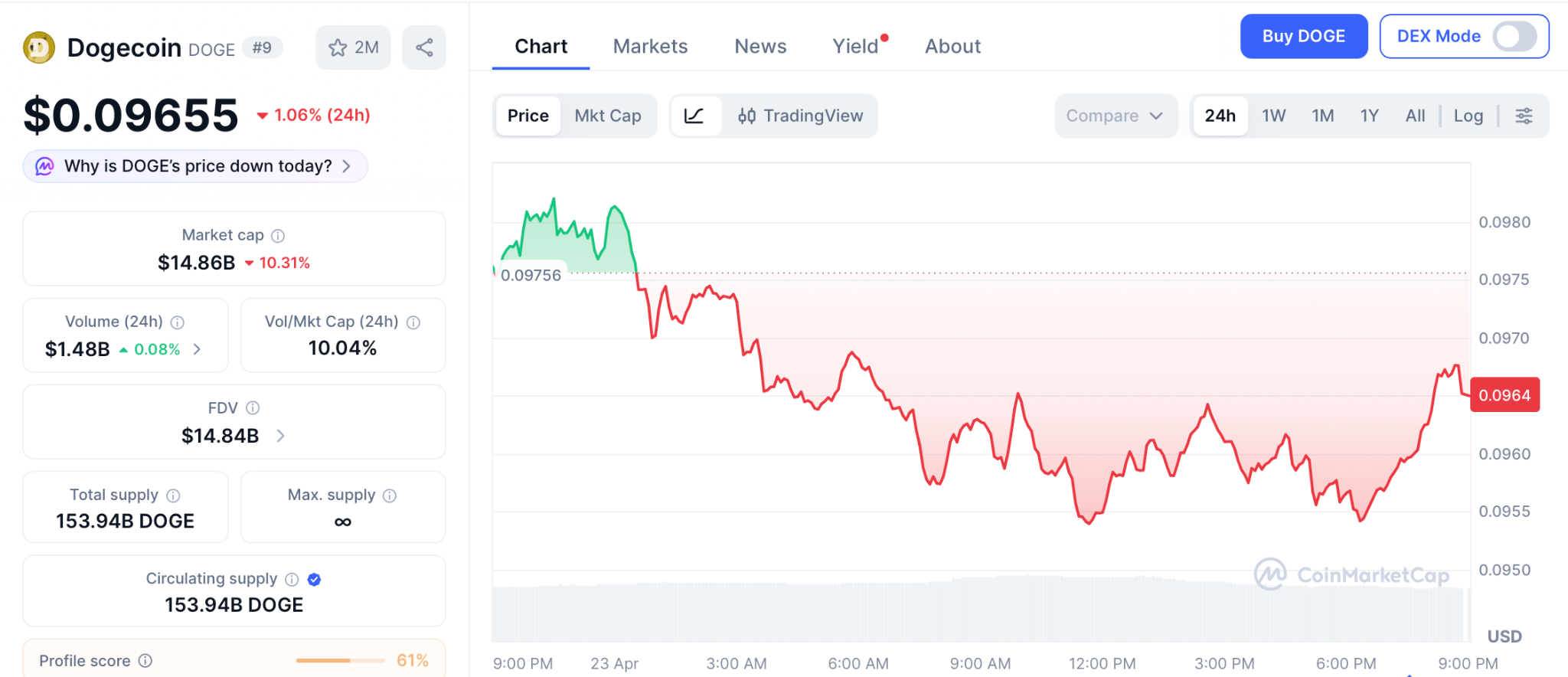
The Dogecoin price prediction turned bullish on April 22 after Bitcoin broke $78,000 and DOGE jumped 2.5% to reclaim its 50-day moving average at $0.096 according to TradingView. President Trump extended the Iran ceasefire on the same day, and the entire crypto market responded with $2.62 trillion in total market cap, a 2.35% gain in 24 hours.
Capital is flowing back into meme coins, and the infrastructure that keeps those wallets safe during a rebound matters as much as timing the entry. The exchange created by the Pepe cofounder delivers that layer of safety, and the Binance listing now approaches with $9.45 million already committed.
Dogecoin Price Prediction Gains After Trump Ceasefire Sends BTC Past $78K and Meme Sector Rebounds
Meme coins bottomed at $34 billion total market cap after a 75% decline from the $150 billion November 2024 high, but on-chain data from CoinMarketCap now shows buying activity across DOGE, SHIB, and PEPE picking up again.
Dogecoin (DOGE) trades at $0.096 per CoinMarketCap, after testing the $0.09 floor and bouncing for the fourth time since February. The SEC gave DOGE a digital commodity label in late 2025, and that classification removed the legal barrier that kept institutional funds away.
The Dogecoin price prediction benefits from a setup where whales add positions while fear dominates the retail side, and that kind of split is exactly when early-stage presale entries draw the heaviest capital inflows.
DOGE, Pepeto, and Why the Strongest Meme Rebounds Begin in Fear
The Presale That Dogecoin Holders See as Their Next Early Entry
Most meme tokens collapsed 75% because they offer nothing beyond a logo and a ticker. No trading platform, no token scanner, no way to move across chains. That gap between hype and utility is exactly what the Pepe cofounder’s new exchange fills during this rebound.
Pepeto screens every token for scams, insider wallets, and contract risks before a buyer commits a single dollar. PepetoSwap executes orders with zero fees, which means the full purchase amount stays in the wallet. The scanner reads smart contract code and shows risk levels in plain language. And the bridge connects Ethereum, BNB, and Solana without gas charges.
With $9.45 million raised at $0.0000001866 and Fear and Greed sitting at 29, the presale is heading toward its Binance listing on schedule. SolidProof completed a full audit with zero issues found. A former Binance listing specialist designed the launch path. And 178% APY staking adds to every position while the exchange grows.
Dogecoin holders who bought at $0.002 in early 2021 turned small bets into generational wealth, and not one of them thinks they bought enough. Pepeto is at that same early stage today, and the wallets entering before the Binance listing date are locking in the kind of entry that everyone else will look back on for the rest of the year.
Dogecoin (DOGE) Price at $0.096 as Ceasefire Rally Lifts Meme Coins and DOGE Reclaims 50-Day Moving Average
Dogecoin (DOGE) trades at $0.096 April 23 when the Iran ceasefire extension and Bitcoin’s push above $78,000 lifted the full crypto market per CoinMarketCap. DOGE sits 86% below its $0.73 all-time high but the $0.09 floor has held through every correction since February.
Analyst targets range from $0.20 to $0.47 depending on catalysts, and reaching $0.20 gives about 106% over months. The Dogecoin price prediction hinges on Bitcoin holding $78,000 and whether X Money confirms DOGE payments. But waiting months for those catalysts competes with a presale where one confirmed listing event delivers the full return.
Conclusion:
The Dogecoin price prediction shows buyers stepping in hard while fear still dominates the market. DOGE trades at $0.096, and reaching $0.20 offers 106% over months of patience.
Dogecoin holders who got in before the world knew the name built wealth that rewrote their financial future. Pepeto is at that identical early stage right now, backed by a live exchange, the Pepe cofounder, and a Binance listing that gets closer every day.
Every presale round closes quicker than the last, and each round that closes raises the floor. The wallets entering now are securing the positions this cycle will celebrate, while everyone who sees Pepeto today and does not act will spend 2026 calculating what that hesitation cost them.
Click To Visit Pepeto Website To Enter The Presale

FAQs
What is the Dogecoin price prediction after the Trump ceasefire rally on April 23?
Analysts target $0.20 to $0.47 for DOGE in 2026, with the recovery depending on sustained accumulation and catalyst confirmation. The April 23 ceasefire rally pushed DOGE to $0.096 with the 50-day moving average reclaimed for the first time in weeks.
What is Pepeto and why are Dogecoin holders watching it closely?
Pepeto is a zero-fee meme coin exchange built by the developer behind the original Pepe token, featuring a contract risk scanner, cross-chain bridge, and 178% APY staking at $0.0000001866 with $9.45 million raised. The confirmed Binance listing gives this entry the kind of pre-listing upside that DOGE at $14 billion market cap no longer has room to deliver.
Disclaimer: This is a Press Release provided by a third party who is responsible for the content. Please conduct your own research before taking any action based on the content.


Summary
- Iranian state-linked media reject claims Tehran is already collecting Strait of Hormuz tolls in Bitcoin or stablecoins.
- Maritime security firms warn of parallel scam emails demanding crypto “clearance” fees from stranded vessels.
- The controversy comes after Western media detailed Iranian plans to charge about $1 per barrel for oil transit, potentially worth tens of billions of dollars a year.
Iranian media have dismissed reports that Tehran is currently collecting transit tolls for the Strait of Hormuz in cryptocurrency, underscoring the confusion surrounding a wartime payment regime that has rattled global shipping and crypto markets.
Tehran moves to quash ‘crypto toll’ claims
State-linked outlet Fars News said on Apr. 23 that “reports about Iran collecting tolls for the Strait of Hormuz in cryptocurrency are inaccurate,” countering weeks of speculation that the Islamic Revolutionary Guard Corps (IRGC) had already begun accepting Bitcoin or stablecoins from oil tankers during a fragile US-brokered ceasefire.
The denial follows detailed reporting from the Financial Times that Iran planned to demand that shipping companies pay transit fees in cryptocurrency for oil tankers passing through the narrow waterway, at an indicative rate of about $1 per barrel of crude.
Scam messages and market fallout
Even as Tehran rejects the idea that crypto tolls are already live, a Greek maritime risk firm, MARISKS, warned that unknown actors have been sending fraudulent messages to shipowners stuck west of the Strait, “posing as Iranian authorities” and demanding payment in Bitcoin or Tether in exchange for “clearance” and safe passage.
“These specific messages are a scam,” MARISKS said, stressing the emails “did not originate from Iranian authorities” and may have contributed to at least one vessel coming under fire while attempting to leave the area.
The Strait of Hormuz previously carried about one-fifth of global oil and liquefied natural gas flows, and proposals for a crypto-based toll system have drawn intense scrutiny from regulators and blockchain analysts.
Bloomberg reported that an IRGC-linked intermediary has discussed opening negotiations at roughly $1 per barrel, implying potential revenue of up to $2 million for a fully loaded supertanker and between $70 billion and $80 billion a year if traffic returns near pre-war levels.
Chainalysis noted that Iran has historically relied on dollar-pegged stablecoins such as USDT on Tron, arguing that any implemented Hormuz tolls would deepen Tehran’s pivot toward censorship-resistant rails while posing new compliance risks for virtual asset service providers.
Industry observers say the Fars News denial leaves a narrow distinction: Iran appears keen to formalize tolls and experiment with yuan and crypto settlement, but claims it has not yet begun collecting those fees directly in digital assets, even as scammers and intermediaries race to fill the vacuum.

MoonPay has launched fiat-to-stablecoin virtual accounts in New York, enabling businesses to convert incoming funds from traditional bank rails such as ACH and SWIFT into stablecoins and settle them directly to non-custodial wallets through a single API. The product is supported by Iron’s technology, following MoonPay’s 2025 acquisition of the company, and is designed to streamline payment, trading, and treasury workflows without prefunded balances or multiple intermediaries.
The rollout strengthens MoonPay’s enterprise stack, extending its integrations with platforms like Deel and Paysafe. It also comes after the company secured a BitLicense, money transmitter licenses, and a New York limited purpose trust charter from the New York State Department of Financial Services in 2025, enabling the service in one of the world’s most regulated crypto markets. MoonPay described the arrangement as delivering faster settlement and programmable payments by bridging traditional banking rails with blockchain infrastructure through a single integration.
MoonPay’s announcement highlights the broader shift toward stabilized fiat rails interwoven with on-chain settlement, a trend echoed across the payments and fintech landscape. The move builds on a growing appetite among enterprises to use stablecoins to streamline cross-border payouts and treasury operations without maintaining multiple prefunded balances across jurisdictions. announcement notes the enterprise focus and regulatory footing behind the launch.
Key takeaways
- The New York launch leverages Iron’s technology and MoonPay’s licensed, regulated framework to offer fiat-to-stablecoin virtual accounts for enterprise use.
- Named, dedicated accounts receive fiat and automatically convert to stablecoins, enabling payment, trading, and treasury flows through a single integration to non-custodial wallets.
- The service extends MoonPay’s enterprise footprint, following the 2025 acquisition of Iron and New York licensing, with existing integrations into payroll and payments networks.
- Across the industry, stablecoins are being embedded into cross-border payout rails to reduce the reliance on prefunded accounts, aided by moves from payment networks and large fintechs.
MoonPay’s NY rails: what changes for businesses
At the core of MoonPay’s offering is a model that replaces the need for pre-funded balances held across multiple accounts with an on-demand bridge between fiat inflows and blockchain settlement. Under the Virtual Accounts program, platforms can issue named, dedicated accounts that receive fiat funding and automatically convert those funds into stablecoins. The stabilized assets can then be settled to non-custodial wallets, enabling seamless onboarding for users and smoother cash-management workflows for enterprises.
Industry participants say the approach can shorten settlement times and reduce the friction typically associated with moving money between fiat and crypto. For businesses that run payrolls, supplier payments, or cross-border settlements, the ability to fund on demand and settle in stablecoins or local currencies via a single API can simplify treasury operations and improve liquidity management. MoonPay’s own materials emphasize faster settlement and programmable payments as key benefits of the New York rollout.
Stability-enabled payments: a broader pattern in crypto finance
MoonPay’s move sits within a wider industry push to embed stablecoins deeper into payments infrastructure. In recent months, several high-profile developments have mirrored this shift. For example, Singapore-based fintech Nium recently integrated USDC payments via Coinbase to enable on-demand funding and settlement of cross-border payouts across more than 190 countries through a single platform. The arrangement allows businesses to fund payouts in stablecoins and settle in either digital assets or local fiat, reducing the overhead of maintaining multi-jurisdictional prefunding.
On the card network side, traditional rails are gradually embracing on-chain settlement. Visa and Stripe-backed Bridge rolled out stablecoin-linked card capabilities across more than 100 countries, with pilots testing on-chain settlement that could see transactions settled in digital assets rather than fiat. Visa publicly stated that its stablecoin settlement run rate reached an annualized level of $4.6 billion as of December 2025, underscoring the growing scale of on-chain payments in mainstream networks.
Meanwhile, Mastercard has signaled its intent to strengthen its own stablecoin capabilities by agreeing to acquire BVNK in a deal valued at up to $1.8 billion. The acquisition aims to deepen Mastercard’s ability to connect traditional payment rails with blockchain-based transactions, supporting use cases such as cross-border payments and business payouts.
Overall market context remains sizable: DefiLlama estimates the total stablecoin market capitalization at roughly $320 billion, illustrating the breadth of stablecoins’ reach across payments, remittances, and treasury operations.
The envelope of regulation continues to shape how these products scale. MoonPay’s New York license package — BitLicense, money transmitter licenses, and a New York trust charter — positions the company within one of the world’s most closely watched crypto markets. This regulatory clearance is frequently cited as a prerequisite for banks and other financial service providers to engage in on/off-ramp activity with certainty, reducing compliance risk for partner platforms and their customers.
What this implies for investors and builders
For investors, MoonPay’s New York program signals a maturation path for enterprise-grade stablecoin infrastructure. The combination of licensed fiat rails, API-driven settlement, and native integration with non-custodial wallets lowers friction for capital deployment and cash management in crypto-native ecosystems. For developers and platform operators, the approach offers a blueprint for scalable, compliant stablecoin infrastructure that can be extended to payroll, cross-border payments, and treasury services without juggling multiple prepaid balances.
For the broader market, the trend toward on-demand stablecoin funding and on-chain settlement highlights both opportunities and risks. On one hand, it could accelerate real-world utility for stablecoins, improving liquidity and access for businesses and individuals alike. On the other hand, it concentrates settlement activity within a handful of regulated corridors, making compliance and interoperability more critical than ever. Industry observers will be watching how these rails adapt to evolving regulatory expectations and how banks, fintechs, and crypto platforms coordinate across international borders.
As adoption broadens, readers should monitor MoonPay’s rollout trajectory in New York and potential expansion to other jurisdictions. The balance between speed, cost, and compliance will likely determine how quickly enterprise users embrace virtual accounts for fiat-to-stablecoin workflows, and whether competing networks can replicate or surpass the efficiency gains demonstrated by this model.
Looking ahead, the intersection of regulated fiat rails and programmable digital assets is likely to remain a focal point for both investors and builders. The coming quarters will reveal how rapidly these enterprise-ready rails proliferate, how adaptable they are to evolving regulatory regimes, and which партнерs will emerge as primary beneficiaries of streamlined stablecoin infrastructure.


Coinbase has rebuilt its anti‑fraud stack by tightly integrating machine learning models with a high‑speed rules engine, slashing response times to new scam patterns from days to hours just as TRM Labs warns crypto fraud is now a tens‑of‑billions‑per‑year, AI‑supercharged industry.
Summary
- Coinbase has overhauled its fraud controls by fusing machine learning with a rules engine to cut response times from days to hours.
- The exchange says rule backtesting now runs more than 10 times faster, enabling quicker deployment of defenses against emerging scams.
- The upgrade comes as crypto fraud losses hit tens of billions of dollars annually, putting pressure on major platforms to harden their defenses.
Coinbase has upgraded its anti-fraud stack by tightly integrating machine learning models with a rules engine, cutting its response time to new fraud patterns from several days to just a few hours as AI-enabled scams surge across the crypto sector.
The company describes a dual-track strategy where “models [are] responsible for long-term defense, rules [are] responsible for rapid response,” all housed in a unified framework that lets rules capture new fraud types which can then be fed back into models to strengthen overall defenses over time.
Coinbase says it has turned what used to be a manual and slow rule creation workflow into a data-driven, automated recommendation system by restructuring data, automating schema evolution, and introducing notebook-based analytical tools for its risk teams.
Coinbase’s new fraud playbook
As part of the overhaul, the performance of rule backtesting has improved by more than 10 times, allowing Coinbase to trial and ship new protections far more quickly as scam behavior evolves in real time.
According to Coinbase, the system now uses machine learning to recommend rule parameters, with the goal of “reducing false positive rates while combating fraud and minimizing the impact on normal users,” an important balance for a major exchange processing billions in trading volume.
The latest upgrade builds on earlier efforts outlined in a Coinbase blog on advanced machine learning models, where the company said its mission is “to keep building scalable, adaptive, blockchain aware ML systems that enable Coinbase to effectively manage risk for its products” without degrading user experience.
AI arms race against crypto fraud
The move comes as fraud in crypto has industrialized.
Blockchain intelligence firm TRM Labs reported that global crypto fraud reached about $35 billion in 2025, warning that when underreporting is included, “total annual losses likely exceed USD 200 billion worldwide”.
In a separate 2026 crime report, TRM said illicit crypto flows hit a record $158 billion in 2025, with scam networks increasingly run like professional businesses and AI tools accelerating impersonation and outreach at scale.
Coinbase’s own chief information security officer, Philip Martin Lunglhofer, has previously said the exchange is seeing growing “AI-use cases to detect fraud” and is already using machine learning to monitor user activity and support chats for signs of scams or account takeovers.
The exchange’s latest investment in automated, event-driven rule generation and potential “one-click conversion” of efficient rules into model features is meant to push Coinbase closer to a fully automated risk management system, as fraudsters themselves weaponize AI to probe and exploit weaknesses faster than ever.
For broader context on Coinbase’s security posture and user protection efforts, readers can refer to Coinbase’s fraud-focused blog posts on machine learning and compliance, as well as prior coverage of Coinbase scam activity and crypto fraud trends on crypto.news.
Crypto World
Critical Bitcoin trend change in works, but analysts say daily close above $80K required

Bitcoin’s rally above $79,000 may be a sign that the downtrend is ending, but a multi-day candle close above $80,000 would help strengthen the odds of a trend change holding.

US spot ETFs absorbed 4,349 BTC, 35,736 ETH and 1,311 SOL in a day, signaling that despite choppy prices, regulated wrappers remain the preferred route into crypto exposure.
Summary
- US Bitcoin ETFs recorded net inflows of 4,349 BTC today, signalling renewed demand from regulated buyers.
- Ethereum products led the day in token terms, with net inflows of 35,736 ETH into US-listed ETFs.
- Solana ETFs also turned positive, absorbing 1,311 SOL in net inflows, according to on-chain monitoring.
US-listed spot Bitcoin (BTC) ETFs saw net inflows of 4,349 BTC today, pointing to steady institutional and advisory demand despite ongoing volatility in digital asset markets, according to on-chain tracker Lookonchain.
Bitcoin, Ethereum, Solana ETFs attract new capital
At current market levels, that represents a roughly mid eight-figure allocation into regulated Bitcoin products in a single session, adding to the already sizable holdings accumulated by issuers since the first approvals.
Ethereum (ETH) ETF flows were even more notable in native units, with Lookonchain reporting 35,736 ETH in net inflows into US vehicles over the same period.
This wave of ETH buying via ETFs comes as traders reassess Ethereum’s positioning ahead of potential further upgrades and as staking yields and DeFi risks remain in focus for professional allocators.
Solana products, still comparatively smaller than their Bitcoin and Ethereum peers, logged net inflows of 1,311 SOL, suggesting that investor interest in higher-beta layer-1 exposure is persisting alongside blue-chip assets.
Taken together, the positive flows into Bitcoin, Ethereum and Solana (SOL) ETFs highlight that regulated wrappers remain a preferred channel for US-based institutions and advisers seeking crypto exposure, even as macro conditions and regulatory signals stay mixed.
XRP spot ETFs have not recorded a single day of outflows since April 9, pulling in $71.31 million so far in April and putting the month on track to be the strongest of 2026, fully erasing March’s $31.16 million loss, which was the first monthly loss XRP ETFs had ever posted.
Summary
- XRP spot ETFs have gone two consecutive weeks without a single outflow day since April 9, their longest positive streak ever recorded.
- The funds have pulled in $71.31 million in April, fully erasing March’s $31.16 million loss and pushing cumulative net inflows back to $1.28 billion.
- Bitwise and Franklin Templeton have absorbed nearly all of April’s inflows, with the CLARITY Act flagged as the key catalyst that could double current cumulative inflow levels if it advances before May 21.
XRP spot ETFs have not recorded a single day of outflows since April 9, according to 247 Wall St., which reported that the funds have pulled in $71.31 million in April so far, with April 21 being the only session to see zero flows rather than positive ones. The run fully erases the $31.16 million that left the funds in March, which was the first monthly loss XRP ETFs had ever posted since their November 2025 debut.
XRP Spot ETF Inflows Deliver Their Strongest Uninterrupted Streak on Record
As crypto.news reported, the week ending April 17 was the single best week for US-listed XRP ETFs in all of 2026, with $55.39 million flowing into the funds across five sessions. Bitwise and Franklin Templeton have absorbed nearly all of April’s inflows, with Bitwise’s XRP ETF on the verge of overtaking Canary Capital as the largest XRP ETF by cumulative inflows, sitting at $419 million against Canary’s $421 million. Combined assets under management across US-listed products have recovered to $1.28 billion, a three-month high that matches the level the funds last reached in mid-January. Live fund flow data from CoinGlass confirms the sustained accumulation pattern, with XRP ETFs logging consistent daily inflows across the streak with no single session of net redemptions recorded.
April’s Run Follows a Record Week of Global XRP ETF Demand
The domestic US inflow streak came on the heels of an even larger global surge. As crypto.news documented, global XRP ETF products pulled in a combined $119.6 million in the week ending April 11, the strongest single weekly figure since December 2025 and more than half of all global crypto fund flows that week. That surge was driven almost entirely by European buyers, making the subsequent US-led streak from April 9 onward a meaningful shift, as domestic institutional demand began catching up to the pace European investors had already set.
The CLARITY Act Is the Next Major Test for the Streak
The 247 Wall St. analysis points directly to the CLARITY Act as the primary catalyst that could extend or supercharge the current run. If the bill clears the Senate Banking Committee before the May 21 recess, XRP ETF inflows could potentially double current cumulative levels, as approximately 65% of institutional investors have cited regulatory clarity as the one condition holding them back from deploying serious capital into XRP. As crypto.news tracked, XRP’s $55 million weekly contribution represented a disproportionately large share of the broader $1 billion week for crypto ETFs overall, and the momentum heading into the CLARITY Act deadline gives the streak meaningful fundamental backing beyond short-term sentiment.
If April closes without a single outflow day, it would mark the first full calendar month of 2026 to achieve that record, a milestone that analysts say could act as a structural signal to institutional allocators watching whether XRP ETF demand has found a durable floor.

Not a financial advice

DeepSeek releases new AI model and claims it beats all open-source competitors

Newmont Corporation 2026 Q1 – Results – Earnings Call Presentation (NYSE:NEM) 2026-04-23

Manchester United reach agreement with Casemiro over contract clause amid transfer speculation

US brings back mandatory military draft registration

Steven Gerrard disagrees with Gary Neville over ‘shock’ Chelsea and Arsenal claim | Football


-

 Sports7 days ago
NWFL Suspends Two Players Over Post-Match Clash in Ado-Ekiti
-

 Fashion6 days ago
Weekend Open Thread: Theodora Dress
-

 Politics6 days ago
Palestine barred from entering Canada for FIFA Congress
-
Entertainment4 days ago
NBA Analyst Charles Barkley Chimes in on Ice Spice McDonald’s Fiasco
-

 Tech5 days ago
Auto Enthusiast Scores Running Tesla Model 3 for Two Grand and Turns It Into Bare-Bones Go-Kart
-

 Business5 days ago
Powerball Result April 18, 2026: No Jackpot Winner in Powerball Draw: $75 Million Rolls Over
-

 Politics5 days ago
Zack Polanski demands ‘council homes not luxury flats for foreign investors’
-

 Crypto World6 days ago
Russia Pushes Bill to Criminalize Unregistered Crypto Services
-

 Politics3 days ago
Gary Stevenson delivers timely reminder to register to vote as deadline TODAY
-

 Business2 days ago
Rolls-Royce Voted UK’s Most Iconic Trade Mark as IPO Register Hits 150
-

 Politics1 day ago
Disabled people challenge government SEND proposals over segregation concerns
-

 Politics1 day ago
Making troops accountable for war crimes threatens US alliance, ex-SAS colonel warns
-

 Crypto World6 days ago
Russia Introduces Bill To Criminalize Unregistered Crypto Services
-

 Politics1 day ago
Starmer handler McSweeney to be dragged from shadows by Foreign Affairs Committee
-
Politics1 day ago
Wings Over Scotland | How To Get Away With Crimes
-

 Politics1 day ago
Zack Polanski responds to home secretary’s taser threat
-
Crypto World5 days ago
Kelp DAO rsETH Bridge Hack Drains $292M as DeFi Losses Top $600M in Two Weeks
-

 Politics1 day ago
‘Iran is still a nuclear threat’
-

 Crypto World2 days ago
New York sues Coinbase, Gemini over prediction market offerings
-
 Sports7 days ago
Kevin Kisner apologizes for Masters criticism: ‘I crossed the line’
You must be logged in to post a comment Login