

Crypto World
Ripple to Buy Back $750M in Shares through April: Report



Despite a decline in the price of XRP in the last year, Ripple is expected to reach a valuation 25% higher than reported after a November 2025 funding round.
Ripple Labs reportedly plans to buy back up to $750 million worth of shares from investors and employees in a program set to give the company a $50 billion valuation.
According to a Wednesday Bloomberg report, Ripple plans to run a tender offer for the shares through April. The $750 million buyback program will reportedly value the company at $50 billion, 25% higher than the valuation assigned following its $500 million raise in November 2025. The company’s president, Monica Long, said at the time that Ripple had no plans to go public.
The reported buyback follows Ripple’s expansion of operations beyond the crypto industry, including through the $1.2 billion acquisition of non-bank prime broker Hidden Road and treasury management system provider GTreasury in October. Earlier this week, the company said that it would move forward with plans for a financial services license in Australia through the acquisition of a local payments firm.
On Monday, Ripple reported that it had processed more than $100 billion in transactions, with its stablecoin, Ripple USD (RLUSD) exceeding a $1 billion market capitalization since its launch in December 2024. The price of XRP (XRP) has fallen more than 53% in the previous six months, trading hands at $1.39 at the time of publication.
Related: Ripple expands stablecoin payments stack for banks, fintechs
Data from private shares platform Forge Global showed more than a 9% drop in Ripple’s private share price as of Wednesday.
Making progress with US national trust bank charter
In December, the US Office of the Comptroller of the Currency announced that it had conditionally approved Ripple and other crypto companies for national trust bank charters. The company specifically said in its application that the charter would “not be a stablecoin issuer” for RLUSD.
Magazine: All 21 million Bitcoin is at risk from quantum computers


US-based prime brokers are quietly positioning themselves to give hedge funds and large institutions direct access to Kalshi’s prediction markets, a move that signals growing institutional interest in event-based betting markets. A Bloomberg report from March 11, 2026, indicates that Clear Street and Marex Group Plc are both lining up access for their clients in the near term. Clear Street, valued at over $12 billion, is expected to clear Kalshi trades as early as late March, while Marex, with a current valuation around $2.6 billion, plans a staged rollout over the coming months. The development underscores a broader shift as predictively driven markets gain traction among mainstream financial players, even amid regulatory ambiguity surrounding their legality and oversight.
Key takeaways
- Prime brokers plan to enable client access to Kalshi’s prediction markets within weeks, signaling rapid institutional onboarding.
- Kalshi’s leadership frames 2026 as a tipping point for institutional adoption, highlighting the market’s utility as data on future events and hedging tools.
- Hedge funds and other large institutions have begun approaching Kalshi contractors for direct market access, indicating a demand-driven expansion.
- Regulatory uncertainty remains a central hurdle, with debates over whether prediction markets fall under sports-betting rules and concerns about insider trading.
- Industry leaders, including Nasdaq and CME, are calling for clearer rules to support broader US adoption of prediction markets, signaling potential regulatory alignment or pathways forward.
Sentiment: Neutral
Market context: The push by prime brokers sits at the intersection of expanding interest in reputation-based forecasting markets and ongoing regulatory scrutiny. As major exchanges press for clarity, policymakers in the U.S. are weighing how prediction markets should be treated in relation to traditional securities and gaming rules, shaping the pace at which institutions can experiment with these platforms.
Why it matters
The entry of prime brokers into Kalshi’s ecosystem represents more than a new distribution channel. It signals a potential inflection point for prediction markets, where institutions view event outcomes as a tool for hedging risk, benchmarking forecasts, and generating returns. Kalshi’s CEO, in a LinkedIn post, has argued that institutional adoption will accelerate in 2026 as the market’s utility becomes clearer—citing the ability of these markets to provide data on future events and a framework for hedging real-world positions. This perspective aligns with broader industry narratives that such markets can function as a complementary data layer for traditional asset classes and macro strategies.
The practical appeal for institutions is twofold: first, the ability to hedge corporate or portfolio risk using event-based contracts; second, an opportunity to participate in markets that CNBC, CNN, Bloomberg, and Fox increasingly reference alongside conventional tickers. Yet, this enthusiasm exists within a regulatory gray zone, particularly around whether certain prediction market offerings resemble sports betting and how insider information may flow through these platforms. The tension between potential financial utility and compliance risk is a central theme shaping how quickly banks and brokers move from exploration to formalized access.
Industry participants have underscored that regulatory clarity is prerequisites for scalable adoption. Executives from Nasdaq and CME recently urged regulators to establish a clearer framework for prediction markets in the United States, arguing that consistent rules protect investors and foster market integrity. The CFTC has signaled its role in overseeing such markets, while the SEC has indicated it will also be involved in defining the boundaries for these instruments. The convergence of these regulatory positions will heavily influence whether institutional traction continues or stalls as cases and compliance questions proliferate across state and federal levels.
What to watch next
- Kalshi trade launches at Clear Street are expected in late March, with additional brokers like Marex rolling out in the ensuing months.
- Regulatory clarity on the classification of prediction markets—whether they fall under sports-betting or another regulatory category—will shape product design and participant eligibility.
- Key lawsuits and ongoing regulatory actions in the U.S. will test the resilience of prediction markets amid a landscape of diversified enforcement.
- Public statements from major exchanges and regulatory bodies, including updates from the CFTC and SEC, will indicate the pace of broader adoption and potential compliance requirements.
- Institutional hedging strategies using Kalshi and similar platforms may become more visible as fund managers assess risk-off and risk-on environments amid macro volatility.
Sources & verification
- Bloomberg report dated March 11, 2026, detailing prime brokers’ race to give Wall Street access to Kalshi’s prediction markets.
- LinkedIn post by Kalshi CEO Tarek Mansour discussing expected acceleration of institutional adoption in 2026 and the market’s broader utility.
- Reuters coverage of Nasdaq and CME executives calling for clearer rules to support prediction-market adoption in the U.S.
- Statements from the Nasdaq and CME discussions about regulatory alignment, and the CFTC/SEC roles in overseeing the sector.
- Related reporting mentioning Kalshi and Polymarket valuations and potential fundraising coverage in mainstream outlets.
Institutional access to Kalshi’s prediction markets gains momentum
Institutional appetite for prediction markets is expanding as prime brokers gear up to broaden access to Kalshi’s event-led contracts. The Bloomberg report paints a picture of late-March milestones for Clear Street, which is expected to clear the first Kalshi trade soon, and Marex, poised to follow in the coming months. The strategic move signals that major financial intermediaries view prediction markets not as speculative oddities but as components of a diversified risk management toolkit. In this view, there is a push to translate the insights from prediction markets into tradable risk-management signals for complex, multi-asset portfolios.
Kalshi’s leadership has framed 2026 as a turning point, arguing that the utility of prediction markets extends beyond speculation into practical data sources for forecasting and hedging. The company’s CEO, in a LinkedIn post, emphasized that institutional adoption will accelerate as more large players recognize the markets’ potential to quantify futures scenarios and hedge exposures. As he noted, the space is no longer an early-adopter niche but a core pillar of the financial ecosystem, with billions flowing weekly through these markets. This perspective is echoed by mainstream media outlets—CNBC, CNN, Bloomberg, and Fox—who regularly cite Kalshi alongside traditional market indicators, underscoring a shift in perception from novelty to necessity.
Nevertheless, the path forward is not without friction. Clear Street and Marex acknowledge a regulatory gray area surrounding prediction markets, alongside active litigation across the United States related to sports betting and other matters. Industry participants stress the importance of robust governance and clear rules to ensure investor protection and market integrity as adoption scales. The broader regulatory dialogue—pursued by exchanges and oversight bodies alike—aims to delineate permissible activities, address insider-trading concerns, and establish a stable framework within which institutions can transact with confidence.
In parallel, major exchanges have publicly called for regulatory clarity to facilitate US adoption. Nasdaq’s chief executive executive highlighted the need to bring options markets under a familiar rule framework, suggesting that a well-defined construct could enable investors to participate in a predictable regulatory environment. The SEC and CFTC have signaled their respective roles in overseeing emerging prediction-market activity, a development that could unlock more comprehensive product design while ensuring critical guardrails remain intact. The dynamic underscores a broader industry trend: practical finance increasingly sits at the intersection of regulatory alignment and innovative market structures, where data-driven decision-making and risk mitigation converge.
What it means for the market
For traders and investors, the potential mainstreaming of Kalshi and prediction markets offers an additional source of informational signals—complementing traditional data feeds with market-based expectations about future events. It may also prompt portfolio managers to incorporate event-based hedges into strategic plans, especially for scenarios with high impact on sectors or individual holdings. The regulatory dialogue surrounding these markets will be pivotal; a clear, harmonized framework could spur broader participation, elevate liquidity, and reduce friction for institutions seeking to deploy these instruments as part of diversified risk management strategies.

Stephen Gregory, a former compliance executive at CEX.IO and Gemini, has taken over as CEO of Binance.US, a crypto exchange that was once a target of a long-running SEC lawsuit.
Binance.US, the US affiliate of crypto exchange Binance, has named compliance lawyer Stephen Gregory as CEO as the company looks to re-expand in the country.
The company said on Wednesday that Gregory took over from former CEO Norman Reed on March 9, who will now serve in an advisory role.
Gregory is the former CEO of crypto exchange Currency.com and previously served as compliance chief and counsel at CEX.IO and as a compliance officer for Gemini.
“I am honored to lead the Binance.US team as we write the next chapter for the best platform for U.S. crypto investors,” Gregory said. “The Binance.US brand is extremely powerful, with a founder, Changpeng Zhao (CZ), who has continuously advocated to make the US the crypto capital of the world.”

Binance.US once sat in legal hot water for years after it was sued by the Securities and Exchange Commission in 2023, alleging it failed to register as an exchange, among other charges.
However, the SEC dismissed its case against the company with prejudice in May, adding to one of many crypto enforcement actions the agency has recanted under US President Donald Trump’s administration.
Binance.US hints at expanded offerings
It was also just over a year ago that Binance.US reinstated US dollar deposits and withdrawals after operating as a crypto-only exchange following the SEC lawsuit.
Related: Binance sues Wall Street Journal amid report of DOJ Iran probe
The past year has also seen the company launch products to expand its rewards and staking offering, as well as a referral program.
Binance.US said in its latest announcement that it plans to continue expanding its crypto staking product and will introduce services around decentralized finance and tokenized assets.
It follows other crypto exchanges that have begun to offer products outside of solely trading, offering digital assets tied to stocks and enticing customers with various ways to earn yield.
Magazine: When privacy and AML laws conflict — Crypto projects’ impossible choice

Ghana’s securities regulator has given the nod to 11 crypto trading platforms to participate in its new regulatory sandbox program, its first major step in support of crypto after passing a law to provide the local market with regulatory clarity in December.
Ghana’s Securities and Exchange Commission said on Tuesday that the 11 crypto platforms will operate under the country’s Virtual Asset Service Providers Act, adopted in December, which provides a regulatory sandbox framework for those companies to pilot their products and services in a controlled environment under the SEC’s oversight.
The companies admitted into the SEC’s regulatory sandbox are Africoin, Blu Penguin, Goldbod, Hanypay, Hyro Exchange, HSB Global, KoinKoin, Whitebits, Vaulta, XChain and Bsystem.
The sandbox program aims to spur crypto innovation while ensuring adequate consumer protection safeguards are in place. The participants will also need to comply with anti-money laundering and counter-terrorism financing standards.
The sandbox will last for 12 months, though companies that show market readiness and comply with all regulatory requirements can transition to a full license after six months.

Ghana said lessons from the pilot will shape the country’s future policies for the crypto market.
The VASP law stated that digital asset activities would fall under the SEC’s oversight and that industry players need to obtain a license or register with the Bank of Ghana or the SEC to operate in the country.
Foreign crypto companies are expanding into Ghana too
The new pilot comes after Blockchain.com said on Monday that it has expanded into Ghana as part of a push to broaden its presence in Africa.
A Blockchain.com spokesperson told Cointelegraph at the time that it would focus on expanding Ghana’s crypto payments infrastructure.
“Given how widely used mobile money is in Ghana, integration with the mobile money ecosystem is a key focus,” they said.
Related: Africa records highest stablecoin conversion spreads, data shows
Ghana is one of the larger economies on the African continent, which sees a high rate of crypto transactions under $1,000.
Crypto value received across the Sub-Saharan African region rose 52% year-on-year to over $205 billion between July 2024 and June 2025, blockchain analytics platform Chainalysis reported in September.
Nigeria dominates crypto activity, receiving over $92 billion over that period, while South Africa, Ethiopia, Kenya, and Ghana are the next-largest markets in the region.
Magazine: A ‘tsunami’ of wealth is headed for crypto: Nansen’s Alex Svanevik
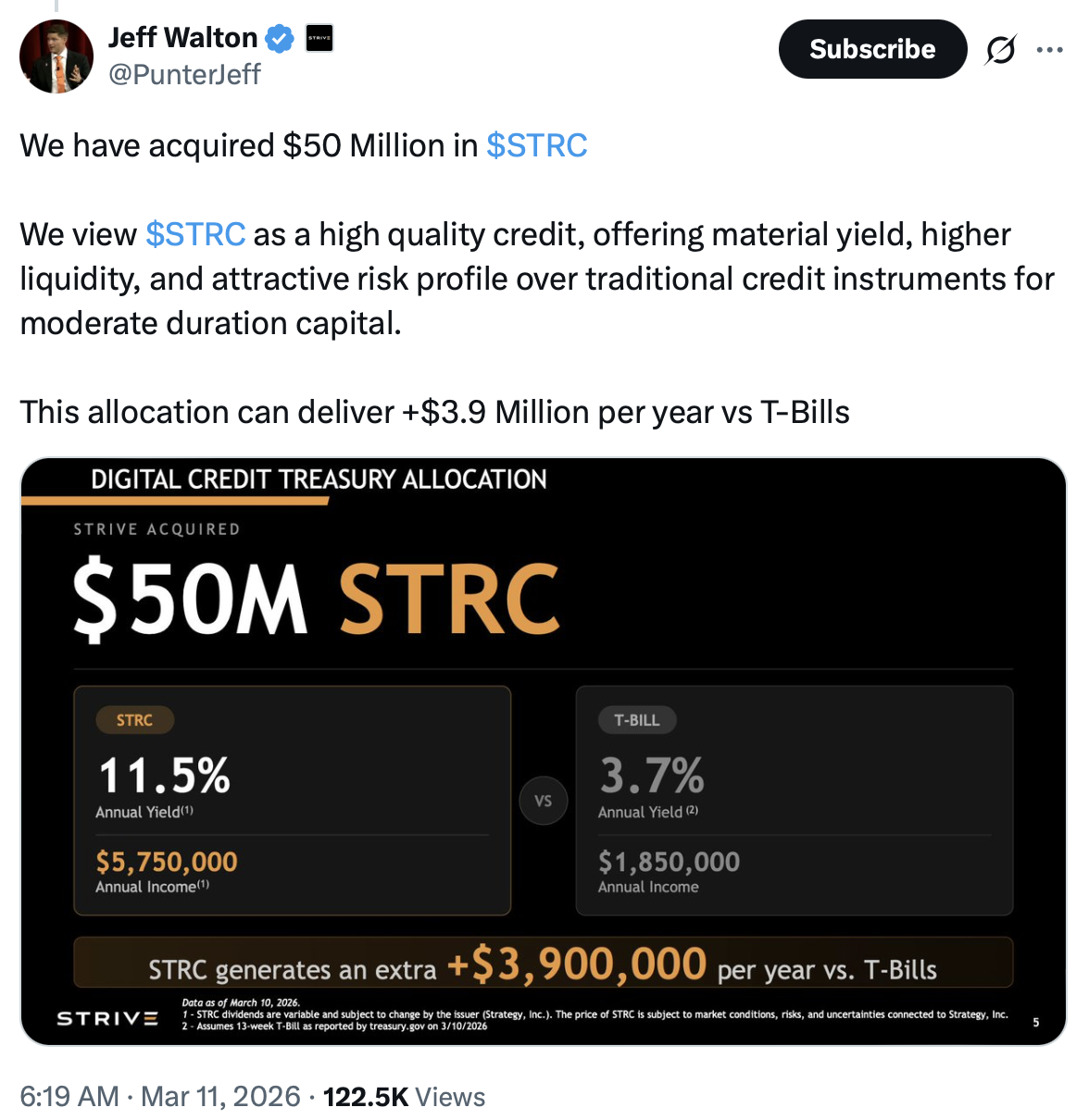
Strive Asset Management (ASST) said Wednesday it has allocated $50 million of its corporate treasury to STRC, the variable-rate perpetual preferred stock issued by Strategy.
The investment represents more than one-third of Strive’s treasury reserves and reflects growing institutional interest in yield-generating securities linked to Bitcoin-focused treasury strategies, according to a company announcement.
The allocation makes Strive the latest company to add STRC to its balance sheet, following similar moves by companies including Prevalon Energy, Anchorage Digital and Oranjebtc, according to Strategy.
The development comes as Wall Street analysts begin covering companies built around Bitcoin treasury strategies. On Monday, investment bank B. Riley Securities initiated coverage of Strategy (MSTR) with a Buy rating, signaling expectations that the stock could outperform the broader market.

Strategy’s Nasdaq-traded STRC pays a floating dividend and trades publicly, allowing companies to hold it as a liquid treasury asset rather than cash or money market funds.
Data from Strategy’s dashboard shows STRC trading around $100, with a market capitalization of about $3.85 billion and around $90.6 million in daily trading volume. The variable dividend is currently at 11.5%.
“Many institutions maintain USD reserves as a buffer for dividend obligations and operational liquidity,” said Matt Cole, chairman and CEO of Strive, adding that allocating a portion of those reserves to instruments such as STRC may provide stronger yield dynamics than traditional money market funds while maintaining liquidity.
Strive is a structured finance company and asset manager that holds about 13,311 Bitcoin, ranking it as the 11th-largest corporate Bitcoin treasury, according to BitcoinTreasuries.NET data. The company’s Nasdaq-listed shares were up about 3.5% at last look on Wednesday.

Related: Strategy buys $1.3B in Bitcoin as holdings top 738,000 BTC
Inside Strategy’s ‘digital credit’ model and the STRC preferred stock
STRC is part of a category Strategy calls “digital credit,” securities designed to generate yield while allowing the company to raise capital linked to its Bitcoin treasury strategy.
Strategy raised about $2.5 billion in a July 2025 initial public offering of the preferred shares.
Strive’s $50 million purchase comes a day after Strategy recorded its largest issuance of STRC following changes to its at-the-market share sales program. The update allows a second sales agent to execute share sales outside regular US trading hours, easing a previous restriction that limited the program to one agent per trading day.
Data from STRC.live shows the company sold roughly 2.4 million STRC shares in a single day, with proceeds estimated to have funded the purchase of about 1,420 Bitcoin.
Strive has also issued its own digital credit instrument, SATA, a variable-rate perpetual preferred stock designed to generate floating yields tied to the company’s Bitcoin-per-share growth.
The shares, which launched in November 2025, currently offer yields of about 13% and have a market capitalization of roughly $319 million.

Magazine: All 21 million Bitcoin is at risk from quantum computers


The crypto market showed a muted reaction after US CPI data held at 2.4%, leaving investors watching Federal Reserve policy and Bitcoin price levels.
Summary
- US CPI held at 2.4% in February, matching forecasts and indicating easing inflation.
- The crypto market reaction remained muted, with Bitcoin stabilizing near $69K.
- Rate expectations remain steady as prediction platforms like Polymarket and Kalshi show low odds of near-term cuts.
The latest inflation data from the United States landed almost exactly where economists expected. February’s Consumer Price Index showed 2.4% annual inflation The report suggests price pressures are cooling, though not disappearing entirely.
The data was released by the U.S. Bureau of Labor Statistics on March 11. On a monthly basis, CPI rose 0.3%, slightly higher than January’s 0.2% increase. Core CPI, which excludes food and energy, increased 0.2% for the month and 2.5% year-over-year.
This is the lowest headline CPI reading since May 2025. Despite recent oil price swings linked to geopolitical tensions in the Middle East, inflation appears to be easing gradually.
Crypto market reaction remains muted
The crypto market reacted calmly after the report. Bitcoin (BTC) briefly dipped below $69,000 before recovering to around $69,500. The move was short-lived, and prices stabilized quickly.
Other major assets followed a similar pattern. Ethereum (ETH) and several large altcoins posted small gains or losses, while overall crypto market capitalization stayed relatively steady.
Inflation data often affects crypto indirectly. When inflation slows, markets tend to expect easier monetary policy from the Federal Reserve. Lower interest rates usually support risk assets such as cryptocurrencies because borrowing becomes cheaper and liquidity improves.
However, the latest CPI reading did not strongly shift expectations. Investors already expected a similar result, which limited the market reaction.
Interest rate outlook and market direction
The Federal Reserve is now widely expected to keep interest rates unchanged at its upcoming March meeting. Current projections place the federal funds rate in a 3.5% to 3.75% range, with markets assigning very low odds to an immediate rate cut.
Because of that, the crypto market may remain in consolidation mode in the short term. Analysts expect Bitcoin to trade between $65,000 and $72,000 while investors wait for clearer signals from macroeconomic data.
A break above the $72,000 resistance zone could re-open the path toward higher levels if liquidity improves and investor sentiment turns more positive. On the downside, renewed geopolitical stress or stronger inflation data could push prices back toward the $60,000 range.
Looking ahead, the next CPI report will be closely watched. Some forecasts suggest inflation could edge higher in March, potentially reaching 2.6% to 2.9%, partly due to energy price pressures.
For now, the crypto market appears to be in a holding pattern. Inflation is easing slowly, interest rates remain high, and traders are waiting for a stronger signal before placing bigger bets on the next move.
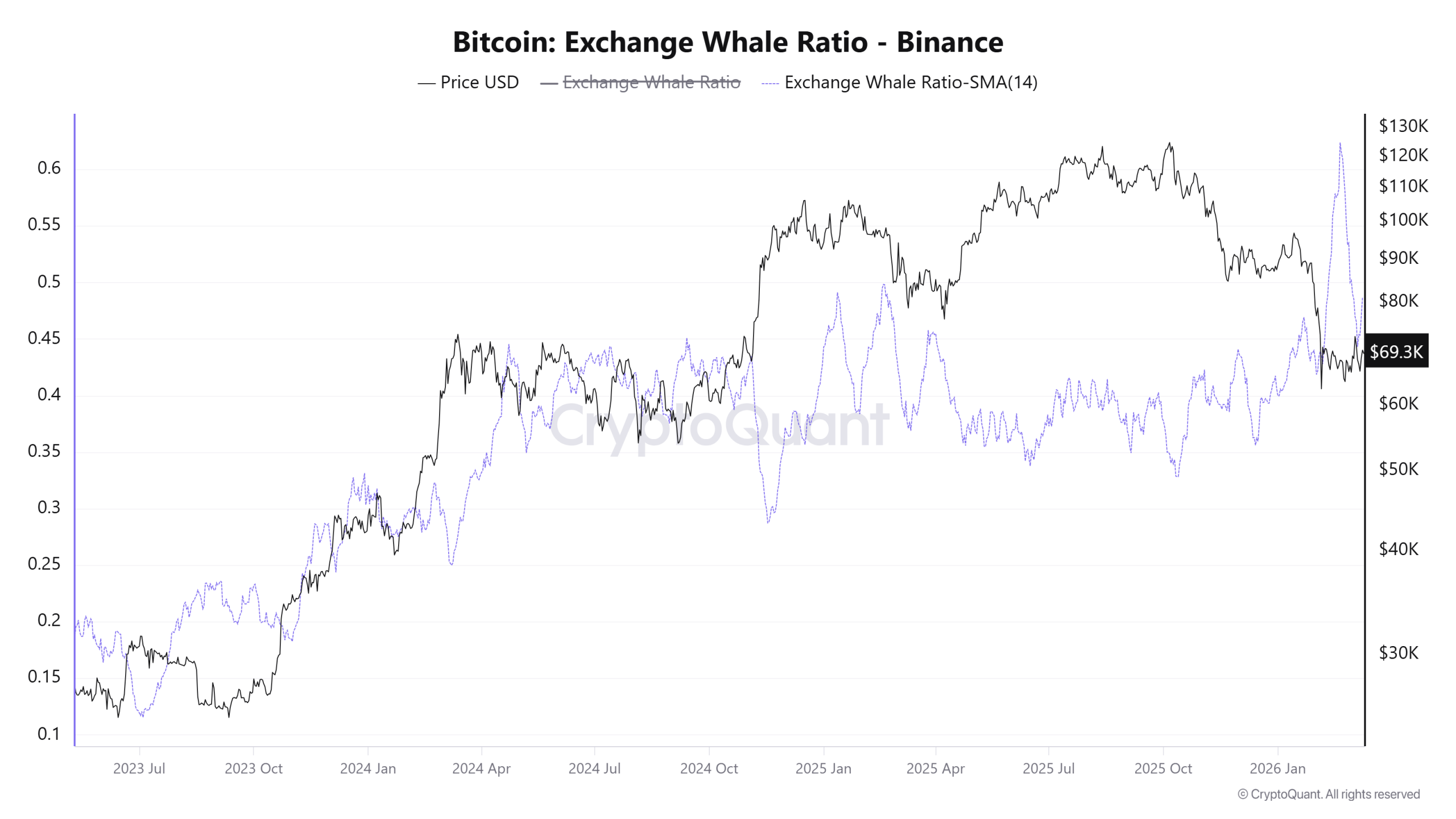
The next big breakout for Bitcoin (BTC) may hinge on changes unfolding across Binance’s exchange flows and derivatives activity.
Onchain data from the largest cryptocurrency exchange currently show a cooling of whale deposits, rising BTC withdrawals, and growing futures dominance, which may influence the next direction for Bitcoin’s price.
Bitcoin whale activity cools after February spike
The Bitcoin exchange whale ratio on Binance, which measures the ten largest inflows relative to total exchange deposits, surged above 0.60 during early February, indicating strong selling by whales.
Since then, the 14-day moving average has settled closer to 0.45, levels seen throughout 2024 and 2025. The drop in large inflow spikes indicates that fewer dominant sell-side transfers are entering Binance during the current range phase.

The price action during this period is also important to note. Bitcoin stabilized in the $65,000-$72,0000 region after its February decline rather than extending the drop.
Related: Bitcoin will need 17% of ‘store of value’ market to hit $1M: Bitwise
Meanwhile, Crypto analyst CW noted that some whales may still be accumulating. Bitcoin’s cumulative volume delta (CVD) indicator shows persistent whale buying during the recent consolidation.
At the same time, whales are showing signs of accumulation. Crypto analyst CW said Bitcoin’s Cumulative Volume Delta (CVD) shows buying from large traders as BTC price consolidates.

The CVD tracks the net difference between aggressive market buys and sells. Higher readings while the price moves sideways may indicate larger participants absorbing supply without allowing the price to accelerate quickly.
BTC outflows on Binance rise as futures dominate spot trading
The exchange netflow on Binance has also changed since mid-February. The total netflow tracks the difference between coins entering and leaving exchanges.
The 14-day moving average moved deeper into negative territory at -1,151 BTC on March 11, showing a sustained wave of Bitcoin withdrawals from the platform. This indicates that more BTC is leaving the exchange, reducing the supply immediately available for selling.

Derivatives activity has expanded alongside these flows. Crypto analyst Maartunn said that the futures-to-spot trading volume ratio on Binance has climbed to roughly 5.3, its highest level since October 2023, meaning futures markets have more than five times the spot volume.
Higher futures activity may signal that traders are using leverage and bracing for BTC price volatility.

Meanwhile, Coinbase research points to improving spot demand. The exchange noted that the spent output profit ratio (SOPR) for short-term holders has turned higher since late February.
Related: Bitcoin faces ‘highly volatile’ setup as bulls eye return to $80K by month-end
According to the exchange, the recovery in short-term holder SOPR above 0 across both Bitcoin and Ether (ETH) indicates that recent demand has been strong enough to absorb selling pressure from newer traders. This has helped stabilize the BTC price in the current range.
These factors highlight the reason behind Bitcoin’s current consolidation phase, which should result in sharper repricing if BTC solidifies the $70,000 level as support.
However, failure to break the $72,000 resistance over the next few days or weeks may confirm a bull trap and trigger the next leg down if history repeats.
This article does not contain investment advice or recommendations. Every investment and trading move involves risk, and readers should conduct their own research when making a decision. While we strive to provide accurate and timely information, Cointelegraph does not guarantee the accuracy, completeness, or reliability of any information in this article. This article may contain forward-looking statements that are subject to risks and uncertainties. Cointelegraph will not be liable for any loss or damage arising from your reliance on this information.
Crypto World
The DEATH BETS Act: Why Lawmakers Are Moving to Shut Down America’s Fastest-Growing Gray Market

TLDR:
- THE DEATH BETS Act seeks to ban prediction contracts tied to war, terrorism, assassination, or individual death.
- Lawmakers cited $500M in wagers on U.S.–Iran strike timing as evidence of rising conflict speculation markets.
- Bill removes discretion from regulators and sets a clear ban on violent event contracts on U.S. exchanges.
- Platforms like Kalshi and Polymarket face scrutiny as war prediction markets attract political attention.
DEATH BETS Act legislation introduced in Washington aims to prohibit prediction markets from listing contracts tied to war, terrorism, assassinations, or individual deaths.
Lawmakers say speculative trading around military conflicts and geopolitical crises has exposed regulatory gaps within U.S. derivatives oversight frameworks and created ethical concerns.
Lawmakers Move to Ban Death and War Event Contracts
The DEATH BETS Act was introduced by Mike Levin and Adam Schiff. The proposal seeks to block regulated prediction markets from offering contracts tied to violent geopolitical events.
The bill would prevent exchanges registered with the Commodity Futures Trading Commission from listing contracts related to war, terrorism, assassination, or an individual’s death.
Lawmakers say the current regulatory framework leaves gaps that allow controversial markets to appear.
Under the Commodity Exchange Act, the CFTC already holds authority to restrict contracts tied to war or terrorism. However, regulators must determine whether such contracts violate public interest standards before taking action.
Supporters of the bill argue that the discretionary nature of the rule allows prediction markets to operate in gray areas. The DEATH BETS Act aims to remove that uncertainty by clearly banning contracts tied to violent events or fatal outcomes.
Rep. Levin pointed to recent speculation involving military conflict. According to the lawmaker, more than $500 million was wagered on the timing of U.S. military strikes on Iran.
Sen. Schiff warned that these markets may encourage traders to profit from classified information or geopolitical instability. Lawmakers argue that markets linked to violent events raise national security concerns.
Prediction Market Activity Fuels Regulatory Debate
Prediction platforms such as Kalshi and Polymarket allow traders to speculate on real-world outcomes. Contracts function similarly to binary options, where traders buy shares representing event probabilities.
Recent geopolitical events have driven heavy activity on these platforms. During tensions involving Iran, traders placed large wagers predicting when military strikes might occur.
A multi-outcome contract on Polymarket reportedly attracted more than $500 million in wagers. Traders could purchase shares tied to specific strike dates and profit if the event occurred during that timeframe.
Reports later suggested several suspected insider accounts generated more than $1.2 million in combined profits from related positions. These findings intensified scrutiny from policymakers.
Another contract on Kalshi asked whether Iranian Supreme Leader Ali Khamenei would remain in power by a certain date. The market reached roughly $54 million in trading volume before trading was halted.
Other markets have speculated on the removal of Nicolás Maduro from power and the capture of Ukrainian territories during the Russia-Ukraine conflict.
Some contracts also explored scenarios involving nuclear escalation or leadership changes during active geopolitical crises. Several were later removed following public criticism.
Lawmakers say these examples illustrate how prediction markets can transform live conflicts into tradable financial events. The DEATH BETS Act aims to establish clear boundaries as the industry expands globally.

Digital asset infrastructure company Foundry Digital plans to launch a mining pool for Zcash in April 2026, expanding beyond Bitcoin mining infrastructure. The company said the pool will be designed for institutional and publicly traded miners seeking compliance-focused mining services.
The new pool will be based in the United States and built on the same infrastructure used by Foundry USA Pool, which is operated by the company. Foundry said the service will include reporting tools and payout systems intended to meet the operational requirements of institutional miners.
Zcash is a privacy-focused cryptocurrency which features an encrypted ledger using zero-knowledge proofs. A mining pool is a service that allows multiple miners to combine computing power and share block rewards, increasing the chances of earning consistent payouts.
A spokesperson for Foundry told Cointelegraph that the company decided to build a the new mining pool because “Zcash addresses something we believe is genuinely important: the idea that financial privacy is foundational to economic freedom, and that privacy and compliance can coexist.” They added:
When institutional and public miners can mine Zcash through infrastructure built to their standards, it brings new hashrate to the network and strengthens its security.
Foundry Digital was founded in 2019 and provides mining infrastructure and related services for digital asset companies. Its Foundry USA Pool is one of the largest Bitcoin mining pools by hashrate share. Foundry said it expects the Zcash pool to begin operations in April 2026.
The announcement comes days after developers who previously worked at Electric Coin Company raised more than $25 million to continue developing a privacy-focused wallet for Zcash.
Related: Dash Evolution chain integrates Zcash Orchard privacy pool
Zcash garners attention amid price volatility
Zcash, launched in 2016, allows users to send transactions without publicly revealing details such as wallet addresses or transaction amounts. The network is based on Bitcoin’s codebase but uses zero-knowledge proofs, known as zk-SNARKs, to enable optional “shielded” transactions alongside standard transparent ones.
In 2025, Zcash became one of the most widely discussed privacy-focused assets in crypto, with comments from industry figures, including Arthur Hayes, Naval Ravikant and Mert Mumtaz, helping drive interest in the network and its native token, ZEC (ZEC).
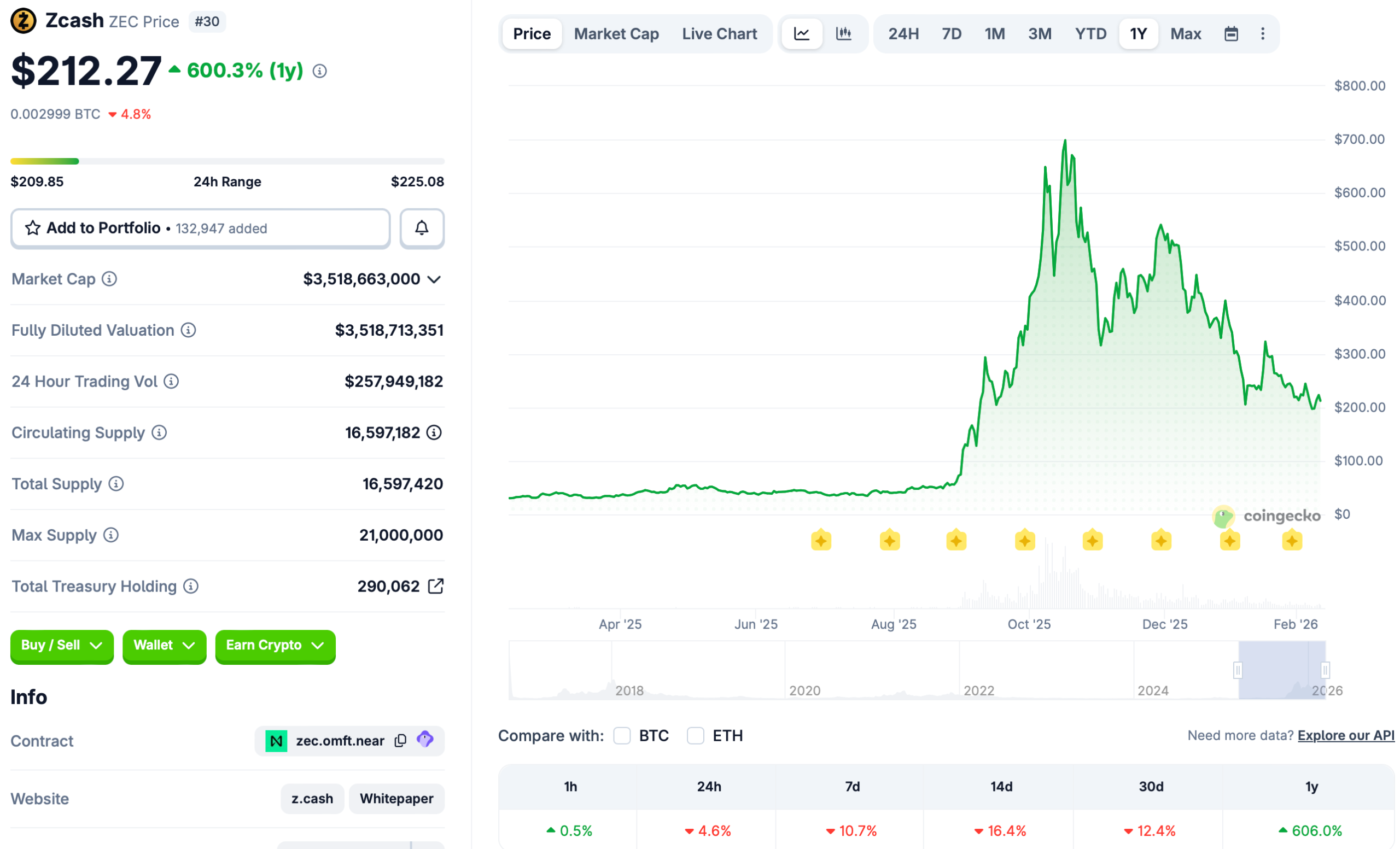
The rally pushed Zcash up nearly 600% over the past year, climbing from below $35 in March 2025 to as high as $698.87 on Nov. 16, 2025, according to CoinGecko data. The token has since pulled back, falling 58.7% year-to-date from about $512 on Jan. 1 to roughly $212 at the time of writing.

Even with the renewed attention, the network’s mining activity remains concentrated among a small number of pools.
Data from Poolbay shows ViaBTC controlling about 31.7% of total hashrate, followed by F2Pool at roughly 15.8%, with smaller shares distributed across pools such as 2Miners and Antpool.
Magazine: All 21 million Bitcoin is at risk from quantum computers

Two of the US’s most influential financial regulators have agreed to better coordinate oversight of the financial markets, seeking to put an end to decades of “regulatory turf wars” between them.
According to the memorandum of understanding written on Wednesday, the US Securities and Exchange Commission and US Commodity Futures Trading Commission said it has become a “pivotal time” to regulate in harmony as new technologies, such as crypto, make it more challenging to monitor the markets:
“New trading models, digital infrastructure, and onchain, automated systems increasingly blur traditional jurisdictional lines,” they said, particularly as market participants operate across platforms and asset classes.
To address that problem, the SEC and CFTC said they will aim to provide regulatory clarity and certainty built on technology-neutral regulations and share information and data concerning issues of “common regulatory interest” to fulfill their respective regulatory mandates.
In a separate statement, SEC chair Paul Atkins said the memo is the latest step toward repairing the relationship between the agencies:
“For decades, regulatory turf wars, duplicative agency registrations, and different sets of regulations between the SEC and CFTC have stifled innovation and pushed market participants to other jurisdictions.”

Both the SEC and CFTC have made strides to deliver on US President Donald Trump’s mission of making the US the “crypto capital of the world,” having set up a crypto-specific task force and established an advisory committee to ensure crypto, AI and other emerging tech innovations continue to push forward in the US.
The agencies also noted in the memo that they strive to provide a “fit-for-purpose regulatory framework for crypto assets.”
Related: SEC chair calls for ‘coordinated oversight‘ between US regulators
The regulatory clarity will be provided to market participants operating everything from trading platforms, clearinghouses and data repositories to pooled investment vehicles, dealers and intermediaries, in addition to products that span securities and derivatives frameworks.
SEC, CFTC to adopt “minimum effective dose” strategy
The two agencies said they also plan to adopt a “minimum effective dose” regulatory strategy to foster innovation while maintaining market integrity and remaining competitive in the global market.
The term “minimum effective dose” is a pharmacological term, defined as the smallest dose of medication that produces the desired therapeutic benefit.
Magazine: Clarity Act risks repeat of Europe’s mistakes, crypto lawyer warns


Traders’ optimism surges as energy shocks and geopolitical uncertainty dominate macro narratives.
Bitcoin (BTC) traders appear to be leaning optimistic in anticipation of a quick end to the war in the Middle East.
In fact, sentiment surrounding the world’s largest crypto asset surged back into FOMO territory after its market value briefly surpassed $70,000 on Tuesday, according to Santiment.
BTC FOMO Returns
Across social platforms, including X, Reddit, and Telegram, discussions reflect optimism, driven in part by comments from US President Donald Trump, who hinted that the war may soon end, as well as by the recent reversal in oil prices.
🤑 Bitcoin sentiment has jumped back into FOMO territory after its market value exceeded $70K Tuesday. Across X, Reddit, Telegram, and other crypto-related discussions, the crowd is encouraged by Trump’s comments that the war may soon end, and oil prices reversing course. pic.twitter.com/S21cXOUM0F
— Santiment (@santimentfeed) March 10, 2026
Despite the heightened market sentiment, on-chain activity shows signs of cooling. Crypto analyst Axel Adler Jr. found that the 30-day average of Bitcoin transfer volume has declined compared with both one month and one quarter ago. This evidences a temporary slowdown in short-term momentum.
However, transfer volume remains above its 365-day average and significantly higher than levels seen six months ago, which potentially means that while network activity has slowed from previous highs, there is no structural breakdown, and the broader trend in Bitcoin usage and movement remains high.
Geopolitical Tensions
This week’s rebound in risk assets such as Bitcoin has coincided with volatility in oil markets and changing expectations about the duration and impact of the Iran conflict.
You may also like:
Amid these macro developments, experts believe that BTC remains within a clearly liquidity-driven structure. In a statement to CryptoPotato, analysts at Bitunix said that derivatives liquidation distributions show a dense concentration of short liquidation zones between approximately $70,000 and $74,000 above current price levels, while leveraged long liquidity remains clustered near the $65,000-$66,000 range below.
After the latest recovery, the analysts said that BTC has entered sideways consolidation, suggesting that short-term price action remains dominated by liquidity sweeps both above and below.
“Overall, with energy shocks and geopolitical uncertainty continuing to dominate the macro narrative, the crypto market has yet to form a unilateral trend structure. Capital currently appears more inclined to engage in short-term liquidity positioning between dense liquidation zones.”
Binance Free $600 (CryptoPotato Exclusive): Use this link to register a new account and receive $600 exclusive welcome offer on Binance (full details).
LIMITED OFFER for CryptoPotato readers at Bybit: Use this link to register and open a $500 FREE position on any coin!

Welshman left unable to speak after ‘work stress’ headaches

Prime Brokers Push Wall Street Access to Prediction Markets: Report

Demidov scores game-winner, Canadiens beat Senators


-
Business6 days ago
Form 8K Entergy Mississippi LLC For: 6 March
-

 Tech7 days ago
Bitwarden adds support for passkey login on Windows 11
-

 News Videos3 days ago
10th Algebra | Financial Planning | Question Bank Solution | Board Exam 2026
-

 Fashion5 days ago
Weekend Open Thread: Ann Taylor
-

 Crypto World2 days ago
Paradigm, a16z, Winklevoss Capital, Balaji Srinivasan among investors in ZODL
-
 Tech20 hours ago
A 1,300-Pound NASA Spacecraft To Re-Enter Earth’s Atmosphere
-
 Sports6 days ago
499 runs and 34 sixes later, India beat England to enter T20 World Cup final | Cricket News
-

 Politics6 days ago
Top Mamdani aide takes progressive project to the UK
-

 Business1 day ago
ExxonMobil seeks to move corporate registration from New Jersey to Texas
-

 Sports4 days ago
Three share 2-shot lead entering final round in Hong Kong
-

 Sports4 days ago
Braveheart Lakshya downs Lai in epic battle to enter All England Open final | Other Sports News
-

 NewsBeat8 hours ago
Residents reaction as Shildon murder probe enters second day
-

 NewsBeat6 days ago
Piccadilly Circus just unveiled ‘London’s newest tourist attraction’ and it only costs 80p to enter
-

 Entertainment5 days ago
Hailey Bieber Poses For Sexy Selfies In New Luscious Lip Thirst Traps
-

 Business3 days ago
Search for Nancy Guthrie Enters 37th Day as FBI Probes Wi-Fi Jammer Theory
-

 Business19 hours ago
Search Enters Sixth Week With New Leads in Tucson Abduction Case
-
 NewsBeat2 days ago
Pagazzi Lighting enters administration as 70 jobs lost and 11 stores close across Scotland
-

 Tech3 days ago
Despite challenges, Ireland sixth in EU for board gender diversity
-

 Tech7 days ago
ACIP To Discuss COVID ‘Vaccine Injuries’ Next Month, Despite That Not Being In Its Purview
-

 Business2 days ago
Search Enters 39th Day with FBI Tip Line Developments and No Major Breakthroughs