
Crypto World
Ripple turns to AI to stress-test the XRP Ledger as institutional use cases scale



Ripple is overhauling how it secures the XRP Ledger, and AI is at the center of the effort.
Its engineering team outlined a new AI-driven security strategy for the XRP Ledger in a detailed post earlier this week, one that integrates machine learning tools across the protocol’s entire development lifecycle.
The strategy includes AI-assisted code scanning on every pull request, automated adversarial testing guided by threat models, and a dedicated AI-assisted red team that continuously analyzes the codebase and how features interact in real-world scenarios.
A newly-created ‘red team’ has already identified more than 10 bugs, with low-severity issues disclosed publicly so far and the remainder being prioritized and fixed. The team uses fuzzing and automated adversarial testing to simulate attacker behavior at scale, surfacing vulnerabilities earlier and with greater coverage than traditional auditing approaches.
“AI allows us to shift from reactive debugging to proactive, systematic discovery of vulnerabilities, strengthening the ledger faster and with greater confidence than ever before,” Ripple wrote.
The initiative comes as the XRPL handles an increasingly complex workload. The ledger has been operating continuously since 2012, processing over 100 million ledgers and facilitating more than 3 billion transactions.
A codebase of that age naturally reflects “design decisions made in earlier phases of the network, assumptions that held at smaller scale, and patterns that predate modern tooling.” The AI tools are designed to systematically find the edge cases and hidden failure modes that accumulate in any long-running production system.
The strategy is built across six pillars. Beyond the AI-assisted scanning and red team, Ripple is modernizing the XRPL codebase itself to address structural issues like limited type safety and inconsistent interaction patterns between features.
The company is expanding security collaboration with XRPL Commons, the XRPL Foundation, independent researchers, and validator operators. Standards for protocol amendments are being raised, with multiple independent security audits now required for significant changes alongside expanded bug bounties and adversarial testing environments.
And the next XRPL release will be dedicated entirely to bug fixes and improvements without new features, a signal that the engineering team is treating the hardening effort as a near-term priority.
The timing aligns with Ripple’s expanding institutional footprint.
The company is currently running a pilot under the Monetary Authority of Singapore’s BLOOM initiative, expanding Ripple Payments globally, pursuing an Australian financial services license, and pushing adoption of its RLUSD stablecoin.
A ledger targeting tokenized real-world assets, central bank-backed trade finance, and enterprise payment flows needs security infrastructure that scales alongside the use cases it supports.
The approach connects to a broader industry trend. Ethereum launched a dedicated post-quantum security hub this week backed by eight years of research and 10-plus client teams shipping weekly devnets. Google set a 2029 deadline for migrating its authentication services to quantum-resistant cryptography. Across both traditional tech and crypto, the emphasis is shifting from reactive patching to proactive, AI-augmented security engineering.
Meanwhile, the Ripple engineering team plans to publish security criteria for new amendments in collaboration with the XRPL Foundation and share findings transparently with the community in the coming weeks.


TLDR:
- Bitcoin STH inflows have fallen to their lowest recorded level of 25,000 BTC.
- Panic-driven selling by short-term holders has declined fourfold since February.
- Reduced STH inflows ease immediate selling pressure on Bitcoin exchanges.
- Bitcoin is in a consolidation phase after dropping more than 50% from its ATH.
Bitcoin STH inflows have dropped significantly, indicating calmer behavior among short-term holders. After Bitcoin fell below $60,000, panic selling pushed around 100,000 BTC to Binance in early February.
Since then, inflows from short-term holders have declined steadily, reaching roughly 25,000 BTC. This reduction suggests that the market is experiencing lower selling pressure, while Bitcoin navigates a consolidation phase following a steep correction.
Short-Term Holders Reduce Exchange Transfers
Bitcoin STH inflows were at a peak in early February when short-term holders moved large amounts to exchanges. Cryptoquant analyst Darkfost highlighted this in his analysis, noting the previous seven-day total of nearly 100,000 BTC to Binance.
Panic selling dominated this period, particularly among younger investors who are highly reactive to price fluctuations.
The trend has changed as inflows have now decreased by four times. Current seven-day transfers from short-term holders are around 25,000 BTC, the lowest recorded level. This shift reflects a stabilization in investor behavior as market volatility begins to ease.
Reduced STH inflows mean less BTC is available for immediate selling on exchanges. Consequently, short-term selling pressure has diminished.
The market is now experiencing calmer conditions, which support a more balanced environment for Bitcoin.
Market Consolidation Continues Amid Stability
Bitcoin is currently in a consolidation phase following a drop of more than 50% from its last all-time high. Such phases are common after large and rapid devaluations. The decline in STH inflows complements this stabilization by reducing short-term market reactions.
Short-term holders, known for their sensitivity, are transferring less BTC to exchanges. This behavior indicates a slower pace of reactive selling.
Analysts note that this adjustment helps maintain steadier market conditions amid ongoing economic and geopolitical challenges.
Lower selling activity aligns with reduced volatility and contributes to market equilibrium. Exchanges see fewer panic-driven transactions, allowing prices to find a more consistent range. While Bitcoin faces external pressures, STH activity suggests a measured response rather than abrupt reactions.
This pattern illustrates how the market adapts after rapid declines. The decreased movement of coins from short-term holders signals patience and a reduction in immediate supply pressure. The consolidation phase, combined with lower inflows, reflects a more orderly market environment.

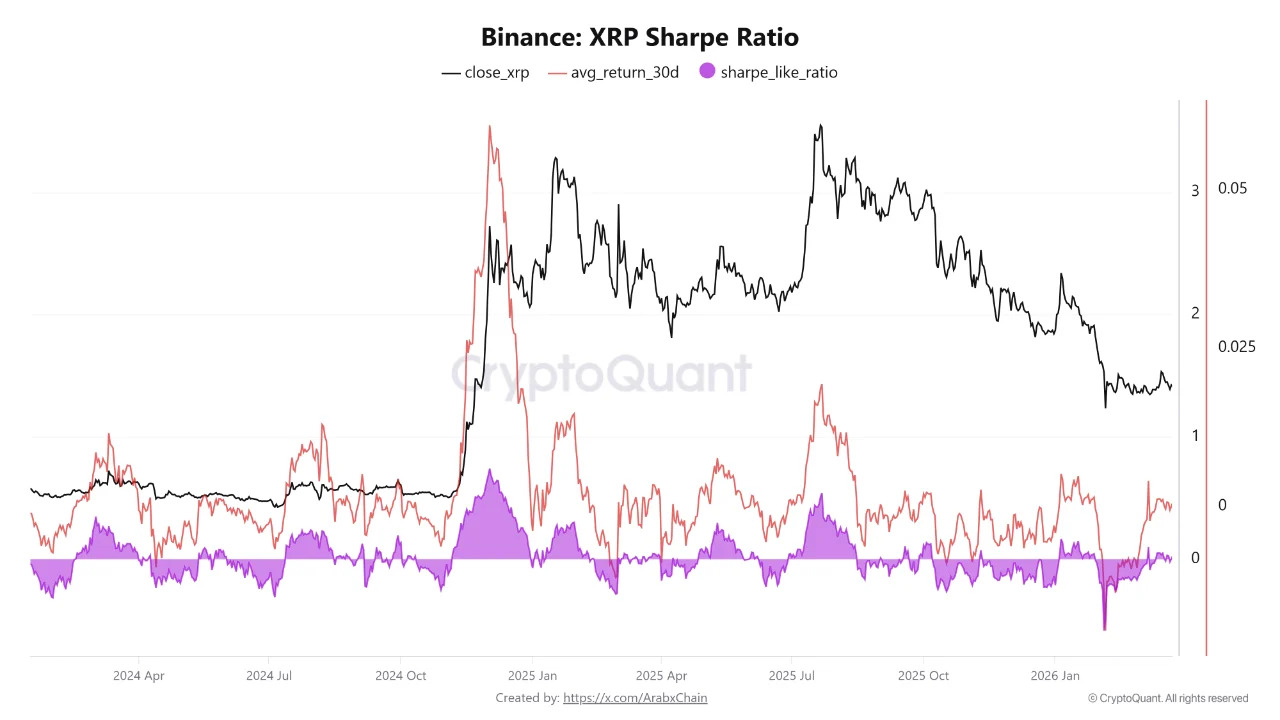
The Sharpe Ratio for XRP (XRP), a measure of return per unit of risk, turned slightly positive on March 26, after spending months near or below zero between October 2024 and February 2025.
A 30-day average return of 0.00063 supports this positive shift, while the Sharpe ratio stands at 0.0267, which reflects that the “current returns still exceed risk”.
Onchain data indicates that whales have steadily accumulated XRP over the past month, pointing to demand despite the weak price action.
XRP risk-adjusted returns hint at limited long-term downside
Crypto analyst Arab Chain noted that the recent improvement in the Sharpe Ratio aligns with a pickup in trading activity, pointing to better returns for XRP holders in the long-term. The analyst explained that the ratio indicates a gradual positive rebalancing, which may limit further downside for the altcoin. Yet, the analyst added,
“If the indicator falls back into negative territory, it could signal a return of volatility and weakening momentum.”

Reinforcing the positive narrative, XRP whale flows have climbed to a 30-day moving average of $9 million per day. The positive flows have held since Feb. 27, marking the longest accumulation phase since April to July 2025.
The last accumulation phase in Q2 2025 led to XRP’s expansion rally to its all-time high of $3.65 on July 18, 2025.

The combination of a positive Sharpe Ratio reading and steady whale inflows points to an improving sentiment alongside accumulation. The gains are minimal, with the volatility relatively stable. This alignment places focus on whether the whale inflows may continue to support consistent returns over time.
Related: XRP price risks 50% drop despite Goldman Sachs’ $152M ETF exposure
XRP open interest rises with fragile positioning
Crypto analyst Amr Taha noted that the 24-hour open interest change reached 14.8% on March 26, its highest level since March 4, indicating renewed trader participation. This rise in activity also coincides with repeated long-side pressure, with liquidation events above $2.5 million on March 18, followed by similar spikes of $2.45 million on March 21 and $2.15 on March 26.

These moves show that aggressive long positioning is still being cleared during the short-term volatility. Thus, while the futures activity has risen, the frequent liquidation signals create an unstable market, where traders are exposed to continuous resets.
The technical structure points to a clear bearish bias. XRP has invalidated its bullish ascending triangle pattern, declining 13.63% over the past 10 days. If the current market structure persists, the altcoin could retest support levels near internal liquidity at $1.27 and yearly lows at $1.11 in the coming weeks.

Related: Bittensor’s TAO price may plunge 40% within five weeks: Fractal data
This article does not contain investment advice or recommendations. Every investment and trading move involves risk, and readers should conduct their own research when making a decision. While we strive to provide accurate and timely information, Cointelegraph does not guarantee the accuracy, completeness, or reliability of any information in this article. This article may contain forward-looking statements that are subject to risks and uncertainties. Cointelegraph will not be liable for any loss or damage arising from your reliance on this information.

U.S. Senator Cynthia Lummis has sharpened her defense of the Digital Asset Market Clarity Act (CLARITY), arguing that Title 3 would deliver the strongest protections yet for DeFi developers and non-custodial innovators. In recent remarks, she contended that bipartisan changes to the bill would fortify safeguards for DeFi insiders and urged lawmakers to advance CLARITY in order to unlock these protections under the BRCA framework.
The comments come as crypto-savvy lawyer Jake Chervinsky challenged the bill’s current design, arguing that Title 3 could undermine protections by imposing Know-Your-Customer obligations on non-custodial software developers. Lummis responded by asserting that the ongoing revisions to Title 3 are aimed at strengthening DeFi defenses, while noting that the latest draft text has not yet been released publicly.
“Don’t believe the FUD,” Lummis wrote in a Friday posting, adding, “We have worked on a bipartisan basis for the last few weeks to make changes to Title 3 that make this bill the strongest protection for DeFi and developers ever enacted. We have to pass the Clarity Act to get these protections.”
The precise revisions to CLARITY—described by Lummis as a path to stronger, clearer protections for DeFi—have not been published, leaving observers to await the official language.
“Don’t believe the FUD. We have worked on a bipartisan basis for the last few weeks to make changes to Title 3 that make this bill the strongest protection for DeFi and developers ever enacted. We have to pass the Clarity Act to get these protections.”
Chervinsky has emphasized that DeFi protections in Title 3 have been overshadowed by attention to stablecoin-related provisions within CLARITY. His central concern is that the bill’s money transmitter definitions could still place many non-custodial DeFi builders at risk of liability, even as the BRCA’s Section 604 language clarifies that non-controlling developers and providers of non-custodial software should not be treated as financial institutions subject to Bank Secrecy Act KYC obligations.
The broader legal landscape isn’t lost on industry figures. The contrast between intent and enforcement risk is shaping the debate around what forms DeFi protection should take—whether liability shields should hinge on code architecture, custodial status, or the nature of on-chain activity.
The debate arrives amid a climate of high-profile regulatory pushback. In recent months, prosecutors have pursued crypto developers and platforms with renewed vigor, including the Tornado Cash case, where Roman Storm was convicted in August 2025 of conspiracy to operate an unlicensed money transmitting business. The outcome has underscored the urgency for clear, workable safeguards for builders who contribute to open-source or non-custodial tooling.
Legislative momentum around CLARITY appears to be advancing in tandem with broader efforts on stablecoins. U.S. lawmakers have signaled that CLARITY’s passage would be instrumental in delivering BRCA-backed protections for DeFi developers, with a Senate Banking Committee markup anticipated in April after progress on the stablecoin rewards provisions. The absence of publicly released text notwithstanding, supporters argue that the package’s architecture is designed to distinguish non-custodial code from regulated financial activity, reducing ambiguity for developers and users alike.
As the clock ticks toward committee consideration, investors and builders will be watching closely how Title 3 evolves and whether the revisions address non-custodial liability concerns without undermining legitimate regulatory aims. The next updates from Congress will determine not only the fate of CLARITY but also the practical implications for DeFi development, funding, and broader market adoption.
Readers should stay tuned for the formal release of the revised draft and subsequent committee milestones, as the balance between protection and compliance continues to shape the trajectory of DeFi regulation in the United States.
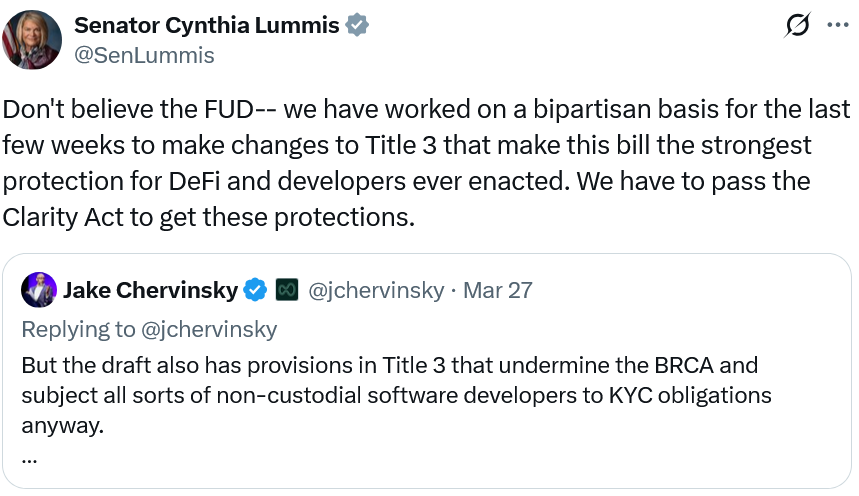
US Senator Cynthia Lummis has dismissed claims that the Digital Asset Market Clarity Act fails to protect decentralized finance innovators from legal repercussions, rebutting that recent changes to the draft will make it the “strongest protection for DeFi and developers ever enacted.”
Her comments on Friday came in direct response to crypto lawyer Jake Chervinsky, who argued that Title 3 of the current draft undermines the Blockchain Regulatory Certainty Act — another crypto bill focused on developer protections — by subjecting non-custodial software developers to know-your-customer obligations.
“Don’t believe the FUD,” Lummis said, adding, “We have worked on a bipartisan basis for the last few weeks to make changes to Title 3 that make this bill the strongest protection for DeFi and developers ever enacted. We have to pass the Clarity Act to get these protections.”
The latest changes to the CLARITY Act have not been publicly released.

Chervinsky said these DeFi protection provisions have been overshadowed by intense focus on stablecoin rewards provisions in the CLARITY Act.
His biggest issue with the Senate Banking Committee’s latest CLARITY Act draft is that Title 3’s money transmitter definitions could still expose many non-custodial DeFi builders to liability.
This is despite the CLARITY Act incorporating the BRCA in section 604, which clarifies that non-controlling developers and providers of non-custodial software are not to be treated as financial institutions subject to Bank Secrecy Act KYC obligations.
“The biggest challenge is ensuring non-custodial software developers aren’t misclassified as money transmitters,” Chervinsky argued.
“That’s non-negotiable for DeFi, and it’s still unsettled.”
His concerns come amid several high-profile prosecutions and convictions of developers in the US in recent months, including Tornado Cash co-founder, Roman Storm, who was convicted in August 2025 of conspiracy to operate an unlicensed money transmitting business.
Related: Delaware eyes stablecoin licensing framework under banking laws
US lawmakers have said the CLARITY Act is moving closer toward a Senate Banking Committee markup expected in April after recent bipartisan progress on stablecoin rewards provisions.
Passage of the CLARITY Act is necessary to ensure DeFi developers are afforded legal protections under the BRCA, Lummis noted.
Magazine: Are DeFi devs liable for the illegal activity of others on their platforms?
Ripple CEO Brad Garlinghouse framed stablecoins as the crypto sector’s potential “ChatGPT moment” for enterprise payments, arguing that faster, more efficient settlements could accelerate real-world adoption among large corporations. In an interview with FOX Business on Friday, he said boards of directors and chief financial officers at Fortune 500 and Fortune 2000 companies are already asking treasurers how stablecoins could fit into their operations, signaling a shift from experimentation to formal strategy.
Garlinghouse described the move as an “unlock” for corporate finance, arguing that giving treasurers a credible on-chain settlement option could accelerate the broader adoption of blockchain-enabled services. He suggested stablecoins could serve as an entry point to a wider ecosystem of digital-asset tools used by enterprises, beyond just payments.
Bloomberg Intelligence has projected that stablecoin payment flows could grow at roughly an 80% compound annual rate to about $56.6 trillion by 2030, underscoring the potential scale if regulation and infrastructure align with demand.
Garlinghouse also highlighted the sheer volumes already moving through stablecoins. He noted that last year stablecoins processed more than $33 trillion in trading volume, with nearly 90% of that activity coming from Tether’s USDt (USDT) and Circle’s USDC, illustrating the current concentration of liquidity in a small handful of assets.
Ripple’s foray into the stablecoin space includes RLUSD, a competitor stablecoin launched in December 2024. CoinGecko data shows RLUSD stands as the 10th-largest stablecoin by market cap, with about $1.4 billion in circulation.
Beyond stablecoins themselves, Garlinghouse highlighted Ripple’s broader push to bolster payments infrastructure through strategic acquisitions. The company bought Hidden Road, an institutional-focused prime brokerage, for $1.25 billion and GTreasury, a corporate treasury platform, for $1 billion. He said the acquisitions have helped Ripple enter a “record quarter” and that the firm has been “on a tear” since closing these deals.
Key takeaways
- Enterprises are increasingly viewing stablecoins as a payments enabler, with senior executives pressing treasurers to outline deployment plans.
- Global stablecoin trading volume last year exceeded $33 trillion, with about 90% concentrated in USDT and USDC, underscoring existing liquidity leadership.
- Ripple operates RLUSD, launched in December 2024, now ranking 10th among stablecoins by market cap at roughly $1.4 billion (per CoinGecko).
- Ripple’s acquisitions of Hidden Road ($1.25 billion) and GTreasury ($1 billion) are positioned to bolster enterprise payments and treasury management capabilities.
- Regulatory context matters: the CLARITY Act could accelerate crypto adoption if enacted, but policymakers must avoid weaponizing policy for political ends, according to Garlinghouse.
- Bloomberg Intelligence foresees stablecoin flows reaching $56.6 trillion by 2030, highlighting the potential scale of enterprise demand.
Stablecoins as a corporate catalyst
The conversation around stablecoins increasingly centers on real-world corporate utility. Garlinghouse framed the narrative around a critical shift: boards and CFOs are evaluating how stablecoins could streamline treasury operations, enable faster cross-border settlements, and unlock a broader set of blockchain-based services for their organizations. In this view, stablecoins are less about speculative trading and more about providing a practical, on-chain settlement layer that can integrate with existing financial workflows.
The enterprise lens also emphasizes risk management and liquidity considerations. Real-time settlements and improved cash visibility could reduce foreign exchange exposure and nested settlement delays that plague traditional cross-border payments. While these advantages exist in theory, they hinge on reliable rails, robust custody, compliance, and interoperability with conventional banking rails—a set of criteria Ripple has sought to address through its product suite and partnerships.
Ripple’s push to enterprise infrastructure
RLUSD represents Ripple’s commitment to building a native stablecoin option within its payments ecosystem. Launched in late 2024, RLUSD has quickly become a test case for how corporate users might leverage stablecoins to settle obligations on Ripple’s rails. According to CoinGecko, RLUSD ranks among stablecoins with a $1.4 billion market cap, placing it in the top tier of on-chain stablecoins by liquidity and size.
Concurrently, Ripple’s strategic acquisitions broaden the toolkit available to enterprises. Hidden Road provides institutional-grade prime brokerage capabilities, potentially easing access to liquidity and trading infrastructure for large clients. GTreasury, a corporate treasury management platform, adds cross-functional treasury tools, enabling better visibility and control over digital-asset holdings within corporate finance operations. Garlinghouse said these acquisitions have strengthened Ripple’s trajectory, contributing to what he described as a “record quarter.”
Taken together, the RLUSD initiative and the strengthened payments backbone position Ripple to offer a more complete enterprise solution: on-chain settlement via stablecoins, coupled with governance, liquidity, and treasury management tools designed for large organizations. For investors and users watching adoption curves, the question is how quickly these capabilities translate into tangible enterprise uptake and steady revenue streams for Ripple and its partners.
Regulatory context and market outlook
The regulatory backdrop remains a pivotal variable in the trajectory of stablecoins and enterprise crypto adoption. Garlinghouse emphasized the potential impact of market-structure legislation such as the CLARITY Act, arguing that Congress could push the sector forward if crafted with clarity and sound policy. He warned against policymakers weaponizing regulation for political ends and urged a measured approach that protects the United States’ competitive standing while fostering innovation.
The broader market context underscores why this regulatory moment matters. The ongoing debate around stablecoin disclosures, reserve standards, and liquidity requirements will influence whether corporate treasuries view stablecoins as a reliable part of their long-term liquidity strategy. As policymakers weigh risk controls and consumer protections, the ability for enterprises to adopt stablecoins at scale will hinge on clear, consistent rules and interoperable infrastructure that can withstand institutional scrutiny.
Looking ahead, the market will be watching how the CLARITY Act progresses through Congress and how Ripple, RLUSD, and related infrastructure adapt to any regulatory requirements. The combination of a strong enterprise narrative, improving payments infrastructure, and a favorable regulatory framework could accelerate corporate engagement with stablecoins, while lingering ambiguities or policy missteps could slow momentum.
Ultimately, the next phase of enterprise crypto adoption will hinge on demonstrated use cases, governance reliability, and the ability to deliver on real-world efficiency gains. For investors and builders, the key watch points are enterprise interest in RLUSD and Ripple’s broader treasury-management story, regulatory developments around stablecoins, and the degree to which large corporations actually embed stablecoins into their treasury operations and payment workflows.
As policymakers deliberate and corporates experiment, the landscape will reveal whether this era’s “ChatGPT moment” translates into durable, enterprise-grade crypto infrastructure and a measurable shift in how businesses move value across borders.
Watch for updates on CLARITY Act progress, RLUSD adoption by enterprises, and any new milestones from Ripple’s expanding payments ecosystem in the coming quarters.
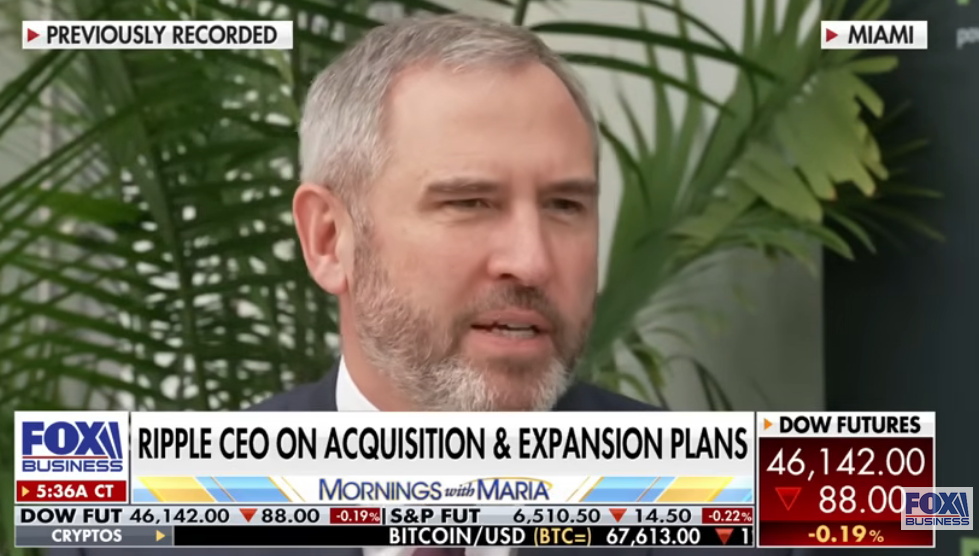
Ripple CEO Brad Garlinghouse said stablecoins will be the crypto sector’s “ChatGPT moment” for businesses in search of faster, more efficient payments, and that many companies are already discussing and strategizing how to implement stablecoins into their operations.
“You have boards of directors and CEOs of companies, whether it’s Fortune 500 or Fortune 2000, they’re asking their treasurers, they’re asking their CFOs, hey, what are we doing with stablecoins,” Garlinghouse told FOX Business on Friday.
“Giving the treasurer and the CFO that option is the unlock,” he said.
Garlinghouse said this unlock would be “the ChatGPT moment of crypto” because it would be the entry point for businesses to access a broader range of blockchain-based services.

Bloomberg Intelligence predicted in early January that stablecoin flows could increase at a compounded annual growth rate of 80% to $56.6 trillion by 2030, a rise that would make stablecoins one of the most important payment tools in global finance.
Garlinghouse noted that stablecoins processed more than $33 trillion in trading volume last year, though nearly 90% of that came from Tether’s USDt (USDT) and Circle’s USDC (USDC).
Ripple launched a competitor stablecoin — Ripple USD (RLUSD) — in December 2024, which is currently the 10th largest stablecoin by market cap at $1.4 billion, CoinGecko data shows.
Ripple also strengthened its blockchain payments infrastructure last year with the acquisition of institutional-based prime brokerage Hidden Road for $1.25 billion and corporate treasury platform GTreasury for $1 billion.
Related: White House crypto adviser says banks shouldn’t fear stablecoin yield
Meanwhile, Garlinghouse said Ripple is set to have a “record quarter,” adding that the company has been “on a tear” since the Hidden Road and GTreasury acquisitions.
Market structure legislation will push crypto industry forward
Garlinghouse said stablecoin payments and broader blockchain adoption would be accelerated by the CLARITY Act, should it pass Congress and be signed into law.
“A lot of eyes are on what is US regulation going to look like and is it going to get done,” he said. “We want to make sure we can’t have another Gary Gensler moment where they try to weaponize policy in a way that is about politics, not about what’s good for the United States.”
Magazine: XRP yet to ‘price in’ 3 bullish catalysts, Bitcoin to $80K? Trade Secrets
The bitcoin mining industry is undergoing the most fundamental transformation in its history, and the clearest sign isn’t the hashrate or the difficulty adjustments. It’s the balance sheets.
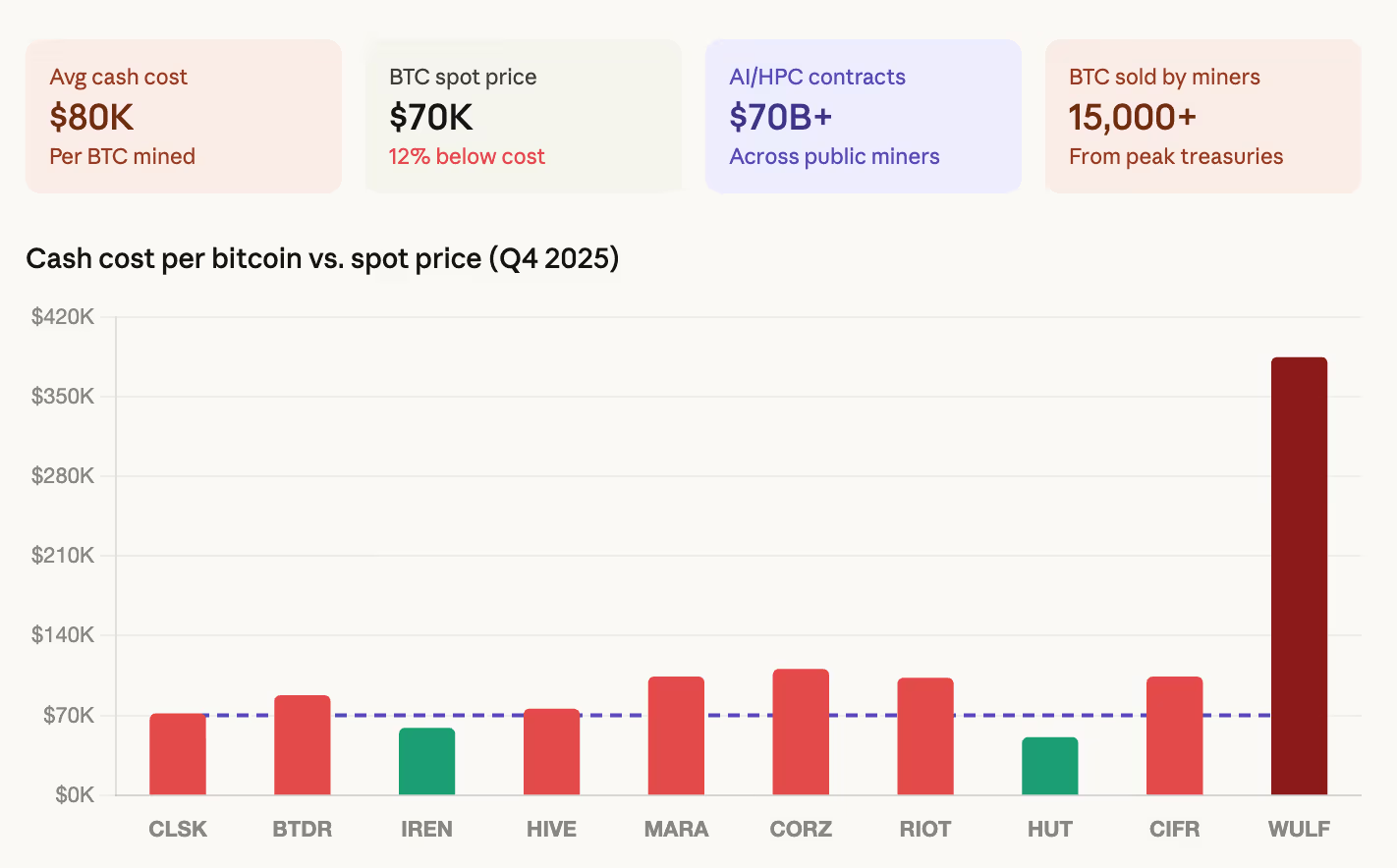
CoinShares’ Q1 2026 mining report, published this week, reveals that the weighted average cash cost to produce one bitcoin among publicly listed miners rose to approximately $79,995 in Q4 2025.
Bitcoin has traded in the $68,000 to $70,000 band, with a CoinDesk report last week estimating losses of $19,000 per BTC mined.
These numbers aren’t sustainable, and the industry knows it. The response has been a wholesale pivot toward artificial intelligence infrastructure that is reshaping what these companies actually are.

Over $70 billion in cumulative AI and high-performance computing contracts have now been announced across the public mining sector, according to the CoinShares report. CoreWeave’s expanded deal with Core Scientific alone is worth $10.2 billion over 12 years. TeraWulf has $12.8 billion in contracted HPC revenue. Hut 8 signed a $7 billion, 15-year lease for AI infrastructure at its River Bend campus. Cipher Digital has a multi-billion-dollar agreement with Google-backed Fluidstack.
Listed miners could derive as much as 70% of their revenue from AI by the end of 2026, up from roughly 30% today. Core Scientific’s AI colocation revenue already accounts for 39% of its total. TeraWulf is at 27%. IREN is at 9% and scaling rapidly with up to 200 megawatts of liquid-cooled GPU capacity under construction.
That means these mining companies are increasingly becoming data center operators that happen to still mine bitcoin on the side.
The economics explain why. According to CoinShares, the cost differential between bitcoin mining infrastructure at roughly $700,000 to $1 million per megawatt and AI infrastructure at $8 million to $15 million per megawatt is wide, but AI offers structurally higher and more stable returns.
Hash price, the metric that determines miner revenue per unit of computing power, hit an all-time post-halving low of roughly $28 to $30 per petahash per day in early March.
At those levels, miners running mid-generation hardware need access to electricity below $0.05 per kilowatt-hour to remain cash-profitable. Meanwhile, AI infrastructure contracts promise margins above 85% with multi-year revenue visibility.
How the financials work
The transition is being financed in two ways, and both are visible in the data, the report explained.
First, debt. The sector’s aggregate leverage has fundamentally changed. IREN now carries $3.7 billion in convertible notes across five series. TeraWulf has $5.7 billion in total debt, split between convertible notes and senior secured notes at its compute subsidiary.
Cipher Digital issued $1.7 billion in senior secured notes in November, causing its quarterly interest expense to surge from $3.2 million for the first nine months to $33.4 million in Q4 alone. These are not mining-scale debt loads. These are infrastructure-scale bets that the AI revenue will materialize fast enough to service the obligations.
Second, bitcoin sales. Publicly listed miners have collectively reduced their BTC treasuries by over 15,000 BTC from peak levels. Core Scientific sold roughly 1,900 BTC worth $175 million in January and is planning to liquidate substantially all remaining holdings in Q1 2026. Bitdeer reduced its treasury to zero in February. Riot Platforms sold 1,818 BTC worth $162 million in December.
Even Marathon, the largest public holder at 53,822 BTC, quietly expanded its policy in its March 10-K filing to authorize sales from its entire balance sheet reserve, partly driven by pressure on its $350 million bitcoin-backed credit facility where the loan-to-value ratio climbed to 87% as prices fell toward $68,000.

The miners that are selling bitcoin to fund AI buildouts are the same companies whose mining operations secure the bitcoin network. That creates a tension at the heart of the transition. When mining is unprofitable and AI is lucrative, the rational economic decision is to reallocate capital away from mining. But if enough miners do that, the network’s security budget shrinks.
The hashrate data already reflects this. The network peaked at approximately 1,160 exahashes per second in early October 2025 and has since declined to roughly 920 EH/s, with three consecutive negative difficulty adjustments, the first such streak since July 2022.
The valuation market has already priced the bifurcation. Miners with secured HPC contracts now trade at 12.3 times next-twelve-month sales. Pure-play miners trade at 5.9 times. The market is paying more than double for the AI exposure, which reinforces the incentive to pivot further.
The geographic picture is shifting alongside the economics, meanwhile. The United States, China, and Russia now control roughly 68% of global hashrate. The U.S. gained about 2 percentage points of market share in Q4 alone.
But emerging markets are entering the picture. Paraguay and Ethiopia have joined the global top 10 mining countries, driven by HIVE’s 300-megawatt operation in Paraguay and Bitdeer’s 40-megawatt facility in Ethiopia.
Hashrate forecasts and estimates
CoinShares forecasts the network hashrate will reach 1.8 zetahashes by the end of 2026 and 2 zetahashes by end of March 2027, one month later than previously predicted.
But that forecast depends on bitcoin recovering to $100,000 by year-end. If prices stay below $80,000, CoinShares expects hash price to continue falling and the hashrate to decline further as more miners exit.
A sustained move below $70,000 could trigger larger capitulation that, paradoxically, benefits survivors through lower difficulty.
Next-generation hardware offers a potential lifeline. Bitmain’s S23 series and Bitdeer’s proprietary SEALMINER A3, both operating below 10 joules per terahash, are expected at scale through the first half of 2026. These machines would roughly halve the energy cost per bitcoin compared to current mid-generation fleets. But deploying them requires capital that many miners are directing toward AI instead.
The bitcoin mining industry entered this cycle as a group of companies that secured the network and accumulated bitcoin. It is exiting as a group of companies that build AI data centers and sell bitcoin to fund them.
Whether that’s a temporary response to unfavorable economics or a permanent structural shift depends on one variable: the price of bitcoin. If it returns to $100,000, mining margins recover and the AI pivot slows. If it stays at $70,000 or below, the transition accelerates and the mining sector as it existed for the past decade continues to disappear into something else entirely.
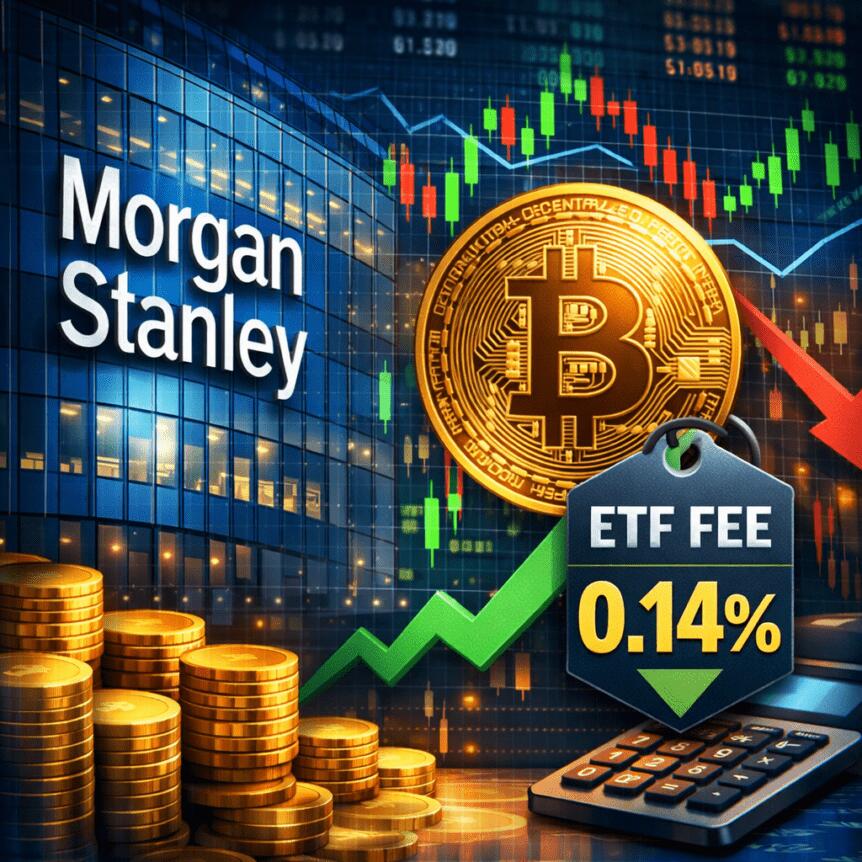
Morgan Stanley is accelerating its crypto ambitions with a plan to launch a spot Bitcoin ETF priced at 0.14% in annual fees. If approved, the vehicle would be the cheapest spot BTC offering in the U.S. market and could push rival fund sponsors to trim fees to stay competitive. The filing appears in the bank’s latest S-1 registration materials and signals a serious intent to broaden access to Bitcoin exposure for Morgan Stanley’s client base.
Industry observers say the move, paired with the bank’s broader crypto strategy, could reshape the U.S. ETF landscape. Bloomberg ETF analyst James Seyffart flagged the filing as a “big move” and forecast an early-April launch for the Morgan Stanley Bitcoin Trust (MSBT). Fellow Bloomberg analyst Eric Balchunas noted the ultra-low fee would be attractive to Morgan Stanley’s advisory network, which manages trillions of dollars in client assets, potentially easing internal conflicts over recommendations. The price tag—0.14%—would sit just a hair below the Grayscale Bitcoin Mini Trust ETF and meaningfully under BlackRock’s iShares Bitcoin Trust ETF, underscoring the fee-pressure dynamic across the space.
Beyond the fee structure, the development underscores Morgan Stanley’s evolving stance on crypto as part of a broader suite of products and services. The bank’s early 2020s shift toward crypto included appointing Amy Oldenburg to lead its digital asset team and pursuing a national banking charter to custody digital assets and execute purchases, sales, and swaps for clients, including staking services. Morgan Stanley previously identified Coinbase and Bank of New York Mellon as the prospective custodians for its Bitcoin ETF, a detail that helps frame how the bank intends to operationalize a spot-BTC product for a traditionally risk-averse client base.
Key takeaways
- The proposed 0.14% fee for Morgan Stanley’s spot Bitcoin ETF would be the lowest in the U.S. market at launch, positioning the bank as a potential price leader and prompting peers to consider fee reductions to retain assets.
- If the SEC approves MSBT, Morgan Stanley would become the first traditional bank to issue a U.S. spot BTC ETF, expanding access to crypto exposure for high-net-worth clients and broader Morgan Stanley advisory channels.
- The move sits within a broader crypto push: Morgan Stanley has filed for a staking Ether ETF and has sought a national trust charter to custody digital assets and trade crypto for clients, signaling a multi-pronged strategy beyond a single ETF product.
- Analysts foresee an early-April launch window for the MSBT, suggesting the bank is moving with pace to bring a regulated, traditional-finance gateway to Bitcoin into its product lineup.
Strategic significance for Morgan Stanley and the market
The 0.14% fee is not just a stat; it signals a strategic pivot with potential ripple effects. For Morgan Stanley, a successful, low-cost spot BTC ETF would enable seamless integration into its existing advisory framework. As Balchunas noted, the soft price point reduces potential conflicts for roughly 16,000 financial advisors who oversee about $6.2 trillion in client assets, potentially making it easier to recommend cryptocurrency exposure within conventional portfolios. For the broader market, the introduction of a bank-backed spot BTC ETF could heighten competition among ETF providers to offer low-cost, accessible crypto exposure, potentially accelerating adoption among institutions and high-net-worth individuals.
The path remains contingent on regulatory approval. A green light from the U.S. Securities and Exchange Commission would mark a milestone not just for Morgan Stanley but for the broader integration of traditional finance with regulated crypto products. The bank’s broader crypto orchestration—ranging from a Solana ETF filed in January to staking-related offerings and a declared charter to custody and trade digital assets—paints a picture of a lane-change moment for Wall Street institutions that have historically approached crypto with caution.
What comes next and what to watch
Investors and crypto observers should monitor several moving parts. First, the SEC’s decision on MSBT will determine whether a bank-backed spot BTC ETF can enter the market with a capital-light, cross-sell approach through Morgan Stanley’s vast advisory network. The timing remains uncertain beyond signals from analysts about an early-April launch, but any formal approval would intensify a fee-competition dynamic already visible across existing U.S. spot BTC ETFs.
Second, Morgan Stanley’s broader crypto agenda—its staking ETH ETF, custody capabilities, and the possibility of additional crypto products—will shape how the bank positions itself as a regulated gateway to digital assets. The custodial framework with potential partners like Coinbase and BNY Mellon will influence both product design and client trust as the firm seeks to democratize access without compromising risk controls.
Third, the market will closely watch how competitors respond. If Morgan Stanley’s 0.14% fee sets a new baseline, rival asset managers may need to recalibrate fee structures, custody arrangements, and distribution strategies to maintain market share among sophisticated investors seeking regulated exposure to Bitcoin.
Lastly, the regulatory trajectory for spot crypto ETFs remains a central theme. While a bank-run product could gain traction, final approvals will hinge on how regulators assess custody standards, liquidity, and investor protection in a landscape evolving toward deeper institutional participation in digital assets.
In sum, Morgan Stanley’s proposed MSBT at a sub-0.15% fee underscores a broader move by legacy financial institutions to normalize and scale regulated crypto exposure. If approved, the impact would extend beyond a single ETF—potentially reshaping fee benchmarks, distribution dynamics, and the pace at which traditional finance fully embraces digital assets in its core client offerings.
Readers should keep an eye on regulatory updates, Morgan Stanley’s official disclosures regarding the MSBT timeline, and any shifts in the competitive landscape as major banks and fund sponsors recalibrate their crypto product menus in response to this development.
Investment bank Morgan Stanley is seeking to launch its spot Bitcoin exchange-traded fund at a 0.14% fee, which would make it the cheapest in the US market and potentially force rivals to cut fees to stay competitive.
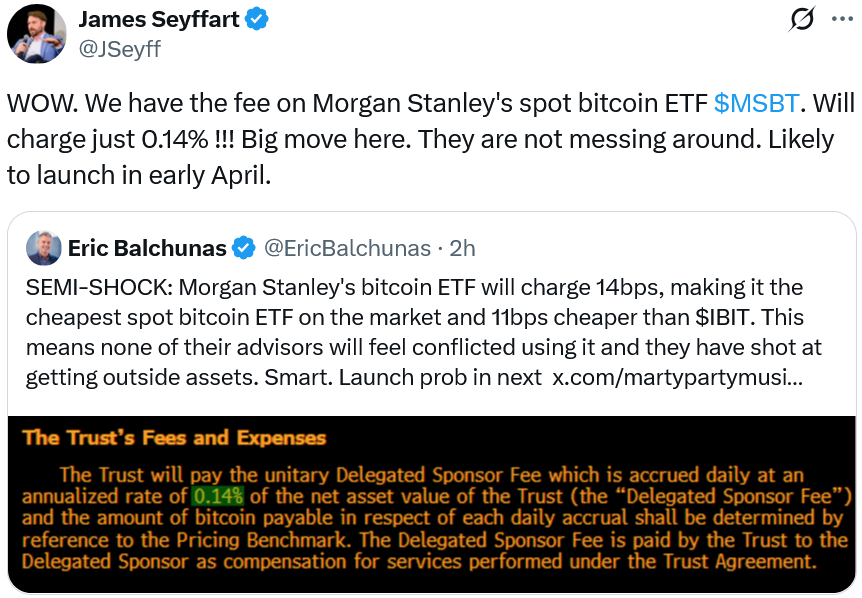
The 0.14% fee, proposed in Morgan Stanley’s latest S-1 registration statement on Friday, would be one basis point below the Grayscale Bitcoin Mini Trust ETF (BTC), currently the cheapest in the US market, and 11 basis points below the BlackRock-issued iShares Bitcoin Trust ETF (IBIT).
“Big move here. They are not messing around,” Bloomberg ETF analyst James Seyffart said, predicting that the Morgan Stanley Bitcoin Trust (MSBT) is “likely to launch in early April.”

Fellow Bloomberg ETF analyst Eric Balchunas said the low fee means that none of Morgan Stanley’s roughly 16,000 financial advisors — which manage $6.2 trillion in client assets — would feel conflicted in recommending the product to its clients.
Given that spot Bitcoin ETFs track the price movements of Bitcoin (BTC), Morgan Stanley’s ultra-low fee could spark a fresh fee war in the $83 billion market, putting immediate pressure on rivals to cut costs or risk losing assets.
Regulatory approval would make Morgan Stanley the first bank to issue a spot Bitcoin ETF, expanding access to Bitcoin exposure for millions of its high-net-worth clients.
“They are the ultimate gatekeepers of rich boomer money,” Balchunas added.
Morgan Stanley previously selected Coinbase and Bank of New York Mellon as the proposed custodians for its Bitcoin ETF.
Morgan Stanley seeking suite of crypto ETFs, banking charter
Morgan Stanley, previously one of the more crypto-hesitant Wall Street firms, filed for the spot Bitcoin ETF in the first week of January, along with a Solana (SOL) ETF.
Related: Bitcoin traders see 53% odds of sub-$66K BTC by April 24
It then filed papers for a staked Ether (ETH) ETF later that week, and by the end of the month, the bank appointed one of Morgan Stanley’s longest-standing executives, Amy Oldenburg, to lead its digital asset team.

Morgan Stanley also applied for a national trust banking charter on Feb. 18, seeking to custody certain digital assets and execute purchases, sales and swaps for clients in addition to staking services.
In October, before the investment bank adopted its institutional crypto strategy, it recommended a 2% to 4% allocation to crypto portfolios for investors. It also allowed its financial advisors to recommend crypto funds to clients with individual retirement accounts (IRAs) and 401(k)s.
Magazine: Bitcoin may face hard fork over any attempt to freeze Satoshi’s coins
Crypto World
XRP Price Prediction in 2026: MARA Sells $1.1B in BTC While Pepeto Targets 100x Over Coins Like XRP and DOT
Mortgage rates at 7% are trapping American families in $2,300 monthly payments for 30 years, and the XRP forecast pointing toward 16% annual growth is not going to change that math for anyone. MARA just sold 15,133 Bitcoin for $1.1 billion to cut its debt by 30%, and that tells the reader everything about what even the largest miners think about holding BTC at these levels.
The XRP forecast is one conversation, but Pepeto is a different one entirely, with more than $8 million raised, a verified exchange already running, and analysts projecting 100x as the Binance listing approaches, the kind of entry that pays off the house.
MARA Holdings sold 15,133 Bitcoin for approximately $1.1 billion between March 4 and March 25, using the proceeds to repurchase $1 billion in convertible notes at a 9% discount according to Bitcoin Magazine.
The move cuts MARA’s debt by 30%. According to Phemex, the market showed little reaction suggesting the sale was anticipated. The XRP forecast sits at 16% while presale entries target 100x, and the gap between those numbers is the gap between 30 more years of payments and owning the house.
The Real Opportunity and Why the XRP Forecast Points Somewhere Else
Pepeto: The Exchange Where One Entry Pays Off the Mortgage While the XRP Price Prediction Delivers 16%
MARA needed to sell $1.1 billion in BTC just to manage debt, while the wallets entering Pepeto at presale are building positions that target 100x from one listing event. Pepeto is the exchange that gives every wallet the protection institutional desks keep for themselves, and the XRP forecast is not the path to the kind of returns that clear a $2,300 monthly mortgage payment permanently.
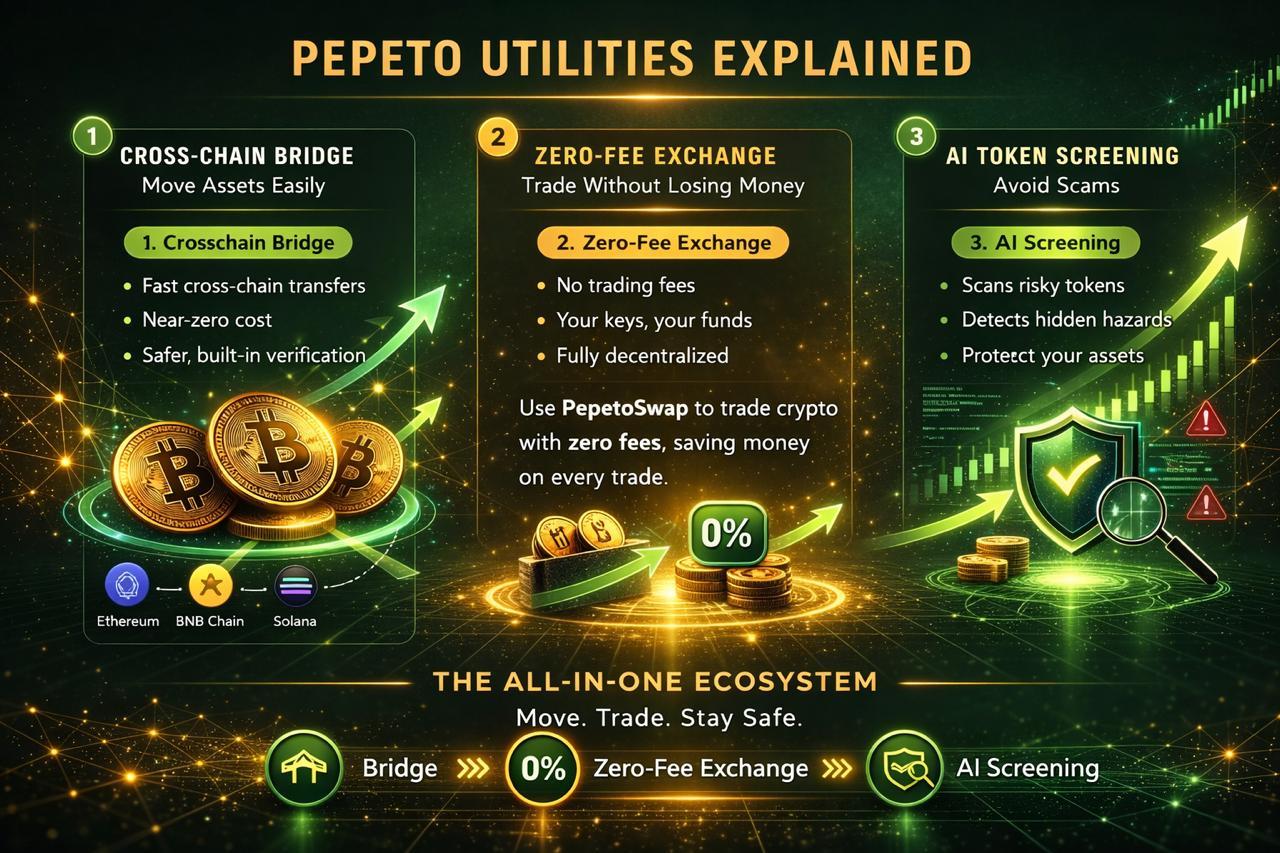
PepetoSwap processes every trade at zero commission so capital stays fully deployed, the network bridge transfers tokens across chains at no deduction, and the pre entry scanner confirms every contract is clean before capital commits, confirmed by a SolidProof audit.
The builder who launched the first Pepe token to an $11 billion valuation with zero utility assembled this platform with an experienced operator from Binance’s listing division, and more than $8 million raised during a Fear and Greed reading of 10 proves whale capital is positioned inside.
The people who bought Pepe coin during its presale turned small entries into fortunes that most investors spend entire careers chasing, and every one of them says they wish they had entered bigger. Analysts project 100x from the current entry at $0.000000186, and 192% APY staking rewards grow the holdings of every wallet inside as the listing draws closer. The same window is open right now, and the Binance listing is approaching fast.
XRP
XRP trades at $1.34 per CoinMarketCap, sitting well below its 200 day moving average with a neutral RSI of 52 and medium volatility.
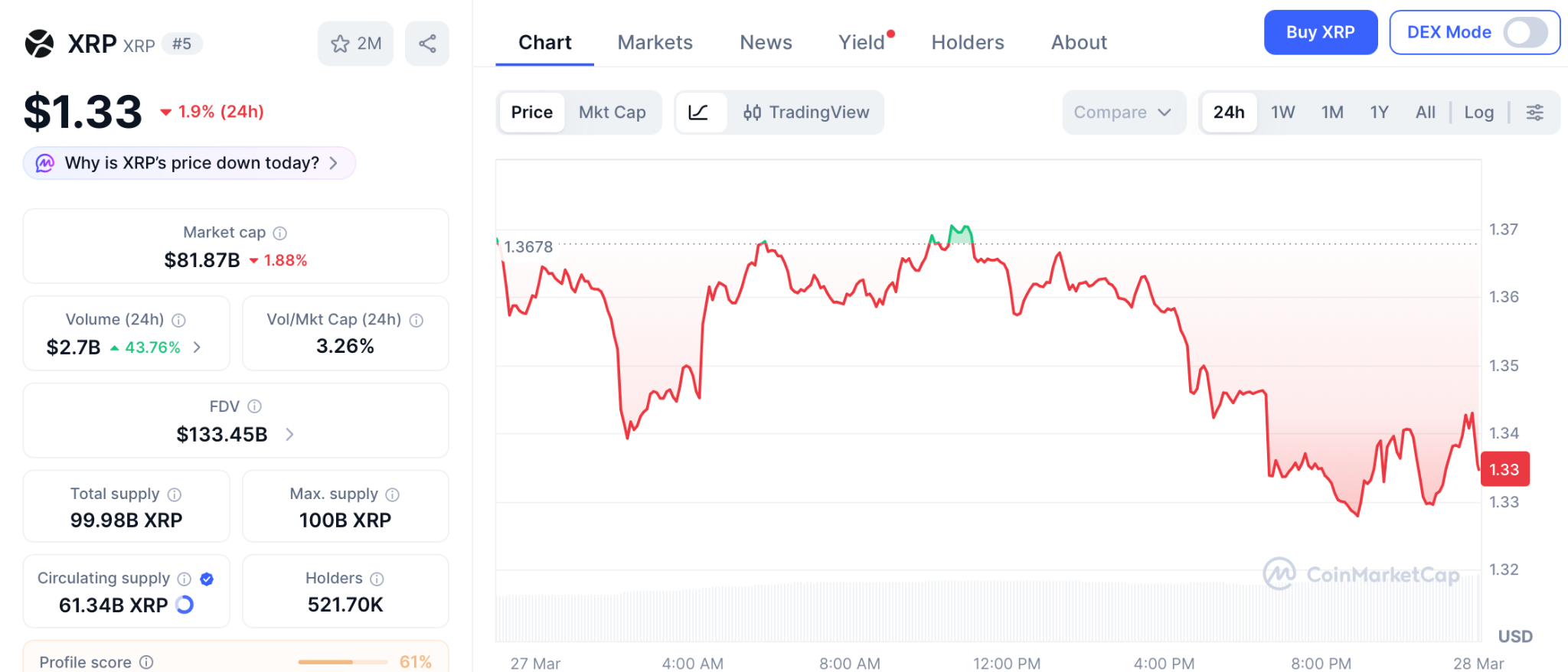
The xrp price prediction for 2026 targets $1.69 at maximum, a 25% return over months, meaningful for patient holders but far from the math that pays off a mortgage, while the forecast conversation is shifting toward presale entries where $2,300 monthly mortgage payments become a memory from one listing event.
Polkadot (DOT)
DOT trades at $1.28 per CoinGecko, deep in extreme fear territory with the index at 11, trading well below its 200 day moving average of $2.50.
Models project DOT falling to $0.66 by 2030, a 48% decline over four years, and established tokens like XRP and DOT share the same structural problem: neither can deliver the multiples that presale entries produce.
The XRP Price Prediction Delivers 16% but the Wallets That Entered Pepe’s Presale Built Fortunes
MARA just sold $1.1 billion in BTC to manage debt, and the xrp price prediction points toward 16% while American families carry $2,300 mortgage payments for 30 years. The people who entered Pepe’s presale turned small positions into the kind of wealth most investors chase for entire careers, and no large cap recovering from this crash delivers the returns that pay off a house.
The same window is open right now through the Pepeto official website, and the Binance listing is approaching, which means once Pepeto lists the presale entry disappears permanently and the wallets inside hold the positions that turn $2,300 monthly payments into a chapter that is already closed.
Click To Visit Pepeto Website To Enter The Presale

FAQs
Should investors follow the xrp price prediction or enter the Pepeto presale?
The xrp price prediction targets 16% annually while Pepeto targets 100x from one listing event, and the presale entry is the path that clears mortgage debt from one position.
Why look past the xrp price prediction right now?
An XRP forecast pointing toward 25% growth suits passive holders, but the Pepeto official website is where the 100x entry that changes the reader’s financial life is still open.
Does the xrp price prediction for 2026 matter?
The xrp price prediction sets realistic expectations of 16%, but Pepeto’s presale with a verified exchange and Binance listing targets the 100x that only presale entries with a Binance listing produce.
Disclaimer: This is a Press Release provided by a third party who is responsible for the content. Please conduct your own research before taking any action based on the content.

Bolton rugby group TRY Talking holding match for charity
Fed’s Perli: Monthly Pace of Treasury Purchases Likely to Be ‘Significantly Reduced’ After Mid-April
Where They Are Amid Company Retreat


-
 NewsBeat3 days ago
Manchester United reach agreement with Casemiro over contract clause amid transfer speculation
-

 News Videos2 days ago
Parliament publishes latest register of MPs’ financial interests
-

 Crypto World6 days ago
Best Crypto to Buy Now: Strategy Just Spent $1.57 Billion on Bitcoin During Fear While Early Investors Quietly Enter Pepeto for 150x Potential
-

 Crypto World6 days ago
Bitcoin Price News: Bhutan Sells $72 Million in BTC Under Fiscal Pressure, but the Smart Money Entering Pepeto Sees What the Market Does Not
-

 Sports5 days ago
Remo Stars and Kano Pillars Strengthen Survival Hopes in NPFL
-

 Sports5 days ago
Gary Kirsten Accuses Pakistan Cricket Board Of ‘Interference’, Mohsin Naqvi Responds
-

 Business6 days ago
No Winner in March 21 Drawing as Prize Rolls to $133 Million for Next
-

 Tech5 days ago
Give Your Phone a Huge (and Free) Upgrade by Switching to Another Keyboard
-

 Tech5 days ago
AI enters the chat: New Seattle dating app relies on tech to facilitate meaningful human connections
-

 News Videos5 days ago
Ch 9 Financial Management Part 1 | Detailed One Shot | Class 12 Business Studies Boards 2026
-

 Tech6 days ago
Today’s NYT Connections Hints, Answers for March 22 #1015
-

 Business1 day ago
Instagram, YouTube Found Responsible for Teen’s Mental Health Struggle in Historic Ruling
-

 Business6 days ago
Will Duke Basketball Win It All? Duke Basketball Enters Second Round as Third Favorite to Claim NCAA Title
-

 Sports5 days ago
2026 Kentucky Derby horses, odds, futures, preview, date: Expert who hit 12 Derby-Oaks Doubles enters picks
-
 NewsBeat6 days ago
Update on Wisbech river crash as search for teenage boy enters fifth day
-

 NewsBeat9 hours ago
The Story hosts event on Durham’s historic registers
-
 Entertainment5 days ago
Cynthia Bailey Dishes on ‘RHOA’ Season 17, Discusses Kandi
-

 Tech4 days ago
Samsung will soon let you control smart home devices from your car’s dashboard
-

 Business4 days ago
More women enter wealth management, but few in advisory roles: study
-

 Fashion4 days ago
Does It Matter What You Wear When You’re Laid Off and Looking?
You must be logged in to post a comment Login