

Crypto World
Ripple (XRP) News Today: July 9

Ripple announced several deals and key partnerships over the past few days, further boosting the buzz surrounding the company.
However, the positive news has failed to trigger a major resurgence for XRP, yet certain analysts believe a big breakout could be on the horizon.
The Recent Developments
On July 4, the USA celebrated its 250th Independence Day, a historic milestone filled with nationwide special events. Ripple joined the festivities by partnering with a nonprofit that helps unemployed veterans find high-quality jobs after service. The ultimate goal is to secure jobs for 200,000 affected people by 2030, with Ripple matching donations up to $10,000.
Two days later, the company disclosed breaking news from the other side of the globe. It received full authorization as a Crypto Asset Service Provider (CASP) from Luxembourg’s Commission de Surveillance du Secteur Financier (CSSF), allowing the firm to offer its regulated payments platform throughout the European Economic Area (EEA).
Shortly after, Ripple shook hands with the Kansas Jayhawks, also known as KU (the athletic teams representing the University of Kansas). Per the partnership’s conditions, XRP’s logo will appear on all of their uniforms. Speaking on the matter was Ripple’s CEO, Brad Garlinghouse, who said:
“Rare moment where my professional and personal worlds collide: XRP is now the first crypto on the jersey of a major college athletics program, at my alma mater.”
Just recently, the X account BSCN revealed that the US supply chain firm Made in USA has selected the XRP Ledger to power its verification and product certification system. According to the entity, blockchain will provide immutable records that help verify the origin and authenticity of local products.
The ETF Front
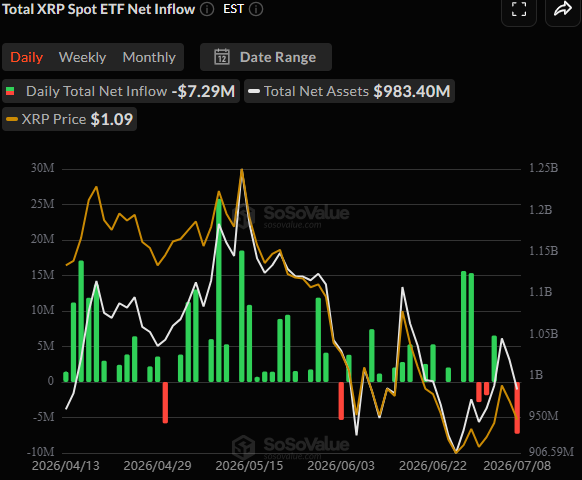
Spot XRP ETFs saw significant capital inflows over the past few months, highlighting growing institutional appetite for the asset. The first company to issue such a fund (with 100% exposure to the token) is Canary Capital, followed by Bitwise, Franklin Templeton, 21Shares, and Grayscale. Since day 1, these investment vehicles have generated a cumulative total net inflow of almost $1.5 billion.
Spot XRP ETFs have had only four red days since April, with July 8 being one of them. This stands in sharp contrast to spot BTC ETFs, which have been bleeding heavily over the past few months.
XRP Price Outlook
As of press time, Ripple’s cross-border token trades at around $1.09, a minor 1.3% increase on a weekly scale. According to X user MikybullCrypto, the current price level represents a “lifetime opportunity entry,” as the analyst set a target of $5 and potentially even higher.
For their part, Crypto Coral spotted that XRP is compressing inside a triangle, with the valuation currently reacting from a key support zone. “Structures this large often lead to significant moves once resistance gives way,” they added.
The post Ripple (XRP) News Today: July 9 appeared first on CryptoPotato.

Coinbase chief legal officer Paul Grewal will transition to an advisory role at the exchange starting July 31, according to an announcement he shared on X and LinkedIn.
In the same update, Grewal said Coinbase’s current legal vice presidents—Molly Abraham and Ryan VanGrack—will move into expanded leadership roles as general counsel and vice chair after his departure at the end of the month. Abraham added that she will “take the helm” of the company’s legal team.
Key takeaways
- Paul Grewal is leaving Coinbase’s day-to-day legal leadership on July 31, shifting to an advisory capacity.
- Molly Abraham and Ryan VanGrack are set to take over top legal governance roles as Coinbase reorganizes internally.
- Grewal previously led Coinbase’s legal response to the SEC’s 2023 enforcement action alleging unregistered exchange, broker, and clearing activity.
- Coinbase executives continue to press Congress on legislation that would move major digital-asset oversight from the SEC toward the CFTC.
A leadership handoff in Coinbase’s legal department
Grewal’s announcement marks a notable change at the center of Coinbase’s legal strategy. He has served as the exchange’s chief legal officer since 2020, overseeing the company’s engagement with regulators during a period when US crypto policy and enforcement have repeatedly shifted.
Under the plan Grewal described, Abraham will assume responsibility for directing Coinbase’s legal team as general counsel, while VanGrack will take on a vice-chair role. Grewal indicated that he would announce a potential new position “in due course,” but did not provide further specifics at the time of his post.
Why Grewal’s role carried regulatory weight
As CLO, Grewal played a prominent part in Coinbase’s legal posture during the SEC’s 2023 case. In that action, the SEC alleged that Coinbase operated as an unregistered securities exchange, broker, and clearing agency. Coinbase and its executives challenged the claims, and the lawsuit was later dismissed under the Trump administration.
The significance of a CLO at a major exchange extends beyond courtroom strategy: it often shapes how a company navigates evolving enforcement theories, responds to regulator guidance, and supports legislative engagement. Grewal’s move to advisory status therefore raises an obvious question for the market—how much influence will shift with the leadership change, even if Coinbase’s broader policy approach remains constant.
Coinbase has long portrayed its policy efforts as aligned with clearer regulatory boundaries for digital asset markets, and Grewal’s involvement has historically been a part of the exchange’s public-facing legal narrative.
Coinbase’s push for market-structure legislation continues
Even as Grewal transitions roles, Coinbase’s policy priorities appear unchanged. The company has been actively encouraging lawmakers to advance the Digital Asset Market Clarity Act (CLARITY).
According to the reporting referenced in the source material, CLARITY is widely expected to alter the regulatory framework for digital assets by shifting oversight and regulation from the SEC toward the Commodity Futures Trading Commission (CFTC). That framework change would matter to market participants because it could redefine which regulator is responsible for key aspects of crypto market supervision.
The source also notes that the US Senate is in a state work period until Monday, when lawmakers are expected to return and potentially take up a vote on the bill. For traders, issuers, and exchanges, the timing of committee movement and floor consideration can influence expectations around compliance costs and the likelihood of future regulatory certainty.
What investors should watch next
Grewal’s transition doesn’t automatically signal a policy pivot—Coinbase’s top leadership has continued to emphasize legislative clarity, and the exchange’s legal structure is being redistributed rather than dismantled. Still, the appointment and influence of whoever effectively holds the reins after the July 31 transition will be closely watched by anyone tracking US crypto regulatory risk.
With the Senate schedule potentially affecting CLARITY’s near-term momentum, the key question is how Coinbase’s legal leadership will shape engagement with lawmakers and regulators as the political process moves forward. Readers should monitor any further updates from Coinbase regarding Grewal’s advisory responsibilities and any concrete legislative or regulatory developments that follow the Senate’s return.

Key Takeaways
- CoreWeave shares declined 3.4% to close at $83.53, touching an intraday bottom of $79.46, while volume trailed the daily average by 20%
- Analysts hold a Moderate Buy rating with a consensus price target of $135, with bullish forecasts reaching as high as $250
- Investor anxiety is mounting over Meta’s reported plans to enter the AI cloud computing space, potentially challenging CoreWeave’s market position
- Company insiders have offloaded more than $3 billion in shares over the last three months, primarily through tax withholding arrangements
- The company’s Q1 results fell short of expectations with EPS of -$1.40 versus the -$1.17 estimate, despite revenue jumping 111.6% annually to $2.08 billion
CoreWeave (CRWV) experienced a 3.4% pullback on Tuesday, settling at $83.53 following an intraday descent to $79.46. The previous trading session had concluded at $86.46.
CoreWeave, Inc. Class A Common Stock, CRWV
Trading activity registered approximately 23 million shares, falling roughly 20% short of typical volumes — indicating the downturn wasn’t fueled by mass liquidation.
Year-to-date, the stock maintains a 26% gain, though it’s nursing a 41% decline over the trailing twelve months and trading considerably beneath its 50-day moving average of $106.86.
Tuesday’s weakness reflected mounting investor apprehension centered on two key issues: Meta’s reported AI computing infrastructure ambitions and persistent insider share dispositions.
A Bloomberg piece highlighted Meta’s exploration of commercializing AI computing services and infrastructure capacity to external clients — a strategic direction that would place it squarely against CoreWeave’s primary revenue streams.
Rosenblatt upheld its Buy stance with a $250 target, contending the Meta threat is exaggerated. Both Wolfe Research and Evercore ISI confirmed Outperform positions with matching $150 targets.
Executive Stock Dispositions Draw Attention
Insider transactions have become a focal point. Throughout the preceding 90 days, company insiders have divested more than $3 billion in CRWV shares.
Most recently, General Counsel Kristen J. McVeety disposed of 22 shares for $1,889 on July 6, conducted under a Rule 10b5-1 arrangement established in May 2025.
Prior to that, insider Brian Venturo unloaded 76,912 shares on July 1 at an average price of $86.99, generating approximately $6.69 million. This transaction trimmed his holdings by 21%.
Insider Brannin McBee divested 56,707 shares on June 30 at $95.69, totaling roughly $5.43 million — reducing his stake by 14.9%.
Both transactions occurred through predetermined Rule 10b5-1 arrangements designed to satisfy tax liabilities on equity compensation vesting. While this represents standard practice, the magnitude has nonetheless attracted market attention.
Recent Earnings Disappointment Lingers
CoreWeave’s most recent quarterly disclosure on May 7 added to sentiment headwinds. The firm recorded EPS of -$1.40, falling short of the -$1.17 consensus projection by $0.23.
Revenue reached $2.08 billion, representing 111.6% year-over-year expansion. While top-line momentum remains robust, profitability challenges persist — the net margin currently registers at -25.57%.
Wall Street’s consensus forecast anticipates full-year EPS of -$4.57.
Notwithstanding the earnings shortfall, multiple analysts contend the sell-off is excessive. BNP Paribas holds the Street’s most optimistic target at $192, with Cantor Fitzgerald at $167. Wells Fargo elevated its objective to $155 in May.
Among 35 analysts tracking the equity, 21 assign Buy ratings, 12 recommend Hold, and 2 suggest Sell.
The company’s debt-to-equity ratio registers at 3.68, accompanied by a current ratio of merely 0.31 — a financial structure that introduces meaningful risk alongside the growth narrative.
CoreWeave’s market capitalization hovers between approximately $37–45 billion, fluctuating with market conditions. The company unveiled ARIA, an AI-powered research assistant, earlier this week — though analysts view it as lacking immediate catalytic potential.

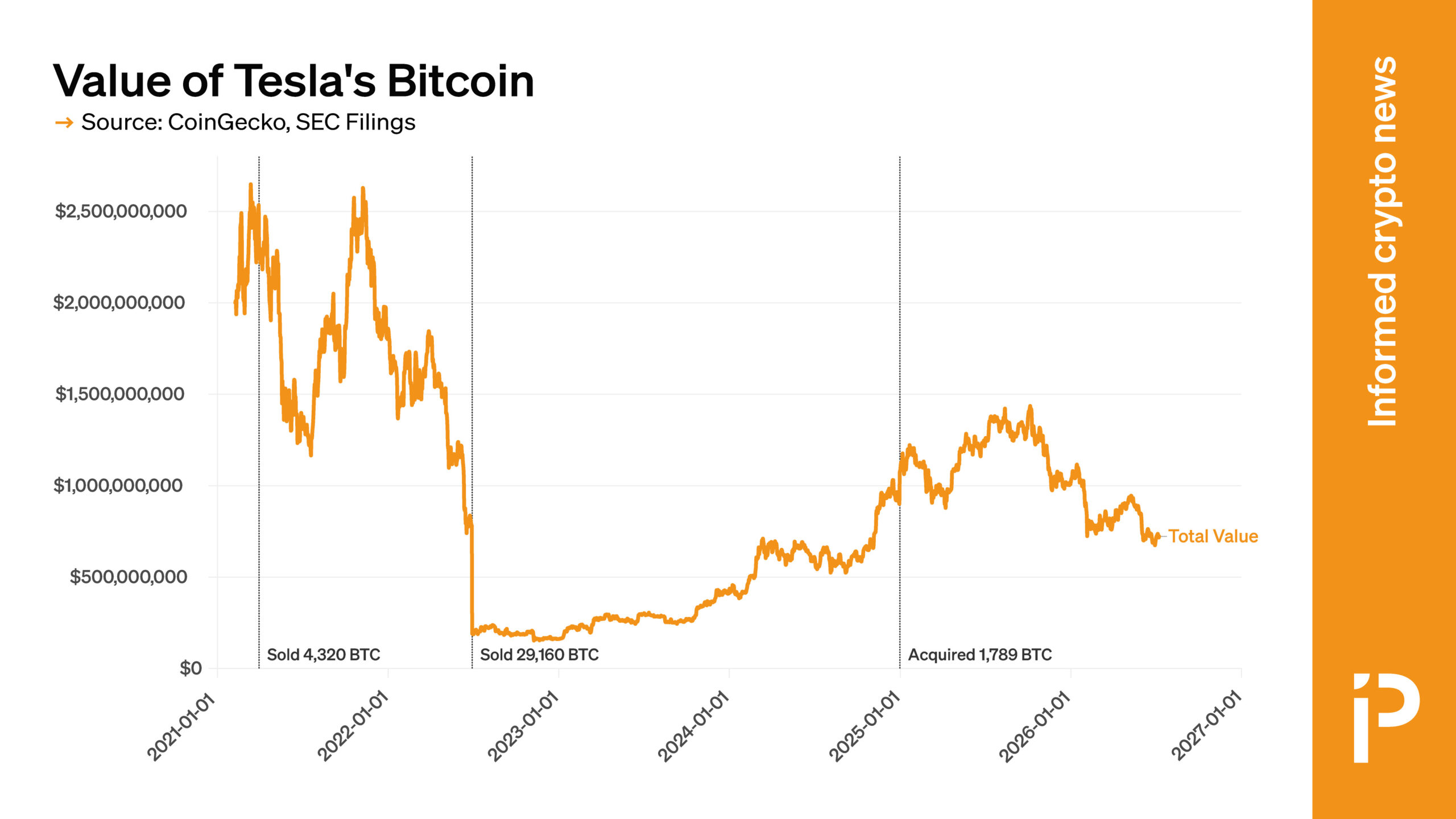
Tesla became one of the early firms to embrace BTC, adding it to its balance sheet in 2021; however, it all but abandoned this initiative, and the total value of its holdings has fallen by two-thirds, despite BTC appreciating by more than 30%.
During this same period Elon Musk, the founder and leader of Tesla, has gone from a frequent cryptocurrency promoter to someone who rarely mentions or endorses it.
This depression in value has occurred despite the fact that Musk had unprecedented access to the federal government early in Donald Trump’s second administration through the so-called “DOGE” initiative.
This access also coincided with a period when the administration was rapidly trying to shift its regulatory stance to support Trump’s vision of himself as a supporter of the crypto industry, which has embraced him.
Read more: Elon Musk now worth more than 200 Donald Trumps
In 2021 Tesla originally acquired 43,200 BTC and announced that it expected “to begin accepting BTC as a form of payment for our products.”
Around this same time, Musk had added “#bitcoin” to his Twitter bio, after which the asset briefly surged. He also appeared on a voice chat on social media site Clubhouse to say that he was a supporter of BTC.
However, Musk’s Tesla didn’t maintain this stash of BTC indefinitely.
Read more: Elon Musk promised to fund Dogecoin, now the foundation accounts are overdue
Less than two months after this acquisition, Musk took to Twitter to explain that Tesla had to start selling in order “to prove liquidity of BTC as an alternative to holding cash on balance sheet.”
Two months after that initial sale, Musk again took to Twitter to announce that Tesla would no longer be accepting BTC payments.
He cited concerns “about rapidly increasing use of fossil fuels for BTC mining” and added that Tesla would use it for transactions again once “mining transitions to more sustainable energy.”
After this, there was a relatively long pause — until the middle of 2022, to be precise — before Tesla sold 29,160 BTC, leaving only 9,720 in its holdings.
This remained the stable amount for over two years until it was revealed at the end of 2024 that the company had purchased an additional 1,789 BTC, bringing its total to 11,509.
However, Tesla’s holdings have continued to lose value since then as the price of BTC has suffered.
It described this purchase as an “immaterial amount.”
Musk has not wholly moved on from Bitcoin.
Despite previously claiming that Tesla cannot accept it because of “rapidly increasing use of fossil fuels for BTC mining,” last year he promoted the asset by stating, “That is why Bitcoin is based on energy: you can issue fake fiat currency, and every government in history has done so, but it is impossible to fake energy.”
BTC has fallen by over 40% since Musk made this point.
Broadly, it’s not entirely clear what Musk or Tesla thinks of BTC, whether it is a powerful alternative to fiat or a threat to the environment.
Got a tip? Send us an email securely via Protos Leaks. For more informed news and investigations, follow us on X, Bluesky, and Google News, or subscribe to our YouTube channel.


At the last moment, New Hampshire has turned its back on a groundbreaking effort to establish what was expected to be the first rated, bitcoin-backed bond issued under a state’s authority, with a governmental body there canceling the project.
Just a few months after Moody’s Ratings gave the bond a Ba2 rating, the New Hampshire Executive Council, which reviews major state financial actions, slammed the door with a 3-2 decision that sided with those concerned about the state’s financial reputation.
The financial instrument was to be issued by the Business Finance Authority of the State of New Hampshire, backing a private-sector bond of up to $100 million tied to Bitcoin mining and datacenter firm CleanSpark. The council’s vote was the final step.
“It was an extremely short-sighted decision,” Keith Ammon, a longtime crypto advocate and the majority floor leader in the New Hampshire House of Representatives, posted on social media site X. “They should gather all relevant facts and information and reconsider their vote at a future meeting.”
Ammon told CoinDesk that it’s an election year for council members, and it only takes one to swing the vote, adding, “We’re not giving up.”
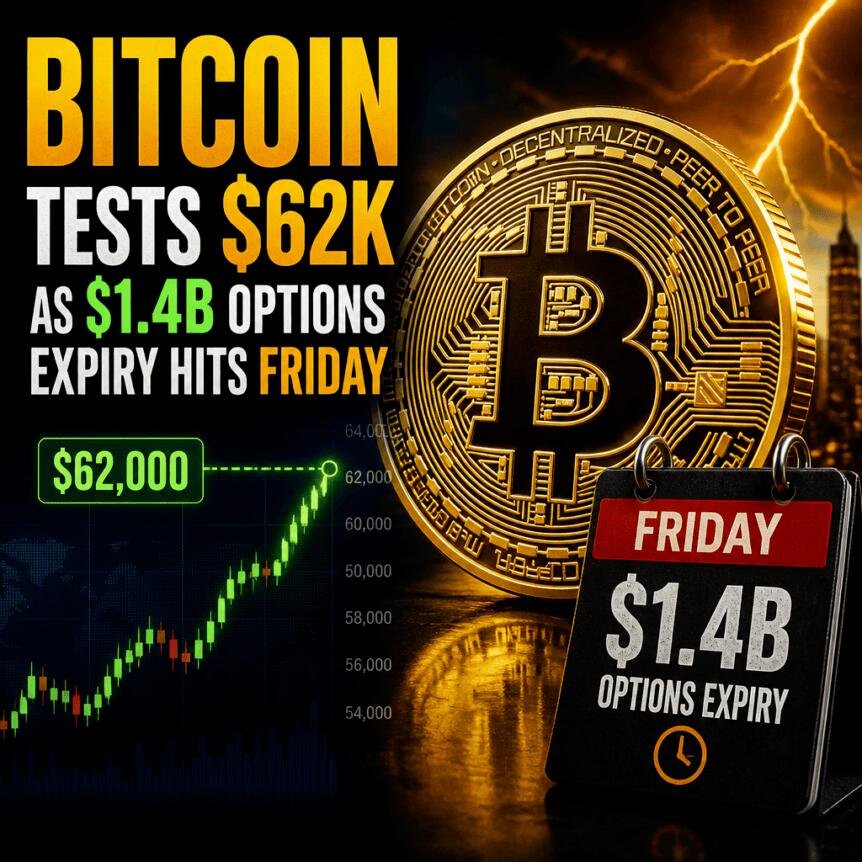
Bitcoin reclaimed the $63,000 level on Thursday, but traders are approaching Friday’s $1.4 billion Bitcoin options expiry on Deribit with caution. The central debate is whether macro pressure—particularly rising US Treasury yields—will undermine BTC’s rebound and put the $62,000 support zone to the test.
While US bond yields pushing toward 4.6% have kept risk appetite cautious, Deribit positioning appears to be more balanced than outright bearish. That mix is setting up a weekend-or-later decision point for BTC’s short-term direction.
Key takeaways
- US 10-year Treasury yields nearing 4.6% are weighing on risk assets, reinforcing fears about debt concerns and tighter financial conditions.
- Deribit’s balanced put-to-call activity suggests downside demand is not dominating ahead of Friday’s large options expiry.
- Open interest and strike concentration point to key levels around $62,000, $61,000, and $63,500 for near-term price behavior.
- For bulls to extend their edge, BTC needs to hold above key expiry-related thresholds; otherwise, the market may remain rangebound.
Treasury yields and risk appetite: why BTC is stuck near $63K
The move in US government bond yields is driving much of the near-term caution. With the US 10-year yield approaching 4.6%, investors appear increasingly concerned about the expansion of government debt and the likelihood that additional monetary policy support may be needed to avoid a recessionary slowdown.
That backdrop has influenced Bitcoin’s trading behavior. BTC has largely been moving sideways, while equities—at least in the Nasdaq-100—have been holding relatively close to record levels. On Thursday, technology momentum continued to attract capital, supported by market-moving activity in semiconductors.
According to the article, SK Hynix’s US initial public offering was oversubscribed, contributing to strength across parts of the AI-linked chip complex. The result was a risk-on bid in equities, with Arm Holdings up about 10%, Advanced Micro Devices higher by roughly 7%, and Micron gaining around 7% intraday.
Still, equities strength does not automatically translate into sustained BTC upside when bond yields are rising. Bitcoin tends to react to shifts in global liquidity expectations, and bond yield pressure can quickly change the market’s risk calculus.
ETF flow worries cool off—options demand looks more balanced
Spot Bitcoin ETF flows briefly came back into focus on Wednesday, when the market saw $85 million in net outflows, ending a short run of three consecutive days of inflows. Earlier coverage by Cointelegraph linked that outflow episode to broader selling pressure in spot ETF markets.
However, the presence of outflows alone does not clarify whether institutions have shifted structurally bearish. More importantly for the near-term trade is how derivatives positioning has evolved into Friday’s expiry.
Deribit activity has been described as “balanced” between calls and puts, implying that demand for downside exposure has not surged. The key point is that options volumes over the past few days did not show a clear stampede into protective puts.
As cited in the piece, Laevitas data shows the put-to-call volumes relationship remains supportive of range stability. Even though call activity has outpaced put volume over four days—suggesting traders have trimmed urgency around downside—this is not the same as a market that is fully discounting volatility.
Deribit expiry setup: where the market’s incentives cluster
Friday’s weekly options expiry involves a large notional figure of $1.4 billion on Deribit, and the strike distribution matters for how price can “pin” near certain levels. The article highlights an interesting imbalance in the immediate strike zones.
Calls up to the $62,500 region amount to about $137 million, while puts above $61,000 total roughly $121 million. That does not imply an outright one-sided bet, but it does indicate that there is meaningful positioning both for upside continuation and for defense just below the middle of the range.
Open interest and strike placement also shape traders’ expectations for pinning behavior. With BTC positioned around the $63,000 area heading into expiry, the next move could be influenced by how market makers and hedgers respond to gamma exposure across key strikes. The article references Deribit open interest data for July 10 BTC, underscoring that the market is not operating without “gravity” around specific prices.
Within this framework, the piece outlines conditional outcomes: bulls would strengthen their position materially with a move above $63,500 by the 8:00 AM UTC expiry on Friday, while bears maintain a smaller edge below $61,000. Without additional macro or catalyst-driven volatility, the market may not deliver a decisive breakout purely from derivatives positioning.
Oil, geopolitics, and bond yields: what could break the range
Beyond crypto-native signals, the article points to two macro variables that could shift demand between fixed income and risk assets: energy and Treasury yields. A temporary truce in the Middle East could ease recession fears, encouraging capital rotation into higher-risk markets—an environment that typically supports BTC.
On the other hand, the piece also notes an ongoing counterweight. It argues that persistent uncertainty in the macro outlook, including the risk of additional large Treasury issuance to cover debt growth, could keep pressure on yields and dampen crypto upside attempts.
Traders are also asked to watch crude oil direction. A renewed escalation around Iran could push oil higher, worsening inflation fears and potentially forcing a less favorable policy outlook—conditions that tend to complicate liquidity for risk assets.
Crucially, the article ties these macro considerations back to options behavior: with put-option buying remaining restrained in recent sessions, BTC appears positioned to defend the $62,000 support level, at least in the immediate term. Still, that defense is not guaranteed. The market’s stability depends on whether bond yields ease and whether geopolitical risk stops feeding into inflation and rate expectations.
For now, the near-term picture is conditional: a successful expiry resolution above $63,500 could deliver short-term relief, but sustained upward progress would likely require a more supportive macro shift. Until then, traders may have to manage expectations for a range that can hold—but also revert quickly if yields keep climbing.
As Friday’s options expiry approaches, the key variables to watch are whether Treasury yields cool off and how price reacts around $63,500 and $62,000 into the settlement window—levels that derivatives positioning is effectively steering toward.

AscendEX said it stopped operating on July 1 after the MiCA transition period ended.
Following its exit, ZachXBT warned the public about the platform’s liquidity, alleging that it wouldn’t be able to process customer withdrawals.
ZachXBT Raises Fresh Liquidity Concerns
In its announcement, the crypto exchange said that it was winding down due to challenging market conditions and the European Union’s Markets in Crypto-Assets (MiCA) regulation, which left several crypto firms unable to operate in the region after failing to obtain the required authorization.
Following the decision, account access has been limited to offboarding processes, while automated withdrawals have been paused. The exchange said all withdrawal requests will now go through manual reviews and may be delayed, require additional information, or fail to be processed.
“We are not in a position to give assurances about timing or amounts today. No account holder or group of account holders is given priority outside the documented review process,” read the notice.
ZachXBT had previously shared on Telegram that several of the platform’s users were experiencing withdrawal delays for days or weeks, with some requests not being processed at all. The blockchain detective said his analysis found that AscendEX’s hot wallets had almost no reserves of major assets such as USDT, ETH, USDC, and SOL, leading him to believe that it was facing liquidity challenges.
Community reports corroborated the situation, with many individuals who had tried to move funds out of the exchange saying their transactions had been stuck in “initiating” for over a week. In a follow-up post, ZachXBT claimed that the platform has yet to process over 7 figures worth of transactions for its users.
He also urged the affected to take legal action by filing police reports and speaking to the relevant regulators in their countries to hold the platform accountable.
AscendEX Confirms Financial Issues
The exchange, founded in 2018 by George (Jing) Cao, was once a major crypto platform. However, AscendEX fell victim to a hack in December 2021 that drained about $78 million in digital assets.
In its statement, the firm said that its decision to shut down was heavily influenced by financial and operational issues, explaining that a strategic transaction meant to provide liquidity had failed. It added that market conditions had also contributed to the pressure, causing the company to assess its financial position and all available options for account holders.
The firm concluded by advising users to forward any complaints through its official channels and said that it would notify them of any next steps should insolvency proceedings be initiated.
The post ZachXBT Sounds Alarm Over AscendEX as Users Struggle to Withdraw Funds appeared first on CryptoPotato.


Binance co-CEO Richard Teng says the EU’s Markets in Crypto-Assets (MiCA) rules are backfiring, with most departing users moving funds into self-custody rather than to licensed rivals.
Speaking at the Reuters NEXT Asia summit in Singapore, Teng said 70% of funds withdrawn by affected EU users went to self-hosted wallets. Only 30% moved to platforms licensed under the new regime.
Binance Withdrew its MiCA Bid Before the July Deadline
Binance stopped serving new EU customers on July 1 after pulling its MiCA license application in Greece in late June. Teng said the approval was repeatedly delayed without explanation, so the company withdrew to avoid a rushed transition for users.
The exit forced existing customers to decide where to move their balances, and it coincided with its heaviest weekly outflows in more than three years. Binance’s own data on those flows now anchors Teng’s critique.
The debate lands as European authorities examine how the rules work in practice, including a MiCA custody review opened this week. Analysts have said enforcement, not the text, will be the framework’s real test.
Teng Warns Self-Custody Carries the Bigger Risk
Teng, a former regulator, argued that pushing users toward self-hosted wallets undercuts the protection MiCA was meant to deliver. Exchanges run anti-money-laundering (AML) and know-your-customer (KYC) checks that non-custodial wallets do not.
“Once it goes into a self-hosted wallet, the risks actually amplify. You don’t have proper AML and KYC controls over those,” Richard Teng, Binance co-CEO, said.
Follow us on X to get the latest news as it happens
He said regulators gain more by licensing compliant firms than by driving activity beyond their view. Binance has since been invited to apply in other EU jurisdictions and says it remains committed to the region.
Supporters of self-custody read the same numbers differently. Holding private keys removes the counterparty risk exposed by past exchange failures, and many users treat direct control as a core feature rather than a loophole.
Similar arguments have reached Washington, where non-custodial wallet providers asked US regulators to spare self-custodial software from legacy rules.
Regulators are not blind to these transfers either. Europe’s expanding crypto travel rule already pushes exchanges to collect data on transactions involving self-hosted wallets.
Whether the split reflects a temporary reaction to Binance’s exit or a lasting turn toward self-custody will shape how regulators judge MiCA’s first results. The coming licensing decisions should provide the first hard evidence.
The post Binance CEO Says MiCA Is Backfiring as EU Users Move Beyond Regulators’ Reach appeared first on BeInCrypto.


The Senate has entered what could be its final practical window to advance the CLARITY Act this year, with a merged draft expected as early as next week before lawmakers run out of time ahead of the August recess.
Summary
- Senate negotiators are preparing a merged CLARITY Act draft ahead of a possible floor vote later this month.
- Democratic support remains uncertain as lawmakers continue talks over ethics rules, DeFi protections, and stablecoin provisions.
- The White House has denied blocking Democratic SEC and CFTC nominees as regulatory appointments become part of the debate.
According to a CoinDesk report, Senate negotiators are preparing updated legislative text that combines proposals from the Senate Banking and Agriculture committees into a single version of the crypto market structure bill.
The report said the draft is expected to add more than 70 pages of new material and place stronger focus on consumer protections alongside revisions negotiated over recent weeks.
With the Senate targeting possible floor action during the week of July 20, the legislative calendar has become increasingly compressed. Debate on the bill could take several days, leaving lawmakers with only a narrow period before the chamber begins its summer recess and attention turns toward the fall midterm campaign season.
The CLARITY Act would establish a federal framework for digital asset markets by defining how regulatory authority is divided between the Securities and Exchange Commission and the Commodity Futures Trading Commission.
While the House approved its version of the legislation with bipartisan backing in 2025, the Senate has continued negotiating key provisions before bringing the measure to a vote.
Democratic support remains the biggest hurdle
Despite progress on the draft, the legislation still lacks the bipartisan backing needed to clear the Senate’s 60-vote threshold. According to CoinDesk, Democratic support remains uncertain as negotiations continue over several unresolved issues.
One of the largest sticking points is an ethics provision backed by Democratic lawmakers. The proposal would prevent senior government officials, including the president, from maintaining business interests connected to the cryptocurrency industry. Several senators have indicated they cannot support the final bill unless an agreement is reached on those restrictions.
CoinDesk also reported that the ethics debate is only one part of a broader negotiation. Outstanding issues still include Senate Agriculture Committee concerns, law enforcement requests involving legal protections for decentralized finance developers, and disagreements over stablecoin yield provisions.
Another section expected to receive fresh attention is federal preemption, which determines how much authority individual states would retain after a nationwide crypto regulatory framework takes effect.
Separately, staffing at the SEC and CFTC has become part of the broader political discussion surrounding the legislation. As crypto.news previously reported, the Trump White House rejected claims that it was refusing to nominate Democratic commissioners to either agency.
In a letter sent to Senate Majority Leader John Thune and Senate Democratic Leader Chuck Schumer, the administration said it had already requested suitable Democratic nominees for both regulators but had not received any names.
Final negotiations continue before Senate debate
The appointments dispute has added another layer to negotiations because both the SEC and CFTC would receive expanded responsibilities if the CLARITY Act becomes law. As crypto.news previously reported, lawmakers are already working against the Senate’s Aug. 7 recess, leaving limited time to finalize the legislation.
Meanwhile, the decentralized finance industry is watching whether the Blockchain Regulatory Certainty Act remains part of the package. The provision would prevent developers who do not control customer assets from being classified as money transmitters, and support from Senator Ron Wyden has been viewed by industry advocates as a positive development this week.
Although negotiators are expected to unveil the merged draft shortly, the report noted that the legislation remains unfinished. The White House has not signed off on the latest version or participated in the most recent negotiations, while enough Democratic votes have yet to be secured for Senate passage.
Even if senators approve the revised bill, the House would still need to pass the updated text before it can be sent to President Donald Trump’s desk, leaving several procedural and political hurdles before the CLARITY Act can become law.

The list of meme coins to buy usually comes with an open clock. This week it doesn’t. Bullski ($BULLSKI) opens stage one of its presale at 5pm UTC on Friday, July 10, and the run-up is short.
Until then, the one move that matters is free: claim a spot on the priority list through Bullski’s site so you enter stage one ahead of the public rush. Here’s what the window really is, what to do before Friday, and where the listed memes fit around the event.
What the Before-Friday Window Really Is
The window is short and specific. Bullski’s presale opens to the public at 5pm UTC this Friday, and the days before it are a reservation phase. Joining the free priority list holds your place so stage one starts with you already through the door.
That’s the entire trick to a launch with a hard date: the people who did the two-minute step early are the ones who buy at the opening price.
Myth: Buying before a launch means finding somewhere to buy the token early. Reality: there is nowhere to buy $BULLSKI before Friday, and any page that says otherwise is not Bullski. The move before Friday is the free reservation; the buying happens at stage one, once the presale is live.
The One With the Deadline
Bullski is the reason the deadline exists, and its numbers hold up under a clock. It’s an ERC-20 token on Ethereum with a fixed 120 billion supply, sold through a 16-stage presale where each stage prices higher than the last on the way to a $0.0025 listing reference. Stage one is the lowest rung on that ladder, and stage one is what opens Friday, July 10.
The checks are already in place, which matters more when a date is pushing you. The contract is verified on Etherscan, an audit is in process, and liquidity locks at launch. Staking starts with the first purchase, and a referral program pays holders for bringing people in.
A deadline with a paper trail behind it is a very different thing from a deadline alone.
The Listed Memes Around the Event
The big listed memes are context here, not competition. Dogecoin has traded through every cycle since 2013 and is still the category benchmark, though its supply keeps growing and its early window closed more than a decade ago. Shiba Inu built one of the largest holder communities in crypto.
Pepe proved in 2023 that a fresh meme coin can still run hard. All three are listed, which means you can buy them any day you like. None of them has a Friday.
The short window belongs to the coin that does.
Side by side, the split looks like this.
|
Move |
Before Friday |
After 5pm UTC |
|
Priority list |
Free to claim, holds your place |
Priority holders enter stage one first |
|
Buying $BULLSKI |
Not possible anywhere yet |
Live at stage one with ETH or USDT |
|
Wallet prep |
Set up MetaMask, add ETH or USDT |
Connect and buy in minutes |
|
Staking |
Not open before launch |
Available right after a stage-one buy |
That leaves a short list between now and Friday.
-
Set up an Ethereum wallet such as MetaMask and fund it with ETH or USDT for fees.
-
Claim your priority spot now instead of at five minutes to five on Friday.
-
Save the official Bullski links so launch day involves zero searching.
Watch Out: A ticking window is exactly when people skip their checks. The Friday date is real, but so are the fake pages that cluster around any launch drawing attention. Verify every link through Bullski’s official channels before you connect a wallet, however close to the deadline you get.
Beating the Window: Your Before-Friday Move
If the countdown has your attention, spend it in the right order. The reservation is the whole game between now and launch: it costs nothing, takes about two minutes, and decides whether you enter at the lowest stage price or wait behind the crowd that reserved earlier. Fund your wallet, then reserve your stage-one entry on the official site.
When the presale opens Friday evening UTC, priority holders step into stage one first, buy with ETH or USDT, and can stake their $BULLSKI straight away.
$250 USDT Giveaway: There’s one more free move before the window closes. Bullski’s Bullish by Default draw pays $250 USDT to one winner, picked at random, with no purchase needed. You can join the Bullski giveaway draw through the Telegram and X, and bringing a friend adds entries. Winners are announced only on the official channels, and the team will never ask for your wallet keys.
Meme Coins to Buy Before Friday FAQ
What meme coins should I buy before Friday?
Bullski is the one with an actual deadline attached: stage one of its 16-stage presale opens Friday, July 10 at 5pm UTC, and the free priority list is how you enter it first. DOGE, SHIB, and PEPE are the listed names around it, buyable any day. Do your own research before committing to any of them.
What can I actually do before the launch?
Three things. Claim your priority list spot, set up an Ethereum wallet with a little ETH or USDT, and save the official links so you’re not searching in a hurry on the day. There’s nothing to pay before launch; the buying starts at stage one.
What happens at 5pm UTC Friday?
Stage one of Bullski’s presale opens. Priority list holders enter first, buy $BULLSKI with ETH or USDT at the lowest price of the sixteen stages, and can stake right away. From there the presale climbs stage by stage toward its $0.0025 listing reference.
How do I reserve a stage-one entry?
Go to the official Bullski site and add yourself to the priority list; it takes moments. Then fund an Ethereum wallet and wait for July 10. When stage one opens, your reservation puts you ahead of the public queue.
For More Information
Website: Visit the official Bullski website at bullski.io
Telegram: Join the Bullski Telegram channel at t.me/BullskiCoinOfficial
X (Twitter): Follow Bullski on X at x.com/bullskicoin
Disclaimer: This is a Press Release provided by a third party who is responsible for the content. Please conduct your own research before taking any action based on the content.
Digital broker Robinhood’s new chain is off to a flying start, and the benefits are trickling to Ethereum-based network Arbitrum.
The native token of Arbitrum (ARB) jumped 19% over the past 24 hours, making it the best-performing asset in the top 100 cryptocurrency, according to CoinDesk data. Bitcoin edged 1.5% higher to trade above $63,000, while ether (ETH) was up 0.5% in an otherwise muted day.
The gains came as Robinhood Chain, built on top of Arbitrum’s technology stack and rolled out to the broader public a week ago, processed over $568 million in daily trading volume on Wednesday and logged over $350 million so far on Thursday, according to blockchain data from Entropy Advisors. Much of that activity was driven by a burst of memecoin trading, while stablecoin balances on the network also climbed quickly above $260 million within its first week.
The activity is translating into revenue for Arbitrum. Under the agreement, 10% of Robinhood Chain’s net protocol revenue flows back to the Arbitrum ecosystem, split between the DAO treasury and the Developer Guild.
Robinhood’s crypto push
Robinhood unveiled the chain at its London event last week as the centerpiece of a broader crypto push. The brokerage announced it would expand access to tokenized U.S. stocks to customers in more than 120 countries, launched a DeFi-powered savings vault offering yields through the lending protocol Morpho, and outlined plans to expand its crypto business into AI-powered trading and additional asset classes.

Trisha Goddard, 68, reveals she’s back in hospital as she gives update on incurable stage 4 breast cancer

Steven Cress’ Top 10 Stocks For 2026 (Mid-Year Review)

Coinbase Legal Chief to Shift to Advisory Role on July 31


-

 Fashion6 days ago
Weekend Open Thread: High Hopes
-
 NewsBeat5 days ago
Taylor Swift and Travis Kelce wedding staffer hilariously struggles to keep her cool while checking in megastars
-

 Crypto World6 days ago
Standard Chartered Secures MiCA License as ESMA Adds 37 New Crypto Firms
-

 Fashion3 days ago
Open Thread: What Great Books Have You Read Recently?
-

 Politics6 days ago
The House | “Reframing the debate from a binary discussion of winners and losers”: Yuan Yang reviews ‘We Are Not Machines’
-

 Fashion12 hours ago
Loro Piana Fall 2026 Enters Houston’s Art Scene
-

 News Videos3 days ago
Whats Hidden Inside This Cash Register? #treasure #reselling #money
-
 Tech3 days ago
Anthropic’s new “J-lens” reveals a silent workspace inside Claude that mirrors a leading theory of consciousness
-
 Crypto World6 days ago
ESMA Expands Crypto Register by 37 Firms Following MiCA Transition Period
-

 Business3 days ago
AXT Shares Jump Nearly 14% as Semiconductor Materials Maker Rebounds on AI-Linked Indium Phosphide Demand
-

 Sports2 days ago
Joshua Pacio ‘more complete’ ahead of ONE rematch vs Malachiev
-

 Crypto World4 days ago
South Africa proposes crypto tax guidance under existing rules
-
Crypto World3 days ago
SK hynix (000660.KS) Stock Dips as $28B Nasdaq ADR Offering Drives AI Memory Expansion
-

 News Videos3 days ago
Best Time to Enter Small Caps Right Now? Another Bull Run? | Financially Free
-

 Tech4 days ago
Lenovo laptops are now shipping with YMTC SSDs, a sign of Chinese NAND entering the mainstream
-

 Business7 days ago
What a 10 Percent Drop Means for Buyers, Sellers and Renters
-
Sports2 days ago
We have punished the disrespect
-

 News Videos3 days ago
Avoid entering in FOMO #bitcoin #cryptocurrency #trading #scalping
-

 Crypto World7 days ago
Alibaba bans Claude Code over alleged backdoor security concerns
-

 Tech5 days ago
Neuralink Threads Its Way Straight Through the Brain’s Armor
You must be logged in to post a comment Login