
Crypto World
Ripple (XRP) Price Jumps 8%, New Crypto Project PlayNance (GCoin) Locks 250M Tokens Within Hours



XRP’s price has increased by more than 8% over the past week, pushing above the pivotal $1.5 level.
Ripple’s native cryptocurrency is also a leading performer for the past 24 hours, up by 2.8% – the most out of the top 10 coins by means of total market capitalization.
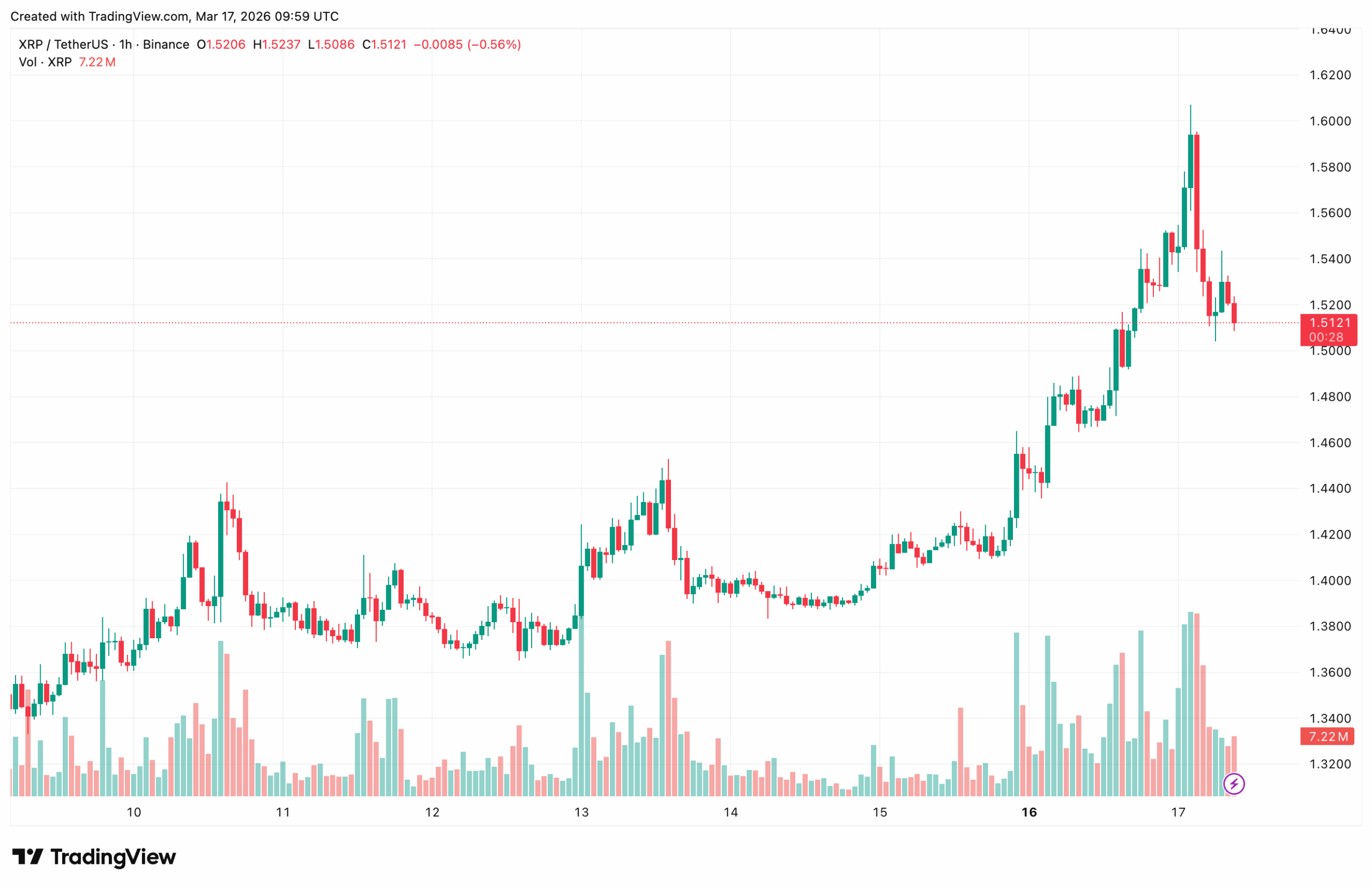
It’s worth noting that XRP reached considerably higher and pushed above $1.6 for a moment, but the bears were quick to intercept the movement, resulting in a slight decline over the past few hours.
What’s Next for the XRP Price?
Nonetheless, this marked a level not seen in over a month, which had some analysts already outlining potential breakout targets.
Notably, during the days leading to today’s move, popular market observer and analyst Ali Martinez outlined that the Bollinger Bands on XRP’s chart had been squeezing. That’s because the coin had spent considerable time trading within a relatively narrow range between $1.33 and $1.47. Bollinger Bands are a well-known volatility indicator. The more squeezed they get, the higher the chance of a breakout move, which is what is happening now, according to the analyst.
Martinez commented on today’s increase, saying that XRP is already breaking out of its triangle pattern.
Moreover, he also suggested that the next upward target is $1.85, which would mean an increase of another 23% from current levels.
$XRP is breaking out of this triangle!
Target: $1.85. https://t.co/3dirkMNDwF pic.twitter.com/H2D56F5zyZ
— Ali Charts (@alicharts) March 17, 2026
It’s also worth noting that this latest surge comes on the back of solid fundamentals. Network activity on the XRP Ledger (XRPL) is soaring, reaching a record high of more than 7.7 million non-empty wallets.
Additionally, the number of active addresses on XRPL reached 46,767, which represents a five-week high.
But XRP’s price isn’t the only thing soaring in crypto today.
PlayNance Launches GCoin Staking
Arguably one of the most anticipated token generation events, PlayNance’s GCoin, is taking place in less than 14 hours, and the team has made a major announcement ahead of it.
PlayNance announced that GCoin staking is now live. This mechanism is designed to strengthen long-term participation in the platform’s growing Web3 entertainment economy.
The program is now live on PlayW3 – the firm’s flagship social gaming platform. Moreover, the community locked over 250 million tokens within just a few hours of the capability being live.
What it means is that GCOIN holders are now able to lock their tokens and participate in rewards distributed within the ecosystem, while also reducing circulating supply through entirely voluntary locking, hence supporting the sustainability of the token’s broader economy.
There are smart-contract staking pools where users can stake their GCOIN with a minimum threshold of 1,000 coins. The lockup durations are 6, 9, 12, and 18 months. Naturally, the longer the period, the longer the reward weight.
Those interested in participating the token generation event can take a look at the official page for more details. Over 13 billion tokens have already been sold and the current price is set at $0.00161, but that’s designed to progressively increase, encouraging early participation.
Disclaimer: The above article is sponsored content. CryptoPotato doesn’t endorse or assume responsibility for the content, advertising, products, quality, accuracy, or other materials on this page. Nothing in it should be construed as financial advice. Readers are strongly advised to verify the information independently and carefully before engaging with any company or project mentioned and to do their own research. Investing in cryptocurrencies carries a risk of capital loss, and readers are also advised to consult a professional before making any decisions that may or may not be based on the above-sponsored content.
Readers are also advised to read CryptoPotato’s full disclaimer.
Binance Free $600 (CryptoPotato Exclusive): Use this link to register a new account and receive $600 exclusive welcome offer on Binance (full details).
LIMITED OFFER for CryptoPotato readers at Bybit: Use this link to register and open a $500 FREE position on any coin!


Key Takeaways
- Circle (CRCL) stock climbs 2.83% following USDC’s launch on Injective
- Native issuance eliminates reliance on vulnerable bridged token solutions
- Cross-Chain Transfer Protocol facilitates frictionless multi-blockchain movement
- Injective’s infrastructure delivers rapid finality and minimal transaction costs
- Integration advances compliant stablecoin adoption in decentralized finance
Shares of Circle Internet Group (CRCL) increased 2.83% to reach $129.39, signaling market enthusiasm for expanded blockchain infrastructure. The stablecoin issuer is deploying USDC across the Injective blockchain platform. This strategic expansion targets improved crosschain connectivity and decentralized financial infrastructure.
Circle Internet Group, CRCL
Through USDC deployment, CRCL delivers a fully compliant stablecoin option for trading activities, yield generation, and treasury operations. Injective’s incorporation benefits institutional participants and application builders requiring reliable dollar-backed digital assets. Additionally, the platform facilitates efficient onchain settlement spanning diverse blockchain environments.
Circle’s initiative improves cross-platform financial compatibility, allowing participants to move USDC without synthetic wrapped alternatives. The Cross-Chain Transfer Protocol (CCTP) destroys tokens on the origin chain while simultaneously creating them on the destination network. This architecture minimizes bridge vulnerability exposure and enhances capital deployment efficiency.
Native USDC Deployment: Foundation for Digital Asset Markets
Injective’s native USDC implementation functions as reliable collateral throughout spot and derivatives trading venues. The stablecoin provides continuous liquidity access for credit markets, yield products, and exchange platforms. It enables automated trading execution and dynamic portfolio management.
The digital dollar facilitates frictionless incorporation into Injective-based applications, supporting rapid settlement cycles and consistent capital movement patterns. Qualified participants access institutional-grade onboarding and redemption services through Circle Mint infrastructure. Market participants obtain a secure, reserve-backed instrument for blockchain-based financial operations.
Native token issuance on Injective removes dependency on external bridge infrastructure and intermediary protocols. Application developers can construct advanced decentralized finance solutions directly within the protocol architecture. This approach increases operational transparency and diminishes complexity throughout decentralized marketplace ecosystems.
Cross-Chain Transfer Protocol: Enhancing Multi-Blockchain Liquidity
CCTP technology allows USDC to transfer directly between Injective and compatible blockchain networks. Market participants can deposit funds, execute trades, and oversee liquidity positions without synthetic token alternatives. This capability reinforces crosschain coordination and elevates aggregate market performance.
The mechanism supports native USDC creation on Injective, simplifying capital distribution across diverse blockchain environments. Through connections with Ethereum, Solana, and Cosmos ecosystems, the infrastructure enhances compatibility for builders and market makers. Liquidity dispersion decreases while capital utilization improves substantially.
Injective’s technical foundation delivers sub-second transaction finality combined with minimal fee structures, accelerating crosschain asset movement while reducing costs. Developers access MultiVM capabilities supporting both EVM and WASM smart contract frameworks. Blockchain applications can expand capacity while preserving speed and dependability.
USDC maintains worldwide expansion momentum, with outstanding tokens nearing the $80 billion threshold. The stablecoin currently represents 64% of volume-adjusted transfer activity, exceeding Tether in transaction metrics. Its integration with Injective may accelerate utilization throughout decentralized exchange and financial protocol environments.
This deployment establishes CRCL as a leader in regulated stablecoin implementation across Layer 1 blockchain platforms. Injective participants obtain protected, efficient, and compatible USDC access. This advancement should strengthen the network’s trading infrastructure and capital market functionality.
The post Circle (CRCL) Stock Surges as USDC Launches on Injective Network appeared first on Blockonomi.


Five major U.S. regional banks just launched a direct assault on the private stablecoin market. The consortium unveiled the Cari Network today, a blockchain-based payment rail built on ZKsync that enables instant settlement of tokenized deposits without funds leaving the insured banking perimeter. This marks the most significant attempt yet by traditional finance to reclaim the settlement layer from dominant non-bank issuers like Tether and Circle.
- The Cari Network leverages ZKsync’s “Prividium” technology to offer private, compliant execution for institutional crypto transactions.
- Unlike USDT or USDC, Cari tokens remain liabilities of the issuing bank, maintaining FDIC insurance eligibility and simplifying compliance with stablecoin regulations.
- Participating lenders, including Huntington and KeyCorp, are targeting a Q3 2026 rollout to prevent deposit flight to faster crypto-native alternatives.
The Regional Bank’s ZKsync Move Explained
The Cari Network is not a standard partnership. It is a fundamental re-architecture of how regional banks handle settlements. The consortium includes Huntington Bancshares, First Horizon, M&T Bank, KeyCorp, and Old National Bancorp. These institutions are building on “Prividium,” a private, permissioned blockchain developed by Matter Labs, the team behind the ZKsync Layer-2 network.
Alex Gluchowski, CEO of Matter Labs, clearly framed the shift. “Financial infrastructure is undergoing the same shift computing went through decades ago, from siloed databases to shared, programmable infrastructure,” he stated in the announcement.
The technical distinction here is critical for traders to understand. Stablecoins are bearer assets usually backed by treasuries in a custodial account. Tokenized deposits on the Cari Network are digital representations of cash that sit directly on the bank’s balance sheet. They move instantly via ZK proofs, but they remain insured and regulated. This allows banks to offer crypto-speed settlement without the regulatory friction of managing a separate stablecoin reserve.
Why Banks Are Moving Now, Not Later
Banks are reacting to an existential threat: the loss of the settlement layer. For years, crypto-native firms have offered 24/7 liquidity, while banks remained bound by banking hours and slow wire transfers. The launch of Cari indicates that traditional finance is no longer willing to cede this ground.
We are seeing a broader trend of incumbents aggressively entering the space. BlackRock just dropped nearly $600 million into Bitcoin, signaling that institutional crypto adoption has moved from exploration to accumulation. Regional banks, however, are focused less on price exposure and more on infrastructure survival.
Regulatory timing is also a major factor. The window to establish compliance with the standard is closing. Industry executives have warned that the CLARITY Act faces slim odds in 2026 without immediate movement in the committee, leaving banks in a precarious position. By launching a network that leverages existing deposit insurance frameworks, the Cari consortium aims to bypass legislative gridlock and deploy a solution that operates within current laws.
The $8Tn Stablecoin Threat
The target of this operation is the $8 trillion payment market currently being encroached upon by Tether (USDT) and Circle (USDC). Non-bank stablecoins have effectively become the world’s digital dollar, processing volume that rivals major card networks. If regional banks lose the ability to settle payments instantly, they risk becoming mere warehouses for liquidity rather than active payment processors.
This competition is heating up across all chains. Solana is eyeing key resistance levels largely driven by institutional ETF demand and its dominance in high-speed stablecoin transfers. The Cari Network is the banking sector’s answer to this speed. Stablecoin regulation has been slow to materialize, so banks are building a “walled garden” alternative that offers the speed of Solana or Ethereum with the safety of a chartered bank.
Cari CEO Gene Ludwig emphasized that banks “should be leading the next phase of digital money, not reacting to it.” The 2026 rollout will test whether institutional clients prefer the permissionless utility of USDT or the regulatory safety of a bank-issued token.
Will the Cari Network Actually Work?
Bull Scenario: The Cari Network successfully aggregates liquidity across mid-sized banks. Corporate clients migrate aggressively to tokenized deposits to reduce counterparty risk, stripping volume away from USDC and USDT. ZKsync establishes itself as the primary backbone for regulated US finance.
Bear Scenario: The private network becomes a silo with poor interoperability. Crypto-native users and global traders continue to prefer the permissionless nature of public stablecoins. The banks build a high-speed intranet that fails to connect with the broader liquidity of the global market.
Right now, the success of this project depends on whether stablecoin regulation validates the non-bank model or forces issuers to become full-reserve banks, effectively leveling the playing field for Cari.
The post Regional Banks Declare War on Stablecoins With ZKsync-Based Cari Network appeared first on Cryptonews.


Economists are penciling in UK inflation hitting 3% to 4% by end of 2026, complicating rate cuts for the foreseeable future.
Central banks in the US, UK, and the European Union are getting ready to announce their interest rate decisions, with markets expecting that there won’t be any changes across the board.
The policy paralysis has led an analyst to suggest that it could make Bitcoin (BTC) more appealing as a neutral store of value, as shown by its recent strength against the euro and US dollar.
Central Banks Could Hold Steady As Inflation Risks Rise
The cluster of rate decisions, scheduled between March 18 and March 21, has put global markets on edge, with Lacie Zhang, a research analyst at Bitget Wallet, telling CryptoPotato that policymakers in the US, UK, and eurozone are likely to keep rates the same, given the recent surge in oil prices caused by the ongoing conflict in the Middle East.
According to her, this environment is already affecting crypto markets.
“With the BoE expected to hold at 3.75% and the ECB at 2%, both central banks are likely to maintain a cautious stance rather than pursue aggressive hikes or cuts,” she said.
The analyst added that this uncertainty has “supported BTC/EUR, with Bitcoin holding strong above €65,000,” which pointed to more institutions treating crypto as a way to protect themselves against fiat instability.
That expectation matches recent reporting from Reuters that the Bank of England is likely to keep its benchmark rate at 3.75% because inflation risks are rising due to higher energy prices caused by the conflict in the Middle East. Per the report, economists are estimating that by the end of 2026, UK inflation will reach 3% to 4%, therefore complicating any rate cuts in the near future.
Europe is also showing similar caution, with a Bloomberg poll done between March 6 and March 11 finding that most economists think the European Central Bank will keep rates the same for an extended period, even though inflation risks are rising.
You may also like:
Expectations are similar in the US, as data shared by journalist Sonali Basak on March 16 showed only one rate cut is priced in for 2026 ahead of this week’s Federal Reserve meeting.
Bitcoin Shows Resilience
The price action of Bitcoin reflects the prevailing macro backdrop. At the time of writing, the asset showed a 5% jump from a week ago to trade at about $74,000, per data from CoinGecko. It briefly hit $76,000 in early trading hours on Coinbase, which was its highest level since early February.
Meanwhile, on-chain data suggested a change in sentiment, with crypto analyst Darkfost saying that buyer activity has started to pick up again after a lot of selling in February, as trading volumes on major exchanges also went back up.
Ultimately, Zhang believes that BTC’s performance during this period supports its positioning as a hedge.
“This ‘higher-for-longer’ stance may temper short-term risk-on sentiment, but it continues to support Bitcoin’s positioning as a non-sovereign store of value,” she explained.
Binance Free $600 (CryptoPotato Exclusive): Use this link to register a new account and receive $600 exclusive welcome offer on Binance (full details).
LIMITED OFFER for CryptoPotato readers at Bybit: Use this link to register and open a $500 FREE position on any coin!
Crypto World
‘Gensler and Biden were just better for crypto,’ says Tally CEO as DAO governance platform shuts down


The CEO of crypto’s largest Decentralized Autonomous Organization (DAO) governance platform says the Biden administration was better for his industry than its successor — and is shutting down his company to prove the point.
Tally, which powered on-chain governance for Arbitrum, Uniswap, ENS, and more than 500 other DAOs, will wind down operations after six years, CEO Dennison Bertram announced today in a blog post.
Crypto protocols are governed not by executives or boards, but by decentralized autonomous organizations, or DAOs, where token holders vote on everything from fee structures to software upgrades.
In practice, participation is often low and decision-making slow, leaving a small group of active voters to steer billion-dollar systems. Tally built the infrastructure that made crypto democracy possible, providing the voting rails, delegation tools, and dashboards used by major DAOs like Uniswap and Arbitrum to run their governance processes.
In an interview with CoinDesk, Bertram said the twin forces that sustained demand for governance tooling — regulatory threat and a growing ecosystem of decentralized applications — have both disappeared.
Across Protocol recently proposed dissolving its DAO entirely and converting into a U.S. C-corp, arguing the token structure was actively impeding institutional partnerships. Its ACX token surged 80% on the news.
Last year, Solana-based exchange Jupiter and NFT conglomerate Yuga Labs both abandoned their DAO structures, with Yuga CEO Greg Solano calling his project’s governance “sluggish, noisy and often unserious governance theater.
“There’s a natural tension between building a collaborative, decentralized system and then founding it upon crypto economics,” Bertram said. “The crypto economics implies we can find some sort of stasis because everyone is going to pursue their own personal best interest, which is kind of a zero-sum, profit-maximizing mentality.
Gensler forced decentralization. His absence is undoing it
Under the SEC’s Gary Gensler-era interpretation of securities law, a token risked being classified as a security if a clearly identifiable group was making managerial decisions that drove its value, one of the key prongs of the Howey Test.
The industry’s response was to push decision-making outward through DAOs, distributing control across thousands of wallets so no single entity could be said to run the network. Governance systems and tools like Tally weren’t just features — they were part of a legal strategy.
Bertram sees this as the end of his company: if teams no longer believe they will be penalized for operating like traditional companies, decentralization stops being a requirement and becomes optional, many teams choose not to pay for it.
“The [Trump] administration is loudly signaling that you’re not in trouble, go forth and do what you wish,” Bertrain said. “That gives an enormous amount of leeway for existing organizations. It’s not actually clear if you need decentralization, or what decentralization looks like.”
The garden isn’t infinite
The regulatory shift alone didn’t kill Tally. The company’s business model was built on a second bet: that the Ethereum ecosystem would produce a vast, infinite garden of protocols and applications, each needing governance infrastructure.
“For Tally and organizations like Tally to exist, it’s not enough to have a Uniswap, an Aave, one or two L2s, and that’s it,” Bertram said. “That’s a very different kind of enterprise consultancy business.”
That infinite garden thesis was central to Tally’s $8 million fundraise last year.
“A big part of our thesis in our last round was, look, there are going to be thousands of L2s, which was an idea that no one pushed back on,” he said. “There are not, in the near term, thousands of L2s. And there may never be.”
Instead, the industry consolidated around a handful of dominant protocols.
Crypto found product-market fit in payments and speculation like prediction markets, Bertram said, but the rich consumer application layer that would have sustained a governance infrastructure business never developed.
“There isn’t a venture-backed business in governance tooling for decentralized protocols,” he wrote in a blog post announcing the shutdown. “At least not yet.”
Retail doesn’t care about crypto
Beyond the governance crisis, Bertram sees a more existential problem for the industry.
“AI has really become the new narrative of the future, and its narrative is actually much larger and much more encompassing than crypto,” he said. “What that does is it sucks away the best and the brightest. The most exciting opportunity is not here, so we don’t get the most exciting founders, we don’t get the most exciting builders.”
Bertram said he still believes in the industry but no longer buys the argument that it is early.
“People always say, it’s still early,” he said. “I’ve been in this since 2011. I don’t know. It doesn’t feel early.”


Vietnam is reportedly looking to tighten restrictions on overseas cryptocurrency trading as authorities move to bring more activity under domestic oversight.
Summary
- Vietnam is preparing rules to restrict overseas crypto trading, with authorities aiming to curb capital outflows and tighten oversight of digital asset activity.
- Five firms, including affiliates of Techcombank, VPBank, and LPBank, have cleared an initial round to participate in the country’s pilot licensing program for domestic crypto exchanges.
According to a Reuters report, Vietnam’s finance ministry is drafting rules that would prevent local residents from trading on foreign crypto platforms, in a bid to curb capital outflows and improve regulatory control.
Vietnam currently maintains strict restrictions on cross-border capital flows, even though it does not explicitly ban owning cryptocurrencies or trading them. However, digital assets are not recognized as money or a legal means of payment under existing laws.
As such, locals are often known to rely on overseas centralized exchanges such as Binance, OKX, and Bybit, the report said.
Vietnam is among the most active crypto markets globally and ranks as the fourth-largest market in the Global Crypto Adoption Index compiled by Chainalysis.
Regulators are concerned that the growing use of cryptocurrencies and stablecoins could lead to uncontrolled capital outflows, particularly in a market where domestic investment channels remain limited.
Local crypto exchanges seek licenses
Last month, crypto.news reported that Vietnam had begun a pilot licensing program for cryptocurrency exchanges, with oversight to be handled by the State Securities Commission.
Authorities plan to establish a regulated framework for locally operated exchanges that will allow approved firms to run compliant trading platforms within the country.
According to a Finance Ministry document dated March 12, cited in the report, five companies have passed an initial qualification round for Vietnam’s pilot licensing program.
Among the companies involved are affiliates of three Vietnamese private banks, Techcombank, VPBank, and LPBank, alongside VIX Securities, which has already moved to develop its own crypto asset exchange infrastructure, and Sun Group, one of the country’s largest private conglomerates.
Industry stakeholders believe the rollout of licensed domestic exchanges could help keep transaction fees within the country while supporting the growth of Vietnam’s digital financial ecosystem.


Robinhood’s (HOOD) newly launched venture fund has added stakes in Stripe and ElevenLabs, marking its first disclosed investments since beginning trading earlier this month.
Robinhood Ventures Fund I (RVI), a closed-end fund designed to give retail investors exposure to private companies, said it purchased roughly $14.6 million in Stripe shares and $20 million in ElevenLabs preferred stock in transactions completed in March.
The fund began trading on the New York Stock Exchange on March 6, part of Robinhood’s broader push to open private markets to everyday investors. Shares of the fund can be bought and sold like a traditional stock, offering access to companies that are typically limited to institutional investors and the wealthy.
Stripe, founded in 2010, provides payments and financial software used by businesses ranging from startups to large enterprises. The investment was made through a secondary transaction, meaning Robinhood bought shares from existing holders rather than directly from the company.
ElevenLabs, a London-based artificial intelligence firm founded in 2022, focuses on voice and audio technology. Its tools allow businesses and developers to generate speech, build conversational agents and create media content across dozens of languages. Robinhood’s investment was part of a primary funding round, meaning the capital goes directly to the company.
The additions expand a portfolio that already includes private companies such as Databricks, Revolut, Ramp and Oura, with more investments expected over time.
Robinhood has positioned the fund as a response to a shift in capital markets. The number of publicly listed companies in the U.S. has declined over the past two decades, while private markets have grown to an estimated $10 trillion, limiting access for retail investors.
“For decades, wealthy people and institutions have invested in private companies while retail investors have been locked out,” CEO Vlad Tenev said previously.
Unlike traditional venture funds, Robinhood’s vehicle does not require investors to be accredited and does not charge performance fees, lowering the barrier to entry.
The strategy follows earlier efforts by the company to offer private market exposure, including tokenized shares in high-profile firms for users in Europe, an initiative that drew scrutiny over how those products were structured.
With the latest investments, Robinhood is signaling that it plans to keep building a portfolio of private companies across fintech and artificial intelligence, two sectors that continue to attract strong investor interest ahead of potential public listings.
Shares of HOOD were up 2% Tuesday trading at $76.78. RVI was lower by 0.4%.
Crypto World
Vietnam pushes local crypto exchanges as Hanoi moves to block offshore trading: Reuters


Vietnamese firms are racing to secure licences for the country’s first domestic cryptocurrency exchanges as Hanoi moves to restrict trading on foreign platforms.
A government resolution issued in February calls for a pilot program for locally run digital asset exchanges, with a rollout possible as soon as March.
A March 12 Finance Ministry document showed that five companies cleared an initial screening round, Reuters reported. These include affiliates of three private banks in the country including Techcombank, VPBank and LPBank, along with VIX Securities and the Sun Group conglomerate.
The move could reshape a market that has grown fast with little formal oversight. Vietnam has ranked fourth in Chainalysis’ latest Global Crypto Adoption Index, with Vietnamese users having moved an estimated $200 billion in crypto in the year through June 2025.
Officials are concerned that heavy use of crypto and stablecoins could weaken control over capital flows. Vietnam already limits cross-border transfers, and many households have few places to put savings beyond gold and property.
That has helped drive gold prices above global levels and fueled waves of housing speculation, the report points out. Vietnam passed a landmark law officially recognizing digital and crypto assets early last year, outlining a broad framework for managing crypto and fostering innovation in the sector.
Crypto World
World launches agentkit with Coinbase-backed x402 to verify human identity behind AI agents


As AI agents increasingly transact, shop, and act autonomously online — a market that can reach $3 trillion to $5 trillion by 2030 — a key issue comes into focus: how to verify that a real person is behind the activity.
Sam Altman–backed identity project World (formerly WorldCoin) says it has the solution.
On Tuesday, the company rolled out AgentKit, a developer toolkit that allows AI agents to carry cryptographic proof that they are backed by a unique human, using its World ID system. The product works with x402, a protocol developed by Coinbase and Cloudflare that enables “agentic payments” by embedding stablecoin micropayments into the internet’s communication layer so AI Agents and software can pay each other without human intervention.
“Payments are the ‘how’ of agentic commerce, but identity is the ‘who,’” said Erik Reppel, head of engineering at Coinbase Developer Platform and founder of x402. “This is a massive step toward a web where agents aren’t just seen as automated traffic, but as legitimate economic participants.”
The move comes as AI agents are rapidly evolving, handling time-consuming and often frustrating tasks from booking reservations to surfing e-commerce marketplaces for the best deals. Some estimates suggest agentic commerce could reach $3 trillion to $5 trillion by 2030, with agents accounting for up to 25% of U.S. e-commerce, World said.
Coinbase founder Brian Armstrong said he believes “very soon” there will be more AI agents than humans making transactions. Binance founder Changpeng Zhao went further, predicting agents will make one million times more payments than people, “and they will use crypto.”
The missing piece
However, as the agentic commerce market expands, its widespread use creates a problem that payments alone cannot solve: identity.
“One person could run thousands of agents that all pay small fees,” said DC Builder, a research engineer at the World Foundation. “Proof of Human addresses this gap.”
The World spokesperson explained that AgentKit addresses this by linking multiple agents to a single verified human, which allows platforms to impose limits at the identity level.
“AgentKit allows developers to link multiple agents to the same verified human,” the spokesperson said. “This means a platform can allow someone to run several agents while still enforcing limits based on the underlying person.”
That could enable services to cap usage, such as one free trial or a fixed number of bookings per day per human, regardless of how many agents are deployed, the spokesperson added.
Another problem with agentic commerce is that most websites treat automated traffic as suspicious and even block bots outright. That approach, designed to stop abuse, is increasingly at odds with a world in which legitimate software agents are gradually acting on user’s behalf.
AgentKit allows users to delegate their World ID, a privacy-preserving proof that they are a unique human, to AI agents acting on their behalf. And World is positioning this not as a replacement for other identity systems, but as a foundational layer.
“This isn’t necessarily an either-or choice,” a World spokesperson told CoinDesk. “World ID is designed to be a proof of human layer that developers can use on their own or alongside other identity systems.”
The system uses zero-knowledge proofs so platforms can verify that an agent represents a real person without collecting or storing personal data, a design World claims is required for scaling identity in an AI-driven web.
Beyond Orb verification
AgentKit, which is currently in beta version, relies on Orb-based biometric verification, the World’s most controversial component.
But the company says it plans to expand the system to include additional credentials. That will include NFC-enabled passports and IDs via “World ID Credentials,” allowing users to prove attributes about themselves without revealing personal information.
“Beyond the beta, we plan to expand AgentKit alongside the next generation of the World ID protocol,” the spokesperson said.
With the world’s real-time human verification meter reading at 17,912,203 at the time of writing, its networks rank among the largest proof-of-personhood globally. It also makes their broader ambition clear: to become the identity layer for an internet increasingly populated not just by people, but by the AI agents acting on their behalf.
Read more: Visa is ready for AI agents. So is Coinbase. They’re building very different internets


For much of the last three years, a predictable cycle dominated the market: companies announced their intentions to purchase massive volumes of Bitcoin, watched their stock prices soar to a premium and issued new shares to buy more Bitcoin. This feedback loop made Bitcoin accumulation look like an “infinite money glitch”: a guaranteed way for public companies to manufacture shareholder value out of thin air.
As we move through the first quarter of 2026, that cycle has broken. Recent data shows that roughly 40% of publicly traded Bitcoin treasuries are now trading at a discount to their net asset value (NAV). In plain terms, the market now values these companies as a liability, worth less than the market price of the Bitcoin they hold.
This collapse in valuation has invited blistering criticism from institutional veterans. Jan van Eck, CEO of VanEck, recently dismissed the sector as a publicity-driven trend, while veteran analyst Herb Greenberg has characterized the most prominent player, Strategy, as a “quasi-Ponzi scheme.”
These critiques point to a failure in how many of these firms are managed. To remain viable, Bitcoin treasury companies must accept that accretive dilution is no longer a sustainable strategy. They must move beyond holding passively and operate as disciplined asset managers.
Competing philosophies: the promoter vs. the asset manager
Today, most Bitcoin treasury companies are divided into two camps, representing fundamentally different philosophies of corporate management: “Promoters” and “Asset Managers.”
Promoters treat Bitcoin as a passive asset to be hoarded. In this model, the company’s primary job is two-fold. First, the firm must act as an aggressive advocate for the underlying currency and its ecosystem. By investing in community projects and maintaining a constant presence in public discourse, the Promoter works to drive the token price higher and capitalize on gains from its existing holdings. Second, the Promoter must market its own stock to maintain a high premium. When the market values the company significantly higher than the Bitcoin it actually holds, the company can sell new shares at that inflated price to buy more Bitcoin at the normal market rate. This calculated financial maneuver is called accretive dilution.
Together, these strategies create a feedback loop of hype. The Promoter needs the price of Bitcoin to rise to increase its net asset value, and it needs the equity premium to be maintained to continue its accumulation strategy. However, this model is fragile because it relies entirely on external sentiment. If the price of BTC stalls or the equity premium vanishes — as we are seeing across the board in 2026 — the Promoter is left with an unproductive balance sheet and no internal mechanism for growth.
In contrast, asset managers view Bitcoin as a productive commodity akin to “digital oil.” In the physical world, an oil major like Exxon or Shell does not simply sit on reserves and hope for a price rally. They are sophisticated financial operators who treat their inventory as a productive asset. They trade the futures curve to capture premiums and monetize market volatility.
Asset Manager-style treasuries apply this same industrial rigor to the digital realm. By using their balance sheet to generate real, Bitcoin-denominated returns, they ensure growth is driven by operational skill, rather than a byproduct of crypto market sentiment. By treating Bitcoin as a commodity to be managed, the asset manager generates real yield from the skilled management of the asset, not from the continuous issuance of new stock to the public.
The era of accretive dilution is over
The distinction between these two models is no longer academic. One of them has stopped working.
The Promoter approach — relying on equity issuance to finance Bitcoin accumulation — is no longer a viable growth strategy. What once passed as financial sophistication was, in practice, a tactic that depended on unusually favorable market conditions.
Issuing shares at a premium can temporarily increase Bitcoin per share, but it does not create an economic return. It generates no cash flow, no operational advantage and no durable compounding mechanism. It exists entirely at the discretion of new investors. When that demand weakens, the strategy collapses.
For much of 2025, this reality was easy to ignore. Rising Bitcoin prices and abundant liquidity made accumulation strategies look interchangeable. Capital flowed freely, equity premiums expanded, and dozens of treasury companies adopted the same playbook: buy Bitcoin, promote the narrative, raise more equity, repeat. In that environment, differentiation didn’t matter.
It does now.
As the market matures, Bitcoin treasuries that rely solely on passive accumulation face a hard constraint: they lack an internal mechanism for growth. When every firm owns the same asset, holds it the same way and depends on the same equity-market dynamics, there is no basis for sustained outperformance. The model has become commoditized — and investors are growing sick of it.
Only the most prominent players — those with exceptional scale, brand recognition, and Michael Saylor-level fame — will be able to sustain this approach. For most treasury companies, passive accumulation without active management offers no path to differentiation, resilience, or long-term relevance.
Markets are already reflecting this reality. Nearly half of Bitcoin treasury companies have fallen below mNAV, and most won’t recover without a drastic pivot.
Transitioning from passive storage to active management
To transition from a promoter to an asset manager, companies must move beyond the simple HODL strategy and put the balance sheet to work. This means adopting the tools of professional commodity trading.
One primary tool is the basis trade, in which a firm exploits the price difference between the spot price of Bitcoin and the futures contract price. By capturing this spread, a company can grow its Bitcoin holdings even when the asset’s price is flat or declining. Furthermore, a Bitcoin asset manager uses dynamic options strategies to turn market turbulence into income.
This approach provides a “real yield” that does not rely on selling more stock or finding new investors. It transforms the treasury from a cost center into a profit center. Most importantly, it provides a clear path to increasing Bitcoin-per-share through operational excellence rather than capital market maneuvers.
Treasury companies also need to adjust the way they communicate with investors. Too many treasury CEOs posture as low-budget Michael Saylor impersonators — focusing on narrative amplification, public advocacy and symbolic accumulation. It’s an approach designed to generate hype, not project careful financial stewardship.
As investor scrutiny intensifies, CEOs will need to project credibility by explaining how risk is managed, how exposure is structured, and how returns are generated across a range of market conditions. The market will not reward Bitcoin’s loudest cheerleaders; it will reward the firms that deploy their holdings most productively.
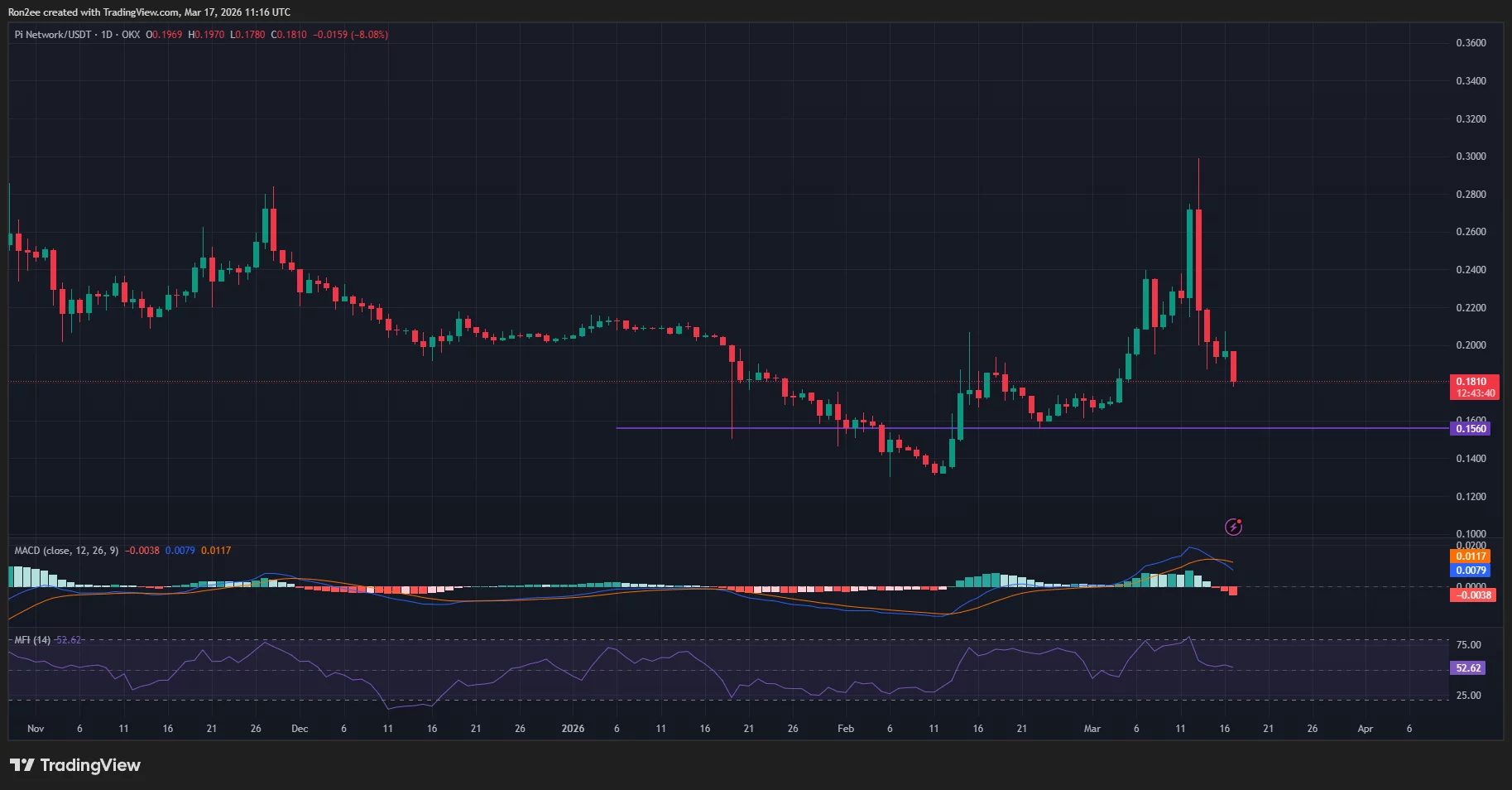
Pi Network price has fallen by over 38% as investors sold the Kraken listing news.
Summary
- Pi Network price has fallen over 10% in the past 24 hours and about 38% from its recent peak as bearish technical indicators signal further downside risk.
- A confirmed MACD bearish crossover and weakening momentum suggest sellers have gained control while the token approaches key support near $0.1900.
- Investor sentiment has also turned cautious ahead of a scheduled unlock of roughly 17 million PI tokens, which could increase supply pressure.
Pi Network (PI) price has dropped over 10% over the past 24 hours and 38% from its highest point on Friday, March 13.
It remains at risk of more downside as technical indicators present a bearish outlook for the coming sessions.
On the 24-hour/USDT price chart, the PI price has confirmed a MACD crossover, which happens when the MACD line crosses below the signal line. When such a bearish crossover forms, an asset has historically signaled a period of consolidation or further price declines as momentum shifts in favour of the sellers.
Additionally, the Pi Network price is closing in on the 50-day SMA, which had been serving as key support for the token during its recent recovery phase. A drop below the $0.176 level could trigger a sharp sell-off, potentially leading to a significant price decline toward the next psychological floor.
At the same time, the Money Flow Index is closing in on neutral territory, a sign that the intense buying and selling pressure in the market is starting to balance out after the recent volatility.
Based on the confluence of bearish technicals, the Pi Network risks a drop to its Feb. 23 low of $0.1560 with no immediate support to cushion the fall if current levels fail to hold.
Pi Network’s recent downtrend began after its listing on crypto exchange Kraken on March 13. Investors likely sold the news as they booked profits after the token surged nearly 30% after the listing.
A more recent bearish development that has turned investors cautious is the token unlock event scheduled for later today. Notably, about 17 million PI tokens will be entering circulation following the event, which adds to the existing supply overhead.
Investors are likely reducing exposure to the token as they expect that the market will not be immediately able to absorb the newly released tokens, which tends to reduce scarcity and put downward pressure on the price.
Disclosure: This article does not represent investment advice. The content and materials featured on this page are for educational purposes only.

Never Leave A Car Covered In MONEY In Public…

Hospital in stunning blunder as 21 patients operated on with unsterilised instruments

Enphase Energy Stock Sees RS Rating Climb To 83


![Oil Price Just COLLAPSED [Here’s What Happens To Bitcoin Next]](https://wordupnews.com/wp-content/uploads/2026/03/1773765190_hqdefault-80x80.jpg)
-
 Tech6 days ago
A 1,300-Pound NASA Spacecraft To Re-Enter Earth’s Atmosphere
-
 Crypto World4 days ago
HYPE Token Enters Net Deflation as HyperCore Buybacks Outpace Staking Rewards
-

 Fashion4 days ago
Weekend Open Thread: Addict Lip Glow
-
Sports3 days ago
Why Duke and Michigan Are Dead Even Entering Selection Sunday
-

 NewsBeat6 days ago
Residents reaction as Shildon murder probe enters second day
-

 Business2 days ago
Search for Savannah Guthrie’s Mother Enters Seventh Week with No Arrests
-

 Business6 days ago
Search Enters Sixth Week With New Leads in Tucson Abduction Case
-

 Business3 days ago
US Airports Launch Donation Drives for Unpaid TSA Workers as Partial Government Shutdown Enters Fifth Week
-

 Sports6 days ago
PWHL, Senators discussing plan to keep Charge in Ottawa
-
Crypto World3 days ago
Coinbase and Bybit in Investment Talks: Could Bybit Finally Enter the US Crypto Market?
-

 NewsBeat6 days ago
I Entered The Manosphere. Nothing Could Prepare Me For What I Found.
-

 Business3 days ago
Country star Brantley Gilbert enters growing non-alcoholic beer market
-

 Business1 day ago
Australian shares drop as Iran war enters third week
-

 Sports4 days ago
College Basketball Best Bets: Conference Tournament Semifinal Picks
-

 Crypto World1 day ago
Crypto Lender BlockFills Enters Chapter 11 with Up to $500M in Liabilities
-

 Tech7 days ago
Clarity as strategy
-

 Politics6 days ago
Trump Says Middle East Is ‘Very Lucky’ That He’s President
-
 Crypto World6 days ago
Three Binance Charts May Be Hinting at Bitcoin’s Next Move
-

 Business5 days ago
Trump demands Powell cut rates as Iran conflict raises energy prices
-
 Crypto World7 days ago
Google’s Gemini AI Predicts the Price of XRP, Solana and Cardano by The End of 2026


You must be logged in to post a comment Login