
Crypto World
Ripple (XRP) Price Prediction: CLARITY Act Targets April Markup While Taurox (TAUX) Nears Phase 4 In a Month After Launch


The topic of Ripple (XRP) price prediction is gaining renewed attention as the CLARITY Act moves toward a late April markup with 72% odds of passing according to prediction market data. XRP is trading around $1.30 following a 22% decline triggered by Trump Liberation Day tariffs on April 2, which imposed duties ranging from 10% to 50% across global trading partners.
Six spot XRP ETFs now hold approximately $1 billion in combined assets under management. Taurox (TAUX) is a decentralized hedge fund protocol where AI agents will trade pooled capital and stakers keep 80% of all profits.
XRP Price Prediction for 2026 and 2028 as Digital Commodity Status Reshapes Outlook
Standard Chartered projects XRP at $2.80 by the end of 2026 and $12.60 by 2028, contingent on sustained ETF inflows and regulatory clarity from the CLARITY Act. The SEC and CFTC have classified XRP as a digital commodity, removing the securities overhang that suppressed institutional adoption for years. Ripple Prime now appears on the DTCC and NSCC directory, signaling deeper integration with traditional settlement infrastructure.
Argentina’s YPF recently tokenized $800 million in energy assets on the XRP Ledger, and an AI-driven security upgrade identified more than 10 bugs in the XRPL’s 14-year codebase. A survey of institutional allocators found that 25% of fund managers plan to add XRP to their portfolios this year. Stakers in protocols built around yield generation keep 80% of trading profits, a structure absent from XRP’s validator-based fee model.

Taurox IO Offers the Structural Upside That XRP Cannot Match Before the End of the Presale
For XRP to reach Standard Chartered’s $12.60 target, its market capitalization would need to exceed $700 billion, a figure that places it above every crypto asset except Bitcoin. The Fear and Greed Index has remained at 9 for more than 47 consecutive days, and the S&P 500 fell 5.1% in Q1, its worst first quarter since 2022. Tariff-driven volatility and compressed risk appetite make large-cap moonshots harder to justify.
Taurox operates on a different scale entirely. The protocol is still in its presale phase with a $0.015 entry, listing target of $0.08, and a path to $1 that represents a 100x return. Before the end of the presale, each closing round raises the floor price permanently. That is a structural advantage no large-cap token can offer at its current valuation.

Two Sold-Out Phases and a $0.015 Entry Make Taurox the Sharpest Position in This Market
Phase 1 sold out in under 24 hours at $0.01. Phase 2 sold out at $0.012. Phase 3 is live at $0.015, and the protocol has raised over $890K across all rounds. The listing price of $0.08 is a 5.33x multiple from current entry. The $1 target represents a 100x return. At a $1 billion pool, the implied TAUX value reaches $1.85. A $500 position at $0.015 buys 33,333 TAUX. At the $0.08 listing that is $2,666. At $1 that is $33,333. The protocol charges zero management fees with 5% taken from profits only. Thirty percent of all fee revenue is burned permanently, 70% flows to the DAO treasury. The total supply is fixed at 2 billion tokens with no minting capability. Every phase that closes removes the lowest entry point from the table.
Conclusion
XRP at $1.30 carries institutional momentum from ETF inflows and commodity classification, but the upside math at large-cap scale is measured, not sharp. Taurox at $0.015, with two sold-out phases, over $890K raised, AI agents that will trade pooled capital, and 80% profit share to stakers, compresses the same institutional thesis into a fraction of the entry cost.
FAQs
What is the Ripple (XRP) price prediction for 2026?
Standard Chartered projects XRP at $2.80 by end of 2026, driven by ETF inflows and the CLARITY Act passing with 72% odds. XRP is currently trading around $1.30 after a tariff-driven selloff.
Will XRP benefit from the CLARITY Act passing?
If the CLARITY Act passes markup in late April, it would formalize XRP’s digital commodity status and remove remaining regulatory uncertainty. That clarity could accelerate institutional allocation from the 25% of fund managers already planning XRP positions.
How does Taurox compare to holding XRP for returns?
Taurox Phase 3 is priced at $0.015 with a listing target of $0.08 and a $1 path that represents 100x. XRP at $1.30 targeting $2.80 offers roughly 2x. The structural gap in upside potential is the primary reason capital is rotating.
Learn More
Buy TAUX: https://taurox.io
Whitepaper: https://docs.taurox.io/
Official Telegram: https://t.me/tauroxlabs
Official X/Twitter: https://x.com/TauroxProtocol
Disclaimer: This is a Press Release provided by a third party who is responsible for the content. Please conduct your own research before taking any action based on the content.




Secretary of Defense Pete Hegseth has reversed a 34-year Pentagon policy, signing a memo on April 2 that authorizes off-duty U.S. service members to carry privately owned firearms on military installations — a decision that lands alongside a downed F-15 and a record defense budget request in what is shaping up to be the most militarily assertive week of Trump’s second term.
Summary
- Secretary of Defense Pete Hegseth signed a memo on April 2 authorizing off-duty service members to carry privately owned firearms on U.S. military installations, ending a prohibition in place since 1992.
- The policy reversal directs base commanders to presume approval for all such requests unless specific documented safety concerns exist.
- The announcement is the third major military policy signal from Washington this week, alongside a downed F-15 over Iran and a record $1.5 trillion defense budget request.
Secretary of Defense Pete Hegseth has reversed a 34-year Pentagon policy, signing a memo on April 2 that authorizes off-duty U.S. service members to carry privately owned firearms on military installations — a decision that lands alongside a downed F-15 and a record defense budget request in what is shaping up to be the most militarily assertive week of Trump’s second term. The official Department of War announcement confirmed that Hegseth also published a video statement on X alongside the signed memorandum.
The memo inverts the existing default on military base carry permissions. Previously, service members seeking to carry a personal firearm had to obtain explicit authorization from their installation commander. Under the new policy, commanders must affirmatively document a specific safety concern to deny a request — approval is now presumed rather than earned. The change ends a policy that has been in place since 1992, spanning six presidential administrations.
“Our military installations have been turned into gun-free zones — leaving our service members vulnerable and exposed. That ends today,” Hegseth said in his post on X announcing the memo.
The broader context for markets
The Hegseth announcement is the third significant military signal from Washington in a single 24-hour window — arriving alongside the shooting down of a U.S. F-15 over Iran and the submission of a record $1.5 trillion defense budget request. For crypto and risk asset investors, the aggregate message from this week’s geopolitical and fiscal headlines is clear: the U.S. is deepening its conflict posture, which sustains oil price pressure, keeps inflation elevated, and narrows the window for Federal Reserve easing.
As crypto.news has reported, Bitcoin has been trading as a risk-sensitive asset throughout the Iran conflict, de-rating during escalation rather than acting as a traditional safe haven. Until a credible path toward de-escalation and Hormuz reopening emerges, the macro regime remains structurally unfavorable for sustained crypto price recovery.

Key Highlights
-
Exchange transitions from fixed VIP requirements to activity-driven advancement model
-
Three distinct pathways enable progression through futures, spot trading, and asset holdings
-
Immediate reward distribution system helps reduce transaction expenses
-
New mobile dashboard provides live VIP status monitoring
-
Enhanced benefits package includes token distributions and cyclical incentive programs
Bitget has rolled out its VIP Fast Track initiative, establishing a reward framework centered on active participation rather than passive holdings. The program eliminates traditional fixed-balance requirements in favor of performance-based criteria spanning futures contracts, spot markets, and overall portfolio value. This redesign reflects the platform’s strategy to better match user benefits with genuine trading engagement.
Multi-Path Advancement Framework Transforms VIP Access
The exchange has implemented three separate advancement channels targeting different trading styles and preferences. Users can now elevate their status through futures market participation, spot trading volume, or maintaining substantial asset positions. This flexible structure accommodates diverse trading approaches while eliminating the need for uniform qualification standards.
Each pathway operates independently, allowing participants to leverage their preferred trading methods for tier progression. Bitget has embedded these options within its comprehensive trading infrastructure, creating seamless progression opportunities without requiring users to navigate disconnected platforms or modify their established strategies.
This initiative represents another component of the platform’s ongoing VIP enhancement strategy. Following previous modifications that adjusted fee structures and reorganized benefit tiers, the exchange maintains its focus on attracting and retaining active market participants through systematic improvements to its loyalty framework.
Instant Rewards and Live Progress Monitoring
The Fast Track program incorporates an immediate distribution mechanism that activates upon reaching specific trading or balance benchmarks. Participants receive their rewards instantly rather than waiting for periodic settlements, creating a direct connection between achievement and compensation while helping manage ongoing trading expenses.
Available incentives span multiple categories including derivatives vouchers, spot market fee reductions, and enhanced yield opportunities. The platform allocates futures vouchers worth up to 300 USDT alongside spot rebates reaching 120 USDT. Users concentrating on asset accumulation gain access to boosted returns on their USDT deposits.
Bitget has simultaneously deployed a dedicated monitoring tool within its mobile platform. This interface delivers comprehensive visibility into current tier standing, outstanding requirements, and projected rewards across all levels. The addition enhances program transparency while simplifying status management for participants.
Broader Integration and Future Initiatives
The exchange continues building out its VIP infrastructure through coordinated incentive programs and scheduled promotional events. By merging trading-based rewards with token distributions and structured benefit cycles, the platform creates a comprehensive retention strategy designed to boost sustained engagement across its service offerings.
Looking ahead, the next VIP season phase will feature a token distribution campaign scheduled between April and May. Participants can anticipate receiving tokenized stock allocations and supplementary digital assets, with individual distribution rounds potentially offering prize pools exceeding 500,000 units.
The platform has also established connections between VIP advancement and its wider product ecosystem, incorporating structured savings instruments and recurring token incentives. Through unified system integration, the exchange streamlines user interaction while positioning its VIP framework as a quantitative model directly correlated with measurable trading performance.
TLDR
- Offchain Labs said Ethereum layer two networks need responsive pricing to handle rising demand and reduce gas fee swings.
- Edward Felten stated that gas price volatility still acts as the main defense against network congestion.
- Arbitrum One introduced dynamic pricing in January to better align fees with infrastructure bottlenecks.
- Data presented at EthCC 2026 showed Arbitrum maintained lower fees during peak demand compared to some rivals.
- Arbitrum One holds $15.2 billion in total value locked, while Base secures $10.9 billion, according to L2beat.
Ethereum layer-2 networks must adopt responsive pricing to handle future demand, Offchain Labs said at EthCC 2026. Edward Felten stated that gas fee swings still protect networks during congestion but deter mainstream users. He urged Ethereum L2s to align prices with real bottlenecks while keeping infrastructure stable.
Ethereum L2s push responsive pricing to manage congestion
Felten said current gas spikes remain the main defense during heavy traffic, and they raise costs quickly. However, he argued that responsive pricing allows more transactions at lower fees without overwhelming systems. He said, “[With responsive pricing], you can see more traffic at lower gas prices without overrunning the infrastructure.”
He explained that Ethereum’s EIP-1559 upgrade reformed the fee market in August 2021. The upgrade changed the gas limit mechanism and burned part of each transaction fee. Still, he said, gas volatility persists, and users reject unpredictable costs.
Felten presented charts comparing Arbitrum and Base during peak demand periods. The data showed Arbitrum gas fees stayed lower at high volumes than networks using EIP-1559 alone. He said Arbitrum adopted dynamic pricing in January to align fees with system bottlenecks.
Arbitrum described the change as a platform direction toward predictable fees under demand. The network said it aimed to match prices with actual infrastructure constraints. Felten said the rollout marked one of the first live tests of this pricing model.
Arbitrum and Base test new fee structures
Arbitrum One leads the layer-2 market with $15.2 billion in total value locked. Coinbase’s Base follows with $10.9 billion in TVL, according to L2beat data. In total, L2 networks secure over $39.7 billion, which reflects a 4.6% yearly increase.
Julian Kors, founder of Pulsar Spaces, said responsive pricing reduces predictability compared to EIP-1559. He said networks must choose between mechanism design purity and real-time efficiency. He told Cointelegraph, “EIP-1559 does the first very well. Responsive pricing leans into the second.”
Jerome de Tychey, president of Ethereum France, said responsive pricing could improve user experience. He said the model makes fees reflect actual demand more closely. However, he did not claim it eliminates volatility.
Cyprien Grau, project lead at Status Network, called the model a “real improvement in fee accuracy.” Yet he said the system still relies on a fee market that can produce spikes. He added, “It doesn’t solve the structural problem.”
Grau said L2 gas fees trend toward zero as scaling improves and competition grows. He said responsive pricing smooths the decline but does not replace the gas model. He added that future L2s must remove gas from the user experience entirely.
The debate continues as Ethereum revisits its rollup-focused scaling thesis. In February, Vitalik Buterin said some layer-2 assumptions no longer hold. He said future scaling should rely more on the mainnet and native rollups.


The Trump administration submitted a $1.5 trillion defense spending request to Congress on April 3 — the largest military budget proposal in U.S. history — pairing record military outlays with cuts to domestic programs in a fiscal combination that signals sustained inflation pressure and a narrower path to Fed rate cuts.
Summary
- The Trump administration submitted a $1.5 trillion FY2027 defense budget proposal to Congress on April 3, roughly a 42% increase over current Pentagon spending levels.
- The proposal pairs the record defense allocation with $73 billion in cuts to domestic programs including housing, health research, and education.
- The fiscal combination — wartime spending surge alongside domestic contraction — carries implications for inflation, Federal Reserve policy, and risk assets including crypto.
The Trump administration submitted a $1.5 trillion defense spending request to Congress on April 3 — the largest military budget proposal in U.S. history — pairing record military outlays with cuts to domestic programs in a fiscal combination that signals sustained inflation pressure and a narrower path to Fed rate cuts. According to NPR’s reporting on the White House release, the proposal represents a roughly 42% increase over current spending and includes $1.1 trillion in base Pentagon funding alongside $350 billion to be passed through the budget reconciliation process.
A $1.5 trillion defense budget — the first base defense budget in U.S. history to cross the $1 trillion mark — funded partly through domestic spending cuts rather than new revenue, raises immediate questions about the fiscal trajectory of the U.S. government. Budget Director Russell Vought wrote that “President Trump promised to reinvest in America’s national security infrastructure, to make sure our nation is safe in a dangerous world.” For crypto markets, the more immediate concern is the inflationary signal embedded in the spending mix.
Defense-heavy budgets during active wartime, combined with domestic spending reductions that shift costs to states, tend to sustain elevated government outlays without equivalent economic output — a dynamic that complicates the Federal Reserve’s rate path at exactly the moment investors had been positioned for monetary easing.
What investors are watching
Bitcoin was trading near $67,000 as the proposal was released, with U.S. equity markets closed for Good Friday. The budget announcement lands as an additional fiscal signal atop an already difficult macro environment for crypto — one defined by oil above $100, the ongoing Strait of Hormuz closure, and a strong March jobs print that independently reduced near-term rate cut expectations.
The budget proposal must now move through Congress, where both the size and the domestic spending cuts will face bipartisan scrutiny. A prolonged legislative fight over defense appropriations would add fiscal uncertainty to the existing geopolitical backdrop — a combination that has historically supported safe-haven assets over risk assets in the near term.

Cambodia’s parliament passed legislation targeting compounds used to defraud victims through scams, including those involving cryptocurrency.
In a Friday notice, the Senate of the Kingdom of Cambodia announced that the chamber had unanimously approved the draft law with no amendment, with 58 senators voting yes. According to reports, the draft bill, which would still need the king’s approval before becoming law, imposed prison time between two to five years and up to $125,000 in fines for certain crimes, or twice the time in prison and penalties if part of a gang or targeting multiple victims.
“The draft law stipulates the establishment of criminal rules to fill the gaps and deficiencies in the current law, which will contribute significantly to addressing challenges that pose serious risks to social security, the economy and citizens, including affecting Cambodia’s reputation, as well as improving the effectiveness of the fight against fraud through technological systems, aiming to contribute to the preservation and protection of public security and order, and improving the effectiveness of cooperation in combating this crime,” said a translation of the Friday Senate notice on the bill.

According to a 2025 report from the US State Department, Cambodia’s government “frequently downplayed scam operation cases as labor disputes,” never arresting or prosecuting any owner or operator of a suspected scam compound. The Cambodian operations are just some of many across parts of Southeast Asia, where compounds are alleged sources of forced labor.
Related: UK sanctions $20B scam market by cutting ‘legitimate’ crypto ties
The passage of the bill followed UK authorities sanctioning the operators of a Cambodia-based scam center, and the country extraditing to China the leader of a criminal syndicate with alleged tied to scam compounds. Cambodia’s national assembly advanced the bill on March 30, with all 112 members voting yay.
What happens in these scam compounds?
According to a 2024 UN News report that explored a compound in the Philippines, scam centers like the ones targeted under the Cambodian bill were massive undertakings, with facilities designed so that the residents would never need to leave. Although many of the workers were responsible for carrying out the scams, they were also “trafficked here, held against their will” and “exposed to violence” in the compounds.
“The people who work here are basically fenced off from the outside world,” said the report. “All their daily necessities are met. There are restaurants, dormitories, barbershops and even a karaoke bar. So, people don’t actually have to leave and can stay here for months.”
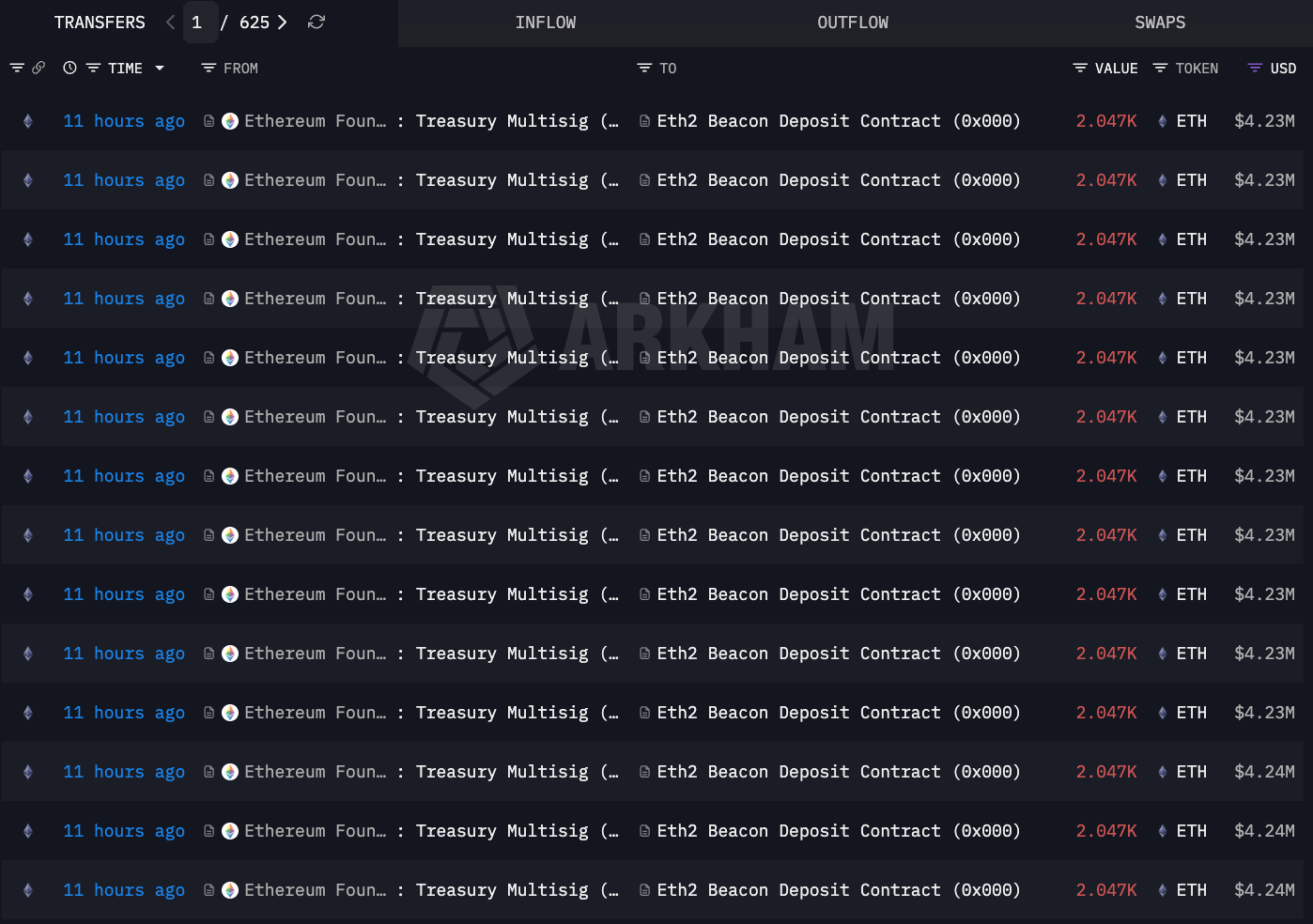
The Ethereum Foundation (EF), the non-profit organization that steers development of the Ethereum ecosystem, staked over 45,000 Ether (ETH) on Friday, bringing the total amount staked to about 69,500 ETH, less than 500 coins shy of the Foundation’s 70,000 goal.
The EF staked the coins in a series of transactions, each consisting of 2,047 ETH, with the total amount staked on Friday valued at over $92.2 million, according to data from Arkham Intelligence.

The EF began staking ETH in February as part of its revamped treasury strategy policy announced in June 2025 and will use the yield generated to fund protocol research, development and ecosystem grants. The EF said in its updated treasury policy:
“We are now increasingly moving into staking and DeFi, both to enhance financial sustainability and to support a key application category that is delivering on the promise of permissionless, secure access to base civilizational infrastructure for millions of people today.”
The foundation staked 2,016 ETH, valued at about $4.1 million in February, followed by 22,517 ETH, valued at about $46.1 million, in March. The EF has locked over $143 million in ETH in the Ethereum Beacon Deposit Contract, according to Arkham Intelligence.

The adoption of a yield-bearing treasury strategy followed pressure from the Ethereum community on the EF to generate income from its treasury to cover expenses, rather than continually selling tokens to fund operations.
Related: Ethereum Foundation sells $10.2M worth of ETH to BitMine in OTC deal
Vitalik Buterin warns EF staking may force positions in hard forks
Validators, who lock up tokens to secure proof-of-stake (PoS) blockchain networks, can influence which chain is valid in the event of a network hardfork, or a partition of a network into two competing chains.
“If EF stakes, ourselves, this de facto forces us to take a position on any future contentious hard fork,” Ethereum co-founder Vitalik Buterin said in January 2025.
The EF is exploring ways to mitigate the centralization risks posed by its staking activities in the event of a contentious hard fork, Buterin added.
Magazine: Ethereum’s Fusaka fork explained for dummies: What the hell is PeerDAS?
Crypto World
Best Crypto to Buy Now: Pepeto Raises Above $8.1M as Investors Look Past BTC and XRP During the Correction
Bithumb, South Korea’s second largest exchange, just postponed its IPO by two years after compliance fines, proving the industry is building for a longer timeline than this correction suggests. The correction is temporary, but the infrastructure underneath is permanent.
The best crypto to buy now is not the asset that needs billions to move 15%, it is the entry where the listing compresses the return into one day. Pepeto has raised above $8.1 million with live tools and a confirmed Binance listing.
Bithumb delayed its planned public offering by at least two years after fines and compliance issues, according to CoinGecko. The postponement confirms the infrastructure buildout will outlast the fear, as CoinDesk noted.
For the best crypto to buy now conversation, the correction is a pause in a longer story, and the entries positioned before the next chapter collect the most.
Best Crypto to Buy Now in 2026: Pepeto, BTC, and XRP
Pepeto
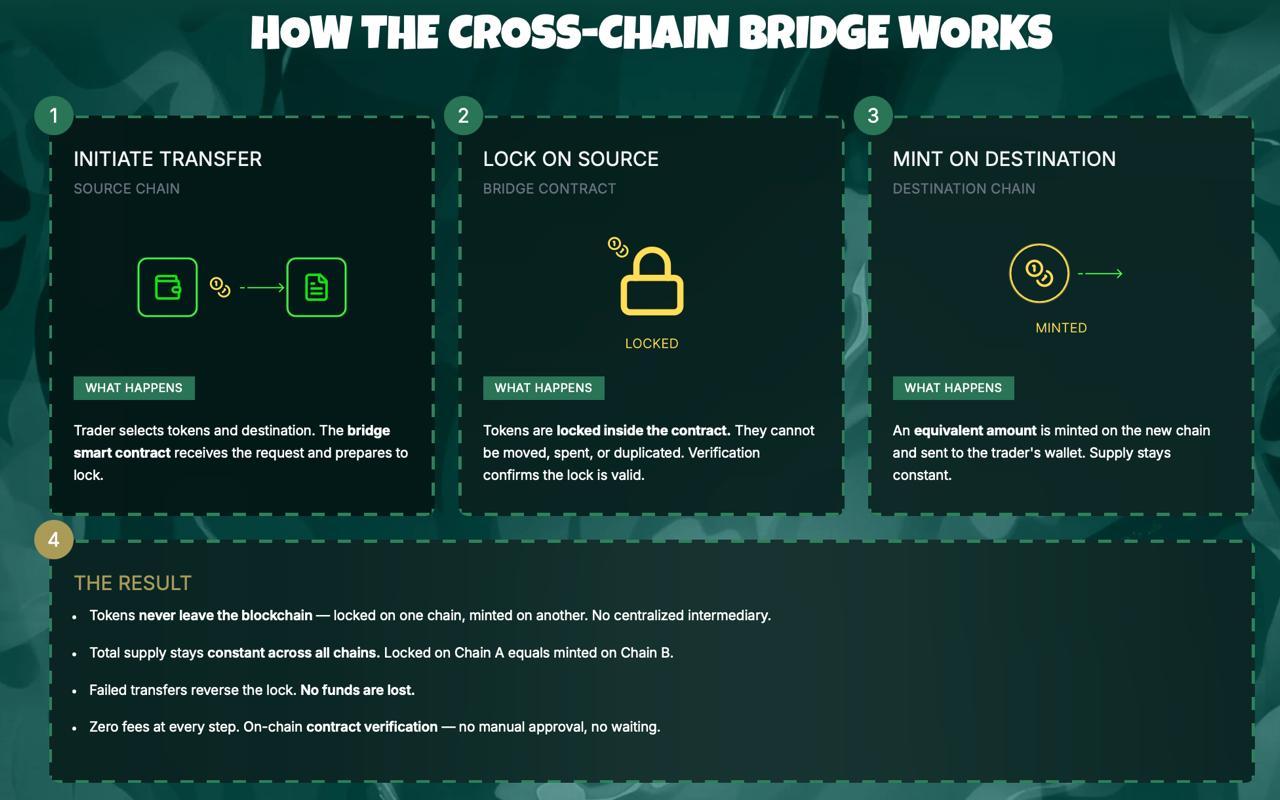
The correction has large cap holders watching BTC grind sideways, but the wallets searching for the best crypto to buy now already found the answer. Pepeto runs a zero fee swap engine that eliminates cost from every trade, and a cross chain bridge that connects networks so tokens move freely. These tools are live, which means every wallet using them interacts with a finished product at a price the Binance listing erases permanently, and that gap between presale pricing and listing day is where every dollar of real return lives.
The wallet behind the original Pepe project is part of the build alongside a former Binance expert, and the SolidProof audit confirmed the contract. The presale has collected above $8.1 million at $0.000000186 while the Fear and Greed Index sat at 9, and a $50,000 position earning 189% APY through staking returns roughly $98,000 in one year before the listing multiplier adds on top.
The correction will pass, the recovery will arrive, and the presale price will be gone, which means every day without a position is a day the reader’s money misses returns that the wallets already inside are set to collect.
The market always recovers, and the entries that turn corrections into wealth have tools working before the recovery starts. The Binance listing closes this window, and the presale counter ticks toward zero while the reader decides whether their money enters at presale pricing or pays whatever the open market charges after listing day rewrites the price.
BTC Holds $66,927 as Institutional Capital Builds Slowly
Bitcoin trades near $66,927 with dominance at 56.2%, according to CoinMarketCap. Institutional inflows are rebuilding, confirming the recovery forms underneath the fear.
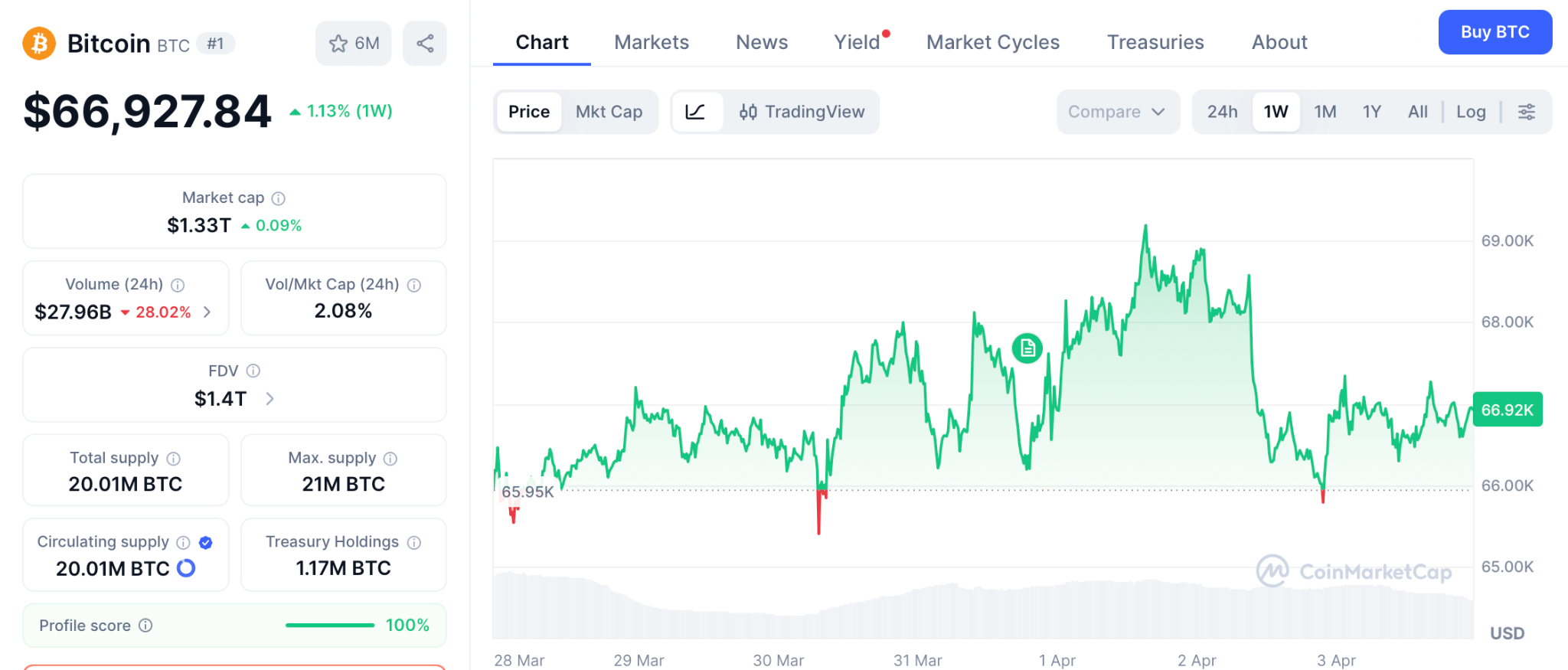
Analysts target $72,000, but BTC needs billions more just to move 15%, math designed for pension funds. The best crypto to buy now for real returns is the entry where one listing delivers what BTC takes a quarter to produce.
XRP Holds $1.32 as CLARITY Act Approaches
XRP trades near $1.32 with support at $1.30 and resistance at $1.35, according to CoinGecko. The CLARITY Act reaching the Senate by mid April could shift sentiment.
The bullish case targets $2.00, a credible 50% gain, but that return takes months and depends on macro conditions the best crypto to buy now at presale pricing does not need.
The Bottom Line
Bithumb postponing its IPO proves the industry is building for a timeline far longer than this correction, and the recovery forming beneath the fear is going to reward the entries positioned before it arrives. BTC needs billions to move 15% and XRP targets $2.00 over months, but neither offers the presale pricing that a Binance listing transforms overnight.
Above $8.1 million committed during fear is the proof, and the Pepeto official website still shows the figure that listing day erases. The reader searched for the best crypto to buy now and the answer led them here, because early wallets acted before the crowd had reason to look, and the reader’s money right now sits at presale pricing with a working exchange behind it, which is how every early fortune in crypto started.
Click To Visit Pepeto Website To Enter The Presale

FAQs
What is the best crypto to buy now during the correction?
Pepeto leads with above $8.1 million raised, live exchange tools, and a confirmed Binance listing. The correction is temporary and the presale price ends when the listing opens.
Why are large caps not the best crypto to buy now for returns?
BTC needs billions to move 15% and XRP targets 50% over months. The best crypto to buy now at presale pricing delivers the listing return from one event the Pepeto official website still shows.
Will the market recover from this correction?
Institutional infrastructure is expanding, exchanges are building for decades, and capital inflows are rebuilding. The correction is a pause, and the entries positioned before the recovery collect the most.
Disclaimer: This is a Press Release provided by a third party who is responsible for the content. Please conduct your own research before taking any action based on the content.
Coinbase has received conditional approval from the Office of the Comptroller of the Currency for a national trust bank charter — a first for any major U.S. crypto exchange — as community banking groups wasted no time calling the decision a grave mistake.
Summary
- Coinbase has received conditional approval from the Office of the Comptroller of the Currency for a national trust bank charter, the company confirmed on April 2.
- The approval positions Coinbase to offer federally regulated digital asset custody services nationwide under a single federal license.
- Community banking groups have pushed back sharply, with the Independent Community Bankers of America calling the OCC’s direction a “grave mistake.”
Coinbase has received conditional approval from the Office of the Comptroller of the Currency for a national trust bank charter, making it the first major U.S. crypto exchange to clear this specific federal regulatory hurdle. The company confirmed the approval through an April 2 blog post authored by Greg Tusar, Co-CEO of Coinbase Institutional, following a Bloomberg report that first broke the news.
The conditional charter would allow Coinbase to operate a national trust bank focused on digital asset custody and related settlement services. The entity will not accept retail deposits or issue traditional loans — its scope mirrors the structures already granted to Ripple, Circle, Paxos, and BitGo, which received their initial OCC approvals in December 2025. For Coinbase, the practical outcome is significant: a federal trust charter replaces a patchwork of state-level licenses with a single, nationwide regulatory status. It also positions the exchange directly inside the stablecoin custody and settlement infrastructure being built under the GENIUS Act.
Coinbase Chief Legal Officer Paul Grewal confirmed the news on X, writing: “Consistent rules and regulatory trust are what allow us to innovate with confidence. Today’s conditional @USOCC approval is yet more proof that our approach is working.”
The banking backlash
The approval has not been well received by traditional financial institutions. The Independent Community Bankers of America, which represents thousands of small lenders, described the OCC’s direction as a “grave mistake” in remarks reported by American Banker. The ICBA has repeatedly urged the OCC to pull or revise its crypto charter framework, arguing that digital asset firms are accessing bank-like federal status under lighter regulatory conditions than traditional banks face.
The Bank Policy Institute has gone further, weighing potential legal action against the OCC over what it describes as an improper reinterpretation of federal licensing rules — a possible lawsuit that could delay or complicate final approval for Coinbase and others in the pipeline.
Institutional and market context
Coinbase’s conditional charter comes as the exchange is already embedded in U.S. institutional crypto infrastructure, serving as custodian for multiple spot Bitcoin and Ethereum ETFs. Full OCC authorization will require meeting operational, governance, and capital thresholds — the same conditions applied to earlier approvals before they became final. Until then, the conditional status means the charter is approved in principle but not yet operational.
Crypto World
Figure Technology Solutions (FIGR) Stock Surges on Record Q1 Loan Growth and Token Adoption
Key Takeaways
-
FIGR shares advance 4.93% following 113% annual increase in Q1 lending volume
-
Monthly loan activity reaches $1.19B in March, demonstrating accelerating momentum
-
YLDS token circulation expands to $598M, indicating growing platform adoption
-
Available capital from lenders increases 14% as liquidity deepens
-
Democratized Prime data reveals synchronized expansion across borrowers and lenders
Shares of Figure Technology Solutions (FIGR) finished regular trading at $34.51, posting a 4.93% gain following a robust intraday surge and subsequent stabilization. During extended hours, the stock retreated modestly to $34.44, representing a 0.20% decline. The upward movement came after the company disclosed preliminary operating results for March and the first quarter of 2026, revealing substantial growth across multiple business segments.
Figure Technology Solutions, Inc. Class A Common Stock, FIGR
Lending Platform Volumes Reach New Heights
Figure Technology disclosed impressive performance in its consumer lending marketplace throughout March 2026. The blockchain-powered platform facilitated $1.19 billion in transactions, representing a 33% sequential gain from February activity. Year-over-year comparisons proved even more dramatic, with volumes doubling from March 2025 levels at a 102% growth rate.
First quarter results demonstrated ongoing momentum, with total platform volume hitting $2.9 billion. This figure exceeded the previous quarter by 7% while soaring 113% compared to the same period last year. The data underscores accelerating demand for distributed ledger-based credit origination and secondary market trading capabilities.
The organization maintains its marketplace operations as a primary revenue generator, offering home equity lines of credit, debt service coverage ratio mortgages, and unsecured consumer loans. Transaction activity through Figure Connect bolstered overall platform engagement. The expanding scope demonstrates the company’s increasing influence within tokenized lending markets.
YLDS Token Achieves Significant Milestone
Figure announced impressive progress for its YLDS offering, which debuted in February 2025. Outstanding tokens reached a valuation of $598 million during March 2026, advancing 2% from the prior month. The metric represents a dramatic escalation from the mere $3 million circulating during March 2025.
First quarter comparisons unveiled even stronger momentum, with YLDS circulation soaring 83% above fourth quarter 2025 levels. This trajectory indicates accelerating acceptance of tokenized credit instruments throughout the platform ecosystem. Furthermore, the expansion reflects increasing confidence in blockchain-enabled financial products among marketplace participants.
The firm characterizes YLDS as unsecured digital certificates collateralized by its affiliated entity’s asset portfolio. Consequently, the instrument enhances liquidity and capital formation across its lending infrastructure. The swift uptake aligns strategically with the organization’s comprehensive asset tokenization initiatives.
Democratized Prime Platform Records Symmetric Expansion
Figure’s Democratized Prime offering maintained consistent matched transaction levels throughout March 2026. The outstanding balance totaled $368 million, remaining relatively flat versus February figures. Borrower appetite edged higher to $376 million, demonstrating persistent credit demand.
Lender capital availability climbed to $453 million during March, posting a 14% monthly gain. This increase suggests enhanced funding capacity within the platform’s liquidity pools. The system maintains equilibrium between available capital and borrower requirements.
Quarterly comparisons revealed substantial acceleration across all measurements, including a 79% expansion in matched transaction balances. Borrower demand advanced 53%, while lender capital surged 112% compared to the final quarter of 2025. These metrics underscore broadening participation and strengthening liquidity throughout the platform architecture.


President Trump has fired Pam Bondi and replaced her with Todd Blanche as interim U.S. Attorney General — handing control of the Justice Department to the official who dismantled the DOJ’s crypto enforcement unit in April 2025 and holds up to $485,000 in personal digital asset holdings.
Summary
- President Trump has replaced Attorney General Pam Bondi with Todd Blanche, the DOJ official who disbanded the National Cryptocurrency Enforcement Team in April 2025.
- Blanche, now acting AG, holds up to $485,000 in personal crypto holdings and authored the memo ending the DOJ’s regulation-by-prosecution approach to digital assets.
- The appointment hands the Justice Department’s leadership to one of the most crypto-friendly figures in U.S. federal law enforcement history.
President Trump has fired Pam Bondi and replaced her with Todd Blanche as interim U.S. Attorney General — handing control of the Justice Department to the official who dismantled the DOJ’s crypto enforcement unit in April 2025 and holds up to $485,000 in personal digital asset holdings.
Bondi confirmed her departure in an April 2 post on X, writing that she would be “working tirelessly to transition the office of Attorney General to the amazing Todd Blanche” before moving to an unspecified private sector role. NBC News confirmed that Bondi was fired following growing frustration from the president over her handling of key priorities.
Blanche is not a new name in the digital asset industry. As Deputy Attorney General, he authored the April 2025 memo that formally disbanded the National Cryptocurrency Enforcement Team, declaring in plain language that the DOJ “is not a digital assets regulator” and criticizing the prior administration’s approach as a “reckless strategy of regulation by prosecution.”
The memo directed prosecutors to stop pursuing cases against crypto exchanges, mixers, and offline wallets for end-user behavior, shifting enforcement focus to individuals directly defrauding investors. The decision triggered a swift backlash from Democratic lawmakers, who argued it opened the door to sanctions evasion, drug trafficking, and large-scale financial fraud.
Blanche also holds reported personal crypto exposure of up to $485,000 — a detail that will almost certainly draw scrutiny from Congress as he leads the nation’s top law enforcement agency.
What changes at the DOJ
Blanche’s elevation to acting AG signals continuity — and likely intensification — of the DOJ’s current posture toward digital asset enforcement. The NCET, which handled major crypto fraud cases and supported cross-border law enforcement coordination, remains disbanded. Its closure, combined with the prior directive to deprioritize structural crypto enforcement, has already reshaped how federal prosecutors approach the space.
With Blanche now at the top, those policy choices become structurally harder to reverse regardless of who eventually takes the permanent AG role. Trump announced the change via Truth Social, describing Blanche as a “very talented and respected Legal Mind.” The White House has not yet specified a timeline for a permanent nomination, with EPA Administrator Lee Zeldin reportedly under consideration.

Man jailed for life after raping baby five times as second man sentenced

NYSE And Nasdaq Shut For Holiday

Hegseth reverses a 34-year Pentagon policy on firearm


-

 NewsBeat1 day ago
Steven Gerrard disagrees with Gary Neville over ‘shock’ Chelsea and Arsenal claim | Football
-

 Sports7 days ago
Sweet Sixteen Game Thread: Tide vs Michigan
-
Entertainment4 days ago
Fans slam 'heartbreaking' Barbie Dream Fest convention debacle with 'cardboard cutout' experience
-

 Business22 hours ago
No Jackpot Winner and $194 Million Prize Rolls Over
-

 Crypto World2 days ago
Gold Price Prediction: Worst Month in 17 Years fo Save Haven Rock
-
 Entertainment6 days ago
Lana Del Rey Celebrates Her Husband’s 51st Birthday In New Post
-

 Tech5 days ago
The Pixel 10a doesn’t have a camera bump, and it’s great
-
Crypto World3 days ago
Dems press CFTC, ethics board on prediction-market insider trades
-

 Fashion4 hours ago
Weekend Open Thread: Spanx – Corporette.com
-

 Tech5 days ago
Avatar Legends: The Fighting Game comes out in July and it looks pretty slick
-

 Sports3 days ago
Tallest college basketball player ever, standing at 7-foot-9, entering transfer portal
-

 Tech4 days ago
EE TV is using AI to help you find something to watch
-

 Fashion6 days ago
Amazon Sundays: Soft Spring Layers
-

 Business2 days ago
Login and Checkout Issues Spark Merchant Frustration
-

 Fashion7 days ago
When Evening Dressing Gets Colorful for Spring
-

 Tech5 days ago
Elon Musk’s last co-founder reportedly leaves xAI
-

 Tech3 days ago
How to back up your iPhone & iPad to your Mac before something goes wrong
-

 Tech4 days ago
Apple will hide your email address from apps and websites, but not cops
-

 Politics4 days ago
Should Trump Be Scared Strait?
-

 Crypto World4 days ago
U.S. rule change may open trillions in 401(k) funds to crypto
You must be logged in to post a comment Login