
Crypto World
RLUSD Supply Drops After Ripple Executes $120M End-Month Burn


TLDR
- Ripple burned about $120 million worth of RLUSD on April 30 through two separate transactions.
- The burn ranks as the second-largest intraday RLUSD reduction recorded on the XRP Ledger.
- The transactions reduced RLUSD supply on the XRP Ledger to about $253 million.
- Ethereum now holds about 82.5% of the total RLUSD supply after the latest burn.
- Historical data shows Ripple often follows large burns with early-month mint activity.
Ripple executed large RLUSD burn transactions on April 30, reducing supply across networks. The company removed about $120 million through two separate ledger entries. Data shows a repeated monthly pattern tied to liquidity adjustments.
RLUSD Burn Activity Reduces Supply on XRPL
Ripple processed two burn transactions on the XRP Ledger within hours on April 30. The first transaction removed $85 million worth of RLUSD at 15:46 UTC.
Later, Ripple completed another burn of 34.248 million RLUSD at 21:24 UTC. Together, these transactions totaled $119.25 million removed from circulation.
The burn reduced RLUSD supply held on the XRP Ledger. Current data shows only $253 million remains on XRPL after the reduction.
Meanwhile, most RLUSD supply sits on Ethereum. About $1.191 billion, or 82.5%, remains outside the XRP Ledger.
A tracker created by validator Vet recorded both transactions. Vet stated, “This marks one of the largest intraday RLUSD burns recorded.”
The tracker confirms the event ranks as the second-largest burn in a single day. Only the March 31 burn exceeded this volume.
Monthly RLUSD Pattern Points to Incoming Mint Activity
Historical data shows Ripple follows large burns with early-month minting. This pattern has repeated across several recent months.
On Dec. 31, 2025, Ripple burned $58 million in RLUSD. It then minted $67.6 million on Jan. 2, 2026.
The company repeated this pattern in late January. It burned $93.2 million before minting $102 million in early February.
In late February, Ripple removed $88.7 million in RLUSD. It then minted the same amount on March 2.
March recorded the largest burn event so far. Ripple removed $179 million on March 31 across networks.
Early April followed with a mint of $123.6 million. These transactions occurred within the first two days of the month.
Vet referenced this trend and said, “Large burns often precede similar mint volumes shortly after.” The data supports this recurring sequence.
RLUSD Supply Distribution and Market Position
The recent burn lowered RLUSD circulating supply on the XRP Ledger. The total supply now reflects a sharp shift toward Ethereum holdings.
XRPL currently hosts only 17.5% of RLUSD supply. This marks a drop after repeated burn transactions.
Ethereum continues to hold the majority share. Its 82.5% portion reflects ongoing distribution changes.
Despite supply changes, RLUSD remains among the top stablecoins. It currently ranks eighth by market capitalization.
Data shows RLUSD needs about $1 billion growth to reach seventh place. Current figures place it behind competitors in that ranking.
Burn and mint cycles continue to shape RLUSD supply levels. The next mint activity may occur in early May based on prior timing.


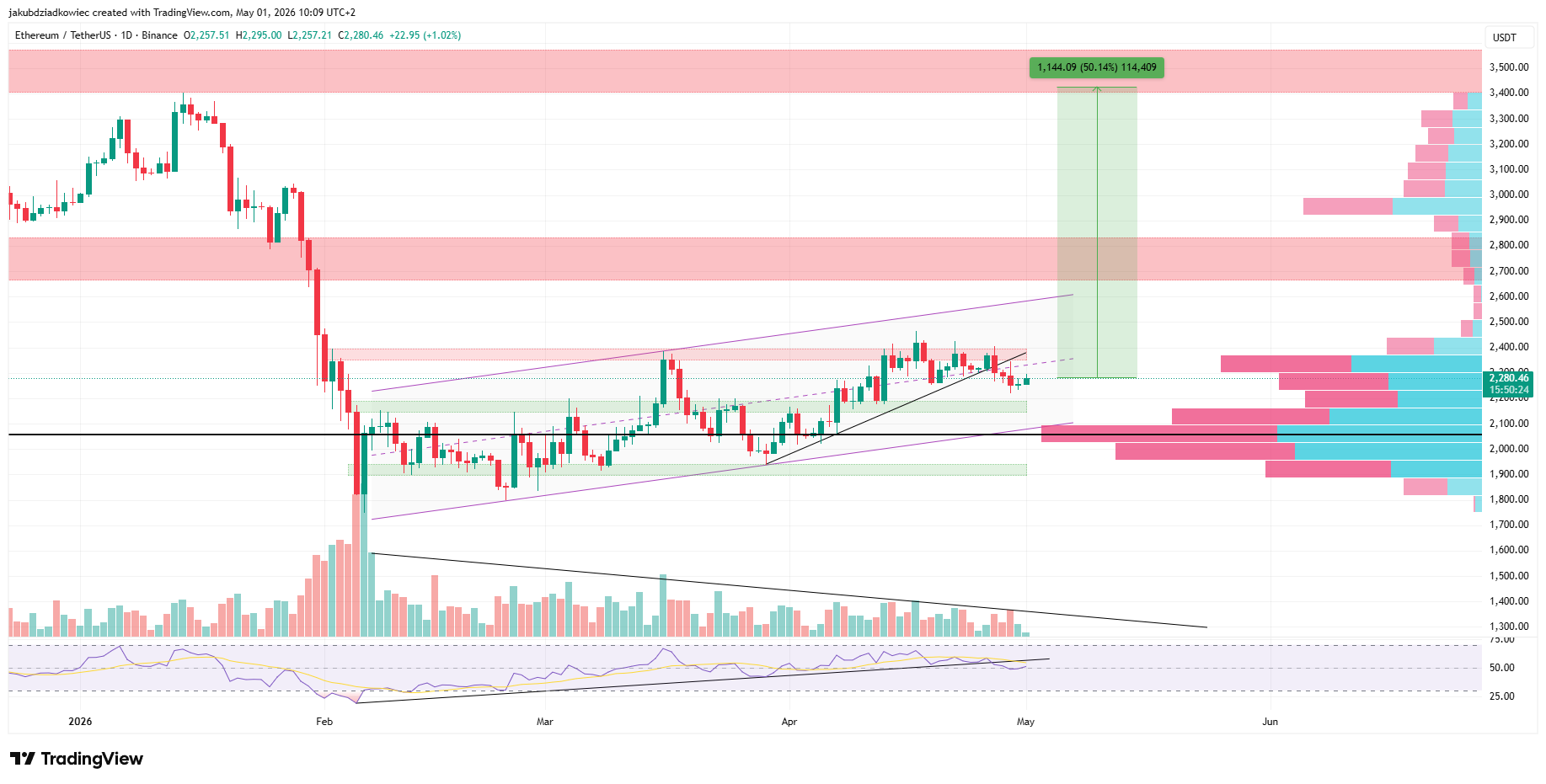
Ethereum (ETH) is coiling under a $2,300 while Bitcoin Dominance approaches a monthly death cross seen only twice in history, the kind of pairing that historically sets up an altseason.
The two charts move as mirrors. Ether is the largest altcoin, so sustained strength in ETH against bitcoin pulls capital away from BTC and pushes the dominance index lower, the textbook setup that has previously marked the start of an altcoin rotation.
Ethereum Price Targets $3,430
Ethereum trades at $2,280, inside an ascending parallel channel that has guided price action since February. The token broke below the channel midline on April 27, a structural shift that put bears in temporary control.
That breakdown coincided with the daily Relative Strength Index (RSI) breaking through its own ascending trendline. The double trendline failure is a bearish confluence that often precedes deeper retracements.
However, the breakdown volume contracted rather than expanded. The Visible Range Volume Profile (VRVP) on the right side of the chart shows heavy accumulation around $2,050, which now overlaps with the lower band of the rising channel and serves as the primary downside target if sellers press the move.
A clean reclaim of the channel midline opens the door to a 50% measured move toward $3,430. Closer overhead resistance sits at $2,750, the prior swing high that bulls would need to clear before the long-range target comes into view.
Trader Fractal Points to the Same $3,430 Magnet
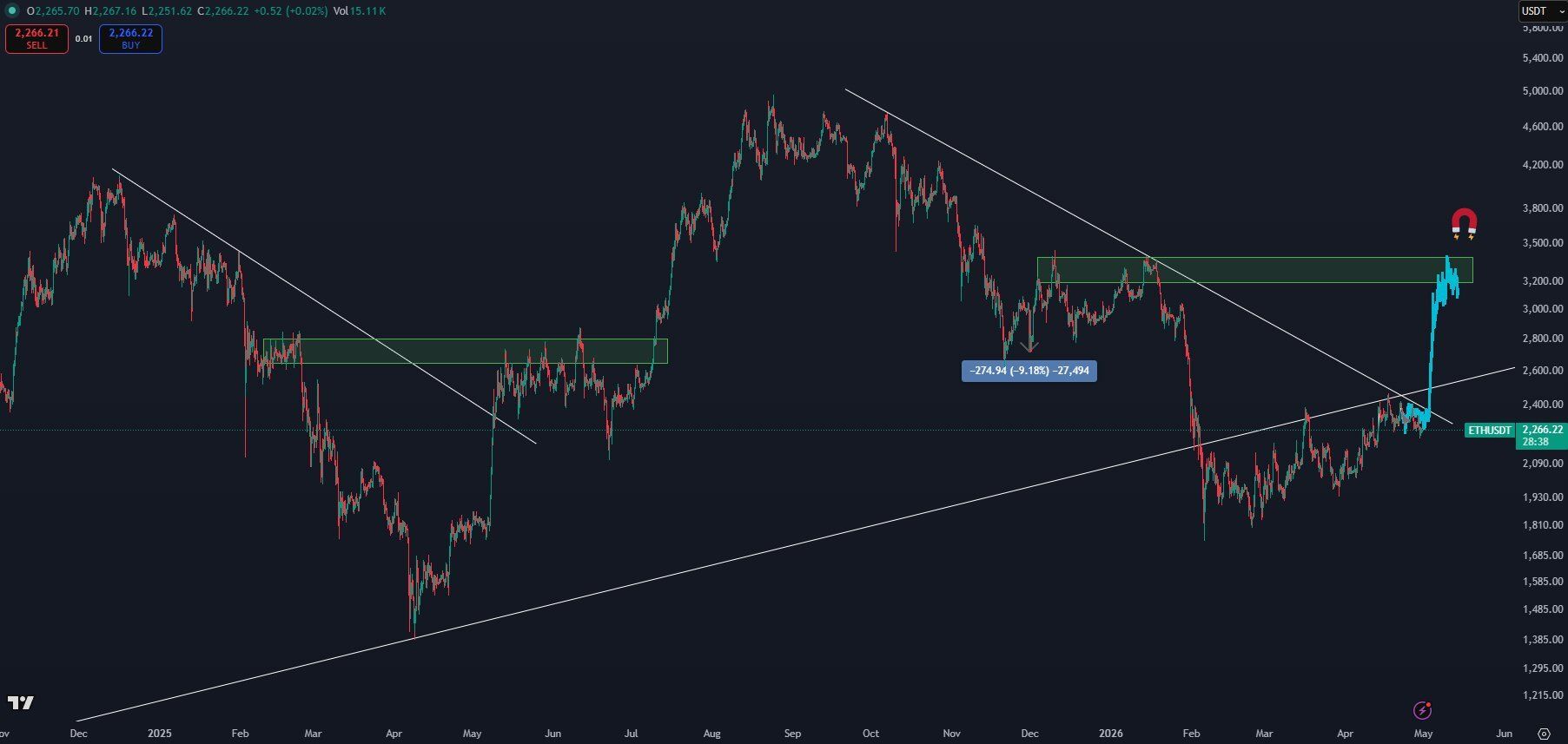
Trader CryptoKaleo published a daily Ether chart on X that arrives at the same $3,430 zone from a different angle. He marks two falling trendlines that the price has already started to break through, a pattern he says mirrors a similar fractal from earlier in 2025.
The earlier setup resolved with a fast move higher after consolidation under resistance. Kaleo treats the prior move as the template for what could follow this base.
His drawn target zone overlaps cleanly with the long-range resistance from the channel chart. Two independent technical reads landing on the same $3,430 area strengthen the case that ether bulls have a defined upside objective if the breakdown fails to extend.
Bitcoin Dominance Approaches Its Third Monthly Death Cross Ever
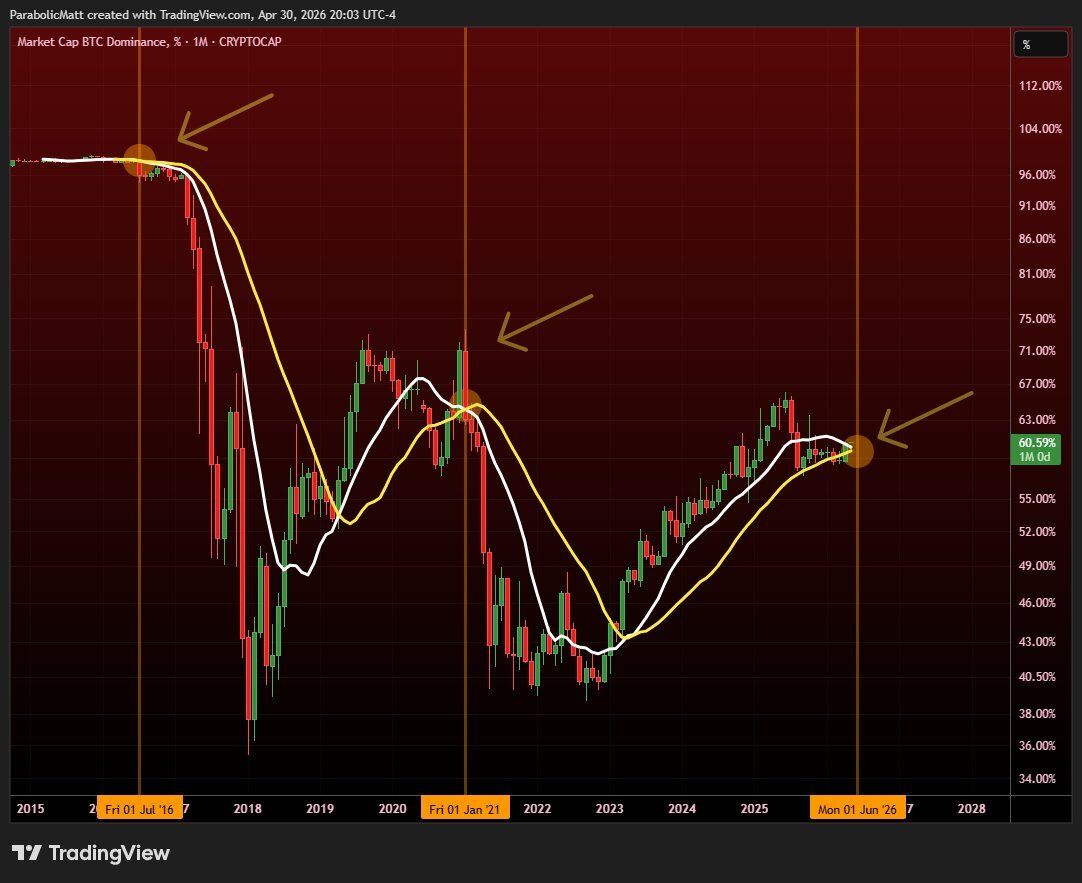
Analyst Matthew Hyland flagged a monthly death cross brewing on the Bitcoin dominance chart, with the slower yellow moving average set to cross below the faster white moving average around June 2026.
The signal has appeared only twice before in the asset’s history. The first cross arrived in July 2016, and the second in January 2021. Both events were followed by sharp drops in dominance and aggressive rotations into altcoins.
BTC.D currently prints a 60.59% monthly close. Even with dominance still elevated near multi-year highs, the structural setup behind the chart suggests the path of least resistance over the coming months may be lower, not higher.
BTC Dominance Tests 61% Resistance That Decides Altseason
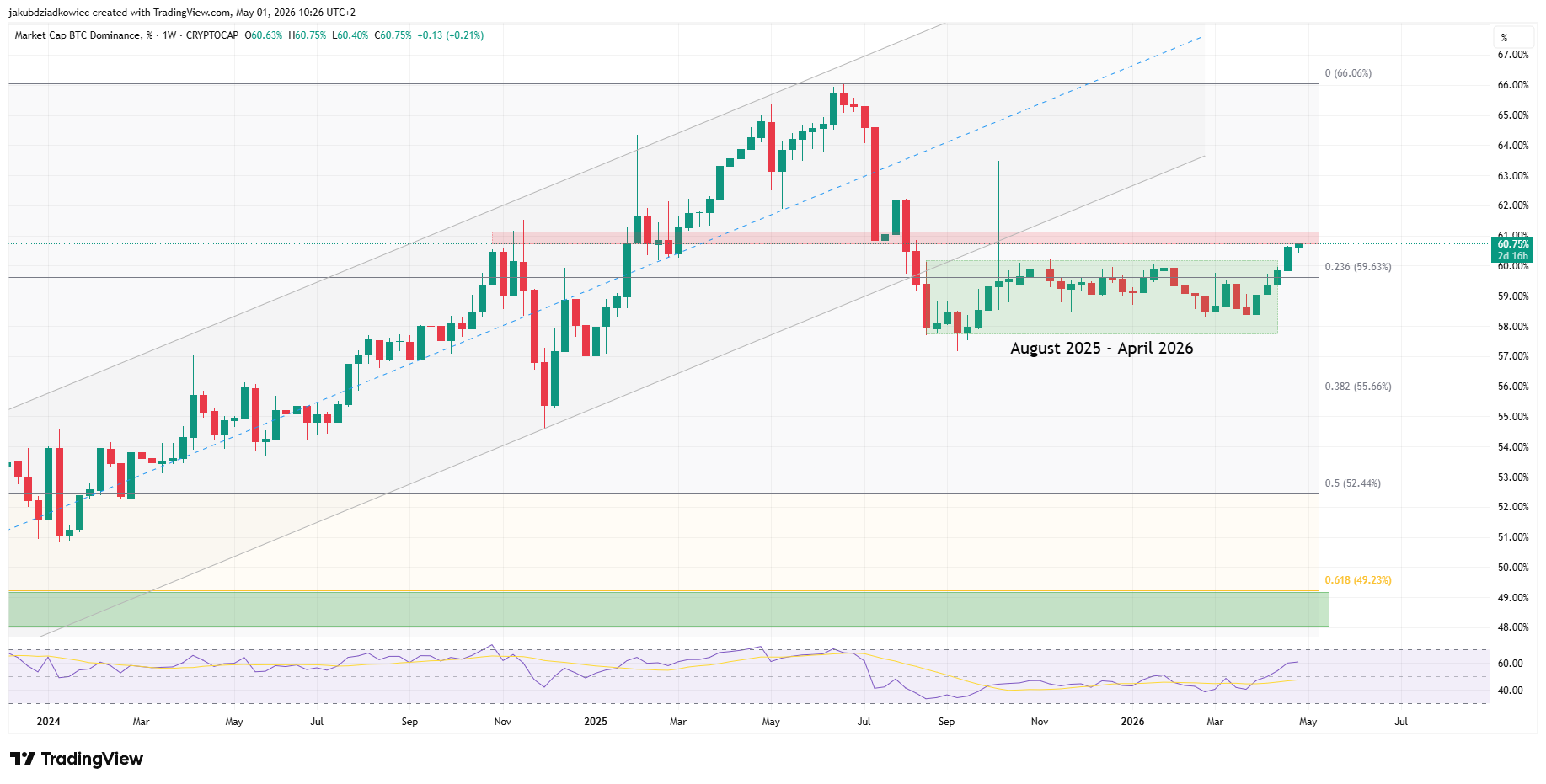
The weekly chart adds precision that the monthly view cannot. Bitcoin Dominance climbed inside an ascending channel for years before breaking down in August 2025, then traded sideways inside an accumulation box from August 2025 through April 2026.
Over the past two weeks, BTC.D pushed out of that range and is now stalling at 60.75%, just below resistance at 61%. That level is the line that decides the next macro move.
A clean break above 61% would open the door to 62% and the 66% June high. A rejection lines up with the monthly death cross thesis and points price action down toward the 0.618 Fibonacci retracement at 49.23%.
Ethereum’s $3,430 breakout and Bitcoin Dominance’s drop toward 49% are two sides of the same altcoin trade. The 61% level on dominance and the channel midline on ETH are the binary triggers to watch over the coming weeks.
The post Bitcoin Dominance Nears Death Cross, Ethereum Could Trigger Altcoin Season appeared first on BeInCrypto.
Key points:
- Bitcoin will have to flip the $80,000 level into support to continue its up move to $84,000.
- Several major altcoins are finding buyers at lower levels, but they will have to overcome the overhead resistance to start a new up move.
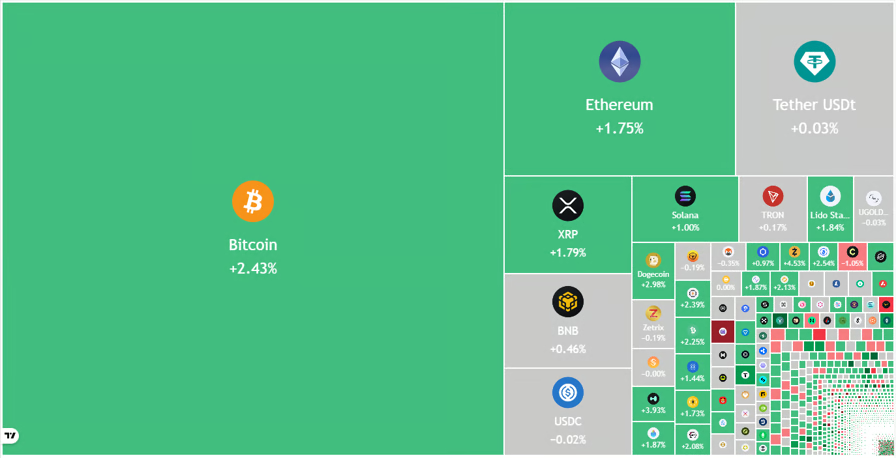
Bitcoin (BTC) has risen above $78,000, extending upon its 11.87% rally in April, per CoinGlass data. The recovery in April was supported by solid buying in the US spot BTC exchange-traded funds, which saw $1.97 billion in inflows, according to SoSoValue data.
The rally is expected to encounter selling in the zone between the True Market Mean at $78,000 and the Short-Term Holder (STH) cost basis at $79,000. Analysts are closely monitoring the $80,000 level, which needs to be flipped into support for confirmation that bulls remain in control.

Crypto market data daily view. Source: TradingView
CryptoQuant is not convinced that BTC’s rally could extend further. In a recent report, the crypto analytics firm said that BTC’s up move in April was fuelled mainly by futures traders, while spot demand contracted. That suggests “the market’s marginal buyer was speculative, not fundamental.” CryptoQuant warned in an X post that the exact setup had “preceded the next leg down” in 2022.
Could BTC and the major altcoins break above their overhead resistance levels? Let’s analyze the charts of the top 10 cryptocurrencies to find out.
Bitcoin price prediction
BTC turned up from the 20-day exponential moving average ($75,814) on Thursday, indicating buying on dips.

BTC/USDT daily chart. Source: Cointelegraph/TradingView
The relief rally is expected to face selling pressure at $79,500, but if buyers pierce the overhead resistance, the uptrend is expected to gain momentum, and the BTC/USDT pair may rally to $84,000.
The 20-day EMA is the crucial support to watch out for on the downside. If the BTC price turns down from the current level or the overhead resistance and breaks below the 20-day EMA, it may start a deeper correction to the 50-day simple moving average ($72,362) and then the support line.
Ether price prediction
Ether (ETH) is finding support near the 50-day SMA ($2,207), indicating that bulls are viewing the dips as a buying opportunity.

ETH/USDT daily chart. Source: Cointelegraph/TradingView
The flattening 20-day EMA and the relative strength index (RSI) just above the midpoint suggest weakening momentum. If the ETH price turns down and breaks below the 50-day SMA, the next stop is likely to be the support line.
Instead, if the price remains above the 20-day EMA, the bulls will attempt to drive the ETH/USDT pair to $2,465 and then to the ascending channel’s resistance. The next trending move is expected to begin on a close above the resistance line or below the support line. Until then, the pair may remain inside the channel.
XRP price prediction
XRP (XRP) remains stuck inside the $1.27 to $1.61 range, signaling buying on dips and selling on rallies.

XRP/USDT daily chart. Source: Cointelegraph/TradingView
The 20-day EMA ($1.39) has started to turn down gradually, and the RSI is near the midpoint, indicating a slight edge to the bears. If the XRP price remains below the moving averages, the likelihood of a drop to the $1.27 support increases.
Buyers are likely to have other plans. They will attempt to thrust the price above the moving averages. If they succeed, the XRP/USDT pair may rally to the downtrend line of the descending channel pattern, then to the $1.61 resistance. A trend change will be signaled on a close above the $1.61 level.
BNB price prediction
BNB (BNB) slipped below the moving averages on Tuesday, but the bears have failed to build upon their advantage. That suggests demand at lower levels.

BNB/USDT daily chart. Source: Cointelegraph/TradingView
The bulls are attempting to push the BNB price back above the moving averages. If they manage to do that, the BNB/USDT pair may rise to $654 and then to the $687 overhead resistance.
On the other hand, if the price turns down and breaks below $610, it signals that the sellers remain in control. The pair may then tumble toward the $570 support, where the buyers are expected to step in.
Solana price prediction
Buyers are attempting to sustain Solana (SOL) above the $82.65 level but the bears continue to exert pressure.

SOL/USDT daily chart. Source: Cointelegraph/TradingView
If the $82.65 level cracks, the SOL/USDT pair may decline to $76. Buyers are expected to defend the $76 level with all their might, as a close below it may start the next leg of the downward move to $67.
On the contrary, if the SOL price rises above the moving averages, it suggests that the pair may remain inside the $82.65 to $90.73 range for some time. A close above $90.73 opens the gates for a retest of the $98 overhead resistance.
Dogecoin price prediction
Dogecoin (DOGE) is showing strength, as bulls prevented the pullback from dipping below the $0.10 level on Thursday.

DOGE/USDT daily chart. Source: Cointelegraph/TradingView
That increases the likelihood of a rally to the $0.12 overhead resistance, where the bears are expected to mount a strong defense. If the price turns sharply lower and breaks below the moving averages, it suggests the DOGE/USDT pair may remain within the $0.09 to $0.12 range for a while longer.
Alternatively, if buyers overcome the $0.12 obstacle, it suggests that the pair may have bottomed out in the near term. The DOGE price may rise to $0.14 and later to $0.16.
Hyperliquid price prediction
Hyperliquid (HYPE) fell below the 50-day SMA ($39.84) on Thursday but the long tail on the candlestick shows buying at lower levels.

HYPE/USDT daily chart. Source: Cointelegraph/TradingView
The bulls are striving to push the HYPE price above the 20-day EMA ($40.85). If they manage to do that, the HYPE/USDT pair may rally toward the $43.76-$45.77 overhead resistance zone. A close above the zone clears the path for a rally to $50.
Contrary to this assumption, if the price turns down and breaks below $38.70, it signals that the bears are selling on rallies. That may start a deeper pullback to $37.77 and subsequently to $34.45.
Related: Did Dogecoin bottom first? DOGE price poised for 20% gains as whales return
Cardano price prediction
Cardano (ADA) has been clinging to the moving averages, indicating that the bulls have kept up the pressure.

ADA/USDT daily chart. Source: Cointelegraph/TradingView
That improves the prospects of a break above the downtrend line. If that happens, the ADA/USDT pair may surge to $0.32 and later to $0.37, signaling a potential short-term trend change.
This bullish view will be invalidated in the near term if the ADA price turns sharply lower and breaks below $0.22. Such a move suggests that the pair may remain inside the descending channel for a few more days.
Bitcoin Cash price prediction
Bitcoin Cash (BCH) bounced off $443 again, indicating that the bulls are aggressively defending the level.

BCH/USDT daily chart. Source: Cointelegraph/TradingView
There is minor resistance at the 50-day SMA ($453), but it is likely to be crossed. The BCH/USDT pair may then soar to $486, at which point bears are expected to sell aggressively. However, if buyers overcome the barrier, the pair may rally to $520.
Contrary to this assumption, if the BCH price turns sharply lower from $486 and breaks below the moving averages, it suggests that bears remain sellers on rallies. That may keep the pair range-bound between $419 and $486 for some time.
Monero price prediction
Monero (XMR) bounced off the 20-day EMA ($366) on Wednesday, indicating a positive sentiment.

XMR/USDT daily chart. Source: Cointelegraph/TradingView
The upsloping 20-day EMA and the RSI in positive territory indicate that the path of least resistance is upward. If buyers push and maintain the XMR price above the $406 resistance, the rally may reach the $500 level.
Conversely, if the price turns sharply lower from the overhead resistance and breaks below the moving averages, it suggests that the XMR/USDT pair may remain range-bound between $302 and $406 for some time.
XRP’s (XRP) sentiment on social media has risen sharply over the last few days, but overhead resistance at $1.40 kept the price in consolidation.
Key takeaways:
- XRP’s social media sentiment has risen 240% over the last 30 days to a two-year high.
- XRP price recovery may face resistance at $1.40, with a prolonged consolidation likely.
.
XRP sentiment jumps on integration with Rakuten Pay
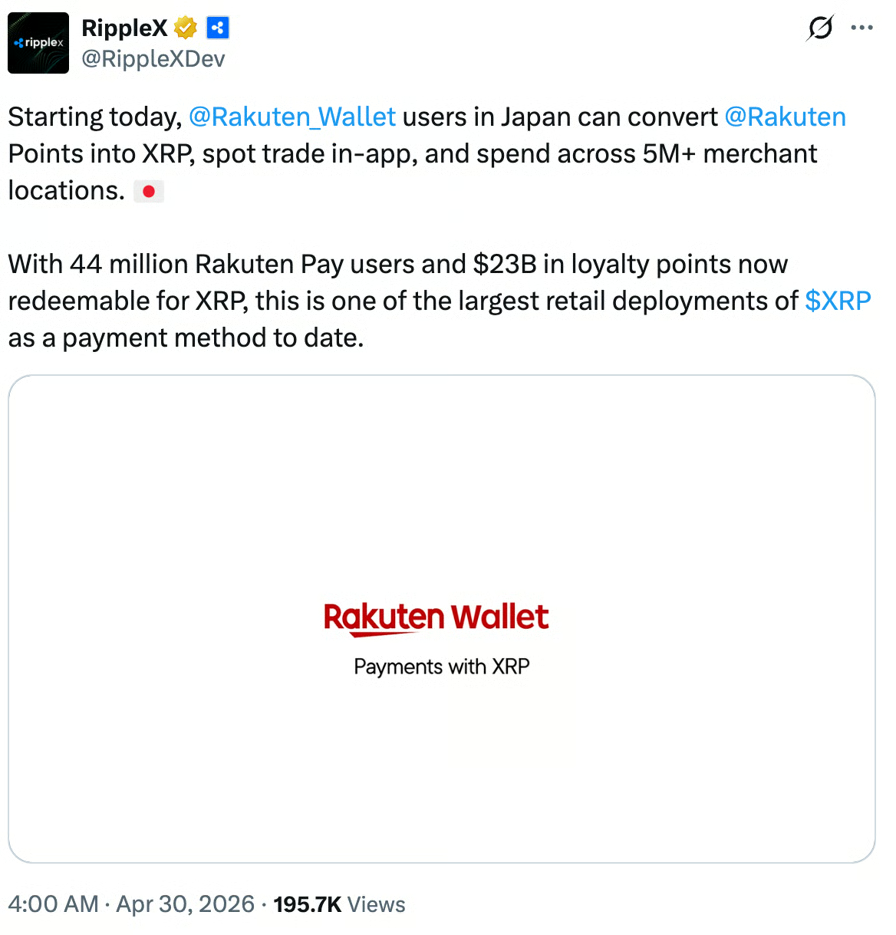
News of XRP’s integration with the Japanese payment platform, Rakuten Wallet, has sparked renewed optimism among investors.
Related: XRP set for ‘strongest’ 2026 monthly ETF inflows as bulls target $2
This integration allows Rakuten’s over 44 million users to convert their loyalty points (worth over $23 billion) directly into XRP, trade it in-app, and spend it at over 5 million merchant locations via the Rakuten Pay app.
This marks “one of the largest retail deployments of $XRP as a payment method to date,” bridging loyalty programs, payments, and crypto utility in a major world economy, Ripple said in an X post on Thursday.

XRP integrates with Rakuten Pay. Source: Ripple
As a result, XRP saw its “2nd highest bullish sentiment across social media in the past 2 years,” Santiment said in a Thursday post on X.
Santiment’s Positive/Negative sentiment indicator, which measures the ratio of positive to negative social media mentions for a cryptoasset, shows XRP has a score of 3.9, levels last seen in early 2024.
This was more than 240% higher than the 1.135 value recorded on March 29, following a 20% price drop over two weeks.
Traders are showing excitement over the fact that XRP is “seeing further adoption,” the onchain data provider said, adding:
“As far as price goes, these events don’t often instantly lead to major price outbreaks. It is usually after the initial wave of euphoria, after FOMO calms down, that the impact of this kind of news sees the bullish outcome.”

XRP’s Positive/Negative sentiment metric. source: Santiment
“Buy $XRP with points. Spend it across millions of merchants in Japan,” analyst John Squire said in reaction to the development, adding:
“This is what mass adoption looks like.”
Following this news, XRP/USD jumped 2% over the last 24 hours, but remains 62% below its $3.66 multi-year high reached in July 2025.
XRP faces stiff resistance above $1.40
XRP’s recent 18% rally from its local low at $1.27 reached on April 5 was stopped at $1.48, coinciding with the upper boundary of a symmetrical triangle.
This trend line has suppressed the price since early February, as shown in the chart below.
Bulls must push the price above the $1.40-$1.45 resistance zone to confirm a bullish breakout from the triangle. This area is also where the 50-day exponential moving average, the 100-day simple moving average and the upper trend line of the triangle sit, reinforcing the significance of this resistance zone.

XRP/USD daily chart. Source: Cointelegraph/TradingView
According to XRP’s cost-basis distribution data, investors hold approximately 2 billion XRP at an average cost of $1.40-$1.45, creating a potential resistance zone. This concentration suggests many investors may sell at break-even, potentially stalling XRP’s upward momentum.

XRP cost basis distribution chart. Source: Glassnode
A break above this supply area could open the way for a rally toward the measured target of the triangle at $2.10, about 50% above the current price.
In a Friday post on X, analyst ChartNerd said a big move was brewing for XRP price once resistance above $1.40 is “cleared.”

As Cointelegraph reported, the XRP/USD pair was required to hold the $1.27 support and rise above the moving averages around $1.40 to signal a trend change.
Crypto World
Consensys Challenges OCC’s Stablecoin Rules, Urges Treasury to Narrow Yield and DeFi Restrictions
TLDR:
- Consensys argues the OCC’s yield ban wrongly extends to third-party distributors beyond what Congress intended.
- The firm says DeFi lending on platforms like Aave is an active user choice, not issuer-paid yield on stablecoins.
- Consensys recommends disclosure and pool segregation over outright prohibition on multi-brand stablecoin issuance.
- The rules, if left unchanged, could favor large institutions and put OCC-supervised issuers at a competitive disadvantage.
Consensys submitted a formal comment letter to the U.S. Treasury Department regarding the Office of the Comptroller of the Currency’s proposed stablecoin rules.
The letter responds to the OCC’s framework implementing the GENIUS Act’s payment stablecoin provisions. While Consensys acknowledged the OCC’s effort, it identified three areas needing revision.
These areas relate to yield restrictions, DeFi access, and multi-brand stablecoin issuance. The outcome of these rules will shape how the U.S. stablecoin market develops.
Yield Restrictions and the Role of Distributors
The GENIUS Act prohibits stablecoin issuers from paying interest or yield to holders. Congress wanted to prevent stablecoins from competing with bank deposits through passive returns. Consensys confirmed it recognizes this concern and accepts Congress’s position on the matter.
However, the OCC extended the prohibition to cover “related third parties.” This broader category sweeps in independent distribution partners that co-brand or white-label a stablecoin product.
Consensys argued that a distributor using its own commercial fee to offer user incentives is not acting as an issuer.
Consensys explained in the letter that such a distributor is “a business competing for customers with its own money, as every business does.”
This is standard commercial practice and not the conduct Congress sought to restrict. Congress also rejected two separate amendments that would have extended the yield ban to non-issuers.
Therefore, the OCC’s proposed rule oversteps the statutory line Congress deliberately drew. Consensys called on the OCC to revise this provision to align with legislative intent and respect the boundaries Congress set.
DeFi Access and the Multi-Brand Stablecoin Issue
On the DeFi question, Consensys pointed to how MetaMask users interact with protocols like Aave or Morpho. When a user deposits stablecoins into such platforms, they make an active investment decision. They accept protocol risk and earn yield from borrowers in that specific market.
Consensys clarified that this activity is not “the issuer paying them to hold a stablecoin.” The GENIUS Act itself excludes non-custodial software interfaces from regulated intermediary status. Consensys argued the final rule should confirm that DeFi access falls under this same carve-out.
Regarding multi-brand stablecoins, the OCC is considering prohibiting a single licensed issuer from supporting multiple co-branded products.
Consensys stated that “disclosure is the right instrument here, not prohibition.” Requiring issuers to identify themselves and explain reserve structures would address transparency concerns directly.
If disclosure alone proves insufficient, Consensys suggested pool segregation as a proportionate remedy. A full prohibition “forecloses the distribution model entirely rather than managing the risk it presents.”
It also places OCC-supervised issuers at a disadvantage compared to FDIC-supervised issuers facing no equivalent restriction.


137 Ventures has raised over $700m across two new funds, lifting AUM above $15b as it doubles down on AI agents, robotics, advanced industry and a $10b‑plus SpaceX stake.
Summary
- SpaceX backer 137 Ventures has closed more than $700 million across two new funds, lifting its assets under management above $15 billion.
- The growth-stage firm says the fresh capital will target high‑impact technology bets in AI agents, robotics, advanced industrial systems, and aerospace propulsion.
- 137 Ventures now owns more than 1% of SpaceX, a stake its founder values at over $10 billion ahead of a potential IPO that could see the rocket company valued above $1 trillion.
San Francisco–based 137 Ventures has raised over $700 million for two new investment vehicles, according to TechFundingNews and a separate press release.
New funds push 137 Ventures past $15b AUM
The closings bring the firm’s total assets under management to more than $15 billion as of March 2026, cementing its status as one of the larger specialist growth funds backing late‑stage technology companies.
137 Ventures, founded in 2010 by Justin Fishner‑Wolfson and S. Alexander Jacobson after their time at Founders Fund, focuses on “generational technology companies” and often provides liquidity solutions to founders and early employees alongside primary capital.
Betting on AI agents, robotics, and propulsion
In its announcement, 137 Ventures said the new funds will back companies “operating at the frontier of AI, defense, and advanced industrial systems,” highlighting categories such as AI agents, robotics, and novel aerospace propulsion as key focus areas.
Recent disclosed portfolio additions include Cognition, Impulse Space, Hadrian, and Physical Intelligence—startups working on AI copilots, in‑space logistics, automated precision manufacturing, and embodied AI, respectively.
Over the past 12 months, the firm has deployed more than $1.7 billion, concentrating capital into a relatively small number of high‑conviction positions rather than spreading bets across hundreds of smaller seed deals.
That strategy fits with a broader venture shift toward fewer, larger rounds in companies seen as core infrastructure for AI and space, even as overall VC volumes in crypto and tech have cooled.
A $10b‑plus SpaceX stake ahead of a trillion‑dollar IPO
137 Ventures’ biggest swing remains its position in SpaceX, where it has invested across roughly two dozen rounds since 2010.
Firm founder Justin Fishner‑Wolfson told Bloomberg that “at this point we own well over I think $10 billion dollars” of SpaceX shares, adding that the stake represents “more than 1%” of the company.
That exposure could become one of the biggest single‑position wins in modern venture history if SpaceX proceeds with a long‑discussed IPO at a valuation north of $1 trillion, as some bankers and secondary‑market indications suggest.
Beyond SpaceX, 137 Ventures has backed names like Anduril, Gusto, and Ramp, reflecting a thesis that AI‑enabled defense, fintech, and enterprise infrastructure will generate outsized returns as automation and autonomy reshape both digital and physical industries.
For founders building AI agents, robotics platforms, or space‑adjacent businesses, the new funds mean 137 Ventures will be an even more active late‑stage counterparty—especially for teams looking for investors comfortable underwriting capital‑intensive, long‑duration bets.

Crypto markets are pulling in competing directions as major industrial shifts unfold beneath the surface. A leading mining operator is reimagining its business model around artificial intelligence infrastructure, even as another miner doubles down on Ether holdings despite sizeable paper losses. At the same time, stablecoins are swelling in supply while on-chain activity cools, hinting at capital staying put rather than deploying. On the institutional front, tokenized Treasurys are moving closer to mainstream use as collateral, with OKX linking arms with BlackRock and Standard Chartered to offer regulated, yield-bearing assets as margin. The week’s developments sketch a market that is fragmenting into distinct narratives about risk, opportunity and the deployment of crypto capital.
Analysts are watching a shift in how crypto-native companies generate growth, with Bernstein highlighting a potential pivot from traditional mining toward AI-focused data-center capacity. In a new report, Bernstein argues that IREN’s access to large-scale energy infrastructure could position the company to support high-performance computing workloads tied to artificial intelligence, suggesting the AI cloud business could become a dominant revenue driver over time. The analysis frames IREN’s path as a broader industry reallocation from cycle-driven mining profits to diversified workloads that align with compute demand in AI and data processing. The report estimates a potential multibillion-dollar trajectory for IREN’s AI cloud segment, with a valuation around $3.7 billion in the scenario outlined by Bernstein. This shift accompanies IREN’s ongoing data-center expansion and financing activity aimed at sustaining the transition beyond crypto mining.
Key takeaways
- Bernstein envisions IREN pivoting from Bitcoin mining to a dedicated AI cloud business, leveraging large-scale energy infrastructure to support AI compute workloads, with a potential $3.7 billion valuation for the new segment.
- BitMine has added another 101,000 ETH to its balance sheet, bringing total exposure to roughly $17.6 billion and reinforcing its position as the largest corporate holder of Ether, even as unrealized losses exceed $6.5 billion.
- Stablecoins show a paradox: supply surpasses $305 billion while transfer activity declines about 19% to around $8.3 trillion; inflows into USDT and USDC dominate, with some outflows from USDe and PYUSD.
- Institutional collateral innovation progresses as OKX integrates BlackRock’s tokenized US Treasuries fund, BUIDL, into a framework with Standard Chartered, enabling posting as margin while assets remain in custody.
- The market mood remains bifurcated: capital seems to be accumulating in select assets, while uncertainty about the next macro and regulatory catalyst keeps deployment cautious.
IREN’s AI cloud ambition gains traction amid shifting mining economics
In a market where four-year mining cycles have conditioned investor expectations, IREN’s strategic reorientation toward AI-focused infrastructure illustrates a broader industry recalibration. Bernstein’s new assessment highlights the advantage of owning and operating energy-intensive data-center assets that can host AI training and inference workloads. The argument is simple: as compute demand grows, the economic appeal of owning scalable, energy-proximate capacity increases, potentially unlocking a new growth engine that sits alongside or even supersedes traditional crypto mining profits. The report suggests that IREN’s AI cloud business could evolve into a multibillion-dollar venture, supported by its ongoing expansion of data-center capacity and access to large-scale energy infrastructure. While mining remains part of the portfolio, the emphasis appears to be on sustaining long-run compute demand through AI workloads, a trend the report frames as increasingly relevant for miners seeking resilience amid cyclical volatility. For readers seeking the Bernstein framing, see the summary here: Bernstein sees IREN pivoting from Bitcoin mining to a $3.7B AI cloud business.
What this matters for investors and builders is twofold. First, it highlights how the crypto ecosystem is intersecting with the broader AI infrastructure boom, potentially reshaping the competitive landscape for data-center operators and energy buyers. Second, it signals that a successful transition will hinge on financing orchestration and the ability to scale infrastructure in a way that supports compute-intensive workloads while managing energy costs and grid considerations. If IREN can translate its energy-scale advantages into reliable AI compute capacity, the company could redefine its valuation and strategic position in a market that has historically rewarded mining-specific metrics.
BitMine’s ETH accumulation continues to diverge from profitability metrics
BitMine’s latest balance-sheet maneuver reinforces the ongoing tension between aggressive asset accumulation and the reality of market prices. The company added another 101,000 Ether to its holdings, solidifying its status as the single largest corporate holder of ETH and underscoring a strategy of prolonged accumulation despite a challenging price backdrop. In total, BitMine’s ETH position is now valued at roughly $17.6 billion, a scale of exposure that emphasizes the company’s long-duration bet on Ether’s upside potential. However, the position is significantly underwater from an unrealized-loss perspective, with estimates exceeding $6.5 billion. DropsTab data indicate BitMine bought ETH at an average price around $2,248.55, versus the current price near $3,621.34, illustrating how timing and price volatility compound the drawdown on a large, behind-the-scenes treasury strategy.
The implications extend beyond BitMine’s balance sheet. Corporate treasuries concentrated in a single asset—ETH in this case—underscore risk considerations for balance-sheet management in crypto-native firms. While the trend points to confidence in Ether’s long-term value proposition, it also raises questions about diversification, liquidity planning, and risk controls when large positions are held as long-term strategic bets. As the crypto ecosystem evolves, investors and counterparties will parse how such concentration impacts funding flexibility, collateral dynamics, and the resilience of corporate treasuries during downturns.
Stablecoins expand in supply as on-chain activity slows
Stablecoins continue to accumulate on balance sheets, with total supply surpassing $305 billion as the on-chain velocity of transfers retreats. Data from RWA.xyz show total stablecoin transfer volume slipping about 19% in the past month, totaling roughly $8.3 trillion even as the market broadly expanded. The juxtaposition suggests a growing pool of liquidity held in stablecoins that is not being rapidly deployed across chains, effectively creating a cushion of capital that can be mobilized when timing and catalysts align. On a currency-by-currency basis, inflows leaned toward USD-backed tokens, with Tether’s USDT leading with roughly $3.6 billion in net inflows, followed by USDC; some stablecoins such as USDe and PayPal’s PYUSD recorded outflows. The dynamic points to a “hold and wait” phase among users and institutions, rather than immediate deployment into new protocols or assets.
For market watchers, the takeaway is that stablecoins remain a large liquidity reservoir, even as activity cools. If macro conditions improve or new on-chain use cases emerge, those idle dollars could swing into action, potentially catalyzing liquidity and turnover across DeFi and cross-chain ecosystems. The resilience of stablecoins as a funding layer is undeniable, but the pace of actual utilization remains a key variable to watch.
OKX expands collateral capabilities with tokenized Treasurys
On the institutional collateral front, OKX has integrated BlackRock’s tokenized US Treasuries fund, BUIDL, into its trading framework. The arrangement, developed in collaboration with Standard Chartered, enables clients to post this yield-bearing Treasury asset as margin while the fund remains in regulated custody with the bank. The setup represents a substantial shift in how collateral can function on crypto exchanges: rather than immobilized cash or idle stablecoins, institutions can leverage a Treasury-backed asset that generates yield while supporting trading activity. In practice, the treasury collateral may stay under off-exchange custody with Standard Chartered, while OKX mirrors the exposure for on-exchange trading, a structure designed to reduce counterparty risk without interrupting execution. The move signals growing interoperability between traditional finance and crypto markets, as regulated custody and risk controls are integrated into exchange-level margin facilities.
The trend toward tokenized Treasuries as collateral aligns with a broader push to bridge DeFi and TradFi, enabling more capital-efficient financing while preserving regulatory guardrails. As more traditional institutions participate in crypto markets through regulated instruments and custody arrangements, readers should monitor how such structures evolve in terms of liquidity, risk management, and the potential for broader adoption across other exchanges and asset classes.
Crypto Biz is your weekly pulse on the business behind blockchain and crypto, delivering market-driven analysis and developments to readers who want a clearer view of what’s new and why it matters.
Notes: This article synthesizes reporting and data from Bernstein, DropsTab, RWA.xyz, and industry coverage of OKX’s collaboration with BlackRock and Standard Chartered. All figures are those cited by the cited sources and reflect published estimates and data points available at the time of writing.


Microsoft and OpenAI restructured their landmark 2019 partnership on April 27, converting Microsoft’s cloud license from exclusive to non-exclusive, allowing OpenAI to sell its full model suite on Amazon Web Services and Google Cloud for the first time, as Amazon CEO Andy Jassy confirmed OpenAI models will arrive on AWS Bedrock within weeks.
Summary
- OpenAI Microsoft exclusivity is gone: the new terms give Microsoft a non-exclusive licence to OpenAI’s IP through 2032, while OpenAI remains obligated to ship new models to Azure first.
- Microsoft stops paying its revenue share to OpenAI immediately, while OpenAI continues paying Microsoft through 2030 subject to an undisclosed total cap.
- The restructuring resolves the legal conflict triggered by OpenAI’s $50 billion Amazon investment in February, which had granted AWS exclusive third-party cloud distribution for OpenAI’s enterprise platform Frontier.
OpenAI Microsoft released a joint statement on April 27 announcing the partnership overhaul that ends seven years of effective Azure exclusivity. As crypto.news reported, OpenAI’s models and its Codex agent are already available to AWS customers through Amazon Bedrock, with Amazon Bedrock Managed Agents powered by OpenAI allowing enterprises to build autonomous AI agents within AWS infrastructure. OpenAI chief revenue officer Denise Dresser told staff in an internal memo that the Microsoft arrangement “has limited our ability to meet enterprises where they are,” and that inbound demand for the AWS offering has been “frankly staggering.” “This is what our customers have been asking us for for a really long time,” AWS CEO Matt Garman said at a San Francisco launch event on April 28. The revised deal converts Microsoft’s license from exclusive to non-exclusive through 2032. Microsoft no longer shares revenue with OpenAI, while OpenAI continues paying Microsoft through 2030. Google Cloud is now reviewing the terms to assess what partnership is possible under the new structure, according to Reuters.
The financial and legal mechanics of the restructuring are precise. As TechCrunch noted, Microsoft was considering legal action against OpenAI after the February Amazon deal granted AWS exclusive third-party cloud distribution for Frontier, OpenAI’s enterprise agent platform. The April 27 restructuring eliminates that legal overhang by making Microsoft’s license explicitly non-exclusive. Microsoft retains roughly 27% of OpenAI’s for-profit entity and last quarter reported $7.5 billion in revenue from its OpenAI stake. For enterprises, the practical change is immediate: cloud workloads that previously required Azure to access OpenAI models can now run on AWS or eventually Google Cloud. As crypto.news documented, the two companies had been building toward this restructuring since June 2025 when their increasingly competitive product lines, from GitHub Copilot versus OpenAI’s Windsurf to Microsoft’s own proprietary LLMs, made the exclusivity arrangement structurally untenable for both sides.


Mantle’s proposal to lend up to 30,000 ETH to Aave’s DeFi United rsETH rescue has gone live on Snapshot, adding structured credit to a $314m multi‑DAO war chest.
Summary
- Mantle Network says its rsETH relief credit facility proposal for Aave has moved into the governance voting stage on Snapshot, with MNT holders required to delegate before they can vote.
- The proposal would let Mantle’s treasury lend up to 30,000 ETH to Aave’s DeFi United recovery effort, giving users more orderly ways to exit or restructure positions impacted by the April 18 rsETH exploit.
- DeFi United, the multi‑DAO rescue initiative led by Aave, has now raised 1,137,714.633 ETH—about $314.57 million at current prices—from commitments across at least six DAOs and multiple major protocols.
Mantle Network has confirmed that its strategic credit facility proposal to support Aave’s rsETH relief effort has formally advanced to a governance vote.
Mantle’s rsETH rescue loan hits Snapshot
In a post shared by Mantle, the team said the measure—known in the forum as MIP‑34—is now live on Snapshot, with MNT token holders required to delegate voting power before they can participate.
If approved, the proposal would authorize Mantle Treasury to lend up to 30,000 ETH to Aave DAO as part of the DeFi United rescue plan, with the funds earmarked specifically for clearing bad debt and collateral shortfalls created by the April 18 rsETH bridge exploit.
How the Mantle–Aave facility is structured
According to the MIP‑34 draft, Mantle’s loan would run for up to 36 months and pay a floating yield benchmarked to the staking return on Lido’s stETH plus a 1% spread, turning idle treasury ETH into a yield‑bearing position rather than a one‑off grant.
On the other side, Aave DAO has proposed backing the facility with 5% of protocol revenue and at least $11 million worth of AAVE tokens, while also granting Mantle delegated governance rights over roughly 130,000 AAVE to align incentives.
Collateral would be held in a multisig wallet, with no penalty for early repayment and default protections designed to limit Mantle’s downside if the broader rsETH recovery falls short of expectations.
Aave founder Stani Kulechov has described the broader DeFi United framework as “the largest DAO coordination I have participated in,” pointing to parallel governance processes at Arbitrum, Aave, EtherFi, Lido, Compound, and Mantle.
DeFi United’s ETH war chest tops $314m
The credit facility comes on top of a large pool of pledged ETH and stETH gathered under the DeFi United banner.
As Phemex and other trackers note, the designated donation and relief addresses tied to the initiative have now accumulated 1,137,714.633 ETH, worth roughly $314.57 million at current prices.
Earlier updates from KuCoin and WEEX showed the total climbing from 13,500 ETH in early donations to more than 100,000 ETH, with major contributions from Arbitrum DAO (30,765 ETH of previously frozen funds), Mantle’s planned 30,000 ETH loan, AaveDAO’s proposed 25,000 ETH, EtherFi’s 5,000 ETH, Lido’s 2,500 stETH, and personal and institutional commitments from Stani and the Golem Foundation.
The goal is to plug an estimated 68,900–118,000 ETH shortfall in rsETH’s backing after the KelpDAO bridge exploit and to restore healthy collateralization ratios across Aave and other integrated lending markets.
Legal analysis from firms tracking the case, such as Travers Smith and others, has framed DeFi United as a landmark example of “on‑chain interventions” coordinated across multiple DAOs, with the Mantle–Aave loan seen as a test of whether structured credit facilities can complement donations in large DeFi rescues.
For users who were hit by the rsETH incident, the combination of direct ETH contributions, governance‑approved credit lines, and protocol‑level technical fixes should—if fully executed—provide more options to exit or rehabilitate positions than a simple liquidation‑and‑write‑off process.

Minneapolis Fed president Neel Kashkari has shifted from penciling in one or two 2026 cuts to a data‑dependent stance as the Iran war and higher oil muddy the inflation path.
Summary
- Minneapolis Fed President Neel Kashkari says he had expected inflation to cool enough to justify cutting interest rates once or twice in 2026, but the Iran war has made that outlook far less certain.
- He now argues that recent data, including March’s inflation prints, are not strong enough to change the Federal Open Market Committee’s policy statement, stressing the need to see how long elevated energy prices persist.
- Kashkari still sees inflation trending lower over time, but says policymakers must “watch both sides” of the Fed’s mandate and avoid getting so aggressive on rates that they damage a labor market that remains broadly resilient.
According to Jinshi’s summary of recent remarks, Federal Reserve official Neel Kashkari said that before the Iran conflict escalated, he believed inflation would likely decline enough to make “one or two” interest rate cuts appropriate later this year.
From “one or two cuts” to data‑dependent caution
That view is consistent with comments he made in early March, when he told Reuters it was reasonable to expect a single 2026 cut as inflation pressures eased and the job market softened modestly.
However, he also emphasized in that interview that the Iran war is a “new shock” for the global economy, saying the Fed now has to assess “the duration and magnitude” of the conflict and its impact on energy prices before firming up any rate‑cut path.
March data “not enough” to change the statement
Kashkari’s more recent message has been that March’s inflation and growth data, while not alarming, are not strong enough to warrant changing the Fed’s policy statement or guidance.
In remarks reported by Jinshi, he said the changes seen in March were “not sufficient” to revise the statement, a stance that aligns with his repeated insistence that officials need “more data” before deciding whether to lean more toward fighting inflation or supporting the labor market.
In a January appearance covered by CNBC, Kashkari argued that policy was “quite close to a neutral position” and warned that inflation remained “excessively high,” even as the economy proved more resilient than he had expected.
That has left him wary of promising aggressive easing, especially with President Donald Trump’s tariff regime and the war‑driven spike in oil prices adding fresh uncertainty to the inflation outlook.
Watching energy prices and the dual mandate
Kashkari has repeatedly highlighted energy costs as a key swing factor.
Speaking at a Bloomberg Invest event in New York, he said the central question now is how persistent higher oil prices will be and whether they materially slow progress toward the Fed’s 2% inflation target.
At the same time, he has stressed in interviews reported by Morningstar and Reuters that the Fed must “watch both sides of our dual mandate,” warning that if policymakers push rates too high for too long, they risk unnecessary damage to employment.
Before the latest geopolitical shock, Kashkari said he saw inflation running in the 2.5%–3% range and expected it to trend lower, but he has now adopted a more explicitly data‑dependent stance, saying the war has “obscured” the policy outlook and that it is “too soon” to know whether the Fed can safely deliver the cuts he once penciled in for 2026.


MegaETH’s DeFi TVL has doubled since Thursday’s MEGA token launch, with USDM and Terminal Points farming pulling in fresh capital.

20 County Durham planning applications listed last week
Form 10Q Iradimed Co For: 1 May

Bitcoin Dominance Nears Death Cross, Ethereum Could Trigger Altcoin Season

Manchester United reach agreement with Casemiro over contract clause amid transfer speculation

US brings back mandatory military draft registration

Steven Gerrard disagrees with Gary Neville over ‘shock’ Chelsea and Arsenal claim | Football


-

 Tech4 days ago
Register Renaming | Hackaday
-
Crypto World6 days ago
Hyperliquid $HYPE Rally Builds Momentum as AI Sector Enters Prove-It Phase
-

 Politics4 days ago
Drax board avoid their own AGM, accused of greenwashing & environmental racism
-

 Tech4 days ago
Images of Samsung’s rumored smart glasses have leaked
-

 Tech4 days ago
Why Blue Badges Disappeared From Toyota Hybrids
-
 Sports5 days ago
IPL 2026: Ruturaj Gaikwad registers slowest fifty of the season, enters all-time unwanted list | Cricket News
-

 NewsBeat5 days ago
LK Bennett closes all stores after entering administration
-

 Fashion3 days ago
Kylie Jenner’s KHY Enters a New Era with ‘Born in LA’
-
 Tech2 hours ago
Trump’s 25% EU auto tariff breaches Turnberry Agreement that also covers semiconductors and digital trade
-
 Entertainment6 days ago
Mariah Carey Slams Deposition Claims In Brother’s Lawsuit
-

 Business3 days ago
Most Commercial Energy Audits Miss the Real Losses
-

 Business4 days ago
(VIDEO) Charlize Theron Climbs Times Square Billboard to Promote New Netflix Thriller ‘Apex’
-

 Crypto World3 days ago
CFTC’s AI will review U.S. crypto registration applications, chairman tells CoinDesk
-

 Business2 days ago
Barclay Brothers Avoid Bankruptcy: HSBC Drops High Court Petitions After IVA Deal
-
 Crypto World7 days ago
Nvidia (NVDA) Stock Jumps 5% as Intel Earnings Ignite Semiconductor Rally
-

 Tech6 days ago
Microsoft to roll out Entra passkeys on Windows in late April
-

 Tech6 days ago
OpenAI’s Sam Altman apologizes for not reporting ChatGPT account of Tumbler Ridge suspect to police
-
 Sports2 hours ago
Paul Scholes issues Marcus Rashford reality check as agreement emerges over Man United star
-

 Tech6 days ago
OpenAI CEO apologizes to Tumbler Ridge community
-
 Business2 days ago
Tesla Officially Registers Elon Musk’s Stock: What Investors Need to Know
You must be logged in to post a comment Login