

Crypto World
Robert Kiyosaki Invests Millions in Bitcoin and Gold Ahead of Predicted 2026 Crash


TLDR
- On March 15, Robert Kiyosaki issued warnings about an intensifying financial “giant crash”
- The author highlighted panic in private credit markets and distress among leading banks
- Kiyosaki deployed millions to acquire oil assets, precious metals, Bitcoin, and Ethereum
- He contrasted his investment strategy with Warren Buffett’s cash-heavy approach
- The financial educator forecasts higher valuations for gold, silver, and Bitcoin post-crash
The bestselling author of Rich Dad Poor Dad, Robert Kiyosaki, issued fresh concerns on March 15 about an escalating financial crisis. His warnings focused on turbulence in private credit markets and mounting pressure on established banking institutions.
“Crash accelerates,” he wrote on X. “Private credit funds are panicked as investors withdraw their money. Major big-name banks and brand-name financial institutions are in trouble.”
Kiyosaki also referenced economist Jim Rickards, noting that he has officially proclaimed the United States has entered a “New Depression.”
In response to these conditions, Kiyosaki revealed he deployed millions of dollars in capital last week. His purchases included additional oil wells, precious metals, and cryptocurrency holdings.
“Last week I took millions in cash and purchased more oil wells, more gold, silver, and bitcoin,” he wrote.
The financial educator confirmed he’s also accumulating Ethereum as part of his diversified acquisition strategy.
Kiyosaki referenced Warren Buffett’s well-known cash accumulation strategy, recognizing it as a tactical approach to maintain liquidity and acquire undervalued assets when markets decline.
Kiyosaki vs. Buffett: Two Different Crash Strategies
Buffett’s company, Berkshire Hathaway, has been building its cash position for some time. Kiyosaki acknowledged the logic, saying “Cash is not trash in a crash.”
However, Kiyosaki emphasized that his investment philosophy differs fundamentally. Rather than stockpiling currency, he’s converting it into tangible assets.
“I doubt Warren Buffett would do what I do,” he wrote.
For investors lacking a clear strategy, Kiyosaki provided straightforward guidance. He suggested that remaining on the sidelines might be the wisest choice during market turbulence for those without a defined plan.
The author also highlighted Middle East geopolitical instability as an influencing factor. He noted that persistent attacks on oil tankers navigating the Strait of Hormuz are elevating crude prices, which directly benefits his Texas-based oil well investments.
Why Kiyosaki Keeps Buying Bitcoin
Kiyosaki has maintained a vocal stance on Bitcoin acquisitions for multiple years. He consistently categorizes it alongside precious metals as a “real asset” due to its mathematically limited supply of 21 million coins.
He has repeatedly stated his conviction that Bitcoin represents a superior investment compared to gold. Market corrections, according to him, present optimal opportunities to expand holdings.
His Bitcoin-related statements have attracted scrutiny for apparent contradictions. One post claimed he never purchased Bitcoin above $6,000, while subsequent posts documented purchases at significantly elevated price levels.
Regardless of the debates, he continues to publicly endorse Bitcoin and Ethereum as fundamental components of his investment approach.
Kiyosaki maintains his belief that valuations for gold, silver, and Bitcoin will surge following a substantial market crash. While acknowledging his predictions could prove incorrect, he expresses strong confidence in his current positions.
The financial author initially forecast his “giant crash” scenario in his 2013 publication Rich Dad’s Prophecy. His warnings have intensified in frequency as 2026 approaches.




A whitehat hacker has gone public over a months-long feud with the team behind Injective over its response to a critical bug disclosure.
According to the report, the vulnerability in question put $500 million at risk via a faulty validation system.
The pseudonymous crypto security researcher, who goes by the moniker al_f4lc0n, has accused Injective of ghosting them for three months, despite fixing the bug, and later lowballing the bounty payout.
Read more: Ethereum address poisoning spike, ‘wallets aren’t ready’ says researcher
The bug
The bounty hunter uploaded a full bug report to a GitHub repository called “injective-wall-of-shame.”
In the repo’s readme, entitled “I Saved Injective’s $500M. They Pay Me $50K,” they explain that the vulnerability allowed “any user to directly drain any account on the chain. No special permissions needed.”
The more detailed technical report describes how a faulty subaccount validation system allowed for an attacker to submit market orders on other users’ behalf.
The bug was exploitable by an attacker creating a worthless token and creating a spot market, pairing it with USDT. Both these actions are permissionless on Injective.
Then, by creating a sell order of the fake token, the attacker could force victim accounts to buy the worthless token for USDT, “at the attacker’s chosen price.” The USDT could then be permissionlessly bridged off Injective, to Ethereum.
The report claims this put all value on the blockchain at risk, and that the total was over $500 million at the time of disclosure.
The figure currently sits at $280 million, the vast majority of which is in the INJ token.
Embed: Oracle error adds to turmoil at DeFi giant Aave
The bounty
Injective is a blockchain network which lists the likes of Binance, Jump, Google and Pantera as partners, claiming “institutional and government players are joining us.”
Bug bounties are a common way for organizations to crowdsource continuous security monitoring from specialist whitehat bounty “hunters.”
Injective’s ImmuneFi page lists a maximum bounty of $500,000 for critical threats related to its blockchain and smart contracts.
The researcher claims, “a mainnet upgrade to fix the bug went to governance vote. The Injective team clearly understood the severity.”
They also allege that injective “ghosted” for three months after the fix, before offering a bounty 10x lower than the maximum. “To be clear: the $50K has not been paid either,” they stress.
Protos has reached out to Injective for comment on al_f4lc0n’s claims, but hadn’t received a response before publication. This article will be updated should we receive one.
Got a tip? Send us an email securely via Protos Leaks. For more informed news, follow us on X, Bluesky, and Google News, or subscribe to our YouTube channel.


South Korea has fined crypto exchange Bithumb 36.8 billion won (about $24.5 million) and imposed a six-month partial business suspension after finding widespread violations of Anti-Money Laundering (AML) rules, according to a Yonhap News Agency report.
According to Yonhap, regulators identified about 6.65 million violations during an AML inspection, including failures related to customer identity verification, transaction restrictions and record-keeping requirements. Authorities found Bithumb facilitated 45,772 crypto transfers involving 18 unregistered overseas virtual asset service providers (VASPs), in violation of South Korea’s AML rules.
The Financial Intelligence Unit (FIU) under the Financial Services Commission (FSC) reportedly decided on the penalties following a sanctions deliberation committee meeting reviewing the exchange’s compliance with the Act on Reporting and Use of Specific Financial Transaction Information.
The sanction includes the largest fine yet imposed on a South Korean crypto exchange, following an ongoing regulatory crackdown on AML compliance.
South Korea imposes a six-month partial ban on Bithumb
Under the measures, Bithumb will be banned from processing external crypto transfers for new customers for six months, from March 27 to Sept. 26.
However, existing users will face no trading restrictions, while new customers can still buy or sell crypto and deposit or withdraw Korean won from the exchange.
Related: South Korea plans to use AI for crypto tax enforcement
The FIU said it had repeatedly warned Bithumb to halt transactions with unregistered overseas crypto firms. However, the regulator said the exchange failed to comply and was unable to implement effective blocking measures.
On March 9, the FIU gave Bithumb a preliminary notice of a six-month partial suspension, citing its concerns over Bithumb’s violations before determining the final sanctions.
South Korea’s broader AML enforcement drive
Apart from Bithumb, the FIU has also previously penalized other South Korean exchanges for AML violations.
In February 2025, the regulator imposed a three-month restriction on crypto deposits and withdrawals for new Upbit customers after finding violations tied to dealing with unregistered VASPs. Upbit also received a 35.2 billion won (about $23.5 million) penalty.
The crackdown later reached crypto exchange Korbit. In December 2025, the FIU imposed a 2.73 billion won (about $1.8 million) fine and an institutional warning on the exchange over AML and customer-verification breaches.
Magazine: China’s ‘50x’ blockchain boost, Alibaba-linked AI mines Bitcoin: Asia Express
Crypto World
International police launch Operation Atlantic to combat crypto approval phishing scams


Law enforcement agencies from the U.S., U.K. and Canada started a joint initiative called Operation Atlantic aimed at disrupting cryptocurrency fraud schemes known as approval-phishing attacks, the Ontario Securities Commission (OSC) said Monday.
The scams work by prompting victims to approve malicious wallet permissions through fake alerts or pop-ups that appear to come from trusted apps or services, the OSC said. Once access is granted, criminals gain control of the wallet and can transfer funds. Because blockchain transactions cannot be reversed, recovery becomes difficult once assets leave a victim’s account.
Cryptocurrency scams generated at least $14 billion in onchain revenue in 2025, according to Chainalysis, with totals expected to climb toward $17 billion as more illicit wallets are identified. Much of the activity now relies on social engineering tactics, complex AI-generated content and phishing-as-a-service platforms to trick victims into granting wallet access or transferring funds.
“Approval phishing and investment scams cost victims millions in financial loss each year,” said Brent Daniels, deputy assistant director for the U.S. Secret Service’s Office of Field Operations, which is involved in the project.
The operation builds on Project Atlas, a 2024 initiative led by the Ontario Provincial Police’s Cyber-Enabled Fraud Team to combat global crypto investment fraud. The project identified over 2,000 compromised wallets across 14 countries, disrupted roughly $70 million in potential fraud, and froze about $24 million in stolen crypto. Similar international efforts, such as Chainalysis’ Operation Spincaster, generated more than 7,000 investigative leads tied to roughly $162 million in losses, highlighting the scale of approval phishing schemes targeting crypto investors.
Authorities said the new operation will help warn potential victims and guide them on securing compromised wallets while attempting to trace and recover stolen funds.
“During Operation Atlantic, the Secret Service, alongside our international law enforcement partners, will identify and disrupt these scams in near real-time denying criminals the ability to further profit from their crimes,” Daniels said.
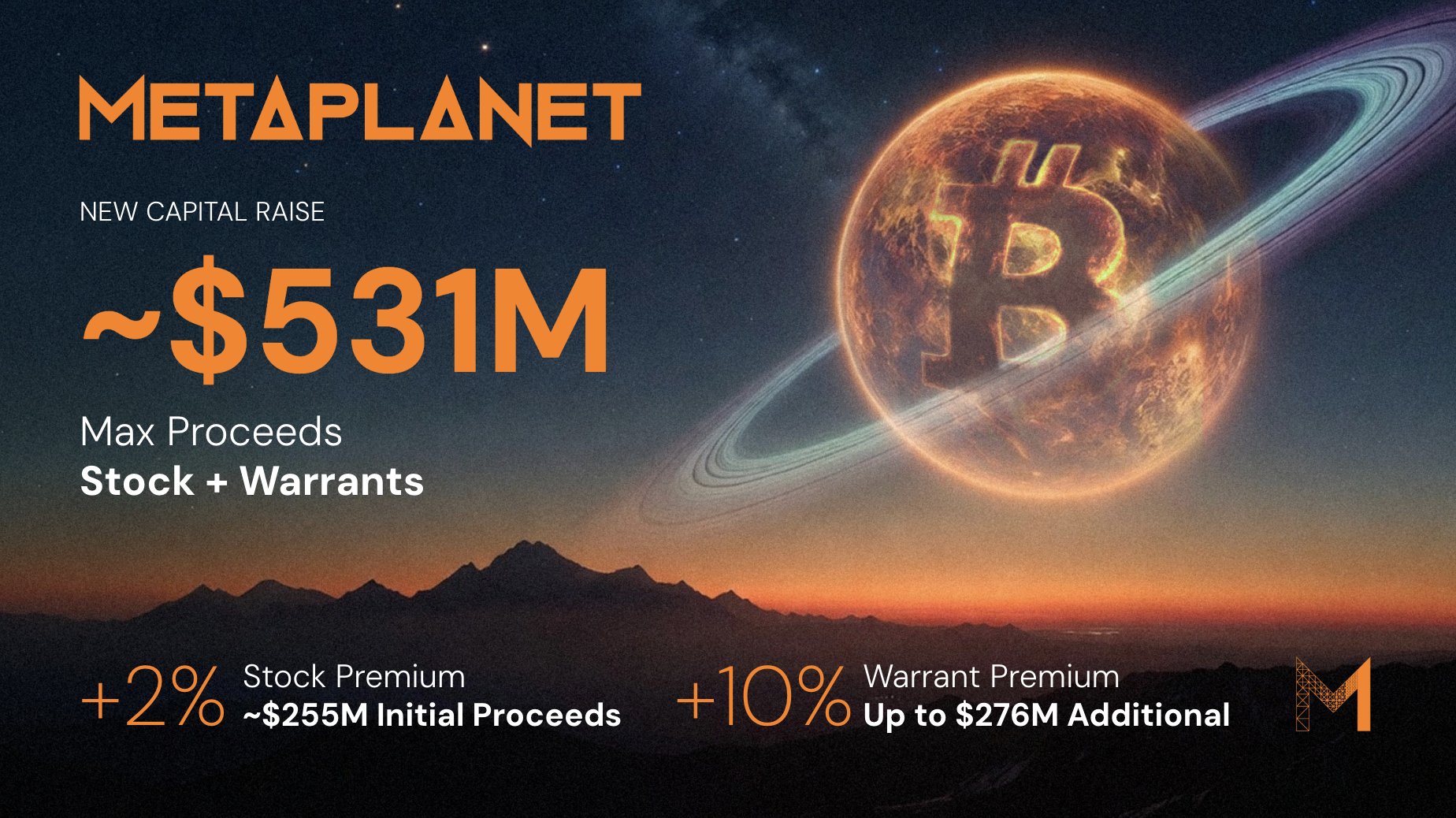
Metaplanet said Monday it raised $255 million in a private placement and launched a new warrant structure to fund additional Bitcoin purchases.
Metaplanet raised about $255 million from institutional investors through a private placement of new shares, according to the company.
The private placement priced new shares at a 2% premium, paired with fixed-strike warrants at a 10% premium, which, if exercised, could add $276 million in additional capital as “firepower” toward the company’s goal of amassing 210,000 Bitcoin (BTC), according to CEO Simon Gerovich.
Metaplanet also issued a separate strike warrant offering on Monday, which may bring an additional $234 million of capital to fuel the accumulation strategy of the fourth-largest Bitcoin treasury company.

Metaplanet seeks $234 million via first-of-its-kind strike warrants
Metaplanet issued another 100 million in Moving Strike Warrants with what Gerovich called a first-of-its-kind Market Net Asset Value (mNAV) clause, which makes these exercisable only if the stock trades above 1.01x mNAV.
The offering enables the Bitcoin treasury company to raise another $234 million of capital for BTC purchases. The mNAV-tied clause aims to ensure that every newly issued share increases shareholder value, announced Gerovich earlier on Monday.
Related: Bitcoin treasuries stall in Q4, but largest holders keep stacking sats
Metaplanet’s mNAV stood at 1.11x on Monday, above the key 1.01x threshold, as the company held 35,102 BTC ($2.5 billion) and its stock price was $2.45, according to Metaplanet’s dashboard.
The mNAV ratio compares a company’s enterprise value to the value of its crypto holdings. An mNAV below 1 makes it more challenging for companies to raise funds by issuing new shares, which may limit their cryptocurrency purchases.

The new capital-raising mechanism is similar to the playbook used by Michael Saylor’s Strategy, the world’s largest corporate Bitcoin holder.
Strategy’s At-The-Market (ATM) common stock offering programs share similar mechanisms, allowing the company to raise capital by gradually issuing new common stock shares. Strategy only issues these shares when the mNAV is above 1x to avoid dilution.
In October 2024, Strategy disclosed plans to issue and sell shares of its class A common stock to raise up to $21 billion in equity and $21 billion in fixed-income securities over the next three years.
Magazine: Mysterious Mr Nakamoto author — Finding Satoshi would hurt Bitcoin
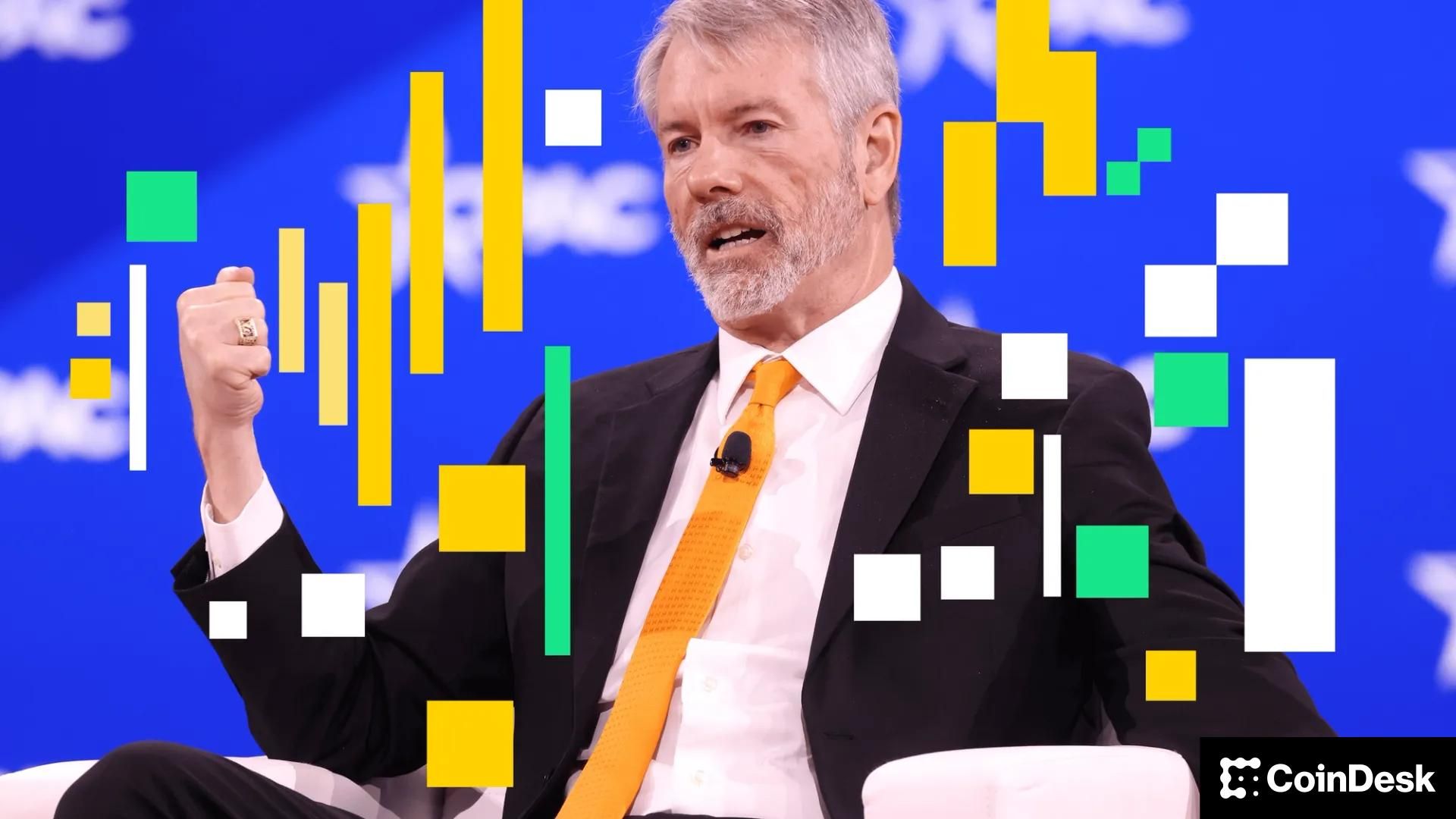
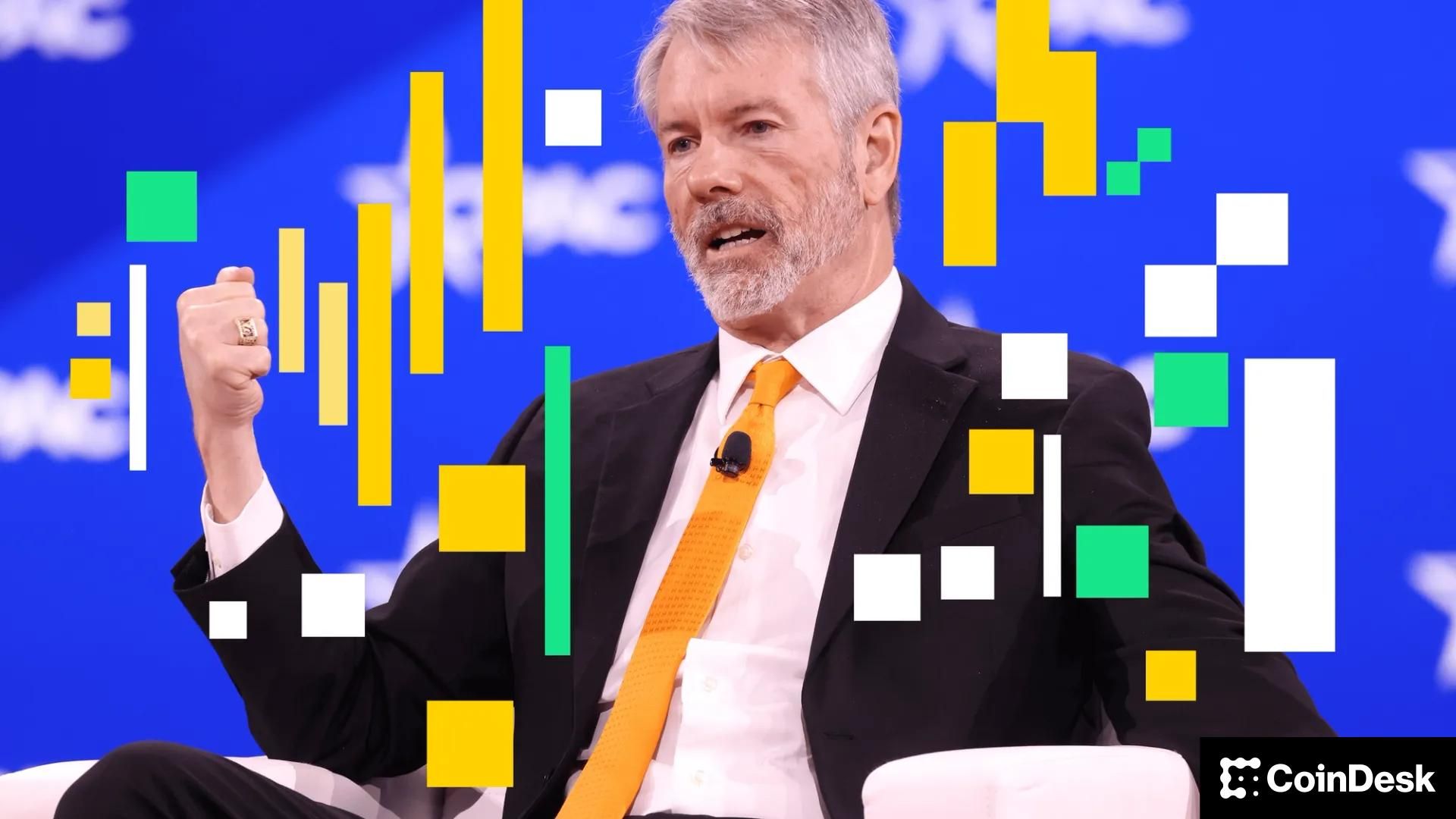
Strategy (MSTR), the world’s largest publicly traded holder of bitcoin, continued with its large string of weekly purchases, adding $1.57 billion worth of BTC, according to a Monday filing.
Led by executive chairman Michael Saylor, the company added 22,337 bitcoin at an average price of $70,194 per coin, bringing holdings to 761,068 coins, acquired for $657.61 billion, or an average of $75,696 per coin.
In terms of bitcoin acquired, it was the fifth-largest ever weekly purchase of coins by the company.
Bitcoin was trading at $73,600 on Monday morning, higher by 2.6% over the past 24 hours.
The latest addition to the company’s bitcoin stash was mostly funded via $1.1 billion in sales of the firm’s STRC series of preferred stock. The company also sold $396 million of common stock.
MSTR shares are up 4% in pre-market trading as bitcoin rose through the weekend, currently trading at $73,600, up 2.6% over the past 24 hours.

TLDR
- Through a premium-priced share placement, Metaplanet secured 40.8 billion yen (approximately $255 million) from international institutional backers.
- Additional warrants featuring a 10% premium strike price could generate another 44.5 billion yen, potentially raising total funding to approximately $531 million.
- A novel mNAV-linked warrant mechanism was unveiled, ensuring share issuance only occurs when Bitcoin holdings per share increase.
- Previously issued warrants representing up to 210 million shares were suspended to minimize shareholder dilution.
- The firm aims to accumulate 100,000 BTC by late 2026 and 210,000 BTC by late 2027, with current holdings at 35,102 BTC.
Tokyo-based Metaplanet (3350) has successfully secured approximately $255 million from international institutional investors via a strategic share placement as part of its aggressive Bitcoin treasury expansion strategy.
The shares were issued at a 2% premium above prevailing market rates. Accompanying the placement are fixed-strike warrants with a 10% premium, potentially generating an additional 44.5 billion yen upon exercise.
Combined, the capital raising initiative could yield approximately $531 million in total funding, as disclosed by CEO Simon Gerovich.
With 35,102 BTC currently in its treasury—worth approximately $2.6 billion at today’s valuations—Metaplanet ranks as the fourth-largest corporate Bitcoin holder globally, trailing Strategy and MARA Holdings, which collectively control 792,553 Bitcoin.
Shares of Metaplanet advanced 5% on Monday, coinciding with Bitcoin’s recovery above the $73,000 threshold.
Innovative Warrant Mechanism Linked to Modified Net Asset Value
As part of this funding round, Metaplanet unveiled a groundbreaking series of moving strike warrants incorporating an mNAV clause—a pioneering feature for stock acquisition instruments of this nature.
This innovative structure permits warrant exercise only when the company’s share price reaches or exceeds 1.01 times its modified net asset value. This measurement compares Metaplanet’s total market capitalization against the valuation of its Bitcoin treasury.
According to company statements, this mechanism guarantees that any new share creation will enhance Bitcoin holdings per share, protecting existing shareholders from value dilution.
In conjunction with this new framework, Metaplanet halted exercise privileges on earlier-issued warrants representing up to 210 million shares. This strategic decision aims to prevent dilution while maintaining focus on Bitcoin accumulation objectives.
Ambitious 210,000 BTC Acquisition Strategy Drives Growth Initiatives
The capital secured will be allocated primarily toward building Metaplanet’s bitcoin treasury.
Management has established an interim objective of accumulating 100,000 BTC by the conclusion of 2026, progressing toward an ultimate target of 210,000 BTC by the end of 2027.
To facilitate this ambitious roadmap, Metaplanet plans to launch a United States-based subsidiary named Metaplanet Asset Management. This entity will concentrate on venture capital investments and digital asset financial services related to Bitcoin capital markets.
Separately, Strategy—the world’s largest corporate Bitcoin holder—is anticipated to reveal additional Bitcoin acquisitions, following recent statements from Executive Chairman Michael Saylor and last week’s preferred equity offering.
Metaplanet’s current Bitcoin holdings stand at 35,102 BTC with an estimated value of $2.6 billion.
Welcome back to Inside DeFi
Today’s edition looks at a gung-ho swap which lost the user almost $50 million. It seems multiple warnings can’t save the kind of madman who’s prepared to swap such size from a mobile-based hot wallet.
We also take a look into the move away from DAOs, and finish up with some short snippets from the security space.
Technical difficulties in the Aave sphere
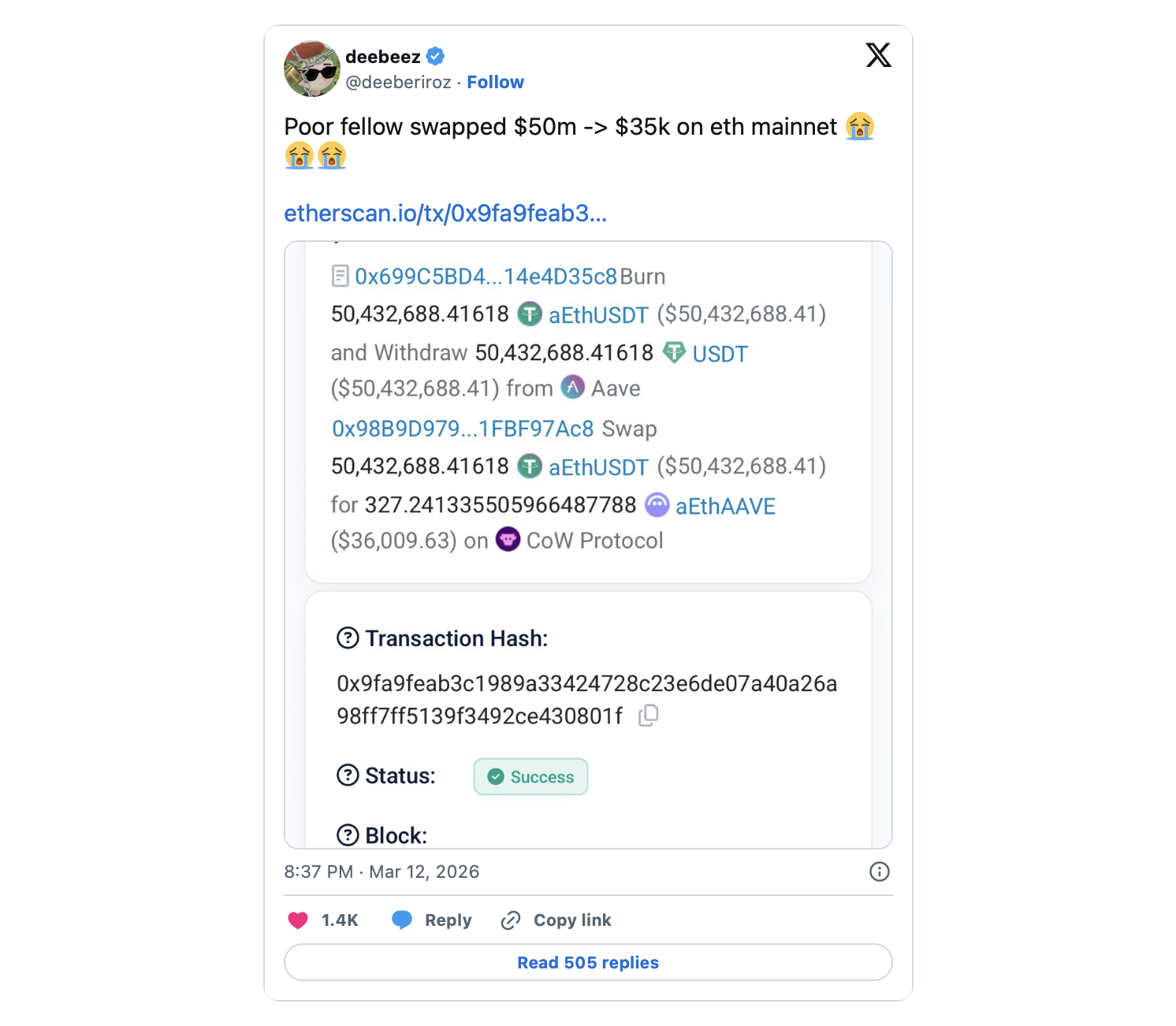
On Thursday, one spectacularly unlucky (or gung-ho) user took a 99.93% loss on a low liquidity $50 million trade.
They swapped $50 million of (Aave-wrapped) USDT to just $35,000 of (Aave-wrapped) AAVE. The trade was made via Aave’s controversial CoW Swap integration which kicked off a months-long governance battle in December.

Read more: Aave Labs faces backlash over CoW Swap integration
That said, swapping such a large sum in a single transaction, apparently from a phone, and after having accepted price impact warnings, doesn’t exactly scream “bulletproof opsec practices.”
While both CoW Swap and Aave have pledged to return the fees, it’s a very small dent in an enormous loss.
Aave founder Stani Kulechov detailed the UI warnings the user ignored, but recognized the result was “far from optimal.”
He also admits the industry needs “additional guardrails… to better protect users.”
Justifying why such swaps aren’t blocked, CoW Swap said, “Preventing users from making trades… can lead to terrible outcomes in some situations (e.g. a market crash).”
Former governance delegate Marc Zeller was quick to rub some salt in the wound. He also pointed out that the loss wouldn’t be possible on the previous swap tool, which Aave Labs replaced.

Read more: Across Protocol accused of looting DAO treasury of $23M
It’s clear who the loser is in this debacle – the one who lost $49,965,000. But the big winners were the MEV bot backrunning the trade and Titan Builder, which apparently made a total of $34 million in tips, sent straight to Coinbase.
The loss wasn’t the only technical glitch in the Aave-sphere this week. Almost $27 million was liquidated the day before due to a faulty update of Chaos Labs’ Correlated Asset Price Oracle.
Are DAOs done?
Now that Aave Labs has flexed its voting power over the DAO, others are taking note.
Across Protocol has proposed ditching the DAO, in favor of a “US C‑corp, via a token-to-equity exchange and token buyout.”
The thinking is that a change in governance will lead to “clearer accountability, faster execution, and a structure that can scale ops, partnerships, and product development over time.”
Co-founder Hart Lambur said “tokens are undervalued and underappreciated… the reality for Across is that having a token generally hurts more than it helps.”
The post goes on to state that the firm’s future focus will be stablecoins and “agentic payments.”
While others are rushing to tokenize equity, Across seems keen on doing quite the opposite.
Sky, formerly Maker DAO, is another (not so explicit) example of centralizing governance, albeit over a longer timeframe.
While some lament the perceived capture of one of DeFi’s longest-established DAOs, it seems to be working for the protocol, economically speaking.
Revenue within each DeFi vertical is concentrated into just one or two winners, as DeFiLlama’s 0xngmi points out. Many of those getting left behind are dropping like flies, or being forced to make tough decisions.

Read more: Across Protocol accused of looting DAO treasury of $23M
The chart comes from an article by Joel John of Decentralisedco, and questions the purpose of tokens. It notes that, while DeFi revenues have grown enormously, “most protocols lack a mechanism to return value to token holders.”
To be useful to holders, tokens must provide “claims to economic activity and the ability to guide governance.”
In cases where one or both of these aren’t in the interests of those holding sway over governance power, we may see more projects tearing off the DAO mask in the weeks and months to come.
Security snippets
A bite sized breakdown of some of the week’s security news.
The ongoing wave of front-end attacks continued to hit popular DeFi projects’ websites this week. Lending protocol Compound Finance and Solana memecoin launchpad BONK.fun were both affected.
No losses were found in relation to the former, while Bubblemaps found $20,000 was lost to the latter.
A SlowMist security researcher, who goes by “23pds,” shared a deep dive into a (possibly North Korean) campaign targeting a range of crypto companies’ supply chains, “from staking platforms, to exchange software providers, to the exchanges themselves.”
The hackers were successful in “exfiltrating proprietary exchange software containing hardcoded secrets.”
Security firm Cantina’s CEO, Hari Mulackal, examined the pressures facing the crowdsourced security model. He says security researchers, customers, and platforms all “hate it.”
In addition to problems with subjective bug severity and costs, Mulackal cites AI, which is “starting to be genuinely useful at finding bugs,” as a growing threat.
To combat endless submissions of slop bounty reports, a staking/penalty system or charge to submit bugs may provide reviewers some respite.
The post came in response to a security researcher’s claim that they “Lost $120K + 1st Place to an AI.”
Read more: DeFi, meet Claude: Moonwell’s ‘vibe-coded’ oracle in $1.8M blowup
Cosmos Labs published an investigation into the root cause of January’s $7 million hack of SagaEVM. The vulnerability was found to affect a number of chains built on the Cosmos EVM stack, specifically those which had used the “ICS20 precompile.”
The report explains that, “under certain execution conditions,” the vulnerability “could allow repeated use of the same token balance within a single transaction.” Affected networks were advised to disable the vulnerable precompile before a permanent fix was deployed.
A price cap oracle mishap saw $27 million in wstETH liquidated on Aave on Tuesday. While the incident isn’t exactly a blackhat exploit, more a failure of Chaos Labs’ code, oracle attacks have seen a recent uptick.
To finish off, in the latest installment of AI behaving badly, one of Alibaba’s research AIs allegedly cryptojacked itself.
The agent broke out of the “bounds of the intended sandbox,” triggering security alerts.
It had hijacked GPU capacity assigned for its own training, repurposing the compute to mine cryptocurrency.
— Jake Harrison

Why most AI service providers build the wrong thing and what to build instead
The building part has never been easier. Everyone obsesses over technical sophistication when the real constraint is finding clients and closing deals. But you still need to build something worth selling.
Most AI service providers build the wrong thing. They build custom bespoke solutions. Complex. Sophisticated. Designed to impress other technical people. The problem: custom work doesn’t scale. It consumes time. It compresses margins. Every client is a fresh project.
The professionals making real recurring revenue build service models that are repeatable, valuable to specific verticals, and don’t require reinventing the wheel with every new client.
The Setup: How Modern AI Development Actually Works
Before we cover the four models, here’s how to actually build these solutions quickly. Open Claude Desktop or Claude Code. Describe the objective. Provide comprehensive customer context their tech stack, current workflows, integrated systems, pain points. The more detailed your context, the better the output.
Claude Code handles the automation logic. For complex workflows, you route to n8n via Synta, which plans, builds, validates, and tests your workflows. No PhD required. No weeks learning node configurations.
The development pipeline: describe the problem, provide context, let tools handle technical execution, review, deploy. Now you can focus on what actually matters: finding customers and communicating value.
Model 1: Speed-to-Lead Response Systems
Setup: $1,500-$5,000 | Monthly Recurring: $300-$1,000
This is the easiest service model to sell because the problem is quantifiable. A speed-to-lead agent responds to new leads instantly, 24/7, without human intervention. Someone submits a form the agent responds within seconds via text or email, asks qualifying questions, captures information, books meetings.
The data backs this up. Responding in 5 minutes versus 30 minutes shows a dramatic difference in qualification rates. Most businesses take hours. Some take days. That’s money leaving the table every single day.
Critical positioning: You’re amplifying human capability, not replacing people. The receptionist isn’t losing their job— they’re freed up from handling cold leads. Framing this as “employee amplification” not “employee replacement” converts objections into signed contracts.
Unit economics are favorable. Operating costs run $20-50 monthly. You charge $500. The math is obvious.
Model 2: Workflow Automation
Setup: $2,000-$5,000 | Monthly Maintenance: $99-$250
Identify the repetitive, manual, low-value tasks consuming your client’s operational time. Email follow-ups nobody sends on time. Proposal generation that takes three hours when it should take 20 minutes. Data entry between systems that don’t talk to each other. Weekly reports consuming half a workday.
You automate one workflow. That’s the service. Leads come in, get qualified, receive personalized follow-up based on what they asked about, route to the CRM. What previously consumed someone’s entire morning runs autonomously.
Critical insight: Invisible automation gets cancelled. Visible automation gets renewed. Build a dashboard showing processed leads, emails sent, time reclaimed. When clients see quantified value, they renew.
Add a monthly maintenance package for $99-$250 to fix issues, optimize processes, and compound recurring revenue.
Model 3: Specialized AI Training Programs
Per Session: $500-$5,000 depending on specialization
Most organizations bought AI licenses. ChatGPT Enterprise, Claude Team, alternatives. Nobody trained their teams to actually use them. The tools sit idle while leadership questions the ROI.
A 90-minute focused workshop solves this. But here’s what matters: generic “Introduction to AI” commands zero premium. That’s a YouTube video. Industry-specific training is premium. “AI for Real Estate Professionals” commands different pricing than “Introduction to AI.” “Claude for Law Firm Associates” justifies a $3,000 session. Generic workshops don’t.
Effective format: immediate applicable wins, hands-on workflow building, department-specific case studies, implementation roadmaps. You’re not selling AI literacy. You’re selling context—deep understanding of their industry, workflow, and pain points translated into business language.
As AI commoditizes technical skills, communication becomes the competitive moat. The person who explains automation to a 55-year-old insurance broker in business terms outearns the person building the most sophisticated agent.
Model 4: Productized Automation
Monthly Recurring: $200-$500 per client | Time Scaling: Zero
This model decouples time from revenue. Find a painful, repetitive task that every business in a niche completes. Build the automation once. Deploy it to unlimited clients in that vertical with monthly maintenance.
Example: A podcast repurposing service. Creators upload raw episodes. Your system generates show notes, social posts, short-form video concepts, newsletters, blog posts—delivered within 24 hours. Charge $297 monthly. Build once, deploy infinitely.
Another example: Real estate automation. Agents add listings. The system generates MLS descriptions, social content, buyer emails, virtual tour scripts. Charge $197 monthly. The workflow doesn’t change. Only the client does.
This is where time stops being a constraint. Twenty clients on productized services, all consuming zero additional hours monthly, generates sustainable recurring revenue that actually scales.
Which Model Should You Start With?
Speed-to-lead is easiest to sell. The ROI is obvious. Most business owners understand the problem immediately. Start here if you want predictable deal flow.
Workflow automation is easiest to build. You’re solving specific problems. Implementation is straightforward. Start here if you want quick wins and case studies.
Training programs are highest margin with lowest technical risk. You’re selling knowledge and positioning, not building complex systems. Start here if you already have industry credibility.
Productized automation is highest upside but requires patience. You spend time building, then you scale without additional effort. Start here once you’ve validated that your solution actually works repeatedly.


Japanese bitcoin treasury firm Metaplanet (3350) said it raised about 40.8 billion yen ($255 million) from global institutional investors through a placement of new shares, part of a financing structure that could provide up to $531 million in total capital to support its bitcoin accumulation strategy.
The Tokyo-listed company priced the new shares at a 2% premium to the market price. The placement was paired with fixed-strike warrants carrying a 10% premium, which could generate an additional 44.5 billion yen if exercised.
The company also introduced a new series of moving strike warrants with what it described as the first mNAV (multiple to net asset value) clause attached to stock acquisition rights.
The mechanism allows the warrants to be exercised only when the company’s shares trade at least 1.01 times its modified net asset value, a metric comparing the firm’s market capitalization with the value of its bitcoin holdings. Metaplanet said the structure ensures any new share issuance increases bitcoin holdings per share.
To manage dilution, the company also suspended the exercise of previously issued warrants representing up to 210 million shares, prioritizing the new structure instead.
Metaplanet plans to use the funds primarily to expand its bitcoin reserves as it pushes toward its long-term goal of holding 210,000 BTC.
Metaplanet closed 5% higher on Monday as bitcoin climbed above $73,000. The firm is the world’s fourth-largest corporate bitcoin treasury company, holding 35,102 BTC.

TLDR
- Micron finalizes PSMC’s Tongluo P5 facility acquisition in Taiwan
- Company reveals plans for a second manufacturing plant at the Tongluo location
- The additional fab will match the scale of its current Miaoli County operation
- Production focus will be on advanced DRAM and high-bandwidth memory technology
- Groundbreaking for the second plant expected before fiscal 2026 concludes
Micron Technology ($MU) is significantly expanding its Taiwan operations. The American memory semiconductor manufacturer announced Monday its intention to construct an additional production facility at the Tongluo location, recently acquired through its takeover of Powerchip Semiconductor Manufacturing Corp (PSMC) assets.
$MU | Micron Completes Acquisition of PSMC Tongluo P5 Fab in Taiwan
👉 𝐊𝐞𝐲 𝐇𝐢𝐠𝐡𝐥𝐢𝐠𝐡𝐭𝐬:
➤ Micron acquires 𝐏𝐒𝐌𝐂 𝐓𝐨𝐧𝐠𝐥𝐮𝐨 𝐏𝟓 semiconductor site in Taiwan.
➤ Facility includes ~𝟑𝟎𝟎,𝟎𝟎𝟎 sq. ft. of 𝟑𝟎𝟎𝐦𝐦 cleanroom space.
➤ Site will expand… pic.twitter.com/w6feTGelnw
— Hardik Shah (@AIStockSavvy) March 16, 2026
The chipmaker has finalized its purchase of PSMC’s Tongluo P5 facility located in Miaoli County. With this acquisition complete, Micron is moving forward with an ambitious expansion plan that includes constructing a second comparable-sized fab at the same location.
This additional manufacturing site will target increased production of cutting-edge DRAM and high-bandwidth memory (HBM) — critical components that drive AI accelerators and data center processors.
Groundbreaking activities are planned to commence before fiscal 2026 ends, which for Micron concludes in late August.
Strategic HBM Expansion
High-bandwidth memory has emerged as one of the semiconductor sector’s most sought-after products. Major AI hardware manufacturers like Nvidia rely on this technology, creating persistent supply constraints across the industry.
Currently ranking third in the HBM market behind SK Hynix and Samsung, Micron’s Taiwan fab expansion represents a strategic effort to strengthen its competitive position.
The Tongluo site establishes Micron’s second Taiwanese manufacturing hub, complementing its existing Taichung facilities.
Co-locating multiple fabs at a single site offers operational advantages, including shared infrastructure expenses and accelerated production scaling through consolidated utilities, logistics networks, and engineering teams.
Strategic Value of the Tongluo Acquisition
Initially announced in the previous year, the PSMC deal has now officially completed. As a former contract manufacturer, PSMC’s Tongluo P5 location provides Micron with ready-to-use manufacturing space that can be adapted for its proprietary DRAM production processes.
The completed acquisition’s financial details have not been publicly revealed by Micron.
While the second Tongluo facility will be comparable in size to the first, specific capacity numbers for either building remain undisclosed at this time.
Taiwan’s dominance in advanced semiconductor manufacturing makes it a strategic location for Micron’s expansion, positioning the company within the region’s established chip production ecosystem and closer to critical supply chain partners.
MU stock was up 5.13% at the time of reporting.

Skipton shop loses licence after worker sold alcohol to child

Nebius Stock Surges. It Got This Huge New AI Deal With Meta.

Whitehat hacker accuses Injective of ghosting after $500M bug disclosure


-
 Tech5 days ago
A 1,300-Pound NASA Spacecraft To Re-Enter Earth’s Atmosphere
-
Crypto World2 days ago
HYPE Token Enters Net Deflation as HyperCore Buybacks Outpace Staking Rewards
-

 Business6 days ago
ExxonMobil seeks to move corporate registration from New Jersey to Texas
-

 Crypto World7 days ago
Paradigm, a16z, Winklevoss Capital, Balaji Srinivasan among investors in ZODL
-

 Fashion3 days ago
Weekend Open Thread: Addict Lip Glow
-

 Tech6 days ago
ChatGPT will now generate interactive visuals to help you with math and science concepts
-
Sports2 days ago
Why Duke and Michigan Are Dead Even Entering Selection Sunday
-

 NewsBeat5 days ago
Residents reaction as Shildon murder probe enters second day
-

 Business5 days ago
Search Enters Sixth Week With New Leads in Tucson Abduction Case
-
 NewsBeat7 days ago
Pagazzi Lighting enters administration as 70 jobs lost and 11 stores close across Scotland
-

 Business18 hours ago
Search for Savannah Guthrie’s Mother Enters Seventh Week with No Arrests
-

 Tech7 days ago
Despite challenges, Ireland sixth in EU for board gender diversity
-

 Business2 days ago
US Airports Launch Donation Drives for Unpaid TSA Workers as Partial Government Shutdown Enters Fifth Week
-
Crypto World2 days ago
Coinbase and Bybit in Investment Talks: Could Bybit Finally Enter the US Crypto Market?
-

 NewsBeat5 days ago
I Entered The Manosphere. Nothing Could Prepare Me For What I Found.
-

 Business7 days ago
Search Enters 39th Day with FBI Tip Line Developments and No Major Breakthroughs
-

 Business2 days ago
Country star Brantley Gilbert enters growing non-alcoholic beer market
-
 Crypto World6 days ago
Will Chainlink price reclaim $10 amid volatility squeeze?
-

 Business3 hours ago
Australian shares drop as Iran war enters third week
-

 Sports5 days ago
PWHL, Senators discussing plan to keep Charge in Ottawa

