
Crypto World
Sam Bankman-Fried Seeks FTX Retrial Citing Fresh Testimony


FTX founder Sam Bankman-Fried is legally challenging his 25-year sentence, filing a motion for a new trial on February 10.
The thirty-three-year-old cites “fresh testimony” that allegedly proves the defunct exchange was solvent.
The filing potentially throws a spanner in the liquidation process, with the claim that the Department of Justice suppressed critical evidence during the original proceedings.
— Mario Nawfal (@MarioNawfal) February 10, 2026
 EXCLUSIVE: SBF SEEKS NEW TRIAL, CLAIMS DOJ SILENCED DEFENSE WITNESSES AND MISLED JURY ON FTX SOLVENCY
Sam Bankman-Fried has filed a Rule 33 motion for a new trial alleging that the jury never heard critical evidence, including sworn declarations claiming FTX was solvent… https://t.co/5fQ3ai4OH2 pic.twitter.com/ggCkYwcIkW
Why Is Bankman-Fried Seeking a New FTX Trial Now?
It has been years since FTX’s November 2022 collapse wiped out $8 billion in customer funds.
Since then, self-custody has become a buzzword for retail investors, who have had to live through multiple bear markets while US regulators prepare comprehensive legislation to ensure it doesn’t happen again.
However, SBF isn’t done fighting. Serving a 25-year sentence, the disgraced mogul filed a pro se motion citing Rule 33 of the Federal Rules of Criminal Procedure.
Bankman-Fried argues that his original conviction was a miscarriage of justice because key witnesses never took the stand.
While global enforcement efforts often successfully target financial malfeasance through standard audits, SBF contends the DOJ’s rapid prosecution missed the actual financial reality of FTX.US.
He maintains that the money was “always there,” a claim he intends to support with evidence that was allegedly unavailable during his initial defense.
What the New Motion Claims
The new filing specifically hinges on declarations from Daniel Chapsky, the former head of data science at FTX.US.
According to the motion, Chapsky’s data analysis contradicts the government’s narrative regarding the $8 billion shortfall.
Bankman-Fried also points to potentially favorable testimony from former co-CEO Ryan Salame, who is currently serving a seven-and-a-half-year sentence.
In the legal documents filed Feb. 10, Bankman-Fried alleges that prosecutors intimidated witnesses and that Judge Lewis Kaplan showed “manifest prejudice” by rushing the verdict. He is demanding a new judge for any retrial, framing the original proceedings as politically motivated “lawfare”.
While the industry has largely shifted toward a compliance-focused market structure to prevent another FTX-style meltdown, SBF argues the DoJ prevented him from showing the jury data that proved solvency.
Legal experts note that Rule 33 motions face an incredibly high bar, often viewed as a “Hail Mary” in federal appeals.
What This Means for Crypto Regulation
While a retrial is statistically unlikely, the motion keeps the FTX wounds fresh for active traders and victims awaiting restitution.
The persistence of the case highlights the long-term risks of offshore exchange failures.
Regulators are likely to use this continued legal drama to justify stricter oversight. We are already seeing similar crackdowns globally, such as when Venezuela’s anti-corruption investigation shut down exchanges in a massive sweep.
For the market, this serves as a stark reminder that the legal fallout from the 2022 crash is far from over, even as prices recover.
Discover:
The post Sam Bankman-Fried Seeks FTX Retrial Citing Fresh Testimony appeared first on Cryptonews.

A bipartisan group of senators introduced the Public Integrity in Financial Prediction Markets Act of 2026 on Thursday, prohibiting government officials from using nonpublic information to trade prediction-market contracts and imposing fines equal to twice the profits earned. It is the second prediction market bill introduced this week alone. That cadence is not a coincidence. It is a coordinated legislative signal.
The bill covers the president, vice president, members of Congress, political appointees, and employees of executive and independent regulatory agencies. Any contract wager above $250 must be reported to a supervising ethics office within 30 days, with disclosure requirements that include price, position, platform name, and profit or loss.
Congress is drawing a line around prediction markets as a new vector for insider trading. Two bills in five days means this is no longer a fringe concern.
- Legislative Scope: The Public Integrity in Financial Prediction Markets Act covers the president, vice president, all members of Congress, political appointees, and federal agency employees — with mandatory reporting of any contract wager exceeding $250 within 30 days.
- Penalty Structure: Violations carry fines up to double the amount of profits earned, targeting financial incentives directly rather than imposing flat regulatory penalties.
- Market Implication: Platforms like Kalshi and Polymarket — which updated trading rules on March 23, 2026, to ban use of confidential information — now face potential CFTC scrutiny and mandatory compliance audits if either bill advances to markup.
Discover: The best crypto presales gaining institutional momentum right now
The Bill: What the Public Integrity Act Actually Prohibits
Senators Todd Young, Elissa Slotkin, John Curtis, and Adam Schiff introduced the bill in the second session of the 119th Congress. The legislation defines insider information as anything a “reasonable investor would consider important” in making a prediction market decision that is not publicly available — a standard deliberately broad enough to cover policy knowledge, regulatory decisions, and government actions before they are announced.
The reporting framework requires officials to disclose the number of contracts purchased, the price and timestamp of each transaction, the contract name, the position taken, the trading platform used, and any profit or loss. That level of granularity mirrors securities disclosure requirements, not casual wagering oversight.
Senator Slotkin framed the bill sharply: “No one should be profiting off the information and knowledge gained as a public servant, period.” She added the bill “has real teeth to ensure those who break these rules face real consequences.” The double-profit penalty structure is designed to eliminate any financial logic behind the violation.

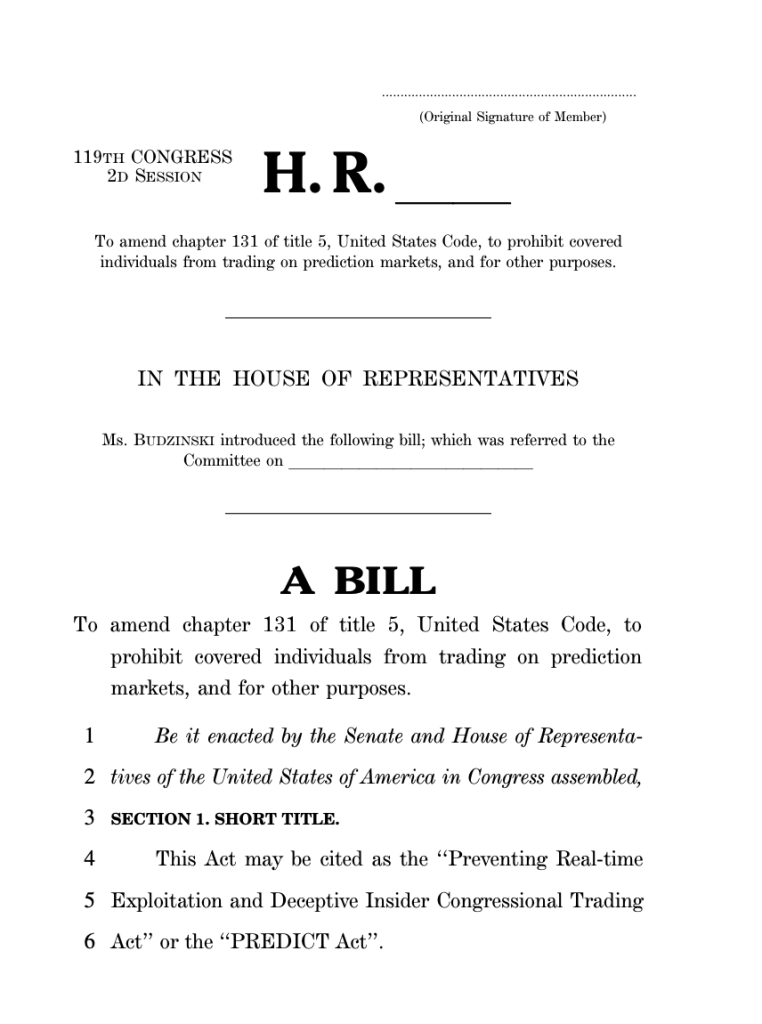
This bill follows the PREDICT Act, introduced March 25, 2026, by Reps. Nikki Budzinski (D-IL) and Adrian Smith (R-NE), which imposes civil penalties of 10% of the transaction value plus full disgorgement of profits to the U.S. Treasury. The PREDICT Act extends trading bans to spouses, dependent children, and Executive Schedule positions — a broader personal scope than the Senate bill. Together, they cover nearly every category of federal official and their immediate households.
Rep. Adrian Smith summarized the bipartisan rationale: “Our commonsense, bipartisan bill will give Americans confidence that the decisions of their elected officials are guided by merit, not personal profit.” Both bills specifically target platforms, including Kalshi and Polymarket, which have emerged as the dominant U.S.-accessible prediction market venues.
The Curtis-Schiff Senate effort, introduced earlier this week, also introduced a companion measure targeting sports betting contracts on prediction platforms, a third legislative prong running parallel to the insider trading focus. That broader sweep suggests Congressional intent extends beyond political event markets into the full prediction market category.
Discover: The best crypto presales gaining institutional momentum right now
The post Lawmakers Introduce Second Bill Targeting Prediction Market Insider Trading appeared first on Cryptonews.


P2P.me said it traded on a Polymarket contract tied to its own fundraising round before the raise went live.
Summary
- P2P.me opened Polymarket positions before its fundraising launch and admitted the disclosure delay was wrong.
- The project raised $5.2 million, missed its $6 million target, and the market resolved no.
- US lawmakers and prediction platforms are tightening rules as insider trading concerns spread wider now.
The disclosure adds fresh attention to insider trading risks on prediction markets as US lawmakers and platforms move to tighten rules.
The team behind the decentralized trading platform said it opened positions on Polymarket 10 days before its capital raise launched. The market asked whether the project would reach its $6 million target. At that time, the team said it had only one “oral commitment” from Multicoin Capital for $3 million, with “no signed term sheets” and “no guaranteed allocations.”
The raise later closed at $5.2 million, below the target, and the market resolved to “no.” The team said it understands why some people may see the trade as a trust issue, even though it did not view the bet as trading on a completed deal.
P2P.me said any profits from the positions will go back to its MetaDAO treasury, which serves as the reserve for the DAO that governs the platform. The team also said it is liquidating all open Polymarket positions and putting in place a formal company policy on prediction market trading.
In its statement, the team said,
“Trading on an outcome you can influence erodes trust.” It added that “not disclosing at the time was a mistake we own.”
Those remarks came as the platform moved to address criticism around market conduct and transparency.
Prediction markets face wider policy pressure
The disclosure comes as scrutiny around prediction markets grows in Washington and beyond. On March 25, Representatives Nikki Budzinski and Adrian Smith introduced the PREDICT Act, a bipartisan bill aimed at stopping senior government officials from insider trading on prediction markets.
At the same time, Polymarket and Kalshi have both announced tighter insider trading rules. Polymarket now says users cannot trade on contracts when they hold confidential information or can influence an outcome, while California barred state officials from using insider knowledge to bet on platforms such as Polymarket and Kalshi.
A separate Senate bill would ban event contracts tied to elections, sports, government actions, and military moves.

Key Takeaways
- Mining a single Bitcoin cost approximately $80,000 during Q4 2025, creating a ~$19,000 loss per coin with BTC trading near $70,000
- Public mining companies have secured more than $70 billion in artificial intelligence and high-performance computing deals
- AI revenue could comprise as much as 70% of miner income by late 2026, up from approximately 30% currently
- Mining firms are liquidating Bitcoin holdings and accumulating billions in debt to finance their AI infrastructure pivot
- Network hashrate has declined from 1,160 EH/s to roughly 920 EH/s as operations shut down
The economics of Bitcoin mining have turned upside down. A recent CoinShares analysis reveals that publicly traded mining operations spent an average of $79,995 to produce each Bitcoin during the fourth quarter of 2025. With Bitcoin currently valued at approximately $70,000, these companies are hemorrhaging roughly $19,000 for every coin mined.
This crushing financial reality has triggered a dramatic industry transformation. Mining companies are rapidly repurposing their facilities into artificial intelligence and high-performance computing (HPC) infrastructure — and liquidating their Bitcoin reserves to finance the transition.
The scale of this shift is staggering. Public mining entities have collectively announced AI and HPC agreements exceeding $70 billion in value. CoreWeave’s partnership with Core Scientific represents a $10.2 billion commitment spanning 12 years. TeraWulf has locked in $12.8 billion in HPC revenue contracts. Hut 8 executed a $7 billion AI infrastructure lease. Cipher Digital secured a massive agreement with Google-backed Fluidstack worth billions.
Core Scientific is already deriving 39% of total revenue from AI colocation services. TeraWulf generates 27% from this segment. IREN sits at 9% but is expanding aggressively, constructing up to 200 megawatts of liquid-cooled GPU infrastructure.
According to CoinShares Head of Research James Butterfill, publicly listed miners could derive as much as 70% of revenue from AI operations by the close of 2026 — a dramatic increase from today’s 30% figure.
Financing the Infrastructure Transformation
Mining companies are funding this strategic pivot through two primary channels: leveraging debt and liquidating Bitcoin holdings.
IREN now shoulders $3.7 billion in convertible note obligations. TeraWulf carries $5.7 billion in aggregate debt. Cipher Digital issued $1.7 billion in senior secured notes during November, causing quarterly interest expenses to skyrocket from $3.2 million to $33.4 million in Q4 alone.
Simultaneously, public mining companies have collectively offloaded over 15,000 Bitcoin from peak treasury positions. Core Scientific liquidated approximately 1,900 BTC valued at $175 million in January. Bitdeer completely depleted its treasury reserves in February. Riot sold 1,818 BTC worth $162 million during December. Marathon, holding the largest public Bitcoin position at 53,822 BTC, amended its corporate policy in March to permit sales from its entire balance sheet reserve.
The financial incentives strongly favor AI infrastructure. Traditional Bitcoin mining facilities require roughly $700,000 to $1 million per megawatt in capital expenditure. AI data centers demand $8 million to $15 million per megawatt, but generate profit margins exceeding 85% with guaranteed long-term revenue contracts.
Impact on Bitcoin’s Network Security
The mining industry’s strategic realignment is manifesting in observable network metrics. [[LINK_START_2]]Bitcoin’s[[LINK_END_2]] hashrate reached a peak of 1,160 exahashes per second in October 2025. It has subsequently declined to approximately 920 EH/s, marked by three consecutive negative difficulty adjustments — the first such consecutive decline since July 2022.
On March 20, mining difficulty decreased 7.7%, representing one of the most significant single-period reductions recorded this year.
CoinShares forecasts hashrate could potentially recover to 1.8 zetahashes by year-end 2026 — but only under the condition that Bitcoin returns to $100,000 valuations. If prices remain beneath $80,000, the research firm anticipates additional miner capitulation.
Mining companies with secured AI contracts currently command valuations of 12.3 times forward sales. Pure Bitcoin mining operations trade at just 5.9 times. MARA was highlighted as among the few major miners maintaining focus on Bitcoin production and low-cost energy acquisition strategies.



The White House on Friday launched a smartphone app that gives users direct access to administration updates, social posts, photos and policy pages tied to President Donald Trump’s second term.
Summary
- White House app offers policy pages, curated news, social feeds, media tools and contact options.
- Users can send tips to ICE while viewing affordability claims and border-focused administration messaging sections.
- The app promised live video, but Trump’s Friday remarks were not streamed in real time.
The administration said the app would deliver information “straight from the source, no filter” after several teaser videos on official social media accounts pointed to a coming launch.
The White House said the app offers breaking news alerts, live video, a media library and direct feedback tools. In its release, the administration described the product as a way to keep users informed and engaged with the Trump administration through real-time updates and push notifications.
The rollout followed a short teaser campaign on social media that drew public attention before the launch. People reported that one video showed a woman asking whether something was “launching soon,” while a White House spokesperson later replied, “I wonder what’s launching soon!” before the app went live.
The app includes tabs for news, livestreams, social feeds and photo galleries. The Verge reported that much of the content mirrors existing White House web pages rather than adding a separate service built only for the app.
Coverage of the launch also said the app directs users to policy and achievements pages that were already live on the White House website. Daily Voice reported that the product also pulls in curated news coverage and material focused on Trump’s policy priorities and record in office.
A “Get in Touch” option in the social section includes a path for users to submit tips to U.S. Immigration and Customs Enforcement through the agency’s official form. The same menu also offers options to text the president, contact the White House and sign up for a newsletter.
The app also includes an affordability page built around selected consumer prices. Daily Voice reported that the section uses a limited set of grocery items and leaves out other goods and energy costs that have moved higher, while another border page states that “0 Illegals Released in Past 10 Months.”
Some promised features were not visible at launch
The White House release said users would be able to watch speeches and briefings as they happen. Yet Daily Voice reported that Trump’s Friday remarks to farmers at the White House were not available in real time on the app during the afternoon event.
The launch came as the administration continued to frame rising costs as temporary. Daily Voice reported that Treasury Secretary Scott Bessent described recent price pressure as “short-term volatility,” while the app itself focused on selected price declines and investment pledges from foreign governments and large companies.
TLDR:
- Coinbase now lets buyers use BTC or USDC as down payment collateral without selling crypto holdings first.
- Better services the crypto loan separately while the main mortgage stays within standard Fannie Mae rules.
- No margin calls apply if borrowers stay current, even during sharp Bitcoin price declines.
- Rising home costs make crypto-backed liquidity a new route for buyers locked out by cash requirements.
Coinbase is moving deeper into consumer finance with a new product that lets U.S. homebuyers use crypto as down payment collateral.
The company has partnered with Better Home & Finance to offer separate loans backed by Bitcoin or USDC held in Coinbase accounts. The structure allows buyers to keep their digital assets while securing funds for one of the costliest parts of a home purchase.
The rollout marks one of the clearest attempts yet to connect crypto wealth with the traditional mortgage market.
Coinbase Crypto-Backed Down Payments Enter Housing Finance
A buyer can now borrow against Bitcoin or USDC for a home down payment instead of liquidating holdings. Better will originate and service the loan, while the main mortgage remains separate.
The mortgage itself still follows the standard Fannie Mae-backed structure described in the Reuters report. That means the crypto-backed portion sits alongside, rather than inside, the primary home loan.
According to Reuters, the arrangement aims to preserve crypto exposure for buyers who expect long-term upside. It also allows them to delay taxable sale events tied to liquidating digital assets.
Coinbase said the product keeps the same legal protections as a conventional mortgage process. The company also noted that the mortgage rate itself does not change once the loan becomes active.
Reuters further reported that pledged crypto price swings will not trigger margin calls. As long as borrowers continue payments, falling Bitcoin prices alone will not force liquidation.
Crypto Utility Expands as Homeownership Costs Rise
The launch lands as homeownership remains difficult for first-time buyers. Reuters cited National Association of Realtors data showing the median first-time buyer age has climbed to 40 from 32 in 2000.
Higher rates, limited inventory, and elevated home prices have tightened access across the U.S. housing market. This backdrop gives crypto-rich buyers another way to unlock liquidity without leaving the market.
Coinbase framed the product as a practical use case for digital assets beyond trading and custody. Reuters noted the company sees it as a way to widen access for users whose wealth sits in crypto rather than bank accounts.
The policy backdrop also matters. Reuters linked the move to a more crypto-friendly U.S. regulatory environment that has recently lowered barriers around mainstream financial products.
The report also tied that shift to broader Washington efforts to expand alternative investments, including crypto, into retirement products. That easing has helped firms explore new bridges between digital assets and legacy finance.
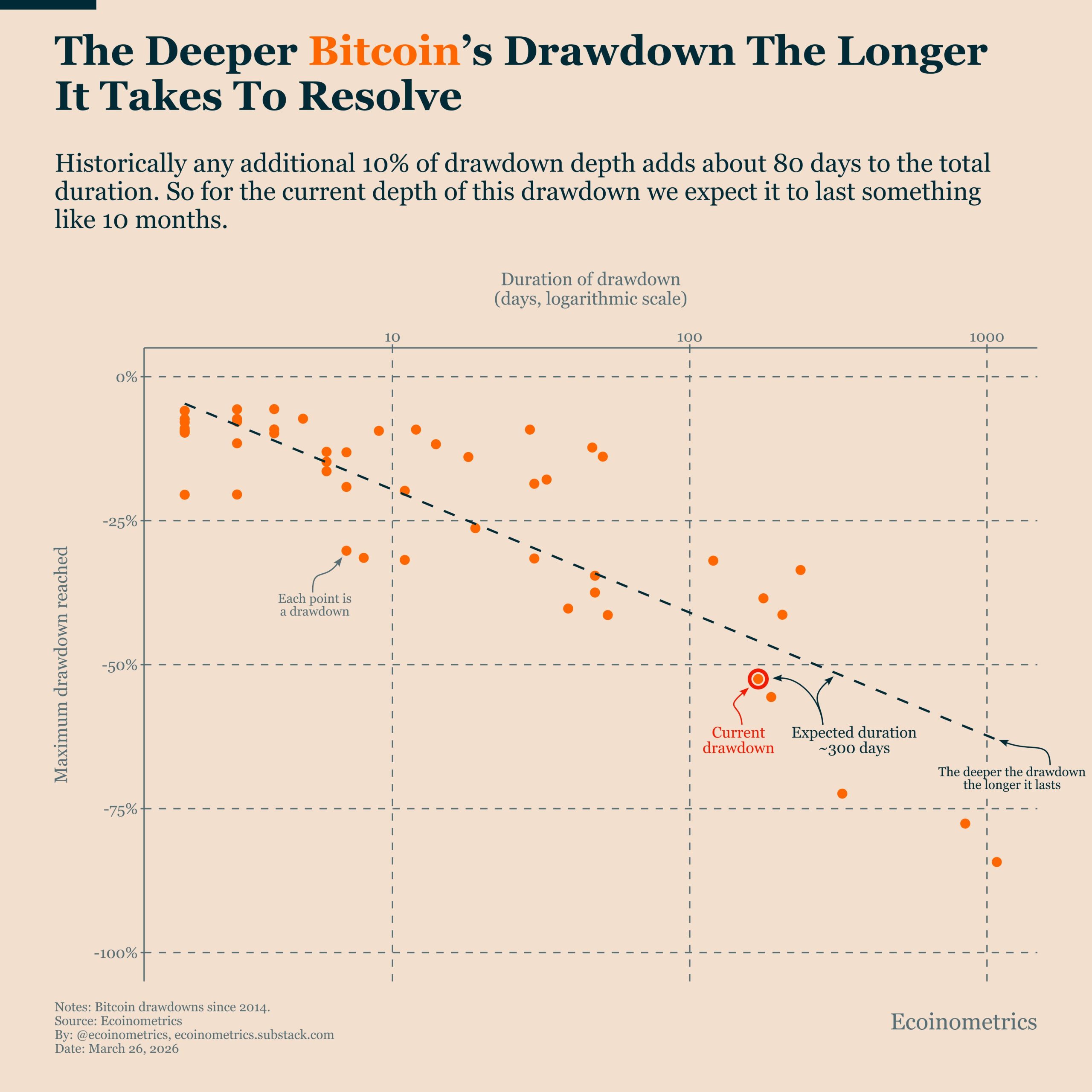
Bitcoin (BTC) has shed all its March gains, currently down 1.40% on the monthly chart and 24.6% for the first quarter of 2026. Bitcoin’s longer-term performance aligns with a deep drawdown cycle for BTC, which may extend until the end of 2026 and many analysts expect another 40% drop in price.
This scenario pushes Bitcoin’s recovery into Q2 2027, as a deeper BTC price drop tends to take longer to recover from.
Bitcoin drawdown depth extends the recovery timeline
Ecoinometrics data shows a clear link between the drawdown depth and recovery duration. Each additional 10% decline has historically added about 80 days to the time required to reclaim the prior highs.
At the current 48% drawdown, the full recovery cycle is estimated to be near 300 days from the October peak of $126,000 in 2025.

Currently, roughly 172 days have passed, leaving about 125 to 130 days if the cycle low is already confirmed at $60,000. However, the cycle lows might not have been tagged yet, with BTC potentially looking at further downside in the coming weeks.
The Bitcoin Combined Market Index (BCMI), which combines market-value to realized-value (MVRV), net unrealized profit/loss (NUPL), spent output profit ratio (SOPR) and market sentiment, currently sits near 0.27.
This level is notably above the 0.15 threshold that has marked the cycle bottoms in every major downturn since 2018.

In the 2018 cycle, BCMI reached 0.15 as Bitcoin fell to $3,100 from its $20,000 peak. In 2020, the index dropped to 0.147 when the price was $5,100. Similarly, in November 2022, BCMI fell to 0.12 as BTC formed its cycle lows at $15,880.
With the index still elevated relative to these historical bottom zones, a move toward 0.15 in 2026 likely requires further downside in BTC’s price. Such a scenario aligns with a deeper capitulation phase for BTC, consistent with the prior cycle resets.
Related: Bitcoin dips under $66K as oil sparks ‘unsustainable’ US inflation risk
Deeper BTC lows extend the recovery window to Q2 2027
Crypto trader Ardi noted that the whale delta vs retail delta reached its most aggressive sell level at -22.13 since October 2024. The chart illustrates the BTC price breaking below a rising trendline, while underlying flows show consistent distribution from the larger participants. Ardi said,
“Larger players are selling into this structure harder than they have in 18 months. That does not mean price has to collapse immediately. But it does mean this level is being tested with real sell pressure pressing into it.”

From a liquidity standpoint, CMCC Crest managing partner Willy Woo outlined a similar weakness for BTC’s price. Woo accurately mapped out last month that BTC would rebound to the mid-$70,000 region in March, before aligning with the bearish trend as “the broader regime is heavily bearish with both spot and futures liquidity deteriorating.”
From a cycle perspective, Woo expects a deeper reset before a confirmed bottom forms. Woo identified the $40,000–$45,000 range as a typical bear market floor, with timing skewed toward Q4 for the end of the bearish phase.
The framework places the return of a stronger bullish momentum into early 2027.

If Bitcoin extends its decline toward the $40,000–$45,000 range, the drawdown from the $126,000 peak deepens to roughly 64–68% from all-time highs. Based on Ecoinometrics’ model, the additional downside significantly stretches the recovery timeline.
At a 60%+ drawdown, the total recovery period historically expands to around 440 days from the cycle peak. In this scenario, a potential reclaim of the prior all-time high is expected to fall sometime after Q2 2027.
It is important to note that these timelines are based on historical drawdown patterns and do not represent predictions. The current macroeconomic conditions may alter that recovery path as well.
The Kobeissi Letter noted that the rate cuts are now expected only by December 2027, with a 51% chance of a rate hike by March 2027. This unexpected development may impact Bitcoin’s recovery pace relative to past cycles.
Related: Bitcoin gained 655% the last time this supply in profit metric dropped to 50%
This article does not contain investment advice or recommendations. Every investment and trading move involves risk, and readers should conduct their own research when making a decision. While we strive to provide accurate and timely information, Cointelegraph does not guarantee the accuracy, completeness, or reliability of any information in this article. This article may contain forward-looking statements that are subject to risks and uncertainties. Cointelegraph will not be liable for any loss or damage arising from your reliance on this information.
TLDR:
- Ethereum activity and stablecoin balances are shifting back from Layer 2 networks to the base layer
- Stablecoin supply and tokenized assets on Ethereum are approaching previous all-time high levels
- Ethereum’s execution density and composability continue to attract high-value on-chain transactions
- ETH has outperformed major Layer 2 tokens since October 2025, signaling renewed market strength
Ethereum comeback narratives are gaining traction as new data points to renewed activity on the network. Insights shared by Coinbase Institutional indicate a measurable shift in user behavior and capital flows.
Stablecoin balances and tokenized assets on Ethereum are approaching historical highs. At the same time, ETH has outperformed major Layer 2 tokens since October 2025, suggesting a change in market structure.
Activity Returns to Ethereum’s Base Layer
Recent observations show that users are gradually returning to Ethereum’s main network. Coinbase Institutional reported that both activity levels and stablecoin balances have tilted back toward Layer 1. This marks a shift from earlier periods when Layer 2 solutions captured a larger share of transactions.
The same update noted that stablecoin supply on Ethereum is nearing record levels. Tokenized asset values are also rising toward previous peaks. These movements point to increased reliance on Ethereum for settlement and liquidity functions.
Metrics tracking organic activity further support this trend. Execution density on Ethereum remains strong, reflecting higher economic value processed within limited block space. This indicates that users continue to prioritize efficiency and depth over lower transaction costs.
Coinbase Institutional also stated that ETH has outperformed major Layer 2 tokens since October 2025. This relative strength aligns with growing on-chain activity and sustained liquidity inflows.
The data was shared through its official X post, which framed the discussion around Ethereum’s evolving role.
Infrastructure Strength Supports Comeback Narrative
Ethereum’s composability continues to serve as a core advantage in the current market. Applications built on the network interact seamlessly, allowing complex financial operations across protocols. This structure supports the use of stablecoins and tokenized assets at scale.
Execution density remains another defining factor. Ethereum processes high-value transactions within its base layer, maintaining efficiency despite higher fees. In contrast, Layer 2 networks distribute activity across multiple chains, often focusing on cost reduction.
The Coinbase Institutional update also pointed to ongoing developments in stablecoin regulations. These changes are drawing attention to the infrastructure supporting digital assets. Ethereum remains a primary base layer for stablecoins due to its liquidity depth and established ecosystem.
At the same time, Layer 2 solutions continue to play a complementary role. They provide scalability and lower transaction costs, especially for retail users.
However, recent data suggests Ethereum is regaining ground in areas requiring composability and capital concentration.
The Ethereum comeback narrative continues to develop as market dynamics shift. Rising activity, growing stablecoin balances, and ETH’s relative performance indicate renewed focus on the base layer.
As conditions evolve, the relationship between Layer 1 and Layer 2 remains central to Ethereum’s positioning.

Spot Bitcoin exchange-traded funds (ETFs) shifted gears this week, snapping a four-week streak of inflows and posting a net outflow of $296.18 million for the period ending Friday. The reversal comes after a sustained run that had drawn more than $2.2 billion into spot BTC ETFs over the prior four weeks. Data from SoSoValue shows inflows of roughly $787.31 million, $568.45 million and $767.33 million in early March, followed by a smaller $95.18 million the previous week before the tide turned to red this week.
The weekly outflow was amplified by consecutive daily withdrawals on Thursday and Friday totaling more than $396 million, including a Friday print of $225.48 million—the largest single-day withdrawal since March 3, when outflows reached $348 million. Despite the shift this week, investors have not exited the BTC ETF space entirely; cumulative inflows to spot BTC ETFs remain robust, with total net inflows measuring $55.93 billion.
On the asset side, total net assets tied to spot BTC ETFs slipped to $84.77 billion, down from just over $90 billion a week earlier. Trading activity also cooled, with combined weekly ETF volume dropping to $14.26 billion from $25.87 billion earlier in March. The pattern mirrors a broader, cautious mood among crypto traders as macro headlines stabilize, but momentum remains elusive.
For context, the shift comes amid a wider debate about the pace of institutional adoption and how ETF mechanics interact with liquidity cycles. A related note from market observers highlights that even a period of macro calm can mask undercurrents of risk, influencing how investors position around the next potential regime shift in cryptos and traditional markets.
Ethereum ETFs followed the broader risk-off tone, registering $206.58 million in weekly net outflows. This marked a second straight week of declines for spot Ether ETFs, reversing a brief inflow stretch seen earlier in March. Daily data shows withdrawals throughout the week, with the largest single-day outflow on Thursday at $92.54 million and another $48.54 million pulled on Friday. The pattern underscores a more cautious stance among holders as investors reassess near-term catalysts for Ethereum’s spot and ETF exposure.
Beyond the ETF desk, the market backdrop remains a balance of surface stability and underlying frictions. In a note shared with Cointelegraph, a Bitunix analyst described the current macro environment as defined by “surface stability, internal imbalance.” Geopolitical tensions persist, while policymakers aim to project calm. Developments such as an ongoing US–EU trade framework and a cooling of tensions in other hot spots have helped ease near-term stress, but the analyst cautioned that the underlying risks have not vanished.
Against that backdrop, Bitcoin’s price action is increasingly seen as a read on liquidity conditions rather than a clear directional consensus. The asset has traded within a defined range, roughly between $65,000 and $72,000, with evidence of demand absorption but limited upside follow-through. “Capital is not exiting the market, but neither is it willing to take directional risk,” the analyst observed, suggesting that volatility may persist within established bands until macro conditions align for a clearer trend.
Investors may find it instructive to compare the current cycle with earlier episodes of ETF-driven participation. The current week’s outflows come after a period of strong inflows that underscored a phase of renewed institutional interest in BTC exposure through regulated vehicles. For market watchers, the key question remains: will macro catalysts—policy signals, liquidity shifts, or geopolitical developments—provide the spark needed to re-ignite sustained ETF inflows, or will liquidity constraints continue to weigh on trend formation?
Key takeaways
- Spot Bitcoin ETFs posted a weekly net outflow of $296.18 million for the period ending Friday, reversing a four-week inflow streak that totaled more than $2.2 billion.
- Cumulative net inflows into spot BTC ETFs stand at $55.93 billion, while total net assets fell to $84.77 billion from just over $90 billion a week earlier; weekly ETF volume dropped to $14.26 billion from $25.87 billion.
- Ether exposure followed a similar pattern, with spot ETH ETFs recording $206.58 million in weekly outflows—a second consecutive weekly decline; the largest daily outflow was $92.54 million on Thursday, followed by $48.54 million on Friday.
- Macro dynamics remain mixed: analysts describe a surface-stable but internally imbalanced environment, with Bitcoin trading range-bound as market participants weigh liquidity conditions against uncertain geopolitical and policy developments.
Spot BTC ETFs retreat after a four-week inflow run
The week’s outflow marks a notable shift after BTC ETFs enjoyed a multi-week surge in demand. SoSoValue’s data shows that inflows for BTC-focused ETFs aggregated to more than $2.2 billion across four consecutive weeks earlier in March, with the standout single-week inflows reaching as high as approximately $787 million. The reversal this week followed a run of daily redemptions culminating in a Friday outflow of $225.48 million—significant in magnitude and the largest single-day drain since the early-March period.
While the net number for the week is negative, the broader trajectory remains positive in aggregate terms. The cumulative $55.93 billion of net BTC ETF inflows illustrates a persistent appetite for regulated BTC exposure among institutional participants, even as near-term liquidity concerns cap momentum. On the surface, fund flows appear to be moderating as traders digest macro cues and position for potential regime shifts in the broader crypto market.
Trading activity, a useful lens into market participation, also cooled noticeably. The week’s combined ETF volume of $14.26 billion sits well below the March peak, a reminder that current appetite for ETF-based BTC exposure is sensitive to shifting liquidity environments and risk tolerance among investors.
For readers tracking industry benchmarks, an adjacent development remains the ongoing discussion around ETF fee structures and product design. Related coverage this week highlighted Morgan Stanley’s anticipated ultra-low-fee BTC ETF filing, pegged at a 0.14% fee if approved, illustrating how major players are calibrating cost structures to attract a broader investor base.
Source: SoSoValue
Ethereum ETFs extend outflow streak
In parallel with Bitcoin, Ethereum ETFs posted meaningful redemptions. SoSoValue data shows spot ETH ETFs recording $206.58 million in weekly outflows, marking the second consecutive week of declines after a prior period of modest inflows. The week-long trend was driven by daily withdrawals, with Thursday accounting for the bulk at $92.54 million and Friday contributing another $48.54 million.
The ETH ETF dynamic underscores a broader caution among crypto asset holders, where even marquee assets like Ethereum face selling pressure in tandem with BTC. As with Bitcoin, macro momentum and liquidity considerations appear to be the primary drivers behind these ETF flows, rather than a singular ETH-specific catalyst.
As investors weigh the path forward, market participants will be looking for signs of stabilization in ETF demand for Ether alongside BTC. The data points to a cautious stance, with redemptions outpacing new inflows for multiple weeks as traders assess risk, regulatory environments, and potential macro-driven liquidity shifts.
Related commentary continues to explore how ETF design and pricing could influence future demand, as well as how early adopters and index designers might respond to evolving market structure. For readers seeking additional context, Morgan Stanley’s ongoing ETF discussions and related reporting offer a useful backdrop to the evolving landscape of regulated crypto exposure.
Source: SoSoValue
Macro calm masks deeper risks
A recurring theme in this week’s flow analysis is the tension between apparent macro calm and underlying fragilities. A Bitunix analyst, speaking to Cointelegraph, framed the current environment as “surface stability, internal imbalance.” While geopolitical frictions and policy tensions have cooled somewhat, the risk built into the system remains unresolved, creating a environment where traditional and crypto markets co-move in nuanced ways.
Bitcoin, in this setting, is behaving less like a breakout asset and more as a proxy for liquidity conditions. The asset has largely traded within a defined band, roughly between $65,000 and $72,000, with demand showing intermittent strength but lacking sustained follow-through. The analyst emphasized that while capital is not fleeing the sector, there is a clear reluctance to embrace directional bets in the near term, signaling that volatility will likely persist until macro catalysts align with a more decisive trend.
In the larger discourse, the ETF flows fit into a broader narrative about adoption, regulation, and liquidity. As investors watch for catalysts—ranging from policy shifts to shifts in macro liquidity—the market will stay sensitive to incoming data and cross-asset dynamics. The interplay between favorable regulatory signals and risk-on/risk-off cycles will likely shape the next leg of ETF-driven participation in BTC and ETH exposure.
Related coverage this week also touched on other ETF developments, including flexible fee structures and the race among traditional banks and asset managers to offer regulated, low-cost access to top crypto assets. The unfolding story remains a test of how fast the market can translate incremental regulatory clarity into sustainable inflows, even as near-term risk sentiment remains cautious.
What comes next for ETF demand and crypto liquidity?
Looking ahead, the key questions center on whether macro conditions will align with a renewed appetite for regulated crypto exposure. If liquidity improves or volatility sharpens in a favorable way, BTC and ETH ETF inflows could resume, reinforcing the role of ETFs in institutional portfolios. Conversely, persistent macro uncertainty and continued outflows could extend the current pause, shaping a market in which price moves hinge on liquidity rather than conviction-driven catalysts.
Readers should monitor notable policy developments, central bank signals, and geopolitical headlines as potential inflection points. The ETF data, while informative, is one lens among many for assessing where crypto markets stand in relation to traditional financial markets—and what it might take to spark a fresh wave of institutional participation.
Key Takeaways
- ETH breached the $2,000 threshold with a 5% decline over 24 hours and 6% weekly loss
- Institutional ETH ETFs experienced a sustained outflow streak spanning seven days, totaling $392 million
- Market demand for Ethereum reached its weakest point in 16 months
- Critical support zones identified at $1,911 and $1,750 by technical analysts
- Centralized exchange reserves dropped from 22 million ETH in 2023 to approximately 15 million ETH currently
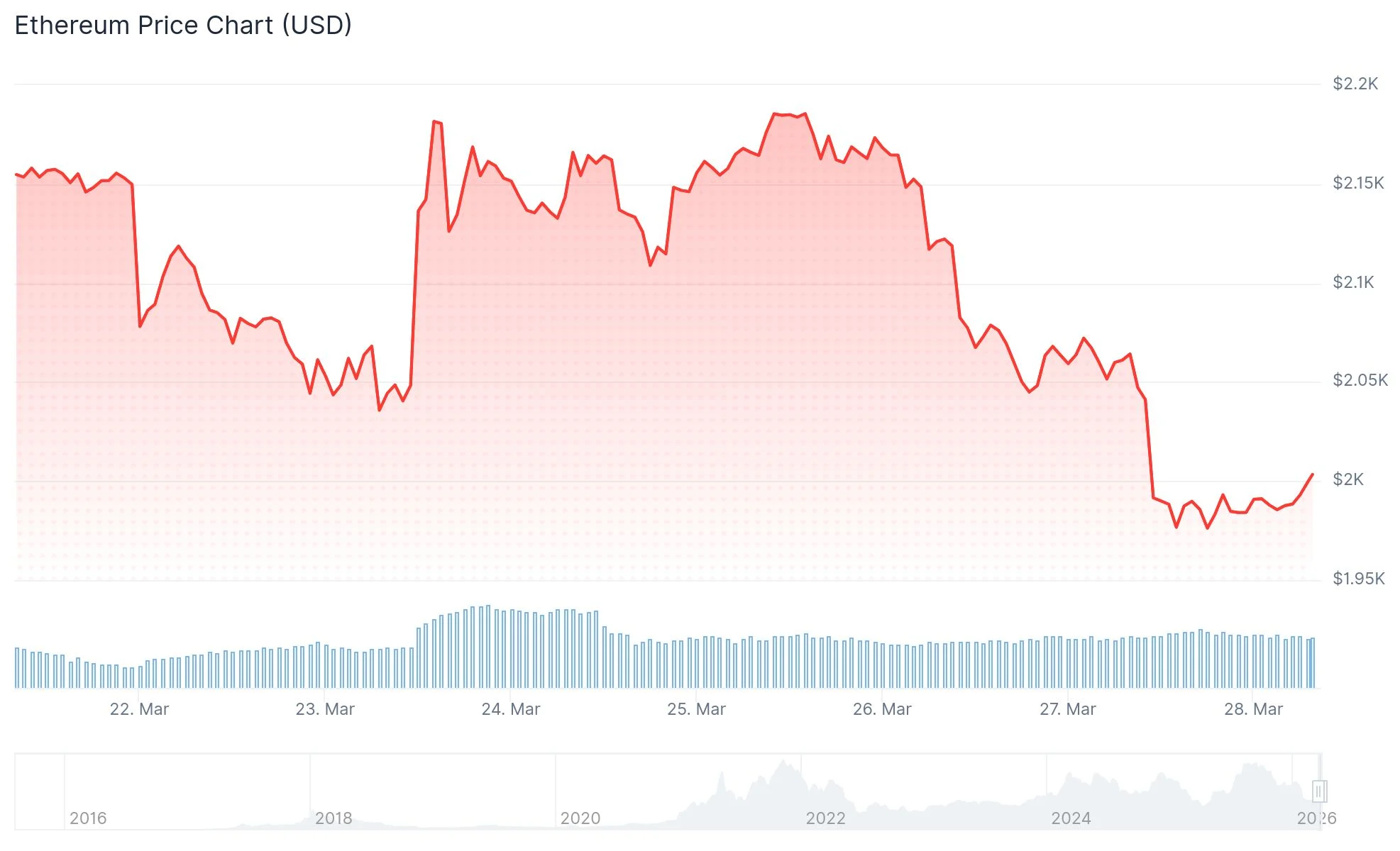
Ethereum pierced the psychological $2,000 barrier on Friday, March 27, 2026. The breakdown resulted in more than $111 million worth of leveraged long positions being liquidated within 24 hours, based on data compiled by Coinglass.
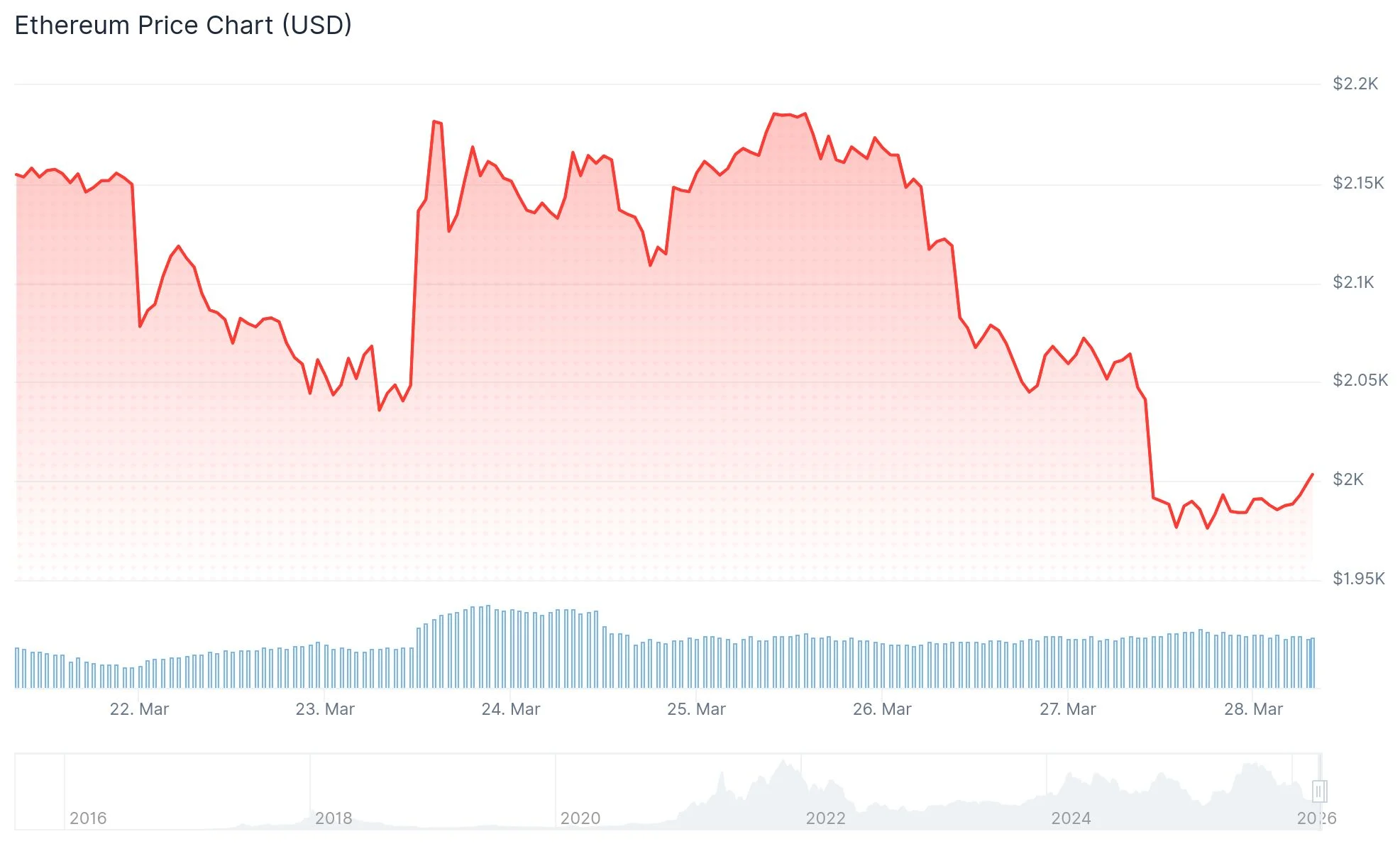
The decline compounded ETH’s weekly losses to 6%, driving monthly performance into negative range.
Geopolitical tensions contributed to the market downturn. Iran’s Islamic Revolutionary Guards Corps delivered warnings to personnel at industrial facilities across Israel and Gulf nations regarding an impending retaliatory operation. These developments followed coordinated US and Israeli strikes targeting Iranian industrial infrastructure, amplifying risk-off sentiment across financial markets.
Institutional appetite for Ethereum has evaporated rapidly. Spot Ethereum ETFs witnessed an unbroken seven-day stretch of net withdrawals, accumulating approximately $392 million in outflows. The institutional capital that previously supported price appreciation has vanished.
Market analyst Ted Pillows shared on X that ETH ETF redemptions hit $92.5 million in one trading session alone, with BlackRock accounting for $43.2 million in Ethereum sales.
Retail participation has similarly weakened. The Coinbase Premium Index descended deeper into negative territory, indicating American traders are either liquidating positions or remaining inactive.
Research from Capriole Investments reveals that observable demand for ETH has remained negative throughout March, plummeting to its lowest reading in 16 months.
Chart Analysis Suggests Further Downside
On the daily timeframe, ETH is positioned beneath its 20-day exponential moving average. The 50-day and 100-day EMAs remain elevated at $2,180 and $2,430 respectively, confirming the prevailing trend is corrective.
Market analyst CryptoWZRD observed that closing below $2,200 earlier this week served as an initial alert before “additional declines.” With both $2,100 and $2,000 levels now compromised, attention shifts to the $1,750–$1,850 zone.
Analyst CyrilXBT published a chart illustrating ETH trading significantly below its 200-day EMA near $2,766. He cautioned that a breakdown beneath the $1,750 floor could drive ETH toward the $1,400–$1,500 region.
On-Chain Metrics Present Mixed Signals
One divergent indicator involves exchange holdings. CryptoQuant data highlighted by analyst James Easton shows Ethereum balances on centralized exchanges have contracted from over 22 million in 2023 to roughly 15 million ETH. Easton characterized large holders as “stacking and staking.”
Nevertheless, declining exchange balances independently do not guarantee price reversal. The metric demonstrates coins exiting platforms but fails to validate actual accumulation behavior.
Regarding institutional accumulation, BitMine Immersion wallets acquired 117,111 ETH across a three-day window, according to Lookonchain. The entity had previously disclosed a separate purchase of 65,341 ETH.
ETH open interest climbed to 14.72 million ETH, despite funding rates shifting negative.
The nearest support level rests at $1,911, with secondary support at $1,741. A decisive move below $1,741 would validate continuation of the existing bearish trajectory.
Key Highlights
- Morgan Stanley’s proposed spot Bitcoin ETF (MSBT) features a 0.14% management fee, establishing a new low benchmark for US-listed Bitcoin funds
- The pricing strategically beats Grayscile’s Bitcoin Mini Trust (0.15%) and significantly undercuts BlackRock’s iShares Bitcoin Trust (0.25%)
- Morgan Stanley’s extensive network of approximately 16,000 financial advisors oversees $6.2 trillion, creating substantial distribution capabilities for MSBT
- Regulatory approval would mark a historic milestone, making Morgan Stanley the first traditional Wall Street bank to offer a spot Bitcoin ETF
- Industry analysts from Bloomberg project a potential launch window as soon as April 2026
Wall Street powerhouse Morgan Stanley has submitted regulatory documentation to introduce a spot Bitcoin exchange-traded fund carrying an exceptionally competitive 0.14% annual fee structure, positioning it as the most affordable Bitcoin ETF available to American investors upon approval.
The fee structure appeared in an updated S-1 registration statement filed with the Securities and Exchange Commission late Friday. This pricing sits just one basis point beneath Grayscale’s Bitcoin Mini Trust, which previously held the distinction of offering the market’s most economical option at 0.15%.
By comparison, BlackRock’s iShares Bitcoin Trust—currently commanding the largest asset base among Bitcoin ETFs—imposes a 0.25% annual fee. Morgan Stanley’s proposed offering creates an 11 basis point advantage over this category leader.
James Seyffart, a Bloomberg ETF analyst, characterized the pricing strategy as a “big move,” projecting that the fund is “likely to launch in early April.”
The investment vehicle will operate under the name Morgan Stanley Bitcoin Trust, designated by the ticker MSBT. The New York Stock Exchange has already published a listing notification for the product, suggesting that trading operations could commence rapidly following regulatory clearance.
For cryptocurrency custody responsibilities, Morgan Stanley has designated Coinbase alongside Bank of New York Mellon to safeguard the fund’s Bitcoin holdings.
The Strategic Importance of Fee Compression
Spot Bitcoin ETFs function on a fundamentally similar basis—they acquire and hold Bitcoin while mirroring its market valuation. This operational similarity elevates the management fee to a primary differentiating factor among competing offerings.
Financial professionals can seamlessly transition client positions from higher-cost products to more economical alternatives through straightforward transactions, maintaining identical market exposure. This dynamic intensifies fee-based competition throughout the sector.
Eric Balchunas, another Bloomberg ETF specialist, highlighted that Morgan Stanley’s extensive advisor workforce of approximately 16,000 professionals manages an impressive $6.2 trillion in client wealth. He emphasized that the competitive fee structure eliminates potential conflicts when advisors recommend the product to their clients.
This distribution infrastructure represents a critical competitive advantage. Even modest portfolio adjustments across this vast advisor ecosystem could channel billions of dollars into the newly launched fund.
Grayscale’s original Bitcoin Trust commanded roughly $29 billion in assets when spot Bitcoin ETFs debuted in January 2024. Current holdings have contracted to approximately $10 billion, with fee-related redemptions contributing significantly to this decline.
Morgan Stanley’s Expanding Digital Asset Strategy
The financial institution submitted its spot Bitcoin ETF application in early January 2026, coinciding with a separate filing for a Solana-based ETF. Within the same week, the bank expanded its digital asset ambitions by filing for a staked Ether ETF.
February saw Morgan Stanley pursue a national trust banking charter, enabling the institution to provide digital asset custody services and staking capabilities for institutional and individual clients.
To spearhead its cryptocurrency initiatives, Morgan Stanley elevated Amy Oldenburg—a veteran executive with extensive tenure at the firm—to direct its digital assets division in January.
Prior to this institutional expansion, the bank had established cryptocurrency allocation guidelines recommending 2% to 4% portfolio exposure and authorized its advisors to incorporate crypto investment products within retirement account strategies.
The aggregate US spot Bitcoin ETF marketplace has reached approximately $83 billion in total assets. Morgan Stanley’s entrance at an unprecedented fee level intensifies competitive dynamics for every established fund operating in this rapidly evolving sector.

Wesley Treat Laser-Welded a Giant Aluminum Head of Himself

Shia LaBeouf Spotted Looking Cozy With Girlfriend Days After Heated Incident

Itauma vs Franklin: Fight time, undercard, prediction, ring walks and odds tonight


-
 NewsBeat3 days ago
Manchester United reach agreement with Casemiro over contract clause amid transfer speculation
-

 News Videos2 days ago
Parliament publishes latest register of MPs’ financial interests
-

 Crypto World6 days ago
Best Crypto to Buy Now: Strategy Just Spent $1.57 Billion on Bitcoin During Fear While Early Investors Quietly Enter Pepeto for 150x Potential
-

 Crypto World6 days ago
Bitcoin Price News: Bhutan Sells $72 Million in BTC Under Fiscal Pressure, but the Smart Money Entering Pepeto Sees What the Market Does Not
-

 Sports5 days ago
Remo Stars and Kano Pillars Strengthen Survival Hopes in NPFL
-

 Sports5 days ago
Gary Kirsten Accuses Pakistan Cricket Board Of ‘Interference’, Mohsin Naqvi Responds
-

 Business6 days ago
No Winner in March 21 Drawing as Prize Rolls to $133 Million for Next
-

 Tech6 days ago
Give Your Phone a Huge (and Free) Upgrade by Switching to Another Keyboard
-

 Tech5 days ago
AI enters the chat: New Seattle dating app relies on tech to facilitate meaningful human connections
-

 News Videos5 days ago
Ch 9 Financial Management Part 1 | Detailed One Shot | Class 12 Business Studies Boards 2026
-

 Tech6 days ago
Today’s NYT Connections Hints, Answers for March 22 #1015
-

 Business2 days ago
Instagram, YouTube Found Responsible for Teen’s Mental Health Struggle in Historic Ruling
-

 Business6 days ago
Will Duke Basketball Win It All? Duke Basketball Enters Second Round as Third Favorite to Claim NCAA Title
-

 Sports5 days ago
2026 Kentucky Derby horses, odds, futures, preview, date: Expert who hit 12 Derby-Oaks Doubles enters picks
-

 NewsBeat11 hours ago
The Story hosts event on Durham’s historic registers
-
 NewsBeat6 days ago
Update on Wisbech river crash as search for teenage boy enters fifth day
-
 Entertainment5 days ago
Cynthia Bailey Dishes on ‘RHOA’ Season 17, Discusses Kandi
-

 Tech6 days ago
SteamOS update adds support for Steam Machine and other non-Valve hardware
-

 Tech5 days ago
Samsung will soon let you control smart home devices from your car’s dashboard
-

 Business4 days ago
More women enter wealth management, but few in advisory roles: study
You must be logged in to post a comment Login