

Crypto World
Samsung Electronics Plunges Nearly 8% Following Apple’s Pricing Announcement


Key Takeaways
- Samsung Electronics shares plummeted 7.8% to ₩330,500 Friday amid a broad technology sector selloff across Korean exchanges
- Investor sentiment deteriorated after Apple revealed price hikes for MacBook and iPad products, casting doubt on AI hardware demand
- Amplified losses occurred through leveraged single-stock ETFs focused on Samsung and SK Hynix
- The KOSPI index tumbled over 8%, activating its fifth circuit breaker halt in 2026
- Reports emerged of Samsung preparing a ₩1,000 trillion ($646 billion) decade-long investment strategy covering chips, AI infrastructure, and more
Samsung Electronics shares collapsed 7.8% to close at ₩330,500 Friday, compounding a devastating week that witnessed a single-day decline exceeding 12% just two days earlier on June 23.
Samsung Electronics Co., Ltd., SMSD.L
The Monday session’s plunge activated the KOSPI’s fourth trading halt of 2026. Friday’s action brought a fifth suspension, with the Korea Exchange implementing a 20-minute freeze beginning around 12:10 p.m. Seoul time as the main index crashed through the 8% decline threshold.
The catalyst for Friday’s turmoil originated from Apple, which revealed significant price increases spanning its MacBook and iPad product portfolios, citing elevated memory and component expenses. The announcement shattered confidence among investors banking on a prolonged AI-fueled hardware expansion cycle.
Chip manufacturers worldwide absorbed heavy losses. SK Hynix, Samsung’s primary domestic competitor, suffered a parallel decline exceeding 8%, while leveraged ETFs tracking both semiconductor leaders plunged beyond 15%.
Leveraged Products Intensified Selling Pressure
Single-stock leveraged exchange-traded funds concentrated on Samsung and SK Hynix have emerged as a mounting worry for South Korean financial authorities. Friday’s session validated those concerns as these instruments amplified market movements far beyond what underlying business fundamentals would typically justify.
The outcome generated a self-reinforcing cycle of liquidation that punished Samsung more severely than headline developments alone warranted.
Japan’s Nikkei 225 index similarly declined in response, demonstrating the velocity at which the selloff propagated throughout the region.
Following a substantial rally during the previous twelve months, Friday’s decline partially reflects profit-taking behavior after an impressive advance. Market reversals can accelerate dramatically when investor psychology shifts.
Massive $646 Billion Capital Plan Sparks Investor Anxiety
The timing proved particularly unfortunate. Domestic media outlets disclosed this week that Samsung intends to unveil a ₩1,000 trillion ($646 billion) investment blueprint spanning the next ten years — potentially representing the largest corporate capital commitment in South Korean corporate history.
The initiative reportedly encompasses semiconductor manufacturing facilities, AI data infrastructure, battery production, and display technology. Approximately ₩300 trillion targets chip fabrication plants in the nation’s southwestern region, while more than ₩350 trillion focuses on AI data centre development.
South Korean President Lee Jae Myung plans to convene a national economic presentation on June 29, where Samsung Vice Chairman Jun Young-hyun and SK Hynix CEO Kwak Noh-jung will both outline their respective investment strategies.
Rather than embracing the announcement enthusiastically, certain investors interpreted the enormous spending obligation as problematic. Committing hundreds of trillions of won toward infrastructure development during uncertain chip demand conditions represents considerable risk exposure.
SK Hynix independently disclosed intentions to secure up to $29.4 billion through a Nasdaq listing of American Depositary Receipts, channeling proceeds toward expanded fabrication plants, advanced packaging operations, and manufacturing equipment.
Both declarations arrive as South Korea endeavors to maintain competitive positioning in the worldwide AI and semiconductor landscape amid escalating competition from the United States and China.
SK Hynix shares traded down 8.36% at press time, while Samsung recovered slightly to ₩339,500 after trimming earlier losses.


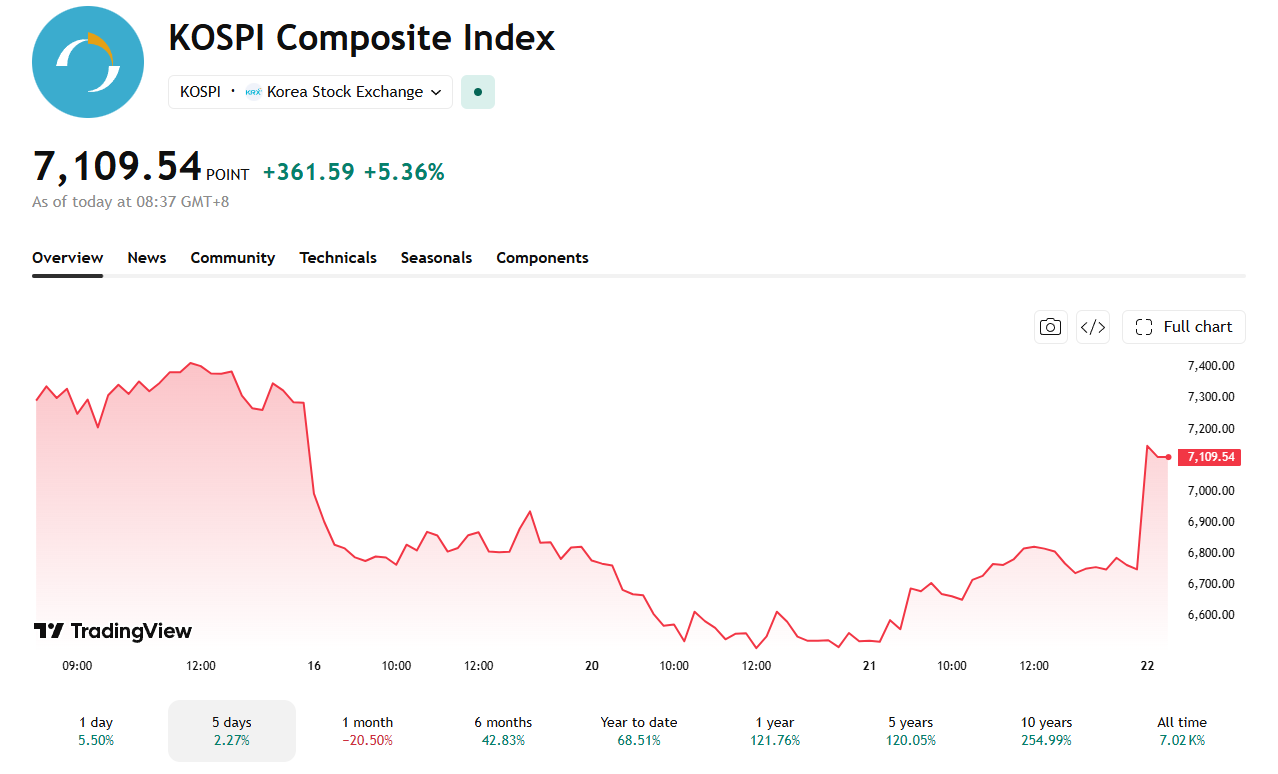
South Korea’s Kospi surged over 5% to a high of 7,164 on Wednesday’s early trading, extending its rebound from an artificial intelligence stock selloff. Asian chipmakers led the gains for a second straight session.
Japan’s Nikkei 225 added near 2% to 67,524.22, also in early trading. The rally builds on Tuesday’s rebound across Asian markets.
Samsung, SK Hynix Lead the Recovery
The gains extend July 21’s rebound, when the Kospi jumped 3.6% and the Nikkei rose 3% after a number of days trending downwards. Chipmakers are looking to pull the Kospi back from a bear market slide that AI valuation fears caused earlier this month.
Samsung Electronics surged reversed its downward trend on Tuesday while SK Hynix, the memory chipmaker, gained also started gaining, recovering from its sharp sidecar plunge earlier this month.

The Kospi is still down more than 20% over the past month, even after gaining over 50% year-to-date. Investors had locked in profits on AI bubble concerns.
Wall Street Also Jumps at Semiconductors
Wall Street added its own momentum on Tuesday. The Nasdaq 100 posted its best session in three weeks, and a key semiconductor gauge jumped 5.2%, according to Bloomberg.
Analysts remain split on whether the bounce will last.
“The recent correction appears more consistent with a healthy reset following a parabolic advance than a fundamental breakdown in the AI investment theme.”
Adam Turnquist, LPL Financial
Nearly 20% of S&P 500 companies by market value report earnings this week. Alphabet and Tesla release results Wednesday. Those results will test whether the chip rally can hold.
The post Kospi Jumps 5% as Asian Chipmakers Rebound From AI Selloff appeared first on BeInCrypto.


S&P Dow Jones Indices and Pantera Capital have launched the S&P Pantera Digital Asset Index, a new crypto benchmark that excludes Bitcoin (BTC) entirely.
CEO Cathy Clay said Bitcoin fails the index’s core test, generating real protocol revenue instead of trading purely on speculation.
How the Index Weighs Its Tokens
The index holds 18 constituents. Its five largest holdings are Ether (ETH), Binance Coin (BNB), Solana (SOL), Tron (TRX), and Hyperliquid (HYPE), a decentralized derivatives exchange.
The benchmark weights holdings by market capitalization and rebalances quarterly. No single token can exceed 35% of the total, and no other holding can top 20%. These caps mirror rules S&P applies to its own equity benchmarks.
Clay wants to bring stock-index discipline into digital assets. She favors protocols with verifiable economic activity over ones that trade on name recognition alone.
Pantera co-developed the methodology with founder Dan Morehead. The firm has managed over $3 billion across three investment strategies since launching its first crypto fund in 2013.
“S&P Dow Jones Indices helps investors cut through market noise with benchmarks you can trust.”
Clay, CEO of S&P Dow Jones Indices
Wall Street Warms to Altcoin Season
The exclusion highlights a widening split in how institutions define crypto value. By this measure, revenue beats Bitcoin’s dominant narrative as the market’s largest asset. Pantera’s history with institutional crypto access suggests more revenue-screened benchmarks could follow.
The launch lands as retail altcoin season signals stay unconfirmed but improving. CoinGlass’s Altcoin Season Index climbed to 58 in mid-July, building on a June 4 spike to 64. That reading sits above the neutral midpoint, but it remains short of the 75 threshold that confirms genuine rotation.
Institutional flows tell a parallel story. A March BeInCrypto Expert Council discussion found major allocators narrowing institutional crypto bets to Bitcoin, Ethereum, and a short list of DeFi names.
A revenue-screened benchmark like the S&P Pantera Digital Asset Index offers portfolio managers a compliant route into that same thesis. It provides exposure to large-cap altcoins with real usage, skipping meme coins and speculative networks entirely.
If other index providers copy the approach, institutional capital could rotate into select altcoins early. That could happen well before retail-driven altcoin season data confirms a broader move.
The post S&P Dow Jones New Crypto Index Snubs Bitcoin, Not a Revenue-Generating Protocol appeared first on BeInCrypto.
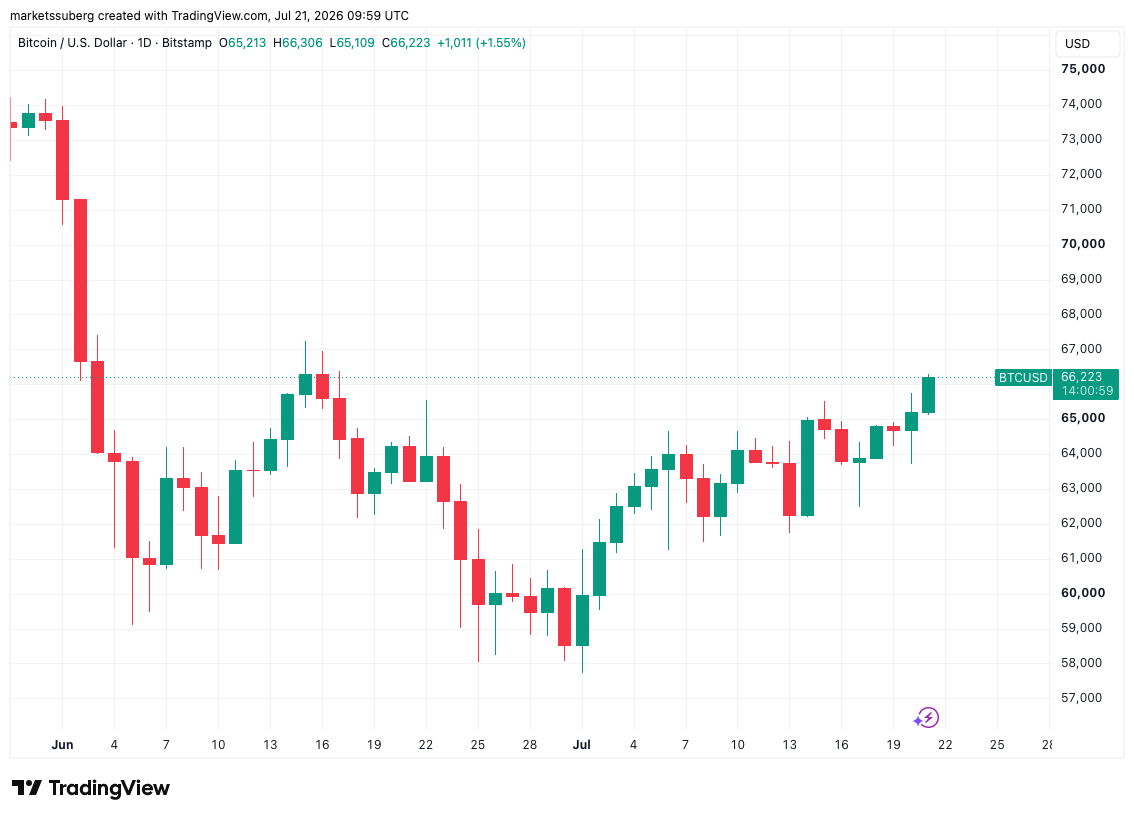
Bitcoin (BTC) passed one-month highs on Tuesday as price action defied the odds to top $66,000.
Key points:
- Bitcoin broke through resistance to hit $66,000 for the first time in more than a month.
- Traders see as much as 6% BTC price gains if further nearby upside targets are reached.
- Month-end derivatives positioning underscores crypto risk confidence slowly returning.
BTC price 6% upside could come “very quickly”: Trader
BTC/USD hit highs of $66,306 on Bitstamp, according to TradingView data. That’s a level last seen on June 17.
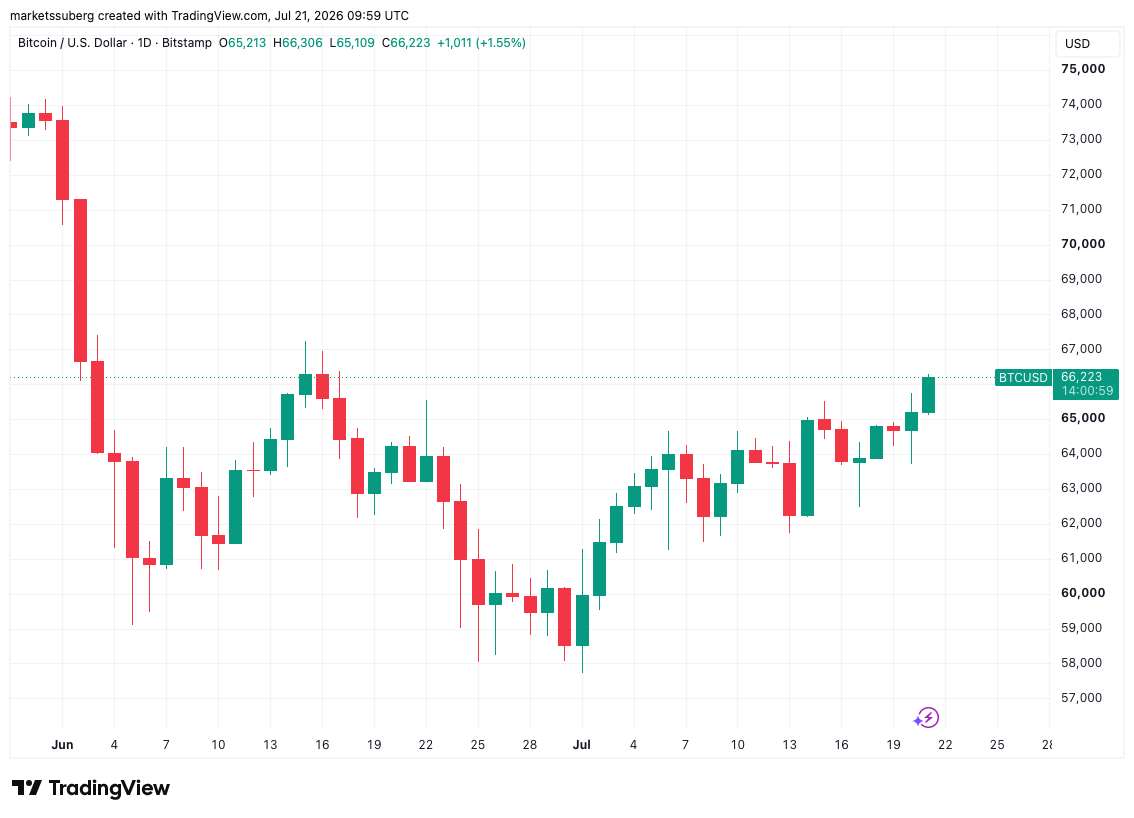
BTC/USD one-hour chart. Source: Cointelegraph/TradingView
A series of rejections around the $65,000 mark had failed to quash traders’ enthusiasm, with calls for $67,000 or higher gaining momentum. Those short-term predictions continued on the day, with key psychological levels around $70,000 now on the horizon.
“$BTC reclaimed the range lows, and is now pushing higher – as expected,” trader Jelle wrote in his latest analysis on X.
“The area between 65 and 67k is resistance from the Q1 range, but given how we sliced through it on the way down – it might not put much of a fight up here either. Eyes on those 70k range highs if so.”
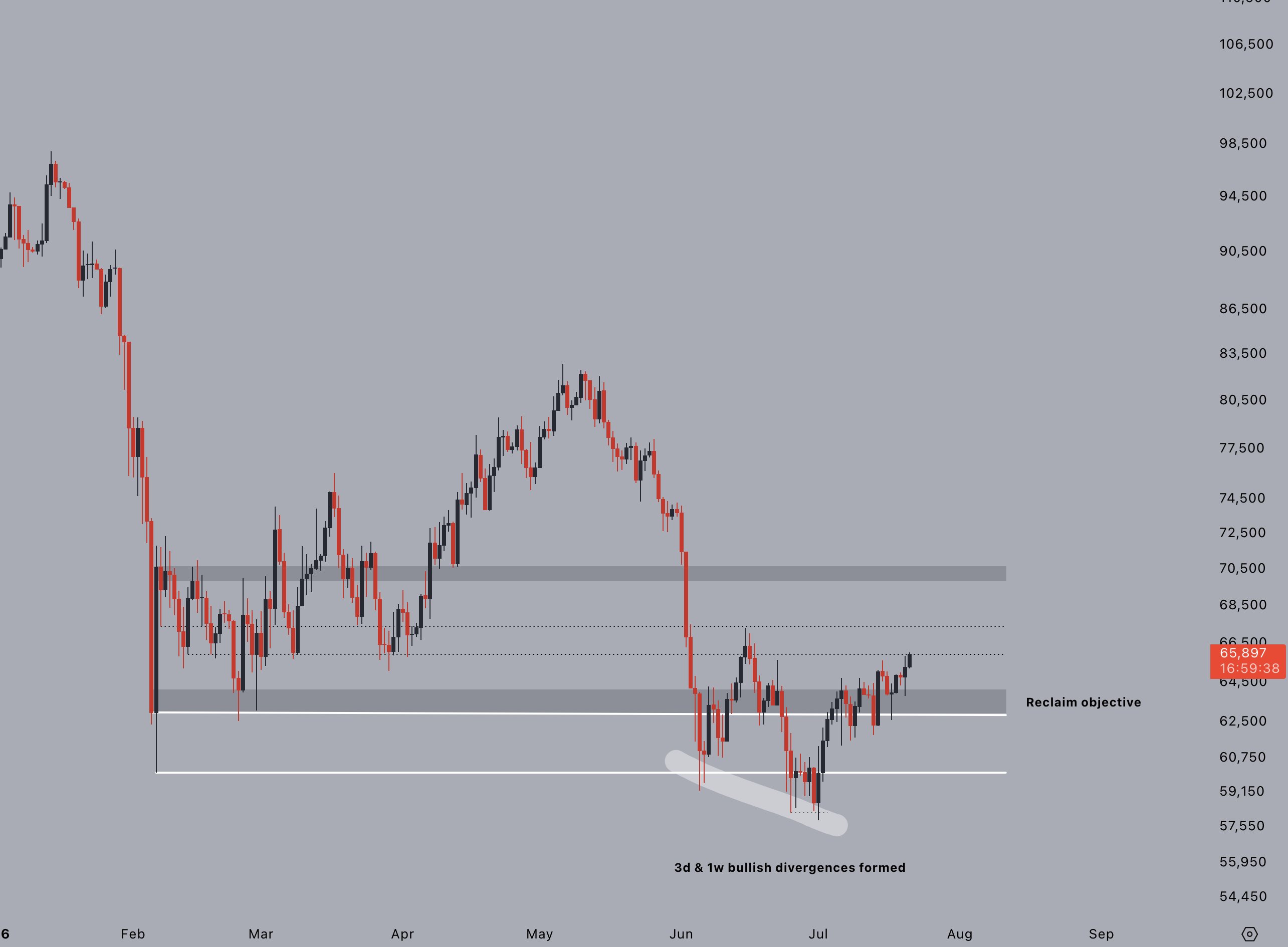
BTC/USD one-day chart. Source: Jelle/X
Short liquidations began to mount as the BTC price broke through range highs, with data from CoinGlass putting 24-hour cross-crypto liquidations at around $200 million.
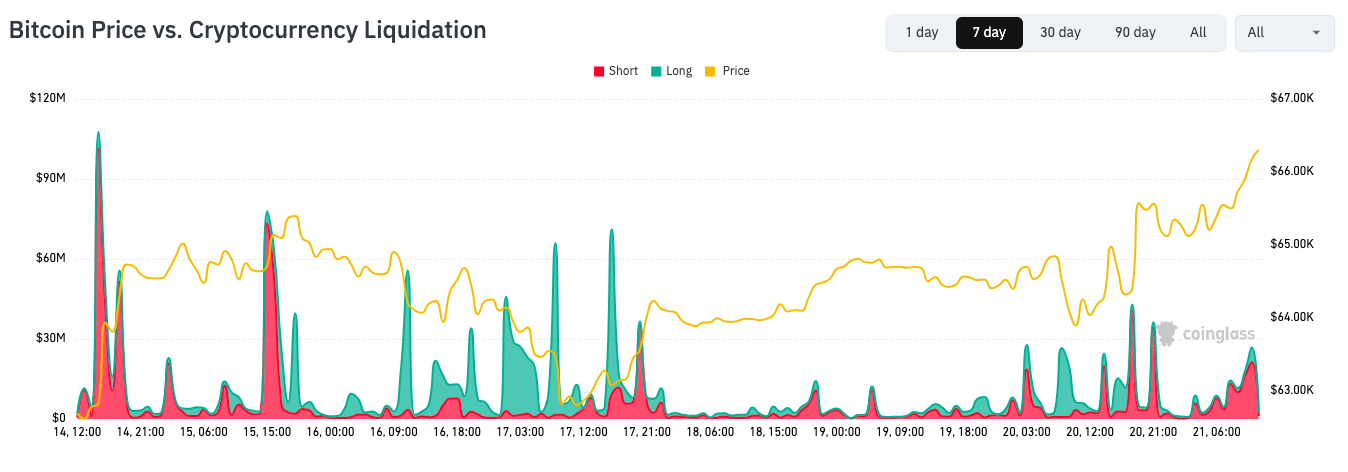
BTC/USD vs. crypto liquidations (screenshot). Source: CoinGlass
“$BTC has reclaimed the $65,000 level. The next key resistance is $67,500-$68,000, which means Bitcoin has some room to pump,” trader Ted Pillows said.
“If BTC manages to reclaim the $68,000 resistance too, it could rally another 5%-6% very quickly.”
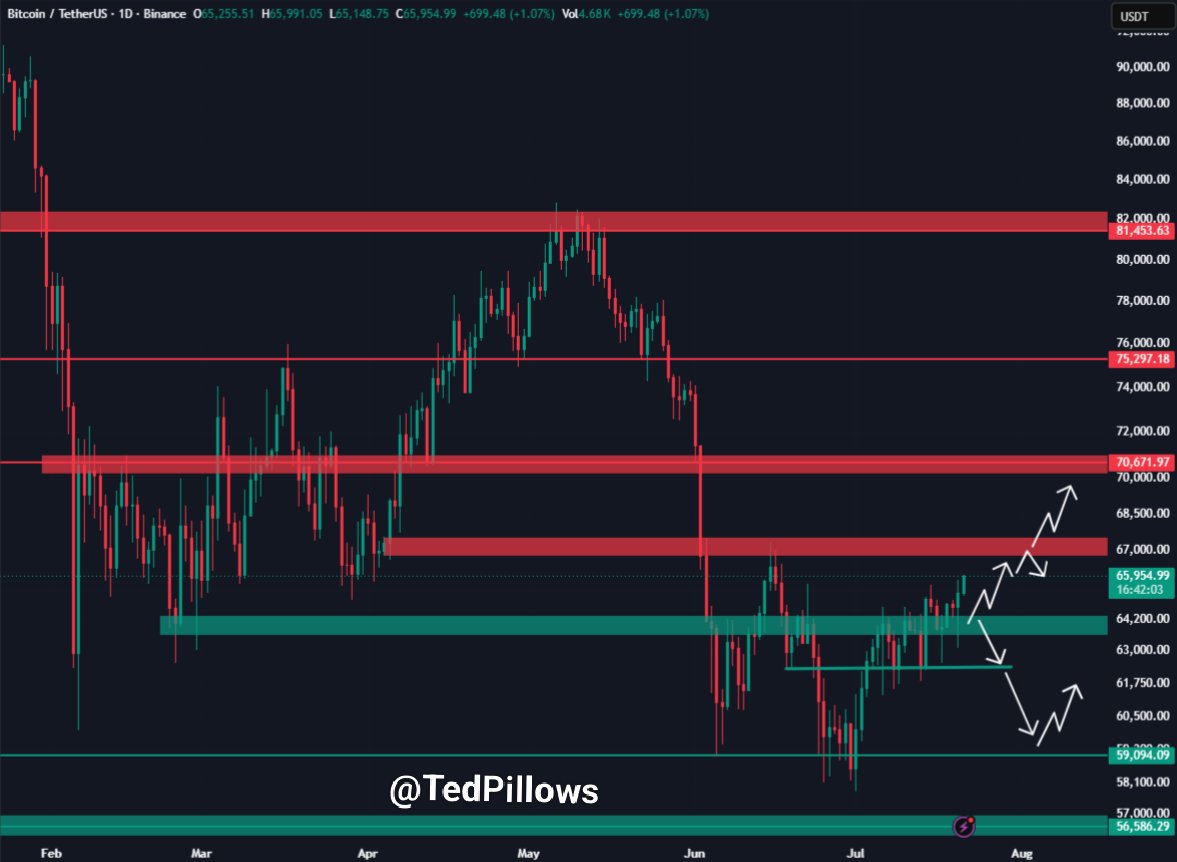
BTC/USDT one-day chart. Source: Ted Pillows/X
Concerns had accompanied the start of the latest move, with commentator Exitpump seeing closing short positions fueling the upside.
“There’s very little real buying interest here,” they warned X followers while analyzing derivatives markets.
BTC derivatives hint at risk-on return
Observing options trends, trading company and market maker QCP Capital flagged “some demand” for higher Bitcoin bets into the end of July.
Related: Trader maintains $67K BTC price target: Five things to know in Bitcoin this week
Here, it noted the US Federal Reserve would hold its next meeting on interest-rate changes, with chair Kevin Warsh potentially offering fresh insight into future policy.
As Cointelegraph reported, market expectations remain that the Fed will leave rates unaltered before September. CME Group’s FedWatch Tool shows 83.4% probability that policy makers will stick with the current target range of 3.50-3.75% at their July 29 meeting. For the Sept. 16 FOMC meeting, there’s a 53.8% probability of a hike to 3.75-4.00%.
“There has been some demand for month-end BTC upside,” Monday’s QCP Market Colour analysis said.
“This positioning leaves dealers short upside gamma into the 28 to 29 July FOMC meeting, increasing the potential for an accelerated move higher should tensions around the Strait of Hormuz ease.”
QCP referred to the US-Iran war once again closing a key global oil route.

Russia’s State Duma has completed the final readings that bring the country’s long-awaited crypto regulatory bill one step closer to becoming law, approving draft legislation that would create a comprehensive framework for digital assets and define how regulated intermediaries can operate.
According to official parliamentary records, lawmakers approved bill No. 1194918-8, titled “On Digital Currency and Digital Rights,” in its second and third readings on Tuesday. The measure is now set to move to Russia’s upper house, the Federation Council, and then to President Vladimir Putin for signature before it can take effect.
Key takeaways
- The bill would establish rules for a regulated crypto market, including exchanges, brokers, asset managers, and custodians.
- The Bank of Russia would be given wide authority to supervise the framework and decide which crypto assets can be offered via licensed intermediaries.
- Crypto use for payments inside Russia would remain prohibited, while the bill allows digital assets to be used in foreign trade operations.
- Non-qualified investors would face purchase and cross-border transfer limits, with higher thresholds for qualified investors.
- If enacted, most provisions would begin on Sept. 1, 2026, with a compliance transition period lasting until July 1, 2027.
Bank of Russia oversight takes center stage
A central feature of the proposed framework is the role assigned to the Bank of Russia. Under the bill, the central bank would oversee the regulated market, including the power to determine which crypto assets are eligible to be offered through licensed intermediaries and to publish implementing regulations.
The bill also lays out five categories of participants that would operate within the new rules: crypto exchanges, brokers, asset managers, custodians, and exchange service providers. By defining who can buy, sell, hold, and exchange crypto assets, lawmakers aim to formalize the market structure and reduce reliance on informal or unlicensed activity.
For investors, the bill differentiates between “qualified” and “non-qualified” participants. Non-qualified investors would be subject to an annual ceiling of 300,000 rubles (about $3,800) on purchases made through a single intermediary, and a 100,000-ruble annual limit on transfers abroad. Qualified investors would have annual purchase limits of 3 million rubles and annual cross-border transfer limits of 1 million rubles.
Payments at home remain blocked, cross-border use allowed
While the bill expands the legal perimeter around crypto markets, it also preserves a key restriction: it would continue to ban the use of crypto assets to pay for goods and services within Russia.
At the same time, lawmakers chose to make room for digital assets in international commerce. The legislation would allow crypto assets to be used in foreign trade operations, aligning with Russia’s broader push to facilitate cross-border settlement alternatives outside conventional payment rails.
Timeline: broad provisions from September 2026, transition through 2027
Most of the bill’s provisions are scheduled to take effect on Sept. 1, 2026, contingent on presidential approval. A transition period runs through July 1, 2027, designed to give market participants time to adapt to the new compliance requirements.
After the transition window closes, the bill indicates that crypto transactions would need to be executed through regulated organizations. It also states that banks would have to reject transactions that do not comply with the framework laid out in the law.
Russia’s legislative push does not stop at market rules. Lawmakers are also drafting related measures, including proposals on taxation and penalties for violations. A separate tax bill has already passed its first reading, while expectations are that penalty provisions would be considered before the transition period ends.
Industry activity appears to be moving alongside the policy work. Earlier coverage from Cointelegraph noted developments involving Russia’s banking sector, including Alfa-Bank testing crypto trading.
Legal framework is not the finish line
Even if the bill becomes law, implementation would still depend heavily on the regulatory follow-through and supporting infrastructure. Olga Goncharova, head of the Digital Financial Assets and Digital Currencies Expert Center at the Association of Russian Banks, told Cointelegraph that the measure creates a legal foundation but requires “extensive follow-up regulation” before the market can function smoothly.
“The law itself is only the beginning,” Goncharova said, adding that practical effectiveness depends on mechanisms that are still being developed by the banking community together with the Bank of Russia.
According to Goncharova, the central bank plans to issue around 80 additional regulatory acts by the end of the year. These would be intended to specify how the framework operates in practice, particularly around compliance expectations for institutions and market participants.
She also pointed to work on operational infrastructure needed for a regulated environment, including development of a domestic Travel Rule system, blockchain node infrastructure, and crypto analytics tools. These elements would be important for monitoring transactions, reporting, and ensuring that regulated intermediaries can meet the requirements that come with licensing and oversight.
The broader regulatory trajectory will also need to align with licensing and supervisory expectations for custody services. Earlier Cointelegraph reporting referenced that custodians face scrutiny even under the EU’s MiCA regime, underscoring that custody regulation is typically a key test case for any emerging framework.
With the State Duma’s approval now secured, the next critical moment is whether the Federation Council and President Vladimir Putin sign the bill. Investors and market participants should watch closely for the Bank of Russia’s forthcoming regulatory acts—especially details on asset eligibility, licensing requirements, and how banks will operationalize the transaction rejection rules once the transition period ends.


Ionic Digital has secured SEC approval for its registration statement, clearing the final regulatory hurdle before its planned Nasdaq direct listing on July 28.
Summary
- Ionic Digital has cleared its final SEC regulatory hurdle ahead of its planned Nasdaq direct listing on July 28.
- Existing shareholders, including former Celsius creditors, will be able to sell their shares as Ionic lists under the ticker IOND.
- The company continues building its AI and high performance computing business alongside its Bitcoin mining operations.
According to a company statement issued Monday, the digital infrastructure operator expects its Class A common stock to begin trading on the Nasdaq Global Select Market under the ticker IOND, subject to Nasdaq’s final listing requirements.
The company is entering public markets through a direct listing instead of a traditional initial public offering. Under that structure, Ionic will not issue new shares or raise fresh capital from the transaction. Existing registered shareholders will instead be able to sell their holdings on the public market once trading begins.
For many investors, the listing represents the first opportunity to trade shares received through the bankruptcy restructuring of crypto lender Celsius Network. Ionic Digital was created in January 2024 to hold Bitcoin mining assets transferred from the Celsius estate after a U.S. bankruptcy court approved the lender’s restructuring plan.
Former Celsius creditors became shareholders after receiving about 37 million Class A shares under the bankruptcy plan. As previously reported by crypto.news, Celsius later continued distributing funds through additional payout rounds, while some creditors also became eligible to receive equity in Ionic Digital.
Unlike a conventional IPO, a direct listing does not involve underwriters setting an offering price. Instead, Nasdaq determines the opening price using buy and sell orders collected before trading begins. Ionic also stated in earlier SEC filings that direct listings can experience higher price volatility because existing shareholders gain a public venue to sell shares without the price stabilization mechanisms commonly associated with underwritten offerings.
Ionic expands beyond Bitcoin mining
Although Ionic began as a Bitcoin mining company, it has increasingly repositioned itself around digital infrastructure supporting artificial intelligence and high-performance computing workloads.
Earlier this month, the company filed its Form S-1 registration statement with the SEC. Before pursuing the listing, Ionic completed a roughly $400 million private equity financing that the company said would fund general corporate purposes, including continued investment in digital infrastructure and data center development.
According to earlier SEC filings, the financing implied a pre-money equity valuation of approximately $2 billion. CEO Andy Stewart previously said the funding strengthened the company’s capital base as it continued building its digital infrastructure platform.
The company’s strategy now extends well beyond cryptocurrency mining. Its Cedarvale campus in Ward County, Texas, has become the centerpiece of that transition after portions of the site were repurposed to support AI and high-performance computing infrastructure.
Earlier company disclosures said the Ward County property includes approximately 234 megawatts of installed capacity. Mining equipment at the site was decommissioned during late 2025 as Ionic prepared the facility for AI infrastructure under a long-term agreement with AI cloud provider Nscale.
According to previous company filings, the lease spans 126 months and is expected to generate about $1.95 billion in contracted revenue, with additional expansion possible if further capacity receives regulatory approval.
During the first quarter of 2026, Ionic reported $44 million in digital infrastructure leasing revenue, while Bitcoin mining revenue declined 82% year over year to $7.4 million from $41.1 million.
The company has also stated that revenue from AI and other high-performance computing services is eventually expected to exceed revenue generated through Bitcoin mining.
Mining companies are transitioning to AI
Ionic’s repositioning comes as several publicly traded Bitcoin miners invest more heavily in AI-focused data centers while mining profitability remains under pressure.
As previously reported by crypto.news, Bitcoin miners generated about $1.086 billion in revenue during May, the strongest monthly performance since January. However, lower Bitcoin prices later reduced mining profitability as hashprice declined and network hashrate eased, prompting some operators to scale back less efficient mining equipment.
Industry participants have increasingly turned toward AI infrastructure because many mining companies already control large power supplies, cooling systems and data center facilities that can be adapted for high-performance computing workloads.
IREN has followed a similar strategy. Earlier this year, the company completed its acquisition of Spain-based Nostrum Group, adding roughly 490 megawatts of secured grid-connected power to support European AI cloud expansion. IREN also reported that AI cloud revenue increased during its latest quarter even as Bitcoin mining revenue declined.
HIVE Digital and Bitdeer have also announced projects converting existing mining facilities into AI computing infrastructure, further illustrating how miners are seeking additional revenue streams beyond cryptocurrency production.
For Ionic, however, the upcoming Nasdaq debut represents more than another mining company entering public markets.
It also provides former Celsius creditors with a long-awaited opportunity to trade shares received through one of the cryptocurrency industry’s largest bankruptcy restructurings while giving investors a chance to evaluate a business increasingly focused on AI infrastructure rather than Bitcoin mining alone.


Sen. Cynthia Lummis said Tuesday she will introduce CLARITY Act bill text "in the next few days," marking the latest step in the Senate's push to pass a crypto market structure law before its August recess. "We've been working on the Clarity Act every day for 10 months, and we'll introduce bill… Read the full story at The Defiant

US lawmakers used a House Agriculture Subcommittee hearing this week to press the Commodity Futures Trading Commission (CFTC) on oversight of sports event prediction market platforms—while also pointing to a pending Senate effort, the Digital Asset Market Clarity (CLARITY) Act, as a potential source of clearer authority and funding.
At the hearing titled “Examining Customer Protections and Market Integrity in Sports Event Prediction Markets,” Carl Kennedy, a partner at law firm Katten Muchin Rosenman, argued that the CFTC may be unable to fully regulate and enforce rules for rapidly expanding prediction markets, citing staffing constraints. Kennedy said the CLARITY Act could expand the agency’s jurisdiction beyond digital assets and help it address the “explosive growth” of prediction markets.
Key takeaways
- Carl Kennedy told the House Agriculture Subcommittee that the CFTC is likely “short-staffed” to effectively oversee prediction market platforms.
- Kennedy said the CLARITY Act could grant the CFTC additional authority covering not only digital assets but also the fast-growing prediction market sector.
- CFTC Chair Michael Selig has argued the agency has “exclusive jurisdiction” over event contracts on major prediction platforms, treating them as “swaps.”
- State regulators have increasingly challenged that federal position, including through lawsuits and court disputes involving platforms such as Kalshi and Polymarket.
- Senate supporters of the CLARITY Act expect the bill text to be released soon, but details on prediction market provisions were not publicly available as of Tuesday.
Why lawmakers are focusing on prediction market oversight
The hearing, chaired around customer protections and market integrity in sports event prediction markets, highlighted how the legal and regulatory question has shifted from whether prediction platforms can operate to who is responsible for regulating them.
Kennedy’s core point was that even if the CFTC has jurisdiction, it may not have the resources to supervise new and complex markets at the pace they are growing. He suggested that an expanded mandate under the CLARITY Act would need to be paired with additional capacity so the agency can handle oversight and enforcement across cash markets and crypto as well as prediction markets.
“With additional resources… to address these new asset classes in the cash markets and crypto… as well as to deal with the explosive growth of prediction markets, I think that the CFTC certainly should receive additional resources,” Kennedy said during the Tuesday hearing.
The subcommittee discussion also reflected that prediction markets—often built on event contracts linked to real-world outcomes—have become a regulatory stress test for existing derivatives rules, especially as platforms attract broader participation.
The CFTC’s “exclusive jurisdiction” position under scrutiny
Legal and regulatory experts at the hearing referenced the CFTC’s approach under Chair Michael Selig, who was confirmed by the Senate in December and is the only Senate-confirmed member heading the commission in a leadership panel that would normally include five commissioners.
Since taking the role, Selig has taken the position that the CFTC has “exclusive jurisdiction” over prediction market companies. The argument is that the event contracts on these platforms fall under the CFTC’s authority because they can be classified as “swaps.”
This stance has drawn criticism—particularly from Democratic senators—who have described it as an “assault” on state authority to regulate prediction markets.
That federal-versus-state tension has produced a growing body of litigation. Some states have pursued lawsuits against platforms including Kalshi and Polymarket over what they see as state-level sports betting concerns.
State court clashes and the path toward the Supreme Court
One recent flashpoint involved a dispute where the CFTC chair’s position came into direct conflict with a state court ruling. Last week, Selig ordered Kalshi to ignore a Michigan court decision, according to prior coverage, with Kalshi arguing that the directive placed it in an “impossible position” between federal and state authorities.
More broadly, experts have suggested that the legal conflict between state regulators and the CFTC could eventually end up before the US Supreme Court. That possibility centers on the same foundational question raised by lawmakers: whether the CFTC’s reading of its jurisdiction leaves room for states to regulate event contracting tied to sports and related forms of wagering.
For market participants, this matters because jurisdiction affects compliance obligations, product design decisions, and the legal risk profile of operating in different states. For consumers, it affects who sets the rules for customer protections and how those rules are enforced—particularly when the platforms operate nationwide.
What the CLARITY Act could change—and what remains unclear
Much of Tuesday’s discussion pointed toward the CLARITY Act as the most significant potential legislative change on the horizon. Republican senators pushing for a vote before August recess have indicated they expect to release the bill’s text soon.
As of Tuesday, details of how the CLARITY Act would address prediction markets, ethics provisions, and other concerns raised by lawyers were not yet public.
However, earlier reporting indicates there is active political pressure to shape the bill’s scope. In June, gambling industry groups petitioned the Senate to add language to CLARITY that would explicitly prohibit event contracts tied to sports and casino-style gaming. Separately, reports cited by earlier coverage said the White House had confirmed that the Trump administration agreed to ethics provisions described as comprehensive, while also accommodating Democrats’ concerns.
That mix—requests for tighter boundaries around wagering-linked event contracts alongside broader ethics requirements—underscores that CLARITY is not only about regulatory authority for digital assets. Kennedy’s remarks at the hearing framed the bill as potentially relevant to prediction markets as a category, particularly in relation to customer protections and market integrity.
For traders, platform operators, and state regulators, the immediate watch item is the CLARITY Act’s released text and how it addresses the core jurisdiction conflict: whether it expands and clarifies federal oversight for event contracts, and whether it limits or displaces state enforcement where prediction markets intersect with sports wagering. Until the bill language is published, the questions raised in court and in Congress—about who regulates, who enforces, and how resources match the scale of these markets—are likely to keep escalating.


Balaji Srinivasan’s Network School, a community of “digital nomads,” is eyeing a new campus in Kazakhstan after its Forest City campus had its business license revoked over alleged premises-use violations.
A memorandum of understanding was signed between Kazakhstan’s Minister of Digital Development, Innovation and Aerospace Industry, Zhaslan Madiyev and Srinivasan to establish the first Network School campus in Kazakhstan, according to a statement from the ministry.
The Kazakhstan agreement gives the Network School a potential new base after its Johor operation was ordered to cease operations effective Wednesday. Kazakhstan has been positioning itself as an emerging technology hub, including plans for Central Asia’s first “crypto city” in Alatau.
“Ironically, this whole drama with Balaji literally validated the network state thesis,” said Dragonfly Capital managing partner Haseeb Qureshi. “The whole idea of a network state is taking a dense group of talent and capital, and collectively negotiating with states. The Malaysia drama set up Balaji to negotiate better terms with another state to copy and paste the network there. “
“Our new campus will become a haven for global techno-optimism, with expedited visas, streamlined redomiciliation, and active recruitment of talent,” Srinivasan said Tuesday.
Network School faces loss of Malaysia Digital status
The new memorandum of understanding with Kazakhstan comes as the Forest City campus faces regulatory action on several fronts.
On Tuesday, the Iskandar Puteri City Council (MBIP) revoked the business license of NSO Malaysia Sdn Bhd, which operates the Network School, alleging the company breached licensing conditions and premises usage requirements.
This led to the Malaysia Digital Economy Corporation (MDEC) announcing it is taking immediate steps to revoke the Malaysia Digital status of NSO Malaysia, which requires companies under the program to follow all local and federal laws.
Malaysia Digital is a recognition awarded to qualified technology and digital companies, providing them with tax incentives, freedom of ownership and allowing the employment of local and foreign workers, among other incentives.
Meanwhile, Onn Hafiz Ghazi, Chief Minister of Johor State, has urged Malaysia’s federal authorities to continue investigating whether the Network School violated immigration laws.
Related: Balaji seeks Malaysia deal, threatens exit after Network School probe
“This matter cannot be taken lightly, especially since Johor is a strategic entry point for the country bordering Singapore. Any weaknesses or abuse of the immigration system must be addressed promptly, firmly, and without compromise,” said Onn.
On Friday, Srinivasan denied reports that the Network School was shutting down, claiming that it had received two notices, with one notice requiring it to “change the text of a sign” and the other regarding a coworking site, created by joining two adjacent units, that had a valid license on one side, not on the other.
“We have a remedial period for both issues, and will remediate them shortly. But our members are otherwise unaffected,” he said.
Cointelegraph reached out to Srinivasan and Network School for comment.
Magazine: Binance & OKX users face $1,900 fines in Vietnam, Coinbase in China? Asia Express


Coinbase began offering a High Yield tier on its USDC lending product paying about 7.02% APY, roughly double the 3.63% APY on its standard Core tier, days after Robinhood Earn launched a competing 7% campaign. Both products route deposits through Morpho, a decentralized lending protocol with $7.11… Read the full story at The Defiant
Traders on Hyperliquid, the onchain exchange that settles the largest share of crypto perpetual futures volume, are trading more money through builder-deployed markets for stocks, commodities and indices than through the platform's native crypto contracts. Those builder markets, deployed under… Read the full story at The Defiant
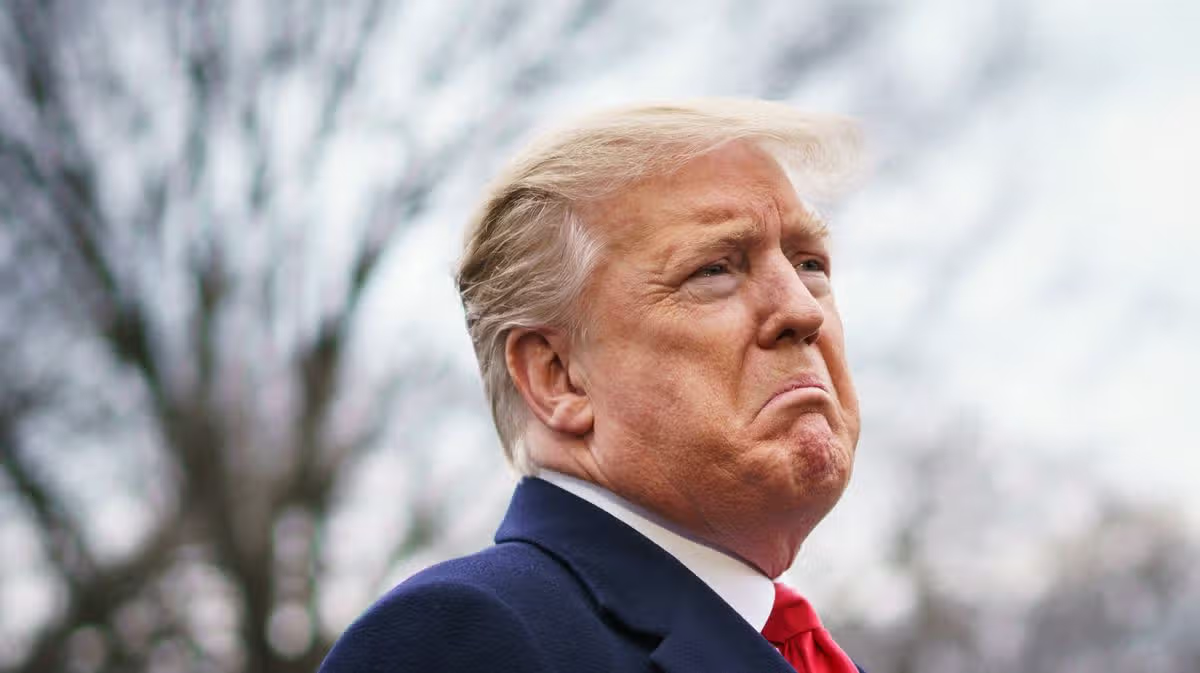
Americans dub Donald Trump ‘dangerous’ and ‘corrupt’ in scathing new survey

What Actually Works (Not Just Luck)

Kospi Jumps 5% as Asian Chipmakers Rebound From AI Selloff


-
 NewsBeat5 days ago
London Mayor Sadiq Khan handed a peerage by Keir Starmer alongside 15 other Labour figures… just days before the PM leaves No10
-

 Fashion4 days ago
Weekend Open Thread – Corporette.com
-

 Politics4 days ago
The House | The City of London can help the new chancellor deliver growth in every postcode
-

 Politics7 days ago
Young campaigners urge incoming PM to act on outdoor junk food ads
-
 Crypto World5 days ago
Two July Windows Left: The CLARITY Act’s Senate Fight and What Failure Means
-

 Crypto World6 days ago
CFTC blocks Kalshi from unwinding Michigan trades after court order
-

 Crypto World4 days ago
Ripple Payments Joins MiCA With 14 Firms, Does It Mean Anything For XRP?
-

 Business6 days ago
Nvidia Stock Slips After Big Tuesday Rally as Huang Confirms Vera Rubin Chip Is Now in Production Today
-

 Politics3 days ago
Democrats look to World Cup watch parties to register thousands of voters
-
 Entertainment6 days ago
Disney’s Most Ambitious Failed Star Wars Attraction Is Coming to SDCC
-

 Crypto World4 days ago
Ripple wins EU-wide access as ESMA adds it to MiCA register
-

 Crypto World18 hours ago
Grayscale Files For Worldcoin ETF, WLD Registers Sharp Rise
-

 Crypto World5 days ago
Injective Submits SEC Transfer-Agent Registration to Onchain Ownership Records
-

 Business6 days ago
Palantir Shares Rise After Expanded Nvidia Partnership and Fresh Analyst Upgrades Ahead of Earnings Day
-

 Tech1 day ago
Sail Virtually Aboard The “Itanic” With IA-64 Emulator
-
 Tech23 hours ago
Turtle Beach Command Series KB7 review: a nifty screen-equipped gaming keyboard
-

 NewsBeat5 days ago
Registration is now open for March for Men with Kev 2026
-

 NewsBeat2 days ago
Unregistered fitter used Gas Safe logo on business flyers
-
 Sports6 days ago
New Cornerback Enters Vikings Trade Rumor Mill
-

 News Videos5 days ago
Money | Class 12 Economics | CBSE Board Exam 2026-27
You must be logged in to post a comment Login